Showing posts with label u.s. army. Show all posts

Monday, June 29, 2026

June 29, 1776: The Presidio of San Francisco

The calendar year 1776 was a pivotal one on the Atlantic Coast of North America. Most Americans know that. What many may not be aware of is that it was also a pivotal year on the Pacific Coast.

June 29, 1776: El Presidio Real de San Francisco, or The Royal Fortress of Saint Francis, is established, marking the birth of what would become the City of San Francisco. It was named for St. Francis of Assisi, not St. Francis Xavier or any other St. Francis.

A "presidio," meaning a jail or a fortification, was a fortified base established by the Spanish Empire, mainly between the 16th and 18th Centuries in areas under their control or influence. The term is derived from the Latin word "praesidium," meaning protection or defense. This may seem strange to people who think of St. Francis of Assisi as a pacifist.

In the Mediterranean Sea and the Philippines, the presidios were outposts of the Christian defense against Islamic raids. In the Americas, the fortresses were built to protect against raids by pirates, rival colonial powers, and Native Americans. Later, having gained their independence from Spain, the Mexicans garrisoned the Spanish presidios on their northern frontier, and followed the same pattern in unsettled frontier regions such as the Presidio de Sonoma in California, and the Presidio de Calabasas in Arizona.

The Presidio of San Francisco was a simple fort made of adobe, brush, and wood. It was often damaged by earthquakes or heavy rains. In 1783, its company had only 33 men. Presidio soldiers' duties were to support Mission Dolores by controlling Indian workers in the Mission and farming, ranching, and hunting to supply themselves and their families. Support from Spanish authorities in Mexico was minimal.

In 1821, Mexico became independent of Spain. The Presidio received even less support from Mexico. Residents of Alta California, which included the Presidio, debated separating from Mexico. In 1835, the Presidio garrison, led by Mariano Vallejo, relocated to Sonoma, 40 miles to the north.

In 1846, the Mexican-American War began. American settlers and adventurers in Sonoma staged the Bear Flag Revolt against Mexican rule. The U.S. Army occupied the Presidio, which began a long era of directing operations to control and protect Native Americans as headquarters for scattered Army units on the West Coast.

From 1898 to 1906, The Presidio became the nation's center for assembling, training, and shipping out forces to the Spanish-American War in the Philippine Islands and the subsequent Philippine Insurrection. President Theodore Roosevelt visited in 1903. Troops from there were instrumental in providing security and fighting fires following the earthquake of 1906.

From 1914 to 1916, General John J. Pershing served as commanding officer, a prelude to his leadership in World War I. For that war, The Presidio produced the 30th Infantry Regiment, which the French nicknamed "The Rock of the Marne" for its service at the pivotal Second Battle of the Marne in 1918.

U.S. Route 101 was extended through the Presidio with the opening of the Golden Gate Bridge in 1937 and the MacArthur Tunnel in 1940. Due to the Pacific Theater of World War II, The Presidio again became a major U.S. Army facility.

Afterward, it was responsible for all U.S. Army forces in the Western U.S., including training, supplies, and deployment. This went on to include supporting roles in the Korean, Vietnam and Persian Gulf Wars, and hosting the signing of the ANZUS Treaty between the U.S. and the Pacific nations of Australia and New Zealand. In 1994, the Army closed The Presidio, and transferred control of it to the National Park Service.

In the future imagined by the Star Trek franchise, The Presidio became the headquarters for the United Federation of Planets' Starfleet Command, including Starfleet Academy.

Also on June 29, 1776: The Battle of Turtle Gut Inlet was fought, off the coast of what is now Wildwood Crest, New Jersey. It was an important, early naval victory for the Continental Navy and the man who went on to become known as the "Father of the American Navy," Captain John Barry.

It was the first privateer battle of the War of the American Revolution, and turned out to be the only battle of that war fought in Cape May County, the southernmost County of New Jersey.

Thursday, June 25, 2026

June 25, 1876: The Battle of the Little Bighorn

June 25, 1876, 150 years ago: The Battle of the Little Bighorn is fought in the Montana Territory. The 7th Cavalry of the U.S. Army fights several tribes of Native Americans. The tribes win.

The main group of Natives was the Lakota Sioux, led by Sitting Bull and Crazy Horse. The Cavalry was led by Lieutenant Colonel George Armstrong Custer. He had graduated 35th and last in his class at the U.S. Military Academy at West Point in 1861. Because the Civil War was raging, he rose fast, and had the brevet (temporary) rank of Major General. After the war, his questionable actions led the Army to drop him back down to Lieutenant Colonel.
Custer had managed some victories against Natives in the intervening 11 years, and began to believe he was invincible. But on the Little Bighorn River, he found out otherwise. The legend that there were no U.S. Army survivors isn't even close to being true, but of the 700 men under Custer's command, 274, including Custer himself, a 36-year-old Ohioan, died. The Natives lost about half that many, out of around 2,500.

Reports of the battle began to reach the Eastern United States on Centennial Day, July 4, 1876. The anger of "the white man" toward "the red man" was stronger than ever. A year later, Crazy Horse was captured and executed. Sitting Bull, too, would eventually face what the white man would call "justice," in 1890, at Standing Rock, South Dakota, not long before the last major battle with the Natives, called Wounded Knee.
The most familiar photograph of Sitting Bull.
There is no known photograph of Crazy Horse,
due to a Native superstition about a camera "capturing the soul."

The battle was nicknamed Custer's Last Stand, and Custer was seen as a hero. In truth, he was an unearned egomaniac, and deserves to be ridiculed by history.

The site of the battle is now part of the Crow Indian Reservation, in the southeastern part of the State of Montana. The closest city is Billings, 60 miles to the northwest. The closest major league city is Denver, nearly 500 miles south -- unless you consider the Canadian Football League to be a "major league," in which case the closest is Regina, home of the Saskatchewan Roughriders, 460 miles northeast.

In 1960, novelty singer Larry Verne had a Number 1 hit with "Mr. Custer." Even by the standards of that time, in which Westerns dominated television and were still big in movies, it was racist as hell toward Natives. It also perpetuated the myth of the cavalry charge order, "Forward, ho!" No such order has ever existed in the U.S. Army.

Saturday, February 14, 2026

February 14, 1946: ENIAC Begins Operation

February 14, 1946, 80 years ago: The 1st programmable, electronic, general-purpose digital computer goes online.

It is the Electronic Numerical Integrator And Computer, or ENIAC. It was built and operated by the University of Pennsylvania, at their Department of Computer and Information Science, at 3330 Walnut Street, in the University City section of West Philadelphia, just around the corner from Penn's basketball arena, The Palestra, and its football stadium, Franklin Field. The original building has been replaced by a new one, hosting Penn's School of Engineering and Applied Sciences. A historical marker denoting ENIAC is outside.

ENIAC cost $487,000 to build, or about $8.74 million today. It was 100 feet long, nearly 8 feet high, and nearly 3 feet deep, and contained 17,468 vacuum tubes. (The invention of the transistor was nearly 2 years away, 85 miles to the northeast in Berkeley Heights, New Jersey.) It was said to be able to make a calculation in 30 seconds that took a human being 20 hours.

As with so many other useful things, ENIAC's primary purpose was for use in warfare. It was designed to calculate artillery firing tables for the U.S. Army's Ballistic Research Laboratory. But its 1st program was a study of the feasibility of a thermonuclear weapon -- which, 3 years later, was successfully tested: The hydrogen bomb, or H-bomb.

In July 1946, Penn handed ENIAC over to the Army Ordnance Corps. On July 29, 1947, it was put into operation at the Aberdeen Proving Ground outside Aberdeen, Maryland. It remained in continuous use until October 2, 1955.

It was disassembled, and parts of it are on public display at several locations, including, among others, Penn, Aberdeen, the Smithsonian Institution in Washington, the U.S. Military Academy in West Point, New York, and the Computer History Museum in Mountain View, California. 

Tuesday, September 30, 2025

September 30, 1945: Lieutenant Hank Greenberg Clinches the Pennant

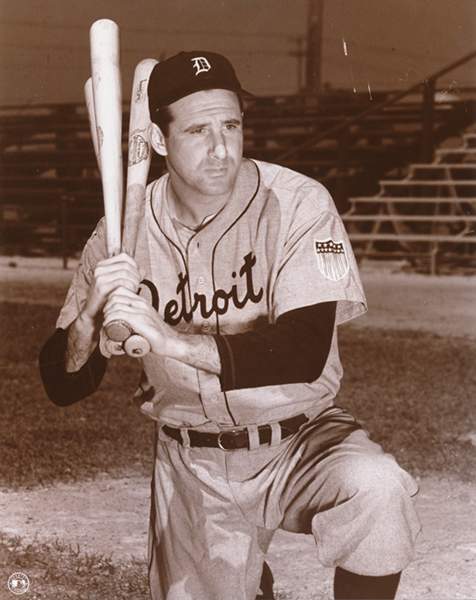
Swinging two bats in the on-deck circle
was a common sight before the Yankees' Elston Howard
invented the "bat donut" in the 1960s.
Hank Greenberg was one of the few players
who was strong enough to swing three bats.

September 30, 1945, 80 years ago: Hank Greenberg, recently discharged from the U.S. Army, hits a grand slam off Nelson Potter in the top of the 9th inning, and gives the Detroit Tigers a 6-3 win over the St. Louis Browns at Sportsman's Park, clinching the American League Pennant, which the Browns had won the previous season, for the only time in their history. The Tigers go on to win the World Series over the Chicago Cubs in 7 games.
The 1st player to go into the service was Philadelphia Phillies pitcher Hugh Mulcahy, drafted on March 8, 1941, and he served for the duration of The War. As my grandmother taught me, she and everyone else who lived through it, even if they never left "the home front," always called it "The War," Capital T, Capital W. 
Greenberg had been the 1st major baseball star to volunteer for the U.S. armed forces in preparation for World War II, inducted into the Army on May 7, 1941. So it was only natural that he was the 1st player to return, discharged on June 14, 1945, with Nazi Germany having surrendered, but not, as yet, Imperial Japan. He had scouted bombing targets for B-29 bombers in the China/India/Burma Theater of Operations, and was discharged with the rank of 1st Lieutenant.
Already known as Hammerin' Hank before Henry Aaron was even born, he had lost his seasons of age 31, 32 and 33, and the 1st half of his age 34 season. He finished his career with a lifetime batting average of .313 and 331 home runs. He should have had at least 150 more home runs. He never regretted it, saying, "My country comes first."
Nor did Chief Petty Officer Bob Feller, U.S. Navy, who lost his seasons of ages 23, 24, 25 and most of 26. He won 266 games and struck out 2,581 batters, all for the Cleveland Indians. Based on his 1941 and 1946 performances, he should have had at least another 90 wins and 1,000 strikeouts, which could have made him the all-time strikeout leader, and, with another 98 wins, the pitcher with the most in the post-1920 Lively Ball Era.
He knew The War was more important. He also knew that people like Ty Cobb and Ohio State football coach Woody Hayes, who compared sports to war, were blowhards, saying, "Anybody who says sports is war has never been in a war."
Warren Spahn had appeared in 4 games before going into the service, and was the winning pitcher in exactly none of them. By the time he rejoined the Boston Braves, 1st Lieutenant Warren Spahn, U.S. Army, had missed his age 22, 23 and 24 seasons, and had gotten frostbite in the Battle of the Bulge and been wounded at the Remagen Bridge.
But his wartime experience may have matured him. From age 25 to 44, he did become the Lively Ball Era's winningest pitcher, and the winningest lefthanded pitcher regardless of era, with 363. So maybe his stats didn't suffer.
The stats of Sergeant Joe DiMaggio, U.S. Army Air Force, did suffer, as he lost his age 28, 29 and 30 seasons. He finished with a .325 batting average, and 2,214 hits including 361 home runs. He should have had at least another 550 hits and another 75 home runs.
And then there was Ted Williams, who served as a flight instructor in World War II and a fighter pilot in the Korean War. By the time he left the service for the last time in 1953, Captain Theodore S. Williams, U.S. Marine Corps, had damaged hearing, and had lost his seasons of age 24, 25 and 26, and most of those of age 33 and 34.
He batted .344 for his career, with 2,654 hits and 521 home runs. It shouldn't surprise people who know a little about baseball history that Ted reached 500 homers, only the 4th to do so after Babe Ruth, Jimmie Foxx and Mel Ott. But it is surprising that the man often called "The Greatest Hitter Who Ever Lived" didn't even get close to 3,000 hits. (He also never got 200 hits in a season.) By missing 4 1/2 prime seasons, he may have missed out on as many as 600 hits and 200 home runs, which would have put him past the 714 of Ruth, the record before Aaron reached 755.
In contrast, Ruth only missed 1 month due to World War I, September 1918, and that was because everybody missed at least that much, since the season was cut short. And Aaron was never drafted. Mickey Mantle was classified 4-F, medically unfit for service.
Willie Mays did serve in the Korean War, missing most of his age 21 season and all of his 22, probably costing him around 350 hits on top of his 3,293, and at least 50 homers on top of his 660, meaning he might have gotten to 715 before Aaron did. Yankee pitcher Whitey Ford (1951 and '52) and Brooklyn Dodger pitcher Don Newcome (1952 and '53) also missed 2 seasons serving in Korea.)
Seaman 1st Class Stan Musial, U.S. Navy, the best hitter in the National League while Ted was the best in the American League, only missed 1945, his age 24 season, due to World War II. He had 3,630 hits and 475 home runs, so he may have missed 200 hits and maybe the 25 homers that would have put him over 500.
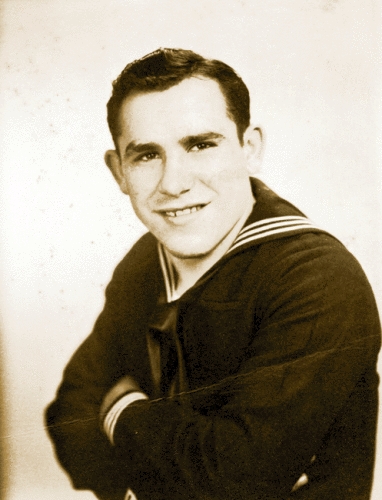
One man was a veteran of both D-Day and Major League Baseball. In his case, he was just 19 when he was in a U.S. Navy ship off the coast of Normandy, and his service probably didn't delay his entry into the major leagues by much. He may have been the calmest man in the battle, later saying that the exploding shells looked like fireworks. He was Seaman 2nd Class Lawrence Peter Berra. Yogi.
Yankee shortstop and Seaman 1st Class Phil Rizzuto missed his age 25, 26 and 27 seasons due to those huckleberries Hitler and Tojo. His Dodger counterpart, Chief Petty Officer Harold "Pee Wee" Reese, missed his age 24, 25 and 26 seasons. And Army 1st Lieutenant Jack Roosevelt Robinson missed his age 24, 25 and 26 seasons in the Army. Of course, at that point, he had no idea that he would ever play professional baseball in any capacity, much less the one that would make him the most important player of all time.

Bobby Shantz, who just turned 100, is the last remaining veteran of both World War II and Major League Baseball. 

Sunday, August 3, 2025

Happy 100th Birthday, Marv Levy

August 3, 1925, 100 years ago: Marvin Daniel Levy is born in Chicago. In World War II, he was a meteorologist for what was then called the U.S. Army Air Forces. Given that he ended up coaching in Canada, Kansas City, Chicago and Buffalo, that may have helped.

He was the head coach at the University of California and the College of William & Mary, leading W&M to the 1966 Southern Conference (not Southeastern Conference) title, before getting his 1st pro coaching job, in 1969, as an assistant with the Philadelphia Eagles. With George Allen’s Washington Redskins, he reached Super Bowl VII in 1973. He led the Montreal Alouettes to the Championship of Canadian football, the Grey Cup, in 1974 and 1977. In 1978, he became head coach of the Kansas City Chiefs. In 1984, he succeeded Allen as head coach of the USFL’s Chicago Blitz.

In 1986, he became head coach of the Buffalo Bills. He led them to 4 straight AFC Championships – but lost all 4 Super Bowls. He went 45-60-5 as a college head coach, 43-31-4 as a pro head coach in Canada, and 143-112 in America.

He grew up a fan of the Chicago Cardinals, the team now known as the Arizona Cardinals, and hates the Chicago Bears, including their theme song, "Bear Down, Chicago Bears." In 1994, after losing to the Bears and hearing that song, he promised his players that if they won their next game, he would write them a fight song. They beat the Miami Dolphins, and he kept his word.

Marv Levy was named to the Pro Football Hall of Fame, the Canadian Football Hall of Fame, and the Bills Wall of Fame. He turns 100 today.

Wednesday, July 16, 2025

July 16, 1945: The Trinity Test

July 16, 1945, 80 years ago: The Trinity test takes place. It is successful.

In June 1942, the U.S. Army Corps of Engineers started the Manhattan Project. This walled-off, super-secure facility in Los Alamos, New Mexico was kept as secret as they could, in order to keep Nazi Germany from knowing what they were doing. As it turned out, the real worry was with the Soviet Union, and their spies.

Due to the Allied bombings of German facilities, the Nazis never came close to developing an atomic bomb. They surrendered on May 8, 1945. But the new President, Harry Truman, wanted to avoid a full-scale invasion of the remaining enemy, Japan, if at all possible. The atomic bomb was the solution.

The Project's director was J. Robert Oppenheimer. He had a concern that the bomb might ignite the atmosphere and eliminate all life on Earth. But he said the chance of that happening was "near zero."
The first bomb was completed, and its test, codenamed "Trinity," was set for July 16, 1945, at what is now White Sands Missile Range, in a sparsely populated area outside Bingham, New Mexico. The detonation was at 5:29 AM Mountain Time, 7:29 U.S. Eastern Time. The test was successful. But every witness knew that this was both good news in the short term and, potentially, very bad news in the long run. They knew that America wouldn't have a monopoly on the bomb forever. Oppenheimer later said:

We knew the world would not be the same. A few people laughed, a few people cried. Most people were silent. I remembered the line from the Hindu scripture, the Bhagavad Gita. Vishnu is trying to persuade the Prince that he should do his duty, and, to impress him, takes on his multi-armed form, and says, "Now, I am become Death, the destroyer of worlds." I suppose we all thought that, one way or another.

On August 6, Truman ordered the dropping of the 1st available atomic bomb on Hiroshima, Japan. On August 9, he ordered another, dropped on Nagasaki. On August 14, Japan surrendered.

In 1949, the Soviets announced that they had successfully tested an atomic bomb.

Saturday, June 14, 2025

June 14, 1775: The Birth of the United States Army

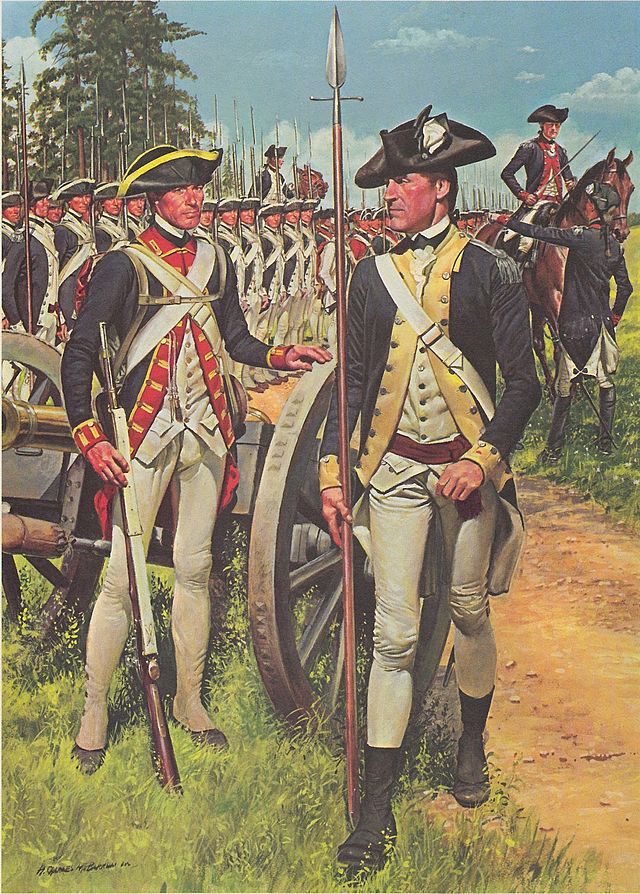
June 14, 1775, 250 years ago: Meeting in Philadelphia, at what will later be called Independence Hall, the Second Continental Congress approves a resolution to establish the Continental Army, to provide for the common defense of the 13 colonies that are, at the time, together known as British America. This is considered the birthdate of the United States Army.

It incorporates patriot forces already in place outside Boston, 22,000 of them; and New York, 5,000 of them. It also raises the 1st 10 companies of Continental Army troops on a one-year enlistment, including riflemen from the Province of Pennsylvania, the Province of Maryland, and the Colony of Virginia.

The following day, June 15, upon the suggestion of Massachusetts delegate John Adams, Virginia delegate George Washington, who had risen to the rank of Colonel in the British Army during the French and Indian War of 1755-1763, was unanimously elected to be the commander-in-chief of the Continental Army.
On June 3, 1784, after the War of the American Revolution, despite great difficulties, was won, the Congress of the Confederation created the United States Army, to replace the disbanded Continental Army. The U.S. Army would, and continues to, consider itself a continuation of the Continental Army.

In 1787, Independence Hall would again host delegates, meeting in a Constitutional Convention. They approved the Constitution of the United States, created the office of the President of the United States, and used the same language to describe the President's role in running the nation's armed forces: "Commander-in-Chief."

The United States Military Academy was founded on March 16, 1802, at Fort Clinton, named for General James Clinton, on the Hudson River at West Point, New York. The school is frequently called "West Point," although, for sports purposes, it's called "Army." The teams were officially known as the Cadets until 1999, when, to reflect the fact that its football team was nicknamed "The Black Knights of the Hudson," it was changed to the Black Knights.

On September 18, 1947, with the reorganization of the U.S. Department of War into the U.S. Department of Defense, the United States Air Force was separated from the United States Army. On April 1, 1954, a separate United States Air Force Academy was founded at Colorado Springs, Colorado.

The U.S. Army has had many great moments, including, but by no means limited to, the following:

* War of the American Revolution, 1775-1783: The Battles of Trenton, Saratoga, Monmouth Courthouse and Yorktown.

* War of 1812, 1812-1815: The Battles of Baltimore and New Orleans.

* Mexican-American War, 1846-1848: The Battles of Monterrey, Buena Vista and Chapultepec.

* American Civil War, 1861-1865: The Battles of Vicksburg, Gettysburg and Richmond, General William Tecumseh Sherman's March to the Sea, and the surrender of Robert E. Lee achieved by General Ulysses S. Grant at Appomattox Court House.

* Spanish-American War, 1898: The Battle of San Juan Hill.

* World War I, 1917 and 1918: The Battles of St-Mihiel and the Argonne Forest.

* World War II, 1941-1945: The amphibious invasions of North Africa, Italy and France, and the accompanying liberations thereof; and the "island-hopping" campaign in the Pacific.

* Korean War, 1950-1953: The amphibious landing at Incheon, saving the country, before the war dragged into a nearly three-year stalemate.

* Persian Gulf War, 1991: Rolling back the conquest of Kuwait by Iraq in a month and a half.

* Balkan Campaigns, 1995 and 1999: Removing Serbia from control of Bosnia in the former and Kosovo in the latter.

* Iraq War, 2003-2011: Removing Saddam Hussein from power in Iraq in a matter of months.
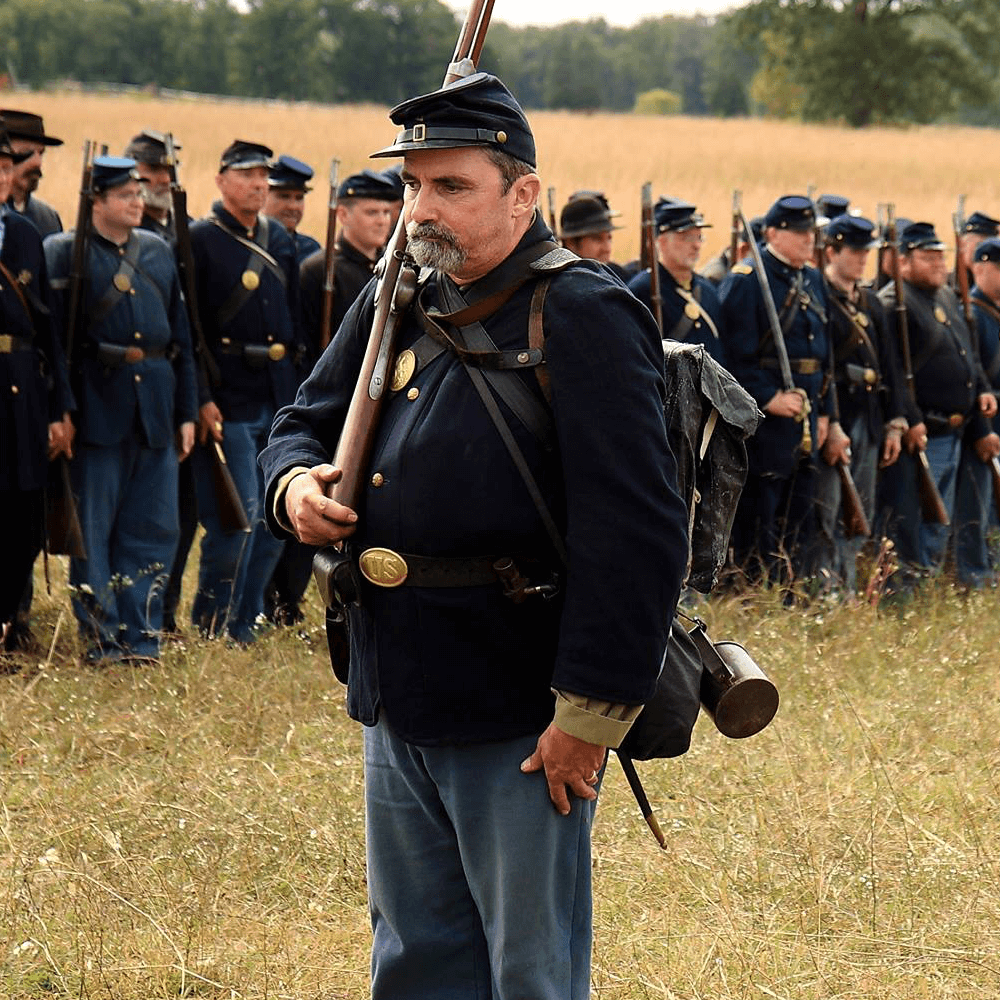
Civil War Union Army re-enactor

Unfortunately, that wasn't the end of the war. Like each of the preceding, and also the Vietnam War of 1959-1975, the Army has also had moments we'd like to forget, but dare not forget.

Of the 45 men who have served as President, 15 have served in the Army: George Washington, Andrew Jackson, William Henry Harrison, Zachary Taylor, Franklin Pierce, Abraham Lincoln, Ulysses S. Grant, Rutherford B. Hayes, James Garfield, Benjamin Harrison, William McKinley, Theodore Roosevelt, Harry Truman, Dwight D. Eisenhower and Ronald Reagan. Grant and Eisenhower are the only West Point graduates to become President.

Both of my grandfathers served in the Army: One in Alaska; the other, with General George S. Patton in the North African and Italian campaigns. My father also served, in Korea during the Vietnam War. None saw combat. Due to my congenital arthritis, I would never have passed a military physical examination; and so, if the military draft had been restored at the time when I would have been eligible, I would have been classified "4-F": Ineligible for service.
My grandfather, Staff Sergeant George Goldberg, 1945

As of June 14, 2025, the Army has (I'm rounding off) about 450,000 active duty personnel, another 330,000 in the Army National Guard, another 170,000 in the Army Reserve, and about 225,000 civilian employees.
Today, a President who lied about his physical condition to get out of serving will hold a military parade in the national capital of Washington, D.C., in celebration of his birthday (his 79th), and also of the Army's (its 250th).

I hope it rains.

Wednesday, March 19, 2025

Jackie Robinson Was a Hero -- NOT a "DEI Hire"

My grandmother was from Queens. Her all-time hero, in all walks of life, was Jackie Robinson. She died well before fellow Queens native Donald Trump first ran for President, but she knew he was a fraud and a rotten guy.

Before he was the first black player in modern baseball, Robinson was the Rosa Parks of the U.S. Army -- 11 years before Rosa Parks became the Jackie Robinson of public transit.

Today, the U.S. Department of Defense removed Robinson's profile from an "Athletes Who Served" page on their website, listing him as "DEI."

Things like this are why Jackie Robinson left the Republican Party. 

Tuesday, March 18, 2025

March 18, 1975: "M*A*S*H" Kills Off Henry Blake

March 18, 1975. 50 years ago: The TV show M*A*S*H closes its 3rd season -- meaning it had now run for as long as the Korean War, which it depicted, had.

Early in an episode titled "Abysinnia, Henry," U.S. Army Lieutenant Colonel Henry Blake, M.D., commanding officer of the 4077th Mobile Army Surgical Hospital, played by McLean Stevenson, finds out that he has been discharged. (Henry had been known to say goodbye by saying, "Abysinnia," the former name of the African nation of Ethiopia, as a corruption of "I'll be seeing you.")

But at the end of the episode, during a surgery session, the camp's company clerk, Corporal Walter "Radar" O'Reilly (Gary Burghoff) came in, and said, needing to pause due to the weight of the words, "I have a message: Lieutenant Colonel... Henry Blake's plane... was shot down... over the Sea of Japan... It spun in... There weren't no survivors."

Radar took it harder than anyone else. Having lost his father before he was old enough to remember him, he looked up to Henry, who became like a father to him. But even the show's meanest characters, Major Margaret "Hot Lips" Houlihan, the head nurse (Loretta Swit), and Major Frank Burns, the "Do as I say, not as I do" second-in-command and now temporary C.O., were broken up over it.

This was the 1st time that an American TV show had actually said that a main character had died. Previously, when an actor died, either the character was played by someone else, or written out of the series and not mentioned again. The same thing was done when an actor simply left the show.

But when Stevenson left M*A*S*H after 3 seasons, wanting to do other things, the producers and writers killed Henry off. They had the announcement right there in the script.

Americans had seen on their TVs that a President, and other beloved figures, had been murdered; that the scenes of wounded soldiers they were seeing in Vietnam were real; that there really were riots by protestors, and beatings, even shootings, by police and national guardsmen at political demonstrations; that a President had committed crimes, and that he was resigning rather than face impeachment over it.

But they had never been told that a TV character that they liked, played by a person who, then, was very much alive, was dead -- and just as he was going home from a war, too.

This was a year and a half before a dispute with the showrunners led to John Amos being fired from Good Times, and his character, James Evans Sr., being written out as dead in a car crash; 11 years before Officer Joe Coffey (Ed Marinaro) was gunned down on Hill Street Blues; 12 years before Valerie Harper was fired from Valerie over a salary dispute, resulting in the title character being killed off and the show being retooled as The Hogan Family; 16 years before Gary Shepherd (Peter Horton) was killed off on thirtysomething; 23 years before the death of Detective Bobby Simone (Jimmy Smits) on NYPD Blue; 26 years before an offscreen car crash killed Dolores Landingham (Kathryn Joosten) on The West Wing; and 36 years before Game of Thrones showed that no character was safe by killing off what appeared to be its lead character, Lord Eddard Stark (Sean Bean).

With every such death, once the initial shock wears off, the surprise becomes less. Nothing will ever top the surprise of Radar saying of Henry's plane, "There weren't no survivors."

Whatever happened between Stevenson and the showrunners, this was unjust. People still complain about it, half a century later.

The thing is, Henry wasn't the main character of M*A*S*H. Nor was his replacement as C.O., Colonel Sherman Potter (Harry Morgan). Nor was the Chief Surgeon, Captain Benjamin Franklin "Hawkeye" Pierce (Alan Alda). The show's main character was war. Not even the Korean War per se, but war itself.

And, as one of America's greatest generals, William Tecumseh Sherman, taught us, "War is cruelty, and you cannot refine it." Or, as he told the graduating class of a military academy, "There is many a boy here today who looks on war as all glory, but, boys, it is all hell." There's a reason the writers showed the cast in the operating room at least once an episode.

Two seasons, our time, and, I suppose, a few months, their time, after Henry's death, in an episode titled "The General's Practitioner," premiering on February 15, 1977, Hawkeye put it in even starker terms:

Frank: Everybody knows that war is Hell.

Captain B.J. Hunnicutt (Mike Farrell): Remember: You heard it here last.

Hawkeye: War isn't Hell. War is war, and Hell is Hell, and, of the two, war is a lot worse.

Father Francis Mulcahy, the camp chaplain (William Christopher): How do you figure that, Hawkeye?

Hawkeye: Easy, Father. Tell me: Who goes to Hell?

Mulcahy: Sinners, I believe.

Hawkeye: Exactly. There are no innocent bystanders in Hell. But war is chock-full of them. Little kids, cripples, old ladies. In fact, except for a few of the brass, almost everybody involved is an innocent bystander.

What better way to show that war is Hell, or worse, than by having it kill a beloved character?

Wednesday, February 12, 2025

February 12, 1955: The 1st American "Advisors" Are Sent to Vietnam

February 12, 1955, 70 years ago: President Dwight D. Eisenhower sends the 1st U.S. "advisors" to South Vietnam. This comes 9 months after the Battle of Dien Bien Phu saw the Communist Viet Minh defeat the French Army, and 7 months after the Geneva Conference divided the country into a Communist North and a "free" South, just like Korea.

These "advisors" -- some of them U.S. Army officers, some of them CIA officers, some of them civilian diplomats -- were supposed to guide South Vietnam toward 3 things: Governmental stability, economic stability, and freedom.

To the American public, most of whom barely knew of Vietnam's existence in those early days of television -- "Indochina" was still the more common name, but that also encompassed Cambodia, Laos, Burman (now Myanmar), Thailand, and Peninsular Malaysia -- let alone could find it on a world map, freedom was the most important part.

But, in all fairness, it would have been a miracle if the country were stable enough to hold together, let alone enough to hold off attacks -- either military or spying -- from North Vietnam.

Since the Vietnam War finally came to an end in 1975, Republicans have usually blamed the American role in the war on President Lyndon B. Johnson, for the Gulf of Tonkin Resolution in 1964 and his subsequent escalation of the war; or on President John F. Kennedy, who increased the U.S. presence in Vietnam in 1961, '62 and '63. JFK and LBJ were both Democrats.

These Republicans tend to ignore the fact that Republican Richard Nixon, after being elected President in 1968, largely on the basis of saying he would end the war, only took the last U.S. combat troops out after being sworn in for a 2nd term in 1973.

Let the record show that the 1st President to send U.S. troops to Vietnam was a Republican, Dwight D. Eisenhower. And his Vice President was Richard Nixon.

Sunday, January 26, 2025

January 26, 1945: Audie Murphy In the Colmar Pocket

January 26, 1945, 80 years ago: Audie Murphy takes actions that lead to him being awarded the Congressional Medal of Honor. The story didn't start there. It certainly did not end there.

Audie Leon Murphy was born on June 20, 1925 in Kingston, Texas. He was born into a large family of sharecroppers. After his father abandoned them, his mother died when he was a teenager. Murphy left school in 5th grade to pick cotton and find other work to help support his family. His skill with a hunting rifle helped feed his family.

He was 16 years old at the time of the Japanese attack on Pearl Harbor in 1941. His older sister helped him to falsify documentation about his birthdate in order to meet the minimum age for enlisting in the military. At first, the Army, the Navy and the Marine Corps all turned him down for being underweight. Eventually, the Army accepted him.

He served in the invasion of Sicily, then the Battle of Anzio, the liberation of Rome, and the invasion of southern France at Provence. He was transferred to northeastern France, and led his men on a successful assault at L'Omet quarry in October 1944.

On January 26, 1945, he single-handedly held off a company of German soldiers for an hour at the Colmar Pocket in Alsace, France, before leading a successful counterattack while wounded and out of ammunition. For this action, he was awarded the Congressional Medal of Honor. He was just 19 years old.

Despite suffering from multiple illnesses and wounds throughout his service, Murphy became one of the most praised and decorated soldiers of World War II. He is credited with killing 241 enemy soldiers. He has been described as the most-decorated soldier in American history.

In 1949, he published a memoir, To Hell and Back. In 1955, he played himself in the film version of the story. He received more acting roles, most of them in Westerns, including the NBC TV series Whispering Smith. He also became an accomplished songwriter and breeder of quarter horses at ranches in California and Arizona.

Murphy married actress Wanda Hendrix in 1949. Their divorce became final in 1951. Four days later, he married former airline stewardess Pamela Opal Lee Archer, with whom he had 2 sons, Terry and James.

Because he had what would today be described as post-traumatic stress disorder (PTSD), then known as "battle fatigue," he slept with a loaded handgun under his pillow. He looked for solace in addictive sleeping pills. He was noted for a quick, fierce temper, and was involved in various violent altercations during his adult life. In May 1970, he was charged with battery and assault in Burbank, California, but was cleared of the charges.

In his last few years, with the Vietnam War and opposition to it having taken the place of World War II as the defining war in Americans' minds, he was seen as a figure from another era. Between this and his personal issues, his acting roles became fewer and further between. He was plagued by money problems, but refused offers to appear in alcohol and cigarette commercials, because he did not want to set a bad example.

Audie Murphy died on May 28, 1971, in the crash of a private plane outside Roanoke, Virginia, shortly before his 46th birthday. There was rain and fog, and the pilot and 4 other passengers were killed. He was interred with military honors at Arlington National Cemetery.

Friday, November 15, 2024

George vs. Donald

 
Actor Sylvester Stallone, known for playing Rocky Balboa and John Rambo, has compared Donald Trump to George Washington.

All right. Let's do it:

* George Washington: Volunteered to be a solider. Donald Trump: Weaseled his way out of being one.

* George Washington: Very successful in real estate. Donald Trump: Failed at it.

* George Washington: Painful dentures. Donald Trump: Has that in common.

* Donald Trump: Betrayed his country. George Washington: Betrayed by his country, which, at the time, was Great Britain.

* George Washington: Had to flee New York. Donald Trump: Has that in common.

* George Washington: Won battles in New Jersey. Donald Trump: Not so much.

* George Washington: Victorious in Virginia. Donald Trump: No.

* George Washington: Asked to chair the Convention that wrote the Constitution. Donald Trump: Says the Constitution has been unfair to him, and says he wants to suspend it.

* George Washington: Spent a lot of his time as President on his estate, but working as a farmer. Donald Trump: Spent a lot of his time as President on his estate, playing golf.

* Donald Trump: Put his corrupt children and their corrupt significant others in his Administration. George Washington: Had no children.

* George Washington: Rich all his life, never went bankrupt. Donald Trump: Started out rich, now billions of dollars in debt.

* George Washington: His Cabinet included Thomas Jefferson and Alexander Hamilton. Donald Trump: His Cabinet turned on him, so he replaced them with psychopaths.

* George Washington: Believed in America, but knew there were issues, and was told only he could fix them. He did his best. Donald Trump: Says, "The American Dream is dead," and, "I, alone, can fix it," and then proved that he can't fix a damn thing.

I think Sly has taken too many blows to the head.

Saturday, June 22, 2024

June 22, 1944: President Franklin D. Roosevelt Signs the G.I. Bill

June 22, 1944, 80 years ago: President Franklin D. Roosevelt takes his 2nd-most important action of the month. Sixteen days after giving the okay for the D-Day invasion, he signs the Servicemen's Readjustment Act of 1944, a.k.a. the G.I. Bill.

FDR was the Assistant Secretary of the Navy during World War I, and saw how returning servicemen found that their jobs and homes had been given to others, leading to a recession so bad that it has often been called a depression, though it didn't last nearly as long as the one that hit in 1929 and led to his 1st election as President. He also didn't want a repeat of the Bonus Army controversy of 1932. He wanted an easier readjustment for the veterans returning from World War II, and he wanted it in place before they came back.

Benefits included housing loans, low-cost mortgages, low-interest loans to start a business or a farm, one year of unemployment compensation, and free college.

And so, all over America, hundreds of thousands of people went from ghetto apartments (The word "ghetto" was originally applied to the Jewish neighborhood of medieval Rome, so it is not a purely African-American term) to houses in better parts of their cities, or to the suburbs, making the growth of places like Long Island, New Jersey and Southern California possible.

This had 2 downsides: The people who moved into those slums were not veterans, and were not upwardly mobile, and the neighborhoods got worse; and it made it harder for baseball fans to get to the inner-city ballparks, leading to teams moving (Boston, Philadelphia and St. Louis all went from 2 teams to 1 between March 1953 and October 1954, and New York lost the Giants and the Brooklyn Dodgers 3 years after that) and other teams building new stadiums on the edges of cities (New York's Shea Stadium being an example of this) or in the suburbs (like Metropolitan Stadium outside Minneapolis).

The college access for veterans cannot be underestimated. By 1956, 7.8 million veterans had used the G.I. Bill for educational purposes. As much as the housing boom helped by the G.I. Bill, it created the great postwar middle class.

The Bill applied to black veterans as well as white ones. FDR got that passed in spite of whatever opposition he may have received from Southern Congressmen. Many of those black veterans used the G.I. Bill to go to what are now called "historically black colleges and universities" (HBCUs). Many of them became pivotal figures in the Civil Rights Movement.

FDR gets criticized for not doing enough for civil rights. His greatest contribution to it may have been inadvertent: If not for the G.I. Bill creating black lawyers and other activists, the Civil Rights Acts of the 1960s might not have happened for another generation.

The G.I. Bill's college provisions were not limited to American colleges. My grandfather's brother, Aaron Goldberg, stayed in France after the war, and attended the University of Paris, a.k.a. the Sorbonne. While there, he got married. Uncle Aaron and Aunt Catherine came to America, and were married for 44 years.

Thursday, June 6, 2024

June 6, 1944: D-Day, the Most Important Day

June 6, 1944, 80 years ago today: The Allies invade Nazi-held Normandy, on the French side of the English Channel. The liberation of Europe has begun.

It was officially called "Operation Overlord" by the United States Army, and "Operation Neptune" by the United States Navy. Since Neptune was the Roman name for the god of the sea -- known as Poseidon to the ancient Greeks -- the name was equivalent to "Overlord."

The term "D-Day" is now used almost exclusively in connection with this event, but it is actually a generic term for the day on which a combat operation is to be initiated, and the "D" doesn't stand for anything. The earliest use of it was in World War I, on September 7, 1918, when the U.S. Army used it for their attack on the St. Mihiel Salient, also in France.

Oddly, the planned invasion of the Japanese home island of Kyushu, set for November 1, 1945, was code-named not another "D-Day," but "X-Day"; while that of the main island of Honshu, set for February 1, 1946, was "Y-Day." Both were rendered unnecessary by the atomic bomb.

And various other events in World War II have been retroactively labeled "D-Days": November 8, 1942, for North Africa; September 3, 1943, the landing at Salerno, has been called "D-Day in Italy"; and June 15, 1944, the start of the Battle of Saipan, became known as "D-Day in the Pacific." The landing an Incheon, on September 15, 1950, has been called "Korea's D-Day." 

June 6, 1944 was the largest amphibious (sea and land) assault in military history. Five beaches were invaded. The U.S. Army sent V Corps to Omaha Beach, and VII Corps -- including the 82nd and 101st Airborne Divisions, helping to make those perhaps the most famous single units in the entire U.S. armed forces -- to Utah Beach.

The British Empire sent their Second Army to Gold Beach, their I Corps to Sword Beach, and Canada's 3rd Infantry Division to Juno Beach. There was also assistance from Free French and exiled Polish forces.

All told, there were about 350,000 men on the Allied side, against about 50,000 for the Nazis, a 7-1 manpower advantage. And still, because of the defensibility of the terrain, the Allies lost 4,415 men -- all in one day, nearly as many as America lost in Iraq over an 8-year stretch, and half again as many as died on 9/11. The Nazis lost over 9,000 men, and were forced to retreat from what they were calling "Fortress Europe."

The commanding officer for the operation, General Dwight D. Eisenhower, had originally scheduled it for the day before, June 5, but had to call it off due to unfavorable weather reports. He saw that the weather reports for the next few days weren't getting appreciably better, and decided that June 6 would be "D-Day."

"Ike," a 53-year-old native of Abilene, Kansas wrote a statement to use in the event the invasion failed, claiming full responsibility. He never had to use it. The invasion would make him the most famous commanding officer of The War, and he would go on to become the 34th President of the United States.
Photo staged, after the fact

Among the nearly 200,000 U.S. Navy personnel was a 19-year-old old gunner's mate from St. Louis, aboard the attack transport vessel USS Bayfield. He saw "the rockets' red glare," and later told an interviewer, "It looked like the 4th of July." He may have been the calmest man in the entire operation. He was the one man who both took part in the D-Day invasion and played Major League Baseball. He was Seaman Second Class Lawrence Peter Berra. Yogi.
He did not thank the Nazis "for making this day necessary,"
but he could legitimately have called
the Allies "overwhelming underdogs."

Also serving in this battle was Captain James Doohan of the Canadian Army. The man who went on to play Chief Engineer Montgomery Scott in the Star Trek franchise was 24, and gunned down a bunch of Nazis. Unfortunately, the story that he "gave the Nazis the finger" isn't true: He lost the middle finger on his right hand, all right, but it was from "friendly fire," a mistake from one of his own men.
Compared to facing the Nazis,
the Klingons were "no tribble at all."

Anyway, that's why every time "Scotty" was shown fixing something or pushing a button, he used his left hand. When he used the transporter, or was "reversing the polarity" in the episode "That Which Survives," another actor's hands were shown.

Also serving that day were British writers William Golding (Lord of the Flies) and Kingsley Amis (Lucky Jim), and American writer J.D. Salinger (Catcher in the Rye).

The only woman to land on Normandy was Martha Gellhorn, journalist, and then-wife of author Ernest Hemingway. She was denied press credentials, so she posed as a nurse, was allowed onto a hospital ship, locked herself in a bathroom so she would be part of the landing, and became an actual nurse, carrying stretchers. She later became one of the reporters who divulged the story of the Dachau concentration camp.

June 6, 1944 was a Tuesday. And no games were played on that day. It was the off-season for the National Football League. The National Hockey League had completed its season on April 13, with the Montreal Canadiens winning the Stanley Cup. There was, as yet, no National Basketball Association. 

And with the news of the invasion reaching American shores early in the morning, the Commissioner of Baseball, Kenesaw Mountain Landis -- whose father survived the Battle of Kennesaw Mountain, outside Atlanta, in the American Civil War, and named his son in honor of it, with a different spelling -- ordered the postponement of all professional baseball games scheduled for the day.

According to the website of the National D-Day Memorial in Bedford, Virginia, about halfway between Roanoke and Lynchburg, and over 200 miles southwest of Washington:

Assuming that D-Day veterans have died at the same rate as other WWII veterans, we can estimate that 1.8% of the 140,000 are still living. That gives us an estimate of 2,520 D-Day veterans still living in 2021.

These are the last survivors of the men, and a few women in support roles, who won the most crucial battle against Nazi Germany. This day, 80 years ago, was the most important day in human history. If the Allies had lost, the Nazis could have held on and negotiated a stalemate, and still ruled a big chunk of Europe for the foreseeable future.

But the Allies won. The good guys won. We won. We freed Europe from Fascism. (Except for Spain and Portugal, which were neutral, as they had been in World War I. Their liberation from Fascism took another 30 years or so, and they had to do it on their own.) We defeated, and punished, the greatest evil that the planet Earth has ever known.

These people, and those who fought in the war earlier from September 1939 onward, were the original "Antifa." We owe these people everything.

Including the decision to cancel the day's baseball games. As Baseball Hall-of-Famer Bob Feller, then serving in the U.S. Navy in the Pacific Theater of Operations, told people for the rest of his life, "Anybody who says sports is war has never been in a war."

Notable films about D-Day include:

* Breakthrough, 1950.
* The Desert Fox: The Story of Rommel, 1951, with British actor James Mason portraying Erwin Rommel as a General too good for the Nazis.
* D-Day The Sixth of June, 1956, a British film whose actors included an actual D-Day lander, Richard Todd.
* The Longest Day, 1962, based on the 1959 book by Cornelius Ryan. It is an epic with a huge cast: Richard Todd again, John Wayne, Robert Mitchum, Richard Burton, Henry Fonda, Red Buttons with no comedy whatsoever, Peter Lawford, Eddie Albert, Jeffrey Hunter, Rod Steiger, George Segal, Robert Wagner, singer Paul Anka; and, notably, the man about to become James Bond, Sean Connery, plus 2 future Bond villains as German officers, Gert Fröbe and Curd Jürgens. My mother saw it when it came out, and mentioned that it was notable as one of the earliest films in which the actors are shown speaking the languages they're supposed to, with subtitles. But she also said it was so long, it should be called The Longest Film.
* Two 1964 films with James Garner: 36 Hours, and The Americanization of Emily, also with Julie Andrews, a year before she took on the Nazis in The Sound of Music.
* A Matter of Resistance, 1966, a French romantic comedy, that happens to include the invasion, starring Catherine Deneuve.
* Where Eagles Dare, 1968, another with Richard Burton, in which Clint Eastwood infiltrates the Nazis, much as he would later do with the Soviet Union in Firefox.
* Patton, 1970, with George C. Scott playing General George S. Patton through the entire European Theater of Operations.
* Overlord, 1975, a post-Vietnam film looking at World War II as an overall failure of humanity.
* The Big Red One, 1980, with Mark Hamill fighting actual Nazis, not just an allegory for them as in the Star Wars films.
* Saving Private Ryan, 1998, Steven Spielberg aiming to make the most realistic version, and, in the opinion of many D-Day survivors, succeeding.
* Ike: Countdown to D-Day, 2004, with Tom Selleck, bald and without his famous mustache, nearly unrecognizable as Eisenhower.
* Storming Juno, 2010, the story told from the Canadian perspective.

Also on June 6, 1944, jazz pianist Monty Alexander was born. Phillip Allen Sharp was born, the 1993 winner of the Nobel Prize for Physiology or Medicine. Derrel McKinley "Bud" Harrelson was born, the shortstop on the New York Mets team that won the 1969 World Series and the 1973 National League Pennant. But D-Day may have been a bigger "miracle" than the '69 Mets. And track star Tommie Smith was born. He would become known for his protest at the 1968 Olympics, during another war, one that divided rather than united America.

Tuesday, November 14, 2023

Top 10 Things About M*A*S*H That Don't Make Sense

I love M*A*S*H. The show, part comedy, part drama, set in a U.S. Army hospital during the Korean War in the early 1950s, might be the greatest TV show of all time. But there are some things about it that just don't make any sense.

And I'm not talking about continuity errors, such as which characters' family members were still alive or not, or consistency in what their names were, or where they might have lived. I'm talking about things that, had they happened in real life, would not have happened that way.

10. The Manpower Turnover Rate. Hawkeye, Margaret, Klinger, Father Mulcahy, and possibly some of the nurses seemed to be at that one unit for the duration of the war, 3 years. They each would have been transferred at least once.

9. Potter's Age. In one episode, he gave his age as 62. But in more than one, he mentioned that he was too young to serve in World War I, and thus lied about his age. This would have put him in his mid-50s. But he looked more like 62, or even older. At that age, it's unlikely that he would have been put in that particular command.

For the record, Harry Morgan played Potter from the age of 60 to 67.

8. The Hair. In that era, men would not have had hair as long as Hawkeye, B.J. and Klinger had. I'm also not sure they would have allowed B.J. to have that mustache.

7. Henry's Unfitness For Command. Aside from cheating on his wife, Henry Blake was a decent guy, and a good doctor. But, as was pointed out by Hawkeye on one side, and Margaret and Frank on the other, he was a bad choice to command any military unit, even a hospital. Potter was so much better suited to it.

And Henry knew it, too. Frank and Margaret "went over his head" so many times, "I've developed athlete's scalp!"

6. Klinger's Stunts. It wasn't just wearing the women's clothing. He tried all kinds of things to either escape from the Army (mostly early on) or convince Henry or Potter to give him a psychiatric discharge. It's shocking that he got away with it for as long as he did, without getting tossed in the stockade, and eventually getting a dishonorable discharge.

5. Hawkeye's Antics. No matter how good a surgeon he was, half of what he did would have gotten him court-martialed.

4. Frank Burns' Incompetence. If he was that bad a surgeon, that would have gone on the record, and he would have been transferred out of there.

And 5. and 4. both lead to...

3. The Frank & Margaret Affair. A couple of times, Hawkeye threatened to blow the whistle on them if they didn't back off on their threats. At some point, the good surgeons would have had enough, and ratted them out. Even if Hawkeye and Trapper, and later Hawkeye and B.J., weren't willing to do so, and Henry didn't have the spine to act like a true commanding officer on the subject, a man like Colonel Sherman T. Potter, M.D., U.S.A. would have.

The only way not doing so can be justified is their professional respect for Margaret as a nurse. They couldn't take Frank down without also ruining Margaret's career. But, at the very least, one threat to Frank should have scared him into leaving Hawkeye alone.

2. Hawkeye's Crackup. In the series finale, the war finally breaks him. While he and Sidney Freedman did reach a breakthrough, it was way too soon to be allowed back into action. It proved to be vital, but the real Army wouldn't have allowed it.

1. The Drinking. There is no way the Army would have let surgeons have a distillery in their quarters. At the rate they were going, surely, there must have been an occasion where they were already drunk when wounded came in. And there was one time when Hawkeye proved to be too hungover to operate. One time that we know of. Surely, there were more. That kind of drinking -- when he was always on call -- would have cost him not only his honorable discharge, but possibly also his civilian medical license.