Showing posts with label 1950. Show all posts

Tuesday, December 30, 2025

December 30, 1950: The Dominoes Record "Sixty Minute Man"

Rock and roll is 75 years old? How can that be? Well, it be.

December 30, 1950, 75 years ago: The Dominoes, an all-black vocal group specializing in rhythm & blues songs, record "Sixty Minute Man" on Federal Records, at National Studios, at 460 West 42nd Street in New York City.

At the time, The Dominoes consisted of singer, pianist, manager and songwriter Billy Ward; tenor Clyde McPhatter; baritones Charlie White and Joe Lamont; and bass singer Bill Brown. Ward had teamed up with white songwriter Rose Marks to write "Sixty Minute Man," in which a man brags about how he's a great lover:

Look-a-here, girls, I'm telling you now:
They call me Lovin' Dan.
I rock 'em, roll 'em, all night long.
I'm a sixty-minute man.

If you don't believe I'm all I say
come up and take my hand.
When I let you go, you'll cry, "Oh, yes:
He's a sixty-minute man!"

There'll be fifteen minutes of kissin'.
Then you'll holler, "Please, don't stop!"
There'll be fifteen minutes of teasin'
and fifteen minutes of pleasin'
and fifteen minutes of blowin' my top!

If your man ain't treatin' you right
come up and see ol' Dan.
I rock 'em, roll 'em, all night long.
I'm a sixty-minute man.

The record was released in May 1951, and within a month, it reached Number 1 on Billboard magazine's R&B chart, holding that top spot for 14 weeks, a record at the time. It actually crossed over onto Billboard's Popular Music chart -- in other words, white people's music -- reaching Number 17. Black singers had done better than that, but they were pop singers like Nat King Cole and Billy Eckstine, not R&B groups or soloists.

If you're asking, "How did a line like 'Fifteen minutes of blowin' my top' get past the censors in 1951?" I don't have an answer. 

Unusual for single records, then as now, the bass singer takes the lead, Bill Brown. There is guitar playing from René Hall, and the drumming is on the 2nd and 4th beats. By a certain definition -- and not just because the words "rock" and "roll" are used together -- this is the very first rock and roll record. 

Another candidate, "Rocket 88" by Jackie Brenston & His Delta Cats -- actually Ike Turner and the band he was using at the time -- was recorded in March 1951 (after "Sixty Minute Man"), released in April (before "Sixty Minute Man"), but didn't debut on the charts until June (after "Sixty Minute Man"). It also has the drumming on the 1st and 3rd beats, which tends to disqualify it from the strict definition of "rock and roll." But then, rock and roll has always been about challenging boundaries, and thus strict definitions don't always apply. So either one of these songs could be claimed as the first.

With his own name on the group, Ward took in most of the group's income, despite the fact that McPhatter was the lead singer on most songs. Ward even had Clyde billed as "Clyde Ward," to make it seem like Clyde was his brother. In 1953, Clyde decided he'd had enough, and left to form a new group, The Drifters, arguably inventing "doo-wop."

In 1955, after 2 years of great success on the R&B charts, Clyde was drafted into the U.S. Army. After serving a year, he started a solo career, while The Drifters built an entirely new lineup led by Ben E. King. After years of hard drinking and drug use, Clyde McPhatter died in 1972, not quite 40 years old.

But back in 1953, Ward was ready for Clyde's departure, as he already had a replacement lined up: Jackie Wilson. Eventually, he got sick of Ward, too, and launched a solo career in 1957. He became known as "Mr. Excitement," and had a bunch of hits.

In 1975, performing for a Dick Clark-sponsored oldies show at the Latin Casino in Camden, New Jersey, across the Delaware River from Philadelphia, Jackie suffered a heart attack -- just as he was singing the opening line of his 1st big solo hit, from 1959, "Lonely Teardrops": "My heart is cryin', cryin'... "

Since throwing his body all over the stage was a part of his act, it took about 30 seconds for people to realize that this collapse wasn't, and it cost his brain precious oxygen. It also didn't help that he was already sweating like crazy, as that was part of his act, too, so that didn't seem like a sign that anything was wrong. He was told that women liked that, and that taking salt tablets would make him sweat more. Those tablets are probably the reason he had a heart attack at the age of 41. He spent the rest of his life in and out of hospitals and nursing homes, dying in 1984.

Bill Brown was even unluckier than McPhatter and Wilson: He got sick of Ward's military-style discipline, left in 1952, joined The Clovers in 1953, and didn't even live to see their success, as he died in 1956. (I've looked for a cause, but I can't find one: Not an illness, not drugs, not an accident, not a murder.) He didn't live to see how his lead vocal would affect rock and roll, inspiring such basses as Fred Johnson of The Marcels (who hit Number 1 in 1961 with a doo-wop version of "Blue Moon") and Melvin Franklin of The Temptations.

René Hall died in 1988, Joe Lamont in 1998, Billy Ward in 2002, and Charlie White was the last survivor, living until 2005. I can find no record of when Rose Marks died, but a photograph of her suggests that she was already middle-aged in 1950, so she has likely been dead for a long time.

Fats Domino, one of the founding fathers of rock and roll, did not name himself for the group: His real name was Antoine Dominique Domino Jr. However, later singer Ernest Evans did take the name "Chubby Checker" as a play on the name "Fats Domino." Still later, in 1970, Van Morrison released the song "Domino," and Eric Clapton formed a group named Derek & The Dominos (no E on the end). Both were tributes to Fats, not Billy Ward's group. (Morrison recorded another song with a tenuous connection to the Dominoes, "Jackie Wilson Said.")

The debate over "the first rock and roll record" continues, but I'm satisfied that it's "Sixty Minute Man" by The Dominoes. 

Wednesday, December 24, 2025

December 24, 1950: The Cleveland Browns Make Their Point

The winning field goal, kicked by Groza, then wearing Number 50.
He would later switch to 76, which the Browns retired for him.
Note the snow on the field.

December 24, 1950, 75 years ago: The NFL Championship Game is held at Cleveland Municipal Stadium. The weather was bitterly cold, but the action was hot.

In 1945, the Cleveland Rams had won the NFL Championship, but had low attendance. Team owner Dan Reeves (no relation to the later NFL coach of the same name) moved them to Los Angeles, where they became a runaway success at the box office, and on the field as well. In 1949, they won the NFL Western Division, and reached the NFL Championship Game. But, contrary to the image of sunny Southern California, a rainstorm hit the Los Angeles Memorial Coliseum, and the Rams lost to the Philadelphia Eagles.

They played the 1950 season as if on a benzedrine kick, with the most potent offense the NFL has ever seen. The "Greatest Show On Turf" that the St. Louis version of the Rams had half a century later had noting on this bunch.

Alternating quarterbacks between Bob Waterfield and Norm Van Brocklin, their runners included former Army Heisman Trophy winner Glenn Davis, Verda Thomas Smith (known as V.T. or "Vitamin"), Dick Hoerner, early black star "Deacon" Dan Towler, and one of the earliest NFL players from a "historically black" school, Paul "Tank" Younger of Grambling State University in Louisiana. Waterfield and Van Brocklin could throw to any of them, and to receivers Tom Fears and Elroy Hirsch, who was so fast, he was nicknamed "Crazy Legs."

The Rams went 9-3, and one of the losses was a 56-20 embarrassment against the Eagles. The other 2 losses came against the Chicago Bears. But on October 22, 1950, the Rams answered this question: "What would happen if the best offense in NFL history played the worst defense in NFL history?" The Rams ended up scoring more points per game in a season than any other, and the Baltimore Colts ended up allowing more per game than any other. Result: Rams 70, Colts 27. To this day, it's still the 3rd-highest-scoring single-game performance in NFL history. In addition, they hung 65 point on the Detroit Lions, 51 and 45 on the Green Bay Packers, 45 and 43 on the New York Yanks (not "Yankees"), and 35 on the San Francisco 49ers.

But the Cleveland Browns could match them for firepower. After winning the All-America Football Conference in all 4 seasons of its existence, 1946 to 1949, the Browns were invited to join the NFL from it, as were the 49ers and the Colts. The opening game of the 1950 season was against the defending Champion Eagles, in Philadelphia, and the Browns embarrassed the allegedly superior league's top team, 35-10.

Head coach Paul Brown was an offensive genius, and he built a team to carry out that genius: Quarterback Otto Graham, running back Marion Motley, and ends Mac Speedie and Dante Lavelli were weapons that any team would be lucky to have. Blocking for them were guard Bill Willis and tackles Lou Groza and Mike McCormack. All of these men would join Brown in the Pro Football Hall of Fame.

Motley and Willis were the men who provided the premiering AAFC with its racial integration, as the Rams' Kenny Washington and Woody Strode had done for the NFL. Alas, by 1950, neither Washington nor Strode was still with the Rams, but Younger and Towler were.

The Browns went 10-2, their only losses to the New York Giants, by a total of 10 points. In addition to the 35 they scored on the Eagles, they scored 45 each on the Pittsburgh Steelers and the Washington Redskins, 34 each on the 49ers and the Chicago Cardinals, and 31 on the Colts.

The Rams and the Browns won their respective Divisions, and, as it was the Eastern Division Champion's turn to host the NFL Championship Game, they met in Cleveland on a frigid Christmas Eve on the shore of Lake Erie. It was the team that did make it in Cleveland vs. the one that didn't in spite of bringing the city a title. It was also the 1st game back in Cleveland for the Rams, as the NFL did not yet allow crossover games from one Division to the other, except in the Championship Game.

The Rams wasted no time: On their 1st play from scrimmage, Waterfield passed to Davis, and he went 82 yards for a 7-0 Ram lead. The Browns responded with their own touchdown, but the Rams came back with another, leading 14-7 at the end of the 1st quarter.

The Browns scored a touchdown in the 2nd quarter, but a high snap caused Groza, also the team's main kicker, to miss the extra point. Waterfield, also the Rams' main kicker, attempted a field goal as the half ran out, from only 15 yards, but the stiff wind blasting in off the lake stopped it, and it was 14-13 Los Angeles.

In the 3rd quarter, Graham threw a 39-yard touchdown pass to Lavelli, giving the Browns a 20-14 lead. But the Rams scored 2 touchdowns, and it was 28-20 Rams after 3 quarters. With 10 minutes to go, the Browns faced 3 4th-down conversion attempts, and made them all. Graham threw another touchdown pass, and it was 28-27 Rams.

With 1:49 left, the Browns got the ball on their own 31-yard line. Graham threw for 1st downs, and ran for 2 of them himself. With 28 seconds left, Groza was sent on to attempt a 16-yard field goal. It was perfect, and it was 30-28 Cleveland. The Rams had 1 more chance, but could do nothing with it. The Browns had won, in their 1st season in the League, and, by staying in the city, gave Cleveland its 1st pro football championship defenders since the 1924 Cleveland Bulldogs.

Paul Brown called it the best game he ever saw, and never changed his mind. NFL Commissioner Bert Bell, who had orchestrated the sort-of-merger between the NFL and the AAFC, called the Browns "the greatest team ever to play football." The Browns may have dominated an inferior league, but now, they had won the superior one. They had made their point.

But it is more than that: By being the winning coach, Paul Brown, having coached Ohio State in 1942, became 1st head coach ever to win both a college football National Championship and an NFL Championship. It would take until the Super Bowl era before that happened again: Jimmy Johnson, with 1987 Miami and the 1993 and 1994 Dallas Cowboys; Barry Switzer, 1974, 1975 and 1985 Oklahoma and the 1996 Cowboys; and Pete Carroll, 2003 and 2004 USC and the 2014 Seattle Seahawks.

In 1981, historian John Thorn left his comfort zone, baseball, and published Pro Football's 10 Greatest Games. He included this game.

The same teams faced each other again the following year. But in 1951, at the Coliseum, the Rams beat the Browns for Los Angeles' 1st major league sports championship. They would play each other again in 1955, with the Browns winning in L.A. It would be Graham's last game, as he retired. The Browns had been to the AAFC or NFL Championship Game every year for 10 straight years. After missing in 1956, they made it 11 out of 12 in 1957. They beat the Detroit Lions in 1954, but lost to them in 1952, '53 and '57.

The fact that the Browns', the Lions', and the Chicago (now Arizona) Cardinals' titles came before the advent of the Super Bowl means that they get discounted: Even before the distance of time became what it is now, NFL fans have come to regard any title won before the Super Bowl, NFL or AFL, as not a "real" championship. This is unfair: A title is a title.

Monday, December 15, 2025

December 15, 1950: The Port Authority Bus Terminal Opens

December 15, 1950, 75 years ago: The Port Authority Bus Terminal opens at 625 8th Avenue, between 40th and 41st Streets in Midtown Manhattan.

There were several bus terminals in Manhattan up until that point. The best-known one was at Pennsylvania Station, mentioned by Jack Kerouac in the 1947 section of his novel On the Road. Greyhound Lines continued to use that terminal until the original Penn Station was demolished in 1963. Only then did they move into Port Authority, finally consolidating all long-distance bus service into one complex.

The opening of the Lincoln Tunnel in 1937 brought increased road traffic into Midtown Manhattan, leading to the need for a new Midtown bus terminal, to handle both commuter and long-distance traffic. The original building occupies an entire block, from 8th to 9th Avenue, with entrances on both, and from 40th to 41st Streets.

It was named for its operator, the Port Authority of New York and New Jersey, which also operates the Port Newark-Elizabeth Marine Terminal; all the New Jersey-to-New York City road connections: The George Washington Bridge, the Lincoln Tunnel, the Holland Tunnel, the Bayonne Bridge, the Goethals Bridge and the Outerbridge Crossing; the Port Authority Trans-Hudson (PATH) rail system, connecting Manhattan with Jersey City, Hoboken and Newark; and 5 airports: John F. Kennedy International and LaGuardia in Queens, Newark Liberty International and Teterboro in New Jersey, and Stewart International in Orange County, New York.

As early as 1965, "Port Authority" (nobody calls it by its full name) was seen as outgrowing its original building. But, as is so often the case in New York City, what was needed took a long time to put together and build. Finally, on May 15, 1981, the North Wing opened, between 41st and 42nd Streets, and going halfway down 42nd in the direction of 8th Avenue.

The Governors of the 2 States have their names on both dedication plaques: New York's Thomas E. Dewey (1950) and Hugh L. Carey (1981), and New Jersey's Alfred E. Driscoll (also the "father" of the New Jersey Turnpike and the Garden State Parkway) and Brendan T. Byrne.

By that point, the Terminal was much like the City itself: A horrible mess, loaded with dirt, poverty and crime. Homeless people were everywhere. Just walking through its retail space on the ground floor was enough to sicken some people. Going into its bathrooms meant risking your wallet, or even your life. My mother recalled seeing a naked woman using a bathroom sink to bathe herself.

The 1994 Crime Bill was the turning point. Within a couple of years, the Terminal was safe again. But no less annoying for commuters.

And you don't get just how big the place is until you finish a long day in the City, come out of the A/C/E Trains stop on the Subway, go up 2 flights of stairs just to get inside the Terminal itself on the ground floor at 42nd & 8th, and then cross over to 40th, walk all the way to the 9th Avenue side, and then take 3 flights of escalators to the top deck to Gate 417 to take Coach USA (formerly known as Suburban Transit) back to East Brunswick, and then have to wait on a long line, hoping there's at least 1 seat left out of the 49 on the bus, because you don't want to stand on line for another half-hour waiting for the next bus -- you might as well stand on the one you've got.

To paraphrase John Mellencamp, "I fight Port Authority, Port Authority always wins."

In December 2024, the Federal Transit Administration approved the New York City Planning Commission's plan to replace the terminal, to be built on the same site. On May 29, 2025, ground was broken for a temporary terminal on Dyer Avenue between 37th and 39th Streets. The new terminal is currently scheduled to open in 2032.

Twenty thirty-two. It's gonna be a hard 7 years for Greyhound riders, and for commuters to New Jersey and the west bank of the lower Hudson River.

Saturday, November 22, 2025

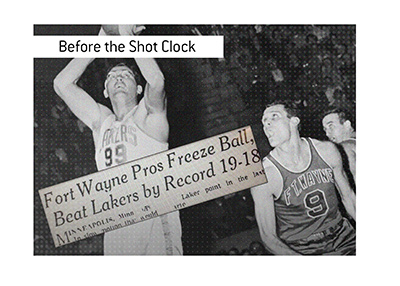
November 22, 1950: Pistons 19, Lakers 18

99: George Mikan. 9: Bob Harris.

November 22, 1950, 75 years ago: The worst game in NBA history is played. There were games that were sloppier, and games that had ugly brawls. But as far as quality of play is concerned, nothing will ever top this one -- or "bottom" it, if you prefer.

The Minneapolis Lakers were hosting the Fort Wayne Pistons at the Minneapolis Auditorium. The Lakers were representing Minnesota, the State known as "the Land of 10,000 Lakes," while the Pistons were owned by Fred Zollner, whose Fort Wayne, Indiana-based Zollner Corporation ran a foundry that manufactured pistons, primarily for car, truck and locomotive engines.

Both teams began play in the Midwest-based National Basketball League before entering the NBA. The Pistons won the NBL Championship in 1944 and 1945. The Lakers won it in 1948, then joined the NBA, and won their title in 1949 and 1950.

Coached by John Kundla, a Minneapolis native and University of Minnesota basketball star who wasn't much older than his players, the Lakers were led by George Mikan, at 6-foot-10 the professional game's 1st great big man. Before coming to the Lakers, he had helped Chicago's DePaul University win the NIT (then considered a more important competition than the NCAA Tournament) in 1944 and 1945. Earlier in 1950, despite being just 26 years old, the Associated Press named Mikan the greatest basketball player of the 1st half of the 20th Century.

(The AP's other honorees: Babe Ruth for baseball, Howie Morenz for hockey, Jack Dempsey for boxing, Bill Tilden -- despite his recent scandal -- for men's tennis, Suzanne Lenglen for women's tennis, Man o' War as the greatest racehorse; and Jim Thorpe for football and track and field, and as greatest athlete overall.)

Mikan wasn't fast or graceful: In 1969, longtime New York sportscaster Bill Mazer wrote, "He was more like a stampeding elephant"; while Boston Globe columnist Bob Ryan said on a 1996 ESPN panel, "Great player in his time. Deserved every accolade he ever got. But, today? He's Greg Kite with a hook shot."

The Lakers had other players who would make the Hall of Fame: Jim Pollard jumped around the court so much, he had the nickname "the Kangaroo Kid" years before Billy Cunningham of the Philadelphia 76ers did; while Slater Martin and Vern Mikkelsen were also among the best players in the game. Kundla would also eventually be elected to the Hall, and lived to be 100, outliving each of these players.

The Lakers' game was simple: Find an outside shot, and, if you can't, get the ball to Mikan and let him shoot over everybody. So, Pistons coach Murray Mendenhall decided that the only way to win the game was to make sure that Mikan doesn't get the ball. And the way to do that was to hold onto possession for as long as possible. In other words, or other word: Stall.

A crowd of 7,021 saw this: The Pistons leading 8-7 at the end of the 1st quarter, the Lakers leading 13-11 at the half, and the Lakers leading 17-14 at the end of the 3rd quarter. The crowd, hoping to see Mikan do his stuff, knew what the Pistons are trying, and they booed vociferously.

The Lakers scored only 1 point in the 4th quarter, but were still leading 18-17 with 6 seconds left in regulation, with Mikan having scored 15 of their points, including all of their field goals, 4 in 11 attempts. The rest came from 3 free throws: The other Lakers shot 0-for-6 from the field.

On the game's final play, unable to stall any longer, Pistons rookie Larry Foust took an inbounds pass, and laid it up over Mikan's outstretched arms. Mikan couldn't stop the shot, and it went in. Final score: Pistons 19, Lakers 18.

Point totals: Pistons: John Oldham 4, Curly Armstrong 4, Foust 3, Fred Schaus 3, John Hargis 2, Jack Kerris 2, Bob Harris 0, Ralph Johnson 0; Lakers: Mikan 15, Bob Harrison 2, Pollard 1, and none for Martin, Mikkelsen, Arnie Ferrin, Joe Hutton, and Bud Grant. Yes, football fans, the same Bud Grant who made the Pro Football Hall of Fame for leading the Minnesota Vikings into 4 Super Bowls (but losing them all).

Kundla told the sportswriters, "Play like that will kill professional basketball." But teams found the Lakers' weakness: Hold on to possession, and you can beat them. The 1950-51 NBA Championship was won by the Rochester Royals.

Kundla got his team to bounce back, winning the NBA Championship in 1952, 1953 and 1954. Then Mikan retired, and they didn't win another title until 1972 -- and not in Minneapolis.

Mikan's timing may have been absolutely right: For the 1954-55 season, the NBA adopted the 24-second shot clock. Stalling was no longer possible. Other teams, by necessity, needed faster players to copy the Lakers' now-useless fast break. For that reason, the aforementioned Bob Ryan said that 1954 is the demarcation line: When comparing great players and great teams in NBA history, you shouldn't put pre-1954 entries into the discussion, because they weren't really playing the same game.

The 19-18 game didn't kill pro hoops, but winning it didn't help the Pistons much. Although they reached the NBA Finals in 1955 and 1956, they didn't win either time. In 1957, accepting that Fort Wayne was too small a market in which to compete, Zollner moved the team to Detroit, the Motor City, where the Pistons name still made sense.

Murray Mendenhall lived until 1972, Fred Zollner until 1982, Larry Foust until 1984, and George Mikan until 2005.

Built in 1927, the Minneapolis Auditorium seated 10,545 people, and was home to the Lakers from 1947 to 1959. They played the 1959-60 season at the Minneapolis Armory, which still stands. After that season, they moved to Los Angeles, where the Lakers name didn't make sense. But they became L.A.'s most popular sports team, and remain so.

Since 1980, they have won 11 NBA Championships, the most of any team over that stretch. In total, in Minneapolis and Los Angeles combined, they have won 17, 2nd only to the Boston Celtics, with 18, for the most. One of those Laker titles came in 2002, when a questionable imbalance of fouls gave them the Western Conference title over the Sacramento Kings. That remains the closest the Kings franchise has come to the NBA Finals since... 1951, when they were the Rochester Royals, the team that briefly interrupted the Lakers' Minneapolis dynasty.

Since their respective moves, the Lakers and the Pistons have played each other in 3 NBA Finals. The Lakers won in 1988, the Pistons in 1989, and the Pistons in one of the great NBA Finals upsets in 2004.

Made obsolete by the construction of the Metropolitan Sports Center in suburban Bloomington in 1967, and more so by the plan to build the Target Center downtown (it opened in 1990), the Auditorium was demolished in 1988, and the Minneapolis Convention Center was built on the site. The Minnesota Timberwolves began play in 1989, playing their 1st season in the Metrodome before the Target Center was ready. They have not been a success: Only twice have they made the NBA Western Conference Finals, and they've lost both: 2004, to the Lakers; and 2024, to the Dallas Mavericks.

*

November 22, 1950 was a Wednesday, the day before Thanksgiving. Steven Van Zandt, who played guitar for Bruce Springsteen's E Street Band, and played consigliere Silvio Dante on The Sopranos, was born on this day.

There were 2 other games played in the NBA that night. The New York Knicks beat the Baltimore Bullets, 87-73 at the Baltimore Coliseum. And the Washington Capitols beat the Tri-Cities Blackhawks, 65-60 at the Uline Arena (now the Washington Coliseum).

Baseball was in the off-season. Football was in midweek. There were 2 NHL games played that night. The New York Rangers beat the Montreal Canadiens, 3-2 at the old Madison Square Garden. And the Toronto Maple Leafs beat the Chicago Black Hawks, 5-2 at Maple Leaf Gardens in Toronto. The Boston Bruins and the Detroit Red Wings were not scheduled.

In spite of the next day being Thanksgiving, a day on which the NBA generally doesn't play today, 5 games were played: New York 109, Washington 78; Philadelphia 89, Rochester 71; Boston 94, Tri-Cities 78; Indianapolis 92, Syracuse 85; and, in a rematch in Fort Wayne, Pistons 73, Lakers 63. So the 19-18 game was an aberration: The Pistons proved they could win while playing what then passed for normal basketball.

In the NHL on Thanksgiving 1950: Toronto 2, Detroit 1 in Detroit; and host Chicago 4, Boston 1. In the modern era, the NBA and the NHL avoid playing on Thanksgiving Day, so as not to compete with college and pro football, although there are usually some college basketball games on the day.

Among the college football games on T-Day '50: Number 12 Wyoming 42, the University of Denver 12 in Denver; Number 19 Washington & Lee 67, Richmond 7 in Richmond; Columbia 33, Brown 0 in Providence; Virginia Military Institute 27, Virginia Tech 0 in Roanoke; Missouri 20, Kansas 6 in Columbia; and Utah 46, Utah State 0 in Salt Lake City.

And in the NFL on T-Day '50: Detroit Lions 49, New York Yanks 14 at Briggs Stadium (Tiger Stadium) in Detroit; and Pittsburgh Steelers 28, Chicago Cardinals 17 at Comiskey Park in Chicago.

Saturday, November 1, 2025

November 1, 1950: The Attempted Assassination of President Harry Truman

November 1, 1950, 75 years ago: President Harry Truman faces an assassination attempt. The Truman family is staying at Blair House, across Pennsylvania Avenue from the White House, while the White House is being renovated. Oscar Collazo and Griselio Torresola, Puerto Rican independence activists, approached Blair House with guns, hoping that killing Truman would help their cause.
Blair House

Collazo shot D.C. police officer Donald Birdzell. He survived, and lived until 1991. Secret Service Agent Vincent Mroz heard this, came outside, and shot Collazo in the chest. He survived. Torresola shot White House Police Officer Leslie Coffelt. He then shot Officer Joseph Downs, but Downs was able to get up and secure a door into the house. He survived, and lived until 1978.

Torresola was reloading when Truman, having heard the shots, made a potentially terrible mistake, and looked outside his 2nd floor window, exposing him to the shooters. Secret Service Agents shouted at him to get away. He did.


Coffelt managed to return fire, hitting Torresola in the head and killing him instantly. But Coffelt was mortally wounded, and died 4 hours later. He was the 1st person ever to, as the Secret Service's saying goes, "take a bullet for the President."
Officer Leslie Coffelt

Collazo was convicted and sentenced to death. Truman, a World War I veteran who said he wasn't scared, because had already "been shot at by professionals," commuted Collazo's sentence to life imprisonment. In 1979, President Jimmy Carter further commuted his sentence to time served, which turned out to be 29 years. He returned to Puerto Rico, continued to support its independence, and died in 1994.

Truman served out his term until January 20, 1953, did not run for another, and retired to his home in Independence, Missouri, outside Kansas City. He died on December 26, 1972. Agent Mroz, who had played football at the University of Michigan, was the last survivor of the incident, living until 2008.

Trying to tie this event to more recent events: In 1948, the White House was seen to be in such poor condition that a major renovation was necessary. It took 4 years, including most of Truman's 2nd term, requiring him and his family to stay at Blair House, although the West Wing, including the Oval Office, were retained. It was done through proper channels, and not on the whim of the incumbent President. It wasn't like the recent demolition of the East Wing by Donald Trump.

Also, the assassination attempt on Truman was real, not staged.

Friday, October 31, 2025

October 31, 1950: The NBA's 1st Black Player

Earl Lloyd

October 31, 1950, 75 years ago: The Rochester Royals defeat the Washington Capitols, 78-70, at the Edgerton Park Arena in Rochester. (It was demolished in the late 1950s.) Arnie Risen scores 20 for the home team, as they begin a season that will bring their 1st NBA Championship.

They had previously won the title in the National Basketball League in 1945. They will become the Cincinnati Royals in 1957, the Kansas City Kings in 1972, and the Sacramento Kings in 1985. Their long-term future in Sacramento is now settled, as they've opened a new arena.


Earl Lloyd, a forward wearing Number 11, scores 2 baskets and 2 free throws for the Capitols, for a total of 6 points. It doesn't sound like much, but his mere presence in the game makes him the NBA's 1st black player.
Chuck Cooper had been the 1st black player drafted, by the Boston Celtics. But, the way the schedule worked out, Earl beat him to the court by 1 day. Chuck should not be confused with another early black star, Charles "Tarzan" Cooper, who played for the New York Renaissance (a.k.a. the Rens) in the 1930s. 
Chuck Cooper
Nat "Sweetwater" Clifton, formerly of the Rens and the Harlem Globetrotters, had been the 1st black player actually signed to a contract, by the New York Knicks, but Earl beat him to the court by 4 days. So, in a way, the NBA had 3 "Jackie Robinsons."
Nat Clifton

Earl Lloyd was born on April 3, 1928 in Alexandria, Virginia, across the Potomac River from Washington, D.C. His hometown team, having fired coach Red Auerbach in 1949, was 10-25 on January 9, 1951, and folded, leaving the nation's capital without an NBA team for the next 22 years. Lloyd was then drafted, and served in the Korean War.

Discharged in 1952, "the Big Cat" (also the nickname of Baseball Hall-of-Famer Johnny Mize, then wrapping up his career with the Yankees) played for the Syracuse Nationals until 1958, and the Detroit Pistons from then until his retirement in 1960. He averaged 8.4 points per game in his 9 NBA seasons. The Pistons then hired him as a scout.
In 1968, they named him the 1st black assistant coach in the NBA. In 1972, they named him the 2nd black head coach, after Bill Russell of the Celtics, and the 1st non-playing black head coach. But the Pistons were awful then, and his career coaching record was just 22-55.
He worked for the Detroit school system, helping students find jobs, then did the same thing for a company run by Pistons Hall-of-Famer Dave Bing. He retired to Tennessee. In 2003, the Basketball Hall of Fame elected him as a "contributor," for his historical prominence.
In 2007, T.C. Williams High School, the integrated Alexandria school into which his former all-black school, Parker-Gray, had been consolidated (a tale told, with considerable dramatic license taken, in the football-themed film Remember the Titans), named their new gym's court after him. He was also elected to the Virginia Sports Hall of Fame, and died on February 26, 2015, a few weeks short of his 87th birthday.

Thursday, October 16, 2025

October 16, 1950: O'Malley vs. Rickey, and the Brooklyn Dodgers' Fate Is Sealed

Branch Rickey

October 16, 1950, 75 years ago: Branch Rickey's contract as president, and de facto general manager, of the Brooklyn Dodgers expires. He is still owner of 1/4 of the franchise. With the death of quarter-owner John L. Smith, another quarter-owner, Walter O'Malley, buys Smith's share from his heirs, making him the largest owner: O'Malley 50 percent, Rickey 25 percent, and James Mulvey and his wife, Elizabeth "Dearie" Mulvey each having 12.5 percent.

Dearie was the daughter of Steve McKeever, who with his brother Ed ran the construction company that helped former sole owner Charlie Ebbets build Ebbets Field in 1912-13.

O'Malley knew he could dominate the Mulveys, and did so until he finally bought their children out in 1975. But he and Rickey were both very strong personalities, with little in common except being lawyers, cheapness, the Republican Party, the love of a good cigar, and the belief that they always had to be right.
Walter O'Malley

O'Malley hated everything about Rickey, including his favorite player, Jackie Robinson, and his favorite broadcaster, Red Barber; and would force Rickey, Robinson and Barber out of the organization -- all before moving the team, meaning he would have been a dirty bastard even if the team were still in Brooklyn to this day.

O'Malley offered to buy Rickey's quarter-share of the club. Seeing no reason to hold onto it -- he was not going to be offered a new contract as president, and thus would no longer have control over transactions and salaries -- Rickey decided to comply.

But Rickey knew a trick that O'Malley didn't know. He knew that an agreement in the Dodger partnership said that if any of the partners got an offer for their shares, and another partner wanted to buy, that other partner had to match the offer. Rickey found someone willing to pony up a million bucks, and so O'Malley had to pay through the nose: The $350,000 of '42 was worth $515,000 in inflation-adjusted dollars, while, in reverse, the $350,000 of '50 was worth just $237,000, so O'Malley was really offering Rickey a 54 percent loss. Instead, O'Malley had to pay Rickey a 104 percent profit.

Nevertheless, O'Malley got what he wanted: Control. From this day onward, the Brooklyn Dodgers were doomed. Over the next 7 years, O'Malley guided them to 4 National League Pennants, their only World Series win -- and their move from Brooklyn to Los Angeles. From his takeover in 1950 until his death in 1979, the Dodgers won 11 Pennants, including 4 World Series.

Today, Rickey's original '42 investment is worth $6.7 million, O’Malley's '50 offer $4.6 million, and Rickey's $1.05 million becomes $13.8 million. In 1969, O'Malley admitted his holdings in the Dodgers were worth $24 million, which is $208 million in 2025 dollars.

At his death in 1979, at which point his son Peter became owner, they were said to be worth $50 million, or today's $220 million. When Peter sold the Dodgers in 1998, it was for $311 million, or today's $621 million. When Magic Johnson bought the Dodger franchise, including Dodger Stadium, in 2012, the price was rumored to be about $2 billion, or today's $2.86 billion.

Rickey's son, Branch Rickey Jr. -- known as "Twig," but never to his face, or to his father's -- was already the Dodgers' farm director. After leaving the Dodgers, Branch Sr. was offered the position of general manager for the Pittsburgh Pirates. He took it, and took Branch Jr. with him to direct their farm system. Health problems forced Branch Sr. to retire in 1955, but his contributions, and those of Branch Jr., would help lead to a World Championship for Pittsburgh in 1960.

Oddly, Branch Jr., who had diabetes, died first, in 1961; Branch Sr. died in 1965. Branch Jr.'s son, Branch Barrett Rickey (never "Branch Rickey III," but that's what people call him), served as the president of the Pacific Coast League, having also worked in the Pirates' organization, and also in that of the Cincinnati Reds (which makes sense, since Branch Sr. was from Ohio). 

Tuesday, October 7, 2025

October 7, 1950: Bronx Bombers vs. Whiz Kids

The World Series programs sold at Shibe Park (left)
and at Yankee Stadium (right)

October 7, 1950, 75 years ago: The World Series comes to an end. It was considerably closer than the results would suggest.

The New York Yankees won the American League Pennant, but it wasn't a runaway: The Detroit Tigers finished 3 games back, the Boston Red Sox 4, and the Cleveland Indians 6. Casey Stengel had managed them to their 2nd straight Pennant, having led them to win the World Series the year before.

But the team was in transition, and the team's veterans, who had starred under manager Joe McCarthy and had been loyal to him, led by Joe DiMaggio, didn't get along with him. Piece by piece, Stengel and general manager George Weiss replaced them with Stengel-loyal men: Yogi Berra became the starting catcher, left fielder Charlie Keller was replaced by Gene Woodling, right fielder Tommy Henrich was replaced by Tommy Henrich, 2nd baseman George "Snuffy" Stirnweiss was replaced by Jerry Coleman and Billy Martin, and 1st baseman George McQuinn was replaced by Joe Collins.

Phil Rizzuto was still the team's shortstop, and the Queens native became a Yankee in large part because, when he tried out for his favorite team, the Brooklyn Dodgers, their manager told him he was too small. He held a grudge against that manager. His name was Casey Stengel. Stengel came to admire Rizzuto, but the feeling was never mutual. In 1950, Rizzuto was rightly named the AL's Most Valuable Player.

Stengel had also built a new starting rotation, with alternating styles: Righthanded fastball pitcher Allie Reynolds, a Native American known as the Superchief; lefthanded off-speed pitcher Eddie Lopat, known as Steddie Eddie and the Junkman; and righthanded fastball pitcher Vic Raschi, from Springfield, Massachusetts and known as the Springfield Rifle. Late in the season, a rookie lefthander from Queens was promoted, Eddie Ford, not yet widely known as Whitey, but he would become so due to his very light blond hair. Joe Page was the team's top relief pitcher.

It would take until the next season for Mickey Mantle to arrive, and another for him to replace DiMaggio in center field. Also in 1951, 3rd baseman Billy Johnson was replaced by Gil McDougald.

In the National League, the Philadelphia Phillies edged the defending Champion Brooklyn Dodgers on the last day of the season, October 1, when Dick Sisler, son of Hall-of-Famer George Sisler, hit a 10th-inning home run. Managed by Eddie Sawyer, the Phils were the youngest team, on the average, ever to win the NL Pennant.

The outfield was Del Ennis in left, Richie Ashburn in center, and Sisler in right. Like Ford, Ashburn had very light blond hair and was nicknamed Whitey, although it didn't catch on as much. Like Rizzuto, Ashburn was his team's sparkplug, a scrappy hitter and a fine defensive player. Also like Rizzuto, he went on to become a beloved broadcaster for the team, telling stories about the old days, wishing people happy birthdays, happy anniversaries, and get-wells. And, like Rizzuto, it took a long time for him to be elected to the Baseball Hall of Fame, but he did live long enough to enjoy it.

Eddie Waitkus played 1st base for the Phils, Mike Goliat was at 2nd, Granville "Granny" Hamner was at short, and Willie "Puddin' Head" Jones was at 3rd. Their catcher was Andy Seminick. Their pitching ace was Robin Roberts, and Jim Konstanty had such a good season, he became the 1st relief pitcher, in either League, to be awarded the MVP. Had there been a Cy Young Award at the time, he probably would have won that, too.

The Phillies hadn't won a Pennant in 35 years, since 1915, before television, before radio, before newsreels had sound. The City of Philadelphia hadn't won a Pennant in 19 years, since the 1931 Athletics, or a World Series in 20 years, since the 1930 A's, and the Phillies had never won one. So this was an exciting moment for the Delaware Valley.

But the Phillies had a problem: Their Number 2 starter, Curt Simmons, had been drafted into the Korean War. Their remaining starters weren't as well regarded. And Roberts was exhausted: He had lost a game on September 7 with 2 days' rest, won a complete game in his next start with 4, started and gone 7 innings of a 19-inning Phils win with 2, lost a complete game with 3, lost after 8 innings with 4, pitched 5 innings and lost with 3, pitched a complete game and lost the very next day, and pitched all 10 innings of the clincher with 2. For Game 1 of the World Series against the Yankees, at Shibe Park in Philadelphia, he would have only 2 days of rest, and Sawyer felt he couldn't risk him again so soon.

Sawyer told the press, "My starting pitcher is Jim Konstanty." He told them that it wasn't quite the gamble that it seemed, because Konstanty had pitched long relief during the season. He had pitched 10 innings of the 19-inning game on September 15, 9 innings in a 15-inning game on August 25, 5 innings on May 28, and at least 3 innings on 12 other occasions that season. Saywer had confidence in him.
Jim Konstanty

October 4, Game 1: The gamble nearly paid off: Konstanty was fantastic, pitching 8 innings, allowing only 1 run, in the top of the 4th. Bobby Brown led off with a double, Bauer hit a flyout that advanced Brown to 3rd base, and he scored on Coleman's sacrifice fly. But Raschi was even better, tossing a shutout with 2 hits and 1 walk, and the Yankees won, 1-0.

October 5, Game 2: This time, Sawyer started Roberts, on 3 days' rest. He somehow managed to hold the Yankees to a 1-1 tie. Both runs scored on sacrifice flies: The Yankees' in the top of the 2nd, Coleman scoring on Woodling's; the Phillies' in the bottom of the 5th, Goliat on Ashburn's.

The Phillies had their chance. With 1 out in the bottom of the 9th, Hamner doubled. Stengel ordered Reynolds, who had also gone the whole way, to intentionally walk Dick Whitman to set up the double play. It worked, as Goliat grounded into one.

Sawyer sent Roberts out to pitch the top of the 10th. His 1st pitch was to DiMaggio, who sent it into the upper deck of the long bleachers that extended from the left field pole to the center field corner at Shibe Park. (It was home to the Athletics from 1909 to 1954, the Phillies from 1938 to 1970, the NFL's Eagles from 1944 to 1957, and was renamed Connie Mack Stadium in 1953.) Roberts got the next 3 outs, but it was now 2-1 Yankees.
Joe DiMaggio

The Phils had one more chance. Sawyer sent Jackie Mayo to pinch-hit for Roberts, and Reynolds, pretty tired himself, walked him. Waitkus sacrificed him to 2nd. Ashburn popped up to 1st. The batter was Sisler. Could lightning strike for him again? Not this time: Reynolds found something left in his tank, and struck him out.

The Phillies had gotten courageous performances from their best starter and their best reliever, and had held the defending World Champions to 3 runs. But they were down two games to none.

October 6, Game 3: The action moved to Yankee Stadium. And, since the ballparks were only 105 miles apart, there was no day off for travel. In other words, presuming Sawyer wanted to give Roberts sufficient rest, he would have to wait until Game 6 to pitch him again, and then hope that somebody, or a collection of somebodies, could hold the Yankees off in Game 7 -- if it got that far.

For this game, Sawyer started Ken Heintzelman. Stengel started Lopat. At 3-9 with a 4.09 ERA, he was no Robin Roberts, no Curt Simmons, not even a Jim Konstanty. And with Shibe Park limited to 33,000 seats, the Bronx crowd of 64,505 might have been overwhelming to the Phillies.

But Heinztelman pitched very well. The Yankees took a 1-0 lead in the bottom of the 3rd, when Rizzuto scored on a Coleman single. The Phillies tied it in the top of the 6th, when Sisler singled Ennis home. They took the lead in the top of the 7th, when Goliat singled Hamner home. It was 2-1 Phillies.

Heintzelman got through the 7th, and got the 1st 2 outs in the bottom of the 8th. But he was out of gas. He walked the next 3 batters: Coleman, Berra and DiMaggio. Brown hit a grounder to Hamner at shortstop, and he mishandled it, allowing Coleman to score. Russ Meyer came in to relieve in the bottom of the 9th, and got the 1st 2 outs. But he allowed 3 straight singles: Woodling, Rizzuto, Coleman, the last of these scoring Woodling with the winning run. Yankees 3, Phillies 2.

The Phils had now played 3 games in this Series, and lost each of them by 1 run. They had held the Yankees to a combined 5 runs in 3 games, to no avail. For fans from Scranton in the north to Rehoboth Beach in the South, from Atlantic City in the east to Harrisburg in the west, this 1950 World Series must have seemed like rotten luck.

But a champion finds a way to win those games. The Yankees did. The "Whiz Kids" were hardly outclassed, but, against the more experience team, the defending World Champions, some of whom had been winning World Series going back more than a decade, they were outplayed.

October 7, Game 4: Ford started, and he outpitched Bob Miller. A Berra single and a DiMaggio double gave the Yankees a 2-0 lead in the 1st inning. In the 6th, Berra hit a home run, DiMaggio was hit by a pitch, Brown tripled him home, and Bauer hit a sacrifice fly to bring Brown home.

Ford took a 5-0 lead into the top of the 9th. But he allowed a leadoff single to Willie Jones, and hit Ennis with a pitch. No big deal, right? He got Sisler to ground into a force play, then struck Hamner out. One out to go, and there would be a sweep and another title.

The batter was Seminick. He hit an easy fly ball to left, where Woodling was under it. But the Autumn Sun combined with the roof of the pre-renovation old Yankee Stadium led to left field being difficult to play. As Berra would say in 1960, after switching positions with Elston Howard, who had become the 1st black Yankee in 1955, "It gets late early out there." Seminick's fly was easy, "a can of corn" in baseball lingo, and Woodling dropped it. Jones and pinch-runner Ken Johnson scored. It was 5-2.

Stengel came out to relieve Ford with Reynolds. The crowd of 68,098 started booing, and Ford thought they were booing him, for not finishing the job. But when he walked off the mound, they gave him a standing ovation, and he realized they were booing Stengel for taking him out. Reynolds then struck Stan Lopata out to end it.
Ford, congratulated after the game by Stengel

It was the 1st of 10 World Series games, still a record, won by Whitey, who would go on to be nicknamed "The Chairman of the Board." He liked that nickname, not so much because it rhymed with his surname, but because he was a big fan of the other celebrity with it, singer Frank Sinatra. For the rest of his life, Sinatra would remain friends with Ford, Rizzuto and Berra. But his once-strong friendship with DiMaggio would be ruined over Marilyn Monroe, and the 2 most famous Italian-Americans ever feuded until Sinatra's death in 1998.

Ford spent the next 2 years serving in the Korean War, but when he returned for the 1953 season, he became the Yankees' ace, the best starting pitcher the team has ever had, and one of the most beloved Yankees.

The Phillies had their chances in the 1950 World Series, but didn't make the most of them. They also did not hit a home run in the World Series, and this has not happened since.

As it turned out, the 1950 Phillies, the Whiz Kids, were the last all-white team to win the National League Pennant. The last one in the American League was the 1953 Yankees.

The Phillies did not reach the postseason again until 1976, and didn't win another Pennant until 1980, when they won their 1st World Series, beating the Kansas City Royals. They lost the World Series to the Baltimore Orioles in 1983, and to the Toronto Blue Jays in 1993. They won another in 2008, beating the Tampa Bay Rays; and lost it in 2009, to the Yankees, and in 2022, to the Houston Astros.

A Yankees-Phillies World Series remains possible as the 2025 season moves into the Division Series.

Thursday, October 2, 2025

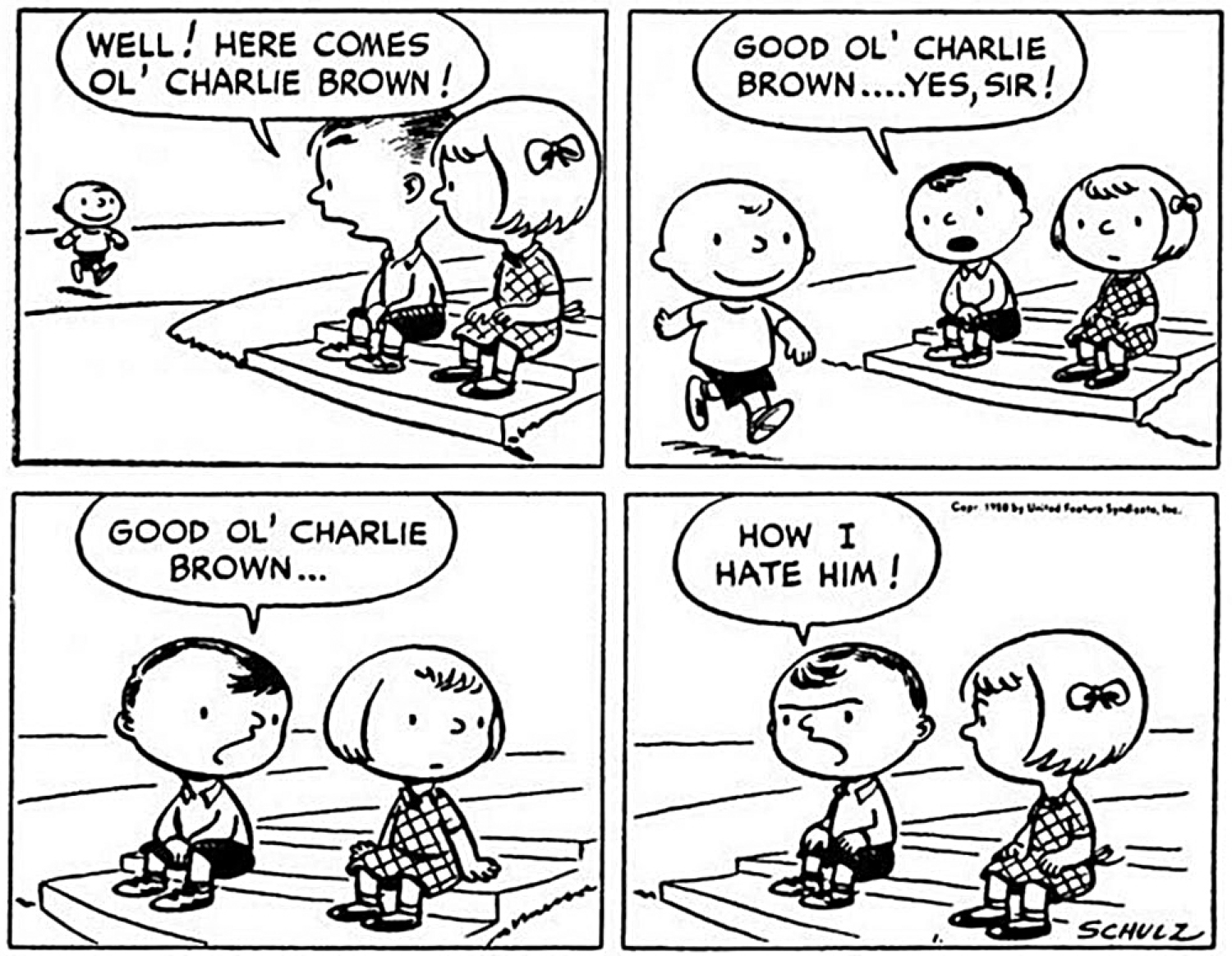
October 2, 1950: "Peanuts" Debuts

The first one

October 2, 1950, 75 years ago: The comic strip Peanuts debuts in national syndication, drawn by Charles M. Schulz. Within 10 years, it becomes the most popular comic strip of all time.

The series is based around Charlie Brown -- almost everybody addressed him by both his first and last names -- a boy with very little hair and even less luck. Nothing he does seems to work out. And the other kids in the neighborhood torment him, calling him things like, "You blockhead!" Leaving him to say things like, "Aaugh!" and "Rats!" and "Good grief!" and "I can't stand it!" and "My stomach hurts!" It never seemed to occur to anyone that an 8-year-old boy had an ulcer. (His age was once mentioned on one of the TV specials.)

He did have one true friend, Linus Van Pelt, philosophical beyond his years. Linus has an older sister, Lucy, described as "crabby" and a "fussbudget." She is physically and emotionally abusive to her brother, to Charlie Brown, and to the one other character who seemed to be a real friend to Charlie Brown, Schroeder, frequently threatening characters, "I'll slug you!" and sometimes actually doing it: "POW!" or "WHOP!" I wonder if the writers of the 1966-68 Batman TV series were inspired by this, along with various other Schulzian visualized sounds like "WHUMP!" and "KLUNK!"

Schroeder was a classical pianist in training on whom Lucy has a crush, but she strikes back when he makes in plain that he's just not that into her. His full name is never mentioned, and it's not clear whether Schroeder is his first name or his last name.

Lucy pretended to be a psychiatrist, diagnosing the neuroses of Charlie Brown and the others, mostly making things worse, and charging 5 cents. And, starting in 1952, it was an annual tradition for Lucy to hold a football for Charlie Brown to kick, for him to tell her he knew she would pull it away and send him flying and landing flat on his back, for her to come up with some new cockamamie excuse for why she wouldn't do it, for him to figuratively fall for it, for him to then literally fall for it, and for her to come up with some new cockamamie excuse for why her reason for not pulling it away did not apply.

In 2021, after watching the 1973 special A Charlie Brown Thanksgiving for the first time in many years, I realized something for the first time. The special begins with Lucy once again pulling the football away from Charlie Brown, but she doesn't get invited to Thanksgiving dinner at his house. Her brother Linus is invited, and even does some of the "cooking." But Lucy isn't invited. Whether intentional or not, Charlie Brown got his revenge on her.

Lucy's abuse of Linus led to him carrying a security blanket everywhere he went. Which made things worse between them. Many times, she stole his blanket, and it was like Superman being affected by kryptonite, as he felt weak without it. He always got it back, though.

Charlie Brown had a dog, Snoopy, who usually slept on top of his doghouse, did a dance when he was about to be fed (or thought he was), and imagined himself as various things: An athlete in various sports, a World War I flying ace, even an astronaut who beat everybody to the Moon: "I beat the Russians, I beat everybody! I even beat that stupid cat who lives next door!" Snoopy became the strip's "breakout character," becoming more popular even than Charlie Brown.

Charlie Brown had a baseball team that never won. Except when he wasn't available. He was the manager and the pitcher, and line drives hit back at him led to him dodging them, and his clothes flying off. Schroeder was his catcher. Snoopy at shortstop and Linus at 2nd base made a good double-play combination, the team's one strength. Lucy, the worst player, was stuck at the usual worst-player position in those days, right field. As a song by Peter, Paul and Mary put it, "Little leagues never have lefties that pull."

In 1966, Schultz introduced Peppermint Patty, a tomboy who, despite being a girl, was the best athlete in the neighborhood. Her best friend, Marcie, was introduced in 1971. Peppermint Patty and Marcie have been retroactively viewed as a gay couple, ignoring that they're just children. Both seem to have some affection for Charlie Brown, although Peppermint Patty does ridicule him sometimes. She calls Charlie Brown "Chuck." Marcie calls him "Charles," and calls Peppermint Patty "Sir." Peppermint Patty doesn't like that: "Stop calling me 'Sir'!"

In 1968, Schulz responded to the assassination of Martin Luther King by introducing the strip's first black character, Franklin. All the kids accepted him, and he accepted Charlie Brown as a real friend, never once mocking his lack of luck or athletic ability. His appearance touched on more than civil rights: He mentioned that his father was serving in Vietnam.

Franklin's last name was never mentioned in the strip, but a TV special made it Armstrong, in honor of Robb Armstrong, one of the earliest widely-known black cartoonists.

Schulz argued with Larry Rutman, then the president of King Features Syndicate, the distributor of the Peanuts comic strips to newspapers. Schulz said, “I remember telling Larry at the time about Franklin. He wanted me to change it, and we talked about it for a long while on the phone, and I finally sighed and said, “Well, Larry, let’s put it this way: Either you print it just the way I draw it or I quit. How’s that?” Rutman printed it just the way Schulz drew it.
So why didn't Schulz ever show Charlie Brown kicking the football, winning a baseball game, winning a spelling bee, or winning anything? He said, "Because winning is happy, but happy isn't funny."

In 1999, Schulz knew he was dying of cancer, and so he decided to wrap the strip up, rather than leaving it to his son or some other collaborator to do, as some other cartoonists had done with theirs. He set his last strip to go on Sunday, February 13, 2000, with a farewell message. He died the day before.

Wednesday, October 1, 2025

October 1, 1950: The Dick Sisler Game & Connie Mack's Farewell

October 1, 1950, 75 years ago: Dick Sisler hits a home run off Don Newcombe in the top of the 10th inning at Ebbets Field, and the Phillies beat the Brooklyn Dodgers 4-1, to clinch the National League Pennant. It is the only Pennant the Phils would win in a 65-year stretch from 1915 to 1980.

This was the 2nd of 3 straight seasons in which the National League race came down to the last day of the regular season with the Dodgers involved. The year before, they had to win to clinch and eliminate the St. Louis Cardinals, and they did. The year after, they had to win to force a Playoff with their arch-rivals, the New York Giants, and they did -- for all the good that ended up doing them.

Dodger pinch-hitter Tommy "Buckshot" Brown is the last living player from this game, 72 years later. For the Phillies, the last survivor, backup infielder Ralph "Putsy" Caballero, died in 2017. Bob Miller and Curt Simmons, neither of whom appeared in this game, are the last 2 living 1950 Whiz Kids.

Richard Alan Sisler was born on November 2, 1920 in St. Louis. His father was George Sisler of the St. Louis Browns, one of the best all-around players of his generation: A .340 lifetime hitter whose 1920 total of 257 hits stood as a major league record for 84 years, a 4-time American League leader in stolen bases, and, according to contemporary observers, the best-fieldling 1st baseman of his time.

His brother Dave Sisler would be a major league pitcher, and his brother George Sisler Jr. became a longtie baseball executive. Oddly, George Sr. was a scout for the Dodgers at the time, and was in the ballpark when Dick hit the home run. A reporter asked George how he felt, and he said, "I felt awful and terrific at the same time."

A 1st baseman and left fielder, Dick debuted with the Cardinals in 1946, contributing to a World Series-winning team a a rookie. He was traded to the Phillies in 1948. That 1950 season was his only selection to the All-Star Game. He was traded to the Cincinnati Reds in 1952, and back to the Cardinals later that year, last playing in the majors with them in 1953. He finished his career with a .276 batting average, and just 55 home runs, but 1 of them won a Pennant.

Dick went into coaching, and won another Pennant in 1961, on the staff of Fred Hutchinson of the Cincinnati Reds. When Hutchison left the team late in the 1964 season due to cancer, Dick stepped in as interim manager. Ironically, his Reds were a big reason why his former team, the Phillies, did not win the Pennant that season. But it was his other former team, the Cardinals, who did.

When Hutch died, Dick was named the official manager, and won 89 games in 1965, but was fired after the season, anyway. The Cardinals brought him onto the coaching staff of his former teammate Red Schoendienst, and, together, they won the 1967 World Series, and lost the 1968 World Series. He later coached for the San Diego Padres and, in 1979 and '80, under Joe Torre on the Mets.
He spent most of the 1980s working in the Cardinal farm system, helping to build a team that won 3 Pennants and the 1982 World Series. He died on November 20, 1998, at the age of 78.

The Dick Sisler Game was is also the last major league game as a manager for Burt Shotton, who'd managed the Dodgers to Pennants in 1947 and 1949, and eased the path of Jackie Robinson as he and general manager ranch Rickey reintegrated baseball.
An outfielder, Shotton had played in the major leagues from 1909 to 1923, including 1915 to 1917 with the St. Louis Browns, where he was a teammate of George Sisler -- hence, George's scouting for the Dodgers. Shotton had previously managed the Phillies from 1928 to 1933, and the Reds in 1934, and had also coached for the Cardinals and the Cleveland Indians.

He left the Indians after the 1945 season. When Rickey needed a manager for 1947 after Leo Durocher's yearlong suspension, he asked for Shatoon, who told Rickey, "I romised my wife I would never put on another uniform." So Rickey talked him into managing in a suit, like Connie Mack.

Speaking of whom...

Also on this day, the Philadelphia Athletics complete a massively disappointing 102-loss season by beating the Washington Senators, 5-3 at Shibe Park. It is the last game for A's manager Connie Mack: Approaching his 88th birthday, his sons Earle, Roy and Connie Jr., agreeing on little else, agree to gang up on him and force him to finally retire as manager -- something he, as also the owner, did not want to do.

Before the A's move to Kansas City, the Phillies, new owners of the ballpark, will rename it Connie Mack Stadium, and will erect a statue of him outside.

Having first played in what we would now call Major League Baseball in 1886, the 1st term of Grover Cleveland, and made it to 1950, the 2nd term of Harry Truman, Connie Mack was involved in 4,490 regular-season games, far and away a major league record. (Vin Scully was on hand for 10,766 games over 67 seasons, but that was as a broadcaster.)
Shotton and Mack were the last managers to wear street clothes during a game. Although no rule specifically mandates that a manager must wear a uniform, there is now a rule that states that, aside from medical and security personnel, no one is allowed on the field of play during a game unless they are wearing some form of baseball uniform.

Pitcher Bobby Shantz is the last living man to have been managed by Connie Mack, and the last player to have played for the Philadelphia Athletics, 75 years after Mack's last game, and 71 years after the A's moved to Kansas City.

Tuesday, September 16, 2025

September 16, 1950: The Cleveland Browns Announce Their Presence

Marion Motley carrying the ball -- painted white,
to be more visible in a night game. This did not catch on.

September 16, 1950, 75 years ago: The National Football League features a season-opening game between their defending Champions and those of a newly-defunct rival league.

The game was played at the 105,000-seat Municipal Stadium in South Philadelphia. Usually playing their home games at Shibe Park in North Philadelphia, the Philadelphia Eagles had played home games at Municipal Stadium from 1936 to 1939, and select games thereafter.
Municipal Stadium, by this point named John F. Kennedy Stadium.
Just to the north was The Spectrum; to the north of that, Veterans Stadium.

This game was, as soccer fans would call it, a "Charity Shield" or "Super Cup" game: The 2-time defending NFL Champion Eagles vs. the Cleveland Browns, 4-time titlists in the All-America Football Conference. The Browns were 47-4-3 over the AAFC's 4-season history; the Eagles, 22-3-1 over the last 2 years, thanks to a 5-2 alignment that was the 1st defensive unit to have a memorable nickname: Before San Diego, Detroit and Los Angeles had lines that became known as the Fearsome Foursome, Philly had the Suicide Seven.

Some people then called it "The Game of the Century," and some now think of as an unofficial "first Super Bowl." Such a name is ironic, since it took the Eagles until 2018 to win an NFL Championship in the Super Bowl era, and, through the 2024 season, the Browns haven't even been to a Super Bowl yet.

Playing on a Saturday night -- making it, sort of, not just "the 1st Super Bowl" but "the 1st Monday Night Football game" -- in front of 71,237 fans, still the largest crowd ever to watch a professional football game in Pennsylvania (and nearly double the capacity of Shibe Park, which really limited the Eagles' attendance), the Browns put on a show.

Paul Brown, having mastered his craft at every level below the NFL -- at Massillon High School outside Cleveland, at Ohio State University where he won the 1942 National Championship, and with the Browns in the AAFC -- was the greatest offensive mind the game of football had yet seen. With Otto Graham as his quarterback, passing to Dante Lavelli, Mac Speedie and Dub Jones, and with the acceptance of black players like fullback Marion Motley and guard Bill Willis, he had won those 4 AAFC titles.
Paul Brown

(The Browns were named for Paul Brown. The story that Brown, or the original owner, Arthur B. McBride, wanted to name the team the Cleveland Brown Bombers in honor of Joe Louis, then the Heavyweight Champion of the World, is a myth. McBride had run a fan contest to determine the name, and the winner was "Cleveland Panthers," who played from 1919 to 1933, including in the 1st American Football League in 1926, but Paul Brown called them a failed team that he wanted no part of. So, over Brown's objection, McBride named them the Browns.)

And that Saturday night in South Philly, Brown let his team put on a show. The Eagles took an early lead on a field goal by Cliff Patton. But Graham threw freely, and the Browns scored the next 4 touchdowns: A 59-yard pass from Graham to Jones, a 26-yard pass from Graham to Lavelli, a 13-yard pass from Graham to Speedie (that was his real name: He was born Mac Curtis Speedie), and a 1-yard run by Graham.

It was 7-3 Browns at the end of the 1st quarter, 14-3 Browns at the half, 21-3 Browns after 3 quarters, and 28-3 Browns before Bill Mackrides threw a touchdown pass to Pete Pihos to get the Eagles into double figures. Late in the game, Rex Bumgardner ran for a touchdown, making the final score Browns 35, Eagles 10. To borrow a line from Bull Durham, a movie from another sport, the Browns had announced their presence with authority.

The Eagles actually had more 1st downs, 24-23; more rushing yards, 148-141; and fewer penalties, 3 for 45 yards to the Browns' 12 for 98 yards. And there were plenty of turnovers on both sides: 5 for Philadelphia, 4 for Cleveland.

But Graham completed 21 of 38 passes for 346 yards, a display that NFL fans, even with Sid Luckman of the Chicago Bears and Sammy Baugh of the Washington Redskins still active, simply weren't used to. It forced the Eagles into the air: Between them, Mackrides and Tommy Thompson attempted 32 passes, but only completed 11.
Until 1951, the Browns wore white helmets,
and Otto Graham wore Number 60. After that,
he switched to 14, and the Browns have worn
orange helmets ever since.

The performance stunned football fans all over the nation. Eagle coach Earle "Greasy" Neale was contemptuous of the aerial assault, calling the Browns "a basketball team." When the teams met again on December 3 at Cleveland Municipal Stadium, Brown told Graham not to throw a single pass, just to make a point, and he didn't. And the Browns didn't score a single offensive touchdown. They didn't need to: Warren Lahr intercepted a Thompson pass, and returned it 30 yards for a touchdown, while Lou Groza added 2 field goals, and the Browns won, 13-7. Brown had a great defense, too.

The Eagles never recovered, going 6-6, and didn't reach the NFL Championship Game again for 10 years. The Browns won the NFL title that year, and appeared in 7 title games in 8 years, winning 3: 1950, 1954 and 1955. Brown and 8 of his 1950 Browns would be elected to the Pro Football Hall of Fame: Graham, Motley, Groza, Lavelli, Speedie, Willis, end Len Ford and center Frank Gatski.

Paul Brown would be fired by new team owner Art Modell after the 1962 season. Cleveland fans treated this as the 1st time Modell aggrieved them, and it would be far from the last, or the worst. In 1968, Brown founded a team in the American Football League, the Cincinnati Bengals. He tried to remake the team in the old Browns' image, using the same colors and the same offense. They even had the same initials, although there had been a previous team with the Cincinnati Bengals name, which played in the 2nd (1936-37) and 3rd (1940-41) leagues with the AFL name.

Don McCafferty (1970 NFL Champion Colts) coached under him at Ohio State. Among his coaches with the Browns were Weeb Ewbank (1958 and '59 NFL Champion Baltimore Colts, 1968 World Champion New York Jets), Blanton Collier (his replacement as Brown coach, 1964 NFL Champions), Lou Saban (1964 and '65 AFL Champion Buffalo Bills) and Don Shula (1968 NFL Champion Colts, 1972 and '73 NFL Champion Miami Dolphins). Among his coaches with the Bengals were Bill Walsh and Sam Wyche (who, among their other achievements, opposed each other in Super Bowl XXIII in 1989).

Take it to the next level, and his "3rd generation" coaches include Red Miller (1977 AFC Champion Denver Broncos), Howard Schenllenberger (1983 NCAA Champion Miami), Dick MacPherson (undefeated season with Syracuse in 1987), George Seifert (1990 and '94 NFL Champion San Francisco 49ers), Paul Holmgren (1996 NFL Champion Green Bay Packers, 2005 AFC Champion Seattle Seahawks), Marty Schottenheimer (4 AFC Championship Games, although he lost them all), Tony Dungy (2006 NFL Champion Indianapolis Colts), Doug Pederson (2017 NFL Champion Philadelphia Eagles) and Andy Reid (2019, '22 and '23 NFL Champion Kansas City Chiefs).

Through Schottenheimer, his "coaching tree" also includes Bill Cowher (2005 NFL Champion Pittsburgh Steelers), Lovie Smith (2006 NFC Champion Chicago Bears), Mike Tomlin and Ken Whisehunt (who, among their other achievements, opposed each other in Super Bowl XLIII in 2009), Mike McCarthy (2010 NFL Champion Packers), Gary Kubiak (2015 NFL Champion Broncos) and Bruce Arians (2020 NFL Champion Tampa Bay Buccaneers). So Brown's NFL legacy spans that much: 1950 to 2023, including 24 of the 1st 59 Super Bowls, and 27 of the last 75 NFL Championships.

The Browns won the 1964 NFL Championship under Collier, reached the NFL Championship Game in 1968 and '69, and reached the AFC Championship Game in 1986, '87 and '89. After the 1995 season, Modell moved them, and they became the Baltimore Ravens. Cleveland was granted a replacement team, and the new Browns began in 1999. They have mostly struggled since. As have the Bengals, although they have won AFC Championships in 1981, 1988 and 2021.

Paul Brown died in 1991. When the Bengals moved into a new stadium for the 2000 season, it was named Paul Brown Stadium. It held that name until Paul's son, Mike Brown, often ridiculed as one of the NFL's cheapest owners (hence, their struggles), finally took his father's name off the stadium and sold the naming rights: In 2022, it became Paycor Stadium.

Speaking of stadiums: The Eagles moved to the University of Pennsylvania's Franklin Field in 1958, then returned to the South Philadelphia sports complex in Veterans Stadium in 1971, replacing that with Lincoln Financial Field in 2003. They won the NFL Championship in 1960, the NFC Championship in 1980 and 2004, and finally won a Super Bowl in the 2017 season.

In 1964, Philadelphia Municipal Stadium was renamed John F. Kennedy Stadium. On August 16, 1966, the Beatles played there. On July 13, 1985, it hosted the American end of Live Aid. But that show exposed to the world that it already falling apart. The Rolling Stones, who had packed the place on their 1981 Tattoo You tour, chose the considerably smaller Vet for Steel Wheels in 1989. It was demolished in 1992, and the new arena opened on the site in 1996.