Showing posts with label robin roberts. Show all posts

Tuesday, October 7, 2025

October 7, 1950: Bronx Bombers vs. Whiz Kids

The World Series programs sold at Shibe Park (left)
and at Yankee Stadium (right)

October 7, 1950, 75 years ago: The World Series comes to an end. It was considerably closer than the results would suggest.

The New York Yankees won the American League Pennant, but it wasn't a runaway: The Detroit Tigers finished 3 games back, the Boston Red Sox 4, and the Cleveland Indians 6. Casey Stengel had managed them to their 2nd straight Pennant, having led them to win the World Series the year before.

But the team was in transition, and the team's veterans, who had starred under manager Joe McCarthy and had been loyal to him, led by Joe DiMaggio, didn't get along with him. Piece by piece, Stengel and general manager George Weiss replaced them with Stengel-loyal men: Yogi Berra became the starting catcher, left fielder Charlie Keller was replaced by Gene Woodling, right fielder Tommy Henrich was replaced by Tommy Henrich, 2nd baseman George "Snuffy" Stirnweiss was replaced by Jerry Coleman and Billy Martin, and 1st baseman George McQuinn was replaced by Joe Collins.

Phil Rizzuto was still the team's shortstop, and the Queens native became a Yankee in large part because, when he tried out for his favorite team, the Brooklyn Dodgers, their manager told him he was too small. He held a grudge against that manager. His name was Casey Stengel. Stengel came to admire Rizzuto, but the feeling was never mutual. In 1950, Rizzuto was rightly named the AL's Most Valuable Player.

Stengel had also built a new starting rotation, with alternating styles: Righthanded fastball pitcher Allie Reynolds, a Native American known as the Superchief; lefthanded off-speed pitcher Eddie Lopat, known as Steddie Eddie and the Junkman; and righthanded fastball pitcher Vic Raschi, from Springfield, Massachusetts and known as the Springfield Rifle. Late in the season, a rookie lefthander from Queens was promoted, Eddie Ford, not yet widely known as Whitey, but he would become so due to his very light blond hair. Joe Page was the team's top relief pitcher.

It would take until the next season for Mickey Mantle to arrive, and another for him to replace DiMaggio in center field. Also in 1951, 3rd baseman Billy Johnson was replaced by Gil McDougald.

In the National League, the Philadelphia Phillies edged the defending Champion Brooklyn Dodgers on the last day of the season, October 1, when Dick Sisler, son of Hall-of-Famer George Sisler, hit a 10th-inning home run. Managed by Eddie Sawyer, the Phils were the youngest team, on the average, ever to win the NL Pennant.

The outfield was Del Ennis in left, Richie Ashburn in center, and Sisler in right. Like Ford, Ashburn had very light blond hair and was nicknamed Whitey, although it didn't catch on as much. Like Rizzuto, Ashburn was his team's sparkplug, a scrappy hitter and a fine defensive player. Also like Rizzuto, he went on to become a beloved broadcaster for the team, telling stories about the old days, wishing people happy birthdays, happy anniversaries, and get-wells. And, like Rizzuto, it took a long time for him to be elected to the Baseball Hall of Fame, but he did live long enough to enjoy it.

Eddie Waitkus played 1st base for the Phils, Mike Goliat was at 2nd, Granville "Granny" Hamner was at short, and Willie "Puddin' Head" Jones was at 3rd. Their catcher was Andy Seminick. Their pitching ace was Robin Roberts, and Jim Konstanty had such a good season, he became the 1st relief pitcher, in either League, to be awarded the MVP. Had there been a Cy Young Award at the time, he probably would have won that, too.

The Phillies hadn't won a Pennant in 35 years, since 1915, before television, before radio, before newsreels had sound. The City of Philadelphia hadn't won a Pennant in 19 years, since the 1931 Athletics, or a World Series in 20 years, since the 1930 A's, and the Phillies had never won one. So this was an exciting moment for the Delaware Valley.

But the Phillies had a problem: Their Number 2 starter, Curt Simmons, had been drafted into the Korean War. Their remaining starters weren't as well regarded. And Roberts was exhausted: He had lost a game on September 7 with 2 days' rest, won a complete game in his next start with 4, started and gone 7 innings of a 19-inning Phils win with 2, lost a complete game with 3, lost after 8 innings with 4, pitched 5 innings and lost with 3, pitched a complete game and lost the very next day, and pitched all 10 innings of the clincher with 2. For Game 1 of the World Series against the Yankees, at Shibe Park in Philadelphia, he would have only 2 days of rest, and Sawyer felt he couldn't risk him again so soon.

Sawyer told the press, "My starting pitcher is Jim Konstanty." He told them that it wasn't quite the gamble that it seemed, because Konstanty had pitched long relief during the season. He had pitched 10 innings of the 19-inning game on September 15, 9 innings in a 15-inning game on August 25, 5 innings on May 28, and at least 3 innings on 12 other occasions that season. Saywer had confidence in him.
Jim Konstanty

October 4, Game 1: The gamble nearly paid off: Konstanty was fantastic, pitching 8 innings, allowing only 1 run, in the top of the 4th. Bobby Brown led off with a double, Bauer hit a flyout that advanced Brown to 3rd base, and he scored on Coleman's sacrifice fly. But Raschi was even better, tossing a shutout with 2 hits and 1 walk, and the Yankees won, 1-0.

October 5, Game 2: This time, Sawyer started Roberts, on 3 days' rest. He somehow managed to hold the Yankees to a 1-1 tie. Both runs scored on sacrifice flies: The Yankees' in the top of the 2nd, Coleman scoring on Woodling's; the Phillies' in the bottom of the 5th, Goliat on Ashburn's.

The Phillies had their chance. With 1 out in the bottom of the 9th, Hamner doubled. Stengel ordered Reynolds, who had also gone the whole way, to intentionally walk Dick Whitman to set up the double play. It worked, as Goliat grounded into one.

Sawyer sent Roberts out to pitch the top of the 10th. His 1st pitch was to DiMaggio, who sent it into the upper deck of the long bleachers that extended from the left field pole to the center field corner at Shibe Park. (It was home to the Athletics from 1909 to 1954, the Phillies from 1938 to 1970, the NFL's Eagles from 1944 to 1957, and was renamed Connie Mack Stadium in 1953.) Roberts got the next 3 outs, but it was now 2-1 Yankees.
Joe DiMaggio

The Phils had one more chance. Sawyer sent Jackie Mayo to pinch-hit for Roberts, and Reynolds, pretty tired himself, walked him. Waitkus sacrificed him to 2nd. Ashburn popped up to 1st. The batter was Sisler. Could lightning strike for him again? Not this time: Reynolds found something left in his tank, and struck him out.

The Phillies had gotten courageous performances from their best starter and their best reliever, and had held the defending World Champions to 3 runs. But they were down two games to none.

October 6, Game 3: The action moved to Yankee Stadium. And, since the ballparks were only 105 miles apart, there was no day off for travel. In other words, presuming Sawyer wanted to give Roberts sufficient rest, he would have to wait until Game 6 to pitch him again, and then hope that somebody, or a collection of somebodies, could hold the Yankees off in Game 7 -- if it got that far.

For this game, Sawyer started Ken Heintzelman. Stengel started Lopat. At 3-9 with a 4.09 ERA, he was no Robin Roberts, no Curt Simmons, not even a Jim Konstanty. And with Shibe Park limited to 33,000 seats, the Bronx crowd of 64,505 might have been overwhelming to the Phillies.

But Heinztelman pitched very well. The Yankees took a 1-0 lead in the bottom of the 3rd, when Rizzuto scored on a Coleman single. The Phillies tied it in the top of the 6th, when Sisler singled Ennis home. They took the lead in the top of the 7th, when Goliat singled Hamner home. It was 2-1 Phillies.

Heintzelman got through the 7th, and got the 1st 2 outs in the bottom of the 8th. But he was out of gas. He walked the next 3 batters: Coleman, Berra and DiMaggio. Brown hit a grounder to Hamner at shortstop, and he mishandled it, allowing Coleman to score. Russ Meyer came in to relieve in the bottom of the 9th, and got the 1st 2 outs. But he allowed 3 straight singles: Woodling, Rizzuto, Coleman, the last of these scoring Woodling with the winning run. Yankees 3, Phillies 2.

The Phils had now played 3 games in this Series, and lost each of them by 1 run. They had held the Yankees to a combined 5 runs in 3 games, to no avail. For fans from Scranton in the north to Rehoboth Beach in the South, from Atlantic City in the east to Harrisburg in the west, this 1950 World Series must have seemed like rotten luck.

But a champion finds a way to win those games. The Yankees did. The "Whiz Kids" were hardly outclassed, but, against the more experience team, the defending World Champions, some of whom had been winning World Series going back more than a decade, they were outplayed.

October 7, Game 4: Ford started, and he outpitched Bob Miller. A Berra single and a DiMaggio double gave the Yankees a 2-0 lead in the 1st inning. In the 6th, Berra hit a home run, DiMaggio was hit by a pitch, Brown tripled him home, and Bauer hit a sacrifice fly to bring Brown home.

Ford took a 5-0 lead into the top of the 9th. But he allowed a leadoff single to Willie Jones, and hit Ennis with a pitch. No big deal, right? He got Sisler to ground into a force play, then struck Hamner out. One out to go, and there would be a sweep and another title.

The batter was Seminick. He hit an easy fly ball to left, where Woodling was under it. But the Autumn Sun combined with the roof of the pre-renovation old Yankee Stadium led to left field being difficult to play. As Berra would say in 1960, after switching positions with Elston Howard, who had become the 1st black Yankee in 1955, "It gets late early out there." Seminick's fly was easy, "a can of corn" in baseball lingo, and Woodling dropped it. Jones and pinch-runner Ken Johnson scored. It was 5-2.

Stengel came out to relieve Ford with Reynolds. The crowd of 68,098 started booing, and Ford thought they were booing him, for not finishing the job. But when he walked off the mound, they gave him a standing ovation, and he realized they were booing Stengel for taking him out. Reynolds then struck Stan Lopata out to end it.
Ford, congratulated after the game by Stengel

It was the 1st of 10 World Series games, still a record, won by Whitey, who would go on to be nicknamed "The Chairman of the Board." He liked that nickname, not so much because it rhymed with his surname, but because he was a big fan of the other celebrity with it, singer Frank Sinatra. For the rest of his life, Sinatra would remain friends with Ford, Rizzuto and Berra. But his once-strong friendship with DiMaggio would be ruined over Marilyn Monroe, and the 2 most famous Italian-Americans ever feuded until Sinatra's death in 1998.

Ford spent the next 2 years serving in the Korean War, but when he returned for the 1953 season, he became the Yankees' ace, the best starting pitcher the team has ever had, and one of the most beloved Yankees.

The Phillies had their chances in the 1950 World Series, but didn't make the most of them. They also did not hit a home run in the World Series, and this has not happened since.

As it turned out, the 1950 Phillies, the Whiz Kids, were the last all-white team to win the National League Pennant. The last one in the American League was the 1953 Yankees.

The Phillies did not reach the postseason again until 1976, and didn't win another Pennant until 1980, when they won their 1st World Series, beating the Kansas City Royals. They lost the World Series to the Baltimore Orioles in 1983, and to the Toronto Blue Jays in 1993. They won another in 2008, beating the Tampa Bay Rays; and lost it in 2009, to the Yankees, and in 2022, to the Houston Astros.

A Yankees-Phillies World Series remains possible as the 2025 season moves into the Division Series.

Thursday, April 3, 2014

St. Louis' All-Time Baseball Team

The St. Louis Cardinals' "territory" is spread over several States, although not as many as there used to be. In the pre-expansion era, powerful radio station KMOX broadcast the Cards' games over about 75 percent of the country. As both the Westernmost team in the majors until 1955, and the Southernmost until 1962, Cardinal fans are still all over the South despite the Atlanta Braves and the Florida and Texas teams, and all over the Midwest despite the arrival of teams in Kansas City, Minnesota and even Colorado.

Today, however, their region is pretty much "limited" to Eastern Missouri, Southeastern Iowa, Southern Illinois, Southwestern Indiana, the Western edges of Kentucky and Tennessee (Memphis' Elvis Presley was a big Cards fan), Northern Mississippi and Northeastern Arkansas.

I grew up in Central Illinois, about halfway between Chicago and St. Louis, and I made a historic blunder: All my friends became Cardinal fans and grew up happy and liberal, and I became a Cub fan and grew up embittered and conservative.
-- George Will, nationally-syndicated columnist for the Washington Post and author of two books about baseball.

He grew up in Champaign, as his father was a professor at the University of Illinois. The campus is 144 miles from Wrigley Field, 134 miles from U.S. Cellular Field, 173 miles from Busch Stadium, and 236 miles from Cincinnati's Great American Ballpark. So he had other choices he could have made.

However, traditionally, Cub fans have been rather liberal, while Cardinal fans have usually been conservative. This is not written in stone, though: Bill Clinton, a liberal who grew up in Hot Springs, Arkansas, 415 miles from St. Louis, and Rush Limbaugh, a right-wing fanatic who grew up in Cape Girardeau, Missouri, 119 miles away, are both big Cardinal fans. (No wonder Bill and Hillary "had problems in their marriage": Hillary grew up in Park Ridge, Illinois, just 12 miles from Wrigley, and was a Cub fan -- before she became a Yankee Fan!)

Anyway, here's...

2. St. Louis' All-Time Baseball Team

1B Gil Hodges of Princeton, Indiana. Putting aside for a moment the fact that he managed the New York Mets, for crying out loud, to a World Series win, he is one of the players not in the Hall of Fame who most deserves it. He had a career OPS+ of 120, the first 3 Gold Gloves given to National League first basemen (the first of which when he was already 33 years old), 7 straight 100-RBI seasons, and 370 home runs despite missing 3 seasons due to World War II.

At the time he played his last game, he was 11th on the all-time home run list, trailing only Jimmie Foxx and, just recently surpassed at that point, Willie Mays among righthanders (and Mickey Mantle if you count switch-hitters). He helped the Dodgers win 7 Pennants (6 in Brooklyn, 1 in Los Angeles) and 2 World Series (1 in each city). His Number 14 was retired by the Mets, but not by the Dodgers. There is no good reason to not have Hodges in the Hall.

St. Louis is loaded at 1st base for its history, having Honorable Mentions dishable out to St. Louis natives Roy Sievers and Ryan Howard (who may replace Hodges as the starter someday); 1890s hitting star and Hall-of-Famer Jake Beckley of Hannibal, Missouri; and Hodges' fellow Hoosier Don Mattingly of Evansville.

2B Red Schoendienst of Germantown, Illinois. A 10-time All-Star, he helped the Cardinals to win the World Series in 1946 and the Milwaukee Braves to do it in 1957, and another Pennant in '58. He suffered from tuberculosis and missed most of '59 and half of '60, or else the Braves might have won 4 straight Pennants. He led the NL in stolen bases as a rookie in 1945, doubles and sacrifice hits in 1950, and hits in 1957. His lifetime batting average was .289. He was never a home run hitter, but he collected 2,449 hits including 427 doubles in an illness-shortened playing career. 

He returned to the Cardinals as their manager, winning the 1967 World Series and the 1968 Pennant. He has occasionally returned as Cards' interim manager, such as during Ken Boyer's fatal illness. The Cards have retired his Number 2, and he is in the Hall of Fame.

SS Don Kessinger of Forrest City, Arkansas. A 6-time All-Star and a 3-time Gold Glove, the Chicago Cub shortstop was part of a few close-but-no-cigar finishes, and never appeared in the postseason. He was also, across town with the White Sox in 1979, the last player-manager in the American League.

Honorable Mention to John Richard Schofield and Richard Craig Schofield, both of Springfield, Illinois. Both major league players and both known as "Dick" and "Ducky," officially they are not "Senior" and "Junior." And neither can push Kessinger out of the starting lineup. However, with John Richard's grandson and Richard Craig's nephew, Jayson Werth, also reaching the majors, this is now a three-generation MLB family.

3B George Kell of Swifton, Arkansas. He's best known for just barely beating out Ted Williams for the AL batting title in 1949, thus denying him a record 3rd Triple Crown. In each of the next 2 seasons Kell led the AL in both hits and doubles. He was a 10-time All-Star, with a .306 lifetime batting average, and after his retirement returned to the Detroit Tigers to become one of many fine broadcasters for that franchise. In the Hall of Fame, although none of the numbers he wore has been retired (mainly wore 21 and 7).

The St. Louis region is also loaded at this position: Bill Madlock of Memphis, Tennessee; Gary Gaetti of Centralia, Illinois; Kevin Seitzer of Springfield, Illinois; and Scott Rolen of Evansville, Indiana, who might one day join Kell in the Hall of Fame, but the voters will have to take his fielding into account.

LF Walter "Hoot" Evers of Collinsville, Illinois. A Detroit teammate of Kell's and a 2-time All-Star, when Kell led the AL in hits and doubles in 1950, Evers led it in triples. It is a bit ironic that while the St. Louis region had Stan Musial, one of baseball's 20 greatest players ever, in left field (although he also played a lot of 1st base), Hoot is the best the region can do for a native left fielder. It's also unfortunate that both Kell and Evers arrived in Detroit after the 1934-45 period that saw the Tigers win 4 Pennants and 2 World Series: The closest they got was a 2nd-place finish in 1950.

CF Max Carey of Terre Haute, Indiana. A .285 lifetime batting average came from getting 2,665 hits, including 419 doubles and 159 triples. And once he got on base, that's when the fun started: He stole 738 bases, a total topped by only 4 guys before (Billy Hamilton, Arlie Latham, and his contemporaries Ty Cobb and Eddie Collins) and only 4 guys since (Lou Brock, Rickey Henderson, Tim Raines and Vince Coleman). He led the NL in steals 10 times, topping 60 twice and 50 6 times, peaking with 63 in 1916.

He was a little unlucky, reaching the Pittsburgh Pirates in 1910, right after they won their first World Series, but was still there in 1925 when they won their second, and he batted .458 with 2 RBIs in his only trip to the postseason. He retired before uniform numbers were worn, but he's in the Hall of Fame.

Honorable Mention to Edd Roush of Oakland City, Indiana. "I didn't know if I'd make it to the major leagues," he said in an interview late in life, "but I didn't care. I just had to get away from those damn cows." He made many baseballs get away from pitchers: Lifetime batting average .323, OPS+ of 127, 2,376 hits. He was said to have had the best outfield arm of his era.

He lived until 1988, and insisted until then that the Cincinnati Reds would have won the 1919 World Series even if the White Sox had played it on the level. He's in the Hall of Fame, and although he played before numbers were worn, he was probably the greatest player the Reds ever had until Johnny Bench came along.

Honorable Mention to Pete Reiser of St. Louis, Missouri. Branch Rickey, then running the Cardinals, started scouting Harold Patrick Reiser in 1931. The man nicknamed after a movie cowboy named Pistol Pete was no man yet: He was just 12 years old. Rickey finally signed him for the Cards in 1937, but in 1940 traded him to the Dodgers -- perhaps Rickey anticipated his own move to Brooklyn.

Leo Durocher was the Dodger manager, and while Leo often said Willie Mays (also a center fielder, of course) was the greatest player he ever saw, he also once said Mays "might have been better than Reiser."

How good was this guy? In 1941, his first full season in the majors, he led the NL in batting (.343), slugging, on-base percentage, total bases, runs, doubles and triples -- and the Dodgers won the Pennant. In 1942, he led it in stolen bases. Then World War II intervened. In his next year of play, 1946, again he led the NL in steals.

But his tendency to crash into hard concrete outfield walls to make catches -- say a prayer of thanks, Lenny Dykstra, for the padded walls of your era -- led to serious injuries, including a fractured skull and a separated shoulder. In 1947, another Dodger Pennant year, he batted .309, but broke his ankle late in the season. He was 28, having already lost the seasons of ages 24, 25 and 26 due to the war, and he never topped 258 plate appearances again.

He last played at age 33, and died at 62. He's one of the great what-if stories in baseball history. On the other hand, if Reiser hadn't continually gotten hurt, Duke Snider might never have become the Dodgers' center fielder.

Honorable Mention to Steve Finley of Paducah, Kentucky. Playing for several teams, he won 5 Gold Gloves, and while not a great hitter (only once topping 100 RBI in a hitting-happy era), he did collect 2,548 hits, including 449 doubles, 124 triples and 304 homers. He appeared in 2 World Series, both against the Yankees, losing with the San Diego Padres in 1998, and winning with the Arizona Diamondbacks in 2001. He's now eligible for the Hall of Fame, but I think he's a step short. Still, it might be nice for the D-backs to retire his Number 12.

RF Arnold "Bake" McBride of Fulton, Missouri. He kind of got lost in the shuffle with the 1976-83 Phillies near-dynasty having Greg "the Bull" Luzinski in left field and Garry "the Secretary of Defense" Maddox in center, but he was a very good outfielder. He won the NL Rookie of the Year in 1974 (with St. Louis, and the Cards were fools to get rid of him), batted .299 lifetime, and had his best year at just the right time, 1980, as the Phils won their first World Series.

Honorable Mention to Jayson Worth of Chatham, Illinois -- the starting right fielder on the other Phillies team to win the World Series, in 2008. (Funny, but Phils fans aren't especially grateful to him these days.) He'll be 35 next month, so his current career home run total of 170 won't rise enough to get him to the Hall of Fame, but he has a 122 OPS+. An All-Star in 2009, he led the NL in doubles in 2010. He may have been the only player to reach the postseason every season from 2007 to 2012 -- the first 5 with the Phils, the last with the Washington Nationals.

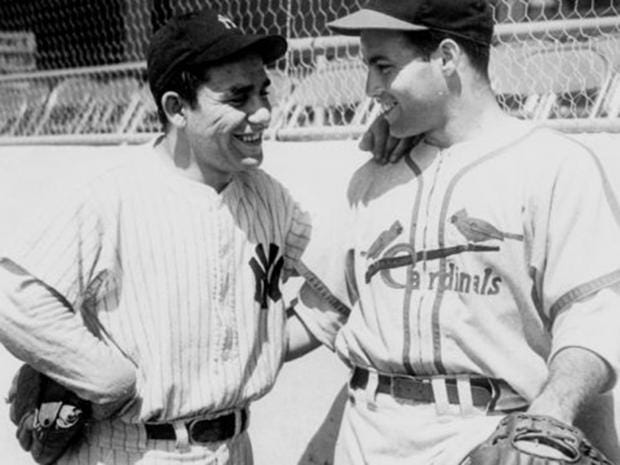
C Lawrence Peter "Yogi" Berra of St. Louis, Missouri -- the North Side, the then-mostly-Italian "The Hill." Actually, that's a shortened name, as it was known as "the Dago Hill" before "Dago" became an unacceptable slur. Yogi grew up across the street from Joe Garagiola, who was also a big-league catcher, although he's in the Hall of Fame as a broadcaster.

Yogi won World Championships with the Yankees in 1947, '49, '50, '51, '52, '53, '56, '58, '61 and '62, plus Pennants in '55, '57, '60 and '63. His 14 appearances, 10 championships, games, at-bats and hits are the most in World Series history.

He was elected to the Hall of Fame and the All-Century Team. His Number 8 was retired by the Yankees, who honored him in their Monument Park. His 358 home runs are the most ever by a player 5-foot-8 or shorter, although he's no longer the all-time leader in home runs by a catcher. And he's the only man ever to win Pennants as manager of both the Yankees and the Mets, in 1964 and '73, although both times his team lost Game 7.

By a weird coincidence, Yogi's backups on this team are his predecessor and his successor as Yankee catcher.

Honorable Mention to Bill Dickey of Searcy, Arkansas. Prior to Yogi and Johnny Bench, he was considered, along with Mickey Cochrane, as perhaps the greatest catcher ever. 8 Pennants and 7 World Championships with the Yankees from 1932 to 1943. Hall of Fame, Number 8 co-retired with Yogi, Monument Park.

When The Sporting News announced its 100 Greatest Baseball Players in 1999, Yogi came in at Number 40, Bill at Number 57.

Honorable Mention to Elston Howard of St. Louis, Missouri. He was the first black Yankee, and played on 9 Pennant-winners, plus 1 more with the Boston Red Sox in 1967, and 4 World Championships. In 1963, practically carrying the offense with Mickey Mantle and Roger Maris injured for much of the season, he became the first black player to win the AL MVP. (By that point, 8 black men had won 11 MVPs in the NL.) Number 32 retired, Monument Park.

Honorable Mention to Quincy Trouppe of St. Louis, Missouri. A star in the Negro Leagues, especially for the Homestead Grays and Kansas City Monarchs, he was player-manager for the Cleveland Buckeyes, taking them to Negro American League Pennants in 1945 and 1947. He spent 2 weeks with the Cleveland Indians, despite being 39 years old.

Along with his Monarch teammate Buck O'Neil, he is one of the black stars still deserving of the Baseball Hall of Fame who is not in. He added the extra P to his surname because it sounded cooler when he played winter ball in the Caribbean, turning "TROOP" into "Troo-PAY." His son, a renowned poet, restored the original name, and goes by Quincy Troupe.

SP Elwyn "Preacher" Roe of Viola, Arkansas. He didn't have a full season until he was 28 because of World War II, and he then struggled with the Pirates. But when he was traded to the Dodgers, he became the top lefty for the Boys of Summer. In 1951, he went 22-3. He finished 127-84, not counting a shutout of the Yankees in Game 2 of the 1949 World Series, but was gone by the time the Dodgers won it all in 1955.

SP Robin Roberts of Springfield, Illinois. He won 20 games. In 6 seasons. In a row. This included 20 in the Phillies' 1950 "Whiz Kids" Pennant season, and 28 in 1952, a total surpassed only once since (Denny McLain's 31 in 1968) and not otherwise matched since (Steve Carlton in 1972 and Bob Welch in 1990 reaching 27).

He won 286 games, despite pitching most of his career for a mediocre Phils team. He was named to 7 All-Star Games. He had a career ERA+ of 113, and WHIP of 1.170. Hall of Fame, and his Number 36 was the 1st ever retired by a Philadelphia sports team. A statue of him was dedicated outside the 1st base gate of Citizens Bank Park when it opened. When The Sporting News announced its 100 Greatest Baseball Players in 1999, he came in at Number 74.

SP Bob Turley of East St. Louis, Illinois. One of the fastest pitchers of the 1950s, came to the Yankees in the post-1954 deal that also brought in Don Larsen from the Baltimore Orioles. At the beginning of that season, he started and won the first home game in Oriole history, at Memorial Stadium. In 1991, at Memorial's last Opening Day, he was invited to throw out the ceremonial first pitch, along with the opposing starter from the first game, Virgil Trucks, then with the White Sox. (By a weird twist of fate, they died just 7 days apart last March.)

In 1958, after developing a sharp curveball to go with his blazing fastball, Bullet Bob, not Whitey Ford, became the first Yankee pitcher to win the Cy Young Award, going 21-7, plus winning Games 5 and 7 of the World Series, one of 4 titles he won. (And remember, until 1967, the Cy Young was awarded to the most valuable pitcher in both Leagues. Ford would win it, in 1961.)

He was 101-85 for his career, 82-52 for the Yankees. Due to injury, he last pitched in the majors in 1963, only 33 years old. He became a pitching coach, then moved to the Atlanta area made a fortune in insurance, then an even bigger one in real estate in Georgia and Florida -- much more money than a baseball player could make during his time, although not as much as a Cy Young Award winner could make now.

SP Tommy John of Terre Haute, Indiana. He used a blazing fastball to win 124 games for the Cleveland Indians, Chicago White Sox and Los Angeles Dodgers -- which would be a fine career for most pitchers. Then, at age 31, he wrecked his elbow. Then he had surgery, a pioneering procedure that now bears his name.

After sitting out a season, became a sinkerballer, and won 164 games for the Dodgers, Yankees, California Angels and Oakland Athletics -- winning more games after the surgery that could have ended his career (had it gone wrong) than he did before it.

Total wins: 288, the closest any pitcher comes to 300 major league wins -- long considered a benchmark for Cooperstown -- without making it. His .555 career winning percentage should also open some eyes. He never pitched on a Series winner, although he did pitch for 6 teams that reached the postseason ('74, '77 & '78 Dodgers; '80 and '81 Yanks, '82 Angels). He belongs in the Hall.

SP Steve Rogers of Jefferson City, Missouri. If only the Montreal Expos had been better at the start of his career, and if only injury hadn't made him just 33 when he pitched his last good season. He still managed to win 158 games, still a record for the Expos/Nationals franchise. His career ERA+ was 116 and his WHIP 1.232.

Sadly, he'll probably be best remembered for giving up a Pennant-losing home run to a guy who almost made this team, Rick Monday of the Dodgers (born in Batesville, Arkansas but grew up in Santa Monica, California and thus ineligible for this team), on "Blue Monday," October 19, 1981.

The Expos never played another postseason game (although they were sabotaged by Bud Selig in 1994 and by their own ownership after that, and took until 2012 to reach the postseason as the Washington Nationals). It's also a little odd that the greatest pitcher in the history of this Canadian team shared the real name of the comic book character Captain America.

Honorable Mention to Mark Buehrle of St. Charles, Missouri. He just turned 35, and has a career record of 186-142. Sounds good, except that those 142 losses are now tops among active pitchers. (Ryan Dempster is next, at 132-133). Buehrle has an ERA+ of 117, plus 2 no-hitters, 1 of them a perfect game, and went 2-0 with a 2.81 ERA in the Pale Hose's 2005 postseason, resulting in their first Pennant since the Ike Age and their first World Championship since World War I. He's made 4 All-Star teams and won 4 Gold Gloves.

Honorable Mention to Max Scherzer of Chesterfield, Missouri. On almost any team but the Tigers, he'd be the ace; but on that team, even his fantastic 21-3, 2.90 ERA, 0.970 WHIP, Cy Young Award 2013 season isn't enough to make him more highly regarded than former MVP Justin Verlander.  Scherzer turns 30 in July, but he's already 73-45 for his career, and has already been to the postseason the last 3 years, including starting Game 4 of the 2012 World Series. (The Giants finished off a sweep of the Tigers, but did it in 10 innings, so Scherzer, who pitched well, was not charged with the loss.)

RP Jason Isringhausen of Brighton, Illinois. He was supposed to be one of the "Generation K" pitchers that would lift the Mets out of their early 1990s stink. By the time they got back to the postseason, though, all of those pitchers were injured, and none looked like they'd be able to contribute much to any team.

But Izzy fooled them, accepting a conversion to the bullpen -- a move Met manager Bobby Valentine had, with his usual acumen, said would be "using an Indy car as a taxi" -- and pitching in the postseason for the A's and Cardinals, including the 2006 World Championship.

When he missed the 1998 season, at the end of which he turned 26, who would then have thought that he would still be pitching as late as 2012, age 40? He finished his career with an even 300 saves, including an NL-leading 47 in the Cards' 2004 Pennant season. And who did the Mets get from the A's in exchange for Isringhausen and Greg McMichael in 1999? Billy Taylor, who pitched 18 games for them, none of them noteworthy. Yet another bonehead Met trade.

MGR Earl Weaver of East St. Louis, Illinois. As the aforementioned political columnist George Will, a baseball nut and Orioles stockholder, said, "Earl Weaver looked like a baseball manager should look." He was short, chubby, had gray hair even in his early 40s that turned white before he was 50, seemed to always be angry, and constantly argued with umpires. I'm convinced Trey Wilson was cast as the manager in Bull Durham because, hair aside, he was Weaveresque.

I didn't always like him: I'm still peeved that he had the field at Memorial Stadium watered down to get a rainout during a 1978 Yanks-O's series, even though the Yanks won the World Series that year anyway. But he was a great manager. He managed the Orioles to 6 postseason berths, 4 Pennants and, strangely, only 1 World Championship, in 1970. (Hank Bauer managed them in 1966, and Joe Altobelli succeeded Earl in 1983 and won that year's Series.)

Thomas Boswell, covering the Orioles for The Washington Post in those years when they were the closest MLB team to the Nation's Capital, made the point that Jim Palmer won 268 games as a big-league pitcher, but wouldn't have won 50 if not for Earl, even though Weaver and Palmer drove each other crazy. Palmer even titled a memoir Together We Were Eleven-Foot-Nine. (Palmer was 6-foot-3. Officially, Weaver was 5-foot-7, but Palmer may have thought him shorter.)

The Earl of Baltimore was a hothead, and I'm convinced that this, contrasted with the calm demeanor of Gil Hodges, is the biggest reason that Hodges' Mets beat Weaver's O's in the 1969 World Series. But the experience helped Earl's O's triumph over rookie manager Sparky Anderson's Reds the next year. The next, hothead Earl lost to calm veteran Danny Murtaugh and the Pirates. In 1979, hothead Earl lost to calm veteran Chuck Tanner and the Pirates.

No matter. Earl is rightfully in the Hall of Fame, and the O's retired his Number 4. When Memorial Stadium was closed in 1991, the first player introduced was Brooks Robinson, the last player introduced was Cal Ripken Jr., but the last person introduced was Earl. He personified that team: "The Oriole Way is pitching, defense, and three-run homers." Not just home runs, but with men on base. He didn't put up with RISPfail. He didn't put up with anything except your best effort.

Maybe if he'd applied the same standard to himself, as did the physically similar but not quite as hotheaded football coach Vince Lombardi, Earl would have won 5 titles like Lombardi did. Certainly, he might not have lost 2 Series in Game 7s. But he did make the Orioles a model organization on the field for an entire generation.

Wednesday, July 28, 2010

St. Louis' All-Time Baseball Team

The Mets broke out of their awful 2-9 Western roadtrip by coming home to beat the St. Louis Cardinals at Citi Field last night, but tonight The Great Johan Santana got rocked with 6 runs in the top of the 1st inning -- all with 2 outs.

Wow, Santana really has made a big difference for the Mets, hasn't he?

The Cardinals' "territory" is spread over several States, although not as many as there used to be. In the pre-expansion era, powerful radio station KMOX broadcast the Cards' games over about 75 percent of the country. As both the Westernmost team in the majors until 1955, and the Southernmost until 1962, Cardinal fans are still all over the South despite the Atlanta Braves and the Florida and Texas teams, and all over the Midwest despite the arrival of teams in Kansas City, Minnesota and even Colorado.

Today, however, their region is pretty much "limited" to Eastern Missouri, Southeastern Iowa, Southern Illinois, Southwestern Indiana, the Western edges of Kentucky and Tennessee (Memphis' Elvis Presley was a big Cards fan), Northern Mississippi and Northeastern Arkansas.

"I grew up in Central Illinois, about halfway between Chicago and St. Louis, and I made a historic blunder: All my friends became Cardinal fans and grew up happy and liberal, and I became a Cub fan and grew up embittered and conservative."
-- George Will, nationally-syndicated columnist for the Washington Post and author of two books about baseball.

He grew up in Champaign, as his father was a professor at the University of Illinois. The campus is 144 miles from Wrigley Field, 134 miles from U.S. Cellular Field, 173 miles from Busch Stadium, and 236 miles from Cincinnati's Great American Ballpark. So he had other choices he could have made.

However, traditionally, Cub fans have been rather liberal, while Cardinal fans have usually been conservative. This is not written in stone, though: Bill Clinton, a liberal who grew up in Hot Springs, Arkansas, 415 miles from St. Louis, and Rush Limbaugh, a right-wing fanatic who grew up in Cape Girardeau, Missouri, 119 miles away, are both big Cardinal fans.

No wonder Bill and Hillary "had problems in their marriage": Hillary grew up in Park Ridge, Illinois, just 12 miles from Wrigley, and was a Cub fan -- before she became a Yankee Fan!

Anyway, here's...

St. Louis' All-Time Baseball Team

1B Gil Hodges of Princeton, Indiana. Putting aside for a moment the fact that he managed the New York Mets, for crying out loud, to a World Series win, he is one of the players not in the Hall of Fame who most deserves it.

He had a career OPS+ of 120, the 1st 3 Gold Gloves given to National League 1st basemen (the 1st of which when he was already 33 years old), 7 straight 100-RBI seasons, and 370 home runs despite missing 3 seasons due to World War II. At the time he played his last game, he was 11th on the all-time home run list, trailing only Jimmie Foxx and, just recently surpassed at that point, Willie Mays among righthanders (and Mickey Mantle if you count switch-hitters).

He helped the Dodgers win 7 Pennants (6 in Brooklyn, 1 in Los Angeles) and 2 World Series (1 in each city). His Number 14 was retired by the Mets, but not by the Dodgers. There is no good reason to not have Hodges in the Hall.

St. Louis is loaded at 1st base for its history, having Honorable Mentions dishable out to St. Louis natives Roy Sievers and Ryan Howard (who may replace Hodges as the starter someday); 1890s hitting star and Hall-of-Famer Jake Beckley of Hannibal, Missouri; and Hodges' fellow Hoosier Don Mattingly of Evansville.

2B Red Schoendienst of Germantown, Illinois. A 10-time All-Star, he helped the Cardinals win the World Series in 1946 and the Milwaukee Braves to do it in 1957, and another Pennant in '58. He suffered from tuberculosis and missed most of '59 and half of '60, or else the Braves might have won 4 straight Pennants.

He led the NL in stolen bases as a rookie in 1945, doubles and sacrifice hits in 1950, and hits in 1957. Lifetime batting average .289, and never a home run hitter, but collected 2,449 hits including 427 doubles in an illness-shortened playing career.

He returned to the Cardinals as their manager, winning the 1967 World Series and the 1968 Pennant. Has occasionally returned as Cards' interim manager, such as during Ken Boyer's fatal illness. The Cards have retired his Number 2, and he is in the Hall of Fame.

SS Don Kessinger of Forrest City, Arkansas. A 6-time All-Star and a 3-time Gold Glove, the Chicago Cub shortstop was part of a few close-but-no-cigar finishes, and never appeared in the postseason. He was also, across town with the White Sox in 1979, the last player-manager in the American League.

Honorable Mention to the John Richard Schofield and Richard Craig Schofield, both of Springfield, Illinois. Both major league players and both known as "Dick" and "Ducky," officially they are not "Senior" and "Junior." And neither can push Kessinger out of the starting lineup. However, with John Richard's grandson and Richard Craig's nephew, Jayson Werth, also reaching the majors, this is now a 3-generation MLB family.

3B George Kell of Swifton, Arkansas. Best known for just barely beating out Ted Williams for the AL batting title in 1949, thus denying him a record 3rd Triple Crown, in each of the next 2 seasons Kell led the AL in both hits and doubles.

 He was a 10-time All-Star, with a .306 lifetime batting average, and after his retirement returned to the Detroit Tigers to become one of many fine broadcasters for that franchise. He is in the Hall of Fame, although none of the numbers he wore has been retired (mainly wore 21 and 7).

The St. Louis region is also loaded at this position: Bill Madlock of Memphis, Tennessee; Gary Gaetti of Centralia, Illinois; Kevin Seitzer of Springfield, Illinois; and Scott Rolen of Evansville, Indiana, who might one day succeed Kell here.

LF Walter "Hoot" Evers of Collinsville, Illinois. A Detroit teammate of Kell's and a 2-time All-Star, when Kell led the AL in hits and doubles in 1950, Evers led it in triples.

 It is a bit ironic that while the St. Louis region had Stan Musial, one of baseball's 20 greatest players ever, in left field (although he also played a lot of 1st base), Hoot is the best the region can do for a native left fielder. It's also unfortunate that both Kell and Evers arrived in Detroit after the 1934-45 period that saw the Tigers win 4 Pennants and 2 World Series: The closest they got was a 2nd-place finish in 1950.

CF Max Carey of Terre Haute, Indiana. A .285 lifetime batting average came from getting 2,665 hits, including 419 doubles and 159 triples. And once he got on base, that's when the fun started: He stole 738 bases, a total topped by only 4 guys before (Billy Hamilton, Arlie Latham, and his contemporaries Ty Cobb and Eddie Collins) and only 4 guys since (Lou Brock, Rickey Henderson, Tim Raines and Vince Coleman). He led the NL in steals 10 times, topping 60 twice and 50 6 times, peaking with 63 in 1916.

He was a little unlucky, reaching the Pittsburgh Pirates in 1910, right after they won their 1st World Series, but was still there in 1925 when they won their 2nd, and he batted .458 with 2 RBIs in his only trip to the postseason. He retired before uniform numbers were worn, but he's in the Hall of Fame.

Honorable Mention to Edd Roush of Oakland City, Indiana. "I didn't know if I'd make it to the major leagues," he said in an interview late in life, "but I didn't care. I just had to get away from those damn cows."

Getting away from those damn cows was good for him, and for the Cincinnati Reds. He had a lifetime batting average .323, OPS+ of 127, 2,376 hits, and was said to have had the best outfield arm of his era. He insisted until his death that the Cincinnati Reds would have won the 1919 World Series even if the White Sox had played it on the level.

He is in the Hall of Fame, and although he played before numbers were worn, he was probably the greatest player the Reds ever had until Johnny Bench came along.

Honorable Mention to Pete Reiser of St. Louis, Missouri. Branch Rickey, then running the Cardinals, started scouting Harold Patrick Reiser in 1931. The man nicknamed after a movie cowboy named Pistol Pete was no man yet: He was just 12 years old. Rickey finally signed him for the Cards in 1937, but in 1940 traded him to the Dodgers -- perhaps Rickey anticipated his own move to Brooklyn. Leo Durocher was the Dodger manager, and while Leo often said Willie Mays (also a center fielder, of course) was the greatest player he ever saw, he also once said Mays "might have been better than Reiser."

How good was this guy? In 1941, his1st full season in the majors, he led the NL in batting with .343, slugging, on-base percentage, total bases, runs, doubles and triples -- and the Dodgers won the Pennant. In 1942, he led it in stolen bases.

Then World War II intervened. In his next year of play, 1946, again he led the NL in steals. But his tendency to crash into hard concrete outfield walls to make catches -- say a prayer of thanks, Lenny Dykstra, for the padded walls of your era -- led to serious injuries, including a fractured skull and a separated shoulder. In 1947, another Dodger Pennant year, he batted .309 but broke his ankle late in the season. He was 28, having already lost the seasons of ages 24, 25 and 26 due to the war, and he never topped 258 plate appearances again.

He last played at age 33, and died at 62. One of the great what-if stories in baseball history. On the other hand, if Reiser hadn't continually gotten hurt, Duke Snider might never have become the Dodgers' center fielder.

Honorable Mention to Steve Finley of Paducah, Kentucky. Playing for several teams, he won 5 Gold Gloves, and while not a great hitter (only once topping 100 RBI in a hitting-happy era), he did collect 2,548 hits, including 449 doubles, 124 triples and 304 homers. He appeared in 2 World Series, both against the Yankees, losing with the San Diego Padres in 1998, and winning with the Arizona Diamondbacks in 2001. He'll be eligible for the Hall of Fame in 2013, but I think he's a step short. Still, it might be nice for the D-backs to retire his Number 12.

RF Arnold "Bake" McBride of Fulton, Missouri. He kind of got lost in the shuffle with the 1976-83 Phillies' near-dynasty having Greg "the Bull" Luzinski in left field and Garry "the Secretary of Defense" Maddox in center. But he was a very good outfielder, won the NL Rookie of the Year in 1974 (with St. Louis, and the Cards were fools to get rid of him), batted .299 lifetime, and had his best year at just the right time, 1980, as the Phils won their 1st World Series.

C Lawrence "Yogi" Berra of St. Louis, Missouri -- the south side, the mostly-Italian "The Hill." Actually, that’s a shortened name, as it was known as "the Dago Hill," before "Dago" became an unacceptable slur. Yogi grew up across the street from Joe Garagiola, who was also a big-league catcher, although he's in the Hall of Fame as a broadcaster.

Yogi won World Championships with the Yankees in 1947, '49, '50, '51, '52, '53, '56, '58, '61 and '62, plus Pennants in '55, '57, '60 and '63. His 14 appearances, 10 championships, games, at-bats and hits are the most in World Series history. Hall of Fame, All-Century Team, Number 8 retired by the Yankees, Monument Park. His 358 home runs are the most ever by a player 5-foot-8 or shorter, although he's no longer the all-time leader in home runs by a catcher.

And he's the only man ever to win Pennants as manager of both the Yankees and the Mets, in 1964 and '73, although both times his team lost Game 7.

By a weird coincidence, Yogi's backups on this team are his predecessor and successor as Yankee catcher:

Bill Dickey of Searcy, Arkansas: Prior to Yogi and Johnny Bench, was considered, along with Mickey Cochrane, as perhaps the greatest catcher ever. 8 Pennants and 7 World Championships with the Yankees from 1932 to 1943. Hall of Fame, Number 8 co-retired with Yogi, Monument Park.

Elston Howard of St. Louis, Missouri: The 1st black Yankee, 9 Pennants, plus 1 more with the Boston Red Sox in 1967, and 4 World Championships. Number 32 retired, Monument Park.

Honorable Mention to Quincy Trouppe of St. Louis. A star in the Negro Leagues, especially for the Homestead Grays and Kansas City Monarchs, he was player-manager for the Cleveland Buckeyes, taking them to Negro American League Pennants in 1945 and 1947.

He spent 2 weeks with the Cleveland Indians, despite being 39 years old, and on May 3, 1952, he joined with Sam Jones (who, with the 1959 Cubs, became the first black pitcher to throw a no-hitter in the major leagues) to form the 1irst all-black battery in the American League. (Roy Campanella and Don Newcombe preceded them in the National League.) Along with his Monarch teammate Buck O'Neil, he is one of the black stars still deserving of the Baseball Hall of Fame who is not in.

SP Elwyn "Preacher" Roe of Viola, Arkansas. He didn't have a full season in the majors until he was 28, because of World War II, and then struggled with the Pirates. But upon coming to the Dodgers, he became the top lefty for the Boys of Summer. In 1951, he went 22-3. Finished 127-84, not counting a shutout of the Yankees in Game 2 of the 1949 World Series, but was gone by the time the Dodgers won it all in 1955.

SP Robin Roberts of Springfield, Illinois. He won 20 games. Six times. In a row. This included 20 in the Phillies' 1950 "Whiz Kids" Pennant season, and 28 in 1952, a total surpassed only once since (Denny McLain's 31 in 1968) and not otherwise matched since (Steve Carlton in 1972 and Bob Welch in 1990 reaching 27).

He won 286 games despite pitching most of his career for a mediocre Phils team. Named to 7 All-Star Games. Career ERA+ of 113, and WHIP of 1.170. Hall of Fame, and his Number 36 was the first ever retired by a Philadelphia sports team.

A statue of him was dedicated outside the first base gate of Citizens Bank Park when it opened. He died a few weeks ago, but lived to receive all of these accolades. Except, of course, for being named to this team.

SP Bob Turley of Troy, Illinois. In 1958 (and remember, until 1967 it was for the best pitcher in both Leagues), Bullet Bob, not Whitey Ford, became the 1st Yankee pitcher to win the Cy Young Award, going 21-7, plus winning Games 5 and 7 of the World Series, one of 4 titles he won. He came to the Yankees in the post-1954 deal that also brought in Don Larsen from the Baltimore Orioles. At the beginning of that season, he started and won the 1st home game in Oriole history, and in 1991, at Memorial Stadium's last Opening Day, he was invited to throw out the ceremonial first pitch.

SP Tommy John of Terre Haute, Indiana. He used a blazing fastball to win 124 games for the Cleveland Indians, Chicago White Sox and Los Angeles Dodgers -- which would be a fine career for most pitchers. Then, at age 31, he wrecked his elbow. Then he had surgery, a pioneering procedure that now bears his name. After sitting out a season, became a sinkerballer, and won 164 games for the Dodgers, Yankees, California Angels and Oakland Athletics -- winning more games after the surgery that could have ended his career (had it gone wrong) than he did before it.

Total wins: 288, the closest any 20th Century pitcher comes to 300 major league wins -- long considered a benchmark for Cooperstown -- without making it. His .555 career winning percentage should also open some eyes. He never pitched on a Series winner, although he did pitch for 6 teams that reached the postseason ('74, '77 & '78 Dodgers; '80 and '81 Yanks, '82 Angels). He belongs in the Hall.

SP Steve Rogers of Jefferson City, Missouri. If only the Montreal Expos had been better at the start of his career, and if only injury hadn't made him just 33 when he pitched his last good season. He still managed to win 158 games, still a record for the Expos/Nationals franchise. His career ERA+ was 116 and his WHIP 1.232.

Sadly, he'll probably be best remembered for giving up a Pennant-losing home run to a guy who almost made this team, Rick Monday of the Dodgers (born in Batesville, Arkansas but grew up in Santa Monica, California and thus ineligible for this team), on "Blue Monday," October 19, 1981. The Expos/Nationals franchise has never played another postseason game (although they were sabotaged by Bud Selig in 1994 and by their own ownership after that). It's also a little odd that the greatest pitcher in the history of this Canadian team shared the real name of the comic book character Captain America.

Honorable Mention to Mark Buehrle of St. Charles, Missouri. He's only 31, but he has already won 144 games, all for the White Sox, with an ERA+ of 121, plus 2 no-hitters, 1 of them a perfect game, and went 2-0 with a 2.81 ERA in the Pale Hose's 2005 postseason, resulting in their first Pennant since the Ike Age and their first World Championship since World War I.

RP Jason Isringhausen of Brighton, Illinois. He was supposed to be one of the "Generation K" pitchers that would lift the Mets out of their early 1990s stink. By the time they got back to the postseason, though, all of those pitchers were injured, and none looked like they'd be able to contribute to anyone. But Izzy fooled them, accepting conversion to the bullpen -- a move Met manager Bobby Valentine had, with his usual acumen, said would be "using an Indy car as a taxi" -- and pitching in the postseason for the A's and Cardinals, including the 2006 World Championship.

At 37, he is coming off, oddly enough, Tommy John surgery, and is pitching for the Reds' top farm team. If his big-league career is over, it's still lasted a lot longer than anyone thought it would when the Mets discarded him, and he has 293 career saves. And who did the Mets get from the A's in exchange for Isringhausen and Greg McMichael in 1999? Billy Taylor, who pitched 18 games for them, none of them noteworthy. Yet another bonehead Met trade.

MGR Earl Weaver of East St. Louis, Illinois. He managed the Baltimore Orioles to 6 postseason berths, 4 Pennants and, strangely, only 1 World Championship, in 1970. (Hank Bauer managed them in 1966, and Joe Altobelli succeeded Earl in 1983 and won that year's Series.) But he's in the Hall of Fame, Number 4 retired, and, well, as political columnist, baseball nut, and Orioles stockholder George Will said, "Earl Weaver looked like a baseball manager should look": Short, chubby, gray hair, always angry, arguing with umpires.

I didn't always like him -- I'm still peeved that he had the field at Memorial Stadium watered down to get a rainout during a 1978 Yanks-O's series, even though the Yanks won the World Series that year anyway -- but he was a great one.

Thursday, May 6, 2010

Robin Roberts, 1926-2010

Not a good week for baseball. On Tuesday, we lost Ernie Harwell, the voice of the Detroit Tigers. Now, I find out that Robin Roberts has died at the age of 83.

Aside from the coincidence of their name, and some athletic success, there is no connection between Robin Evan Roberts, the legendary pitcher; and Robin Rene Roberts, who currently co-anchors ABC's Good Morning America after establishing herself on ESPN.

There was a commercial a few years back, promoting Major League Baseball. In the San Diego Padres' dugout, Bip Roberts was talking about what a good investment baseball cards were. He opened a price guide, showing that his own rookie card was worth $600. Sitting next to him was Tony Gwynn, Mr. Padre himself, and Tony said, "Yo, Bip, you're looking at Robin Roberts. Your card is worth 4 cents." To which Bip protested, "Yo, T, 6 cents in good condition!"

So what did Robin Roberts do to get a value of 600 smackers for his rookie card? Well, he won 286 games. 234 of those were for the Philadelphia Phillies, from 1948 to 1961. For the first few of those seasons, the Phils were a good team. But for most of that time, they weren't. Still, from 1950 to 1955, Roberts won 20 games every season. That's 6 straight. How many pitchers, in this era of 5-man rotations and questionable bullpens, will win 20 in even 1 season? He did it 7 times, 6 in a row. For the pre-Mike Schmidt Phillies.

His 1st 20-win season was the Phils' 1950 "Whiz Kids" season, where they won their only National League Pennant between 1915 and 1980. In 1952, he won 28 for an 87-win Phils team. Think about that: 28 wins in 1 season. It's only been topped (or even matched) once since, by Denny McLain's 31 in 1968. Since '52, the only others to get 27 (or even 26) are another Phillie, Steve Carlton in '72; and Bob Welch with the Oakland A's in 1990.

Roberts pitched and won the 1950 season finale for the Phils, going 10 innings against the Brooklyn Dodgers in the bandbox of Ebbets Field. Had the Phils lost, there would have been a Playoff for the Pennant the next day. Instead, Dick Sisler (son of Hall-of-Famer George) hit a 10th-inning homer, and Roberts held off the mighty Brooks lineup in the bottom of the 10th to win. After just 2 days' rest, he started Game 2 of the World Series, and went 10 innings again, holding the Yankees to 1 run over the first 9, before Joe DiMaggio took him into the Shibe Park bleachers in the top of the 10th, for a 2-1 Yankee win.

On May 13, 1954, pitching against the Cincinnati Redlegs (this was the really stupid part of American history where we didn't even want to call a baseball team "the Reds" because of the implications of Communism), Roberts gave up a leadoff home run to Bobby Adams, and then retired 27 consecutive batters to win 8-1. So had he gotten Adams out, he could have had a perfect game. As it is, none of his 286 wins was a no-hitter.

After the conclusion of the 1961 season, Roberts was sold to the New York Yankees. On February 6, 1962, the Phillies announced that Roberts' uniform Number 36 would be retired by the team on March 21, when the Yankees would visit Clearwater to play the Phillies in a spring training game. It was the 1st uniform number to be retired by the organization. Roberts started for the Yankees that day, and gave up 4 runs in 3 innings, but was still the winning pitcher in the game which the Yankees won 13-10. However, he did not appear for the Yankees before being traded to the Baltimore Orioles.

Roberts pitched on until 1966, and never reached the postseason again, though he did help get the Orioles to within 2 games of the 1964 American League Pennant. He finished his career with the Houston Astros and Chicago Cubs, and ended up as the first player elected to the Hall of Fame who'd played for either the modern version of the Orioles or for the Astros.

Because he pitched prior to 1953 and into 1966, he was able to become the only pitcher to defeat the Braves in Boston, Milwaukee and Atlanta.

He was honored with the retirement of his number by the Phillies and the modern versions of 2 minor-league teams he pitched for: The Wilmington Blue Rocks (Delaware) and the Vermont Mountaineers. He is also a member of the Michigan State University Hall of Fame, and in his hometown of Springfield, Illinois, the minor-league ballpark is named for him.

When the Phillies began the Philadelphia Baseball Hall of Fame in 1978, Roberts and longtime A's manager-owner Connie Mack were the first 2 inductees. A statue of him stands outside the 1st-base entrance of Citizens Bank Park in Philadelphia. (Check the link to Philly sports blog The 700 Level off to the side of this one, and there will be a link to a picture of the statue.) In 1999, The Sporting News named him Number 74 on their list of the 100 Greatest Baseball Players, and he was a nominee for the Major League Baseball All-Century Team.

I was at Veterans Stadium in 2003 when the Athletics came in for an interleague series, their first appearance in Philadelphia since they moved out in 1954. Along with a few surviving A's stars (including Gus Zernial, Bobby Schantz, Eddie Joost), Roberts was on hand, signing copies of his book My Life In Baseball. The fans seemed more interested in him than in the current Phillies. He'd earned that. (Of course, so had they: This was before Jimmy Rollins blossomed, before Ryan Howard, Chase Utley and Cole Hamels arrived.)
It's been a good era for Phillies fans, but also a sad one, losing Harry Kalas last season and now Roberts. Dallas Green, take care of yourself!

UPDATE: Robin Roberts has no gravesite; he was cremated. Dallas Green lived on until 2017.