Showing posts with label joe dimaggio. Show all posts

Monday, October 12, 2026

Top 10 Italians Worthier of an American Holiday and Parade Than Christopher Columbus

October 12, 1492: Christoffa Corombo – as he was known in his native Genoa, or Christophorus Columbus as he was known in Latin, or Cristobal Colon as his patron, Queen Isabella I of Spain, calls him -- finally gets his ships to land.
He believes he has reached South Asia. He names the island on which he lands San Salvador, after Jesus. Eventually, the island will be taken over by the English, and renamed Watling Island. Today, it is a part of the Bahamas.
Born in 1451, probably between August 25 and October 31, in Genoa, in what is now northwestern Italy, the man the English-speaking world knows as Christopher Columbus ended up making 4 voyages west. He went to his death on May 20, 1506, at age 54 in Valladolid, Spain, never fully realizing he was in what became known as "the New World," always thinking he was in Asia. But he did start the wave of European exploration that will make the Americas -- eventually named for rival Italian explorer Amerigo Vespucci – possible.
Yet, considering previous voyages of the Vikings (and, some believe, the Chinese), it is disingenuous to say, "Columbus discovered America." In fact, he never set foot on the soil of the continental U.S., coming the closest when he reached Puerto Rico.
As far as I can tell, it was Juan Ponce de León, who came with Columbus on his second voyage in 1493, who was the 1st European to set foot on present-day U.S. soil, reaching Florida in 1513. Vespucci did reach land in what’s now called South America, but not North America. The Vikings reached present-day Canada, and possibly present-day Maine.
It's also not true that Columbus "proved the world is round." The ancient Greeks had proven it in the 6th Century BC. By 1492, most people already believed it. Even so, it would be 1522, and the conclusion of the Ferdinand Magellan expedition, before anyone sailed all the way around the world and back to his starting point, and proved through firsthand experience that the world was round.
Today, there is a Triple-A minor league baseball team in Columbus, Ohio, and a Double-A team in Columbus, Georgia. And a major league team in Washington, District of Columbia. And, of course, there is a tremendous amount of talent in lands that Columbus revealed to the Old World, including the places now known as Puerto Rico and the Dominican Republic.
The first Columbus Day celebration took place on October 12, 1792, when the Columbian Order of New York, better known as the Tammany Society, the precursor to the Tammany Hall political machine, held an event to commemorate the 300th anniversary of the historic landing. The same year, the Columbus Obelisk was erected in Baltimore.
For the 400th anniversary of Christopher Columbus's voyage in 1892, following the lynchings of 11 Italian immigrants by a mob in New Orleans the year before, President Benjamin Harrison declared Columbus Day as a one-time national celebration.
In 1934, as a result of lobbying by the Catholic organization the Knights of Columbus, and New York City Italian leader Generoso Pope, Congress passed a statute stating: "The President is requested to issue each year a proclamation (1) designating October 12 as Columbus Day; (2) calling on United States government officials to display the flag of the United States on all government buildings on Columbus Day; and (3) inviting the people of the United States to observe Columbus Day, in schools and churches, or other suitable places, with appropriate ceremonies that express the public sentiment befitting the anniversary of the discovery of America." President Franklin D. Roosevelt responded by making such a proclamation.
In 1966, Mariano A. Lucca, from Buffalo, New York, founded the National Columbus Day Committee, which lobbied to make Columbus Day a federal holiday. On June 28, 1968, President Lyndon B. Johnson signed the legislation for it, effective in 1971, to be celebrated on the 2nd Monday in October. This year, it happens to fall on the actual anniversary, October 12.
But it's kind of a "half-holiday": Some things are closed, but some are open, like federal government buildings, including post offices. Banks are open, as are stock markets.
Do Italian-Americans deserve a holiday, complete with a parade of ethnic pride? Certainly. Should it be for Columbus? No, he was a horrible person. It's no wonder some places have replaced Columbus Day with "Indigenous Peoples Day," to instead honor the people he hurt, or led to the hurting of.
Top 10 Italians Worthier of an American Parade Than Christopher Columbus
These are in chronological order. And I separate "Italian" from "Roman": We can debate when "Romans" became "Italians," but the 1st of these may have been the 1st true "Italian" celebrity:
1. Dante Alighieri, 1265-1321. With his Divine Comedy, an epic poem of Hell, Purgatory and Heaven, he became the 1st popular writer in the Italian language.
2. Leonardo da Vinci, 1452-1519 -- and the other major Renaissance artists, especially those who got "Teenage Mutant Ninja Turtles" named after them: Donatello di Betto Bardi (1386-1466), Michelangelo Buonarotti (1475-1564), and Raffaello da Urbino (Raphael, 1483-1520). Their advancements of art and science helped to make the modern world possible.
3. Giuseppe Garibaldi, 1807-1882. The uniter, and thus the liberator, of Italy. He also aided anti-colonial movements in South America, thus making him a hero on not just one, not just two, but three continents.
4. Frances Xavier Cabrini, 1850-1917. The 1st American-born person canonized as a Saint by the Roman Catholic Church was a nun who founded the Missionary Sisters of the Sacred Heart of Jesus. Today, Mother Cabrini's system provides education, health care, and other services to the poor in 15 nations.
One name that will not be on this list, but would be here chronologically if he was, would be Guglielmo Marconi (1874-1937), the father of radio broadcasting. He went on to be an early supporter of Benito Mussolini and Fascism. Vaffanculo!
5. Vince Lombardi, 1913-1970. He was the greatest coach in pro football history, and I don't want to hear about no Bill Belichick. He not only became the modern model of what an NFL coach should be, to the point where the trophy awarded to the winning team in the Super Bowl is named for him, but, every bit as much as the next 2 names on this list, he helped to pull Italian-Americans into the mainstream of American life.
There are many Italian-Americans in the Pro Football Hall of Fame. For a while, The Boot could claim the 2 greatest defensive ends of all time: Leo Nomellini of the San Francisco 49ers and Gino Marchetti of the Baltimore Colts. Now, in addition to the greatest coach ever, they can legitimately claim the greatest quarterback ever, Joe Montana -- and I don't want to hear about no Tom Brady.
6. Joe DiMaggio, 1914-1999. The greatest of all Italian baseball players. Shout-out also to his Yankee teammates Tony Lazzeri, Lawrence "Yogi" Berra and Phil Rizzuto. But not Billy Martin.
Other players of Italian descent in the Baseball Hall of Fame: Ernie Lombardi, Roy Campanella (Italian father, black mother), Ron Santo, Rollie Fingers, Craig Biggio, John Smoltz and Mike Piazza. And managers Tommy Lasorda, although he was not a good guy, and Tony La Russa. And a great player who became a great manager, Joe Torre. And broadcasters Rizzuto and Joe Castiglione. Fingers and Smoltz are both Italian on their mother's sides.
Joe Tinker, of "Tinker to Evers to Chance," and Eppa Rixey have been mistakenly listed as Italians in the Hall of Fame, but neither was of even partial Italian descent.
In basketball, I must mention 2 men: Hank Luisetti (1916-2002) became the 1st player to regularly shoot with just one hand, opening up players' mobility. However, he peaked in the 1930s, at Stanford University, when the only pro leagues were minor ones. By the time the NBA was founded in 1946, he was 30, not too old to play, but his regular job was paying more than the NBA.
And Danny Biasone (1909-1992), owner of the Syracuse Nationals (who became the Philadelphia 76ers in 1963), came up with the idea of the 24-second shot clock in 1954, speeding up the game and making the NBA viable in the long term.
7. Frank Sinatra, 1915-1998. Yes, he could be a bully. Yes, he hung out with Mob guys. Yes, he switched from Democrat to Republican. But his daughter Nancy says he hated Donald Trump as far back as when Trump was just a local annoyance.
The Chairman of the Board was the greatest entertainer of the 20th Century: He recorded more music than anyone, and almost better than anyone; and, unlike Elvis Presley and Michael Jackson, he was a very good actor, legitimately winning an Academy Award. He stood up for his fellow Italian-Americans by refusing to change his name when his then-boss, bandleader Harry James, demanded it. He stood up for black performers, doing so for Nat King Cole even before he met Sammy Davis Jr.
1945 Frank did the all-inclusive "The House I Live In," which 1972 Frank and especially 1984 Frank would have done well to remember.
Also worth noting, given today's occasion: On October 12, 1944, his show at the Paramount Theater in New York's Times Square led to teenagers going wild in the streets, something they never did for Elvis or The Beatles. It became known as the Columbus Day Riot.
DiMaggio and Sinatra were once close friends, but split when Sinatra made a move on DiMaggio's ex-wife, Marilyn Monroe.
And so many other great singers. I'm not even going to get into opera, although I will point out that Enrico Caruso toured America, and was eventually played in a movie by Mario Lanza. But: Dean Martin, Al Martino, and all those doo-woppers, like Dion DiMucci and Frankie Valli. And, of course, Bruce Springsteen. For years, I thought he was Jewish, and that the family name had been "Springstein," or something like that. No, his mother was Adele Zerilli, daughter of an immigrant from the Naples area.
8. Rocky Marciano, 1923-1969. The only Heavyweight Champion of the World who never lost a fight. There have been a lot of great Italian-American boxers, and Italy's own Nino Benvenuti. But the Rock topped them all -- and this would include Rocky Balboa if he were real. By the way, Sylvester Stallone, for all his achievements, does not get counted here. Balboa would be worth celebrating; Stallone is not.
Honorable Mention: Lee Iacocca, 1924-2019. Yes, he designed the Ford Pinto. And, yes, he was a Republican. But he also designed the Ford Mustang. He left the Ford Motor Company when it did not make sufficient amends after the Pinto scandal. He saved Chrysler from bankruptcy. What's more, he did his own commercials. You've heard of Italian-Americans praising somebody by saying, "He's a stand-up guy," right? Iacocca was a stand-up guy, putting his own reputation on the line, by telling you about his cars, and saying things like, "If you can find a better car, buy it!"
He probably inspired a lot of bosses to do their own commercials. Yes, chicken producer Frank Perdue was already doing them. But most of them were only on a local basis at the time, like New York ice cream man Tom Carvel and Los Angeles car dealer Cal Worthington. After Iacocca, Herman Lay started doing ads for Frito-Lay products, Orville Redenbacher started doing his own popcorn commercials, and Remington's Victor Kiam was saying, "I was so impressed, I bought the company!"
9. Sophia Loren, born 1934 and still alive as I write this. More than Gina Lollobrigida, more than Claudia Cardinale, more than any other Italian actress, she has defined Italian femininity, and Italian acting.
Not far from where I live, there's a pizzeria that used to have on its wall a photo of Sophia, wearing an apron, dishing out spaghetti with a big smile on her face. She never looked better. The place has since taken the picture down. And now I'm sad.
10. Robert De Niro, born 1943 and still alive as I write this. What's so great about him? As the man himself might say, "I heard things." He's played good guys, bad guys, good guys who did bad things, bad guys who did good things, mostly tough guys, but also some guys who had to accept that they weren't so tough. De Niro saw through Trump early on, and would probably hate Trump's guts, if Trump had any guts, which he doesn't.
Honorable Mention to his 2 biggest directors, Francis Ford Coppola and Martin Scorcese; and to several of his fellow actors, including Marlon Brando and Al Pacino.
There you have it: Lots of Italians, and Italian-Americans, to celebrate with an ethnic-pride holiday.
I'd say, "To Hell with Christopher Columbus," but I'd be over 500 years too late.

Sunday, October 11, 2026

October 11, 1946: The Reynolds-Gordon Trade

Allie Reynolds

October 11, 1946, 80 years ago: A trade is made in baseball, and it is a rarity: One that works out very well for both teams.

The New York Yankees trade 2nd baseman Joe Gordon to the Cleveland Indians for pitcher Allie Reynolds. Gordon, the 1942 American League Most Valuable Player, was nicknamed "Flash," not because of his flashy defense, but because he reminded people of science-fiction film hero Flash Gordon, played by Buster Crabbe, who also played another sci-fi hero, Buck Rogers.

Joe Gordon secured his (posthumously-elected) Hall of Fame status by helping the Indians win the 1948 World Series, on October 11, 2 years to the day after the trade. This was his 5th title, having won 4 with the Yankees. But the Yankees had gotten George "Snuffy" Stirnweiss in a separate trade, and then had Jerry Coleman, Billy Martin and Bobby Richardson at the keystone sack for the next 15 years.
Joe Gordon

The Indians needed a veteran infield presence like Gordon, and their owner, Bill Veeck, was willing to trade any pitcher except the future Hall-of-Famer Bob Feller. Yankee general manager Larry MacPhail asked his best player, Joe DiMaggio, which one he should take. The Yankee Clipper said, "Take Reynolds. I'm a fastball hitter, but he can buzz his hard one by me any time he has a mind to." In other words, "He's really good, so even if he does nothing for us, at least he won't be doing anything to us."

That fastball, and his Cherokee heritage, got Reynolds a nickname that applied to Native Americans and a famous train of the time: The "Superchief." Still, he was only 51-47, with a 3.31 ERA, for his career when the Yankees acquired him. There was no indication that he would become a great pitcher.

But he did. In a rotation that already included Vic Raschi, the "Springfield Rifle," the Yankees won the 1947 World Series. In 1948, the Yankees obtained Eddie Lopat, a lefthander specializing in off-speed pitches, known as "the Junkman."

And with new manager Charles "Casey" Stengel coming in for the 1949 season, and pitching the speedy righthander Reynolds followed by the junkballing lefty Lopat, followed by the speeding righthander Raschi, the Yankees had a very tough combination that won the next 5 World Series: 1949, '50, '51, '52 and '53 -- each time with a different 4th starter. So this trade helped the Yankees get 6 titles.

Reynolds only won 20 games once, in 1952, but that was partly because Stengel also frequently used him as a reliever. Had he come along 30 years later, he might have been a big blazing righthanded closer in the mold of Goose Gossage, Rob Dibble or Rod Beck. He hurt his back in 1954, but still managed to go 13-4 at age 37. He then retired: Having invested in oil wells in Oklahoma, he could afford to play for the love of the game, and then walk away.

The Yankees honored him with a Plaque for Monument Park in Yankee Stadium in 1989, although they have never retired his Number 22. He died in 1994.

*

October 11, 1946 was a Friday. There was baseball action on this day, Game 5 of the World Series at Fenway Park in Boston. The Boston Red Sox beat the St. Louis Cardinals, 6-3. Ted Williams singled in a run in the bottom of the 1st inning, and Cardinal manager Eddie Dyer panicked, taking out starter Howie Pollet. While Al Brazle got out of the jam, he gave up a home run to Leon Culberson in the 6th inning, and fell apart in the 7th. In contrast, Joe Dobson went the distance for the Sox, holding Stan Musial to a 1-for-3 day. 

Saturday, October 10, 2026

October 10, 1951: Joe DiMaggio's Last Game

October 10, 1951, 75 years ago: The Yankees defeat the New York Giants, 4-3 in Game 6 at Yankee Stadium, and win their 3rd straight World Series, their 14th World Championship. The Giants had taken 2 of the 1st 3 games in this Series, but the Yanks took 3 straight to win.
Joe DiMaggio goes 1-for-2 with 2 walks. In the bottom of the 8th, he laces a double to left-center off Larry Jansen. It turns out to be the last at-bat of his career, as he announces his retirement 2 months later.
His intended center field successor, Mickey Mantle, had gotten hurt in right field in Game 2, and missed the rest of the Series, and the knee he injured would never be the same again, the beginning of a cloud over his career that would only grow. The "other" great rookie center fielder, Willie Mays of the Giants, had a poor Series, and would spend most of the next 2 seasons in the Army in the Korean War. But both Mantle and Mays would be back, and would resume building their legends.
This game is significant for another reason: It is the Yankees' 14th World Series win, making them, officially, the greatest franchise in baseball history. While the team known, at this point, as the Boston Braves had won only 1 World Series, in 1914, they had previously won 9 National League Pennants, and, before that, 4 Pennants in the National Association, making them, effectively, the world champions of baseball 13 times. The Yankees had now exceeded that.
On December 12, 1951, DiMaggio announced his retirement at Yankee Stadium: "I have played my last game of ball." He later explained that he would see a ball coming toward him in center field, and his brain would give the commands on how to play it, and his body would say, "Who, me?"
He had reached his 37th birthday between that last game and his retirement announcement. And 37 has been a troublesome age for the Yankees: Mantle would also retire at 37, Lou Gehrig died at that age, Yogi Berra began his last season, Don Mattingly had been retired for 3 years, and Thurman Munson had been dead for 5.
Bobby Brown was the last surviving member of the 1951 Yankees, living until 2021.
Among the Yankees' many traditions is Monument Park at Yankee Stadium. From the 1949-53 team that won 5 straight World Series, they have honored center fielders Joe DiMaggio and Mickey Mantle with Monuments; and given Plaques to catcher Lawrence "Yogi" Berra, shortstop Phil Rizzuto, pitchers Allie Reynolds and Edward "Whitey" Ford, manager Charles "Casey" Stengel, public address announcer Bob Sheppard, and broadcaster Mel Allen.
Billy Martin played 2nd base in this period, but that's not why he's in Monument Park, or why his uniform Number 1 has been retired. The Yankees have also retired 5 for DiMaggio, 7 for Mantle, 8 for Berra, 10 for Rizzuto, 16 for Ford and 37 for Stengel. Although 1st baseman Johnny Mize and general manager George Weiss are in the Baseball Hall of Fame, they are not honored in Monument Park. Neither are team owners Dan Topping and Del Webb, who are also not in the Hall of Fame.

Monday, October 5, 2026

October 5, 1951: Mantle vs. Drain

October 5, 1951, 75 years ago: Game 2 of the World Series is played at Yankee Stadium. The New York Yankees, with Eddie Lopat pitching a fine game, evened up the Series against the New York Giants by winning 3-1 over Larry Jansen. Joe Collins hit a home run. But the big story came in the top of the 5th inning.

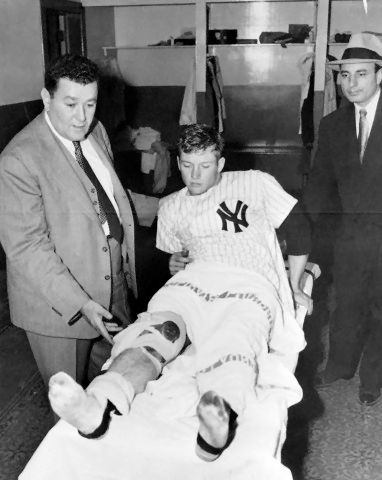
The Yankees' big rookie, Mickey Mantle, already a big story and not yet 20 years old for another 15 days, was playing right field, with the idea that, the next season, he would succeed Joe DiMaggio in center field.
The Giants' big rookie, Willie Mays, who had turned 20 in May, hit a fly ball to right-center. Mantle went for it, but heard DiMaggio calling for it, and stopped short. That caused Mantle to step in a drain that had been mistakenly left open, catching his spikes, and tearing the anterior cruciate ligament (ACL) in his right knee.
With today's sports medicine, Mickey would have been operated on the next day, and would have been ready for Opening Day the next April. But they didn't know how to treat a torn-up knee in the Truman years. The surgery he got was hardly good enough, and the knee never really healed right. This is why people say, "We never got to see Mickey Mantle on 2 good legs."
If the Yankees ever found out which groundskeeper left the drain open, they handled it privately, without ever revealing the man's name. Which, given the fanatical devotion of the fans Mantle would eventually have, was for the best.
The story got worse. Mickey's father, Elvin "Mutt" Mantle, who had made his son a special project, teaching him to play, including how to switch-hit, was in attendance. They rode to Lenox Hill Hospital together in a taxi. Mickey leaned on his father for support getting out of the cab. But Mutt collapsed, causing Mickey to collapse, too.
All those years of working in the zinc mines of northeastern Oklahoma, inhaling the poisonous dust, had given Mutt Hodgkin's disease. He was not just too weak to support his son at that moment, he was dying. Also with today's medicine, he might have lived. Then again, with today's economy, he might not have had to work in the mines.
Father and son spent the rest of the World Series watching the games from adjoining hospital beds. Mutt died on May 7, 1952, only 40 years old. None of the men in Mickey's family had lived past the age of 45, and Mickey was convinced they family was "cursed," and that he wouldn't make it past 45, either. So he was going to live every day like there was no tomorrow. It didn't occur to him that, not working in the mines, he would be healthier.
Instead, he drank to dull the physical pain of so many injuries, and the psychological pain of losing his father so soon, and of the way he was often treated by the New York fans and the New York media, until he went from being the kid with all the promise to the star who was fulfilling the promise. He ended up playing 18 seasons, hitting 536 home runs, winning 3 American League Most Valuable Player awards, including in 1956 when he won the Triple Crown, and helped the Yankees win 12 Pennants and 7 World Series.
But it never seemed to be enough for him. There was always a hole in his life, and he tried filling it with booze and other indulgences. That never works. Realizing it too late, Mickey began using the old line, "If I'd known I was gonna live this long, I'd have taken a lot better care of myself." He finally quit drinking in 1994 -- but the damage to his liver was done, as he only lived another year and a half.
*
October 5, 1951 was a Friday. Actress Karen Allen and Irish rock singer Bob Geldof were born on this day. And the DuMont network variety show Cavalcade of Stars, hosted by Jackie Gleason, includes a 6-minute sketch that became a recurring one, and eventually its own half-hour sitcom on CBS: The Honeymooners.
That night, Florida State University, which had only become coeducational in 1947 (after being a women's college since its founding in 1854), played the University of Miami in football for the 1st time, at Burdine Stadium in Miami -- the stadium that will later be renamed the Orange Bowl. Miami won, 35-13. The Seminoles did not beat the Hurricanes for the 1st time until 1958, and not at home in Tallahassee until 1979. The rivalry would get much bigger over the next few years. 

Tuesday, July 14, 2026

Yankee All-Star Appearances, 1933-2026

Stan Musial and Mickey Mantle,
1975 All-Star Game, Milwaukee County Stadium

This list takes into account all times a player was named to an All-Star Team, whether he got into the All-Star Game or not; but not the doubled-up ASGs of 1958 to 1962. It does not include managers. And it only includes berths in the Game while with the Yankees, not with other teams.

Also, while the All-Star Game was canceled twice, in both cases due to travel restrictions, in 1945 because of World War II and in 2020 due to COVID-19, All-Star Teams were still named in those seasons.

Keep in mind also that the All-Star Game did not start until 1933. If it had started earlier -- say, in 1920 -- Babe Ruth and Lou Gehrig, in particular, would have had many more appearances.

Players in Yankee Blue are Monument Park honorees. Players in bold are Baseball Hall of Fame inductees.

Mickey Mantle, 16: 1952, 1953, 1954, 1955, 1956, 1957, 1958, 1959, 1960, 1961, 1962, 1963, 1964, 1965, 1967, 1968
Yogi Berra, 15: 1948, 1949, 1950, 1951, 1952, 1953, 1954, 1955, 1956, 1957, 1958, 1959, 1960, 1961, 1962
Derek Jeter, 14: 1998, 1999, 2000, 2001, 2002, 2004, 2006, 2007, 2008, 2009, 2010, 2011, 2012, 2014
Joe DiMaggio, 13: 1936, 1937, 1938, 1939, 1940, 1941, 1942, 1946, 1947, 1948, 1949, 1950, 1951
Mariano Rivera, 12: 1997, 1999, 2000, 2002, 2004, 2005, 2006, 2008, 2010, 2011, 2013
Bill Dickey, 11: 1933, 1934, 1936, 1937, 1938, 1939, 1940, 1941, 1942, 1943, 1946

Elston Howard, 9: 1957, 1958, 1959, 1960, 1961, 1962, 1963, 1964, 1965
Whitey Ford, 8: 1954, 1955, 1956, 1958, 1959, 1960, 1961, 1964
Dave Winfield, 8: 1981, 1982, 1983, 1984, 1985, 1986, 1987, 1988

Aaron Judge, 8: 2017, 2018, 2021, 2022, 2023, 2024, 2025, 2026
Lefty Gomez, 7: 1933, 1934, 1935, 1936, 1937, 1938, 1940
Bobby Richardson, 7: 1957, 1959, 1962, 1963, 1964, 1965, 1966
Alex Rodriguez, 7: 2004, 2005, 2006, 2007, 2008, 2010, 2011
Lou Gehrig, 6: 1933, 1934, 1935, 1936, 1937, 1938
Red Ruffing, 6: 1934, 1938, 1939, 1940, 1941, 1942

Joe Gordon, 6: 1939, 1940, 1941, 1942, 1943, 1946

Thurman Munson, 6: 1971, 1973, 1974, 1975, 1976, 1977
Don Mattingly, 6: 1984, 1985, 1986, 1987, 1988, 1989

Tommy Henrich, 5: 1942, 1947, 1948, 1949, 1950
Phil Rizzuto, 5: 1942, 1950, 1951, 1952, 1953
Allie Reynolds, 5: 1949, 1950, 1952, 1953, 1954

Gil McDougald, 5: 1952, 1956, 1957, 1958, 1959
Mel Stottlemyre, 5: 1965, 1966, 1968, 1969, 1970
Graig Nettles, 5: 1975, 1977, 1978, 1979, 1980
Reggie Jackson, 5: 1977, 1978, 1979, 1980, 1981
Willie Randolph, 5: 1976, 1977, 1980, 1981, 1987
Bernie Williams, 5: 1997, 1998, 1999, 2000, 2001
Jorge Posada, 5: 2000, 2001, 2002, 2003, 2007

Robinson Canó, 5: 2006, 2010, 2011, 2012, 2013
Red Rolfe, 4: 1937, 1938, 1939, 1940
Charlie Keller, 4: 1940, 1941, 1943, 1946
Spud Chandler, 4: 1942, 1943, 1946, 1947
Vic Raschi, 4: 1948, 1949, 1950, 1952
Bill "Moose" Skowron, 4: 1958, 1959, 1960, 1961
Bobby Murcer, 4: 1971, 1972, 1973, 1974
Rich "Goose" Gossage, 4: 1978, 1980, 1981, 1982
Ron Guidry, 4: 1978, 1979, 1982, 1983

Rickey Henderson, 4: 1985, 1986, 1987, 1988
Wade Boggs, 4: 1993, 1994, 1995, 1996

Paul O'Neill, 4: 1994, 1995, 1997, 1998
Dellin Betances, 4: 2014, 2015, 2016, 2017
Ben Chapman, 3: 1933, 1934, 1935
Joe Page, 3: 1944, 1947, 1948
Hank Bauer, 3: 1952, 1953, 1954
Tony Kubek, 3: 1958, 1959, 1961
Roger Maris, 3: 1960, 1961, 1962
Joe Pepitone, 3: 1963, 1964, 1965
Sparky Lyle, 3: 1973, 1976, 1977
Jason Giambi, 3: 2002, 2003, 2004
Curtis Granderson, 3: 2010, 2011, 2012
Gerrit Cole, 3: 2021, 2022, 2023
Babe Ruth, 2: 1933, 1934
George Selkirk, 2: 1936, 1939
Frank Crosetti, 2: 1936, 1939
Johnny Murphy, 2: 1937, 1939
Monte Pearson, 2: 1936, 1940
Tiny Bonham, 2: 1942, 1943
Hank Borowy, 2: 1944, 1945
George McQuinn, 2: 1947, 1948
Bob Turley, 2: 1955, 1958
Ryne Duren, 2: 1958, 1959
Tom Tresh, 2: 1962, 1963
Roy White, 2: 1969, 1970
Jim "Catfish" Hunter, 2: 1975, 1976
Tommy John, 2: 1979, 1980
Bucky Dent, 2: 1980, 1981
Dave Righetti, 2: 1986, 1987
Steve Sax, 2: 1989, 1990
Jimmy Key, 2: 1993, 1994
Andy Pettitte, 2: 1996, 2001
David Cone, 2: 1997, 1999
Roger Clemens, 2: 2001, 2003
Alfonso Soriano, 2: 2002, 2003
Hideki Matsui, 2: 2003, 2004
Gary Sheffield, 2: 2004, 2005
Mark Teixeira, 2: 2009, 2015
CC Sabathia, 2: 2011, 2012
Masahiro Tanaka, 2: 2014, 2019
Luis Severino, 2: 2017, 2018
Gary Sánchez, 2: 2017, 2019
Gleyber Torres, 2: 2018, 2019
DJ LeMahieu, 2: 2019, 2020
Aroldis Chapman, 2: 2019, 2021
Clay Holmes, 2: 2022, 2024
Tony Lazzeri, 1: 1933
Marius Russo, 1: 1941
Buddy Rosar, 1: 1942
Johnny Lindell, 1: 1943
Rollie Helmsley, 1: 1944
Nick Etten, 1: 1945
Oscar Grimes, 1: 1945
George "Snuffy" Stirnweiss, 1: 1946
Aaron Robinson, 1: 1947
Frank "Spec" Shea, 1: 1947
Billy Johnson, 1: 1947
Tommy Byrne, 1: 1950
Jerry Coleman, 1: 1950
Eddie Lopat, 1: 1951
Johnny Mize, 1: 1953
Johnny Sain, 1: 1953
Irv Noren, 1: 1954
Billy Martin, 1: 1956
Johnny Kucks, 1: 1956
Bobby Shantz, 1: 1957
Bob Grim, 1: 1957
Jim Coates, 1: 1960
Luis Arroyo, 1: 1961
Ralph Terry, 1: 1962
Jim Bouton, 1: 1963
Al Downing, 1: 1967
Fritz Peterson, 1: 1970
Bobby Bonds, 1: 1975
Chris Chambliss, 1: 1976
Mickey Rivers, 1: 1976
Ron Davis, 1, 1981
Phil Niekro, 1: 1984
Scott Sanderson, 1: 1991
Roberto Kelly, 1: 1992
Mike Stanley, 1: 1995
John Wetteland, 1: 1996
Tino Martinez, 1: 1997
David Wells, 1: 1998
Scott Brosius, 1: 1998
Mike Stanton, 1: 2001
Robin Ventura, 1: 2002
Javier Vázquez, 1: 2004
Tom Gordon, 1: 2004
Nick Swisher, 1: 2010
Phil Hughes, 1: 2010
Russell Martin, 1: 2011
David Robertson, 1: 2011
Brett Gardner, 1: 2015
Carlos Beltrán, 1: 2016
Andrew Miller, 1: 2016
Giancarlo Stanton, 1: 2022
Jose Trevino, 1: 2022
Nestor Cortes, 1: 2022
Juan Soto, 1: 2024
Jazz Chisholm Jr., 1: 2025
Max Fried, 1: 2025
Carlos Rodón, 1: 2025
Ben Rice, 1: 2026
Cody Bellinger, 1: 2026
Cam Schlittler, 1: 2026

DiMaggio played 13 seasons, missing 1943, 1944 and 1945 due to service in World War II, and made the All-Star Game every season. He's the only player with as many seasons to make the All-Star Game every season.

Living Yankee All-Stars, in chronological order: Bobby Shantz, Bobby Richardson, Tony Kubek, Al Downing, Roy White, Sparky Lyle, Graig Nettles, Chris Chambliss, Mickey Rivers, Willie Randolph, Reggie Jackson, Ron Guidry, Goose Gossage, Tommy John, Bucky Dent, Dave Winfield, Don Mattingly, Dave Righetti, Steve Sax, Roberto Kelly, Wade Boggs, Jimmy Key, Paul O'Neill, Mike Stanley, Andy Pettitte, John Wetteland, Mariano Rivera, Bernie Williams, Tino Martinez, David Cone, Derek Jeter, David Wells, Scott Brosius, Jorge Posada, Roger Clemens, Mike Stanton, Jason Giambi, Alfonso Soriano, Robin Ventura, Hideki Matsui, Alex Rodriguez, Gary Sheffield, Javier Vázquez, Tom Gordon, Robinson Canó, Mark Teixeira, Nick Swisher, Phil Hughes, Curtis Granderson, CC Sabathia, Russell Martin, David Robertson, Masahiro Tanaka, Dellin Betances, Brett Gardner, Carlos Beltrán, Andrew Miller, Aaron Judge, Luis Severino, Gary Sánchez, Gleyber Torres, DJ LeMahieu, Gerrit Cole, Giancarlo Stanton, Clay Holmes, Jose Trevino, Nestor Cortes, Juan Soto, Jazz Chisholm Jr., Max Fried, Carlos Rodón, Ben Rice, Cody Bellinger, Cam Schlittler.

Cone, Beltrán and Soto are the only players to be named to the All-Star Game as a Yankee and as a Met.

Based solely on most All-Star berths, this would be the all-time Yankee lineup:

1B Lou Gehrig
2B Bobby Richardson
SS Derek Jeter
3B Alex Rodriguez
LF Dave Winfield
CF Joe DiMaggio
RF Aaron Judge
DH Mickey Mantle
C Yogi Berra
SP1 Whitey Ford
SP2 Lefty Gomez
SP3 Red Ruffing
SP4 Allie Reynolds
SP5 Mel Stottlemyre
RP Mariano Rivera

Tuesday, April 21, 2026

Yankees vs. Red Sox, The Defining Moments, Part II, 1939-1966

April 20, 1939, Yankee Stadium. Opening Day, and while one legend, Lou Gehrig, is fading, another debuts. Ted Williams strikes out against Red Ruffing in his 1st major league at-bat. But in his 2nd, he strokes a double, and "Teddy Ballgame" is underway. In spite of Ted's debut, the Yankees win, 2-0, as Ruffing outduels Lefty Grove. The Yankees go on to win the World Series for the 4th consecutive season.

From 1938 to 1949, the Red Sox would finish 2nd to the Yankees 6 times, and would finish 3rd an additional 3 times in the 1950s. But only twice did they finish ahead of the Yankees in any season from 1919 to 1965: In 1946 and 1948.

April 23, 1941, Yankee Stadium. Rookie Phil Rizzuto -- not exactly a musclebound slugger -- hits his 1st major league home run, taking Charlie Wagner deep in the bottom of the 11th inning. It was the 1st of only 38 big-league round-trippers for the Scooter, and none of the 37 to come was a walkoff. I wonder if he yelled, "Holy cow!"

July 2, 1941, Yankee Stadium. Joe DiMaggio beats the Sox, and the 95-degree heat, and hits a home run to extend his hitting streak to a record 45 games. Yankees 8, Red Sox 4.

Williams goes on to hit .406, the last man to hit over .400 (or even over .390 in a full season), but DiMaggio's streak reaches 56 games, carrying the Yankees from 4th place when it starts to a big lead when it ends. He leads the Yankees to win the World Series over the Brooklyn Dodgers, and he, rather than Williams, deservedly wins the American League's Most Valuable Player award.

In case you're wondering: That season, DiMaggio, 26 years old and in his 6th major league season, was paid $37,500 (about $866,000 in 2026 money); Williams, who turned 23 during the season, his 3rd, was paid less than half as much, $18,000 ($415,000).

August 12, 1942, Yankee Stadium. Charlie Keller clobbers a Mike Ryba pitch for a grand slam in the bottom of the 9th, giving the Yankees an 8-4 win.

Williams wins the Triple Crown, leading the AL in batting average, home runs and runs batted in. But, again, it's a Yankee who is correctly voted the AL's MVP: 2nd baseman Joe Gordon.

August 10, 1946, Yankee Stadium. Aaron Robinson is not especially remembered, but someone had to be the Yankee catcher between Bill Dickey and Yogi Berra. He took Clem Dreiswerd deep in the bottom of the 9th to win, 7-5.

However, several Yankees, including Joe DiMaggio, Tommy Henrich and Phil Rizzuto, hadn't found their batting stroke just yet, after returning from World War II. And Charlie Keller hurt his back, curtailing what could have been a Hall of Fame career. The result was that the Yankees never seriously challenged for the Pennant, and the Sox won a Boston sports record 104 games.
The left field Wall, 1946. The next year, the ads were taken off,
and it became known as the Green Monster.
As with a sign at the Phillies' Baker Bowl, a joke was made:
"The Red Sox use Lifebuoy" -- and they still stink!
Note the Cities Service sign. In 1965, the company's name changed,
and it became the CITGO sign.

However, they lost the World Series to the St. Louis Cardinals, although the Cards were a much more experienced team, having been in 3 of the previous 4 World Series, winning 2 of them, including a 1942 win and a 1943 loss to the Yankees.

May 12, 1947, Fenway Park. Berra turns 22, and hits a home run. He becomes the 3rd Yankee to hit a home run against the Red Sox on his birthday. He remains the youngest. I guess it never occurred to him to say, "I was the youngest one to do it, but that's because all the other guys were older." At any rate, the Sox win anyway, 4-3. But the Yankees go on to dethrone the Sox as Pennant winners, and win the World Series.

Williams joined Rogers Hornsby as the only players to win the Triple Crown twice. But, again, he is denied the MVP, as one voter didn't put Ted on his Top 10 at all -- forgetting, he said. That gave DiMaggio the award by one point over Williams.

Sox fans have fumed about this ever since, saying DiMaggio only got the MVP because the press liked him and hated Williams. Well, whose fault was that? DiMaggio treated the press well, because he wanted to be treated well in return; while Williams acted like he didn't care what the press thought, and paid for it, dearly.

October 3, 1948, Fenway Park. The Sox beat the Yankees, 10-5, clinching at least a tie for the AL Pennant, and knocking the Yanks out of a chance for it, in the 154th and final game of the regular season. (The AL adopted the current 162-game schedule after it expanded in 1961; the National League did the same the following season.)

Williams went 2-for-4 with 2 RBI doubles. Sox center fielder Dom DiMaggio, Joe's younger brother, and a very good hitter and a very good center fielder in his own right, goes 3-for-4, including a solo home run. Joe goes went 4-for-5 with 2 doubles and 3 RBIs -- meaning that, between them, the DiMaggios go 7-for-9 with 3 extra-base hits and 4 RBIs. And brother Vince, who also reached the majors, wasn't even in this game! Although he was there, as were their parents.

Joe gets a standing ovation from the Boston fans during this game, and later called it one of the biggest thrills of his life. Boston fans, showing class? It used to happen all the time.

The next day, the Sox lost a playoff for the Pennant to the Cleveland Indians, 8-3, as Tribe shortstop-and-manager Lou Boudreau hit 2 home runs to cement his place as the AL's MVP, ahead of the Yankee Clipper and the Splendid Splinter.

April 30, 1949, Yankee Stadium. Tommy Henrich was nicknamed "Ol' Reliable" by Yankee broadcaster Mel Allen, and he lived up to that name on this day, by taking Tex Hughson downtown in the bottom of the 9th, to win, 4-3.

Five months later, Henrich would do it to Don Newcombe in Game 1 of the World Series, becoming the 1st MLB player to hit a walkoff homer in postseason play. He lived to the age of 96, but never really got the credit he deserved for his clutch play.

June 28, 29 and 30, 1949, Fenway Park. After missing the entire season thus far with a heel spur -- developing it after serving in World War II, not before serving in war like Donald Trump would later claim for himself, to keep himself out of it -- DiMaggio says he is ready to play again.

In a 3-game series, he goes 5-for-9, with 4 home runs and 9 RBIs. The Yankees sweep, winning 5-4, 9-7 and 6-3. During the 3rd game, a fan flies a plane over Fenway, trailing a banner reading "THE GREAT DIMAGGIO."
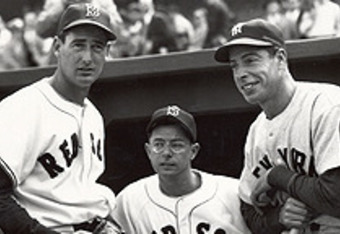
Ted Williams, Dom DiMaggio, Joe DiMaggio.

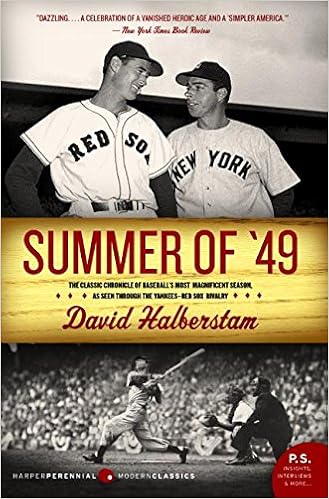
The Pennant race that was well-chronicled by both Peter Golenbock in his book Dynasty: The New York Yankees, 1949-1964, and David Halbertsam in his book Summer of '49, is well and truly on.

October 1, 1949, Yankee Stadium. Believe it or not, the Yankees blew a 12-game lead, and trailed the Sox by 1 game with 2 to play -- and these 2 were against the Sox at The Stadium. The Yanks hold Joe DiMaggio Day, since Dom plays for the Sox, and thus the whole family can attend. Joe has been ill with pneumonia, but has kept playing, and says, "I'd like to thank the Good Lord for making me a Yankee." (I guess he didn't have an agent back in 1934.)

The Sox, acting like more recent Red Sox teams, blow a 4-0 lead, Johnny Lindell hits an 8th-inning homer, and the race is tied. Yankees 5, Red Sox 4. Allie Reynolds didn't get out of the 3rd inning, but Joe Page allowed just 1 hit over the last 6 2/3rds innings. In the 1901 to 1968 era of 2 single-division leagues, 1949 was the only season in which both leagues' races were unresolved as the final day of the regular season dawned: The Brooklyn Dodgers needed a win or a St. Louis Cardinals loss to win the Pennant, and they got their win.

October 2, 1949, Yankee Stadium. This is for the Pennant. The Yanks lead 1-0 in the 8th, when Joe McCarthy, managing the Sox after all those Pennants with the Yankees, relieves starter Ellis Kinder. Big mistake, as a Jerry Coleman double clears the loaded bases. But Vic Raschi falters a bit in the 9th, partly due to DiMaggio, still sick, dropping an easy fly ball. Normally so good out there, Joe walks off the field, taking himself out of the game.

The tying runs are on, the run that could win the Pennant is at the plate, and Yogi Berra goes out to talk to Raschi. "The Springfield Rifle" angrily says, "Gimme the goddamned ball, and get the hell out of here!" Yogi does as he's told, and Raschi gets the final out, as Birdie Tebbetts pops up to 1st base, and Henrich, playing out of position, catches it. Yankees 5, Red Sox 3.

The Yanks beat the Dodgers in the World Series. In the last 2 seasons, the Sox had won 192 games, and didn't even win a Pennant.

This time, falling just short of the AL batting title to Detroit's George Kell, and this oh-so-slightly losing out on a unique 3rd Triple Crown, Williams was awarded the MVP. It could have gone to Rizzuto, who won it in 1950; or to Berra, who won it in 1951, '54 and '55. Instead, it went to Williams in a year in which he did not lead the Sox to a Pennant. So Sox fans can shut up about how Ted was robbed in '41, '42 and '47.

That season, DiMaggio was paid $100,000 (about $1.4 million in today's money), only the 2nd player ever to reach 6 figures, following Hank Greenberg. Williams was paid $75,000 ($1.1 million).

April 18, 1950, Fenway Park. Opening Day. Reynolds had nothing, and Mel Parnell was pitching well. After 4 innings, the Red Sox led, 9-0. The Yankees scored 4 runs in the 6, 9 in the 8th and 2 in the 9th, and won, 15-10. Don Johnson (no relation to the actor of the same name) was the winning pitcher, while Parnell gave out and Walt Masterson was the losing pitcher.

Oddly, the Yankees did this without hitting any home runs. 3rd baseman Billy Johnson had 3 RBIs. So did 2nd baseman Billy Martin, making his major league playing debut, and he didn't even start the game.

September 23, 1950, Yankee Stadium. Red Smith of the New York Herald Tribune called this 2-game series "the itsy-bitsy World Series." Eddie Lopat pitched a shutout, and the Yankees won, 8-0.

September 24, 1950, Yankee Stadium. The Yankees are leading the Red Sox, 9-5 in the 9th inning, when word comes in that Cleveland has beaten Detroit, clinching the Pennant for the Yankees. They finish the game off.

April 17, 1951, Yankee Stadium. The Yankees open the season at home against the Red Sox. Although it isn't obvious yet, it will be the final season for DiMaggio. It is the 1st season, and the 1st game, for Mickey Mantle -- who will also end up playing his last game against the Red Sox. His 1st at-bat is a groundout against Sox starter Mickey McDermott. This is also the debut as Yankee public address announcer for Bob Sheppard, who stays for 57 years.

In the 6th inning, Mantle gets his 1st hit and his 1st RBI, singling home Jackie Jensen against Bill Wight, helping the Yankees win 5-0. DiMaggio goes 1-for-4 with an RBI. Williams goes 1-for-3. Raschi pitches a shutout.
Joe DiMaggio, Mickey Mantle, Ted Williams

September 28, 1951, Yankee Stadium. The Yanks can clinch the Pennant with a win, and need just 1 more out. Even more, Allie Reynolds needs one more out for his 2nd no-hitter of the year. But who's at bat? Ted Williams. "The Superchief" gets "the Splendid Splinter" to hit an easy popup... which Yogi drops! Fortunately, it's in foul territory, but you don't give Ted Williams a second chance.

But in an example of what Yankee haters would call "Yankee luck," Ted pops it up again, and this time, Yogi catches it. Yankees 8, Red Sox 0. The Yanks go on to beat the Giants in the World Series.
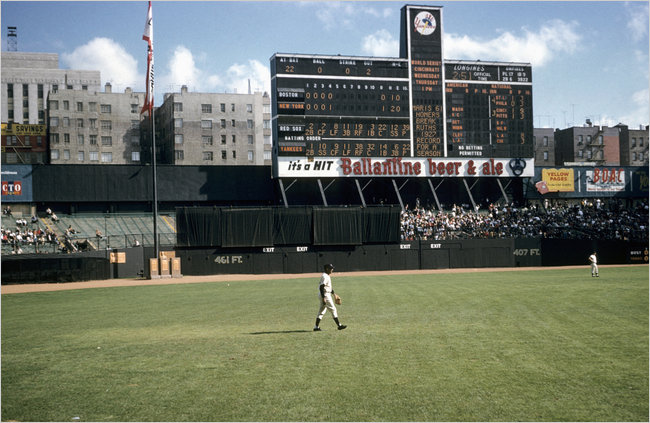
Yankee Stadium. Judging by the scoreboard, the green seats,
and the off-white outer wall, this has to be between 1959 and 1966.

Early the next season, Williams was called back into the Marine Corps for the Korean War, as he had been in World War II.  He was unavailable from May 1, 1952 to July 28, 1953, and by the time he came back, the Red Sox "glory years" of 1946-51 were over, as most of the other good players had retired or been traded away.

The Yanks-Sox rivalry went dormant as a result, leading Boston Globe columnist Dan Shaughnessy, born in 1953, to later remark that it had become like a conversation between Humphrey Bogart and Peter Lorre in the film Casablanca, a script written by Julius and Philip Epstein, the grandfather and great uncle of future Sox general manager Theo Epstein:

Ugarte: "You despise me, don't you, Rick?"
Rick: "Well, if I gave you any thought, I probably would."

April 23, 1953, Yankee Stadium. For the 1st time in his career, Mantle hits a walkoff home run. It's a 3-run job off Ellis Kinder, and the Yankees beat the Red Sox, 6-3. They had led 3-1 after 8, but the Sox scored 3 in the 9th to tie it. Mickey won it.

April 14, 1955, Fenway Park. The Red Sox host the Yankees in their home opener, and win, 8-4. This game is notable as the major league debut of Elston Howard, who thus becomes the 1st black player for the Yankees in a regular season game. In the bottom of the 6th inning, he replaces Irv Noren in left field, and in his first at-bat, drives in Mickey Mantle with a single in the 8th.

At this time, there were still 3 major league teams that had not introduced a black player: The Philadelphia Phillies, the Detroit Tigers, and the Red Sox, who would be the last, with Elijah "Pumpsie" Green in 1959. 

September 16, 1955, Yankee Stadium. Yogi Berra is remembered as one of the best clutch hitters ever, and he backed that up with 7 walkoff home runs, including this one, also off Ellis Kinder, for a 5-4 Yankee win.

April 28, 1957, Yankee Stadium. Yogi does it against the Sox again, off Ike Delock in the 10th inning, giving the Yankees a 3-2 win.

September 5, 1957, Yankee Stadium. Bob Grim becomes the 2nd Yankee pitcher to hit a walkoff home run -- and the 2nd to do it against Boston. He decides Nixon's the one -- Willard Nixon, that is -- and homers off him to give the Yankees a 5-2 win.

September 3, 1958, Yankee Stadium. Yogi torments the Sox again. This time, the walkoff victim is Leo Kelly, and the Yankees win, 8-5.

October 2, 1960, Yankee Stadium. Dale Long is remembered for hitting home runs in 8 straight games in 1956 (with the Pittsburgh Pirates), and being one of baseball's rare lefthanded catchers in 1958 (with the Chicago Cubs). On this day, for the Yankees, he hit a walkoff homer against Arnold Early of the Red Sox.

It had been exactly 11 years since the Yankees had won a Pennant by beating the Sox, and it would be exactly 18 years later that Sox fans would come to hate Bucky Dent.

Ted Williams had made his last appearance for the Sox in their home finale on September 28, hitting a home run, the 521st of his career, in his last at-bat. His salary was a record $135,000 (about $1.5 million in today's money).

October 1, 1961, Yankee Stadium. The Yankees beat the Red Sox 1-0. The only run of the game comes in the 4th inning, on a home run by Roger Maris. It is Maris' 61st home run of the season, breaking the record that Babe Ruth set in 1927.
The Yankee Stadium scoreboard, right after Maris' 61st

Williams had been replaced in Boston's left field by a native of Southampton, Long Island -- a working-class "townie" rather than a rich Summer-home owner there. His name was Carl Yastrzemski. He made $10,000 ($111,000). For his record-setting 61 home runs and AL-leading 142 RBIs, the Yankees paid Maris $32,000 ($355,000). For his 54 homers, Mantle was paid $70,000 ($776,000) -- and the greatest player of his generation, over even Willie Mays and Hank Aaron, never got a penny over $100,000.

July 7, 1966, Yankee Stadium. The Mick strikes again, with his 10th career walkoff home run, off Don McMahon, a relief pitcher who gave the Yankees trouble with the Milwaukee Braves in the 1957 and '58 World Series. The Yankees win, 5-2, and the winning pitcher, as 1960s Yankee pitcher Jim Bouton would say, was "Dooley Womack. The Dooley Womack!"

September 10, 1966, Fenway Park. Roger Maris turns 32, and hits a home run, the 4th Yankee to do so on his birthday. The Yankees win 5-1.

By this point, the Yankees had collapsed, but no one knew that, in the following season, the Sox were in for the defining season in their history, the one that took them from an afterthought -- and very nearly moved, at least out of Fenway Park, possibly to the suburbs, maybe out of the Boston area altogether -- to being New England's most beloved sports team.

Part III follows.

Wednesday, April 15, 2026

April 15, 1976: The Renovated Yankee Stadium Opens

April 15, 1976, 50 years ago: Yankee Stadium opens, after a renovation of two and a half years. Much of the original 1923 structure remains, but much of it is new. Some old-time Yankee Fans are relieved and thrilled. Others are appalled at the changes.

The support poles, and the obstructions they provided, were removed, while the upper deck was "cantilevered" and extended upward, so it no longer needed the poles' support. Seats and aisles were widened, dropping the Stadium's capacity from 65,010 (from a peak of 67,224) to 57,545.

The back wall of the Bleachers was raised to twice its height. No longer could a fan stand on the platform of the 161st Street Station of the Number 4 Train and watch the game for the price of a Subway token. And the "façade," actually a frieze, that wrapped around the roof of the Stadium was removed, as was the roof itself. A copy of the frieze was placed atop the Bleacher wall.

Robert Merrill sings the National Anthem. Bob Shawkey, the starting and winning pitcher from the 1st game there in 1923, throws out the ceremonial first ball. Among the guests with a connection to the Stadium's history are Babe's widow Claire Ruth, Lou's widow Eleanor Gehrig, Joe DiMaggio, Mickey Mantle, New York Giants legend Frank Gifford, and Joe Louis, who successfully defended the Heavyweight Championship of the World at Yankee Stadium 7 times.

A photograph of "the four great Yankee catchers" in uniform is taken: Bill Dickey as a special guest, Yogi Berra and Elston Howard as current Yankee coaches, and Thurman Munson as the current Yankee catcher, who has been named the team's 1st Captain since Lou Gehrig.
And, yes, there was a game. The opponent was the Minnesota Twins. While Babe Ruth had hit the 1st home run in the Stadium, the 1st home run in the renovated Stadium was hit by the Twins' Dan Ford, off Yankee starter Rudy May. And the Twins led 4-0 going to the bottom of the 3rd inning.

A groundout by Roy White got the Yankees on the board in the 3rd. They put it together in the 4th: With 1 out, Graig Nettles drew a walk. (Cliché Alert: Walks can kill you.) Oscar Gamble tripled him home, and was singled home by Willie Randolph. Randolph stole 2nd, and was singled home by Lou Piniella to tie the game. A wild pitch by Vic Albury got Piniella to 2nd, and Otto Vélez singled him home, and the Yankees had the lead.

The Yankees scored 6 more runs in the 8th, thanks to walks by White, Piniella and Fred Stanley; singles by Nettles, Randolph, Mickey Rivers and Chris Chambliss; and a double by Gamble.

Yankees 11, Twins 4. Dick Tidrow, in relief, was the winning pitcher. Two days later, Munson would have the 1st Yankee homer in the "New Stadium."

The Yankees won the 1st of 3 straight American League Pennants that season. From the Stadium's reopening until its closing in 2008, they won 15 AL Eastern Division titles, 10 Pennants, and 6 World Championships -- more than most teams, to this day, have won in their entire history.

Friday, November 14, 2025

Top 10 Worst Baseball MVP Choices

Yesterday, surprising no one, Major League Baseball's Most Valuable Player awards went to Aaron Judge of the Yankees in the American League, and to Shohei Ohtani of the Los Angeles Dodgers in the National League.

I am of the firm belief that the MVP should only go to a player who helps his team get into the postseason. If you helped your team get into the Playoffs, by definition, you have more value, and are more valuable, than a player who didn't help his team get into the Playoffs. Never mind Judge, or Cal Raleigh of the Seattle Mariners, or Vladimir Guerrero Jr. of the Toronto Blue Jays: The 25th man on each of those teams was more valuable than any player on any of the teams that didn't make it.

Top 10 Worst Baseball MVP Choices

Remember: While the voting is announced after the postseason, the MVP voting is based on regular-season performance only. I think that's wrong, but that's how they do it. As Joe Girardi would say, "It's not what you want." But as Aaron Boone would say, "It is what it is."

The current award began in the 1931 season, so no previous versions will be taken into account -- or held to account. And while some of these choices now look bad due to revelations of cheating, that was not known at the time, so I can't include those choices.

Honorable Mention: 1949 American League: Ted Williams, Boston Red Sox. This will be considered blasphemy in New England. They're wrong. First, let's look at the MVPs won by Yankees that "should" have been given to the Splendid Splinter.

Joe DiMaggio of the Yankees was awarded the American League MVP for 1941. Red Sox fans, now 3 generations removed, remain angry about this. They say Ted's .406 average was a greater achievement than DiMaggio's 56-game hitting streak the same season. They forget that the award is Most Valuable Player, not Most Outstanding Player. Ted's great season did not get the Red Sox the Pennant, finishing 2nd, 17 games behind the Yankees. Joe's great season put the Yankees on a run that led to them winning the World Series.

There would be another MVP controversy in 1942. Ted batted .356, hit 36 home runs, and had 137 RBIs. Each of these led the League, giving him the Triple Crown. But the Sox finished 2nd to the Yankees, a not-very-close 9 games back, and the MVP went to Joe Gordon, who did bat .302 with 103 RBIs, though only 18 home runs, and played 2nd base superbly. How do you deny a Triple Crown winner the MVP? Again: Most Valuable Player, not Most Outstanding Player.

In 1946, the Red Sox ran away with the Pennant. This time, there was no denying Ted: He batted .342, hit 38 home runs, and had 123 RBIs (oddly, none of these led the AL), and he was an easy choice for MVP.

Then came the World Series. The opposition was the St. Louis Cardinals. Led by the NL's answer to Ted, Stan Musial, the Cards were in their 4th World Series in 6 years, having won in 1942 and 1944, and lost in 1943. But Ted was nursing an elbow injury, and only batted .200, 5-for-25. Stan didn't hit well, either, and neither would end up the big story of the Series. The Cards won in 7 games.

Ted won the Triple Crown again in 1947, as he batted. .343, hit 32 home runs and had 114 RBIs. But, again, the Sox didn't win the Pennant. In 1947, DiMaggio won the MVP by 1 point in the voting over Ted -- because 1 writer, whose name has never been revealed, left Ted off his ballot completely. If he had even listed Ted 10th, Ted would have won it. But he wouldn't have deserved it: The Sox finished 3rd, 14 games behind the Yankees (and 2 behind the Tigers).
 
In 1949, the Sox and Yanks battled for the Pennant all the way to the final weekend. The Sox led the Yanks by 1 game with 2 to go, against each other, at Yankee Stadium. All the Sox had to do was win 1 of the 2. The Yankees won them both, 5-4 and 5-3. Ted went 1-for-3 with a walk in the Saturday game, and 0-for-2 with 2 walks in the Sunday game.

In spite of the Sox not winning the 1949 Pennant, the Yanks didn't have any single player who stood out above the others -- DiMaggio being hurt much of the year, keeping his power stats down -- so Ted got his 2nd MVP. But he had also begun to get a reputation as coming up small in big games. This ignores the fact that, in those 3 end-of-season games in '48 and '49, he did reach base 5 times. But, in those days, you rarely heard the cliché , "A walk is as good as a hit."

Ted hit 43 home runs and had 159 RBIs. His .343 slightly trailed George Kell of the Tigers for the batting title, costing him a record 3rd Triple Crown by the slimmest of margins. But he got 13 of a possible 16 1st-place votes, and won the MVP.

Among the Yankees, Phil Rizzuto finished 2nd, reliever Joe Page 3rd, and Tommy Henrich 6th. But the Scooter just didn't have big stats, and as for Page, nobody was willing to give the MVP to a relief pitcher to that point. The next year, Jim Konstanty of the Philadelphia Phillies became the 1st, in the NL. No AL reliever would get the award until Rollie Fingers of the Milwaukee Brewers in 1981.

So Ted didn't help his team win the Pennant. Yogi Berra finished 15th in the voting, but, giving the Yankees their 1st good year from a catcher since 1943, he was probably the best choice. Since there was no obvious candidate, I'm making Ted's '49 win an Honorable Mention.

Other Honorable Mentions: 1947 National League, Bob Elliott of the Boston Braves over Jackie Robinson of the Brooklyn Dodgers; 1953 American League, Al Rosen of the Cleveland Indians over Yogi Berra of the New York Yankees; 1954 American League, Yogi over Larry Doby of the Indians.

Derek Jeter probably should have won it in 1999, 2006 and 2009. At least, on those occasions, the winner was from a Playoff team: Respectively, Iván Rodríguez of the Texas Rangers (now believed to have been a steroid cheat), and Justin Morneau and Joe Mauer of the Minnesota Twins.

10. 1958 American League: Jackie Jensen, Boston Red Sox. The Red Sox were 3rd, 13 games behind the Yankees. So this one made no sense at all: Jensen did lead the AL with 122 RBIs, but his 35 homers were surpassed by 4 players, including Mickey Mantle's AL-leading 42; and he only batted .286, 3rd on his own team behind Ted Williams with an AL-leading .328 and Pete Runnels with .322, and also behind Mantle at .304.

Did the voters simply not want to give Mantle a 3rd consecutive award? That wouldn't happen in either League until 2004, with Barry Bonds. But Mantle only finished 5th. Bob Turley finished 2nd, and became the 1st Yankee to win the Cy Young Award.

9. Tie. Four selections of three players for the Chicago Cubs in the National League. In 1952, Hank Sauer led the NL in home runs and RBIs. But his Cubs were exactly .500, 77-77, 19 1/2 games behind the Pennant-winning Dodgers. They finished 5th, making this the 1st MVP awarded to a player on a "second-division" theme. Joe Black finished 3rd, tops among Dodgers. But since Konstanty had just won it 2 years earlier, maybe the voters weren't ready to give it to another reliever.

Everybody loves Ernie Banks. Even Chicago White Sox and St. Louis Cardinals fans grudgingly respected him. But, as with Sauer, the Cubs were 2nd-division teams in Ernie's MVP seasons, 5th in both seasons.

In 1958, Hank Aaron of the Pennant-winning Milwaukee Braves did not surpass Banks in homers, 30 to an NL-leading 47; or RBIs, 95 to an NL-leading 129; but did surpass him in batting average, .326 to .313. But he didn't even finish 2nd: Willie Mays of the San Francisco Giants did.

In 1959, statistically, Banks was comparable to another Brave, Eddie Mathews: Mathews batted .306 to Banks' .304, Mathews' 46 homers edged Banks' 45 for the MLB lead, and Banks' 143 RBIs were well ahead of Mathews' 114. The Los Angeles Dodgers won the Pennant, but their highest finisher was Wally Moon, in 4th, and his stats weren't even close. Still, a 2nd-division player, no matter good, no matter how decent, and no matter how beloved, shouldn't win the MVP.

Likewise, Andre Dawson became beloved by Cub fans for signing with them as a free agent for the 1987 season, and delivering, at least on an individual basis. He wasn't on steroids, but this decision was like the Sauer and Banks MVP choices on steroids. Dawson hit 49 home runs and had 137 RBIs to lead the NL, but the Cubs finished 76-85, 18 1/2 games out of 1st in the NL East.

So, if not the Hawk, then who? The Wizard? Ozzie Smith of the Pennant-winning St. Louis Cardinals finished 2nd, batting .303 with 75 RBIs and 43 stolen bases -- but no home runs. No nonpitcher has ever won the MVP with no homers. In contrast, the 3rd-place finisher, also a Cardinal, was Jack Clark, who hit 35 homers and had 106 RBIs. It should have been him, even if Dawson had him beat on character by a lot.

8. 1991 American League: Cal Ripken, Baltimore Orioles. The O's were 67-95, 24 games behind the AL East-winning Toronto Blue Jays. Giving Cal the MVP was a joke. But the 2nd-place finisher was no better: Cecil Fielder led the AL in RBIs and tied for the lead in homers, but the Detroit Tigers were 7 games out. Fishing 3rd was Frank Thomas, but the Chicago White Sox were 8 back in the AL West. José Canseco of the Oakland A's was 4th, and tied Fielder for the homer lead, but the A's were 11 back.

Finishing 5th was Joe Carter of the Blue Jays. He helped them win the Division, with 33 homers and 108 RBIs. His teammate Roberto Alomar finished 6th. Kirby Puckett of the World Series-winning Minnesota Twins finished 7th, but, aside from a .319 batting average, wasn't all that close. It should have been Carter.

7. 2023 American League: Shohei Ohtani, Los Angeles Angels. I don't care how great he was as a hitter and/or a pitcher: The Angels finished 73-89, 17 games out of 1st place, 16 games out of the last AL Playoff slot. Corey Seager of the World Champion Texas Rangers finished 2nd, and it should have been him.

6. Tie: 2014, 2016 and 2019 American League: Mike Trout, Los Angeles Angels. Trout's fans claim that he would be a 1st-ballot Hall-of-Famer even if he never plays another game. After all, he's won 3 MVPs, and every player with 3 MVPs -- and no serious steroid accusations -- is in the Hall.

So the question becomes, "Did Trout deserve those MVPs?" In 2014, the Angels won the AL Western Division. This remains Trout's only postseason appearance -- and he went 1-for-12 as the Angels got swept in 3 straight by the Kansas City Royals. But Victor Martinez of the Detroit Tigers, who also made the Playoffs, batted .048 higher than Trout, and was close to him in homers and RBIs. Oddly, though the Royals won the Pennant, their closest finisher was Alex Gordon, 12th.

In 2016, the Angels finished 74-88, 15 games out of the last AL Playoff berth. Mookie Betts of the AL East-winning Red Sox finished 2nd, and beat Trout in batting average, .318 to .315; homers, 31 to 29; and RBIs, 113 to 100. So what possible reason was there to pick Trout? Unless you believe the Red Sox were cheating, but no serious accusation has ever been leveled at Betts.

In 2019, the Angels finished 72-90, 24 games out of the last AL Playoff slot. Trout got the MVP, anyway. Who finished 2nd in the voting? Alex Bregman of the Pennant-winning Houston Astros, already known cheaters. Who finished 3rd? Marcus Semien of the Oakland A's, who made the Playoffs. So it should have been Martinez in '14, Betts in '16, and Semien in '19.

And, no, Trout is not yet a Hall-of-Famer. He's at least 2 good seasons short of having the stats.

5. 1969 National League: Willie McCovey, San Francisco Giants. No question, McCovey had a great season: .320, 45 homers, and 126 RBIs. The HR and RBI totals were surpassed only by Harmon Killebrew of the Minnesota Twins, who won the AL Western Division, in this 1st season of Divisional Play. But the Giants finished 3 games behind the Atlanta Braves in the NL Western Division.

Should a Brave have won the NL MVP? Hank Aaron finished 3rd, batting .300 with 44 homers and 97 RBIs. But, truly, in lower-case letters, the most valuable player in the National League was the ace pitcher of the World Champion New York Mets, Tom Seaver: 25-7, 2.21 ERA, 1.039 WHIP (not that WHIP had yet been created as a stat).

To this day, no Met has ever been selected as an MVP. Yogi Berra, Willie Mays, Ken Boyer, Keith Hernandez, Kevin Mitchell, Rickey Henderson, Mo Vaughn, Jeff Kent and Justin Verlander have all won MVPs, and all have played for the Mets -- but none in the same season.

4. 1937 American League: Charlie Gehringer, Detroit Tigers. No question about it: He was a great player, one of the best 2nd basemen who ever lived. He was a great fielder, so reliable he was known as the Mechanical Man. He batted .371 to lead the League.

But he had 96 RBIs. His teammate, Hank Greenberg, had 184 RBIs, nearly breaking Lou Gehrig's AL record of 185 set in 1931. Greenberg literally had more than twice as many RBIs as his teammate who got the MVP. What's more, Joe DiMaggio, not yet 23 years old, led the Yankees to win the World Series, batting .346, leading the AL with 46 home runs (a Yankee record for righthanded hitters that lasted until 2005), and had 167 RBIs (no Yankee, indeed hardly anybody, has come close to that since). Greenberg deserved it more than Gehringer, but it should have been DiMaggio.

3. 1962 National League: Maury Wills, Los Angeles Dodgers. One of many examples of the L.A. media machine promoting a city athlete more than he deserved. The nation was seduced by the new record that Wills set with 104 stolen bases. But it was an insane pick: On his own team, Tommy Davis led the NL with a .346 batting average and 153 RBIs, with 27 homers; and Don Drysdale went 25-9. They finished 3rd and 5th, respectively.

Willie Mays finished 2nd, and helped the San Francisco Giants win the Pennant. He batted .304, had 141 RBIs, and led MLB with 49 home runs. He should have been the MVP. Frank Robinson finished 4th, and had a better season, statistically anyway, than he had the year before, when he led the Cincinnati Reds to the Pennant and rightly won the MVP.

2. 2003 American League: Alex Rodriguez, Texas Rangers. As I said to start, this has nothing to do with whatever we know, and whatever we suspect, about steroid use. This is about what was known at the time. The Rangers finished 71-91, 24 games out of the last AL Playoff berth. The highest-finishing player among those making the Playoffs was Jorge Posada of the Yankees, in 3rd.

1. 1978 American League: Jim Rice, Boston Red Sox. This one was just plain fucking stupid, unless you believe that the MVP should never go to a pitcher. Ron Guidry went 25-3 with a 1.74 ERA and 248 strikeouts, which stood as a Yankee team record for 45 years.

To make it more amazing, 14 of Guidry's 25 wins came in the next game after a Yankee loss. Even in one of the games he lost, to Mike Flanagan and the Orioles on August 4, he went the distance, allowing 2 runs, 1 earned, 5 hits, no walks, and struck out 10. In his 7 no-decisions, the Yankees won 5, and the 2 they lost were 2-1 and 5-4. With a little more support, he could have gone 30-2. "Most Valuable."

If the Red Sox had a left fielder who batted .260, hit 10 homers and had 50 RBIs, instead of Rice, with .315, 46 and 139, those power totals running away with the AL titles, they would have missed the Playoffs -- which they did with him, as the Bucky Dent Game is officially considered a regular-season game, not part of the MLB postseason. If the Yankees had an average pitcher going .500, 14-14, in Guidry's spot in the rotation, that 11-game difference would have dropped them from 100-63 and World Champions to 89-73 and 4th place in the AL East.

This was the easiest MVP choice of all time. And the voters blew it.

Tuesday, October 7, 2025

October 7, 1950: Bronx Bombers vs. Whiz Kids

The World Series programs sold at Shibe Park (left)
and at Yankee Stadium (right)

October 7, 1950, 75 years ago: The World Series comes to an end. It was considerably closer than the results would suggest.

The New York Yankees won the American League Pennant, but it wasn't a runaway: The Detroit Tigers finished 3 games back, the Boston Red Sox 4, and the Cleveland Indians 6. Casey Stengel had managed them to their 2nd straight Pennant, having led them to win the World Series the year before.

But the team was in transition, and the team's veterans, who had starred under manager Joe McCarthy and had been loyal to him, led by Joe DiMaggio, didn't get along with him. Piece by piece, Stengel and general manager George Weiss replaced them with Stengel-loyal men: Yogi Berra became the starting catcher, left fielder Charlie Keller was replaced by Gene Woodling, right fielder Tommy Henrich was replaced by Tommy Henrich, 2nd baseman George "Snuffy" Stirnweiss was replaced by Jerry Coleman and Billy Martin, and 1st baseman George McQuinn was replaced by Joe Collins.

Phil Rizzuto was still the team's shortstop, and the Queens native became a Yankee in large part because, when he tried out for his favorite team, the Brooklyn Dodgers, their manager told him he was too small. He held a grudge against that manager. His name was Casey Stengel. Stengel came to admire Rizzuto, but the feeling was never mutual. In 1950, Rizzuto was rightly named the AL's Most Valuable Player.

Stengel had also built a new starting rotation, with alternating styles: Righthanded fastball pitcher Allie Reynolds, a Native American known as the Superchief; lefthanded off-speed pitcher Eddie Lopat, known as Steddie Eddie and the Junkman; and righthanded fastball pitcher Vic Raschi, from Springfield, Massachusetts and known as the Springfield Rifle. Late in the season, a rookie lefthander from Queens was promoted, Eddie Ford, not yet widely known as Whitey, but he would become so due to his very light blond hair. Joe Page was the team's top relief pitcher.

It would take until the next season for Mickey Mantle to arrive, and another for him to replace DiMaggio in center field. Also in 1951, 3rd baseman Billy Johnson was replaced by Gil McDougald.

In the National League, the Philadelphia Phillies edged the defending Champion Brooklyn Dodgers on the last day of the season, October 1, when Dick Sisler, son of Hall-of-Famer George Sisler, hit a 10th-inning home run. Managed by Eddie Sawyer, the Phils were the youngest team, on the average, ever to win the NL Pennant.

The outfield was Del Ennis in left, Richie Ashburn in center, and Sisler in right. Like Ford, Ashburn had very light blond hair and was nicknamed Whitey, although it didn't catch on as much. Like Rizzuto, Ashburn was his team's sparkplug, a scrappy hitter and a fine defensive player. Also like Rizzuto, he went on to become a beloved broadcaster for the team, telling stories about the old days, wishing people happy birthdays, happy anniversaries, and get-wells. And, like Rizzuto, it took a long time for him to be elected to the Baseball Hall of Fame, but he did live long enough to enjoy it.

Eddie Waitkus played 1st base for the Phils, Mike Goliat was at 2nd, Granville "Granny" Hamner was at short, and Willie "Puddin' Head" Jones was at 3rd. Their catcher was Andy Seminick. Their pitching ace was Robin Roberts, and Jim Konstanty had such a good season, he became the 1st relief pitcher, in either League, to be awarded the MVP. Had there been a Cy Young Award at the time, he probably would have won that, too.

The Phillies hadn't won a Pennant in 35 years, since 1915, before television, before radio, before newsreels had sound. The City of Philadelphia hadn't won a Pennant in 19 years, since the 1931 Athletics, or a World Series in 20 years, since the 1930 A's, and the Phillies had never won one. So this was an exciting moment for the Delaware Valley.

But the Phillies had a problem: Their Number 2 starter, Curt Simmons, had been drafted into the Korean War. Their remaining starters weren't as well regarded. And Roberts was exhausted: He had lost a game on September 7 with 2 days' rest, won a complete game in his next start with 4, started and gone 7 innings of a 19-inning Phils win with 2, lost a complete game with 3, lost after 8 innings with 4, pitched 5 innings and lost with 3, pitched a complete game and lost the very next day, and pitched all 10 innings of the clincher with 2. For Game 1 of the World Series against the Yankees, at Shibe Park in Philadelphia, he would have only 2 days of rest, and Sawyer felt he couldn't risk him again so soon.

Sawyer told the press, "My starting pitcher is Jim Konstanty." He told them that it wasn't quite the gamble that it seemed, because Konstanty had pitched long relief during the season. He had pitched 10 innings of the 19-inning game on September 15, 9 innings in a 15-inning game on August 25, 5 innings on May 28, and at least 3 innings on 12 other occasions that season. Saywer had confidence in him.
Jim Konstanty

October 4, Game 1: The gamble nearly paid off: Konstanty was fantastic, pitching 8 innings, allowing only 1 run, in the top of the 4th. Bobby Brown led off with a double, Bauer hit a flyout that advanced Brown to 3rd base, and he scored on Coleman's sacrifice fly. But Raschi was even better, tossing a shutout with 2 hits and 1 walk, and the Yankees won, 1-0.

October 5, Game 2: This time, Sawyer started Roberts, on 3 days' rest. He somehow managed to hold the Yankees to a 1-1 tie. Both runs scored on sacrifice flies: The Yankees' in the top of the 2nd, Coleman scoring on Woodling's; the Phillies' in the bottom of the 5th, Goliat on Ashburn's.

The Phillies had their chance. With 1 out in the bottom of the 9th, Hamner doubled. Stengel ordered Reynolds, who had also gone the whole way, to intentionally walk Dick Whitman to set up the double play. It worked, as Goliat grounded into one.

Sawyer sent Roberts out to pitch the top of the 10th. His 1st pitch was to DiMaggio, who sent it into the upper deck of the long bleachers that extended from the left field pole to the center field corner at Shibe Park. (It was home to the Athletics from 1909 to 1954, the Phillies from 1938 to 1970, the NFL's Eagles from 1944 to 1957, and was renamed Connie Mack Stadium in 1953.) Roberts got the next 3 outs, but it was now 2-1 Yankees.
Joe DiMaggio

The Phils had one more chance. Sawyer sent Jackie Mayo to pinch-hit for Roberts, and Reynolds, pretty tired himself, walked him. Waitkus sacrificed him to 2nd. Ashburn popped up to 1st. The batter was Sisler. Could lightning strike for him again? Not this time: Reynolds found something left in his tank, and struck him out.

The Phillies had gotten courageous performances from their best starter and their best reliever, and had held the defending World Champions to 3 runs. But they were down two games to none.

October 6, Game 3: The action moved to Yankee Stadium. And, since the ballparks were only 105 miles apart, there was no day off for travel. In other words, presuming Sawyer wanted to give Roberts sufficient rest, he would have to wait until Game 6 to pitch him again, and then hope that somebody, or a collection of somebodies, could hold the Yankees off in Game 7 -- if it got that far.

For this game, Sawyer started Ken Heintzelman. Stengel started Lopat. At 3-9 with a 4.09 ERA, he was no Robin Roberts, no Curt Simmons, not even a Jim Konstanty. And with Shibe Park limited to 33,000 seats, the Bronx crowd of 64,505 might have been overwhelming to the Phillies.

But Heinztelman pitched very well. The Yankees took a 1-0 lead in the bottom of the 3rd, when Rizzuto scored on a Coleman single. The Phillies tied it in the top of the 6th, when Sisler singled Ennis home. They took the lead in the top of the 7th, when Goliat singled Hamner home. It was 2-1 Phillies.

Heintzelman got through the 7th, and got the 1st 2 outs in the bottom of the 8th. But he was out of gas. He walked the next 3 batters: Coleman, Berra and DiMaggio. Brown hit a grounder to Hamner at shortstop, and he mishandled it, allowing Coleman to score. Russ Meyer came in to relieve in the bottom of the 9th, and got the 1st 2 outs. But he allowed 3 straight singles: Woodling, Rizzuto, Coleman, the last of these scoring Woodling with the winning run. Yankees 3, Phillies 2.

The Phils had now played 3 games in this Series, and lost each of them by 1 run. They had held the Yankees to a combined 5 runs in 3 games, to no avail. For fans from Scranton in the north to Rehoboth Beach in the South, from Atlantic City in the east to Harrisburg in the west, this 1950 World Series must have seemed like rotten luck.

But a champion finds a way to win those games. The Yankees did. The "Whiz Kids" were hardly outclassed, but, against the more experience team, the defending World Champions, some of whom had been winning World Series going back more than a decade, they were outplayed.

October 7, Game 4: Ford started, and he outpitched Bob Miller. A Berra single and a DiMaggio double gave the Yankees a 2-0 lead in the 1st inning. In the 6th, Berra hit a home run, DiMaggio was hit by a pitch, Brown tripled him home, and Bauer hit a sacrifice fly to bring Brown home.

Ford took a 5-0 lead into the top of the 9th. But he allowed a leadoff single to Willie Jones, and hit Ennis with a pitch. No big deal, right? He got Sisler to ground into a force play, then struck Hamner out. One out to go, and there would be a sweep and another title.

The batter was Seminick. He hit an easy fly ball to left, where Woodling was under it. But the Autumn Sun combined with the roof of the pre-renovation old Yankee Stadium led to left field being difficult to play. As Berra would say in 1960, after switching positions with Elston Howard, who had become the 1st black Yankee in 1955, "It gets late early out there." Seminick's fly was easy, "a can of corn" in baseball lingo, and Woodling dropped it. Jones and pinch-runner Ken Johnson scored. It was 5-2.

Stengel came out to relieve Ford with Reynolds. The crowd of 68,098 started booing, and Ford thought they were booing him, for not finishing the job. But when he walked off the mound, they gave him a standing ovation, and he realized they were booing Stengel for taking him out. Reynolds then struck Stan Lopata out to end it.
Ford, congratulated after the game by Stengel

It was the 1st of 10 World Series games, still a record, won by Whitey, who would go on to be nicknamed "The Chairman of the Board." He liked that nickname, not so much because it rhymed with his surname, but because he was a big fan of the other celebrity with it, singer Frank Sinatra. For the rest of his life, Sinatra would remain friends with Ford, Rizzuto and Berra. But his once-strong friendship with DiMaggio would be ruined over Marilyn Monroe, and the 2 most famous Italian-Americans ever feuded until Sinatra's death in 1998.

Ford spent the next 2 years serving in the Korean War, but when he returned for the 1953 season, he became the Yankees' ace, the best starting pitcher the team has ever had, and one of the most beloved Yankees.

The Phillies had their chances in the 1950 World Series, but didn't make the most of them. They also did not hit a home run in the World Series, and this has not happened since.

As it turned out, the 1950 Phillies, the Whiz Kids, were the last all-white team to win the National League Pennant. The last one in the American League was the 1953 Yankees.

The Phillies did not reach the postseason again until 1976, and didn't win another Pennant until 1980, when they won their 1st World Series, beating the Kansas City Royals. They lost the World Series to the Baltimore Orioles in 1983, and to the Toronto Blue Jays in 1993. They won another in 2008, beating the Tampa Bay Rays; and lost it in 2009, to the Yankees, and in 2022, to the Houston Astros.

A Yankees-Phillies World Series remains possible as the 2025 season moves into the Division Series.