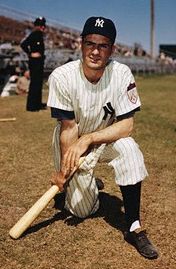
Showing posts with label jerry coleman. Show all posts

Tuesday, October 7, 2025

October 7, 1950: Bronx Bombers vs. Whiz Kids

The World Series programs sold at Shibe Park (left)
and at Yankee Stadium (right)

October 7, 1950, 75 years ago: The World Series comes to an end. It was considerably closer than the results would suggest.

The New York Yankees won the American League Pennant, but it wasn't a runaway: The Detroit Tigers finished 3 games back, the Boston Red Sox 4, and the Cleveland Indians 6. Casey Stengel had managed them to their 2nd straight Pennant, having led them to win the World Series the year before.

But the team was in transition, and the team's veterans, who had starred under manager Joe McCarthy and had been loyal to him, led by Joe DiMaggio, didn't get along with him. Piece by piece, Stengel and general manager George Weiss replaced them with Stengel-loyal men: Yogi Berra became the starting catcher, left fielder Charlie Keller was replaced by Gene Woodling, right fielder Tommy Henrich was replaced by Tommy Henrich, 2nd baseman George "Snuffy" Stirnweiss was replaced by Jerry Coleman and Billy Martin, and 1st baseman George McQuinn was replaced by Joe Collins.

Phil Rizzuto was still the team's shortstop, and the Queens native became a Yankee in large part because, when he tried out for his favorite team, the Brooklyn Dodgers, their manager told him he was too small. He held a grudge against that manager. His name was Casey Stengel. Stengel came to admire Rizzuto, but the feeling was never mutual. In 1950, Rizzuto was rightly named the AL's Most Valuable Player.

Stengel had also built a new starting rotation, with alternating styles: Righthanded fastball pitcher Allie Reynolds, a Native American known as the Superchief; lefthanded off-speed pitcher Eddie Lopat, known as Steddie Eddie and the Junkman; and righthanded fastball pitcher Vic Raschi, from Springfield, Massachusetts and known as the Springfield Rifle. Late in the season, a rookie lefthander from Queens was promoted, Eddie Ford, not yet widely known as Whitey, but he would become so due to his very light blond hair. Joe Page was the team's top relief pitcher.

It would take until the next season for Mickey Mantle to arrive, and another for him to replace DiMaggio in center field. Also in 1951, 3rd baseman Billy Johnson was replaced by Gil McDougald.

In the National League, the Philadelphia Phillies edged the defending Champion Brooklyn Dodgers on the last day of the season, October 1, when Dick Sisler, son of Hall-of-Famer George Sisler, hit a 10th-inning home run. Managed by Eddie Sawyer, the Phils were the youngest team, on the average, ever to win the NL Pennant.

The outfield was Del Ennis in left, Richie Ashburn in center, and Sisler in right. Like Ford, Ashburn had very light blond hair and was nicknamed Whitey, although it didn't catch on as much. Like Rizzuto, Ashburn was his team's sparkplug, a scrappy hitter and a fine defensive player. Also like Rizzuto, he went on to become a beloved broadcaster for the team, telling stories about the old days, wishing people happy birthdays, happy anniversaries, and get-wells. And, like Rizzuto, it took a long time for him to be elected to the Baseball Hall of Fame, but he did live long enough to enjoy it.

Eddie Waitkus played 1st base for the Phils, Mike Goliat was at 2nd, Granville "Granny" Hamner was at short, and Willie "Puddin' Head" Jones was at 3rd. Their catcher was Andy Seminick. Their pitching ace was Robin Roberts, and Jim Konstanty had such a good season, he became the 1st relief pitcher, in either League, to be awarded the MVP. Had there been a Cy Young Award at the time, he probably would have won that, too.

The Phillies hadn't won a Pennant in 35 years, since 1915, before television, before radio, before newsreels had sound. The City of Philadelphia hadn't won a Pennant in 19 years, since the 1931 Athletics, or a World Series in 20 years, since the 1930 A's, and the Phillies had never won one. So this was an exciting moment for the Delaware Valley.

But the Phillies had a problem: Their Number 2 starter, Curt Simmons, had been drafted into the Korean War. Their remaining starters weren't as well regarded. And Roberts was exhausted: He had lost a game on September 7 with 2 days' rest, won a complete game in his next start with 4, started and gone 7 innings of a 19-inning Phils win with 2, lost a complete game with 3, lost after 8 innings with 4, pitched 5 innings and lost with 3, pitched a complete game and lost the very next day, and pitched all 10 innings of the clincher with 2. For Game 1 of the World Series against the Yankees, at Shibe Park in Philadelphia, he would have only 2 days of rest, and Sawyer felt he couldn't risk him again so soon.

Sawyer told the press, "My starting pitcher is Jim Konstanty." He told them that it wasn't quite the gamble that it seemed, because Konstanty had pitched long relief during the season. He had pitched 10 innings of the 19-inning game on September 15, 9 innings in a 15-inning game on August 25, 5 innings on May 28, and at least 3 innings on 12 other occasions that season. Saywer had confidence in him.
Jim Konstanty

October 4, Game 1: The gamble nearly paid off: Konstanty was fantastic, pitching 8 innings, allowing only 1 run, in the top of the 4th. Bobby Brown led off with a double, Bauer hit a flyout that advanced Brown to 3rd base, and he scored on Coleman's sacrifice fly. But Raschi was even better, tossing a shutout with 2 hits and 1 walk, and the Yankees won, 1-0.

October 5, Game 2: This time, Sawyer started Roberts, on 3 days' rest. He somehow managed to hold the Yankees to a 1-1 tie. Both runs scored on sacrifice flies: The Yankees' in the top of the 2nd, Coleman scoring on Woodling's; the Phillies' in the bottom of the 5th, Goliat on Ashburn's.

The Phillies had their chance. With 1 out in the bottom of the 9th, Hamner doubled. Stengel ordered Reynolds, who had also gone the whole way, to intentionally walk Dick Whitman to set up the double play. It worked, as Goliat grounded into one.

Sawyer sent Roberts out to pitch the top of the 10th. His 1st pitch was to DiMaggio, who sent it into the upper deck of the long bleachers that extended from the left field pole to the center field corner at Shibe Park. (It was home to the Athletics from 1909 to 1954, the Phillies from 1938 to 1970, the NFL's Eagles from 1944 to 1957, and was renamed Connie Mack Stadium in 1953.) Roberts got the next 3 outs, but it was now 2-1 Yankees.
Joe DiMaggio

The Phils had one more chance. Sawyer sent Jackie Mayo to pinch-hit for Roberts, and Reynolds, pretty tired himself, walked him. Waitkus sacrificed him to 2nd. Ashburn popped up to 1st. The batter was Sisler. Could lightning strike for him again? Not this time: Reynolds found something left in his tank, and struck him out.

The Phillies had gotten courageous performances from their best starter and their best reliever, and had held the defending World Champions to 3 runs. But they were down two games to none.

October 6, Game 3: The action moved to Yankee Stadium. And, since the ballparks were only 105 miles apart, there was no day off for travel. In other words, presuming Sawyer wanted to give Roberts sufficient rest, he would have to wait until Game 6 to pitch him again, and then hope that somebody, or a collection of somebodies, could hold the Yankees off in Game 7 -- if it got that far.

For this game, Sawyer started Ken Heintzelman. Stengel started Lopat. At 3-9 with a 4.09 ERA, he was no Robin Roberts, no Curt Simmons, not even a Jim Konstanty. And with Shibe Park limited to 33,000 seats, the Bronx crowd of 64,505 might have been overwhelming to the Phillies.

But Heinztelman pitched very well. The Yankees took a 1-0 lead in the bottom of the 3rd, when Rizzuto scored on a Coleman single. The Phillies tied it in the top of the 6th, when Sisler singled Ennis home. They took the lead in the top of the 7th, when Goliat singled Hamner home. It was 2-1 Phillies.

Heintzelman got through the 7th, and got the 1st 2 outs in the bottom of the 8th. But he was out of gas. He walked the next 3 batters: Coleman, Berra and DiMaggio. Brown hit a grounder to Hamner at shortstop, and he mishandled it, allowing Coleman to score. Russ Meyer came in to relieve in the bottom of the 9th, and got the 1st 2 outs. But he allowed 3 straight singles: Woodling, Rizzuto, Coleman, the last of these scoring Woodling with the winning run. Yankees 3, Phillies 2.

The Phils had now played 3 games in this Series, and lost each of them by 1 run. They had held the Yankees to a combined 5 runs in 3 games, to no avail. For fans from Scranton in the north to Rehoboth Beach in the South, from Atlantic City in the east to Harrisburg in the west, this 1950 World Series must have seemed like rotten luck.

But a champion finds a way to win those games. The Yankees did. The "Whiz Kids" were hardly outclassed, but, against the more experience team, the defending World Champions, some of whom had been winning World Series going back more than a decade, they were outplayed.

October 7, Game 4: Ford started, and he outpitched Bob Miller. A Berra single and a DiMaggio double gave the Yankees a 2-0 lead in the 1st inning. In the 6th, Berra hit a home run, DiMaggio was hit by a pitch, Brown tripled him home, and Bauer hit a sacrifice fly to bring Brown home.

Ford took a 5-0 lead into the top of the 9th. But he allowed a leadoff single to Willie Jones, and hit Ennis with a pitch. No big deal, right? He got Sisler to ground into a force play, then struck Hamner out. One out to go, and there would be a sweep and another title.

The batter was Seminick. He hit an easy fly ball to left, where Woodling was under it. But the Autumn Sun combined with the roof of the pre-renovation old Yankee Stadium led to left field being difficult to play. As Berra would say in 1960, after switching positions with Elston Howard, who had become the 1st black Yankee in 1955, "It gets late early out there." Seminick's fly was easy, "a can of corn" in baseball lingo, and Woodling dropped it. Jones and pinch-runner Ken Johnson scored. It was 5-2.

Stengel came out to relieve Ford with Reynolds. The crowd of 68,098 started booing, and Ford thought they were booing him, for not finishing the job. But when he walked off the mound, they gave him a standing ovation, and he realized they were booing Stengel for taking him out. Reynolds then struck Stan Lopata out to end it.
Ford, congratulated after the game by Stengel

It was the 1st of 10 World Series games, still a record, won by Whitey, who would go on to be nicknamed "The Chairman of the Board." He liked that nickname, not so much because it rhymed with his surname, but because he was a big fan of the other celebrity with it, singer Frank Sinatra. For the rest of his life, Sinatra would remain friends with Ford, Rizzuto and Berra. But his once-strong friendship with DiMaggio would be ruined over Marilyn Monroe, and the 2 most famous Italian-Americans ever feuded until Sinatra's death in 1998.

Ford spent the next 2 years serving in the Korean War, but when he returned for the 1953 season, he became the Yankees' ace, the best starting pitcher the team has ever had, and one of the most beloved Yankees.

The Phillies had their chances in the 1950 World Series, but didn't make the most of them. They also did not hit a home run in the World Series, and this has not happened since.

As it turned out, the 1950 Phillies, the Whiz Kids, were the last all-white team to win the National League Pennant. The last one in the American League was the 1953 Yankees.

The Phillies did not reach the postseason again until 1976, and didn't win another Pennant until 1980, when they won their 1st World Series, beating the Kansas City Royals. They lost the World Series to the Baltimore Orioles in 1983, and to the Toronto Blue Jays in 1993. They won another in 2008, beating the Tampa Bay Rays; and lost it in 2009, to the Yankees, and in 2022, to the Houston Astros.

A Yankees-Phillies World Series remains possible as the 2025 season moves into the Division Series.

Thursday, March 17, 2016

Top 10 Yankee Second Basemen

Honorable Mention to Horace Clarke, 1965-74. He had terrible timing, getting to the big leagues right as the old dynasty was collapsing, and tailing off just as it was all coming back together. For years, he was the answer to a trivia question: "Who was the only player to play 10 years for the New York Yankees without winning a Pennant?" There is now, of course, one who played 14 seasons for the Yankees without winning a Pennant: Don Mattingly.

Clarke wasn't a terrible ballplayer; you generally don't last that long if you are truly terrible. But he was a typical middle infielder of his time, the kind often described with the expression "good field, no hit." He batted .285 in 1969, but that was pretty much as good as it got: He never topped 6 home runs (1966) or 48 RBI (1969), was a good but not exceptional base stealer (also topped out in that stat in '69, with 33), and never won a Gold Glove or made the All-Star Team.

He gave his best, and was hardly the worst of the players the Yankees had when CBS was running the team (into the ground). Roy White, who came up at the same time and did last long enough to help the Yankees win titles, paid him a pretty good compliment: "A 100 percent player. He wanted to play everyday."

His Number 20 has been retired, but for Jorge Posada.

Honorable Mention to Brian Doyle, 1978-80. He stepped in for the injured Willie Randolph in September and October 1978, and helped to put the finishing touches on what was, until 1996, my favorite baseball season. Speaking of which...

Honorable Mention also to Mariano Duncan, 1996-97. He was only a Yankee for a season and a half, but that full season was 1996, when the Bronx Bombers won the World Series, with Duncan batting .340 and giving the team its motto: "We play today, we win today, das it."

Honorable Mention to Luis Sojo, 1996-2003. Okay, he wasn't a great player, but he played on 5 Yankee Pennant winners and 4 World Champions, and got the hit that won the clinching Game 5 of the 2000 World Series against the Mets, making him (at least, from the perspective of those of us who had to listen to Met fans in the Eighties) one of the most important players in Yankee history.

Honorable Mention to Jose Vizcaino, 2000. He played a grand total of 82 games for the Yankees, but 4 of them were in the aforementioned 2000 World Series. His 12th inning RBI single won Game 1, and essentially decided the Series that means that, no matter what the Mets did after that, the Yankees would have the edge over them for all time.

Honorable Mention to Alfonso Soriano, 1999-2003, returning 2013-14. The Yankees had him at the beginning and the end of his career, and didn't really get the best of him, although he came within 2 outs of being the hero of the 2001 World Series, and in 2002 he led the American League in hits, runs and stolen bases.

He hit 412 home runs during his career, but only 121 were with the Yankees. He played on 7 teams that reached the postseason, but never won a World Series ring, playing for the Yankees in the 2001 and '03 Series. But his weak postseason performance in 2003 (I called him Strikeout Soriano) made him trade bait in the offseason, being exchanged even-up for Alex Rodriguez.

10. Aaron Ward, 1917-26. If you say you saw him play, either you're about 100 years old, or you've got a time machine, or you're lying. But somebody had to be the 1st Yankee 2nd baseman to win a Pennant, and the 1st to win a World Series.

This Arkansan was the Yanks' regular "keystone sacker" from 1920 to '25, and batted .306 in '21 to help win that first Pennant. The coming of Tony Lazzeri was the beginning of the end for him, but it should not be forgotten that he was at the beginning of the original Yankee Dynasty.

9. Billy Martin, 1950-57. Let's clear something up: Billy was batting .241 when he was sent to the Kansas City Athletics at the trading deadline, June 15, 1957. True, he was at the Copacabana Club that night a month earlier, but he never threw a punch, and it can be legitimately argued that he was traded because he wasn't hitting. He was not traded because of "the Copacabana Incident," even if it did give general manager George Weiss, who hated Billy's guts, the final nail in his coffin, one his beloved manager Casey Stengel couldn't keep from being slammed shut.

Nevertheless, prior to that, Billy the Brat had his moments. He was a good fielder, and in 1953 hit 15 homers with 75 RBIs. In all 7 seasons he played for the Yankees, 1950 to '57, they won the Pennant. They failed to win it in '54, when Billy was in the Army. (The Korean War was over, but he got drafted anyway.) He never got tired of pointing out that fact.

In the 1952 World Series, his catch of a bases-loaded popup by Jackie Robinson, lost in the sun by all the other infielders, ended a potential Dodger rally and saved a Game 7 lead for the Yankees. In 1953, he got 12 hits, tying a Series record (since broken), and his 12th and final hit drove home the Series-winning run in Game 6.  He's often called the MVP of the 1953 World Series, but the award wasn't created until 1955.

He batted .257 during the regular season, but .333 in the 4 World Series where he was a regular. Counting only full seasons, Billy was a member of 4 Pennant winners (1952, '53, '55 and '56) and 3 World Champions (all but '55). In those 4 Series, he played every game, despite the potential availability of Jerry Coleman.

It was his managing, from 1975 to '78 (and 4 more times between '79 and '88) that got him his Plaque in Monument Park and the retirement of his Number 1. But for most of his playing career, Billy was a good player.

Weiss said Billy was a "bad influence" on his teammates, especially Mickey Mantle. Oh yeah? In 1950, in his brief callup, Billy was roomed with Phil Rizzuto; in 1951, with Yogi Berra; in 1956, with Mickey; in all 3 seasons, his roomie won the AL's MVP. As Mickey himself said, "In 1956, I roomed with Bill,y and I won the Triple Crown and the MVP. How bad an influence could he have been? Then they traded him, and they realized it was Whitey (Ford) who was the bad influence on me."

8. George "Snuffy" Stirnweiss, 1943-50. The native New Yorker helped the Yankees win the World Series in 1943, '47 and '49. In 1944, he led the American League in hits, triples, and, rare for a Yankee, stolen bases, with 55. In 1945, he led the AL in all those categories again, and also in batting average, slugging percentage, on-base percentage and total bases. Had the Yankees been in the Pennant race that year, he would have been a good choice for the AL's Most Valuable Player.

He played his last big-league game at age 33, and went into private business. On September 15, 1958, shortly before his 40th birthday, he was 1 of 48 people killed in a commuter train crash in Newark. He wore Number 1, which, as I said, has been retired for Billy Martin.

7. Jerry Coleman, 1949-57. Billy's fellow native of the San Francisco Bay Area (San Jose and later San Francisco, as opposed to Billy's Berkeley) both preceded and outlasted him. Coleman served in both World War II (delaying his big-league debut) and the Korean War (causing him to miss all but the start of the '52 season and all but the end of '53), and was a renowned Marine Corps pilot -- though he said many times that he didn't consider himself a hero.

In 1949, his 8th-inning double in the season finale against the Boston Red Sox clinched the Pennant, putting him on the way to winning a World Series ring in his rookie season. He remained the Yanks' regular 2nd baseman in '50 and '51, with his reserve callup into the Corps giving Billy his chance. He was the regular again in '54 when Billy was in the service, but once Billy came back, that was it for him. Still, he won 5 Pennants (1949, '50, '51, '55 and '56) and was on the World Series roster for 4 titles (all but '55).

Coleman went into the broadcast booth, teaming with former double-play partner Phil Rizzuto for a few years -- what a mess that must've been, between Phil's whacked-out stories and Jerry's "Colemanisms" (known as "Colemanballs" in Britain in honor of sportscaster David Coleman, who died within a few weeks of Jerry) -- before going to the expansion San Diego Padres. He was the voice of the team almost throughout their history until his death, and for this service received the Ford Frick Award, the broadcasters' equivalent of election to the Hall of Fame.

Like Ralph Kiner with the Mets and Herb Score with the Cleveland Indians, Jerry was known for malaprops -- like the other two, he has used, "He slides into second with a standup double." He's also used, "Rich Folkers is throwing up in the bullpen." About a Cy Young Award winner with blond curly hair reminiscent of Harpo Marx, he said, "On the mound for the Padres is Randy Jones, the lefthander with the Karl Marx hairdo."

Then there was this line, used on a Padre star who became a Yankee star: "There's a long fly ball, deep to right field, Winfield goes back to the wall, he hits his head on the wall! And it rolls off! It's rolling all the way back to second base. This is a terrible thing for the Padres!"

But he was also known for his equivalent of Rizzuto's "Holy Cow": "Oh, doctor!" which was often paired with, "You can hang a star on that baby!" For this, his notation along with the Padres' retired numbers at Petco Park is a star. The uniform number he wore with the Yankees has been retired, but it's 42, so it was retired for Mariano Rivera (and, officially, is already retired for Jackie Robinson).

6. Bobby Richardson, 1955-66. After brief callups in 1955 and '56, Richardson stepped into the void caused by the trade of Martin in '57, and was the Yanks' starting 2nd baseman for the next 10 years, winning 7 Pennants (1957, '58, '60, '61, '62, '63 and '64) and 3 World Series (1958, '61 and '62).

He made 7 All-Star Teams. In 1961, the 1st season of the 162-game schedule, he became the 1st player ever to play in 162 games in a season. In '62, he set major-league records with 754 plate appearances and 692 at-bats (both since broken), got a League-leading 209 hits, batted .302, and finished 2nd to Mickey Mantle in the MVP voting -- after Mantle, asked in an interview who should get the MVP, said it should be Richardson.

Richardson's 2 most impressive feats came in losing causes. In the 1960 World Series, he collected a record 12 RBIs, including a grand slam, but the Yankees lost to the Pittsburgh Pirates. In 1964, he became the first player to get 13 hits in a World Series (since tied but not broken), but the Yanks lost to the St. Louis Cardinals. But he's best known for catching a Willie McCovey line drive that ended a San Francisco Giant threat and preserved Ralph Terry's 1-0 shutout to win Game 7 of the 1962 Series. He was a .266 hitter in the regular season, but batted .305 in Series play.

Injuries forced his retirement at age 31. He became an ordained minister, and the head baseball coach at Jerry Falwell's Liberty University in Virginia, and, in his home State, at Coastal Carolina University and the University of South Carolina, leading them to the Final of the 1975 College World Series. Rev. Richardson presided over Mantle's funeral in Dallas in 1995, and recently published a memoir, Impact Player.

5. Chuck Knoblauch, 1998-2001. Go ahead, make your jokes. And, I admit it, after that "Knob-block-head" play in the 1998 ALCS, I personally wanted to beat him to death with my own two hands. But this man won 4 World Series rings, in 1991 with the Minnesota Twins (he was AL Rookie of the Year that season) and in '98, '99 and 2000 with the Yankees, and another Pennant in '01.

The Houstonian's home runs tied up Game 1 in '98 and Game 3 in '99, and his sacrifice fly sent Game 1 in 2000 into extra innings, making Yankee wins in those games possible. He started the rally that won Game 5 in '01, scoring the winning run.

He made 4 All-Star Games. He led the AL in doubles in 1994 (had 45, a great total for a full season, in 2/3 of a season before the strike hit) and in triples in 1996. He had 3 .300 seasons and just missed a 4th. He had over 300 doubles and 400 stolen bases despite playing only 12 big-league seasons before whatever happened to his throwing also began to affect his hitting. But he still hit .289 for his career.

4. Willie Randolph, 1976-88. The 1st Yankee 2nd baseman I knew, and until recently still the best in my memory. He got a cup of coffee with the Pirates in 1975, and was on their postseason roster as they won the NL East. Then he was on 3 straight Pennant winners with the Yankees, winning the Pennant in '76 and the World Series in '77 and '78, although he got hurt in September '78 and missed the postseason. In fact, starting in '75, he reached the postseason in 6 of his 1st 7 seasons.

But that was it, and the rest of his career, while respectable, came with lots of injuries. His last 4 seasons in Pinstripes, '85 through '88, he missed significant time each year; each year, the Yankees were in first place late, but didn't make the Playoffs. His injury shortly after the 1987 All-Star Game was particularly troublesome, as the Yanks went from 1st to 4th in the AL East before he came back.

Still, he twice batted .300, had 2,210 hits (1,731 as a Yankee), 271 stolen bases (252 as a Yankee), made 6 All-Star Games (5 as a Yankee), and was as dependable at getting on base and fielding his position as anybody the Yankees have had in my lifetime.

After bouncing around for 4 years, he returned to the Yankees in 1993, first as an assistant general manager, then as 3rd base coach, winning 4 more rings and guiding several young players including Derek Jeter.

In 2005, he became the 1st black manager in New York -- albeit with the Mets, the team he grew up rooting for in Brooklyn (though he was born in South Carolina). He got the Mets to the 2006 NL East title (their only first-place finish since 1988), but we know how that ended. The Mets were still in contention for another Division Title on the final day in 2007, but we know how that ended.

Then came the Midnight Massacre (not to be confused with the one the Mets pulled on Tom Seaver in '77), and "Witless Willie," as the Mets' buh-rilliant fans called him, was gone. It wasn't just the results they hated: They hated him because he was a Yankee. Then Jerry Manuel was hired as Met manager and proved that it wasn't Willie's fault at all.

He is now working with the U.S. national team. Last year, he got a Monument Park Plaque, although his Number 30 will probably never be retired. On Old-Timers' Day in 2008, shortly after being fired by The Other Team, he got the biggest ovation of the day -- bigger than Yogi, Whitey, Reggie or Donnie. And in the pregame cermonies for the final game at the old Stadium, Willie, then 54 years old, ran out to his old position and slid into the base, to another thunderous ovation. It may have been 2nd base he was standing on, but, a Yankee forever, he was, truly, safe at home.

3. Robinson Cano, 2005-13. When I originally did this list, I had him at Number 1. Now, I've dropped him to 3. Is it fair to hold his leaving, or the way he left, against him on this ranking? I don't know. After all, neither of the guys ahead of him ended their careers with the Yankees -- then again, neither left in bitterness or in a way that was insulting to either the Yankee organization or the Yankee Fans. Cano did.

The Dominican's parents named him after Jackie Robinson, and he wore Number 24, the reverse of 42, as a tribute, Robbie was 2nd in the race for AL Rookie of the Year in 2005 and 3rd for MVP in 2010. As a Yankee, he was named to 5 All-Star Games, won 2 Gold Gloves, batted .309 with a 126 OPS+, hit 204 of his 239 home runs thus far, and had 3 100-RBI seasons and 7 40-doubles seasons.

He had just turned 31 when he left. He should have had several more solid seasons in him. But was it worth acceding to his contract demands, given the ways the Yankees had already been burned on long-term contracts in the 21st Century? His 1st 2 seasons with the Seattle Mariners have been good, and certainly would have helped the Yankees in place of the weak-hitting Stephen Drew. But the decision to let him go was never about his next 2 seasons; it was about his last 2, and maybe his last 5, whenever those turn out to be.

2. Joe Gordon, 1938-46. Born in Los Angeles and raised in Portland, Oregon, he was one of many West Coasters to come east in the 1920s and '30s to put on the Pinstripes. With the science-fiction movie serial becoming a phenomenon in the Thirties, it surprised no one that he was nicknamed Flash Gordon, and he certainly knew what it was to "flash the leather." There was no Gold Glove Award until 1957, but Gordon would have been a perennial contender.

But it's not his glove that finally, over 30 years after his death in 1978, got him into the Hall of Fame: Unusual for a 2nd baseman in those days, he was a heck of a hitter. A 9-time All-Star, he had a 120 career OPS+, and collected 1,530 hits in only 11 seasons.

In 1942, he was named AL MVP even though Ted Williams won the Triple Crown. Red Sox fans are still pissed about that, but it's Most Valuable Player, not Most Outstanding, and Gordon led the Yankees to the Pennant with a .322 average, 29 doubles, 18 homers, 103 RBIs and 12 stolen bases (not much, but then the Yankees rarely needed a running game until Billy Martin became manager so this was a lot for a Yankee).

Gordon then missed 3 seasons due to World War II, and had a bad first season back in 1946. Then the Yankees pulled off a stunning trade, sending Gordon to the Cleveland Indians, straight-up, for pitcher Allie Reynolds. This may have been the greatest trade in baseball history, because it worked wonders for both teams. Reynolds became the ace of a staff that won 6 of the next 7 World Series. The one AL Pennant the Yanks didn't win in that stretch was in 1948, when Gordon and his manager and double-play partner Lou Boudreau led the Tribe to what is still their last World Championship.

Gordon later became a manager, taking the Indians to a 2nd place finish in 1959 and, 10 years later, becoming the first manager of the expansion Kansas City Royals.

1. Tony Lazzeri, 1926-37. Yet another -- perhaps the first -- great player who came out of the Pacific Coast League to star with the Yankees. Like Joe DiMaggio, basketball pioneer Hank Luisetti, and football legend turned criminal defendant O.J. Simpson, he came out of Galileo High School in San Francisco, and became a star on the playing fields of the Bay Area.

In 1925, playing for the Salt Lake Bees, he became the 1st player in the history of professional baseball to hit 60 home runs -- albeit in the PCL, where the weather allowed them a 200-game schedule. But it was enough for the Yankees to send the Bees 3 players and $50,000 for him. As sports historian Bert Randolph Sugar would say, these were Coolidge dollars: It's about $650,000 in today's money.

He wasn't the 1st Italian player in Major League Baseball, but he was the 1st who was that good, and New York's Italian community saw runners on base and yelled from the stands, "Push them up, Tony!" In their accent, he became known as Poosh-em-Up Tony.

In his 1st big-league season, 1926, the Yankees won the Pennant. Unfortunately, the Yanks lost the World Series to the Cardinals, with aging legend Grover Cleveland Alexander coming out of the bullpen to strike Lazzeri out with the bases loaded in the bottom of the 7th in Game 7. It is still the most famous strikeout in baseball history, save for the fictional one of the poem "Casey At the Bat."

It didn't faze the 22-year-old star. He helped the Yankees win 6 Pennants (1926, '27, '28, '32, '36 and '37) and 5 World Series (never losing one after that first). In 5 seasons he batted at least .300, and 7 times he had at least 100 RBIs. In 1933, he was the AL's starting 2nd baseman in the 1st All-Star Game. In 1937, he dropped from a .287 average the year before to .244, and Gordon was brought in to replace him. He signed with the Chicago Cubs, and in 1938 won one more Pennant, but losing the Series to the Yankees. He hung on in the high minors until 1943, age 39.

In 1945, in an interview for John P. Carmichael's classic book My Greatest Day In Baseball, Alexander chose that 1926 Game 7, and mentioned that, just the other day in New York, he'd met Lazzeri on the street, and said, referencing how many times he'd been asked to tell the story, "Tony, I'm getting tired of fanning you." Lazzeri didn't think it was funny, and said, "Maybe you think I'm not!"

Sadly, within 5 years, both men would be dead. On August 6, 1946, Lazzeri, who had epilepsy, suffered a seizure at his San Francisco home, fell down the stairs, and broke his neck, killing him at age 42. Alexander, by a sad twist of fate, also had epilepsy, but it was not that but alcoholism that ruined his health and led to his death in 1950, at 63. Alexander did live long enough attend his election to the Hall of Fame in 1938. Lazzeri, with only 14 big-league seasons under his belt, didn't make it until well after his death, in 1991.

I previously chose him as the greatest Yankee 2nd baseman because he was the first Yankee 2nd baseman elected to the Hall; Gordon recently joined him. But there is no consensus that Lazzeri was better than Gordon; in fact, a lot of people disagree.

As a result of there not being a consensus on who the all-time Yankee 2nd baseman is, neither Lazzeri nor Gordon has a Plaque in Monument Park. Nor has the Number 6 that both wore for most of their careers been retired for either of them: It was retired, but for Joe Torre. And there are very few fans left who saw either of them at their peak. But they deserve to be remembered.

Monday, September 28, 2015

September 28, 1955: Jackie Steals Home... Or DOES He?

September 28, 1955, 60 years ago today: Game 1 of the World Series, at the original Yankee Stadium. Yes, a World Series game was played on a September 28. This was also the 1st World Series game broadcast in color, on NBC (as were all World Series from the 1st telecast of one in 1947 until 1975), although hardly anyone has a color TV set at this point, and no TV recording of it, in color or otherwise, is known to survive.

There is film footage, though. That footage shows Jackie Robinson of the Brooklyn Dodgers, his increasing weight (in part due to diabetes) having cut down on his speed, but not his daring, stealing home plate against the New York Yankees.

Home plate umpire Bill Summers rules him safe. Yankee catcher Yogi Berra says Jackie was out, and has a fit.

To the end of his life, Yogi insisted that he wouldn't have argued that strenuously if he wasn't sure, or if Jackie was definitely safe, as Monte Irvin of the New York Giants was when he stole home on Yogi in the 1951 World Series.

Whitey Ford was pitching, and he insists to this day that Jackie was out. But Phil Rizzuto claimed that Jackie was safe, and he knew because he was playing shortstop and had the best view of the play.

Whitey didn't like that, so he looked it up. The steal was in the top of the 8th inning -- and in the bottom of the 6th, manager Casey Stengel had pinch-hit Eddie Robinson for the Scooter! In the top of the 7th, a new shortstop took the field: Jerry Coleman (normally a 2nd baseman). Coleman was playing short when Jackie stole home.

So who was right? Judge for yourself. Here's the film. It's hard to tell from there. But this photo makes it obvious: He was out!
And if the Yankees had lost the game, and the World Series, because of this, there would have been an uproar -- or, as the Dodgers' legendary broadcaster, ironically now with the Yankees, Red Barber, would have put it, a rhubarb.

But the Yankees did not lose the Series, or even the game, because of the steal. The Yankees won the game, 6-5. Left fielder (and backup catcher) Elston Howard, a "rookie" at age 30, hit a home run off Don Newcombe in the 2nd inning, while 1st baseman Joe Collins hit 2 homers off Big Newk. Carl Furillo and Duke Snider hit home runs off Ford.

Like Carlton Fisk's home run in Game 6, 20 years later, Robinson's steal of home was a spectacular moment, but, ultimately, had no effect on the result of the Series.

Still, stealing home plate became Jackie Robinson's signature, along with his grace under more pressure than any American athlete has ever faced. He did in 19 times in the regular season, plus this time in the World Series -- still the last steal of home in a World Series game. (One of the many records that Ty Cobb set, and one that he still holds, is the most steals of home in a career: 54.) It even became a point of reference in Buddy Johnson's 1949 song about Jackie, with the Count Basie Orchestra having made the best-known recording:

Did you see Jackie Robinson hit that ball?
Did he hit it? Yeah, and that ain't all.
He stole home.
Yes, yes, Jackie's real gone.


"Gone" meaning "cool." Not as in "left the vicinity" or "gone in the head." No player ever kept his head -- or had to -- as much as Jack Roosevelt Robinson of Pasadena, California (and Stamford, Connecticut).

With the recent deaths of Yogi and Dodger 2nd baseman Don Zimmer -- Jackie was usually playing 3rd base by this point, not his standard 2nd -- the starting pitchers, Newcombe and Ford, pinch-hitter Eddie Robinson, and Yankee left fielder Irv Noren are the only players from this game who are still alive, 60 years later.

This Series was a classic, and it went to 7 games. In the end, as would be said in the Brooklynese accent, the Dodgers finally dooed it. After World Series losses in 1916, 1920, 1941, 1947, 1949, 1952 and 1953 (the last 5 of those 7 against the Yankees), losses in Playoffs for the National League Pennant in 1946 and 1951 (the latter against the hated New York Giants), losing the Pennant on the final day of the regular season in 1942 and 1950, and finishing 2nd to the Giants in 1954 -- 10 close calls in a span of 14 years -- 1955 turned out to be the "Next Year" that Dodger fans from Williamsburg to Coney Island, from Morristown to Montauk, from Poughkeepsie to Point Pleasant, had waited for.

*

September 28, 1932: Game 1 of the World Series. The Chicago Cubs score 2 runs in the 1st inning, but the Yankees outscore them 37-17 over the rest of the Series. Lou Gehrig hits a home run, and the Yankees win, 12-6.

September 28, 1959: Game 1 of the National League Playoff. It was the Braves' move to Milwaukee, with is (then) modern stadium and its huge parking lot, that made Walter O'Malley want a better ballpark for the Brooklyn Dodgers, and ultimately made him move the team to Los Angeles. Now, after the Braves have won the last 2 Pennants, there is a tie for the flag, and these 2 teams, representing cities that didn't even have teams 7 seasons ago face off at Milwaukee County Stadium.

Dodger manager Walter Alston starts Danny McDevitt, who pitched a shutout in the last game at Ebbets Field, 2 years and 4 days earlier. But he doesn't get out of the 2nd inning this time, as he falls behind, 2-1. Alston brings Larry Sherry in to relieve, and he goes the rest of the way. John Roseboro hits a home run off Carlton Willey, and the Dodgers win, 3-2, to take a 1-0 lead back to L.A.

September 28, 1998: The Chicago Cubs and San Francisco Giants, having finished in a tie for the NL's Wild Card berth, face each other in a Playoff game at a raucous Wrigley Field. Former Minnesota Twins World Series winner Gary Gaetti hits a home run, and Rod Beck holds off his former team to save a fine performance by Steve Traschel, and the Cubs win, 5-3.

Sammy Sosa goes 2-for-4 for the Cubbies, and scores 2 runs. Barry Bonds goes 0-for-4 for the Jints. I guess Sammy's steroids were working that night, and Barry's weren't.

Monday, February 10, 2014

Longest-Serving Active MLB Broadcasters

With the death of Ralph Kiner last week, and of Jerry Coleman last month, I was wondering just how many "old-time broadcasters" are left.

Certainly, Vin Scully is still with the Dodgers, the last link to their Brooklyn days (that most of us know of, anyway).

The following list shows only how long the broadcaster in question has been with his current team. I list the longest-serving current one with each of the 30 current MLB teams, plus anyone else who has been with them for at least 20 years. (For Arizona and Tampa Bay, of course, that last stat won't be possible until Opening Day 2017; for Washington, not until Opening Day 2024.)

Studio analysts don't count, only guys actually in the booth calling the game.

57th, Vin Scully, Los Angeles Dodgers, 1958 (That's the team's entire L.A. history. He arrived with the Dodgers in Brooklyn in 1950, so if he makes it to Opening Day this year, and he seems to be in good health at age 86, it will be 65 seasonss. Even Connie Mack and Phil Rizzuto weren't on a single team's payroll for that long. A recipient of the Ford Frick Award, the broadcasters' equivalent of being elected to the Baseball Hall of Fame.)

57th, Jamie Jarrin, Los Angeles Dodgers, 1958 After moving to the U.S. from Ecuador in 1955, he had never seen a baseball game. But he has broadcast every game the franchise has played as a Los Angeles team, all in Spanish, and has received the Frick Award from the Hall of Fame. He has been joined by Dodger legend Fernando Valenzuela.)

46th, Denny Matthews, Kansas City Royals, 1969 (That's the franchise's entire history, although he now has a reduced workload. Frick Award.)

44th, Bob Uecker, Milwaukee Brewers, 1971 (One season short of the franchise's entire history. Despite all the jokes, including his own, about his ineptitude as a player, he was the first Wisconsin native to play for the Milwaukee Braves. Frick Award.)

43rd, Mike Shannon, St. Louis Cardinals, 1972 (Also played for them. John Rooney, although a relative newcomer to St. Louis, has been broadcasting for nearly 30 years.)

41st, Marty Brennaman, Cincinnati Reds, 1974 (Good timing, as they won the World Series in 1975 and '76. Frick Award. His son Thom is also a broadcaster, and has worked with the Reds since 2007.)

36th, Eric Nadel, Texas Rangers, 1979 (He received this year's Frick Award.)

35th, Tom Grieve, Texas Rangers, 1980 (also played for them)

35th, Ted Leitner, San Diego Padres, 1980 (Taking over for Jerry Coleman in Coleman's ill-advised year as manager, stayed on with him. Dick Enberg's long broadcasting career brought him to the Padres' booth in 2010, although his best-known baseball work was for the then-California Angels in the 1960s and '70s.)

34th, Jerry Howarth, Toronto Blue Jays, 1981 (Buck Martinez, who also played for and managed them, broadcast for them from 1987 to 1999, and returned to their booth in 2010, so this will be his 18th season in their booth.)

32nd, Ken Harrelson, Chicago White Sox, 1982 (missing one season as team GM; played for several teams, but not the White Sox)

32nd, Steve Blass, Pittsburgh Pirates, 1983 (Also pitched for them. Lanny Frattare retired in 2008, after 33 seasons.)

32nd, Joe Castiglione, Boston Red Sox, 1983

32nd, Dick Bremer, Minnesota Twins, 1983

32nd, Rick Rizzs, Seattle Mariners, 1983

30th, Milo Hamilton, Houston Astros, 1985 (Though with a reduced workload, this will be his 54th year in an MLB booth, which included calling Henry Aaron's 715th home run for the Braves in 1974. Frick Award.)

30th, Duane Kuiper, San Francisco Giants, 1985 (Also played for them. Jon Miller has been broadcasting MLB games since 1974, entering his 41st season, but continuously with the Giants only since 1997, his 18th. He's won the Frick Award, Kuiper hasn't.)

28th, Bill Brown, Houston Astros, 1987

26th, John Sterling, New York Yankees, 1989 (Previously did games for the Braves; also in New York, for the Nets, Islanders, WHA's New York Raiders & WFL's New York Stars, and hosted a sports-talk show on WMCA as far back as 1971. His career is high, and it is far. Though some people wish he was gone.)

26th, Gary Cohen, New York Mets, 1989 (A Queens native and a Met fan from Day One.)

25th, Tom Hamilton and Rick Manning, Cleveland Indians, 1990 (Manning played for them.)

24th, Ed Farmer, Chicago White Sox, 1991 (Also played for them.)

23rd, Michael Kay, New York Yankees, 1992 (Previously worked with Sterling on Nets broadcasts.)

22nd, Mike Krukow, San Francisco Giants, 1993 (Also played for them.)

22nd, Fred Manfra, Baltimore Orioles, 1993 (Joe Angel started with them in 1988, left in 1993, and returned in 2004.)

22nd, Jim Price, Detroit Tigers, 1993

22nd, Felo Ramirez, Miami Marlins, 1993 (Now 90 years old, the Cuban émigré he was doing Spanish broadcasts on radio well before the team then named the Florida Marlins arrived. In addition, Dave Van Horne has broadcast for the Marlins since 2001, and previously did so for the Montreal Expos, 1969 to 2000, their entire history to that point, so that's 46 seasons in total. Both Ramirez and Van Horne have received the Frick Award.)

21st, Greg Brown, Pittsburgh Pirates, 1994

19th, Ken Korach, Oakland Athletics, 1996

19th, Pat Hughes, Chicago Cubs, 1996 (The deaths of Harry Caray and Ron Santo, and the move of Steve Stone across town to the White Sox, have seriously dented the Cub announcers' institutional memory.)

17th, Larry Andersen, Philadelphia Phillies, 1998 (Took over as the Phils' player-turned-broadcaster after the death of Hall-of-Famer Richie Ashburn. With the deaths of Ashburn, Harry Kalas and Andy Musser, and the recent firing of Chris Wheeler and Gary Matthews, the Phils' broadcasting seniority has gone way down in recent years. Incredibly, Bill Campbell, who broadcast for them from 1963 to 1970, is not only still alive, but still doing a radio show.)

17th, Dewayne Staats and Todd Kalas, Tampa Bay Rays, 1998 (The franchise's entire history; Staats, owner of the best name in the history of baseball broadcasting, previously did Yankee games 1990-94; Kalas is the son of legendary Phillies voice Harry.)

17th, Greg Schulte, Arizona Diamondbacks, 1998 (the franchise's entire history)

13th, Terry Smith, Los Angeles Angels of Anaheim, 2002

13th, Jack Corrigan and Drew Goodman, Colorado Rockies, 2002

10th, Chip Caray, Atlanta Braves, 2005 (The Braves' longest-serving continuous announcer, son of former Braves announcer Skip and grandson of St. Louis/Chicago legend Harry, has only been there since 2005 because of a major shakeup in 2007. Chip previously broadcast for the Cubs, as did his grandfather before him. Hall of Fame pitcher Don Sutton, who hasn't broadcast for any of the teams for whom he played, broadcast for the Braves from 1989 to 2006, went to the Nationals for 2 years, and returned, so this will be his 24th season with them. Although a native of Alabama, he was already in the minor leagues when the Braves moved to Atlanta, so he wasn't able to grow up  a fan of theirs.)

10th, Charlie Slowes, Washington Nationals, 2005 (Previously with the Rays for their entire history to that point, 1998-2004.)

So that's 10 Frick Award winners currently broadcasting: Scully, Jarrin, Matthews, Uecker, Brennaman, Nadel, Hamilton, Ramirez, Van Horne and Miller.

Sunday, January 5, 2014

Jerry Coleman, 1924-2014

Rarely is a figure beloved by fans of both the Yankees and another team. There are a few examples:

* New York Mets: Darryl Strawberry, Dwight Gooden and David Cone. (But not Joe Torre. Or Yogi Berra.)
* Boston Red Sox: Wade Boggs. (But not Roger Clemens.)
* Oakland Athletics: Reggie Jackson and Catfish Hunter.
* St. Louis Cardinals: Enos Slaughter.
* Cleveland Indians: Bob Lemon.
* Brooklyn (now Los Angeles) Dodgers: Red Barber.
* San Diego Padres: Dave Winfield and Jerry Coleman.

That's about it. And it is, for a sad reason, the last of these names that I post tonight.

Gerald Francis Coleman was born on September 14, 1924, in San Jose, California. He was one of many Yankees in the pre-1957 era, before the Dodgers moved to Los Angeles and the Giants moved to San Francisco, to have been plucked from the rich "farmland" of the Pacific Coast League.

He was a graduate of Lowell High School, named for poet James Russell Lowell, in San Francisco. Other graduates of this distinguished institution include scientist Rube Goldberg, artist Alexander Calder, California Governor Pat Brown (father of current Governor Jerry Brown), Hewlett-Packard co-founder William Hewlett, videotape pioneer Charles Ginsburg, actress Carol Channing, President Kennedy's Press Secretary Pierre Salinger, Gorillas in the Mist author Dian Fossey, actor Bill Bixby, The Gap founder Donald Fisher, Supreme Court Justice Stephen Breyer, his brother and fellow federal Judge Charles Breyer, Star Trek costume designer William Ware Theiss, Golden State Warriors legend Tom Meschery, Dennis Marcellino of Sly's Family Stone, San Diego Charger defensive back Gill Byrd, writer Naomi Wolf, actor Benjamin Bratt, Lemony Snicket author Daniel Handler, and Walter Haas, the Levi Strauss magnate who bought the A's from Charlie Finley and saved them for the Bay Area for 2 generations. (Whether there will be a 3rd remains to be seen.) Graduating with Coleman in 1942 was Art Hoppe, longtime columnist for the San Francisco Chronicle.

The Yankees scouted and signed him, and played out the 1942 in Class D ball, before enlisting in the Marine Corps and becoming a pilot. He would also fly for the Marines in the Korean War. A few players, including Ted Williams, would serve in both of those wars, but Coleman was the only major league player to see combat in 2 wars -- any 2 wars. (Hank Gowdy was the only player to have served in World Wars I and II, and was the first player to enlist in I, but wasn't in combat for II.)

When he got back, he rose quickly, playing for the Binghamton Triplets and the Kansas City Blues in 1946, the Blues exclusively in 1947, and the Newark Bears in 1948. He made his major league debut on April 20, 1949, at Yankee Stadium, leading off, playing 2nd base, and going 0-for-4 against the Washington Senators. To make matters worse, on the very first batter he ever faced, Gil Coan, he muffed a grounder for an error. He made up for it, though, starting an inning-ending double play. This helped Vic Raschi to pitch a shutout, and a home run by Tommy Henrich helped the Yankees win, 3-0.

He got his 1st major league hit the next day, a single off Senator pitcher Forrest Thompson, in a 2-1 Yankee win, and he was on his way. When that season came down to the last 2 games, with the Yankees needing to win both at home against the Red Sox, or else the Sox would win the American League Pennant, Coleman got a hit in both games. The finale was won by his bases-loaded double in the bottom of the 8th, of Tex Hughson, as the Yankees won, 5-3, and took the Pennant. He batted .275 that year, with 2 homers and 42 RBIs, and finished 3rd in the first-ever AL Rookie of the Year balloting, behind Roy Sievers and Alex Kellner.

He made his only All-Star Team in 1950, batting .287 with 6 homers and 69 RBIs. In his 1st 3 seasons, 1949, '50 and '51, the Yankees won the World Series every year. But after just 11 games in '52, he was called back by the Corps, and flew missions over Korea. He received 13 Air Medals and 2 Distinguished Flying Crosses, rising to the rank of Lieutenant Colonel, and was known as "The Colonel" for the rest of his life. (This meant that he outranked "The Major," WWII vet Ralph Houk, his teammate as a player and the manager for much of his time as a Yankee broadcaster.) He was discharged in time to play in the last 8 games of the 1953 season, but not in time to be eligible for the World Series roster.

The 1955 World Series was the 1st and only won by the Brooklyn Dodgers. In Game 1 (which the Dodgers, everyone forgets, lost), Jackie Robinson stole home plate. To this day, Yogi Berra insists that Jackie was out. So does Whitey Ford, who was pitching that day. The film seems to bear them out. But Phil Rizzuto said that he had the best view of the play, at shortstop, and that Jackie was safe.

Whitey got tired of hearing the Scooter say this, so he looked it up. It turned out that, in the bottom of the 6th, Eddie Robinson (no relation to Jackie) had pinch-hit for Rizzuto, and Coleman had gone into to play short, and he was there when Jackie stole home in the top of the 8th! The Scooter's memory must have been playing tricks on him. Coleman's thoughts on the steal, as far as I know, were never recorded.

Coleman won another World Series with the Yankees in 1956, and another Pennant in 1957, but was released after that season, shortly after his 33rd birthday. His lifetime batting average was .263, his OPS+ a mere 83, with 558 hits, 16 homers and 257 RBIs. A decent player, but, clearly, he wasn't going to get into the Baseball Hall of Fame that way. For the entirety of his playing career, he was with the Yankees, and wore Number 42, making him the greatest Yankee to wear the number until Mariano Rivera.

In the 1958 and '59 seasons, he served as the Yankees' personnel director, effectively making him their chief scout. In 1960, he began broadcasting baseball with CBS, and in 1963 was hired to broadcast Yankee games.

My Grandma told me that, when Coleman and his former double-play partner Rizzuto used to get going, it was a riot. Sadly, there doesn't seem to be any surviving broadcasts of their banter. Red Barber was also there until 1966, and Jerry picked up the phrase "Oh, doctor!" from him. He also used phrases like, "You can hang a star on that baby!", "And the beat goes on" (presumably before Sonny & Cher recorded their song with that title), and "The natives are getting restless."

His most notable moment behind the microphone for the Yankees was his call of former teammate Mickey Mantle's 500th career home run, off Stu Miller of the Baltimore Orioles, on May 14, 1967, on WPIX-Channel 11. Because of the significance of the milestone (only 5 players had done it before Mantle), this is one of the rare surviving color videotape clips from the pre-renovation original Yankee Stadium.
Sadly, a lot of pre-1980s sports video was simply taped over by TV stations, in order to save money, as high-quality videotape was expensive then. It's why, aside from NFL Films, we don't have footage of Super Bowl I, even though both CBS and NBC broadcast it live.

After the 1969 season, Coleman left the Yankees, and broadcast for the California Angels for 2 years. In 1972, he joined the broadcast staff of the San Diego Padres, and remained in their booth for the rest of his life. With one exception: In the 1980 season, the Padres named him their manager. This proved to be a bad idea, as the Padres went just 73-89, and finished last in the National League Western Division.

In an oddity, he almost wasn't the only beloved broadcaster-turned-manager that year. After Dallas Green was the Philadelphia Phillies' manager at the end of the 1979 season, the Phils considered offering the job to Richie Ashburn, who had also been their star center fielder in the 1950s. But Phils owner Ruly Carpenter realized that, eventually, he would have to fire him, and he didn't want to go down in history as "the man who fired Richie Ashburn."

So he gave Green the job for the full season, and the Phils won their 1st World Series that year. The Padres made the decision to move their beloved broadcaster into the manager's job, and may have been the NL's worst team; the Phils didn't, and were baseball's best.

As the voice of the Padres, Coleman was behind the mike for postseason runs in 1984, 1996, 1998, 2005, 2006 and 2007 (if you count the Wild Card play-in game, and I do). His biggest moment was calling the walkoff home run of Steve Garvey in Game 4 of the 1984 NLCS, setting up the next day as the Padres won their 1st Pennant. (You'll want to skip ahead to 2:12 on this clip, so you don't have to see those "Cub-busters" T-shirts and, worse, hear that "Ballbusters" song.)
In a weird twist, he died just 15 days after David Coleman, a British soccer announcer, who was known for malaprops that became known as "Colemanballs." Jerry had his own, which were called "Colemanisms." Let me rattle off 3, including 1 featuring the other legend shared by the Padres and the Yankees, Dave Winfield:

* "There's a fly ball, deep to right field, Winfield goes back to the wall, he hits his head on the wall! And it rolls off! It's rolling all the way back to second base! Oh, this is a terrible thing for the Padres!" (Maybe he should have said, "Oh, doctor!")

* (Seeing the Padres' ace, with his Harpo Marx-like hair) "On the mound for the Padres is Randy Jones, the lefthander with the Karl Marx hairdo."

* "Rich Folkers is throwing up in the bullpen."

The line "He slides into second with a standup double" has been attributed to Coleman, Cleveland Indians pitcher-turned-announcer Herb Score, Pittsburgh Pirates slugger turned Mets broadcaster Ralph Kiner, and probably a few others.

He was honored with a star (appropriately enough) on the wall at San Diego/Jack Murphy/Qualcomm Stadium, and now at Petco Park, in place of a "retired number." Along with Tony Gwynn, he is also honored with a statue at Petco Park.
(Not the statue. This is him throwing out
the first ball at the Padres' 2012 home opener.)

In 2005, Coleman received the Ford Frick Award, the broadcasters' equivalent to being elected to the Baseball Hall of Fame. Up until that point, he hadn't been back to Yankee Stadium for Old-Timers' Day since he left the club's booth, because he was always working. But after that, the Padres let him return, and he always got a big hand in The Bronx. Here he is, with Don Larsen.
For the last few years, he had understandably cut his broadcast schedule back to 30 games a year. A few days ago, as is the case with too many old people who had previously been in good health, he was injured in a fall at home, and went downhill quickly. He died today, at the age of 89.

*

With his death, the following players remain living from the Yankees' 1949 World Champions: Yogi, Whitey, Bobby Brown and Charlie Silvera.

They are also the only survivors from the 1950 World Champions, although only in '49 was Silvera on the World Series roster.

From the 1951 World Champions, surviving are those 4 and Bob Kuzava.

From the 1956 World Champions, surviving are Yogi, Whitey, Don Larsen, Bob Cerv, Norm Siebern, Jerry Lumpe and Billy Hunter, better known as Earl Weaver's longtime 3rd base coach with the Baltimore Orioles, and briefly manager of the Texas Rangers. Irv Noren, also a survivor of the '52 and '53 Champs, played for the Yankees in '56 but missed much of the season with injury, including the World Series, but should also be counted as a survivor of that team. Jim Coates is still alive, but only appeared in 2 games in '56 and was not on the Series roster.

Jerry Coleman was an American hero and a Yankee Legend. Now, he becomes one of "the Ghosts of Yankee Stadium."

Semper Fi, Colonel. Ooh-rah!

UPDATE: Jerry was buried at Miramar National Cemetery in San Diego.

Thursday, February 17, 2011

Top 10 Yankee Second Basemen

Honorable Mention to Brian Doyle, for stepping in for the injured Willie Randolph in September and October 1978, and helping to put the finishing touches on what was, until 1996, my favorite baseball season. Speaking of which...

Honorable Mention also to Mariano Duncan. He was only a Yankee for a season and a half, but that full season was 1996, when the Bronx Bombers won the World Series, with Duncan batting .340 and giving the team its motto: "We play today, we win today, das it."

10. Horace Clarke, 1965-74. The native of the Virgin Islands had terrible timing, getting to the big leagues right as the old dynasty was collapsing, and tailing off just as it was all coming back together. For years, he was the answer to a trivia question: "Who was the only player to play 10 years for the New York Yankees without winning a Pennant?" There is, of course, now one who played 14 seasons for the Yankees without winning one, Don Mattingly.

Clarke wasn't a terrible ballplayer -- you generally don't last that long if you are. But he was a typical middle infielder of his time, "good field, no hit." He batted .285 in 1969, but that was pretty much as good as it got: He never topped 6 home runs (1966) or 48 RBI (1969), was a good but not exceptional base stealer (also topped out in that stat in '69, with 33), and never won a Gold Glove or made the All-Star Team.

He gave his best, and was hardly the worst of the players the Yankees had when CBS was running the team (into the ground). Roy White, who came up at the same time and did last long enough to help the Yankees win titles, paid him a pretty good compliment: "A 100 percent player. He wanted to play everyday."

9. Aaron Ward, 1917-26. If you say you saw him play, either you're over 90 years old, or you've got a time machine, or you're lying. But somebody had to be the 1st Yankee 2nd baseman to win a Pennant and the 1st to win a World Series.

This Arkansas native was the Yanks' regular "keystone sacker" from 1920 to '25, and batted .306 in '21 to help win that 1st Pennant. The coming of Tony Lazzeri was the beginning of the end for him, but it should not be forgotten that he was at the beginning of the original Yankee Dynasty.

8. Billy Martin, 1950-57. Let's clear something up: Billy was batting .241 when he was sent to the Kansas City Athletics at the trading deadline, June 15, 1957. True, he was at the Copacabana Club that night a month earlier, but he never threw a punch, and it can be legitimately argued that he was traded because he wasn't hitting.

Nevertheless, prior to that, Billy had his moments. He was a good fielder, and in 1953 hit 15 homers with 75 RBIs. In all 7 seasons he played for the Yankees, 1950 to '57, they won the Pennant. They failed to win it in '54, when Billy was in the Army. (The Korean War was over, but he got drafted anyway.) He never got tired of pointing out that fact.

In the 1952 World Series, his catch of a bases-loaded popup by Jackie Robinson, lost in the sun by all the other infielders, ended a potential Dodger rally and saved a Game 7 lead for the Yankees. In 1953, he got 12 hits, tying a Series record (since broken), and his 12th and final hit drove home the Series-winning run in Game 6.

He batted .257 during the regular season, but .333 in the 4 World Series where he was a regular. Counting only full seasons, Billy was a member of 4 Pennant winners (1952, '53, '55 and '56) and 3 World Champions (all but '55). In those 4 Series, he played every game, despite the potential availability of Jerry Coleman and/or Gil McDougald.

It was his managing, from 1975 to '78 (and 4 more times between '79 and '88) that got him his Plaque in Monument Park and the retirement of his Number 1. But for most of his playing career, Billy was a good player. Yankee general manager George Weiss said he was a "bad influence" on his teammates, especially Mickey Mantle. Oh yeah? As Mickey himself said, "In 1956, I roomed with Billy and I won the Triple Crown and the MVP. How bad an influence could he have been? Then they traded him, and they realized it was Whitey (Ford) who was the bad influence on me."

7. Jerry Coleman, 1949-57. Billy's fellow native of the San Francisco Bay Area (San Jose and later San Francisco, as opposed to Billy's Berkeley) both preceded and outlasted him. Coleman served in both World War II (delaying his big-league debut) and the Korean War (causing him to miss all but the start of the '52 season and all but the end of '53), and was a renowned Marine Corps pilot -- though he's said many times he doesn't consider himself a hero.

In 1949, his 8th-inning double in the season finale against the Boston Red Sox clinched the Pennant, putting him on the way to winning a World Series ring in his rookie season. He remained the Yanks' regular 2nd baseman in '50 and '51, with his reserve callup into the Corps giving Billy his chance. He was the regular again in '54 when Billy was in the service, but once Billy came back, that was it for him. Still, he won 5 Pennants (1949, '50, '51, '55 and '56) and was on the World Series roster for 4 titles (all but '55).

Coleman went into the broadcast booth, teaming with former double-play partner Phil Rizzuto for a few years -- what a mess that must've been, between Phil's whacked-out stories and Jerry's "Colemanisms" -- before going to the expansion San Diego Padres. He has been the voice of the team almost throughout their history, and for this service received the Ford Frick Award, the broadcasters' equivalent of election to the Hall of Fame.

Like Ralph Kiner with the Mets and Herb Score with the Cleveland Indians, Jerry is known for malaprops, such as "Rich Folkers is throwing up in the bullpen," and a line used on a Padre star who became a Yankee star: "There's a long fly ball, deep to right field, Winfield's racing back, he hits his head against the wall! It's rolling away!"

But he's also known for his equivalent of Rizzuto's "Holy Cow": "Oh, doctor! You can hang a star on that baby!" For this, his notation along with the Padres' retired numbers at Petco Park is a star. The uniform number he wore with the Yankees will be retired, but it's 42, so it will be retired for Mariano Rivera (and, officially, is already retired for Jackie Robinson).

6. Bobby Richardson, 1955-66. After brief callups in 1955 and '56, Richardson stepped into the void caused by the trade of Martin in '57 and was the Yanks' starting 2nd baseman for the next 10 years, winning 7 Pennants (1957, '58, '60, '61, '62, '63 and '64) and 3 World Series (1958, '61 and '62). He made 7 All-Star Teams.

In 1961, the 1st season of the 162-game schedule, he became the 1st player ever to play in 162 games in a season. In '62, he set major-league records with 754 plate appearances and 692 at-bats (both since broken), got a League-leading 209 hits, batted .302 and finished 2nd to Mickey Mantle in the MVP voting -- after Mantle, asked in an interview who should get the MVP, said it should be Richardson.

Richardson's 2 most impressive feats came in losing causes. In the 1960 World Series, he collected a record 12 RBIs, including a grand slam, but the Yankees lost to the Pittsburgh Pirates. In 1964, he became the 1st player to get 13 hits in a World Series (since tied but not broken), but the Yanks lost to the St. Louis Cardinals. But he's best known for catching a Willie McCovey line drive that ended a San Francisco Giant threat and preserved Ralph Terry's 1-0 shutout to win Game 7 of the 1962 Series. He was a .266 hitter in the regular season, but batted .305 in Series play.

Injuries forced his retirement at age 31. He became an ordained minister, and the head baseball coach at Jerry Falwell's Liberty University in Virginia, and, in his home State, at Coastal Carolina University and the University of South Carolina, leading them to the Final of the 1975 College World Series. Rev. Richardson presided over Mantle's funeral in Dallas in 1995.

5. Chuck Knoblauch, 1998-2001. Go ahead, make your jokes. And, I admit it, after that "Knob-block-head" play in the 1998 ALCS, I personally wanted to beat him to death with my own hands. But this man won 4 World Series rings, in 1991 with the Minnesota Twins (he was AL Rookie of the Year that season) and in '98, '99 and 2000 with the Yankees, and another Pennant in '01.

His home runs tied up Game 1 in '98 and Game 3 in '99, and his sacrifice fly sent Game 1 in 2000 into extra innings, making Yankee wins in those games possible. He started the rally that won Game 5 in '01, scoring the winning run.

He made 4 All-Star Games. He led the AL in doubles in 1994 (had 45, a great total for a full season, in 2/3 of a season before the strike hit) and in triples in 1996. He had 3 .300 seasons and just missed a 4th. He had over 300 doubles and 400 stolen bases despite playing only 12 big-league seasons before whatever happened to his throwing also began to affect his hitting. But he still hit .289 for his career.

4. Robinson Cano, 2005-present. Already? Yes, it's been 6 full seasons, haven't you noticed? Named after Jackie Robinson and wearing Number 24, the reverse of 42 as a tribute, Robbie was 2nd in the race for AL Rookie of the Year in 2005 and 3rd for MVP in 2010. He's already been to 2 All-Star Games and won a Gold Glove. His "lifetime" batting average is .309 and his OPS+ 117 -- double-play partner Derek Jeter is at .314 and 119, so Cano is doing just fine. Last year was his first 100-RBI season, and his 4th of at least 40 doubles.

And he's only 28. He's getting better, with the apparent declines of Jeter and Alex Rodriguez he may already be the best player on the Yankees, and 1 of the top 10 in all of baseball, and, barring a medical or ethical calamity, will become the greatest 2nd baseman in Yankee history within 5 years. If he doesn't end up in the Hall of Fame, I will be very surprised.

3. Willie Randolph, 1976-88. The 1st Yankee 2nd baseman I knew, and still the best in my memory. He got a cup of coffee with the Pirates in 1975, and was on their postseason roster as they won the NL East. Then he was on 3 straight Pennant winners with the Yankees, winning the Pennant in '76 and the World Series in '77 and '78, although he got hurt in September '78 and missed the postseason. In fact, starting in '75, he reached the postseason in 6 of his 1st 7 seasons.

But that was it, and the rest of his career, while respectable, came with lots of injuries. His last 4 seasons in Pinstripes, '85 through '88, he missed significant time each year; each year, the Yankees were in first place late, but didn't make the Playoffs. His injury shortly after the 1987 All-Star Game was particularly troublesome, as the Yanks went from 1st to 4th in the AL East before he came back. Still, he twice batted .300, had 2,210 hits (1,731 as a Yankee), 271 stolen bases (252 as a Yankee), made 6 All-Star Games (5 as a Yankee), and was as dependable at getting on base and fielding his position as anybody the Yankees have had in my lifetime.

After bouncing around for 4 years, he returned to the Yankees in 1993, first as an assistant general manager, then as 3rd base coach, winning 4 more rings and guiding several young players including Derek Jeter. In 2005, he became the 1st black manager in New York -- albeit with the Mets, the team he grew up rooting for in Brooklyn (though he was born in South Carolina). He got the Mets to the 2006 NL East title (their only first-place finish since 1988), but we know how that ended. The Mets were still in contention for another Division Title on the final day in 2007, but we know how that ended.

Then came the Midnight Massacre (not to be confused with the one the Mets pulled on Tom Seaver in '77), and "Witless Willie," as the Mets' buh-rilliant fans called him, was gone. It wasn't just the results they hated: They hated him because he was a Yankee. Then Jerry Manuel was hired as Met manager and proved that it wasn't Willie's fault at all.

Buck Showalter, under whom Willie coached from 1993 to '95, has just hired him as his bench coach for the Baltimore Orioles. Willie does not have a Monument Park Plaque, and his Number 30 will probably never be retired. But on Old-Timers' Day in 2008, shortly after being fired by The Other Team, he got the biggest ovation of the day -- bigger than Yogi, Whitey, Reggie or Donnie. And in the pregame cermonies for the final game at the old Stadium, Willie, then 54 years old, ran out to his old position and slid into the base, to another thunderous ovation. It may have been 2nd base he was standing on, but, a Yankee forever, he was, truly, safe at home.

2. Joe Gordon, 1938-46. One of many West Coasters to come east in the 1920s and '30s to put on the Pinstripes. With the science-fiction movie serial becoming a phenomenon in the Thirties, it surprised no one that he was nicknamed Flash Gordon, and he certainly knew what it was to "flash the leather." There was no Gold Glove Award until 1957, but Gordon would have been a perennial contender.

But it's not his glove that finally, over 30 years after his death in 1978, got him into the Hall of Fame. Unusual for a 2nd baseman in those days, he was a heck of a hitter. A 9-time All-Star, he had a 120 career OPS+, and collected 1,530 hits in only 11 seasons. In 1942, he was named AL MVP even though Ted Williams won the Triple Crown. Red Sox fans are still pissed about that, but it's Most Valuable Player, not Most Outstanding, and Gordon led the Yankees to the Pennant with a .322 average, 29 doubles, 18 homers, 103 RBIs and 12 stolen bases (not much, but then the Yankees rarely needed a running game until Billy Martin became manager so this was a lot for a Yankee).

Gordon then missed 3 seasons due to World War II, and had a bad first season back in 1946. Then the Yankees pulled off a stunning trade, sending Gordon to the Cleveland Indians, straight-up, for pitcher Allie Reynolds. This may have been the greatest trade in baseball history, because it worked wonders for both teams. Reynolds became the ace of a staff that won 6 of the next 7 World Series. The one AL Pennant the Yanks didn't win in that stretch was in 1948, when Gordon and his manager and double-play partner Lou Boudreau led the Tribe to what is still their last World Championship.

Gordon later became a manager, taking the Indians to a 2nd place finish in 1959 and, 10 years later, becoming the 1st manager of the expansion Kansas City Royals.

1. Tony Lazzeri, 1926-37. Yet another -- perhaps the first -- great player who came out of the Pacific Coast League to star with the Yankees. Like Joe DiMaggio, basketball pioneer Hank Luisetti, and football legend turned criminal defendant O.J. Simpson, he came out of Galileo High School in San Francisco, and became a star on the playing fields of the Bay Area.

In 1925, playing for the Salt Lake Bees, he became the 1st player in the history of professional baseball to hit 60 home runs in a season -- albeit in the PCL, where the weather allowed them a 200-game schedule. But it was enough for the Yankees to send the Bees 3 players and $50,000 for him. As sports historian Bert Randolph Sugar would say, these were Coolidge dollars: It's about $625,000 in today's money.

He wasn't the 1st Italian player in Major League Baseball, but he was the 1st who was that good, and New York's Italian community saw runners on base and yelled from the stands, "Push them up, Tony!" In their accent, he became known as Poosh-em-Up Tony.

In his 1st big-league season, 1926, the Yankees won the Pennant. Unfortunately, the Yanks lost the World Series to the Cardinals, with aging legend Grover Cleveland Alexander coming out of the bullpen to strike Lazzeri out with the bases loaded in the bottom of the 7th in Game 7. It is still the most famous strikeout in baseball history, save for the fictional one of the poem "Casey At the Bat."

It didn't faze the 22-year-old star. He helped the Yankees win 6 Pennants (1926, '27, '28, '32, '36 and '37) and 5 World Series (never losing one after that first). In 5 seasons he batted at least .300, and 7 times he had at least 100 RBIs. In 1933, he was the American League's starting 2nd baseman in the 1st All-Star Game. In 1937, he dropped from a .287 average the year before to .244, and Gordon was brought in to replace him.

The Yankees released him instead of trading him, allowing him to become a free agent and sign with any team he could -- a very rare gesture in those days, especially since, as it turned out, he wasn't washed-up yet. He signed with the Chicago Cubs, and in 1938 won one more Pennant, but losing the Series to the Yankees. He hung on in the high minors until 1943, age 39.

In 1945, in an interview for John P. Carmichael's classic book My Greatest Day In Baseball, Alexander chose that 1926 Game 7, and mentioned that, just the other day in New York, he'd met Lazzeri on the street, and said, referencing how many times he'd been asked to tell the story, "Tony, I'm getting tired of fanning you." Lazzeri didn't think it was funny, and said, "Maybe you think I'm not!"

Sadly, within 5 years, both men would be dead. On August 6, 1946, Lazzeri, who had epilepsy, suffered a seizure at his San Francisco home, fell down the stairs, and broke his neck, killing him at age 42. Alexander, by a sad twist of fate, also had epilepsy, but it was not that but alcoholism that ruined his health and led to his death in 1950, at 63. Alexander did live long enough attend his election to the Hall of Fame in 1938. Lazzeri, with only 14 big-league seasons under his belt, didn't make it until well after his death, in 1991.

I chose him as the greatest Yankee 2nd baseman because he was the 1st Yankee 2nd baseman elected to the Hall; Gordon recently joined him. But there is no consensus that Lazzeri was better than Gordon; in fact, a lot of people disagree. As a result of there not being a consensus on who the all-time Yankee 2nd baseman is, neither Lazzeri nor Gordon has a Plaque in Monument Park.

Nor has the Number 6 that both wore for most of their careers been retired for either of them -- it will almost certainly be retired, but for Joe Torre. And there are very few fans left who saw either of them at their peak. But they deserve to be remembered.