Showing posts with label elston howard. Show all posts

Monday, April 14, 2025

April 14, 1955: The Yankees Finally Integrate

April 14, 1955, 70 years ago: The New York Yankees put a black man onto the field in a regular-season game for the first time -- 6 years after the New York Giants had done so, and 8 years after the Brooklyn Dodgers became the 1st Major League Baseball team to integrate.

The pioneer is Elston Howard, a 26-year-old native of St. Louis, who had previously played for the Kansas City Monarchs of the Negro Leagues. The Yankees are playing the Boston Red Sox at Fenway Park in Boston, and in the bottom of the 6th inning, Howard runs out to left field, replacing Irv Noren.

His 1st at-bat comes in the top of the 8th, and he singles home Mickey Mantle as the Yankees mount a comeback. It falls short, however, and the Red Sox win, 8-4.

Mantle went 1-for-2, with 2 walks. Ted Williams, the Red Sox' biggest star, did not play.

Howard would be the Yankees' starting left fielder through the 1959 season. In 1960, he switched positions with Yogi Berra, becoming the team's starting catcher until midway through 1967. He helped the Yankees win 9 American League Pennants, and 4 World Series: 1956, 1958, 1961 and 1962. In 1963, he became the 1st black man to be named the Most Valuable Player of the AL. (In the NL, the honor had already been received by Jackie Robinson, Roy Campanella 3 times, Willie Mays, Hank Aaron, Ernie Banks twice, Frank Robinson and Maury Wills.)

Howard won 1 more Pennant, in 1967 -- with some irony, with the Red Sox, who had been the last MLB team to integrate, in 1959. Howard would be one of a few black and Hispanic players who were critical to the Sox' success in that "Impossible Dream" season.

In 1969, the Yankees named Howard the AL's 1st black coach. He would be on the staff of their 1976 Pennant winners, and their 1977 and 1978 World Champions. He died of a heart ailment in 1980, only 51 years old. Had he lived, he might have been the 1st black manager of a New York team. Instead, that honor went to Willie Randolph, a former Yankee 2nd baseman who was hired as such by the New York Mets in 2005. Going into the 2025 season, the Yankees have still never had a black manager.

In 1984, the Yankees retired Howard's Number 32, and dedicated a plaque in his memory at Yankee Stadium's Monument Park.

*

April 14, 1955 was a Thursday. Back in New York, the Brooklyn Dodgers beat the New York Giants, 10-8 at the Polo Grounds. Don Newcombe was the winning pitcher, Sal Maglie the losing one. Newcombe himself hit 2 home runs, and was also backed by homers from Roy Campanella and Carl Furillo. Jackie Robinson went 2-for-3 with 2 walks. Hank Thompson and Bobby Hofman hit homers for the Giants, and Willie Mays went 1-for-4 with a walk.

The NFL was out of season. The NBA season ended 5 days earlier, when the Syracuse Nationals beat the Fort Wayne Pistons in Game 7 of the Finals.

On this night, the Detroit Red Wings beat the Montreal Canadiens, 3-1, in Game 7 of the Stanley Cup Finals, at the Olympia Stadium in Detroit. This made it back-to-back Cups for the Wings, 4 in the last 7 years, and 7 overall. Without the suspended Maurice "the Rocket" Richard, the Canadiens couldn't quite get the job done. With him, they won the next 5 Cups. The Wings would not win another Cup until 1997.

Friday, April 15, 2016

Every MLB Team's 1st Black Player

1. April 15, 1947, Brooklyn Dodgers: Jackie Robinson. Hall of Fame. Born in Georgia but raised in Pasadena, California, he died in 1972, of complications of diabetes, at age 53. The Dodgers moved to Los Angeles in 1958.

2. July 5, 1947, Cleveland Indians: Larry Doby. Hall of Fame. Born in South Carolina but raised in Paterson, New Jersey, he died in 2003, age 79.

3. July 17, 1947, St. Louis Browns: Hank Thompson. Probably should have been an All-Star at some point in his career. The Oklahoma City native died following a seizure in 1969, only 43. The Browns became the Baltimore Orioles in 1954.

4. July 8, 1949, New York Giants: Hank Thompson, again. Monte Irvin, a future Hall-of-Famer, debuted later in the same game. The Giants moved to San Francisco in 1958.

5. April 18, 1950, Boston Braves: Sam Jethroe. All-Star. The native of East St. Louis, Illinois died in 2001, age 83. The Braves moved to Milwaukee in 1953, and to Atlanta in 1966.

6. May 1, 1951, Chicago White Sox: Orestes "Minnie" Miñoso. The 1st black Hispanic player. Should be in the Hall of Fame. This was also the game in which Hall-of-Famer Mickey Mantle hit his 1st major league home run. The Cuban legend died in 2015, age 89.

7. September 13, 1953, Philadelphia Athletics: Bob Trice. The Georgia native died in 1988, age 62. The A's moved to Kansas City in 1955, and to Oakland in 1968.

8. September 17, 1953, Chicago Cubs: Ernie Banks. Hall of Fame. The Dallas-born "Mr. Cub" died in 2015, age 83.

9. April 13, 1954, St. Louis Cardinals: Tom Alston. The North Carolinian died in 1993, age 67.

10. April 13, 1954, Pittsburgh Pirates: Curt Roberts. Both Alston and Roberts started the games in question, but I have Alston and his team listed first because Alston was involved in a play first. A native of Oakland, he was killed by being hit by a car in 1969, only 40.

11. April 17, 1954, Cincinnati Reds: Nino Escalera. He entered the game as a pinch-hitter. Chuck Harmon, also black, did the same in the very next at-bat. Escalera, a native of Puerto Rico, is still alive, at age 86.

12. September 6, 1954, Washington Senators: Carlos Paula. The Cuban was only 55 when he died, in 1983. The Senators moved and became the Minnesota Twins in 1961.

13. April 14, 1955, New York Yankees: Elston Howard. All-Star. Honored in Monument Park. The St. Louis native died from heart trouble in 1980, just 51.
14. April 22, 1957, Philadelphia Phillies: John Kennedy. Of course, no relation to the man who won the next Presidential election. The Jacksonville native died in 1998, age 71.

15. June 6, 1958, Detroit Tigers: Ozzie Virgil Sr. All-Star. The Dominican is 83, and the father of former major leaguer Ozzie Virgil Jr.

16. July 21, 1959, Boston Red Sox: Elijah "Pumpsie" Green. They could have taken any number of future All-Stars and Hall-of-Famers. Instead, they chose a guy who turned out to be so bad, he got cut by the 1963 Mets. It was as if they were trying to say, "See, none of them are good enough for us!" This was in Year 13 of a 20-year stretch where they won no Pennants.
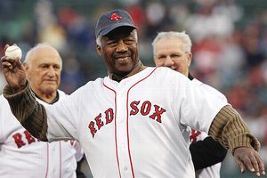
Nevertheless, they have honored Green in recent years,
including this first ball ceremony.

The Oklahoma native, and brother of former Dallas Cowboy safety Cornell Green, is now 82. This means, of the Original 16, only 3 have their 1st black player still alive.

UPDATE: Pumpsie Green died on July 17, 2019. Nino Escalera died on July 3, 2021. As of July 21, 2022, the 63rd Anniversary of Green's arrival in the majors, of these 16, only Virgil is still alive.

Ironically, Boston was ahead of the curve in other areas. Earl Wilson of the Red Sox was the 1st black pitcher to throw a no-hitter in an American League game, in 1962. (Sam Jones of the Cubs did it first in the National League, in 1959.) The Celtics made Bill Russell the 1st black head coach in North American major league sports. (Fritz Pollard was a player-coach on the 1st NFL Champions, the 1920 Akron Pros, but the NFL could hardly have been called "major league" at the time.) And the Bruins had the 1st black player in the NHL, Willie O'Ree -- on January 18, 1958.

That's right, a hockey team, in Boston no less, had a black player 547 days before the Red Sox did.

17. April 10, 1961, Washington Senators: Willie Tasby. He was the only black player who started the game for the Senators. The native of Shreveport, Louisiana is now 83. The "New Senators" moved, and became the Texas Rangers in 1972.

Nobody ever thinks about who were the 1st black players on each of the expansion teams, because the established 16 were all integrated. Maybe we'd think about it if one hadn't been. But, by 1961, the idea of a team's 1st black player was no longer a big deal. Not even in Texas in 1962 or in Georgia in 1966. (Hank Aaron played in the Braves' 1st game in Atlanta.)

18. April 11, 1961, Los Angeles Angels: Julio Bécquer. He was the only black player who started the game for the Angels. Lou Johnson later entered the game as a defensive replacement. The Cuban Becquer is now 84. (UPDATE: He died on November 1, 2020.)

19. April 10. 1962, Houston Colt .45's: Jim Pendleton. He and Roman Mejias both started the game, but Pendleton was involved in a play first. Pendleton, from outside St. Louis, died in 1996, age 72. The Colt .45's were renamed the Houston Astros in 1965.

20. April 11, 1962, New York Mets: Félix Mantilla. An All-Star, and the starting 2nd baseman on the 1957 World Champion Milwaukee Braves, he was the 2nd Met to bat, after the white Richie Ashburn. Also in the lineup for the Mets in this away game in St. Louis was Charlie Neal. Mantilla, a Puerto Rican, is now 81. He should not be confused with Félix Millán, the 2nd baseman on the Mets' 1973 Pennant winners.
21. April 8, 1969, Kansas City Royals: Eliseo "Ellie" Rodríguez. As the starting catcher in a home game, he was involved in a play before any of the team's other black players came to bat. The Puerto Rican is now 69, and works in scouting for the Atlantic League, which includes New Jersey's Somerset Patriots.

22. April 8, 1969, Seattle Pilots: Tommy Harper. He was the leadoff hitter in their 1st game, in Anaheim. Tommy Davis was also in the starting lineup. Harper, from Oakland, is now 75. The Pilots moved, and became the Milwaukee Brewers in 1970.

23. April 8, 1969, Montreal Expos: Maury Wills. He was the leadoff hitter in their 1st game, at Shea Stadium. Mack Jones and Jim "Mudcat" Grant were also in their starting lineup. Of course, the 1st team in white baseball for whom Jackie Robinson played was the Dodgers' top farm team in 1946, the Expos' Triple-A predecessors, the Montreal Royals. Maury, now 83, is a club ambassador for the Dodgers. The Expos moved, and became the Washington Nationals in 2005.

24. April 8, 1969, San Diego Padres: Ollie Brown. One of 6 black players in the starting lineup in a home premiere, he was the 1st one involved in a play. The Alabama native died last year, at 71.

25. April 6, 1977, Seattle Mariners: Diego Seguí. He was the starting pitcher in a home game. He was the only player to play for both Seattle teams, the Pilots and the Mariners. He was 39, and thus became the 1st Seattle player to have the nickname "The Ancient Mariner." Now 78, he is the father of former major leaguer David Seguí.

26. April 7, 1977, Toronto Blue Jays: Pedro García. One of 4 black players in the starting lineup of a home game, he was the 1st one involved in a play. Now 65, the Puerto Rican played for a while in Mexico.

27. April 5, 1993, Florida Marlins: Benito Santiago. The Marlins were at home, and he was the catcher, so he was involved in a play before fellow members of the starting lineup Junior Félix and Orestes Destrade. Now 51, the Puerto Rican is out of baseball. His son Benito Santiago Jr. plays pro basketball in Puerto Rico. The Marlins were renamed the Miami Marlins in 2012.

28. April 5, 1993, Colorado Rockies: Eric Young Sr. He was the leadoff hitter in their 1st game, at Shea Stadium. Unlike Maury Wills of the '69 Expos, though, he was a local, from New Brunswick, Middlesex County, New Jersey. Both he and his son Eric Jr. would play for the Mets. Eric Sr. would also hit the 1st home run in Rockies history, 4 days later, in their home opener. Now 48, he is the Rockies' 1st base coach. Why do I list the Marlins before the Rockies? Because their game started first, that's all.

29. March 31, 1998, Arizona Diamondbacks: Jorge Fábregas. The D-backs were at home, and he was the catcher, so he was involved in a play before any of the other black players. Now 46, the Miami native is out of baseball.

30. March 31, 1998, Tampa Bay Devil Rays: Wilson Álvarez. He was the starting pitcher in a home game, so he handled the ball first. Now 46, the Venezuelan is a pitching coach in the Orioles' system. The Devil Rays would be renamed the Tampa Bay Rays in 2008.

Sunday, April 3, 2016

Top 10 Best Days In Yankee History

Jacob Ruppert looks on as Babe Ruth signs a contract

Opening Day is always a good day, at least until the game begins. But what are the best days in Yankee history?

I've done this before, and it doesn't really need an update. I just felt like doing it again. These will be in chronological order, and will not necessarily involve actual games.

Top 10 Best Days In Yankee History

1. January 9, 1903. This was the day American League founder and President Byron Bancroft "Ban" Johnson approved the move of the AL's Baltimore Orioles to New York, where they would take on the name "Highlanders" until officially being renamed the "Yankees" in 1913, though the name had been around nearly from the start. So this day is as close to an official "birthday" as the Yankees have. Naturally, it is a great day, as the founding day is for each of the 30 MLB teams.

For the record, on the New York Tri-State Area's other teams:

* It's not clear when in 1925 the National Football League franchise for the New York Giants was granted, but they played their 1st game on October 4, 1925.

* The New York Rangers were granted National Hockey League membership on April 30, 1926

* The New York Knickerbockers, or Knicks for short, were granted Basketball Association of America membership on June 6, 1946. The league merged with the National Basketball League and became the National Basketball Association in 1949.

* The New York Titans were granted American Football League membership on August 14, 1959. They became the New York Jets in 1963.

* The New York Mets were granted National League membership on March 6, 1961.

* The New Jersey Americans were granted American Basketball Association membership on February 2, 1967. They became the New York Nets in 1968, the New Jersey Nets in 1977, and the Brooklyn Nets in 2012.

* The New York Islanders were granted National Hockey League membership on November 8, 1971.

* The Colorado Rockies franchise was transferred from Denver to New Jersey on May 27, 1982, and renamed the New Jersey Devils on June 30, 1982.

2. January 11, 1915. The Yankees' first owners, Frank Farrell and Big Bill Devery are sick of losing, sick of the baseball business, and sick of each other. So they sell the team to Jacob Ruppert and Tillinghast L'Hommedieu Huston.

Ruppert, son of a German immigrant, was a brewer (the Ruppert Houses project now stands on the site of the Ruppert Brewery at 92nd Street & 2nd Avenue on the Upper East Side), and had served 2 terms as a Democratic Congressman from New York. Due to his political connections, he had been named an honorary colonel in the New York National Guard.

Huston was an engineer, who had made his name and fortune helping the U.S. Army out during the Spanish-American War in 1898, rising to the rank of Captain. So Ruppert was nicknamed "Colonel" (you didn't dare call him "Jake"), and Huston was nicknamed "Cap" (which he still answered to even after he went off to World War I and was promoted to an actual Colonel, though he also answered to "Til").

Ruppert was a lot like George Steinbrenner, beyond his role and his German ancestry: He was not willing to pay for mediocrity, but he was willing to spend to build a champion. He and Huston did so, although by the time the Yankees won their 1st World Series in 1923, they, like the men from whom they purchased the franchise, had had enough of each other (Huston never liked Miller Huggins, Ruppert's choice for manager), and Ruppert bought out Huston's half-share.

Huston has been virtually forgotten: While Ruppert's heirs dedicated a plaque in his memory that graced the outfield wall of the pre-renovation Yankee Stadium from 1940 to 1973, and hung on the wall in the old Stadium's Monument Park from 1976 to 2008 and is now in the new Stadium's Monument Park, and the street connecting 157th and 161st Streets on the third-base side of the old Stadium was named Ruppert Place, there is no memorial to Huston at the Stadium.

When Ruppert died in 1939, he was still the sole owner of the Yankees, and had been around the team nearly every day until his final illness, so there were big headlines; when Huston died the year before, no current member of the team had even met him.

Nevertheless, when "the Colonels" bought the Yankees, they set an ambitious course that intended championships -- if not a gigantic new stadium -- from the start. In 1915, the Yankees were New York's 3rd-most-popular team, and it wasn't even close. By 1923, and the Yanks' defeat of the Giants in the World Series after losing the last 2 to them, they were not only the most popular team in New York, but, thanks to someone I'm about to mention, they were the most popular sports team in the world.

3. December 26, 1919. Let's clear some things up right now. Harry Frazee, owner of the Boston Red Sox from 1916 to 1923, is not to blame for selling George Herman "Babe" Ruth to the Yankees. Ruth himself is.

Ruth, about to turn 25 years old, was still very much a juvenile delinquent -- perhaps not a malicious sort, but he was, in the word he had hated since he was sent off to a combination orphanage/reform school in Baltimore at age 7, "incorrigible." He had openly defied his manager and his team owner, was making unreasonable demands, and was one of the champion carousers of that era. He made today's star athletes and music stars look like rank amateurs.

Frazee had no choice: He had to get rid of the Babe, just to restore order at Fenway Park. And with a dispute cutting the AL in half, there were only 2 teams willing to make deals with him: The Yankees and the Chicago White Sox. And the White Sox were owned by Charlie Comiskey. There are 2 things everyone not a White Sox fan remembers about Comiskey today: He was cheap, and that caused the Black Sox Scandal that was then about to break. Comiskey was willing to make a deal with Frazee, but he wasn't willing to pay what he considered an exorbitant sum for Ruth.

Ruppert and Huston were. So they bought Ruth's contract for $125,000, by far the biggest sum ever spent on a player transfer in North American sports. (I seriously doubt that any soccer club -- in Europe, South America or anywhere else -- had yet reached their national currency's equivalent of that figure on a player transfer.) The deal was announced a few days later, on January 5, 1920. The rest is history.

Well, history and myth. Let me make a point that others have made: Frazee was hurting, all right, but it was because Ruth was giving him headaches and ulcers. He was not hurting for cash. He didn't need the money to finance a new Broadway play: The plays he was producing, mostly musical comedies, were doing well. And the play most often cited as the reason for the Ruth sale, No, No, Nanette, didn't debut until 1925.

Say what you want about Harry Harrison Frazee, but he didn't sell Ruth because he was greedy, and he didn't sell Ruth so he could sacrifice the Red Sox on the altar of Broadway.

Funny thing: When the Yankees played the Red Sox in Game 7 of the 2003 ALCS, I couldn't get in, so I went from bar to bar in Manhattan looking for a good place to watch it, until finally deciding I had to go up to The Stadium to be there for the result, whatever it turned out to be. But because it was now after midnight, the trains were on a different schedule. So I got off at 50th Street, and soon found myself at 220 West 48th Street, outside the Longacre Theatre, which had once been owned by... Harry Frazee.

Once I realized the significance of where I was and what it represented (where Frazee staged the plays that he supposedly needed to sell Ruth to finance), I heard a tremendous sound on my Walkman: Aaron Boone hitting the Pennant-winning home run, giving the supposed Curse of the Bambino one last extension. Tell me God isn't a Yankee Fan!

One more thing: In the picture above, Ruth signs his contract with his right hand. But he did everything else lefthanded: Bat, throw a baseball, bowl, even swing a golf club. Most baseball players who bat lefty and like golf still swing a club righthanded. This may be because it's still difficult to get good lefty clubs.

4. April 18, 1923. Opening Day of the original Yankee Stadium. The biggest ballpark yet built, and although it wouldn't stay that way (Cleveland Municipal Stadium would seat more), The Stadium, as much as anything else, became part of the Yankees' identity and mystique. Ruth hit the park's first home run, and the Yankees beat (who else?) the Red Sox, 4-1.

5. November 21, 1934. The Yankees purchase the contract of an outfielder, who had just turned 21 years old, from the San Francisco Seals of the Pacific Coast League. No other big-league team seemed to want him. Why not? Knee injury. The Yankees took a chance, giving the Seals $25,000, 5 players, and the right to hang onto the kid for the 1935 season before sending him east for 1936. His name? Joseph Paul DiMaggio.

Ruth had played his last game for the Yankees, although the general public didn't know that yet. Gehrig was just 31 and still at his peak -- in fact, he'd just won the Triple Crown. But with DiMaggio, the Yankees had secured their future, all the way through the 1940s and into the early 1950s. This made what we now think of as "The Yankee Mystique" possible -- including the scoutings and signings of the cornerstones of their 1950s dynasty: Mickey Mantle, Yogi Berra and Whitey Ford. They no longer needed Ruth to promote themselves.

Purchasing DiMaggio turned the Yankees from a team that had a great generation into a team for all generations. In essence, they went from being what the New York Islanders became from 1975 to 1987 to being... the New York Yankees.

Neat little footnote: DiMaggio's 1st pro game was for the Seals on October 1, 1932 -- the very day Ruth called his shot against the Chicago Cubs in the World Series.

6. October 12, 1948. The Yankees take the next step in their future-securing by hiring Charles Dillon "Casey" Stengel as manager. He'd gotten a reputation, both as a player and as a manager, for being a "clown." For this reason, many Yankee players, fans and sportswriters were against the hiring.

As Jim Ogle, the Newark Star-Ledger reporter who later ran the Yankee Alumni Association (making him responsible for putting together Old-Timers' Day), put it, "Well, the clown did pretty well. He won 10 Pennants in 12 years, and made the Yankee legend and mystique grow volumes." As Casey himself would have put it, "And you could look it up."

7. April 14, 1955. Aside from the opening of the original Yankee Stadium, this the only date on this list to involve an actual game. And it was a loss, to the Red Sox of all teams, 8-4 at Fenway Park. So had could this have been one of the best days in Yankee history?

Because Elston Howard played left field at the end of the game. The Yankees had finally put a black player on the field in a game that counted. It had been 8 years since Jackie Robinson had done the same for all of baseball.

It should be noted that the Red Sox were then managed by Michael "Pinky" Higgins, a Dallas native (and thus a Southerner) who allegedly said, "There'll be no (N-word)s on this ballclub as long as I have anything to say about it." In 1959, he was fired, and Pumpsie Green was promoted from the minors, making the Sox the last MLB team to integrate.

Oddly, no one blames Sox general manager (and former shortstop and field manager) Joe Cronin for the color bar at Fenway, yet 1959 was the year he was named AL President, thus leaving the Sox organization, and the year the Sox integrated. Coincidence? That's what the incurious believe in.

For the record, Higgins returned as manager a year later, and became general manager as well, holding the latter job until 1965. He did bring in some black players. Is it possible that he was misquoted? Is it possible that he had a change of heart? Is it possible that Sox owner Tom Yawkey told him that he had to bring in black players if he wanted to continue working in the organization?

Whatever the truth is, it is interesting that, for decades, no one dared blame Cronin, instead preferring to blame Higgins, whose firing as GM paved the way for Dick O'Connell as GM and Dick Williams as field manager to build the 1967 "Impossible Dream" Pennant winners.

8. January 3, 1973. George Steinbrenner and his group buy the Yankees from CBS. The era of Yankee management tolerating mediocrity was over. The Boss Years were about to begin.

When George bought the Yankees, the purchase price was $8.8 million. When he died in 2010, the team and all its assets were said to be worth $1.6 billion. With inflation factored in, that's about 37 times what he paid.

9. July 30, 1990. Commissioner Francis T. "Fay" Vincent permanently bans George Steinbrenner from the day-to-day management (although not the actual ownership, and financial responsibilities and receipt of income thereof) of the team. This was because George had hired Howie Spira, a private investigator and compulsive gambler, to find damaging information about Yankee star Dave Winfield and his charitable foundation, in order to discredit Winfield.

If Spira ever found anything, it has never been publicly revealed. For that reason, Dave, in the exact opposite of what George intended, was the only one of the three who came out looking good. Spira turned to Vincent, and George was banned. George was, however, permitted to apply for reinstatement after 2 years, and in 1993 reinstatement was granted.

The Yankees were already in last place at the time -- 1908, 1912, 1966 and 1990 remain the only last-place finishes in the team's history -- and I actually went to the game that night, against the Detroit Tigers. The Yankees won, 6-2. Only 24,037 attended, and what a relief there was in the crowd. I'm not ashamed to admit it: I took part in the "Steinbrenner sucks!" chant.

If you had told us that night that, as a result of the banning order, Gene Michael (whose initials, appropriately, are GM) would rebuild the organization, top to bottom, and within 6 years we'd be World Champions again, I think we would have taken it.

But if you had told us then that, 6 years later, we'd be chanting, "Thank you, George!" at the ticker-tape parade following said World Series win, we'd have wondered what you were smoking.

And yet, both came true: Both the Yankees and their Boss were rehabilitated, restored and redeemed. In order for both the team and Steinbrenner to be redeemed, George had to go. As Richie Ashburn would've said to his broadcast partner, "Hard to believe, Harry."

10. July 30, 2009. If you're a Red Sox fan, and you're intellectually honest, this was The Day the Music Died. This was the day it was revealed that both David Ortiz and Manny Ramirez flunked steroid tests in 2003 -- meaning the team's 2004 and 2007 World Championships were illegitimate. 

Maybe Manny was already a great hitter without steroids, but there's no way the Sox would've won either title with the David Ortiz who averaged 14 homers and 59 RBIs a year for the Minnesota Twins from 1997 to 2002. Big Papi was a big fat fraud.

To this day, Sox fans chant "Sterrrr-oids!" at the Yankees, especially Alex Rodriguez, who, to this day, has still never been caught as a Yankee, and whose 1st World Championship came 6 years -- not 1 year -- after he was caught. Since 1918, Yankees 27, Red Sox 0*. The Curse of the Bambino could not be broken without the Sox cheating. So if it ever actually existed, then... it still does.

And the collapse of October 17-20, 2004 counts for nothing. The Yankees didn't choke, the Sox fucking cheated.

And July 30, 2009 was the day that confirmed that we never deserved such ignominy. And the Sox did. In other words, the Curse of the Mitchell Report was dead.

And any Sox fan who says those 2004, 2007 and 2013 titles are real, whether I know you or not, you can kiss my ring. Take your pick: There's 27 of them. All real.

Wednesday, March 16, 2016

Top 10 Yankee Catchers

Old-Timers Day, 1976. Left to right:
Bill Dickey, Yogi Berra, Elston Howard and Thurman Munson.

This list will have considerably fewer Honorable Mentions than that of the Top 10 Yankee Pitchers. And that's a good thing, since it reflects the luck and longevity the Yankees have had with their catchers.

Honorable Mention: Pat Collins, 1926-28. Just as the 1990s Chicago Bulls were the weakest at the most important position in basketball, center (although not that weak, as Bill Cartwright and Luc Longley were good, just not sensational), so, to, were the 1926, 1927 and 1928 Yankees, often called the greatest team in baseball history, weakest at the most important position: Catcher.

Collins, Benny Bengough and Mike Gazella were the catchers who bridged the gap between Wally Schang, who got old in 1925, and Bill Dickey, who wasn't ready to take over as the starter until 1929. Collins, who came from Sweet Springs in western Missouri, played the most of them.

Honorable Mention: Aaron Robinson, 1943-47. Here's a neat little trivia question: Who wore Number 8 on the Yankees between Bill Dickey and Yogi Berra? Here's another: Which Robinson played on the winning side of the 1947 World Series? Not Jackie. The answer to both is Aaron Robinson.

He came up for 1 game in 1943, then back up to become the starter in late 1945. In 1946, he batted .297 with 16 homers and 64 RBIs in only 100 games. But he tailed off in 1947, and it was clear that Yogi was the catcher of the future, so he was traded. But he was the starting catcher on a Yankee World Series winner, and, so far, there's been only 8 other human beings, living or dead, who could truthfully say that.

Honorable Mention: Brian McCann, 2014-present. He's played just 2 seasons with the Yankees, with 49 home runs and 169 RBIs, but a .232 batting average and an OPS+ of just 101. Good guy, good power, good defensive catcher, but not yet one of the Top 10 Yankee Catchers.

10. Jake Gibbs, 1962-71. The best quarterback the University of Mississippi has ever had -- aside from those named Manning -- he chose baseball because he could make more money. But he didn't get more than a cup of coffee in the majors until 1966, and was only the starter in '67 and '68.

His hitting stats aren't really worth mentioning. He was there mainly for his defense. He probably would have been better off if he'd gone to the NFL -- or the AFL, which was a possibility at the time. (He was drafted by the NFL's Cleveland Browns and the AFL's Houston Oilers.) Still, somebody has to round out the Top 10. Gibbs wore Number 41.

9. Rick Cerone, on and off 3 times 1980-90. The Newark native was brought in from the Toronto Blue Jays for Chris Chambliss in order to replace Thurman Munson, and helped the Yankees win the AL East in 1980 (he actually finished 7th in the MVP voting) and the Pennant in '81. But that was it, and he never again had more than 300 plate appearances in a season. His main number was 10.

I remember listening to Max Kinkel's All Night Radio show on WCBS-FM one night in 1987 (it was a music show, but he talked about sports a lot), and he was talking to someone about the Yankees, ripping Mark Salas, saying, "To me, Salas just could not call a game." The caller said that Cerone, then in his 2nd go-around, could, and Max said, "Well, Cerone can call a game, but Cerone can't throw the ball!" Sad, but true.

After his playing career, which also included a stopover with the Mets, Cerone, a Newark native and a graduate of Seton Hall University, was one of the founders of the reborn Newark Bears minor-league team.

8. Joe Girardi, 1996-99. Speaking of the Mets, as we all know, in nearly 54 seasons, no Met pitcher has ever thrown a no-hitter. (Don't tell me Johan Santana did: That was a fraud, and you know it.) But a few Mets-to-be and lots of former Mets have. Girardi caught 2 such no-hitters, by Dwight Gooden on May 14, 1996 and a perfect game by David Cone on July 18, 1999.

The Peoria, Illinois native was one of the cornerstones of the Yanks' 1996 revival, including a triple off Greg Maddux that started a 3-run rally that won Game 6 of the World Series and the Series itself. Considering that he was known for his defense, usually capable of 40-50 RBI per year but no more than that, and that he was built like the stereotypical old-time catcher and not expected to run well (though he did steal 13 bases in '96), I said at the time that hitting a triple off Maddux in the World Series was the baseball equivalent of Buster Douglas knocking out Mike Tyson.

He guided the Yanks' pitching staff until Jorge Posada was ready, and it surprised no one when he became a big-league manager. He kept a Florida Marlins team starved of payroll near .500 most of the 2006 season, got the NL Manager of the Year award, and got fired for his trouble. Named Yankee manager in 2008, he led them to the 2009 World Championship.

He started off wearing Number 45, then switched to 25 when Cecil Fielder arrived. When he was hired as manager, he wore 27 to remind the team of its goal of a 27th World Championship. He led them there. He then switched to 28, but he's been stuck on it, now into a 7th season. As much as anything else, this is due to his pitching mismanagement. Let's hope that 2016 is the year he throws away the binder and starts using his eyes to determine whether a pitcher should stay in or be relieved.

7. Mike Stanley, 1992-95. He grew up in Fort Lauderdale, where the Yankees then had their spring training camp. At first, it looked like he was going to be a big part of the Yanks' 1990s revival, batting .305 with 24 homers and 85 RBIs for the 1993 squad that hung close to the Blue Jays until mid-September. He hit .300 again in strike-shortened '94, and made the All-Star Team in '95.

But he was granted free agency, and the Yankees didn't lift a finger to re-sign him, a move that left some Yankee Fans (like me) quite puzzled, and some very angry. The Red Sox jumped at the chance, and he gave them a very solid season and much of another before a rare trade between the teams briefly brought him back in 1997. (The trade was ultimately a wash, the only other player worth mentioning being Tony Armas Jr., who the Sox soon put in the trade that brought in Pedro Martinez from the Montreal Expos.)

The Yanks may have known what they were doing, though: They got Girardi, they had Posada on the way up, and while Stanley was still productive until 2000 (he then retired at age 37), Girardi was a little younger, Posada considerably so.

6. Wally Schang, 1921-25. He came from the Buffalo area, and came up with the Philadelphia Athletics in time to play in the 1913 and '14 World Series, winning the former. But Connie Mack's breakup of his dynasty sent him to the Red Sox in 1917, where he won another Series in 1918. Harry Frazee's breakup of his dynasty meant that Schang was one of those who, in large measure, made the 1921-28 Yankees an extension of the 1912-18 Red Sox.

He helped the Yankees win their 1st 3 Pennants and their 1st World Series in 1923. He batted .300 6 times, but only twice with the Yankees. Trading him to the St. Louis Browns in 1926 looks like a bad trade, but the Yanks got a pretty good pitcher for him, George Mogridge.

Schang wrapped up his career with the Detroit Tigers in 1931, and that's the only season that he wore a uniform number. Interestingly, it was the number that Bill Dickey was already making synonymous with Yankee catchers, 8.

5. Elston Howard, 1955-67. Like the man he replaced behind the plate, he was from St. Louis. Why is he so low on this list? Actually, due to Yogi already being there, Elston, the 1st black Yankee, was mainly the Yankees' starting left fielder until 1959.

But then he became the best catcher in the game. He was the 1st black man to win the AL's MVP award, in 1963 -- this after several had won it in the NL. Mickey Mantle and Roger Maris were hurt much of that season, and Elston carried that team, helping Whitey Ford to win 24 games and young Jim Bouton to win 21.

With the Yankee dynasty having collapsed, Elston was traded to the Boston Red Sox in 1967, and helped them win their "Impossible Dream" Pennant. It's a very strange thing to look at that World Series highlight film and see Ellie in a Red Sox uniform, standing with Roger Maris in a Cardinal uniform.

In 1969, he returned to the Yankees as the AL's 1st black coach. His death due to a heart ailment in 1980 probably prevented him, at the rate George Steinbrenner was hiring and firing, from becoming New York's 1st black manager, a distinction that would later go to Willie Randolph with the Mets. The Yankees have still never had a black manager, but they retired Ellie's Number 32 and dedicated a Plaque to him in Monument Park.

4. Thurman Munson, 1969-79. In 1970, his first full season, he won the AL's Rookie of the Year. In 1976, he won the MVP. Thanks to Derek Jeter, the 1996 ROY, having been robbed of the MVP in both 1999 and 2009, and possibly also in 2006, Thurman remains the only Yankee ever to win both of those awards. (There was no ROY until 1947, denying guys like Ruth, Gehrig and DiMaggio, and Mantle's 1st season was troubled.)

In spite of injury after injury, the first man trusted with the Yankees' official Captaincy since Lou Gehrig put together 3 straight seasons, 1975-77, of at least a .300 batting average and 100 RBIs. That streak ended in '78, but he led the team to its 3rd straight Pennant and back-to-back World Championships.

The thing I love the most about Thurman is that, at the moment when the Yankees most needed a home run from him, he hit the longest home run of his career. It was Game 3 of the '78 ALCS, bottom of the 8th, trailing 4-3 to the Kansas City Royals, and Doug Bird hung a curveball, and Thurman sent it 470 feet into Monument Park.

Sadly, the next person enshrined in Monument Park would be Thurman himself, the victim of a plane crash on August 2, 1979. George Steinbrenner, his fellow native of the Cleveland area, immediately ordered the retirement of his Number 15 (which had also been worn by Yankee greats Red Ruffing, Tommy Henrich and Tom Tresh), and a year later his Plaque was ready.

3. Jorge Posada, 1995-2011. There are those who say that Posada wasn't a very good catcher. Many of those will say that Mike Piazza of the Mets and Jason Varitek of the Red Sox were better. These people are fools.

A Puerto Rico native of Cuban descent, Jorge is a legend. He caught David Wells' perfect game on May 17, 1998. He hit from both sides of the plate with power. He hit home runs in World Series games. His double ended the big 3-run rally that tied up Game 7 of the 2003 ALCS and set up Aaron Boone's Pennant-winning homer. He's raised a bundle of money for charity. And he's married to Laura Posada. This last factor cannot be discounted in discussing Jorge's greatness.

He has his Plaque in Monument Park, and his Number 20 has been retired. Sorry, Bucky Dent.

2. Bill Dickey, 1928-46. The man from northeastern Louisiana ook the title of "greatest catcher ever" away from Mickey Cochrane, and was, unusually for a catcher, one of the 10 best hitters in baseball for much of his career. He was not on the roster of the 1928 World Series, but helped the Yankees win 8 Pennants (1932, '36, '37, '38, '39, '41, '42 and '43) and 7 World Series (losing only in '42).

He was Lou Gehrig's best friend on the team, and played himself in the film The Pride of the Yankees. (So did Yankee teammates Babe Ruth, Bob Meusel and Mark Koenig, and sportscaster Bill Stern.) That scene where a teammate questions Gehrig's effort as the disease that will later bear his name is overtaking him, and Dickey punches the guy out? That really happened.

After Gehrig's illness-forced retirement in 1939, there was no official Yankee Captain until Munson, 37 years later. But Dickey was very much an unofficial captain, leading the Yankees to their 106-win season in '39, the Joe DiMaggio streak season of '41, and taking them to the '43 title when several players, including DiMaggio, Tommy Henrich and Phil Rizzuto, were off fighting World War II. (Dickey himself went into the service for the next 2 seasons.)

He came back in '46, briefly replaced Joe McCarthy as manager, and was one of Casey Stengel's coaches from 1949 to '60. His greatest accomplishment may actually have been making Yogi Berra an even better catcher than himself: As Yogi said, "Bill Dickey is learning me all his experiences."

1. Lawrence "Yogi" Berra, 1946-63. In 1944 and '45, the U.S. Navy had, arguably, the 3 greatest catchers in baseball history: Cochrane, whose playing career was over; Dickey, who had a little baseball left in him; and Yogi, who was on one of the boats during the Normandy invasion of June 6, 1944, and became the only man to be a veteran of both D-Day and Major League Baseball.

It's hard to look at Dickey's offensive stats and say that Yogi was better, but Dickey played in a hitter-friendly era, while Yogi played in a pitcher-friendly era. Yogi won 3 AL MVPs, in 1951, '54 and '55. Somebody once argued that, due to his hitting and his handling of a pitching staff that was constantly changing and yet constantly winning, Yogi might be the most valuable player the Yankees have ever had.

And, like Dickey, Yogi became sort of an unofficial captain, particularly from 1956, when Rizzuto was unceremoniously and callously released, and 1961, when new manager Ralph Houk began to insist that Mantle take more of a leadership role -- not as a slap against Yogi, but more in order to make Mickey finish growing up, and it wasn't entirely a fool's errand.

Nobody won more Pennants than Yogi: 14 (1947, '49, '50, '51, '52, '53, '55, '56, '57, '58, '60, '61, '62, '63 and '64). Nobody won more World Series: 10 (1947, '49, '50, '51, '52, '53, '56, '58, '61 and '62 -- in all of sports, only Bill Russell in basketball and Henri Richard in hockey have 11). He still holds the records for most World Series games, at-bats and hits.

In 1972, Yogi was elected to the Hall of Fame. Dickey had been elected in 1955. Upon Yogi's election, the Yankees retired Number 8 for both men. (Dickey wore 33 as a coach while Yogi was the catcher.) In 1988, both men were awarded Plaques in Monument Park.

And Yogi was a good manager: He got the Yankees to the 1964 Pennant, and the Mets to the 1973 Pennant. Not only did he have to make both teams come from behind in the process, but it made him the only manager ever to take both teams to the World Series. (I will Broadway Joe Namath guarantee you that there will never be another in my lifetime.) He lost in Game 7 both times, but there's no shame in losing a World Series to Bob Gibson and Lou Brock -- or to Reggie Jackson and Catfish Hunter, for that matter.

Today, people my age and younger know Yogi only as an elder statesman of baseball and as the guy who said funny things, often in TV commercials. They're not old enough to remember him as a manager, let alone as a player. But he was one of the true greats of the game, well before he became known for his "Yogi-isms."

As the man himself might have said, He was a living legend, until he wasn't anymore. He's still one of the game's greatest legends, although he never would have told you so himself. He was a special guy, in so many ways.

The photo at top -- Dickey, Berra (then a coach), Howard (ditto) and Munson (then the starting catcher) -- was taken on Old-Timers' Day 1977.

Monday, September 28, 2015

September 28, 1955: Jackie Steals Home... Or DOES He?

September 28, 1955, 60 years ago today: Game 1 of the World Series, at the original Yankee Stadium. Yes, a World Series game was played on a September 28. This was also the 1st World Series game broadcast in color, on NBC (as were all World Series from the 1st telecast of one in 1947 until 1975), although hardly anyone has a color TV set at this point, and no TV recording of it, in color or otherwise, is known to survive.

There is film footage, though. That footage shows Jackie Robinson of the Brooklyn Dodgers, his increasing weight (in part due to diabetes) having cut down on his speed, but not his daring, stealing home plate against the New York Yankees.

Home plate umpire Bill Summers rules him safe. Yankee catcher Yogi Berra says Jackie was out, and has a fit.

To the end of his life, Yogi insisted that he wouldn't have argued that strenuously if he wasn't sure, or if Jackie was definitely safe, as Monte Irvin of the New York Giants was when he stole home on Yogi in the 1951 World Series.

Whitey Ford was pitching, and he insists to this day that Jackie was out. But Phil Rizzuto claimed that Jackie was safe, and he knew because he was playing shortstop and had the best view of the play.

Whitey didn't like that, so he looked it up. The steal was in the top of the 8th inning -- and in the bottom of the 6th, manager Casey Stengel had pinch-hit Eddie Robinson for the Scooter! In the top of the 7th, a new shortstop took the field: Jerry Coleman (normally a 2nd baseman). Coleman was playing short when Jackie stole home.

So who was right? Judge for yourself. Here's the film. It's hard to tell from there. But this photo makes it obvious: He was out!
And if the Yankees had lost the game, and the World Series, because of this, there would have been an uproar -- or, as the Dodgers' legendary broadcaster, ironically now with the Yankees, Red Barber, would have put it, a rhubarb.

But the Yankees did not lose the Series, or even the game, because of the steal. The Yankees won the game, 6-5. Left fielder (and backup catcher) Elston Howard, a "rookie" at age 30, hit a home run off Don Newcombe in the 2nd inning, while 1st baseman Joe Collins hit 2 homers off Big Newk. Carl Furillo and Duke Snider hit home runs off Ford.

Like Carlton Fisk's home run in Game 6, 20 years later, Robinson's steal of home was a spectacular moment, but, ultimately, had no effect on the result of the Series.

Still, stealing home plate became Jackie Robinson's signature, along with his grace under more pressure than any American athlete has ever faced. He did in 19 times in the regular season, plus this time in the World Series -- still the last steal of home in a World Series game. (One of the many records that Ty Cobb set, and one that he still holds, is the most steals of home in a career: 54.) It even became a point of reference in Buddy Johnson's 1949 song about Jackie, with the Count Basie Orchestra having made the best-known recording:

Did you see Jackie Robinson hit that ball?
Did he hit it? Yeah, and that ain't all.
He stole home.
Yes, yes, Jackie's real gone.


"Gone" meaning "cool." Not as in "left the vicinity" or "gone in the head." No player ever kept his head -- or had to -- as much as Jack Roosevelt Robinson of Pasadena, California (and Stamford, Connecticut).

With the recent deaths of Yogi and Dodger 2nd baseman Don Zimmer -- Jackie was usually playing 3rd base by this point, not his standard 2nd -- the starting pitchers, Newcombe and Ford, pinch-hitter Eddie Robinson, and Yankee left fielder Irv Noren are the only players from this game who are still alive, 60 years later.

This Series was a classic, and it went to 7 games. In the end, as would be said in the Brooklynese accent, the Dodgers finally dooed it. After World Series losses in 1916, 1920, 1941, 1947, 1949, 1952 and 1953 (the last 5 of those 7 against the Yankees), losses in Playoffs for the National League Pennant in 1946 and 1951 (the latter against the hated New York Giants), losing the Pennant on the final day of the regular season in 1942 and 1950, and finishing 2nd to the Giants in 1954 -- 10 close calls in a span of 14 years -- 1955 turned out to be the "Next Year" that Dodger fans from Williamsburg to Coney Island, from Morristown to Montauk, from Poughkeepsie to Point Pleasant, had waited for.

*

September 28, 1932: Game 1 of the World Series. The Chicago Cubs score 2 runs in the 1st inning, but the Yankees outscore them 37-17 over the rest of the Series. Lou Gehrig hits a home run, and the Yankees win, 12-6.

September 28, 1959: Game 1 of the National League Playoff. It was the Braves' move to Milwaukee, with is (then) modern stadium and its huge parking lot, that made Walter O'Malley want a better ballpark for the Brooklyn Dodgers, and ultimately made him move the team to Los Angeles. Now, after the Braves have won the last 2 Pennants, there is a tie for the flag, and these 2 teams, representing cities that didn't even have teams 7 seasons ago face off at Milwaukee County Stadium.

Dodger manager Walter Alston starts Danny McDevitt, who pitched a shutout in the last game at Ebbets Field, 2 years and 4 days earlier. But he doesn't get out of the 2nd inning this time, as he falls behind, 2-1. Alston brings Larry Sherry in to relieve, and he goes the rest of the way. John Roseboro hits a home run off Carlton Willey, and the Dodgers win, 3-2, to take a 1-0 lead back to L.A.

September 28, 1998: The Chicago Cubs and San Francisco Giants, having finished in a tie for the NL's Wild Card berth, face each other in a Playoff game at a raucous Wrigley Field. Former Minnesota Twins World Series winner Gary Gaetti hits a home run, and Rod Beck holds off his former team to save a fine performance by Steve Traschel, and the Cubs win, 5-3.

Sammy Sosa goes 2-for-4 for the Cubbies, and scores 2 runs. Barry Bonds goes 0-for-4 for the Jints. I guess Sammy's steroids were working that night, and Barry's weren't.

Tuesday, February 15, 2011

Top 10 Yankee Catchers

Talk going around spring training that if the St. Louis Cardinals don't give Albert Pujols a contract extension by noon tomorrow, he'll test the free-agent market at the end of the season.

Pujols has been the face of the franchise the last 10 years, lifting them out of the cloud of Mark McGwire. As far as anyone knows, he's clean. He gives all the appearance of being a good guy. And he has hit like hell. By the time he's done, he can give earlier Card legends Rogers Hornsby and Stan Musial, and also Willie Mays and Hank Aaron, a run for their money for the title of greatest offensive player in National League history. (Barry Bonds, of course, is ineligible; and even if McGwire's stats were clean, he was only in the NL for 4 years and change.)

Cardinal owner Bill DeWitt Jr. maybe be a filthy rich Republican campaign contributor, but that doesn't mean he's dumb. He's not going to let Albert Pujols, currently the best hitter in the game (if not necessarily the best all-around player), play for anyone else.

*

Now that that's out of the way, in honor of pitchers and catchers having reported, and the Top 10 Yankee Pitchers having been done yesterday, here are...

Top 10 Yankee Catchers

This will be a considerably shorter list. And that's a good thing, since it reflects the luck and longevity the Yankees have had with their catchers.

10. Jake Gibbs, 1962-71. The best quarterback the University of Mississippi has ever had -- at least, the best one not named Manning -- he chose baseball because he could make more money. But he didn't get more than a cup of coffee in the majors until 1966 and was only the starter in '67 and '68.

He probably would have been better off if he'd gone to the NFL -- or the AFL, which was a possibility at the time. He was drafted by the NFL's Cleveland Browns and the AFL's Houston Oilers. Still, somebody has to round out the Top 10.

9. Rick Cerone, on and off 3 times 1980-90. Brought in from the Toronto Blue Jays for Chris Chambliss in order to replace Thurman Munson, he helped the Yankees win the AL East in 1980 (he actually finished 7th in the MVP voting) and the Pennant in '81. But that was it, and he never again had more than 300 plate appearances in a season.

I remember listening to Max Kinkel's All Night Radio show on WCBS-FM one night in 1987 (it was a music show, but he talked about sports a lot), and he was talking to someone about the Yankees, ripping Mark Salas, saying, "To me, Salas just could not call a game." The caller said that Cerone, then in his 2nd go-around, could, and Max said, "Well, Cerone can call a game, but Cerone can't throw the ball!"

After his playing career, which also included a stopover with the Mets, Cerone, a Newark native and a graduate of Seton Hall University, was one of the founders of the reborn Newark Bears minor-league team.

8. Joe Girardi, 1996-99. Speaking of the Mets, as we all know, in nearly 50 years, no Met pitcher has ever thrown a no-hitter. But a few Mets-to-be and lots of former Mets have. Girardi caught 2 such no-hitters, by Dwight Gooden in 1996 and David Cone in 1999.

He was also one of the cornerstones of the Yanks' 1996 revival, including a triple off Greg Maddux that started a 3-run rally that won Game 6 of the World Series and the Series itself. Considering that he was known for his defense, usually capable of 40-50 RBI per year but no more than that, and that he was built like the stereotypical old-time catcher and not expected to run well (though he did steal 13 bases in '96), I said at the time that hitting a triple off Maddux in the World Series was the baseball equivalent of Buster Douglas knocking out Mike Tyson.

He guided the Yanks' pitching staff until Jorge Posada was ready, and it surprised no one when he became a big-league manager. He kept a Florida Marlins team starved of payroll near .500 most of the 2006 season, got the NL Manager of the Year award, and got fired for his trouble.

Named Yankee manager in 2008, he led them to the 2009 World Championship, and, with the retirements of Joe Torre, Lou Piniella and Bobby Cox, is up there with Tony LaRussa and Mike Scioscia as one of the game's most repsected managers.

7. Mike Stanley, 1992-95. At first, it looked like he was going to be a big part of the Yanks' 1990s revival, batting .305 with 24 homers and 85 RBIs for the 1993 squad that hung close to the Blue Jays until mid-September. He hit .300 again in strike-shortened '94 and made the All-Star Team in '95.

But he was granted free agency, and the Yankees didn't lift a finger to re-sign him, a move that left some Yankee Fans (like me) quite puzzled, and some very angry. The Red Sox jumped at the chance, and he gave them a very solid season and much of another before a rare trade between the teams briefly brought him back in 1997. (The trade was ultimately a wash, the only other player worth mentioning being Tony Armas Jr., who the Sox soon put in the trade that brought in Pedro Martinez from the Montreal Expos.)

The Yanks may have known what they were doing, though: They got Girardi, they had Posada on the way up, and while Stanley was still productive until 2000 (he then retired at age 37), Girardi was a little younger, Posada considerably so.

6. Wally Schang, 1921-25. He came up with the Philadelphia Athletics in time to play in the 1913 and '14 World Series, winning the former. But Connie Mack's breakup of his dynasty sent him to the Red Sox in 1917, where he won another Series in 1918. Harry Frazee's breakup of his dynasty meant that Schang was one of those who, in large measure, made the 1921-28 Yankees an extension of the 1912-18 Red Sox.

He helped the Yankees win their 1st 3 Pennants and their first World Series in 1923. Schang batted .300 6 times, but only twice with the Yankees. Trading him to the St. Louis Browns in 1926 looks like a bad trade, but they got a pretty good pitcher for him, George Mogridge.

Oddly, the "Murderer's Row" Yankees of 1926, '27 and '28 did not have a solid player at catcher, the most important position on the field. (An oddity unmatched in sports until the Chicago Bulls won 6 NBA Championships in the 1990s despite their centers being the good, but hardly great, Bill Cartwright and Luc Longley.) Pat Collins, Mike Gazella, Benny Bengough... these were not good players, but the Yanks managed to win 2 World Series, very nearly 3, with them behind the plate until Bill Dickey became the full-time catcher in 1929.

Schang wrapped up his career with the Detroit Tigers in 1931, and that's the only season that he wore a uniform number. Interestingly, it was the number that Bill Dickey was already making synonymous with Yankee catchers, 8.

5. Elston Howard, 1955-67. Why so low? Actually, due to Yogi already being there, Elston, the first black Yankee, was mainly the Yankees' starting left fielder until 1959. But then he became the best catcher in the game. He was the first black man to win the AL's MVP award, in 1963 -- this after several had won it in the NL. Mickey Mantle and Roger Maris were hurt much of that season, and Elston carried that team, helping Whitey Ford win 24 games and young Jim Bouton win 21.

With the Yankee dynasty having collapsed, Elston was traded to the Boston Red Sox in 1967, and helped them win their "Impossible Dream" Pennant. It's a very strange thing to look at that World Series highlight film and see Ellie in a Red Sox uniform, standing with Roger Maris in a Cardinal uniform.

In 1969, he returned to the Yankees as the AL's first black coach. His death due to a heart ailment in 1980 probably prevented him, at the rate George Steinbrenner was hiring and firing, from becoming New York's first black manager, a distinction that would later go to Willie Randolph with the Mets. The Yankees have still never had a black manager, but they retired Ellie's Number 32 and dedicated a Plaque to him in Monument Park.

4. Thurman Munson, 1969-79. In 1970, his 1st full season, he won the AL's Rookie of the Year. In 1976, he won the MVP. Thanks to Derek Jeter having been robbed in both 1999 and 2009, Thurman remains the only Yankee ever to win both of those awards. (There was no ROY until 1947, denying guys like Ruth, Gehrig and DiMaggio, and Mantle's 1st season was troubled.)

In spite of injury after injury, the first man trusted with the Yankees' official Captaincy since Lou Gehrig put together 3 straight seasons, 1975-77, of at least a .300 batting average and 100 RBIs. That streak ended in '78, but he made up for it by leading the team to its 3rd straight Pennant and back-to-back World Championships.

The thing I love the most about Thurman is that, at the moment when the Yankees most needed a home run from him, he hit the longest home run of his career. It was Game 3 of the '78 ALCS, bottom of the 8th, trailing 4-3 to the Kansas City Royals, and Doug Bird hung a curveball, and Thurman sent it 470 feet into Monument Park.

Sadly, the next person enshrined in Monument Park would be Thurman himself, the victim of a plane crash on August 2, 1979. George Steinbrenner, his fellow native of the Cleveland area, immediately ordered the retirement of his Number 15 (which had also been worn by Yankee greats Red Ruffing, Tommy Henrich and Tom Tresh), and a year later his Plaque was ready.

3. Jorge Posada, 1995-present. There are those who say that Posada isn't a very good catcher. Many of those will say that Mike Piazza of the Mets and Jason Varitek of the Red Sox were better. These people are fools.

Jorge is a legend. He caught David Wells' perfect game in 1998. He hits from both sides of the plate with power. He hits home runs in World Series games. His double ended the big 3-run rally that tied up Game 7 of the 2003 ALCS and set up Aaron Boone's Pennant-winning homer. He's raised a bundle of money for charity. And he's married to Laura Posada. This last factor cannot be discounted in discussing Jorge's greatness. He will get a Plaque in Monument Park, and if any later Yankee ever wears Number 20, it will be a crime. (Sorry, Bucky Dent.)

2. Bill Dickey, 1928-46. He took the title of "greatest catcher ever" away from Mickey Cochrane, and was, unusual for a catcher, one of the 10 best hitters in baseball. He was not on the roster of the 1928 World Series, but he helped the Yankees win 8 Pennants (1932, '36, '37, '38, '39, '41, '42 and '43) and 7 World Series (losing only in '42).

He was Lou Gehrig's best friend on the team, and played himself in The Pride of the Yankees. That scene where a teammate questions Gehrig's effort, not realizing that ALS is overtaking him, and Dickey punches the guy out? That really happened.

After Gehrig's illness-forced retirement in 1939, there was no official Yankee Captain until Munson, 37 years later. But Dickey was very much an unofficial captain, leading the Yankees to their 106-win season in '39, leading them through the Joe DiMaggio streak season of '41, and taking them to the '43 title when several players, including DiMaggio, Tommy Henrich and Phil Rizzuto, were off fighting World War II. (Dickey himself went into the service for the next 2 seasons.)

He came back in '46, briefly replaced Joe McCarthy as manager, and was one of Casey Stengel's coaches from 1949 to '60. His greatest accomplishment may actually have been making Yogi Berra an even better catcher than himself: As Yogi said, "Bill Dickey is learning me all his experiences."

1. Lawrence "Yogi" Berra, 1946-63. It's hard to look at Dickey's stats and say Yogi was better, but Dickey played in a hitter-friendly era, while Yogi played in a pitcher-friendly era. He won 3 AL MVPs, 1951, '54 and '55. Somebody once argued that, due to his hitting and handling a pitching staff that was constantly changing and yet constantly winning, Yogi might be the most valuable player the Yankees have ever had.

And, like Dickey, Yogi became sort of an unofficial captain, particularly from 1956, when Rizzuto was unceremoniously and callously released, and 1961, when new manager Ralph Houk began to insist that Mantle take more of a leadership role -- not as a slap against Yogi, but more in order to make Mickey finish growing up, and it wasn't entirely a fool's errand.

Nobody won more Pennants than Yogi: 14 (1947, '49, '50, '51, '52, '53, '55, '56, '57, '58, '60, '61, '62, '63 and '64). Nobody won more World Series: 10 (1947, '49, '50, '51, '52, '53, '56, '58, '61 and '62 -- in all of sports, only Bill Russell in basketball and Henri Richard in hockey have 11). He still holds the records for most World Series games, at-bats and hits.

In 1972, Yogi was elected to the Hall of Fame. Dickey had been elected in 1955. Upon Yogi's election, the Yankees retired Number 8 for both men. (Dickey wore 33 as a coach while Yogi was the catcher.) In 1988, both men were awarded Plaques in Monument Park.

And Yogi was a good manager: He got the Yankees to the 1964 Pennant, and the Mets to the 1973 Pennant. Not only did he have to make both teams come from behind in the process, but it made him the only manager ever to take both teams to the World Series. (I will Broadway Joe Namath guarantee you that there will never be another in my lifetime.) He lost in Game 7 both times, but there's no shame in losing a World Series to Bob Gibson and Lou Brock -- or to Reggie Jackson and Catfish Hunter, for that matter.

Today, people my age and younger know Yogi only as an elder statesman of baseball and as the guy who says funny things, often in TV commercials. They're not old enough to remember him as a manager, let alone as a player. But he was one of the true greats of the game, well before he became known for his "Yogi-isms."

Friday, November 12, 2010

Top 10 Best Days In Yankee History

A few weeks ago, I did the top 10 worst. This time, the best. As with the worst, these will be in chronological order, and will not necessarily involve actual games.

Top 10 Best Days In Yankee History

1. January 9, 1903. This was the day American League founder and President Byron Bancroft "Ban" Johnson approved the move of the AL's Baltimore Orioles to New York, where they would take on the name "Highlanders" until officially being renamed the "Yankees" in 1913, though the name had been around nearly from the start. So this day is as close to an official "birthday" as the Yankees have. Naturally, it is a great day, as the founding day is for all 30 MLB teams.
For the record, the Mets were granted National League membership on March 6, 1961. Which means, although the 50th Anniversary of their first game isn't until April 11, 1962, their 50th Birthday is less than 4 months away.

2. January 11, 1915. The Yankees' 1st owners, Frank Farrell and Big Bill Devery are sick of losing, sick of the baseball business, and sick of each other. So they sell the team to Jacob Ruppert and Tillinghast L'Hommedieu Huston.

Ruppert, son of a German immigrant, was a brewer (the Ruppert Houses project now stands on the site of the Ruppert Brewery at 92nd Street & 2nd Avenue on the Upper East Side), and had served 2 terms as a Democratic Congressman from New York. Due to his political connections, he had been named an honorary colonel in the New York National Guard.

Huston was an engineer, who had made his name and fortune helping the U.S. Army out during the Spanish-American War in 1898, rising to the rank of Captain. So Ruppert was nicknamed "Colonel" (you didn't dare call him "Jake"), and Huston was nicknamed "Cap" (which he still answered to even after he went off to World War I and was promoted to an actual Colonel, though he also answered to "Til").
Ruppert and Huston, flanking
Commissioner Kenesaw Mountain Landis,
at the opening of Yankee Stadium, April 18, 1923

Ruppert was a lot like George Steinbrenner: He was not willing to pay for mediocrity, but he was willing to spend to build a champion. He and Huston did so, although by the time the Yankees won their 1st World Series in 1923, they, like the men from whom they purchased the franchise, had had enough of each other (Huston never liked Miller Huggins, Ruppert's choice for manager), and Ruppert bought out Huston's half-share.

Ruppert's heirs dedicated a plaque in his memory that graced the outfield wall of the pre-renovation Yankee Stadium from 1940 to 1973, and hung on the wall in the old Stadium's Monument Park from 1976 to 2008 and is now in the new Stadium's Monument Park. And the street connecting 157th and 161st Streets on the 3rd-base side of the old Stadium was named Ruppert Place. But Huston has been virtually forgotten. There is no memorial to him at the new Stadium. Nor was there at the old one.

When Ruppert died in 1939, he was still the sole owner of the Yankees, and had been around the team nearly every day until his final illness, so there were big headlines; when Huston died the year before, it hardly made the papers, no current member of the team had even met him.

Nevertheless, when "the Colonels" bought the Yankees, they set an ambitious course that intended championships -- if not a gigantic new stadium -- from the start. In 1915, the Yankees were New York's 3rd-most-popular team, and it wasn't even close.

By 1923, and the Yanks' defeat of the Giants in the World Series after losing the last 2 to them, they were not only the most popular team in New York, but, thanks to someone I'm about to mention, they were the most popular sports team in the world.

3. December 26, 1919. Let's clear some things up right now. Harry Frazee, owner of the Boston Red Sox from 1916 to 1923, is not to blame for selling George Herman "Babe" Ruth to the Yankees. Ruth himself is. Ruth, about to turn 25 years old, was still very much a juvenile delinquent -- perhaps not a malicious sort, but he was, in the word he had hated since he was sent off to a combination orphanage/reform school in Baltimore at age 7, "incorrigible." He had openly defied his manager and his team owner, was making unreasonable demands, and was one of the champion carousers of that ear. He made today's star athletes and music stars look like rank amateurs.

Frazee had no choice: He had to get rid of the Babe, just to restore order at Fenway Park. And with a dispute cutting the AL in half, there were only 2 teams willing to make deals with him: The Yankees and the Chicago White Sox. And the White Sox were owned by Charlie Comiskey. There are 2 things everyone not a White Sox fan remembers about Comiskey today: He was cheap, and that caused the Black Sox Scandal that was then about to break. Comiskey was willing to make a deal with Frazee, but he wasn't willing to pay what he considered an exorbitant sum for Ruth.

Ruppert and Huston were. So they bought Ruth's contract for $125,000, by far the biggest sum ever spent on a player transfer in North American sports. (I seriously doubt that any soccer club -- in Europe, South America or anywhere else -- had yet reached that figure on a player transfer.) The deal was announced a few days later, on January 5, 1920. The rest is history.
Well, history and myth. Let me make a point that others have made: Frazee was hurting, all right, but it was because Ruth was giving him headaches and ulcers. He was not hurting for cash. He didn't need the money to finance a new Broadway play: The plays he was producing, mostly musical comedies, were doing well. And the play most often cited as the reason for the Ruth sale, No, No, Nanette, didn't debut until 1925.

Say what you want about Harry Harrison Frazee, but he didn't sell Ruth because he was greedy, and he didn't sell Ruth so he could sacrifice the Red Sox on the altar of Broadway.

Funny thing: When the Yankees played the Red Sox in Game 7 of the 2003 ALCS, I couldn't get in, so I went from bar to bar in Manhattan looking for a good place to watch it, until finally deciding I had to go up to The Stadium to be there for the result, whatever it turned out to be. But because it was now after midnight, the trains were on a different schedule. So I got off at 50th Street, and soon found myself at 220 West 48th Street, outside the Longacre Theatre, which had once been owned by... Harry Frazee. Once I realized the significance of where I was and what it represented (where Frazee staged the plays that he supposedly needed to sell Ruth to finance), I heard a tremendous sound on my Walkman: Aaron Boone hitting the Pennant-winning home run, giving the supposed Curse of the Bambino one last extension. Tell me God isn't a Yankee Fan!

4. April 18, 1923. Opening Day of the original Yankee Stadium. The biggest ballpark yet built, and although it wouldn't stay that way (Cleveland Municipal Stadium would seat more), The Stadium, as much as anything else, became part of the Yankees' identity and mystique. Ruth hit the park's first home run, and the Yankees beat (who else?) the Red Sox, 4-1.
5. November 21, 1934. The Yankees purchase the contract of an outfielder, who had just turned 21 years old, from the San Francisco Seals of the Pacific Coast League. No other big-league team seemed to want him. Why not? Knee injury. The Yankees took a chance, giving the Seals $25,000, 5 players, and the right to hang onto the kid for the 1935 season before sending him east for 1936. His name? Joseph Paul DiMaggio.

Ruth had played his last game for the Yankees, although the general public didn't know that yet. Gehrig was just 31 and still at his peak -- in fact, he'd just won the Triple Crown. But with DiMaggio, the Yankees had secured their future, all the way through the 1940s and into the early 1950s.
Bill Dickey, Lou Gehrig, Joe DiMaggio and Tony Lazzeri.
This has to be from either 1936 (Joe's 1st season with the Yankees)
or 1937 (Tony's last with the Yankees).

This made what we now think of as "The Yankee Mystique" possible -- including the scoutings and signings of the cornerstones of their 1950s dynasty: Mickey Mantle, Yogi Berra and Whitey Ford. They no longer needed Ruth to promote themselves. Purchasing DiMaggio turned the Yankees from a team that had a great generation into a team for all generations. In essence, they went from being what the New York Islanders became from 1975 to 1987 to being... the New York Yankees.

Neat little footnote: DiMaggio's 1st pro game was for the Seals on October 1, 1932 -- the very day Ruth called his shot against the Chicago Cubs in the World Series.

6. October 12, 1948. The Yankees take the next step in their future-securing by hiring Charles Dillon "Casey" Stengel as manager. He'd gotten a reputation, both as a player and as a manager, for being a "clown."
As Jim Ogle, the Newark Star-Ledger reporter who later ran the Yankee Alumni Association (making him responsible for putting together Old-Timers' Day), put it, "Well, the clown did pretty well. He won 10 Pennants in 12 years, and made the Yankee legend and mystique grow volumes." As Casey himself would have put it, "And you can look it up."

7. April 14, 1955. This the only date on this list to involve an actual game. And it was a loss, to the Red Sox of all teams, 8-4 at Fenway Park. So had could this have been one of the best days in Yankee history?

Because Elston Howard played left field at the end of the game. The Yankees had finally put a black player on the field in a game that counted. It had been 8 years since Jackie Robinson had done the same for all of baseball.
It should be noted that the Red Sox were then managed by Pinky Higgins, who allegedly said, "There'll never be a (N-word) on the Red Sox as long as I'm the manager." In 1959, he was fired, and Pumpsie Green was promoted from the minors, making the Sox the last MLB team to integrate.

Oddly, no one blames Sox general manager (and former shortstop and field manager) Joe Cronin for the color bar at Fenway, yet 1959 was the year he was named AL President and the year the Sox integrated. Coincidence? That's what the incurious believe in.

For the record, Higgins returned as manager a year later, and had more black players on the field than the man in between his tours of duty, Billy Jurges. Not that I'm blaming Jurges or exonerating Higgins, but it is interesting that for years, no one dared blame Cronin.

8. January 3, 1973. George Steinbrenner and his group buy the Yankees from CBS. The era of Yankee management tolerating mediocrity was over. The Boss Years were about to begin.
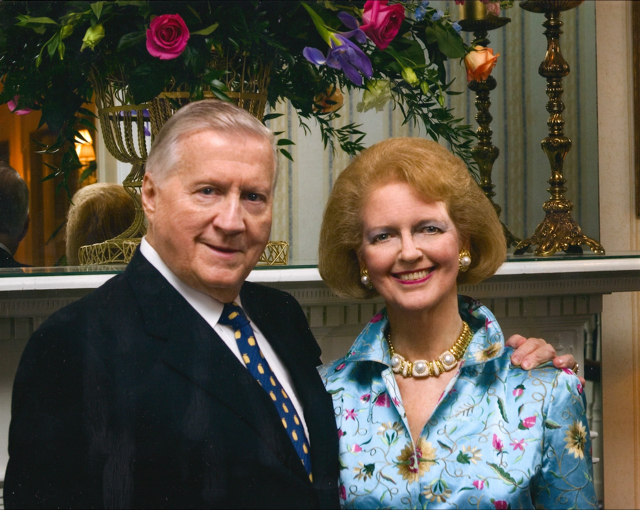
George and Joan Steinbrenner at Yankee Stadium, 1973

When George bought the Yankees, the purchase price was $8.8 million, about $45.2 million in today's money. When he died earlier this year, the team and all its assets were said to be worth $1.6 billion. About 35 times what he paid.
George and Joan Steinbrenner, 2000, considerably happier

9. July 30, 1990. Commissioner Francis T. "Fay" Vincent permanently bans Steinbrenner from the day-to-day management (although not the actual ownership, and financial responsibilities and receipt of income thereof) of the team. This was because George had hired Howie Spira, a private investigator and compulsive gambler, to find damaging information about Yankee star Dave Winfield and his charitable foundation, in order to discredit Winfield.

If Spira ever found anything, it has never been publicly revealed. For that reason, Dave, in the exact opposite of what George intended, was the only one of the three who came out looking good. Spira turned to Vincent, and George was banned. George was, however, permitted to apply for reinstatement after 2 years, and in 1993 reinstatement was granted.

The Yankees were already in last place at the time -- 1908, 1912, 1966 and 1990 remain the only last-place finishes in the team's history -- and I actually went to the game that night, against the Detroit Tigers. The Yankees won, 6-2. Only 24,037 attended, and what a relief there was in the crowd. I'm not ashamed to admit it: I took part in the "Steinbrenner sucks!" chant.

If you had told us that night that, as a result of the banning order, Gene Michael (whose initials, appropriately, are GM) would rebuild the organization, top to bottom, and within 6 years we'd be World Champions again, I think we would have taken it. But if you had told us then that, 6 years later, we'd be chanting, "Thank you, George!" at the ticker-tape parade following said World Series win, we'd have wondered what you were smoking.

And yet, both came true: Both the Yankees and their Boss were rehabilitated, restored and redeemed. In order for both the team and Steinbrenner to be redeemed, George had to go. As Richie Ashburn would've said to his broadcast partner, "Hard to believe, Harry."

10. July 30, 2009. If you're a Red Sox fan, and you're intellectually honest, this was The Day the Music Died. This was the day it was revealed that both David Ortiz and Manny Ramirez flunked steroid tests in 2003 -- meaning the team's 2004 and 2007 World Championships were illegitimate.

Maybe Manny was already a great hitter without steroids, but there's no way the Sox would've won either title with the David Ortiz who averaged 14 homers and 59 RBIs a year for the Minnesota Twins from 1997 to 2002. Big Papi was a big fat fraud.

To this day, Sox fans chant "Sterrrr-oids!" at the Yankees, especially Alex Rodriguez, who was never caught AS a Yankee, and whose first World Championship game 6 years -- not 1 year -- after he was caught. Since 1918, Yankees 27, Red Sox 0*. The Curse of the Bambino could not be broken without the Sox cheating. So if it ever actually existed, then... it still does.

And the collapse of October 17-20, 2004 counts for nothing. The Yankees didn't choke, the Sox fucking cheated.

And July 30, 2009 was the day that confirmed that we never deserved such ignominy. And the Sox did. In other words, the Curse of the Mitchell Report was dead.

And any Sox fan who says those 2004 and 2007 titles are real, whether I know you or not, you can kiss my ring. Take your pick: There's 27 of them. All real.