Showing posts with label 1955. Show all posts

Saturday, September 19, 2026

September 19, 1926: The Duke of Flatbush

September 19, 1926, 100 years ago: Edwin Donald Snider is born in Los Angeles, and grows up in neighboring Compton.

One of the great ironies of North American sports history is that, while the greatest of all Los Angeles Dodgers, Sandy Koufax, was from Brooklyn but didn't find his control until after the move, the 2 men often cited as the greatest Brooklyn Dodgers, Robinson and Snider, were both from the Los Angeles area: Jackie was born in Georgia and grew up in Pasadena, while "the Duke of Flatbush" was, yes, straight outta Compton.

Snider hit 407 home runs. Today, there's some real donkeys with more than that, but, when he retired in 1964, the only ones with more were Babe Ruth, Jimmie Foxx, Ted Williams, Mel Ott, Willie Mays, Lou Gehrig, Stan Musial, Eddie Mathews and Mickey Mantle. His 389 homers in a Dodger uniform is still a franchise record, regardless of coast. (Eric Karros is the L.A. leader, with a mere 289.)

His 326 home runs were the most of any player in the 1950s. In comparison, Hodges hit 310: Mantle 273, Mays 250, Ted Williams 227, Stan Musial 266, and Hank Aaron 179. Remember: Both Mays and Williams missed most of '52 and '53, Aaron didn't start until '54, and when the decade began, Williams was already 31, and Musial 29.

Duke's lifetime batting average was .292, and 8 times he hit at least .300. His career OPS+ was a whopping 140. He wasn't as good in center field as Mays, but he was roughly as good as Mantle.

And that brings up the inevitable question of the 3 New York center fielders: Willie, Mickey, and the Duke. Who was better? Looking at their career stats, it seems silly to put the Duke into the equation; it's got to be either the Say Hey Kid or the Mick, not the Duke.

And yet...

Mickey and Willie entered the majors in 1951. Duke was in his 5th full season. Makes sense, he was 5 years older:

* Edwin Donald Snider, born September 19, 1926 in Los Angeles.
* Willie Howard Mays Jr., born May 6, 1931 in Westfield, Alabama.
* Mickey Charles Mantle, born October 20, 1931 in Spavinaw, Oklahoma.

If you look at what they did while all 3 were together, the case for the Duke gets a lot better:

* In 1951, Willie had a sensational rookie season, while the Duke a pretty good season, and Mickey struggled and got sent down to the minors before regaining his stroke and keeping it for a generation. Willie 1st, Duke 2nd, Mickey 3rd.

* In 1952, Willie was drafted into the Army early on, and missed most of the season. The Duke's stats went down a little. Mickey, still only 20 until right after the World Series, had a little bit better year. Mickey 1st, Duke 2nd, Willie 3rd (not that it was his fault).

* In 1953, Willie was still in the Korean War, but the Duke bounced back with a season in which he led both leagues in slugging percentage and OPS+ (not that the former was then mentioned much or the latter, well, at all). Mickey's season was more bark than bite, as some of his 21 homers were of the variety that came to be called "tape measure" due to their distance, hitting shots that were contenders for the title of longest ever hit in Washington, Philadelphia and St. Louis. But he didn't have as good a season as the Duke. Duke 1st, Mickey 2nd, Willie 3rd (again, through no fault of his own).

* In 1954, Willie returned with his best season, a batting title and a World Championship. The Duke had a sensational season, but not quite as sensational as Willie's. In spite of the Yankees not winning the Pennant for the first time since he arrived, Mickey had his best season yet, but not as good as the other two. Willie 1st, Duke 2nd, Mickey 3rd.

* In 1955, the Duke had his best season, and not just because the Dodgers finally went all the way. I don't want to say Campy didn't deserve the MVP, but the Duke led both leagues in RBIs and he, as much as Podres, was deserving of being named MVP of the '55 Series. Willie had another great year, and Mickey finally began to not just hit the tar out of the ball, but do so with consistency. Great year, but not as good as the other two. Duke 1st, Willie 2nd, Mickey 3rd.

* In 1956, Mickey came into his own, winning the Triple Crown -- in fact, becoming the last player to date to lead both leagues in all 3 categories. The Duke had another great year, leading the NL with a career-high 43 homers. By almost anybody else's standards, Willie had a great year, but not as good as the other two. Mickey 1st, Duke 2nd, Willie 3rd.

* In 1957, the last season of all 3 teams in New York, Mickey won another MVP had batted .365, a figure neither Willie nor the Duke ever approached (in fact, no New York-based player has since). The Duke was still quite productive; his tailoff in 1958 can be attributed to going from the cozy confines of Ebbets Field to the misshapen field at the L.A. Coliseum, but he still had 88 RBIs in leading what was now his hometown team to the 1959 World Championship and a .296 average in 1961.

It was only with the move to Dodger Stadium in 1962 that he really began to slow down, at age 35/36, and he was gone 2 years later, playing, ironically, at the Polo Grounds for the Mets and then closing with the Giants. Willie had another really good year, but not quite up to the standard that was being set by New York center fielders; he didn't really have a subpar year until 1969, and was still pretty productive until 1971 when he was 40. So, in '57, Mickey 1st, Duke 2nd, Willie 3rd.

Willie: 1st, 3rd, 3rd, 1st, 2nd, 3rd, 3rd; average, 2.29.
Mickey: 3rd, 1st, 2nd, 3rd, 3rd, 1st, 1st; average, 2.00.
Duke: 2nd, 2nd, 1st, 2nd, 1st, 2nd, 2nd; average, 1.72.

Surprise! Granted, this takes into account Willie's 2 missing seasons, but even if you count only '51, '54, '55, '56 and '57, the Duke still holds his own, no worse than 2nd each time.

If this Duke wasn't quite a king, he was certainly no bum.

He was not happy when the Dodgers were moved out of Brooklyn after the 1957 season, but he was glad to be going home. He helped them win National League Pennants in 1947, 1949, 1952, 1953, 1955, 1956 and 1959, and the 1955 and 1959 World Series. He briefly played for the Mets toward the end of his career, although it was a bit weird to see him wear Number 11, instead of the 4 that would later be retired by the Dodgers. It was even weirder to see him end his career in 1964 with the San Francisco version of the Giants, as a teammate of Mays.

He was elected to the Baseball Hall of Fame in 1980. In 1999, The Sporting News listed him at Number 83 on their list of the 100 Greatest Baseball Players. He died on February 27, 2011, at the age of 84, having outlived Mantle by over 15 years.

James Lipton, host of Inside the Actors Studio, was also born in September 19, 1926, in his case in Detroit.

Friday, December 26, 2025

December 26, 1955: Otto Graham Goes Out a Winner

December 26, 1955, 70 years ago: The NFL Championship Game is played at the Los Angeles Memorial Coliseum. It was moved up a day, because, that year, December 25 fell on a Sunday, and the NFL refused to play on Christmas Day until 1971.

The Cleveland Browns were playing in a league championship game for the 10th straight year: The 1st 4 in the All-America Football Conference (1946-49), winning all 4 of those; and the last 6 in the NFL, having beaten the Los Angeles Rams in 1950, lost to the Rams in 1951, lost to the Detroit Lions in 1952 and 1953, and beaten the Lions in 1954. Now, they were playing the Rams again.

Quarterback Otto Graham had been there for all of those games. Under head coach Paul Brown, an offensive genius, he had been, in terms of results, the most successful quarterback in pro football history. (Sure, Tom Brady later got teams into 10 championship games under the Super Bowl name, all within the NFL. But Graham did 10 in a row, and matched Brady with 7 wins. And Graham never had to cheat.)

Graham had retired after the 1954 Championship Game, but Brown talked him into returning for 1 more season. He led the Browns to a 9-2-1 record. They opened with a loss to the Washington Redskins, but shrugged it off to beat the San Francisco 49ers away, the Philadelphia Eagles at home, the Redskins away, the Green Bay Packers at home, the Chicago Cardinals away, and the New York Giants at home.

In addition to Graham, the Browns still had receiver Dante Lavelli, center Frank Gatski, tackle and placekicker Lou Groza, and defensive end Len Ford, who would all be elected to the Pro Football Hall of Fame. So would Brown. So would linebacker Chuck Noll, albeit as the later head coach of the Pittsburgh Steelers.

The Browns lost to the Eagles in Philadelphia, then beat the Steelers at home. They could only manage a tie with the Giants in New York, then won away to Pittsburgh, and closed by beating the Cardinals at home.

The Rams were coached by Sid Gillman, whose innovations in the passing game had begun to rival those of Paul Brown. They had finished 8-3-1, with 2 of their losses inflicted by the Chicago Bears. They still finished ahead of the Bears, who went 8-4.

The Rams still had several of the players who beat the Browns in the 1951 title game, including quarterback Norm Van Brocklin and his top 2 receivers, Tom Fears and Elroy "Crazy Legs" Hirsch, all of whom would be elected to the Pro Football Hall of Fame. So would Gillman, and linebacker Les Richter. Running back Paul "Tank" Younger and defensive tackle Gene "Big Daddy" Lipscomb have not yet been elected to the Hall, but should be.

And, this being an odd-numbered year, the Western Division winners would have the home-field advantage. And the Coliseum was the only stadium in the NFL that seated more than the Browns' Cleveland Municipal Stadium, so 87,695 fans came out, supporting the blue and gold, rather than the orange and white.

Groza kicked a 43-yard field goal to give the Browns a 3-0 lead at the end of the 1st quarter. The 2nd quarter featured several big plays, including Don Paul intercepting Van Brocklin, and returning it 65 yards for a touchdown, to make it 10-0 Browns; Van Brocklin throwing a 67-yard touchdown pass to Volney "Skeet" Quinlan, closing the Rams to within 10-7; and Graham throwing a 50-yard touchdown pass to Lavelli, giving the Browns a 17-7 halftime lead.

Graham himself ran the ball in for 2 touchdowns in the 3rd quarter, and the Browns led, 31-7. In the 4th quarter, Graham's last touchdown pass was 35 yards to Ray Renfro. Ron Waller scored from 4 yards out to give the Rams a consolation score, and the Browns won, 38-14.

It was the 7th league championship, the 3rd in the NFL, for Graham and Paul Brown. It would be the last. Graham retired again, and, this time, stuck with it. Brown led the Browns until 1962, before being fired by new owner Art Modell. He later founded the Cincinnati Bengals.

Gillman would further develop his passing ideas, and led the San Diego Chargers to the 1963 AFL Championship. Bill Walsh, who served as an assistant on the Bengals under Brown, and also under on the Oakland Raiders under Al Davis, who had been an assistant on the Chargers under Gillman, would coach the San Francisco 49ers to 3 Super Bowl wins.

Under the new regime, the Browns won the Championship in 1964 -- and haven't reached a world championship game since. The Rams would fare little better, not reaching another until Super Bowl XIV in the 1979 season, and losing. They moved to St. Louis in 1995, won Super Bowl XXXIV in the 1999 season, lost Super Bowl XXXVI in the 2001 season, moved back to Los Angeles in 2016, and have lost Super Bowl LIII in the 2018 season and won Super Bowl LVI in the 2021 season.

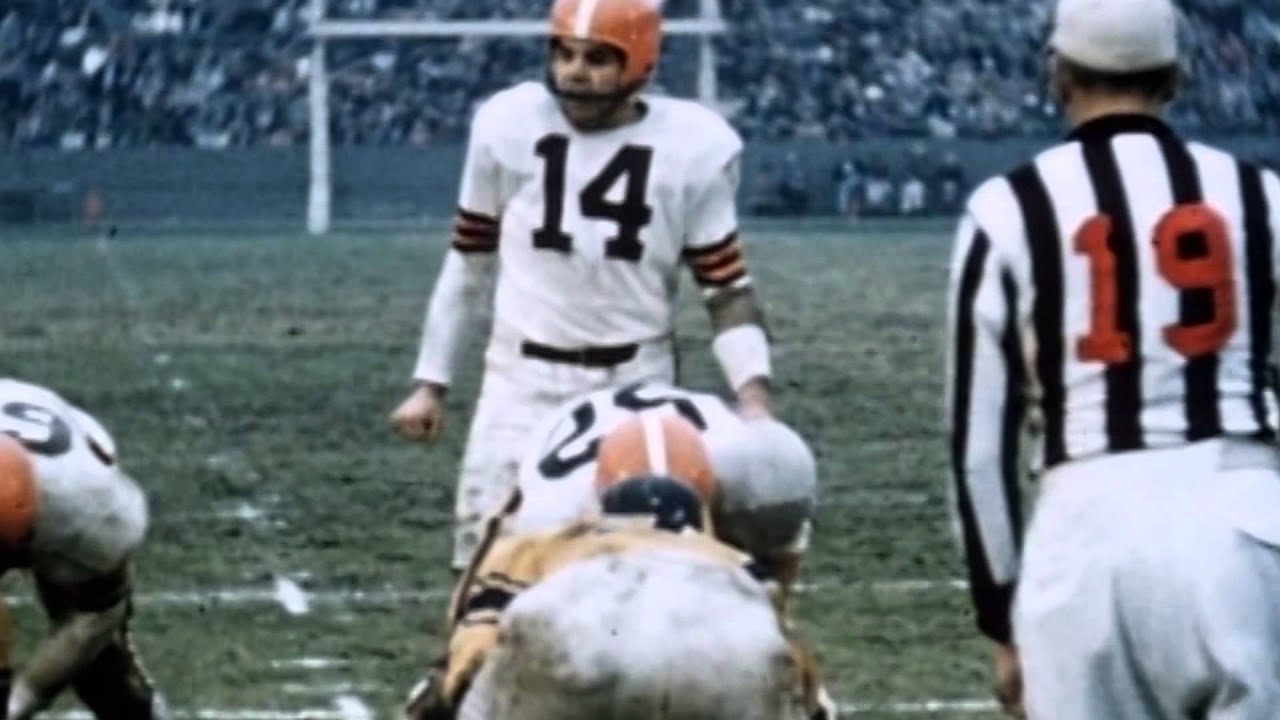
Graham started his professional career wearing Number 60, from 1946 to 1951. From 1952 onward, he wore Number 14. The Browns retired that number, and also named him to their Ring of Honor. He was elected to the Pro Football Hall of Fame in its 3rd class, in 1965.

He later served as head coach and general manager of the Washington Redskins, and as head coach and athletic director at the U.S. Coast Guard Academy. In 1999, he was ranked 7th on The Sporting News' list of the 100 Greatest Football Players, trailing only Joe Montana and Johnny Unitas among quarterbacks. He died in 2003.

In 2010, the NFL Network ranked Graham 16th on its list of the 100 Greatest Players, among quarterbacks trailing only Montana, Unitas, Peyton Manning and the even earlier Sammy Baugh, but not yet Tom Brady. He was named to the NFL's 50th Anniversary Team in 1969, its 75th Anniversary Team in 1994, and its 100th Anniversary Team in 2019. Also in 2019, a statue of Graham was dedicated outside Huntington Bank Field in Cleveland.

Monday, December 1, 2025

December 1, 1955: Rosa Parks Holds Her Seat

December 1, 1955, 70 years ago: Rosa Parks is told to get up and move. She says, "No." In so, doing, she made history.

As historian Laurel Thatcher Ulrich said, "Well-behaved women rarely make history."

Let the record show that Rosa Parks was not the first woman to make this kind of history. In 1943, 17-year-old Bernice Delatte was arrested for defying segregation rules on a bus in New Orleans. In 1944, a U.S. Army Lieutenant was told to go to the back of a bus, to make room for a lower-ranking soldier. He refused. He got court-martialed. He was acquitted. His name was Jack Roosevelt Robinson. Yes, that Jackie Robinson. And in 1953, a 6-day boycott got the buses in Baton Rouge, Louisiana desegregated.

On March 2, 1955, Claudette Austin was arrested in Montgomery, the capital of Alabama, for refusing to give up her seat to a white woman on a crowded, segregated bus. The National Association for the Advancement of Colored People had been waiting for a chance to challenge a "send the blacks to the back of the bus" law, in line with the decision the year before, by the U.S. Supreme Court, in Brown v. Board of Education of Topeka, Kansas, that accommodations that were officially "separate but equal" was unconstitutional.

But Claudette was 15 years old, unmarried, and pregnant. Parks later said, "If the white press got ahold of that information, they would have a field day. They'd call her a bad girl, and her case wouldn't have a chance." The NAACP would need a more sympathetic defendant. Nine months later -- perhaps an appropriate time period -- they found one: Parks herself.

Rosa Louise McCauley was born on February 4, 1913 in Tuskegee, Alabama, and grew up in Pine Level, outside Montgomery. She was bullied by white children, and never forgot it. In 1932, she married Raymond Parks, a barber who worked with the NAACP. She joined the Montgomery chapter in 1943, and was elected its secretary. During World War II, she rode on an integrated trolley at Maxwell Air Force Base in Montgomery. She later said, "You might just say Maxwell opened my eyes up."

On November 27, 1955, Rosa Parks was attending Dexter Avenue Baptist Church in Montgomery, whose pastor was 26-year-old Dr. Martin Luther King Jr. He had invited T.R.M. Howard, head of the Regional Council of Negro Leadership in Mississippi, to speak of the recent murder of Emmett Till, and the acquittal of the 2 men who did it.

It was still on her mind 4 days later, on December 1. At around 6:00 PM, she boarded a Montgomery City Lines bus downtown. Eventually, all of the White-only seats in the bus filled up. The bus reached the third stop, in front of the Empire Theater, and several White passengers boarded. The driver, James F. Blake, noted that two or three White passengers were standing, as the front of the bus had filled to capacity.

Blake moved the "colored" section sign behind Parks, and demanded that four Black people give up their seats in the middle section, so that the White passengers could sit. Three of them complied. Parks said, "I thought of Emmett Till, a 14-year-old African American who was lynched in Mississippi in 1955, after being accused of offending a White woman in her family's grocery store, whose killers were tried and acquitted – and I just couldn't go back." In her autobiography, she said:
People always say that I didn't give up my seat because I was tired, but that isn't true. I was not tired physically, or no more tired than I usually was at the end of a working day. I was not old, although some people have an image of me as being old then. I was forty-two. No, the only tired I was, was tired of giving in.
When Parks refused to give up her seat, Blake took to his radio, and called the police. When she was arrested, she asked the officer, "Why do you push us around?" She remembered him saying, "I don't know, but the law's the law, and you're under arrest."

She was charged with a violation of Chapter 6, Section 11, segregation law of the Montgomery City code. Edgar Nixon, president of the Montgomery chapter of the NAACP and leader of the Pullman Porters Union, and her friend Clifford Durr bailed Parks out of jail that evening.

On Sunday, December 4, plans for the Montgomery bus boycott were announced at Black churches in the area, and a front-page article in the Montgomery Advertiser helped spread the word. At a church rally that night, those attending agreed unanimously to continue the boycott until they were treated with the level of courtesy they expected, until Black drivers were hired, and until seating in the middle of the bus was handled on a first-come-first-served basis.

The next day, Parks was tried on charges of disorderly conduct and violating a local ordinance. The trial lasted 30 minutes. After being found guilty and fined $10, plus $4 in court costs -- the total of $14 worth about $170 in 2025 money -- she appealed her conviction, and formally challenged the legality of racial segregation.

It rained that day, but the Black community persevered in their boycott. Some rode in carpools, while others traveled in Black-operated cabs that charged the same fare as the bus, 10 cents. Most of the remainder of the 40,000 Black commuters walked, some as far as 20 miles.

The boycott lasted for an entire year. On December 20, 1956, the federal ruling Browder v. Gayle took effect, declaring the Alabama and Montgomery laws that segregated buses were unconstitutional. All the seats on all the buses were now open to all.

In 1957, Rosa and Raymond Parks moved to Detroit, living with her brother and sister-in-law. She became a fair housing activist, helped John Conyers get elected to Congress in 1964, and served as his secretary until 1988. She participated in the Selma-to-Montgomery march in 1965. Her husband and brother died within weeks of each other in 1977, and she stepped back from civil rights activities thereafter to care for her mother, who died in 1979.

She then returned to the struggle, adding Planned Parenthood to her causes. In 1994, she was robbed and assaulted in her Detroit home. Mike Ilitch, founder of Detroit-based pizza chain Little Caesars, and owner of baseball's Detroit Tigers and hockey's Detroit Red Wings, bought her an apartment in a high-rise riverfront condo.

The following year, in commemoration of the 40th Anniversary of her seated stand, President Bill Clinton invited her to the State of the Union Address. He said, "She's sitting down with the First Lady tonight, and she may get up, or not, as she chooses." Acknowledging a standing ovation, she briefly stood.
She died on October 24, 2005, at the age of 92, after years of ill health and cognitive decline. Although often called "the mother of the Civil Rights Movement," she had no children of her own. She became the 1st woman, the 2nd black person, and the 1st private citizen to lie in state under the Rotunda of the U.S. Capitol Building in Washington.
A statue of her stands in Montgomery, roughly where she was arrested. In her adopted hometown of Detroit, the bus terminal is named for her. The bus on which she was arrested was also moved to Detroit, to the Henry Ford Museum in adjoining Dearborn, where it is on display along with the limousine in which President John F. Kennedy was assassinated, and the Ford's Theatre chair in which President Abraham Lincoln was sitting when he was assassinated.
As has been said, Rosa Parks sat, so that Martin Luther King could march, so that Barack Obama could run.
Bernice Delatte, the 1943 New Orleans protestor, lived until 2010. Claudette Austin became a nurse, married, and took the name Claudette Colvin. As of December 1, 2025, she is still alive.

Wednesday, November 19, 2025

November 19, 1955: National Review Is First Published

November 19, 1955: The weekly magazine National Review is first published by its editor, William F. Buckley Jr.

Modern American conservatism, from Senator Joseph R. McCarthy onward, has been based on lies and hysterics. Buckley tried to change that. But, as is so often the case, telling the truth got him into just as much trouble.

Even his name wasn't originally correct: When born on November 24, 1925 -- 4 days after an eventual ideological opponent, Robert F. Kennedy -- in Manhattan, it was with the name William Francis Buckley. At some point, it was changed to William Frank Buckley Jr.

William Frank Buckley Sr. was a lawyer and an oil developer, whose work took him and his family to Mexico, and when it was time to send his son to his first school, it was a boarding school in Paris. Thus, he spoke Spanish first, French second, and English third. Which seems odd for someone who became so skilled with the English language, and seemed to have such a "patrician" accent.

"Bill" Buckley was an officer in the U.S. Army during World War II, but was never transferred off U.S. soil. He attended Yale University, where both its joys and its frustrations would serve him well. He served 2 years in the early CIA, which helped to inspire his later spy novels. His character Blackford Oakes was, basically, an upper-class American ripoff of James Bond.

Buckley married Patricia Taylor, and settled on an estate (they called it a "farm," perhaps for tax purposes, as rich people sometimes do) in Sharon, Connecticut, far enough from Midtown Manhattan (100 miles) to be isolated, but close enough to be near the corridors of power. Despite being an old-style Catholic and 1 of 10 siblings, he had only 1 child, a son named Christopher, who also became an acclaimed author.

In 1951, William F. Buckley Jr. wrote his 1st book, God and Man at Yale -- known thereafter to the conservative movement by its initials, GAMAY. He attacked several officials and professors at the school as "leftists," including McGeorge Bundy, who would go on to become National Security Adviser to 2 Democratic Presidents.

In a review titled "The Attack on Yale" for the November 1951 issue of The Atlantic, Bundy wrote: "In the end Mr. Buckley's indictment of Yale's economics texts turns out to be a self-indictment. This chapter shows him to be a twisted and ignorant young man whose personal views of economics would have seemed reactionary to Mark Hanna." (Hanna was the Senator from Ohio who managed the conservative Republican campaigns of President William McKinley, who died half a century earlier.) This was in Part I of Bundy's review. Part II began with "The worst is yet to come."

In 1955, with several fellow reactionaries -- including L. Brent Bozell Jr. (who had married Bill's sister, Patricia Buckley, and whose son, L. Brent Bozell III, had just been born, and would later write for the magazine), Russell Kirk (who had published the anthology The Conservative Mind 2 years earlier), Revilo P. Oliver (the noted historian's name is a palindrome, reading the same forwards and backwards), and Whittaker Chambers (the ex-Communist ex-editor for Time magazine, whose testimony had sent Alger Hiss to prison) -- Buckley founded National Review.

(Its 1st drama critic was 23-year-old Garry Wills, who became one of America's greatest historians, and not so conservative. A biographer of multiple Presidents, his books about Richard Nixon and Ronald Reagan were highly critical.)

Buckley's introductory essay made the magazine's mission clear:

Let's face it: Unlike Vienna, it seems altogether possible that did National Review not exist, no one would have invented it. The launching of a conservative weekly journal of opinion in a country widely assumed to be a bastion of conservatism at first glance looks like a work of supererogation, rather like publishing a royalist weekly within the walls of Buckingham Palace. It is not that, of course; if National Review is superfluous, it is so for very different reasons: It stands athwart history, yelling Stop, at a time when no one is inclined to do so, or to have much patience with those who so urge it.

National Review is out of place, in the sense that the United Nations and the League of Women Voters and the New York Times and Henry Steele Commager are in place. It is out of place because, in its maturity, literate America rejected conservatism in favor of radical social experimentation.

Of course, there was a reason for this: Conservatism caused the stock market Crash of 1929, just 26 years earlier, and the subsequent Great Depression of the 1930s, which led to the political backlash that caused the election of Franklin D. Roosevelt as president, and his Administration's radical social experimentation, which saved the nation's economy and perhaps worldwide capitalism itself. Unlike conservatives following the economic downturns of 1973-76, 1990-93, 2001-04, 2007-09, and 2020-21, Buckley was not asking people to forget that the Depression happened on conservatives' watch.

Rather, he was asking people to accept his position, which was that the time for radical social experimentation ended once the immediate economic emergency ended, and that a return to the kind of conservatism that brought the economic prosperity of the 1920s was what was needed today (1955). Of course, as I said, that kind of conservatism caused the Depression.

Buckley once wrote, "I want discretion in the sense that I want intelligence, and no crackpottery. But I want some positively unsettling vigor, a sense of abandon, and joy, and cocksureness that may, indeed, be interpreted by some as indiscretion." In 1957, he published a nasty review that Chambers wrote for Ayn Rand's right-wing novel Atlas Shrugged.

Nevertheless, in 1958, Oliver left the magazine, and joined candy executive Robert W. Welch Jr. to become one of the founders of the John Birch Society, which seemed to encourage crackpots, to the point where, in 1963, both Bob Dylan and the Chad Mitchell Trio wrote songs making them look like paranoid psychotics. (The Trio's song included the line, "There's no one left but thee and we, and we aren't sure of thee!")

And yet, in 1957, 3 years after Brown v. Board, 1 year after the Southern Manifesto, and a few weeks before the Little Rock Crisis, Buckley published an editorial titled "Why the South Must Prevail":

The central question that emerges... is whether the White community in the South is entitled to take such measures as are necessary to prevail, politically and culturally, in areas where it does not predominate numerically? The sobering answer is Yes – the White community is so entitled because, for the time being, it is the advanced race.

NR did improve its record on race -- somewhat. It denounced the 1968, 1972 and 1976 Presidential campaigns of Governor George Wallace of Alabama. But it has also, perennially, called for the end of affirmative action. In 1965, at Oxford University in England, Buckley himself infamously took the segregationist side in a debate with black writer James Baldwin.

In the 1980s, NR opposed sanctions against the apartheid government of South Africa, because that government was anti-Communist -- and, like all white-supremacy governments, including in the Southern U.S., it falsely took the official tack that civil rights activists were motivated by Communism.

The Spanish Fascist leader Francisco Franco was a hero in the Buckley household, celebrated as a conservative and Catholic bulwark against the officially atheist worldwide Communist movement, known to its opponents as "the Red Menace." In 1957, Buckley declared in his magazine, "General Franco is an authentic national hero." NR writer James Burnham echoed this sentiment in a 1975 obituary declaring "Francisco Franco was our century's most successful ruler."

(He wasn't. Within 3 years, Spain had a free election, and the voters chose a liberal government. Spanish voters have chosen conservative governments since, but never again a Fascist one.)

In his 1997 book Nearer, My God: An Autobiography of Faith, Buckley condemned the 1960s rulings that he viewed as "the Supreme Court's war against religion in the public school," and argued that Christian faith was being replaced by "another God... multiculturalism." He disapproved of the liturgical reforms following the Second Vatican Council of 1962-66.

On April 4, 1966, the program Firing Line, hosted by Buckley, premiered on NET, and continued on its successor network, PBS, until 1999. In addition to the various NR writers, and conservative activists -- Milton Friedman, Friedrich Hayek, Phyllis Schlafly, and so on -- Buckley invited people no one would have expected, like liberal activists Saul Alinsky, Julian Bond and Noam Chomsky; Watergate-busting reporters Bob Woodward and Carl Bernstein; Democratic political candidates like Jimmy Carter (not yet President), Jesse Jackson and John Kerry; and even figures from the 1960s "left," like Norman Mailer, Allen Ginsberg, Timothy Leary and Huey Newton.

In August 1968, ABC News invited Buckley and Gore Vidal, a liberal-leaning author and, like Ginsberg, one of the few openly gay celebrities of the time, to debate each other during the controversy-strewn Democratic Convention in Chicago. Even people who would normally have agreed with Vidal politically found themselves sympathizing with Buckley, because Vidal was completely rude, even telling Buckley, "Shut up a minute!"

Buckley compared New Left youths carrying pro–Viet Cong flags to pro-Nazis, which is ridiculous, because the Nazis, as Fascists, were a right-wing movement, not a left-wing one. Vidal responded by saying, "As far as I'm concerned, the only sort of pro- or crypto-Nazi that I can think of is yourself."

This set Buckley off: Remembering his gay-baiting pre-Vatican II Catholicism, and his service in World War II against the Nazis, he said, "Now, listen, you queer: Stop calling me a crypto-Nazi, or I'll sock you in the goddamned face, and you'll stay plastered!" (And by "plastered," he didn't mean "drunk.") And ABC either didn't have a seven-second delay to "bleep out" any profanities, or didn't use it, and Buckley's use of the word "goddamned" stayed on the broadcast -- to this day, a rarity on American television, at any hour of the day.

Buckley and Vidal were the same age, the former born just 9 days before the latter, so there was no age advantage. And, with his Army and CIA training, if there had been a fight, it would have seemed like Buckley would be heavily favored. But someone who knew Buckley mentioned that he had recently broken his left arm, and he could be seen on the videotape tucking that arm in, using his right hand to keep his earpiece in. He might not have won a fight on that occasion.

After Watergate, Buckley rallied the conservative movement behind Ronald Reagan, and was very pleased with how the Reagan Administration turned out. In that Administration's time, and also later in its wake, there would be copies of Buckley's work.

Debuting on NBC in 1982, The McLaughlin Group was a more freewheeling, if host-controlled, version of Firing Line. The American Spectator was founded in 1972, as more of a gut-punching magazine, and by the time Bill Clinton began his successful run for President in 1992, it was willing to embrace any conspiracy theory against him and other liberals, no matter how ridiculous. The Weekly Standard was founded in 1996, as a cheekier, less Ivy-ish version of National Review. Debuting the same year, Fox News Channel made Firing Line seem very quaint by comparison.

I used to read National Review, even though I agreed with very little in it, because it was so well-written, and, probably upon Buckley's insistence, the sense of humor was still there. And it wasn't a mean, bullying, frat-boy sense of humor, either, like The American Spectator had.

In 1995, on PBS, Michael Kinsley of the liberal-leaning magazine The New Republic moderated a Firing Line-sponsored debate on the subject of religion in public life. As captain of one side, favoring more of it, was Buckley. As captain of the other side, favoring less of it but otherwise a conservative, was controversial lawyer Alan Dershowitz.

During his opening remarks, Kinsley told the theater audience, "I should warn you: Some of these panelists are under the delusion that they have a special pipeline to God." Several people, including Buckley, laughed. Kinsley continued: "And some of these panelists are under the delusion that they are God." More people laughed. Buckley was one of them. Dershowitz was not.

But age and ill health caught up with Buckley. He retired Firing Line in 1999. And he gave up editorial control of National Review in 2005. Without him to hold it back, it totally embraced the insanity -- the "crackpottery," as Buckley once put it -- of the Republican Party in the 21st Century.

William F. Buckley Jr. died on February 27, 2008, at the age of 82. Surprising no one who knew him, his death came less than a year after his wife's.

Buckley's son, Christopher Buckley, became a novelist, and was chief of staff to George H.W. Bush while he was Reagan's Vice President.

Firing Line was revived in 2018, again on PBS, hosted by Margaret Hoover, a former Fox News correspondent, and a great-granddaughter of President Herbert Hoover. 

Tuesday, October 7, 2025

October 7, 1955: Allen Ginsberg Howls

October 7, 1955, 70 years ago: Allen Ginsberg gives the 1st public reading of his poem "Howl," at the Six Gallery in the North Beach section of San Francisco.

The poets reading that night were, in order: Philip Lamantia, Michael McClure, Philip Whalen, Ginsberg and Gary Snyder. The organizer was Kenneth Rexroth. They were introduced by Lawrence Ferlinghetti, who also owned the nearby City Lights Bookstore. Both Rexroth and Ferlinghetti were published poets, but neither read his work that night. Jack Kerouac, already a published novelist but 2 years away from his magnum opus On the Road being published, refused to read his own poetry, but cheered the other writers on, and passed a jug of wine around.

"Howl" is best remembered for its opening:

I saw the best minds of my generation destroyed by madness, starving hysterical naked,
dragging themselves through the negro streets at dawn looking for an angry fix,
angelheaded hipsters burning for the ancient heavenly connection to the starry dynamo in the machinery of night,
who poverty and tatters and hollow-eyed and high sat up smoking in the supernatural darkness of cold-water flats floating across the tops of cities contemplating jazz,
who bared their brains to Heaven under the El and saw Mohammedan angels staggering on tenement roofs illuminated,
who passed through universities with radiant cool eyes hallucinating Arkansas and Blake-light tragedy among the scholars of war,
who were expelled from the academies for crazy & publishing obscene odes on the windows of the skull,
who cowered in unshaven rooms in underwear, burning their money in wastebaskets and listening to the Terror through the wall...

And so on. But the part that sticks out to me is Part II, in which Ginsberg compares America's consumer culture to a Canaanite god, usually in the form of a giant bull and demanding the sacrifice of children, mentioned in the Old Testament as Molech (MOLL-ick) or Moloch (MOH-lock):

What sphinx of cement and aluminum bashed open their skulls and ate up their brains and imagination?

Moloch! Solitude! Filth! Ugliness! Ashcans and unobtainable dollars! Children screaming under the stairways! Boys sobbing in armies! Old men weeping in the parks!

Moloch! Moloch! Nightmare of Moloch! Moloch the loveless! Mental Moloch! Moloch the heavy judger of men!
Moloch the incomprehensible prison! Moloch the crossbone soulless jailhouse and Congress of sorrows! Moloch whose buildings are judgment! Moloch the vast stone of war! Moloch the stunned governments!
Moloch whose mind is pure machinery! Moloch whose blood is running money! Moloch whose fingers are ten armies! Moloch whose breast is a cannibal dynamo! Moloch whose ear is a smoking tomb!
Moloch whose eyes are a thousand blind windows! Moloch whose skyscrapers stand in the long streets like endless Jehovahs! Moloch whose factories dream and croak in the fog! Moloch whose smokestacks and antennae crown the cities!
Moloch whose love is endless oil and stone! Moloch whose soul is electricity and banks! Moloch whose poverty is the specter of genius! Moloch whose fate is a cloud of sexless hydrogen!...

Moloch! Moloch! Robot apartments! invisible suburbs! skeleton treasuries! blind capitals! demonic industries! spectral nations! invincible madhouses! granite cocks! monstrous bombs! 
They broke their backs lifting Moloch to Heaven!
Moloch in whom I sit lonely! Moloch in whom I dream angels! Crazy in Moloch!

Moloch had appeared in literature before. In his 1667 Paradise Lost, John Milton described him as a child-eating fallen angel, a "horrid king besmeared with blood / Of human sacrifice, and parents’ tears." Charles Dickens mentioned him in his 1848 novella The Haunted Man. In his 1862 novel Salammbô, set in Carthage during the Mercenary Revolt after the First Punic War in 237 BC, Gustauve Flaubert described Moloch as a god who represents the destructive power of the Sun.

"Howl" became the subject of an obscenity trial, for its profanity and sexual imagery, including the homosexual inferences made by Ginsberg, one of the few openly gay celebrities of the era. It was Ferlinghetti and his store, for selling the book, that were sued, not Ginsberg for writing it. On October 3, 1957, Judge Clayton W. Horn ruled that the poem was not obscene, and could be publicly sold.

As a native of Paterson, New Jersey and a New York resident for most of his life, he certainly had the opportunity to face sports. He was invited to read a poem and throw out a ceremonial first ball before a San Francisco Giants game on June 1, 1994. The Giants lost, 1-0 to the Atlanta Braves, in front of 28,808 fans, the biggest audience one of his readings had ever received. The poem was not well-received, but, 2 days short of his 68th birthday, he threw a strike from the mound.
Ginsberg admitted that day that he had never previously been inside a baseball stadium, except once for a Rolling Stones concert. "I'm just a four-eyed sissy," he remarked that day. In contrast, Kerouac was a star football player and track performer in high school, who washed out at Columbia University.

Certainly, the 1955 edition of Ginsberg wouldn't have been surprised at the move of the Brooklyn Dodgers to Los Angeles just 2 years later; at the corporations buying the naming rights to stadiums and arenas; or at the massive amounts of money that TV networks pay to televise sports, to the point where the NFL teams could lock their stadiums and not admit one single fan to a game, and not collect one single admission fee, and still make a profit.

Kerouac died in 1969, Ginsberg in 1997, Whalen in 2002, Lamantia in 2005, McClure in 2020, and Ferlinghett in 2021, at the age of 101. As of October 7, 2025, Snyder is the only reader from that night still alive.

October 7, 1955 was a Friday. Classical cellist Yo-Yo Ma was born.

Wednesday, October 1, 2025

October 1, 1955: "The Honeymooners" Premieres

Left to right: Jackie Gleason, Audrey Meadows, Art Carney and Joyce Randolph.

October 1, 1955, 70 years ago: A new show premieres on CBS. Well, sort of: The Honeymooners had been a sketch on The Jackie Gleason Show, but now it becomes a standalone half-hour situation comedy, perhaps the greatest "sitcom" in history.

The 1st episode, appropriately enough, discusses television itself: It is titled "TV Or Not TV," and shows what happens when Brooklyn bus driver Ralph Kramden (Gleason) and sewer worker, upstairs neighbor and best friend Ed Norton (Art Carney) go halfsies on a television set, because neither one can afford their own. (Ralph has never had one, because he's cheap. Ed's 1st one just broke down.)

Ralph's wife, Alice Kramden (Audrey Meadows), wants a TV set, but she doesn't think this arrangement will work. Interestingly, unless you count Alice's groan over a tricky sink, Ed's wife, Thelma "Trixie" Norton (Joyce Randolph), has the 1st line in the show's history: "Hiya, Alice!"

Ralph was always yelling at Alice. Today, we would call that "verbal abuse." And one of the things he yelled at her was threats. "You are gonna get yours." "You're going to the Moon!" "Hoo-hoo, would I like to... " "Oh-ho... Oh-ho... Bang! Zoom!"

And, just once in the "Classic 39" episodes -- he used this one a lot more when it was just a sketch on his earlier Jackie Gleason Show -- "One of these days, one of these days, pow! Right in the kisser!" As comedian Bill Maher put it, Ralph was always threatening to graduate from verbal to physical abuse, and mainstream America was fine with this, and thought it was funny.

You know how many times Ralph actually hit Alice onscreen in those 39 episodes? Zero. Because Alice wouldn't have put up with it. No, she couldn't have beaten Ralph in a genuine fight -- Gleason was 5-foot-10, and was usually around 240 pounds but peaked at 285 -- but if she so much as slapped him just once, he would have been so shocked that the woman he loved had done that to him, that he would have backed down. For all his "king of the castle" bluster, Ralphie Boy was whipped.

Sure, Ralph would get in Alice's face and berate her, but she was just as likely to get into his. Check out this exchange, from the aforementioned 1st episode, after she accused him of being cheap, leading to the lack of amenities in their apartment (and 328 Chauncey Street, which is a real address, was actually in the Bushwick section of Brooklyn, not in Bensonhurst like was so often said onscreen):

Ralph: When we got married, you said, "Ralph, I'd be happy to live in a tent with you!"
Alice: I'm still willing. I think it'd be an improvement.
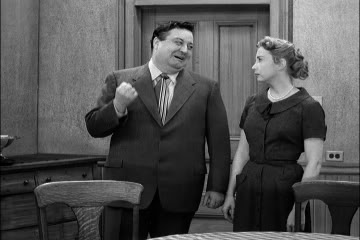
Ralph, shaking his fist in her face: You wanna go to the Moon? Do ya wanna go to the Moon?
Alice: That would be an improvement, too!

Look at this picture. Ralph has his fist balled up. Is Alice intimidated? Hell, no: She's standing her ground, ramrod straight, and giving Ralph a death stare.
She was from Brooklyn, too, you know: Alice Gibson Kramden was one tough redhead. She gave as good as she got, and, while Ralph would frequently continue the verbal thrust-and-parry, just as often, he would back down, and make that big sad moon face, and be contrite, and apologize.

And she would forgive him. Because, deep down, she loved him as much as he loved her. And he would acknowledge just how good a fit she was for him, say, "Baby, you're the greatest!" and grab her and bend her over and kiss her like in romantic movies -- a much better "Pow, right in the kisser." For all his big talk, he was a romantic and a sentimentalist.
Lucille Ball may have been the first woman with any power in television production, but Audrey Meadows was TV's first feminist.

The show had the occasional sports reference. In "The Golfer," Ralph tries to learn how to play golf to impress a bus company official. In "Here Comes the Bride," Ralph notes that Alice's sister, finally getting married, has been a bridesmaid so often, she caught her own bouquet. Alice said her foot slipped, and Ralph compares her to Willie Mays, saying, "If my foot could slip like that, I'd be playing center field for the New York Giants!"

In "Young At Heart," Ralph wears a varsity football letter sweater. The letter is V, although the name of his school is never revealed. (There is a Martin Van Buren High School in New York, but it's in Queens, and is unlikely to have been Ralphie Boy's alma mater.) And in the last episode, "A Man's Pride," Ralph runs into a high school nemesis at a boxing card at the old Madison Square Garden.

Gleason died in 1987, Meadows in 1996, Carney in 2003. Randolph died in 2024, 9 months before she would have turned 100. She was not only the last survivor of the main cast, she may have been the last surviving castmember, period. Even the actors who played the kids on the show died before her.

In 2005, a film re-imagining The Honeymooners was released, directed by John Schultz, and set in the present day. Reflecting the current demographics of Brooklyn, it was a mostly-black cast. Ralph was played by Cedric the Entertainer, Alice by Gabrielle Union, Ed by Mike Epps, and Trixie by Regina Hall. Eric Stoltz and John Leguizamo also appear, in a plot based around, as original Alice would have put it, one of Ralph's "crazy harebrained schemes" to get rich quick.

Tuesday, September 30, 2025

September 30, 1955: The Death of James Dean

September 30, 1955: Actor James Dean is killed in a car crash. He was only 24 years old.

He had been in 5 films, uncredited in each, between 1951 and 1953, and none of them are worth remembering today. In 1954, he filmed East of Eden, based on the 4th and last part of John Steinbeck's 1952 novel about a family in the Salinas Valley of central California in 1917. It was released on April 10, 1955, and made Dean, as troubled teenager Cal Trask, a star.

He soon filmed Rebel Without a Cause, playing another angsty teenager, Jim Trask, in present-day Los Angeles. His performance would make the Australian humorist Clive James, in his TV documentary Fame in the 20th Century, say, "James Dean was so moody, he made Marlon Brando look like Danny Kaye." It was set to premiere on October 27, 1955, and did.

Before that could happen, Dean filmed Giant, based on the 1952 novel by Edna Ferber, and set in Texas oil country from the 1920s to the 1940s, with Dean playing Jett Rink, a ranch hand who strikes oil and strikes it rich, but never being accepted by those who were already rich.

Filming began on May 21, 1955. While filming was going on, Dean agreed to appear in a public service announcement. Gig Young -- another actor whose death would turn out to be bizarre -- interviewed Dean, who said that he felt he was safer on the racetracks on which he had begun competing than on the roads, because the rules were better enforced. He closed by looking into the camera by saying, "Take it easy, drivin', you know? The life you might save might be mine!" (A takeoff on the more familiar saying, "The life you save might be your own.")

He had gotten permission to take time off from filming to return to the Salinas area, and enter the Salinas Road Race to be held on October 1 and 2. He drove his Porsche 550 Spyder, which he had named Little Bastard (and had the words painted on it), with the mechanic he hired to take care of the car, Rolf Wütherich. They planned on entering that very car in a race.

At around 5:45 PM Pacific Time, they were driving westbound on U.S. Route 466 near Cholame. Donald Turnupseed, a 23-year-old student at California Polytechnic State Institute (a.k.a. Cal Poly), was driving a 1950 Ford Tudor, and made a left turn onto U.S. Route 41.

Various versions of the story have Dean driving at 90 miles per hour, or even as high as 140. An inquest determined it was 55. Nevertheless, there was no way for him to stop in time. He was trapped in the car, and his neck was broken. Among the passersby who saw the wreck was a nurse, who said death was instantaneous. Wütherich was thrown from the Porsche, and was badly hurt, but survived. Turnupseed sustained only minor injuries.

This was not the era of social media, where (as with the details of Kobe Bryant's 2020 helicopter crash) pieces of information, some of them wrong, would reach around the world within minutes. Since it was already mid-evening Eastern Time, it took until the morning of October 2 for most Eastern newspapers and TV stations to mention Dean's death.

Wütherich developed survivor's guilt, depression and a drinking problem. In 1981, in his native Germany, he was in another car crash, this one killing him at age 53. Turnupseed was cleared of any wrongdoing, built a business in Tulare, California, and lived until 1995, dying at age 63.

U.S. Route 466 was rebannered as California Route 46, and realignment means that its intersection with U.S. Route 41, while named James Dean Memorial Junction, is about 100 feet north of the actual crash site, about 180 miles northwest of downtown Los Angeles, and about 220 miles southeast of San Francisco.

Dean's early death, after just 1 major film role, made him a legend. The photo of him as Jim Stark on the poster for Rebel Without a Cause became iconic. By the time Giant was released on November 24, 1956, his name had become a byword for disaffected youth.

After Giant, his next role was supposed to be that of former Middleweight Champion of the World Rocky Graziano, in the film version of Graziano's memoir Somebody Up There Likes Me. The role went to Paul Newman instead, and launched him to stardom.

Newman has had so many big roles, it's easy to imagine half of them going to a still-living Dean, with Newman still having enough great roles in which to become a film legend. I can imagine Dean, at 27, playing Brick Pollitt, alongside his Giant co-star Elizabeth Taylor, in Cat On a Hot Tin Roof; at 30, playing Fast Eddie Felson in The Hustler; at 36, as Lucas Jackson in Cool Hand Luke; at 38, as Butch Cassidy in Butch Cassidy and the Sundance Kid; and even at 51, as Frank Galvin in The Verdict.

Indeed, Newman was also into auto racing, and it's not hard to imagine his last film role, as the voice of Doc Hudson in the 2006 animated film Cars, being the last film role of an 85-year-old James Dean.

Some of Newman's other roles are hard to imagine Dean in. Dean as Henry Gondorff in The Sting? Probably not. Dean as Doug Roberts in The Towering Inferno? I don't think so. Dean as Reggie Dunlop in Slap Shot? No way. (Dean had played basketball at Fairmount High School in Indiana, but not hockey.)

And the idea of James Dean going on to market salad dressing under his name is ludicrous.

Tuesday, September 23, 2025

September 23, 1955: The Murderers of Emmett Till Are Acquitted

September 23, 1955, 70 years ago: Two men are found not guilty of murder. They went on to brag about how they got away with it.

Emmett Louis Till was born on July 25, 1941 in Chicago. His father, Louis, would enter the U.S. Army after his mother, Mamie, kicked him out of the house for being abusive. He would be executed in Italy following a 1945 court-martial for the murder of a local woman.

Mamie was born in Mississippi, and, as a small child, moved north with her family in what has become known as the Great Migration of African-Americans in search of better civil rights and working conditions. They lived on the South Side of Chicago, in a sub-neighborhood called Argo, a.k.a. Little Mississippi. When Emmett was 6 years old, he contracted polio, leaving him with a stutter. He and his mother moved to Detroit, where she married a man named Pink Bradley. The marriage didn't last, and they moved back to Chicago, although she kept the name Mamie Till Bradley.

Statistics on lynchings began to be collected in 1882. Between then and 1955, more than 500 African-Americans had been killed by extrajudicial violence in Mississippi alone, and more than 3,000 across the South. Most of the incidents took place between 1876 and 1930. Though far less common by the mid-1950s, these racially motivated murders still occurred.
Flag flown outside NAACP headquarters in New York,
1936 to 1938. They stopped when the owner of the building
threatened them with eviction.

Throughout the South, interracial relationships were prohibited, as a means to maintain white supremacy and "purity." Even the suggestion of sexual contact between black men and white women could carry severe penalties for black men. 

In 1955, Mamie's uncle, 64-year-old Mose Wright, visited her and Emmett in Chicago during the Summer, and told stories about living in the Mississippi Delta. Emmett wanted to see for himself. Wright planned to accompany Till with a cousin, Wheeler Parker; another cousin, Curtis Jones, would join them soon after.

Wright was a sharecropper and part-time minister who was often called "Preacher." He lived in Money, a small town in the Delta that consisted of three stores, a school, a post office, a cotton gin, and a few hundred residents, 8 miles north of Greenwood. Before Emmett departed for the Delta, his mother cautioned him that Chicago and Mississippi were two different worlds, and he should know how to behave in front of whites in the South. He assured her he understood.

Emmett took the Illinois Central Railroad down, and arrived in Money on August 21, 1955. On August 24, a cousin, Maurice Wright, drove Emmett and some other black boys, relatives and neighbors, to Bryant's Grocery and Meat Market, to buy candy. The Market was owned by Roy Bryant, 24, and his wife, Carolyn, 21. Carolyn was in the front of the store. Her sister-in-law, Juanita Milan, was in the back, watching some white children.

What happened next is in dispute. One witness said that one of the boys dared Emmett to flirt with Carolyn. Another said that this did not happen. Emmett's cousins Simeon Wright and Wheeler Parker both said that Emmett "wolf-whistled" at Carolyn. His mother would later tell a reporter that, because of his stutter, Emmett had trouble pronouncing the letter B, and that whistling sometimes helped. This backs up the suggestion that he had tried to order bubble gum. 

At the trial, Carolyn testified that Emmett grabbed her hand and said, "How about a date, baby?" She said she got away, and that he then grabbed her waist and said, "What's the matter baby, can't you take it?" And then one of the other boys grabbed Emmett and got him out of there.

In 2008, 53 years later, Bryant admitted that she had made this up, and said, "Nothing that boy did could ever justify what happened to him." Supposedly, there was a white man in the store, who confirmed that Emmett said nothing inappropriate to her. There was a checkers game going on out front, and one of the white men involved said that Emmett did whistle, but at an impressive move made in the game, a completely harmless gesture.

Roy Bryant was on a hunting trip, and did not return until August 27. He heard about what happened from one of the checkers players, and was angry at Carolyn for not telling him herself. In the middle of the night on August 28, Roy and his half-brother, John William Milam, broke into Mose Wright's house with a gun, and kidnapped Emmett.

Emmett was found 3 days later, by boys fishing in the Tallahatchie River. Emmett's face had been beaten beyond recognition, and his body had been weighted down with an electric fan whose cord was tied around it. He had just turned 14 years old.

Mamie Till Bradley demanded an open-casket funeral in Chicago: She wanted people to see what was done to him. Gruesome postmortem photos appeared in Jet magazine.

This time, the rednecks had gone too far. Governor Hugh White sent a telegram to the NAACP, saying, "Mississippi does not condone such conduct," and saying that local authorities should pursue a "vigorous prosecution." Leflore County Deputy Sheriff John Cothran stated, "The white people around here feel pretty mad about the way that poor little boy was treated, and they won't stand for this." Letters to the editor appeared in local newspapers, admitting that white actions like these did more damage to the South than any black actions did.

The bigots, naturally, fought back. They falsely reported riots in the funeral home in Chicago. Roy Bryant and J.W. Milam appeared in photos smiling and wearing military uniforms, and Carolyn Bryant's beauty and virtue were extolled.

Bryant and Milan were indicted for murder on September 3. The trial was held at the Tallahatchie County Courthouse in Sumner, Mississippi. District Attorney Gerald Chatham was the prosecutor, and he was pessimistic about getting a conviction from an all-white jury. The jury was all-white because jurors are selected from voter rolls, and black people were not permitted to vote in Mississippi, despite the 15th Amendment to the Constitution of the United States officially guaranteeing them that right.

County Sheriff Clarence Strider served as the defense attorney. He said, "The last thing I wanted to do was to defend those peckerwoods. But I just had no choice about it."

The main defense argument was that the body pulled from the river could not be definitively identified, and that Emmett Till might be still alive and missing, perhaps in hiding, to set up the good white people of Mississippi.

Sheriff Strider was told that there were 2 black witnesses who could back up the prosecution's case. He had them found, and kept them in jail for the duration of the trial, to keep them from testifying. This should have not only produced a mistrial, but gotten Strider disbarred. In contrast, Judge Curtis Swango was hailed for his even-handedness, and no one has ever alleged any misconduct on his part.

Mose Wright did not see the murder, but he did identify Milam as one of the kidnappers. It was said to be the first time in the South that a black man had testified to the guilt of a white man in court and lived.

On September 23, the all-white, all-male jury acquitted both defendants, after a deliberation of 1 hour and 7 minutes. One juror said, "If we hadn't stopped to drink pop, it wouldn't have taken that long." Basically, they took just enough time to make it look like they had to give it some thought, when they didn't: They were never going to vote to convict, no matter what the evidence said.

Protected against double jeopardy, Bryant and Milam struck a deal with Look magazine in 1956, to tell their story to journalist William Bradford Huie for between $3,600 and $4,000. The interview took place in the law firm of the attorneys who had defended Bryant and Milam. Huie did not ask the questions; Bryant and Milam's own attorneys did. Neither attorney had heard their clients' accounts of the murder before.

According to Huie, the older Milam was more articulate and sure of himself than the younger Bryant. Milam admitted to shooting Till, and neither of them believed they were guilty or that they had done anything wrong. Milam said, "What else could I do? He thought he was as good as any white man."

Emmett Till was as good as any white man. Certainly, he was better than the two white men who premeditatedly murdered him in cold blood.

D.A. Chatham's health suffered as a result of the trial, and he died a little over a year later, only 50 years old. His son, Gerald Chatham Jr., who was 11 years old at the time of the trial, would later serve two terms as District Attorney in the same district. Judge Swango died in 1968.

Unrepentant to the end, Clarence Strider died in 1970; J.W. Milam, in 1981; Roy Bryant, in 1994. Carolyn Bryant divorced Roy in 1981, remarried, and became known as Carolyn Bryant Donham. In 2022, she gave a 99-page memoir, titled I Am More Than a Wolf Whistle, to the Southern Historical Collection at the University of North Carolina, with an agreement that UNC would hold it privately until the year 2036. She died on April 25, 2023. As far as is known, she was the last surviving person who knew what really happened.

None of these 4 guilty people ever spent a day in prison. A historical marker now stands outside the remnants of the grocery store, which has yet to be torn down.  

Mose Wright left Mississippi for Chicago, never to return. He lived until 1977. Mamie Till-Mobley, having remarried, lived until January 6, 2003, at the age of 81.

The treatment of Emmett Till by the State of Mississippi, both before and after his death, inspired 2 young black men to become civil rights activists. You might know their birth names: Malcolm Little and Cassius Clay. You surely know the names they chose for themselves, the names by which they became better known: Malcolm X and Muhammad Ali.

One more analogy: Trent Lott was born on October 9, 1941 in Grenada, Mississippi. In 1972, he was elected to Congress. In 1989, he was elected to the Senate. In 1996, he became the U.S. Senate's Majority Leader.

In 2002, Lott spoke at a dinner in celebration of the 100th birthday of Strom Thurmond, the longtime Senator who, in 1948, as Governor of South Carolina, led a 3rd-party campaign for President on an anti-civil rights platform. Lott said, "Let me say something about my home State: When Strom Thurmond ran for President, we voted for him. We're proud of it. And if the rest of the country had followed our lead, we wouldn't have had all these problems over the years, either." The backlash was such that Lott had to step down as Majority Leader, although he served in the Senate for another 4 years.

Trent Lott was elected to Congress at age 31, to the Senate at 47, and Majority Leader at 55. As of September 23, 2025, he is approaching his 84th birthday.

Emmett Till would be the same age. It is possible he could have died at any time in the interim. He could have served in Vietnam and been killed there. He could have fallen victim to illness or accident. Or, some other bigot could have taken matters into his own hands. But it would hardly be out of the ordinary for him to still be alive in 2025.

He should have had a full life. Instead, he was murdered as a boy of 14 -- not because he thought he was as good as a white man, but because an evil white man believed he wasn't.

The historical marker marker for Emmett Till's murder is a short walk from a bridge over the Tallahatchee River. But this is not the bridge that country singer Bobbie Gentry would later write about in her 1967 Number 1 hit "Ode to Billie Joe." That bridge, which collapsed in 1972 and was replaced, is 9 miles downstream.

The historical markers marking the locations of the murders of Emmett Till and of civil rights workers Andrew Goodman, Michael Schwerner and James Chaney, 9 years later, are 117 miles apart.