Showing posts with label detroit. Show all posts

Tuesday, August 25, 2026

August 25, 2001: Aaliyah Is Killed In a Plane Crash

You might be cool, but you probably won't be
cool enough to wear a T-shirt with
your own face on it and get away with it.

August 25, 2001, 25 years ago: Aaliyah Dana Houghton, the hip-hop-influenced singer known professionally by just her first name, is killed in a plane crash in the Bahamas.

Aaliyah was born on January 16, 1979 in Brooklyn, and grew up in Detroit. She was related by marriage to singer Gladys Knight, and saw her in concert many times. In 1989, she appeared on the talent show Star Search, singing "My Funny Valentine." She graduated from The Detroit School of Arts with a 4.0 grade point average.

In 1994, she released her 1st album, titled Age Ain't Nothing But a Number. It was successful, but the title proved problematic. It was eventually revealed that, on August 31, 1994, Aaliyah had married Chicago-based singer Robert Kelly, a.k.a. R. Kelly. He was 27. On the marriage certificate, she listed her age as 18. She was actually 15.

Both denied the marriage, but it was discovered, and annulled due to her being underage. There was a rumor of pregnancy, including the alleged fact that he only married her because of it, but no child was born, nor is there any known record of an abortion. She later described him as "a bad man," and the marriage was used as evidence in his later trial for statutory rape.

She released the albums One in a Million in 1996, and Aaliyah in 2001. In 2000, she began an acting career, starring in Romeo Must Die. Her song from that film, "Try Again," hit Number 1 in 2001. She had just finished filming the title role in Queen of the Damned, based on the vampire novel in Anne Rice's Lestat series. She was widely believed to have been dating record executive Damon Dash.

On August 25, 2001, she completed filming a video for "Rock the Boat," a song off Aaliyah -- not to be confused with the song of the same name, a Number 1 hit for The Hues Corporation in 1974 -- in The Bahamas. She got on board a Cessna 402, a propeller-driven plane. In 2001. She was 22, but still should have been aware enough to say, "A propeller-driven plane? Who's piloting this thing, Charles Lindbergh? Oh, hell, no, I ain't getting on that thing!" But she got on, and, shortly after takeoff, it crashed into Marsh Harbour. All 9 people on board were killed.

Tributes soon followed, including at the 2001 MTV Video Music Awards. At the end of the calendar year, the U.S. Social Security Administration ranked the name Aaliyah as one of the 100 most popular names for newborn girls.

Thursday, February 5, 2026

Mickey Lolich, 1940-2026

Who is the all-time leader in batters struck out? Nolan Ryan. Among lefthanded pitchers? Randy Johnson. Before him? Steve Carlton. Before him?

Mickey Lolich.

The other three are in the Baseball Hall of Fame. Lolich is not.

Michael Stephen Lolich was born on September 12, 1940 in Portland, Oregon, to parents of Croatian descent. As a boy, a tricycle accident caused an injury that forced him to become lefthanded. A 1964 article in the Indianapolis News wrote, "He now eats, writes and bats right-handed, pitches left-handed and thinks sideways."

He went to Lincoln High School in Portland, whos alumni also include baseball star Johnny Pesky, basketball star Swede Halbrook, cartoon voice king Mel Blanc, Simpsons creator Matt Groening, ill-fated actress Rebecca Schaeffer, U.S. Senator Richard Neuberger, artist Mark Rothko and Beat Generation poet Gary Snyder.

He graduated in 1958, and was immediately signed by the Detroit Tigers. After a difficult introduction to the pros, where a sportswriter called him a "flamethrowing wildman," the Tigers loaned him to his hometown team, the Portland Beavers of the Pacific Coast League, where he learned control, and earned his way into the bigs.

He made his major league debut on May 12, 1963, pitching 2 scoreless innings of relief in a 9-3 Tiger loss to the Cleveland Indians at Tiger Stadium. He was put into the starting rotation in 1964, and went 18-9, and then 15-9 in 1965. In 1967, he was just 14-13, but led the American League in shutouts with 6, as the Tigers fell 1 games short of the Pennant.

The 1968 season was "The Year of the Pitcher." In the National League, Bob Gibson went 22-9 with a 1.12 ERA, the lowest in the post-1920 Lively Ball Era; Juan Marichal went 26-9; and Don Drysdale only went 14-12, but pitched a new record of 58 2/3rds consecutive scoreless innings.

In the American League, Sam McDowell, who pitched a complete-game victory in Lolich's debut, went 15-14, but had a 1.81 ERA, and led both Leagues in strikeouts with 283; his Cleveland teammate, Luis Tiant, went 21-9 and led the AL with 1.60; Mel Stottlemyre of the Yankees went 21-12 with 2.45; and Denny McLain became the 1st pitcher in 32 years to win 30 games in a season, going 31-6 with 280 strikeouts and a 1.96 ERA. Lolich had a very good season by most standards, going 17-9 with 3.19 and 197 strikeouts.

Following the near-miss and the riot of 1967, Detroit needed a winner, and the Tigers won their 1st Pennant in 23 years. But they ran smack into the defending World Champions, the St. Louis Cardinals, and in Game 1, Bob Gibson set a World Series record with 17 strikeouts, beating McLain. Lolich won Game 2, hitting a home run to aid his own cause. But the Cards won Game 3 and 4, with Gibson beating McLain again. They won Game 5, behind Lolich, then Game 6 behind McLain on short rest.

Manager Mayo Smith started Lolich in Game 7, on 2 days' rest, to face Gibson, on 3. Jim Northrup's 3-run triple in the 7th inning broke up a scoreless tie, and each team added a run in the 9th, but Lolich finished the job, and the Tigers won, 4-1, to win the World Series for the 1st time since 1945. Lolich joined Harry Brecheen of the 1946 Cardinals as only the 2nd lefthanded pitcher to win 3 games in a single World Series, and was named its Most Valuable Player.

While McLain's star would fall, Lolich remained one of the AL's top pitchers. He went 19-11 in 1969. The Tigers fell apart in 1970, in part due to McLain's shenanigans, but the team as a whole slumped, and McLain was only 14-19.

But he went 25-14 in 1971, leading the major leagues in wins, and in strikeouts with 308. But he lost the Cy Young Award to Vida Blue. In addition, Blue started the All-Star Game over him, even though it was at Tiger Stadium in Detroit. Lolich was, however, the 1st reliever used in the Game. In 1972, he went 22-14, made the last of his 3 All-Star Games, and helped the Tigers win the AL Eastern Division.

But the Tigers' 1967-72 core, led by Al Kaline, was getting old, and fell apart. Lolich went 16-15 in 1973, 16-12 in 1974, and 12-18 in 1975. The Tigers traded him to the Mets for Rusty Staub. Going from one aging team getting broken up to another, he was just 8-13 in 1976, and was upset with team management, especially manager Joe Frazier and his coaching staff. He retired.

He went back to the Detroit suburb of Rochester, Michigan, and opened a doughnut shop. Which was considered ironic, as he was considered fat in his time, the original "hefty lefty" or "portly portsider." He was considerably thinner, though, than later pitchers Terry Forster, David Wells and CC Sabathia. (And righthanders like Rod Beck, Rich Garces and Bartolo Colón.) Asked about it, he said that he rarely sampled his own product, and mentioned the old line, "Never trust a skinny cook."

He sat out the 1977 season, which allowed him to become a free agent. The San Diego Padres signed him, and he pitched 47 games for them over the next 2 seasons, mostly in relief, and retired after being released after the 1979 season. His career record was 217-191, with a 3.44 ERA, a 1.227 WHIP, and 2,832 strikeouts. He had surpassed Warren Spahn as the all-time leader in that category among lefthanded pitchers. He was soon surpassed as such by Steve Carlton, who was eventually surpassed by Randy Johnson.

With his former Tiger teammate Bill Freehan, he started 324 games, a new major league record for most starts together for a pitcher-catcher combination, or "battery." That record stood until 2022, when Adam Wainwright and Yadier Molina of the St. Louis Cardinals raised it to 328.

*

Should Mickey Lolich be in the Baseball Hall of Fame? Among lefthanded pitchers, he still ranks 5th all-time in strikeouts, behind Johnson, Carlton, CC Sabathia and Clayton Kershaw. Among lefties in the post-1947 Integration Era, he ranks 17th.

Baseball-Reference.com has a "Hall of Fame Monitor," on which a "Likely HOFer" is at 100. Lolich is at 99, suggesting that he falls just short. B-R also has "Hall of Fame Standards," which is weighted more toward career achievement, and on which the "Average HOFer" is at 50. Lolich is at 37, suggesting that he doesn't come all that close.

B-R also has "Similarity Scores," which, weighted toward players of the same position but not completely tied to them (except for pitchers), which shows the 10 players who are most statistically similar to that player. Lolich's Top 10 are Jim Bunning, Jerry Koosman, Jerry Reuss, Rick Reuschel, Luis Tiant, Curt Simmons, Billy Pierce, Jim Perry, Vida Blue and Joe Niekro. Of those, only Bunning is in the Hall, although Koosman, Tiant and Blue have their supporters.

Put it all together, and it looks like Lolich just doesn't quite make it. However, he was elected to the Michigan Sports Hall of Fame, and the Croatian-American Sports Hall of Fame.

In the late 1990s, he sold the doughnut shop and retired. He remained active in charity work, and served as a coach at the Tigers' baseball fantasy camp in their Spring Training facility at Lakeland, Florida.
He married Joyce Fleenor, and they were together for 61 years. They had 3 daughters: Kimberly, Stacy and Jody; and 3 grandsons.

Mickey Lolich died yesterday, February 4, 2026, at the age of 85, at a care center in the Detroit suburb of Sterling Heights, Michigan.

With his death, there are now 6 surviving players from the 1968 World Champion Detroit Tigers: Willie Horton, Denny McLain, Dick Tracewski, Mickey Stanley, John Hiller and Jon Warden.

February 5, 2006: Last Stop for the Bus

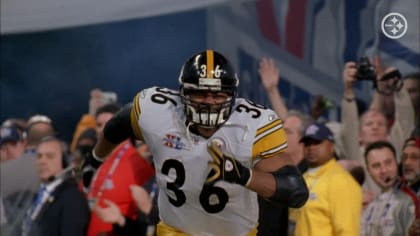
February 5, 2006, 20 years ago: Super Bowl XL is played at Ford Field in Detroit. The Seattle Seahawks were making their 1st appearance, having won the NFC Championship, after having played in the AFC from 1977 (after their 1st season, 1976, in the NFC) to 2001. They were coached by Mike Holmgren, who had coached the Green Bay Packers to victory in Super Bowl XXXI.

The Pittsburgh Steelers were making their 6th appearance. They had won their 1st 4, but had won their last in 1980, and thus sought "One for the Thumb In '81," but couldn't get it. They lost their most recent appearance, in 1996.

Head coach Bill Cowher had Ben Roethlisberger at quarterback. "Big Ben" had faced controversy over his treatment of women. Among his blockers was future Hall of Fame guard Alan Faneca. And a new edition of the "Steel Curtain" defense included linebackers James Farrior and Joey Porter, and future Hall of Fame safety Troy Polamalu.

But the leading figure on the team was running back Jerome Bettis. "The Bus" was retiring after 13,662 rushing yards, 200 receptions for 1,449 yards, and 94 total touchdowns. And he was playing his last game in his hometown of Detroit.

The Seahawks scored first, on a field goal by Josh Brown. They thought they had a touchdown on a 16-yard pass from Matt Hasselback to Darrell Jackson. But the officials called a penalty on Jackson for offensive pass interference, nullifying the score. The Seahawks and their fans were furious with this call, but replays showed it was correct.

The only score in the 2nd quarter was a 1-yard run by Roehtlisberger, and it was 7-3 Steelers at the half. Early in the 2nd half, Willie Parker broke off a 75-yard touchdown run to put the Steelers up 14-3. Hasselback threw a 16-yard touchdown pass to Jerramy Stevens, and the 3rd quarter ended with Seattle down just 14-10.

In the 4th quarter, Seattle right tackle Sean Locklear was called for holding Steelers linebacker Clark Haggans, nullifying a deep pass that would have put the Hawks in position to take the lead. Seattle and their fans were furious with this call as well, but, again, the replay proved the call to be correct. Also disputed was a penalty called on Hasselbeck for an illegal block below the waist, while making a tackle during Ike Taylor's interception return.

With 8:56 left in the game, the Steelers tried some trickery: A reverse got the ball to receiver Antwaan Randle El, who had been a quarterback at Indiana University. He threw an option pass to Hines Ward, who took it 43 yards for a touchdown. It was the 1st touchdown pass by a receiver in a Super Bowl, and it made the score 21-10 Pittsburgh. That score held, as good clock management on offense and strong defense got the Steelers their "One for the Thumb."

The retiring Bettis rushed 14 times for 43 yards. He did not score a touchdown, but he converted a key first down, and allowed his team to run time off the clock late in the 4th quarter.

The Seahawks had more 1st downs, 20-14; more net yards, 396-339; fewer turnovers, 2-1; and more time of possession, 33:02-26:58. It was argued that the difference was penalties: The Hawks were penalized 7 times for 70 yards; the Steelers, 3 times for 20 yards.

But there were also 2 questionable calls that hurt the Steelers, and these were equally justified by instant replay. It wasn't the officials that cost the Seahawks the game: It was the Steelers getting the job done that did that.

The Steelers won a 6th Super Bowl 3 years later. The Seahawks finally won their 1st Super Bowl in 2014. 

Saturday, January 31, 2026

January 31, 1936: "The Green Hornet" Debuts

Gordon Jones in the 1940 serial

January 31, 1936, 90 years ago: The Green Hornet debuts on Detroit radio station WXYZ, 1270 on the AM dial, created by station owner George W. Trendle and writer Fran Striker.

The Green Hornet was Britt Reid, the wealthy publisher of a newspaper, The Daily Sentinel, who saw a crime wave in his city, and decided that what was needed was "a modern-day Robin Hood," so he took on the masked persona and pretended to be a competing gangster, muscling in on bad guys' territory, and setting them up to be captured by the cops.

He was assisted by Kato, an Asian mechanical genius, who designed and built the character's knockout-gas gun, and turned Britt's car into the souped-up "Black Beauty." Originally, Kato was said to be Japanese. But by the time of the 1st film serial in 1940, the Japanese were committing war crimes against China, so the character was rewritten as Korean. Although a capable fighter, his only use of martial arts, in either of the film serials, was the occasional judo chop.

On radio, the Hornet was played by Al Hodge from 1936 to 1945. He would later star as the early science fiction TV hero Captain Video. Bob Hall took over the role in 1945, and Jack McCarthy was the last in the role, from 1947 to 1952. Kato was played by Raymond Toyo, and later by Rollon Parker. For the entire run, it was directed by James Jewell, and his sister, Leonore Jewell Allman, played Lenore Case, Britt's secretary, who occasionally had to be rescued by the Green Hornet, and finally discovered his secret identity in 1948.

In 1947, Britt revealed his identity to the Daily Sentinel's actual owner, his father, Dan Reid Jr. The father had his own revelation, that Britt was not the first fighter for justice in the family: Dan is the son of Dan Reid, a Texas Ranger who was martyred, and whose brother fought criminals in the Wild West as the Lone Ranger. The Reid family fortune came from the silver mine that also supplied the Ranger's bullets.

The radio show could legally do this, because Trendle and Striker had created the Lone Ranger 3 years earlier, and his show was still running, with WXYZ as its flagship station. Every subsequent version of the Hornet has added a generation, but he's still descended from the Lone Ranger's martyred brother.

Two film serials were produced: The Green Hornet in 1940, with Gordon Jones in the title role; and The Green Hornet Strikes Again! in 1941, with Warren Hull starring. Both were directed by Ford Beebe. In both versions, Kato was played by Keye Luke, who had already become famous playing Lee Chan, the "number one son" in the Charlie Chan films.

Anne Nagel played Lenore Case, who supported the Hornet; and Wade Boteler played Mike Axford, the paper's leading reporter, who opposed the Hornet, seeing only the criminal side of him, not the "Robin Hood" side. Neither discovered his true identity over the length of the serials.

In 1966, William Dozier, creator and producer of the Batman TV series, wanted to try another superhero show. For his version of The Green Hornet, he cast former Surfside Six star Van Williams as Reid, who was made a rich man of his time: A swinging playboy who, in addition to his newspaper, also ran a TV station, known as Daily Sentinel TV. It used the initials DSTV, so that it couldn't be pinned down to a single city, and thus not have to start with a W (indicating that it was in the Eastern U.S.) or a K (the West). Nor was a channel number ever mentioned.

Hong Kong-based actor and martial arts expert Bruce Lee was cast as Kato -- allegedly, because he was the only Asian-American actor that Dozier could find who could properly pronounce the name "Britt Reid." The character was every bit the genius as before, adding to the hero's arsenal a "Hornet Sting": A device that looked like a walking stick, and used sound waves as a weapon.
Van Williams (left) and Bruce Lee.
Kato never got a "superhero name."

To match Lee, his ethnicity was changed to Chinese, and one episode, "The Praying Mantis," included the Hornet and Kato taking on the unnamed city's Chinese gangs, or "tongs," as a friend of Kato's was the son of a tong leader who was trying to take his group legitimate, and their rivals didn't want them to "go straight."

Aside from Kato, 2 characters knew Britt's secret identity from the beginning. Wende Wagner played Lenore Case, or "Casey." And while Batman had the city's police commissioner as his establishment ally (but not knowing his secret identity), Dozier didn't want the Hornet's ally to have the exact same job, so Walter Brooke was cast as the District Attorney, Frank Scanlon, who did know.

Lloyd Gough played Mike Axford, the Daily Sentinel’s crime reporter, said to be an old friend of Britt's father, the Sentinel's previous publisher. Gough played down Axford's previously-established stereotypical Irish accent and well-meaning bumbling, but kept the character's clueless hatred of the Hornet, and the pride of an aging crimebuster who occasionally got in over his head while pursuing a story, and had to be reluctantly (on his part) rescued by the Hornet.

A key difference this time is that Britt's father, seen only in a portrait in his office, is dead. The episode "The Frog Is a Deadly Weapon" mentions that he had been framed for murder, though it is left ambiguous as to whether he was convicted and died in prison, or acquitted and then the stress of the experience killed him. What is clear is that he was set up by a gangster that the elder Reid was pursuing, Glenn Connors, played by Victor Jory. Finally given the chance to do so, the Hornet defeated him in the episode.

Unlike with Batman, Dozier did not narrate the show, but he did narrate its opening, which sounds like a holdover from the days of radio:

Another challenge for the Green Hornet, his aide Kato, and their rolling arsenal, the Black Beauty. On police records a wanted criminal, the Green Hornet is really Britt Reid, owner-publisher of the Daily Sentinel. His dual identity is known only to his secretary, and to the District Attorney. And now, to protect the rights and lives of decent citizens, rides The Green Hornet!

Just as The Lone Ranger kept Giacomo Rossini's William Tell Overture as its theme song when making the transition from radio to TV, The Green Hornet had a familiar classical piece as a theme: Flight of the Bumblebee, composed in 1900 by Nikolai Rimsky-Korsakov, played by the great jazz trumpeter Al Hirt, while Lionel Newman conducted the orchestra in an arrangement by Billy May, who was responsible for the arrangements in some of Frank Sinatra's best work.

Van Williams said he wouldn't have done the series if it was going to be as campy as Batman. At first, it wasn't. But the ratings were never good. A crossover with Batman, "A Piece of the Action" and "Batman's Satisfaction," aired, establishing that Bruce Wayne and Britt Reid were rivals.

A fight between Batman and the Green Hornet, and between Robin and Kato, ended in a draw as the police came in. Lee insisted: He was willing to lose a fight to Batman, since it was his show; but his pride was such that he refused to lose a fight to Robin, a character then seen widely as a joke. (This was long before, in the comics, Dick Grayson, the original Robin, became Nightwing and the leader of the Teen Titans, and became regarded as a character who, while keeping his sense of humor and sunny attitude, could be taken much more seriously.)

The crossover didn't help the ratings, and the show was canceled after 1 season. Lee wrote Dozier a letter thanking him for "my start in show business."

The Green Hornet appeared in a few comic books, including one showing the nephew of the '66 Britt Reid and the niece of the '66 Kato fighting crime together, with Diana Reid, daughter of Britt and Casey (and thus the 1st cousin of this younger Britt), filling in for the deceased Scanlon as D.A.

In 2010, Seth Rogen made a Green Hornet film, playing the starring role as a ridiculous playboy who, unlike previous editions of the character, was a wasted disappointment to his father, but nevertheless enlists the help of Kato, played by Jay Chou, to avenge him after his murder by a Russian gangster, played by Christoph Waltz with his usual bad-guy scenery-chewing. Cameron Diaz played Lenore Case. Michel Gondry directed. The film flopped: It infuriated the character's existing fans (myself included), and didn't add many new ones. 

Also in 2010, filmmaker Kevin Smith, long with an interest in superheroes and comic books, began writing a series for the Green Hornet, which still runs, set in the present day, with a female Kato. In July 2020, he announced plans to develop a Green Hornet animated TV series, based on his series. 

In 2022, it was announced that Leigh Whannell, the Australian filmmaker who co-created the Saw franchise, would direct a reboot film. In 2023, it was reported that Chris Pine would play the Hornet. As of January 31, 2026, the 90th anniversary of the premiere of the radio series, both the film reboot and the animated TV series remain in limbo.

In 1978, WXYZ, the station where the Green Hornet and the Lone Ranger debuted, switched from music to talk. In 1984, the call letters were changed from the alphabetical closure WXYZ to WXYT, the "T" standing for "Talk." In 2000, it switched to sports/talk, and was rebranded as "The Bet Detroit" in 2021.

Wade Boteler died in 1943, Fran Striker in 1962, Gordon Jones in 1963, Anne Nagel in 1966, Rollon Parker in 1968, George Trendle in 1972, Bruce Lee in 1973, Warren Hull in 1974, James Jewell in 1975, Ford Beebe in 1978, Al Hodge in 1979, Lloyd Gough in 1984, Walter Brooke in 1986, Bob Hall and Leonore Allman in 1989, Keye Luke and William Dozier in 1991, Jack McCarthy in 1996, Wende Wagner in 1997, Al Hirt in 1999, Raymond Toyo in 2000, and Van Williams in 2016.

Monday, December 1, 2025

December 1, 1955: Rosa Parks Holds Her Seat

December 1, 1955, 70 years ago: Rosa Parks is told to get up and move. She says, "No." In so, doing, she made history.

As historian Laurel Thatcher Ulrich said, "Well-behaved women rarely make history."

Let the record show that Rosa Parks was not the first woman to make this kind of history. In 1943, 17-year-old Bernice Delatte was arrested for defying segregation rules on a bus in New Orleans. In 1944, a U.S. Army Lieutenant was told to go to the back of a bus, to make room for a lower-ranking soldier. He refused. He got court-martialed. He was acquitted. His name was Jack Roosevelt Robinson. Yes, that Jackie Robinson. And in 1953, a 6-day boycott got the buses in Baton Rouge, Louisiana desegregated.

On March 2, 1955, Claudette Austin was arrested in Montgomery, the capital of Alabama, for refusing to give up her seat to a white woman on a crowded, segregated bus. The National Association for the Advancement of Colored People had been waiting for a chance to challenge a "send the blacks to the back of the bus" law, in line with the decision the year before, by the U.S. Supreme Court, in Brown v. Board of Education of Topeka, Kansas, that accommodations that were officially "separate but equal" was unconstitutional.

But Claudette was 15 years old, unmarried, and pregnant. Parks later said, "If the white press got ahold of that information, they would have a field day. They'd call her a bad girl, and her case wouldn't have a chance." The NAACP would need a more sympathetic defendant. Nine months later -- perhaps an appropriate time period -- they found one: Parks herself.

Rosa Louise McCauley was born on February 4, 1913 in Tuskegee, Alabama, and grew up in Pine Level, outside Montgomery. She was bullied by white children, and never forgot it. In 1932, she married Raymond Parks, a barber who worked with the NAACP. She joined the Montgomery chapter in 1943, and was elected its secretary. During World War II, she rode on an integrated trolley at Maxwell Air Force Base in Montgomery. She later said, "You might just say Maxwell opened my eyes up."

On November 27, 1955, Rosa Parks was attending Dexter Avenue Baptist Church in Montgomery, whose pastor was 26-year-old Dr. Martin Luther King Jr. He had invited T.R.M. Howard, head of the Regional Council of Negro Leadership in Mississippi, to speak of the recent murder of Emmett Till, and the acquittal of the 2 men who did it.

It was still on her mind 4 days later, on December 1. At around 6:00 PM, she boarded a Montgomery City Lines bus downtown. Eventually, all of the White-only seats in the bus filled up. The bus reached the third stop, in front of the Empire Theater, and several White passengers boarded. The driver, James F. Blake, noted that two or three White passengers were standing, as the front of the bus had filled to capacity.

Blake moved the "colored" section sign behind Parks, and demanded that four Black people give up their seats in the middle section, so that the White passengers could sit. Three of them complied. Parks said, "I thought of Emmett Till, a 14-year-old African American who was lynched in Mississippi in 1955, after being accused of offending a White woman in her family's grocery store, whose killers were tried and acquitted – and I just couldn't go back." In her autobiography, she said:
People always say that I didn't give up my seat because I was tired, but that isn't true. I was not tired physically, or no more tired than I usually was at the end of a working day. I was not old, although some people have an image of me as being old then. I was forty-two. No, the only tired I was, was tired of giving in.
When Parks refused to give up her seat, Blake took to his radio, and called the police. When she was arrested, she asked the officer, "Why do you push us around?" She remembered him saying, "I don't know, but the law's the law, and you're under arrest."

She was charged with a violation of Chapter 6, Section 11, segregation law of the Montgomery City code. Edgar Nixon, president of the Montgomery chapter of the NAACP and leader of the Pullman Porters Union, and her friend Clifford Durr bailed Parks out of jail that evening.

On Sunday, December 4, plans for the Montgomery bus boycott were announced at Black churches in the area, and a front-page article in the Montgomery Advertiser helped spread the word. At a church rally that night, those attending agreed unanimously to continue the boycott until they were treated with the level of courtesy they expected, until Black drivers were hired, and until seating in the middle of the bus was handled on a first-come-first-served basis.

The next day, Parks was tried on charges of disorderly conduct and violating a local ordinance. The trial lasted 30 minutes. After being found guilty and fined $10, plus $4 in court costs -- the total of $14 worth about $170 in 2025 money -- she appealed her conviction, and formally challenged the legality of racial segregation.

It rained that day, but the Black community persevered in their boycott. Some rode in carpools, while others traveled in Black-operated cabs that charged the same fare as the bus, 10 cents. Most of the remainder of the 40,000 Black commuters walked, some as far as 20 miles.

The boycott lasted for an entire year. On December 20, 1956, the federal ruling Browder v. Gayle took effect, declaring the Alabama and Montgomery laws that segregated buses were unconstitutional. All the seats on all the buses were now open to all.

In 1957, Rosa and Raymond Parks moved to Detroit, living with her brother and sister-in-law. She became a fair housing activist, helped John Conyers get elected to Congress in 1964, and served as his secretary until 1988. She participated in the Selma-to-Montgomery march in 1965. Her husband and brother died within weeks of each other in 1977, and she stepped back from civil rights activities thereafter to care for her mother, who died in 1979.

She then returned to the struggle, adding Planned Parenthood to her causes. In 1994, she was robbed and assaulted in her Detroit home. Mike Ilitch, founder of Detroit-based pizza chain Little Caesars, and owner of baseball's Detroit Tigers and hockey's Detroit Red Wings, bought her an apartment in a high-rise riverfront condo.

The following year, in commemoration of the 40th Anniversary of her seated stand, President Bill Clinton invited her to the State of the Union Address. He said, "She's sitting down with the First Lady tonight, and she may get up, or not, as she chooses." Acknowledging a standing ovation, she briefly stood.
She died on October 24, 2005, at the age of 92, after years of ill health and cognitive decline. Although often called "the mother of the Civil Rights Movement," she had no children of her own. She became the 1st woman, the 2nd black person, and the 1st private citizen to lie in state under the Rotunda of the U.S. Capitol Building in Washington.
A statue of her stands in Montgomery, roughly where she was arrested. In her adopted hometown of Detroit, the bus terminal is named for her. The bus on which she was arrested was also moved to Detroit, to the Henry Ford Museum in adjoining Dearborn, where it is on display along with the limousine in which President John F. Kennedy was assassinated, and the Ford's Theatre chair in which President Abraham Lincoln was sitting when he was assassinated.
As has been said, Rosa Parks sat, so that Martin Luther King could march, so that Barack Obama could run.
Bernice Delatte, the 1943 New Orleans protestor, lived until 2010. Claudette Austin became a nurse, married, and took the name Claudette Colvin. As of December 1, 2025, she is still alive.

Monday, November 10, 2025

November 10, 1975: The Wreck of the Edmund Fitzgerald

November 10, 1975, 50 years ago: The SS Edmund Fitzgerald sinks in a storm in Lake Superior, between the American State of Wisconsin and the Canadian Province of Ontario, with 29 men aboard. There were no survivors.

A year later, Canadian singer Gordon Lightfoot would have a hit song about the ship, reaching Number 2 on the U.S. music charts.

Lightfoot described the way the wind whipped up the Great Lakes as "the Witch of November come stealing." And there was recent precedent: On November 29, 1966, 9 years to the month earlier, the freighter SS Daniel J. Morrell, named for a Pennsylvania Congressman, sank in Lake Huron, taking with it 28 of its 29 crewmen. The sole survivor was named Dennis Hale.

The SS Edmund Fitzgerald, known as "the Eddie Fitz" or "the Big Fitz" was launched in 1958. As Lightfoot said, "As the big freighters go, it was bigger than most." In fact, at the time of its launch, it was the largest ship of any kind sailing the Great Lakes: From west to east, Lake Superior, Lake Huron, Lake Michigan, Lake Erie and Lake Ontario.

(Mark Russell, a native of Buffalo, New York, between Erie and Ontario, and a comedian whose specialty was politics, once commented on a bill before Congress to declare Lake Champlain, between New York, Vermont and Quebec, "the 6th Great Lake": "It is not a Great Lake. It's a pretty good lake, but it's not a great lake." He had a point: It is considerably smaller, with considerably less commercial traffic.)

The ship was owned by the Northwestern Mutual Life Insurance Company, and named for its president. Its home port was Milwaukee. There, on June 8, 1958, it was launched. It took Edmund’s wife Elizabeth 3 tries to break the champagne bottle at its christening. A delay of 36 minutes followed, while the shipyard crew struggled to release the keel blocks. Upon sideways launch, the ship created a large wave that "doused" the spectators and then crashed into a pier before righting herself. One man watching the launching had a heart attack and later died. Maybe all of this was a bad sign.

The ship regularly went to Duluth, Minnesota, where it would pick up deliveries of taconite iron ore from nearby mines in Minnesota's "Iron Range," and taking them to Great Lakes port cities, including Detroit, Toledo and Cleveland. She set seasonal haul records six different times.

On November 9, 1975, at 2:15 PM Central Standard Time, commanded by Captain Ernest McSorley -- as Lightfoot sang, "with a crew and good captain, well-seasoned" -- it left Superior, Wisconsin on its last voyage of the calendar year, due to arrive at Zug Island, off the coast of Detroit. (Lightfoot, either mistakenly or on purpose because it made for a better rhyme, said, "they left fully loaded for Cleveland.")

It would have to be the last voyage of the year, because it was getting colder, and a storm on any of the Great Lakes could be as bad as one on an ocean. As Lightfoot sang, such storms were known among the freighters' crews as "the Gales of November" and "the Witch of November."

The Edmund Fitzgerald traveled Lake Superior at a top speed of 16 miles per hour. At 1:00 AM on November 10, the ship's radio reported winds of 52 knots (60 miles per hour), and waves 10 feet high. At 2:00 AM, they received a report from the National Weather Service, upgrading their official warning from gale to storm. The ship kept going through the night, and the next morning. At 2:45 in the afternoon, it began to snow.

Another freighter crossing Lake Superior, the Arthur M. Anderson, had been in contact with them much of the way, and were even within visual contact until the storm and the fog got to be too much. At 3:30 PM, McSorley radioed the Anderson, reporting to Captain Bernie Cooper that the Fitzgerald was taking on water and listing. He chose to slow his ship down, so that the Anderson could catch up, in case a rescue was necessary.

Shortly afterward, the U.S. Coast Guard warned all shipping that the Soo Locks, between the city of Sault Ste. Marie in Ontario and the city of the same name on Michigan's Upper Peninsula, were closed, and safe anchorage should be sought.

At 4:10, McSorley called the Anderson again: The Fitzgerald's radar had failed, so they were effectively blind. The Anderson would have to get close, and use their radar to act as the Fitzgerald's "eyes." Cooper told McSorley head for Whitefish Bay, Ontario. McSorley learned that the lighthouse at Whitefish Point was on, but not its radio beacon.

At 6:00, both ships were reporting winds of 58 knots (67 MPH), with gusts up to 75 knots (86 MPH -- hurricane force, by definition, is 75 MPH). Waves were regularly as high as 25 feet, and some as high as 35 feet.

At 7:10, the Anderson received a message from McSorley, saying, "We are holding our own." It seemed to be a message of confidence, unlike in the song. But it would be the Fitzgerald's last received message. There was never a distress signal. The Anderson lost both radio and radar contact. At 7:39, after nearly half an hour of trying to reach McSorley, Cooper called the Coast Guard station at Sault Ste. Marie, Michigan on Channel 16, the distress channel -- not for his ship, but for the Fitzgerald.

There weren't sufficient search-and-rescue vessels to look for the Fitzgerald. At 9:00, the Coast Guard advised Cooper to turn around and look for survivors. At 10:30, the Coast Guard asked all commercial vessels in or near Whitefish Bay to assist. Although no other vessels were lost in the rescue attempt, it would take until November 14 to find the Fitzgerald, its hull broken in two and sitting on the bottom of the lake.

The Mariners' Church in Detroit -- in the song, Lightfoot called it "the Maritime Sailors' Cathedral" -- held a memorial service, ringing its bell 29 times, once for each life lost. From 1976 to 2005, it held a memorial every November 10. Starting in 2006, it broadened the annual ceremony, to commemorate all lives lost on the Great Lakes.
Lightfoot had also called the Church "a musty old hall." Due to complaints, he changed the lyric to "a rustic old hall" in his live performances. The native of Orillia, Ontario, a few miles inland from Lake Huron, died on May 1, 2023, at the age of 84.
The 29 men: Ernest McSorley, Captain, at the age of 63 the oldest man on board; John McCarthy, first mate, 62; James Pratt, second mate, 44; Michael Armagost, third mate, 37; George Holl, chief engineer, 60; Edward Bindon, 1st assistant engineer, 47; Thomas Edwards, assistant engineer, 50; Oliver Champeau, assistant engineer, 41; Russell Haskell, assistant engineer, 40; Ralph Walter, oiler, 58; Blaine Wilhelm, oiler, 52; Thomas Bentsen, oiler, 23; John Simmons, senior wheelman, 62; John Poviach, wheelman, 59; Eugene O'Brien, wheelman, 50; William Spengler, watchman, 59; Ransom Cundy, watchman, 53; Karl Peckol, watchman, at 20 the youngest man on board; Paul Riippa, deckhand, 22; Bruce Hudson, deckhand, 22; Mark Thomas, deckhand, 21; Gordon MacLellan, wiper, 30; Joseph Mazes, special maintenance man, 59; Thomas Borgeson, maintenance man, 41; Robert Rafferty, steward, 62; Allen Kalmon, second steward, 43; Frederick Beetcher, porter, 56; Nolan Church, porter, 55; and David Weiss, cadet, 22.

As Lightfoot sang, "And all that remains are the faces and the names of the wives and the sons and the daughters."

Lightfoot died on May 1, 2023.

Wednesday, July 30, 2025

July 30, 1975: The Disappearance of Jimmy Hoffa

July 30, 1975, 50 years ago: Jimmy Hoffa goes to a meeting. Nobody knows the result of this meeting, because nobody ever saw Hoffa again. Anybody who did see him after this meeting hasn't been talking.

James Riddle Hoffa was born on February 14, 1913 in Brazil, Indiana, outside Terre Haute. Controversial Bishop James Pike was born the exact same day, and he would also disappear, although he was found -- dead. New York Yankees broadcaster Mel Allen was born the same day. So was Ohio State football coach Woody Hayes.

Hoffa was 7 when his father died, and at 11, his mother moved him to Detroit, where he lived for the rest of his life. He dropped out of school to go to work at age 14. Because of the abuses he sustained on his job, he was drawn to union activity. By 1932, he was a member of the International Brotherhood of Teamsters, which then represented truck drivers and chauffeurs, although it now represents a diverse group of blue-collar and professional workers.

Hoffa proved to be an organizing genius: In his rise through the Teamsters, they grew from 75,000 members in 1933 to 420,000 in 1939, actually growing despite the manpower drain of World War II (for which Hoffa's leadership role within the union got him a draft deferment), and topping 1 million in 1951. By 1952, Hoffa was the union's national vice president, and was elected president in 1957.

By this point, the actions of the Teamsters had attracted some inconvenient attention. The U.S. Senate's Select Committee on Improper Activities in Labor or Management Field, chaired by John McClellan of Arkansas (and thus remembered as "the McClellan Committee"), called Hoffa's predecessor, Dave Beck, to Capitol Hill to testify on organized crime's influence on the union. He invoked his right against self-incrimination under the 5th Amendment to the Constitution of the United States 140 times, and was subsequently indicted and convicted of embezzlement. (He served 2 1/2 years in prison, and died in 1993, at age 99.) That allowed Hoffa to rise to the union's presidency sooner than would have been expected.

One of the members of the McClellan Committee was John F. Kennedy of Massachusetts. The legal counsel for the Committee was Kennedy's brother, Robert F. Kennedy. Bobby had discovered several financial irregularities, including the misappropriation of $9.5 million in union funds  -- about $108 million in 2022 money.

The exchange between Robert Kennedy and Hoffa was so intense, it inspired Bobby's 1st book, titled The Enemy Within. I found the book once, and couldn't believe that the man who wrote it was the same man who ran for President in 1968 on a message of peace and brotherhood. This Robert Kennedy was incredibly belligerent, and he didn't seem to have a nice thing to say about anybody. It later inspired a 1983 TV-movie, titled Blood Feud, starring Robert Blake as Hoffa and Cotter Smith as Bobby.

Hoffa was indicted for bribery over this. He was acquitted, but the controversy led the AFL-CIO to expel the Teamsters from its ranks. This didn't stop Hoffa: He managed to bring airline workers and transport workers (bus drivers and subway motormen) under the Teamsters' umbrella.

John F. Kennedy was elected President in 1960, and appointed Bobby as his Attorney General. (A law has since been passed prohibiting nepotism by a President.) Bobby wanted Hoffa imprisoned, very badly, and failed in his 1st attempt, being acquitted of conspiracy in 1962. In May 1963, Bobby got Hoffa indicted for jury tampering. On November 22, 1963, before the case could go to trial, President Kennedy was assassinated. According to the TV-movie, Hoffa hated Bobby so much that, when he was told, "Kennedy's been shot!" he asked, "Which Kennedy?"

Hoffa was convicted on March 6, 1964, and sentenced to 13 years. After 3 years of appealing, he went to prison on March 6, 1967. On December 23, 1971, President Richard Nixon -- perhaps to spite the Kennedys, and the memories of Jack and Bobby -- commuted Hoffa's sentence to time served, and he was free.

But there was a catch: As part of the deal, he was forbidden to "engage in the direct or indirect management of any labor organization." He couldn't stay away, and in 1973, he sued to invalidate the restriction, but lost his case.

He also found that he had lost support in the union, even in his native Detroit, where Anthony Provenzano, a caporegime in New York's Genovese crime family, had become the power behind the throne, along with the brothers Anthony and Vito Giacalone, major figures in the "Detroit Partnership," as the local Mafia were known. By 1975, the back-and-forth between Hoffa and the mobsters was nasty enough that Hoffa's son, James P. Hoffa, said, "I was increasingly afraid that the Mob would do something about it."

They did: They set up an alleged peace meeting between Tony Giacalone and Hoffa, for July 30, at 2:00 PM, at Machus' Red Fox restaurant in suburban Bloomfield Township, Michigan. Between 2:15 and 2:30, Hoffa's wife, Josephine, received a phone call from him, made from a payphone in front of Damman Hardware, behind the Red Fox, telling her that Tony hadn't shown up, and that he'd been stood up. He said he'd be home at 4:00 to grill some steaks for dinner.

Two men later admitted that they saw Hoffa, shook his hand and talked to him, and walked away without harming him. Another witness said he saw Hoffa in the back of a maroon car, either a Lincoln or a Mercury, with 3 other people, around 2:45 or 2:50, but, at the time, with no indication that he was in any kind of trouble. Hoffa was never reported as having been seen again. He was 62 years old.

The FBI investigated, but found through their wiretaps that mobsters were unwilling to talk about Hoffa's disappearance. Theories about it abound, but pretty much all of them end with Hoffa being killed, rather than running off with money (or perhaps another woman) and living to a ripe old age.

One of the theories is that, after being murdered by mobsters, Hoffa was buried in an oil drum underneath the end zone at Giants Stadium, then under construction in the Meadowlands in East Rutherford, New Jersey. When the stadium was demolished, no oil drums were found. So, whatever happened to Hoffa, this wasn't it.

Spoiler alerts for films based on Hoffa. In 1978, Sylvester Stallone starred in F.I.S.T., in which he played Johnny Kovak, head of the Federation of Inter-State Truckers. At the end of the movie, he is shot by the Mob. The aforementioned Blood Feud, with Robert Blake, ends with the notation that Hoffa disappeared, but offers no explanation for it. In the 1992 film Hoffa, he is played by Jack Nicholson, and is shot in his car along with another man.

In the 2019 film The Irishman, the real-life hitman Frank Sheeran, played by Robert De Niro, claims that, as a friend of Hoffa's, he was the only man the Mob trusted to pull the trigger on Hoffa, played by Al Pacino. In this film, Hoffa is told that the meeting was moved to a house where Provenzano was waiting for them. This matches the story that Hoffa was seen in the back seat of a car with no apparent trouble. When he got there, Sheeran shot him, and worked with other men to have Hoffa cremated, which would explain why no trace of his body has ever been found. If this story is true, then Sheeran never paid for his crime, avoiding prison until his death in 2003, age 83.

The building that housed Machus' Red Fox, at 6676 Telegraph Road, a.k.a. U.S. Route 24, 22 miles northwest of downtown Detroit, still stands, and is still a restaurant, an Italian steakhouse named Andiamo.

James P. Hoffa, whose wedding reception -- before his father's disappearance -- was held at the Red Fox, was elected to his father's old job of President of the Teamsters in 1998, and was continually re-elected until leaving office on March 21, 2022, at age 81.

Wednesday, June 18, 2025

Most Popular Sport In Each City

U.S. cities only, no Canadian cities, because they would all be hockey, except for Hamilton and Regina, which have CFL teams but not NHL teams. Cities/metro areas listed in alphabetical order. 

Baseball: Boston/New England, New York/New Jersey/Long Island, St. Louis, San Diego.

Football: Atlanta, Baltimore, Buffalo/Western New York, Charlotte/Carolina, Chicago, Cincinnati, Cleveland, Dallas/Metroplex, Denver, Houston, Indianapolis, Jacksonville/North Florida, Kansas City, Las Vegas, Miami/South Florida, Milwaukee/Green Bay, Minneapolis/Twin Cities, Nashville, New Orleans, Philadelphia, Phoenix, Pittsburgh, San Francisco (Bay Area), Seattle, Tampa (Bay), Washington/DMV.

Basketball: Los Angeles, Oklahoma City, Orlando, Portland, Sacramento, Salt Lake City/Utah, San Antonio.

Hockey: Detroit.

Recent titles won don't always change these things. The Phillies may have won 3 recent Pennants and a World Series, but they'll never be more popular in Philadelphia and environs than the Eagles. No matter what they win, the Dodgers will not be more popular in Los Angeles than the Lakers, even though the Dodgers arrived first. If the Lions finish the job and win the Super Bowl, they might overtake the Red Wings in Detroit; but the Pistons didn't despite nearly winning back-to-back titles in 2004-05.

The Athletics' temporary stay in West Sacramento won't make them more popular in California's capital than the Kings. If the Pacers come from behind and beat the Thunder to win the NBA title, it still won't make them more popular in Indianapolis than the Colts. Basketball as a whole may be more loved in Indiana as a whole, but, in Indianapolis, the Colts have taken over.

Thursday, April 10, 2025

Yanks Salvage Finale of Cold Series In Detroit

After winning the 1st 2 games of a roadtrip in Pittsburgh, the Yankees lost the last game of the series. They went on to Detroit, for 3 games against the Tigers at Comerica Park. All 3 games were played in the afternoon, the 1st of them the Tigers' home opener, and all 3 were cold: 38, 34 and 42 degrees. The  Yankees' bats went cold, too.

Carlos Rodón started on Monday, but he allowed 6 runs in 6 innings. Aaron Judge singled home a run in the top of the 5th inning, and the Yankees got another run on an error in the 8th, but that was it. The Tigers won, 6-2.

Carlos Carrasco started on Tuesday, but allowed 4 runs in 4 1/3rd innings. Tarik Skubal, who won the Triple Crown of Pitching and the American League's Cy Young Award last year, pitched 6 innings, followed by 3 from Brant Hurter, combining on a 6-hit shutout: 3 by Paul Goldschmidt, 2 by Judge, 1 by Ben Rice. The Tigers won, 5-0.

But yesterday, it was Max Fried's turn to pitch superbly. He went 7 innings, allowing 5 hits and no walks, and struck out 11. Luke Weaver pitched a scoreless 8th. The Yankees got 2 runs on a home run by Rice in the 7th, and another 2 on a single by Judge in the 9th. New closer Devin Williams was sent out to protect a 4-0 lead -- and, unlike its predecessor, Tiger Stadium, Comerica Park is a pitcher's park, and it was cold. Circumstances seemed to make for an easy inning.

It wasn't. Williams brought back memories of Clay Holmes, Aroldis Chapman, Boone Logan, Scott Proctor and Kyle Farnsworth. Cliché Alert: Walks can kill you, especially the leadoff variety. Williams allowed a leadoff walk. He struck out the next 2 batters, then allowed a single and a walk. He threw a wild pitch that scored a run, and allowed a single that scored 2 more.

Aaron Boone saw enough: He pulled Williams, and brought in Mark Leiter Jr. He got a pop-up to end it. Yankees 4, Tigers 3.

*

The Yankees are 7-5, half a game behind the Toronto Blue Jays in the AL Eastern Division. The Boston Red Sox and the Tampa Bay Rays are 2 back, and the Baltimore Orioles 3 back.

It's not a bad place to be in, given that 3 starting pitchers are injured, Gerrit Cole for the season, Luis Gil for probably another month, and Clarke Schmidt might be back a little sooner than that; and that Giancarlo Stanton is also still out with an injury; and that there still isn't a closer, because Boone trusts Williams too much and Weaver not enough.

They are off today. Tomorrow night, they begin an Interleague series with the San Francisco Giants. At 10-3, they have the best record in baseball.

Tuesday, October 22, 2024

October 22, 1954: Ford Introduces the Thunderbird

October 22, 1954, 70 years ago: Ford Motor Company introduces the Ford Thunderbird, as part of its 1955 models. Originally a 2-seat sports coupe, a convertible with a removable hardtop with "portholes," a rear seat was added in 1958, making it more of a luxury car.

From 1968 to 1998, Ford's Lincoln-Mercury Division marketed "rebadged" variants, as the Mercury Cougar; and the Lincoln Continental Marks III, IV, V, VI, VII and VIII. Ford stopped making the Thunderbird after the 1997 models, but brought it back in 2002. In 2005, in celebration of the car's 50th Anniversary, Ford brought it back as a special edition, complete with the '55 original's "portholes." This remains the last model year for the Thunderbird.

The "T-bird" was popular enough to become a watchword in popular culture. In 1962, in his song "Oh, Boy!" (to the tune of "Las Chiapanecas"), Thunderbirds and Cadillacs as the kind of cars that made parodist Allan Sherman give an enthusiastic, "Oh, boy!"

The Beach Boys mentioned the car in 2 songs: In "Little Deuce Coupe," they said the title car would "walk a Thunderbird like she's standing still"; and in "Fun, Fun, Fun," that's what the narrator's girlfriend will have, "'til her daddy takes the T-bird away." And a 1966 Thunderbird was the roadtrip/getaway car in the 1991 film Thelma & Louise.

Wednesday, April 3, 2024

Cities Winning the NCAA Men's Basketball Tournament & a Major League Championship In the Same Year

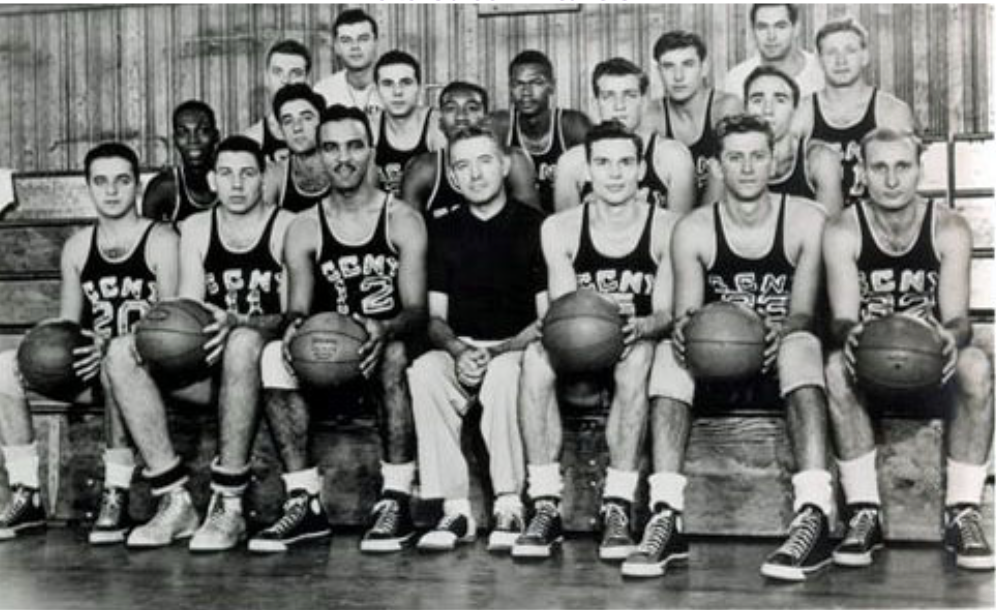
The 1950 CCNY Team, National Champions.

Note: That's calendar year, January 1 to December 31 -- not schoolyear, July 1 to June 30.

1. 1950: City College of New York (CCNY) won the NCAA Tournament, and the New York Yankees won the World Series.

2. 1963: Loyola University of Chicago won the NCAA Tournament, and the Chicago Bears won the NFL Championship.

3. 1965: The University of California at Los Angeles (UCLA) won the NCAA Tournament, and the Los Angeles Dodgers won the World Series.

4. 1972: UCLA won the NCAA Tournament, and the Los Angeles Lakers won the NBA Championship.

5. 1989: Michigan won the NCAA Tournament, and the Detroit Pistons won the NBA Championship. The Crisler Center is 54 miles from the site of The Palace of Auburn Hills. This is close enough for me to count it as the same metropolitan area, but it's certainly not the same city.

6. 2018: The Philadelphia Eagles won the Super Bowl, and Villanova University won the NCAA Tournament. The Finneran Pavilion is 19 miles from Lincoln Financial Field; so, if UM and the Pistons count, then 'Nova and the Eagles count.

So, 6 occurrences: 2 by Los Angeles, and 1 each by New York, Philadelphia, Detroit and Chicago.

New York had a close call in 1952: The Yankees won the World Series, but St. John's University lost the NCAA Final.

In 1961, the University of Cincinnati won the NCAA Tournament, but the Cincinnati Reds lost the World Series.

In 1976, Indiana University won the NCAA Tournament, and the Cincinnati Reds won the World Series. However, despite the Reds being the closest MLB team to IU, the distance of 127 miles from Assembly Hall to Riverfront Stadium, and the crossing of a State Line, means this doesn't count.

In 1980, the Lakers won the NBA Championship, but UCLA lost the NCAA Final.

In 1996, the Yankees won the World Series, but Syracuse University lost the NCAA Final. Besides, the JMA Wireless Dome (then the Carrier Dome) is 252 miles from Yankee Stadium, so it wouldn't have counted, anyway. Nor would 2003, when Syracuse won the NCAA Final, but the Yankees lost the World Series, have counted. That 1996 Final was hosted at the Meadowlands, but that doesn't count, either. If St. John's had done it, or if one of the New Jersey schools -- Rutgers, Princeton, Seton Hall, St. Peter's of Jersey City -- had done it, that would have counted.

In 2001, the Arizona Diamondbacks won the World Series, but the University of Arizona lost the NCAA Final. Besides, the McKale Center in Tucson is 114 miles from Chase Field (then Bank One Ballpark), so I probably wouldn't have counted it, anyway.

In 2004, the University of Connecticut won the NCAA Tournament. The New England Patriots won the Super Bowl, and the Boston Red Sox won the World Series. However, Gampel Pavilion in Storrs, Connecticut is 74 miles from Gillette Stadium in Foxborough, Massachusetts; and 82 miles from Fenway Park in Boston. And, unlike Ann Arbor and Auburn Hills in Michigan, it's not in the same State. So I chose not to count it.

In 2005, the Chicago White Sox won the World Series, but the University of Illinois lost the NCAA Final. Besides, the State Farm Center (then Assembly Hall) in Champaign is 132 miles from Guaranteed Rate Field (then U.S. Cellular Field), so I probably wouldn't have counted it, anyway.

In 2006, the University of Florida won the NCAA Tournament, and the Miami Heat won the NBA Championship. However, Gainesville is 338 miles from Miami, so that can't be counted.

In 2019, the University of Virginia won the NCAA Tournament, and the closest MLB team, the Washington Nationals, won the World Series. However, Charlottesville, Virginia is 119 miles from D.C., and a State Line must be crossed, so I can't count it.

The 2024 Final Four teams are, in alphabetical order: Alabama, Connecticut, North Carolina State and Purdue. The Kansas City Chiefs have won the Super Bowl, but can't be paired up with any of these schools. Alabama, in Tuscaloosa, is too far, even from Atlanta, to match up. Connecticut has already been ruled out.

North Carolina State is in Raleigh, so a Stanley Cup win by the Carolina Hurricanes, which is currently possible, would work; but the NBA's Charlotte Hornets are 162 miles away, so that pairing wouldn't work. And Purdue is in West Lafayette, Indiana: It's 69 miles from the Indianapolis teams, and nearly twice that from the Chicago teams, so it would be a judgment call if any of the applicable teams should be counted.

UPDATE: UConn won, so there won't be a new entry in 2024.

Monday, April 1, 2024

April 1, 1984: The Death of Marvin Gaye

April 1, 1984, 40 years ago: Singer Marvin Gaye is shot and killed -- by his father, of all people -- a day before what would have been his 45th birthday.

Marvin Pentz Gay Jr. was born on April 2, 1939, in Washington, D.C., the son of a Pentecostal minister who beat him and the other children. His love of music developed early, and he formed one doo-wop singing group, then another, before his father kicked him out of the house. He found the U.S. Air Force no better than an abusive father, and faked mental illness, getting a general discharge.

He returned to Washington, and formed The Marquees. Harvey Fuqua, lead singer of The Moonglows, heard them, took them to Chicago, and hired them for Chess Records, renaming them the New Moonglows, singing backup on Chuck Berry's "Back in the U.S.A." and "Almost Grown."

In 1960, Fuqua took Gaye to Detroit, and introduced him to Berry Gordy Jr., who had just founded Motown Records. At the time, "gay" still usually meant "lightly happy" rather than "homosexual," but this was changing. But there were other reasons to change his name: He wanted to distance himself from his father's name, and it was a tribute to someone else who had put an E on the end of his name: Sam Cooke.

While Marvin could sing and play piano, Gordy was impressed with his drumming, and put him on sessions with The Miracles (led by Smokey Robinson) and The Marvelettes. The Miracles' "Shop Around" very nearly became the 1st Motown song to hit Number 1. When The Marvelettes' "Please Mr. Postman" did, in December 1961, Marvin Gaye was the drummer on the recording.

In 1962, Marvin played drums on a song he co-wrote for The Marvelettes, "BEechwood 4-5789," a song that came out just before telephone numbers were converted to all-number. And he had his 1st hit as a singer, "Stubborn Kind of Fellow." In 1963, he broke into the Top 40 with "Hitch Hike," and then the Top 10 with "Pride and Joy" and "Can I Get a Witness."

Starting in late 1962, he was one of the acts on the Motortown Revue, which toured all over the country, and even allowed its performers on ABC-TV's American Bandstand. In 2002, the NBC 1960s tribute series American Dreams recreated one of these Bandstand performances, with Usher playing Marvin singing "Can I Get a Witness."

By this point, Marvin was married to Anna Gordy, Berry's sister, and his love songs like "Pride and Joy" had been written about her. But things were already complicated. According to official Motown releases, they had a son, named Marvin Pentz Gaye III (with the E on the end). But that was a half-truth: Marvin Jr. was the father, but the mother was Denise Gordy, Berry's and Anna's 16-year-old niece, and Marvin and Anna subsequently adopted the baby.

This wasn't a traditional infidelity: Anna couldn't have children, and everybody agreed to it beforehand. But Anna was still only 16. Had it been revealed at the time, it would have destroyed Marvin, much like the revelation of marriage to his 13-year-old cousin while still married to someone else derailed the career of Jerry Lee Lewis.

By 1965, Motown was more than keeping up with rock and roll's "British Invasion," and Marvin's contributions that year included "I'll Be Doggone" and "Ain't That Peculiar." And he recorded a series of hit duets with Supremes lead singer Diana Ross, Kim Weston, and especially Tammi Terrell. Tammi was married, but the musical chemistry between them was such that rumors of an affair between them persist to this day. No evidence of them being anything more than close friends has ever been discovered.

In 1968, the Detroit Tigers won the American League Pennant. Their broadcaster, Ernie Harwell, was asked to select the National Anthem singers for the World Series games in Detroit. For Game 3, he selected Margaret Whiting, a white Detroit native known for singing standards. For Game 4, he selected Marvin, who sang it straight, and got a nice hand. For Game 5, he selected José Feliciano, a blind Puerto Rican known as a great virtuoso on Spanish-style classical guitar.

So Harwell, a 50-year-old white man from the South, and a Marine who served in World War II, and an ordained minister and a published songwriter, selected 3 performers: 1 white, 1 black, 1 Hispanic. Feliciano sang the Anthem with a totally different arrangement, and the NBC switchboard was flooded with nasty calls, almost destroying Feliciano's career. Marvin's performance was forgotten.

But the world was changing, and Marvin thought his music should change with it. But Berry Gordy was a control freak, and he thought having black singers address social ills would hurt Motown's profile. He began to relent in 1968, letting The Supremes sing "Love Child" (which hit Number 1) and "Living In Shame."

But Marvin wasn't allowed to sing about social ills. At the end of the turbulent year of 1968, he had the Number 1 song in the country, and it was a spectacular recording, but it was "I Heard It Through the Grapevine," a traditional love song. In 1969, he had a hit with "Too Busy Thinking About My Baby." This was a decent song, and, with its line of, "I ain't got time to do no studying once I get out of class," it would have been a fine start for an 18-year-old rookie singer at Motown. Marvin Gaye was 30 years old.

The year 1970 would prove to be a turning point. Tammi Terrell died from a brain tumor, and Marvin couldn't handle it. And his brother Frankie Gaye -- he, too, became a singer and added the E -- returned from serving in Vietnam, and told Marvin of the awful things he had experienced there. Marvin knew that Berry had complete creative control. But he also knew that something had to be done.

Even more important, he now had an ally: Stevie Wonder, now 20, was also ready to move on to topical material. Together, Marvin and Stevie went on strike, and Berry relented. He let Stevie record "Higher Ground," and that was the start of a bunch of great songs about issues. And he let Marvin record "What's Going On," which became the title track to a landmark album that also included "Inner City Blues" and the environmental song "Mercy Mercy Me."

The title track included Lem Barney and Mel Farr of the NFL's Detroit Lions singing backup. Marvin had been so disillusioned by his career, and perhaps inspired by Paper Lion, the film based on writer George Plimpton's book about trying out for the Lions, that he asked them for a tryout. They turned him down, fearing that injuries could hurt his music career. But when "What's Going On" the single hit Number 2 and sold over 1 million copies, everyone who played or sang on it, including Barney and Farr, received gold records.

Berry Gordy saw that he was wrong, and Marvin and Stevie were right. He began to move Motown from Detroit to Los Angeles, which had become the center of the recording industry on planet Earth. But Marvin and Anna split up, and he began seeing Janis Hunter, who became the mother of his daughter Nona, who became a singer and actress, and his son Frankie, named for his brother.

Berry wasn't the only one who saw the light: What's Going On sold over 2 million copies within a year of its release. It is often rated as one of the Top 10 rock and roll albums of all time.  Even my father, a fan of classical, folk and country music, admitted (years after Marvin's shocking death) that this album made him a fan of Marvin's.

Having gotten that out of his system, on August 28, 1973, Marvin released Let's Get It On, another concept album, one about... getting it out of your system. The title track became his 2nd Number 1 hit. He had a 3rd in 1977, "Got to Give It Up." This song inspired many other performers, from Michael Jackson, whose 1st solo Number 1, "Don't Stop 'Til You Get Enough," was very close in lyrics and style; to Robin Thicke, Pharrell Williams and T.I., whose 2013 chart-topper "Blurred Lines" was so close to it that, 2 years later, a court awarded $7.4 million in royalties/damages to Marvin's children.

In spite of this success, Marvin had become, to borrow the title of David Ritz's posthumous biography of him, a divided soul. His divorce from Anna had cost him a lot of money, and so had his increasing cocaine habit. He moved to Europe, where he was already popular, and lived and toured there.

In 1982, having kicked drugs for the moment, a deal was made to release Marvin from his Motown contract. He signed with CBS Records, and recorded the album Midnight Love, including the single "Sexual Healing." It was a smash, and he was back in the spotlight, winning his 1st 2 Grammy Awards, and being invited to sing the National Anthem before the NBA All-Star Game at The Forum outside Los Angeles. He made it sound like a gospel song. It had been 15 years since he sang it straight at the World Series, and Jose Feliciano hadn't. Times had changed, and everyone loved Marvin's new version.

But the comeback was all too brief, as he fell back on cocaine, and suffered bouts of paranoia. He had bought his parents a house in the Hancock Park area of Los Angeles. But his father had never really changed, and was always arguing with everyone else in the family, including Marvin and his mother Alberta.

On April 1, 1984, at that house, an argument between Marvin Gay Sr. and Marvin Gaye Jr. turned into a shoving match, and Marvin Jr. got the upper hand, beating his father severely.

It was understood among Marvin Jr. and his siblings that if any of them ever tried to get revenge on their father for the abuse they'd suffered, the father would take it to the next level and kill them. After Alberta separated the Marvins, Marvin Sr. did just that: He went to get a gun, a .38 pistol that Marvin Jr. had bought him to protect the house from intruders, walked back into Marvin Jr.'s room, and, at 12:38 PM Pacific Time (3:38 in New York, their native Washington, and Detroit), calmly shot him in the chest.

Brother Frankie lived in a smaller house on the property, and he found Marvin, and heard his last words: "I got what I wanted. I couldn't do it myself, so I had him do it. It's good. I ran my race. There's no more left in me." At 1:01 PM, he was pronounced dead.

Since it happened on April 1, many people's reaction was that it couldn't be real, that it had to be the sickest April Fool's joke of all time. It wasn't.

Marvin Gay Sr. was examined, and found to have a brain tumor. It was small and benign, and removed. Given this, and the amount of drugs that Marvin Gaye Jr. had in his system at the time of the shooting, a deal was reached: Marvin Sr. pleaded no contest to voluntary manslaughter. He was given a 6-year suspended sentence and 5 years' probation.

Later in 1984, The Commodores paid tribute to Marvin, and to Jackie Wilson, who had worked with Berry Gordy Jr. before Motown was founded, with the song "Nightshift." And Diana Ross recorded "Missing You." Both hit the Top 10.

Alberta died in 1987, Marvin Sr. in 1998, Frankie in 2001, Anna Gordy Gaye in 2014, and Janis Hunter in 2022. Berry Gordy Jr., Denise Gordy and Janis Hunter are still alive. Marvin Jr. has 2 grandchildren through Marvin III, including Marvin IV, and 3 through Nona. The younger Frankie Gaye is not known to have any children.