This coming Sunday, the New York Jets travel to FirstEnergy Stadium to play the Cleveland Browns.
Cleveland is in the Eastern Time Zone, so you won't have to change your timepieces.
Tickets. In 2019, the last pre-COVID season, the Browns averaged 67,431 fans per home game, a sellout. Tickets may be hard to get.
Browns tickets used to be among the cheapest in the NFL. Not this season: Seats in the lower level, the 100 sections, are $389 along the sidelines, and $165 in the end zones. Seats in the middle level, the 300 sections, are $395 and $136. Seats in the upper level, the 500 sections, are $107, with no end-zone seats.
Do not order tickets in the 1st 2 levels of the east end zone. That's the Dawg Pound. You will be surrounded by, dare I say it, rabid Browns fans.
Getting There. Cleveland is 500 land miles from New York. Well, not quite: Specifically, it is 465 miles from Times Square to Public Square; and 459 miles from MetLife Stadium to FirstEnergy Stadium. Knowing this, your first reaction is going to be to fly out there.
This may be a good idea if you can afford it: Like New York, Boston and Chicago, but unlike most of the American League cities, Cleveland has good rapid transit from the airport to downtown. In fact, with the extension of the RTA Rapid Transit's Red Line in 1968, Cleveland became the 1st city in the Western Hemisphere to have rapid transit direct from downtown to its major airport.
But it's going to be expensive: A a nonstop flight would be a round-trip fare of a little under $1,100. You could get a flight for under $900, but you'd need to change planes at Dulles outside Washington. The heck with that!
Cleveland Hopkins International Airport, named for William R. Hopkins, a City Manager in the 1920s and an early pilot, is about 12 miles southwest of downtown, and the Red Line takes 24 minutes, 9 stops, to get from Hopkins to Tower City.
Train? Bad idea. Not because of the price, just $219 round-trip -- cheaper than Greyhound, for once -- but because of the schedule. Amtrak's
Lake Shore Limited (formerly known as the
Twentieth Century Limited when the old New York Central Railroad ran it from Grand Central Terminal to Chicago's LaSalle Street Station) leaves New York's Penn Station at 3:40 every afternoon, and arrives at Cleveland's Lakefront Station at 3:53 in the morning. In reverse, the train leaves Lakefront Station at 5:50 AM and arrives back at Penn Station at 6:42 PM. Time-wise, this is incredibly inconvenient.
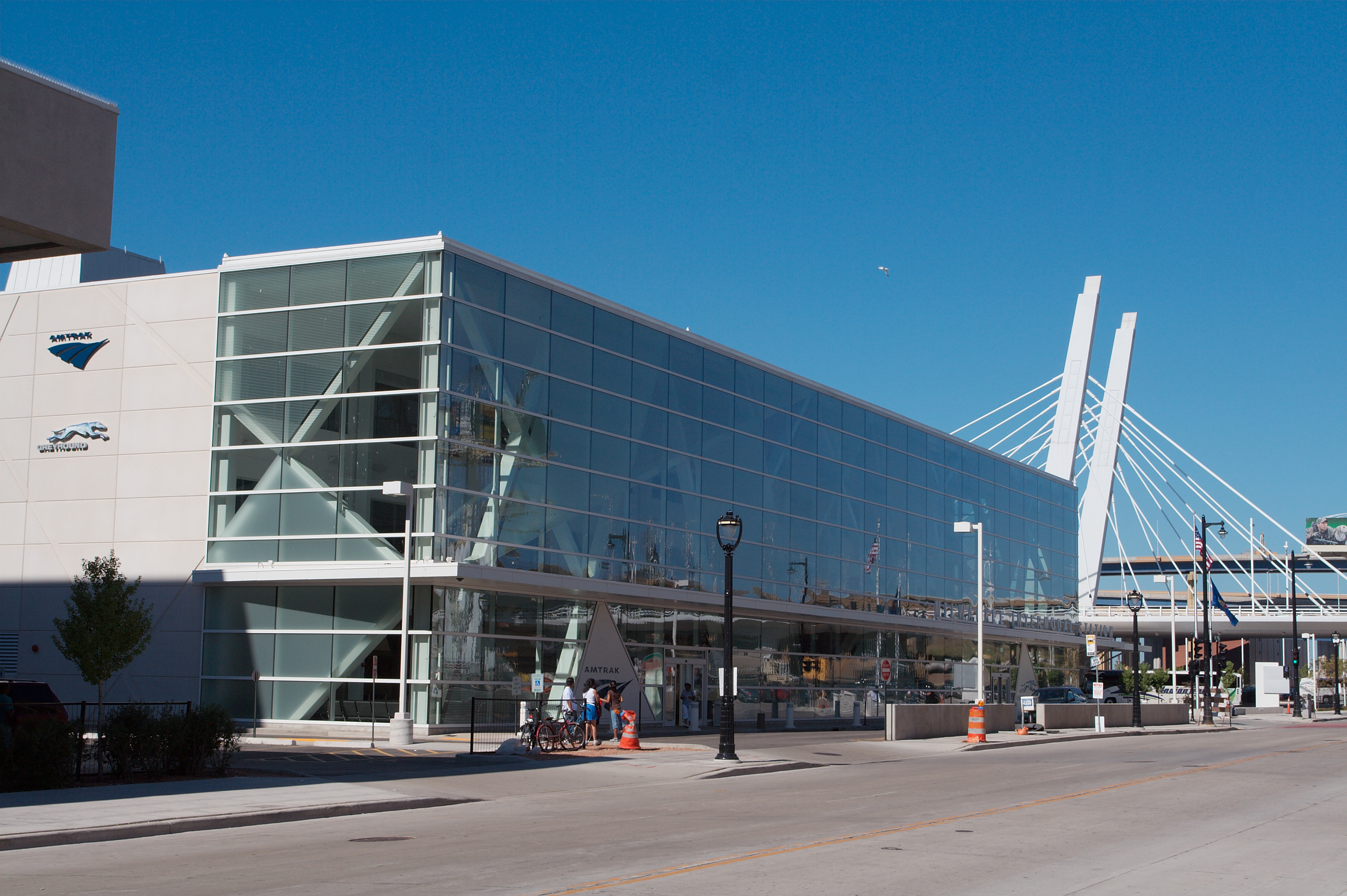
And, unlike the Cleveland Union Terminal, now known as Tower City Center but hasn't had long-distance passenger rail traffic since 1977, Lakefront Station, at 200 Cleveland Memorial Shoreway, is not exactly one of the great rail terminals of this country. To make matters worse, while the RTA Green Line and Blue Line both serve Lakefront Station, the RTA doesn't run overnight, and thus any Amtrak train that comes into the station will not be serviced by it.
How about Greyhound? There are 5 buses leaving Port Authority every day with connections to Cleveland, but only 1 of these are nonstop: The rest require you to change buses in Pittsburgh, Buffalo, or in 1 case, Cambridge, Ohio. The ride, including the changeover, takes about 13 hours. Round-trip fare is $338, although it can be as little as $198 with advanced purchase.
The terminal, at 1465 Chester Avenue, adjacent to the Cleveland State University campus east of downtown, was a hideously filthy hole on my first visit in 1999, but apparently they got the message and cleaned it up, and it's tolerable again. At least on the inside; on the outside, it's a magnet for panhandlers. It's a 7-block walk from the terminal to Public Square, but it's better to take a cab, or to walk 3 blocks to the corner of 13th Street & Superior Avenue and take the Number 3 bus in.
If you decide to drive, the directions are rather simple, down to (almost literally) the last mile. You'll need to get into New Jersey, and take Interstate 80 West. You'll be on I-80 for the vast majority of the trip, through New Jersey, Pennsylvania and Ohio. In Ohio, in the western suburbs of Cleveland, I-80 will merge with Interstate 90. I point this out merely to help you avoid confusion, not because I-90 will become important. You'll take I-80's Exit 173, and get onto Interstate 77 North. Take Exit 163 toward E. 9th St. This will take you into downtown. If you're driving, I would definitely recommend getting a hotel, and there are several downtown, including some near the ballpark.
If you do it right, you should spend about an hour and a half in New Jersey, 5 hours and 15 minutes in Pennsylvania, and a little over an hour in Ohio. Counting rest stops, preferably at either end of Pennsylvania, and accounting for traffic in both New York and Cleveland, it should be no more than 10 hours.
Once In the City. Cleveland, which once had a city population of over 900,000, but is now under 400,000 with a metro area population of 3.6 million, was founded in 1796 by Moses Cleaveland, a hero of the War of the American Revolution, a General in the Connecticut militia, and a shareholder in the Connecticut Land Company. When the Northwest Ordinance was passed in 1787, a lot of New Englanders moved to what's now the Great Lakes States, and many "original" Ohio families can trace their roots back to Connecticut and Moses' expedition to what was known as the Western Reserve.
Supposedly, the reason for the difference in spelling is that, in 1830, the city's 1st newspaper was established, but the editor found "
Cleaveland Advertiser" was too long to fit on the incorporation form, so he dropped an A.
The city doesn't really have a highway "beltway" as we understand that term. It is centered on Public Square, at the intersection of Ontario Street and Superior Avenue (U.S. Route 6), with Euclid Avenue (U.S. Route 20) flowing into it. The Terminal Tower, a 708-foot Art Deco masterpiece, is at the southwest corner of Public Square, and includes the Tower City rail hub and shopping mall. It opened in 1930 and, until 1964, was the tallest building in North America outside New York.
At the southeast corner is the Soldiers & Sailors Monument, probably the best memorial to the American Civil War outside of that war's preserved battlefields. And at the northeast corner is the Key Tower, at 948 feet now the tallest building in the State of Ohio; Richard Jacobs, who owned the Indians for a time, also owned the real estate development company that built the Key Tower (named for Key Bank) in 1991.
Cuyahoga County Soldiers' and Sailors' Monument,
at Public Square
The sales tax in Ohio is 5.75 percent, and in Cuyahoga County (which includes Cleveland), it's 8 percent. ZIP Codes in Cleveland begin with the digits 441, and the Area Code is 216. Cleveland is one of the cities that had a major race riot -- in their case, on the East Side in 1966 -- which led to "white flight": The city's population was 83 percent white in 1950, but just 33 percent white now, along with 53 percent black, 10 percent Hispanic and 2 percent Asian.
Cleveland had been comparatively free of racial strife until July 18, 1966. But that doesn't mean it was free of crime. In particular, the East Side, centered on the Hough neighborhood, had issues, including with The Seventy-Niner's Café at East 79th Street and Hough Avenue. A confrontation there between police and patrons escalated to the point where, over the next 5 days, 4 people were killed, 50 others were injured, and 275 were arrested.
Two years later, there was another incident on the East Side, what became known as the Glenville Shootout. The police and black nationalists fired at each other on July 23, 1968, and this led to rioting. Between the shootout and the riot, 9 people were killed including 3 policemen, and 16 others were wounded in the shootout.
The Kent State University massacre, about 40 miles southeast of Public Square, on May 4, 1970, was about the Vietnam War, not racial issues. Northern Ohio had no more civil disturbances until October 15, 2005, when neo-Nazis calling themselves the National Socialist Movement demonstrated against black gang activity in Toledo, and got their asses handed to them by a group called Anti-Racist Action.
On November 22, 2014, Tamir Rice, a 12-year-old black boy, was carrying a toy gun at the Cudell Recreation Center on Cleveland's West Side, was shot and killed by police. Along with the police killings of Eric Garner in New York and Michael Brown in the St. Louis area, both earlier in the year, this was one of the sparks of the Black Lives Matter movement.
The Greater Cleveland Regional Transit Authority (RTA) runs a heavy rail Red Line, similar to New York's Subway, and light rail Blue and Green Lines. They converge at the Tower City, and all 3 run together from there to East 55th Street. The Blue and Green Lines both start at South Harbor, and run together to Shaker Square before diverging. The fare is $2.25, and is the same for RTA buses.
An RTA train at Tower City
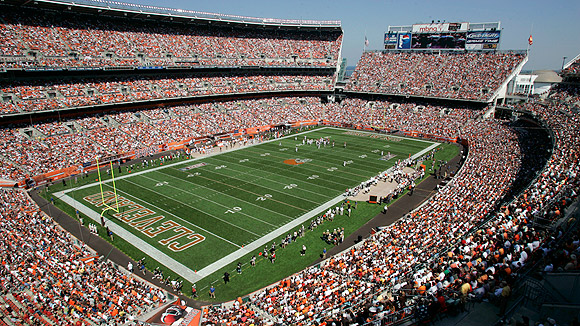
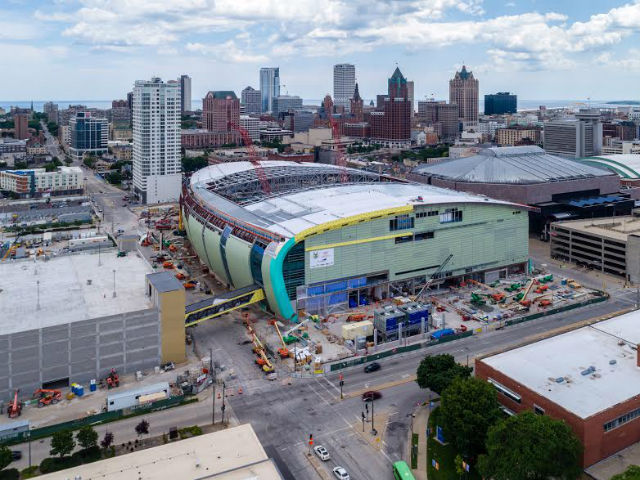
Going In. Built in 1999 on the site of the old Cleveland Municipal Stadium, and known until 2013 as Cleveland Browns Stadium, FirstEnergy Stadium seats 67,431, down from 73,200 when it opened, and from 86,288 at the old stadium.
The Akron-based energy company also holds naming rights to minor-league ballparks in Lakewood, New Jersey and Reading, Pennsylvania. It's a subsidiary of Ohio Edison, which runs electricity for the Cleveland area, but not the Columbus and Cincinnati areas. Yankee broadcaster Bill White, who grew up in Cleveland, mentioned on the air once that, like Consolidated Edison in New York, "Ohio Ed" sponsored a program to take inner-city kids to Indians games.
The official address is 100 Alfred Lerner Way (formerly Erieside Avenue), named for the 1st owner of the revived Browns franchise. It is across from Lakefront Station, and adjacent to the Great Lakes Science Center and the Rock and Roll Hall of Fame. Parking is $21. The West 3rd Street station of the light rail system serves it. The field is aligned northeast-to-southwest, and is natural grass. The Browns have never played a home game on artificial turf.
The stadium has also hosted college games, including "home games" for Ohio State, Bowling Green State and Kent State, and Playoff games for the Ohio High School Athletic Association (OHSAA).
It has also hosted U.S. soccer games. The men's team won a friendly 2-0 over Venezuela on May 26, 2006; lost a friendly 4-2 to Belgium on May 29, 2013; and won a CONCACAF Gold Cup Group Stage game 3-0 over Nicaragua on July 15, 2017. The women's team has played 3 friendlies there, winning them all: 4-0 over Germany on May 22, 2010; 2-0 over Japan on June 5, 2016; and 2-1 over China on June 12, 2018. It hosted 2 games in the 2017 CONCACAF Gold Cup, and will host 2 more in next year's tournament.
Welcome to Cleveland! Titletown USA! Home of Champi... oh, wait. Yeah, they're still the Browns. But, hey, at least the stadium is nice, assuming you aren't too bothered by the words "thirty-five below." Because the stadium was the cornerstone of the Browns' return to Cleveland after they moved to Baltimore and immediately won a Super Bowl, it's pretty nice -- a sight better than the team. Wide concourses, great food, big scoreboards, and all the things that make for a modern NFL palace. Tailgating here is great not only because of the knowledgeable fans, but because the city embraces and encourages it, unlike in other places. And while the surrounding neighborhood doesn't offer much beyond the Great Lakes Science Center and the Rock & Roll Hall of Fame, they still make a great indoor diversion when the bitter cold off Lake Erie renders the stadium uninhabitable.The Ravens didn't immediately win a Super Bowl after moving. It took them 5 seasons. It wasn't quite a Quebec Nordiques-to-Colorado Avalanche situation. More like a Hartford Whalers-to-Carolina Hurricanes situation (that was 9 years). Of course, the Browns are still looking for their 1st appearance in a world championship game since the 1964 season.
On November 4, 2020, MoneyWise published an article about the worst NFL stadiums, and FirstEnergy Stadium came in 13th -- which is actually an improvement on the
Thrillist article: On an accompanying list of best stadiums, it would rise from 20th to 17th. The article praised the atmosphere provided by the fans' enthusiasm, but the big problem remains the literal atmosphere: Being right on the lakefront, it can get really cold.)
The Three Tenors -- Luciano Pavarotti, Placido Domingo and José Carreras -- sang at FirstEnergy Stadium on June 25, 2000. (UPDATE: On February 18, 2023, Ohio State and Michigan will renew their rivalry at FirstEnergy Stadium, in college hockey.)
Food. Ohio -- much more than New Jersey and Maryland -- is part of Big Ten Country, where college football tailgate parties are practically a sacrament. Aramark, the successor company to Harry M. Stevens, runs the concessions.
First Down Favorites are behind Sections 104, 121, 504 and 528; B Spot (barbecue) at 115 and 540; Grill Portables at 122, 146 and 344; and Great Lakes Cheesesteaks at 139 and 420.
There was a restaurant called the New York Spaghetti House on East 9th Street, just a few steps from Progressive Field, but it went out of business in 2001. Original owner Mario Brigotti, who died in 1998 at age 99, was a friend of another Italian Clevelander, Mario Boiardi – a.k.a. Chef Boyardee.
Team History Displays. The Browns have won 8 league championships: 1946, 1947, 1948 and 1949 in the All-America Football Conference (every season that league played); and 1950, 1954, 1955 and 1964 in the NFL.
However, they have not won a World Championship since 1964, and have not played an NFL Championship Game, under any name, since 1969 -- which means they have never played in a Super Bowl. The only other teams for which this is true are the Detroit Lions, the Jacksonville Jaguars and the Houston Texans -- and the Jags and Texans are far newer franchises than the Lions and Browns.
Their titles are shown on the facing of the upper deck, and are the only achievements they mention. They do not mention the Division Championships of 1951, 1952, 1953, 1957, 1965, 1967, 1968, 1969, 1971, 1980, 1985, 1986, 1987 or 1989; or the Wild Card berths of 1958, 1972, 1982, 1988, 1994 and (the only one they've won since their return) 2002.
On the other side of the stadium, the Browns have a Ring of Honor, which includes 18 members of the Pro Football Hall of Fame who are identified mainly with the Browns.
In addition, there are 52 other players in a program called Cleveland Browns Legends. Among those still living, they serve as "ambassadors" for the team. To be eligible, a player must have played at least 5 seasons with the Browns, been "a major contributor at their respective positions," and retired from playing professional football for at least 5 years. They are:
* From the 1950 NFL Champions: Ring of Honor: Head coach Paul Brown, quarterback Otto Graham, running back Marion Motley, offensive tackle and placekicker Lou Groza, guard Bill Willis, center Frank Gatski, receivers Dante Lavelli and Mac Speedie, and defensive end Len Ford. Legends: Receiver and Dub Jones (father of later Colts quarterback Bert Jones), guard Abe Gibron, defensive backs Tommy James and Warren Lahr, linebacker Tony Adamle, and end Horace "Big Horse" Gillom.
* From the 1954 and 1955 NFL Champions: Ring of Honor: Paul Brown, Graham, Groza, Lavelli, Ford, Gatski, and offensive tackle Mike McCormack. Guard and linebacker Chuck Noll was also a member of this team, but was elected to the Hall for coaching the Pittsburgh Steelers to 4 Super Bowl wins. Legends: Jones, Gibron, James, Lahr, Gillom; receiver Ray Renfro, defensive tackles Bob Gain and Don Colo, and linebacker Walt Michaels, brother of former Baltimore Colts defensive end Lou Michaels. Walt later coached the Jets to the 1982 AFC Championship Game, and also coached the New Jersey Generals of the USFL.
* Between the 1955 and 1964 titles: Ring of Honor: Receiver Bobby Mitchell, better known for his later tenure with the Washington Redskins. Legends: Offensive tackle Jim Ray Smith.
* From the 1964 NFL Champions: Ring of Honor: Groza, running backs Jim Brown and Leroy Kelly, receiver Paul Warfield (better known for his later tenure with the Miami Dolphins), and guard Gene Hickerson. Legends: Gain, quarterback Frank Ryan, running back Ernie Green, receiver Gary Collins (no relation to the game show host of the same name), guard John Wooten, offensive tackle Dick Schafrath, defensive ends Paul Wiggin and Bill Glass, linebackers Galen Fiss, Vince Costello and Jim Houston, and cornerback Bernie Parrish.
Ryan, now 86 years old and the only living human being to have quarterbacked the Browns to an NFL Championship (Graham died in 2003), is usually referred to as "Dr. Frank Ryan," as he gained a doctorate in mathematics while still an active player.
New York Times sports columnist Red Smith wrote, "The Browns' offense consists of a quarterback who understands Einstein's theory of relativity, and ten teammates who don't know that there is one."
* From the teams that advanced to the 1968 and 1969 NFL Championship Games, and the 1971 AFC Central Division Champions: Ring of Honor: No additions. Legends: Quarterback Bill Nelsen, tight end Milt Morin, defensive tackle Walter Johnson (no relation to the baseball legend of the same name), defensive back Erich Barnes, and kicker Don Cockroft.
* From the 1980 AFC Central Champions: Ring of Honor: Tight end Ozzie Newsome, guard Joe DeLamielleure, and linebacker Clay Matthews Jr. Legends: Cockroft, quarterback Brian Sipe, running backs Greg Pruitt and Mike Pruitt, center Tom DeLeone, guard Robert Jackson, offensive tackles Doug Dieken and Cody Risien, defensive tackles Walter Johnson and Jerry Sherk, linebackers Dick Ambrose, and safeties Clarence Scott and Thom Darden.
Matthews is the son of 1950s San Francisco 49ers tackle Clay Matthews Sr., the brother of Houston Oilers Hall of Fame offensive lineman Bruce Matthews, the father of the Green Bay Packers' possible future Hall of Fame linebacker Clay Matthews III and and former Philadelphia Eagles linebacker Casey Matthews; and the uncle of former Tennessee Titans center Kevin Matthews and current Atlanta Falcons offensive tackle Jake Matthews, both sons of Bruce. Clay Sr.'s father, H.L. Matthews, played minor-league baseball, and coached several sports at The Citadel, a military college in Charleston, South Carolina. (Like Jake, Clay Jr. also played for the Falcons.)
The Pruitts are not related, though Greg's wearing of Number 34 and Mike's of 43 helped to confuse this. Greg is also known for wearing a "tearaway" jersey, which he had made famous on the University of Oklahoma team that almost won the 1971 National Championship, but the NFL banned them, and that's known as the Greg Pruitt Rule. Dieken is now a Browns broadcaster.
* From the 1986, 1987 and 1989 teams that won the AFC Central Division, but lost the AFC Championship Game all 3 times: Ring of Honor: Matthews. Legends: Risien, quarterback Bernie Kosar, running backs Earnest Byner and Kevin Mack, receiver Webster Slaughter, defensive tackle Bob Golic (brother of former NFL defensive tackle and ESPN host Mike Golic), linebacker Eddie Johnson, and cornerbacks Hanford Dixon and Frank Minnifield. Running back Eric Metcalf (son of Cardinals running back Terry Dixon) and defensive end Michael Dean Perry (brother of Bears defensive tackle William "the Refrigerator" Perry) arrived in 1989, and were also members of the old Browns' last Playoff team in 1994, and have been added to the Legends.
* From the 21st century: Ring of Honor: So far, none. Legends: Receiver Josh Cribbs, linebacker D'Qwell Jackson.
Graham (14), Jim Brown (32), and Groza (76) have had their uniform numbers retired. So have 2 other players: Running back Ernie Davis (45), the 1st black Heisman Trophy winner, in 1961 with Syracuse University, whose leukemia prevented him from ever playing a down of pro football; and safety Don Fleming (46), who, in those days before players got salaries large enough to not have to take an off-season job, was electrocuted along with a co-worker on a construction site in the Orlando suburb of Winter Park, Florida. Davis died on May 18, 1963; Fleming on June 4, 17 days later.
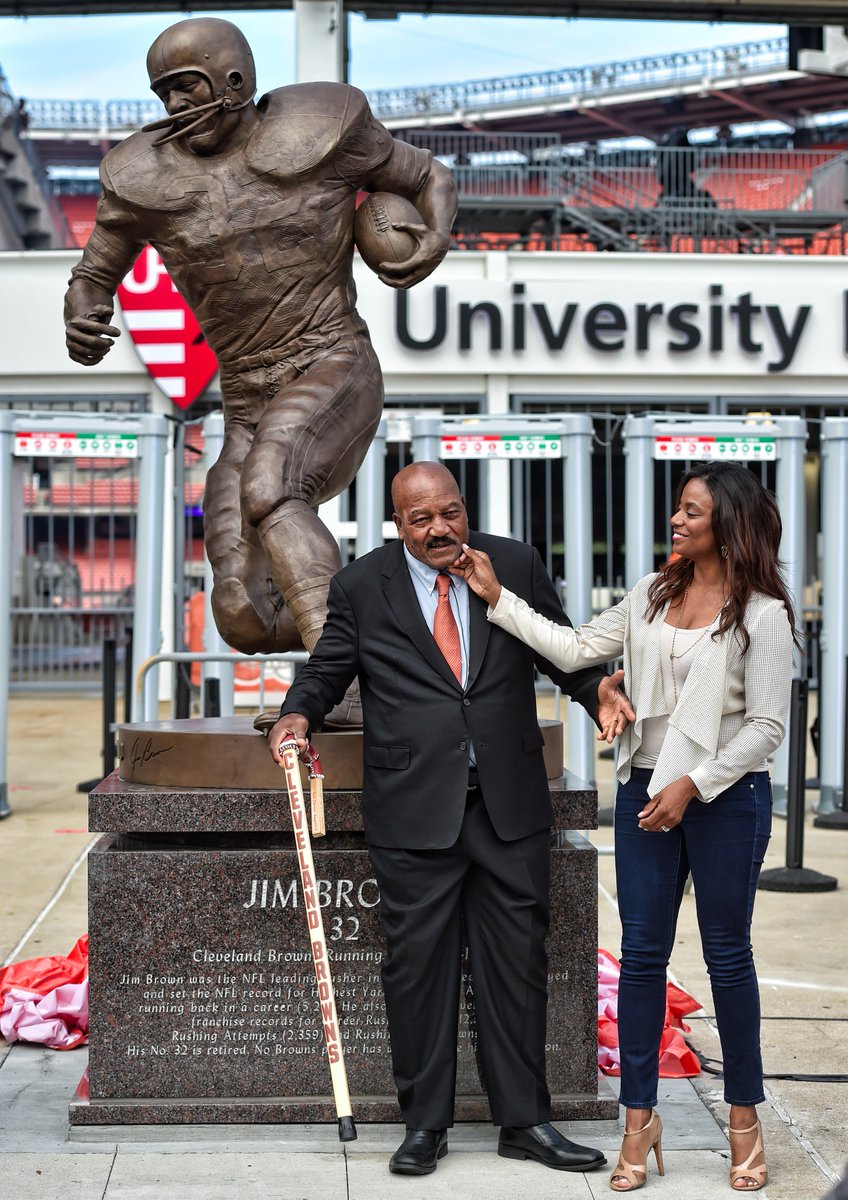
Jim Brown was recently honored with a statue outside FirstEnergy Stadium. So were Otto Graham, and Al Lerner, the owner who helped bring the Browns back. They honored Paul Brown and Lou Groza with statues at their training facility in suburban Berea, Ohio.
Jim and his wife Monique Brown at the unveiling
Graham, Motley and Jim Brown were named to the NFL's 75th Anniversary team in 1999. They, Groza and Warfield were named to
The Sporting News' 100 Greatest Football Players in 1999 -- as was an earlier football star of the Cleveland area, Jim Thorpe of the Canton Bulldogs. They and Ozzie Newsome were named to the NFL Network's 100 Greatest Players in 2010.
In the
TSN 100 poll, Brown ranked Number 1, chosen as the greatest football player ever, ahead of Jerry Rice at Number 2. In the NFL Network 100, Brown ranked Number 2 behind Jerry Rice. Jim Brown, Graham, Motley and Warfield were named to the NFL's 100th Anniversary Team in 2019. So was Doug Atkins, a defensive end who played just 2 seasons for them before Paul Brown traded him to the Chicago Bears, where he built his Hall of Fame credentials. Paul Brown and Bill Belichick (although most of his credentials came later, with the New England Patriots) were named coaches on the 100th Anniversary Team.
The Browns have signed 9 Heisman Trophy winners. Most of them didn't play for them for long, and 1, the aforementioned Ernie Davis, didn't play for them at all. They now have last season's Heisman winner, University of Oklahoma quarterback Baker Mayfield.
The others have been: Les Horvath (1944 Ohio State running back, with the Browns only in 1949), Howard "Hopalong" Cassady (1955 Ohio State running back, 1962), Charles White (1979 USC running back, 1980-84), Vinny Testaverde (1986 Miami quarterback, 1993-95), Rashaan Salaam (1994 Colorado running back, 1999), Ty Detmer (1990 Brigham Young quarterback, 1999-2000), Johnny Manziel (2012 Texas A&M quarterback, 2014-15), and Robert Griffin III (2011 Baylor quarterback, 2016).
There are 32 Browns players in the Greater Cleveland Sports Hall of Fame, although some of these are in more for being Cleveland natives who were successful players elsewhere. In chronological order: Chet Adams, Otto Graham, Lou Groza, Dante Lavelli, Cliff Lewis, Marion Motley, Bill Willis, John Yonakor, Tony Adamle, Les Horvath, Jim Martin, Bob Gain, Chuck Noll, Billy Reynolds, Sam Palumbo, Gene Hickerson, Paul Warfield, Ernie Kellerman, Tom Schoen, Doug Dieken, Greg Pruitt, Dick Ambrose, Robert Jackson, Mike Pruitt (no relation to Greg), Tom Cousineau, Bob Golic, Brian Brennan, Kevin Mack, Bubba Baker, Tom Tupa, LeCharles Bentley and Joe Jurevicius; plus coaches Paul Brown and Sam Rutigliano, and team owners Mickey McBride and Al Lerner, making for 36.
The nasty Browns-Steelers rivalry is known as the Turnpike War, since the Pennsylvania and Ohio Turnpikes are used to get between the cities. The Steelers lead, 79-61-1. In the Battle of Ohio with the Cincinnati Bengals, the team founded by Paul Brown after Art Modell fired him, the Bengals lead 51-46. And an artificial rivalry, created when the old Browns became the Baltimore Ravens, is led 34-12 by the Ravens,. There is no trophy given to the winner of any of these rivalries.
Stuff. The Cleveland Browns Pro Shop is located on the Main Concourse, across from Section 112. There, you can get the usual team-themed items. You might even be able to buy an orange Browns hard hat or a rubber dog mask, as seen in the Dawg Pound.
There are several good books about the Browns. When the Browns returned in 1999, Bob Moon published a comprehensive history,
The Cleveland Browns: The Great Tradition, and Scott Huler published
On Being Brown: What It Means to Be a Cleveland Browns Fan.
Terry Pluto, the
Plain Dealer columnist who is the poet laureate of Cleveland sports, wrote
Browns Town 1964 and
Things I've Learned from Watching the Browns. Jonathan Knight (not the New Kid On The Block) wrote Kardiac Kids: The Story of the 1980 Cleveland Browns and Sundays In the Pound: The Heroics and Heartbreak of the 1985-89 Cleveland Browns. And, in a 2014 book that is now somewhat out of date, Scott Kevin O'Brien wrote
Why Is Daddy Sad on Sunday?: A Coloring Book Depicting the Most Disappointing Moments in Cleveland Sports. (The "Daddy" on the cover is wearing a Number 19 Browns jersey, presumably in honor of Bernie Kosar.)
The NFL has released 1964 WORLD CHAMPION CLEVELAND BROWNS: Three Restored Vintage Films on One DVD (season highlights, NFL Championship Game preparations, and the game itself in color); The History of the Cleveland Browns in 2008 (so far, not much reason for an update), and Cleveland Browns: NFL Greatest Games (featuring entire network broadcasts of a 1980 win over Green Bay known as the Dave Logan Game, a 1989 51-0 season-opener over Pittsburgh, and 2002 win over Atlanta that clinched what's still the only Playoff berth of the reborn Browns).During the Game. According to a 2015 Thrillist article on the NFL's Most Obnoxious Fans, the Browns ranked 25th -- in the bottom quarter, among the least obnoxious. But that only applies when they're not facing a fellow AFC Northern Division team:
You know all those jokes people make about Ohio? You ARE those jokes. And it's hard to be bothered by a group of people dedicated to an awful franchise that, three years after moving and changing their name to the Ravens, somehow managed to win a Super Bowl. Sure, you might toss the occasional dog biscuit/snowball/glass bottle on the field, but you're America's lovable losers -- just incredibly delusional. You really thought [Charlie Frye, Brady Quinn, Seneca Wallace, Trent Dilfer, Tim Couch, Jake Delhomme, Brian Hoyer, Colt McCoy, Derek Anderson, Ken Dorsey] were legitimate starting quarterbacks?
From September 1 to 7, 2017, early in the NFL National Anthem protest controversy, FiveThirtyEight.com polled fans of the 32 NFL teams, to see where they leaned politically. Browns fans were found to be 4.8 percent more liberal than conservative, about right in the middle of the NFL.Cleveland fans really hate the cross-State Cincinnati Bengals (254 miles away); they really, really hate the former Browns, now the Baltimore Ravens (375 miles); and they really, really really hate the closest NFL team, the Pittsburgh Steelers (135 miles). Oddly, despite the closeness (171 miles) and a historical rivalry (the 1952, '53, '54 and '57 NFL Championship Games), they don't particularly hate the Detroit Lions; and, despite the closeness (183 miles), they don't particularly hate the Buffalo Bills. I guess it's a Divisional thing.
So, unless you bring up those other teams, or remind anyone that the late Yankee Boss George Steinbrenner was from Cleveland, or tell the classic "Cleveland Jokes" (like about the city going broke in 1969, the Cuyahoga River catching fire the same year, or Russian comedian Yakov Smirnoff's line, "They made me feel at home in Cleveland, so I had to escape again"), you shouldn't have any problem wearing your Jets gear in the city.
Chomps
The Browns hold auditions for National Anthem singers, instead of having a regular. Their fight song, one of the NFL's oldest, is "Hi-O-Hi-O for Cleveland." They have as mascots both a man in a dog suit named Chomps, and a live bull mastiff named Swagger, who kind of looks like Hooch from Turner & Hooch.Both are in reference to "The Dawg Pound," the old bleachers at the east end of Municipal Stadium. In 1985, cornerback Hanford Dixon said, "We had the idea of the quarterback being the cat, and the defensive line being the dog. Whenever the defense would get a sack, the defensive linemen and linebackers would bark." Soon, the fans watching training camp would bark along with the players.
When the season began, much as Washington Redskin fans wore pig masks (or just plastic pig snouts) in honor of their offensive line, nicknamed The Hogs, fans in the Municipal Stadium bleachers would wear dog masks, and yell, "Woof, woof, woof!" Or, in competition with a similar chant for the hated Steelers, "Here we go, Brownies, here we go! Woof, woof!"
It got a little crazy, as the fans, led by 400-pound John "Big Dawg" Thompson (he has BIG DAWG on the back of a Number 98 Browns jersey, and even made "Big Dawg" his legal middle name), began throwing dog biscuits onto the field. Sometimes, they'd throw eggs, or even batteries.Big Dawg is one of the few NFL fans
famous enough to get autograph requests.
When Cleveland-area native Arsenio Hall got his talk show in 1989, he put a little bleacher section behind the band, and called it The Dawg Pound, and pumped his fist while they yelled, "Woof, woof, woof!"
On December 10, 1989, across the State, when Cincinnati Bengals fans began throwing stuff onto the field, Bengals coach Sam Wyche got a microphone, and told the fans, "Will the next person that sees anybody throw anything onto this field point 'em out? And get 'em outta here! You don't live in Cleveland! You live in Cincinnati!" and got a standing ovation. (Cincinnati doesn't like Cleveland any more than vice versa. The Bengals lost that game to the Seattle Seahawks, 24-17.)
The Browns are 1 of 6 NFL teams that doesn't have cheerleaders. The others are the Giants, the Buffalo Bills, the Pittsburgh Steelers, the Chicago Bears and the Green Bay Packers.
After the Game. Cleveland has some rough areas, but you should be safe downtown. There are a number of places you could go after the game, with names like the Greenhouse (2038 East 4th Street at Prospect Avenue) and the Winking Lizard (811 Huron Road East at Prospect). A House of Blues is at 308 Euclid Avenue.
The Winking Lizard, a.k.a. Winks, is the home of the local Jet fans' club. The local Giant fans meet at Anthony's, 10703 W. Pleasant Valley Rd. at York Rd., 18 miles southwest of downtown. Bus 45.
If your visit to Cleveland is during the European soccer season, the best place to watch your club is probably The Old Angle Tavern, at 1848 West 25th Street in the Ohio City neighborhood, acros the Cuyahoga, west of downtown. Red Line to West 25th-Ohio City.
Sidelights. Cleveland has a losing reputation. The city (for the moment) haven't won a World Series since 1948, the Browns haven't won an NFL Championship sine 1964 (Super Bowl –II, if you prefer), and the Cavaliers have played since 1970 and took until 2015 just to win their 1st NBA Finals game, before finally winning a title this past June. But Cleveland is still a great sports city.
On February 3, 2017, Thrillist made a list ranking the 30 NFL cities (New York and Los Angeles each having 2 teams), and Cleveland came in 20th, in the bottom half. They praised Cleveland's restaurant and beer scenes, saying, "It's still Cleveland, but it's better than you probably thought."
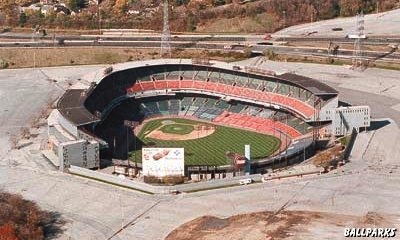
The new stadium was built on the site of Municipal Stadium, which was also the Indians' part-time home from 1932 to 1946, and their full-time home from 1947 to 1993. An NFL team named the Indians played at the Stadium in its 1st season, 1931.
The stadium opened on July 3, 1931, with a Heavyweight Championship fight. Max Schmeling, quite popular in America before the rise of Nazism in his native Germany, delivered the only knockout of William "Young" Stribling's career.
The NFL's Rams played there from 1936 to 1945, winning the 1945 NFL Championship Game there, but moved to Los Angeles due to lousy attendance. The Browns, founded with the All-America Football Conference in 1946 and moving into the NFL in 1950, played there until 1995, before being moved to Baltimore to become the Ravens and being reborn in 1999.
The Browns won the AAFC Championship in all 4 seasons of that league's existence, then won NFL Championships in 1950, 1954, 1955 and 1964. In fact, the Browns played in a league championship game every season they played, from their 1946 debut until 1955. The 1950 NFL Championship Game, won by a Lou Groza field goal in the last 30 seconds of a chilly Christmas Eve encounter over, ironically, the Rams, is regarded as one of the greatest games in pro football history, although the Rams got revenge in the 1951 title game in Los Angeles.
The Browns lost the 1952 Title Game at home to the Detroit Lions, lost to the Lions in Detroit in 1953, beat the Lions at home in 1954, and beat the Rams in Los Angeles in 1955. A new generation of Browns won the 1964 NFL Championship Game at home against the Baltimore Colts – though it's hard to argue that Baltimore taking the Browns in 1995 was revenge. Still, that '64 Title remains the Browns' last World Championship -- and, until the Cavs won the NBA title in 2016, the city's last. No city with at least 3 major league sports teams has ever had to wait longer.
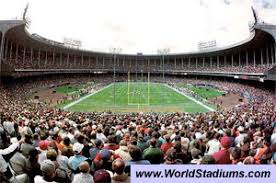
Most Clevelanders who watch college football are Ohio State University fans, even though Ohio Stadium is 145 miles away in Columbus, which is further from the Browns' Stadium than the Steelers' Heinz Field, 135 miles. Still, while O-State has won many Big Ten titles and some National Championships over the years, including since 1964, they are a team for the entire State, not Cleveland-specific, and have played very few home-away-from-home games in Cleveland. And Cleveland State only restarted their football program in 2010. So while Cleveland is a great pro football city and a great high school football city, it is not a good college football city.
Municipal Stadium hosted a Beatles concert on August 14, 1966. The Beatles also played Cleveland's Public Auditorium on September 15, 1964. That building, which opened in 1922, not only still stands, it now hosts the annual Rock and Roll Hall of Fame induction ceremony. Elvis Presley sang there on November 6, 1971 and June 21, 1974.
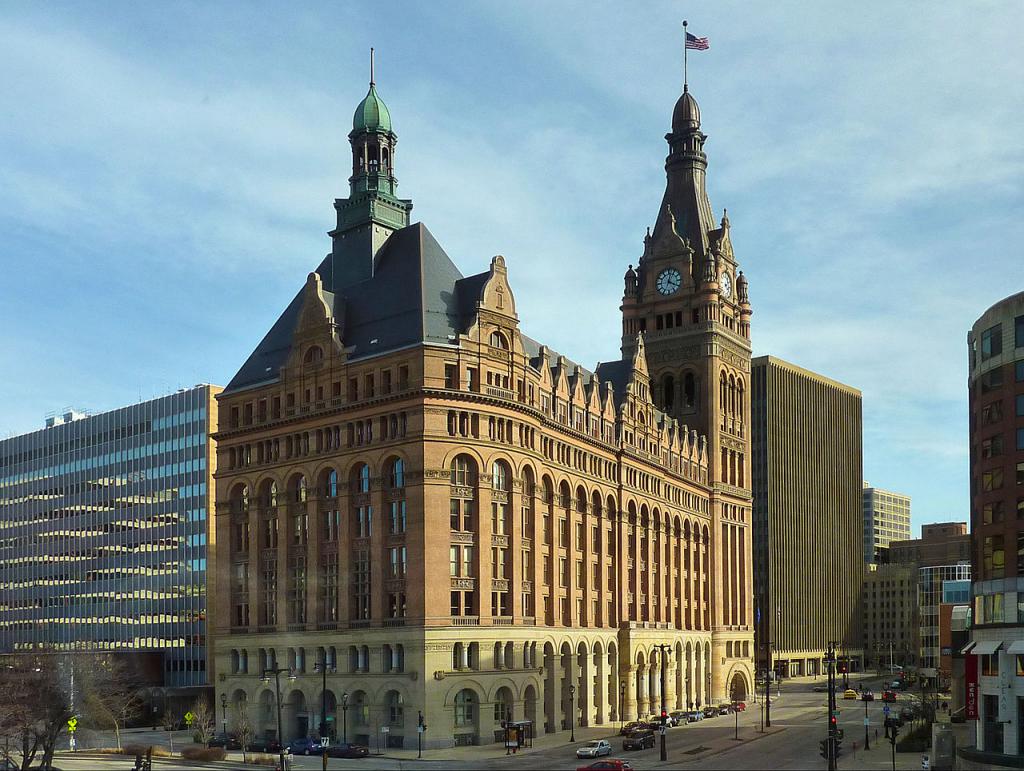
It also hosted the Republican Conventions of 1924 (nominating Calvin Coolidge) and 1936 (Alf Landon). And it hosted the only Presidential Debate of 1980, when Ronald Reagan hit Jimmy Carter with the lines, "There you go again," and, "Are you better off than you were four years ago?" 500 Lakeside Avenue East, a 6-block walk from Public Square and across from City Hall.
The downtown Cleveland sports complex, known as the Gateway Complex, opened both of its venues in 1994. The Guardians, formerly the Indians, played at Jacobs Field, now Progressive Field ("the Jake" is now known as "the Prog"), next-door to the Cavaliers' Gateway Arena, later known as the Gund Arena, the Quicken Loans Arena ("the Q"), and now the Rocket Mortgage Fieldhouse. 2401 Ontario Street, downtown.
There were 2 different ballparks known as League Park, constructed at East 66th Street and Lexington Avenue on the city's East Side. The 1st was built in 1891, and was the home of the National League's Cleveland Spiders until 1899 and the American League team that became the Indians from 1901 to 1909. A 2nd park built there in 1910 was the Indians' home until 1946. A pro football team called the Cleveland Indians played there from 1916 to 1921.
League Park was also the home of the Cleveland Buckeyes, who played in the Negro Leagues from 1943 to 1950, and won the Negro World Series in 1945.
Unlike most parks of the pre-World War I era (or even before the 1960s), something remains of this park: The ticket office that stood in the right-field corner still stands. And there is a baseball field, a public park, on the site today, although it is currently undergoing renovations. However, this is a poverty-stricken neighborhood – it has never really recovered from the 1966 riot – so do not visit at night.
The Number 3 bus will take you up Superior Avenue to 66th, and it's a 6-block walk; a bus called "The HealthLine," which can be picked up on Euclid Avenue across from the Soldiers & Sailors Monument at Public Square, will take you up Euclid Avenue to 66th, and it's a 7-block walk.
There is a Baseball Heritage Museum, inside the 5th Street Arcades shopping center at 530 Euclid Avenue. It began as a private collection of Negro League memorabilia, and it grew to include stuff from the Indians and all kinds of baseball, including amateur, industrial/semi-pro, women's and international leagues.
The Cleveland Arena was home to one of the great minor-league hockey teams, the Cleveland Barons, from 1937 to 1974 and the World Hockey Association's Cleveland Crusaders from 1972 to 1974. It was home to the Cleveland Rebels in the 1st NBA season of 1946-47, and the Cavaliers from their 1970 debut until 1974.
It was here, on March 21, 1952, that local disc jockey Alan Freed hosted the Moondog Coronation Ball, which is often called the first rock and roll concert (which is why Cleveland is the home of the Rock and Roll Hall of Fame). The place held about 10,000, but about twice that tried to get into Freed's show, launching him on a career that would take him to his pioneering job on New York's WINS and then WABC.
Elvis sang at the Arena on November 23, 1956. While the 1988 film
Heartbreak Hotel shows him, played by David Keith, in concert at the Cleveland Arena in 1972, that film is fiction, and the website
elvisconcerts.com clearly states that he gave only 1 concert in the State of Ohio that year, at the University of Dayton Arena.
The Arena was demolished in 1977. The HealthLine bus will drop you off at 36th Street; but, again, this is an uneasy neighborhood, so be aware of your surroundings.
From 1974 to 1994, between the Cleveland Arena and the Gund/Quicken Loans Arena, the Cavs played at The Coliseum at Richfield, a.k.a. the Richfield Coliseum. This was also the home of the minor-league Barons in the 1974-75 and 1975-76 seasons, and the NHL version of the Barons (who had been the California Golden Seals) in the 1976-77 and 1977-78 seasons, before money problems forced them to be merged with the Minnesota North Stars.
On March 24, 1975, in his first fight after regaining the heavyweight title from George Foreman, Muhammad Ali fought a journeyman fighter from North Jersey, Chuck Wepner, a.k.a. the Bayonne Bleeder. Wepner actually knocked Ali down in the 9th round, and that pissed Ali off: He clobbered Wepner, but the Marine veteran refused to go down, until he had nothing left and fell to an Ali punch with 19 seconds left in the 15th and final round. Supposedly, seeing this fight on TV led Sylvester Stallone to create the character of Rocky Balboa. Wepner is still alive at age 74, and recently retired from running a liquor store in Carlstadt, Bergen County.
Like the Meadowlands Arena and the Nassau Coliseum, the Richfield Coliseum had two levels of seats and one level of concourse – and, when a full house of 20,000 showed up, this was a mess. The location was also bad, picked because it was halfway between downtown Cleveland and downtown Akron, but it didn't exactly help people of either city. When the Cavs moved out, its days were numbered, and it was demolished in 1999. The site is now a wildlife sanctuary. 2923 W. Streetsboro Road, and don't expect to take public transportation: The closest bus, the 77F, drops you off almost 6 miles away.
Elvis sang at the Coliseum on July 10 and 18, 1975; and on March 21 and October 23, 1976. Elvis actually gave concerts in Cleveland before becoming nationally famous. On February 26, 1955, nearly a year before "Heartbreak Hotel" hit the charts as his first national hit single, he did 2 shows at the Circle Theater, at 105th & Euclid (built 1920, demolished 1959 for the expansion of the Cleveland Clinic, hence the bus is called the "HealthLine," and this area is a bit safer). On October 19, 1955, he again played 2 shows at the venue.
The next day, he did a matinee at Brooklyn High School (9200 Biddulph Road, Number 45 bus to Biddulph and walk a mile west) and an evening show at St. Michael's Hall (Mill Road & Wallings Road, 77F bus to Wallings, walk a mile west and a couple of blocks south on Mill).
No NCAA Final Four has ever been held in the State of Ohio. Ohio State won it in 1960, and lost Finals in 1939, 1961, 1962 and 2007, but they're in the State capital of Columbus, 142 miles from Public Square, and considerably closer to Cincinnati. The most notable college in the area is Cleveland State University, whose Vikings notably reached the Sweet Sixteen as a 14th seed in 1986, upsetting Indiana and St. Joseph's of Philadelphia before David Robinson and Navy beat them by 1 point to keep them out of the Elite Eight, but that's as close as any Northern Ohio team has come to the Final Four. Their campus is headquartered on Euclid Avenue between 17th and 26th Streets.
With the demise of the Barons, minor-league hockey has been played at the Coliseum and The Q, but the closest NHL team is the Pittsburgh Penguins, 134 miles away. It's not clear how much of the fandom of the Columbus Blue Jackets, 143 miles away, comes from Cleveland, but with Cleveland being a big boost to Ohio State's fandom, I can easily imagine Clevelanders preferring a team from Ohio's capital, however much they might dislike the State government, over the team from Steeler Town. If Cleveland ever did get another hockey team, it would rank 17th in population in NHL markets.
Cleveland's highest-ranked soccer team is Cleveland SC, which plays in the National Premier Soccer League, the 4th tier of American soccer. Their home field is the 5,416-seat Don Shula Stadium, formerly Wasmer Field, at John Carroll University, a Jesuit school in NCAA Division III, that nonetheless includes among its alumni Shula and All-Pro linebacker London Fletcher.
20700 N. Park Blvd., in the University Heights section of Cleveland, 9 miles east of Public Square. Blue-Green Waterfront Line to Belvoir Station, then a mile's walk north.
I once asked Drew Carey, through Twitter, if he loves soccer so much, why didn't he try to get a Major League Soccer franchise for Cleveland, instead of buying into the group that owns the Seattle Sounders? Especially since Cleveland had done so well in the Major Indoor Soccer League. He said there was no suitable playing facility, unless they wanted to play before 50,000 empty seats at the new Browns stadium. This made sense, which is why the nearest MLS team is the Columbus Crew, 138 miles away. Presuming the plan to move the Crew to Austin next season goes through, the next-closest is Toronto FC, 289 miles away.
There is a Cleveland Museum of Art, but it's way out on the East Side of the city, at 11150 East Boulevard at Wade Oval Drive, near the campus of Case Western Reserve University. It's a 15-minute walk from the Euclid-East 120th Street Station on the Red Line, or a 35-minute ride on the HealthLine bus. As I said, near the Browns' stadium are the Great Lakes Science Center, at 601 Erieside Avenue; and the Rock and Roll Hall of Fame, at 1100 East 9th Street.
Cleveland was home to a President, James Garfield, elected in 1880 but assassinated just a few months into his Presidency. Although he died near us, at his "Summer White House" in Long Branch, New Jersey, on September 19, 1881, he was born in the Cleveland suburb of Orange (now Moreland Hills, and he was the last President to be born in a log cabin), and his home, Lawnfield, stands at 8095 Mentor Avenue in Mentor, northeast of the city. It takes 4 buses to get there: The 3, the 28, the R2 and the R1, but it is possible to get there without a car or an expensive taxi.
William McKinley, elected in 1896 and 1900, was from Canton, 60 miles away, and there are some historic sites there relating to him. We Yankee Fans also know Canton as the home town of Captain Thurman Munson. But most sports fans know it as the home of the Pro Football Hall of Fame, selected because it was the location of the NFL's founding meeting on September 17, 1920, at the Hupmobile showroom of Ralph Hay, also the owner of the Canton Bulldogs. The Frank T. Bow Federal Building is now on the site. 201 Cleveland Avenue SW.
The Hall of Fame itself is 3 miles to the northwest, at 2121 George Halas Drive NW, off Exit 107 on Interstate 77. Just to the south is Tom Benson Hall of Fame Stadium, named for the owner of the New Orleans Saints, who made a big donation to renovate the Hall and the adjoining Fawcett Stadium, which was renamed for him. Originally built in in 1938 for McKinley High School, just to the south, it replaced the old 8,000-seat League Field. It now seats 22,375, and annually hosts the NFL's exhibition season-opening Hall of Fame Game.
The Canton Bulldogs played at League Field from 1905 to 1926, winning Ohio League titles in 1915, 1916, 1917 and 1919, and NFL Championships in 1922 (10-0-2), 1923 (11-0-1) and 1924 (7-1-1 -- that's 28-1-4 in 3 seasons). They featured eventual Pro Football Hall-of-Famers Jim Thorpe, Joe Guyon, Guy Chamberlin, Pete Henry, Link Lyman and Greasy Neale, though not all at the same time.
But starpower meant big salaries, and their owners couldn't afford them. After the 1926 season, the NFL cast off several weaker franchise, and the Bulldogs were among them. Thus passed the 1st great professional football team.
The Akron-Canton Regional Airport, where Thurman Munson died on August 2, 1979, is at 5400 Lauby Road in North Canton. He is laid to rest at Sunset Hills Burial Park and Memory Gardens, 5001 Everhard Road NW. Thurman Munson Memorial Stadium is a 5,700-seat minor-league ballpark at 2501 Allen Avenue SE. It was built in 1989, before Camden Yards in Baltimore revolutionized ballpark construction in both the majors and the minors, so it is an all-aluminum stadium, and the Canton-Akron Indians left after the 1996 season to become the Akron Aeros.
It is possible to get from Cleveland to Canton via public transportation, via GoBus, but it takes 2 hours and 20 minutes. Each way.
Akron is about 40 miles south of Cleveland on I-77, a little more than halfway to Canton. There is a Bus C that goes there, taking a little under an hour and costing $10, each way. Since 1997, the Double-A Eastern League team known as the Akron Aeros, and now the Akron RubberDucks (1 word), has played at Canal Park, 300 S. Main Street at Exchange Street.
The 1st NFL Champions were the Akron Pros, in 1920. Their coach was also their best player, two-way back Frederick Douglass "Fritz" Pollard -- the 1st black head coach in any major league sport. (Well, sort of: He was, unquestionably, the head coach; it's the NFL's status as "major league" up until 1933 or so, or even until after World War II, that's questionable.) Another great black football player of the era, the 1917 and '18 All-America end at Rutgers and later actor and singer Paul Robeson, played for them in the 1921 season. (He also played for the Milwaukee Badgers in 1922.)
The Pros played under various names, in various leagues, from 1908 to 1926, but financial problems made them part of the NFL's post-1926 purge, and they folded. They played at League Park, at the southeast corner of Carroll and Beaver Streets, a mile and a half east of downtown. The area is industrial now.
The University of Akron Zips play football at InfoCision Stadium, built in 2009 and seating 27,881. 300 Vine Street. It replaced the 35,000-seat Rubber Bowl (Akron is home to the Goodyear Tire and Rubber Company and its iconic blimps), which stood from 1940 until this year, at 800 George Washington Blvd.
On November 19, 2018,
Moneywise compiled a list of their
Worst College Football Stadiums, the bottom 19 percent of college football, 25 out of 129. InfoCision Stadium came in 14th, apparently due to a serious lack of atmosphere.
Kent State University is in Kent, about 40 miles southeast of Cleveland. Yankee Legend Thurman Munson was a student there before signing with the Yankees, and was a baseball teammate there of Steve Stone, 1980 American League Cy Young Award winner with the Baltimore Orioles and a Chicago Cubs broadcaster. The Kent State Golden Flashes play at 25,319-seat Dix Stadium, which opened in 1969. 2213 Summit Street.
Of course, Kent State is best known for the events of May 4, 1970, when a demonstration against the Vietnam War led to the Ohio National Guard firing on the protesters, wounding 13 people, 4 of whom died. The fallen fell at what is now Parking Lot R-3. The May 4 Visitors Center is across from the site. 300 Midway Drive. Hard to reach by public transit: The best way is Greyhound to Akron and then Bus 90 to the Student Center.
The best-known Kent State students are comedians, who may have helped people there deal with the trauma: Arsenio Hall in the mid-1970s, and Drew Carey, who left in 1981 and enlisted in the Marine Corps Reserve.
Also associated with Ohio are Presidents William Henry Harrison, Ulysses S. Grant, Benjamin Harrison and William Howard Taft, but they were from the Cincinnati side; Rutherford B. Hayes, whose hometown of Fremont was closer to Toledo; and Warren G. Harding, whose birthplace of Blooming Grove and adult hometown of Marion are closer to Columbus.
The Armstrong Air & Space Museum was built to honor Neil Armstrong, the 1st man to walk on the Moon, in his hometown of Wapakoneta, Ohio. The building is, naturally, shaped like a crescent moon. 500 Apollo Drive, 185 miles southwest of Cleveland, 93 miles southwest of Toledo, and 88 miles northwest of Columbus.
If you're a fan of
The Drew Carey Show, and you remember the cast's hangout, the Warsaw Tavern, you should know that there is a real-life bar with that name, in Brooklyn (a separate city) south of downtown, on West 22nd Street at Calgary Avenue. Take the Number 35 bus.
Aside from
The Drew Carey Show, the biggest TV show filmed in the Forest City has been
Hot In Cleveland.
3rd Rock from the Sun was set at Pendleton State University in fictional Rutherford, said to be 52 miles from Cleveland, a distance suggesting that the school was probably based on Kent State University.
The Fernwood franchise --
Mary Hartman, Mary Hartman and its spinoffs,
Forever Fernwood and
Fernwood 2 Night, running on from 1976 to 1978, was set in a city named Fernwood, which is the name of a real town in eastern Ohio, but hardly big enough to match the shows' setting. It was probably based on Cleveland, hometown of Martin Mull, who played twin brothers Garth and Barth Gimble on the shows.
The house from the film
A Christmas Story, in which Cleveland stands in for Chicago and author Jean Shepherd's hometown of Hammond, Indiana, is at 3159 West 11th Street at Rowley Avenue, and was restored by a fan to its exact appearance in the movie, made in 1983 but set around 1939 or so. Take the Number 81 bus.
The Higbee's store was also real, but was most likely based on Chicago's real-life Marshall Field's chain. Higbee's still stands on Public Square, and the sign visible in the movie is still there, but the store moved out years ago, and the building is now home to the Cleveland Convention & Visitors Bureau and Horseshoe Casino Cleveland.
Roy Orbison played his last concert, on December 4, 1988, 2 days before his death, at the Front Row Theater. It was torn down in 1995, and a Home Depot is now on the site. 6199 Wilson Mills Road, in Highland Heights, 13 miles east of Public Square. Red Line to Stokes-Windermere, then Bus 7A.
Toledo is 115 miles west of Cleveland, where the Maumee River flows into Lake Erie. Megabus can get you there in 2½ hours. In fact, it's closer to Detroit: 60 miles. For this reason, their Triple-A baseball team, the Toledo Mud Hens, has been a farm club of the Detroit Tigers for much of their history, including continuously since 1987.
What's a "mud hen"? It's a bird that flocked near Bay View Park, where the team played from 1886 to 1896. It's also known as an American coot. The team left the next season, but the name stuck. The stadium remained in place, and was used as the site of the Heavyweight Championship fight of July 4, 1919, when Jack Dempsey won the title by destroying Jess Willard. It's all parkland now, except for the clubhouse of the Bay View Yacht Club. 3900 Summit Street, 3½ miles northeast of downtown.
Originally known as the Toledo Blue Stockings, they played at League Park from 1883 to 1885, before moving to Bay View Park. It was here, in the 1884 season, that they fielded catcher Moses Fleetwood "Fleet" Walker and his brother, outfielder Weldy Wilbeforce "Welday" Walker, the 1st 2 black players in what we would now call Major League Baseball, but were forced by the baseball establishment to let them go.
The Taylor Body Shop is now on the site of this important, but shunted-aside, piece of baseball history. 1400 Monroe Street, just west of downtown.
The Mud Hens moved to Armory Park, playing there from 1897 to 1909. This was the home of an early pro football team, the Toledo Maroons, from 1902 onward. In 1922, they entered the NFL, but it became too expensive for them, and they folded after the 1923 season. Armory Park was demolished in 1934, and the site is now part of the Civic Center Mall, on Jackson Street between Spielbusch Avenue and Erie Street.
Swayne Field opened in 1909, and was the home of the Mud Hens until 1955. This stadium, eventually reaching 14,800 seats after a 1928 expansion, would have been "home" to the M*A*S*H
character Max Klinger, played by Toledo native Jamie Farr, who made the Hens' jersey and block-T cap nationally famous. For this reason, the modern version of the team retired Number 1, which Farr wore in character as Klinger, for him.
In 1927, the Mud Hens won their 1st Pennant at Swayne Field. But they were never prosperous, and in 1955, they moved, and the ballpark was soon demolished. A shopping center, including a McDonald's, is on the site now. 3000 Monroe Street, at Detroit Avenue (U.S. Route 24), 2 miles west of downtown, and a mile and a half's walk down Monroe from the site of League Park.
The team was revived in 1965, when the 10,197-seat Lucas County Stadium opened, thanks to the efforts of County Commissioner Ned Skeldon. They won the Pennant in 1968. In 1988, when it was learned Skeldon was dying, the County government renamed the stadium for him. He lived long enough to see it, dying 3 months later.
Ned Skeldon Stadium remains a home for amateur baseball, as part of the Lucas County Recreation Center. 2901 Key Street in suburban Maumee, 8 miles southwest of downtown.
In 2002, the Mud Hens moved back downtown, to the 10,300-seat Fifth Third Field, named for an Ohio-based bank (which also holds naming rights to Dayton's ballpark and the University of Cincinnati's arena). They won Pennants there in 2005 and 2006. 406 Washington Street at Huron Street, downtown.
And while Adam's Ribs, the Chicago barbecue joint mentioned in one of the better M*A*S*H
episodes, isn't real (though many places with the name have popped up since that 1974 episode), Klinger's beloved sausage emporium, Tony Packo's Café, is absolutely real. The original is at 1902 Front Street at Consaul Street, 2 miles across the river from downtown, and they have another across from the ballpark at 7 S. Superior Street.
Elvis sang at the 5,230-seat Toledo Sports Arena on November 22, 1956, and at the University of Toledo's 8,300-seat John F. Savage Arena on April 23, 1977. The old Sports Arena stood at 1 Main Street at Riverside Drive, a mile across the river from downtown, from 1947 to 2007, hosting concerts and minor-league hockey. It was replaced by the 5,000-seat Huntington Center, at 500 Jefferson Avenue at Huron Street, downtown. It is home to minor-league hockey's Toledo Walleyes. The Savage Arena is at 2025 Douglas Road, on campus, 4 miles west of downtown.
Bowling Green State University, of the Mid-American Conference, is 112 miles west of Public Square, and 22 miles south of downtown Toledo. They won hockey's National Championship in 1984. The 5,000-seat Slater Family Ice Arena is at 417 N. Mercer Road.
The 24,000-seat Doyt Perry Stadium, built in 1966 and named for their former football coach, who from 1955 to 1964 won 5 of the school's 12 MAC Championships, is next-door, at Stadium Drive & Alumni Drive. Perry once served on Woody Hayes' staff at Ohio State, as did Michigan coach Bo Schembechler, and the 3 would often (not during football season or recruiting season) meet at Doyt's house, as it was halfway. (Not really: Bowling Green is 69 miles from Ann Arbor and 118 miles from Columbus.)
Cleveland likes to call itself "America's North Coast," but, in spite of its infamous Winter, it does have beach resorts. Headlands Beach State Park attracts 2 million visitors a year from America and Canada (presumably, mostly from nearby Ontario). 9601 Headlands Rd., in Mentor, 29 miles northeast of Public Square. Unreachable by public transit.
And there's a beach at Cedar Point, the lakeshore town that also includes an amusement park that serves as Ohio's answer to Great Adventure. (Six Flags has nothing to do with it.) They call themselves the Roller Coaster Capital of the World. Cedar Point Road, in Sandusky. 61 miles east of Public Square. Again, no public transit, but Sandusky can be reached by Greyhound.
*
A visit to Cleveland can be a fun experience. These people love football. They don't like the Yankees, but they don't much mind the Jets, and their city should be able to show you a good time. Again, don't mention that George Steinbrenner was a Clevelander. And, for your own sake, don't mention the name of Art Modell.