Showing posts with label new york city. Show all posts

Thursday, June 25, 2026

June 25, 1966: The Brooklyn Navy Yard Closes

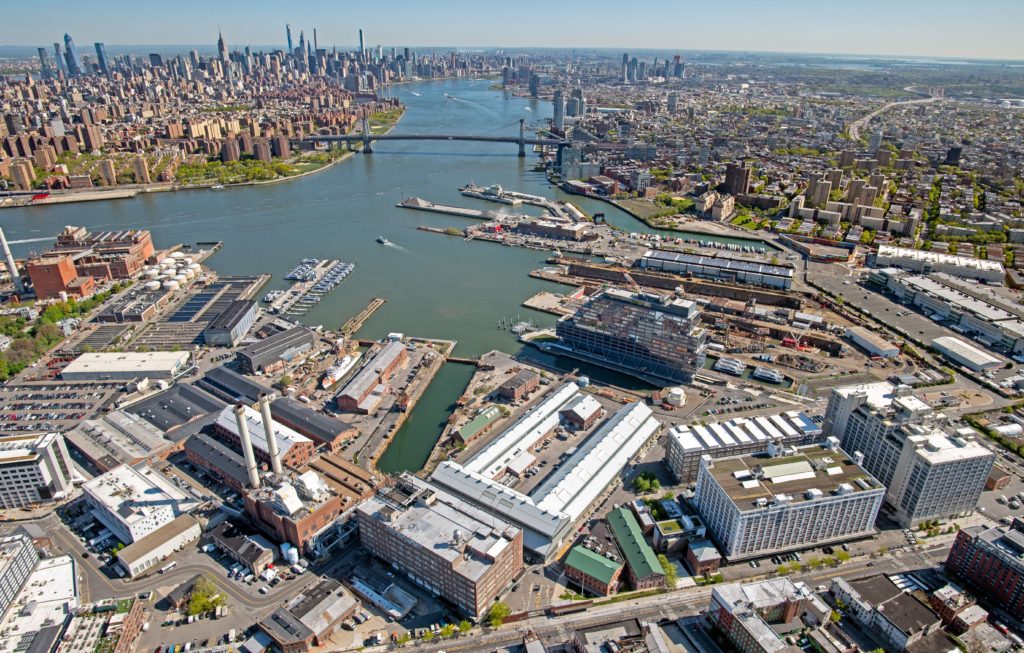
A recent photo of the Navy Yard,
which has been redeveloped for residential and retail use.
The Williamsburg Bridge is in the background.

June 25, 1966, 60 years ago: The Brooklyn Navy Yard is closed, emblematic of New York City's loss of industry.

At the height of World War II production, what was officially named the New York Naval Shipyard had 75,000 people working there. In 1947, it was down to 10,000 workers. It doubled back up to 20,000 by the end of the Korean War in 1953, but after that war ended, it was back to 10,000 again.

In 1960, with the Yard's workforce 11,000 strong, the aircraft carrier USS Constellation was being built there, and an accident caused a fire that killed 49 people. The investigation showed that, although this fact was not responsible for the fire, the Yard was obsolete, especially since it was determined that, in order to reach the open sea, ships built there had to pass under the Manhattan Bridge and the Brooklyn Bridge; and ships going there for repairs also had to pass under those bridges -- and most new ones were too big. 

And so, on June 25, 1966, a closing ceremony was held at the Yard, with work stopping for good on June 30, and the last 9,500 workers were laid off.

This was symbolic of the loss of industry in New York City. The loss of jobs crushed the Borough economically, and was much more damaging to the communities of Brooklyn than the so-often-cited move of baseball's Brooklyn Dodgers in 1957 had been.

Indeed, it was crushing to the City as a whole. It wasn't the first time industry had been phased out: The Gashouse District, between 1st Avenue and the Hudson River, from 14th to 23rd Street, its name already appropriated for baseball's St. Louis Cardinals, "the Gashouse Gang," was torn down in World War II, to build the housing projects Stuyvesant Town and Peter Cooper Village.

*

June 25, 1966 was a Saturday. Basketball Hall-of-Famer Dikembe Mutombo was born on this day. 

Sunday, June 14, 2026

The Knicks Bring New York a Championship

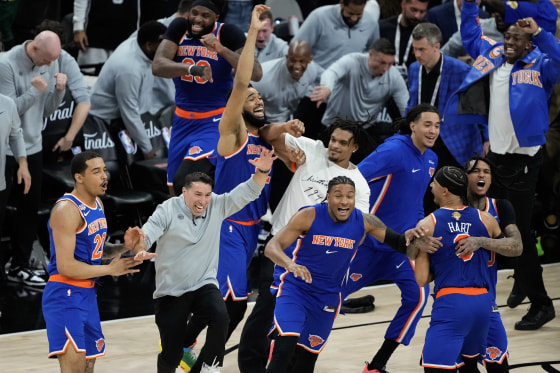
Congratulations to the New York Knickerbockers, World Champions of basketball.

The Knicks won Game 5 of the NBA Finals, beating the San Antonio Spurs, 94-90 at the Frost Bank Center in San Antonio, Texas. Yes, New York City messed with Texas.

The only game in the Finals that they lost was Game 3, when Donald Trump showed up at Madison Square Garden. As they say in New York, I'm not sayin', I'm just sayin'.

The Knicks have, historically, been a snakebit franchise. Along with the Boston Celtics, they are 1 of only 2 original NBA franchises from 1946 still in their original city. They reached the NBA Finals in 1951, 1952 and 1953, but lost them all. They moved from the old Garden, at 49th-50th Streets and 8th-9th Avenues, to the new Garden, at 31st-33rd Streets and 7th-8th Avenues, in 1968. There, they built a new Champion, winning the title in 1970, losing the Finals in 1972, and winning them again in 1973.

But then the dynasty of coach Red Holzman, captain Willis Reed and Walt Frazier got old. The Knicks had a good run in 1984 with Bernard King, but fell short. They had a (sometimes literally) hard-fighting team team in the 1990s, reaching the Finals in 1994 and 1999, but losing. And for most of the 21st Century, they've been mediocre at best.

But team president Leon Rose and general manager Gerrson Rosas have built a new Champion, coached by Mike Brown. Their 53-year drought was almost as long as the 54 years that the supposedly cursed New York Rangers, with whom they share the Garden, had from 1940 to 1994. But they went 53-29 in the regular season, and beat the Atlanta Hawks, then the Philadelphia 76ers in 4 straight, and then the Cleveland Cavaliers in 4 straight to reach the NBA Finals.

In all 5 games of the Finals, they came from behind to take the lead, including Game 3 that they ended up losing, anyway. They won Game 1 in San Antonio, 105-95. They won Game 2, 105-104. They lost Game 3 at home, 115-111. But in Game 4, the trailed by 29 points, and then launched the biggest comeback in NBA Finals history, before OG Anunoby's tip-in gave them a 107-106 victory. Tonight, Jalen Brunson, the captain, scored 45 points, a team Finals record, and they won, 94-90. The clock ran out at 11:28 PM on June 13, 2026. Brunson was named the Finals MVP.

Hail the Champions:

* Number 00, Jordan Clarkson, 34 years old, a 6-foot-5 guard from Tampa, and the University of Missouri.
* Number 2, Miles McBride, 25, a 6-2 guard from Cincinnati and West Virginia University.
* Number 3, Josh Hart, 31, a 6-5 forward from the Washington suburb of Silver Spring, Maryland, and Villanova University.
* Number 4, Pacôme Dadiet, 30, a 6-9 forward born to Ivorian parents in Aubagne, southern France. He did not attend college, either in France or in America.
* Number 5, Jose Alvarado, 28, a 6-feet-even guard from Queens and Georgia Tech.
* Number 8, Ogugua "OG" Anunoby, 28, a 6-foot-7 forward, born to Nigerian parents in London, grew up in Jefferson City, Missouri, and went to Indiana University.
* Number 11, Jalen Brunson, 29, a 6-2 guard from the Philadelphia suburb of Cherry Hill, New Jersey, and then the Chicago suburb of Lincolnshire, Illinois, and went to Villanova University.
* Number 13, Tyler Kolek, 25, a 6-2 guard from Cumberland, Rhode Island, and Marquette University.
* Number 20, Jeremy Sochan, 23, a 6-8 forward, born in Guymon, Oklahoma to an African-American father and a Polish mother, grew up in Milton Keynes, England, and played at Baylor University.
* Number 23, Mitchell Robinson, 28, a 7-foot-even center from Chalmette, Louisiana. He did not play in college.
* Number 25, Mikal Bridges, 29, a 6-6 guard from the Philadelphia suburb of Malvern, Pennsylvania and Villanova.
* Number 32, Karl-Anthony Towns, 30, a 7-foot-even center from Piscataway, New Jersey, playing at St. Joseph's High School of nearby Metuchen, and the University of Kentucky.
* Number 44, Landry Shamet, 29, a 6-5 guard from Kansas City, and Wichita State University.
* Number 51, Mohamed Diawara, 21, a 6-9 forward, born to Malian parents in Paris, and grew up there. Like his countryman Dadiet, he did not attend college.
* Number 55, Ariel Hukporti, 24, a 7-feet-even center, born to Togolese parents in Stralsund, in northeastern Germany. He also did not attend college.

The starting 5 are guards Brunson and Bridges, forwards Hart and Anunoby, and center Towns.

I've often said that a Knicks title would mean more to New York than a title for any other team. Not just because New York loves its basketball so much, but because the Knicks have a greater share of the local fandom over the Nets than the Yankees over the Mets, the Giants over the Jets, and the Rangers over the Islanders and the Devils.

And Knick fans have lived through a lot of disappointment, and even some utter crap, the specifics of which don't matter now. Although owner James Dolan did get on the microphone at the presentation of the Larry O'Brien Trophy and apologize to Knick fans for having taken so long.

The Knicks are the World Champions. Fully earned, fully deserved, and worthy of the great story that they have told.

Saturday, May 30, 2026

Arsenal Is For Anybody

Notice the Yankee caps.

Today, Arsenal Football Club took a 1-0 lead over Paris Saint-Germain after 6 minutes of the UEFA Champions League Final in Budapest, Hungary, and couldn't hold it. All the money that PSG got from their owners, the oil-rich slavedriving royal family of the Middle Eastern nation of Qatar, and the assistance from referee Daniel Siebert, and the game ended 1-1 after extra time. PSG then won on penalty kicks, 4-3.

At the end, I felt like I did when the Yankees lost Game 7 of the 2001 World Series: Drained, too tired to feel anything more than disappointed. It took longer for the steroid use of the opposition to be revealed in that case. In this case, as with Arsenal's defeat to FC Barcelona in the CL Final 20 years earlier, the dirty play and the favoring thereof was obvious while the game was in progress.

It was the biggest game in Arsenal's history, and they lost it -- through little fault of their own, but they did lose it.

And I, for one, have never been prouder to be an Arsenal fan.

It is true that, as late as the morning of March 22, Arsenal were still eligible for all 4 trophies for which they were eligible. That day, they lost the League Cup Final to Manchester City. On April 4, they lost to Southampton in the Quarterfinal of the FA Cup. On April 19, they lost to Manchester City, which took their Premier League destiny out of their hands. They were still in the Semifinal of the Champions League, but it was looking like they would go 0-for-4 in trophies.

But they beat Atlético Madrid in the CL Semifinal, and advanced to the Final to play PSG, the defending Champions, who had eliminated Arsenal in the previous season's Semifinal. And Man City faltered, losing League games. Arsenal won their last 5 Premier League games. On May 19, Man City lost to Bournemouth, meaning they could no longer finish ahead of Arsenal. Arsenal were the Premier League Champions, for the 1st time in 22 years. It was their 1st trophy in 6 years, since the 2020 FA Cup.

Upon the final whistle of City's defeat, thousands of people descended upon the Emirates Stadium in North London. Wherever Arsenal fans gather, they gathered: In Manhattan, in Montreal, in Mombassa, in Mumbai, in Melbourne. All of England's "big clubs" have fans from all over the world, but most of them don't celebrate diversity like Arsenal do. Even the new Mayor, Zohran Mamdani, is an Arsenal fan, and has seen games at one of the Arsenal bars in Brooklyn. (But he's also a Mets fan, so take his Gooner status with a grain of salt.)

Today, I saw the match in the space that used to be the home of the NYC Arsenal Supporters, on East 14th Street between 2nd and 3rd Avenues in Manhattan's East Village, before it began filling up and became a victim of its own success, leading to O'Hanlon's, a block away on 14th between 1st and 2nd, becoming the new headquarters. From 2011 to 2019, this space was known as the Blind Pig, named for an alternate term for a speakeasy, one of the secret bars that sprang up all over America during Prohibition, 1920 to 1933.

In 2019 -- before COVID -- the Blind Pig had to close, due to a rent increase. Coyote Ugly, the bar made famous in the 2000 film of the same title, moved around the corner from 2nd Avenue into the former Blind Pig space. Obviously, the decor is different, but the space is still recognizable. As with both the Blind Pig and Coyote Ugly's former location, the bartenders are still, as the English would say, "fit as fook." And they were willing to take in spillover customers who couldn't get into O'Hanlon's.

When it was over, the consensus was that we were disappointed in the result, and angry at the officials, but the Premier League title was no consolation prize, it was still something to celebrate. (Indeed, Arsenal will have its trophy parade in London tomorrow.)

As with my fellow fans of the Yankees and the New Jersey Devils, I have "found my people." And the hope for more trophies over the next few years, under manager Mikel Arteta, is strong.

We are The Arsenal: We are for anybody willing to join us, and we fear nobody.

Sunday, May 24, 2026

May 24, 1626: Peter Minuit Buys Manhattan

May 24, 1626, 400 years ago: Peter Minuit buys Manhattan Island from the native Indians for $24. Or so the legend says.

The truth is a bit more complicated.

Henry Hudson, an English explorer, had sailed up the Hudson River on September 2, 1609, claiming a large swath of land for the Dutch Republic. The Hudson Valley, up to present-day Albany and Schenectady, in what became the State of New York; Long Island, including what is now the Boroughs of Brooklyn and Queens, and Nassau County, named for the ruling house of the Netherlands; what is now the western half of Connecticut; the entirety of New Jersey; much of southeastern Pennsylvania, including what became Philadelphia; northernmost Delaware; and the northeastern corner of Maryland. This colony became known as New Netherland. Its capital, occupying the southern tip of Manhattan Island, was named New Amsterdam, after the mother country's capital.
"Manhattan" was a word from the language of the Native Americans living there, the Lenape tribe, meaning "the place where we get bows" -- in other words, the wood to make bows for arrows. One of the many legends of early New York that has proven to not be true is that it was originally "Manahatta," meaning "place of many hills," although the island does have many hills.

Peter Minuit was born in Wesel, Germany between 1580 and 1585 into a Calvinist family that had moved from the city of Tournai, presently part of Wallonia in Belgium, then controlled by Spain, in order to avoid Spanish Catholic authorities, who were not favorably disposed toward Protestants. Minuit married Gertrude Raedts in 1613. She was from a wealthy family, and she probably helped him establish himself as a broker.

Minuit joined the Dutch West India Company, and was sent with his family to New Netherland in 1625 to search for tradable goods other than the animal pelts that then were the major product coming from New Netherland. He returned in the same year, and in 1626 was appointed the new director of New Netherland. He sailed to North America and arrived in the colony on May 4, 1626.

He is credited with purchasing the island of Manhattan, from Native Americans in exchange for traded goods valued at 60 guilders. That figure came from a letter by a representative of the Dutch States-General and member of the board of the Dutch West India Company, Pieter Janszoon Schagen, to the States-General in November 1626. In 1844, New York historian John Romeyn Brodhead converted the figure of Fl 60 (or 60 guilders) to US$24. By 2006, 60 guilders in 1626 was worth approximately $1,000 in current dollars, according to the Institute for Social History of Amsterdam.

The original inhabitants of the area were unfamiliar with the European notions and definitions of ownership rights. For the Indians, water, air and land could not be traded; therefore, it is likely that both parties probably went home with totally different interpretations of the sales agreement. The Lenape probably thought they were the ones who got the great deal.

A contemporary purchase of rights in nearby Staten Island, to which Minuit also was party, involved duffel cloth, iron kettles, axe heads, hoes (garden tools -- the prostitutes came later), wampum, drilling awls, "Jew's harps" and "diverse other wares."

In 1632, the Dutch West India Company recalled Governor Minuit, essentially firing him for corruption. So political corruption in New York City goes back that far. He left the Netherlands, and in 1637, having made a deal with Sweden, he sailed up the Delaware River, and established the colony of New Sweden.

The following year, he was at sea, and his ship was lost in a hurricane. Without his guidance, New Sweden never had a chance, as the mother country was losing what became known as the Thirty Years War, ending its status as a European power. In 1655, the Dutch reclaimed New Sweden as part of New Netherland.

In 1664, as part of the Anglo-Dutch War, England conquered New Amsterdam without firing a shot. Although the Netherlands ended up winning the war, England got to keep New Netherland. It renamed both the colony and its capital city New York, after the Duke of York, brother of King Charles II. He later became King James II.

Thursday, May 14, 2026

May 14, 1951: TV's 1st Sitcom Is Blacklisted

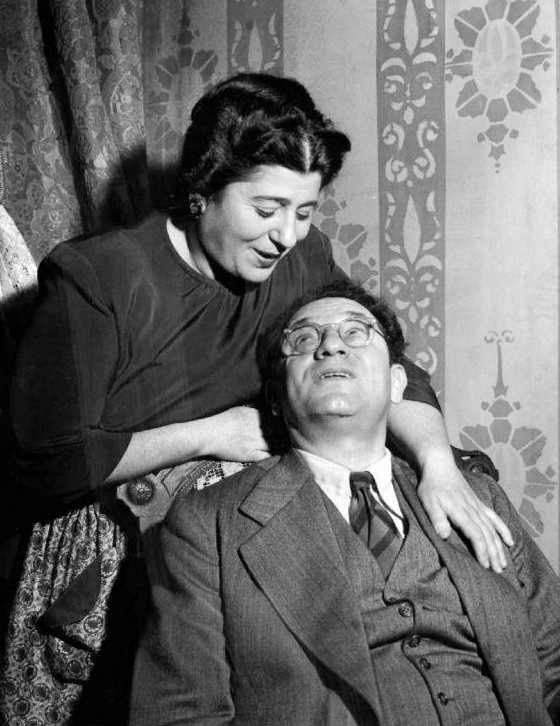
Gertrude Berg (left) and Philip Loeb

May 14, 1951, 75 years ago: American TV's 1st sitcom is canceled, because its creator and star stood up for her co-star when he was blacklisted.

Gertrude Berg had created the radio program The Rise of the Goldbergs for NBC radio in 1929. From the beginning, she played Molly Goldberg, described by an announcer as "a woman with a place in every heart and a finger in every pie." In 1936, it moved to CBS and became simply The Goldbergs.

According to the show, Molly lived at 1038 East Tremont Avenue in The Bronx, New York City, with her husband Jake, their son Sammy, their daughter Rosalie, and Molly's Uncle David. The generation gap was typical of immigrant families in America at the time: David, who came over on the boat, was still very much an "old country" man; Molly and Jake, who had grown up in New York, wanted to be Americans without giving up any of their Jewish heritage; while Sammy and Rosalie wanted to be totally assimilated.

Berg was not averse to incorporating serious real-world issues which affected Jewish families. One 1939 episode addressed Nazi Germany, including a rock through the family window as the Goldbergs had their Passover Seder. Other episodes during World War II alluded to friends or family members trying to escape the Holocaust.

But these were sporadic deviations from the show's main theme of family, neighborhood and the balance between old world values and new world assimilation. Molly shows viewers the strong matriarch she is by constantly helping others with their dilemmas, and proving to be the hero time and time again.

The role of husband Jake Goldberg was originally played by Himan Brown, and later, James R. Waters. When Waters died suddenly in 1945, Berg resisted recasting the role. Instead, she simply had Molly refer to Jake, occasionally setting up dialogue in which his reply was not heard when she spoke to him.

On September 26, 1949, The Goldbergs premiered on CBS television, and it is considered to be American TV's 1st "situation comedy" or "sitcom." Philip Loeb was cast as Jake. Eli Mintz played Uncle David, Larry Robinson played Sammy, and Arlene McQuade played Rosalie.

Each episode began with Berg opening her window and yelling to a neighbor, "Yoo-hoo, Mrs. Bloom!" Mrs. Bloom was never seen, and was thus TV's first unseen character, paving the way for the titular detective's wife on Columbo, Phyllis Lindstrom's husband Lars on The Mary Tyler Moore Show, Carlton the Doorman on Rhoda, the bullying Gooch on Diff'rent Strokes, Norm Peterson's wife Vera on Cheers, and Niles Crane's wife Maris on Frasier.

Berg, now 50 years old, continued to write every episode. By this point, World War II was over, and the State of Israel had won its war of independence. But she knew that hearing about situations was one thing, while seeing them was another. So she avoided issues that could be considered political, while still using Jewish mannerisms. It worked: Not only was the TV version of the show a hit, but, in 1950, she won the 1st Emmy Award for Best Actress.

(The transition from sound to pictures was a reason that Amos & Andy, one of the most popular radio shows, didn't make a successful transition to TV: It was one thing for white Americans to hear white men pretending to be black men for comedic effect, it was another thing to see black men, and they didn't like it.)

But, shortly after that, Loeb was named as a Communist in the publication Red Channels: The Report of Communist Influence in Radio and Television. He denied it. But General Foods, whom Berg had personally recruited as the show's main sponsor, demanded that Loeb be dropped from the show. She refused. On May 14, 1951, CBS aired the show's 2nd season finale, and received word that General Foods had canceled their sponsorship. CBS canceled the show.

Berg didn't give up. She tried to find other sponsors, but none would stand up for Loeb. Finally, Loeb sacrificed himself, telling Berg to go on without him, and to recast the character. On January 7, 1952, 8 months later, NBC agreed to pick up the show, with Harold Stone playing Jake. Robert H. Harris took over the role the next season, and played it for the rest of the show's run.

The show continued into 1955, when the family moved from The Bronx to Haverville, a fictional suburb, presumably also in the State of New York. In-universe, the family's adjustment was initially difficult, but they and their new suburban neighbors soon adapted to each other. In reality, though, the move was the death knell for the show, as the viewers now saw the Goldbergs as fish out of water.

The final episode aired on February 26, 1957 -- pretty much mirroring the move of baseball's Brooklyn Dodgers to Los Angeles at the end of the year. This would be mirrored in the 1991-93 CBS series Brooklyn Bridge, created by Gary David Goldberg (no relation), about a Jewish family in Brooklyn, and the show's final episode discussed the launch of Sputnik 1 on October 4, 1957, 10 days after the last game at Ebbets Field, and 4 days before the Dodgers officially announced the move.

Philip Loeb did not last as long as the show that made him famous: In 1955, he took an overdose of sleeping pills. He was 65 years old. The right-wing fanatics who drove him to it never expressed so much as one single unit of remorse. They didn't have a guilty conscience. They had no conscience.

Berg lived until 1966, shortly before her 67th birthday. Mintz, who played a character a generation older than Molly and Jake, was actually younger than either Berg or Loeb, and lived until 1988. Harris lived until 1981, Stone until 2005, Robinson until 2006, and McQuade until 2014.

In 2013, ABC debuted a sitcom titled The Goldbergs. Aside from the title, and the family's obvious Jewishness, it had nothing in common from the original show. It was more like Brooklyn Bridge, in that it was created by someone with the surname, Adam Goldberg; and took place in the past, in this case in the 1980s, in the suburbs of Philadelphia. It ran for 10 seasons.

Friday, May 1, 2026

May 1, 1926: Hakoah at the Polo Grounds

Béla Guttmann

May 1, 1926, 100 years ago: A crowd of 46,000 files into the Polo Grounds in New York to watch an all-star team from the American Soccer League beat Hakoah Wien, 3-0. It remains the largest crowd to watch a soccer game in America until Pelé and the New York Cosmos move into Giants Stadium, 51 years later.

The New York Yankees beat the Washington Senators, 4-1 at Yankee Stadium. This game was just across the Harlem River from the Hakoah match, and attracted 42,000 customers -- 4,000 fewer. Waite Hoyt outpitched Dutch Reuther. Babe Ruth went 1-for-3 with a walk. Lou Gehrig went 0-for-3.

Hakoah -- a Hebrew word meaning "strength" -- was an All-Jewish sports club based in Vienna, the capital of Austria. It was founded in 1909, countering the then-popular idea of "muscular Christianity" with "muscular Judaism." It sponsored teams in several sports, and in 1925, its soccer team won the national title. They went on a tour of the United States, including that game at the Polo Grounds.

Their best player was centerback Béla Guttmann. He was born on January 27, 1899 in Budapest, the capital of Hungary. He starred for the team now known as MTK Budapest. Escaping his homeland's anti-Semitism, in 1922 he moved to Vienna, and played for Hakoah Wien. In 1923, they went to London, and beat West Ham United, 5-1 at Upton Park in the East End. While the Hammers, who had reached the FA Cup Final that season, had played a largely reserve team against Hakoah, this still made Hakoah the 1st team from the European Continent to defeat an English team in England.

Their 1926 U.S. tour inspired some of the players to stay in America. Guttmann played for the Brooklyn Wanderers at Ebbets Field, and the soccer version of the New York Giants at the Polo Grounds; and founded New York Hakoah, who played at Dexter Park in Queens, and are still in existence today, albeit at a semipro level.

Losing everything in the stock market Crash of 1929, Guttmann returned to Europe, coaching in Austria, the Netherlands and Hungary. In 1944, he was captured by the Nazis, and sent to a concentration camp. Several members of his family were killed, as were 6 of his Hakoah teammates, but he escaped.

After World War II, he managed teams in Hungary, Romania, Italy, Argentina, Cyprus, Brazil, Portugal, Uruguay, Switzerland and Greece. He won League titles in Hungary with Újpest in 1939 and 1947; in Portugal with Porto in 1959, and Benfica in 1960 and 1961; and in Uruguay with Peñarol in 1962. With Benfica, he won the European Cup (now the UEFA Champions League) in 1961 and 1962. He was the Larry Brown of his sport, rarely staying at a club longer than two seasons, no matter how well he was doing, and was quoted as saying, "The third season is fatal."

After the 1962 title, he asked for a raise, didn't get it, and quit. Supposedly, he then said, "Not in a hundred years from now will Benfica ever be European Champions again." So far, 64 years later, he is still right: Between the Champions League and the UEFA Cup/Europa League, they have lost their last 8 finals in European competition. Nevertheless, a statue of him now stands outside Benfica's Estádio da Luz (Stadium of Light). He died on August 28, 1981, in Vienna.

Sportclub Hakoah Wien had been founded in 1909, but the Nazis dissolved it after the Anschluss with Austria in 1938. It was re-started in 1945, but it dropped soccer in 1949. It is still active in other sports.

Monday, April 13, 2026

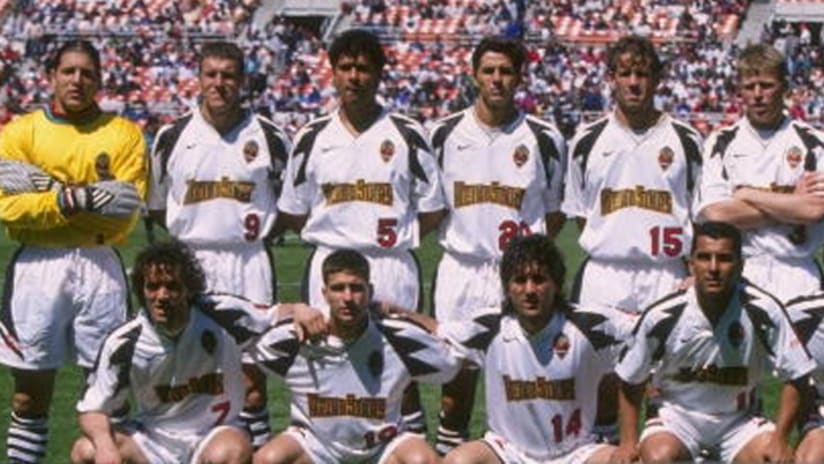
April 13, 1996: The MetroStars (Red Bulls) Debut

April 13, 1996, 30 years ago: The sports rivalry between the New York and Los Angeles metropolitan areas, dormant in soccer since the Los Angeles Aztecs folded after the 1980 North American Soccer League season, resumes, as each area's 1st team in Major League Soccer began play, against each other.

At the Rose Bowl in suburban Pasadena, California, the Los Angeles Galaxy played the New York/New Jersey MetroStars. A crowd of 69,225 attended, and the game was broadcast nationally on ABC.

Cobi Jones opened the scoring for the Galaxy, in the game's 37th minute. Arash Noamouz scored another in the 56th minute. Giovanni Savarese pulled one back for the MetroStars in the 77th, but that was as close as they would get: L.A. won, 2-1.

The "Gals" have gone on to win 5 MLS Cups. The MetroStars, or "Metro" for short, became the New York Red Bulls in 2005, but they and the New England Revolution are the only original MLS teams that have not yet won an MLS Cup.

Despite having had such stars as Savarese, Peter Vermes, Tony Meola, Tab Ramos, Clint Mathis, Lothar Matthäus, Eddie Pope, Juan Pablo Ángel, Thierry Henry, Dax McCarty, Tim Cahill, Sacha Kljestan, and the brothers Shawn and Bradley Wright-Phillips, the Red Bulls haven't gone all the way. They've won the Supporters' Shield, the overall regular-season title, in 2013, '15 and '18; and also finished 1st overall in the Eastern Conference in 2000, '10 and '16. They've reached the MLS Cup Final in 2008 and 2024, but never won it. They've also reached the Final of the U.S. Open Cup in 2003 and '17, but never won that, either.

Friday, February 13, 2026

Who's "Overrated"? And What Does It Mean?

The New York media always elevates its stars above their true level. Not just in baseball. Joe Namath is in his sport's Hall of Fame because he won one particular game. Had he lost it, he wouldn't be in. Lawrence Taylor was no better a linebacker than his Chicago contemporary Mike Singletary. Willis Reed was a really good center and team leader, but because he sank two baskets while in immense pain, he was raised to the level of a sports god. Mark Messier, the most beloved New York Ranger of all time, was one Vancouver goal short of being taken downstairs from Madison Square Garden to Penn Station and literally being run out of town on a rail as someone who failed New York.

This is why New York-based players Mickey Mantle and Willie Mays are considered the two best baseball players of their generation -- and they probably were -- but Hank Aaron usually gets listed behind them, when he was roughly their equal.

The media of Los Angeles also does this. It's why a mediocre manager like Tommy Lasorda is in the Hall of Fame, some people think Steve Garvey should be, Sandy Koufax with his brilliant but relatively short peak is raised above Juan Marichal and Bob Gibson, and Vin Scully, who was average at best, gets called the greatest broadcaster of all time.

Yes, I said it, and I stand by it: Vin Scully was not a great broadcaster.

It's why Kobe Bryant got forgiven for his heinous crime, why LeBron James gets called the greatest player by people who don't fall for the Michael Jordan propaganda, why Jerry West was called the greatest shooter until Steph Curry came along, and why Wayne Gretzky is now thought of as a better hockey player than Gordie Howe. The Los Angeles Times and the L.A. TV stations.

Chicago also does this, to a lesser extent. It's why Jordan gets considered the greatest player ever, Ernie Banks and Walter Payton became beloved far outside "Chicagoland," the 1985 Bears are held up as the pinnacle of defense, and Bobby Hull became the 1st hockey player that most Americans loved. (Gordie Howe was respected, but, south of the Canadian border, never truly loved outside Michigan.)

Boston, too, does this, to a lesser extent. It's why the 1967 Red Sox, and Carl Yastrzemski in particular, became so beloved despite having lost the World Series; why Larry Bird is sometimes put on the same level as Jordan and Magic Johnson; why Bobby Orr became America's most beloved hockey player, even though he wasn't American; why David Ortiz is beloved, and his failed steroid test and other failures of character are ignored; and why Tom Brady is considered the greatest quarterback ever, and not the blatant cheating egomaniac he actually is.

Back to New York, and its media's effects. Derek Jeter is handsome and personable, never embarrassed his team and his fans unlike Alex Rodriguez, and got the job done, pretty much anytime the Yankees needed it. It made him a star.

And so, people who hate New York, and the Yankees in particular, call him "overrated." And, yes, they do have a point: He's not "on the Yankee Mount Rushmore" with Babe Ruth, Lou Gehrig, Joe DiMaggio and Mantle. He's not even the most important player in that era of Yankees: Mariano Rivera made the difference between maybe just 2 or 3 Pennants, and the actually-won 7 Pennants and 5 World Championships.

But Rivera was a pitcher. And a relief pitcher, at that. And foreign, with an accent. That last one shouldn't have been a factor, but it was. Jeter is the son of an interracial couple, and faced no illusions while growing up: As a boy, he was reminded that he was black. But he was an "All-American Boy," and seen as "more white" than Rivera. Jeter was the sellable leader of that 1996-2003 Yankee team, and certainly of the 2009 Champions, compared to Rivera, the problematic Alex Rodriguez, and the superb by very foreign Hideki Matsui.

So Jeter was put above everyone. And people inclined to love the Yankees embraced this, and people inclined to hate the Yankees called him "overrated," and some even said that he "sucks" -- to the point where this was addressed when he hosted Saturday Night Live.

But he was an all-time great. He is, arguably, the best shortstop of the last 100 years. Or, at least, the best player to have played that position. A-Rod? We may never know when he started using performance-enhancing drugs, so how can we know he was truly "better"?

And as for the argument that Jeter was a bad (or even "the worst") defensive shortstop? "Advanced metrics" is bullshit that people who hate somebody made up to feel better about themselves and their team. Use your eyes: Jeter has more "highlight reel" plays preserved than any other player, at any position, including the beloved St. Louis Cardinals shortstop legend Ozzie Smith.

That doesn't mean that DiMaggio or Willie Mays -- or, if we're limiting this to shortstops, Luis Aparicio -- didn't have more great plays that simply weren't preserved for posterity, on film or videotape. It does mean that we have proof that Jeter was a great-fielding shortstop, and anybody who says otherwise is using evidence that simply doesn't hold up.

The Mets' fans of that era needed a star on the same magnitude, so they tried to make one out of Mike Piazza, who, unlike Jeter, might actually be the worst defensive player in the history of his position. The Mets needed a captain on the same magnitude as Jeter, so they tried to make David Wright that. And now, having failed to make Pete Alonso "the face of New York baseball" while Aaron Judge was the better player, they're trying to do it with Francisco Lindor. Bitch, please.

It's important to note: "Overrated" does not mean "bad." A player can be truly great, as Jeter was, and still be overrated, treated as more or greater than he actually is. Occasionally, a player gets called "overrated" so much and for so long, people forget how great he was: He becomes "so overrated, he's underrated."

As Leonard Nimoy would say, It is not logical, but it is often true.

Monday, February 2, 2026

February 2, 1876: The Founding of the National League

February 2, 1876, 150 years ago: The National League of Professional Base Ball Clubs is founded. At some point, "baseball" began to be widely spelled as one word instead of two, and the name was officially changed to "The National League of Professional Baseball Clubs."

That name officially remains. But, from the start, pretty much everybody interested in baseball has called it simply "The National League," or "The NL" for short. When the American League was founded in 1901, baseball fans started calling that "The Junior Circuit," and the older NL "The Senior Circuit."

The National Association of Professional Base Ball Players (NA) was founded in 1871, as baseball's 1st professional league. But it was loaded with problems. Scheduling was an issue. Gambling was an issue. Teams starting and folding, and even moving in mid-season, was an issue. And, following the Philadelphia Athletics winning the 1871 Pennant, the Boston Red Stockings, 4 of whom had been the mighty Cincinnati Red Stockings of 1869-70, winning the next 4 Pennants, by ever-increasing margins, was an issue.

Then there was the Davy Force controversy. After the 1874 season, Force, a 25-year-old infielder, signed with both his 1874 team, the Chicago White Stockings, and the Athletics. It was relatively common that players signed two contracts. A league judiciary committee awarded Force to the White Stockings, because he had signed that contract first. That was the way it was usually done: Figure out who had signed the player first, and send him there, and that was that.

However, Charles Spering, president of the Athletics, became president of the NA, and he ruled that Force belonged to the Athletics. The reversal, a clear conflict of interest, contributed to the motivation to organize a new league led by William Hulbert, a Chicago-based coal magnate, and president of the Chicago White Stockings.

In 1875, the Red Stockings went 71-8, winning the Pennant by 15 games. And 6 teams, including the venerable Brooklyn Atlantics, who never quite made the adjustment to the professional game, dropped out of the NA before completing their schedule.

On October 24, an editorial in the Chicago Tribune called for the formation of an organization of major professional teams, with these members: Chicago‚ Cincinnati‚ Louisville‚ Philadelphia‚ New York‚ Boston‚ and Hartford: "Unless the present Professional Association leadership adopts rules to limit the number of teams allowed to participate in the Championship season‚ all clubs will go broke."

Most likely, this editorial was written by Hulbert. Although he was born in Burlington Flats, New York, just 16 miles from the eventual location of the Baseball Hall of Fame in Cooperstown, Hulbert lived most of his life in Chicago, and said, "I'd rather be a lamppost in Chicago than a millionaire in any other city."
William Hulbert

Also on this day, in Chicago, he met with the Red Stockings' ace pitcher, Illinois native Al Spalding. Hulbert stressed to Spalding that his roots were in Illinois, so he should play for the Chicago club. He also stressed to Spalding that, under the current conditions, the NA is going to result in all teams going broke. Hulbert said there must be tighter control, that teams must stick to their schedules and not leave opponents in the lurch, and that gambling must be driven out of the game.

Spalding, already of a business mind, and about to found the sporting goods company that still bears his name, agreed on all counts, and signed with the White Stockings for the 1876 season. He was at the top of his game that season, going 47-12, but was already more interested in running the ballclub and the sporting goods company, and only appeared in 61 more games, only 27 at the time of his last game in 1878. Not until Sandy Koufax, nearly 90 years later, would so great a player quit so early in his career.
The following winter, on February 2, 1876, Hulbert gathered some other team owners at the Grand Central Hotel in New York, and founded the National League, with these teams, running from east to west: The Boston Red Stockings, the Hartford Dark Blues, the New York Mutuals, the Philadelphia Athletics, the Cincinnati Reds, the Louisville Grays, the Chicago White Stockings and the St. Louis Brown Stockings. The Cincinnati and Louisville franchises were new, while the others were admitted from the NA.

Late in that first season of 1876, the Mutuals and the Athletics fell behind in the standings, and refused to make their respective last Western roadtrips, preferring to play home games against local non-league competition, to recoup some of their financial losses, rather than travel extensively and incur more costs. 

Hulbert reacted to the clubs' defiance by expelling them, an act which not only shocked baseball followers -- New York and Philadelphia were the two most populous cities in the country, and in the League -- but made it clear to the remaining clubs that League scheduling commitments, a cornerstone of competitive integrity, were not to be ignored.

Both literally and figuratively, Hulbert meant business, and the rest of the teams got the message: If he was willing to sacrifice New York and Philadelphia in the name of integrity, then they'd better toe the line.

But, despite now being in by far the biggest city in the new League, Hulbert's White Stockings did not dominate it. They did win the 1st Pennant in 1876, but Boston took the next 2. The White Stockings would win 5 Pennants in 7 seasons from 1880 to 1886, but then didn't win again for another 20 years.

The NL's membership changed dramatically: Of the 8 teams that played the 1882 season, the start of which included Hulbert's death, from a heart attack at only 49 years old, only 2 are still in business today, only 1 in the same city, and it does not have the same name. Hulbert's White Stockings, founded in 1870, were owned by Spalding after Hulbert's death. Spalding sold them in 1902, and they became the Chicago Cubs in 1903. The Boston Red Stockings, founded in 1871, went through a few name changes, before settling in 1912 as the Boston Braves. They moved to Milwaukee in 1953, and to Atlanta in 1966.

But 1882 would see the foundation of the 1st league to seriously challenge the NL: The American Association. From this league would come teams that would later join the NL: The Cincinnati Reds, the Brooklyn Grays, the Pittsburgh Alleghenys and the St. Louis Brown Stockings.

The Reds were the AA's founding team, and, unlike the Braves, are not connected to baseball's 1st openly professional team, the Cincinnati Red Stockings of 1869 and 1870. The Grays went through some name changes before settling on "Dodgers" in 1911. They hired Wilbert Robinson as manager in 1914, and were known as the Brooklyn Robins, but most people still called them the Dodgers, and the old name was officially brought back after Robinson was fired in 1931. They moved to Los Angeles after the 1957 season.

An underhanded transaction in 1890 led to the Pittsburgh team being nicknamed the Pirates, and they officially adopted that name for the 1891 season. The Brown Stockings, or Browns, became the Cardinals in 1900.

The 1883 season would see the NL's Troy Trojans move to New York, where they became the Gothams and, in 1885, the New York Giants, moving to San Francisco after the 1957 season; and the foundation of a new team, the Philadelphia Quakers, who were renamed the Phillies in 1890.

The AA challenged the NL from 1882 to 1891. The Union Association tried to be a 3rd major league, but lasted just 1 season, 1884. The Players' League challenge of 1890 hurt the NL, and crippled the AA, resulting in consolidation into one National League of 12 teams for 1892. But 4 NL teams were dropped after the 1899 season: The Baltimore Orioles, the Cleveland Spiders, the Louisville Colonels and the Washington Senators.

That gave the American League a chance, and it got underway in 1901. Over time, 7 different AL teams would use names, or variations thereon, formerly used by teams in the NL or the AA: The Baltimore Orioles, the Boston Red Sox, the Chicago White Sox, the Milwaukee Brewers, the Philadelphia Athletics, the St. Louis Browns (who later became a different Baltimore Orioles) and the Washington Senators.

Of the 8 original NL cities, only Hartford and Louisville have not had major league teams since 1900. Both are now considered too small for it, although Louisville has been one of the more successful cities in Class AAA, one level below the major leagues.

The National League now consists of:

* Eastern Division: Atlanta Braves (Boston 1871-1952, Milwaukee 1953-1965), Miami Marlins (Florida Marlins 1993-2011), New York Mets, Philadelphia Phillies, Washington Nationals (Montreal Expos 1969-2004).

* Central Division: Chicago Cubs, Cincinnati Reds, Milwaukee Brewers (Seattle Pilots 1969, American League 1969-1997), Pittsburgh Pirates, St. Louis Cardinals.

* Western Division: Arizona Diamondbacks, Colorado Rockies, Los Angeles Dodgers (Brooklyn 1883-1957), San Diego Padres, San Francisco Giants (New York 1883-1957).

Pennants Won, as NL members only:

1. Dodgers, 26: 1890, 1899, 1900, 1916, 1920, 1941, 1947, 1949, 1952, 1953, 1955, 1956, 1959, 1963, 1965, 1966, 1974, 1977, 1978, 1981, 1988, 2017, 2018, 2020, 2024, 2025. Plus, in the American Association in 1889.
2. Giants, 23: 1888, 1889, 1904, 1905, 1911, 1912, 1913, 1917, 1921, 1922, 1923, 1924, 1933, 1936, 1937, 1951, 1954, 1962, 1989, 2002, 2010, 2012, 2014.
3. Cardinals, 19: 1926, 1928, 1930, 1931, 1934, 1942, 1943, 1944, 1946, 1964, 1967, 1968, 1982, 1985, 1987, 2004, 2006, 2011, 2013. Plus, in the AA in 1885, 1886, 1887 and 1888.
4. Braves, 18: 1877, 1878, 1883, 1891, 1892, 1893, 1897, 1898, 1914, 1948, 1957, 1958, 1991, 1992, 1995, 1996, 1999, 2021. Plus, in the National Association in 1872, 1873, 1874 and 1875.
5. Cubs, 17: 1876, 1880, 1881, 1882, 1885, 1886, 1906, 1907, 1908, 1910, 1918, 1929, 1932, 1935, 1938, 1945, 2016.
6. Reds, 9: 1919, 1939, 1940, 1961, 1970, 1972, 1975, 1976, 1990. Plus, in the AA in 1882.
7. Pirates, 9: 1901, 1902, 1903, 1909, 1925, 1927, 1960, 1971, 1979.
8. Phillies, 8: 1915, 1950, 1980, 1983, 1993, 2008, 2009, 2022.
9. Mets, 5: 1969, 1973, 1986, 2000, 2015.
10. Diamondbacks, 2: 2001, 2023.
11. Marlins, 2: 1997, 2003.
12. Padres, 2: 1984, 1998.
13. Nationals, 1: 2019.
14. Rockies, 1: 2007.
15. Brewers, none: Won AL Pennant in 1982.

The Grand Central Hotel was at 673 Broadway, at 3rd Street in Greenwich Village. It opened in 1870, and was advertised as the largest hotel in America. Crooked financier Jim Fisk was murdered there in 1872.
By August 3, 1973, it was a welfare hotel. On that date, part of the building collapsed, killing 4 people. New York University built a dormitory on the site. A plaque honoring the NL's founding is on the Broadway side.
Tuesday, January 6, 2026

January 6, 1996: The Northeast Blizzard of '96

January 6, 1996, 30 years ago: The New York Tri-State Area is hit with its biggest snowfall since official measurements began, 30 inches. That's two and a half feet.

The City had been hit by big blizzards before. The most celebrated one was from March 11 to 14, 1888: It paralyzed the City for days, and led to the construction of the Subway system, and to the City's electric company, Consolidated Edison, moving most electrical lines underground as well. The snowfall was officially measured at 21 inches.
This record held until December 26, 1947, 26 inches. Fortunately, by then, snow removal equipment was mechanized, so the City's paralysis didn't last nearly as long.
A "nor'easter" dropped 20 inches on New York from February 8 to 11, 1969. This one was terribly mishandled by Mayor John Lindsay, who got Manhattan plowed fairly quickly, but not the Outer Boroughs. People there were outraged, and when the Republican Primary for the Mayoral election was held that year, Lindsay was dumped for John Marchi, a State Senator from Staten Island.
The Democrats nominated the City's Comptroller, Mario Procaccino, but he made racist statements, and it looked like any chance for social progress in The City was doomed. But due to New York State's unusual 4-party system, Lindsay was nominated by the Liberal Party, and narrowly won re-election, partly because he had tied his fortunes to those of the Mets, who won the World Series 19 days before the general election. (The 4th party, the Conservative Party, nominated Marchi.) Lindsay won 42 percent of the vote, Procaccino 36, and Marchi 22.
The 1st big blizzard that I can remember struck on February 11, 1983. I was in the 8th grade in East Brunswick, New Jersey, and we were let out at 12:00 Noon instead of the usual 2:05 PM. I spent much of the night dipping a yardstick into the backyard. When the snow topped out, I had it measured at 22 inches. Fortunately, that was a Friday, so most people who worked Monday-to-Friday jobs didn't miss much time, or pay.
That would also be the case with the Blizzard of '96. Still, it was, at least at first, beyond The City's capacity to get people out. Boston, Philadelphia, Baltimore and Washington, D.C. were clobbered as well, getting 18, 30, 22 and 24 inches, respectively.
The federal government was paralyzed politically, as President Bill Clinton, a Democrat, and the Republican-controlled Congress couldn't agree on a budget, so the government was shut down for a while, before Clinton's public popularity forced the Republicans to cave.
Kids sledding on the steps of the U.S. Capitol Building.
A better January 6 for the building than would happen in 2021.
That same day, Willie Brown, long the Speaker of the House of Representatives of the State of California, forced to leave that post because of a stupid newly-passed term limits law, was sworn in as Mayor of San Francisco. After his Inaugural Address, he got a congratulatory phone call from Clinton. Brown told him, "Mr. President, you'd love it here: There's no snow, and no Republicans!" As Brown laughed, a big cheer went up from the crowd in what is, perhaps, America's most liberal city.
Sure, New York has to worry about snow, and extreme heat in the Summer. And San Francisco doesn't. But look at the bright side: We don't have to worry about earthquakes.
The Tri-State Area's basketball teams were lucky: Neither the New York Knicks nor the New Jersey Nets were scheduled, and neither had to postpone a game.

Amazingly, both the New Jersey Devils and the New York Islanders got their games in before the worst of the blizzard hit, while the New York Rangers had the day off: The Devils beat the Washington Capitals, 3-1 at the Brendan Byrne Arena. Reid Simpson scored a goal for the defending Stanley Cup Champions, and Bill Guerin scored 2. The attendance was listed as a full 19,040, but that may be tickets sold, not people actually showing up. The Islanders beat the Ottawa Senators, 5-4, before 12,175 at the Nassau Coliseum.

Thursday, January 1, 2026

January 1, 1966: The New York Transit Strike

Mike Quill
January 1, 1966, 50 years ago: For the 1st time, the New York City Transit Workers Union goes on strike, shutting down the City's Subway and bus systems.
Their contract with the City had expired, and, after threatening strikes before, the union's head, Michael Joseph Quill, called it at 5:00 AM.
This was just 5 hours into the Administration of the new Mayor, John Vliet Lindsay. At his Inaugural Ball that night, the lead entertainer was New York native Sammy Davis Jr., who told the crowd, "Just one day in office, and he's already eliminated crime in the Subways!"
In their issue dated on this day, Billboard magazine's chart of the biggest songs in America, the Hot 100, was topped by "The Sound of Silence," by Paul Simon and Art Garfunkel. It includes Simon's line, "The words of the prophets are written on the subway walls, and tenement halls." But nobody saw the words on this day. 
Lindsay had won the office because he was good-looking, well-spoken, charismatic, smart, and seemed to be paying attention to the City's nonwhite neighborhoods. Though a Republican (he had been a Congressman for 6 years before that), he stood by his Party's stance in favor of civil rights after the national edition of the Party had abandoned it.
You wanted the job, John.
Mike Quill had been a personal friend of the outgoing Mayor, Robert F. Wagner Jr., and worked things out with him rather than go on strike, making what he considered acceptable gains. But Lindsay was not his friend.
Quill was 60, an immigrant from Ireland, a Roman Catholic, a former ditch-digger, who had founded the TWU in 1934, at a time when being in the American labor movement meant that you, quite literally, took your life into your own hands. He had served 12 years on the City Council, with the leftist American Labor Party, earning him the nickname Red Mike.
Lindsay was 44, of English descent, a Protestant, as patrician as you could get, and had pretty much run the year before against the idea of New York's old Democratic political machine, of which Quill's friend Wagner had been a symbol. And each man took it personally.
As Jimmy Breslin wrote in the New York Daily News, "John Lindsay looked at Mike Quill, and he saw the past. And Mike Quill looked at John Lindsay, and he saw the Church of England." Quill was not Boss Tweed, and Lindsay was not Oliver Cromwell. But they had one thing in common: They were stubborn as hell. You couldn't tell either of them anything.
And Quill managed to gain the upper hand in the media. At a time when the Irish were still the best-known ethnic group in New York (if not the biggest), and when not just the TWU, but the police and fire departments were dominated by Irish-Americans, the City that had elected Lindsay with a plurality in a 3-way race, with 45 percent of the vote, decided that it liked Quill better. This pretty much poisoned the political atmosphere and made Lindsay a lame duck, literally from Day One.
Lindsay didn't help himself. He tried to brush it off by saying, "New York is a fun city." "Fun City" soon became a nickname, every bit as sarcastic as calling the New York Mets baseball team "Amazin'" was at the time. What's worse, all of Lindsay's public relations skills, his greatest asset the year before, abandoned him. Evidence of this was his suggestion that "nonessential" workers stay home. When the holiday ended, a lot of people decided they were "nonessential." It was, for all intents and purposes, a sympathy strike.
Lindsay got a judge to issue an injunction against the strike, meaning that Quill was subject to arrest. Shortly after midnight on January 4, Quill said, "The judge can drop dead in his black robes. I don't care if I rot in jail: I will not call off the strike." He was arrested.
If enforcing the law was intended to give Lindsay the upper hand with the public, it backfired massively. Quill was sick, and was taken to Bellevue Hospital. (And not to the hospital's famous psychiatric ward.) The City's sympathy was with Quill.
On January 10, 15,000 workers picketed City Hall. Lindsay knew he had lost, and ordered negotiations to start. On January 13, the strike was settled, on terms the union embraced. 
Quill was released from the hospital on January 25. He made a victory speech to the union that day. He died on January 28. As with Bart Giamatti's fatal heart attack a week after his permanent ban of Pete Rose perhaps dooming Rose's chance of ever being reinstated, Quill's death so soon after his win in the transit strike cast a pall over Lindsay's mayoralty that he was never able to shake. He had a rough time running for re-election in 1969, and didn't dare run for a 3rd term in 1973.
New York would have another transit strike in 1980. That time, Mayor Ed Koch seized the media narrative from the beginning, and made the union out to be the villains, and won.
*
Being New Year's Day, college football bowl games were played: 
* In the Rose Bowl in the Los Angeles suburb of Pasadena, California, UCLA, the University of California at Los Angeles, beat Michigan State University, 14-12. Michigan State had been declared the National Champions before the bowls by the AP, the sportswriters' poll, so this put that into question.
* In the Cotton Bowl in Dallas, Louisiana State University beat the University of Arkansas, 14-7. Arkansas had won a share of the National Championship for the 1964 season, and had they won this game, their Number 2 ranking and Michigan State's loss would have given them a sweep of the polls. But they lost, and were out.
* In the Orange Bowl in Miami, the University of Alabama beat the University of Nebraska, 39-28. Since Alabama went in ranking Number 3, this led to UPI, the coaches' poll, declaring them the National Champions.
* In the Sugar Bowl in New Orleans, the University of Missouri beat the University of Florida, 20-18.

Tuesday, December 30, 2025

December 30, 1950: The Dominoes Record "Sixty Minute Man"

Rock and roll is 75 years old? How can that be? Well, it be.

December 30, 1950, 75 years ago: The Dominoes, an all-black vocal group specializing in rhythm & blues songs, record "Sixty Minute Man" on Federal Records, at National Studios, at 460 West 42nd Street in New York City.

At the time, The Dominoes consisted of singer, pianist, manager and songwriter Billy Ward; tenor Clyde McPhatter; baritones Charlie White and Joe Lamont; and bass singer Bill Brown. Ward had teamed up with white songwriter Rose Marks to write "Sixty Minute Man," in which a man brags about how he's a great lover:

Look-a-here, girls, I'm telling you now:
They call me Lovin' Dan.
I rock 'em, roll 'em, all night long.
I'm a sixty-minute man.

If you don't believe I'm all I say
come up and take my hand.
When I let you go, you'll cry, "Oh, yes:
He's a sixty-minute man!"

There'll be fifteen minutes of kissin'.
Then you'll holler, "Please, don't stop!"
There'll be fifteen minutes of teasin'
and fifteen minutes of pleasin'
and fifteen minutes of blowin' my top!

If your man ain't treatin' you right
come up and see ol' Dan.
I rock 'em, roll 'em, all night long.
I'm a sixty-minute man.

The record was released in May 1951, and within a month, it reached Number 1 on Billboard magazine's R&B chart, holding that top spot for 14 weeks, a record at the time. It actually crossed over onto Billboard's Popular Music chart -- in other words, white people's music -- reaching Number 17. Black singers had done better than that, but they were pop singers like Nat King Cole and Billy Eckstine, not R&B groups or soloists.

If you're asking, "How did a line like 'Fifteen minutes of blowin' my top' get past the censors in 1951?" I don't have an answer. 

Unusual for single records, then as now, the bass singer takes the lead, Bill Brown. There is guitar playing from René Hall, and the drumming is on the 2nd and 4th beats. By a certain definition -- and not just because the words "rock" and "roll" are used together -- this is the very first rock and roll record. 

Another candidate, "Rocket 88" by Jackie Brenston & His Delta Cats -- actually Ike Turner and the band he was using at the time -- was recorded in March 1951 (after "Sixty Minute Man"), released in April (before "Sixty Minute Man"), but didn't debut on the charts until June (after "Sixty Minute Man"). It also has the drumming on the 1st and 3rd beats, which tends to disqualify it from the strict definition of "rock and roll." But then, rock and roll has always been about challenging boundaries, and thus strict definitions don't always apply. So either one of these songs could be claimed as the first.

With his own name on the group, Ward took in most of the group's income, despite the fact that McPhatter was the lead singer on most songs. Ward even had Clyde billed as "Clyde Ward," to make it seem like Clyde was his brother. In 1953, Clyde decided he'd had enough, and left to form a new group, The Drifters, arguably inventing "doo-wop."

In 1955, after 2 years of great success on the R&B charts, Clyde was drafted into the U.S. Army. After serving a year, he started a solo career, while The Drifters built an entirely new lineup led by Ben E. King. After years of hard drinking and drug use, Clyde McPhatter died in 1972, not quite 40 years old.

But back in 1953, Ward was ready for Clyde's departure, as he already had a replacement lined up: Jackie Wilson. Eventually, he got sick of Ward, too, and launched a solo career in 1957. He became known as "Mr. Excitement," and had a bunch of hits.

In 1975, performing for a Dick Clark-sponsored oldies show at the Latin Casino in Camden, New Jersey, across the Delaware River from Philadelphia, Jackie suffered a heart attack -- just as he was singing the opening line of his 1st big solo hit, from 1959, "Lonely Teardrops": "My heart is cryin', cryin'... "

Since throwing his body all over the stage was a part of his act, it took about 30 seconds for people to realize that this collapse wasn't, and it cost his brain precious oxygen. It also didn't help that he was already sweating like crazy, as that was part of his act, too, so that didn't seem like a sign that anything was wrong. He was told that women liked that, and that taking salt tablets would make him sweat more. Those tablets are probably the reason he had a heart attack at the age of 41. He spent the rest of his life in and out of hospitals and nursing homes, dying in 1984.

Bill Brown was even unluckier than McPhatter and Wilson: He got sick of Ward's military-style discipline, left in 1952, joined The Clovers in 1953, and didn't even live to see their success, as he died in 1956. (I've looked for a cause, but I can't find one: Not an illness, not drugs, not an accident, not a murder.) He didn't live to see how his lead vocal would affect rock and roll, inspiring such basses as Fred Johnson of The Marcels (who hit Number 1 in 1961 with a doo-wop version of "Blue Moon") and Melvin Franklin of The Temptations.

René Hall died in 1988, Joe Lamont in 1998, Billy Ward in 2002, and Charlie White was the last survivor, living until 2005. I can find no record of when Rose Marks died, but a photograph of her suggests that she was already middle-aged in 1950, so she has likely been dead for a long time.

Fats Domino, one of the founding fathers of rock and roll, did not name himself for the group: His real name was Antoine Dominique Domino Jr. However, later singer Ernest Evans did take the name "Chubby Checker" as a play on the name "Fats Domino." Still later, in 1970, Van Morrison released the song "Domino," and Eric Clapton formed a group named Derek & The Dominos (no E on the end). Both were tributes to Fats, not Billy Ward's group. (Morrison recorded another song with a tenuous connection to the Dominoes, "Jackie Wilson Said.")

The debate over "the first rock and roll record" continues, but I'm satisfied that it's "Sixty Minute Man" by The Dominoes.