Showing posts with label lyndon johnson. Show all posts

Monday, July 13, 2026

July 13, 1966: Jim Brown Retires

July 13, 1966, 60 years ago: Jim Brown retires from playing football. He is 30 years old.

It is not due to injury. It is because he is a black man who is his own man, and does not like a white man telling him what to do -- unless, possibly, it's by a film director.

Brown had played 9 seasons with the Cleveland Browns, 1957 to 1965, and had led the NFL in rushing yardage in 8 of those seasons, all but 1962. In 1963, he rushed for 1,852 yards, which stood as a single-season record for 10 years. In 1964, he helped the Browns win the NFL Championship, still the last they have ever won. In 1965, he got them back into the NFL Championship Game, losing to the Green Bay Packers.

He was still the best running back in professional football, already the NFL's all-time leading rusher with 12,312 yards (a record that would stand until 1984), and was eventually selected in 1999 by The Sporting News as the greatest player in NFL history.

He was now trying his hand as an actor, filming the World War II movie The Dirty Dozen in London. He was enjoying himself, feeling freer than he ever had.

But preseason training camps were underway, and Browns owner Art Modell told him to leave and come back to join his teammates in Berea, Ohio, 13 miles southwest of downtown Cleveland.

Brown refused, telling Modell, already a noted cheapskate, that he could make more money and sustain fewer injuries as an actor than as a football player. Brown retired from football, taking away the one power that Modell had over him, which was to have an undue affect on his football career, but giving up that football career.

He was 30. As of July 13, 2022, Jim Brown is 86 years old, and has never regretted his decision. As he put it, "What would you rather do: Get hit by Dick Butkus, or make love to Raquel Welch?" (Brown and Welch went on to film one of the earliest interracial love scenes in American movies, in the 1969 Western 100 Rifles. Though she was considered "white," Jo Raquel Tejada was of Bolivian descent.)

He went on to star in several "blaxploitation" films, including the Slaughter series. In 1988, he was among the stars of such films who joined Keenen Ivory Wayans in his parody of such films, I'm Gonna Git You Sucka, playing Slammer to Isaac Hayes' Hammer, the two men's characters having retired from fighting crime on the streets of their city to run a barbecue restaurant.

Modell made peace with Brown, and named him a team consultant. Modell continued to own the Browns until 1995, never reaching another World Championship game, until moving them to become the Baltimore Ravens. They won Super Bowl XXXV in 2001. He sold the team in 2003, and died in 2012, beloved in Maryland, but despised in Ohio.

A new Browns team began play in 1999, and Brown was named a consultant to their front office. He still holds this post. A statue of him stands outside their home, FirstEnergy Stadium, built in 1999 on the site of their home in his era, Cleveland Municipal Stadium.

Brown died on May 18, 2023, at the age of 87.

July 13, 1966 was a Wednesday. Singer Gerald LeVert was born. This was also the night that Richard Speck killed 8 student nurses in Chicago.

Thursday, June 25, 2026

June 25, 1966: The Brooklyn Navy Yard Closes

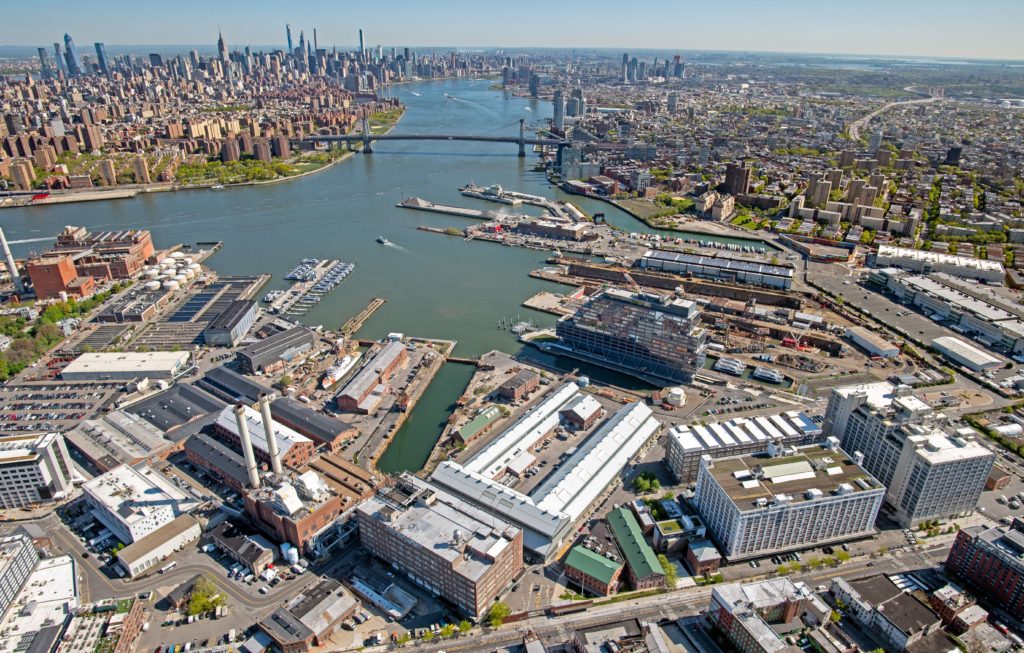
A recent photo of the Navy Yard,
which has been redeveloped for residential and retail use.
The Williamsburg Bridge is in the background.

June 25, 1966, 60 years ago: The Brooklyn Navy Yard is closed, emblematic of New York City's loss of industry.

At the height of World War II production, what was officially named the New York Naval Shipyard had 75,000 people working there. In 1947, it was down to 10,000 workers. It doubled back up to 20,000 by the end of the Korean War in 1953, but after that war ended, it was back to 10,000 again.

In 1960, with the Yard's workforce 11,000 strong, the aircraft carrier USS Constellation was being built there, and an accident caused a fire that killed 49 people. The investigation showed that, although this fact was not responsible for the fire, the Yard was obsolete, especially since it was determined that, in order to reach the open sea, ships built there had to pass under the Manhattan Bridge and the Brooklyn Bridge; and ships going there for repairs also had to pass under those bridges -- and most new ones were too big. 

And so, on June 25, 1966, a closing ceremony was held at the Yard, with work stopping for good on June 30, and the last 9,500 workers were laid off.

This was symbolic of the loss of industry in New York City. The loss of jobs crushed the Borough economically, and was much more damaging to the communities of Brooklyn than the so-often-cited move of baseball's Brooklyn Dodgers in 1957 had been.

Indeed, it was crushing to the City as a whole. It wasn't the first time industry had been phased out: The Gashouse District, between 1st Avenue and the Hudson River, from 14th to 23rd Street, its name already appropriated for baseball's St. Louis Cardinals, "the Gashouse Gang," was torn down in World War II, to build the housing projects Stuyvesant Town and Peter Cooper Village.

*

June 25, 1966 was a Saturday. Basketball Hall-of-Famer Dikembe Mutombo was born on this day. 

Thursday, March 12, 2026

March 12, 1956: The Southern Manifesto

Southern Senators, led by Strom Thurmond of South Carolina

March 12, 1956, 70 years ago: The Declaration of Constitutional Principles is signed, by 19 members of the U.S. Senate and 82 members of the U.S. House of Representatives, all from States that had been in the Confederate States of America.

Since there was not a goddamned thing about it that was constitutional, it became known as the Southern Manifesto, allowing people on the right side of the struggle for civil rights to do what these rednecks had been doing to them for years: Comparing them to Communists.

The main author was Senator Strom Thurmond of South Carolina. In 1948, as his State's Governor, he had briefly left the Democratic Party to run as the nominee for President of the States' Rights Party. From that point onward, Southern Democrats who opposed civil rights were known as "Dixiecrats."

It was written in response to the unanimous decision of the U.S. Supreme Court, 2 years earlier, in Brown v. Board of Education of Topeka, Kansas, declaring that racial segregation in public schools was unconstitutional.

The Declaration included these words: "The unwarranted decision of the Supreme Court in the public school cases is now bearing the fruit always produced when men substitute naked power for established law."

This was a bald-faced lie: The decision was warranted, and it was a strike against naked power, in the form of "Jim Crow" laws that overturned established law.

It also said: "The original Constitution does not mention education. Neither does the 14th Amendment nor any other amendment. The debates preceding the submission of the 14th Amendment clearly show that there was no intent that it should affect the system of education maintained by the States."

This was true, but it covered up the text of the 14th Amendment: "No State shall make or enforce any law which shall...deny to any person within its jurisdiction the equal protection of the laws." This is known as the Equal Protection Clause.

It also said: "This unwarranted exercise of power by the Court, contrary to the Constitution, is creating chaos and confusion in the States principally affected. It is destroying the amicable relations between the white and Negro races that have been created through 90 years of patient effort by the good people of both races. It has planted hatred and suspicion where there has been heretofore friendship and understanding."

This was a lie: There had not been friendship. And the Court's decision didn't create confusion; it clarified the law.

Three Democratic Senators from Southern States did not sign: Albert Gore and Estes Kefauver of Tennessee, and the Majority Leader, Lyndon Johnson of Texas. In the House, 16 of 21 Democrats from Texas refused to sign it, including the Speaker of the House, Sam Rayburn, and a future Speaker, Jim Wright. Also refusing to sign were 3 of the 11 Democrats from North Carolina; and 1 of the 7 from Florida, Dante Fascell.

The following year, Thurmond launched the longest filibuster the Senate had yet seen, in a vain attempt to stop the Civil Rights Act of 1957. When the Civil Rights Act of 1964 was passed, he became the 1st Dixiecrat to switch to the Republican Party. There would be many more.

Thurmond turned out to be the last-serving member who signed the Southern Manifesto, serving until 2003, shortly after his 100th birthday, and dying a few months later. The last surviving signer was Richard Poff of Virginia, who died in 2011.

The last-serving member who refused to sign was Jack Brooks of Texas, who served until 1994. The last surviving refuser was the aforementioned Jim Wright, who died in 2015.

Monday, August 11, 2025

August 11, 1965: The Watts Riot

August 11, 1965, 60 years ago: A race riot breaks out in Watts, in South Central Los Angeles.

Like the connected Brooklyn neighborhoods of Flatbush, Crown Heights, Bedford-Stuyvesant, Bushwick and East New York, Watts had been a white and Jewish neighborhood before World War II. But when the returning veterans took advantage of housing opportunities to move to nicer places, poor black people moved in, and found it harder to move up. 

There had already been a black community in Los Angeles, having arrived there as a result of what's known as the Great Migration. In the 1910s and '20s, thousands of black people left the South, and headed for the industrial cities of the Northeast and the Midwest, and some went to Los Angeles, looking for jobs without segregation, with limited success.

Then came another migration, this time of white people out of the South. The Great Depression, its bank foreclosures on farms, and farms rendered useless by the Dust Bowl forced a lot of people out of the Southern States of Oklahoma and Arkansas.

These people, derisively nicknamed Okies and Arkies, headed west on U.S. Route 66, and looked for farm jobs in the interior of California. Some of them kept going and reached Los Angeles.

Ray Manzarek, keyboard player for the Los Angeles-based rock band The Doors, made the point that some of these migrants joined the Los Angeles Police Department, bringing their Southern attitude with them. This manifested itself in the Zoot Suit Riots of 1943, when LAPD officers joined with white soldiers and sailors from the South, stationed in LA, to attack Mexican American teenagers wearing the fancy suits of the period.

As is so often the case, once a family enters law enforcement, it stays there, and the rednecks-turned-cops of 1940s L.A. had sons who became urban racist cops in the 1960s. And the already-present conservative oil and film industry executives of the city were all too happy to accept this.

By 1965, Southern California was more Southern than white liberal America realized, or perhaps was willing to admit. Indeed, to this day, many people, including LAPD officers, call Southern California "The Southland."

As with the race riots in Harlem and North Philadelphia the year before, and the Newark and Detroit in 1967, the event that sparked the Watts Riot was an act of white police brutality on a black person. 

On August 11, 1965, Marquette Frye, 21, was pulled over for perceived drunken driving. After he failed a field sobriety test, officers attempted to arrest him. He resisted arrest, and was hit in the face with a baton. 

A crowd of onlookers had gathered. As with the Newark Riot two years later, an erroneous belief that the situation was even worse then it was led to the start of civil unrest, which in this case lasted six days.

The riots were finally suppressed by the California National Guard, and led to 34 deaths, 3,438 arrests, and $40 million in property damage -- about $408 million in 2025 money.

Marquette Frye found it difficult to get a job after the riots, even using his mother's maiden name for a time, before he finally found a living as a motivational speaker, on the subject of civil rights. But his health was not good, and in 1986, only 42 years old, he died of pneumonia. He did not live to see the beating of Rodney King in 1991, the travesty of a verdict a year later, and the even worse race riots that followed that.

August 11, 1965 was a Wednesday. Actress Viola Davis was born.

Wednesday, August 6, 2025

August 6, 1965: The Voting Rights Act

August 6, 1965, 60 years ago: President Lyndon B. Johnson signs the Voting Rights Act of 1965 into law. It creates legal mechanisms for the federal government to enforce the 15th Amendment to the Constitution of the United States, which, at least in theory, had guaranteed the right to vote for all adult American citizens since its ratification in 1870.

(In 1920, the 19th Amendment was ratified, ensuring that women were included. In 1971, the 26th Amendment was ratified, lowering the minimum voting age from 21 to 18.)

But "Jim Crow" laws has been enacted by Southern States, making it all but impossible for black people to vote, thus guaranteeing that white supremacists would be elected to offices in those States. 

And when people protested, and tried to work around the Jim Crow laws, the bigots fought back. On June 21, 1964, 3 activists -- white Northern Jews Andrew Goodman and Michael Schwerner, and local black man James Chaney -- were murdered in rural Mississippi by members of the Ku Klux Klan.

On March 7, 1965, activists began a march from Selma, Alabama to the State Capitol in Montgomery, but before they could leave the city limits of Selma, they were beaten by policemen. 

Finally, Johnson had had enough. He had lobbied Congress to pass the Civil Rights Act of 1964, which he signed into law on July 2 of that year. But that bill was put into play by his predecessor, President John F. Kennedy. The Voting Rights Act would be his bill, a key fixture of his "Great Society," along with Medicare, Medicaid, his education reforms and his "War On Poverty."

On March 15, 1965, he addressed a Joint Session of Congress, and demanded the voting rights bill. And this man, born in the Southern State of Texas in 1908, with the slow drawl of an accent to match, invoked the title of the unofficial theme song of the Civil Rights Movement: "It is not just Negroes, but really it is all of us, who must overcome the crippling legacy of bigotry and injustice. And we shall overcome."

The Senate passed the bill on May 26. The House passed it with an amendment on July 9. It went to a conference committee to settle the differences between the 2 versions. The House passed it again on August 3, by a vote of 328-74. The Senate passed it the next day, 77-19. All 19 votes against it -- 17 Democrats and 2 Republicans -- were from Southern States.

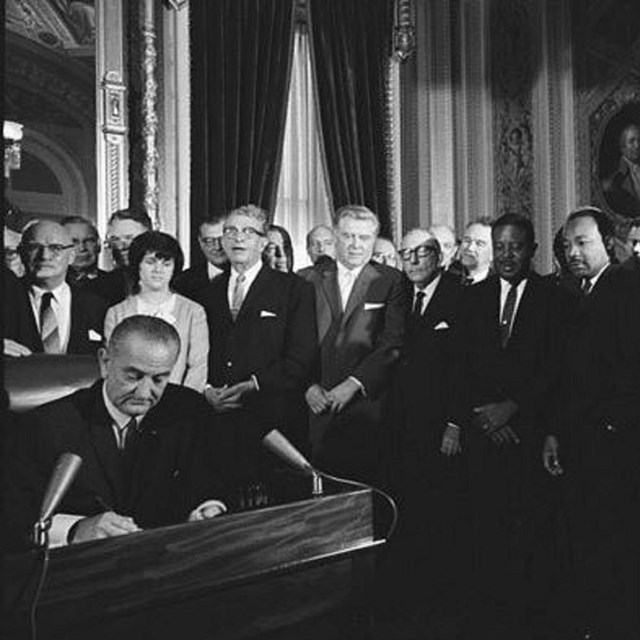
LBJ signed the Voting Rights Act at the White House -- with Dr. Martin Luther King, Montgomery Bus Boycott launcher Rosa Parks, and Selma march leader and future Congressman from Georgia John Lewis as invited attendees -- just 1 week after signing Medicare and Medicaid into law. It was the high point of American liberalism. 

Just 5 days later came the Watts riot in Los Angeles, and reports from the Vietnam War began to get more troubling. For the Johnson Administration, it was downhill from there.

Amendments designed to improve the Voting Rights Act were passed by Congress in 1970, 1975, 1982, 1992 and 2006. Each time, it was a Republican President who signed these improvements into law.

But on June 25, 2013, in the case of Shelby County v. Holder, the Supreme Court of the United States ruled that Section 4(b) of the Act was unconstitutional, because the coverage formula was based on data over 40 years old, making it no longer responsive to current needs, and therefore an impermissible burden on the constitutional principles of federalism and equal sovereignty of the States.

The vote was 5-4. The 5 Justices striking Section 4(b) down were all appointed by Republican Presidents: Chief Justice John Roberts, Antonin Scalia, Anthony Kennedy, Clarence Thomas and Samuel Alito. Roberts and Alito had been appointed by George W. Bush, installed as President by a previous SCOTUS decision (including the votes of Scalia, Kennedy and Thomas), and their votes must be viewed in that light.

The 4 Justices refusing to tamper with the Act were all appointed by Democratic Presidents: Ruth Bader Ginsburg, Stephen Breyer, Sonia Sotomayor and Elena Kagan.

Since this decision, States with Republican-controlled legislatures and Governors have passed new laws designed to make it harder for black and Hispanic people to vote. It's been called "Jim Crow Jr." and "James Crow, Esquire."

The John Lewis Voting Rights Act, first proposed in 2021 after the former Congressman's death, designed to fully restore and update the 1965 Act, remains stalled in Congress. In the 2024 election, voter suppression in certain States, especially in the Southern State of Georgia, helped ensure Donald Trump's return to the Presidency. In 2025, the Supreme Court, now with a 6-3 conservative majority, announced it would take up a case that would essentially wipe the Voting Rights Act out.

But, hey, you wanted cheap eggs, and for immigrants to stop eating the dogs (which they weren't doing).

Wednesday, July 30, 2025

July 30, 1965: Medicare and Medicaid Become Law

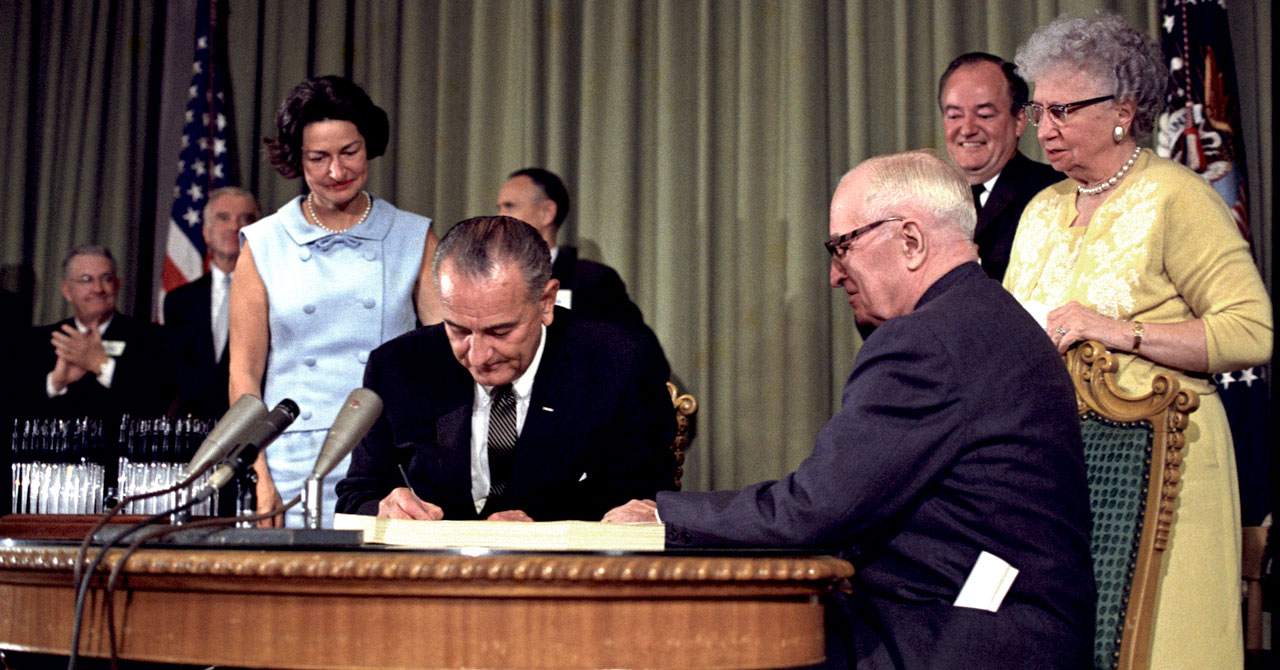
July 30, 1965, 60 years ago: President Lyndon B. Johnson signs the Social Security Amendments of 1965 into law, in a ceremony at the Harry S Truman Presidential Library and Museum, in Independence, Missouri, outside Kansas City.

Former President Truman had tried to get a national health service, offering universal coverage, similar to Britain's passed in 1949, but failed. Holding the signing ceremony at his library was a tribute to his efforts. Also in attendance were each man's wife, Claudia "Lady Bird" Johnson and Elizabeth "Bess" Truman; Vice President Hubert Humphrey, and Governor Warren Hearnes of Missouri, for whom the University of Missouri's arena is named.

Although the Amendments increased benefits for people who met the legal definition of being disabled, the two main components were Medicare and Medicaid. Medicare provides coverage for healthcare for people aged 65 and up. Medicaid helps with health care costs for people of limited income, including nursing home and personal care services, which Medicare doesn't cover.

Medicare and Medicaid joined the Office of Economic Opportunity (a.k.a. "the War On Poverty"), and two major education reform bills to form Johnson's "Great Society." Within days of signing this bill, LBJ would add the Voting Rights Act of 1965. It remains the high point of American liberalism.

Canada passed National Health Service with universal coverage in 1967. Australia did so in 1984. In both cases, they use the term Medicare. In America, however, that term is still limited to health care for senior citizens.

Sunday, May 25, 2025

May 25, 1965: Ali-Liston II: The Phantom Punch

May 25, 1965, 60 years ago: A fight is held for the Heavyweight Championship of the World. It's not the greatest such fight. But it might be the most controversial. Certainly, it is the strangest.

Arguably, the most significant sports building in Maine is The Colisée in Lewiston, about 36 miles north of Portland. Not because it was home to the Maine Nordiques, a farm team of hockey's Quebec Nordiques, from 1973 to 1977. Not because it hosted the Lewiston Maineiacs of the Quebec Major Junior Hockey League from 2003 to 2011, before they moved to Sherbrooke from whence they came. Not because it hosted the Portland Pirates in the 2013-14 season while the Cross Insurance Arena in Portland was being renovated. Not because it is now home to another team named the Maine Nordiques, of the North American Hockey League.
No, it's because, after the Boston Garden balked at holding it due to both men's controversies, the rematch between Heavyweight Champion Muhammad Ali and former Champion Charles "Sonny" Liston as held at this arena, then known as the Central Maine Civic Center, on May 25, 1965. Built in 1958, it is the smallest building to host a Heavyweight Title fight: 3,677 seats.

Ali, born Cassius Clay, had taken the title from Liston on February 25, 1964 in Miami Beach. Shortly thereafter, he announced his name change and his conversion to Islam. Both men were shrouded in controversy: Ali due to his association with the Nation of Islam, Liston due to his status as an ex-convict and his suspected ties to organized crime. Lewiston was chosen as a site because boxing's governing bodies were committed to a New England venue, but nobody else in the 6-State region (Maine, New Hampshire, Vermont, Massachusetts, Rhode Island and Connecticut) seemed to want it.

To make matters worse, the fight, originally scheduled for November 16, 1964, had to be delayed, as Ali needed surgery due to a hernia. So it was delayed to May 25, 1965, allowing all the simmering resentments to come to a near boil. There was even talk that the fight was fixed -- though both men's fans were suggesting it was fixed for the other.

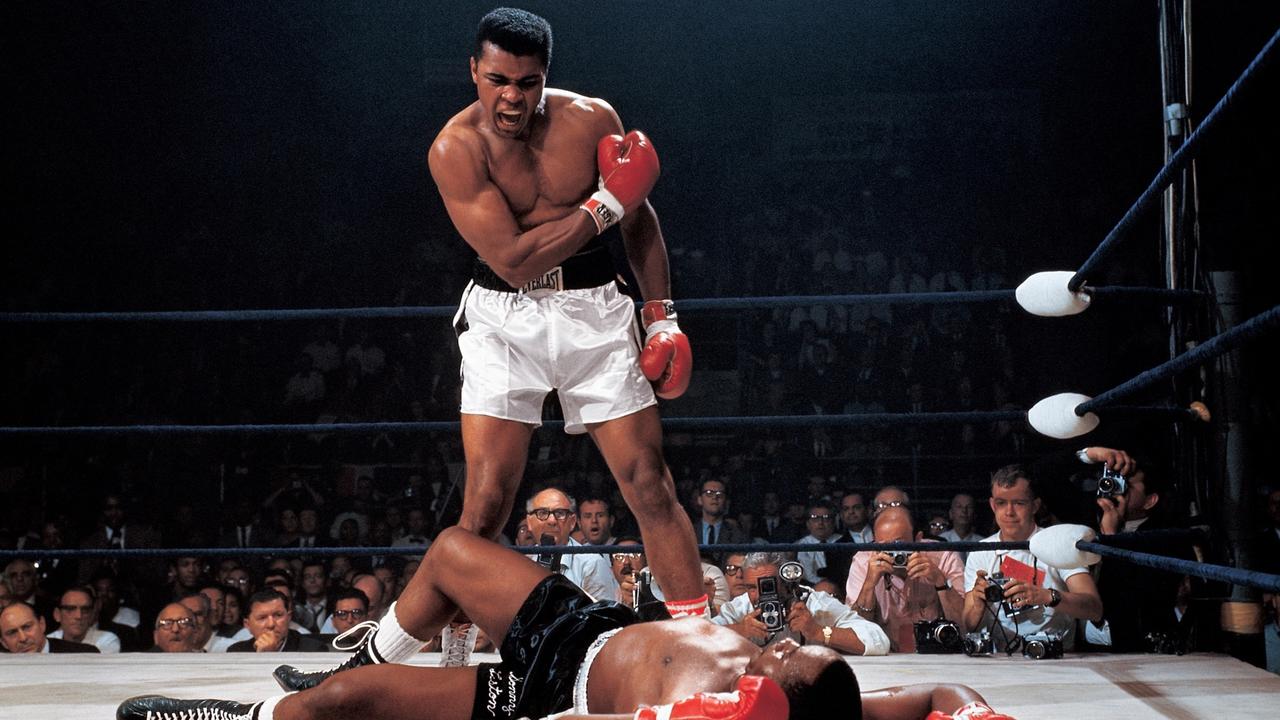
The referee was former Champion Jersey Joe Walcott. Both fighters were booed upon their introductions. Midway through the 1st round, Liston threw a left jab, and Ali went over it with a fast right, knocking the former Champion flat on his back. Liston rolled over, got to his right knee, and then fell on his back again.

Walcott had a hard time getting Ali to go to a neutral corner. Ali initially stood over Liston, yelling, "Get up, sucker!" At this point, Neil Leifer of Sports Illustrated took the picture above, one of the most famous photographs in sports history.

When Walcott got back to Liston, and looked at the knockdown timekeeper, Francis McDonough, to pick up the count, Liston had fallen back on the canvas. Walcott never did pick up the count. He said he could not hear McDonough, who did not have a microphone. Also, McDonough did not bang on the canvas or motion a number count with his fingers. McDonough, however, claimed Walcott was looking at the crowd and never at him.

After Liston arose, Walcott wiped off his gloves. He then left the fighters to go over to McDonough. Waltcott later said McDonough had told him, "I counted him out. The fight is over." Nat Fleischer, editor of The Ring magazine, had no authority over the fight, but he backed McDonough up, saying the fight should be over. Walcott then rushed back to the fighters, who had resumed boxing, and stopped the fight, awarding Ali a knockout victory.

It remains one of the quickest heavyweight title knockouts in history. Many in the small crowd had not even settled in their seats when the fight was stopped. The official time of the stoppage was announced as 1:00 into the first round, which was wrong. Liston went down at 1:44, got up at 1:56, and Walcott stopped the fight at 2:12.

McDonough and Fleischer were wrong in their interpretation of how the rule should have been applied. Under the rule, the timekeeper is supposed to start the count at the time of a knockdown. The referee's duty is to get the boxer scoring the knockdown to a neutral corner, pick up the count from the timekeeper. and continue it aloud for the knocked down boxer.

Nevertheless, Liston was down for 12 seconds -- 2 seconds fewer than Gene Tunney was down in his "Long Count" fight with Jack Dempsey in 1927. But Liston was no Tunney. He was more like the Mike Tyson of his era: Show him that you're not afraid of him, and that you can hit him, and he would fold, or even start cheating. In his 1st fight with Ali, he tainted his gloves to try to blind Ali. In the 2nd fight, he never got the chance to cheat.

Some people wondered if Ali had even hit Liston, or if Liston had gone down on his own, quitting the way he'd quit on his stool between the 6th and 7th rounds of their 1st fight. The suggestion was that he lost on purpose for more money from gamblers -- in ring parlance, "took a dive." The film shows this not to be the case: It clearly shows that Ali's punch was no "Phantom Punch." Instead, it had lifted Liston off the canvas entirely. Liston didn't dive: He fell, from being hit.

James Braddock was Heavyweight Champion from 1935 to 1937. He said of Ali, "I have a feeling that this guy is a lot better than any of us gave him credit for. It isn't the knockout punch that sticks in my mind as much as a punch he let go earlier... It was a right to Liston's jaw, and it shook him to his shoetops. For all we know, it could have been the one that set up the knockout."

Rocky Marciano was Heavyweight Champion from 1952 to 1955. After seeing the replay, he said, "I didn't think it was a powerful punch when I saw the fight from ringside. Now, I think Clay, seeing the opening, snapped the punch the last six inches." But he still didn't think the punch was hard enough to be a knockout, only a knockdown.

Liston had 16 more fights, winning 15 of them, 14 by knockout. So the suggestion that "He was never the same fighter" is ridiculous. But he never got another shot at the title, not even after Ali was stripped of it in 1967, following his refusal to accept being drafted into the U.S. Army. Of course, by then, Liston was officially 35 years old -- but Walcott had been 37 when he won the title. Liston died in 1970, also under mysterious circumstances.

McDonough died in 1968, Fleischer in 1972, Walcott in 1994.

Tuesday, April 15, 2025

April 15, 1965: John Havlicek Steals the Ball

April 15, 1965, 60 years ago: Game 7 of the NBA Eastern Conference Finals, at the Boston Garden. The Boston Celtics led the Philadelphia 76ers 110-109, but a rare mistake by Russell gave the Sixers the ball with just a few seconds left on the clock.

If the Sixers could score, they would end (or, at least, interrupt) the Celtic dynasty, and head to the NBA Finals against the Los Angeles Lakers, who had wrapped up the Western Conference Championship 2 days earlier.

Hal Greer was getting ready to inbound the ball, and if the Sixers could get it to Wilt Chamberlain, that would probably be it. First, Greer saw Chet Walker (Number 25 in the photo above), and tried to get the ball to him.

John Havlicek had other ideas. Johnny Most had the call, on WHDH, 850 on the AM dial (now WEEI):

Greer is putting the ball in play. He gets it out deep, and Havlicek steals it! Over to Sam Jones! Havlicek stole the ball! It's all over! It's all over! Johnny Havlicek is being mobbed by the fans! It's all over! Johnny Havlicek stole the ball! Oh my, what a play by Havlicek at the end of this ball game!

"I knew he had 5 seconds to inbound," Havlicek said at the time. "So I started counting to myself: '1,001, 1,002, 1,003.' Usually, something has happened by then. So, by 1,003 and a half, I started to peek a little more."

The film always confused me. The player dribbling the ball up the court is clearly a black man, who, as Most pointed out, was Sam Jones. Havlicek was still playing when I was a little kid, so I knew he was white. If Havlicek was the one who stole the ball, why was he not the man dribbling up the court? The film shows him jumping and just tipping the ball with his hand, and Jones retrieving it. It's a "Blink and you'll miss it" play.

But it's become the most famous single play in NBA history -- due to Most doing for it what Russ Hodges did for Bobby Thomson's home run to win the New York Giants the 1951 National League Pennant, and, in each case, the moment did the same for the man -- and 2nd only to Willie Mays' catch in the 1954 World Series as the most famous defensive play in the history of sports.

The Celtics went on to beat the Lakers in the Finals, having already done so in 1959 (while the Lakers were still in Minneapolis), 1962 and 1963; and did so again in 1966, 1968 and 1969, with Chamberlain and the 76ers finally breaking through in 1967, beating the San Francisco (now Golden State) Warriors.

Havlicek would be a member of 8 NBA Championship teams with the Celtics, the last in 1976. The current version of the NBA Championship Trophy, now named for former Commissioner Larry O'Brien, was introduced the following year, so "Hondo" never won the trophy he's holding in this photo. The predecessor Trophy, and this trophy until O'Brien's retirement as Commissioner in 1984, was named for the Celtics' founder and owner, Walter Brown.
Havlicek was elected to the Basketball Hall of Fame, and named to the NBA's 50th and 75th Anniversary Teams. The Celtics retired his Number 17. He died in 2019. I don't know if he ever met Mays. 

Wednesday, April 9, 2025

April 9, 1965: The Astrodome Opens

April 9, 1965, 60 years ago: The Astrodome opens in Houston, Texas, with an exhibition game between the Houston Astros and the defending American League Champions, the New York Yankees.

The Astros had begun play in the National League in 1962, as the Houston Colt .45s. Colt Stadium was never meant to be more than a stopgap facility until the Harris County Domed Stadium could open. It was necessary, due to not just Houston's heat and humidity, but mosquitoes: Los Angeles Dodger pitcher Sandy Koufax said, "Some of those bugs were twin-engine jobs."

The dome was the brainchild of the team's owner, Roy Hofheinz, a State Representative from 1934 to 1936, a Harris County Judge from 1936 to 1944, and Mayor from 1953 to 1955. Despite being Mayor of the State's largest city, he was known as "Judge Hofheinz" for the rest of his life.

It was the 1st roofed stadium in the modern world, seating 46,000 for baseball and 50,000 for football. Much of where the outfield's upper deck would have gone was occupied instead by what was then the world's largest and most active scoreboard. Houston proclaimed the stadium "The Eighth Wonder of the World."
They couldn't have chosen a better opponent: The Yankees had won 29 of the last 44 Pennants, and had such stars as Mickey Mantle, Whitey Ford, Roger Maris and Joe Pepitone. And, sure enough, following a ceremonial first ball thrown out by Texas' own Lyndon Baines Johnson, the 36th and current President of the United States, Mantle hit the dome's 1st home run in the 4th inning.

But the Astros tied the game with a fielder's choice in the 6th. With 2 out in the 7th, Johnny Blanchard doubled, and Yankee pitcher Mel Stottlemyre helped his own cause with a hit. But Jimmy Wynn, known as the Toy Cannon because he wasn't very tall but was very strong, threw Blanchard out at the plate.

The game went to extra innings. In the bottom of the 12th, new Yankee manager Johnny Keane sent Pete Mikkelsen out to pitch. Wynn beat out an infield single, and stole 2nd. Bob Lillis and Ron Brand struck out. Astro manager Luman Harris sent up the Astros' best-known player, former Chicago White Sox superstar Nellie Fox. He looped a hit over Yankee shortstop Tony Kubek, and the Astros had won, 2-1.

Three days later, on April 12, 1965, the 1st game at the Astrodome that counted was played. The Astros lost to the Philadelphia Phillies, 2-0. Dick Allen hit the 1st home run.

The dome's skylights made it hard for fielders to see the ball. So the lights were painted over. Then the grass died. For the 1966 season, a plastic grass made by the Monsanto Corporation was installed. Astroturf was born. The Dark Ages had begun.

Koufax saw some of the bounces the ball took on it, and said, "I was one of those guys who pitched without a cup. I wouldn't do it on this stuff." And Allen, who trained racehorses, said, "If a horse can't eat it, I don't want to play on it." And that was before football fans began to see what Astroturf did to the human knee.

The Astros would reach the Playoffs in 1980, 1981, 1986, 1997, 1998 and 1999; and host the All-Star Game in 1968 and 1986, before moving into what would a new stadium in 2000, known first as Enron Field, and then, after the collapse of Enron, it became Minute Maid Park in 2002, and now Daikin Park in 2025.

The University of Houston football team moved into the Astrodome for the 1965 season, and won the Southwest Conference while playing there in 1976, 1978, 1979 and 1984, and the Conference USA title in 1996. The dome hosted the Bluebonnet Bowl from 1968 to 1987, and the Houston Bowl in 2000 and 2001.

The dome hosted pro football with the Oilers, who started in the the AFL and moved in for 1968, and into the NFL in 1970, until 1996 when they moved to Tennessee; the original version of the Houston Texans, in the World Football League in 1974; and the Houston Gamblers, in the United States Football League in 1984 and 1985.

It hosted some home games of the NBA's Houston Rockets from 1971 to 1975. It hosted the original North American Soccer League, with the Houston Stars in 1967 and 1968; and the Houston Hurricane in 1978, 1979 and 1980. It hosted the NCAA Final Four in 1971, with UCLA winning.

And it hosted such stunt events as college basketball's Houston vs. UCLA "Game of the Century" in 1968, and tennis' "Battle of the Sexes" where Billie Jean King beat Bobby Riggs in 1973. Elvis Presley sang there in 1970 and 1974. (The Beatles could have played there on their 1965 and 1966 tours, but didn't.) It hosted Selena Quintanilla-Perez's last concert in 1995, and Jennifer Lopez's recreation of it for the 1997 film Selena.

Muhammad Ali defended the Heavyweight Championship of the World there, against Cleveland Williams in 1966 and Ernie Terrell in 1967. Evel Knievel jumped over 13 cars inside on back-to-back nights in 1971, but canceled a plan to jump over the dome entirely. It also hosted the 1992 Republican Convention, a disgusting festival of bigotry that presaged the Trump era.

But the building hosted only the 1 Final Four, and never hosted a Super Bowl: When Houston hosted Super Bowl VIII in 1974, it was held at Rice University Stadium, because it then had 10,000 more seats.

And the teams began to leave. An expansion of the stadium to 54,370 for baseball and 62,439 for football, scaling back the famous scoreboard, didn't help. Oilers owner Bud Adams hated the lease, almost moved the team to Jacksonville, and finally did move it to Tennessee after 1996. At that point, UH moved back to an on-campus facility. And when Major League Soccer added the Houston Dynamo, they groundshared with UH.

The dome housed thousands of evacuees from Hurricane Katrina in 2005. But Reliant Stadium, now NRG Stadium, opened next-door in 2002, to host the Texans, and it has hosted the Super Bowl and the Final Four.

Today, the Astrodome is still the most famous building in the State of Texas, but it now hosts nothing. "The Eighth Wonder of the World" has seen its time come and go. Since the SkyDome (now the Rogers Centre) opened in Toronto in 1989, the move has been toward stadiums with retractable roofs. Astroturf, deadly to various parts of the body but especially to knees, has been mostly replaced with FieldTurf, a softer, better-cushioned artificial grass.

When the Astros moved out, a writer (whose name I've sadly forgotten) compared it to the New York State Pavilion at Flushing Meadow-Corona Park, and called them "relics of a future that never came to pass." Various plans have been floated as to what to do with the Astrodome, but nothing has been approved. So it just sits there, waiting... for something. Anything, even demolition, but nobody can even agree on how to do that.

In 1982, another dome, the Metrodome in Minneapolis, would open, named for Hubert H. Humphrey, former Mayor and U.S. Senator from Minnesota, elected Vice President with Johnson in 1964. Roosevelt Stadium in Jersey City, which opened in 1937, was named for Franklin D. Roosevelt. In 1972, the Harry S Truman Sports Complex opened in Kansas City, including the Royals' Kauffman Stadium and the Chiefs' Arrowhead Stadium. And, briefly, War Memorial Stadium in Buffalo was named Grover Cleveland Stadium.

If LBJ had managed to get a peace deal in Vietnam -- or if Humphrey had won the 1968 election, removing the need for LBJ to get one -- the Astrodome might well have been renamed the Lyndon B. Johnson Astrodome. But the Vietnam War would forever add a "Yes, but... " to all his achievements.

Saturday, March 15, 2025

March 15, 1965: President Lyndon B. Johnson Says "We Shall Overcome"

LBJ addressing Congress, in front of Vice President Hubert Humphrey
(left) and Speaker of the House John McCormack

March 15, 1965, 60 years ago: President Lyndon B. Johnson speaks before a Joint Session of Congress, on the need for a Voting Rights Act.

The speech comes 8 days after "Bloody Sunday," when demonstrators attempting to march from Selma, Alabama to the State capital in Montgomery were beaten by local police. Having gotten the Civil Rights Act of 1964 passed the previous summer, and with the biggest majorities that the Democratic Party has had since the 1937-38 session, Johnson now knew it was time to act.

As as a native of Texas, he had previously resisted advances in civil rights. At the time, it was a requirement for a Southerner who wanted to stay in office. But after he became the Senate Majority Leader in 1955, he began to open up to the idea. He was one of the few Southern Senators who refused to sign the Southern Manifesto of 1956.

In a speech written by Richard Goodwin, one of the few White House employees he had kept from the John F. Kennedy Administration, he said: 

There is no Negro problem. There is no Southern problem. There is no Northern problem. There is only an American problem...

Our mission is at once the oldest and the most basic of this country: To right wrong, to do justice, to serve man...

What happened in Selma is part of a far larger movement, which reaches into every section and State of America. It is the effort of American Negroes to secure for themselves the full blessings of American life. Their cause must be our cause too.

Because it is not just Negroes, but, really, it is all of us, who must overcome the crippling legacy of bigotry and injustice.

Johnson then leaned forward slightly, to make his point more deeply, and said, "And we shall overcome." He emphasized the word "shall."

The inclusion of that last line bolstered Johnson's status within the Civil Rights Movement. It showed that this 56-year-old white Southerner was completely serious about making sure that black people were going to get the right to vote.

The line came Pete Seeger's civil rights folk anthem. Seeger stated he first heard the line sung by striking African-American tobacco workers in the 1940s.

John Lewis, who had been one of those beaten at Selma, watched the speech with Dr. Martin Luther King Jr., and said that King wiped away a tear when Johnson uttered the phrase.

The Voting Rights Act of 1965 was introduced into Congress 2 days later. The Senate passed it on May 26. The House of Representatives passed it with amendments on July 9. A conference committee worked out the differences on July 29. It was passed by the House, 328-74, on August 3. It was passed by the Senate, 79-18, on August 4. And on August 6, 1965, LBJ signed it into law.

It was the high-water mark of American liberalism, and of Johnson's Administration, coming just 7 days after he signed Medicare and Medicaid into law. Just 5 days after he signed the Voting Rights Act into law, a race riot broke out in the Watts section of Los Angeles. It wasn't the first such riot, but nor would it be the last. Meanwhile, people began to realize that the Vietnam War was not coming to an end.

From November 22, 1963 to August 6, 1965, a span of 622 days, Lyndon Baines Johnson did more good as President than most others who have held the office have done, even if given a full 8 years. But from 1967 onward, he has been remembered as "The Vietnam President" first, and the pro-civil rights and anti-poverty President second, if that. It's been 60 years. It's time to remember the good he did.

Friday, March 7, 2025

March 7, 1965: Bloody Sunday in Selma & U.S. Soccer's Great Missed Opportunity

March 7, 1965, 60 years ago: Selma, Alabama becomes a flashpoint in the Civil Rights Movement. A crowd estimated at 600 people were determined to march from Selma to the State capital of Montgomery, 54 miles away, to demand a Voting Rights Act to follow the Civil Rights Act of the previous year.

The march was led by John Lewis of the Student Nonviolent Coordinating Committee (SNCC), and the Rev. Hosea Williams of the Southern Christian Leadership Conference (SCLC).

The marches reached the Edmund Pettus Bridge, carrying U.S. Route 80 over the Alabama River. Built in 1940, the bridge was already heavy with symbolism: Pettus was a Brigadier General in the Confederate Army, and later an official in the Ku Klux Klan. He was elected to the U.S. Senate in 1896, and served until his death in 1907.

By 1965, Pettus was virtually unknown outside Alabama, but the bridge named for him became a landmark.

When the marchers got to the other side of the bridge, State Troopers were waiting for them. Their commanding officer, John Cloud, ordered them to disband. Williams tried to speak to him, but was shoved. The Troopers then moved forward, shoved other demonstrators, and began beating them with their nightsticks. Tear gas was fired. Mounted Troopers charged.

Williams escaped serious injury. Lewis did not: He sustained a fractured skull. (That's him in the overcoat, in the middle of the photograph above.) Amelia Boynton, another organizer of the march, was beaten unconscious. Television cameras captured it all: The horses, the shoving, the beating, the gas. There were 67 injuries, including 17 people admitted to hospitals. Incredibly, no one died. But the event became known as Bloody Sunday.

There have been many "Bloody Sundays" in human history:

* Many of them have involved the struggle for Ireland: An 1887 police attack on a demonstration in London, a 1920 battle between the Irish Republican Army and undercover British intelligence agents in Dublin, a 1921 Loyalist massacre in Belfast, and a 1972 British Army shooting of protesters in Derry City.

* Some of them were in connection with the labor movement: A police charge during the 1911 Liverpool transit strike, the Everett Massacre in Washington State in 1916, police attacking a steelworkers' strike in Nova Scotia in 1923.

* Probably the best-known one outside the English-speaking world was in St. Petersburg, leading to the failed Russian Revolution of 1905.

This was America's Bloody Sunday. March 9 was "Turnaround Tuesday." Dr. Martin Luther King led marchers over the bridge, then, faced with another phalanx of State Troopers, turned them around and marched back. That night, 4 KKK members attacked the 3 white Unitarian Universalist ministers who had been assisting the black marchers. One of them, the Rev. James Reeb, died from his injuries on March 11. 

On March 15, President Lyndon B. Johnson addressed a joint session of Congress, demanding the Voting Rights Act that the marchers wanted. This white Southerner, once an opponent of civil rights, had made a complete turnaround, and told the nation, "It is not just Negroes, but, really, it is all of us, who must overcome the crippling legacy of bigotry and injustice. And we shall overcome."

On March 17, the bill for the Act was introduced in Congress. The same day, a federal judge ruled that the marchers had the legal right to proceed, and that the government of the State of Alabama, through any of its law enforcement agencies, could not interfere.

On March 21, 2 Sundays after the 1st attempt, the marchers, led by Dr. King, tried again. Among the celebrities who joined the march were black singers Sammy Davis Jr., Harry Belafonte and Nina Simone, and Hispanic singer Joan Baez -- but also white singers Tony Bennett, Frankie Laine, the Chad Mitchell Trio, and Peter, Paul and Mary (Peter Yarrow, Paul Stookey and Mary Travers). Many of those had been at the March On Washington a year and a half earlier.

On March 25, the march reached the State Capitol, where Dr. King said, "I know you are asking today, 'How long will it take?' I come to say to you this afternoon, however difficult the moment, however frustrating the hour, it will not be long."

That night, Viola Liuzzo, a 39-year-old white mother of 5 from Detroit was driving marchers back to Selma, as she had volunteered to do. A car full of Klansmen pulled up to her, and shot her. The KKK had no respect for the dead, especially those they murdered: They said she was a registered member of the Communist Party who had abandoned her white children in the North to have sex with black men in the South. It was a total lie.

On July 15, Barry McGuire recorded "Eve of Destruction," a song written by P.F. Sloan. The 4th and last verse contains these lines, invoking strife foreign and domestic:

Think of all the hate
there is in Red China
then take a look around
to Selma, Alabama.
You may leave here
for four days in space
but when you return
it's the same old place.

Some things did change: On August 6, 1965, 5 months after the 1st attempt at the march, LBJ signed the Voting Rights Act into law.

Some things didn't change: On April 4, 1968, Dr. King was assassinated in Memphis. In 1975, his widow, Coretta Scott King, led 4,000 marchers over the Edmund Pettus Bridge to commemorate the 10th Anniversary of the march.

In 1986, John Lewis was elected to Congress from a district in Atlanta. In 1995, Lewis led a 30th Anniversary march. In 1996, with the Olympics set for Atlanta, the Olympic torch was carried over the bridge.

In 2015, on the 50th Anniversary, Lewis, Amelia Boynton Robinson, Barack Obama (the 1st black President), Michelle Obama (the 1st black First Lady, and she and her husband flanked Lewis and held hands with him), their daughters Malia and Sasha, Vice President Joe Biden, and George W. Bush (whose record on race relations as Governor of Texas and then as President was, to put it politely, less than stellar), led a new march, of 40,000 people, including some of the original marchers, some now elderly and in wheelchairs.
Mrs. Robinson died later that year. Hosea Williams had died in 2000. On July 17, 2020, John Lewis died at age 80, having served in Congress for 33 years. On July 26, a horse-drawn carriage carried his coffin over the Edmund Pettus Bridge, and he lay in state at the Alabama State Capitol. The coffin was flown back to Washington, where it lay in state in the Rotunda of the U.S. Capitol on July 27 and 28.

He was buried in South-View Cemetery in Atlanta, which is also the final resting place of fellow civil rights figure Julian Bond, several members of Dr. King's family (but not Dr. King himself), singer Chuck Willis, baseball icon Hank Aaron, and Basketball Hall-of-Famer Walt Bellamy.

*

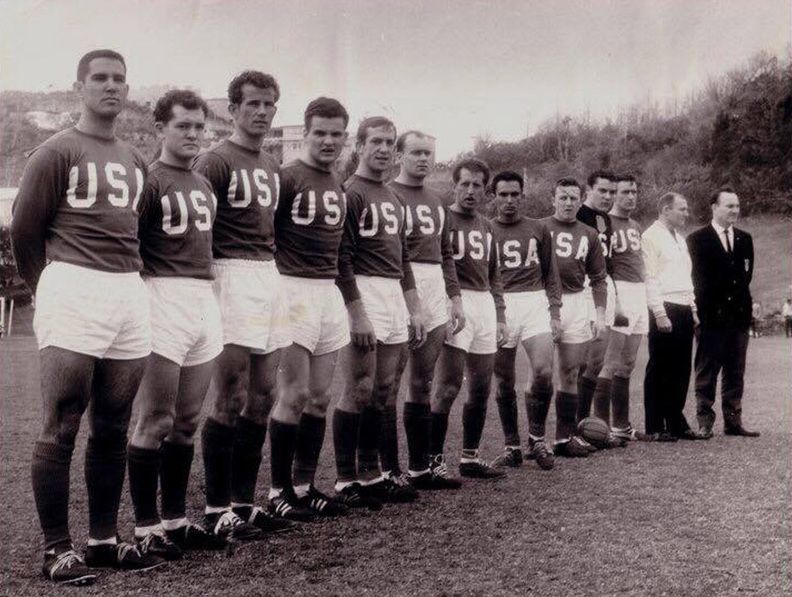
There is another event that took place on March 7, 1965 that should be mentioned. The U.S. national soccer team was in qualification, through CONCACAF -- the governing body for soccer in North America, Central America, and the Caribbean region -- for the 1966 World Cup in England.
The 1965 U.S. soccer team

The U.S. was placed in a group with Mexico and Honduras. We got a 1-0 win and a 1-1 draw with Honduras, but only a 2-2 draw and a 2-0 loss with Mexico. Had that 2-2 draw with Mexico at the Los Angeles Memorial Coliseum on March 7, 1965 been a 3-2 win, we would have advanced to the round-robin with Costa Rica and Jamaica.

Could we have won that? We'll never know. We still would have had to beat Mexico out for the one and only berth in the World Cup awarded to CONCACAF.

But even if we had won that game with Mexico, it would not have been the biggest story of the day. The Selma-to-Montgomery March was a story that should be remembered for all time.

Saturday, March 1, 2025

March 1, 1965: The Moynihan Report

March 1, 1965, 60 years ago: The Moynihan Report is released, although that is not its title, and the name "Moynihan" doesn't appear anywhere on it. That's the name that it got, because some people insist upon assigning credit, while others insist upon assigning blame.

Daniel Patrick Moynihan may have seemed like the most Irish of New Yorkers, but he was born in Tulsa, Oklahoma in 1927, before moving to Hell's Kitchen on Manhattan's West Side with his family as a boy. He worked as a longshoreman before getting a free education at City College of New York, then serving in the U.S. Navy during World War II, and getting a Ph.D. in history from Tufts University, in the Boston suburb of Medford, Massachusetts.

"Pat" went to the London School of Economics, where he began to cultivate, in his own words, "a taste for Savile Row suits, rococo conversational riffs and Churchillian oratory," even as he maintained that "nothing and no one at LSE ever disposed me to be anything but a New York Democrat who had some friends who worked on the docks and drank beer after work."

He worked on the staff of New York Governor W. Averell Harriman, an old-money Democrat, before being appointed an Assistant Secretary of Labor under President John F. Kennedy. The night that JFK was assassinated, he spoke with Mary McGrory of The Washington Star, invoking the heritage of both of them, and also that of the fallen President: "There's no point in being Irish if you don't know that the world will break your heart eventually."

He remained under the new President, Lyndon B. Johnson, who wanted the Department of Labor to give him as much information as he could for his "War On Poverty." The result was The Negro Family: The Case For National Action, published on March 1, 1965. Moynihan wrote the report on his own initiative, hoping to persuade White House officials that civil-rights legislation, alone, would not produce racial equality. Few people doubted this.

But Moynihan didn't suggest an additional solution, only an additional subject to address: Black families. He pointed out that the out-of-wedlock birthrate was much higher for black people than for white people. And he used the phrase "tangle of pathologies" to describe conditions within black families.

Conservatives loved it: Only 5 months after their epic electoral defeat at LBJ's hands, here was a lifeline, and it was coming from inside their enemy's own house: Not just a sub-Cabinet official, but a man who was respected by both JFK and LBJ. The report seemed to back up their idea that spending money on achieving racial equality shouldn't be done, giving them the justification that it was pointless.

Liberals hated it: The report seemed to "blame the victim" for his own problems. This presaged later conservative "dog whistles," like "race hustler," "poverty pimp," "welfare queen," and "superpredator."

Between the backlash against this report, and LBJ's perception that Moynihan was too close to his intraparty rival, JFK's brother, now-Senator Robert F. Kennedy of New York, Moynihan realized that his position in the Johnson Administration was untenable. Before the year was out, he resigned to take a professor's position at Harvard University.

But the Republicans remembered. In 1969, the new President, Richard Nixon, appointed Moynihan to be Assistant to the President for Domestic Policy; and, later in the year, as Counselor to the President. (He would be succeeded in these offices by John Ehrlichman and Donald Rumsfeld, respectively.)

But his support for a guaranteed national income, or a "negative income tax," was too close to socialism for Tricky Dick and his tricksters. At the end of 1970, he left the Administration, and went back to Harvard. In 1973, Nixon appointed him to be U.S. Ambassador to India. In 1975, President Gerald Ford appointed him U.S. Ambassador to the United Nations. In 1976, despite still officially living in Massachusetts, he ran for the U.S. Senate from New York, for the seat formerly held by RFK, and won it.

He would serve 4 terms, becoming, as I eventually put it, in language that wouldn't go over well today, "a political transvestite." He was reliably Democratic on education, the environment, civil liberties and abortion, and was a reliable vote for federal judges appointed by Democratic Presidents Jimmy Carter and Bill Clinton. But he seemed to side with the Republicans on taxes, and absolutely sided with them on health care and welfare.

During the health care reform debate in early 1994, he was the Chairman of the Senate's Committee on Finance, which had to approve any reform bill. Clinton had been pushing for universal coverage, saying there was a crisis on the issue. But the Republicans were saying there wasn't any crisis. In other words, the Republicans were lying.

Moynihan appeared as a guest on NBC's Meet the Press, hosted by a former aide of his, Tim Russert, and said, as if he were a Republican, "We don't have a health care crisis in this country. But we do have a welfare crisis." Russert asked him if there would be a new health care reform law. Moynihan said, "Ah, in this Congress? No." By refusing to even consider holding hearings in the Finance Committee on such a bill, he did as much to kill health care reform for the next 16 years as any conservative, in Congress or in the media.

Clinton did sign a welfare reform bill in 1996, after vetoing 2 others he thought too draconian, vetoes that Moynihan criticized on the Senate floor. But, as someone with more days dealing with medical difficulties than days at work between 1994 and 2010, I have never forgiven Moynihan -- or the Republicans -- for killing health care reform, offering it as a sacrifice to the god of welfare reform.

Moynihan continued to officially be a Democrat, while taking some Republican positions, until, bowing to advancing age, he retired in advance of the 2000 election. His seat was won by Hillary Clinton, Bill's wife. She had been careful to get on good terms with him, despite the fact that the health care reform movement was as much her pet project as it was her husband's. So Hillary winning Moynihan's seat must have given both Clintons satisfaction on more than one level.

Moynihan died in 2003. In 2021, something for which he had long advocated and attempted to fund, an expansion of New York's Pennsylvania Station, opened in the former main post office across 8th Avenue. Designed to handle Amtrak traffic, so that the station between 8th and 7th Avenues could handle New Jersey Transit and the Long Island Rail Road more easily, the new facility was named Moynihan Train Hall.

When this honor was offered to him during his lifetime, Moynihan said he didn't want it, saying the building should continue to carry the name it had, honoring James A. Farley, an old-line New York Democrat whom President Franklin D. Roosevelt had named Postmaster General, and who had gotten the building built. Farley died in 1976, the last survivor of FDR's Cabinet (the position is no longer Cabinet-level), and had been pretty much forgotten by people younger than Moynihan and his fans.

If anything, the commuter portion of Penn Station should have been named for Moynihan, given how often he commuted between America's 2 main political parties.

Friday, December 6, 2024

December 6, 1964: The Rankin/Bass Empire Premieres

December 6, 1964, 60 years ago: Rudolph the Red-Nosed Reindeer premieres on CBS, the 1st animated holiday special produced by Rankin/Bass Productions, Inc., now known as Rankin/Bass Animated Entertainment.

Arthur Gardner Rankin Jr. was born on July 19, 1924 in Manhattan, and both of his parents were actors. Julius Bass, known professionally as Jules Bass, was born on September 16, 1935 in Philadelphia. In 1955, ABC hired Rankin as an art director, and Bass as a copywriter. Together, they made TV commercials, using animation.

In 1960, they founded Videocraft International, which became Rankin/Bass Productions. In 1964, they made their 1st stop-motion animation special, based on the 1947 Christmas-themed song "Rudolph, the Red-Nosed Reindeer."
Arthur Rankin Jr. (left) and Jules Bass

The story, narrated by Burl Ives as Sam the Snowman (who has a mustache and a goatee, like Ives himself did), follows the song, with some embellishments. In this version, Rudolph is the son of Donner, who is listed here as Santa Claus' lead reindeer, and Donner's wife, whose name is never mentioned. (This was before "the Second Wave of Feminism.") Rudolph, voiced by actress Billie Mae Richards, has the bright red nose from birth. Santa (voiced by Stan Francis) agrees with Donner that the nose has to be hidden. It has been noted that it's not just "all of the other reindeer" who were mean to Rudolph: This is not one of the nicer versions of Big Red.

After running away with Hermey (voice of Paul Soles, a voiceover legend, including the 1st person to play Spider-Man, if an animated one), an Elf who doesn't want to make toys for Santa, and would rather be a dentist, they find adventure with a miner, an abominable snowman, and an island of "misfit toys." Upon returning to the North Pole, they gain new respect.

On Christmas Eve, the fog is so thick that Santa and the reindeer can't see through it, but Rudolph, with his nose so bright, can guide the sleigh that night. It has occurred to me that neither Santa nor any of the other reindeer ever apologized to Rudolph.

The special is a musical, and it closes with Ives, as Sam, singing a song that became a Christmas classic: "A Holly Jolly Christmas."
The success of this special led to other holiday-themed specials, most of them based around Christmas legends, even though Rankin and Bass were both Jewish. In 1968, they produced The Little Drummer Boy, a stop-motion animation that aired on NBC, narrated by a woman voiced by actress Greer Garson. The drummer boy is voiced by Teddy Eccles, and the Vienna Boys' Choir sings the title song.

That special is not widely remembered today. Their next one is: In 1969, for CBS, they produced, with traditional animation, Frosty the Snowman. Jimmy Durante narrated, and was represented by a lookalike resident of the town where Frosty was "born," complete with big nose.

Comedian Jackie Vernon voiced Frosty. Because the original 1950 song doesn't have an antagonist, aside from the weather, the magic hat that brings Frosty to life previously belonged to Professor Hinkle, an evil magician voiced by Billy De Wolfe. Paul Frees returns, playing a much kindlier Santa than seen in Rudolph.

In 1970, Rankin & Bass returned to stop-motion, for Santa Claus is Comin' To Town. Fred Astaire voiced the narrator, a mailman named S.D. Kluger -- "S.D." for "Special Delivery." He gives the first truly detailed origin story for Santa Claus, although others have been put forth. Mickey Rooney voices Santa from infancy to jolly old elf. Robie Lester voices schoolteacher Miss Jessica, who becomes Mrs. Claus.

In 1971, they produced a special for Easter, Here Comes Peter Cottontail. It was not based on the 1950 song of that title, but on a 1957 novel The Easter Bunny That OversleptDanny Kaye played narrator Seymor S. Sassafrass. Casey Kasem, star Los Angeles disc jockey, who voiced Shaggy on Scooby-Doo (and would later voice Robin in the Super Friends cartoons), voiced Peter. And the master of horror, Vincent Price, voiced the villain, evil rabbit January Q. Irontail.

In 1974, Mickey Rooney once again played St. Nick, in the stop-motion The Year Without a Santa Claus, premiering on ABC. Santa doesn't feel up to delivering the presents this year. His doctor says it's because not enough people believe in him anymore. So Mrs. Claus, this time voiced by Hazel star Shirley Booth, sends a pair of Elves named Jingle Bells and Jangle Bells out on the sleigh, pulled by Vixen, the lone female reindeer of the usual crew of 8 (9, when Rudolph is leading the way).

What everyone tends to remember about this special, more so than the outcome (Santa is convinced to go for it, of course), is the antagonists, Snow Miser and Heat Miser, bickering brothers, both sons of Mother Nature. Each of them, true to their alternating song, is "too much." Snow Miser was voiced by Dick Shawn, Heat Miser by George S. Irving.

Rudolph's Shiny New Year premiered on ABC in 1976. Red Skelton voices Father Time, who narrates. Billie Richards returns as Rudolph. Father Time tells his friend Santa that the Baby New Year must be found before the 12th "bong" at midnight on New Year's Eve, or else there will be no new year. As it's snowing, Santa sends Rudolph out to find him. Father Time considers Rudolph a good choice, because he would understand: The Baby, a.k.a. Happy, ran away from home because of his own unusual physical feature, enormous ears.

Rudolph goes to the Archipelago of Last Years (a variation on the Island of Misfit Toys). Each island represents a past year. On 1,000,000 BC Island, they meet a caveman named O.M. (for "One Million," voiced by Morey Amsterdam). He agrees to help Rudolph. So does Sir 1023, a Scottish knight (Frank Gorshin), who leaves his island of the year 1023, where all the fairy tales you've ever heard are real. Also agreeing to help is Sev (short for "1776," who looks like Benjamin Franklin and is voiced by Paul Frees), who leaves his island where every day is the 4th of July.

Other islands are no use: On 4,000 BC Island, all the people there want to do is build pyramids; on 1492 Island, people are too busy discovering things; everybody on 1893 Island is depressed, since there was a depression that year; and 1965 Island is "too noisy," as people are yelling about rock bands and a war. Nevertheless, Happy is found, rescued from a monster bird, and is brought back, crowned just before the last bong.

Like Rudolph, Frosty returned in 1976, with Frosty's Winter Wonderland. By this point, Jimmy Durante was too ill to participate, so Andy Griffith was hired to narrate. With a new snowfall, Frosty returned to the town where he was "born," but the kids' love of Frosty makes Jack Frost, the symbol of Winter (Paul Frees), jealous, and he fights Frosty.

Frosty buys him off, by asking him to be the best man at his wedding to a snowwoman named Crystal (as snowflakes are crystals, and she's voiced by Shelley Winters). She came to life with a snow-corsage. The Parson Brown mentioned in the original song can't marry them, as he can only marry humans. So a snow parson is made, and Brown's Bible brings him to life. (Dennis Day voices both parsons.) Frosty and Crystal have to go north again, but promise to return.

Next, in 1977, again with Astaire as S.D. Kluger, was The Easter Bunny Is Comin' to Town. Keep in mind: Peter Cottontail and the Easter Bunny are separate characters, and this special told of a possible origin for the Easter Bunny, voiced by Skip Hinnant, already known to kids as Fargo North, Decoder on PBS' The Electric Company.

On Thanksgiving Weekend 1979 came the Justice League or Avengers of Christmas specials: Rudolph and Frosty's Christmas in July. Returning are Billie Richards as Rudolph, Jackie Vernon as Frosty, Shelley Winters as Crystal, Mickey Rooney as Santa, and Paul Frees as Jack Frost. Frees also plays the villain, a snow wizard named Winterbolt, who wants to reclaim the North Pole from Santa, and plans to discredit Rudolph and Frosty to achieve this.

Red Buttons returns, but as Milton, an ice cream salesman, not as Father Time. Don Messick, the original voice of Scooby-Doo, plays several roles, including taking over as Rudolph's father, Donner. Darlene Conley voices Mrs. Claus. Thurl Ravenscroft, best known as the voice of Kellogg's cereals' Tony the Tiger, but also the singer of "You're a Mean One, Mr. Grinch" from How the Grinch Stole Christmas! (not a Rankin/Bass special), plays the Genie of the Ice Scepter, and Ethel Merman plays Lilly Loraine, owner of the circus where Milton works. The only things that seem to be missing are Mother Nature and the Miser Brothers.

Finally, a few days after that special, came Jack Frost, as the Winter sprite got his own special, although this time, he is voiced by Robert Morse instead of Frees. His story is told by Pardon-Me-Pete, a groundhog voiced by Buddy Hackett, who has a vested interest in a longer Winter: More sleep. Jack and a human girl, voiced by Debra Clinger, fall in love, but, in the end, he loses her to a human boy. The girl's name is Elisa; maybe if her name had been Elsa, it would have worked out, but Jack has to let it go.

In 1987, Rankin and Bass sold their company to Lorimar Productions. Jimmy Durante, the narrator of Frosty, died in 1980. Paul Frees, voice of many characters in these specials, including the original Jack Frost, died in 1986. Jackie Vernon, the voice of Frosty, died in 1987. So did Fred Astaire, the narrator of Santa Claus is Comin' To Town. So did Danny Kaye, the narrator of Here Comes Peter Cottontail. So did Dick Shawn, the voice of Snow Miser. Burl Ives, the narrator of Rudolph the Red-Nosed Reindeer, died in 1995. Red Skelton, the narrator of Rudolph's Shiny New Year, died in 1997.

Billie Mae Richards, the voice of Rudolph, died in 2010. Andy Griffith, the narrator of Frosty's Winter Wonderland, died in 2012. Arthur Rankin died on January 30, 2014, at age 89. Mickey Rooney, twice the voice of Santa in Rankin/Bass specials, also died in 2014. George S. Irving, the voice of Heat Miser, died in 2016. Robert Morse, star of Jack Frost, died in 2022. Jules Bass died on October 25, 2022, at 87. Still alive as of December 6, 2022 is Skip Hinnant, the '77 voice of the Easter Bunny.