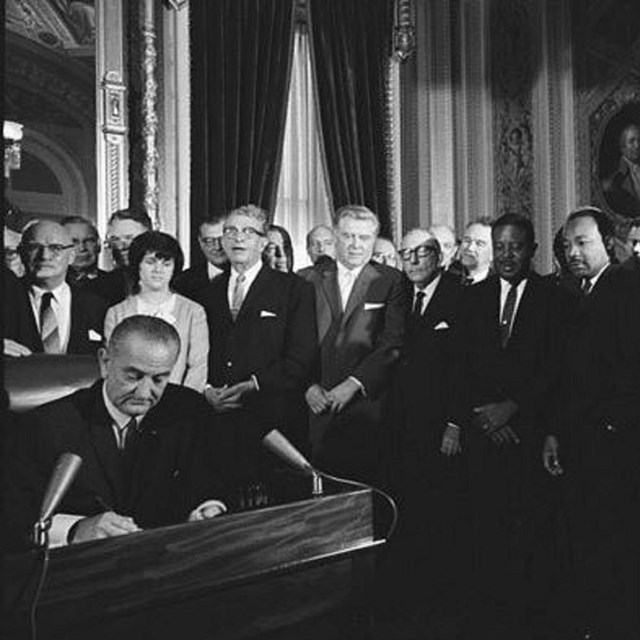
August 6, 1965, 60 years ago: President Lyndon B. Johnson signs the Voting Rights Act of 1965 into law. It creates legal mechanisms for the federal government to enforce the 15th Amendment to the Constitution of the United States, which, at least in theory, had guaranteed the right to vote for all adult American citizens since its ratification in 1870.
(In 1920, the 19th Amendment was ratified, ensuring that women were included. In 1971, the 26th Amendment was ratified, lowering the minimum voting age from 21 to 18.)
But "Jim Crow" laws has been enacted by Southern States, making it all but impossible for black people to vote, thus guaranteeing that white supremacists would be elected to offices in those States.
And when people protested, and tried to work around the Jim Crow laws, the bigots fought back. On June 21, 1964, 3 activists -- white Northern Jews Andrew Goodman and Michael Schwerner, and local black man James Chaney -- were murdered in rural Mississippi by members of the Ku Klux Klan.
On March 7, 1965, activists began a march from Selma, Alabama to the State Capitol in Montgomery, but before they could leave the city limits of Selma, they were beaten by policemen.
Finally, Johnson had had enough. He had lobbied Congress to pass the Civil Rights Act of 1964, which he signed into law on July 2 of that year. But that bill was put into play by his predecessor, President John F. Kennedy. The Voting Rights Act would be his bill, a key fixture of his "Great Society," along with Medicare, Medicaid, his education reforms and his "War On Poverty."
On March 15, 1965, he addressed a Joint Session of Congress, and demanded the voting rights bill. And this man, born in the Southern State of Texas in 1908, with the slow drawl of an accent to match, invoked the title of the unofficial theme song of the Civil Rights Movement: "It is not just Negroes, but really it is all of us, who must overcome the crippling legacy of bigotry and injustice. And we shall overcome."
The Senate passed the bill on May 26. The House passed it with an amendment on July 9. It went to a conference committee to settle the differences between the 2 versions. The House passed it again on August 3, by a vote of 328-74. The Senate passed it the next day, 77-19. All 19 votes against it -- 17 Democrats and 2 Republicans -- were from Southern States.
LBJ signed the Voting Rights Act at the White House -- with Dr. Martin Luther King, Montgomery Bus Boycott launcher Rosa Parks, and Selma march leader and future Congressman from Georgia John Lewis as invited attendees -- just 1 week after signing Medicare and Medicaid into law. It was the high point of American liberalism.
Just 5 days later came the Watts riot in Los Angeles, and reports from the Vietnam War began to get more troubling. For the Johnson Administration, it was downhill from there.
Amendments designed to improve the Voting Rights Act were passed by Congress in 1970, 1975, 1982, 1992 and 2006. Each time, it was a Republican President who signed these improvements into law.
But on June 25, 2013, in the case of Shelby County v. Holder, the Supreme Court of the United States ruled that Section 4(b) of the Act was unconstitutional, because the coverage formula was based on data over 40 years old, making it no longer responsive to current needs, and therefore an impermissible burden on the constitutional principles of federalism and equal sovereignty of the States.
The vote was 5-4. The 5 Justices striking Section 4(b) down were all appointed by Republican Presidents: Chief Justice John Roberts, Antonin Scalia, Anthony Kennedy, Clarence Thomas and Samuel Alito. Roberts and Alito had been appointed by George W. Bush, installed as President by a previous SCOTUS decision (including the votes of Scalia, Kennedy and Thomas), and their votes must be viewed in that light.
The 4 Justices refusing to tamper with the Act were all appointed by Democratic Presidents: Ruth Bader Ginsburg, Stephen Breyer, Sonia Sotomayor and Elena Kagan.
Since this decision, States with Republican-controlled legislatures and Governors have passed new laws designed to make it harder for black and Hispanic people to vote. It's been called "Jim Crow Jr." and "James Crow, Esquire."
The John Lewis Voting Rights Act, first proposed in 2021 after the former Congressman's death, designed to fully restore and update the 1965 Act, remains stalled in Congress. In the 2024 election, voter suppression in certain States, especially in the Southern State of Georgia, helped ensure Donald Trump's return to the Presidency. In 2025, the Supreme Court, now with a 6-3 conservative majority, announced it would take up a case that would essentially wipe the Voting Rights Act out.
But, hey, you wanted cheap eggs, and for immigrants to stop eating the dogs (which they weren't doing).


No comments:
Post a Comment