
The Louisiana Superdome, home of the NFL's New Orleans Saints, was used as a shelter, topping out at 26,000 people. But because of the nature of the emergency, getting relief supplies into the city was incredibly difficult.
Although there had been devastating fires in Chicago and Boston in the 19th Century, and Baltimore and San Francisco in the early 20th Century, an earthquake in San Francisco in 1989 and Miami clobbered by Hurricane Andrew in 1992, Katrina was the first natural disaster that made Americans think that a great American city might actually be lost, ruined to the point where there would be no choice but to abandon it.
President George W. Bush was at his ranch outside Crawford, Texas, on vacation. He should have immediately flown back to Washington and coordinated the federal government's response. Instead, he stayed at his ranch for 5 days, doing nothing -- except for 1 trip to San Diego for a Republican Party fundraiser.
As a result, most of the goodwill he'd generated with his response to the 9/11 attacks and the early part of the Iraq War was gone. One political magazine showed a cover with a cartoon of Bush being poked with a fork, with the headline, "HE'S DONE," and a caption that he might have still been in office, "but the 9/11 Presidency is over."
Indeed, he had roughly 4 full years in which even Democrats who didn't like him, and thought he had cheated to win in 2000 (and maybe even in 2004), still accepted him as President: September 11, 2001 to September 12, 2005.
That was the day that Michael D. Brown resigned as Administrator of the Federal Emergency Management Agency (FEMA), which is in charge of responding to natural disasters. Bush was caught on camera telling him, "Heck of a job, Brownie." It wasn't sarcastic: Bush really believed that Brown was doing a good job.
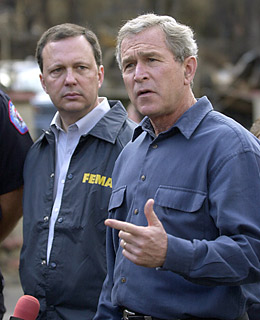
"Brownie" and "Dubya"
At his best, Bush was a genial idiot. At his worst, he was a nasty right-winger. He was never competent enough to be President, and he appointed people he liked to posts for which they were not qualified and ill-suited, and Brown was one of them.
As late as 1950, New Orleans' population was 660,000, putting it in America's top 20 cities. White flight led to a drop to about 484,000 people within the city limits in the 2000 Census. After Hurricane Katrina, it dropped to 230,000, losing over half its people in one fell swoop. According to a recent estimate, it's back up to about 362,000, making it larger than such NFL cities as Tampa, St. Louis, Pittsburgh, Cincinnati and Buffalo (and, of course, Green Bay).
But the metropolitan area has just a shade over 1 million people, making it the smallest metro area in the NFL, ahead of only Buffalo (if Green Bay is included with Milwaukee and Niagara Falls is included with Buffalo). And the poverty issue, so pervasive before the hurricane, is worse. And crime is definitely an issue.
In 1940, the city was 70 percent white. As late as 1970, it was 51 percent white. By 1990, it was 62 percent black, and the proportions are roughly the same today: 61 percent black, 31 percent white, 5 percent Hispanic and 3 percent Asian. The further east you go, the greater the black percentage; the further west, the more white.
Both the dome and the arena were nearly ruined by Hurricane Katrina. Whatever had gone wrong on the inside of the Superdome, more noticeable was the outside, as the hurricane's winds had stripped the top of the dome, making it look like it had been sandblasted.
The Saints played their entire 2005 season on the road while the dome was refurbished. Next door, the Smoothie King Center, home of the NBA's New Orleans Hornets (since rebranded as the Pelicans), needed work, so the Hornets played most of the 2005-06 season in Oklahoma City, thus opening the door to a team for that city: In 2008, the Seattle SuperSonics became the Oklahoma City Thunder.
A relief concert was held at Madison Square Garden, "The Big Apple to the Big Easy," featuring performers from New Orleans, and others whose work was inspired by them. In 2012, the favor was returned after Hurricane Sandy became the 2nd-most-damaging storm in American history, behind Katrina.
The Superdome reopened for the 2006 season, and the Saints provided a lift to the devastated city. On February 7, 2010, the Saints won Super Bowl XLIV, beating the Indianapolis Colts 31-17 at Sun Life Stadium (now Hard Rock Stadium) in the Miami suburbs, for their 1st NFL Championship. It had been a little over 4 years since the hurricane, and it resulted in the biggest party in the history of America's greatest party city.

The Superdome was restored. But the city still needs help. Having lost so many former residents, whose houses could not be rebuilt, hurt its tax base. It's the same with businesses that never came back. In New Orleans, "back" is a relative term.


1 comment:
The Saints’ Super Bowl win was an affirmation of Obama’s ideals: hope, change, and the idea that “Yes We Can!”
Compare that to Tom Brady’s Super Bowl wins, all of which are rooted in Trumpism.
Post a Comment