Showing posts with label muhammad ali. Show all posts

Wednesday, October 1, 2025

October 1975: Some Kind of a Month

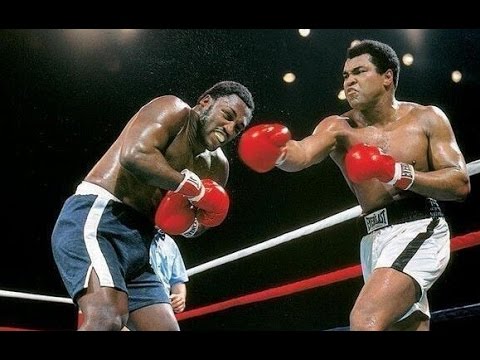
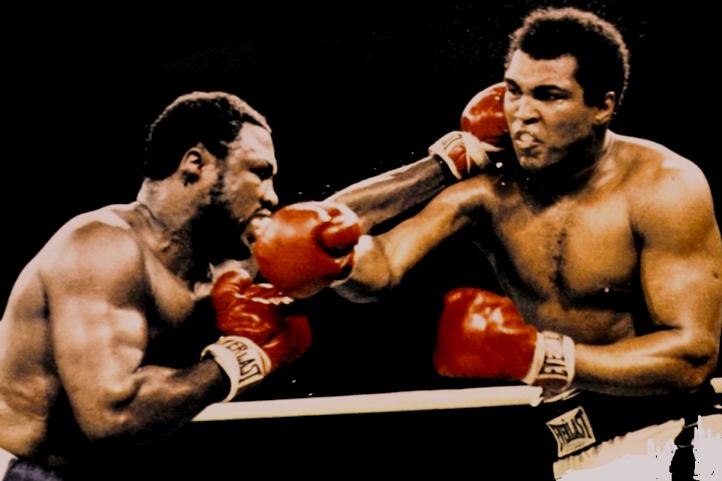
October 1, 1975, 50 years ago: Heavyweight Champion Muhammad Ali fights former Heavyweight Champion Joe Frazier for the 3rd time, at the Araneta Coliseum in Quezon City, the capital of the Philippines. Quezon City is the national capital, and the arena is located about 5 miles east of the country's largest city, Manila.

It becomes known as "The Thrilla in Manila." Frazier said he hit Ali with punches that would have brought down buildings. Ali said he had never come so close to death. In the 13th round, an Ali punch sent Frazier's mouth-guard flying. The 14th round was even more brutal. Frazier's corner wouldn't let him go out for the 15th and final round. The fight was declared over. Ali raised his arm in triumph, and then collapsed.

Both men should have retired after that fight. Howard Cosell, who broadcast it for ABC, said, "A big part of Ali remained inside that ring."

That same day, in Memphis, a man broke into the home of Al Jackson Jr., the drummer for Booker T. & The M.G.'s, looking to burglarize it. Jackson confronts him, and is shot and killed. He was only 39 years old.

It was some kind of a fight. It began some kind of a month.

*

October 2: Chevrolet introduces its "subcompact" car, the Chevette. And W.T. Grant department stores files for bankruptcy. They had a store in my hometown of East Brunswick, New Jersey. Oddly enough, the space was bought by a theater chain named Grant's, so they kept the sign over the front door. The new theater was named Movie City Five, and I worked there in 1988.

October 3: A siege ends at the Spaghetti House restaurant in Knightsbridge, London. Franklin Davies, a Nigerian student, led 2 other gunmen in an attempted armed robbery of the restaurant, where managers of the chain had assembled to pay in the week's takings of approximately £13,000. When the armed robbery did not go to plan, 9 Italian staff members were taken hostage, and moved into the basement. Another staff member escaped and raised the alarm, leading to a siege of 6 days.

The robbers and their captives emerged unharmed. As with the recent film Dog Day Afternoon, about a 1972 Brooklyn robbery, a film was made about it, Spaghetti House.

October 5: The Svenska Hockeyligan begins play in Sweden. And actresses Kate Winslet and Parminder Nagra are born.

October 6: For the 1st time, major U.S. TV networks declined a request to interrupt programming to broadcast a speech by the President. The nationwide address by Gerald Ford is carried only by ABC, not by NBC, CBS or PBS.

Four days earlier, Ford had vetoed  an extension of the federal school lunch and nutrition program, On October 7, both houses of Congress overwhelmingly voted to override that veto, 397-18 in the House and 79-13 in the Senate, and make it law.

With the combination of inflation and recession, known as "stagflation," and the lingering anger over his pardon the year before of his predecessor, Richard Nixon, Ford is very unpopular, including among many of his fellow Republicans, who believe he is not conservative enough. And he has to face election for a term of his own in 13 months, with Primaries starting in 4 months.

October 7: Former Beatle John Lennon gets his deportation order overruled in federal court. He can now stay in America for as long as he wants. Sean Ono Lennon, his son with Yoko Ono, is born 2 days later.

Both of Major League Baseball's Pennants are decided. The Boston Red Sox beat the Oakland Athletics, 5-3 at the Oakland Coliseum, completing a 3-game sweep of the American League Championship Series, and ending a 3-year Pennant streak for the A's. Team owner Charlie Finley was too cheap to live up to his contract with pitcher Jim "Catfish" Hunter, and lost him to free agency. But with the Sox sweeping the series, it's hard to say that Hunter would have made much of a difference.

The A's had still won 5 straight titles in the AL Western Division. But before the next regular season began, Finley would trade his best player, Reggie Jackson, and the breakup of his dynasty was on.

And the Cincinnati Reds completed a sweep in the National League Championship Series, beating the Pittsburgh Pirates, 5-3 in 10 innings. It is the Reds' 3rd Pennant in 6 seasons, but they haven't won a World Series in 35 years. They will face the Red Sox, who haven't won one in 57 years. Something's got to give.

October 8: Kim Dae-doo, with 17 kills South Korea's all-time leading serial killer, is arrested. Doug Jarvis makes his NHL debut with the Montreal Canadiens, and eventually plays in 964 consecutive games, setting a record (since broken). And President Ford signs a bill allowing women into the U.S. military service academies: The Army at West Point, New York; the Naval Academy (which also trains officers for the Marine Corps) at Annapolis, Maryland; the Air Force at Colorado Springs, Colorado; and the Coast Guard at Kings Point, New York.

October 10: For the 2nd time, actors Elizabeth Taylor and Richard Burton marry. It lasts for 9 months. It was the 6th of 8 marriages for Liz, the 3rd of 5 for Dick.

*

October 11: Bill Clinton marries Hillary Rodham in Little Rock, the capital of Arkansas. A little more than a year later, Bill was elected to office for the first time, as Attorney General of the State. Despite everything, not only are the Clintons still together, but, unlike many of their detractors, they are each still on their 1st marriage.
That afternoon, Game 1 of the World Series is played at Fenway Park in Boston. With the game scoreless in the bottom of the 7th inning, Red Sox pitcher Luis Tiant -- who, due to the designated hitter, had only come to bat once all season -- got a hit, and ended up scoring the 1st of 6 runs in the inning. He finished the game with a 5-hit shutout. The Red Sox won, 6-0, and took a surprising lead in the series.

That night, NBC premieres a new late night variety program, titled Saturday Night. The title made sense, as NBC already had shows titled Today, Tonight and Tomorrow.

Lorne Michaels created, produced and directed it. The original cast, known as "The Not Ready for Prime Time Players," were John Belushi, Dan Aykroyd, Chevy Chase, Garrett Morris, Michael O'Donoghue, Golden Radner, Jane Curtin and Laraine Newman.
The 1st guest host was George Carlin. In spite of the late hour (11:30 PM), he did not do his routine "Seven Words You Can Never Say On Television." He did, however, open with a parody of The Lord's Prayer": "Our Father, whose art is in Heaven, hollow be thy name." He also did his routine comparing "Baseball and Football." The 1st musical guest was Billy Preston.

At the end of the 1st season, when a similarly titled show, on ABC, hosted by, of all people, Howard Cosell, is canceled, the NBC show adopts the BBC show's name: Saturday Night Live. Chase left, replaced by Bill Murray.

*

October 12: The Reds bounce back, winning Game 2, 3-2, with Dave Concepción and Ken Griffey Sr. each driving in a run in the top of the 9th, tying the series.

And Marion Jones is born. She went on to star on the women's basketball team at the University of North Carolina, winning the 1994 National Championship. At the 2000 Olympics in Sydney, she won 3 Gold Medals and 2 Bronze Medals as a sprinter, but was disqualified from each for using performance-enhancing drugs. In 2010, at the age of 36, she made a comeback of sorts, playing the 1st of 2 seasons with the WNBA's Tulsa Shock.

October 13: Charles "Swede" Risberg, the last survivor of the 8 Chicago White Sox players who "threw" the 1919 World Series, died. And the U.S. Mint released the Bicentennial Dollar coin, replacing the image of the Apollo 11 logo, the eagle landing on the Moon, with an image of the Liberty Bell superimposed over the entire Moon.

The Bicentennial Half-Dollar had already been released, with Independence Hall in Philadelphia replacing the Great Seal of the United States. So had the Bicentennial Quarter, with a Revolutionary War drummer boy replacing the eagle. Aside from a date of "1776-1976," no changes were made to the front: Dwight D. Eisenhower would be on the dollar, as he had since 1971 and would be until 1978; John F. Kennedy would be on the half-dollar, as he had since 1964; and George Washington would be on the quarter, as he had since 1962.

October 14: The World Series moved to Cincinnati for Games 3, 4 and 5. Game 3 went to a 10th inning, marked by a controversial play involving Cincinnati's Ed Armbrister and Boston's Carlton Fisk: Armbrister, a backup outfielder, lays down a sacrifice bunt, and seemingly hesitates breaking out of the batter's box; Fisk's subsequent throwing error leads to the Reds' winning run. The Sox scream for an interference call from umpire Larry Barnett‚ but to no avail.
The Reds hang on to win, 6-5. Tony Kubek, former Yankee shortstop and now one of the NBC broadcasters, says on the air that Barnett blew the call. Barnett ends up getting thousands of angry letters, some of them death threats, nearly all of them from the New England States. Had instant replay been in effect at the time, there would not have been enough evidence of intentional interference to overturn the call.

October 15: The Red Sox win Game 4, 5-4. They score all 5 runs in the 4th inning, giving Tiant his 2nd win of the series. And Elgin Baylor Lumpkin, named for a basketball legend, is born. He grew up to become the rapper Ginuwine.

October 16: Game 5 is the only game of the Series that ends up not being close. The Red win, 6-2, thanks to 2 home runs by Tony Pérez.

Game 6 is supposed to be played in Boston on October 18. But it starts raining in New England. And it rains, and rains, and rains...

It is not a good time for sports' "rebel leagues." As it turns out, the American Basketball Association is in its last season, and 4 of its teams will be absorbed into the NBA within a year. The Baltimore Claws will not be one of them. On this day, they play an exhibition game, losing to the Norfolk-based Virginia Squires. Only 500 people come out to the Baltimore Civic Center (now the CFG Bank Arena). Three days later, unable to make their rent, never mind their payroll, they fold without playing a regular-season game.

The Utah Stars would not be one of the absorbed teams, either: On October 18, they beat the NBA's Milwaukee Bucks in an exhibition game at the Salt Palace in Salt Lake City, but they ended up folding in December.

The World Hockey Association is not doing well, either. But they're doing better than the World Football League, which plays its last games on:

October 19: The Birmingham Vulcans, winners of the previous season's title under the Birmingham Americans name, beat the Memphis Southmen, 21-0 at Legion Field in Birmingham. The Shreveport Steamer (no S on the end) beat the San Antonio Wings, 41-31 at Independence Stadium in Shreveport. The Portland Thunder beat the Jacksonville Express, 30-13 at Civic Stadium (now Providence Park) in Portland. And in the very last game, the Southern California Sun beat The Hawaiians, 26-7 at Anaheim Stadium (now Angel Stadium of Anaheim).

On October 21, the WFL folded. And it wasn't the biggest sports story of the day. The WFL couldn't even die with dignity.

October 20: Two subway trains collide in Mexico City, killing 43 people. It's the worst accident in the history of the Mexico City Metro, and it remains the worst urban transit accident in North America since the Malbone Street Wreck in Brooklyn in 1918.

*

October 21: Tom Waits releases his album Nighthawks at the Diner, including the song “Eggs and Sausage.” In that song, he sings, "Baby, you gotta understand, I'm in a graveyard charade, a spaceship masquerade." Good metaphors for the 1970s.

Finally, the rain lets up, for what Boston Globe columnist Dan Shaughnessy called "a brilliant autumn day in New England." That night, Game 6 of the World Series could finally be played at Fenway Park.

The delay gives Luis Tiant enough rest to start for the 3rd time. Sox fans loved him for his effective pitching and his twisty windup. He loved himself just as much: He would stand in the shower, smoking a cigar, looking at himself in a mirror, seeing his bald head and huge mustache, and saying, in heavily-accented English, "Damn, I am a gooood-looooking son of a biiiitch!"

He looked good for 4 innings, pitching a shutout and benefiting from a 3-run home run by Fred Lynn, who went on to become the 1st player ever to win either League's Rookie of the Year and its Most Valuable Player award in the same season. But he faltered in the 7th, and the Reds took a 3-0 lead in the top of the 8th. In the bottom of the 8th, Bernie Carbo, whom the Reds had traded away, hit a drive to straightaway center field, for a 3-run homer, tying the game, 6-6.

The game went to extra innings. Leading off the top of the 11th, the Reds' Pete Rose said to Red Sox catcher Carlton Fisk, "Some kind of a game, isn't it?" It wasn't just some kind of a game: It was some kind of a month.

Fisk led off the bottom of the 12th. At 12:34 AM on October 22, he hit a drive off Pat Darcy, down the right-field line, that looked like it might go foul. As though it would actually influence the flight of the ball, Fisk waved his arms to his right. The ball hit the pole near its top, for a home run. Final score, Boston 7, Cincinnati 6. The Series was tied, and would go to a Game 7.
John Kiley, the organist at Fenway Park (and also at the Boston Garden, thus the answer to the corny old trivia question about "the only man to play for the Red Sox, Celtics and Bruins"), played George Friedrich Handel's "Hallelujah Chorus." Then he played "Stout-Hearted Men." Then he played "The Beer Barrel Polka." ("Roll out the barrel, we'll have a barrel of fun.") Then he played "Seventy-six Trombones" from the Broadway musical The Music Man. (I have no idea why he played that one.)

The shot of Fisk thinking he can wave the ball fair, which I've dubbed the Fenway Twist, is the most familiar clip in the history of televised sports. (As they had with every World Series since 1947, NBC was televising it, although they would begin to alternate with ABC starting with the 1977 season, until 1989.)

October 22: Historian Arnold Toynbee dies. Modern Family actor Jesse Tyler Ferguson and Spanish soccer star Míchel Salgado are born. Venera 9, a Soviet space probe, lands on the planet Venus, and sends to Earth the 1st photographs of the surface of another planet.

And Game 7 of the 1975 World Series is played at Fenway Park. Reds manager George "Sparky" Anderson started Don Gullett, and said, "No matter who wins, my starting pitcher is going to the Hall of Fame." Red Sox manager Darrell Johnson started Bill Lee, who, asked about Anderson's statement, said, "No matter who wins, I'm going to the Eliot Lounge." That was a famous Boston bar, since gone out of business. Gullett would be kept out of the Hall of Fame by shoulder woes.

He was kept from being the winning pitcher in this game by allowing 3 runs in the bottom of the 3rd inning, including an RBI single by Carl Yastrzemski and back-to-back bases-loaded walks to Rico Petrocelli and Dwight Evans.

Lee kept his shutout through 5 innings. He allowed a single to Rose to lead off the top of the 6th, then got 2 outs. Then he made the biggest mistake in Red Sox history. He had been experimenting with a blooper pitch, and had used it with some success in this game. This time, he threw it to Tony Pérez, who knocked it far over the Green Monster, Fenway's left field wall, 37 feet high and 315 feet from home plate. (Or so it was labeled at the time. It was eventually relabeled 310, and some people believe it's even closer than that.) Cincinnati 3, Boston 2.

The Reds tied the game in the 7th. Cliché Alert: Walks can kill you, especially the leadoff variety. Jim Burton walked Griffey to start the top of the 9th. César Gerónimo bunted him over to 2nd base. One out, but now, the run that would win the World Series was in scoring position. Dan Driessen grounded out. Two out, but now, the run that would win the World Series was in scoring position. Burton walked Rose to keep the inning alive. Joe Morgan was up, and he blooped a single into short center field, scoring Griffey. In the bottom of the 9th, Will McEnaney got Juan Beníquez to fly to right, Bob Montgomery to ground to short, and Yastrzemski to fly to center.
Cincinnati 4, Boston 3, both in this game and in the World Series. Not only has Game 6 been called baseball's "Greatest Game Ever Played," but the Series has been called the best World Series ever. At any rate, the Big Red Machine had their title, and their validation. The Red Sox, and all of New England, would have to wait.

*

October 25: In England's Football League, West Ham United, of the East End of London, hosted Manchester United, beating them, 2-1. A fight between 2 of the biggest hooligan "firms" in England, West Ham's Inter-City Firm (ICF) and Man U's Cockney Reds, based in London but fans of Man U due to their television exposure during the 1960s, led to 102 people being injured, and 38 arrested. England's hooligan problem would get worse before it got better.

And in Los Angeles, Elton John -- by this point, a part-owner of his hometown soccer team, Watford Football Club in Hertfordshire -- plays the 1st of 2 sold-out concerts at Dodger Stadium. He wears a sequined Dodger uniform, with "ELTON" and the Number 1 on the back, designed by CBS costume wizard Bob Mackie.
October 27: Rex Stout, creator of the fictional private detective Nero Wolfe, dies. And, for the 1st time, the weekly news magazines Time and Newsweek put the same person on their covers. It's not a major figure in domestic or international politics, or a renowned scientist, or a beloved humanitarian. It's a rock and roll star: Bruce Springsteen, riding the success of his album Born to Run.

October 28: Georges Carpentier dies. He had been a hero in World War I, and the Light Heavyweight Champion of the World. In 1921, he fought Heavyweight Champion Jack Dempsey at a temporary stadium called Boyle's Thirty Acres in Jersey City, New Jersey, for the heavyweight title, and it became boxing's 1st gate of over $1 million. Dempsey won by knockout.

That same day, having been admitted the day before, I underwent surgery at the Hospital for Joint Diseases, then located at 1919 Madison Avenue, at 123rd Street, in Manhattan's Spanish Harlem, to correct a problem in my legs that made walking difficult.

My 2 weeks in that hospital were a blur, as I was almost 6 years old. What I do remember from the experience, I wouldn't wish on anyone. I've been a hospital patient on Halloween Night at age 5, and I've been a hospital patient on Thanksgiving Day at age 17. Halloween at 5 in a hospital is worse.

A follow-up surgery was performed on July 12, 1976. This time, I left the hospital after 1 week. Both times, it was in a wheelchair.

As with the previous one, the surgery was successful, to an extent. But the problem, caused by a birth defect, wouldn't go away. I still developed arthritis, and the pain in my legs frequently made walking a chore. I told myself that, one day, I would walk out of that hospital. I was walking within a few weeks.

In 1979, Joint Diseases moved into a new building, at 301 East 17th Street, off 2nd Avenue, as part of New York University's Langone Orthopedic Hospital. In 2006, it was fully absorbed into the NYU Langone system. Its old building is now an apartment building, with the ground floor occupied by another health care facility, the Ralph Lauren Cancer Center. Finally, in 2018, I walked into their new building, and, symbolically, walked out of it. In 2019, I went back up to their old one, and did the same.

It was something I had to do, and, finally, I did it. It was, both figuratively and literally, a moving experience.

In 2020, I had my right hip replaced; in 2021, the left. So much pain was gone.

But I have no memory of what was going on in the outside world during those 2 weeks, which was plenty -- including in the City around me.

Also on October 28, President Ford convinced Vice President Nelson Rockefeller to drop out of a place on the Republican Party's 1976 ticket. The conservative wing of the Party had never trusted him. Ford ended up choosing Senator Bob Dole of Kansas.

October 29: Ford tells the National Press Club that he would veto any legislation for a federal bailout of New York City, which was in desperate financial straits.

In rebuilding mode, hockey's New York Rangers put their popular goaltender, Eddie Giacomin, on waivers. On October 31, he was claimed by the Detroit Red Wings. According to legend, the Rangers' next game was against those very Red Wings. It's not true: On November 1, they played the Canadiens in Montreal, and lost, 4-0. But the next game, their 1st home game after the waiver claim, on November 2, was at The Garden against the Wings, and Davidson and Giacomin were the opposing starting goalies.

All game long, Ranger fans chanted, "Ed-DIE! Ed-DIE! Ed-DIE!" They cheered when he made a save. They cheered when the Wings scored. They booed when their own players scored. The Wings won, 6-4, and the Ranger fans gave Giacomin a standing ovation.

On November 7, the Rangers traded beloved veterans Jean Ratelle and Brad Park to the hated Boston Bruins for Phil Esposito and Carol Vadnais. Both teams' fans hated "The Trade."

October 30: The New York Daily News, responding to Ford's statement that he wouldn't allow the federal government to bail out New York City's desperate finances, prints the most famous newspaper headline ever: "FORD TO CITY: DROP DEAD." Ford didn't actually say that, but that was the message he sent, intentionally or otherwise.
Both sides compromised, as the City did a few more things to try to get its financial house in order, and this satisfied Ford to the point where he changed his mind and signed a bailout bill.

But Ford was damned when he did, and damned when he didn't. The bailout he actually did sign infuriated many conservatives, who already had a few problems with the mildly conservative Ford, and they voted for former Governor Ronald Reagan of California in the Republican primaries, and Reagan very nearly won the GOP nomination, and when Ford won the nomination anyway, many of those conservatives stayed home on Election Day, November 2, 1976.

This may have made the difference in throwing some States, including New York, to the Democratic nominee, former Governor Jimmy Carter of Georgia. White conservatives in Queens, Brooklyn, Staten Island, Long Island and Westchester abandoned him. Not that they voted for Carter (Southern or not, conservative by Democratic standards or not, they still viewed all Democrats as "socialists"), but they didn't vote at all.

It also upset undecided voters and disaffected Democrats. A lot of people remembered only the headline, and forgot that Ford changed his mind about the bailout, and held it against him, and a lot of people in the City who might not have been comfortable with Carter either voted for Carter or stayed home, enough to throw the State of New York to Carter. It may have made, literally, all the difference in the world. Had Ford simply won the State, he would have won a full term.

True, the Nixon pardon, lingering feelings over Watergate, the shaky economy, his debate gaffe about Eastern Europe, and conservatives issues with him over things like foreign policy and federal spending also hurt him.

Also on this day, Wilma McCann was murdered in Leeds, England. She would later be determined to be the 1st victim of Peter Sutcliffe, arrested as the "Yorkshire Ripper" in 1981. He would be convicted of 13 murders.

Martha Moxley was murdered the same day, in Greenwich, Connecticut. She was 15 years old, as was Michael Skakel, who was accused of the murder. He was a nephew of Ethel Kennedy, widow of Robert F. Kennedy. It took 24 years for him to be indicted for it. He was finally convicted in 2002. He was released in 2013 and received an order for a new trial. He was convicted again in 2016, but remained free upon appeal. In 2018, the Connecticut Supreme Court vacated his conviction. As of October 1, 2025, he is out of prison, and still professes his innocence.

October 31: The British rock band Queen release their single "Bohemian Rhapsody," from their album A Night at the Opera. It was entirely written by lead singer Freddie Mercury, produced by Roy Thomas Baker, and recorded at Rockfield Studios 1 at Rockfield, Monmouth, Wales, about 37 miles northeast of the Welsh capital of Cardiff, and 154 miles west of London.

The 1970s were Schrödinger's Decade. There was too much Republican competence, too much oil, too much crimefighting, too much television, too much overwrought music, disco and otherwise; and, overall, too many ridiculous distractions from it all... and, at the same time, not enough of those things.

October 1975 was some kind of a month.

November wouldn't get any less strange. On the 5th, The Sex Pistols gave their 1st concert, in London. On the 7th, The New Original Wonder Woman, starring Lynda Carter, premiered on ABC. On the 10th, the SS Edmund Fitzgerald sank in Lake Superior, taking all 29 hands with them.

On the 11th, Australia's Governor-General, without getting permission from the head of state he represented, Queen Elizabeth II, fired the Prime Minister, Edward Gough Whitlam over a budget bill. And Portugal grants independence to the African land of Angola, which immediately breaks out into a civil war that lasts for 27 years.

On the 20th, Francisco Franco, Fascist dictator of Spain for 36 years, died. As Chevy Chase said on Saturday Night (Live) every week, "Generalissimo Francisco Franco is still dead!" Spain moved toward democracy, and, while it has since elected conservative governments, it has never again had a Fascist government.

October 1, 1975: The Thrilla In Manila

October 1, 1975, 50 years ago: Heavyweight Champion Muhammad Ali fights former Heavyweight Champion Joe Frazier for the 3rd time, at the Araneta Coliseum in Quezon City, the capital of the Philippines. Quezon City is the national capital, and the arena is located about 5 miles east of the country's largest city, Manila.

Ali, under his birth name Cassius Clay, was an Olympic Gold Medalist in boxing, in 1960 in Rome. Frazier was as well, in 1964 in Tokyo. A man they would both memorably fight, George Foreman, followed them, in 1968 in Mexico City.

Ali first won the title in 1964 by knocking out Sonny Liston. He held it until he was stripped of it in 1967, for refusing to accept the U.S. military draft. Foreman won what was essentially a tournament for the title, ending in 1970 with a win over top contender Jimmy Ellis.

Ali got his conviction overturned by the Supreme Court, and his boxing license restored -- but not his title. That, he would have to win back. When he and Frazier met for "The Fight of the Century" at Madison Square Garden in 1971, it was the 1st time 2 undefeated Heavyweight Champions had ever met in the ring. It was a hard, even fight until the 15th and final round, when a classic Philly left hook floored the Louisvillian, and Ali received his first-ever knockdown, from which he got up to finish the fight, and his first-ever professional loss.

Ali got revenge in 1974, also at The Garden, although neither man was champion at the time. Frazier had lost the title in 1973 to Foreman, whom Ali subsequently beat to regain the title in Kinshasa, Zaire (now the Democratic Republic of the Congo), the fight known as "The Rumble In the Jungle."

Ali mocked Frazier for his fighting ability and his looks, saying, "It'll be a thrilla and a chilla and a killa, when I get the Gorilla in Manila!"
Araneta Coliseum

But it was intensely hot inside the Coliseum when "The Thrilla In Manila" was fought. Still, like the other 2 Ali-Frazier fights, it lived up to the hype. Ali led in the early rounds, but in the 5th round, Frazier began to turn the tide. At the end of the 6th, Ali, who'd been trash-talking (as we would say today) all the way, yelled, "They told me Joe Frazier was washed up!" Frazier yelled back, "They lied!"

Ali won the 8th round, but Frazier clobbered him in the 9th, leading him to go back to his corner and tell his trainer, Angelo Dundee, "Man, this is the closest I've ever been to dying." But Ali had landed so many punches that Frazier's face was swelling, and he was having trouble seeing.

Early in the 13th round, Ali hit Frazier in the jaw with a thunderous right hook, sending Frazier's mouthpiece flying out of his mouth and out of the ring. Ali dominated the 14th as well, because Frazier was too tired and having too much difficulty seeing. Ali was hitting Frazier with the same kind of punches that knocked out Foreman a year earlier. Except, when Ali knocked Foreman out, it took just a few seconds. He had been throwing these things at Frazier for the last 2 rounds, and Frazier simply would not go down.

Frazier had more courage and endurance than sense, and refused to go down, and refused to quit. As the 15th and final round approached, Frazier wanted to continue. His trainer, Eddie Futch, told him that he was going to stop the fight. Frazier said no: "I want him, boss." He was unable to talk Futch out of it: "The fight's over, Joe. No one will forget what you did here today." And he told the referee, Carlos Padilla, to stop the fight. Padilla did so.

Ali retained the crown, the belt, the title, whatever you want to call it. He got up off his stool, raised his right arm in victory... and collapsed. He had nothing left to give. If Futch had let Frazier fight the 15th round, he would have knocked Ali out.

It's been called the greatest prizefight in history. Today, most people know the name Manila for 3 things: The brown office folders that bear its name, its role in the Pacific Theater of World War II, and Ali-Frazier III.

Howard Cosell, who covered the fight for ABC Wide World of Sports, later said, "A big piece of Ali remained in that ring." Indeed, at age 33, with nothing left to prove, Ali probably should have retired right there. Instead, he kept fighting for 6 more years. So did Frazier. Both men would have their moments, but neither was ever so good again.
"The Greatest of All Time" developed Parkinson's disease as a result of his taking so many blows to the head. The big mouth that got him the early nickname "The Louisville Lip" was rendered mostly silent by the turn of the 21st Century. He died on June 3, 2016, at age 74.

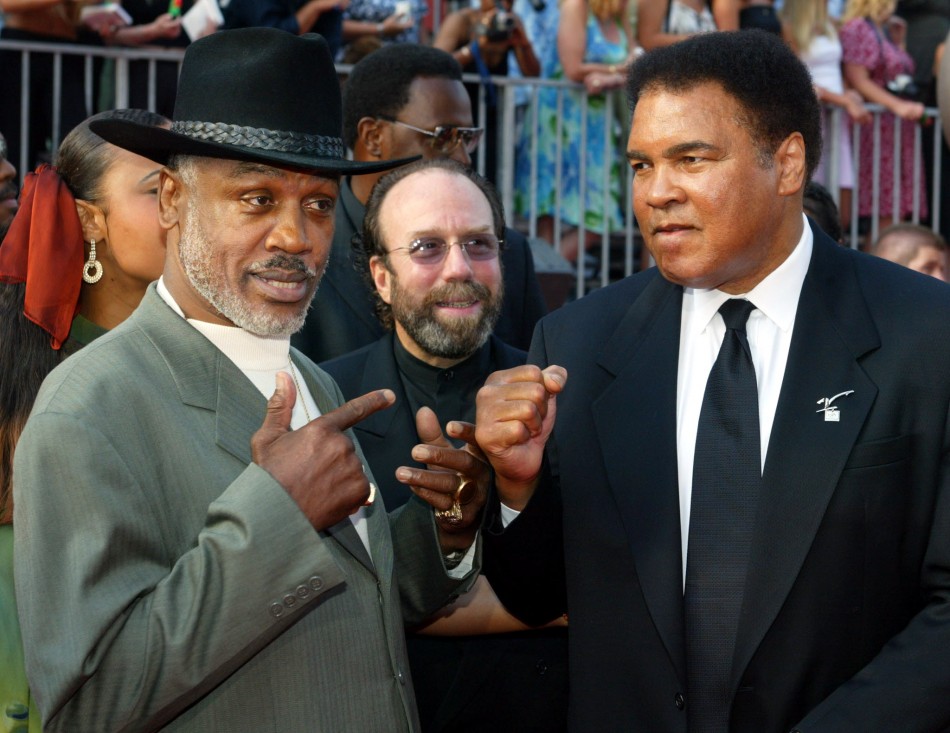
"Smokin' Joe" would continue to feud with Ali and reconcile with him, restart the feud, and reconcile again. Joe died of liver cancer on November 7, 2011, at age 67, after 30 years of training fighters at his gym in North Philadelphia.

One of the fighters he trained was his son Marvis, who, like Ali on that awful night in 1980, would get slaughtered by Larry Holmes in Las Vegas. His daughter Jackie Frazier-Lyde also fought professionally, as has Ali's daughter Laila Ali. (She went 24-0 with 21 knockouts, and won a majority decision against Frazier-Lyde in Verona, New York in 2001.) Another daughter of Ali's, Maryum, is a rapper using the name May May.

Opened in 1960, the Araneta Coliseum is still used for sporting events and concerts. A shopping center 2 blocks away is named Ali Mall.

Tuesday, September 23, 2025

September 23, 1955: The Murderers of Emmett Till Are Acquitted

September 23, 1955, 70 years ago: Two men are found not guilty of murder. They went on to brag about how they got away with it.

Emmett Louis Till was born on July 25, 1941 in Chicago. His father, Louis, would enter the U.S. Army after his mother, Mamie, kicked him out of the house for being abusive. He would be executed in Italy following a 1945 court-martial for the murder of a local woman.

Mamie was born in Mississippi, and, as a small child, moved north with her family in what has become known as the Great Migration of African-Americans in search of better civil rights and working conditions. They lived on the South Side of Chicago, in a sub-neighborhood called Argo, a.k.a. Little Mississippi. When Emmett was 6 years old, he contracted polio, leaving him with a stutter. He and his mother moved to Detroit, where she married a man named Pink Bradley. The marriage didn't last, and they moved back to Chicago, although she kept the name Mamie Till Bradley.

Statistics on lynchings began to be collected in 1882. Between then and 1955, more than 500 African-Americans had been killed by extrajudicial violence in Mississippi alone, and more than 3,000 across the South. Most of the incidents took place between 1876 and 1930. Though far less common by the mid-1950s, these racially motivated murders still occurred.
Flag flown outside NAACP headquarters in New York,
1936 to 1938. They stopped when the owner of the building
threatened them with eviction.

Throughout the South, interracial relationships were prohibited, as a means to maintain white supremacy and "purity." Even the suggestion of sexual contact between black men and white women could carry severe penalties for black men. 

In 1955, Mamie's uncle, 64-year-old Mose Wright, visited her and Emmett in Chicago during the Summer, and told stories about living in the Mississippi Delta. Emmett wanted to see for himself. Wright planned to accompany Till with a cousin, Wheeler Parker; another cousin, Curtis Jones, would join them soon after.

Wright was a sharecropper and part-time minister who was often called "Preacher." He lived in Money, a small town in the Delta that consisted of three stores, a school, a post office, a cotton gin, and a few hundred residents, 8 miles north of Greenwood. Before Emmett departed for the Delta, his mother cautioned him that Chicago and Mississippi were two different worlds, and he should know how to behave in front of whites in the South. He assured her he understood.

Emmett took the Illinois Central Railroad down, and arrived in Money on August 21, 1955. On August 24, a cousin, Maurice Wright, drove Emmett and some other black boys, relatives and neighbors, to Bryant's Grocery and Meat Market, to buy candy. The Market was owned by Roy Bryant, 24, and his wife, Carolyn, 21. Carolyn was in the front of the store. Her sister-in-law, Juanita Milan, was in the back, watching some white children.

What happened next is in dispute. One witness said that one of the boys dared Emmett to flirt with Carolyn. Another said that this did not happen. Emmett's cousins Simeon Wright and Wheeler Parker both said that Emmett "wolf-whistled" at Carolyn. His mother would later tell a reporter that, because of his stutter, Emmett had trouble pronouncing the letter B, and that whistling sometimes helped. This backs up the suggestion that he had tried to order bubble gum. 

At the trial, Carolyn testified that Emmett grabbed her hand and said, "How about a date, baby?" She said she got away, and that he then grabbed her waist and said, "What's the matter baby, can't you take it?" And then one of the other boys grabbed Emmett and got him out of there.

In 2008, 53 years later, Bryant admitted that she had made this up, and said, "Nothing that boy did could ever justify what happened to him." Supposedly, there was a white man in the store, who confirmed that Emmett said nothing inappropriate to her. There was a checkers game going on out front, and one of the white men involved said that Emmett did whistle, but at an impressive move made in the game, a completely harmless gesture.

Roy Bryant was on a hunting trip, and did not return until August 27. He heard about what happened from one of the checkers players, and was angry at Carolyn for not telling him herself. In the middle of the night on August 28, Roy and his half-brother, John William Milam, broke into Mose Wright's house with a gun, and kidnapped Emmett.

Emmett was found 3 days later, by boys fishing in the Tallahatchie River. Emmett's face had been beaten beyond recognition, and his body had been weighted down with an electric fan whose cord was tied around it. He had just turned 14 years old.

Mamie Till Bradley demanded an open-casket funeral in Chicago: She wanted people to see what was done to him. Gruesome postmortem photos appeared in Jet magazine.

This time, the rednecks had gone too far. Governor Hugh White sent a telegram to the NAACP, saying, "Mississippi does not condone such conduct," and saying that local authorities should pursue a "vigorous prosecution." Leflore County Deputy Sheriff John Cothran stated, "The white people around here feel pretty mad about the way that poor little boy was treated, and they won't stand for this." Letters to the editor appeared in local newspapers, admitting that white actions like these did more damage to the South than any black actions did.

The bigots, naturally, fought back. They falsely reported riots in the funeral home in Chicago. Roy Bryant and J.W. Milam appeared in photos smiling and wearing military uniforms, and Carolyn Bryant's beauty and virtue were extolled.

Bryant and Milan were indicted for murder on September 3. The trial was held at the Tallahatchie County Courthouse in Sumner, Mississippi. District Attorney Gerald Chatham was the prosecutor, and he was pessimistic about getting a conviction from an all-white jury. The jury was all-white because jurors are selected from voter rolls, and black people were not permitted to vote in Mississippi, despite the 15th Amendment to the Constitution of the United States officially guaranteeing them that right.

County Sheriff Clarence Strider served as the defense attorney. He said, "The last thing I wanted to do was to defend those peckerwoods. But I just had no choice about it."

The main defense argument was that the body pulled from the river could not be definitively identified, and that Emmett Till might be still alive and missing, perhaps in hiding, to set up the good white people of Mississippi.

Sheriff Strider was told that there were 2 black witnesses who could back up the prosecution's case. He had them found, and kept them in jail for the duration of the trial, to keep them from testifying. This should have not only produced a mistrial, but gotten Strider disbarred. In contrast, Judge Curtis Swango was hailed for his even-handedness, and no one has ever alleged any misconduct on his part.

Mose Wright did not see the murder, but he did identify Milam as one of the kidnappers. It was said to be the first time in the South that a black man had testified to the guilt of a white man in court and lived.

On September 23, the all-white, all-male jury acquitted both defendants, after a deliberation of 1 hour and 7 minutes. One juror said, "If we hadn't stopped to drink pop, it wouldn't have taken that long." Basically, they took just enough time to make it look like they had to give it some thought, when they didn't: They were never going to vote to convict, no matter what the evidence said.

Protected against double jeopardy, Bryant and Milam struck a deal with Look magazine in 1956, to tell their story to journalist William Bradford Huie for between $3,600 and $4,000. The interview took place in the law firm of the attorneys who had defended Bryant and Milam. Huie did not ask the questions; Bryant and Milam's own attorneys did. Neither attorney had heard their clients' accounts of the murder before.

According to Huie, the older Milam was more articulate and sure of himself than the younger Bryant. Milam admitted to shooting Till, and neither of them believed they were guilty or that they had done anything wrong. Milam said, "What else could I do? He thought he was as good as any white man."

Emmett Till was as good as any white man. Certainly, he was better than the two white men who premeditatedly murdered him in cold blood.

D.A. Chatham's health suffered as a result of the trial, and he died a little over a year later, only 50 years old. His son, Gerald Chatham Jr., who was 11 years old at the time of the trial, would later serve two terms as District Attorney in the same district. Judge Swango died in 1968.

Unrepentant to the end, Clarence Strider died in 1970; J.W. Milam, in 1981; Roy Bryant, in 1994. Carolyn Bryant divorced Roy in 1981, remarried, and became known as Carolyn Bryant Donham. In 2022, she gave a 99-page memoir, titled I Am More Than a Wolf Whistle, to the Southern Historical Collection at the University of North Carolina, with an agreement that UNC would hold it privately until the year 2036. She died on April 25, 2023. As far as is known, she was the last surviving person who knew what really happened.

None of these 4 guilty people ever spent a day in prison. A historical marker now stands outside the remnants of the grocery store, which has yet to be torn down.  

Mose Wright left Mississippi for Chicago, never to return. He lived until 1977. Mamie Till-Mobley, having remarried, lived until January 6, 2003, at the age of 81.

The treatment of Emmett Till by the State of Mississippi, both before and after his death, inspired 2 young black men to become civil rights activists. You might know their birth names: Malcolm Little and Cassius Clay. You surely know the names they chose for themselves, the names by which they became better known: Malcolm X and Muhammad Ali.

One more analogy: Trent Lott was born on October 9, 1941 in Grenada, Mississippi. In 1972, he was elected to Congress. In 1989, he was elected to the Senate. In 1996, he became the U.S. Senate's Majority Leader.

In 2002, Lott spoke at a dinner in celebration of the 100th birthday of Strom Thurmond, the longtime Senator who, in 1948, as Governor of South Carolina, led a 3rd-party campaign for President on an anti-civil rights platform. Lott said, "Let me say something about my home State: When Strom Thurmond ran for President, we voted for him. We're proud of it. And if the rest of the country had followed our lead, we wouldn't have had all these problems over the years, either." The backlash was such that Lott had to step down as Majority Leader, although he served in the Senate for another 4 years.

Trent Lott was elected to Congress at age 31, to the Senate at 47, and Majority Leader at 55. As of September 23, 2025, he is approaching his 84th birthday.

Emmett Till would be the same age. It is possible he could have died at any time in the interim. He could have served in Vietnam and been killed there. He could have fallen victim to illness or accident. Or, some other bigot could have taken matters into his own hands. But it would hardly be out of the ordinary for him to still be alive in 2025.

He should have had a full life. Instead, he was murdered as a boy of 14 -- not because he thought he was as good as a white man, but because an evil white man believed he wasn't.

The historical marker marker for Emmett Till's murder is a short walk from a bridge over the Tallahatchee River. But this is not the bridge that country singer Bobbie Gentry would later write about in her 1967 Number 1 hit "Ode to Billie Joe." That bridge, which collapsed in 1972 and was replaced, is 9 miles downstream.

The historical markers marking the locations of the murders of Emmett Till and of civil rights workers Andrew Goodman, Michael Schwerner and James Chaney, 9 years later, are 117 miles apart.

Sunday, May 25, 2025

May 25, 1965: Ali-Liston II: The Phantom Punch

May 25, 1965, 60 years ago: A fight is held for the Heavyweight Championship of the World. It's not the greatest such fight. But it might be the most controversial. Certainly, it is the strangest.

Arguably, the most significant sports building in Maine is The Colisée in Lewiston, about 36 miles north of Portland. Not because it was home to the Maine Nordiques, a farm team of hockey's Quebec Nordiques, from 1973 to 1977. Not because it hosted the Lewiston Maineiacs of the Quebec Major Junior Hockey League from 2003 to 2011, before they moved to Sherbrooke from whence they came. Not because it hosted the Portland Pirates in the 2013-14 season while the Cross Insurance Arena in Portland was being renovated. Not because it is now home to another team named the Maine Nordiques, of the North American Hockey League.
No, it's because, after the Boston Garden balked at holding it due to both men's controversies, the rematch between Heavyweight Champion Muhammad Ali and former Champion Charles "Sonny" Liston as held at this arena, then known as the Central Maine Civic Center, on May 25, 1965. Built in 1958, it is the smallest building to host a Heavyweight Title fight: 3,677 seats.

Ali, born Cassius Clay, had taken the title from Liston on February 25, 1964 in Miami Beach. Shortly thereafter, he announced his name change and his conversion to Islam. Both men were shrouded in controversy: Ali due to his association with the Nation of Islam, Liston due to his status as an ex-convict and his suspected ties to organized crime. Lewiston was chosen as a site because boxing's governing bodies were committed to a New England venue, but nobody else in the 6-State region (Maine, New Hampshire, Vermont, Massachusetts, Rhode Island and Connecticut) seemed to want it.

To make matters worse, the fight, originally scheduled for November 16, 1964, had to be delayed, as Ali needed surgery due to a hernia. So it was delayed to May 25, 1965, allowing all the simmering resentments to come to a near boil. There was even talk that the fight was fixed -- though both men's fans were suggesting it was fixed for the other.

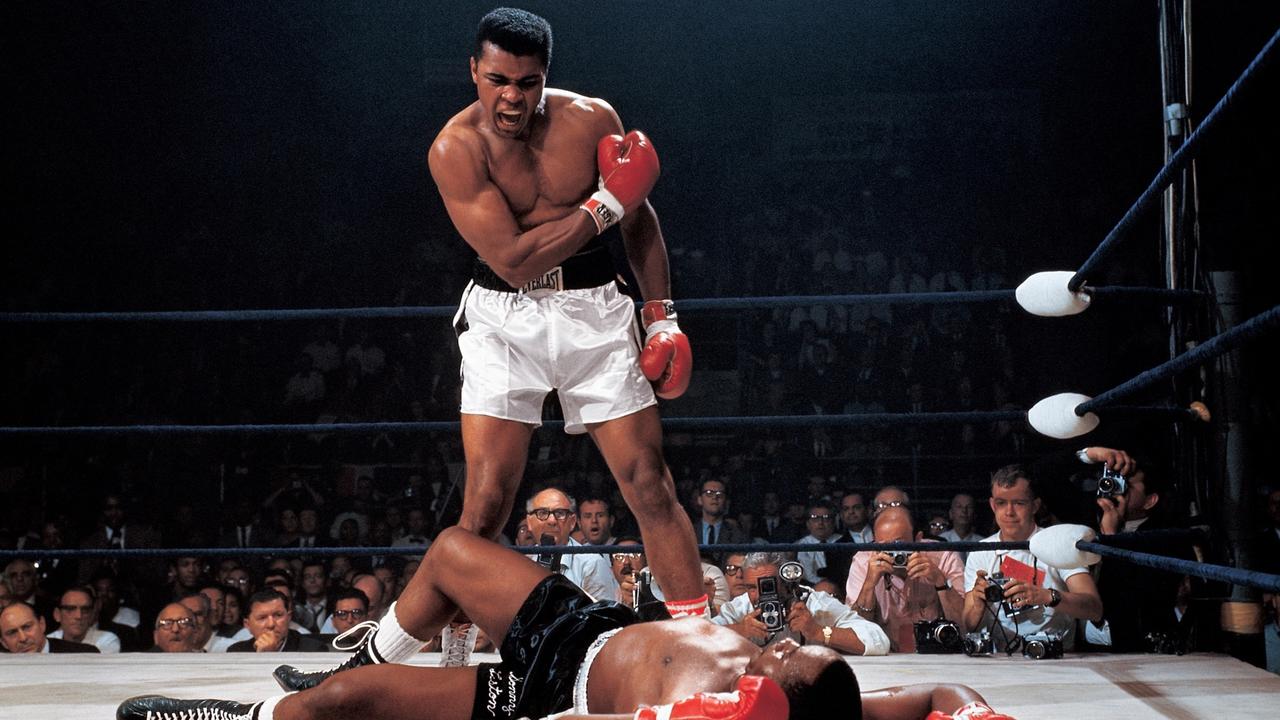
The referee was former Champion Jersey Joe Walcott. Both fighters were booed upon their introductions. Midway through the 1st round, Liston threw a left jab, and Ali went over it with a fast right, knocking the former Champion flat on his back. Liston rolled over, got to his right knee, and then fell on his back again.

Walcott had a hard time getting Ali to go to a neutral corner. Ali initially stood over Liston, yelling, "Get up, sucker!" At this point, Neil Leifer of Sports Illustrated took the picture above, one of the most famous photographs in sports history.

When Walcott got back to Liston, and looked at the knockdown timekeeper, Francis McDonough, to pick up the count, Liston had fallen back on the canvas. Walcott never did pick up the count. He said he could not hear McDonough, who did not have a microphone. Also, McDonough did not bang on the canvas or motion a number count with his fingers. McDonough, however, claimed Walcott was looking at the crowd and never at him.

After Liston arose, Walcott wiped off his gloves. He then left the fighters to go over to McDonough. Waltcott later said McDonough had told him, "I counted him out. The fight is over." Nat Fleischer, editor of The Ring magazine, had no authority over the fight, but he backed McDonough up, saying the fight should be over. Walcott then rushed back to the fighters, who had resumed boxing, and stopped the fight, awarding Ali a knockout victory.

It remains one of the quickest heavyweight title knockouts in history. Many in the small crowd had not even settled in their seats when the fight was stopped. The official time of the stoppage was announced as 1:00 into the first round, which was wrong. Liston went down at 1:44, got up at 1:56, and Walcott stopped the fight at 2:12.

McDonough and Fleischer were wrong in their interpretation of how the rule should have been applied. Under the rule, the timekeeper is supposed to start the count at the time of a knockdown. The referee's duty is to get the boxer scoring the knockdown to a neutral corner, pick up the count from the timekeeper. and continue it aloud for the knocked down boxer.

Nevertheless, Liston was down for 12 seconds -- 2 seconds fewer than Gene Tunney was down in his "Long Count" fight with Jack Dempsey in 1927. But Liston was no Tunney. He was more like the Mike Tyson of his era: Show him that you're not afraid of him, and that you can hit him, and he would fold, or even start cheating. In his 1st fight with Ali, he tainted his gloves to try to blind Ali. In the 2nd fight, he never got the chance to cheat.

Some people wondered if Ali had even hit Liston, or if Liston had gone down on his own, quitting the way he'd quit on his stool between the 6th and 7th rounds of their 1st fight. The suggestion was that he lost on purpose for more money from gamblers -- in ring parlance, "took a dive." The film shows this not to be the case: It clearly shows that Ali's punch was no "Phantom Punch." Instead, it had lifted Liston off the canvas entirely. Liston didn't dive: He fell, from being hit.

James Braddock was Heavyweight Champion from 1935 to 1937. He said of Ali, "I have a feeling that this guy is a lot better than any of us gave him credit for. It isn't the knockout punch that sticks in my mind as much as a punch he let go earlier... It was a right to Liston's jaw, and it shook him to his shoetops. For all we know, it could have been the one that set up the knockout."

Rocky Marciano was Heavyweight Champion from 1952 to 1955. After seeing the replay, he said, "I didn't think it was a powerful punch when I saw the fight from ringside. Now, I think Clay, seeing the opening, snapped the punch the last six inches." But he still didn't think the punch was hard enough to be a knockout, only a knockdown.

Liston had 16 more fights, winning 15 of them, 14 by knockout. So the suggestion that "He was never the same fighter" is ridiculous. But he never got another shot at the title, not even after Ali was stripped of it in 1967, following his refusal to accept being drafted into the U.S. Army. Of course, by then, Liston was officially 35 years old -- but Walcott had been 37 when he won the title. Liston died in 1970, also under mysterious circumstances.

McDonough died in 1968, Fleischer in 1972, Walcott in 1994.

Saturday, March 22, 2025

George Foreman, 1949-2025

George Foreman was one amazing guy.  Actually, he was two amazing guys. The second was a great guy. The first... less so.

George Edward Foreman was born on January 10, 1949 in Marshall, Texas, about 150 miles east of Dallas, 20 miles west of the Texas-Louisiana State Line, and 40 miles west of Shreveport. In 2015, George, former Pittsburgh Steelers quarterback Terry Bradshaw, and actors William Shatner and Henry Winkler, all already old men, traveled the world together, for an NBC miniseries titled Better Late Than Never. Most viewers knew they were contemporaries, but not that they were close friends. And yet, despite being identified with Houston, Foreman was born not that far from Shreveport native Bradshaw.

He grew up in the Fifth Ward of Houston, then nearly all-black, but now about evenly divided between black and Hispanic. Other notable natives include Congressmembers Barbara Jordan and Mickey Leland, rap group Geto Boys, and baseball star Carl Crawford.

He was 1 of 6 siblings raised by his mother, Nancy, and her husband, J.D. Foreman. But, alone among his siblings, he was born before Nancy and J.D. were married. His younger siblings, in their Texas accents, called him "Mo'head." He thought they were saying he had a big head. It was a long time before he found out that his biological father was a man named Leroy Moorehead.

He later admitted that this is why he named all 5 of his own sons "George": "My sons are going to know who their father is."

He admitted, years later, that he was a bad kid. He dropped out of school at age 15, and made money by mugging smaller kids. At 16, he saw an ad for the Job Corps, and talked his mother into signing him up for it. He got his GED, and trained to become a carpenter and a bricklayer.

He learned to box, and in 1968, at the Olympics in Mexico City, he followed in the footsteps of future Heavyweight Champions Floyd Patterson, Muhammad Ali (then named Cassius Clay) and Joe Frazier, and won a Gold Medal.

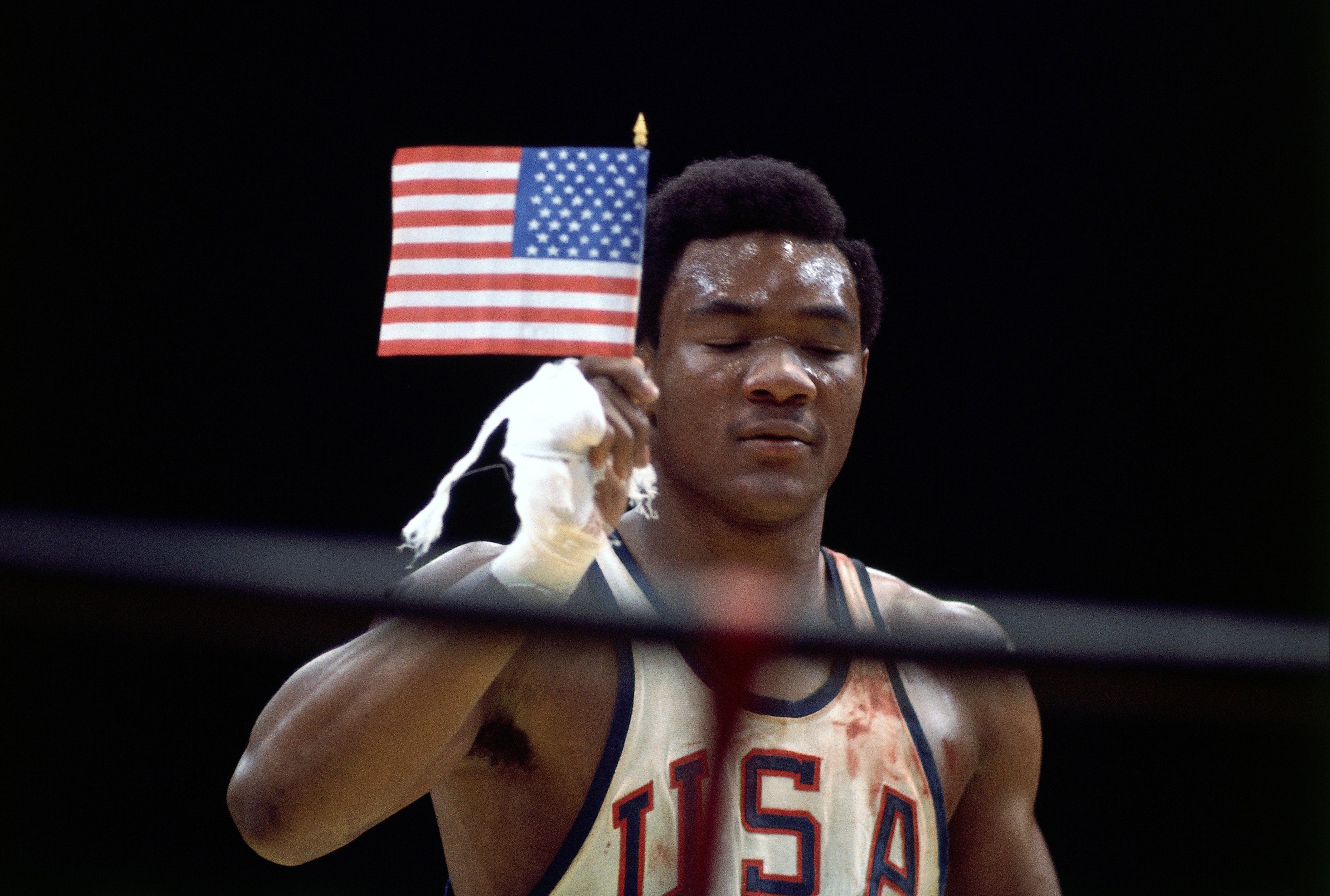
After winning the final match, he walked around the ring, holding a small American flag. He was highly praised for this, with sportswriters thinking he was trying to contrast himself with the "Black Power Salute" of sprinting medalists Tommie Smith and John Carlos, and the basketball boycott led by Kareem Abdul-Jabbar (then named Lew Alcindor) and Elvin Hayes. George said it wasn't true: He wasn't even thinking about that. He was just proud to be an American and a Gold Medalist.
On December 18, 1969, the day I was born, George Foreman climbed into the ring at the Seattle Center Coliseum, against Gary "Hobo" Wiler. The fight was meant to go a maximum of 10 rounds. It didn't make it to the end of the 1st round. George was now 13-0 as a professional.

On January 22, 1973, he was 37-0, and he got his shot at the Heavyweight Championship of the World. His opponent would be Frazier, who was 29-0, and already thought to be one of the greatest fighters who ever lived. It was at the National Stadium (now named Independence Park) in Kingston, Jamaica.

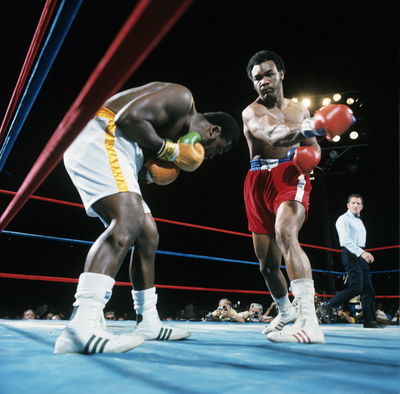
In what was known as the Sunshine Showdown (despite taking place at night), Foreman dominated from the opening bell. The rule mandating the fight be ended in the event of 3 knockdowns in 1 round was waived for this fight. Angelo Dundee, Muhammad Ali's trainer, who had also worked with Foreman, was seated at ringside, and, halfway through the 1st round, could be heard on ABC Sports' broadcast yelling, "Frazier's hurt!"

Sitting next to Dundee, Howard Cosell tried to tell the ABC audience what Dundee had said, but couldn't finish it, because Foreman delivered a knockdown blow: "Angie Dundee, Ali's trainer, right next to me, is saying it. You may hear it... Down goes Frazier! Down goes Frazier! Down goes Frazier! The Heavyweight Champion is taking the mandatory 8-count, and Foreman is as poised as can be in a neutral corner!"
Frazier got up at the count of 2, but took the 8-count, and resumed. With 16 seconds left in the 1st round, Foreman knocked Frazier down again. He got up. Just before the bell rang to end the round, Foreman knocked Frazier down for a 3rd time. There was no "saving by the bell": Had Frazier not gotten up, it would have been over then.

It should have been over then. Instead, referee Arthur Mercante, who had refereed the 1st Ali-Frazier fight in 1971, let the 2nd round begin. Frazier was knocked down a 4th time. Mercante didn't stop it. Frazier was knocked down a 5th time. Mercante didn't stop it. Frazier was knocked down a 6th time. Only then did Mercante stop it. Foreman was the Champion.

In his next fight, on September 1 at Budokan in Tokyo, Japan, Foreman knocked Puerto Rican fighter José "King" Roman out in the 1st round. Next up, on March 26, 1974 in Caracas, Venezuela, Foreman knocked Ken Norton out in the 2nd round.

Roman had never fought Ali. But, now, Foreman had destroyed the only 2 men to defeat Ali as professionals. Yet Ali wanted to fight him to regain the title. Ali was talking his usual trash, but most people thought he would lose. Indeed, there were some who feared that Ali would be killed in the ring. For a promotional video broadcast on ABC's Wide World of Sports, Ali stuck his finger and his face in the camera, bragging about how he was once again going to shock the world. Foreman just calmly said, "I'm gonna kill you." Then he smiled, to show that he wasn't serious about that.

But, at 40-0 (as opposed to Ali's 44-2), and 25 years old (in his prime, as opposed to Ali being 32), Foreman looked like an unbeatable monster.

Built in 1952 under Belgian rule as the Stade Roi Baudouin, the site of the fight was renamed Stade du 20 Mai (for May 20, the anniversary of the founding of Zaire's ruling party) in 1967, and Stade Tata Raphaël (Father Raphael Stadium) in 1997, after the death of dictator Mobutu Sese Seko.

Through a months-long psychological campaign, including practically the entire black population of the continent of Africa in his favor and against the equally black Foreman – he had done something similar to Joe Frazier, who was puzzled by it: "I'm darker than he is!" – Ali had gotten into Foreman's head, just as he had done to Sonny Liston, Floyd Patterson, and just about everybody else he'd ever fought.

The referee was Zack Clayton, who had played in baseball's Negro Leagues, and for one of the great pre-NBA all-black teams, the New York Renaissance Five.

Ali fooled them all. People who say he just leaned against the ropes in his "rope-a-dope" strategy, and let Foreman tire himself out with punches, are fools. I've seen the tape of the fight a few times, and my opinion never changes: Ali got in a lot of punches, enough to win every round except for the 2nd and the 6th.

Foreman would later tell an interviewer that, at the end of the 6th, Ali yelled at him, "Is that all you got, George?" And Foreman had to admit, "Yup, that's about it."

In the 8th round, backed up against the ropes, Ali managed to turn an exhausted Foreman around, toss a few jabs, and knock him on his can. Foreman tried to get up, but he ran out of time, and Ali was the winner by a knockout. He proved that he really was "The Greatest... Of All Tiiiiiiiime!"

Ali was on top of the world again, the most beloved man in the world. Foreman was... he didn't really know where he was. He trained for a comeback, but didn't fight again for over a year. In 1976, he went to Las Vegas to fight Ron Lyle, who had been beaten by Ali the year before. It was an amazing fight, with each man knocking the other down, before Foreman knocked Lyle out in the 5th round.

He got a rematch with Frazier, at the Nassau Coliseum on June 15, 1976. Smokin' Joe had lost his 3rd fight with Ali the previous October, and seemed spent, so it didn't help Foreman's imagine much when he knocked Frazier out in the 5th. He won 3 more fights. On March 17, 1977, he went into the Roberto Clemente Coliseum in San Juan, Puerto Rico, and lost a unanimous decision to Jimmy Young. He was only 28, and at 45-2, he hardly seemed done as a fighter.

But what the crowd, and the TV audience, and boxing fans around the world didn't know was that he became ill in his dressing room after the fight. He was suffering from exhaustion and heatstroke, and stated he had a near-death experience. He spoke of being in a hellish, frightening place of nothingness and despair, and felt that he was in the midst of death.

Though not yet religious, he began to plead with God to help him. He explained that he sensed God asking him to change his life and ways, whereupon he said, "I don't care if this is death: I still believe there is a God!"

He stopped fighting, and became an ordained minister, initially preaching on street corners before becoming the minister of the Church of the Lord Jesus Christ in Houston, and devoting himself to his family and his congregation. He also opened a youth center.

As sportswriter and boxing broadcaster Larry Merchant put it, "There was a transformation from a young, hard character who felt a heavyweight champion should carry himself with menace to a very affectionate personality."

He married 4 times, before marrying Mary Joan Martelly in 1985, a marriage that lasted for the rest of his life. He had 5 sons and 7 daughters. As I said, he named all of his sons George Edward Foreman, like himself. Fortunately, they all have nicknames: George Jr. is Junior, George III is Monk, George IV is Big Wheel, George V is Red, and George VI is Little Joey. His 7 daughters were named Courtney, Isabella, Georgetta, Michie, Freeda, Leola and Natalia. No, he didn't name them all Georgetta or Georgia, or variations thereof.

At one point, when Red was a baby, the 1st 5 Georges did a Doritos commercial together. The problem was, Georges V, IV, III and Jr. ate the entire bag, leaving Big George with nothing, and, using the classic line of a boxer who's been unfairly beaten, said, "I was robbed!" It a parody of the Trident chewing gum ad, talking about how many dentists recommended it, the narrator said, "IV out of V George Foremans agree!"

At any rate, Big George had become a better man, a champion at life for a lot longer than he was a champion in boxing. And if that had been the end of the story, it would still have been an amazing story.

*

But the story got better. When F. Scott Fitzgerald said, "There are no second acts in American life," he could not have foreseen George Foreman.

In 1987, at the age of 38 -- an age at which many boxers have never retired and just kept at it, or had retired and come back at least once -- George returned to boxing, to raise money for his church. Discovering that he still had some punching power, he kept at it. He won 7 straight matches, and got a matchup at Caesars Palace outside Las Vegas with Dwight Muhammad Qawi, a former Champion at the Light Heavyweight and Cruiserweight levels. George won by a 7th-round TKO. His comeback was no longer a joke: He had a major name on his revived record.

Over the next year and a half, he went 11-0. Early in 1990, he was paired up with Gerry Cooney, who had given Larry Holmes a tough title defense in 1982. The fight was set for Convention Hall (now named Boardwalk Hall) in Atlantic City, New Jersey. It was billed as "The Preacher vs. the Puncher" and "The War at the Shore." But Tonight Show host Johnny Carson, who'd had George as a guest, noted that George was 41, and Cooney, while just 33, hadn't won a fight in nearly 4 years, and called it "Two Geezers at Caesars." (The Atlantic City version of Caesars is 2 blocks away.) George knocked Gerry out in the 2nd round. Gerry never fought again.

After 4 more wins, making him 69-2, and 24-0 in his comeback, George got another shot at the title, facing Evander Holyfield at Boardwalk Hall on April 19, 1991. It was billed as "The Battle of the Ages": Foreman was 42, and Holyfield was 28 and very much in his prime.

Holyfield won: One judge had it as close as 115-112, but the others had it as 116-111 and 117-110. Nevertheless, Foreman went the distance, didn't get hurt, and didn't embarrass himself. Lots of people, myself included, thought he had proven his point, and that he should stop before he did get hurt.

He didn't stop. His next fight was against a former NFL linebacker named Jim Ellis. People began to wonder if George had taken so many punches to the head that he thought he was fighting Jimmy Ellis, a contender from early in his career. George knocked him out. He won a close decision over Alex Stewart, a Jamaican who had given Holyfield a tough time, but had gotten clobbered by Mike Tyson. He knocked out South African fighter Pierre Coetzer. In 1993, at the Thomas & Mack Center outside Las Vegas, he lost a decision to Tommy Morrison.

Still, George wouldn't give up. With the governing bodies for boxing once again disagreeing on who the real Champion was, he signed to fight WBA and IBF Champion Michael Moorer on November 5, 1994, at the MGM Grand Garden Arena outside Las Vegas.

Moore was not considered a great fighter -- he'd won the title 6 months earlier, in a controversial majority decision over Holyfield -- but it didn't matter: He was about to turn 27, while George was 45. The oldest Heavyweight Champion ever had been Jersey Joe Walcott, 38 when he was knocked out by Rocky Marciano in 1952. 

Joe Cortez was the referee. A member of the International Boxing Hall of Fame, and a former Golden Gloves Champion from Harlem, New York City, he refereed over 900 fights in his career. This would be his 5th title fight in 1994 alone. Angelo Dundee, who had worked with both Ali and Foreman, was with Foreman this time. He wore the same trunks he'd worn against Ali in Zaire, 20 year earlier to the week. 

George's strategy was to let Moorer fight his usual fight, while waiting for him to slip up. He felt that if he was able to wait, Moorer would leave himself open for a combination that would allow George to knock him out.

Moorer controlled the pace of the fight from the beginning and kept winning rounds. George took a lot of punches, and his left eye swelled, nearly shut. But he stayed on his feet. At this point, the only fighters ever to knock him down were Ali, Lyle and Young. Holyfield hadn't done it. And only Ali had knocked him out.

Still, after the 9th round, the judges had it 88-83, 88-83 and 86-85 in Moorer's favor. And with the fight set for a maximum of 12 rounds, time was running out. Before sending him out for the 10th round, Angie told George it would take a knockout to win.

George hit Moorer with a body punch that slowed him down, giving George the chance he needed to land some combinations. He finally caught Moorer with a right on the jaw, and Moorer fell flat on his back. Not until Cortez's count reached 5 did Moorer move. At 8, he tried to push himself up. He couldn't, and Cortez reached 10. At 45 years, 9 months and 26 days old, 20 years and 6 days after he'd last held the title, George Foreman was the Heavyweight Champion of the World.

This was also the year that George did something that made him richer and more famous than boxing did: His claim to have succeeded in a return to boxing by eating healthy, which didn't seem to make sense as he was a bit fat, led to him teaming up with Salton, Inc., which was working with Michael Boehm. He was an inventor who had created an indoor grill that cooked on both sides at once. He didn't get his name on the product, but he got as much money from it as George did, selling it through commercials for "The George Foreman Lean Mean Fat-Reducing Grilling Machine." Everyone just called it "The George Foreman Grill." Even my mother bought one.
Five months after winning the title back, George defended it against German fighter Axel Schulz. It was a close decision, and the IBF ordered a rematch. George wouldn't give him one, and was stripped of the title. He fought 3 more times, the last a close decision to Shannon Briggs in Atlantic City in 1997. Finally hanging up the gloves for good at the age of 48, he was 76-5 -- 31-3 in his comeback.

In 2015, he (then 66 years old) and actors William Shatner (84) and Henry Winkler (70), and quarterback-turned-football analyst Terry Bradshaw (67), all close friends with each other (though most people didn't know that), got together for a special project for NBC. Better Late Than Never showed them traveling together to Asia for a 1st season, and then Europe for a 2nd season, and how they reacted to these different cultures. (A running gag was Shatner getting the others to try exotic food, often odd body parts of various animals.)

The European trip, in 2016. included a visit to Lithuania, from which Shatner's Jewish ancestors had come. But it was also the homeland of boxer Jonas Čepulis, who had competed for the Soviet Union, and lost to George in the heavyweight final at the 1968 Olympics in Mexico City. Sadly, Čepulis had died the year before, but George got to meet his family, and pay his respects at his early opponent's grave.

In 2022, he competed on the U.S. version of The Masked Singer, as "Venus Fly Trap." He sang "Get Ready" by The Temptations, but was eliminated. He may have knocked Joe Frazier out, but he couldn't sing like him.

George Foreman passed away yesterday, March 21, 2025, in Houston, surrounded by his family. He was 76 years old. He lived two very colorful lives, one troubled, one glorious.