Showing posts with label mississippi. Show all posts

Tuesday, September 23, 2025

September 23, 1955: The Murderers of Emmett Till Are Acquitted

September 23, 1955, 70 years ago: Two men are found not guilty of murder. They went on to brag about how they got away with it.

Emmett Louis Till was born on July 25, 1941 in Chicago. His father, Louis, would enter the U.S. Army after his mother, Mamie, kicked him out of the house for being abusive. He would be executed in Italy following a 1945 court-martial for the murder of a local woman.

Mamie was born in Mississippi, and, as a small child, moved north with her family in what has become known as the Great Migration of African-Americans in search of better civil rights and working conditions. They lived on the South Side of Chicago, in a sub-neighborhood called Argo, a.k.a. Little Mississippi. When Emmett was 6 years old, he contracted polio, leaving him with a stutter. He and his mother moved to Detroit, where she married a man named Pink Bradley. The marriage didn't last, and they moved back to Chicago, although she kept the name Mamie Till Bradley.

Statistics on lynchings began to be collected in 1882. Between then and 1955, more than 500 African-Americans had been killed by extrajudicial violence in Mississippi alone, and more than 3,000 across the South. Most of the incidents took place between 1876 and 1930. Though far less common by the mid-1950s, these racially motivated murders still occurred.
Flag flown outside NAACP headquarters in New York,
1936 to 1938. They stopped when the owner of the building
threatened them with eviction.

Throughout the South, interracial relationships were prohibited, as a means to maintain white supremacy and "purity." Even the suggestion of sexual contact between black men and white women could carry severe penalties for black men. 

In 1955, Mamie's uncle, 64-year-old Mose Wright, visited her and Emmett in Chicago during the Summer, and told stories about living in the Mississippi Delta. Emmett wanted to see for himself. Wright planned to accompany Till with a cousin, Wheeler Parker; another cousin, Curtis Jones, would join them soon after.

Wright was a sharecropper and part-time minister who was often called "Preacher." He lived in Money, a small town in the Delta that consisted of three stores, a school, a post office, a cotton gin, and a few hundred residents, 8 miles north of Greenwood. Before Emmett departed for the Delta, his mother cautioned him that Chicago and Mississippi were two different worlds, and he should know how to behave in front of whites in the South. He assured her he understood.

Emmett took the Illinois Central Railroad down, and arrived in Money on August 21, 1955. On August 24, a cousin, Maurice Wright, drove Emmett and some other black boys, relatives and neighbors, to Bryant's Grocery and Meat Market, to buy candy. The Market was owned by Roy Bryant, 24, and his wife, Carolyn, 21. Carolyn was in the front of the store. Her sister-in-law, Juanita Milan, was in the back, watching some white children.

What happened next is in dispute. One witness said that one of the boys dared Emmett to flirt with Carolyn. Another said that this did not happen. Emmett's cousins Simeon Wright and Wheeler Parker both said that Emmett "wolf-whistled" at Carolyn. His mother would later tell a reporter that, because of his stutter, Emmett had trouble pronouncing the letter B, and that whistling sometimes helped. This backs up the suggestion that he had tried to order bubble gum. 

At the trial, Carolyn testified that Emmett grabbed her hand and said, "How about a date, baby?" She said she got away, and that he then grabbed her waist and said, "What's the matter baby, can't you take it?" And then one of the other boys grabbed Emmett and got him out of there.

In 2008, 53 years later, Bryant admitted that she had made this up, and said, "Nothing that boy did could ever justify what happened to him." Supposedly, there was a white man in the store, who confirmed that Emmett said nothing inappropriate to her. There was a checkers game going on out front, and one of the white men involved said that Emmett did whistle, but at an impressive move made in the game, a completely harmless gesture.

Roy Bryant was on a hunting trip, and did not return until August 27. He heard about what happened from one of the checkers players, and was angry at Carolyn for not telling him herself. In the middle of the night on August 28, Roy and his half-brother, John William Milam, broke into Mose Wright's house with a gun, and kidnapped Emmett.

Emmett was found 3 days later, by boys fishing in the Tallahatchie River. Emmett's face had been beaten beyond recognition, and his body had been weighted down with an electric fan whose cord was tied around it. He had just turned 14 years old.

Mamie Till Bradley demanded an open-casket funeral in Chicago: She wanted people to see what was done to him. Gruesome postmortem photos appeared in Jet magazine.

This time, the rednecks had gone too far. Governor Hugh White sent a telegram to the NAACP, saying, "Mississippi does not condone such conduct," and saying that local authorities should pursue a "vigorous prosecution." Leflore County Deputy Sheriff John Cothran stated, "The white people around here feel pretty mad about the way that poor little boy was treated, and they won't stand for this." Letters to the editor appeared in local newspapers, admitting that white actions like these did more damage to the South than any black actions did.

The bigots, naturally, fought back. They falsely reported riots in the funeral home in Chicago. Roy Bryant and J.W. Milam appeared in photos smiling and wearing military uniforms, and Carolyn Bryant's beauty and virtue were extolled.

Bryant and Milan were indicted for murder on September 3. The trial was held at the Tallahatchie County Courthouse in Sumner, Mississippi. District Attorney Gerald Chatham was the prosecutor, and he was pessimistic about getting a conviction from an all-white jury. The jury was all-white because jurors are selected from voter rolls, and black people were not permitted to vote in Mississippi, despite the 15th Amendment to the Constitution of the United States officially guaranteeing them that right.

County Sheriff Clarence Strider served as the defense attorney. He said, "The last thing I wanted to do was to defend those peckerwoods. But I just had no choice about it."

The main defense argument was that the body pulled from the river could not be definitively identified, and that Emmett Till might be still alive and missing, perhaps in hiding, to set up the good white people of Mississippi.

Sheriff Strider was told that there were 2 black witnesses who could back up the prosecution's case. He had them found, and kept them in jail for the duration of the trial, to keep them from testifying. This should have not only produced a mistrial, but gotten Strider disbarred. In contrast, Judge Curtis Swango was hailed for his even-handedness, and no one has ever alleged any misconduct on his part.

Mose Wright did not see the murder, but he did identify Milam as one of the kidnappers. It was said to be the first time in the South that a black man had testified to the guilt of a white man in court and lived.

On September 23, the all-white, all-male jury acquitted both defendants, after a deliberation of 1 hour and 7 minutes. One juror said, "If we hadn't stopped to drink pop, it wouldn't have taken that long." Basically, they took just enough time to make it look like they had to give it some thought, when they didn't: They were never going to vote to convict, no matter what the evidence said.

Protected against double jeopardy, Bryant and Milam struck a deal with Look magazine in 1956, to tell their story to journalist William Bradford Huie for between $3,600 and $4,000. The interview took place in the law firm of the attorneys who had defended Bryant and Milam. Huie did not ask the questions; Bryant and Milam's own attorneys did. Neither attorney had heard their clients' accounts of the murder before.

According to Huie, the older Milam was more articulate and sure of himself than the younger Bryant. Milam admitted to shooting Till, and neither of them believed they were guilty or that they had done anything wrong. Milam said, "What else could I do? He thought he was as good as any white man."

Emmett Till was as good as any white man. Certainly, he was better than the two white men who premeditatedly murdered him in cold blood.

D.A. Chatham's health suffered as a result of the trial, and he died a little over a year later, only 50 years old. His son, Gerald Chatham Jr., who was 11 years old at the time of the trial, would later serve two terms as District Attorney in the same district. Judge Swango died in 1968.

Unrepentant to the end, Clarence Strider died in 1970; J.W. Milam, in 1981; Roy Bryant, in 1994. Carolyn Bryant divorced Roy in 1981, remarried, and became known as Carolyn Bryant Donham. In 2022, she gave a 99-page memoir, titled I Am More Than a Wolf Whistle, to the Southern Historical Collection at the University of North Carolina, with an agreement that UNC would hold it privately until the year 2036. She died on April 25, 2023. As far as is known, she was the last surviving person who knew what really happened.

None of these 4 guilty people ever spent a day in prison. A historical marker now stands outside the remnants of the grocery store, which has yet to be torn down.  

Mose Wright left Mississippi for Chicago, never to return. He lived until 1977. Mamie Till-Mobley, having remarried, lived until January 6, 2003, at the age of 81.

The treatment of Emmett Till by the State of Mississippi, both before and after his death, inspired 2 young black men to become civil rights activists. You might know their birth names: Malcolm Little and Cassius Clay. You surely know the names they chose for themselves, the names by which they became better known: Malcolm X and Muhammad Ali.

One more analogy: Trent Lott was born on October 9, 1941 in Grenada, Mississippi. In 1972, he was elected to Congress. In 1989, he was elected to the Senate. In 1996, he became the U.S. Senate's Majority Leader.

In 2002, Lott spoke at a dinner in celebration of the 100th birthday of Strom Thurmond, the longtime Senator who, in 1948, as Governor of South Carolina, led a 3rd-party campaign for President on an anti-civil rights platform. Lott said, "Let me say something about my home State: When Strom Thurmond ran for President, we voted for him. We're proud of it. And if the rest of the country had followed our lead, we wouldn't have had all these problems over the years, either." The backlash was such that Lott had to step down as Majority Leader, although he served in the Senate for another 4 years.

Trent Lott was elected to Congress at age 31, to the Senate at 47, and Majority Leader at 55. As of September 23, 2025, he is approaching his 84th birthday.

Emmett Till would be the same age. It is possible he could have died at any time in the interim. He could have served in Vietnam and been killed there. He could have fallen victim to illness or accident. Or, some other bigot could have taken matters into his own hands. But it would hardly be out of the ordinary for him to still be alive in 2025.

He should have had a full life. Instead, he was murdered as a boy of 14 -- not because he thought he was as good as a white man, but because an evil white man believed he wasn't.

The historical marker marker for Emmett Till's murder is a short walk from a bridge over the Tallahatchee River. But this is not the bridge that country singer Bobbie Gentry would later write about in her 1967 Number 1 hit "Ode to Billie Joe." That bridge, which collapsed in 1972 and was replaced, is 9 miles downstream.

The historical markers marking the locations of the murders of Emmett Till and of civil rights workers Andrew Goodman, Michael Schwerner and James Chaney, 9 years later, are 117 miles apart.

Wednesday, April 30, 2025

April 30, 1900: The Legend of Casey Jones

April 30, 1900, 125 years ago: Casey Jones saves the people on his train, at the cost of his own life, and becomes an American legend. That's the legend, and that's also the truth. There is more to the truth, however. He was... complicated.

John Luther Jones was born on March 14, 1863 in Cayce, Kentucky. The town's pronunciation, KAY-see, led to his nickname, "Casey." (Just as Charles Dillon Stengel was from Kansas City, and that got shortened to "K.C.," ultimately becoming "Casey.") He had a wife and 3 children, and was believed to have never touched a drop of alcohol.

He worked for the Mobile & Ohio Railroad, and became a brakeman on their route from Columbus, Kentucky to Jackson, Tennessee, outside Memphis. Jackson became his home for the rest of his life. He was promoted to fireman (shoveling coal to put in the fire to power the locomotive) on their route from Jackson to Mobile, Alabama. In 1887, a yellow fever epidemic hit the Illinois Central Railroad hard, opening opportunities, and in 1888, Casey was hired as a fireman on their freight line from Jackson to Water Valley, Mississippi, finally being promoted to engineer in 1891. He was 28, and becoming an engineer so young was unusual.

He was noted for his exceptionally punctual schedules, often saying he would "get here there on the advertised," meaning on schedule. People were known to set their watches by his arrival. But this sometimes had a degree of risk, including those of derailing, crashing into another train, or hitting a person on the track before they could get out of the way of the oncoming train. But from 1891 to 1899, there were no incidents.

Well, one, a heroic incident. In 1895, he was approaching Michigan City, Mississippi. He had left the cab in charge of fellow engineer Bob Stevenson, who had reduced speed sufficiently for Casey to walk safely out on the running board to oil the relief valves. He advanced from the running board to the steam chest and then to the pilot beam to adjust the spark screen.

He had finished well before they arrived at the station, as planned, and was returning to the cab when he noticed a group of small children dart in front of the train some 60 yards ahead. All cleared the rails easily except for a little girl who suddenly froze in fear at the sight of the oncoming locomotive. Jones shouted to Stevenson to reverse the train and yelled to the girl to get off the tracks in almost the same breath. Realizing that she was still immobile, he raced to the tip of the pilot or cowcatcher and braced himself on it, reaching out as far as he could to pull the frightened but unharmed girl from the rails.

In February 1900, Casey was transferred from Jackson to Memphis, for the passenger run between there and Canton, Mississippi, the 3rd link in the 4-train Illinois Central run from Chicago to New Orleans, in the days before the City of New Orleans (leaving Chicago by morning and arriving in New Orleans at morning, and vice versa, running from 1947 to 1971) and the Panama Limited (a night train at each end, 1911 to 1971) could run the whole way (and before each could be celebrated in song: "The City of New Orleans" in 1971 and "Night Train" in 1951).

On April 29, 1900, already scheduled to make the Memphis to Canton run, he was asked to take over another service through the day, which may have deprived him of sleep. He left Memphis aboard Engine No. 382, known (like many other fast trains of the era) as "The Cannonball," at 12:50 AM on April 30, an hour and 15 minutes late.

But he drove that train hard. By the time he got to Durant, Mississippi, he was only 5 minutes behind, telling his fireman, a black man named Simeon Webb, "Sim, the old girl's got her dancing slippers on tonight!" He thought he could get to Canton "on the advertised" at 4:05 AM.

But at Vaughan -- 172 miles south of Memphis, 225 miles north of New Orleans, and just 16 miles north of his destination of Canton -- there were 3 trains in the station, and 2 were, due to their length, crossing between the passing track and the main line. An air hose broke on one, leaving 4 cars of 1 of the trains on the main line. And Jones and Webb were coming in, only 2 minutes behind schedule, on a left-hand curve that blocked Jones' view from the right side.

Webb saw the red lights ahead, meaning "Stop." He told Casey. Casey told him to jump off, which was pretty dangerous, but better than staying on. He jumped, and was knocked unconscious, but not before he heard Jones blow a long, piercing train whistle to warn anyone still on the freight train ahead.

Casey reversed the throttle and slammed the airbrakes. This could only cut his speed from 70 to 40 miles per hour, before he crashed into the freight cars ahead of him, wrecking some. There were 6 people injured, including Webb. But, between his train, the others, and the people in the station, only 1 person died, and that was Casey Jones. The impact stopped his watch at 3:52 AM -- 13 minutes before he was scheduled to arrive in Canton. Had the tracks been clear, he would have made it. He was 37 years old.

Adam Hauser, a passenger on Casey's train, told The Times-Democrat, a New Orleans newspaper, "The passengers did not suffer, and there was no panic. I was jarred a little in my bunk, but when fairly aware the train was stopped and everything was still. Engineer Jones did a wonderful as well as a heroic piece of work, at the cost of his life."

Sim Webb -- who, probably due to his race, never got the credit he deserved for seeing the stuck train and giving Casey the chance to save everyone's lives -- lived on until 1957, age 83. Casey's widow, Janie Brady Jones, died the next year, at 92, having never remarried, and having worn black nearly every day since Casey's death. She was buried next to him in Jackson (the one in Tennessee, not the State capital of Mississippi).

By 1909, there was already a song titled "The Ballad of Casey Jones." It made its way up the Illinois Central to Chicago, where it became popular in vaudeville. Poet Carl Sandburg, based in Chicago, called it "the greatest ballad ever written." Labor activist and songwriter Joe Hill challenged the traditional version and, without evidence of Casey actually having been one, wrote "Casey Jones, Union Scab." (In fact, Casey belonged to 2 unions, 1 for locomotive firemen and 1 for engineers.)

In 1969, The Grateful Dead began performing a song titled "Casey Jones," recording it for their 1970 album Workingman's Dead. It bears little resemblance to the true story, with lyricist Robert Hunter writing:

Driving that train
high on cocaine.
Casey Jones you'd better
watch your speed.
Trouble ahead
trouble behind
and you know that notion
just crossed my mind.

Hunter later said he tried rhyming "Driving that train" with something else: "I write, 'Driving that train, whipping that chain.' No. 'Lugging propane.' No. I tried any way to get away from it, and there just wasn't one. It had to go. There was no other line for that song." 

Monday, November 9, 2020

My Ranking of the States, 2020 Edition

I did this in 2015. I thought it was time for an update.

Here's what I'm looking for:

* Looks. Is your State nice to look at, on the average?

* History. Is it long? Is it good? Being 1 of the 1st 13 States in 1776 helps. Being a Union State in the Civil War from 1861 to 1865 helps, while being a Confederate State hurts. Being a segregated State from 1865 to 1965 hurts. Anything else important, or at least something I find interesting, happen there?

* Politics. Do you vote right -- or, rather, correctly? (If you're a regular reader, you know where I stand on this.)

* Sports. If you favor baseball or hockey, that's a plus. If you favor football, that doesn't help you as much. Success in sports also helps.

* Food. What kind of food is thought of when we think of the State?

* Transport. Is it easy to get around the State to see the State's good stuff?

* Weather. Could I handle it on a regular basis?

* Have I been there? If so, did I find the experience enjoyable? If I haven't been there, that doesn't hurt. But if I have, and have enjoyed it, that helps.

So, here goes, in descending order:

50. Mississippi. This is the State where Elvis Presley, Oprah Winfrey, William Faulkner, and the blues as we know it were born. And, um, nice Gulf Coast beaches. Still doesn't make up for so much foulness. Also, it's too damn hot!

49. Alabama. This is the State where Hank Williams, Hank Aaron and Willie Mays were born, America learned to appreciate Southern football, and the Civil Rights Movement began. But then, there's a reason the Movement began there. Also, it's too damn hot!

48. Idaho. Natural beauty and the world's greatest potatoes don't make up for being the birthplace of the Aryan Nations. Or the birthplace of Sarah Palin, for that matter. Compared to that, Boise State University's horrid blue "Smurf Turf" is a minor offender.

47. North Dakota. Aside from being staunchly Republican, there's not much that's bad about it. In fact, the biggest bad thing about it is that there's hardly any good things about it. Also, it's too damn cold!

46. Arkansas. This is the State where Johnny Cash, Bear Bryant and Bill Clinton were born. But if the last 20 years has proven anything, it's that it's still more Orval Faubus', Mike Huckabee's and Jim Bob Duggar's State than Clinton's. Also, it's too damn hot!

45. Oklahoma. The home State of Will Rogers, Jim Thorpe, Mickey Mantle and Johnny Bench is also Tornado Alley and a hotbed of Teabaggers. Also, it's too damn hot!

44. Wyoming. It's got Yellowstone National Park. It's also got Dick Cheney. They cancel each other out. After that, what's left? Not much.

43. Alaska. Lots and lots of natural beauty. But there's so little of anything but natural beauty. And the people... Let's face it, anybody who watched Northern Exposure wasn't surprised by Palinmania. Also, it's too damn cold!

42. South Dakota. Mount Rushmore helps, but that's pretty much all there is to do there. Unless you like to hunt and/or fish. And I don't and/or don't. Also, it's too damn cold!

41. Montana. As Red Skelton once said of Texas, they got miles and miles of nothing but miles and miles. There's no State that has a worse size-to-stuff ratio.

40. Kansas. "What's the matter with Kansas?" Not enough Jayhawk basketball fans and too many Tea Partiers. Also, it's too damn hot!

39. Nebraska. Nice, friendly people -- if you're just like them. If you're not, you'd better be male, between the ages of 18 and 23, and be able to play football. There is, however, Omaha and its suburbs, with black voters and white liberals that got it nicknamed "Obamaha," and gave one Electoral Vote to Hillary Clinton in 2016 and Joe Biden this time.

38. Utah. Salt Lake City is quickly becoming what Atlanta is to Georgia and Austin is to Texas: A liberal enclave in the capital of a seriously backward State. Also, it's too damn hot!

37. New Mexico. A lot more nice scenery than Montana, and they've voted Democratic in every election since 2008. But that's about it. Also, it's too damn hot!

36. South Carolina. The good news is, the history keeps it from being a bottom-tenner. The bad news is, so much of that history is bad. And Myrtle Beach proves that rednecks can't do beach towns. At least the food is good. Also, it's too damn hot!

35. Iowa. The Hawkeye State is becoming increasingly liberal, to the point where the worst thing I can say about it is that there isn't much to attract your attention, unless you like politics, and even then, the Caucuses only happen once every 4 years.

34. Indiana. The Colts, IU, Purdue and Notre Dame help. The Indy 500? It's big, but I don't like auto racing. And it's a conservative State: Aside from Barack Obama in 2008 and Lyndon Johnson in 1964 -- both outlier elections -- it hasn't voted for a Democratic nominee for President since Franklin Roosevelt in 1936. That's 1 in the last 15 elections, and 2 in the last 21.

33. Louisiana. New Orleans is pretty much the only thing keeping this former Confederate State from being another Mississippi or Alabama. Also, it's too damn hot!

32. Vermont. Like skiing? You'll love it. Don't like skiing? Uh... Well, there's Lake Champlain. And... that's about it. Ben & Jerry's? You can buy that anywhere.

31. Maine. "Vacationland"? I've never gotten around to visiting, and hopefully I'll get to do so next year, once all the restrictions are lifted. But it doesn't seem to be a very interesting place. Also, Red Sox fans.

30. West Virginia. With natural beauty and good sports fans, it used to rank much higher, until they started to believe that Democrats were going to take all their guns away, and failed to notice that Republicans took a lot of their jobs away.

29. Missouri. Sports and history keep it in the top 30, but they're going to have to overcome the legacies of Rush Limbaugh, John Ashcroft and Branson. Also, it's too damn hot!

28. Kentucky. College basketball, horse racing and natural beauty help. Little else does.

27. Texas. History and sports put it a lot higher than its blatant stupidity in politics and its chauvinism in just about everything else would suggest. Also, it's too damn hot!

26. Tennessee. Great music. Great food. Great for college sports. Not so good for pro sports, or politics, and it was a Confederate State. Also, it's too damn hot!

25. Georgia. College football and food can't offset Confederacy and Coke. Also, it's too damn hot! But then, it is one of the States that helped to save us from Trump. 

24. Hawaii. Beautiful and liberal, but it's too damn far, and not sports-oriented enough.

23. New Hampshire. Another relatively close State that I have never visited, and it will probably help if I do. Still, not a lot to do there, and too many Red Sox fans.

22. Florida. The highest-ranking Southern State, and despite that history, and being too damn hot and too damn humid, there's so much to see and do, even if you don't want to visit Disney World. Great college sports State, and its pro sports status has gotten better lately. But the natives, and the Cubans with their misunderstanding of "socialism," are nasty and dumb, and there aren't yet enough old New York Jews and young Puerto Ricans and gays to offset them.

21. Colorado. My only visits have been in changing planes. I should rectify that, as it's beautiful, it's an increasingly liberal State, and it's a good sports State.

20. Washington. Looks nice. Good liberal people. Good sports State. Food. Another one that would probably rise significantly if I visited.

19. Minnesota. Thank you for what you tried to do in 1984. (But what's your explanation for 1972?) Thank God the Metrodome is gone now. Good sports State. Nice people. But it's too damn cold!

18. Arizona. Natural beauty? Check. Good sports State? Check. Good food? Check. Good politics? They're working on it. But it's too damn hot! Don't tell me it's a dry heat: It's a heat!

17. Nevada. Las Vegas is an acquired taste, but I acquired it. Lots of nice scenery. Good on politics. But it's too damn hot!

16. Oregon. It seems like a place I'd love to visit, but I never have, due to the distance. For politics, sports, food and natural beauty, it looks terrific.

15. Ohio. Great for college sports, good for pro sports, improving in politics, and Cleveland is a great food city. I've never been to Cincinnati, and I need to change that.

14. North Carolina. Beautiful, great food, great college sports, getting better in pro sports. Evolving into a better political State, and was one of the Original 13. Still, it was a Confederate State.

13. Delaware. A neighboring State for New Jersey, and thus one I've visited a few times. Rehoboth Beach alone might get this State into the top half. And having given us Joe Biden helps.

12. Virginia. Only its Confederate/segregation status keeps it out of the Top 10. Its Revolutionary role, its many tourist attractions, its natural beauty from mountains to bay, and its generous people make it the 2nd-highest of the ex-Confederate States.

11. Rhode Island. The smallest State by area, but one of the nicest. Its only real flaw: Too many Red Sox fans.

10. Wisconsin. I love Milwaukee. I've never been to Green Bay or Madison, but I'm sure I'd love them, too. Away from Lake Michigan, though, it's not much to look at, and it gets cold. That's all that's keeping it out of the Top 5.

9. Connecticut. Very nice. Great State for college sports. Losing the NHL's Whalers hurt. Also, too many Red Sox fans. Other than that, I like Connecticut a lot.

8. Michigan. Yes, Detroit needs serious help. But it's a great sports town, and the rest of the State supports the pro and college teams very well. Michigan has lots of natural beauty, and the many ethnic groups provide lots of fine food. And while they stupidly elected and re-elected some horrible Governors in John Engler and Rick Snyder, they usually vote Democratic for President and Senator.

7. California. Yes, it's got Los Angeles and its vacuous suburbs, and Oakland is a bit dodgy. But is there a better State for Sports? Is there a better State for showing that liberalism works and conservatism doesn't? Is there a State where the people better show their appreciation for that truth by voting? And with L.A. and San Francisco, there aren't many better States for ethnic food variety. As for natural beauty, there's San Francisco, San Diego, the Sierra Nevadas, the Redwoods, and Yosemite National Park.

6. Illinois. Chicago alone gets it into the Top 10, and the historical stuff elsewhere in the State helps. (Thanks, Abe.)

5. Maryland. Some parts of the State -- the mountainous Panhandle and the Eastern Shore -- aren't too palatable. Otherwise, this beautiful State with one great (if troubled) city, Baltimore, and access to another, Washington, might well be Number 1.

4. Massachusetts. Between the history, the natural beauty, the food, and the sports, this State could have been Number 1 if their sports fans weren't so, how shall I put this... Boston.

3. New Jersey. I'd have loved to be able to put my home State at Number 1. I just couldn't, because, well, Jersey City. And Paterson. And Trenton. And Camden. And Atlantic City. And the industrial blight along the Turnpike (North and South). And the tax whiners in the "McMansion" suburbs. But pretty much anything you could want, we've got it, and we've got it good. Too bad we can't claim either New York City or Philadelphia as our own, as close as we come to them. Speaking of which:

2. Pennsylvania. James Carville once said, "Pennsylvania is Philadelphia and Pittsburgh, with Alabama in between." He wasn't kidding, and he wasn't referring only to the State's love of football. There's a reason that the 280 miles in between the suburbs of those cities, and the rural mining areas in the north of the State, are called "Pennsyltucky." And they were too quick to defend the indefensible from Joe Paterno. But with Philly, Pitt, its role in the Revolution, it's role in the Civil War, and its having made up for voting for Trump by rejecting him this time, how can you not put Pennsylvania in the Top 5?

1. New York. Admittedly, most of this is due to New York City. But even the rest of the State, by itself, would make the Top 20. Buffalo. Rochester, Syracuse. Lake Placid. And, oh yeah, Cooperstown. Plus, the Hudson Valley, West Point, the Catskills, the Adirondacks, Lake Champlain, the Finger Lakes, and Niagara Falls. And, yes, New York City.

Disagree? Set your own guidelines, and then make your own list.

Saturday, December 1, 2018

Conservative Time Warp

Last week, Cindy Hyde-Smith won a runoff election for a full term as U.S. Senator from Mississippi. She defeated Mike Espy, a black former Congressman and President Bill Clinton's Secretary of Agriculture. She won just under 54 percent of the vote, a solid win.

She won despite her 2007 vote in the State Legislature that praised a soldier in the Confederate Army for his efforts to "defend his homeland." The South, not America.

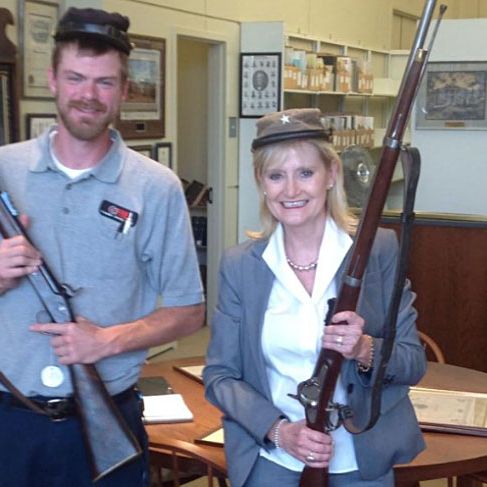
She won despite her 2014 photo of herself outside the plantation home of the Confederate President, former U.S. Senator from Mississippi and Secretary of War, Jefferson Davis, wearing a Confederate Army cap and holding a rifle, having written the caption, "Mississippi history at its best!"

She won despite being caught on video, after the general election but before the runoff, saying it would be "a great idea" to make it more difficult for liberals to vote.

And she won despite a campaign appearance in Tupelo, Mississippi -- birthplace of Elvis Presley -- in which she stood next to Colin Hutchinson, a local cattle rancher, and said, "If he invited me to a public hanging, I'd be in the front row." This was seen as an endorsement of lynching: The practice of an unregulated mob, with no authority from any government at any level, finding a person and hanging him to death from a tree. In the South, lynchings were almost always done by white people to black people. It was sickeningly common until the Civil Rights Movement in the 1960s.

She won despite all of that. Or... Did she win because of all of that?

I went on Twitter, and saw John Stanway, a native of Toronto, but clearly a good observer of American politics, say this:

I think it would also be fair to say that all conservatives' brains are, in general, frozen in 1979. They still think we're in a crisis of corrupt union power, high taxes, high crime, and excessive regulation long after these problems have faded away, if they were ever that bad.

A responder, whose real name I don't have:


I think you might be giving him too much credit. 1979 seems too recent. I'm thinking maybe 1897--before women had the right to vote, after Jim Crow and disfranchisement started to become part of the South's legal fabric.

This matches something I've said for a long time: Conservatives want to take us back to the depression. And I don't mean the one in 1932, before the New Deal and civil rights. I mean the one in 1894, before both Roosevelts, before the regulations of even the Food & Drug Administration.


At any rate, I am reminded of the 1965 song of folksinger Phil Ochs: "Here's to the State of Mississippi." Where the calendar is still lyin' when it reads the present time.

Sunday, December 10, 2017

Top 10 Athletes From Mississippi

December 10, 1817, 200 years ago today: Mississippi is admitted to the Union as the 20th State.

Top 10 Athletes From Mississippi

Choosing the top 2 was easy. Separating them was very tough.

Honorable Mention to Jake Gibbs of Grenada. Like the man at Number 8 on this list, he was a quarterback at the University of Mississippi, a.k.a. "Ole Miss," who had to choose between baseball and football. Indeed, he led the school to Southeastern Conference Championships in both sports, and a National Championship in football in 1960. Unlike the other man, he chose baseball.

He was a September call-up to the majors by the Yankees late in the 1962, '63 and '64 seasons, but played a grand total of 9 games, and never appeared on a World Series roster. He was the team's starting catcher from 1966 to 1969, taking over from Elston Howard, before losing his job to Thurman Munson.

He retired after the 1971 season, due to injuries. He was about to turn 33. It was his misfortune to arrive just as the old Dynasty was crumbling, and to leave before George Steinbrenner and Gabe Paul could arrive and rebuild the team.

He went back to Ole Miss, and coached their baseball team to the 1972 SEC Championship. He was named national Coach of the Year in 1972 and 1977. He was elected to the College Football Hall of Fame. There is a College Baseball Hall of Fame, near the Texas Tech campus in Lubbock, but he has not yet been elected, as either a player or a coach.

Honorable Mention to Charlie Hayes of Hattiesburg. A 3rd baseman, he had some rotten luck. He came up with the San Francisco Giants, but they traded him to the Philadelphia Phillies right before winning the Pennant in 1989. The Phillies traded him to the Yankees before they could win the 1993 Pennant. The Yankees left him unprotected in the 1993 expansion draft, so it looked like he would miss out on their renaissance.

He was an original 1993 Colorado Rockie, and could have made the Playoffs with them in 1994, as they were in the hunt for the National League Western Division title and Wild Card, when the Strike hit. He returned to the Phillies, but they had already fallen apart. He went back to the Giants, but lost the NL Wild Card Game with them in 1998. He closed his career with the Houston Astros, losing the 2001 NL Division Series. He finished with a .262 batting average and 144 home runs. Not bad, but hardly legendary.

But he did have one break. He was traded to the Yankees in 1996, and was placed on the postseason roster. When Wade Boggs had an uncharacteristic slump, Hayes was made the starting 3rd baseman. The result was that he caught the final out of the 1996 World Series, making him a Yankee hero (if not a Yankee Legend). Thank you, Charlie.

Honorable Mention to Frank "Bruiser" Kinard of Jackson. As his nickname suggests, he was tough and mean. He also had the odd distinction of playing for the football teams named the Brooklyn Dodgers and the New York Yankees. He was a 6-time All-Pro, and was elected to the College and Pro Football Halls of Fame. He later returned to his alma mater, Ole Miss, and became an assistant coach and the school's athletic director.

Honorable Mention to Hugh Green of Natchez. A defensive end, playing at the University of Pittsburgh, for "the Pitt Panthers," at the same time that Mean Joe Greene was leading the Steel Curtain, it was inevitable that he would be called "Mean Hugh Green." Sports Illustrated put him and an actual panther on the cover of their 1980 College Football Preview issue, calling him the "BADDEST CAT IN THE GAME."

He won some Player of the Year awards, and finished 2nd in the Heisman Trophy balloting to George Rogers, the closest any defensive lineman has ever come to winning the award. He was elected to the College Football Hall of Fame. In 2008, ESPN named ranked him 14th on their list of the Top 25 College Football Players of All Time.

He played 11 seasons as an NFL linebacker, for the Tampa Bay Buccaneers and Miami Dolphins, making 2 Pro Bowls, but injuries prevented him from reaching the same heights that he did in college.

Honorable Mention to Ralph Boston of Laurel. He won the Gold Medal in the long jump at the 1960 Olympics in Rome, breaking the world record set by Jesse Owens 25 years earlier. He also won the Silver Medal in Tokyo in 1964 and the Bronze Medal in Mexico City in 1968. He is a member of the USA Track and Field Hall of Fame.

Honorable Mention to Spencer Haywood of Silver City. This was a tough call, not for his achievements, but for his location. He moved to Detroit at age 15, and I thought that was too late to make him qualify for Michigan, despite being a star in both high school and college basketball there. So he qualifies for Mississippi.

He was a 5-time All-Star, once in the ABA, winning their Most Valuable Player award with the 1970 Denver Rockets (forerunners of the Nuggets), and 4 times in the NBA, with the Seattle SuperSonics. After becoming perhaps the 1st of the many "false saviors" for the Knicks, he went to the Los Angeles Lakers, and won the 1980 NBA Championship with them.

The University of Detroit Mercy retired his Number 45, and the Sonics retired his Number 24. He was named to the ABA All-Time Team, and he is the only Mississippi-trained man elected to the Basketball Hall of Fame.

The only man. There is a woman who thus qualifies:

Honorable Mention to Lusia Harris of Greenwood. A center, she led Delta State University of Cleveland, Mississippi to the AIAW (Association for Intercollegiate Athletics from Women) title, the closest thing women's basketball then had to a collegiate National Championship, in 1975, 1976 and 1977. She was awarded the 1976-77 Honda-Broderick Cup as the outstanding women's collegiate athlete of the schoolyear.

In 1977, the New Orleans Jazz made her the 1st woman ever selected in the NBA Draft. She was 6-foot-3, and a good shooter. Could she have made it? We'll never know, as she refused her tryout -- because she was pregnant. She was married at the time, and eventually had 4 children. She briefly played in a women's minor league, and went back to her high school as a teacher and coach. In 1992, Lusia Harris-Stewart and 1950s and '60s star Nera White were the 1st 2 women elected to the Basketball Hall of Fame.

Now, the Top 10:

10. Felix "Doc" Blanchard of Bay St. Louis. He was "Mr. Inside" to Glenn Davis' "Mr. Outside" on the National Champion Army football teams of 1944, 1945 and 1946. In those 3 seasons, Army went 28-0-1, the only blemish being the 0-0 tie with Notre Dame at Yankee Stadium, perhaps the 1st college football game to be called "The Game of the Century."

In 1945, Doc (so nicknamed because his father was a doctor) won the Heisman Trophy, the 1st underclassman ever to do so (Davis won it in 1946); and also the James E. Sullivan Memorial Award as the outstanding amateur athlete in the country.

Shortly after his 1947 graduation from West Point, the U.S. Air Force was separated from the Army, and when he was denied a furlough to accept the other kind of draft, by the Pittsburgh Steelers, he became a fighter pilot, serving in the Korean and Vietnam Wars, and retiring in 1971 with the rank of Colonel. He was elected to the College Football Hall of Fame, and West Point retired his Number 35.

9. Archie Manning of Drew. Okay, so he's now only the 3rd-best quarterback in his own family. But Elisha Archibald Manning III is still his family's best all-around athlete. He was also a star basketball player in high school, and was good enough in baseball to be drafted 4 times: By the Atlanta Braves in 1967, the Chicago White Sox in 1969 and 1970, and the Kansas City Royals in 1971.

He starred at Ole Miss, and finished in the top 4 in the Heisman Trophy voting twice, but couldn't get them to a Southeastern Conference Championship. He did get them to bowl games all 3 seasons, winning the 1968 Liberty Bowl and the 1970 Sugar Bowl, before losing the 1971 Gator Bowl. He didn't have much luck with the New Orleans Saints, either, only once getting the strapped team to a .500 record.

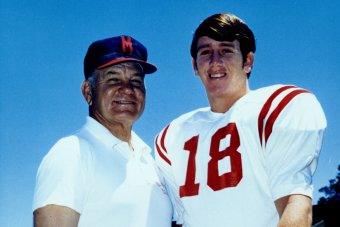
He was elected to the College Football Hall of Fame. He has a statue at Ole Miss' Vaught-Hemingway Stadium. The school not only retired his number, but set their speed limit for on-campus vehicles at his number: 18.

Of course, since he raised his sons Peyton and Eli in New Orleans, they qualify for Louisiana, even though Eli also went to Ole Miss.

8. Charlie Conerly of Clarksdale. The 1st great quarterback at Ole Miss, he led them to their 1st SEC Championship, in 1947. He also played baseball for them. He was drafted by the New York Giants, and was named All-Pro 3 times, leading them to the 1956 NFL Championship. He also got them into the NFL Championship Game in 1958 and 1959, winning the NFL's Most Valuable Player award in 1959.

He seemed to get old in a hurry, and the Giants replaced him with Y.A. Tittle in 1961. Nevertheless, they retired his Number 42 (which he lived to see), and named him to their Ring of Honor (which he didn't live to see). He has been elected to the College Football Hall of Fame, but not yet the Pro version.

7. Jackie Slater of Jackson. A 7-time Pro Bowler, he played offensive tackle in the NFL for 20 straight seasons. He helped the Los Angeles Rams reach the NFC Championship Game 5 times, and reach Super Bowl XIV in 1980. He was elected to the Pro Football Hall of Fame. The Rams retired his Number 78, and even though he only played 1 season, the last of his career, in St. Louis as the Rams moved there, he was named to the St. Louis Football Ring of Fame.

6. Lem Barney of Gulfport. In 1999, CBS aired a special for The Sporting News' 100 Greatest Football Players poll. Barney was ranked 97th. Jerry Glanville was then a correspondent for CBS' The NFL Today. Among the players he coached were Barney and Wayne Walker with the 1974-76 Detroit Lions, William Andrews and Clay Matthews Jr. with the 1977-82 Atlanta Falcons, Earl Campbell with the 1984 Houston Oilers, Clay's brother Bruce Matthews with the 1984-89 Oilers (as head coach), and Deion Sanders with the 1990-93 Falcons (as head coach). He said, of all the players he ever coached, "Best athlete: Deion Sanders. Best football player, Lem Barney!"

A cornerback, Barney led the NFL in interceptions as a rookie in 1967, and made 7 Pro Bowls. He had 56 career interceptions, 7 of them returned for touchdowns. He is a member of the Pro Football, Detroit Lions, Jackson State Sports, Mississippi Sports and Michigan Sports Halls of Fame. In 2004, the Lions retired Number 20 for 3 legends who wore it: Barney, Billy Sims and Barry Sanders.

5. Willie Brown of Yazoo City. He was an All-Star 9 times, 5 in the AFL and 4 in the NFL. He starred for the Denver Broncos, and then for the Oakland Raiders, getting them into Super Bowl II, and winning Super Bowl XI, returning an interception for a touchdown in that game. (As he did so, NBC broadcaster Curt Gowdy called him "Old Man Willie." He was 35.)

He was named to the Pro Football Hall of Fame, the AFL All-Time Team and the NFL 1970s All-Decade Team. He later served as an assistant coach with the Raiders, winning 2 more Super Bowls, before coaching elsewhere, and has returned to them in a front office capacity.

In 1999, The Sporting News named him 50th on their list of the 100 Greatest Football Players, making him the highest-ranking player identified with the Raiders. In 2010, on their list of the 100 Greatest Players, the NFL Network ranked him 66th.

4. Brett Favre of Kiln. His character has come under rough scrutiny, so much so that his 2007 recipt of Sports Illustrated's Sportsperson of the Year award now seems unworthy. But the guy broke most of the career passing records, although many of since been broken again by Peyton Manning and/or Tom Brady.

An 11-time Pro Bowler, he became the 1st man ever to win 3 straight NFL Most Valuable Player awards, 1995-97. With all his individual achievements, it seems odd that he only got the Green Bay Packers into 4 NFC Championship Games, winning Super Bowl XXXI and losing Super Bowl XXXII.

The University of Southern Mississippi and the Packers retired his Number 4. He was named to the Pro (but not yet College) Football and Green Bay Packers Halls of Fame, and the NFL 1990s All-Decade Team.

3. Lance Alworth of Brookhaven. A 7-time All-Star, he was named American Football League Player of the Year in 1963, leading the San Diego Chargers to the AFL Championship -- the only time a San Diego team has ever gone as far as it could go at the major league level.

Some people have suggested that trading "Bambi" (nicknamed because he "ran like a deer" to the Dallas Cowboys after the 1970 season led to The Curse of Bambi, dooming all San Diego teams. Here's what's happened since: Alworth won Super Bowl VI with the Cowboys his 1st season in Dallas, the Chargers only reached the Super Bowl once in the ensuing 46 seasons and finally moved, the Padres have won only 2 Pennants and exactly 1 World Series game, while the NBA's Clippers, the ABA's Conquistadors/Sails, and the WHA's Mariners all moved, with the city not getting another major league basketball or hockey team since. Only the Padres are left, and they nearly moved to Washington in 1974, and probably would've moved if voters hadn't approved a bond issue for Petco Park following the team's 1998 Pennant.

Alworth caught 542 passes for 10,266 yards. The Chargers made his Number 19 the 1st they retired, and he was elected to their team Hall of Fame. The University of Arkansas graduate was elected to the College Football Hall of Fame, and was the 1st player whose career was mainly in the AFL to be elected to the Pro Football Hall of Fame. He was also named to the NFL 75th Anniversary Team and the AFL All-Time Team. He was 31st on The Sporting News' 100 Greatest Football Players and 38th on the NFL Network's 100 Greatest Players.

2. Walter Payton of Columbia. "Sweetness" was a 9-time Pro Bowler. He was named NFL Most Valuable Player in 1977 and 1985. He once held the records for rushing yards in a game (275) and in a career (16,725). He also caught 492 passes. He had 110 touchdowns rushing, 15 more receiving... and 8 passing. He even had a punt go 39 yards. He was as close to being an all-around threat as existed in his era.

He had already surpassed Jim Brown in 1984 to become the NFL's all-time rushing leader (since himself surpassed by Emmitt Smith), when the Chicago Bears roared through the 1985 season toward Super Bowl XX, wanting to win it for him as much as for themselves and their city. They did.

The Bears retired his Number 34. He was elected to the College and Pro Football Halls of Fame, and to the NFL's 1970s and 1980s All-Decade Teams and its 75th Anniversary Team. In 1999, The Sporting News listed him 8th on their 100 Greatest Football Players. He died of liver disease later that year, and his reputation grew: In 2010, when the NFL Network did the 100 Greatest Players, he came in 5th. Both times, he was 2nd among running backs to Jim Brown.

There are 2 Walter Payton Awards: The NCAA's "Heisman Trophy" for Football Championship Subdivision (FCS, formerly known as Division I-AA) players, in honor of Payton having played at Mississippi's Jackson State University; and the NFL's Man of the Year award, for humanitarian contributions off the field.

How do you top that? This is what it takes:

1. Jerry Rice of Crawford. The Sporting News named him Number 2 among all players, behind Brown. And he still had several good years left. When the NFL Network did its 100 Greatest Players 11 years later, they listed Rice as Number 1.

In 1989, the year Rice was named MVP of Super Bowl XXIII, Don Hutson, then on the short list for the title of greatest receiver ever, said Rice was better than he was -- and this was after Rice had just 4 full seasons in the NFL.

Herewith the evidence, and the numbers are staggering. He made 13 Pro Bowls, the 1st at age 23, and the last at age 39. A receiver making the Pro Bowl at thirty-nine years old! He was named NFL Offensive Player of the Year in 1987 and 1993. He won Super Bowls XXIII, XXIV and XXIX with the San Francisco 49ers, being named MVP in XXIII.

Career receptions: 1,549 -- he was the 1st man with 1,000, and the next-best is Tony Gonzalez with 1,325. Receiving yards: 22,895 -- next-best is Terrell Owens with 15,934, nearly 6,000 less! All-purpose yards: 23,546 -- slightly ahead of Brian Mitchell with 23,330. Receiving touchdowns: 197 -- next-best is Randy Moss with 156. Overall touchdowns: 208 -- next-best is Emmitt Smith with 175. In other words, he was not only great, but the numbers suggest he was insanely great.

The 49ers retired his Number 80. He was elected to the College and Pro Football Halls of Fame, and to the NFL's 1980s and 1990s All-Decade Teams and its 75th Anniversary Team.

Friday, November 17, 2017

How to Go to the Egg Bowl: Football In Mississippi

45 States down, 5 to go.

Thanksgiving Day is the renewal of the Egg Bowl, the annual game between the University of Mississippi and Mississippi State University -- hereafter to be referred to by their familiar nicknames: "Ole Miss" and "MSU."

Before You Go. Mississippi is known for steamy Summers, but this is Thanksgiving, so heat won't be an issue. Rain might be: It's being predicted for Thursday, and temperatures during the week are predicted to be in the high 50s in daylight, high 30s at night -- and this will be a night game, and I don't care what State you're in: Chilly and rainy is a bad combination. Though the day may be warm, you may have to bundle up at the game.

Mississippi is in the Central Time Zone, 1 hour behind New York. Adjust your timepieces accordingly. Although Mississippi had, from January 9, 1861 to April 14, 1865, been part of a foreign country, and wasn't readmitted to the Union until February 23, 1870, you will not need a passport to visit, nor will you need to exchange your money.

Tickets. Ole Miss generally sells between 50,000 and 64,000 tickets per home game; MSU, about the same. This one may be a tough buy.

All tickets for Ole Miss home games are a whopping $90. At MSU, lower-level seats are $96, and upper-deck seats are $75.

Getting There. Keep in mind that this is Thanksgiving Week, not just Day, and the normal travel rules will not apply.

It's 1,113 miles from Times Square in Midtown Manhattan to Vaught-Hemingway Stadium in Oxford, Mississippi.

If you want to drive, take Interstate 78 West across New Jersey to Harrisburg, Pennsylvania. There, switch to Interstate 81 South through Pennsylvania, Maryland, West Virginia and Virginia, into Tennessee, where it will flow into Interstate 40 West. Take it through Knoxville and Nashville, almost all the way to Memphis, to Exit 24, for Interstate 269 South into Mississippi.

Take Exit 23, turning left onto State Route 302 West, turn right onto Cayce Road, then onto Interstate 22 East. Exit 30 will take you to State Route 7 South, and that will take you into Oxford. Turn right onto U.S. 278 East, and that will take you to the campus.

If you do it right, you should spend an hour and 15 minutes in New Jersey, 2 hours and 45 minutes in Pennsylvania, 15 minutes in Maryland, half an hour in West Virginia, 5 and a half hours in Virginia, 7 hours in Tennessee, and an hour and 15 minutes in Mississippi. That's 18 and a half hours. Counting rest stops, it should be around 24 hours.

It's 1,105 miles from Times Square to Davis Wade Stadium in Starkville, Mississippi. Follow the same directions as you would for Ole Miss until you get to I-40's Exit 368. Take Interstate 75 South, to Exit 2, for Interstate 24 West. Pass Chattanooga, into Georgia, to Interstate 59 South. You'll take that out of Georgia into Alabama. At Birmingham, take Interstate 20 West to Tuscaloosa, and at Exit 68, switch to U.S. 82 West. This will take you into Mississippi, all the way to Starkville.

If you do it right, you should spend an hour and 15 minutes in New Jersey, 2 hours and 45 minutes in Pennsylvania, 15 minutes in Maryland, half an hour in West Virginia, 5 and a half hours in Virginia, 9 hours in Tennessee, 15 minutes in Georgia, 3 hours and 45 minutes in Alabama, and half an hour in Mississippi. That's a little under 24 hours. Counting rest stops, it'll be about 32 hours.

Why do I cite the driving directions? Because that's the best way to get to either school. Amtrak doesn't go to Oxford or Starkville. Greyhound doesn't go to either one, either. Neither Oxford nor Starkville has a major airport, so you'd have to fly to Jackson or Memphis and rent a car to Oxford, or to Jackson or Birmingham and rent a car for to Starkville. So, it's driving (or flying and then driving) or nothing.

Once In the State. Mississippi became the 20th State in the Union on December 10, 1817, meaning the State's Bicentennial has been celebrated all year long. The State was named for the Mississippi River, the name being an Ojibwe word meaning "great river." So, no surprise there.
Mississippi was the 2nd State to secede from the Union in the run-up to the American Civil War, on January 9, 1861; and the 9th State to be readmitted, on February 23, 1870. On occasion, it has resisted its reunion in despicable ways.

Mississippi is home to just under 3 million people, with Jackson being the State capital and the largest city, with 170,000 people. Oxford, with 21,000 people, was founded in 1837, and named themselves after the famous English university city, in the hopes that the University of Mississippi would be founded there. In 1848, they got their wish.
The State House in Jackson

Starkville, with 26,000, was founded in 1835, as named for General John Stark, a hero of the Battle of Bennington during the War of the American Revolution. The Agricultural and Mechanical College of the State of Mississippi was founded there in 1878. More commonly known as Mississippi A&M, the name was changed to Mississippi State College in 1932 and Mississippi State University in 1958.

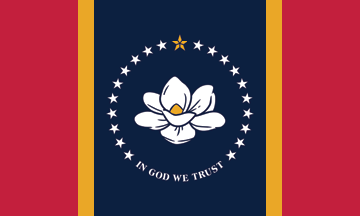
Although Georgia still uses a variation on the "Stars and Bars" flag, and Alabama and Florida still have red X's, Mississippi is the last remaining Southern State that has a form of the Confederate Battle Flag in its State Flag. Moves to replace it with something that isn't representative of treason and racism have, thus far, failed -- not just because of neo-Confederate, but because those who oppose the current flag can't agree on what should replace it.
This has been a problem at Ole Miss, and considerably more recently than September 1962, when President John F. Kennedy federalized the Mississippi National Guard so that James Meredith could register as the University's 1st black student. On May 14, 1970, National Guardsmen shot 14 demonstrators, killing 2, at Jackson State University. It happened 10 days after a similar shooting at Kent State University in Ohio, but since it was second and also black, it has been mostly forgotten outside Mississippi.

There were race riots in Mississippi in Meridian in 1871, Vicksburg in 1874, And Yazoo City and Clinton in 1875. And the voter-registration drive known as Mississippi Freedom Summer resulted in the Ku Klux Klan murdering 3 civil rights activists: Andrew Goodman and Michael Schwerner, white, Jewish and from New York; and James Chaney, from Meridian.

Prominent newspapers in the State include the Jackson-based Clarion-Ledger, the Biloxi-Gulfport area-based Sun Herald, the Hattiesburg American, and, in the towns in question, the Oxford Eagle and the Starkville Daily News.
ZIP Codes for Mississippi start with the digits 386 (that one includes Oxford) to 397 (that one includes Starkville). The Area Code for most of Mississippi is 601. For Oxford and Starkville, it's 662. The sales tax is 7 percent.
Courthouse Square is Oxford's address centerpoint, with Lamar Blvd. dividing them into East and West, and Jackson Avenue dividing them into North and South. Oxford-University Transit operates buses, with a single fare of $1.00. Starkville has no public transportation, so if you don't want to drive everywhere, you're going to have to hoof it. Washington Street divides addresses into East and West, and Main Street into North and South. Neither Oxford nor Starkville has a freeway "beltway."

In addition to the main campus in Oxford, the University of Mississippi has regional campuses in Booneville, DeSoto, Grenada and Tupelo.

Notable non-sports graduates of Ole Miss include:

* Entertainment: Actor Gerald McRaney; actresses Mary Anne Mobley (Miss America 1959), Lynda Mead Shea (Miss America 1960), Kate Jackson and Cynthia Geary; director Tate Taylor; songwriter Glen Ballard.

* Literature: Novelists William Faulkner and John Grisham.

* Journalism: Larry Speakes (White House Press Secretary to President Ronald Reagan), Shepard Smith.

* Military: Admiral John S. McCain Sr., grandfather of Vietnam War pilot, Senator and 2008 Republican Presidential nominee John S. McCain III.

* Politics, representing Mississippi unless otherwise stated: Governors William Allain, Earl Brewer, Martin Conner, Lee Russell, Hugh White, Ross Barnett, Cliff Finch, Paul Johnson, John Bell Williams, William Winter, Ronnie Musgrove, Haley Barbour, Millard Caldwell of Florida, Winfield Dunn of Tennessee, and Jeanne Shaheen of New Hampshire; Senators Hernando Money, Hubert Stephens, James Gordon, James Eastland, Thad Cochran and Trent Lott.

* In fiction, Star Trek Doctor Leonard "Bones" McCoy, played by DeForest Kelley, was said to be an Ole Miss graduate, although a native of Georgia.

Notable non-sports MSU graduates include:

* Politics: Senators John Stennis of Mississippi and Marsha Blackburn of Tennessee.

* Journalism: WABC-Channel 7 Eyewitness News anchor Bill Evans, New York meteorologist Audrey Puente (daughter of legendary bandleader Tito Puente).

* And former WorldCom executive Cynthia Cooper, who shared Time magazine's 2002 Person of the Year with other “whistleblowers.”

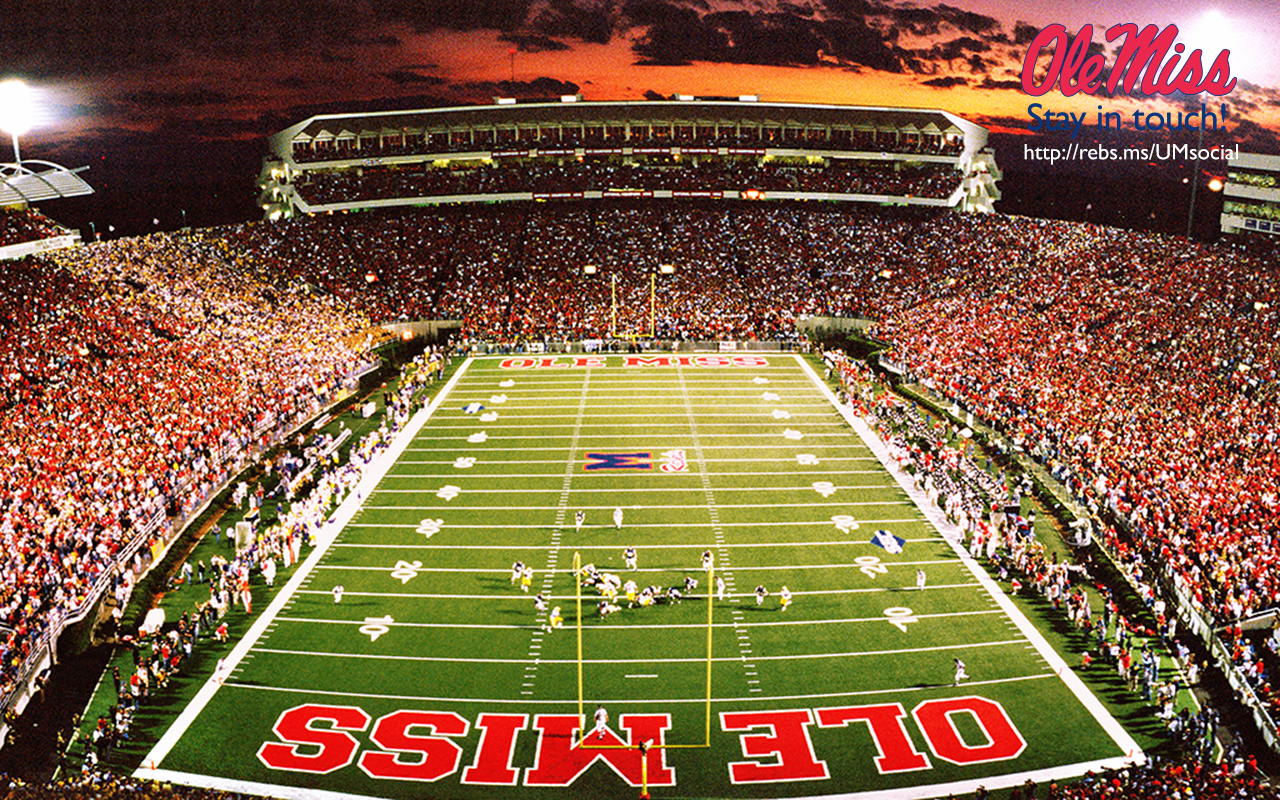
Going In. The official address of Ole Miss' Vaught-Hemingway Stadium at Hollingsworth Field is "All-American Drive & Hill Drive," about a mile southwest of downtown. Oxford-University Transit does run a bus line there. If you drive in, parking is $20.

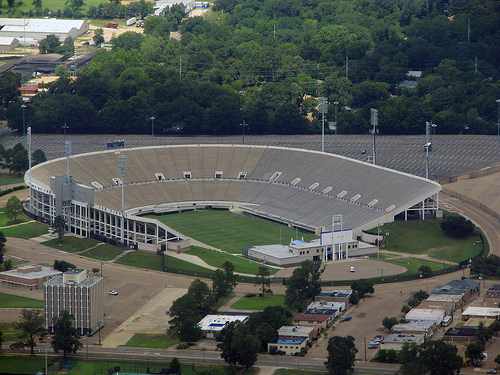
The stadium, once a horseshoe with the open end pointing northeast, is now a fully-enclosed bowl. The field runs southwest-to-northeast, and was first switched from grass to artificial turf in 1970, back to grass in 1984, back to turf in 2003, and back to grass in 2016.
It opened in 1915, with a capacity of 24,000. It was expanded to 34,500 in 1950, 37,500 in 1973, 42,500 in 1980, 50,577 in 1998, 60,580 in 2002, and to its present 64,038 in 2016. The expansions were necessary because some of the Southeastern Conference's larger schools brought too many fans for the on-campus stadium to hold. Some games were moved to Mississippi Veterans Memorial Stadium in Jackson -- including every "Egg Bowl" against MSU from 1973 to 1990 -- or to the Liberty Bowl in Memphis (especially if they were playing Tennessee or Arkansas).

The on-campus stadium was originally named Hemingway Stadium, in honor of Judge William Hemingway, a professor of law and the chairman of the University's Committee on Athletics, what we would call an athletic director today. In 1982, they added the name of 1947-70 head coach Johnny Vaught, who was still alive to receive the honor. In 1998, the field was named after longtime booster Dr. Jerry Hollingsworth.
The official address of Mississippi State's Davis Wade Stadium is 90 B.S. Hood Road, about a mile southeast of downtown. If you drive in, parking is $20.

Vaught-Hemingway is old, but it's not even the oldest stadium in the State: Davis Wade opened a year earlier, in 1914, as New Athletic Field. In all of the Football Bowl Subdivision (FBS, formerly known as Division I-A), only Georgia Tech has an older stadium.

In 1920, New Athletic Field was renamed Scott Field, for Don Magruder Scott, a football star who went on to compete in track & field events at the recent Olympics in Antwerp, Belgium (and would again in 1924 in Paris). In 2001, Floyd Davis Wade Sr., co-founder of insurance company Aflac, was honored: The playing surface remained Scott Field, but the structure surrounding it became Davis Wade Stadium.
Capacity was about 6,000 when it opened, and was expanded to 20,000 in 1936, 35,000 in 1948, 40,656 in 1986, 55,082 in 2003, and to the current 61,337 in 2014. It's a horseshoe open at the south end. The field runs north-to-south, and has always been natural grass.
Food. When it comes to food, "Southern Hospitality" is no myth. Ole Miss has Chops BBQ at Sections B, C, K, L and 55; Rebel Grill at B, E and K; Fry Zone at B and R; Pig-mento's at S2 (south end zone); and, showing that Mississippi is still a very conservative State, both Chick-fil-A and Papa John's Pizza at B, K, 56, and in the north end zone.

MSU's website doesn't have a concession map, or even a description, only a statement that, "There are 17 concession stands located throughout Davis Wade Stadium for your convenience."

Team History Displays. The Ole Miss Rebels are far more successful in football than the MSU Bulldogs. The Bulldogs' only titles are for the SEC in 1941 and the SEC Western Division in 1998. They've won the 1941 Orange Bowl; the 1963, 2007 and 2013 Liberty Bowls;, the 1974 Sun Bowl, the 1981 Hall of Fame Bowl, the 1999 Peach Bowl, the 2000 Independence Bowl, the 2011 Gator Bowl, the 2011 Music City Bowl, the 2015 Belk Bowl and, last season, the 2016 St. Petersburg Bowl. Among the traditional New Year's Day bowl games, they've also lost the 1937 and 2014 Orange Bowls, and the 1999 Cotton Bowl.

How unsuccessful, or under-successful, are they? They're 18-80-3 against Alabama, 35-73-3 against LSU, 6-18 against Georgia, 26-63 against Auburn. Of the old-line SEC teams, the only ones against whom they have a winning record are Vanderbilt (13-7-2) and Kentucky (and that, just barely, 23-22).

Who's the greatest football player in MSU history? They have no College Football Hall-of-Famers, nor any retired numbers. Remember Johnie Cooks? At 10 seasons, he's the longest-lasting MSU Bulldog in the NFL, including winning Super Bowl XXV with the Giants, which also makes him the only Bulldog with a Super Bowl ring.
A young Bill Belichick, Bill Parcells, and Johnie Cooks,
at Super Bowl XXV, Tampa Stadium, January 27, 1991

Ole Miss has done far better. They claim 3 National Championships: 1959, 1960 and 1962. The wire service polls were taken before the bowl games then, and they were awarded, respectively, to Syracuse, Minnesota and USC. But Minnesota lost the 1961 Rose Bowl, which left Ole Miss as the only undefeated team in the country (though with a tie), so they probably should have been named the official National Champions.

They've won the Southeastern Conference title 6 times, all under head coach Johnny Vaught: 1947, 1954, 1955, 1960, 1962 and 1963. They won the SEC West in 2003. These titles are noted with signs on the facade of the south end zone.
They won the the 1955 Cotton Bowl; the 1957, 1959, 1960, 1962, 1969 and 2015 Sugar Bowls; the 2003, 2008 and 2009 Cotton Bowls; the 1948 Delta Bowl, the 1958 Gator Bowl; the 1965, 1968, 1989 and 1992 Liberty Bowls; the 1971 Peach Bowl; the 1986, 1998, 1999 and 2002 Independence Bowls; the 1997 Motor City Bowl, the 2012 BBVA Compass Bowl, and the 2013 Music City Bowl. As for the traditional New Year's Day bowl games, they've also lost the Orange Bowl in 1935; the Sugar Bowl in 1952, 1954, 1963; and the Cotton Bowl in 1961.

There are 9 former Rebels in the College Football Hall of Fame. One is coach Vaught, whose statue stands outside the stadium. 1970 quarterback Archie Manning is another, although his son, 2003 quarterback Eli Manning, is not yet eligible. When he is elected, he will join these Rebel legends who made names for themselves in New York sports: 1937 defensive tackle Frank "Bruiser" Kinard, 1947 quarterback Charlie Conerly, and 1960 quarterback Jake Gibbs. Kinard and Conerly played for the Giants, but Gibbs became a catcher for the Yankees.
Also elected have been 1938 running back Parker Hall, 1948 end Barney Poole, 1959 running back Charlie Flowers, and 1988 tight end Wesley Walls, who won Super Bowl XXIV with the San Francisco 49ers. Kinard and 1956 guard Gene Hickerson, a member of the 1964 NFL Champion Cleveland Browns, are in the Pro Football Hall of Fame. 1954 safety Jim Patton was a member of the Giants' 1956 NFL Champions, and 1957 linebacker Larry Grantham was with the Jets when they won Super Bowl III in 1969.

The Rebels have 1 retired number, the 18 worn by Archie Manning. (Eli wore 10, as he does with the Giants.) And they have a special number, the 38 worn by cornerback Lee Roy "Chucky" Mullins, who broke his neck making a tackle against Vanderbilt in 1989. His paralysis compromised his health, and he died in 1991.

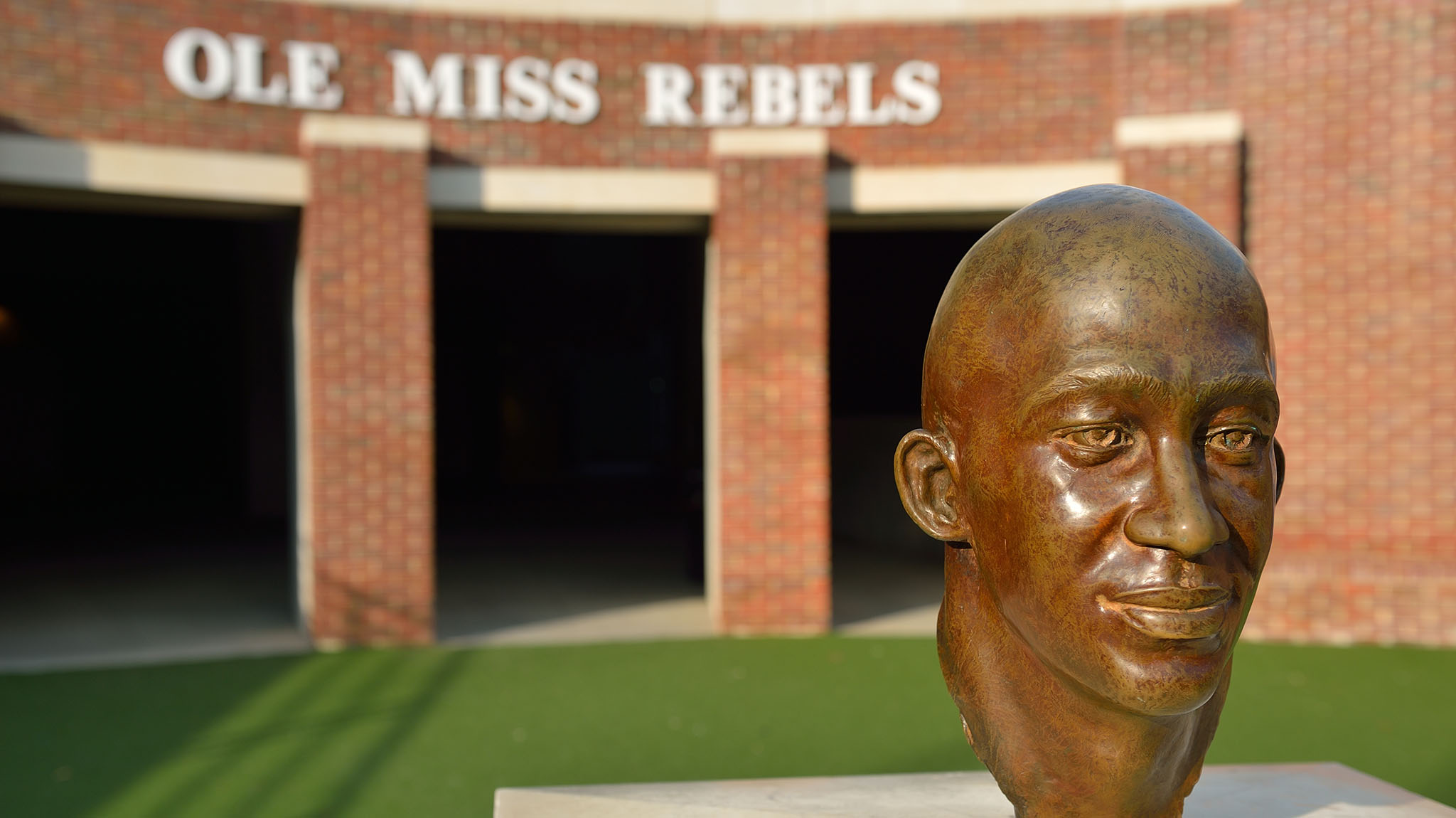
At the conclusion of spring football, Ole Miss hosts the intrasquad Grove Bowl, and the head coach decides which player most embodies Mullins' spirit, and gives him the Chucky Mullins Memorial Courage Award, and Mullins' Number 38. A bust of Mullins now stands outside the stadium.
Behind the south end zone is the Olivia and Archie Manning Athletics Pavilion. The street to the east and south of the stadium is named Manning Way.
Johnny Vaught and Archie Manning

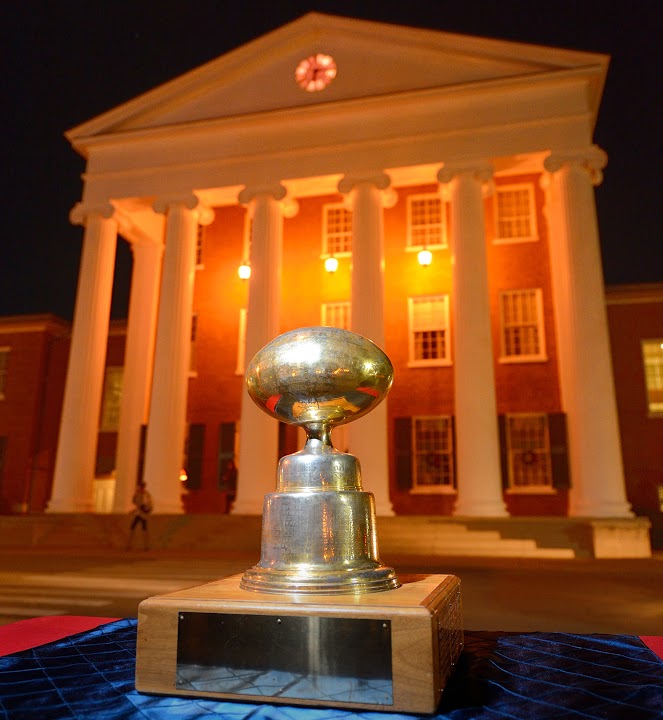
As for the rivalry between the 2 schools: They've played each other since 1901, and every year since 1944. Ole Miss leads 63-44-6, although MSU won last year and has taken 7 of the last 12. But through 1925, MSU (then still Mississippi A&M) had dominated, winning 13 straight. When Ole Miss won in 1926, their fans tore down the goalposts -- at A&M. To avoid future occurrences, it was decided to give the schools something else to play for: A trophy with a brass football on it.

In those days, footballs weren't as streamlined as they would become in the 1930s, and it looked like a Golden Egg, so that's what they called it. And it's been the Battle for the Golden Egg, or the Egg Bowl, ever since. Ole Miss leads 57-27-5 since the introduction of the trophy.
The Golden Egg, in front of the Lyceum,
the signature building of the Ole Miss campus

Ole Miss also has notable rivalries with Louisiana State, a.k.a. LSU, a game known as the Magnolia Bowl, trailing 41-61-4; Arkansas, trailing 28-35-1 (or 27-36-1, if you believe Arkansas); Alabama, trailing 48-11-2; and the University of Memphis, formerly Memphis State, leading 48-11-2.

UPDATE: Through the 2020 season, Ole Miss leads MSU 63-45-6, but trails Alabama 53-10-2, LSU 64-41-4, and Arkansas 36-30-1.

Stuff. The Rebel Shop is under the West Stand at Vaught-Hemingway Stadium. The University Bookstore is at the Ole Miss Union, at Student Union Drive at North Lane. MSU doesn't have a large team store at Davis Wade Stadium. The MSU Bookstore is adjacent to the stadium, at 75 B.S. Hood Drive.

There aren't many books about either program. But in 2000, the sports staff of The Clarion-Ledger published Bloodfeud: The Storied Rivalry of Ole Miss-Mississippi State Football.

During the Game. This is a blood feud -- although that's the 1st time I've seen it written as 1 word. As Keith Jackson, that great college football broadcastin' Southern gentleman, would say, "These two teams just... don't... like each other!" So if you're going to either school, especially if they're playing each other, stick with the home team's fans. Your chances of getting out of the State, never mind off the campus, with your head in one piece will go way up.

By the 1950s, The Grove, a short walk north of the stadium at University Avenue and Grove Loop, named for the oak, elm and magnolia trees on the premises, had become Ole Miss tailgate party central. After a 1991 rainstorm combined with car and RV tires to tear up the grass, vehicles were banned, and now it's a tent city for tailgaters. Also, probably because of all the wood, open flames and propane grills are not allowed, so the food has to be pre-cooked.

This is not like college football in the Northeast or the Midwest: Many Grovers dress up to tailgate. Men wear slacks, button-up shirts, ties (sometimes bow ties), and the shoe of choice seems to be Sperry Top Siders. Women wear cocktail dresses and high heel shoes. There's fine china, sterling silver and lace doilies. No, I'm not joking: It's like a San Francisco 49ers game, but with a Southern accent, no talk of tech stocks, and while wine is possible, you're more likely to find hard liquor.
The "Grove Walk," or the "Walk of Champions," has been a tradition since 1985, and many schools have a similar tradition. The players walk down the sidewalk in the middle of the Grove, and fans reach out and touch the players, on their way into the stadium.

Ole Miss calls its band The Pride of the South. Their fight song is "Forward, Rebels." Yeah, about that...

In 1937, "Colonel Reb," looking like an elderly Confederate veteran, was introduced as a mascot, but he only appeared in print until 1979. With the success of professional mascots such as the San Diego Chicken and the Phillie Phanatic, Ole Miss fans wanted a costumed mascot, and the Colonel debuted.

In 1983, Ole Miss administration began to move away from all that Confederate stuff, barring faculty from displaying Confederate imagery in their offices. In 1997, with then-head coach Tommy Tuberville noting that he was having trouble recruiting black players, the Student Senate passed a resolution prohibiting the Confederate Battle Flag at athletic events.
Apparently, the Colonel forgot to put on pants,
and went to this game in his pajama bottoms.

In 2003, the school retired Colonel Reb, and was without a mascot for a few years. A few students got the idea to use the character of fish-headed Admiral Ackbar from the Star Wars films -- after all, he commanded the military forces of the Rebel Alliance! But they couldn't get permission from Lucasfilm to use his likeness. So in 2010, noting that black bears were common in Mississippi, they introduced "Rebel, the Black Bear." The fact that the bear was black encouraged some black people, but angered others.
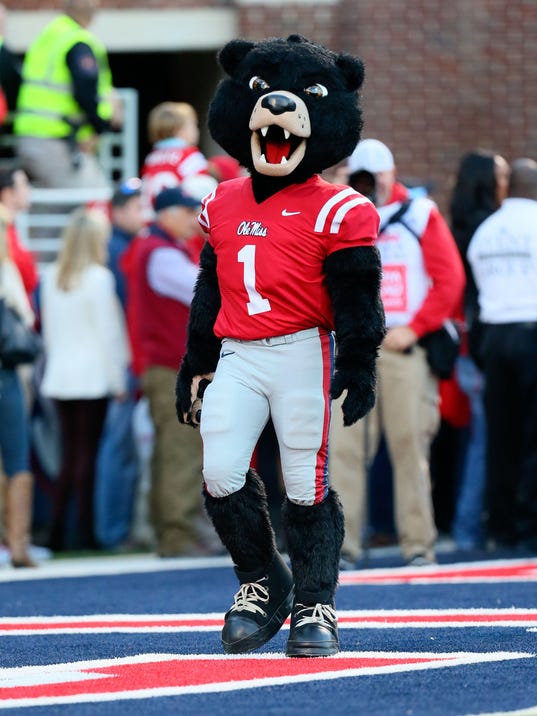
By 2008, Ole Miss fans had begun doing a gesture called "The Landshark," based on the 1975 Saturday Night Live parody of Jaws. So, a few weeks ago, University Chancellor Jeffrey Vitter announced that, starting next season, Rebel the Black Bear will be retired, and a new Landshark mascot will be introduced. Silly? Maybe not: Landshark Beer, which currently owns the naming rights to the Miami Dolphins' stadium, is owned by singer Jimmy Buffeet, and he's a Mississippi native (although he grew up in Mobile, Alabama, and attended the University of Southern Mississippi).

The traditional Ole Miss cheer, "Hotty Toddy," begins when someone yells out, "Are you ready?":

Hell yeah! Damn right!
Hotty Toddy, gosh almighty!
Who the hell are we? Hey!
Flim flam, bim bam
Ole Miss, by damn!

MSU has their own version of the Grove, The Junction, on the south side of Davis Wade Stadium. It was named for the railroad that once ran through the area. Like the Grove, it's tents yes, cars no. And, 3 hours before kickoff, the Bulldog team and the coaches do the Dawg Walk through The Junction.

The Mississippi State Famous Maroon Band plays the National Anthem, the fight song "Hail, State!" and, since 2014, at the request of head coach Dan Mullen, the Journey song "Don't Stop Believin'." The mascot is Bully the Bulldog. The 1st live mascot was used in 1935, and they're now on Bully XXI. They also have a Bully in a suit.
The Bullys

If there's one thing Mississippi State football is known for, it's the cowbells. If Christopher Walken were to go to an MSU game, he would never again asked for "more cowbell."

Supposedly, the origin is that a cow -- of the Jersey breed, named for Britain's Channel Island, for which New Jersey was named -- wandered onto the field during an early game with Ole Miss, and MSU won big, and their fans presumed it was good luck. This Bulldog cow story may be bullshit, but the ringing of cowbells in the stands was underway by the late 1930s, and became iconic during the 1941 SEC title season. To this day, just as you can always tell a Princeton graduate by the stuffed or ceramic Tiger he has in his home or office, you can always tell a Mississippi State graduate by the cowbell he keeps there.

In 1975, after a complaint by Auburn coach Shug Jordan, the SEC banned "artificial noisemakers." This temporarily led Auburn's arch-rivals, Alabama, to start using them, even though Crimson Tide fans had no love for MSU. A few fans got around the rule, but in 2010, the ban was lifted, with some restrictions: Cowbells can only be run at specific times, with the video boards letting them know.

After the Game. As I said, stick with the home fans, and stay away from the visitors, and you should be okay. If the home fans do any taunting of the visitors, do not join in.

There are a few places to eat around Vaught-Hemingway Stadium. Just to the west of it, the new basketball arena, the 9,500-seat Pavilion at Ole Miss, has a fast-food stand called Raising Cane's Chicken Fingers. Across All-American Drive from the Stadium and the Pavilion is an Einstein Bros. Bagels. A few steps away, inside the J.D. Williams Library, there's a Starbucks. An iconic Mississippi chain is Gus' World Famous Fried Chicken. The closest one is at 306 S. Lamar Blvd., downtown.

Postgame meals or snacks will be harder to come by at MSU. The University Bookstore is to the west of the stadium, and it's a Barnes & Noble, which means it's got a Starbucks. But you'll have to head downtown, down State Route 12, to find some of the chains with which you're familiar. The most famous Starkville eatery is Mugshots, at 101 N. Douglas Conner Drive., downtown.

If your visit to Mississippi is during the European soccer season, you're going to have a tough time finding a bar that will show your club's match. The best such "pub" in the State is generally considered to be the Capitol Grille, at 5050 I-55 North Frontage Road, about 5 miles north of downtown Jackson. 

Sidelights. Both schools are considerably closer to the big city at the northern end of Mississippi, Memphis, Tennessee (Ole Miss 84 miles, MSU 183) than they are to the big city at the southern end, New Orleans, Louisiana (Ole Miss 347, MSU 293).

Jackson, the State capital, is about 161 miles south of Oxford, 126 miles southwest of Starkville, 209 miles south of Memphis, 238 miles southwest of Birmingham, 188 miles north of New Orleans, and 405 miles east of Dallas.

Mississippi Veterans Memorial Stadium opened in 1950, and seats 60,492. Because of its size, all 3 of the FBS schools in the State played selected home games there: Ole Miss from 1953 to 1996, MSU from 1953 to 1990, and Southern Miss from 1952 to 1988. Jackson State University, the "historically black" school that produced Walter Payton, has played home games there since 1967. 2531 N. State Street, about 2 miles north of downtown. Bus 1. 
The University of Southern Mississippi is the alma mater of Hall of Fame quarterback Brett Favre, which (if you didn't already know) won't come as a big surprise to you. And I've already told you that Jimmy Buffett has a degree from USM, so that won't surprise you. What might surprise you is that it's also the alma mater of Chuck Scarborough, the Pittsburgh-born anchor of WNBC-Channel 4's news since 1974.

USM is in Hattiesburg, 114 miles northeast of New Orleans, 248 miles south of Oxford, 181 miles south of Starkville, and 296 miles south of Memphis. Since 1932, the Golden Eagles have played at M.M. Roberts Stadium, formerly Faulkner Field, now seating 36,000. 118 College Drive.
There are 2 minor-league baseball teams in Mississippi, both in the Class AA Southern League. The Biloxi Shuckers are a farm team of the Milwaukee Brewers, and play at the 6,076-seat MGM Park. It opened in 2015, and the Shuckers won a division title that year.
The Mississippi Braves are a farm team of the Atlanta Braves, and play at the 8,480-seat Trustmark Park, built in 2005. The Braves won the Pennant there in 2008. 1 Braves Blvd., in the Jackson suburb of Pearl, 3 miles southeast of downtown. No bus service.
The classic Mississippi baseball team was the Jackson Generals, named, like the city, for General and President Andrew Jackson. At other times, the team was known as the Jackson Mets, the Jackson DiamondKats, and the Jackson Senators. As the Mets, they won Pennants in 1981, 1984 and 1985. From 1975 to 2005, they played at the 5,200-seat Smith-Wills Stadium. It's now used mainly for small-college football. 1200 Lakeland Drive, about 4 miles northeast of downtown. Bus 4B. 
Across the street is Lefleur's Bluff State Park, home of the Mississippi Sports Hall of Fame, the Mississippi Museum of Natural Science, and the Mississippi Children's Museum. The Hall of Fame includes the items from the former Dizzy Dean Museum, as the 1930s St. Louis Cardinal pitcher lived his adult life nearby, with his wife Patricia in her hometown of Bond, and they're buried there.

Pennant winners in the old Class C Cotton States League included the 1913 Jackson Lawmakers and the 1927 and 1928 Jackson Red Sox.

Who a Mississippian supports in baseball may depend on his age. Because of their vast radio network, if he's old enough to remember before the 1980s, he's probably a St. Louis Cardinals fan. If he came of age in the 1980s or '90s, when TBS became the South's national "superstation" and the Atlanta Braves got good, he's probably a Braves fan. If he's too young to remember the Braves winning Pennants, and his experience with championship baseball is from watching ESPN or Fox Sports instead of watching TBS or listening to KMOX, then he probably roots for the Yankees or the Boston Red Sox.

Except for the northwestern corner of the State, close to Memphis, and for some strange reason supporting the Dallas Cowboys, Mississippi's favorite NFL team is the New Orleans Saints. The NBA doesn't have much of an effect: The northwest favors the Memphis Grizzlies, the south favors the New Orleans Pelicans, but, in between, it's either the Los Angeles Lakers or whatever team LeBron James is playing for at the moment.

Mississippi doesn't care much about hockey (despite its overwhelming whiteness, it's also overwhelmingly foreign and "socialist"), but, as you might guess, the favorite team is the closest one, the Nashville Predators, and that was true even before the Preds made the 2017 Stanley Cup Finals.

Mississippi's most famous sports location is not a recent one. In the 19th Century, professional boxing was illegal in America, and when the last fight for the Heavyweight Championship of the World under the London Prize Ring Rules -- the last without gloves, the last "bare-knuckle fight" -- was announced, between Champion John L. Sullivan and challenger Jake Kilrain, fight fans (known as "fancy men," and, yes, that was considered a masculine term at the time) were told to go to New Orleans, where they would board special trains to take them to a location that had to be kept secret, in order to stay one step ahead of the law.

The date was July 8, 1889. The night before, about 3,000 people boarded the trains, having tickets that listed no location, only the words "Destination and Return." The trains rolled overnight, and took them to a temporary ring and stands on a farm in Richburg, Mississippi.

The fight began at 10:30 AM, in 100-degree heat. Kilrain led most of the way, and Sullivan actually threw up during the 44th round. But that probably got all the booze out of his system, and he pummeled Kilrain, whose manager threw in the towel after the 75th round. It was 12:46 PM, and "The Great John L.," a.k.a. "The Boston Strong Boy," was still champion. From this point onward, American boxing would use the Marquis of Queensberry Rules, forcing force gloves and 3-minute rounds.

The site was not used for boxing again. A historical marker is on the corner of what's now named Sullivan Kilrain Road and Richburg Road. It's 6 miles southwest of Hattiesburg, 94 miles southeast of Jackson, 187 miles south of Starkville, 254 miles south of Oxford, and 108 miles northeast of New Orleans. It is only reachable by car.

Two of Mississippi's historically black colleges and universities (HBCUs) have won the National Championship of black college football. The aforementioned Jackson State did so in 1962, 1985 and 1996. The other is Alcorn State, in Lorman, winning it in 1968, 1969, 1974, 1984 and 2014. In 1976, they were famously mentioned on the Thanksgiving episode of the police-themed ABC sitcom Barney Miller, as Detective Sergeant Nick Yemana fed his gambling problem by betting on them, and being unable to get the score.

Alcorn State's best-known player is Tennessee Titans quarterback Steve McNair. Another HBCU, Mississippi Valley State, in Itta Bena, produced Jerry Rice.

Back in Oxford: The University of Mississippi Museum is at 500 University Avenue. Between the Lyceum and the Williams Library is the Ole Miss Civil Rights Monument, a statue of James Meredith, depicting his 1962 enrollment. Just south of hometown is Rowan Oak, the restored home of novelist William Faulkner. 916 Old Taylor Road.

If there's one positive thing Mississippi is known for, it's a grand musical legacy, particularly the "Delta Blues." (A "delta" usually refers to a triangle, but the "Mississippi Delta" is more of a diamond shape, between the Mississippi and Yazoo Rivers, from Tunica south to Vicksburg.) This is the region that produced Bessie Smith, Muddy Waters (McKinley Morganfield), Howlin' Wolf (Chester Burnett), Willie Dixon, B.B. King, and Robert Johnson.

In his 1936 song "Cross Road Blues," later turned into "Crossroads" for Cream by Eric Clapton, Johnson told of dropping to his knees and asking God for mercy. But the legend says he went the other way, and sold his soul to the Devil in exchange for becoming the world's greatest guitar player. It may have worked, but at a price: Just 2 years later, on August 16, 1938 -- 10 years to the day before Babe Ruth, and 39 years before Elvis Presley -- Robert Johnston died, some say of being poisoned by the husband of a woman he was fooling around with, some say of syphilis. He was 27 years old, possibly the first "member of the 27 Club."

The crossroads in question is the intersection of U.S. Routes 61 and 49 -- also giving rise to another song, Bob Dylan's "Highway 61 Revisited." While it was rural in 1936, it's been built up a little since, and there is a historical marker there, and highway realignments have meant that it's no longer the intersection of 61 and 49. 599 N. State Street. There is a Delta Blues Museum in Clarksdale, at 332 Delta Avenue. 76 miles southwest of Memphis, 61 miles west of Oxford, 145 miles northwest of Starkville. 

Did I mention Elvis? The King of Rock and Roll was born on January 8, 1935, in Tupelo, The "shotgun shack" where he lived for the 1st 3 years of his life still stands, and the address is now 306 Elvis Presley Drive. It's 109 miles southeast of Memphis, 55 miles east of Oxford, and 67 miles north of Starkville.

Because of his Mississippi and Memphis roots, Elvis played several shows in the Magnolia State early in his career, in 1955. A lot of these were in high school gyms and auditoriums: Ripley on February 7, Randolph on March 1, Big Creek on March 28, Toccopola on March 29, Charleston on April 5, Sledge on April 6, Houlka on April 21, Bruce on June 14, Belden on June 15, and McComb on September 9.

He also played the City Auditorium in Clarksdale on January 12, March 10 and September 8; the Booneville Junior College Auditorium on January 17; the Alcorn County Courthouse in Corinth on January 18 and April 7; the VFW Club in Hernando on April 19; the American Legion Hut in Grenada on April 20; the American Legion Hall in Meridian on May 25; Meridian Junior College Stadium on May 26; the Slavonian Lodge in Biloxi on June 26; the Airman's Club in Biloxi on June 27 and 28, and November 7 and 8; the Tupelo Fairgrounds on August 1; the Community House in Biloxi on November 6; and the National Guard Armory on December 13.

He also played the Von Theatre in Booneville on January 3, 1956, and returned to the Tupelo Fairgrounds on September 26, 1956 and September 27, 1957. Toward the end, he played the State Fair Coliseum in Jackson on May 5 and June 8 and 9, 1975, and on September 5, 1976. Now named the Mississippi Coliseum, the 6,500-seat arena has stood since 1962 at 1207 Mississippi Street, downtown.

The Beatles never played in Mississippi. Johnny Cash did, many times, and on May 11, 1965, he was arrested for public drunkenness in Starkville. He wrote a song about it, "Starkville City Jail." It's been said that Cash was arrested in 7 places, but he only wrote a song about 1 of them. Contrary to popular belief, he never actually served time in prison -- not in Folsom, not in San Quentin, not anywhere. (He didn't write "Jackson," his duet with eventual wife June Carter, and it's generally believed that the Jackson in question isn't the one in Mississippi, but the one in Tennessee, where his pal Carl Perkins was from.)

Mississippi has never produced a President, or a Vice President. But it hosted a pivotal moment in American history. The Union would have found it very hard to win the American Civil War had General Ulysses S. Grant, who went on to become President, not won his Siege of Vicksburg on July 4, 1863 -- right after the equally pivotal Battle of Gettysburg in Pennsylvania. The siege essentially cut the Mississippi River, and thus the Western half of the Confederacy, in half.

Vicksburg National Military Park is located at 3201 Clay Street, 42 miles west of Jackson, 205 miles northwest of New Orleans, 244 miles south of Memphis, 196 miles southwest of Oxford, and 160 miles southwest of Starkville.

The tallest building in Mississippi is the 347-foot Beau Rivage Casino Resort. 875 Beach Blvd. in Biloxi, on the Gulf Coast.

Mississippi has inspired writers like Faulkner, Tennessee Williams, Eudora Welty, Zora Neale Hurston, Willie Morris and John Grisham. But a lot of the fiction inspired by the State is based on its racial divide. The 1965 novel In the Heat of the Night led to a 1967 film and a 1988-92 TV series. Dyersburg, Tennessee stood in for the fictional Sparta; for the TV show, Hammond, Louisiana and later Covington, Georgia stood in.

Other films concerning the issue, many of them filmed where the actual events took place, include For Us the Living: The Medgar Evers Story, Mississippi Burning and Ghosts of Mississippi. Purely fictional films include the 1959 and 2014 versions of Faulkner's The Sound and the Fury, the 1958 and 1984 versions of Williams' Cat on a Hot Tin Roof, Neil Simon's World War II-set comedy Biloxi Blues, and Grisham's A Time to Kill

*

Mississippi has a reputation. Some of it is worth being proud of. Some of it is best left in the past, even though William Faulkner wrote, "The past isn't dead, it's not even past." The Egg Bowl between the University of Mississippi and Mississippi State University puts the State's passions on display. It is a spectacle like no other.