Showing posts with label florida. Show all posts

Wednesday, January 28, 2026

January 28, 1986: The Space Shuttle Challenger Is Destroyed

Top row, left to right: Ellison Onizuka, Christa McAuliffe,
Greg Jarvis and Judy Resnik.
Bottom row, left to right: Michael J. Smith,
Dick Scobee and Ron McNair.
January 28, 1986, 11:39 AM, 40 years ago: The Space Shuttle Challenger explodes, 1 minute and 13 seconds after liftoff from Cape Canaveral, Florida, killing all 7 astronauts aboard.
The 10th mission for the orbiter, and the 25th Shuttle mission overall, it was America's 1st in-flight space travel tragedy. Previously, on January 27, 1967, a fire during a ground test of Apollo 1 led to the deaths of 3 astronauts; 6 other astronauts had been killed in plane test flight crashes; and the Soviet space program had lost 5, including 3 in a single spaceflight in 1971.
The flight had already been delayed twice, and the decision was made to launch despite temperatures being lower than ideal. Even Florida has some days that can be classified as Winter, and the ground temperature at launch was just 36 degrees -- still 15 degrees lower than any other Cape Canaveral launch, ever. The low temperature caused a failure in the "O-ring" seals, allowing pressurized burning gas from within the solid rocket motor to reach the outside, and ignite the external fuel tank.
The crew:
* Captain Gregory B. Jarvis, U.S. Air Force, mission commander, 41 years old, from Mohawk, in Central New York.
* Lieutenant Colonel Francis "Dick" Scobee, U.S. Air Force, 46, from Auburn, Washington, outside Seattle.
* Captain Michael J. Smith, U.S. Navy, 40, from Beaufort, North Carolina, on the Outer Banks
* Colonel Ellison S. Onizuka, U.S. Air Force, 39, from Kona, Hawaii.
* Doctor Judith A. Resnik, civilian engineer, 36, from Akron, Ohio.
* Doctor Ronald E. McNair, civilian physicist, 35, from Lake City, South Carolina.
* Christa McAuliffe, 37, from Framingham, Massachusetts, outside Boston. A social studies teacher at Concord High School in Concord, the capital of New Hampshire, she had won a contest to be a "teacher in space." This made her the face of the mission, and, by extension, its greatest tragedy.
It was the 2nd spaceflight each for Onizuka, McNair and Resnik. The others were each on their 1st. Onizuka was the 1st Asian-American to fly in space, and also the 1st person of Japanese ancestry to do so, for any country. McNair was the 2nd African-American in space, after Guion Bluford in 1983; Arnaldo Tamayo Méndez, a pilot in the Cuban Air Force, was the 1st black person in space, aboard a Soviet mission in 1980.
Had the mission succeeded, McAuliffe would have been the 10th woman in space. Resnik was the 4th, following Soviets Valentina Tereshkova in 1963 and Sveltana Savitskaya in 1982, and American Sally Ride in 1983. Resnik was also the 1st Jewish American in space, and the 2nd of her faith to reach space, following the Soviets' Boris Volynov in 1969.
I was a junior at East Brunswick High School at the time. By a weird twist of events, one of our teachers had reached the semifinal round of the "teacher in space" project. I won't mention his name, because he later disgraced himself in a way I won't mention, either.
I had just come back from lunch, and was about to start my English class, when a friend ran up to me and said, "Mike, the Shuttle blew up!"
When the Columbia was the 1st Space Shuttle launched, in 1981, our local newspaper did a feature on myself and 2 other students at my elementary school who were particularly interested in spaceflight. It was the 1st U.S. spaceflight since the Apollo-Soyuz mission, 6 years earlier. It was the long-delayed next step in American spaceflight. It was a big deal.
But by 1986, Shuttle flights had become routine. No one even brought TV sets into classrooms to watch the launches anymore.
So when the friend said, "The Shuttle blew up!" I wasn't sure of what he was talking about. To me, it sounded like a code from a spy movie. He explained. The English teacher confirmed it. When the class ended, I went home, skipping the rest of the day. I sat in front of the TV set, watching it over and over again.
For my generation, born after the assassinations of President John F. Kennedy, Senator Robert F. Kennedy and Dr. Martin Luther King -- and after the good news of the 1st Moon landing, and being old enough to watch but not understand the good-and-bad news of the resignation of President Richard Nixon -- it was our first event like that, our first "Where were you when... " moment, our first "Ran home from school and watched the same images on TV over and over again" event. Maybe it wouldn't have been, if Ronald Reagan, still President at this point, hadn't survived his assassination attempt in 1981.
But, for my generation, it would be that moment, until September 11, 2001. And, since that was a crime, as was the Capitol Insurrection of January 6, 2021, the Challenger disaster remains our defining tragedy, even after the Columbia was similarly lost, 17 years to the week later.

I saw the replay of the launch, and I saw the turn, and a little over a minute in, someone at Mission Control said, "Challenger, go with throttle-up." And pilot Smith said, "Roger, go with throttle-up."

Before NATO standardized "phonetic alphabet," with "Romeo" meaning the letter R, "Roger" was used for "received," as in, "I have received and understood your last transmission." It's still used in flying today, both commercial and private. On military flights, "Roger that" is a common use. "Roger Wilco" means, "I have received and understood, and will comply."

But after Smith's acknowledgement, someone on board the orbiter said, "Uh-oh!" And then came the explosion. There was a big cloud of smoke, and only the 2 booster rockets emerged, flying uncontrollably. No orbiter. No external tank. They were in pieces. And Mission Control kept giving orders, because they were looking at their instruments, not their screens -- which, not that I knew it at the time, was exactly what they were supposed to do. They were looking at the "telemetry" coming in.

It was only when they received no response to multiple transmissions that they looked at their screens, and saw the cloud. Finally, somebody, in a calm monotone that seemed awfully cold to those of us who were watching this after the fact, made the most "You think?" statement of all time: "Flight control looking carefully at the situation. Obviously, a major malfunction."

When the crew compartment was found at the bottom of the Atlantic Ocean, it was intact, but it was determined that its emergency eject system was inoperable from the moment of the explosion. The astronauts probably died on impact with the water, knowing they were doomed. At least they didn't suffocate or drown.

Reagan was scheduled to deliver the State of the Union Address before a Joint Session of Congress that night. (The SOTU is usually delivered in late January or early February, either on a Tuesday night, or a Wednesday night, and this was a Tuesday night in late January.) The Address was postponed a week, to February 4. Instead, Reagan addressed the nation from the Oval Office of the White House. For all his flaws, he made a great "Comforter-in-Chief":

For the families of the seven, we cannot bear, as you do, the full impact of this tragedy. But we feel the loss, and we're thinking about you so very much. Your loved ones were daring and brave, and they had that special grace, that special spirit that says, ``Give me a challenge, and I'll meet it with joy.'' They had a hunger to explore the universe and discover its truths. They wished to serve, and they did. They served all of us...

And I want to say something to the schoolchildren of America who were watching the live coverage of the shuttle's takeoff. I know it is hard to understand, but sometimes painful things like this happen. It's all part of the process of exploration and discovery. It's all part of taking a chance and expanding man's horizons. The future doesn't belong to the fainthearted; it belongs to the brave. The Challenger crew was pulling us into the future, and we'll continue to follow them...

The crew of the space shuttle Challenger honored us by the manner in which they lived their lives. We will never forget them, nor the last time we saw them, this morning, as they prepared for their journey and waved goodbye and "slipped the surly bonds of earth" to "touch the face of God."

A commission later determined that the cold weather caused a key part of one of the Shuttle's booster rockets to fail. Florida usually doesn't get cold, but it was just 26 degrees Fahrenheit at the intended launch time of 9:38 AM. NASA waited for it to get warmer. It was 36 degrees at the 11:38 launch. Clearly, this was still not warm enough.

No American spaceflight has been launched at so low a temperature again. NASA took the time to get it right with the necessary parts, and did not launch again until September 29, 1988, when Discovery was launched.

Friday, December 12, 2025

December 12, 2000: Bush v. Gore

December 12, 2000, 25 years ago: The Supreme Court of the United States overrules the Supreme Court of the State of Florida. It is the case of Bush v. Gore.

In the Presidential election of November 7, the Democratic nominee for President of the United States, the then Vice President of the United States, Albert Arnold Gore Jr., got more popular votes than the Republican nominee, the Governor of Texas, George Walker Bush: Gore 50,999,897, Bush 50,456,002, a margin of 543,895 votesRalph Nader, famous as a consumer advocate since the 1960s, ran as the nominee of the Green Party. He got 2,882,955 votes. Gore got 48.4 percent of the popular vote; Bush, 47.9 percent, Nader, 2.7 percent.

Bush's brother, Governor John Ellis "Jeb" Bush of Florida, saw how close the vote was in his State, and tampered with the voting process, and that one State held everything up for 5 weeks. The best attempt at a recount, in downtown Miami, was interrupted on November 22 by what became known as the Brooks Brothers Riot. As a result, there were votes that were never counted. I don't mean they weren't recounted, I mean they were never counted, not even once.

On December 8, the Florida Supreme Court ruled that all 61,000 "undervotes" had to be counted. Had that happened, Gore surely would have won. The Bush campaign immediately appealed to the U.S. Supreme Court. SCOTUS ruled on December 12:

* Four Justices ruled that the recount had to go forward: John Paul Stevens, appointed by Republican President Gerald Ford; David Souter, appointed by Republican President George H.W. Bush, the current Republican nominee's father; Ruth Bader Ginsburg, appointed by the current President, Democrat Bill Clinton; and Stephen Breyer, also appointed by Clinton.

* Five Justices ruled that the recount had to stop immediately, all of them appointed by Republican Presidents: William Rehnquist, appointed by Richard Nixon, and promoted to Chief Justice by Ronald Reagan; Sandra Day O'Connor, appointed by Reagan; Antonin Scalia, appointed by Reagan; Anthony Kennedy, appointed by Reagan; and Clarence Thomas, appointed by the elder George Bush.

It was pretty easily guessed that all 4 Justices who voted to keep the recount going would do so; and that 3 Justices known for being archconservatives -- Rehnquist, Scalia and Thomas -- would vote to stop it.

The question marks were 2 moderates, both known as "swing votes": O'Connor and Kennedy. If either of them had voted to keep the recount going, it would have been kept going, and Gore would have won. Instead, both voted to stop it.

And so, in an election where over 104 million votes had been accepted as counted, only two votes ended up mattering: Those of O'Connor and Kennedy.

It may have been the ghastliest decision in the Court's history, aside from the 1857 decision in Dred Scott v. Sandford, that said that black people weren't citizens (a decision remedied by the 14th Amendment to the Constitution). It also marked perhaps the 1st time in the nation's history that political conservatives overruled a case based in part on a State's rights.

It may have been surpassed as the ghastliest decision in the Court's history by Trump v. United States in 2024, when the Court ruled that Presidents have immunity from criminal prosecution.

Gore conceded the election the next day, forever doomed to be "the 42nd 1/2 President of the United States" -- a President-elect, but never a President. On January 6, 2001, in his role as the outgoing Vice President, Gore properly read the Electoral Votes, including the 25 of the State of Florida. Whether those votes were properly arrived at is another matter. Congress then certified the Electoral Votes.

On that January 6, no Democrats stormed the U.S. Capitol Building in an attempt to stop that process.

Twenty years later, of course, when it was Republicans who didn't like the result, they did storm the Capitol, and attempt to stop the process. They only delayed the inevitable.

Rehnquist died in office in 2005. O'Connor retired right before that. Souter retired in 2009. Stevens retired in 2010, and died in 2019. Scalia died in office in 2016. Kennedy retired in 2018. Ginsburg died in office in 2020. Breyer retired in 2022. O'Connor died in 2023. Souter died in 2025. As of December 12, 2025, Kennedy, Thomas and Breyer are still alive; while Thomas is the only 1 of the 9 who is still on the Court.

Bush's 2 terms in office were an unmitigated disaster, both domestically (especially economically) and internationally. Had Gore been allowed to accept his victory, he would have governed completely differently, and most Americans, including the conservatives, would have been better off.

Saturday, November 22, 2025

November 22, 2000: The Brooks Brothers Riot

November 22, 2000, 25 years ago: An election that began to be stolen on Election Day itself, November 7, takes a big step closer to being stolen, with "The Brooks Brothers Riot."

The Republican nominee for President, Governor George W. Bush of Texas, lost the national popular vote to the Democratic nominee, Vice President Al Gore. But he appeared to have won enough Statewide popular votes to win 271 Electoral Votes to Gore's 269.

In dispute was the State of Florida, where Bush was originally certified to have won by 1,784 votes. It's important to note that the Governor of Florida was his brother, John Ellis "Jeb" Bush. Through his Secretary of State -- and, it was rumored, his mistress -- Katharine Harris, Jeb had the Florida vote fixed for his brother, including the deletion of the names of 55,000 people, nearly all black men, from the voter rolls.

In other words, if those 55,000 people were permitted to vote, even if less than half of them ended up voting at all, there was no way Gore wouldn't have gotten enough of those 55,000 votes to offset a 1,784-vote lead for "Dubya."

A clause in Florida's State Constitution mandated that, since the election was so close, a Statewide recount had to be done. The recount for Dade County, including the City of Miami, was done at the Stephen P. Clark Government Center, at 111 Northwest 1st Street in downtown Miami. (Clark was Mayor of Miami from 1967 to 1972, and again from 1993 to 1996.)
The Stephen P. Clark Government Center

The recount began, but Representative John E. Sweeney, then a freshman Congressman from New York's Capital Region, including the State capital of Albany, told an aide to "Shut it down." And so dozens of people, many of them wearing sharp suits typical of Republican staffers at the time -- hence the name of the demonstration, as Brooks Brothers is a popular store chain with them -- found their way into the building, and pounded on the doors of the room where the recount was being done, making it unsafe for the counters.

They got what they wanted. Bush's lead got down to 537 votes, when a local court ordered that the recount be stopped. In other words, some votes were never counted, not even once. The State Supreme Court ruled that the recount had to resume.

But on December 12, the U.S. Supreme Court ruled that the recount had to stop. And so, Bush's 537-vote win in Florida was certified by the State of Florida, and later by Congress.

Strange: For decades, conservatives -- first in the Democratic Party, then in the 1960s they began to shift to the Republican Party -- were in favor of States' rights over civil rights. But when States' rights and civil rights came together in Florida in 2000, the conservatives wanted the State of Florida to have no rights.

Did Democratic protestors try to stop Congress from certifying this apparently stolen election, as Republican ones tried 20 years later? No. Every Democratic demonstration, including outside Bush's Inauguration as the 43rd President of the United States on January 20, 2001, was peaceful.

But the Republicans have now tried this sort of thing twice in the 21st Century. Indeed, the Brooks Brothers Riot has been called a "dress rehearsal" for the Capitol Insurrection of January 6, 2021.

Many of the Miami demonstrators later took jobs in the Bush Administration. One of them was Roger Stone, a self-described "GOP Hitman," with a history of Republican dirty tricks going back to his work for Richard Nixon's Committee for the Re-Election of the President, the group behind the Watergate burglary of 1972.

Nobody was ever charged with a crime in connection with the Brooks Brothers Riot -- not with election fraud, not with property damage, not with assault, not even with trespassing, of which they were all guilty.

*

November 22, 2000 was a Wednesday, the day before Thanksgiving. As was tradition in my family, I spent Thanksgiving weekend at my grandmother's house, including the Thursday night with my parents and sister, and we sat transfixed at the TV, watching not football games -- the Detroit Lions beat the New England Patriots 34-9 at the Silverdome in suburban Pontiac, Michigan; while the Dallas Cowboys lost to the Minnesota Vikings, 27-15 at Texas Stadium in suburban Irving, Texas -- but footage of the Brooks Brothers Riot, on a seemingly endless loop, as talking heads on CNN and MSNBC tried to make sense of the most blatant election theft in American history.

Other Presidential elections have had accusations of fraud. But this was on television. Even the alleged theft of Illinois' votes by Mayor Richard J. Daley of Chicago in 1960 -- the overturning of which wouldn't have swung the election from John F. Kennedy to Nixon anyway -- wasn't caught by TV or film cameras. The Brooks Brothers Riot was, and the news networks were all too happy to show it over and over again, refusing to say that it was wrong.

The fact that Al Gore's rightly-won Presidency was being assassinated on November 22, the anniversary of the assassination of President John F. Kennedy in 1963, seemed not to have occurred to most people. Certainly, I didn't think of it at the time. With the chaos of the election, the JFK anniversary may have been mentioned less than on any November 22 since 1963. 

Friday, November 7, 2025

November 7, 2000: No One Is Elected President

November 7, 2000, 25 years ago: Election Day. The Democratic Party's nominee for President, Vice President of the United States, Albert Arnold Gore Jr., gets more votes than the Republican Party's nominee, the Governor of Texas, George Walker Bush: Gore 51.0 million, Bush 50.4 million. Gore gets 48.4 percent of the popular vote, Bush 47.9 percent.

Ralph Nader, famous as a consumer advocate since the 1960s, runs as the nominee of the Green Party. He gets 2.9 million votes, or 2.7 percent.

Bush's brother, Governor John E. "Jeb" Bush of Florida, sees how close the vote is in his State, and tampers with the voting process, and that one State holds everything up for 5 weeks.

The following Sunday, November 12, among the guests on NBC's Meet the Press is William Safire, longtime political columnist for The New York Times; before that, a speechwriter for President Richard Nixon. Host Tim Russert asks him, "What do we have here, Bill?" And Safire says, "We have a tie."

For all intents and purposes, he was correct. Both Bush and Gore had a base that thought their man would make a good President. Both of them had party regulars who might not have been happy that the party as a whole nominated the candidate that it did, but would vote for that party's nominee anyway, because that's what they always did. And then there were people who weren't members of either party, and didn't especially like either one, but decided one was worse, and voted for the other one.

It would have been so simple for Gore to win. All he had to do was ask the outgoing President, Bill Clinton, to do one rally for him in downtown Miami. It would, literally, have made all the difference in the world, because, in spite of his personal mistakes, Clinton was a very successful President, and still popular nationwide -- more so than Gore or Bush.

But Gore was terrified that Clinton's personal scandal, which led to his impeachment by a Republican-controlled U.S. House of Representatives, and then his acquittal by a Republican-controlled U.S. Senate, would attach itself to him. So, in his speech at the Democratic Convention at the Staples Center in Los Angeles, he tried to run on the Clinton economic record without the Clinton personal-conduct record, and said, "I stand here today as my own man."

Bush couldn't say that. Well, he could, but, like so many other things he said, it would have been a lie. The son of a President, he was a dimwitted hothead who had faked his way through life. Every time he failed -- in keeping out of military service, in business, and in a 1978 run for Congress -- his father's friends bailed him out.

But Texas evangelicals got him nominated for that State's Governor, an office where the only real requirement is make it easier for businessmen to make money. He got elected in 1994 and 1998. Jeb, considered the smart, level-headed one in the family -- often compared to Michael Corleone, to George's Sonny and father George's Don Vito -- lost in his 1st race for Governor, also in 1994, but won in 1998.

The media gave Bush the benefit of every doubt, and Gore the doubt of every benefit. Case in point: The 1st debate, on October 3, at the Boston campus of the University of Massachusetts. Bush, as he usually did, made himself look like he was not smart enough to be President. Gore was caught on camera sighing over some of Bush's dumb answers. The reaction of most of the American media was not that Bush was too dumb to be President, but that Gore was too rude to be President.

This was the problem: Bush, a known recovering alcoholic, was seen as "the kind of guy you'd like to have a beer with," while Gore was "stiff," "uptight," and "a know-it-all." As comedian Bill Maher put it, "God forbid, the President of the United States should be smarter than we are." But Maher also addressed Gore's image: "People like what he stands for. They just don't like him." And people did like Bush, even if they thought he was dumb.

And enough people didn't like Gore to throw Florida into doubt. Jeb Bush's Secretary of State, in charge of running elections, was Katherine Harris: Young (33 in 2000), attractive, every bit as committed to the conservative movement as the Bush brothers were, and, it was rumored at the time, Jeb's mistress. He put her in charge of ensuring that "Dubya" won in Florida.

Court-ordered recounts were undertaken, and "the Brooks Brothers Riot" in downtown Miami the day before Thanksgiving stopped the one in Dade County. When the U.S. Supreme Court finally ruled on December 12 that the recounts must stop, and Bush be accepted as the winner, it was the ghastliest decision in the Court's history, aside from the Dred Scott decision that said black people weren't citizens (a decision remedied by the 14th Amendment to the Constitution).

Nader, appealing to leftists who felt betrayed by Gore and President Bill Clinton over the last 8 years, won 97,488 votes in Florida. Bush's final lead in Florida was 537 votes. But Nader's voters wanted their "pure" candidate, and the result was the most un-Nader-like (and the most un-Gore-like) Administration anyone could have imagined.

Needless to say, New York's 2 major tabloid newspapers had differing opinions. The Daily News cared about journalism, and their headline was "TOO CLOSE." The Post cared about promoting the conservative candidate, and their headline was "BUSH WINS!"

The election of sitting First Lady Hillary Clinton to be a U.S. Senator from New York was almost unnoticed outside that State. More attention was paid in Missouri, where Governor Mel Carnahan was killed in a plane crash, too close to the election to be replaced on the ballot, and still won the election for Senator over the incumbent, former Governor John Ashcroft. His widow, Jean Carnahan, was appointed to replace him. Bush appointed Ashcroft to be his Attorney General.

Indeed, in connection with the Democratic nominee for President getting the most popular votes, the Democrats gained 4 seats in the Senate, forging a 50-50 tie, which went 51-49 in their favor the following June, when Jim Jeffords of Vermont switched to become an Independent caucusing with the Democrats. The Democrats only gained 1 seat in the House, not nearly enough to take control.

Thursday, July 17, 2025

July 17, 1955: Disneyland Opens

July 17, 1955, 70 years ago: Disneyland opens in Anaheim, California, 26 miles southeast of Los Angeles.

Walt Disney, head of the film studio that bore his name, based it on Henry Ford's Museum and Greenfield Village, in the Detroit suburbs, having enjoyed its Main Street concept and steamboat rides. He had also been inspired by such places as Colonial Williamsburg in Virginia and the 1939-40 New York World's Fair.

The opening day was a disaster. It was open only to invited guests and the media, but about half of the 28,000 people there had bought counterfeit tickets or climbed over the fence. Traffic to get in was as bad as for a major sporting event.

And the temperature was 101 degrees. (Most of Southern California had been desert before L.A. was built on it and then expanded out, after all.) The local plumbers' union was on strike. As a result, the water pressure was such that Disney was given a choice of having working drinking fountains or working public toilets. He chose the toilets, which was unquestionably the right move. But since Pepsi-Cola was one of the sponsors, having non-working drinking fountains made it look like a cynical move to sell more Pepsi.

And the vendors didn't have enough food. The heat also meant that some of the asphalt that had just been poured didn't have time to fully cool, and some women's high heels sank into it, tripping them up and injuring some.

Usually being media-savvy, Disney wanted the events televised nationwide, and got ABC to broadcast it, with some of his conservative Hollywood friends like Art Linkletter, Bob Cummings and... Ronald Reagan. But many guests tripped over the large TV camera cables of the era. Cummings was caught kissing a dancer. Linkletter tried an "over to you" to Cummings over and over again, but a technical issue made it impossible, and he ended up looking very foolish on live TV. (It was Linkletter's birthday, too: He was 43.)

For the rest of his life, Disney referred to the day as "Black Sunday," and accepted the next day, July 18, as Disneyland's "official birthday." After his death, though, the park began to restore the July 17 birthday.

The original park had 5 main sections, which have since been added onto. Main Street, U.S.A. was patterned after a typical Midwest town of the early 20th Century -- specifically, the one Disney himself grew up in, during the 1900s and 1910s: Marceline, in north-central Missouri, which now has a museum in Disney's honor. 

Adventureland was "designed to recreate the feel of an exotic tropical place in a far-off region of the world," as Disney put it, "far from civilization, in the remote jungles of Asia and Africa." Being in the Western U.S., and this being the early days of television, when Western movies were big, there pretty much had to be a Wild West-themed place, and it was named Frontierland.

Fantasyland was inspired by such Disney cartoon classics as their versions of the stories of Snow White and the Seven Dwarfs, Cinderella, Alice in Wonderland and Peter Pan. Its centerpiece, and the park's symbol, is the 77-foot-high Sleeping Beauty Castle. And Tomorrowland was especially inspired by New York 1939, as an idea of what the future would look like -- keeping in mind that, in 1955, space travel was still just a concept.

All of which allowed Disneyland to rebound from the lousy Day One to become what it billed itself as: "The Happiest Place On Earth," one that denied the existence of the troubles of post-World War II America: The Cold War, smog, suburban banality... and racial strife. It would be a while before Disneyland's employee roster was desegregated, and even longer before there was enough of a black middle class in America to provide enough of a black customer base.

On October 1, 1955, 76 days after Disneyland opened, The Honeymooners premiered on CBS. Formerly a sketch on The Jackie Gleason Show, Gleason spun the show off as a half-hour sitcom. The premiere episode featured Gleason's Ralph Kramden facing the demand of his wife Alice, played by Audrey Meadows, for something they did not yet have, but most families now seemed to: A television set. But Ralph hadn't even gotten a telephone -- or, something that always bugged my mother, a kid at the time, curtains for the kitchen window, the only window visible on the stage set.

Ralph told Alice he worked hard for his money -- no question about that, he was a bus driver in New York -- and that she should be lucky to live the way she does, in their small apartment in Brooklyn, without modern amenities. Alice went along with it, in the most sarcastic of fashions: "It's a regular Disneyland!"

She pointed out the window, at the tenements, and the laundry lines between them: "That's my Fantasyland!" She turned on the faucet of the kitchen sink. What came out of it? Water? Nope, just a weird knocking sound. "I never know what's going to happen with it," she said. "That's my Adventureland. That stove and that icebox: That's Frontierland. The only thing missing, Ralph, is The World of Tomorrow. I have nothing in my Disneyland from The World of Tomorrow!"

Ralph: "You want The World of Tomorrow? I'll show you The World of Tomorrow: You're going to the Moon!"

In 1966, two and a half miles to the east, across Interstate 5, what is now Angel Stadium of Anaheim opened, as the home of the baseball team then known as the California Angels, but now again called, as they originally were, the Los Angeles Angels. Jokes about the Angels playing "at Disneyland" have abounded ever since. But, between them, the Angels and Mickey Mouse have made the City of Anaheim grow by leaps and bounds, to the point where it's no longer just a giant suburb of L.A., but a real city in its own right, of 350,000 people.

*

October 1, 1971: Walt Disney World opens in Bay Lake, Florida, 15 miles southwest of Orlando.

Okay, why a 2nd park? Was "Uncle Walt" simply greedy? No: By 1959, he was seeing figures showing that, at the time, 75 percent of America's population lived east of the Mississippi River, but only 5 percent of Disneyland's visitors came from there. And he didn't like some of the businesses that were sprouting up near Disneyland. So he wanted a place convenient to the East, but with more land, so he could control what went up around it. If there's one thing that a powerful person desires more than money, it's control.

He had an idea he called "EPCOT": Experimental Prototype Community Of Tomorrow. In other words, while there would be a Main Street, U.S.A., a Fantasyland and a Frontierland as with Anaheim, the place would be more about tomorrow than yesterday.

The project was barely in the planning stage when Disney died from cancer on December 15, 1966. His brother Roy Disney saw it through, but only the original part of the park, known as the Magic Kingdom, opened in 1971.

"The Most Magical Place On Earth" was built over a series of tunnels that allowed employees or guests to move through the park out of sight. As with its California counterpart, the centerpiece is a castle, this one named Cinderella Castle, and reaching a higher peak, 189 feet.

All the water in the park is kept moving. Not having standing water nearly -- but not completely, as nothing is 100 percent effective -- eliminates one of the biggest problems with being in Florida: Disney World has hardly any mosquitoes.

Disney's Contemporary Resort also opened on the Magic Kingdom's opening day. It is a hotel, and a terminus for the park's monorail system.

November 17, 1973: On vacation, trying to get away from the troubles of the Watergate scandal, and staying at the Contemporary Resort, President Richard Nixon decides to hold a press conference. He gets mad at the questions about his integrity, and finally says, "I welcome this sort of examination, because people have gotta know whether or not their President is a crook! Well, I'm not a crook! I've earned everything I've got!"

The line becomes remembered as "I am not a crook." And, technically speaking, he wasn't a "crook." He was an arch-criminal. His recently-resigned Vice President, Spiro Agnew, forced out over charges of bribery and tax evasion? He met the definition of a crook.

October 1, 1982: Epcot, as Walt imagined it, finally opened, crowned by a "Spaceship Earth." It included several sections devoted to various countries around the world, inspired by the Busch Gardens theme parks in nearby Tampa and in Williamsburg, Virginia.

March 8, 1983: Another Republican President took time off to go to Orlando -- although the speech in question was not given at the Disney World complex. Addressing the National Association of Evangelicals, 28 years after the former actor had helped open Disneyland, Ronald Reagan gave a speech appealing to the anti-atheist, and therefore anti-Communist, views of the attendees, attacking the Soviet Union -- not with bombs, but with words:

I urge you to beware the temptation of pride, the temptation of blithely declaring yourselves above it all and label both sides equally at fault, to ignore the facts of history and the aggressive impulses of an evil empire, to simply call the arms race a giant misunderstanding and thereby remove yourself from the struggle between right and wrong, and good and evil.

Uncle Walt would have approved.

November 4, 1986: I visited Disney World with my family. My parents had wanted to go for a long time, and could now afford it. I wasn't crazy about the idea, but my sister was then 7 years old, so it was more for her than for anything else.

The place quickly grew on me, and, despite the distaste I eventually developed for Disney the man, it was a great experience. At one point, I lost my wallet, and it was found and returned within 2 hours. At the time, I was relieved. As time went by, I become very impressed with the efficiency of the place.

My parents noticed just how much of it had been bought by Disney from the 1964-65 New York World's Fair. My grandmother was with us, and kept saying, "That wasn't the real World's Fair," remembering the 1939-40 edition, But she enjoyed it, too. (We also visited nearby Sea World, the John F. Kennedy Space Center at Cape Canaveral -- my father and I, both science fiction fans, insisted -- and, at the other end of Florida, a cousin of my father's outside Tampa. While some members of my family have been to California, none of us has ever visited Disneyland.)

January 26, 1987: The day after the New York Giants won Super Bowl XXI, a commercial began airing. To the tune of "When You Wish Upon a Star," from the 1940 Disney cartoon Pinocchio, highlights of the game were shown, mostly of the game's Most Valuable Player, Giant quarterback Phil Simms.

Halfway through, an unseen announcer said, "Phil Simms: You've just won the Super Bowl! Now, what are you going to do?" And Simms looked into the camera and said, "I'm going to Disney World!" Sure enough, Simms and his teammates attended a parade in their honor at Disney World, and a tradition was born: Not just for Super Bowl MVPs, but for other sports stars. (Mark McGwire did it after breaking * Roger Maris' home run record in 1998.)

What I didn't know for several years was that 2 versions had been filmed, one for the East, and one for the West, in which Simms said, "I'm going to Disneyland!" Since the game was played at the Rose Bowl, on the other side of Los Angeles, they went to Disneyland first.

May 1, 1989: Disney's Hollywood Studios opens on Disney World land, to compete with the nearby Universal Studios theme park.

June 1, 1989: Disney's Typhoon Lagoon, a water park, opens.

November 4, 1989: Orlando becomes a major league sports city, with the debut of an NBA team. It is named in honor of the Magic Kingdom: The Orlando Magic. The team has made the Playoffs 16 times in its 1st 32 seasons, including 2 trips to the NBA Finals. But it has never explained what "one Magic" is called. Then again, neither have their Florida arch-rivals, the Miami Heat.

April 1, 1995: Disney's Blizzard Beach, a water park with a contradictory name, opens.

April 22, 1998: Disney's Animal Kingdom opens, based on the safari at Six Flags Great Adventure in Jackson, New Jersey and the nearby Busch Gardens park in Tampa.

Friday, May 2, 2025

May 2, 1950: The Smathers Smears -- Real and Otherwise

 
George Smathers

May 2, 1950, 75 years ago: The Democratic Primary is held in Florida. With the Republican Party then having very little standing in the South, winning this Primary is, as the saying goes, "tantamount to election."

Born and raised in Alabama in 1900, Claude Pepper served in World War I and graduated from the University of Alabama and Harvard Law School. He established a legal practice in Florida, and in 1936 won a special election for the U.S. Senate in that State. He was re-elected in 1938 and 1944, and was up for election again in 1950.

Born in 1913 in Atlantic City, New Jersey, George Smathers was the son of a Floridian, who moved the family back to Miami. He graduated from the University of Florida and served in World War II. In 1946, he asked Pepper for help getting elected to Congress. He got it, and won.

How did Smathers thank Pepper? By opposing him in the 1950 Democratic Primary, and running an incredibly dirty campaign, based on the current anti-Communist "Red Scare." He opened his campaign on January 12, with a speech at Kemp's Coliseum in Orlando, accusing Pepper of being "the leader of the radicals and extremists," an advocate of treason, and a person against the constitutional rights of Americans.

Pepper had traveled to the Soviet Union in 1945 and, after meeting Soviet leader Joseph Stalin, declared he was "a man Americans could trust." Additionally, Pepper supported universal health care, sometimes referred to as "socialized medicine." Pepper's opponents called him "Red Pepper," and widely circulated a 49-page booklet titled The Red Record of Senator Claude Pepper.

Smathers accused the "Northern labor bosses" of paying black people to register and vote for Pepper. That accusation turned out to be true: Unlike Smathers, a traditional Southern "Dixiecrat" who favored segregation, Pepper did not. But neither did he openly oppose integration and interracial marriage, and so the Florida media claimed he supported them. Orlando Sentinel publisher Martin Andersen published a doctored photograph of Pepper shaking hands with a black woman in Sanford.

In its April 17, 1950 issue, Time magazine, then run by archconservative Henry Luce, published a story about a speech Smathers had given many times in rural parts of Florida. It became known as "The Redneck Speech":

Are you aware that Claude Pepper is known all over Washington as a shameless extrovert? Not only that, but this man is reliably reported to practice nepotism with his sister-in-law, he has a brother who is a known homo sapiens, and he has a sister who was once a thespian in wicked New York. Worst of all, it is an established fact that Mr. Pepper, before his marriage, habitually practiced celibacy.

Here's a question: Presuming that the charges against his brother and his sister were true -- and they were -- what did that have to do with his qualifications? Basically, the only thing this paragraph said that reflected badly on Pepper was the nepotism, which was also true. The problem was, people heard the words, and, not fully understanding them, compared them to words they did know, and were horrified, to the point where they couldn't possibly vote for Pepper.

The quote was a fake: Smathers never said it. He was happy to accept the benefits of it, but he never said it. No newspaper in Florida ever mentioned the speech. Smathers offered $10,000 -- about $135,000 in 2025 money -- to anyone who could prove he said it.

When the Primary was held on May 2, Smathers got 387,315 votes, to Pepper's 319,754. Percentage-wise, it was Smathers 54.8, Pepper 45.2. It was a landslide.

Seeing this, a Republican activist in California spoke to Representative Richard Nixon, who was running for the State's Senate seat against Representative Helen Gahagan Douglas, and told him that a publication like The Red Record would be useful against her.

The California Republican Party printed up 500,000 copies of "The Pink Sheet," listing reasons why Douglas was a Communist sympathizer, or a "pinko," rather than an outright Commie, or a "Red." Most of the reasons were ridiculous, including her support for blacks and Jews. Nixon called her "The Pink Lady," and said, in language that was a bit over-the-top for 1950, that she was "pink right down to her underwear." He won, with 59 percent of the vote -- but she gave him the nickname that would stick to him for the rest of his life: "Tricky Dick."

Smathers won the general election against the Republican nominee, Miami-area attorney John P. Booth, with 76 percent of the vote. He was re-elected in 1956 and 1962, all the while playing the "Dixiecrat," opposing civil rights legislation. Smathers did, however, vote for "socialized medicine" in 1965, when it was called Medicare and Medicaid.

Smathers was a close friend of John F. Kennedy, and served as a groomsman at his wedding to Jacqueline Bouvier in 1953, and that's the nicest thing I can say about this bum. He was also a friend of Nixon, sold his Key Biscayne house to him (where Nixon said he was when he found out about the Watergate break-in), and introduced Nixon to his infamous Florida friend Bebe Rebozo.

Like a lot of corrupt conservatives, George Smathers became a lobbyist after leaving Congress, because that's where the real money is. He died in 2007, at the age of 93, having never had to pay the $10,000 bounty on proof he gave "The Redneck Speech."

His son, Bruce Smathers, was elected Florida's Secretary of State in 1974 and 1976. He ran for Governor in 1978, losing the Democratic Primary to Bob Graham. In 1986, Graham won the Senate seat that had been held by Claude Pepper and George Smathers. (And, in between, by Republican Edward Gurney from 1969 to 1975, by Democrat Richard Stone from then until 1981, and the by Republican Paula Hawkins.)

Incredibly, Pepper did manage to come back, getting elected to the U.S. House of Representatives in 1962, supporting civil rights legislation, and, recognizing that his Miami-area district had a lot of retirees, became Congress' foremost champion of Social Security and Medicare. From 1983 to 1989, he was the Chairman of the Rules Committee, making him, arguably, the 2nd-most powerful member of the House, behind the Speaker.
By the time of this 1983 cover,
Henry Luce had been dead for 16 years,
and Time had gotten considerably more liberal.

Or, to put it another way: Had Pepper won in 1950, he might have lost in the Eisenhower landslide of 1956, and not recovered. Or, if he had won again then, the shift of the South might have doomed him in 1962, or 1968. He would never have become Senate Majority Leader, and if he had risen to the Chairmanship of a powerful Senate committee, he would have lost that in an election. And even if he got elected to the House later on, he wouldn't have become the Congressman he became.

Today, Claude Pepper is fondly remembered as a great public servant, while George Smathers, when he is remembered at all, is remembered for evil stands that he took, and an evil speech that he never gave. In other words, in the long run, not only was Pepper better off for losing that 1950 election, but he was better off than the man who won it.

Pepper died in office in 1989, at the age of 88, having outlived a lot of those retirees. But in the special election that followed, his seat was won by a Republican, Cuban exile Ileana Ros-Lehtinen. It was a harbinger of Florida's lurch to the political right. Today, a white politician in Florida is likely to be a Republican, and so far to the right as to make Smathers look like Pepper by comparison.

Florida has grown so much that Pepper's District was the 3rd when he first won the seat, but is now listed as the 27th. Today, it is represented by a Republican woman of Cuban descent, María Elvira Salazar, who had long been a news anchorwoman for a local Spanish-language TV station.

Tuesday, December 3, 2024

Ballgame Over for Democrats? Not Yet

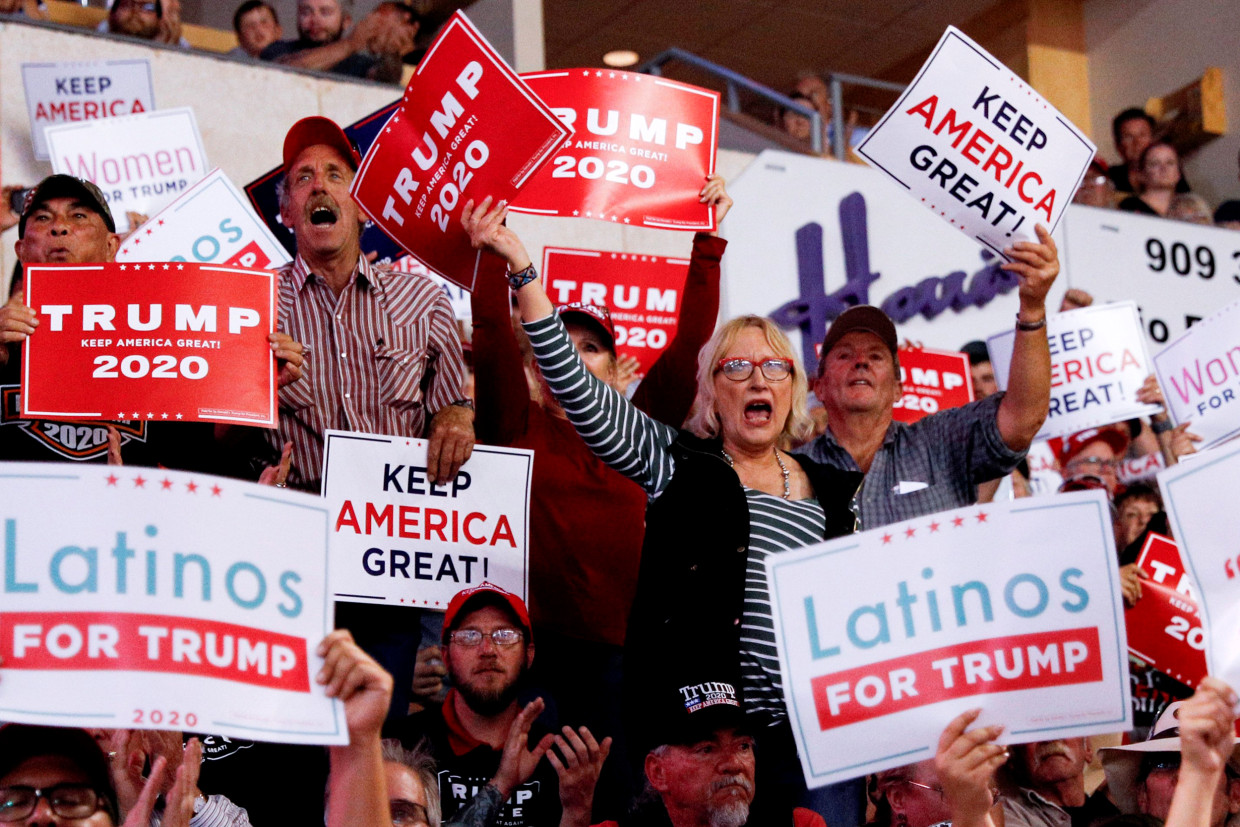
In 1988, Michael Dukakis got about 40 percent of the white vote, and 111 Electoral Votes. In 2008, Barack Obama got about 43 percent of the white vote, yet won 365 Electoral Votes. The difference was the rise in the Hispanic vote, especially in the Western States, like Colorado, New Mexico, Nevada and Arizona.

In 1988, all 4 of those States went Republican, as they had in most elections from 1968 onward. In 1992, Bill Clinton won all of them but Arizona. In 1996, Clinton won all of them except Colorado, becoming the 1st Democratic nominee to win Arizona since Harry Truman in 1948. (As Barry Goldwater's home State, it was the only State outside the South that didn't go for Lyndon Johnson in 1964.)

In 2000, out of those 4 States, Al Gore won only New Mexico. In 2004, John Kerry lost them all. But in 2008, Obama won all of them except Arizona, and probably would have won that if it hadn't been the home State of his opponent, John McCain. In 2012, again, Obama won all but Arizona. In 2016, Hillary Clinton won all but Arizona. In 2020, Joe Biden won all 4.

Obama turning those States in 2008 led to the thought that, by 2020, the Democrats could take Florida and Texas. If so, it would have been ballgame over for the Republicans -- and also for the Electoral College, because the only things saving them from total wipeout were Florida and Texas, so they would have supported scrapping it.

Now we see that Florida and Texas are lost causes. And if the Republicans can hold the Hispanic male vote in 2028, that means the Democrats can no longer count on the cities to save certain States for them, and it's ballgame over for them.

What can Democrats do between now and November 7, 2028? First, watch as Trump's policies hurt everybody. Second, show the Hispanic men that those policies have particularly hurt them and their families. And nominate someone who can, both literally and figuratively, speak their language. Then, the Democrats can get back to where they were from 2008 to 2020.

Saturday, August 31, 2024

Major League Distances From SEC Cities

* University of South Carolina, Columbia, South Carolina. Braves, Panthers, Hornets, Hurricanes, Charlotte FC.
MLB: Atlanta Braves 230.
NFL: Carolina Panthers 99, Atlanta Falcons 218.
NBA: Charlotte Bobcats 99, Atlanta Hawks 218.
NHL: Carolina Hurricanes 238.
MLS: Charlotte FC 99, Atlanta United 218.  

* University of Georgia, Athens, Georgia. Braves, Falcons, Hawks, Predators, United.
MLB: Atlanta Braves 71.
NFL: Atlanta Falcons 71.
NBA: Atlanta Hawks 71.
NHL: Nashville Predators 307, Carolina Hurricanes 349.
MLS: Atlanta United 71.

* University of Florida, Gainesville, Florida. Rays, Jaguars, Magic, Lightning, Orlando City.
MLB: Tampa Bay Rays 152, Miami Marlins 336, Atlanta Braves 343.
NFL: Jacksonville Jaguars 74, Tampa Bay Buccaneers 134, Miami Dolphins 323, Atlanta Falcons 331.
NBA: Orlando Magic 113, Atlanta Hawks 331, Miami Heat 336.
NHL: Tampa Bay Lightning 131, Florida Panthers 317.
MLS: Orlando City 111, Inter Miami 309, Atlanta United 331.

* University of Kentucky, Lexington, Kentucky. Reds, Bengals, Pacers, Blue Jackets, FC Cincinnati.
MLB: Cincinnati Reds 82.
NFL: Cincinnati Bengals 82, Indianapolis Colts 188, Tennessee Titans 212.
NBA: Indiana Pacers 188.
NHL: Columbus Blue Jackets 189, Nashville Predators 214.
MLS: FC Cincinnati 82, Nashville SC 215.

* University of Tennessee, Knoxville, Tennessee. Braves, Titans, Hawks, Predators, Nashville SC.
MLB: Atlanta Braves 202, Cincinnati Reds 251.
NFL: Tennessee Titans 180, Carolina Panthers 229.
NBA: Atlanta Hawks 213, Charlotte Hornets 229, Indiana Pacers 358, Memphis Grizzlies 393.
NHL: Nashville Predators 181.
MLS: Nashville SC 180, Atlanta United 213, Charlotte FC 229.

* Vanderbilt University, a.k.a. Vandy, Nashville, Tennessee. Braves, Titans, Grizzlies, Predators, Nashville SC.
MLB: Atlanta Braves 237, Cincinnati Reds 275, St. Louis Cardinals 310.
NFL: Tennessee Titans 3.
NBA: Memphis Grizzlies 212, Atlanta Hawks 248, Indiana Pacers 291.
NHL: Nashville Predators 2.
MLS: Nashville SC 3.

* University of Alabama, a.k.a. 'Bama, Tuscaloosa, Alabama. Braves, Falcons, Hawks, Predators, Atlanta United.
MLB: Atlanta Braves 206.
NFL: Atlanta Falcons 203, Tennessee Titans 249, New Orleans Saints 292.
NBA: Atlanta Hawks 203, Memphis Grizzlies 239, New Orleans Pelicans 292.
NHL: Nashville Predators 248.
MLS: Atlanta United 203, Nashville SC 246.

* Auburn University, Auburn, Alabama. Braves, Falcons, Hawks, Predators, Atlanta United.
MLB: Atlanta Braves 117.
NFL: Atlanta Falcons 110, Tennessee Titans 304, Jacksonville Jaguars 328, New Orleans Saints 362.
NBA: Atlanta Hawks 110, Memphis Grizzlies 348, New Orleans Pelicans 362.
NHL: Nashville Predators 302.
MLS: Atlanta United 110, Nashville SC 301.

* University of Mississippi, a.k.a. Ole Miss, Oxford, Mississippi. Braves, Titans, Grizzlies, Predators, Nashville SC.
MLB: Atlanta Braves 335.
NFL: Tennessee Titans 266, Atlanta Falcons 332, New Orleans Saints 347.
NBA: Memphis Grizzlies 83, Atlanta Hawks 332, New Orleans Pelicans 347.
NHL: Nashville Predators 264.
MLS: Nashville SC 246, Atlanta United 332.

* Mississippi State University, Starkville, Mississippi. Braves, Titans, Grizzlies, Predators, Nashville SC.
MLB: Atlanta Braves 287.
NFL: Tennessee Titans 265, Atlanta Falcons 284, New Orleans Saints 295.
NBA: Memphis Grizzlies 179, Atlanta Hawks 284, New Orleans Pelicans 295.
NHL: Nashville Predators 264.
MLS: Nashville SC 263, Atlanta United 284.

* University of Missouri, a.k.a. Mizzou, Columbia, Missouri. Royals, Chiefs, Bulls, Blues, St. Louis City.
MLB: Kansas City Royals 120, St. Louis Cardinals 126, Chicago White Sox 384, Chicago Cubs 394.
NFL: Kansas City Chiefs 120, Chicago Bears 385.
NBA: Chicago Bulls 387, Memphis Grizzlies 396.
NHL: St. Louis Blues 125. Chicago Blackhawks 387.
MLS: St. Louis City 125, Sporting Kansas City 141.

* University of Arkansas, Fayetteville, Arkansas. Rangers, Cowboys, Thunder, Stars, FC Dallas.
MLB: Texas Rangers 348, St. Louis Cardinals 362.
NFL: Dallas Cowboys 349, Tennessee Titans 530.
NBA: Oklahoma City Thunder 236, Memphis Grizzlies 318, Dallas Mavericks 332.
NHL: Dallas Stars 332, St. Louis Blues 361, Nashville Predators 528.
MLS: FC Dallas 310, St. Louis City 361, Nashville SC 531.

* Louisiana State University, a.k.a. LSU, Baton Rouge, Louisiana. Astros, Saints, Pelicans, Stars, Dynamo.
MLB: Houston Astros 268, Texas Rangers 444, Atlanta Braves 533.
NFL: New Orleans Saints 80, Houston Texans 277, Dallas Cowboys 445, Tennessee Titans 590.
NBA: New Orleans Pelicans 80, Houston Rockets 269, Memphis Grizzlies 383, Dallas Mavericks 430.
NHL: Dallas Stars 430, Nashville Predators 588.
MLS: Houston Dynamo 269, FC Dallas 449, Nashville SC 587.

* University of Oklahoma, Norman, Oklahoma. Rangers, Cowboys, Thunder, Stars, FC Dallas.
MLB: Texas Rangers 191, Kansas City Royals 373.
NFL: Dallas Cowboys 192, Kansas City Chiefs 373.
NBA: Oklahoma City Thunder 21, Dallas Mavericks 186.
NHL: Dallas Stars 186.
MLS: FC Dallas 172, Sporting Kansas City 358.

* University of Texas, Austin, Texas. Astros, Texans, Spurs, Stars, Dynamo.
MLB: Houston Astros 168, Texas Rangers 201.
NFL: Houston Texans 170, Dallas Cowboys 201.
NBA: San Antonio Spurs 77, Houston Rockets 167, Dallas Mavericks 195.
NHL: Dallas Stars 195.
MLS: Austin FC 8, Houston Dynamo 168, FC Dallas 220.

* Texas A&M University, College Station, Texas. Astros, Texans, Rockets, Stars, Dynamo.
MLB: Houston Astros 94, Texas Rangers 188.
NFL: Houston Texans 99, Dallas Cowboys 187.
NBA: Houston Rockets 94, San Antonio Spurs 168, Dallas Mavericks 180.
NHL: Dallas Stars 180.
MLS: Houston Dynamo 95, Austin FC 105, FC Dallas 205.

Wednesday, March 22, 2023

March 22, 1993: The Crash On Little Lake Nellie

Steve Olin

March 22, 1993, 30 years ago: The Cleveland Indians are struck by tragedy, when a boating accident kills two of their pitchers, and badly injures a third.

Steve Olin, a 27-year-old native of Portland, Oregon, reached the Indians in the 1989 season. In 1991, he went 3-6 with 17 saves. In 1992, he went 8-5 with 29 saves. He looked like a star in the making, part of the Indians' plan to contend for a title by the time they moved out of Cleveland Municipal Stadium and into the new Jacobs Field for the 1994 season. (It was renamed Progressive Field in 2008.)

Tim Crews, 31, from Tampa, had reached the majors with the Los Angeles Dodgers in 1987. He was a middle reliever, with a career record of 11-13, and 15 saves, peaking at 6 in 1991.
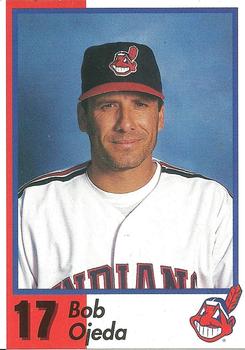
Bob Ojeda, 35, was from Visalia, California, and had helped the New York Mets win the 1986 World Series. An elbow injury the next season curtailed his career, and the Mets traded him to the Dodgers for the 1991 season. He went 12-9, but fell to 6-9 in 1992. After that season, both he and Crews were free agents, and both signed with the Indians.

Olin, Crews and Ojeda reported to Spring Training in Chain of Lakes Park in Winter Haven, Florida, after having trained in Tucson, Arizona since 1947. March 22 was an off-day, and the 3 pitchers decided to take a boat ride on Little Lake Nellie in nearby Clermont.

Crews piloted the boat. All 3 men had been drinking. Crews' blood alcohol level was found to be 0.14, or 0.04 over the legal limit. It was getting dark, and the boat struck a pier that jutted out into the lake. Olin was killed instantly. Crews died the next day.

Ojeda sustained lacerations to his head, and admitted he had been slouching at the time of impact, which probably saved his life. But his psychological issues were greater than his physical ones, and he didn't make his 1st appearance of the season until August 7.
In a pregame ceremony on Opening Day, April 5, 1993, at Municipal Stadium, Patti Olin and Lori Crews were presented with their husbands' jerseys. The Cleveland players took the field wearing patches with Olin's Number 31 and Crews' Number 52 on them. They lost the opener to the New York Yankees, and never really recovered from losing one-third of their pitching staff in one fell swoop. They went 76-86, finishing in 6th place in the American League Eastern Division.
Although Crews had chosen to sign with another team, the Dodgers also wore patches with a Number 52 on them. Later in the season, Dodger Hall-of-Famers Don Drysdale and Roy Campanella also died.

After the 1993 season, the Indians lost another pitcher: Cliff Young was killed in a car crash in his native Houston suburbs. He was only 29.
Cliff Young, from earlier in his career,
with the California Angels

Ojeda made 9 appearances for the Indians in 1993, and 2 more for the Yankees in 1994, before he finally accepted that his injuries were too much to overcome, and retired, with a career record of 115-98. He has since served as a pitching coach in the Mets' organization, and as an analyst for their network, Sportsnet New York.

The Indians won the American League Pennant in 1995, their 1st in 41 years. They lost the World Series to the Atlanta Braves. The won another Pennant in 1997, but lost the World Series in 7 games to the Florida Marlins, because their top reliever, Jose Mesa, turned out to be unreliable. Steve Olin would have been a few days past his 32nd birthday, and probably at his peak. But he was unavailable, for the worst of reasons. The Indians also won American League Central Division titles in 1996, 1998, 1999 and 2001. They won the Division again in 2007. Olin would have been 42, and, theoretically, could still have contributed to the Indians' postseason effort.

In 2009, the Indians left Winter Haven, and began training in Arizona again, at Goodyear Ballpark in the Phoenix suburb of Goodyear. (It's named for the town, not the tire company.) In 2010, they began sharing it with Ohio's other Major League Baseball team, the Cincinnati Reds. In 2022, the Indians became the Cleveland Guardians.

Sunday, March 5, 2023

March 5, 1973: The Yankee Wife-Swap

Left to right: Marilyn and Fritz Peterson,
Susanne and Mike Kekich -- as they were then known.

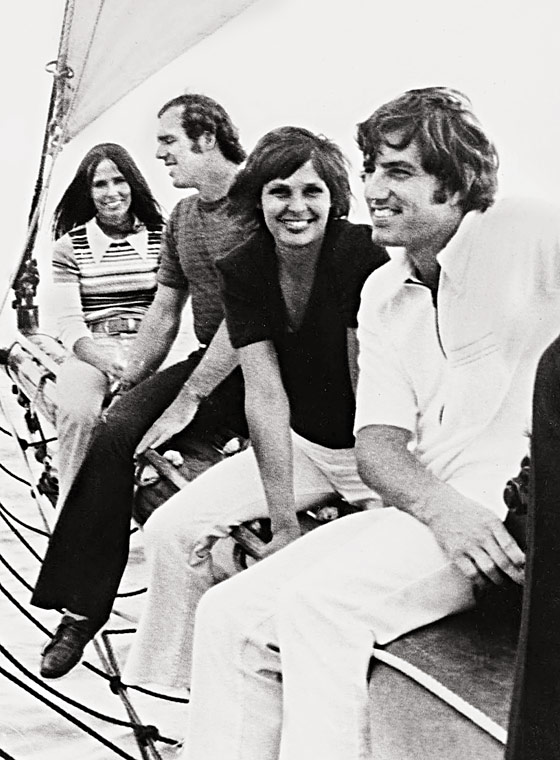
March 5, 1973, 50 years ago: At the New York Yankees' Spring Training camp in Fort Lauderdale, Florida, pitchers Fred "Fritz" Peterson, a 31-year-old lefthanded starter from Chicago, and Mike Kekich, a 27-year-old lefthanded reliever from San Diego, announce that they have engaged in an oh-so-1970s activity: Wife-swapping.

It actually went well beyond that. They'd been teammates since 1969, and they ended up switching entire families. Fritz moved in with Susanne Kekich, while Mike moved in with Marilyn Peterson. The pitchers swapped wives, houses, children, even dogs.

The media ate this story up: It had sports and sex. What a combination.

This must have driven George Steinbrenner crazy. Only 43 years old, and apparently at the peak of his business career, he had bought the Yankees from CBS just 2 months earlier. He wanted to rebuild the organization in what he perceived to be his own image: Straitlaced, almost military, very businesslike, and successful.

What's more, he wanted them to win and -- equally important to him, because he wanted to fill the seats -- to make headlines, to take attention away from the New York Mets. The old Yankee dynasty had collapsed after the 1964 season, and fans had stopped going to the bad neighborhood that Yankee Stadium was in, because, without the winning, and with superstar Mickey Mantle retired, there was no more reason to go to the South Bronx.

In contrast, the Mets had a new stadium in a parking lot in Flushing Meadow-Corona Park, so there was no neighborhood at all, and had won a "miracle" World Series in 1969, and still had most of the players on that team. Indeed, the Mets would win another Pennant in 1973.

The Mets were making headlines by winning and providing fun for their fans. The Yankees were making a totally different kind of headline. Now, they were seen as a team of perverts, even though it was only 2 players involved. But Peterson was 1 of their top 2 pitchers, along with Mel Stottlemyre. He had won 20 games in 1970, and 17 in 1969 and 1972. He led the American League in WHIP (Walks + Hits, divided by Innings Pitched) twice. Kekich, on the other hand, was a journeyman: He'd gone 10-9 in 1971, but 10-13 in 1972, and he was never even that good again.

Despite Peterson and Kekich getting booed in just about every AL ballpark, including Yankee Stadium, the '73 Yankees stayed in the AL Eastern Division race through August, then tailed off, and the Baltimore Orioles won the Division, then lost the AL Championship Series to the Oakland Athletics, who then beat the Mets in the World Series -- thanks in large part to 3 players that Steinbrenner would eventually acquire for the Yankees: Slugging outfielder Reggie Jackson, and pitchers Jim "Catfish" Hunter and Ken Holtzman.

Kekich wasn't there for most of that: On June 12, Steinbrenner had him traded to the Cleveland Indians for pitcher Lowell Palmer, then stuck in the minors with a 3-13 career major league record. He ended up never throwing a pitch for the Yankees.

On April 26, 1974, the Yankees traded Peterson, Fred Beene, Tom Buskey and Steve Kline, all pitchers, to the Indians for 1st baseman Chris Chambliss, and pitchers Dick Tidrow and Cecil Upshaw. They traded 1/3rd of their pitching staff for Chambliss, a former AL Rookie of the Year, and 2 pitchers nobody had ever heard of. With Watergate's Saturday Night Massacre having happened just 6 months earlier, this trade became known as the Friday Night Massacre, and was very unpopular at the time, both in the clubhouse and in the stands.

But it was a great trade for the Yankees. As one observer wrote, it "broke up the country club." Upshaw never did much for them, but Tidrow became a key pitcher, both starting and relieving, on the team that would win 3 straight Pennants from 1976 to 1978. And Chambliss had both a Gold Glove and a power bat, hitting the home run that clinched the 1976 Pennant.

Peterson went 14-8 for the Indians in 1975, but pitched only 1 more season and change in the majors, due to a shoulder injury. He would finish his career at 133-131, pitching mostly for bad Yankee teams. His career WHIP was 1.191, and he led the American League in that category twice. Kekich was taken by the expansion Seattle Mariners, and threw the 1st complete-game victory in franchise history. That was it for him, as he finished 39-51.

And what about the swap? Well, Mike Kekich and Marilyn Peterson's relationship suffered, probably due to the other swap, the one where he was sent to Cleveland. He eventually found happiness by marrying a nurse. As of March 5, 2023, he and his wife were living outside Albuquerque, New Mexico.

But Fritz Peterson and his wife, formerly known as Susanne Kekich, stayed together. In 2013, on the 40th Anniversary, he told a reporter, "It's a love story. It wasn't anything dirty. I could not be happier with anybody in the world." He wrote 3 books about his time with the Yankees, and, with some irony, became an evangelical Christian (as did Susanne), working with Baseball Chapel.

In 2018, Peterson announced that he had Alzheimer's disease, and was withdrawing from public life. In March 2021, with assistance from his daughter Lindsay, he said on his Facebook page that he had forgotten how to use a computer. But Lindsay said that he was "having a blast" hearing from fans. (UPDATE: He died on October 19, 2023, although it wasn't publicly announced for another 6 months, until April 12, 2024.)

Since 2015, Ben Affleck and Matt Damon have been trying to get a movie made about the Yankee Wife-Swap. Of course: They're Boston Red Sox fans, trying to make the Yankees look bad. Let the record show that, in 1973, the Sox didn't get close to making the Playoffs, either, finishing 8 games behind the Orioles.

Sunday, June 19, 2022

How to Be a Met Fan In Miami -- 2022 Edition

Next Friday, the Mets will begin a 3-game series in Miami against the Marlins.

Stereotypically, South Florida in general, and Miami in particular, is where old Italian and Jewish New Yorkers go to retire. Along with the railroad and air-conditioning, New Yorkers essentially made that region possible.

And how has Miami thanked New York? Well, the Marlins have beaten the Yankees in a World Series (2003) and tormented the Mets in 2 season-ending knock-'em-out-of-Playoff-contention games (2007 and '08), the Dolphins have made fools out of the Jets (not that the Jets have needed much help), and the Heat have fought with the Knicks, figuratively and literally (1997 & '98).

But the Marlins' new ballpark is so sparsely populated these days that, starting this coming Friday night, Met fans can do what Yankee Fans do in Tampa Bay: Take over the ballpark, and turn it into the Sixth Borough.

Before You Go. It's South Florida: Presume that it will be hot, and that it will be rainy. This is why the new ballpark has a retractable roof. Most likely, it will be closed. Check the Miami Herald
website for their local forecast before you go.

Currently, they're saying that next week's daytime temperatures will be in the high 80s, while nighttime will be in the high 70s. They are saying there will be rain on Sunday. But, as I said, the roof is likely to be closed, so while you might get rained on, you won't get rained out.

Miami is in the Eastern Time Zone, so you won't have to fiddle with your watch or the clock on your smartphone. And, while Florida was a Confederate State, and parts of Miami may seem like an extension of Cuba or the Dominican Republic, you won't have to bring your passport or change your money.

Tickets. In 2019, the last pre-COVID season, the Marlins averaged 10,114 fans per home game – dead last in all of North American major league sports, and that includes MLS and the CFL -- but not the women's leagues, and even 1 WNBA team (the Los Angeles Sparks) and 1 NWSL team (the Portland Thorns) managed to top the Marlins.

The novelty of the new stadium has worn off like a 24-hour virus, and the shattered expectations of new acquisitions that either flopped or, like Jose Reyes and now Giancarlo Stanton, have already been dumped has killed whatever buzz they had.

Although they opened strong as an expansion franchise in 1993 with 37,838, and were doing well in 1994 with 33,695 before the strike hit, only in their 1997 World Championship season, 29,190, and in their first season in Marlins Park, 2012, have they since topped 24,000. Even in their World Championship season of 2003, they averaged just 16,290.

Although Hard Rock Stadium (the 8th name the facility has had in its 31 years of operation) has 75,192 seats for football and, during World Series play, topped out at 67,498, much of the upper deck was tarped off, and official baseball capacity was 38,560, turning what could be the largest stadium in the majors into one of the smallest. And still, they couldn't sell it out.

Official capacity of Marlins Park is 36,742 -- meaning they averaged 26,000 short of capacity. So getting tickets will probably not be a problem: Pretty much anything you can afford will be available. As with any roadtrip, I advise ordering your tickets in advance, but you can probably get anything you can afford.

This would not, however, include the upper deck "Vista Boxes" and "Vista Reserved": These are not on sale for the Marlins vs. Mets series. My guess is, they're being tarped off, with the club thinking they can't sell them. Oh really, with all those older ex-New Yorkers living nearby?

Home Plate Box seats go for $47, Baseline Reserved are $32, Bullpen Reserved in right field are $28, and the upper-deck Home Run Porch seats are $22. In left field, the "Marlins Crew" section (formerly the "Clevelander" section) goes for $28.

Getting There. It's 1,283 miles from Times Square in New York to downtown Miami, and 1,289 miles from Citi Field and Marlins Park. Knowing this distance, your first reaction is going to be to fly down there. This is not a horrible idea, as the flight is just 3 hours, but you'll still have to get from the airport to wherever your hotel is. If you're trying to get from the airport to downtown, you'll need to change buses – or change from a bus to Miami's Tri-Rail rapid transit service. And it is possible, if you order quickly, to find nonstop flights for under $500 round-trip.

The train is not a very good idea, because you'll have to leave Penn Station on Amtrak's Silver Star at 11:02 AM and arrive in Miami at 6:35 the next day's evening, a 31 1/2-hour ride. The return trip will leave at 11:40 AM and return to New York at 7:10 PM, 32 hours – no, as I said earlier, there's no time-zone change involved. Round-trip, it'll cost $424. And the station isn't all that close to downtown, at 8303 NW 37th Avenue. Fortunately, there's a Tri-Rail station there that will take you in.

How about Greyhound? There are 6 buses leaving Port Authority every day with connections to Miami, only one of them nonstop, the 10:30 PM to 4:20 AM (2 days later) version. The rest require you to change buses in Richmond and Orlando. (I don't know about changing buses in Orlando, but I have changed buses in Richmond, and I can tell you: It is not fun.) The ride, including the changeovers, takes about 30 hours. Round-trip fare is $586, but you can get it for $399 on advanced-purchase.

The station is at 4111 NW 27th Street and, ironically, is right across 42nd Avenue from the airport. It's worth the fact that it'll cost twice as much to simply fly down. Plus, you might be reminded of the end of the movie Midnight Cowboy, and nobody wants to be reminded of that.

If you want to drive, it'll help to get someone to go down with you, and take turns driving. You'll be going down Interstate 95 (or its New Jersey equivalent, the Turnpike) almost the whole way. It'll be about 2 hours from the Lincoln Tunnel to the Delaware Memorial Bridge, 20 minutes in Delaware, and an hour and a half in Maryland, before crossing the Woodrow Wilson Bridge, at the southern tip of the District of Columbia, into Virginia. Then it will be 3 hours or so in Virginia, another 3 hours in North Carolina, about 3 hours and 15 minutes in South Carolina, a little under 2 hours in Georgia, and about 6 hours and 15 minutes in Florida before you reach downtown Miami.

Given rest stops, preferably in one in each State from Maryland to Georgia and 2 in Florida, you're talking about a 28-hour trip.

Once In the City. A lot of people don't realize it, because Miami is Florida's most famous city, but the most populous city in the State is Jacksonville. However, while Miami has about 470,000 people within the city limits, there are nearly 7 million living in the metro area, making it far and away the largest in the South, not counting Texas.
Because Florida is so hot (How hot is it?), and air-conditioning didn't become common until the mid-20th Century, Miami was founded rather late by the standards of the East coast, in 1825, and wasn't incorporated as a city until 1896. The name is derived from the Mayaimi tribe of Native Americans. Miami Avenue is the east-west divider, Flagler Street the north-south. The city has no beltway.

The Herald is the only major newspaper left in the city, but the Sun-Sentinel of Fort Lauderdale should also be available. And, considering how many ex-New Yorkers are around, you might also be able to get the Times, the Daily News, or, if you're really desperate (or really conservative), the Post.

The sales tax in Florida is 6 percent, but it's 7 percent within Miami-Dade County. ZIP Codes in Miami start with the digits 330, 331 and 332; in the Fort Lauderdale area, 333; and in the Palm Beach area, 334 and 349. Florida Power & Light runs the Miami area's electricity.

No longer thought of as a haven for retired Jewish New Yorkers, Miami is the most Hispanic major city east of Texas: 70 percent, with half of that, 34 percent of the total, being of Cuban origin, many of them refugees from the 1959 Castro Revolution and their descendants.

It should be noted, though, that, after 2 generations, there are Cubans in South Florida who don't remember living under the Castros, and find out that things weren't so great under the Batista regime, either, and thus don't automatically vote Republican because of the single issue.

The city is 19 percent black, 10 percent white, and only about 1 percent Asian. Miami-Dade County as a whole is about 65 percent Hispanic, 17 percent black, 15 percent white, 2 percent Asian, and 1 percent Middle Eastern. North of the river is mostly black, and a few miles north of that mostly white; while south of the river is mostly Hispanic.
Red = White, Purple = Black, Orange = Hispanic

Miami had a race riot in downtown in 1980, after the acquittal of policemen who had beaten a black man to death late the previous year; a riot in the Overtown section in early 1989, after a white policeman ran over a black bicyclist; and a riot in the Wynwood section in late 1990, after the acquittal of officers who had beaten a drug dealer to death.

Since 1984, Miami has had a rapid-transit rail service, Metrorail. However, the ballpark isn't all that close to it. You will need to take the Number 7 bus from downtown. The fare for the Metrorail and the Metrobus is $2.25. There is also the downtown Metromover. Brightline service now connects Miami with Fort Lauderdale and West Palm Beach (its only stops), hoping to open an extension to Orlando in 2021.
A Metrorail train at a downtown station

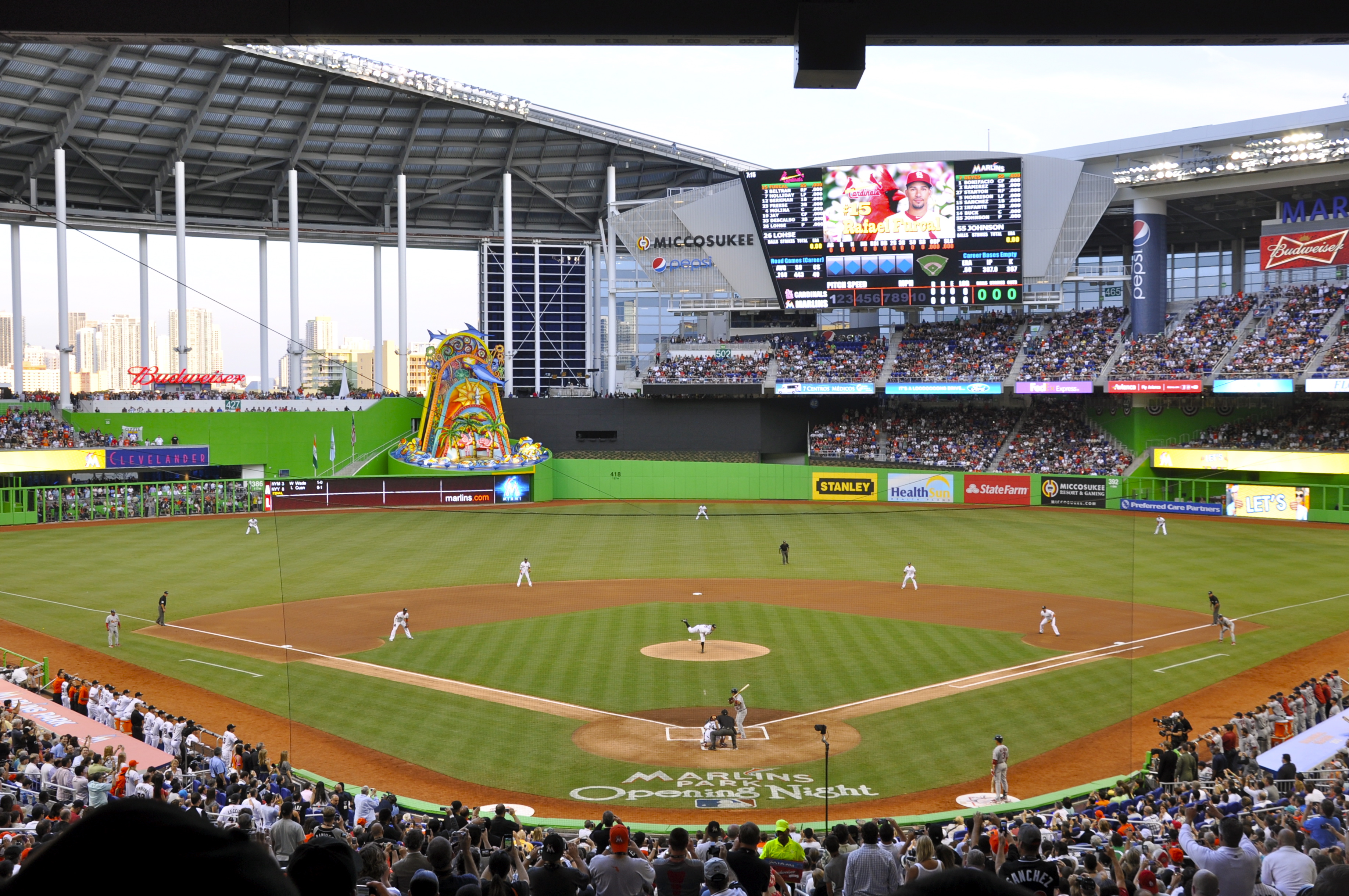
Going In. Marlins Park opened in 2012, and was renamed LoanDepot Park in 2020. The official address used to be 1390 NW 6th Street, but it's now 501 Marlins Way. It's 2 miles west of downtown, between 4th and 6th Streets, and 14th and 16th Avenues. Parking is $10.
LoanDepot Park with roof closed,
and downtown in the background

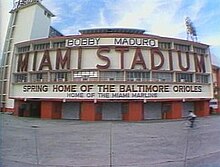
Three of those surrounding streets have specialized names for the stretches that border the park: 16th Avenue is Marlins Way; 4th Street is Bobby Maduro Drive, after the Cuban baseball executive who was forced to flee his native land during Fidel Castro's revolution and had the old Miami minor-league stadium named in his honor; and 6th Street is Felo Ramírez Drive, after the legendary baseball and boxing announcer who has been the main Spanish radio voice of the Marlins from day one in 1993, and is a winner of the Baseball Hall of Fame's Ford Frick Award for broadcasters.
LoanDepot Park with roof open

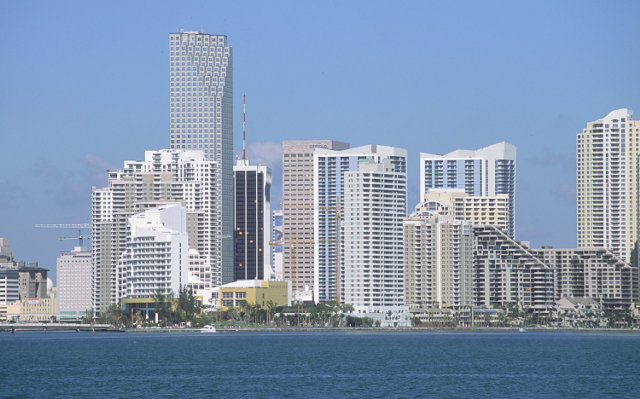
Due to South Florida's climate – the city probably gets more rain than any other in the major leagues, including Seattle – the ballpark was built with a retractable roof, going from the 1st base side across to left field. The park points southeast, but is west of downtown, so you can't really see Miami's skyline from inside. Which is too bad, because Miami is undergoing a building boom, including the "Biscayne Wall" along the waterfront. The seats are all a bright blue.

Marlins Park has a natural grass field. In fact, one of the good things about the Marlins organization is that they've never played a home game on artificial turf. The outfield distances are 344 feet down the left field line, 386 to left-center, 420 to the furthest point, the left-center region they call "the Bermuda Triangle," 418 to straightaway center, 392 to right-center, and 335 down the right field line.

Every bit as much as the Dolphins' stadium was in its baseball configuration, this is a pitcher's park. The longest home run in it is a 484-footer by Giancarlo Stanton in 2014. (He is, of course, now with the Yankees.) Andres Galarraga, as a Colorado Rockie, hit the longest in Miami's major league history, a 529-footer at Joe Robbie Stadium in 1997.

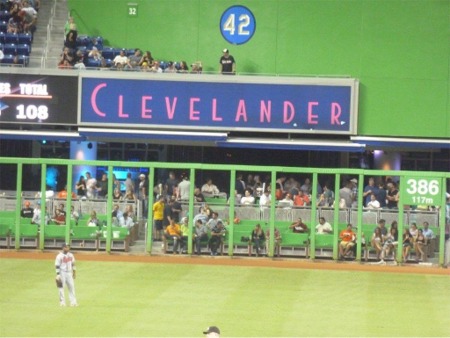
There's funky (or tacky, depending on how you look at it) artwork all over the place, including the tropic-themed Home Run Sculpture in left field. And then there's the Marlins Crew section, formerly "The Clevelander." Something the Marlins captured during their 1997 World Series win over the Indians, maybe? Nope, it's something they call "South Beach Comes to the Ballpark!" They have a poolside bar and grill, restricted to fans age 21 and over. In other words, it's the Arizona Diamondbacks' right-center-field pool kicked up a notch. It's something that does not belong at a ballpark.
(I don't know if there's a connection, but Julia Tuttle, the local booster who convinced railroad baron Henry Flagler to help her make a modern city possible in the 1890s, was from Cleveland. Because of her, Miami is sometimes called the only American city founded by a woman.)

Food. With a great Hispanic, and especially Cuban, heritage, and also being in Southeastern Conference country (hello, tailgating), you would expect the baseball team in Miami to have great food at their stadium. They certainly go heavy on the regional cuisine at Taste of Miami, behind Section 27: Cuban sandwiches, Pan con Lechon (the best item in the stadium according to a recent Thrillist article on the best food at each MLB stadium), Chicharron, Fish Ceviche, Cuban coffee and Mariquitas. This is not to be confused with the Miami Mex taco stand at Section 4.

Burger 305 (named for the city's original Area Code) has several stands, and includes a "Miami Shrimp Burger." There's 3 Sir Pizza stands -- after all, what would Miami be without Italian senior citizens? There is a Kosher Korner at Section 1 -- after all, what would Miami be without Jewish senior citizens? Brother Jimmy's BBQ, introduced to New York sports at the new Yankee Stadium, is at Section 8.

Team History Displays. Not much. The Marlins hang banners for their 1997 and 2003 World Championships, their only trips to the postseason, in the windowed area behind left field, and on the outside wall of the stadium.
The 1st retired number they had was for Carl Barger, their team president, who organized the team for the start of the 1993 season, and then died right before it. He was a friend of Joe DiMaggio, who lived in nearby Hollywood, Florida, and threw out the first ball at the Marlins' 1st game.

(There was precedent for a legend of one team throwing out the first-ever first ball of another team: Ty Cobb's last appearance in a big-league ballpark was throwing out the first ball at the Los Angeles Angels' 1st home game, because he was a friend and former teammate of their 1st general manager, Fred Haney. In 1998, Central Florida legend Ted Williams threw out the first ball at the 1st Tampa Bay Rays game.)

In Barger's memory, and in connection with his friendship with the Yankee Clipper, original owner Wayne Huizenga retired Number 5 for Barger, who never wore it – not even for fun. But upon the opening of the new park, it was unretired, and it is currently being worn by utility player John Berti. A utility player. How's that for a comedown?

When All-Star pitcher Jose Fernandez died in a boating accident in 2016, the Marlins announced that his Number 16 would be immediately retired, and that he would receive a statue at Marlins Park. This is in spite of the fact that the autopsy report showed that Fernandez was driving the boat, and that the toxicology report showed that he had both alcohol and cocaine in his system at the time. For comparison's sake, neither the Mets nor the Phillies have yet named convicted drunk driver Lenny Dykstra to their respective team halls of fame.

As yet, there has been no ceremony for Fernandez, no statue, and no display for his number. The only retired number the Marlins currently recognize is the universally-retired Number 42 of Jackie Robinson. Their notation for it is in left-center, next to The Clevelander.
The team did honor Barger with a plaque at the new park, but that's hardly the same thing, unless it's part of a team Hall of Fame display, which they don't have: Not a display, nor a team Hall of Fame. Nor even an all-time team as chosen by the fans, not even in 2013, with the team celebrating its 20th Anniversary. Nor in 2018, for their 25th. Maybe next year, for their 30th.

There are 6 players who played for the Marlins who are in the Baseball Hall of Fame in Cooperstown: Miami native Andre Dawson, former manager Tony Pérez, Trevor Hoffman, Iván Rodríguez, Mike Piazza, and Sanford, Florida native Tim Raines.

It should be noted, though, that Pérez  never played for the Marlins; Hoffman played only the 1st half of the 1st season of his career for the Marlins; Piazza played just 5 games for them in 1998, between being traded by the Dodgers and to the Mets; Rodríguez only did so for 1 season, even if it was the World Championship season of 2003; Raines only did so in the last season of his career, for 98 games; and Dawson only did so for the last 2 years of his career, for 121 games. So, 6 Hall-of-Famers, playing a grand total of 396 games, or about 2 1/2 full seasons.

They have 2 broadcasters "in the Hall of Fame": Ramírez, and Dave Van Horne, who came down from the Montreal Expos when Jeffrey Loria essentially moved the Expos' organization, if not its players, in 2002.

No player for the Marlins was named to The Sporting News' 100 Greatest Players in 1999. In 2006, Dontrelle Willis was chosen by Marlin fans for the DHL Hometown Heroes series. In 2022, ESPN named its 100 Greatest Baseball Players. Among players who played significant time for the Marlins, Miguel Cabrera ranked 59th, and Rodríguez (if you can count 1 season, even a World Championship season, as "significant time") 90th.


The Florida Sports Hall of Fame is located at Lake Myrtle Sports Park in Auburndale, 232 miles northwest of downtown Miami. The Marlins figures inducted are Raines, Dawson, Jeff Conine, and 2 men who played for both the Yankees and the Mets, Al Leiter and Gary Sheffield; plus Huizenga.

There is no trophy for the winner of the "Citrus Series" between the Marlins and the Tampa Bay Rays. The rivalry couldn't be much closer: The Rays have won it 13 times, the Marlins 10, and there's been 1 split; while in overall games, the Rays lead 73-58.

Stuff. The Marlins have team stores in the stadium, but nothing out of the ordinary: Caps, jerseys, T-shirts, bats, gloves, stuffed Billy the Marlin dolls.

A few books have been written for the Marlins, and may be available in the team stores. Dan Schlossberg, Miami Herald columnist Dave Barr, Kevin Baxter and Conine collaborated on Miracle Over Miami: How the 2003 Marlins Shocked the World. Jenny Reese wrote The History of the Florida Marlins, published in 2010.

One book you will almost certainly not see in the stores is Dave Rosenbaum's book about how original owner Huizenga "went all in" to win the 1997 World Series, then broke the team up, going from 92-70 that season to 54-108 the next, having practically come out and told everyone that a 100-plus-loss next season was likely. The title of the book? If They Don't Win It's a Shame.

(Yeah, tell that to the Giants, who they beat in the NLDS and who had never yet won a Series in San Francisco; and to the Indians, who blew a 9th-inning lead in Game 7 of the Series and still haven't won a Series since 1948. Rosenbaum also wrote Miami Ice: Winning the NHL Rat Race with the Florida Panthers.)

Although the Marlins have won 2 World Series and have been around for nearly 20 years now, there is, as yet, no commemorative DVD of their World Series highlight films, and no The Essential Games of the Florida Marlins DVD.

During the Game. South Florida is loaded with people who came from elsewhere, including ex-New Yorkers. The stereotype is that, when a New Yorker gets old, if he has enough money to do so, he moves to Miami. Especially if he's Jewish. Or Italian.

As a result, you may see a lot of Met fans, few of whom switched to the Marlins. You may run into a few Yankee Fans who adopted the Marlins as their "second team" or their "National League team," although how many of them kept that status after the 2003 World Series is debatable. (Blast you, Jeff Weaver – Alex Gonzalez sure did.)

I don't know if your safety will be an issue. The new ballpark, on the site of the Orange Bowl, is in a questionable neighborhood. However, if you leave your car at the hotel and take the bus in, the police presence will probably mean you're protected from the local criminal element.

As for the Marlin fans, a recent Thrillist article put them almost right in the middle, 14th out of 30, on a list of "Baseball's Most Intolerable Fans."

You will almost certainly be fine. Miamians might fight if they're at a Dolphins game -- or a University of Miami Hurricanes game, especially against the University of Florida or Florida State -- especially if provoked by visiting fans, but not at a Marlins game. Any leftover bad juju from Dolphins or Hurricanes games the Orange Bowl isn't going to be a problem.

The Friday game will not feature a promotion. The Saturday game will be Bahamian Heritage Celebration, as Nassau, the capital and largest city of the Bahamas, is just 180 air miles from Miami. Bobblehead dolls of the Marlins' Bahamian 2nd baseman Jazz Chisholm Jr. will be given away. It will also be a Legacy Saturday, with the Marlins wearing red jerseys. The Sunday game will be both South Florida Black Legacy Day, with the Marlins wearing black jerseys; and Bark at the Park, with dogs allowed.

They hold auditions for National Anthem singers, instead of having a regular. heir mascot is Billy the Marlin, whose name was chosen by Huizenga because a Marlin is a "billfish" – and it has nothing to do with the infamous 1970s-80s Yankee manager Billy Martin, in spite of the character's large nose. Since the change of team colors upon moving into Marlins Park in 2012, Billy's costume was altered to show the new colors.
That's Carlos Zambrano, the former All-Star pitcher
for the Cubs, that he's high-fiving, not Victor Zambrano
whom the Mets traded Scott Kazmir for. 

Billy sometimes "water-skis" in behind a golf cart built to look like a boat. Any resemblance of this setup to Richie Cunningham driving the boat that allowed the Fonz to jump the shark on Happy Days is strictly coincidental.

Worse than a dopey mascot, the Marlins had cheerleaders. No, I'm not making this up: They were the one and only MLB team with cheerleaders. Or, as they would put it, a dance/cheer team. The Marlins Mermaids debuted in 2003.
I don't care: It doesn't belong in baseball.

As noted Phillies fan Bill Cosby used to say in his act, before we decided we never wanted to see his act again, "Don't ever say, 'It can't get any worse.' It can always get worse. 'Worse' is rough." In 2008, the team debuted the Marlins Manatees, an all-male "dance/energy squad" who performed alongside the Mermaids. They even wore costumes, like a fat version of the Village People.
Did you think I was making it up?

Speaking of the Village People: You want to blame the Yankees for having the grounds crew dance to "YMCA," go ahead, because that's one "Yankee Tradition" I don't like, anyway; but this, as noted Met fan Oscar Madison (Jack Klugman on The Odd Couple) would say, is as ridiculous as Aristophanes. Thankfully, upon moving into Marlins Park in 2012, the team abandoned these concepts, and formed a co-ed "energy squad" without a stupid name.
At least they're dressed better.

The Marlins do not have a regular song to play in the 7th inning stretch after "Take Me Out to the Ball Game." Their postgame victory song is "Echa Pa'lla (Manos Pa'rriba)," meaning "Move (Hands Up)," by Miami native Armando Christian Pérez, a.k.a. Pitbull. 

It could be worse: They could play Gloria Estefan & Miami Sound Machine. Worse yet, Miami-based discoteers KC and the Sunshine Band. Or, worst of all, Robbie Van Winkle, the suburbs-of-Dallas loser who, very briefly, tried (and failed) to fool us into thinking he was Miami gangbanger Vanilla Ice.

After the Game. As I said, the Marlins Park area is a bit rough. My advice is to get back downtown as soon as possible, and either look for a nightspot there, or get across the Causeways to Miami Beach, or stay in your hotel and try their bar.

If you're too hungry to wait, on opposite sides of 7th Street, just north of the ballpark, there's a Wendy's and a Subway. A place called New York Pizza is 2 blocks from the ballpark, at 1755 NW 7th Street.

I checked for area bars where New Yorkers gather, and found one for each of the city's NFL teams.

The South Florida Jets Fan Club meets at Hammerjack's, at 5325 S. University Drive in Davie, a bit closer to the stadium, but still 24 miles north of downtown. But what had been the home of the local Giants fan club, J.C. Wahoo's, 40 miles north of downtown, went under during the depths of the COVID pandemic.

Don't bother looking for Dan Marino's restaurants: They've all closed. He's had financial setbacks, partly due to paying his extramarital baby mama millions of dollars in hush money.

If you visit Miami during the European soccer season, your best bet is American Social, 690 SW 1st Court, of 7th Street, downtown. 

Sidelights. On November 30, 2018, Thrillist published a list of "America's 25 Most Fun Cities," and Miami came in a surprisingly low 12th. Miami's sports history is long, but aside from football, it's not all that involved.

Marlins Park was, as I said, built on the site of the stadium known as Burdine Stadium from its 1937 opening until 1959 and the Miami Orange Bowl thereafter. It was best known for hosting the Orange Bowl game on (or close to) every New Year's Day from 1938 to 1995, and the NFL's Miami Dolphins from their debut in 1966 until 1986.

It was home to the University of Miami football team from 1937 to 2007 (famed for its fake-smoke entrances out of the tunnel). It was also the home of, if you count the All-America Football Conference of the 1940s, the 1st "major league" team in any of the former Confederate States: The 1946 Miami Seahawks.

But the black players on the Cleveland Browns would not accept being housed away from their white teammates in segregated Florida, and in that league, what the Browns wanted, the Browns got. So the Seahawks (in no way connected the NFL's Seattle team of the same name) were moved to become the Baltimore Colts after just 1 season.
The Orange Bowl game hosted de facto National Championships for the seasons of 1938-39, Tennessee over Oklahoma; 19556-56, Oklahoma over Maryland; 1971-72, Nebraska over Alabama; 1981-82, Clemson over Nebraska; 1983-84, Miami over Nebraska; 1987-88, Miami over Oklahoma; 1990-91, Colorado over Notre Dame; 1991-92, Miami over Nebraska; 1993-94, Florida State over Nebraska; and 1994-95, Nebraska finally getting revenge over both Miami and their own history in the building.

The Orange Bowl also hosted the Bert Bell Benefit Bowl, a game involving the 2nd-place teams in each of the NFL's divisions from 1960 to 1969, a charity game, a glorified exhibition. Also known as the Playoff Bowl, it was considered so lame that Green Bay Packers coach Vince Lombardi publicly called it "the only game I never want to win" – and he didn't. The stadium also hosted the Miami Toros of the North American Soccer League from 1972 to 1976.

And it hosted 5 Super Bowls, most notably (from a New York perspective) Super Bowl III, when the Jets beat the Colts in one of the greatest upsets in sports history, on January 12, 1969. It also hosted Super Bowls II (1968, Green Bay over Oakland), V (1971, Baltimore over Dallas), X (1976, Pittsburgh over Dallas) and XIII (1979, also Pittsburgh over Dallas). All subsequent South Florida Super Bowls, including the one the Giants won in 2012, Super Bowl XLVI, have been held at the Dolphins' stadium.

The U.S. national soccer team played 19 matches at the Orange Bowl, from 1984 to 2004. They didn't do so well, though, winning only 2 of them, drawing 10 and losing 7. And the biggest crowd they could get was 49,000 -- you'd think that, being in a heavily Hispanic city, they could draw "futbol" fans. Instead, most of the Hispanics came to see them play Latin American teams, and root for those teams.

It was also the home of the North American Soccer League's Miami Gatos and Miami Toros, before they moved up I-95 to become the Fort Lauderdale Strikers. Arsenal played their 1st game in North America at the Orange Bowl, on May 31, 1972, beating the Gatos 3-2. Only 4,725 attended, which is why you shouldn't schedule a soccer game for Miami during Memorial Day Weekend. It hosted the 1974 Soccer Bowl, with the host Toros losing on penalties to the Los Angeles Aztecs.

The Orange Bowl was where the Dolphins put together what remains the NFL's only true undefeated season, in 1972. The Canton Bulldogs had gone undefeated and untied in 1922, but there was no NFL Championship Game in those days. The Chicago Bears lost NFL Championship Games after going undefeated and untied in the regular seasons of 1932 and 1942. And the Browns went undefeated and untied in the 1948 AAFC season, but that's not the NFL. The Dolphins capped their perfect season by winning Super Bowl VII, and then Super Bowl VIII.

And yet, despite having reached the Super Bowl 5 times, and Miami having hosted 10 of them, the Dolphins have never played in a Super Bowl in their home region. They've done so in New Orleans, in Houston, in the San Francisco Bay Area, and twice in the Los Angeles area. They also haven't been to one in 31 seasons, which includes all of their history in their new stadium. Curse of Joe Robbie, anyone? Which brings me to...

* The facility currently, officially, named Hard Rock Stadium. Better known by its original name, Joe Robbie Stadium, after the Dolphins' original owner (although legendary entertainer Danny Thomas also had a stake in the team in its first few years), it's also been known as Dolphin Stadium, Dolphins Stadium, Pro Player Stadium and Landshark Stadium.

The Marlins reached the postseason here twice, in 1997 and 2003, and won the World Series both times. In other words, they've never lost a postseason series. Contrast that with the Dolphins: Only once, in their first 29 seasons in the Dolphin Tank, have they even reached the AFC Championship Game (in January 1993, and they lost at home to the Bills).

But don't think that the stadium was better for the Marlins: It was a football stadium, with a baseball field wedged into it, and it wasn't really adequate for the horsehide game. It is, however, still regarded as one of the better stadiums in the NFL, despite having been built before Camden Yards rewrote the rules of stadium construction.
Joe Robbie Stadium in its baseball configuration.
Notice all the tarped-over sections.

It's hosted Super Bowls XXIII (1989, San Francisco over Cincinnati), XXIX (1995, San Francisco over San Diego), XXXIII (1999, Denver over Atlanta), XLI (2007, Indianapolis over Chicago) and XLIV (2010, New Orleans over Indianapolis). It will host Super Bowl LIV this coming season, the NFL's 100th Season (2020).

It has hosted 6 college football National Championship games: 1997-98, Nebraska over Tennessee; 2001-01, Oklahoma over Florida State; 2004-05, USC over Oklahoma; 2008-09, Florida over Oklahoma; 2012-13, Alabama over Notre Dame; and 2015-16, Clemson over Oklahoma. It will host the title game again for the 2020-21 season.

The stadium is also a premier U.S. soccer venue. On August 4, 1989, London's Arsenal played Argentine club Independiente, each team coming off winning its national league title. Arsenal won, 2-1, but only 10,042 fans came out to see it in the oppressive August Florida heat. (Perhaps this is why Arsenal did not play in North America again for 25 years, coming to Red Bull Arena in 2014.)

Other major club teams to play there include Mexico's Chivas of Guadalajara; England's Chelsea of London, Liverpool, Manchester City and Manchester United; Spain's Real Madrid and Barcelona; France's Paris Saint-Germain; Germany's Bayern Munich; and Italy's AC Milan, Internazionale and Juventus.

The U.S. national team has played there 4 times: A 1-0 loss to Colombia on April 22, 1990; a 1-1 draw with Bolivia on February 18, 1994; a 3-1 loss to Sweden on February 20, 1994; and a 1-0 win over Honduras on October 8, 2011. Other national teams to play there have been England, Croatia, Mexico, Brazil, Educador, Peru, Venezuela, Chile, Ghana and South Korea. It has been selected by the U.S. Soccer Federation as one of the host venues for the 2026 World Cup.

The Three Tenors -- Luciano Pavarotti, Placido Domingo and José Carreras -- sang there on March 8, 1997.

Now that the Marlins are out, the official address of the stadium is 347 Don Shula Drive, for the number of games that Shula won as an NFL head coach -- although that counts the postseason, and the games he won as boss of the Colts. (But not Super Bowl III, which he lost as coach of the Colts.) It's between NW 199th and 203rd Streets (199th is renamed Dan Marino Blvd.), and NW 21st and 26th Avenues. Take Metrorail toward Palmetto, and get off at the Martin Luther King Jr. station. (I doubt if a sports stadium in the Miami suburbs was a part of Dr. King's dream, although stadiums and performing-arts venues with racially-integrated seating, particularly in the South, sure were.)

* Comfort Inn. This hotel, across 36th Street from the airport, was built on the site of the Playhouse, once considered one of South Florida's finest banquet halls. It was here, on January 9, 1969, 3 days before the Super Bowl, at a dinner organized by the Miami Touchdown Club, that Joe Namath of the Jets was speaking, and some drunken Colts fan yelled out, "Hey, Namath! We're gonna kick your ass on Sunday!" And Joe said, "Let me tell you something: We got a good team. And we're gonna win the game. I guarantee it!" He was right. NW 36th Street between Curtiss Parkway and Deer Run. MetroRail toward Palmetto, to Allapattah Station, then transfer to the 36 Bus.

* Site of Miami Stadium. Also known as Bobby Maduro Stadium, this was the home of the original Miami Marlins, of the Florida State League. Seating 13,000, it was known for its Art Deco entrance and a roof that shielded nearly the entire seating area, to protect fans from the intense Miami weather.
The FSL team that played here was known as the Sun Sox from 1949 to 1954, the Marlins from 1956 to 1960, the Marlins again from 1962 to 1970, the Miami Orioles from 1971 to 1981, and the Marlins again from 1982 to 1988.  It was the spring training home of the Brooklyn Dodgers from 1950 to 1957, the Dodgers in their first season in Los Angeles in 1958 (it can be said that "the Los Angeles Dodgers" played their 1st game here, not in California), and the Baltimore Orioles from 1959 to 1990. The FSL Pennant was won here 7 times: 1950, 1952 (Sun Sox), 1969, 1970 (old Marlins), 1971, 1972 and 1978 (Orioles).
It was demolished in 2001, and The Miami Stadium Apartments were built on the site. 2301 NW 10th Avenue, off 23rd Street. It's just off I-95, and 8 blocks north and east from the Santa Clara MetroRail station.

* FTX Arena: Formerly the American Airlines Arena, this venue has been the home of the NBA's Miami Heat since 2000, including their 2006, 2012 and 2013 NBA Championship seasons. 601 Biscayne Blvd. (U.S. Routes 1 & 41), between NE 6th and 8th Streets, across Port Blvd. from the Bayside Marketplace shopping center (not exactly their version of the South Street Seaport) and the Miami outlets of Hooters, the Hard Rock Café and Bubba Gump Shrimp.
The closest rapid-rail station is Overtown – ironically, the same stop for the previous sports arena…

* Site of Miami Arena. Home of the Heat from their 1988 debut until 1999 (the new arena opened on Millennium Eve, December 31, 1999), and the NHL's Florida Panthers from their 1993 debut to 1998, this building was demolished in 2008. Only 20 years? Apparently, like the multipurpose stadiums of the 1960s and '70s, and the Meadowlands Arena and (soon?) the Nassau Coliseum, it served its purpose – getting teams to come in – and then quickly became inadequate.
Nevertheless, when the Overtown race riot happened in January 1989, just before Super Bowl XXIII, area residents took great pains to protect this arena from damage (and the Miami area from the public-relations nightmare that would have occurred had there been a riot during Super Bowl week), and succeeded. 701 Arena Blvd., between Miami Avenue, NW 1st Avenue, and 6th and 8th Streets. Overtown/Arena rail station.

* FLA Live Arena. The home of the Panthers, under various names, since 1998, and there's a reason the team is called "Florida" instead of "Miami": The arena is 34 miles northwest of downtown Miami, and 14 miles west of downtown Fort Lauderdale, in a town called Sunrise. 1 Panther Parkway, at NW 136th. If you don't have a car, you'd have to take the 195 Bus to Fort Lauderdale, and then the 22 Bus out to the building, named for Branch Banking & Trust Corporation.
* Fort Lauderdale Stadium, Lockhart Stadium and DRV PNK Stadium. Built in 1962, the Yankees moved their spring training headquarters to the 8,340-seat Fort Lauderdale Stadium after being assured that, unlike their spring home of St. Petersburg at the time, their black players could stay in the same hotel as their white players. The Yankees remained there until 1995, by which point Tampa was not only long since integrated, but was willing to pretty much anything city resident George Steinbrenner wanted, including build him a new spring home for the Yankees.
The Yankees' Class A team in the Florida State League also used it as a home field. After the Yankees left, the Orioles used it from 1996 to 2009. Although it no longer has a permanent tenant, or even a spring training tenant, it still stands, and the Fort Lauderdale Strikers use it as a practice facility. 1401 NW 55th Street.

Built in 1959, Lockhart was a 17,417-seat high school football stadium, across 55th Street from Fort Lauderdale Stadium, along 12th Avenue. It's been home to 4 different teams called the Fort Lauderdale Strikers, including the original NASL's version from 1977 to 1983, the new NASL's version from 2011 until 2016 when they moved, and MLS' Miami Fusion from 1998 to 2001).
It was the only stadium I know of with more seats
in the end zones than along the sidelines.

It's hosted 3 games of the U.S. national soccer team, including the November 23, 1980 2-1 victory that was the 1st time the U.S. ever defeated Mexico on home soil, the 1st time anywhere since the countries' 1st meeting, in the 1934 World Cup. It also hosted Florida Atlantic University's football team from 2003 to 2010, after which their on-campus stadium opened. 1350 NW 55th Street, at 12th Avenue.

Lockhart Stadium was demolished in 2019, and has been replaced by the 18,000-seat DRV PNK Stadium (pronounced like "Drive Pink") to be replaced by a new stadium, of about the same capacity, on the same site, as the home field for MLS expansion team Inter Miami. 1350 NW 55th Street, at 12th Avenue. For both stadiums, take MetroRail to Tri-Rail, then Tri-Rail to northbound to Cypress Creek. From there, it's about a 10-minute walk.

For both stadiums, take MetroRail to Tri-Rail, then Tri-Rail to northbound to Cypress Creek. From there, it's about a 10-minute walk.

* Miami Freedom Park. The proposed 25,000-seat stadium for Inter Miami is set to be built on the grounds of International Links Melreese Country Club, bounded by 37th and 42nd Avenues, and 14th and 21st Streets, across from Miami International Airport. It is set to open during the 2022 season. MetroRail to Airport Station.

Florida International University is at 11200 SW 8th Street, 16 miles west of downtown. Its Riccardo Silva Stadium, formerly FIU Stadium, opened in 1995 and seating 23,500, is at 11310 SW 17th Street. Bus 8. It is home to Miami FC, the largest team in the area until the Beckham team finally takes the field, if it ever does.
FIU should not be confused with Florida Atlantic University in Boca Raton. Its 29,419-seat FAU Stadium, which opened in 2011, is at 777 Glades Road, or FAU Blvd. & N. University Drive. Tri-Rail to Boca Raton station. On October 14, 2014, the U.S. soccer team had a 1-1 draw with Honduras at FAU Stadium.
The Miami Orioles won 5 straight FSL Pennants from 1968 to 1972, and another in 1978. FSL Pennants were also won by the Fort Lauderdale Tarpons in 1928; the Fort Lauderdale Yankees in 1962, 1980, 1982, 1984 and 1987; the West Palm Beach Expos in 1974 and 1991; and the Palm Beach Cardinals in 2005. Hurricane Irma forced the cancellation of the 2017 Playoffs, so the Palm Beach Cardinals and the Dunedin Blue Jays were declared co-champions. 

* Gulfstream Park. Built in 1939, this racetrack is home to the annual Florida Derby, one of several warmup races for thoroughbred racing's Triple Crown. It's hosted the Breeders' Cup in 1989, 1992 and 1999. 901 S. Federal Highway (U.S. Route 1), in Hallandale Beach, 16 miles north of downtown Miami. Bus 9 to 29th Place & Aventura Blvd., then Bus 1 to 9th Street.

* Hialeah Park Race Track. The other great thoroughbred course in Florida (South or otherwise) opened in 1922, closed in 2001, and reopened in 2013. It also hosts a warmup for the Triple Crown, the Flamingo Stakes. 2200 E. 4th Avenue in Hialeah, about 10 miles northwest of downtown. MetroRail to Hialeah.

* Sports Immortals Museum. This museum is in Boca Raton, at 6830 N. Federal Highway (Route 1), 50 miles north of downtown Miami. It's got a statue of Babe Ruth, and some memorabilia on display. However, some people have reported that much of the memorabilia they sell has been judged to be fake by authenticators, so buyer beware.

Theoretically, it's reachable by public transportation from Miami, but you'd need to take a bus to a train to a bus to a bus (32 to Tri-Rail to 70 to 1), and it would take about 3 hours. If you don't have the time to make for this, by car or otherwise, skip it.

* Joe DiMaggio Children's Hospital. For the last 30 or so years of his life, the Yankee Clipper lived in South Florida, and while he pretty much ignored his one and only child, son Joe Jr., he adored his grandchildren and children in general. He was a heavy donor to local hospitals, and the Children's Hospital named for him was established in 1992. There is now a statue of him there.

1005 Joe DiMaggio Drive, Hollywood. about 20 miles north of downtown Miami. 22 bus to Hollywood Tri-Rail station, then a mile's walk.

Someone got a copy of an expired DiMaggio driver's license (possibly at an auction), and posted it online. It shows the Yankee Clipper's address as 5151 Collins Avenue in Miami Beach. This, and any other Miami Beach location, can be reached via the 103, 113 or 119 Bus, or car, over the MacArthur Causeway. If you do visit, remember that it is still a private residence, and you will not be allowed inside, and you should not bother whoever's living there now.

* Miami Beach Convention Center. Opened in 1957, it seats 15,000 people. The American Basketball Association's Miami Floridians played here from 1968 to 1972. The 1968 Republican Convention, and both major parties' Conventions in 1972, were held here. Why? Simple: They wanted to be away from downtown, putting water between themselves and wherever the hippies and another antiwar demonstrators were staying.

This building hosted the heavyweight title fights of 1961 (Floyd Patterson-Ingemar Johansson III, Floyd won) and 1964 (Cassius Clay-Sonny Liston I, Clay winning and then changing his name to Muhammad Ali). Just 9 days before Ali forced his "total eclipse of the Sonny," on February 16, 1964, the Beatles played their 2nd full-length U.S. concert here. (A photo exists of the Beatles visiting Ali at his Miami training center, and he knocks the 4 of them over like dominoes.) Elvis Presley gave a pair of concerts here on September 12, 1970.
Convention Center Drive between 17th Street and Dade Blvd. The Jackie Gleason Theater, where "The Great One" taped his 1960s version of The Jackie Gleason Show (including a revival of The Honeymooners) is next-door.

* Coconut Grove Convention Center. This former Pan Am hangar, attached to the Dinner Key Marina, was used as a Naval Air Station, convention center, concert hall and sports arena (the Floridians played a few home games here).

It was also known as the Dinner Key Auditorium. On March 1, 1969, The Doors gave a concert here, and lead singer Jim Morrison supposedly committed an indecent act there. (Yeah, he told the crowd, "I'm from Florida! I went to Florida State! Then I got smart and moved to California!")

More recently, it was used as a TV studio, particularly for the Miami-based series Burn Notice. It was demolished in 2013, shortly after that series wrapped production. Pan American Drive at 27th Avenue. Number 102 Bus to Number 48.

* Gusman Center for the Performing Arts. Formerly the Olympic Theater, Elvis sang here early in his career, on August 3 and 4, 1956. 174 E. Flagler Street, downtown.

On March 26, 1960, Elvis taped a segment for The Frank Sinatra Timex Show, subtitled Welcome Home Elvis, in the ballroom of the Fontainebleau Hotel. It was his 1st TV appearance since his discharge from the Army 3 weeks earlier.

Frank was not initially a fan of Elvis, but his 2-year peacetime-but-Cold-War hitch for Uncle Sam -- further emphasized by the fact that an ear condition left Frank himself 4-F, meaning he didn't serve in World War II -- convinced a lot of grownups that he was all right after all, and Frank and his fellow Rat Packers were now happy to go along -- down to Frank's daughter, 15-year-old Nancy (6 years from becoming a star in her own right), being the first "name" he saw when he got off the plane.

Elvis sang both sides of his 1st post-service single, "Fame and Fortune" and the soon-to-be-Number 1 hit "Stuck On You." Then he sang Frank's "Witchcraft," and Frank sang his "Love Me Tender," and they closed the latter song together. They remained friends for the rest of Elvis' life.

The Fontainebleau, then as now, was the most famous hotel in Miami, in Florida, indeed in the entire Southern U.S. 4441 Collins Avenue in Miami Beach.

In addition to the preceding, Elvis sang in South Florida in Fort Myers at the City Auditorium on May 9 and July 25, 1955; in West Palm Beach at the Palms Theater on February 20, 1956 and the West Palm Beach Auditorium on February 13, 1977; and in Hollywood at the Sportatorium on February 12, 1977.

Mets legend Gary Carter is buried at Riverside Memorial Park. So is another Baseball Hall-of-Famer, 1930s Chicago Cubs 2nd baseman Billy Herman. 19351 SE County Line Road in Jupiter, 91 miles north of downtown Miami, and 42 miles south of the Mets' Spring Training home in Port St. Lucie. Not reachable without a car. Hall-of-Fame slugger Jimmie Foxx is buried at Flagler Memorial Park, 5301 W. Flagler Street, 6 miles west of downtown Miami. Bus 11.

Miami isn't a big museum city. The big two are the Miami Science Museum, at 3280 S. Miami Avenue (Vizcaya Station on Tri-Rail); ; and the Miami Art Museum, at 101 W. Flagler Street (downtown).

No President has ever been born in Florida, or grew up there, or even had his permanent residence there. Two men who served as Governor ran for the Democratic Party's nomination for the office, but neither came particularly close to the nomination: Reubin Askew (served 1971 to 1979) dropped out after the 1984 New Hampshire Primary, and Bob Graham (1979 to 1987, U.S. Senate 1987 to 2005) didn't even make it to calendar year 2004, much less the Iowa Caucuses.

Nevertheless, Miami has a key role in Presidential history. On February 15, 1933, President-elect Franklin Roosevelt and Chicago Mayor Anton Cermak were at a rally in Bayfront Park, when Giuseppe Zangara started shooting. FDR was not hit, but Cermak was, and he died on March 6, just 2 days after FDR was inaugurated. Bayfront Park station on Metromover.

More recently, the building where the votes for Dade County were supposed to be counted in the 2000 election was besieged by protesters, hired by House Majority Leader Tom DeLay, so Miami was ground zero for the theft of the election by the George W. Bush campaign. Because of the suits the protesters wore, it's become known as the Brooks Brothers Riot. The Stephen P. Clark Government Center, 111 NW 1st Street, downtown. Government Center station.

The Watsco Center, formerly the University of Miami Convocation Center, hosted a Presidential Debate between Bush and John Kerry in 2004. 1245 Dauer Drive, in Coral Gables. Tri-Rail to University. And Lynn University in Boca Raton hosted a Presidential Debate between Barack Obama and Mitt Romney in 2012. 3601 N. Military Trail. Tri-Rail to Boca Raton, then Bus 2.

The Kennedy family had a compound in Palm Beach, but sold it in 1995. It's still in private hands, and not open to the public. Also in Palm Beach is the Mar-a-Lago Club, a hotel and members-only club built in 1927 by cereal company heiress and socialite Marjorie Merriweather Post. In 1985, it was bought by Donald Trump, and he's turned it into his "Southern White House," disgracing the nation there every other weekend. 1100 S. Ocean Blvd. Bus 1 from downtown West Palm Beach will get you to Dixie Highway & Southern Blvd. (U.S. Routes 1 & 98), but you'd have to walk almost 2 miles over Southern Blvd., across Lake Worth Lagoon and Bingham Island, to get to the sandbar on which Palm Beach sits.

There was a "Little White House" in Key West (111 Front Street), used by Harry Truman (and, to a lesser extent, his immediate successors Dwight D. Eisenhower and Kennedy), and it's open to tours. But that's a long way from Miami: 160 miles, with no public transportation between the 2 cities, and Greyhound charges $110 round-trip for a 4 1/2-hour ride.

For the moment, the tallest building in Miami, and in the entire State of Florida, is the 800-foot Four Seasons Hotel and Tower, which opened in 2003 at 1435 Brickell Avenue. Financial District station on Metromover. But the city's building boom, including the bayfront "Biscayne Wall" is going so quickly that it's about to be surpassed by the 868-foot Panorama Tower, at 1101 Brickell Avenue. Tenth Street Promenade station on Metromover. And that won't last long as the tallest, since it will be surpassed in 2020 by the 1,005-foot One Bayfront Plaza, at 100 S. Biscayne Blvd. Bayfront Park station on Metromover.

The tallest of Miami's older buildings is the Freedom Tower, built in 1925 as the home of the now-defunct Miami News. It now houses Miami-Dade College and a Museum. 600 Biscayne Blvd., downtown, across from the American Airlines Arena. Freedom Tower station on Metromover.

* Movies & TV. Several TV shows have been set in Miami. A restaurant called Jimbo's Place was used to film scenes from Flipper and Miami Vice, and more recently CSI: Miami and Burn Notice. It's at 4201 Rickenbacker Causeway in Key Biscayne, accessible by the Causeway (by car) and the 102 Bus (by public transportation).

If you're a fan of The Golden Girls, you won't find the house used for the exterior shots. It's actually in Los Angeles. The address mentioned on the show was 6151 Richmond Street, but that address doesn't exist in Miami. The exterior shot used for the hospital in its spinoff Empty Nest was also in Southern California.

If you're a fan of those not-quite-golden girls, the Kardashian sisters, the penthouse they use to tape the Miami edition of their "reality show" is on Ocean Drive between 1st and 2nd Streets in Miami Beach. But I don't think they use it anymore, especially since Kourtney and Kim have since "taken New York."

Greenwich Studios has been used to film Miami Vice, True Lies, There's Something About Mary
and The Birdcage. It's at 16th Avenue between 121st and 123rd Streets, in North Miami, and often stands in for Miami Beach for the TV shows and movies for which it's used. 93 Bus.

Other shows set in Miami include Surfside 6, Dave's World (based on the Miami Herald columns of Dave Barry), Nip/Tuck, Dexter, and Jane The Virgin.

*

You don't have to be old to be a New Yorker in Miami -- but it helps to be a sports fan. Who knows, the Mets might even get a little bit of revenge for those season-ending series of 2007 and '08.