Showing posts with label california. Show all posts

Tuesday, March 10, 2026

March 10, 1936: Dorothea Lange's Photo of Florence Owens

March 10, 1936, 90 years ago: The San Francisco News publishes Migrant Mother, a photograph by Dorothea Lange. It becomes one of the foremost images of the Great Depression.

Dorothea Margaretta Nutzhorn was born on May 26, 1895 in Hoboken, Hudson County, New Jersey, and grew up on the Lower East Side of Manhattan. When she was 7 years old, she contracted polio, which left her with a permanent limp on her right leg. When she was 12, her father left the family, and she took her mother's maiden name, Lange.

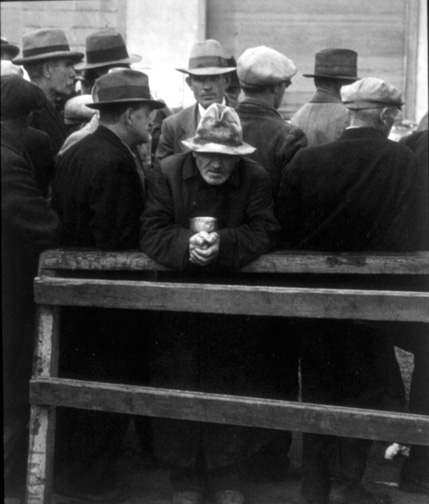
In spite of her poor background, she was admitted to Columbia University, and became a photographer. In 1920, she married the noted western painter Maynard Dixon, with whom she had 2 sons. Her photography studio in San Francisco supported her family for the next 15 years. But at the onset of the Great Depression, she turned her lens from the studio to the street, including this one, in San Francisco in 1933, titled White Angel Breadline. (The White Angel wasn't the name of the soup kitchen, it was the nickname of the woman who ran it.)
She was hired to take pictures for the Farm Security Administration, one of President Franklin D. Roosevelt's New Deal programs. In 1935, she divorced Dixon, and a few weeks later, married Paul Schuster Taylor, a professor of economics at the University of California.

For the next 5 years, they traveled through the California coast and the Midwest, documenting rural poverty, in particular the exploitation of sharecroppers and migrant laborers. Taylor interviewed subjects and gathered economic data, while Lange produced photographs and accompanying data.
Her work was distributed to newspapers across the country, and the poignant images became icons of the era. None more so than Migrant Mother.

Florence Leona Christie was born on September 1, 1903, somewhere in Oklahoma, while it was still a Territory. Both her parents were of Cherokee descent. As with Lange, her father left the family. At 17, she married Cleo Owens, a Missouri farmer. Like many farmers in the South and Midwest, as depicted on John Steinbeck's novel The Grapes of Wrath and the film based on it, they moved to the Sacramento Valley in California, where they became migrant farmers. In 1931, Cleo died of tuberculosis. At the time, Florence was pregnant with their 6th child.

In 1933, she had a 7th child (the father is not publicly known), returned to Oklahoma for a time, and then was joined by her parents as they migrated to Shafter, California, near Bakersfield. There, she met Jim Hill, with whom she eventually had an 8th, a 9th and a 10th child. She said: "I worked in hospitals. I tended bar. I cooked. I worked in the fields. I done a little bit of everything to make a living for my kids."

On March 6, 1936 -- the 100th Anniversary of the Battle of the Alamo, not that Florence and her kids cared enough to "Remember the Alamo" -- they were on U.S. Route 101, heading for Watsonville, "where they had hoped to find work in the lettuce fields of the Pajaro Valley." The car's timing chain snapped, and they coasted to a stop just inside a pea-pickers' camp in Nipomo. They were shocked to find as many as 3,500 people camping there. The crops had been destroyed by freezing rain, leaving them without work or pay.

While Jim Hill, her partner, and 2 of her sons went into town to get parts to repair the car, she and some of the children set up a temporary camp. As she waited, Dorothea Lange drove up, and started taking photos of Florence and her family, 7 pictures in 10 minutes. Two of the photos, which were not published, showed Florence breast-feeding a child. Her note on the best-known picture read, getting the month wrong: "Destitute peapickers in California; a 32 year old mother of seven children. February 1936."

Dorothea said, "I did not ask her name or her history. She told me her age, that she was 32. She said that they had been living on frozen vegetables from the surrounding fields and birds that the children killed. She had just sold the tires from her car to buy food."

Troy Owens, one of Thompson's sons, disputed this: "There's no way we sold our tires, because we didn't have any to sell. The only ones we had were on the Hudson, and we drove off in them. I don't believe Dorothea Lange was lying. I just think she had one story mixed up with another. Or she was borrowing to fill in what she didn't have."

Four days later, The San Francisco News published the picture, labeling it Migrant Mother. Dorothea sent the photos there before even sending them to the Resettlement Administration. Within days, the pea-picker camp received 20,000 pounds of food from the federal government. Just their luck, Florence and her family had moved on by the time the food arrived.

The family settled in Modesto, California in 1945. After World War II, Florence met and married hospital administrator George Thompson. This brought her far greater financial security than she had previously enjoyed.

As Lange was funded by the government when she took the picture, the image was public domain, and she was not entitled to royalties. However, the picture did help make her a celebrity, and earned her "respect from her colleagues." She continued to work for the federal government through World War II, then taught photography in the San Francisco Bay Area. She died of cancer on October 11, 1965, at age 70.

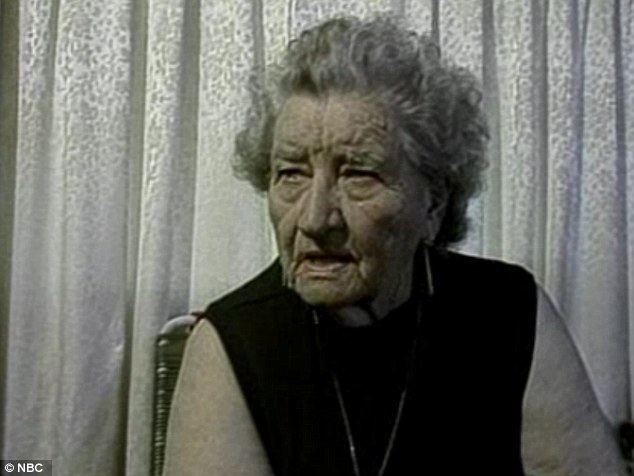
Roy Stryker, Dorothea's boss at the Farm Security Administration in 1936, called Migrant Mother the "ultimate" photo of the Depression Era. But the Mother's identity was lost until 1978, when Emmett Corrigan of the Modesto Bee tracked her down. He quoted her as saying, "I wish she hadn't taken my picture. I can't get a penny out of it. She didn't ask my name. She said she wouldn't sell the pictures. She said she'd send me a copy. She never did."
Florence Owens Thompson, 1978

Florence Owens Thompson, as she was known by then, died on September 16, 1983, of heart trouble, in Scotts Valley, California, across the State from San Francisco, but it might as well have been on the other side of the world. She was 80.

Tuesday, September 30, 2025

September 30, 1935: Hoover Dam Opens

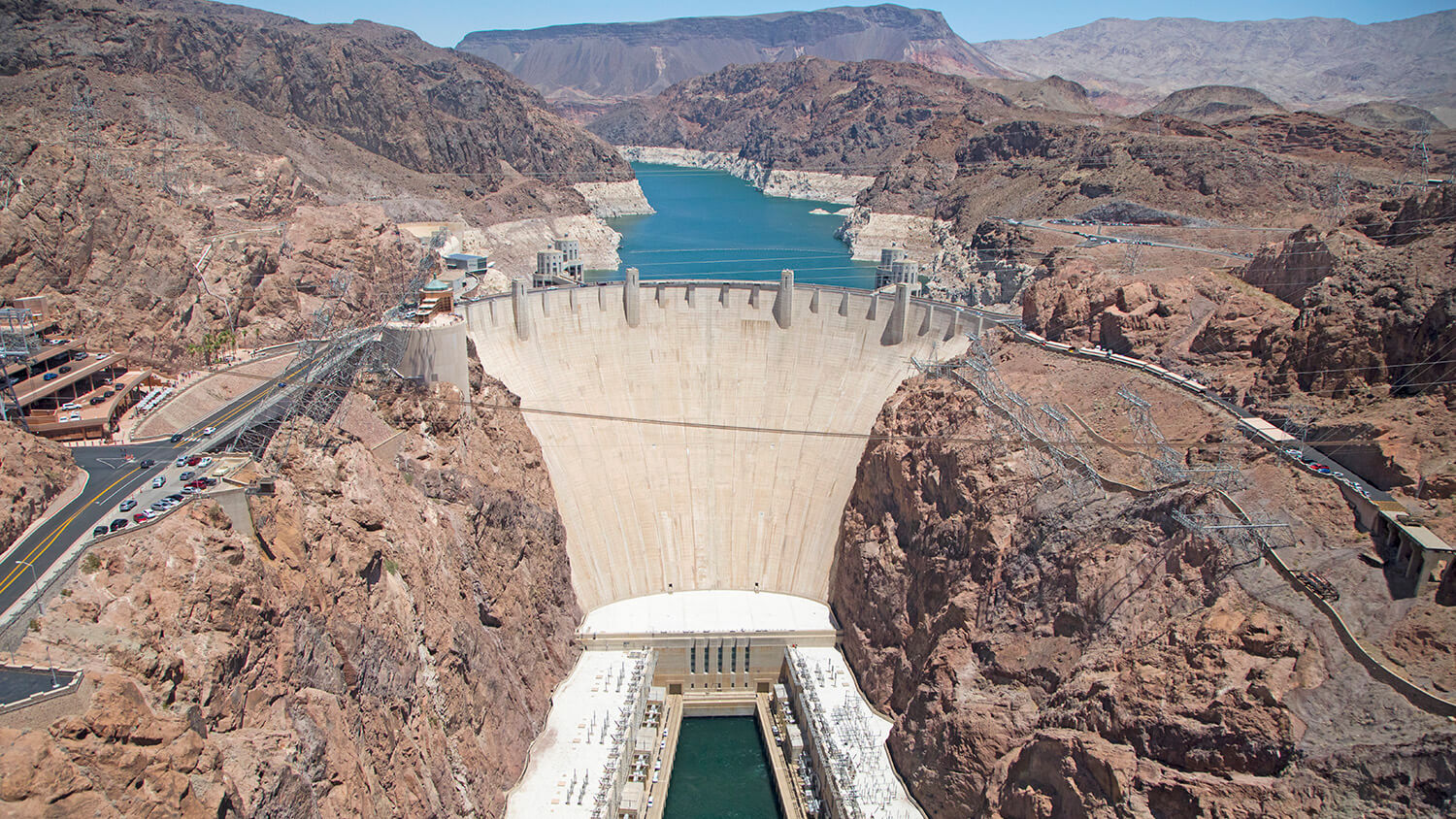
September 30, 1935, 90 years ago: Hoover Dam is dedicated, on the Colorado River between Boulder City, Nevada and Temple Bar Marina, Arizona, 33 miles southeast of Las Vegas. It provides electricity for Southern California. Without it, the rise of Los Angeles and San Diego would have been a lot harder.

It is a concrete gravity-arch dam, rising 726 feet above ground level, with a capacity of 3.25 million cubic yards. By damming up the river, it created Lake Mead, resulting also in Lake Mead National Recreation Area. There were 112 deaths among the construction workers, and a plaque memorializes them, saying, "They died to make the desert bloom."

President Herbert Hoover signed Congress' appropriation for it into law, and Secretary of the Interior Ray Wilbur, in charge of its construction, named it Hoover Dam. But after the 1932 election, President Franklin D. Roosevelt wanted to wipe Hoover and the depths of the Great Depression from the national memory, because, as one writer said, "The Great Engineer had quickly drained, ditched and dammed the country." FDR appointed a new Secretary, Harold Ickes, and, in 1933, he renamed it after Boulder City: Boulder Dam.

In his dedication speech, Ickes used the name "Boulder Dam" 5 times in 30 seconds. Also in the speech, he said that if it should be named after any one person, it should be Senator Hiram Johnson of California, who sponsored the bill, knowing that his State would benefit the most. And he was a Republican.

In 1947, after the Republicans took control of Congress for the 1st time since 1930, they passed bills through both houses restoring the name Hoover Dam. Unlike FDR, his successor, President Harry Truman, had no problem with the name, and signed it into law.

The top of the Dam was bannered as part of U.S. Route 93, but it was only 2 lanes. In 2010, a new bridge opened over the Colorado River, just downstream from the Dam. It was named the Mike O'Callaghan-Pat Tillman Memorial Bridge. O'Callaghan was Governor of Nevada from 1971 to 1979. Tillman was the Arizona State University and Arizona Cardinals safety who left the NFL to enlist in the U.S. Army after the 9/11 attacks, and was killed in action in Afghanistan.
Hoover Dam and the O'Callaghan-Tillman Bridge 

The new bridge is bannered as Interstate 11 and U.S. Route 93, while the top of the dam has been rebannered as Nevada Route 172.

Hoover Dam is one of those American icons that tends to get destroyed in disaster movies, including Superman: The Movie in 1978, Dante's Peak in 1997, 10.5: Apocalypse in 2006, San Andreas in 2015. In reality, it still stands, and supplies badly-needed water and electricity to the American Southwest. 

Friday, September 5, 2025

September 5 & 22, 1975: The Assassination Attempts On President Gerald Ford

September 5, 1975, 50 years ago: President Gerald Ford faces an assassination attempt on a visit to Sacramento, the capital of California.

Ford, for 25 years a Republican Congressman from Michigan, had been nominated for Vice President by President Richard Nixon, seemingly because he was liked by everybody in Washington and offended hardly anybody. He replaced Spiro Agnew, who resigned the office on October 10, 1973, due to his conviction for income tax evasion. On August 9, 1974, Nixon resigned due to his role in the Watergate scandal, and Ford, who was planning to retire after the 1976 election if the Republicans didn't take Congress in 1974, which would have made him Speaker of the House, became the 38th President of the United States.

Ford started with a lot of goodwill, but, a month into his Presidency, he pardoned Nixon. This infuriated many people, and seemed to make him a lame duck before he even announced that he was running for a term of his own in 1976. A recession was underway, but people blamed him for it instead of Nixon (or the Democratic Party). Ford had nothing to do with causing the recession, but his efforts to fix it were, thus far, falling short.

He was visiting the city to attend the annual Sacramento Host Breakfast, a gathering of wealthy California business leaders at the Sacramento Convention Center. The new Governor, Jerry Brown -- Edmund G. Brown Jr., son of former Governor Edmund G. "Pat" Brown -- refused to attend, because he wanted to show them, after 8 years of the archconservative Ronald Reagan, the new Governor wasn't going to be their friend.

To spite Brown, a Democrat, who was already talking about running for President in 1976 -- or, perhaps, to counter-spite him -- they invited President Ford, a Republican, as was Reagan. Ford, who had become President 13 months earlier upon the resignation of Richard Nixon, knew that winning a term of his own would be difficult, and that California would be crucial. (This included in the Republican Primaries, in which Reagan was expected to run.) So he accepted.

In August 1975, The New York Times printed an article detailing Ford's visit to California in September. It included the fact that, as a Congressman from Michigan, he had voted against the Clean Air Act of 1970.

This angered Lynette Alice Fromme. Born on October 22, 1948 in the Los Angeles suburb of Santa Monica, California, As a child, she was a member of the Westchester Lariats, a Los Angeles-based dance group that appeared on The Lawrence Welk Show -- and had even been invited to perform at the White House, when Dwight D. Eisenhower was President. As far as I know, this is the only time that someone who would go on to attempt to assassinate a President would visit the White House before that President took office.

In 1967, she became a follower of cult leader Charles Manson. Another of his followers, George Spahn, noticed that she made a sound like a squeak when he touched her, so he gave her the nickname "Squeaky." She was not charged in connection with the Tate-Labianca Murders, unlike Manson and some of his other followers.

In 1975, she was 26 years old, still committed to the imprisoned Manson, and paranoid about the environment. When she saw the article about Ford, she saw a chance to strike a blow for both the environment and Manson.
Ford was crossing L Street from the Senator Hotel to the State Capitol, shaking hands, at 10:02 AM. Fromme got within 2 feet of him. In his memoir, Ford wrote, "As I stopped, I saw a hand come through the crowd in the first row, and that was the first active gesture that I saw, but in the hand there was a gun."

Fromme didn't know that she needed to pull back the gun slide to insert a cartridge into the pistol's chamber. She pulled the trigger, and nothing happened. Secret Service Agent Larry Buendorf grabbed the gun, and forced Fromme to the ground. Other Agents pulled Ford away, and dragged him to the Capitol's entrance.

Ford was unhurt, and, when the Agents determined that the threat was over, he resumed his schedule, including meeting with Governor Brown. He returned to Washington that night.

*

September 22, 1975: Gerald Ford becomes the 1st President to face 2 close assassination attempts. And they happen just 18 days, and 86 miles, apart.

It had been 3 years since Governor George Wallace had been shot and paralyzed while running for President, 5 years since Pope Paul VI had faced an assassin with a knife, 7 years since Dr. Martin Luther King and Senator Robert F. Kennedy were shot and killed, 10 years since Malcolm X was shot and killed, and 12 years since President John F. Kennedy and NAACP executive Medgar Evers were shot and killed. Still, Ford said he would not stop meeting with the people.

He made another trip to California on September 22. He was in San Francisco, for a meeting of the World Affairs Council. He returned to the city's famed St. Francis Hotel, off Union Square. At 3:30 PM, he walked out of the hotel's Post Street entrance, and stopped short of his limousine to wave the crowd, when a shot rang out.

The shot missed Ford's head by about 5 inches. On the film, he can be heard yelling, "Hey!" A bystander named Oliver Sipple grabbed the shooter's arm as she pulled the trigger a 2nd time. Her shot hit John Ludwig, a taxi driver standing outside the hotel. He also survived.

San Francisco Police Captain Timothy Hettrich grabbed the shooter, and pulled her gun away. The Secret Service shoved Ford into his limo. Donald Rumsfeld, then his White House Chief of Staff, covered him, and the limo was sped back to San Francisco International Airport, where Air Force One was waiting. After waiting for First Lady Betty Ford to arrive, the plane returned to Washington.

The shooter was Sara Jane Moore. Born on February 15, 1930, in Charleston, West Virginia as Sara Jane Kahn, the former accountant had been married and divorced 5 times, with 4 children. She had no connection to either Fromme or Manson, but had become fascinated by another crime in San Francisco, the kidnapping of Patty Hearst.
The day before the shooting, the San Francisco Police Department arrested her on an illegal handgun charge. They decided to call the Secret Service, and they evaluated her, they confiscated her .44 caliber revolver and 113 rounds of ammunition... and they told the SFPD to let her go, as they believed she posed no danger to the President's visit the next day.

They were wrong. The next day, September 22, she bought a new gun, a .38 caliber revolver, a cheap one, a Charter Arms Bulldog -- a smaller version of the one David Berkowitz began using in New York the next year, becoming known as the .44-Caliber Killer and the Son of Sam. The sight on Moore's gun was 6 inches off. That's why, despite being only 40 feet away, she missed Ford. She pleaded guilty.

Before her sentencing, she said, "Am I sorry I tried? Yes and no. Yes, because it accomplished little except to throw away the rest of my life. And, no, I'm not sorry I tried, because, at the time, it seemed a correct expression of my anger." She was sentenced to life in prison.

Ford lost the California Primary to Reagan in 1976, and almost lost the nomination to him. He won it, and did win California in the general election, but narrowly lost both the popular vote and the Electoral Vote to former Governor Jimmy Carter of Georgia. In 1981, he opened his Presidential Museum in his hometown of Grand Rapids, Michigan. The U.S. Attorney's office in Sacramento donated Fromme's gun to the Museum. Ford lived until 2006.

Fromme was convicted of attempted murder, and sentenced to life in prison. On Christmas Eve 1987, she escaped, but was captured 2 days later. She was released in 2009, after serving 34 years.
In 1979, as Fromme had, Moore escaped from prison but was soon recaptured. In 2005, she was released from prison, after serving 32 years. At that time, she said, "I am very glad I did not succeed. I know now that I was wrong to try."
 
As of September 5, 2022, Fromme is 72 years old, and lives with a fellow ex-con in Marcy, New York, outside Syracuse. Unlike most of Manson's followers, she has never renounced him. Moore is 92 years old, and lives in Northern California.

Oliver Sipple was a decorated Marine in the Vietnam War, but it was apparently saving Ford's life that made him a well-known hero. The Secret Service officially commended him, and Ford sent him a thank-you letter.
But the popular San Francisco Chronicle columnist Herb Caen was tipped off to the fact that Sipple was gay, and had worked for Harvey Milk, then running for the City's version of a City Council, the Board of Supervisors. (Milk would lose that election, but won in 1977, before being assassinated in 1978.)

Caen asked Milk if he should reveal this information, and Milk said yes, because the wider public needed to see that gay people could be heroes. Caen did not ask Sipple, whose life went into a tailspin. His parents, in Detroit, refused to see him for years. He sued for invasion of privacy, and lost. He started drinking heavily, and died in 1989, only 47 years old.

As for the other injured man, John Ludwig, he'd already been through a lot, having fled Nazi Germany, only to end up in Shanghai, China when it was occupied by Imperial Japan, and he was shot by a Japanese soldier. He survived, working with the Chinese resistance at the age of 12, and was reunited with his family in San Francisco in 1948. He became a taxi driver. retired to Sacramento (the site of the 1st assassination attempt, something of an irony), published a memoir in 2004, and died in 2015, age 81.

About Captain Timothy Hettrich, who grabbed Moore's gun, the only information I can find is that he was still alive as of 2006.

UPDATE: Sara Jane Moore died on September 24, 2025, 2 days after the 50th Anniversary of her attempt, at the age of 95.

Thursday, July 17, 2025

July 17, 1955: Disneyland Opens

July 17, 1955, 70 years ago: Disneyland opens in Anaheim, California, 26 miles southeast of Los Angeles.

Walt Disney, head of the film studio that bore his name, based it on Henry Ford's Museum and Greenfield Village, in the Detroit suburbs, having enjoyed its Main Street concept and steamboat rides. He had also been inspired by such places as Colonial Williamsburg in Virginia and the 1939-40 New York World's Fair.

The opening day was a disaster. It was open only to invited guests and the media, but about half of the 28,000 people there had bought counterfeit tickets or climbed over the fence. Traffic to get in was as bad as for a major sporting event.

And the temperature was 101 degrees. (Most of Southern California had been desert before L.A. was built on it and then expanded out, after all.) The local plumbers' union was on strike. As a result, the water pressure was such that Disney was given a choice of having working drinking fountains or working public toilets. He chose the toilets, which was unquestionably the right move. But since Pepsi-Cola was one of the sponsors, having non-working drinking fountains made it look like a cynical move to sell more Pepsi.

And the vendors didn't have enough food. The heat also meant that some of the asphalt that had just been poured didn't have time to fully cool, and some women's high heels sank into it, tripping them up and injuring some.

Usually being media-savvy, Disney wanted the events televised nationwide, and got ABC to broadcast it, with some of his conservative Hollywood friends like Art Linkletter, Bob Cummings and... Ronald Reagan. But many guests tripped over the large TV camera cables of the era. Cummings was caught kissing a dancer. Linkletter tried an "over to you" to Cummings over and over again, but a technical issue made it impossible, and he ended up looking very foolish on live TV. (It was Linkletter's birthday, too: He was 43.)

For the rest of his life, Disney referred to the day as "Black Sunday," and accepted the next day, July 18, as Disneyland's "official birthday." After his death, though, the park began to restore the July 17 birthday.

The original park had 5 main sections, which have since been added onto. Main Street, U.S.A. was patterned after a typical Midwest town of the early 20th Century -- specifically, the one Disney himself grew up in, during the 1900s and 1910s: Marceline, in north-central Missouri, which now has a museum in Disney's honor. 

Adventureland was "designed to recreate the feel of an exotic tropical place in a far-off region of the world," as Disney put it, "far from civilization, in the remote jungles of Asia and Africa." Being in the Western U.S., and this being the early days of television, when Western movies were big, there pretty much had to be a Wild West-themed place, and it was named Frontierland.

Fantasyland was inspired by such Disney cartoon classics as their versions of the stories of Snow White and the Seven Dwarfs, Cinderella, Alice in Wonderland and Peter Pan. Its centerpiece, and the park's symbol, is the 77-foot-high Sleeping Beauty Castle. And Tomorrowland was especially inspired by New York 1939, as an idea of what the future would look like -- keeping in mind that, in 1955, space travel was still just a concept.

All of which allowed Disneyland to rebound from the lousy Day One to become what it billed itself as: "The Happiest Place On Earth," one that denied the existence of the troubles of post-World War II America: The Cold War, smog, suburban banality... and racial strife. It would be a while before Disneyland's employee roster was desegregated, and even longer before there was enough of a black middle class in America to provide enough of a black customer base.

On October 1, 1955, 76 days after Disneyland opened, The Honeymooners premiered on CBS. Formerly a sketch on The Jackie Gleason Show, Gleason spun the show off as a half-hour sitcom. The premiere episode featured Gleason's Ralph Kramden facing the demand of his wife Alice, played by Audrey Meadows, for something they did not yet have, but most families now seemed to: A television set. But Ralph hadn't even gotten a telephone -- or, something that always bugged my mother, a kid at the time, curtains for the kitchen window, the only window visible on the stage set.

Ralph told Alice he worked hard for his money -- no question about that, he was a bus driver in New York -- and that she should be lucky to live the way she does, in their small apartment in Brooklyn, without modern amenities. Alice went along with it, in the most sarcastic of fashions: "It's a regular Disneyland!"

She pointed out the window, at the tenements, and the laundry lines between them: "That's my Fantasyland!" She turned on the faucet of the kitchen sink. What came out of it? Water? Nope, just a weird knocking sound. "I never know what's going to happen with it," she said. "That's my Adventureland. That stove and that icebox: That's Frontierland. The only thing missing, Ralph, is The World of Tomorrow. I have nothing in my Disneyland from The World of Tomorrow!"

Ralph: "You want The World of Tomorrow? I'll show you The World of Tomorrow: You're going to the Moon!"

In 1966, two and a half miles to the east, across Interstate 5, what is now Angel Stadium of Anaheim opened, as the home of the baseball team then known as the California Angels, but now again called, as they originally were, the Los Angeles Angels. Jokes about the Angels playing "at Disneyland" have abounded ever since. But, between them, the Angels and Mickey Mouse have made the City of Anaheim grow by leaps and bounds, to the point where it's no longer just a giant suburb of L.A., but a real city in its own right, of 350,000 people.

*

October 1, 1971: Walt Disney World opens in Bay Lake, Florida, 15 miles southwest of Orlando.

Okay, why a 2nd park? Was "Uncle Walt" simply greedy? No: By 1959, he was seeing figures showing that, at the time, 75 percent of America's population lived east of the Mississippi River, but only 5 percent of Disneyland's visitors came from there. And he didn't like some of the businesses that were sprouting up near Disneyland. So he wanted a place convenient to the East, but with more land, so he could control what went up around it. If there's one thing that a powerful person desires more than money, it's control.

He had an idea he called "EPCOT": Experimental Prototype Community Of Tomorrow. In other words, while there would be a Main Street, U.S.A., a Fantasyland and a Frontierland as with Anaheim, the place would be more about tomorrow than yesterday.

The project was barely in the planning stage when Disney died from cancer on December 15, 1966. His brother Roy Disney saw it through, but only the original part of the park, known as the Magic Kingdom, opened in 1971.

"The Most Magical Place On Earth" was built over a series of tunnels that allowed employees or guests to move through the park out of sight. As with its California counterpart, the centerpiece is a castle, this one named Cinderella Castle, and reaching a higher peak, 189 feet.

All the water in the park is kept moving. Not having standing water nearly -- but not completely, as nothing is 100 percent effective -- eliminates one of the biggest problems with being in Florida: Disney World has hardly any mosquitoes.

Disney's Contemporary Resort also opened on the Magic Kingdom's opening day. It is a hotel, and a terminus for the park's monorail system.

November 17, 1973: On vacation, trying to get away from the troubles of the Watergate scandal, and staying at the Contemporary Resort, President Richard Nixon decides to hold a press conference. He gets mad at the questions about his integrity, and finally says, "I welcome this sort of examination, because people have gotta know whether or not their President is a crook! Well, I'm not a crook! I've earned everything I've got!"

The line becomes remembered as "I am not a crook." And, technically speaking, he wasn't a "crook." He was an arch-criminal. His recently-resigned Vice President, Spiro Agnew, forced out over charges of bribery and tax evasion? He met the definition of a crook.

October 1, 1982: Epcot, as Walt imagined it, finally opened, crowned by a "Spaceship Earth." It included several sections devoted to various countries around the world, inspired by the Busch Gardens theme parks in nearby Tampa and in Williamsburg, Virginia.

March 8, 1983: Another Republican President took time off to go to Orlando -- although the speech in question was not given at the Disney World complex. Addressing the National Association of Evangelicals, 28 years after the former actor had helped open Disneyland, Ronald Reagan gave a speech appealing to the anti-atheist, and therefore anti-Communist, views of the attendees, attacking the Soviet Union -- not with bombs, but with words:

I urge you to beware the temptation of pride, the temptation of blithely declaring yourselves above it all and label both sides equally at fault, to ignore the facts of history and the aggressive impulses of an evil empire, to simply call the arms race a giant misunderstanding and thereby remove yourself from the struggle between right and wrong, and good and evil.

Uncle Walt would have approved.

November 4, 1986: I visited Disney World with my family. My parents had wanted to go for a long time, and could now afford it. I wasn't crazy about the idea, but my sister was then 7 years old, so it was more for her than for anything else.

The place quickly grew on me, and, despite the distaste I eventually developed for Disney the man, it was a great experience. At one point, I lost my wallet, and it was found and returned within 2 hours. At the time, I was relieved. As time went by, I become very impressed with the efficiency of the place.

My parents noticed just how much of it had been bought by Disney from the 1964-65 New York World's Fair. My grandmother was with us, and kept saying, "That wasn't the real World's Fair," remembering the 1939-40 edition, But she enjoyed it, too. (We also visited nearby Sea World, the John F. Kennedy Space Center at Cape Canaveral -- my father and I, both science fiction fans, insisted -- and, at the other end of Florida, a cousin of my father's outside Tampa. While some members of my family have been to California, none of us has ever visited Disneyland.)

January 26, 1987: The day after the New York Giants won Super Bowl XXI, a commercial began airing. To the tune of "When You Wish Upon a Star," from the 1940 Disney cartoon Pinocchio, highlights of the game were shown, mostly of the game's Most Valuable Player, Giant quarterback Phil Simms.

Halfway through, an unseen announcer said, "Phil Simms: You've just won the Super Bowl! Now, what are you going to do?" And Simms looked into the camera and said, "I'm going to Disney World!" Sure enough, Simms and his teammates attended a parade in their honor at Disney World, and a tradition was born: Not just for Super Bowl MVPs, but for other sports stars. (Mark McGwire did it after breaking * Roger Maris' home run record in 1998.)

What I didn't know for several years was that 2 versions had been filmed, one for the East, and one for the West, in which Simms said, "I'm going to Disneyland!" Since the game was played at the Rose Bowl, on the other side of Los Angeles, they went to Disneyland first.

May 1, 1989: Disney's Hollywood Studios opens on Disney World land, to compete with the nearby Universal Studios theme park.

June 1, 1989: Disney's Typhoon Lagoon, a water park, opens.

November 4, 1989: Orlando becomes a major league sports city, with the debut of an NBA team. It is named in honor of the Magic Kingdom: The Orlando Magic. The team has made the Playoffs 16 times in its 1st 32 seasons, including 2 trips to the NBA Finals. But it has never explained what "one Magic" is called. Then again, neither have their Florida arch-rivals, the Miami Heat.

April 1, 1995: Disney's Blizzard Beach, a water park with a contradictory name, opens.

April 22, 1998: Disney's Animal Kingdom opens, based on the safari at Six Flags Great Adventure in Jackson, New Jersey and the nearby Busch Gardens park in Tampa.

Friday, June 6, 2025

Each State's Greatest Baseball Player

Monte Irvin of Orange, New Jersey

Notes: This is based not necessarily on where the player was born, but where he was trained to play baseball. And, as you will see, personal feelings will be set aside, except where steroids are concerned: All players known to have used steroids are ineligible.

1. Alabama: Willie Mays of Fairfield.
2. Alaska: Chad Bentz of Juneau.
3. Arizona: Jim Palmer of Scottsdale.
4. Arkansas: Brooks Robinson of Little Rock.
5. California: Joe DiMaggio of San Francisco.
6. Colorado: Roy Halladay of Arvada.
7. Connecticut: Jeff Bagwell of Killingworth.
8. Delaware: Chris Short of Milford.
9. District of Columbia: Maury Wills of Washington.
10. Florida: Steve Carlton of North Miami.
11. Georgia: Ty Cobb of Royston.
12. Hawaii: Shane Victorino of Wailuku.
13. Idaho: Harmon Killebrew of Payette.
14: Illinois: Robin Roberts of Springfield.
15. Indiana: Sam Rice of Morocco.
16. Iowa: Bob Feller of Van Meter.
17. Kansas: Walter Johnson of Humboldt.
18. Kentucky: Jim Bunning of Southgate.
19. Louisiana: Mel Ott of Gretna.
20. Maine: George Gore of Hartland.
21. Maryland: Babe Ruth of Baltimore.
22. Massachusetts: Mickey Cochrane of Bridgewater.
23. Michigan: Derek Jeter of Kalamazoo.
24. Minnesota: Dave Winfield of St. Paul.
25. Mississippi: Frank White of Greenville.
26. Missouri: Albert Pujols of Independence.
27. Montana: Dave McNally of Billings.
28. Nebraska: Grover Cleveland Alexander of St. Paul.
29. Nevada: Greg Maddux of Las Vegas.
30. New Hampshire: Carlton Fisk of Charlestown.
31. New Jersey: Monte Irvin of Orange.
32. New Mexico: Alex Bregman of Albuquerque.
33. New York: Lou Gehrig of Manhattan.
34. North Carolina: Gaylord Perry of Williamston.
35. North Dakota: Roger Maris of Fargo.
36. Ohio: Cy Young of Newcomerstown.
37. Oklahoma: Mickey Mantle of Commerce.
38. Oregon: Mickey Lolich of Portland.
39. Pennsylvania: Honus Wagner of Carnegie.
40. Rhode Island: Nap Lajoie of Woonsocket.
41. South Carolina: Joe Jackson of Greenville.
42. South Dakota: Dave Collins of Rapid City.
43. Tennessee: Todd Helton of Knoxville.
44. Texas: Tris Speaker of Hubbard.
45. Utah: Bruce Hurst of St. George.
46. Vermont: Ray Fisher of Middlebury.
47. Virginia: Justin Verlander of Goochland.
48. Washington: Ryne Sandberg of Spokane.
49. West Virginia: Jesse Burkett of Wheeling.
50. Wisconsin: Al Simmons of Milwaukee.
51. Wyoming: Tom Browning of Casper.

Friday, May 2, 2025

May 2, 1950: The Smathers Smears -- Real and Otherwise

 
George Smathers

May 2, 1950, 75 years ago: The Democratic Primary is held in Florida. With the Republican Party then having very little standing in the South, winning this Primary is, as the saying goes, "tantamount to election."

Born and raised in Alabama in 1900, Claude Pepper served in World War I and graduated from the University of Alabama and Harvard Law School. He established a legal practice in Florida, and in 1936 won a special election for the U.S. Senate in that State. He was re-elected in 1938 and 1944, and was up for election again in 1950.

Born in 1913 in Atlantic City, New Jersey, George Smathers was the son of a Floridian, who moved the family back to Miami. He graduated from the University of Florida and served in World War II. In 1946, he asked Pepper for help getting elected to Congress. He got it, and won.

How did Smathers thank Pepper? By opposing him in the 1950 Democratic Primary, and running an incredibly dirty campaign, based on the current anti-Communist "Red Scare." He opened his campaign on January 12, with a speech at Kemp's Coliseum in Orlando, accusing Pepper of being "the leader of the radicals and extremists," an advocate of treason, and a person against the constitutional rights of Americans.

Pepper had traveled to the Soviet Union in 1945 and, after meeting Soviet leader Joseph Stalin, declared he was "a man Americans could trust." Additionally, Pepper supported universal health care, sometimes referred to as "socialized medicine." Pepper's opponents called him "Red Pepper," and widely circulated a 49-page booklet titled The Red Record of Senator Claude Pepper.

Smathers accused the "Northern labor bosses" of paying black people to register and vote for Pepper. That accusation turned out to be true: Unlike Smathers, a traditional Southern "Dixiecrat" who favored segregation, Pepper did not. But neither did he openly oppose integration and interracial marriage, and so the Florida media claimed he supported them. Orlando Sentinel publisher Martin Andersen published a doctored photograph of Pepper shaking hands with a black woman in Sanford.

In its April 17, 1950 issue, Time magazine, then run by archconservative Henry Luce, published a story about a speech Smathers had given many times in rural parts of Florida. It became known as "The Redneck Speech":

Are you aware that Claude Pepper is known all over Washington as a shameless extrovert? Not only that, but this man is reliably reported to practice nepotism with his sister-in-law, he has a brother who is a known homo sapiens, and he has a sister who was once a thespian in wicked New York. Worst of all, it is an established fact that Mr. Pepper, before his marriage, habitually practiced celibacy.

Here's a question: Presuming that the charges against his brother and his sister were true -- and they were -- what did that have to do with his qualifications? Basically, the only thing this paragraph said that reflected badly on Pepper was the nepotism, which was also true. The problem was, people heard the words, and, not fully understanding them, compared them to words they did know, and were horrified, to the point where they couldn't possibly vote for Pepper.

The quote was a fake: Smathers never said it. He was happy to accept the benefits of it, but he never said it. No newspaper in Florida ever mentioned the speech. Smathers offered $10,000 -- about $135,000 in 2025 money -- to anyone who could prove he said it.

When the Primary was held on May 2, Smathers got 387,315 votes, to Pepper's 319,754. Percentage-wise, it was Smathers 54.8, Pepper 45.2. It was a landslide.

Seeing this, a Republican activist in California spoke to Representative Richard Nixon, who was running for the State's Senate seat against Representative Helen Gahagan Douglas, and told him that a publication like The Red Record would be useful against her.

The California Republican Party printed up 500,000 copies of "The Pink Sheet," listing reasons why Douglas was a Communist sympathizer, or a "pinko," rather than an outright Commie, or a "Red." Most of the reasons were ridiculous, including her support for blacks and Jews. Nixon called her "The Pink Lady," and said, in language that was a bit over-the-top for 1950, that she was "pink right down to her underwear." He won, with 59 percent of the vote -- but she gave him the nickname that would stick to him for the rest of his life: "Tricky Dick."

Smathers won the general election against the Republican nominee, Miami-area attorney John P. Booth, with 76 percent of the vote. He was re-elected in 1956 and 1962, all the while playing the "Dixiecrat," opposing civil rights legislation. Smathers did, however, vote for "socialized medicine" in 1965, when it was called Medicare and Medicaid.

Smathers was a close friend of John F. Kennedy, and served as a groomsman at his wedding to Jacqueline Bouvier in 1953, and that's the nicest thing I can say about this bum. He was also a friend of Nixon, sold his Key Biscayne house to him (where Nixon said he was when he found out about the Watergate break-in), and introduced Nixon to his infamous Florida friend Bebe Rebozo.

Like a lot of corrupt conservatives, George Smathers became a lobbyist after leaving Congress, because that's where the real money is. He died in 2007, at the age of 93, having never had to pay the $10,000 bounty on proof he gave "The Redneck Speech."

His son, Bruce Smathers, was elected Florida's Secretary of State in 1974 and 1976. He ran for Governor in 1978, losing the Democratic Primary to Bob Graham. In 1986, Graham won the Senate seat that had been held by Claude Pepper and George Smathers. (And, in between, by Republican Edward Gurney from 1969 to 1975, by Democrat Richard Stone from then until 1981, and the by Republican Paula Hawkins.)

Incredibly, Pepper did manage to come back, getting elected to the U.S. House of Representatives in 1962, supporting civil rights legislation, and, recognizing that his Miami-area district had a lot of retirees, became Congress' foremost champion of Social Security and Medicare. From 1983 to 1989, he was the Chairman of the Rules Committee, making him, arguably, the 2nd-most powerful member of the House, behind the Speaker.
By the time of this 1983 cover,
Henry Luce had been dead for 16 years,
and Time had gotten considerably more liberal.

Or, to put it another way: Had Pepper won in 1950, he might have lost in the Eisenhower landslide of 1956, and not recovered. Or, if he had won again then, the shift of the South might have doomed him in 1962, or 1968. He would never have become Senate Majority Leader, and if he had risen to the Chairmanship of a powerful Senate committee, he would have lost that in an election. And even if he got elected to the House later on, he wouldn't have become the Congressman he became.

Today, Claude Pepper is fondly remembered as a great public servant, while George Smathers, when he is remembered at all, is remembered for evil stands that he took, and an evil speech that he never gave. In other words, in the long run, not only was Pepper better off for losing that 1950 election, but he was better off than the man who won it.

Pepper died in office in 1989, at the age of 88, having outlived a lot of those retirees. But in the special election that followed, his seat was won by a Republican, Cuban exile Ileana Ros-Lehtinen. It was a harbinger of Florida's lurch to the political right. Today, a white politician in Florida is likely to be a Republican, and so far to the right as to make Smathers look like Pepper by comparison.

Florida has grown so much that Pepper's District was the 3rd when he first won the seat, but is now listed as the 27th. Today, it is represented by a Republican woman of Cuban descent, María Elvira Salazar, who had long been a news anchorwoman for a local Spanish-language TV station.

Monday, December 2, 2024

December 2, 1964: Mario Savio's "Bodies Upon the Gears" Speech

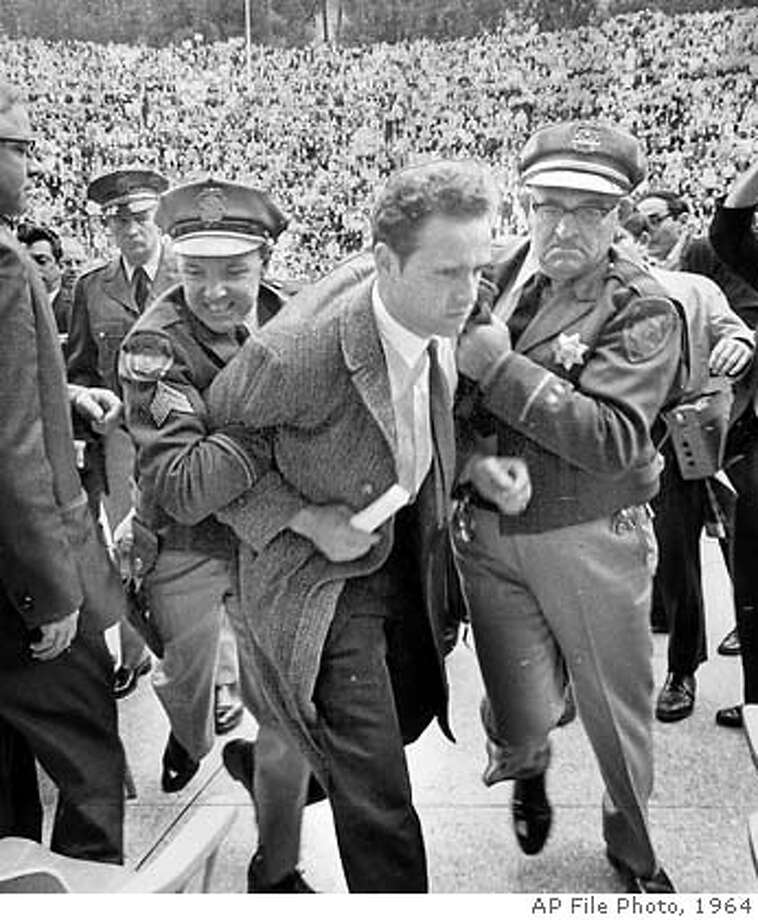
Mario Savio, arrested shortly after his speech

December 2, 1964, 60 years ago: The "Free Speech Movement" at the main campus of the University of California, in Berkeley, across the Bay from San Francisco, is galvanized by a speech by graduate student Mario Savio.

This Movement was the first mass act of civil disobedience on an American college campus in the 1960s. Students insisted that the university administration lift the ban of on-campus political activities and acknowledge the students' right to free speech and academic freedom. The Free Speech Movement was influenced by the New Left, and was also related to the Civil Rights Movement and the opposition to the Vietnam War.

Savio, from Queens in New York City, was approaching his 22nd birthday, and had already graduated from Queens College, and worked in the Civil Rights Movement in California and in the Mississippi Freedom Summer, and for anti-poverty program in Mexico.

When he returned to Berkeley after his time in Mississippi, he intended to raise money for the Student Nonviolent Coordinating Committee (SNCC), but found that the university had banned all political activity and fundraising. He told an interviewer that it was a question as to whose side one was on: "Are we on the side of the civil rights movement? Or have we gotten back to the comfort and security of Berkeley, California, and can we forget the sharecroppers whom we worked with just a few weeks back? Well, we couldn't forget."

Savio sounded pretty radical. Even today, he sounds radical. But he sure didn't look radical: Like most of the activist students of the time, his hair wasn't especially long, and tended to wear a jacket, a dress shirt and a tie. He was an activist, but he was no hippie.

Until 1966 or so, when people heard the word "hippie," they thought it meant "jazz musician," like in the 1963 hit by the Philadelphia girl group The Orlons: "Where do all the hippies meet? South Street, South Street." South Street, then as now, was Philly's "Greenwich Village."

The rhetoric between the students and University President Clark Kerr went back and forth. On December 2, Savio took to the steps of Sproul Hall, a new student activity center, where folksinger Joan Baez had recently sung, and, in front of 4,000 people, delivered what became known as the "Operation of the Machine" speech or the "Bodies Upon the Gears" speech:

There's a time when the operation of the machine becomes so odious, makes you so sick at heart, that you can't take part! You can't even passively take part! And you've got to put your bodies upon the gears, and upon the wheels, upon the levers, upon all the apparatus, and you've got to make it stop! And you've got to indicate to the people who run it, to the people who own it, that unless you're free, the machine will be prevented from working at all!

Savio and 800 others were arrested that day. It took until 1967 for the case to be concluded, and he was sentenced to 120 days in jail. At the time, he told reporters that he "would do it again."

But just a few months after his speech, he quit the FSM because "he was disappointed with the growing gap between the leadership of the FSM and the students themselves." As has so often been the case, a revolution was divided even before achieving its goals, and it fell apart.

But Berkeley became not just a center for political activity among leftward (if not necessarily "leftist") college students, but a byword for it. Ronald Reagan won the Governorship of California in 1966 in large part by campaigning against it, promising to reform the University of California System so that the students had less influence. (Some "reform." Unfortunately, he kept his word.) There would be a riot at the student-setup People's Park in Berkeley in 1969.

Appearing on a 1968 episode of Rowan & Martin's Laugh-In, actor Peter Lawford said, "I hear the Governor Reagan is increasingly concerned about earthquakes in California. He's afraid that Berkeley may shift even further to the left."

And in the 1986 film Star Trek IV: The Voyage Home, the Enterprise crew members had to travel back in time to the present day, and Admiral James T. Kirk (played by William Shatner) had to explain why Captain Spock (Leonard Nimoy, wearing a headband so Spock's pointed ears would be hidden and so he wouldn't have to wear the often painful prosthetics) was so weird. His history almost as good as it should have been, Kirk said, "Back in the Sixties, he was a part of the Free Speech Movement at Berkeley. I think he did a little too much LDS." (He meant the drug LSD, not the Church of Jesus Christ of Latter-Day Saints, a.k.a. the Mormons.)

The University's flagship campus is usually called "Cal" for sports purposes, and "Berkeley" for everything else.  Their arch-rivals are Stanford University, across the Bay in Palo Alto, and Stanford has the opposite political reputation, very conservative, in part due to the Hoover Institution, an economic "think tank" named after one of the school's first graduates, the eventual President Herbert Hoover. Naming an economic organization after him was not a good idea.

Savio later became a professor (though not at the college where he protested, unlike a few of the Columbia University protestors later in the decade), married twice, had a son with each wife, and developed heart trouble, which killed him in 1996, only 53 years old.

"You've got to indicate to the people who run it, to the people who own it, that unless you're free, the machine will be prevented from working at all!" Words that "hit differently" with Donald Trump coming back into the White House with full control of Congress and legal immunity granted to him by a 6-3 Republican majority on the Supreme Court. 

Thursday, October 27, 2022

October 27, 1922: Ralph Kiner Is Born

October 27, 1922, 100 years ago: Ralph McPherran Kiner is born in Santa Rita, New Mexico, about 150 miles northwest of El Paso, Texas. He was 4 years old when his father died, and his mother moved him to the Los Angeles suburb of Alhambra, California, and he grew up there.

As his contemporary Duke Snider pointed out, the Southern California weather enabled kids to play baseball all year long, which led to the Pacific Coast League (including the less-weather-friendly Oregon and Washington State) producing a seemingly endless stream of baseball talent, which continues to this day. It's why the College World Series is dominated by the Sun Belt: California teams, Arizona teams, Texas teams, Louisiana State, Mississippi State, Alabama, Auburn, Georgia Tech, Florida teams.

Ralph was signed by the Pittsburgh Pirates, played in the low minors in 1941 and '42, and in 1943 was a member of the first sports team to be named the Toronto Maple Leafs, then the Pirates' top farm team. But World War II was raging, and his country called.

When he came back from serving as a pilot in the U.S. Navy, he was 23 years old, and ready to make the big club. On April 16, 1946, he made his major league debut for the Pirates, against the St. Louis Cardinals at Sportsman's Park. Batting 3rd and playing center field, he had a single and a walk in 5 trips to the plate. The Pirates won, 6-4, a bump in the road for the Cardinals, as they went on to win their 4th Pennant and 3rd World Series in a 5-year stretch. He hit his 1st major league home run 2 days later, on April 18, in the top of the 8th off the Cardinals' Howie Pollet. But the Cards won that game, 6-2, as Stan Musial also homered.

After that, Ralph was mainly a left fielder. He wore Number 43 in his rookie season, the last year in which the Pirates wore red, white & blue uniforms. In 1947, he was given Number 4, and the Pirates wore blue & white. In 1948, they switched to black & gold, the same colors as the football team that had been named for them but was now called the Steelers, and they have worn those colors ever since.

In that 1st season, 1946, he led the National League by hitting 23 home runs, a pretty good total for a man whose home games were in Pittsburgh's Forbes Field. "The Old Lady of Schenley Park," home to the Buccos from 1909 to 1970, had dimensions very close to those of the pre-renovation, 1923-73 version of Yankee Stadium: Close in the right-field corner, but pretty distant everywhere else. Left field was 360 feet away, its furthest point was 462 to left-center, and straightaway center was 442. Terrible conditions for a righthanded hitter, which Ralph was.

But in '46, Ralph was just getting warmed up. In 1947, the Pirates brought in Hank Greenberg, the great slugger of the Detroit Tigers, making him baseball's 1st $100,000 a year player. (That's about $1.33 million in today's money, meaning, compared to today's players, even the highest-paid player in the game's history to that point was underpaid.) To help him out, the Pirates put an inner fence in left field, in front of Forbes' familiar scoreboard, reducing the left-field pole from 360 to 335. The area between the fences was called Greenberg Gardens. After playing in '47, Greenberg retired, and the area was renamed Kiner's Korner. The inner fence was removed after he was traded.

Kiner always credited Greenberg with making him a better hitter, and the results speak for themselves: 23, 51, 40, 54, 47, 42, 37, 35. Those were his seasonal home run totals from 1946 to 1953, making him easily the best slugger in the National League during the Truman Administration.

Those 54 homers in 1949 were the most by a National Leaguer between Hack Wilson's 56 in 1930 and Mark McGwire's 70* in 1998. It's a total that was never reached by Lou Gehrig, Joe DiMaggio, Ted Williams, Stan Musial, Willie Mays, Ernie Banks, Hank Aaron, Frank Robinson, Harmon Killebrew, Reggie Jackson or Mike Schmidt -- and only once by Mickey Mantle.

Indeed, from 1938, when Greenberg hit 58, until 1997, when steroids allowed McGwire and others to rewrite the record book, the only player who hit more than that in a season was Roger Maris, his "61 in '61" breaking Babe Ruth's 1927 record of 60.

As Hall of Fame pitcher Warren Spahn said, "Ralph Kiner could wipe out your lead with one swing."

The Pirates' broadcasters at the time were Bob Prince, a.k.a. "The Gunner," and Albert "Rosey" Rowswell, the man who nicknamed the Pirates "the Buccos." (A "buccaneer" was a kind of privateer, not quite a pirate.) These men were the other kind of "homers," broadcasters favoring the home team, to the extent that they made Yankee mikemen Mel Allen, Phil Rizzuto and John Sterling sound objective by comparison. Rosey, who grew up outside Pittsburgh, claimed not to have missed a Pirates home game since 1909, the year Forbes Field opened and Honus Wagner led them to win the World Series for the first time.

Rosey had a trick: When a Pirate hitter, more often Kiner than anyone else, would hit a ball that looked like it would be a home run, he imagined an old lady whose house faced Forbes Field, and he would yell, "Open the window, Aunt Minnie, here it comes!" Then Prince, or whoever was handy at the moment, would drop a box full of items to make it sound like glass was breaking, and say, "Too late!" (I've also heard that Rosey would smash a light bulb there in the broadcast booth, but that sounds a little too dangerous.)

On Opening Day of the 1948 season, the year after Kiner hit 51 to set a club record (which he would break in '49), entertainer Bing Crosby, a minority owner of the Pirates, was in the booth with Rosey, but he kept talking through a Kiner swing, and Rosey had to interrupt him: "Open the window, Aunt Minnie!... There it goes, clean clear over the scoreboard! Home run for Ralph Kiner, his first of the 1948 season! Let's hope it's the first of 61!"

Rosey died on the eve of the 1955 season, by which point his Aunt Minnie routine could be seen as just an act, because television was beginning to take over, and fans watching at home could see that there was nothing but parkland for a few blocks beyond the left and center field fence, until the Carnegie Museum, which can be seen behind that scoreboard in the famous photo of Bill Mazeroski's home run that won the 1960 World Series.

In spite of Ralph's home run heroics, the Pirates were a bad team. In 1952, they lost 112 games, the most of any NL team between the 115 of the 1935 Boston Braves and the 120 of the 1962 Mets. In The Road to Bali, one of the "Road Pictures" he made with his pal Bob Hope (himself a minority owner of the Cleveland Indians at the time), Dorothy Lamour asked Bing, "Do you still have pirates in America?" And Der Bingle said, "Yes, but they're in the basement."

Branch Rickey, the man who built championship teams in St. Louis and Brooklyn, and was now the general manager in Pittsburgh. It was said, "He had money and players, and didn't like to see them mix."

And on June 4, 1953, Rickey traded Ralph to the Chicago Cubs, along with fellow future broadcaster Joe Garagiola, George "Catfish" Metkovich, and, ironically, the man who had given up Ralph's first homer, Howie Pollet.

In exchange, he got 6 players and $150,000. The only player of the 6 who might be familiar to a New York fan was the former Brooklyn outfielder Gene Hermanski, by then washed up. Rickey wanted Hermanski to take over in left field, but he really wanted the money, and Cubs owner Phil Wrigley, he of the chewing-gum fortune, was one of the few among the 16 team owners who was willing to spend it -- not that it did him much good after 1945.

Ralph didn't want to go. He liked Pittsburgh. The Pittsburgh fans loved him. But he made $90,000 in 1952 -- the highest in the game at that point, as Greenberg and Joe DiMaggio, the 2nd $100,000 man, had retired; and Ted Williams, the 3rd, only got about $25,000 of his scheduled $125,000 that year before the Marines called him to Korea. Ralph's 1952 $90,000 works out to a shade over $1 million today.

Looking to not have to pay him a similarly huge sum, or more, in the future, Rickey told him, keeping in mind that 8th place was last in the League at the time, "We finished 8th with you, and we can finish 8th without you."

Of course, putting a power hitter in Chicago's Wrigley Field, with its close power alleys and its wind frequently blowing out, should have helped Ralph a lot. It did, at first. And, like Greenberg did for him, he was able to help out a young player just coming up: Ernie Banks, who would go on to become one of the best sluggers in baseball in the late 1950s and all through the 1960s.

But a back injury made it hard for Ralph to swing. After the 1954 season, the Cubs sent him to the Cleveland Indians for pitcher Sam Jones. A rare good move for the Cubs, as Jones, that next season, became the 1st black pitcher to throw a no-hitter in the major leagues.

But the Indians' GM at this point was Ralph's mentor, Greenberg, and he thought Ralph could help the Tribe, who had won the American League Pennant, but were under no illusions about the Yankees trying to reclaim it (which they did).

Ralph wore Number 9 for the Indians, but his back injury limited him to 390 plate appearances. That, and the distant fences at Cleveland Municipal Stadium, limited him to a .243 average, 18 homers and 54 RBIs. In other words, when he could play at all, he could still hit the ball a long way. But, like Greenberg, a bad back led him to call it a career early.

The same thing would happen to his Indians teammate, Al Rosen. Those back injuries meant that none of them got the career statistics necessary to get them into the Hall of Fame in the early years of their eligibility. Greenberg and Kiner lived long enough to make it and enjoy it. Supporters of Rosen, also dead now, are still waiting.

Kiner was just short of 33 years old when he played his last game, on September 25, 1955 -- 3 days before Jackie Robinson stole home plate, in the World Series, 5 days before James Dean was killed in a car crash, 6 days before The Honeymooners premiered on CBS, and 8 days before the Dodgers won Brooklyn's only World Series.

Years later, I was watching a Mets game, and a player had hit his first major league home run. And Tim McCarver said something shocking: "I don't remember my first major league home run. You'd think I would, since I didn't hit very many of them!" Ralph said, "I remember my first home run. I don't remember my last home run. Because, at the time, I didn't think it would be my last!"

His last home run was on September 10, 1955, off Ellis Kinder of the Red Sox at Fenway, and it was significant, since it was part of a 5-run 7th inning that gave the Wahoos a 10-7 win, their 5th straight win, moving them to a game and a half ahead of the Yankees. But they only went 6-7 the rest of the way, and finished 3 games back. It was the only Pennant race Ralph ever played in. (Ted Williams didn't homer in the game, but he did go 3-for-5 with an RBI.)

Greenberg didn't forget his friend, though, and appointed him as GM of the Indians' top farm team at the time, the San Diego Padres of the PCL. (The major league team with that name replaced them in 1969.) He'd be working a 2 1/2-hour drive from home in Los Angeles. It looked like, again, Ralph was following Hank's path.

But in 1961, the Chicago White Sox -- for whom Greenberg was now the GM -- offered him a broadcasting post. This was something Greenberg hadn't done. The next year, the expansion New York Mets offered him one of their initial broadcasting slots.

*

Ralph was a one-dimensional player. He couldn't hit for average. He was one of the slowest players in the game at the time. He didn't embarrass himself in the field, but had he played in the AL after 1973, he would likely have been a designated hitter.

But what a job he did in that one dimension. He led the NL in homers every season from 1946 to 1951, had 7 100+ RBI seasons including a League-leading 127 in 1949, led the NL in on-base percentage once and in slugging percentage 3 times.

His career home run total was 369. That may not sound like much, but, keep in mind, he was limited -- by war at the beginning, and by injury at the end -- to just 10 seasons. Now, doubling his career to 20 seasons wouldn't necessarily have doubled his career total to 738 -- more than Babe Ruth had, but less than Hank Aaron and Barry Bonds ended up with -- but 500 certainly wasn't out of the realm of possibility, even if he had played the rest of his career in "Cavernous Cleveland Stadium."

Knowing Greenberg, he might have brought Ralph to the White Sox, whose Comiskey Park wasn't exactly conducive to sluggers, although, in 1959, with Ted Kluszewski bopping 'em out, they won the Pennant. A healthy Ralph Kiner, then approaching his 37th birthday, could have made a difference in the World Series, even if only in a veteran's pinch-hitting role like the Yankees had in that decade with Johnny Mize and Enos Slaughter.

To put those 369 homers in another light: At the time he retired, in 1955, it was 6th all-time, behind Ruth's 714, Jimmie Foxx's 534, Mel Ott's 511, Gehrig's 493, and the still-active Williams' 394 (of the 521 with which he would finish). Among righthanded hitters, only Foxx had more; among NL hitters, only Ott did. DiMaggio had 361, Mize 359. Musial would end up with 475, but, at the time, had only 325. Kiner's homer rate was, until the Steroid Era, 2nd only to Ruth's.

Ralph has often been cited as being the player who said, "Home run hitters drive Cadillacs, singles hitters drive Fords." The line actually predates him, but he did add to it, by explaining why he wouldn't choke up on the bat to try to raise his average: "Cadillacs are down at the end of the bat."

Hits: 1,451 -- meaning he should have had about 2,500, which wouldn't have gotten him into the magic circle of 3,000, but would have put him ahead of Mantle's 2,415 and DiMaggio's 2,245. Batting average: .279, nothing special. On-base percentage: .398, which is very good. (He walked at least 98 times in 7 different seasons.) Slugging percentage: .548 -- at the time, 10th, trailing only Ruth, Williams, Gehrig, Foxx, Greenberg, DiMaggio, Rogers Hornsby, Mize and Musial. OPS+: 149, meaning he was 49 percent better at producing runs than the average player in his time.

Unfortunately, that shortened career, and people by that point knowing him mainly as a broadcaster, nearly kept him out of the Baseball Hall of Fame. Those 10 seasons in the major leagues meant that he met the minimum requirement for election (which has been waived in a few special cases, such as Negro League players). And by 1971, by which point 11 players had joined the 500 Home Run Club, his 369 no longer seemed like such a big number.

It wasn't until 1975, his 15th and last year on the Baseball Writers' Association of America (BBWAA) ballot, that he got the necessary 75 percent of the ballots to be elected -- and, even then, he got 273 votes, 2 more than the 75 percent needed. (Had he missed out that time, he would have had to wait a few years, until he was eligible through the Veterans' Committee.)

Even then, he had to wait 45 minutes to find out. Why? Because Jack Lang, the sportswriter whose job it then was to call the newly-elected to tell them that they had, in fact, been newly elected, kept calling him, and calling him, and calling him, but kept getting a busy signal. Why? As Ralph explained when Jack finally got through to him, his mother-in-law had been calling him every 5 minutes to ask if he'd made it on this last try.

The Pirates would eventually retire his Number 4. The Sporting News listed him at Number 90 on their end-of-the-century list of the 100 Greatest Players, and he was a finalist for the Major League Baseball All-Century Team. In 1995, in his book Ted Williams' Hit List, Ted named him one of the Top 20 Hitters of all time. He has been honored with a statue in his hometown of Alhambra.

He was introduced, along with many of the All-Century Team finalists, before the 1999 All-Star Game at Fenway Park, and with 48 of the other 60 living Hall-of-Famers before the 2008 All-Star Game at Yankee Stadium.

*

Bing, knowing Ralph was both a Southern Californian and a highly-paid, highly-eligible bachelor, set him up with some of Hollywood's finest. In 1949, he accompanied 17-year-old Elizabeth Taylor to the premiere of Twelve O'Clock High. He dated Ava Gardner, before she married Frank Sinatra.

You may remember the 1994 film Angels In the Outfield, which used the California Angels as the team that needed divine intervention. It was a remake of a 1951 film, which used the then-downtrodden Pirates, and Ralph was in it. It starred Janet Leigh -- before she married and divorced Tony Curtis, became the mother of Jamie Lee Curtis, and got hacked to death in Psycho by Anthony Perkins, who played ballplayer and eventual broadcaster Jimmy Piersall in Fear Strikes Out -- and Ralph was her date for the premiere.

Shortly after that premiere, Ralph got married for the 1st of 3 times, to tennis player Nancy Chaffee.
Greenberg was his best man. That year, Nancy was ranked Number 4 in the world among female players, and she and Patricia Todd reached the Finals in the U.S. Open ladies' doubles. The year before, she'd reached the Semifinals of ladies' singles at the U.S. Open and the Quarterfinals at Wimbledon. But that was as close as she ever got to winning a major, since, by her own admission, she now liked Ralph more than she liked tennis.
Together, she and Ralph had 3 children. Possibly encouraged by Greenberg, who was good at the game, he took up tennis as well. In a memoir, Baseball Forever, Ralph mentioned that he once beat her in tennis. Only once. "Of course," he added, "she was 8 months pregnant at the time." They eventually divorced, and she married another sportscaster, Jack Whitaker. She even became an announcer herself. She died of cancer in 2002, at the age of 73.

Ralph later married a woman named Barbara George, which also ended in divorce. A 3rd marriage, to DiAnn Shugart, lasted for the rest of her life. He would eventually have 5 children, who, between them, presented him with 12 grandchildren.

*

Like Phil Rizzuto, Richie Ashburn, Herb Score, and some other players, it could be said that the demarcation line between whether you're old yet or not could be if you remember Ralph Kiner as a player, or only as a broadcaster. That's no longer the case: If you remember him as a player, you're probably at least 75 years old.
But 3 generations of New York sports fans got to know him only as a broadcaster -- although, unlike those other men, not for any of the teams for which he played. He joined the original Mets broadcast team, with Lindsey Nelson and Bob Murphy. As those 2 men were eventually honored with the Hall of Fame's recognition for broadcasters, the Ford Frick Award, it could be said that the Mets had an all-Hall of Fame broadcast team from 1962 to 1979 -- 18 seasons.

Ralph broadcast with Lindsey and Murph on WOR-Channel 9, which had been the Dodgers' station from 1950 until they left Brooklyn after the 1957 season. That triad took Met fans through the awful beginnings of the team at the Polo Grounds, the early days when the biggest draw at the brand-new Shea Stadium was the stadium itself; and on through the "miracle" World Championship season of 1969, the Pennant year of 1973, and the collapse of 1977, caused by team president M. Donald Grant's salary dumps, by which point attendance dropped so much, Shea began to be called "Grant's Tomb."

In 1980, Nelson Doubleday and Fred Wilpon bought the team, and brought in Frank Cashen as GM, and the Mets began to climb out of the hole. With Nelson retiring, and Murphy now mainly doing radio, there was a new team of Kiner, former major league catcher Tim McCarver, and Steve Zabriskie. Upon his retirement as a player, Rusty Staub joined them on Channel 9, which became WWOR in 1987.

This was the Mets' greatest period, where they finished 1st or 2nd in the NL Eastern Division every year from 1984 to 1990, including the 1986 World Championship, which remains the franchise's last. In fact, a one-day's delay due to rain meant that they won it on October 27, which was Ralph's 64th birthday.

Starting in 1963, Channel 9 began airing Kiner's Korner, hosted by Ralph, usually as a postgame show or between games of doubleheaders. The show ran until 1995, and old episodes can now be seen on SNY -- something you can't see on the Yankees' YES Network, since they had no equivalent show on WPIX-Channel 11; or, if they did, none of the broadcasts have survived.
Bob Murphy, Lindsey Nelson in one of his hideous sportsjackets,
and Ralph in the Kiner's Korner studio at Shea Stadium

Ralph was an expert interviewer, and occasionally a great caller of games. He was credited with a line that actually originated with Dan Hafner of the Los Angeles Times in 1978: Saluting the Gold Glove center fielder for the Philadelphia Phillies, by saying, "Two-thirds of the Earth is covered by water. The other third is covered by Garry Maddox."

It's lucky he didn't goof, and call him "Elliott Maddox." It would have been an easy mistake to make, since Elliott played center field for the Mets, and Ralph saw him a lot more.

It would have been especially easy for Ralph to make that mistake. Like Herb Score of the Indians, Jerry Coleman of the Yankees and Padres, and a few others, he dropped some beauts in his time on the air. A few times, he began a broadcast with, "Hello again, everybody, and welcome to New York Mets baseball. I'm Ralph Korner."

Another time, he opened a broadcast with, "Hello, again, everybody. Welcome to New York Mets baseball. I'm Ralph Kiner, along with Tim MacArthur." After the game, which the Mets lost, Tim McCarver said, "You know, Ralph, Douglas MacArthur said, 'Chance favors the prepared mind,' and the Mets obviously weren't prepared tonight." Ralph said, "He also said, 'I shall return,' and so shall we, right after these messages."

You know the old legal disclaimer given during baseball telecasts? "This copyrighted telecast is presented by the authority of Major League Baseball, and is intended solely for the private, noncommercial use of our audience. Any rebroadcast or retransmission of the pictures, descriptions and accounts of this game, without the expressed written consent of the New York Mets and Major League Baseball, is similarly prohibited." Ralph had trouble with the word "similarly," until he changed it to "likewise prohibited." (I always heard Yankee announcers Phil Rizzuto, Frank Messer and Bill White say it as "strictly prohibited.")

Among the inept early Mets was 1st baseman Marv Throneberry. Among the Mets who didn't make it to the 1986 title was former Cincinnati Reds slugger George Foster. Once, Ralph called Darryl Strawberry "Darryl Throneberry"; another time, "George Strawberry." On another occasion, Ralph got Darryl's name right, but one of his achievements wrong: "Darryl Strawberry has been voted to the Hall of Fame five years in a row." (He meant the All-Star Team. Darryl has not been elected to the Hall of Fame, and probably never will be.)

He once had Hubie Brooks as a guest on Kiner's Korner, but kept calling him "Mookie," as in Wilson. And he also called Hubie "Foster Brooks." (It wasn't just confusion with George Foster: Foster Brooks was a comedian who, in spite of being a teetotaler in real life, was known for his drunk act.) Calling Sid Fernandez "Sid Hernandez" was easy enough, since Keith Hernandez was also on the Mets at the time. He also once called Gary Carter "Gary Cooper." (Well, Cooper did play a Hall-of-Famer, Lou Gehrig in The Pride of the Yankees.)

When Vince Coleman was on the Mets, Ralph called him "Gary Coleman" a few times. I'm surprised he didn't call him "Ronald Colman," after an actor who was a contemporary of Gary Cooper's. But he never called him "Choo Choo Coleman," after an early Met catcher.

In a mistake that happened to Ralph, rather than because of him, he asked Choo-Choo, whose real name was Clarence, "Tell us about your wife: What's her name, and what's she like?" Choo-Choo said, "Her name is Mrs. Coleman, and she likes me." Choo-Choo and attended the Mets' 50th Anniversary celebrations in 2012, at which point, he denied that he said the famous line. The broadcast is lost, so we can't prove it either way, but it was cited in early accounts of the team. (He died in 2016.)

Ralph doubled down on one, in a game against the Pirates: Dale Berra, Yogi's son, was coming around to score. Rather than make the mistake of calling him "Yogi," he instead confused him with Pirate catcher Ed Ott (I don't see how, they looked nothing alike), and called him Mel Ott. (No relation to Ed.)

Some more choice Kinerisms:

"Tickets to all Mets home games are available in advance from Tricketron." (Admittedly hard to say, Ticketron was bought out by Ticketmaster in 1991.)

"The reason the Mets have played so well at Shea this year is, they have the best home record in baseball."

(On the other side of the coin) "All of the Mets' road wins against the Dodgers this year occurred at Dodger Stadium." (I once heard Bobby Murcer say on a Yankee broadcast, "The Detroit Tigers are very tough at home, especially when they play at Tiger Stadium.")

(On a slump by Dodger pitcher Don Sutton) "Sutton lost 13 games in a row without winning a ballgame."

"The Pirates will be a very competitive team this season because they made some great off-season accusations." (He meant "acquisitions.") 

"The Mets have gotten their leadoff batter on only once this inning." (He meant "this game.")

(Seeing Hall of Fame reliever Bruce Sutter get hurt) He's going to be out of action for the rest of his career. (He meant "the rest of the season.")

"Solo homers usually come with no one on base." (Can't argue with that one!)

"All of Rick Aguilera's saves have come in relief appearances." (Ditto.)

"Kevin McReynolds stops at 3rd, and he scores." (This is similar to "He slides into 2nd with a standup double." Both Score and Coleman are said to have used that one, but Ralph apparently never did.)

(Discussing a new Hall-of-Famer, who allegedly called himself "the straw that stirs the drink")
"Reggie Jackson called himself the spoon that stirred the cup."

(Seeing Jesse Jackson, a friend of Reggie's but not a relative of his, in the stands) "We'd like to give the Reverend Reggie Jackson a warm Shea Stadium welcome."

(Seeing the Bronx-Whitestone Bridge, visible in the distance from Shea) "It reminds me of the Golden State Bridge." (Okay, the Golden Gate Bridge is in the Golden State, but it's painted flame-red, not battleship-gray like the Whitestone.)

"Tony Gwynn was named Player of the Year for April." (He meant Player of the Month.)

"The Mets just had their first .500-or-better April since July of 1992." (I think he meant their first .500-or-better month.)

"The Mets are winless in the month of Atlanta."

(Seeing Jason Isringhausen start against Todd Stottlemyre) "This will go down in history as the game where the pitchers have the most initials." (He meant "letters.")

Ralph once blamed his malaprops on having to listen to original Met manager Casey Stengel (1962-65), and also Yogi Berra during his time as Met coach (1965-71) and manager (1972-75). Casey and Yogi, of course, were also known for their mangled syntax, although Yogi is on record as having said some doozies before he ever met Casey. And, indeed, Ralph once said, on the air, "If Casey Stengel were alive today, he'd be spinning in his grave." (He may have gotten that one from President Gerald Ford, who allegedly said it about Abraham Lincoln.)

Ralph's usual home run call was, "It is going, it is going, it is gone, goodbye!" But, like Mel Allen with, "It is going, it is going, it is gone!" and John Sterling with, "It is high, it is far, it is gone!" he would occasionally futz it up: "This one deep to right, and it is way back, going, going, it is gone, no, off of the top of the wall."

The line most often cited as the biggest Kinerism is, "On this Father's Day, we again wish you all Happy Birthday." Along the same lines, he once said of a father-and-son pair of players, "There's a lot of heredity in that family."

But the all-timer came in the late 1970s, when both the Yankees and the Mets had Manufacturers Hanover -- a.k.a. Manny Hanny, later bought out by Chemical Bank and then Chase -- as a broadcast sponsor. Anyway, Ralph ended an inning by saying, "We'll be right back, after this message from Manufacturers Hangover."

(One of Manny Hanny's previous incarnations was the Brooklyn Trust Company, which, due to the Dodgers' financial difficulties in the 1930s, owned a 1/4th share of the team's stock. In 1942, they needed to appoint a new trustee to oversee that share. They chose a 38-year-old lawyer for the company: Walter Francis O'Malley. In 1944, O'Malley bought that quarter-share from his employers, and the rest is history. The other man they considered, among the lawyers working for them, was a 35-year-old former Georgetown basketball player named William Alfred Shea. Yes, the same Bill Shea that Mayor Robert Wagner would turn to in order to help bring National League baseball back to New York, for whom the Mets' stadium was named, and who became a good friend of Kiner's. As Mel Allen would say, "How about that?")

*

Ralph attended every induction ceremony for the Hall of Fame from his own in 1975 until 2013. Of course, he even managed to goof on that on the air: "The Hall of Fame ceremonies are on the 31st and 32nd of July."

In 1986, my grandmother and I attended the induction ceremony for the first time. Ralph was seated next to Ted Williams, and all through the ceremony (at which the inductees were Willie McCovey, Bobby Doerr and Ernie Lombardi), Ted kept talking to Ralph. At one point, Ralph turned to talk to whoever was sitting on his other side... and Ted reached over and, literally, bent his ear, to turn his attention back to him. For the rest of her life, Grandma wondered what Ted was saying to Ralph.

(I attended 2 more induction ceremonies, but will never go to another. Unless a player you absolutely loved is going in, don't go. By all means, go to Cooperstown, visit the Hall and the area's other attractions. But Induction Weekend is the absolute worst time to go: A town of 1,794 (as of the 2020 Cenus) simply can't handle 100 times that many people visiting.) 

In 1995, Ralph suffered a stroke, and developed Bell's palsy. This affected the muscles in his face, leading to a small but noticeable change in his voice. Other than that, though, he continued to broadcast.

But like a lot of aging broadcasters, he began to cut back, doing only home games, and, in the last few years, going into the booth only on Friday nights or on special occasions. When Citi Field opened in 2009, the TV booth was named in his honor, and the radio booth was named in Murphy's memory.
  
Ralph Kiner died on February 6, 2014, at his home in Rancho Mirage, California. He was 91 years old. It was a remarkable life, and a career that spanned so much of baseball history. Although he had left New Mexico at age 4, he was buried there, at Greenlawn Cemetery in Farmington. 

When he played his first professional game in 1941, men like Jimmie Foxx, Lefty Grove and Mel Ott, who had begun in the 1920s, were still playing. When he broadcast his last game in 2013, he was watching players who could still be playing into the mid-2030s. That's a span of over 100 years.

Baseball Forever was the title of his memoir. "Baseball Forever," indeed.