
March 10, 1936, 90 years ago: The San Francisco News publishes Migrant Mother, a photograph by Dorothea Lange. It becomes one of the foremost images of the Great Depression.
Dorothea Margaretta Nutzhorn was born on May 26, 1895 in Hoboken, Hudson County, New Jersey, and grew up on the Lower East Side of Manhattan. When she was 7 years old, she contracted polio, which left her with a permanent limp on her right leg. When she was 12, her father left the family, and she took her mother's maiden name, Lange.
In spite of her poor background, she was admitted to Columbia University, and became a photographer. In 1920, she married the noted western painter Maynard Dixon, with whom she had 2 sons. Her photography studio in San Francisco supported her family for the next 15 years. But at the onset of the Great Depression, she turned her lens from the studio to the street, including this one, in San Francisco in 1933, titled White Angel Breadline. (The White Angel wasn't the name of the soup kitchen, it was the nickname of the woman who ran it.)
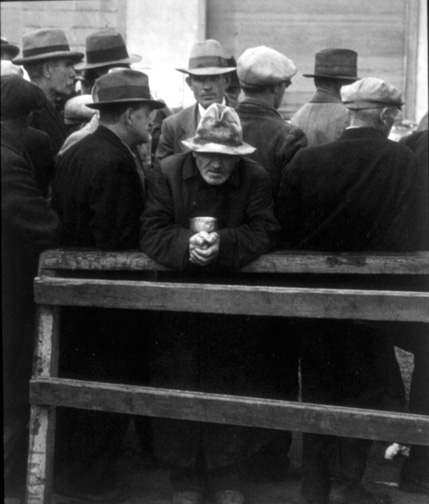
She was hired to take pictures for the Farm Security Administration, one of President Franklin D. Roosevelt's New Deal programs. In 1935, she divorced Dixon, and a few weeks later, married Paul Schuster Taylor, a professor of economics at the University of California.
For the next 5 years, they traveled through the California coast and the Midwest, documenting rural poverty, in particular the exploitation of sharecroppers and migrant laborers. Taylor interviewed subjects and gathered economic data, while Lange produced photographs and accompanying data.

Her work was distributed to newspapers across the country, and the poignant images became icons of the era. None more so than Migrant Mother.
Florence Leona Christie was born on September 1, 1903, somewhere in Oklahoma, while it was still a Territory. Both her parents were of Cherokee descent. As with Lange, her father left the family. At 17, she married Cleo Owens, a Missouri farmer. Like many farmers in the South and Midwest, as depicted on John Steinbeck's novel The Grapes of Wrath and the film based on it, they moved to the Sacramento Valley in California, where they became migrant farmers. In 1931, Cleo died of tuberculosis. At the time, Florence was pregnant with their 6th child.
In 1933, she had a 7th child (the father is not publicly known), returned to Oklahoma for a time, and then was joined by her parents as they migrated to Shafter, California, near Bakersfield. There, she met Jim Hill, with whom she eventually had an 8th, a 9th and a 10th child. She said: "I worked in hospitals. I tended bar. I cooked. I worked in the fields. I done a little bit of everything to make a living for my kids."
On March 6, 1936 -- the 100th Anniversary of the Battle of the Alamo, not that Florence and her kids cared enough to "Remember the Alamo" -- they were on U.S. Route 101, heading for Watsonville, "where they had hoped to find work in the lettuce fields of the Pajaro Valley." The car's timing chain snapped, and they coasted to a stop just inside a pea-pickers' camp in Nipomo. They were shocked to find as many as 3,500 people camping there. The crops had been destroyed by freezing rain, leaving them without work or pay.
While Jim Hill, her partner, and 2 of her sons went into town to get parts to repair the car, she and some of the children set up a temporary camp. As she waited, Dorothea Lange drove up, and started taking photos of Florence and her family, 7 pictures in 10 minutes. Two of the photos, which were not published, showed Florence breast-feeding a child. Her note on the best-known picture read, getting the month wrong: "Destitute peapickers in California; a 32 year old mother of seven children. February 1936."
Dorothea said, "I did not ask her name or her history. She told me her age, that she was 32. She said that they had been living on frozen vegetables from the surrounding fields and birds that the children killed. She had just sold the tires from her car to buy food."
Troy Owens, one of Thompson's sons, disputed this: "There's no way we sold our tires, because we didn't have any to sell. The only ones we had were on the Hudson, and we drove off in them. I don't believe Dorothea Lange was lying. I just think she had one story mixed up with another. Or she was borrowing to fill in what she didn't have."
Four days later, The San Francisco News published the picture, labeling it Migrant Mother. Dorothea sent the photos there before even sending them to the Resettlement Administration. Within days, the pea-picker camp received 20,000 pounds of food from the federal government. Just their luck, Florence and her family had moved on by the time the food arrived.
The family settled in Modesto, California in 1945. After World War II, Florence met and married hospital administrator George Thompson. This brought her far greater financial security than she had previously enjoyed.
As Lange was funded by the government when she took the picture, the image was public domain, and she was not entitled to royalties. However, the picture did help make her a celebrity, and earned her "respect from her colleagues." She continued to work for the federal government through World War II, then taught photography in the San Francisco Bay Area. She died of cancer on October 11, 1965, at age 70.
Roy Stryker, Dorothea's boss at the Farm Security Administration in 1936, called Migrant Mother the "ultimate" photo of the Depression Era. But the Mother's identity was lost until 1978, when Emmett Corrigan of the Modesto Bee tracked her down. He quoted her as saying, "I wish she hadn't taken my picture. I can't get a penny out of it. She didn't ask my name. She said she wouldn't sell the pictures. She said she'd send me a copy. She never did."
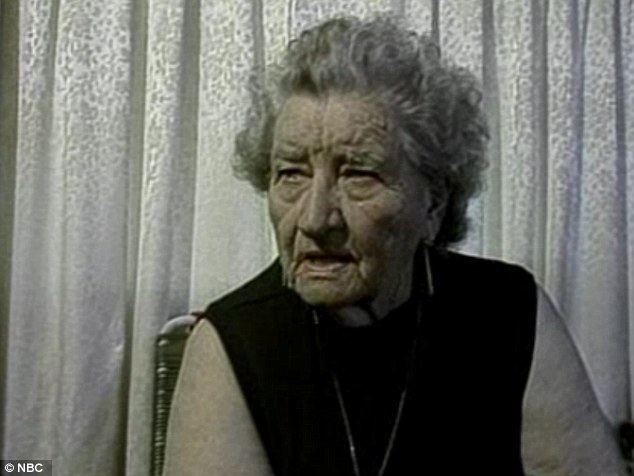
Florence Owens Thompson, 1978
Florence Owens Thompson, as she was known by then, died on September 16, 1983, of heart trouble, in Scotts Valley, California, across the State from San Francisco, but it might as well have been on the other side of the world. She was 80.


1 comment:
One of those images I'll always remember
Post a Comment