Showing posts with label oklahoma. Show all posts

Friday, June 6, 2025

Each State's Greatest Baseball Player

Monte Irvin of Orange, New Jersey

Notes: This is based not necessarily on where the player was born, but where he was trained to play baseball. And, as you will see, personal feelings will be set aside, except where steroids are concerned: All players known to have used steroids are ineligible.

1. Alabama: Willie Mays of Fairfield.
2. Alaska: Chad Bentz of Juneau.
3. Arizona: Jim Palmer of Scottsdale.
4. Arkansas: Brooks Robinson of Little Rock.
5. California: Joe DiMaggio of San Francisco.
6. Colorado: Roy Halladay of Arvada.
7. Connecticut: Jeff Bagwell of Killingworth.
8. Delaware: Chris Short of Milford.
9. District of Columbia: Maury Wills of Washington.
10. Florida: Steve Carlton of North Miami.
11. Georgia: Ty Cobb of Royston.
12. Hawaii: Shane Victorino of Wailuku.
13. Idaho: Harmon Killebrew of Payette.
14: Illinois: Robin Roberts of Springfield.
15. Indiana: Sam Rice of Morocco.
16. Iowa: Bob Feller of Van Meter.
17. Kansas: Walter Johnson of Humboldt.
18. Kentucky: Jim Bunning of Southgate.
19. Louisiana: Mel Ott of Gretna.
20. Maine: George Gore of Hartland.
21. Maryland: Babe Ruth of Baltimore.
22. Massachusetts: Mickey Cochrane of Bridgewater.
23. Michigan: Derek Jeter of Kalamazoo.
24. Minnesota: Dave Winfield of St. Paul.
25. Mississippi: Frank White of Greenville.
26. Missouri: Albert Pujols of Independence.
27. Montana: Dave McNally of Billings.
28. Nebraska: Grover Cleveland Alexander of St. Paul.
29. Nevada: Greg Maddux of Las Vegas.
30. New Hampshire: Carlton Fisk of Charlestown.
31. New Jersey: Monte Irvin of Orange.
32. New Mexico: Alex Bregman of Albuquerque.
33. New York: Lou Gehrig of Manhattan.
34. North Carolina: Gaylord Perry of Williamston.
35. North Dakota: Roger Maris of Fargo.
36. Ohio: Cy Young of Newcomerstown.
37. Oklahoma: Mickey Mantle of Commerce.
38. Oregon: Mickey Lolich of Portland.
39. Pennsylvania: Honus Wagner of Carnegie.
40. Rhode Island: Nap Lajoie of Woonsocket.
41. South Carolina: Joe Jackson of Greenville.
42. South Dakota: Dave Collins of Rapid City.
43. Tennessee: Todd Helton of Knoxville.
44. Texas: Tris Speaker of Hubbard.
45. Utah: Bruce Hurst of St. George.
46. Vermont: Ray Fisher of Middlebury.
47. Virginia: Justin Verlander of Goochland.
48. Washington: Ryne Sandberg of Spokane.
49. West Virginia: Jesse Burkett of Wheeling.
50. Wisconsin: Al Simmons of Milwaukee.
51. Wyoming: Tom Browning of Casper.

Saturday, April 19, 2025

April 19, 1995: The Oklahoma City Bombing

April 19, 1995, 30 years ago: The Alfred P. Murrah Federal Building in Oklahoma City, Oklahoma is destroyed by a car bomb, resulting in the deaths of 168 people. (The building was named for a federal judge from Oklahoma.)

The bombing was carried out at 9:02 AM, by Timothy McVeigh, a 27-year-old native of the Buffalo area, who had fallen in with right-wing extremist groups like the Michigan Militia.

He chose the date because it was the anniversary of the start of the American Revolution (by some people's reckoning), the Battle of Lexington and Concord in Massachusetts on April 19, 1775. But he had a 2nd reason: April 19 was also the anniversary of the end of the Waco Siege 2 years earlier, when the federal government moved in to arrest David Koresh for his crimes at Waco, Texas. He chose the location because he believed the order had come from the Murrah Federal Building.
The building before, from 1977 to 1995

McVeigh was captured 2 days later. He was convicted in 1997. On June 11, 2001, he became the 1st prisoner executed by the federal government since 1963.

He was assisted in the bombing by Terry Nichols, a 40-year-old Michigan native that he had met while in the U.S. Army. Nicholas was sentenced to life imprisonment at ADX Florence, the "supermax" federal prison in Colorado.

Three months after that, their act was no longer the greatest act of terrorism, or of mass murder, perpetrated in America. But it remains the greatest act of domestic terrorism.

And the perpetrators weren't black, or Hispanic, or Asian, or Arab: They were white. They weren't immigrants: They were native-born. They weren't Muslim: They identified as Christian. And they weren't Spanish speakers, or Arabic speakers: They spoke only English.

Monday, December 23, 2024

December 23, 1924: Basketball's 1st Big Man Is Born

December 23, 1924, 100 years ago: Robert Albert Kurland is born in St. Louis, and grows up in nearby Jennings, Missouri. He was considered basketball's first great "big man," standing 7 feet tall and weighing 220 pounds, and is the first player noted to have dunked in a collegiate game (if not the first to actually do it).

Bob "Foothills" Kurland led Oklahoma A&M to the National Championship in 1945 and 1946. (The school was renamed Oklahoma State in 1958.) His duels with George Mikan of DePaul, NIT Champions at the time (and thus, to many fans, the real "National Champions") became legend.

He never turned pro, instead working for Phillips Petroleum and playing for their company team, the Phillips 66ers, based in Bartlesville, Oklahoma. He led the U.S. team to Olympic Gold Medals in 1948 in London, and in 1952 in Helsinki, Finland.

He stayed with Phillips long after his basketball career ending in 1952, rising to become an executive. He was one of the earliest inductees into the Basketball Hall of Fame, in 1961. He died a year ago. 

Kurland died at his home on Sanibel Island in Florida, on September 29, 2013, at age 88. He was survived by his wife of 62 years, Barbara; their 4 children Alex, Ross, Dana, and Barbara; and 7 grandchildren.

Saturday, August 31, 2024

Major League Distances to Big 12 Conference Cities

These schools are listed from East to West. Distances are listed in miles.

* University of Central Florida, a.k.a. UCF, Orlando, Florida. Lightning, Buccaneers, Magic, Lightning, Orlando City.
MLB, 121 to Tampa Bay Lightning, 229 to Miami Marlins.
NFL, 103 to Tampa Bay Buccaneers, 141 to Jacksonville Jaguars, 216 to Miami Dolphins.
NBA, 16 to Orlando Magic, 229 to Miami Heat.
NHL, 99 to Tampa Bay Lightning, 209 to Florida Panthers.
MLS, 17 to Orlando City, 199 to Inter Miami.

* West Virginia University, a.k.a. WVU, Morgantown, West Virginia. Pirates, Steelers, Cavaliers, Penguins, Crew.
MLB, 74 to Pittsburgh Pirates, 200 to Cleveland Guardians, 211 to Baltimore Orioles, 213 to Washington Nationals, 308 to Philadelphia Phillies, 309 to Cincinnati Reds.
NFL, 74 to Pittsburgh Steelers, 203 to Cleveland Browns, 210 to Baltimore Ravens, 215 to Washington Commanders, 308 to Philadelphia Eagles, 309 to Cincinnati Bengals.
NBA, 200 to Cleveland Cavaliers, 213 to Washington Wizards, 308 to Philadelphia 76ers.
NHL, 75 to Pittsburgh Penguins, 207 to Columbus Crew, 213 to Washington Wizards, 308 to Philadelphia Flyers.
MLS, 207 to Columbus Crew, 212 to DC United, 296 to Philadelphia Union, 309 to FC Cincinnati.

* University of Cincinnati, Cincinnati, Ohio. Reds, Bengals, Pacers, Blue Jackets, FC Cincinnati.
MLB, 2 to Cincinnati Reds, 248 to Cleveland Guardians.
NFL, 2 to Cincinnati Bengals, 111 to Indianapolis Colts, 251 to Cleveland Browns.
NBA, 111 to Indiana Pacers, 248 to Cleveland Cavaliers.
NHL, 106 to Columbus Blue Jackets.
MLS, 2 to FC Cincinnati, 106 to Columbus Crew.

* Iowa State University, a.k.a. ISU, Ames, Iowa.
MLB, 218 to Minnesota Twins, 229 to Kansas City Royals, 349 to Chicago White Sox, 349 to Milwaukee Brewers, 354 to Chicago Cubs, 379 to St. Louis Cardinals.
NFL, 219 to Minnesota Vikings, 229 to Kansas City Chiefs, 350 to Chicago Bears, 412 to Green Bay Packers.
NBA, 218 to Minnesota Timberwolves, 345 to Chicago Bulls, 353 to Milwaukee Bucks.
NHL, 219 to Minnesota Wild, 345 to Chicago Blackhawks, 379 to St. Louis Blues.
MLS, 219 to Minnesota United, 242 to Sporting Kansas City, 350 to Chicago Fire, 378 to St. Louis City.

* University of Kansas, a.k.a. KU, Lawrence, Kansas. Royals, Chiefs, Thunder, Blues, Sporting KC.
MLB, 50 to Kansas City Royals, 289 to St. Louis Cardinals, 552 to Texas Rangers. 
NFL, 50 to Kansas City Chiefs, 522 to Dallas Cowboys.
NBA, 316 to Oklahoma City Thunder, 516 to Dallas Mavericks, 552 to Chicago Bulls.
NHL, 289 to St. Louis Blues, 516 to Dallas Stars, 552 to Chicago Blackhawks. 
MLS, 29 to Sporting Kansas City, 288 to St. Louis City, 502 to FC Dallas.

* Kansas State University, a.k.a. KSU, Manhattan, Kansas. Royals, Chiefs, Thunder, Blues, Sporting KC.
MLB, 131 to Kansas City Royals, 370 to St. Louis Cardinals, 498 to Texas Rangers.
NFL, 131 to Kansas City Chiefs, 498 to Dallas Cowboys.
NBA, 292 to Oklahoma City Thunder, 493 to Dallas Mavericks, 634 to Chicago Bulls.
NHL, 370 to St. Louis Blues, 493 to Dallas Stars, 634 to Chicago Blackhawks. 
MLS, 111 to Sporting Kansas City, 269 to St. Louis City,  478 to FC Dallas.

* Oklahoma State University, a.k.a. OSU, Stillwater, Oklahoma. Rangers, Cowboys, Thunder, Stars, FC Dallas.
MLB, 273 to Texas Rangers, 319 to Kansas City Royals.
NFL, 273 to Dallas Cowboys, 319 to Kansas City Chiefs.
NBA, 66 to Oklahoma City Thunder, 267 to Dallas Mavericks, 
NHL, 267 to Dallas Stars, 463 to St. Louis Blues.
MLS, 252 to FC Dallas, 303 to Sporting KC.

* University of Houston, a.k.a. UH, Houston, Texas. Astros, Texans, Rockets, Stars, Dynamo.
MLB, 3 to Houston Astros.
NFL, 5 to Houston Texans.
NBA, 2 to Houston Rockets.
NHL, 244 to Dallas Stars.
MLS, 3 to Houston Dynamo.

* Baylor University, a.k.a. BU, Waco, Texas. Rangers, Cowboys, Mavericks, Stars, FC Dallas.
MLB, 103 to Texas Rangers.
NFL, 102 to Dallas Cowboys.
NBA, 96 to Dallas Mavericks.
NHL, 96 to Dallas Stars.
MLS, 122 to FC Dallas.

* Texas Christian University, a.k.a. TCU, Fort Worth, Texas. Rangers, Cowboys, Mavericks, Stars, FC Dallas.
MLB, 18 to Texas Rangers.
NFL, 19 to Dallas Cowboys.
NBA, 36 to Dallas Mavericks.
NHL, 36 to Dallas Stars.
MLS, 52 to FC Dallas.

* Texas Tech University, Lubbock, Texas. Rangers, Cowboys, Thunder, Stars, FC Dallas.
MLB, 332 to Texas Rangers, 521 to Houston Astros, 545 to Colorado Rockies.
NFL, 331 to Dallas Cowboys, 523 to Houston Texans, 542 to Denver Broncos.
NBA, 348 to Oklahoma City Thunder, 349 to Dallas Mavericks, 392 to San Antonio Spurs, 522 to Houston Rockets, 542 to Denver Nuggets.
NHL, 349 to Dallas Stars, 542 to Colorado Avalanche.
MLS, 317 to FC Dallas, 367 to Austin FC, 521 to Houston Dynamo, 537 to Colorado Rapids.

* University of Colorado, Boulder, Colorado. Rockies, Broncos, Nuggets, Avalanche, Rapids.
MLB, 26 to Colorado Rockies.
NFL, 27 to Denver Broncos.
NBA, 26 to Denver Nuggets.
NHL, 26 to Colorado Avalanche.
MLS, 27 to Colorado Rapids.

* University of Arizona, Tucson, Arizona. Diamondbacks, Cardinals, Suns, Golden Knights, LAFC.
MLB, 114 to Arizona Diamondbacks.
NFL, 131 to Arizona Cardinals.
NBA, 114 to Phoenix Suns.
NHL, 417 to Vegas Golden Knights, 480 to Honda Center, 498 to Los Angeles Kings.
MLS, 501 to Los Angeles FC, 514 to Los Angeles Galaxy.

* Arizona State University, a.k.a. ASU, Tempe, Arizona. Diamondbacks, Cardinals, Suns, Golden Knights, Galaxy. 
MLB, 9 to Arizona Diamondbacks.
NFL, 26 to Arizona Cardinals.
NBA, 9 to Phoenix Suns.
NHL, 312 to Vegas Golden Knights, 375 to Anaheim Ducks, 393 to Los Angeles Kings.
MLS, 395 to Los Angeles Galaxy, 395 to Los Angeles FC.

* University of Utah, Salt Lake City, Utah. Rockies, Broncos, Jazz, UHC, RSL.
MLB, 514 to Colorado Rockies.
NFL,  515 to Denver Broncos.
NBA, 4 to Utah Jazz.
NHL, 44 to Utah Hockey Club.
MLS, 14 to Real Salt Lake.

* Brigham Young University, Provo, Utah. Rockies, Broncos, Jazz, UHC, RSL.
MLB, 486 to Colorado Rockies.
NFL,  482 to Denver Broncos.
NBA, 44 to Utah Jazz.
NHL, 44 to Utah Hockey Club.
MLS, 31 to Real Salt Lake.

Major League Distances From SEC Cities

* University of South Carolina, Columbia, South Carolina. Braves, Panthers, Hornets, Hurricanes, Charlotte FC.
MLB: Atlanta Braves 230.
NFL: Carolina Panthers 99, Atlanta Falcons 218.
NBA: Charlotte Bobcats 99, Atlanta Hawks 218.
NHL: Carolina Hurricanes 238.
MLS: Charlotte FC 99, Atlanta United 218.  

* University of Georgia, Athens, Georgia. Braves, Falcons, Hawks, Predators, United.
MLB: Atlanta Braves 71.
NFL: Atlanta Falcons 71.
NBA: Atlanta Hawks 71.
NHL: Nashville Predators 307, Carolina Hurricanes 349.
MLS: Atlanta United 71.

* University of Florida, Gainesville, Florida. Rays, Jaguars, Magic, Lightning, Orlando City.
MLB: Tampa Bay Rays 152, Miami Marlins 336, Atlanta Braves 343.
NFL: Jacksonville Jaguars 74, Tampa Bay Buccaneers 134, Miami Dolphins 323, Atlanta Falcons 331.
NBA: Orlando Magic 113, Atlanta Hawks 331, Miami Heat 336.
NHL: Tampa Bay Lightning 131, Florida Panthers 317.
MLS: Orlando City 111, Inter Miami 309, Atlanta United 331.

* University of Kentucky, Lexington, Kentucky. Reds, Bengals, Pacers, Blue Jackets, FC Cincinnati.
MLB: Cincinnati Reds 82.
NFL: Cincinnati Bengals 82, Indianapolis Colts 188, Tennessee Titans 212.
NBA: Indiana Pacers 188.
NHL: Columbus Blue Jackets 189, Nashville Predators 214.
MLS: FC Cincinnati 82, Nashville SC 215.

* University of Tennessee, Knoxville, Tennessee. Braves, Titans, Hawks, Predators, Nashville SC.
MLB: Atlanta Braves 202, Cincinnati Reds 251.
NFL: Tennessee Titans 180, Carolina Panthers 229.
NBA: Atlanta Hawks 213, Charlotte Hornets 229, Indiana Pacers 358, Memphis Grizzlies 393.
NHL: Nashville Predators 181.
MLS: Nashville SC 180, Atlanta United 213, Charlotte FC 229.

* Vanderbilt University, a.k.a. Vandy, Nashville, Tennessee. Braves, Titans, Grizzlies, Predators, Nashville SC.
MLB: Atlanta Braves 237, Cincinnati Reds 275, St. Louis Cardinals 310.
NFL: Tennessee Titans 3.
NBA: Memphis Grizzlies 212, Atlanta Hawks 248, Indiana Pacers 291.
NHL: Nashville Predators 2.
MLS: Nashville SC 3.

* University of Alabama, a.k.a. 'Bama, Tuscaloosa, Alabama. Braves, Falcons, Hawks, Predators, Atlanta United.
MLB: Atlanta Braves 206.
NFL: Atlanta Falcons 203, Tennessee Titans 249, New Orleans Saints 292.
NBA: Atlanta Hawks 203, Memphis Grizzlies 239, New Orleans Pelicans 292.
NHL: Nashville Predators 248.
MLS: Atlanta United 203, Nashville SC 246.

* Auburn University, Auburn, Alabama. Braves, Falcons, Hawks, Predators, Atlanta United.
MLB: Atlanta Braves 117.
NFL: Atlanta Falcons 110, Tennessee Titans 304, Jacksonville Jaguars 328, New Orleans Saints 362.
NBA: Atlanta Hawks 110, Memphis Grizzlies 348, New Orleans Pelicans 362.
NHL: Nashville Predators 302.
MLS: Atlanta United 110, Nashville SC 301.

* University of Mississippi, a.k.a. Ole Miss, Oxford, Mississippi. Braves, Titans, Grizzlies, Predators, Nashville SC.
MLB: Atlanta Braves 335.
NFL: Tennessee Titans 266, Atlanta Falcons 332, New Orleans Saints 347.
NBA: Memphis Grizzlies 83, Atlanta Hawks 332, New Orleans Pelicans 347.
NHL: Nashville Predators 264.
MLS: Nashville SC 246, Atlanta United 332.

* Mississippi State University, Starkville, Mississippi. Braves, Titans, Grizzlies, Predators, Nashville SC.
MLB: Atlanta Braves 287.
NFL: Tennessee Titans 265, Atlanta Falcons 284, New Orleans Saints 295.
NBA: Memphis Grizzlies 179, Atlanta Hawks 284, New Orleans Pelicans 295.
NHL: Nashville Predators 264.
MLS: Nashville SC 263, Atlanta United 284.

* University of Missouri, a.k.a. Mizzou, Columbia, Missouri. Royals, Chiefs, Bulls, Blues, St. Louis City.
MLB: Kansas City Royals 120, St. Louis Cardinals 126, Chicago White Sox 384, Chicago Cubs 394.
NFL: Kansas City Chiefs 120, Chicago Bears 385.
NBA: Chicago Bulls 387, Memphis Grizzlies 396.
NHL: St. Louis Blues 125. Chicago Blackhawks 387.
MLS: St. Louis City 125, Sporting Kansas City 141.

* University of Arkansas, Fayetteville, Arkansas. Rangers, Cowboys, Thunder, Stars, FC Dallas.
MLB: Texas Rangers 348, St. Louis Cardinals 362.
NFL: Dallas Cowboys 349, Tennessee Titans 530.
NBA: Oklahoma City Thunder 236, Memphis Grizzlies 318, Dallas Mavericks 332.
NHL: Dallas Stars 332, St. Louis Blues 361, Nashville Predators 528.
MLS: FC Dallas 310, St. Louis City 361, Nashville SC 531.

* Louisiana State University, a.k.a. LSU, Baton Rouge, Louisiana. Astros, Saints, Pelicans, Stars, Dynamo.
MLB: Houston Astros 268, Texas Rangers 444, Atlanta Braves 533.
NFL: New Orleans Saints 80, Houston Texans 277, Dallas Cowboys 445, Tennessee Titans 590.
NBA: New Orleans Pelicans 80, Houston Rockets 269, Memphis Grizzlies 383, Dallas Mavericks 430.
NHL: Dallas Stars 430, Nashville Predators 588.
MLS: Houston Dynamo 269, FC Dallas 449, Nashville SC 587.

* University of Oklahoma, Norman, Oklahoma. Rangers, Cowboys, Thunder, Stars, FC Dallas.
MLB: Texas Rangers 191, Kansas City Royals 373.
NFL: Dallas Cowboys 192, Kansas City Chiefs 373.
NBA: Oklahoma City Thunder 21, Dallas Mavericks 186.
NHL: Dallas Stars 186.
MLS: FC Dallas 172, Sporting Kansas City 358.

* University of Texas, Austin, Texas. Astros, Texans, Spurs, Stars, Dynamo.
MLB: Houston Astros 168, Texas Rangers 201.
NFL: Houston Texans 170, Dallas Cowboys 201.
NBA: San Antonio Spurs 77, Houston Rockets 167, Dallas Mavericks 195.
NHL: Dallas Stars 195.
MLS: Austin FC 8, Houston Dynamo 168, FC Dallas 220.

* Texas A&M University, College Station, Texas. Astros, Texans, Rockets, Stars, Dynamo.
MLB: Houston Astros 94, Texas Rangers 188.
NFL: Houston Texans 99, Dallas Cowboys 187.
NBA: Houston Rockets 94, San Antonio Spurs 168, Dallas Mavericks 180.
NHL: Dallas Stars 180.
MLS: Houston Dynamo 95, Austin FC 105, FC Dallas 205.

Tuesday, November 9, 2021

How to Be a New York Basketball Fan In Oklahoma City -- 2021-22 Edition

The Brooklyn Nets visit Oklahoma City to play the Thunder next Sunday, November 14. The New York Knicks' visit this season will be on December 31.

The Nets formerly played in Newark, "Brick City," and Oklahoma City is known as "Bricktown," not to be confused with Brick Township on the Jersey Shore, which also (in their case, incorrectly) gets called "Bricktown" or "Brick Town."

Judging by how the fans of OKC have embraced their 1st real major league sports team -- the USFL's Oklahoma Outlaws played in Tulsa, as did the WNBA's Tulsa Shock, and, besides, those are hardly major leagues -- it can safely be said that the people of Oklahoma City deserved their own team. But not the Seattle SuperSonics: They should have gotten either an expansion team or a team whose fans weren't supporting it.

But we should not hold Oklahoma accountable for that. Besides, it's not like they went out of their way to steal a team: It was the owner who bought the Sonics and moved them, because he didn't like Seattle's Key Arena.

No, don't hold Oklahomans responsible for stealing the Sonics -- they didn't. If you want to knock them for something, knock them for electing Tea Party dimwits to public office.

Before You Go. Oklahoma is part of the Great Plains region. There aren't a lot of trees to shade you or to block the wind. As a result, it gets beastly hot in the summer, and brutally cold in the winter. This will be mid-October, so you should be spared particularly cold weather.

The website for The Daily Oklahoman is predicting low 60s for Sunday afternoon, and high 30s for Sunday night. Bring a jacket.

Oklahoma City -- indeed, the entire State except for the westernmost Panhandle, which is on Mountain Time -- is in the Central Time Zone, 1 hour behind New York. Adjust your timepieces accordingly.

Tickets. The Thunder averaged 18,203 fans per home game in 2019-20, until COVID shut everything down -- a sellout every game. They're the only game in town -- the Sooners are a 45-minute drive away -- and have been fully embraced by a populace used to following just the one sport, college football. Getting tickets will be tough.

Tickets in the lower level, the 100 sections, are $180 between the baskets and $100 behind them. The 200 level is club seating, and available only to season ticketholders. The Balcony and Loft level, the 300 sections, has seats going for $75 between the baskets and $36 behind them.

Getting There. It's 1,451 miles from Madison Square Garden to the Chesapeake Energy Arena. Knowing this, your first reaction is going to be to want to fly.

You won't get a nonstop flight. There are any number of cities in which you would have to change planes, depending on the airline: Charlotte, Chicago, Dallas, for example. This week, it would be a little over $800. Will Rogers World Airport is southwest of downtown, but there is no local bus service between them.

Amtrak is not an option: Service to Oklahoma City has been suspended, and I don't know when, or even if, it will be restored. At any rate, the station is on Gaylord Blvd., between Reno and Sheridan Avenues, just 2 blocks from the arena -- sure, now, at the end, it's convenient.

On Greyhound, the trip is much shorter, about 39 hours, and you only have to transfer once, and, believe me, 4 hours in Chicago is good. (More hours in Chicago is better, but that's a story for another time.) It's also possible that your transfer may be in Kansas City. The round-trip fare is $483, but can drop to $340 with advanced purchase. The station is at 1948 E. Reno Avenue at Martin Luther King Avenue, on the same street as the arena, but 2 miles to the east, so what it makes up for in convenience during the trip, it blows up at the end -- the opposite of Amtrak.

If you decide to drive, it's far enough that it will help to get someone to go with you and split the duties, and to trade off driving and sleeping. You'll need to get on the New Jersey Turnpike, and take Interstate 78 West across New Jersey, and at Harrisburg get on the Pennsylvania Turnpike, which at this point will be both I-70 and I-76. When the two Interstates split outside Pittsburgh, stay on I-70 west. You'll cross the northern tip of West Virginia, and go all the way across Ohio (through Columbus), Indiana (through Indianapolis) and Illinois.

When you cross into Missouri, you'll be in St. Louis, going over the new Stan Musial Veterans Memorial Bridge. Switch to Interstate 44 West, the Will Rogers Turnpike, and take that across southern Missouri and northeastern Oklahoma. Outside Edmond, you'll turn onto Interstate 35 South, then onto Interstate 40 West, taking Exit 150B for downtown Oklahoma City and the Arena.

If you do it right, you should spend about an hour and 15 minutes in New Jersey, 5 hours in Pennsylvania, 15 minutes in West Virginia, 3 hours and 45 minutes in Ohio, 2 hours and 30 minutes in Indiana, 2 hours and 30 minutes in Illinois, 5 hours in Missouri, and 3 hours and 30 minutes in Oklahoma before arriving. That's going to be nearly 24 hours. Counting rest stops, preferably 6 of them, and accounting for traffic at both ends, it should be about 30 hours.

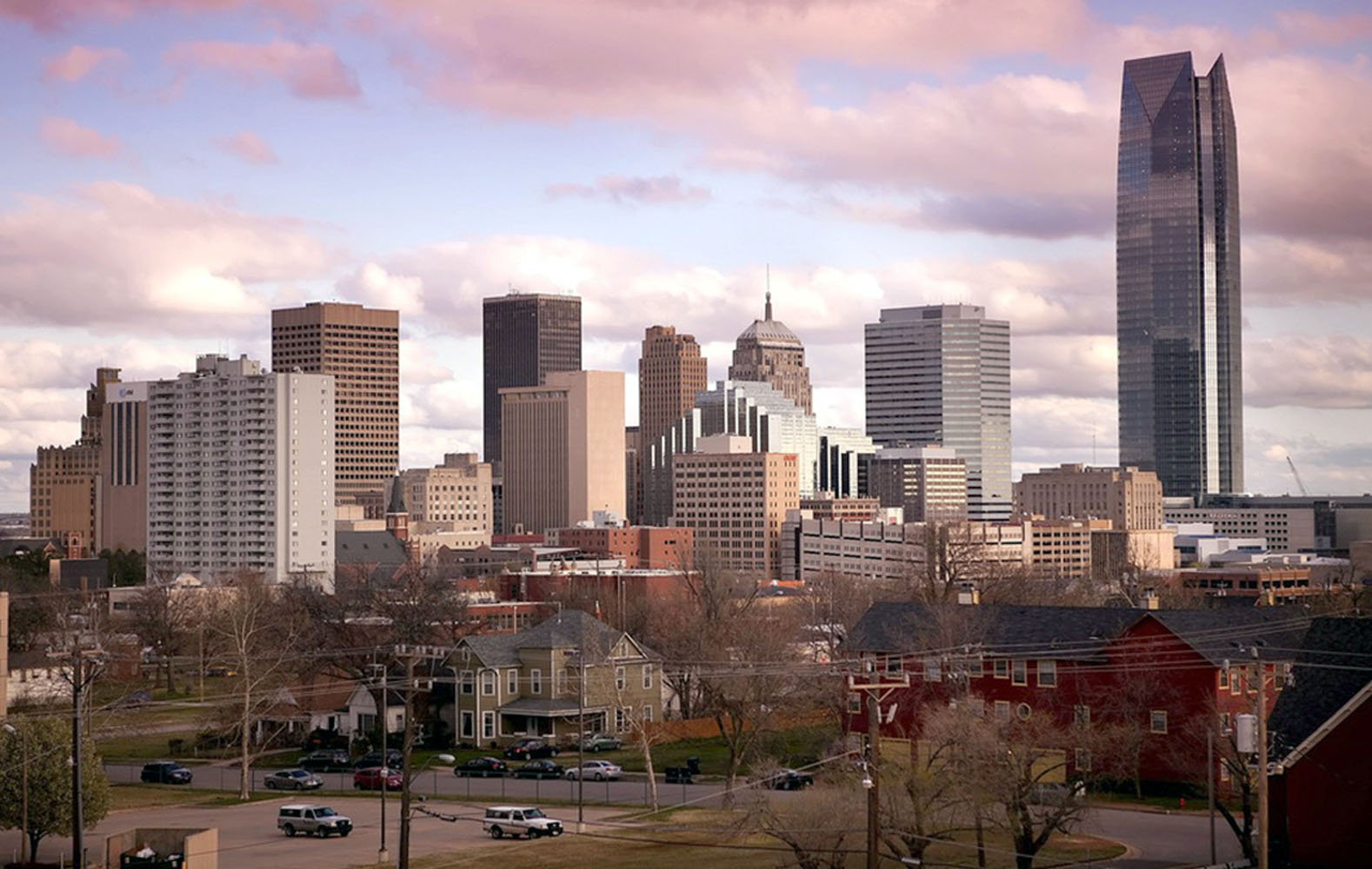
Once In the City. Oklahoma City, the capital of the State of Oklahoma, was founded in 1889 as a result of the Oklahoma land rush, after the former Indian Territory was legally (if not morally) opened up to white settlers. (As a result, their minor-league baseball team was long called the 89ers.) The name comes from the Choctaw tribe, meaning "red people."
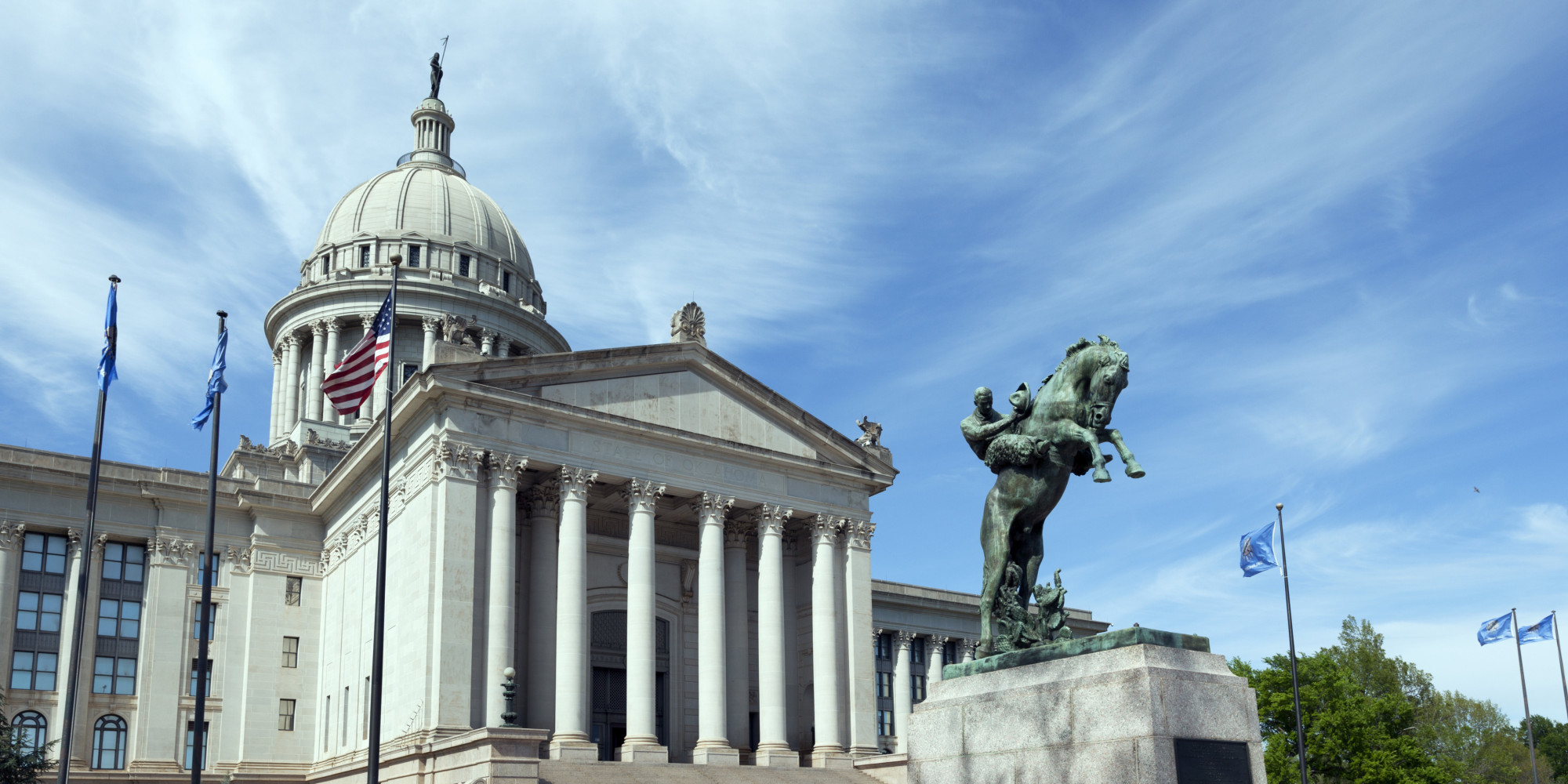
The State House. The statue is called Tribute to Range Riders,
and does not represent any particular person.

It's a decent-sized city, with about 680,000 people, but the metropolitan area is small, just 1.4 million. This makes it the 2nd-smallest market in the NBA, larger than only Salt Lake City, home of the Utah Jazz. It would also be the smallest in MLB, and smaller than all U.S.-based NHL cities, though it would also be larger than Ottawa, Calgary, Edmonton and Winnipeg. The city is about 56 percent white, 17 percent Hispanic (nearly all of that Mexican), 15 percent black, 4 percent Asian, and 4 percent Native American.

Oklahoma's darkest hour came on May 31, 1921, when mobs of White residents, some of them deputized and given weapons by city officials, attacked Black residents and destroyed homes and businesses of the Greenwood District in Tulsa, Oklahoma. The attacks burned and destroyed more than 35 square blocks of the neighborhood – at the time one of the wealthiest Black communities in the United States, known as "Black Wall Street." As many as 300 people were killed.

    The sales tax in the State of Oklahoma is 4.5 percent, but in Oklahoma City it nearly doubles to 8.375 percent. Gaylord Blvd. divides street addresses into east and west, while Sheridan Avenue divides them into north and south. Oklahoma City has a light rail system, the Oklahoma City Streetcar, that opened in 2018. The fare is $1.00. EMBARK buses charge just $1.75.
    The Streetcar at Mickey Mantle Station,
    next to Bricktown Ballpark

    ZIP Codes for Oklahoma start with the digits 73 and 74. The Area Code for most of the State is 405. The city has no "beltway." Oklahoma Gas & Electric (OG&E) runs the State's electricity.

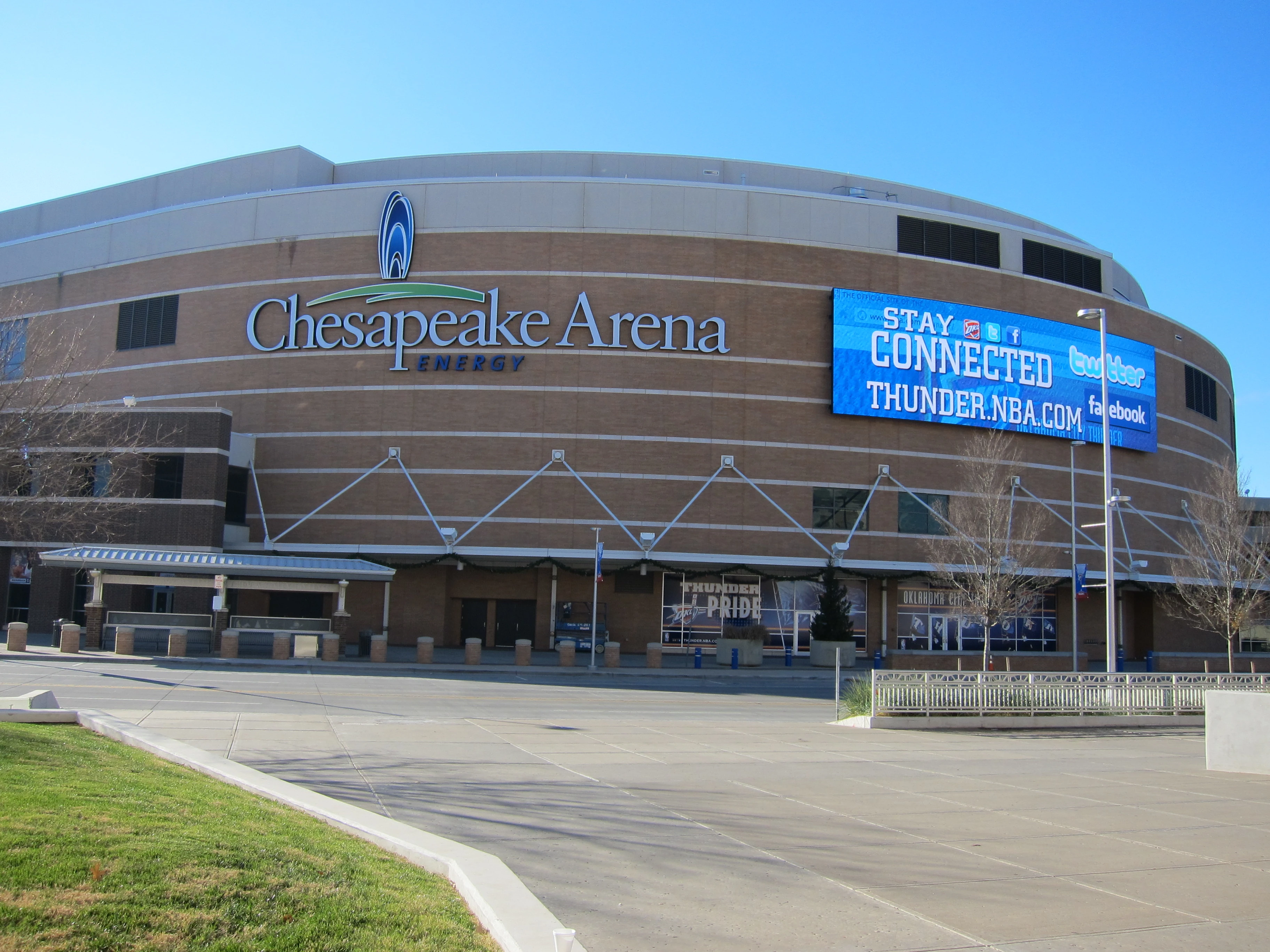
    Going In. The Thunder's building opened in 2002 as the Ford Center, but became the Chesapeake Energy Arena, or "The 'Peake" for short, in 2011. In 2021, it was renamed the Paycom Center.

    When the Thunder reached the NBA Finals in 2012, the exposure of the arena's name caused the namesake company's stock to surge. The address is 100 W. Reno Avenue, and the arena is bounded by Reno, Gaylord Blvd., 3rd Street and Robinson Avenue, which is known as Thunder Drive as it passes the arena. Parking is $8.00.
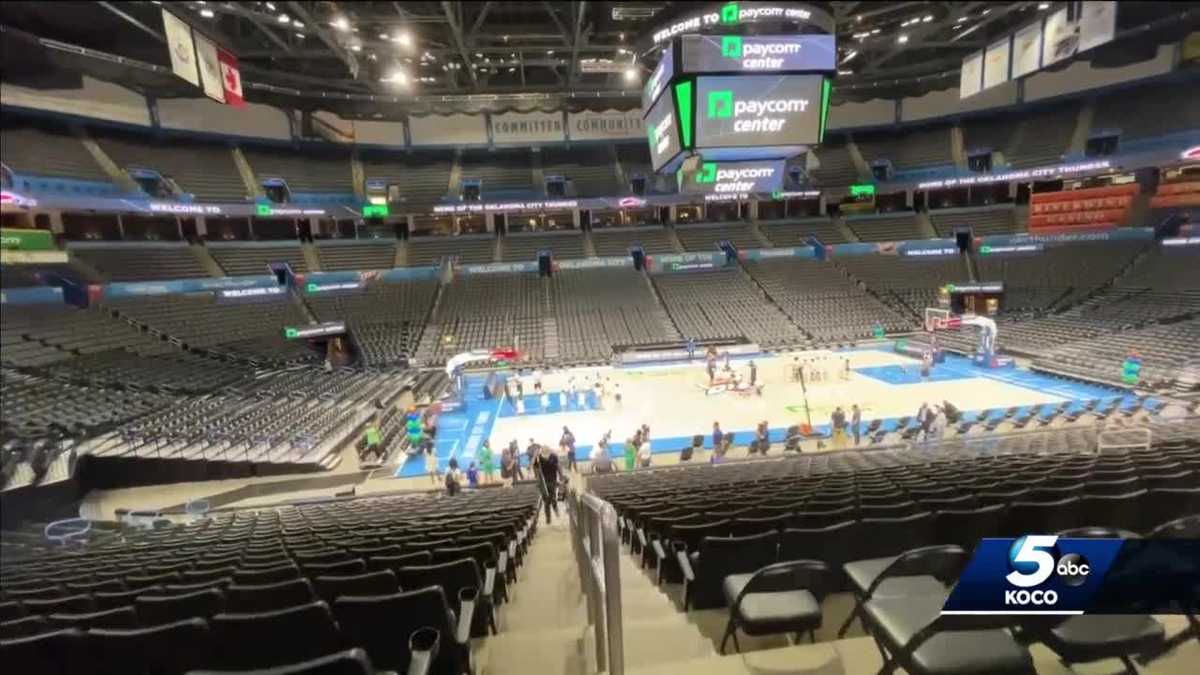
    The building is in the usual post-Camden Yards style, with concourses for each level. The court is laid out northwest to southeast. It remains a college basketball center (having hosted the Big 12 Conference Tournament), and a site for pro wrestling and Ultimate Fighting. It has also hosted minor-league hockey, but currently does not.
    Interior shot, showing the original Ford Center name

    Food. Levy Restaurants runs the concessions at Chesapeake Energy Arena. In addition to the usual array of stands selling typical sports-stadium food, they have, according to the arena's website:

    * The Jack Daniels Old No. 7 Club is located on the 100 level concourse at section 114-115. Old No. 7 provides a trendy and unique atmosphere with full bar offerings and several beers on tap. A selection of appetizers are available in this local hot spot.

    * The Center Court Carvery is located on the 100 level concourse at section 114-115 across from the Jack Daniels Old No. 7 Club. Center Court Carvery provides a unique, upscale dining experience with a full buffet at each game featuring carved meat options, an assortment of salads, potatoes, vegetables and breads. A carved sandwich option with one side is also available for those looking for something quick, yet filling. Center Court Carvery's buffets change nightly, so check back often to see what's on the cutting board at Center Court!

    * Center Court Grill is the new urban hot spot for guests inside Chesapeake Energy Arena. Center Court Grill will be open 2 1/2 hours prior to every Thunder home game for ticket holders. The restaurant will also be open for ticketed concerts and other select ticketed events throughout the year. Center Court Grill features a menu that has a balance between grilled entrees, sandwiches and house-made BBQ.

    Team History Displays. As the newest team in the NBA, dating back only to 2008 (though one of its older franchises, dating back to 1967), the Thunder's history is nearly all that of the Seattle SuperSonics, even though they can't count it as such.

    While it should be noted that they have made the Playoffs in 10 out of their 12 full seasons since moving in -- missing in 2015 and 2021, and not counting their lockout-truncated original 2008-09 season -- despite being stuck in the Western Conference with the Kobe Bryant Lakers, the Dirk Nowitzki Mavericks, the Tim Duncan Spurs and the Steph Curry Warriors. 

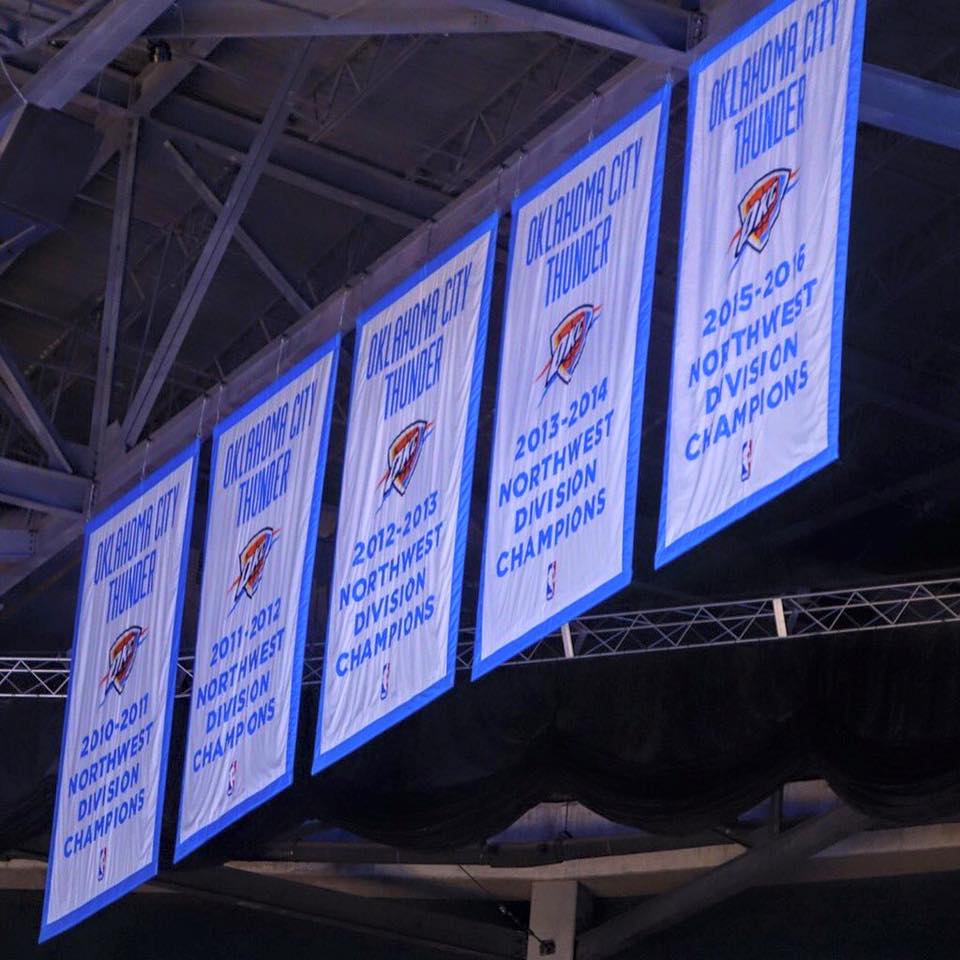
    The Thunder had a streak of winning their Division in 5 of 6 seasons, and hang 5 white banners with blue lettering to denote this: 2011, 2012, 2013, 2014 and 2016. They also hang a blue banner with white lettering to denote their 2012 Western Conference title.
    As the Sonics, they previously won the 1979 NBA title; the West in 1978, 1979 and 1996; and the Pacific Division in 1979, 1994, 1996, 1997, 1998 and 2005. But they make no mention of this at the Arena. The Sonics' banners, and those of the WNBA's Seattle Storm, remain at the Key Arena at Seattle Center.

    The Thunder recently retired their 1st uniform number, the 4 of forward Nick Collinson, who played with the franchise from 2003 to 2018, including the last 5 years in Seattle.

    The Sonics retired 6 uniform numbers, and, along with them in the rafters at the Key Arena, hung a banner for broadcaster Bob Blackburn. Except for 10, for guard Nate McMillan from their 1996 Western Conference Champions, all of those numbers (as well as Blackburn's honor) were from their 1978 Western Conference Champions and their 1979 NBA Champions: 1, guard Gus Williams; 19, guard Lenny Wilkens (who, by that point, was a non-playing coach, but did play 4 years for the Sonics); 24, forward Spencer Haywood; 32, guard Fred "Downtown" Brown; and 43, center Jack Sikma.

    The 20 of guard Gary Payton and the 40 of forward Shawn Kemp from the 1996 team might have been retired had the Sonics still been in Seattle when they retired. Those 2, and the 6 that are officially retired, have been kept out of circulation: No member of the Thunder from 2008 onward has worn any of them.

    My guess is that the Thunder's management is waiting until Seattle gets a new (expansion or moved) team, at which point the Sonics' records and achievements will be officially given back to them, and the Thunder can then give those numbers out with a clear conscience.

    Wilkens was the only Sonics player named to the NBA's 50th Anniversary 50 Greatest Players in 1996, unless you count Patrick Ewing, who played just 1 season in Seattle (2000-01). Wilkens, Ewing, Payton, Ray Allen, Kevin Durant (who played the last season in Seattle and then the 1st 8 seasons in Oklahoma City), Russell Westbrook, James Harden, Carmelo Anthony (who played the 2017-18 season for the Thunder) and Chris Paul (who played the 2019-20 season for them) were named to the NBA's 75th Anniversary 75 Greatest Players.

    Sheryl Swoopes, who played her last WNBA season with the Tulsa Shock, was named to the WNBA Top 20 at 20 in 2016 -- in the 20th Season, rather than at the 20th Anniversary.

    Stuff. Concession stands selling team merchandise are scattered throughout the arena. I can find no reference to where in the arena a team store is located, but I find it hard to believe that an organization as professional as the Thunder have been the last 6 seasons would not have at least one large one. Since Oklahoma likes to think of itself as a Western State, you may be able to buy cowboy hats with team logos on them.

    As they are not yet a historic franchise, there aren't many books about the Thunder. Nate LeBoutillier has written The Story of the Oklahoma City Thunder as part of the NBA's A History of Hoops book series. (I wonder if it goes over the history of the SuperSonics, or if it just mentions them as the Thunder's predecessors.) As part of the NBA's The Inspirational Story of Basketball Superstar...
    series, Bill Redban has written books about Durant, Westbrook and Harden. These are, admittedly, unauthorized biographies.

    There aren't yet team DVDs of the Thunder, but there is a movie about them: Thunderstruck, a cross between Freaky Friday and Space Jam, in which a kid unwittingly and magically exchanges basketball abilities with then-Thunder star Kevin Durant, as in the kid becomes a high school basketball star, while Durant can't buy a basket. Amazon.com has Sonicsgate: Requiem for a Team, but that's more for the Seattle fan.

    During the Game. A November 13, 2014 article on DailyRotoHelp ranked the NBA teams' fan bases, and listed the Thunder's fans 10th. Of course, it's worth noting that, aside from their 23-59 1st season, when the fans still came out due to the novelty, they've averaged 53 wins a season. So we don't yet know how their fans would react to a bad established team.

    You do not need to worry about wearing Knicks or Nets gear as an opposing fan against the Thunder. Their main rivals are the Mavs and the Spurs, and their fans don't get rough with those guys, so they won't get rough with you.

    Nevertheless, having just the 1 team in the 4 major league sports -- not even in MLS, and the WNBA's Tulsa Shock were a ways off -- the same effect applies to the Thunder as applies to the other NBA-only cities, where the NBA team means everything: San Antonio, Salt Lake City, Sacramento and Portland. (To be fair, San Antonio also has a WNBA team, while Salt Lake and Portland have the WNBA and MLS.)

    As Bill Simmons, in a rare thoughtful moment for him, wrote for ESPN:

    With the possible exception of  Portland, no NBA team means more to its city. This goes beyond having the loudest fans. There's genuine devotion here. These people arrived a good 45 minutes early for last night's Game 1 — and by "these people" I mean "everyone with a ticket" — then clapped their way through pregame warm-ups with such infectious enthusiasm that I remember saying to a friend, "No way these yahoos keep this up for three hours, they're going to burn out." Wrong. You know what burned out? My eardrums. My head is still ringing.

    Simmons speculated that the 1995 Oklahoma City bombing played a major part in the team's culture, noting that Thunder general manager Sam Presti has every new Thunder player visit the memorial to the event, and encourages players to look into the stands and consider that many of the team's fans were personally affected by the event.

    On February 17, 2009, Rumble the Bison was introduced as the Thunder's mascot during the halftime of a game against, appropriately enough, the team that used the arena (then still named the Ford Center) as their temporary home after Hurricane Katrina, the New Orleans Hornets. Rumble was a big hit in that 1st season, and was awarded the 2008–09 NBA Mascot of the Year. Although I'm not sure having a mascot with a "beard" that covers up the team name on his jersey is a good idea.
    Rumble don't wanna work. He just wanna bang on the drum all day.

    They also have the Thunder Girls cheerleaders. There is also Thundor, a "celebrity fan" who dresses like a luchador, a Mexican professional wrestler. (Baseball's Arizona Diamondbacks also have one, and he's official.) His real name is Garret Havilland -- not Mexican, or even Spanish -- and he carries a megaphone, making him a pain in the neck to free-throw shooters when the visiting team is playing toward his end.
    In real life, he has a psychology degree and runs a home for troubled teenage girls, so, despite his silly appearance, he is a very serious and admirable man, unlike some other infamous NBA fans like Robin Ficker, the disbarred lawyer known for heckling opponents at Washington Wizards games. He even shows enough respect for the girls he works with that he asks them to teach him dance moves, so he can stay current.

    Neither of the New York City teams' visits to Oklahoma City this season will feature a promotion. The Thunder hold auditions for singing the National Anthem, instead of having a regular singer. The OKC-based band The Flaming Lips rewrote their song "Race for the Prize," giving it the title "Thunder Up," to use as a team fight song. The words "Thunder Up" have also become a team slogan.

    Like fans of the Winnipeg Jets hockey team, Thunder fans tend to wear white T-shirts in the stands, providing a "Whiteout" effect that supposedly distracts opposing players. (How much it does so is debatable.)
    After the Game. In Oklahoma City, the violent crime rate is one of the highest in the nation. However, if you stick to the downtown area, you should be safe.

    Most of the notable places to eat are to the northeast of the arena, across the railroad tracks and closer to the ballpark. Mickey Mantle's Steakhouse -- unlike the now-closed restaurant named for him on New York's Central Park South, it didn't open until after he died -- is across the street from the ballpark, at 7 S. Mickey Mantle Drive.

    Bricktown Brewery, Spaghetti Warehouse, Pearl's Crabtown and the Wormy Dog Saloon (I swear, I am not making that name up) are along E. Sheridan Avenue. Texadelphia, "a sports-bar chain serving Philadelphia cheesesteak sandwiches with a Texas twist & various pub eats," is at 200 S. Oklahoma Avenue.

    If your visit to Oklahoma City is during the European soccer season, as we are now in, your best bet for a place to watch your club is Skinny Slim's, at 201 E. Main Street, downtown.

    Sidelights. Oklahoma's sports history includes Jim Thorpe, Johnny Bench, and Yankee Legends Mickey Mantle, Bobby Murcer and Allie Reynolds. And then there's all those college football legends, although not every OU and OSU legend was originally from Oklahoma.

    * Chickasaw Bricktown Ballpark. Opened in 1998, this is the home of the Oklahoma City Dodgers, now the top farm team of the Los Angeles Dodgers. Previously, they were known as the 89ers and the RedHawks. They haven't yet won a Pennant since moving into the Class AAA Pacific Coast League (and Oklahoma isn't exactly on any coast), but they have won Division titles in 1999, 2002, 2004, 2005, 2008, 2010, 2013 and 2015.
    Every street bordering the ballpark is named for a local legend. The official address is 2 S. Mickey Mantle Drive, but outside the ballpark it's Walnut Avenue. It runs along the 3rd base side. Reno Avenue runs along the 1st base side, where it is named Johnny Bench Drive. The right field side is Russell M. Perry Avenue, except next to the ballpark where it is Joe Carter Avenue, after the Toronto Blue Jays legend. And a street that only exists for a few blocks along the left field side is named for the aforementioned local band, Flaming Lips Alley. Statues of Mantle and Bench are outside the park.
    Prior to the new ballpark opening, the team was known as the Oklahoma City 89ers, and competed in the Class AAA American Association. They played at All Sports Stadium, and won Pennants in 1963, 1965, 1992 and 1996. It was located in State Fair Park at 333 Gordon Cooper Blvd. at Eighty-Nine Drive, about 5 miles west of downtown. Number 38 bus from downtown.

    According to an April 24, 2014 article in The New York Times, the most popular MLB team in Oklahoma City, according to Facebook Likes, is the Texas Rangers, which is not surprising, since they are the closest team, 209 miles away. However, they get only about 20 percent of the fans, and the Yankees and Red Sox are not far behind. By the time we got into Tulsa town, them bears was a-gettin' smart... Sorry, drifted into C.W. McCall's "Convoy" there.

    But before you get all the way from OKC to Tulsa, it becomes mainly St. Louis Cardinals territory. The Kansas City Royals? You need to get into northernmost Oklahoma, near the Kansas State Line, to find their fans, although that may have changed in the time since the article, due to the Royals having won 2 Pennants and a world Series.

    According to a September 5, 2014 article in The Atlantic Monthly, when it comes to the NFL, the most popular team in the entire State of Oklahoma is the Dallas Cowboys. Cowboys territory also includes all of Texas except the part around Houston, and all but the northwesternmost part of New Mexico, and all but the southeasternmost part of Arkansas.

    The Cowboys are 210 miles away. Fans of the Kansas City Chiefs and even the Denver Broncos, not that far from the western tip of the Oklahoma Panhandle, need not apply for Oklahoma City football fandom. This was also true for the Rams when they were still in St. Louis. Dallas is also home to the nearest NHL team, the Stars, 204 miles away; and the nearest Major League Soccer team, FC Dallas, 189 miles away.

    * Oklahoma City Energy. This team began play in U.S. soccer's 2nd division, the United Soccer League, in 2014. They play at Taft Stadium, which seats 7,500, renovated in 2015 after opening in 1934. 2501 North May Avenue, 4 miles west of downtown. Bus 23.

    Because of its comparatively low metropolitan population, Oklahoma City would rank 31st in MLB, and 33rd in the NFL, in each case dead last. So don't expect them to be awarded a franchise in either league anytime soon.

    * Site of Oklahoma City Bombing. In 1977, the federal government opened the Alfred P. Murrah Federal Building, named for a federal judge whom U.S. Chief Justice Earl Warren had called "one of the foremost figures in the American judiciary." He was not widely known outside Oklahoma, but nearly 20 years after his death, his name became ingrained into the American memory. Since 1963, Timothy McVeigh, who carried out the bombing, is the only prisoner ever executed by the federal government.

    This wasn't the first plot to bomb the building: A man named Richard Snell, a member of a "Christian" extremist group, had threatened to blow the buildup up with a van bomb, perhaps inspiring McVeigh to use the same method. He was convicted of an unrelated murder, and his execution was set for April 19, 1995 -- the very day that the building was destroyed by a bomb anyway. The execution happened as scheduled.

    A memorial to the 168 victims of the worst domestic terrorist attack in American history is now on the site. 200 NW 5th Street & N. Harvey Avenue, about 7 blocks north of the arena. A new federal building was built on a 2-city-block site, 1 block north and west of the former site. It carries out the same functions as the former building, hosting regional offices for the Social Security Administration, the U.S. Secret Service, the Drug Enforcement Administration, recruiting offices for the Army and the Marine Corps, and, most significant in McVeigh's mind, as he was seeking revenge for the Ruby Ridge incident of 1992 and the Waco incident exactly 2 years earlier on April 19, 1993, the Bureau of Alcohol, Tobacco and Firearms.

    * Other Historic Sites. The State Capitol (or State House, if you prefer) is at 2300 N. Lincoln Blvd. at NE 23rd Street, about 3 miles northeast of the arena. Number 2 bus. The Oklahoma History Center is to the immediate northeast of the State House, at 800 Nazih Zuhdi Drive at Lincoln Blvd. According to its website, "The goal is to span the entire breadth of Oklahoma's diverse history from Native Americans to oil."

    The Oklahoma City Museum of Art is a short walk from the Arena, at 415 Couch Drive at Walker Avenue. Contrary to an easy guess, it does not specialize in Western-themed and Native American art. If those interest you, you can visit the National Cowboy and Western Heritage Museum, at 1700 N. 63rd Street, off Grand Blvd., northeast of downtown. Number 22 bus.

    The Beatles never performed in Oklahoma, but Elvis Presley did. He did 2 shows at the Oklahoma City Municipal Auditorium on October 16, 1955, and 2 more on April 19, 1956. (There's that date again.) It's now named the Civic Center Music Hall. 201 N. Walker Avenue at Lee Avenue, about a mile northwest of the arena.

    He also performed at the Fair Ground Arena, next-door to the All Sports Stadium (and also since demolished) on November 16, 1970. He also performed at the Myriad Convention Center on July 2, 1973; July 8, 1975; and May 29, 1976. Seating 13,846, this arena, now named the Cox Convention Center, is across Reno Avenue from the Chesapeake Energy Center, which augmented it, rather than replacing it, as it still hosts lots of conventions.

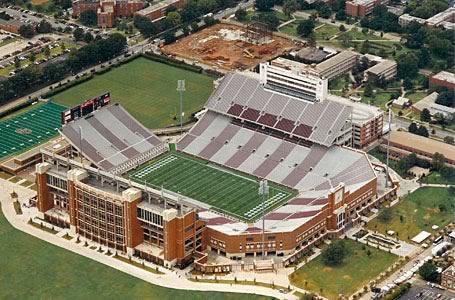
    The University of Oklahoma is in Norman, 23 miles south of Oklahoma City, and plays its football games at Gaylord Family-Oklahoma Memorial Stadium at Owen Field. Originally built in 1923, it now seats 82,112 people. Led by running back Tommy McDonald and center-linebacker Jerry Tubbs, from 1953 to 1957 the Sooners won 47 straight games, and that's still a college football record. (Both the last team and the next team to beat them was Notre Dame.)
    The stadium was the site of the 1971 "Game of the Century," when Oklahoma and Nebraska, a great rivalry which has fallen by the wayside as they've gone into separate leagues, played each other on Thanksgiving Day (the only major college football game scheduled for that day that year, thus the entire country could watch it), with the Sooners ranked Number 1 and the Cornhuskers ranked Number 2. Nebraska won, and went on to win the National Championship. But the Sooners have won 7 National Championships: 1950, 1955 and 1956 under Bud Wilkinson; 1974 and 1975 under Chuck Fairbanks; 1985 under Barry Switzer, and 2000 under current coach Bob Stoops.

    Oklahoma has had 5 winners of the Heisman Trophy: 1952 running back Billy Vessels, 1969 running back Steve Owens, 1978 running back Billy Sims, 2003 quarterback Jason White and 2008 quarterback Sam Bradford. Their litany of football legends also includes Pro Football Hall-of-Famers Tommy McDonald and Lee Roy Selmon, and All-Pros Greg Pruitt, Joe Washington, Dewey Selmon, Tony Casillas and Keith Jackson (not the sportscaster, who did have to call some of his games). It also includes Bob Kalsu, a Buffalo Bills tackle who was killed in action in Vietnam; Brian Bosworth, the linebacker known more for his attitude and "style" than his playing; and, ironically, the 1949 quarterback who became the greatest coach ever at their biggest rivals -- not Oklahoma State, but the University of Texas: Darrell Royal.

    The stadium is located at 180 W. Brooks Street & S. Jenkins Avenue. The OU (never "UO," even though that's more correct) campus can be reached from Oklahoma City via the Number 24 bus. The ride takes about an hour.

    Their basketball arena, the 11,562-seat Lloyd Noble Center, opened in 1975, and has hosted 5 Big 8 regular-season titles, 1 titles since moving to the Big 12, 7 conference tournament titles, and Final Four teams in 1988, 2002 and 2016. It hosted concerts by Elvis on March 25 and 26, 1977; and one of the New Orleans/Oklahoma City Hornets' games in 2006, due to a scheduling conflict with the new OKC arena. 2900 Jenkins Avenue, about a mile and a half south of the stadium.

    Oklahoma State University is in Stillwater, 67 miles northeast of Oklahoma City. They play at Boone Pickens Stadium, formerly named Lewis Field. Built in 1920, it was the oldest stadium in the former Big 8 Conference, and is now the oldest in the league currently (but erroneously) known as the Big 12. It seats 60,218, and is unusual among U.S. football stadiums in that its field is aligned east-to-west. (Most, including Owen Field, are north-to-south due to sun issues.) Oil baron T. Boone Pickens, an OSU alum, had donated $165 million to his alma mater to boost their athletic facilities.

    Their stars have included 1940s halfback Bob Fenimore, Super Bowl-winning Dallas Cowboy and chewing tobacco spokesman Walt Garrison, 4-time Super Bowl-winning Pittsburgh Steeler tackle Jon Kolb, Cleveland Browns All-Pro tackle Jerry Sherk, 1988 Heisman Trophy winner Barry Sanders and current Dallas Cowboys All-Pro receiver Dez Bryant. In the 1940s, they had a 2-way end named Neill Armstrong. Note the extra L: This man did not walk on the Moon. Aside from his name, he's best known as the head coach the Chicago Bears fired in 1981 to make way for Mike Ditka.

    The Cowboys have never won a National Championship, although they have won their conference 10 times, most recently taking the Big 12 title in 2011. Pickens Stadium is at 700 W. Hall of Fame Avenue & Hester Street. You're going to need a car to get there from Oklahoma City.

    The OU-OSU rivalry, known as "The Bedlam Series," includes one of the most lopsided college football matchups, maybe the most lopsided among major rivalries: The Sooners have won 86 times, the Cowboys only 18, with 7 ties.

    Oklahoma also has decent programs in baseball, track, wrestling, and basketball, having made the NCAA Final in 1947 and 1988 (though losing both times). Oklahoma State, known until 1958 as Oklahoma A&M, won the National Championship in basketball in 1944 and 1945, coached by Hank Iba, and led by one of the first 7-footers, Bob "Foothills" Kurland, who, despite his size and talent, never played in the NBA. They also reached the Final Four in 1949, 1951, 1995 and 2004. They also have the nation's most successful wrestling program (even more National Championships than the University of Iowa), built by coach Ed Gallagher.

    OSU's Gallagher-Iba Arena opened in 1938, at the eastern end of Lewis Field/Pickens Stadium. It still uses its original basketball court, and is known as "The Rowdiest Arena in the Country," "The Madison Square Garden of The Plains" and "Mr. Iba's House of Horrors." OU plays basketball at the Lloyd Noble Center.
    Oklahoma's other major city, Tulsa, home to 400,000 people, is 106 miles northeast of Oklahoma City -- roughly as far apart as New York and Philadelphia, without the advantage of high-speed rail in between. Interstate 44, known in this section as the Turner Turnpike, connects the cities.
    And yet, Tulsa, the smaller city and not the State Capital, had a permanent "major league" team before OKC did, unless you count the temporary New Orleans-Oklahoma City Hornets. The WNBA's Tulsa Shock, formerly the Detroit Shock, played at the BOK Center, before moving to Dallas for the 2016 season. (BOK, at least officially, stands for Bank of Oklahoma.) Opening in 2008, it seats 17,839, a big arena for a city that size.

    The University of Tulsa, whose teams are called the Golden Hurricane, play football at Skelly Field at H.A. Chapman Stadium, a 30,000-seat facility built in 1930 but heavily renovated since, so that it looks nothing like a stadium from that period. It was home to the Tulsa Roughnecks of the old North American Soccer League, winning the 1983 title. (Another team of that name has begun play in U.S. soccer's 3rd division, but in a smaller stadium.)

    The USFL's Oklahoma Outlaws played their one and only season there, in 1984. Steve Largent and Dennis Byrd played there for the Hurricane, Doug Williams for the Outlaws. S. Florence & E. 8th Streets.

    On November 19, 2018, Moneywise compiled a list of their Worst College Football Stadiums, the bottom 19 percent of college football, 25 out of 129. Tulsa's Skelly Field came in 18th. 

    Langston University is now in the NAIA, effectively NCAA Division IV. They won National Championships for historically black colleges and universities (HBCUs) in football in 1939 and 1941, and in basketball in 1944 and 1946. 701 Sammy Davis Jr. Drive in Langston, 42 miles northeast of downtown Oklahoma City.

    Elvis sang in Tulsa at the Fairground Pavilion (now the Expo Square Pavilion, 4145 E. 21st Street) on April 18, 1956; the Civic Assembly Center (now the Cox Business Center, across 3rd Street from the BOK Center) on June 20, 1972; and at the Mabee Center on the campus of Oral Roberts University (7777 S. Lewis Avenue) on March 1 and 2, 1974; July 4, 1976.

    Elvis also sang in Oklahoma in June 1955, before he became nationally famous, at the high school auditorium in Guymon on the 1st; the McMahon Memorial Auditorium (an 8 PM show) and the Southern Club (an 11 PM show) in Lawton on the 23rd; and at the City Auditorium in Altus on the 24th.

    Outside of sports, the most famous native of Oklahoma is probably Will Rogers. The ranch where he was born is on a lake northeast of Tulsa, at 9501 East 380th Road in Oologah. And the Will Rogers Memorial Museum is near it, at 1720 W. Will Rogers Blvd. in Claremore.

    Yankee Legend Mickey Mantle was born in Spavinaw, 174 miles northeast of Oklahoma City; grew up in a shotgun shack at 319 S. Quincy Street in Commerce, 198 miles northeast; and played semipro ball, since Commerce High School didn't have a baseball team (though it did have a football team, on which he excelled), in towns where 4 States come together: Oklahoma, Kansas, Missouri and Arkansas. Joplin, Missouri, just 28 miles northeast of his home, was the site of his 1st pro team, a Class C team (equivalent to Class A ball today) called the Joplin Miners. The house still stands, but while there's been discussions of turning it into a Mantle museum, it remains vacant. Mickey lived his adult life (the off-season part of it, anyway) in Dallas, 205 miles south of Oklahoma City, and is interred there.

    Mickey's successor as Yankee center fielder (if you don't count the 2 years he switched positions with 1st baseman Joe Pepitone to ease the strain on his legs in those pre-DH days), Bobby Murcer, lived his whole off-season life in Oklahoma City, graduating from Southeast High School. Like Mantle, he attracted some attention from OU football, but chose baseball instead. Cincinnati Reds superstar Johnny Bench, although born in Oklahoma City, grew up 60 miles to the west, in Binger.

    Mantle is buried in Dallas. Bobby Murcer is buried at Rose Hill Burial Park, at 6001 NW Grand Blvd., 5 miles north of downtown Oklahoma City. Bus 5 to Classen and Grand Blvds. Allie Reynolds is buried at Memorial Park Funeral Home & Cemetery, 13313 N. Kelley Avenue, 11 miles north of downtown. Not reachable by public transit. Legendary pitcher Warren Spahn, a native of Buffalo who moved to Oklahoma where his wife was from, is buried at Elmwood Cemetery in Hartshorne, 145 miles east of Oklahoma City.

    The greatest athlete ever to come from Oklahoma wasn't Mantle, or Murcer, or Reynolds, or Bench, or the many great running backs at OU (such as Heisman winners Billy Vessels, Steve Owens and Billy Sims) and OSU (such as Thurman Thomas and Heisman winner Barry Sanders, who were teammates for 2 seasons in the 1980s). It was Jim Thorpe, both the greatest football player and the greatest track and field performer of the 1st quarter of the 20th Century, and a man who once hit .317 in Major League Baseball.

    The only Oklahoma home of Thorpe's known to still stand is one he owned from 1917 to 1923, and it's now a museum. 706 E. Boston Avenue in Yale, about 83 miles northeast of Oklahoma City, closer to Tulsa. Thorpe is buried in Pennsylvania.

    There has never been a President who was born or spent significant time in Oklahoma, and so there's no Presidential Library there. Dwight D. Eisenhower was born close to the State Line, in Denison, Texas, but grew up in Abeline, Kansas, and always considered himself to be from there.

    Herbert Hoover's Vice President was an Oklahoman, Charles Curtis, believed to be the 1st person of Native American descent to serve in the U.S. Congress, and he served in both houses. Typical for Vice Presidents, he tends to get forgotten. Then again, Hoover should have been so lucky.

    Carl Albert, known as the Little Giant from Little Dixie (he was 5-foot-4), served a northeastern Oklahoma district in Congress from 1947 to 1977. From 1955 onward, he served in the Democratic Party's leadership in the House of Representatives, and was Speaker of the House from January 21, 1971 to January 3, 1977.

    This meant that, from Spiro Agnew's resignation of the Vice Presidency on October 10, 1973 until Congress approved House Minority Leader Gerald Ford as Vice President on December 6, and again from Richard Nixon's resignation making Ford President on August 9, 1974 until Nelson Rockefeller's confirmation as Vice President on December 19, Albert was the next person in line for the Presidency.

    If Nixon or Ford had died during those times -- or, a very real danger the 1st time around, if evidence was discovered that would have forced Nixon's earlier resignation -- the Presidency would have passed to Albert, and thus from a Republican to a Democrat, without an election. Knowing this, Albert never lifted a finger to make himself President. Quite the opposite: He made Ford's confirmation as Vice President as smooth as he could. In spite of their political differences, they were friendly.

    The Devon Energy Center, opening in 2012 at 844 feet, is tallest building in Oklahoma -- indeed, it's the tallest building between Chicago and Dallas. 280 W. Sheridan Avenue at Robinson Street.

    Aside from Thunderstruck, the most notable movies set in Oklahoma are the 1940 version of John Steinbeck's The Grapes of WrathThe Outsiders, Far and Away, Twister (as you might guess for a State known as "Tornado Alley"), Elizabethtown and The Killer Inside Me.

    Cimarron, made in 1931 off Edna Ferber's novel, and based on the 1889 land rush that created Oklahoma as we know it, was perhaps the 1st great Western of the sound film era. It was remade in color in 1960, shortly after NBC aired an unrelated Western series named Cimarron City. A few years later, CBS aired a Western series named Cimarron Strip. However, none of those movies was actually filmed in Oklahoma, instead using Southern California locations.

    The TNT crime drama Saving Grace was set in Oklahoma City, hometown of its creator Nancy Miller. While it used some location shots, it was largely filmed in Los Angeles and Vancouver. The HBO series Carnivàle was also set in Oklahoma, but filmed in Southern California.

    (UPDATE: In 2021, Hulu premiered the drama Reservation Dogs, set on a Native American reservation in Oklahoma. The show, whose title is a play on the Quentin Tarantino film Reservoir Dogs, is billed as the 1st TV series filmed completely in Oklahoma.)

    Special Agent Eleanor "Ellie" Bishop on NCIS grew up on an Oklahoma farm and is an Oklahoma State graduate, and had an OSU pennant on the wall of her cubicle. She was played by Emily Wickersham (who has since left the series), who actually grew up in Mamaroneck, New York and went to Muhlenberg College in Pennsylvania. The University of Oklahoma doesn't have a claim on a pop-culture figure even that big.

    *

    Oklahoma is a long way from New York, but Oklahoma City is no one-horse town in the middle of nowhere. It's an interesting place, and a good place to watch a basketball game. Good luck to anyone going to see the Knicks or the Nets play the Thunder there this season. 

    Monday, May 31, 2021

    May 31, 1921: The Tulsa Race Massacre

    May 31, 1921, 100 years ago: The Tulsa Race Massacre begins, and continues into the next day. Mobs of White residents, some of them deputized and given weapons by city officials, attacked Black residents and destroyed homes and businesses of the Greenwood District in Tulsa, Oklahoma. The attacks burned and destroyed more than 35 square blocks of the neighborhood – at the time one of the wealthiest Black communities in the United States, known as "Black Wall Street."

    More than 800 people were admitted to hospitals, and as many as 6,000 Black residents of Tulsa were interned in large facilities, many of them were interned for several days. The Oklahoma Bureau of Vital Statistics officially recorded 36 dead. The actual death toll may have been as high as 300.

    The massacre began when 19-year-old Dick Rowland, a Black shoeshiner, was accused of assaulting Sarah Page, the 17-year-old White elevator operator in the nearby Drexel Building. He was taken into custody. After he was arrested, rumors which stated that he was going to be lynched were spread throughout the city.

    Upon hearing reports that a mob of hundreds of White men had gathered around the jail where Rowland was being held, a group of 75 Black men, some of whom were armed, arrived at the jail in order to ensure that Rowland would not be lynched. The sheriff persuaded the group to leave the jail, assuring them that he had the situation under control.

    An old white man approached O.B. Mann, a Black man, and demanded that he hand over his pistol. Mann refused, and the old man attempted to disarm him. Mann shot him, and then, according to the sheriff's reports, "all hell broke loose." At the end of the exchange of gunfire, 12 people were dead, 10 White and 2 Black. Subsequently the militants fled back into Greenwood shooting as they went. White rioters invaded Greenwood that night and the next morning, killing men and burning and looting stores and homes. Around noon on June 1, the Oklahoma National Guard imposed martial law, ending the massacre.

    About 10,000 Black people were left homeless, and property damage amounted to more than $1.5 million in real estate and $750,000 in personal property, equivalent to $32.7 million today. Many survivors left Tulsa, while Black and White residents who stayed in the city largely kept silent about the terror, violence, and resulting losses for decades.

    The massacre was largely omitted from local, state and national histories. Growing up white in a mostly-white suburb in the 1970s and '80s, I didn't learn about it until around 2000 or so. With the growth of the Black Lives Matter movement in the early 21st Century, the event has re-entered the national consciousness, including as a plot point in the 2017 TV miniseries version of Watchmen.

    Friday, November 9, 2018

    How to Be a New York Basketball Fan In Oklahoma City -- 2018-19 Edition

    The New York Knicks visit Oklahoma City to play the Thunder next Wednesday. The Brooklyn Nets' visit this season will be on March 13.

    The Nets formerly played in Newark, "Brick City," and Oklahoma City is known as "Bricktown," not to be confused with Brick Township on the Jersey Shore, which also (in their case, incorrectly) gets called "Bricktown" or "Brick Town."

    Judging by how the fans of OKC have embraced their 1st real major league sports team -- the USFL's Oklahoma Outlaws played in Tulsa, as didthe WNBA's Tulsa Shock, and, besides, those are hardly major leagues -- it can safely be said that the people of Oklahoma City deserved their own team. But not the Seattle SuperSonics: They should have gotten either an expansion team or a team whose fans weren't supporting it.

    But we should not hold Oklahoma accountable for that. Besides, it's not like they went out of their way to steal a team: It was the owner who bought the Sonics and moved them, because he didn't like Seattle's Key Arena.

    No, don't hold Oklahomans responsible for stealing the Sonics -- they didn't. If you want to knock them for something, knock them for electing Tea Party dimwits to public office.

    Before You Go. Oklahoma is part of the Great Plains region. There aren't a lot of trees to shade you or to block the wind. As a result, it gets beastly hot in the summer, and brutally cold in the winter. This will be mid-October, so you should be spared particularly cold weather.

    The website for The Daily Oklahoman is predicting low 50s for Wednesday afternoon, and high 30s for Wednesday night. Bring a jacket.

    Oklahoma City -- indeed, the entire State except for the westernmost Panhandle, which is on Mountain Time -- is in the Central Time Zone, 1 hour behind New York. Adjust your timepieces accordingly.

    Tickets. The Thunder averaged 18,203 fans per home game last season -- a sellout every game. They're the only game in town -- the Sooners are a 45-minute drive away -- and have been fully embraced by a populace used to following just the one sport, college football. Getting tickets will be tough.

    Unlike last season, the Thunder are not restricting online ticket sales to residents of Oklahoma and the surrounding States. So you may be able to use the team website as a source. But don't overlook other sources, as you may be able to get a better deal.

    Tickets in the lower level, the 100 sections, are $116 between the baskets and $80 behind them. The 200 level is club seating, and available only to season ticketholders. The Balcony and Loft level, the 300 sections, has seats going for $27 between the baskets and $15 behind them.

    Getting There. It's 1,451 miles from Madison Square Garden to the Chesapeake Energy Arena. Knowing this, your first reaction is going to be to want to fly.

    You won't get a nonstop flight. There are any number of cities in which you would have to change planes, depending on the airline: Charlotte, Chicago, Dallas, for example. This week, it would be about $760. Will Rogers World Airport is southwest of downtown, but there is no local bus service between them.

    Amtrak isn't all that convenient to OKC. You'd have to board the Lake Shore Limited at Penn Station at 3:40 PM Eastern Time, then arrive at Union Station in Chicago at 9:45 AM Central Time the next morning, then there's a 4-hour layover until the Texas Eagle leaves at 1:45 PM, and it arrives in Fort Worth the next day at 1:25 PM, and then you'd have to change trains again, with a 4-hour layover -- in Fort Worth, not the despised but much more modern city of Dallas -- before taking the Heartland Flyer at 5:25, finally arriving in Oklahoma City at 9:27 PM. That's 62 hours and 42 minutes. And it's prohibitively expensive, $726 round-trip. That may not be worth the hassles. At any rate, the station is on Gaylord Blvd., between Reno and Sheridan Avenues, just 2 blocks from the arena -- sure, now, at the end, it's convenient.

    On Greyhound, the trip is much shorter, about 39 hours, and you only have to transfer once, and, believe me, 4 hours in Chicago is good. (More hours in Chicago is better, but that's a story for another time.) It's also possible that your transfer may be in Kansas City. The round-trip fare is $498, but can drop to $344 with advanced purchase. The station is at 1948 E. Reno Avenue at Martin Luther King Avenue, on the same street as the arena, but 2 miles to the east, so what it makes up for in convenience during the trip, it blows up at the end -- the opposite of Amtrak.

    If you decide to drive, it's far enough that it will help to get someone to go with you and split the duties, and to trade off driving and sleeping. You'll need to get on the New Jersey Turnpike, and take Interstate 78 West across New Jersey, and at Harrisburg get on the Pennsylvania Turnpike, which at this point will be both I-70 and I-76. When the two Interstates split outside Pittsburgh, stay on I-70 west. You'll cross the northern tip of West Virginia, and go all the way across Ohio (through Columbus), Indiana (through Indianapolis) and Illinois.

    When you cross into Missouri, you'll be in St. Louis, going over the new Stan Musial Veterans Memorial Bridge. Switch to Interstate 44 West, the Will Rogers Turnpike, and take that across southern Missouri and northeastern Oklahoma. Outside Edmond, you'll turn onto Interstate 35 South, then onto Interstate 40 West, taking Exit 150B for downtown Oklahoma City and the Arena.

    If you do it right, you should spend about an hour and 15 minutes in New Jersey, 5 hours in Pennsylvania, 15 minutes in West Virginia, 3 hours and 45 minutes in Ohio, 2 hours and 30 minutes in Indiana, 2 hours and 30 minutes in Illinois, 5 hours in Missouri, and 3 hours and 30 minutes in Oklahoma before arriving. That's going to be nearly 24 hours. Counting rest stops, preferably 6 of them, and accounting for traffic at both ends, it should be about 30 hours.

    Once In the City. Oklahoma City, the capital of the State of Oklahoma, was founded in 1889 as a result of the Oklahoma land rush, after the former Indian Territory was legally (if not morally) opened up to white settlers. (As a result, their minor-league baseball team was long called the 89ers.) The name comes from the Choctaw tribe, meaning "red people."
    The State House. The statue is called Tribute to Range Riders,
    and does not represent any particular person.

    It's a decent-sized city, with about 630,000 people, but the metropolitan area is small, just 1.3 million. This makes it the 2nd-smallest market in the NBA, larger than only Salt Lake City, home of the Utah Jazz. It would also be the smallest in MLB, and smaller than all U.S.-based NHL cities, though it would also be larger than Ottawa, Calgary, Edmonton and Winnipeg. The city is about 56 percent white, 17 percent Hispanic (nearly all of that Mexican), 15 percent black, 4 percent Asian, and 4 percent Native American.

    Oklahoma's darkest hour came on May 31, 1921, when mobs of White residents, some of them deputized and given weapons by city officials, attacked Black residents and destroyed homes and businesses of the Greenwood District in Tulsa, Oklahoma. The attacks burned and destroyed more than 35 square blocks of the neighborhood – at the time one of the wealthiest Black communities in the United States, known as "Black Wall Street." As many as 300 people were killed.

      The sales tax in the State of Oklahoma is 4.5 percent, but in Oklahoma City it nearly doubles to 8.375 percent. Gaylord Blvd. divides street addresses into east and west, while Sheridan Avenue divides them into north and south. Oklahoma City doesn't have a subway or a light rail system (not surprising, they're more Southern than Midwestern), but they are building a light rail system, the Oklahoma City Streetcar, scheduled to open late next year. EMBARK buses charge just $1.75.

      ZIP Codes for Oklahoma start with the digits 73 and 74. The Area Code for most of the State is 405. The city has no "beltway." Oklahoma Gas & Electric (OG&E) runs the State's electricity.

      Going In. The Thunder's building opened in 2002 as the Ford Center, but became the Chesapeake Energy Arena in 2011. It's now known as "The 'Peake" for short. When the Thunder reached the NBA Finals in 2012, the exposure of the arena's name caused the namesake company's stock to surge. The address is 100 W. Reno Avenue, and the arena is bounded by Reno, Gaylord Blvd., 3rd Street and Robinson Avenue, which is known as Thunder Drive as it passes the arena. Parking is $8.00.
      The building is in the usual post-Camden Yards style, with concourses for each level. The court is laid out northwest to southeast. It remains a college basketball center (having hosted the Big 12 Conference Tournament), and a site for pro wrestling and Ultimate Fighting. It has also hosted minor-league hockey, but currently does not.
      Interior shot, showing the original Ford Center name

      UPDATE: The name of the arena was changed to the Paycom Center in 2021.

      Food. Levy Restaurants runs the concessions at Chesapeake Energy Arena. In addition to the usual array of stands selling typical sports-stadium food, they have, according to the arena's website:

      * The Jack Daniels Old No. 7 Club is located on the 100 level concourse at section 114-115. Old No. 7 provides a trendy and unique atmosphere with full bar offerings and several beers on tap. A selection of appetizers are available in this local hot spot.

      * The Center Court Carvery is located on the 100 level concourse at section 114-115 across from the Jack Daniels Old No. 7 Club. Center Court Carvery provides a unique, upscale dining experience with a full buffet at each game featuring carved meat options, an assortment of salads, potatoes, vegetables and breads. A carved sandwich option with one side is also available for those looking for something quick, yet filling. Center Court Carvery's buffets change nightly, so check back often to see what's on the cutting board at Center Court!

      * Center Court Grill is the new urban hot spot for guests inside Chesapeake Energy Arena. Center Court Grill will be open 2 1/2 hours prior to every Thunder home game for ticket holders. The restaurant will also be open for ticketed concerts and other select ticketed events throughout the year. Center Court Grill features a menu that has a balance between grilled entrees, sandwiches and house-made BBQ.

      Team History Displays. As the newest team in the NBA, dating back only to 2008 (though one of its older franchises, dating back to 1967), the Thunder's history is nearly all that of the Seattle SuperSonics, even though they can't count it as such.

      While it should be noted that they have made the Playoffs in 8 out of their 9 full seasons since moving in -- missing in 2015, and not counting their lockout-truncated original 2008-09 season -- despite being stuck in the Western Conference with the Kobe Bryant Lakers, the Dirk Nowitzki Mavericks, the Tim Duncan Spurs and the Steph Curry Warriors. Indeed, since 1998, the count of Western Conference titles is as follows: L.A. 7, San Antone 6, Golden State 4, Dallas 2, OKC 1.

      The Thunder had a streak of winning their Division in 5 of 6 seasons, and hang 5 white banners with blue lettering to denote this: 2011, 2012, 2013, 2014 and 2016. They also hang a blue banner with white lettering to denote their 2012 Western Conference title.
      As the Sonics, they previously won the 1979 NBA title; the West in 1978, 1979 and 1996; and the Pacific Division in 1979, 1994, 1996, 1997, 1998 and 2005. But they make no mention of this at the Arena. The Sonics' banners, and those of the WNBA's Seattle Storm, remain at the Key Arena at Seattle Center.

      The Thunder recently retired their 1st uniform number, the 4 of forward Nick Collinson, who played with the franchise from 2003 to 2018, including the last 5 years in Seattle.

      The Sonics retired 6 uniform numbers, and, along with them in the rafters at the Key Arena, hung a banner for broadcaster Bob Blackburn. Except for 10, for guard Nate McMillan from their 1996 Western Conference Champions, all of those numbers (as well as Blackburn's honor) were from their 1978 Western Conference Champions and their 1979 NBA Champions: 1, guard Gus Williams; 19, guard Lenny Wilkens (who, by that point, was a non-playing coach, but did play 4 years for the Sonics); 24, forward Spencer Haywood; 32, guard Fred "Downtown" Brown; and 43, center Jack Sikma.

      The 20 of guard Gary Payton and the 40 of forward Shawn Kemp from the 1996 team might have been retired had the Sonics still been in Seattle when they retired. Those 2, and the 6 that are officially retired, have been kept out of circulation: No member of the Thunder from 2008 onward has worn any of them.

      My guess is that the Thunder's management is waiting until Seattle gets a new (expansion or moved) team, at which point the Sonics' records and achievements will be officially given back to them, and the Thunder can then give those numbers out with a clear conscience.

      Wilkens was the only Sonics player named to the NBA's 50th Anniversary 50 Greatest Players in 1996. Sheryl Swoopes, who played her last WNBA season with the Tulsa Shock, was named to the WNBA Top 20 at 20 in 2016 -- in the 20th Season, rather than at the 20th Anniversary.

      Stuff. Concession stands selling team merchandise are scattered throughout the arena. I can find no reference to where in the arena a team store is located, but I find it hard to believe that an organization as professional as the Thunder have been the last 6 seasons would not have at least one large one. Since Oklahoma likes to think of itself as a Western State, you may be able to buy cowboy hats with team logos on them.

      As they are not yet a historic franchise, there aren't many books about the Thunder. Nate LeBoutillier has written The Story of the Oklahoma City Thunder as part of the NBA's A History of Hoops book series. (I wonder if it goes over the history of the SuperSonics, or if it just mentions them as the Thunder's predecessors.) As part of the NBA's The Inspirational Story of Basketball Superstar...
      series, Bill Redban has written books about Kevin Durant, Russell Westbrook and James Harden. These are, admittedly, unauthorized biographies.

      There aren't yet team DVDs of the Thunder, but there is a movie about them: Thunderstruck, a cross between Freaky Friday and Space Jam, in which a kid unwittingly and magically exchanges basketball abilities with then-Thunder star Kevin Durant, as in the kid becomes a high school basketball star, while Durant can't buy a basket. Amazon.com has Sonicsgate: Requiem for a Team, but that's more for the Seattle fan.

      During the Game. A November 13, 2014 article on DailyRotoHelp ranked the NBA teams' fan bases, and listed the Thunder's fans 10th. Of course, it's worth noting that, aside from their 23-59 1st season, when the fans still came out due to the novelty, they've averaged 53 wins a season. So we don't yet know how their fans would react to a bad established team.

      You do not need to worry about wearing Knicks or Nets gear as an opposing fan against the Thunder. Their main rivals are the Mavs and the Spurs, and their fans don't get rough with those guys, so they won't get rough with you.

      Nevertheless, having just the 1 team in the 4 major league sports -- not even in MLS, and the WNBA's Tulsa Shock were a ways off -- the same effect applies to the Thunder as applies to the other NBA-only cities, where the NBA team means everything: San Antonio, Salt Lake City, Sacramento and Portland. (To be fair, San Antonio also has a WNBA team, while Salt Lake and Portland have the WNBA and MLS.)

      As Bill Simmons, in a rare thoughtful moment for him, wrote for ESPN:

      With the possible exception of  Portland, no NBA team means more to its city. This goes beyond having the loudest fans. There's genuine devotion here. These people arrived a good 45 minutes early for last night's Game 1 — and by "these people" I mean "everyone with a ticket" — then clapped their way through pregame warm-ups with such infectious enthusiasm that I remember saying to a friend, "No way these yahoos keep this up for three hours, they're going to burn out." Wrong. You know what burned out? My eardrums. My head is still ringing.

      Simmons speculated that the 1995 Oklahoma City bombing played a major part in the team's culture, noting that Thunder general manager Sam Presti has every new Thunder player visit the memorial to the event, and encourages players to look into the stands and consider that many of the team's fans were personally affected by the event.

      On February 17, 2009, Rumble the Bison was introduced as the Thunder's mascot during the halftime of a game against, appropriately enough, the team that used the arena (then still named the Ford Center) as their temporary home after Hurricane Katrina, the New Orleans Hornets. Rumble was a big hit in that 1st season, and was awarded the 2008–09 NBA Mascot of the Year. Although I'm not sure having a mascot with a "beard" that covers up the team name on his jersey is a good idea.
      Image result for rumble bison drum
      Rumble don't wanna work. He just wanna bang on the drum all day.

      They also have the Thunder Girls cheerleaders. There is also Thundor, a "celebrity fan" who dresses like a luchador, a Mexican professional wrestler. (Baseball's Arizona Diamondbacks also have one, and he's official.) His real name is Garret Havilland -- not Mexican, or even Spanish -- and he carries a megaphone, making him a pain in the neck to free-throw shooters when the visiting team is playing toward his end.
      In real life, he has a psychology degree and runs a home for troubled teenage girls, so, despite his silly appearance, he is a very serious and admirable man, unlike some other infamous NBA fans like Robin Ficker, the disbarred lawyer known for heckling opponents at Washington Wizards games. He even shows enough respect for the girls he works with that he asks them to teach him dance moves, so he can stay current.

      Neither of the New York City teams' visits to Oklahoma City this season will feature a promotion. The Thunder hold auditions for singing the National Anthem, instead of having a regular singer. The OKC-based band The Flaming Lips rewrote their song "Race for the Prize," giving it the title "Thunder Up," to use as a team fight song. The words "Thunder Up" have also become a team slogan.

      Like fans of the Winnipeg Jets hockey team, Thunder fans tend to wear white T-shirts in the stands, providing a "Whiteout" effect that supposedly distracts opposing players. (How much it does so is debatable.)
      After the Game. In Oklahoma City, the violent crime rate is one of the highest in the nation. However, if you stick to the downtown area, you should be safe.

      Most of the notable places to eat are to the northeast of the arena, across the railroad tracks and closer to the ballpark. Mickey Mantle's Steakhouse -- unlike the now-closed restaurant named for him on New York's Central Park South, it didn't open until after he died -- is across the street from the ballpark, at 7 S. Mickey Mantle Drive.

      Bricktown Brewery, Spaghetti Warehouse, TapWerks Ale House, Pearl's Crabtown and the Wormy Dog Saloon (I swear, I am not making that name up) are along E. Sheridan Avenue. Jazmo'z Bourbon Street Café and Whiskey Chicks are along Reno Avenue.

      If your visit to Oklahoma City is during the European soccer season, as we are now in, your best bet for a place to watch your club is Skinny Slim's, at 201 E. Main Street, downtown.

      Sidelights. Oklahoma's sports history includes Jim Thorpe, Johnny Bench, and Yankee Legends Mickey Mantle, Bobby Murcer and Allie Reynolds. And then there's all those college football legends, although not every OU and OSU legend was originally from Oklahoma.

      * Chickasaw Bricktown Ballpark. Opened in 1998, this is the home of the Oklahoma City Dodgers, now the top farm team of the Los Angeles Dodgers. Previously, they were known as the 89ers and the RedHawks. They haven't yet won a Pennant since moving into the Class AAA Pacific Coast League (and Oklahoma isn't exactly on any coast), but they have won Division titles in 1999, 2002, 2004, 2005, 2008, 2010, 2013 and 2015.
      Every street bordering the ballpark is named for a local legend. The official address is 2 S. Mickey Mantle Drive, but outside the ballpark it's Walnut Avenue. It runs along the 3rd base side. Reno Avenue runs along the 1st base side, where it is named Johnny Bench Drive. The right field side is Russell M. Perry Avenue, except next to the ballpark where it is Joe Carter Avenue, after the Toronto Blue Jays legend. And a street that only exists for a few blocks along the left field side is named for the aforementioned local band, Flaming Lips Alley. Statues of Mantle and Bench are outside the park.
      Prior to the new ballpark opening, the team was known as the Oklahoma City 89ers, and competed in the Class AAA American Association. They played at All Sports Stadium, and won Pennants in 1963, 1965, 1992 and 1996. It was located in State Fair Park at 333 Gordon Cooper Blvd. at Eighty-Nine Drive, about 5 miles west of downtown. Number 38 bus from downtown.

      According to an April 24, 2014 article in The New York Times, the most popular MLB team in Oklahoma City, according to Facebook Likes, is the Texas Rangers, which is not surprising, since they are the closest team, 209 miles away. However, they get only about 20 percent of the fans, and the Yankees and Red Sox are not far behind. By the time we got into Tulsa town, them bears was a-gettin' smart... Sorry, drifted into C.W. McCall's "Convoy" there.

      But before you get all the way from OKC to Tulsa, it becomes mainly St. Louis Cardinals territory. The Kansas City Royals? You need to get into northernmost Oklahoma, near the Kansas State Line, to find their fans, although that may have changed in the time since the article, due to the Royals having won 2 Pennants and a world Series.

      According to a September 5, 2014 article in The Atlantic Monthly, when it comes to the NFL, the most popular team in the entire State of Oklahoma is the Dallas Cowboys. Cowboys territory also includes all of Texas except the part around Houston, and all but the northwesternmost part of New Mexico, and all but the southeasternmost part of Arkansas.

      The Cowboys are 210 miles away. Fans of the Kansas City Chiefs and even the Denver Broncos, not that far from the western tip of the Oklahoma Panhandle, need not apply for Oklahoma City football fandom. This was also true for the Rams when they were still in St. Louis. Dallas is also home to the nearest NHL team, the Stars, 204 miles away; and the nearest Major League Soccer team, FC Dallas, 189 miles away.

      * Soccer. The Oklahoma City Energy began play in U.S. soccer's 2nd division, the United Soccer League, in 2014. They play at Taft Stadium, which seats 7,500, renovated in 2015 after opening in 1934. 2501 North May Avenue, 4 miles west of downtown. Bus 23.

      Rayo OKC, owned by Rayo Vallecano of Spain's La Liga, and wearing near-identical uniforms, lasted only the 2016 season, playing in U.S. soccer's 2nd division, the new version of the North American Soccer League. They played at 7,000-seat Miller Stadium, the home field of Yukon High School, in Yukon, a suburb of Oklahoma City. 13 miles west of downtown. There is no public transportation out there.

      Because of its comparatively low metropolitan population, Oklahoma City would rank 31st in MLB, and 33rd in the NFL, in each case dead last. So don't expect them to be awarded a franchise in either league anytime soon.

      * Site of Oklahoma City Bombing. In 1977, the federal government opened the Alfred P. Murrah Federal Building, named for a federal judge whom U.S. Chief Justice Earl Warren had called "one of the foremost figures in the American judiciary." He was not widely known outside Oklahoma, but nearly 20 years after his death, his name became ingrained into the American memory. Since 1963, Timothy McVeigh, who carried out the bombing, is the only prisoner ever executed by the federal government.

      This wasn't the first plot to bomb the building: A man named Richard Snell, a member of a "Christian" extremist group, had threatened to blow the buildup up with a van bomb, perhaps inspiring McVeigh to use the same method. He was convicted of an unrelated murder, and his execution was set for April 19, 1995 -- the very day that the building was destroyed by a bomb anyway. The execution happened as scheduled.

      A memorial to the 168 victims of the worst domestic terrorist attack in American history is now on the site. 200 NW 5th Street & N. Harvey Avenue, about 7 blocks north of the arena. A new federal building was built on a 2-city-block site, 1 block north and west of the former site. It carries out the same functions as the former building, hosting regional offices for the Social Security Administration, the U.S. Secret Service, the Drug Enforcement Administration, recruiting offices for the Army and the Marine Corps, and, most significant in McVeigh's mind, as he was seeking revenge for the Ruby Ridge incident of 1992 and the Waco incident exactly 2 years earlier on April 19, 1993, the Bureau of Alcohol, Tobacco and Firearms.

      * Other Historic Sites. The State Capitol (or State House, if you prefer) is at 2300 N. Lincoln Blvd. at NE 23rd Street, about 3 miles northeast of the arena. Number 2 bus. The Oklahoma History Center is to the immediate northeast of the State House, at 800 Nazih Zuhdi Drive at Lincoln Blvd. According to its website, "The goal is to span the entire breadth of Oklahoma's diverse history from Native Americans to oil."

      The Oklahoma City Museum of Art is a short walk from the Arena, at 415 Couch Drive at Walker Avenue. Contrary to an easy guess, it does not specialize in Western-themed and Native American art. If those interest you, you can visit the National Cowboy and Western Heritage Museum, at 1700 N. 63rd Street, off Grand Blvd., northeast of downtown. Number 22 bus.

      The Beatles never performed in Oklahoma, but Elvis Presley did. He did 2 shows at the Oklahoma City Municipal Auditorium on October 16, 1955, and 2 more on April 19, 1956. (There's that date again.) It's now named the Civic Center Music Hall. 201 N. Walker Avenue at Lee Avenue, about a mile northwest of the arena.

      He also performed at the Fair Ground Arena, next-door to the All Sports Stadium (and also since demolished) on November 16, 1970. He also performed at the Myriad Convention Center on July 2, 1973; July 8, 1975; and May 29, 1976. Seating 13,846, this arena, now named the Cox Convention Center, is across Reno Avenue from the Chesapeake Energy Center, which augmented it, rather than replacing it, as it still hosts lots of conventions.

      The University of Oklahoma is in Norman, 23 miles south of Oklahoma City, and plays its football games at Gaylord Family-Oklahoma Memorial Stadium at Owen Field. Originally built in 1923, it now seats 82,112 people. Led by running back Tommy McDonald and center-linebacker Jerry Tubbs, from 1953 to 1957 the Sooners won 47 straight games, and that's still a college football record. (Both the last team and the next team to beat them was Notre Dame.)
      The stadium was the site of the 1971 "Game of the Century," when Oklahoma and Nebraska, a great rivalry which has fallen by the wayside as they've gone into separate leagues, played each other on Thanksgiving Day (the only major college football game scheduled for that day that year, thus the entire country could watch it), with the Sooners ranked Number 1 and the Cornhuskers ranked Number 2. Nebraska won, and went on to win the National Championship. But the Sooners have won 7 National Championships: 1950, 1955 and 1956 under Bud Wilkinson; 1974 and 1975 under Chuck Fairbanks; 1985 under Barry Switzer, and 2000 under current coach Bob Stoops.

      Oklahoma has had 5 winners of the Heisman Trophy: 1952 running back Billy Vessels, 1969 running back Steve Owens, 1978 running back Billy Sims, 2003 quarterback Jason White and 2008 quarterback Sam Bradford. Their litany of football legends also includes Pro Football Hall-of-Famers Tommy McDonald and Lee Roy Selmon, and All-Pros Greg Pruitt, Joe Washington, Dewey Selmon, Tony Casillas and Keith Jackson (not the sportscaster, who did have to call some of his games). It also includes Bob Kalsu, a Buffalo Bills tackle who was killed in action in Vietnam; Brian Bosworth, the linebacker known more for his attitude and "style" than his playing; and, ironically, the 1949 quarterback who became the greatest coach ever at their biggest rivals -- not Oklahoma State, but the University of Texas: Darrell Royal.

      The stadium is located at 180 W. Brooks Street & S. Jenkins Avenue. The OU (never "UO," even though that's more correct) campus can be reached from Oklahoma City via the Number 24 bus. The ride takes about an hour.

      Their basketball arena, the 11,562-seat Lloyd Noble Center, opened in 1975, and has hosted 5 Big 8 regular-season titles, 1 titles since moving to the Big 12, 7 conference tournament titles, and Final Four teams in 1988, 2002 and 2016. It hosted concerts by Elvis on March 25 and 26, 1977; and one of the New Orleans/Oklahoma City Hornets' games in 2006, due to a scheduling conflict with the new OKC arena. 2900 Jenkins Avenue, about a mile and a half south of the stadium.

      Oklahoma State University is in Stillwater, 67 miles northeast of Oklahoma City. They play at Boone Pickens Stadium, formerly named Lewis Field. Built in 1920, it was the oldest stadium in the former Big 8 Conference, and is now the oldest in the league currently (but erroneously) known as the Big 12. It seats 60,218, and is unusual among U.S. football stadiums in that its field is aligned east-to-west. (Most, including Owen Field, are north-to-south due to sun issues.) Oil baron T. Boone Pickens, an OSU alum, had donated $165 million to his alma mater to boost their athletic facilities.

      Their stars have included 1940s halfback Bob Fenimore, Super Bowl-winning Dallas Cowboy and chewing tobacco spokesman Walt Garrison, 4-time Super Bowl-winning Pittsburgh Steeler tackle Jon Kolb, Cleveland Browns All-Pro tackle Jerry Sherk, 1988 Heisman Trophy winner Barry Sanders and current Dallas Cowboys All-Pro receiver Dez Bryant. In the 1940s, they had a 2-way end named Neill Armstrong. Note the extra L: This man did not walk on the Moon. Aside from his name, he's best known as the head coach the Chicago Bears fired in 1981 to make way for Mike Ditka.

      The Cowboys have never won a National Championship, although they have won their conference 10 times, most recently taking the Big 12 title in 2011. Pickens Stadium is at 700 W. Hall of Fame Avenue & Hester Street. You're going to need a car to get there from Oklahoma City.

      The OU-OSU rivalry, known as "The Bedlam Series," includes one of the most lopsided college football matchups, maybe the most lopsided among major rivalries: The Sooners have won 86 times, the Cowboys only 18, with 7 ties.

      Oklahoma also has decent programs in baseball, track, wrestling, and basketball, having made the NCAA Final in 1947 and 1988 (though losing both times). Oklahoma State, known until 1958 as Oklahoma A&M, won the National Championship in basketball in 1944 and 1945, coached by Hank Iba, and led by one of the first 7-footers, Bob "Foothills" Kurland, who, despite his size and talent, never played in the NBA. They also reached the Final Four in 1949, 1951, 1995 and 2004. They also have the nation's most successful wrestling program (even more National Championships than the University of Iowa), built by coach Ed Gallagher.

      OSU's Gallagher-Iba Arena opened in 1938, at the eastern end of Lewis Field/Pickens Stadium. It still uses its original basketball court, and is known as "The Rowdiest Arena in the Country," "The Madison Square Garden of The Plains" and "Mr. Iba's House of Horrors." OU plays basketball at the Lloyd Noble Center.
      Oklahoma's other major city, Tulsa, home to 400,000 people, is 106 miles northeast of Oklahoma City -- roughly as far apart as New York and Philadelphia, without the advantage of high-speed rail in between. Interstate 44, known in this section as the Turner Turnpike, connects the cities.
      And yet, Tulsa, the smaller city and not the State Capital, had a permanent "major league" team before OKC did, unless you count the temporary New Orleans-Oklahoma City Hornets. The WNBA's Tulsa Shock, formerly the Detroit Shock, played at the BOK Center, before moving to Dallas for the 2016 season. (BOK, at least officially, stands for Bank of Oklahoma.) Opening in 2008, it seats 17,839, a big arena for a city that size.

      The University of Tulsa, whose teams are called the Golden Hurricane, play football at Skelly Field at H.A. Chapman Stadium, a 30,000-seat facility built in 1930 but heavily renovated since, so that it looks nothing like a stadium from that period. It was home to the Tulsa Roughnecks of the old North American Soccer League, winning the 1983 title. (Another team of that name has begun play in U.S. soccer's 3rd division, but in a smaller stadium.)

      The USFL's Oklahoma Outlaws played their one and only season there, in 1984. Steve Largent and Dennis Byrd played there for the Hurricane, Doug Williams for the Outlaws. S. Florence & E. 8th Streets.

      UPDATE: On November 19, 2018, Moneywise compiled a list of their Worst College Football Stadiums, the bottom 19 percent of college football, 25 out of 129. Tulsa's Skelly Field came in 18th. 

      Langston University is now in the NAIA, effectively NCAA Division IV. They won National Championships for historically black colleges and universities (HBCUs) in football in 1939 and 1941, and in basketball in 1944 and 1946. 701 Sammy Davis Jr. Drive in Langston, 42 miles northeast of downtown Oklahoma City.

      Elvis sang in Tulsa at the Fairground Pavilion (now the Expo Square Pavilion, 4145 E. 21st Street) on April 18, 1956; the Civic Assembly Center (now the Cox Business Center, across 3rd Street from the BOK Center) on June 20, 1972; and at the Mabee Center on the campus of Oral Roberts University (7777 S. Lewis Avenue) on March 1 and 2, 1974; July 4, 1976.


      Elvis also sang in Oklahoma in June 1955, before he became nationally famous, at the high school auditorium in Guymon on the 1st; the McMahon Memorial Auditorium (an 8 PM show) and the Southern Club (an 11 PM show) in Lawton on the 23rd; and at the City Auditorium in Altus on the 24th.

      Outside of sports, the most famous native of Oklahoma is probably Will Rogers. The ranch where he was born is on a lake northeast of Tulsa, at 9501 East 380th Road in Oologah. And the Will Rogers Memorial Museum is near it, at 1720 W. Will Rogers Blvd. in Claremore.

      Yankee Legend Mickey Mantle was born in Spavinaw, 174 miles northeast of Oklahoma City; grew up in a shotgun shack at 319 S. Quincy Street in Commerce, 198 miles northeast; and played semipro ball, since Commerce High School didn't have a baseball team (though it did have a football team, on which he excelled), in towns where 4 States come together: Oklahoma, Kansas, Missouri and Arkansas. Joplin, Missouri, just 28 miles northeast of his home, was the site of his 1st pro team, a Class C team (equivalent to Class A ball today) called the Joplin Miners. The house still stands, but while there's been discussions of turning it into a Mantle museum, it remains vacant. Mickey lived his adult life (the off-season part of it, anyway) in Dallas, 205 miles south of Oklahoma City, and is interred there.

      Mickey's successor as Yankee center fielder (if you don't count the 2 years he switched positions with 1st baseman Joe Pepitone to ease the strain on his legs in those pre-DH days), Bobby Murcer, lived his whole off-season life in Oklahoma City, graduating from Southeast High School. Like Mantle, he attracted some attention from OU football, but chose baseball instead. Cincinnati Reds superstar Johnny Bench, although born in Oklahoma City, grew up 60 miles to the west, in Binger.

      Mantle is buried in Dallas. Bobby Murcer is buried at Rose Hill Burial Park, at 6001 NW Grand Blvd., 5 miles north of downtown Oklahoma City. Bus 5 to Classen and Grand Blvds. Allie Reynolds is buried at Memorial Park Funeral Home & Cemetery, 13313 N. Kelley Avenue, 11 miles north of downtown. Not reachable by public transit. Legendary pitcher Warren Spahn, a native of Buffalo who moved to Oklahoma where his wife was from, is buried at Elmwood Cemetery in Hartshorne, 145 miles east of Oklahoma City.

      The greatest athlete ever to come from Oklahoma wasn't Mantle, or Murcer, or Reynolds, or Bench, or the many great running backs at OU (such as Heisman winners Billy Vessels, Steve Owens and Billy Sims) and OSU (such as Thurman Thomas and Heisman winner Barry Sanders, who were teammates for 2 seasons in the 1980s). It was Jim Thorpe, both the greatest football player and the greatest track and field performer of the 1st quarter of the 20th Century, and a man who once hit .317 in Major League Baseball.

      The only Oklahoma home of Thorpe's known to still stand is one he owned from 1917 to 1923, and it's now a museum. 706 E. Boston Avenue in Yale, about 83 miles northeast of Oklahoma City, closer to Tulsa. Thorpe is buried in Pennsylvania.

      There has never been a President who was born or spent significant time in Oklahoma, and so there's no Presidential Library there. Dwight D. Eisenhower was born close to the State Line, in Denison, Texas, but grew up in Abeline, Kansas, and always considered himself to be from there.

      Herbert Hoover's Vice President was an Oklahoman, Charles Curtis, believed to be the 1st person of Native American descent to serve in the U.S. Congress, and he served in both houses. Typical for Vice Presidents, he tends to get forgotten. Then again, Hoover should have been so lucky.

      Carl Albert, known as the Little Giant from Little Dixie (he was 5-foot-4), served a northeastern Oklahoma district in Congress from 1947 to 1977. From 1955 onward, he served in the Democratic Party's leadership in the House of Representatives, and was Speaker of the House from January 21, 1971 to January 3, 1977.

      This meant that, from Spiro Agnew's resignation of the Vice Presidency on October 10, 1973 until Congress approved House Minority Leader Gerald Ford as Vice President on December 6, and again from Richard Nixon's resignation making Ford President on August 9, 1974 until Nelson Rockefeller's confirmation as Vice President on December 19, Albert was the next person in line for the Presidency.

      If Nixon or Ford had died during those times -- or, a very real danger the 1st time around, if evidence was discovered that would have forced Nixon's earlier resignation -- the Presidency would have passed to Albert, and thus from a Republican to a Democrat, without an election. Knowing this, Albert never lifted a finger to make himself President. Quite the opposite: He made Ford's confirmation as Vice President as smooth as he could. In spite of their political differences, they were friendly.

      The Devon Energy Center, opening in 2012 at 844 feet, is tallest building in Oklahoma -- indeed, it's the tallest building between Chicago and Dallas. 280 W. Sheridan Avenue at Robinson Street.

      Aside from Thunderstruck, the most notable movies set in Oklahoma are the 1940 version of John Steinbeck's The Grapes of WrathThe Outsiders, Far and Away, Twister (as you might guess for a State known as "Tornado Alley"), Elizabethtown and The Killer Inside Me.

      Cimarron, made in 1931 off Edna Ferber's novel, and based on the 1889 land rush that created Oklahoma as we know it, was perhaps the 1st great Western of the sound film era. It was remade in color in 1960, shortly after NBC aired an unrelated Western series named Cimarron City. A few years later, CBS aired a Western series named Cimarron Strip. However, none of those movies was actually filmed in Oklahoma, instead using Southern California locations.

      The TNT crime drama Saving Grace was set in Oklahoma City, hometown of its creator Nancy Miller. While it used some location shots, it was largely filmed in Los Angeles and Vancouver. The HBO series Carnivàle was also set in Oklahoma, but filmed in Southern California.

      *

      Oklahoma is a long way from New York, but Oklahoma City is no one-horse town in the middle of nowhere. It's an interesting place, and a good place to watch a basketball game. Good luck to anyone going to see the Knicks or the Nets play the Thunder there this season.