Showing posts with label knicks. Show all posts

Monday, June 15, 2026

How Long It's Been: The Knicks Won an NBA Championship (UPDATE)

NOTE: This is an update of a piece I wrote on the 40th Anniversary, in 2013.

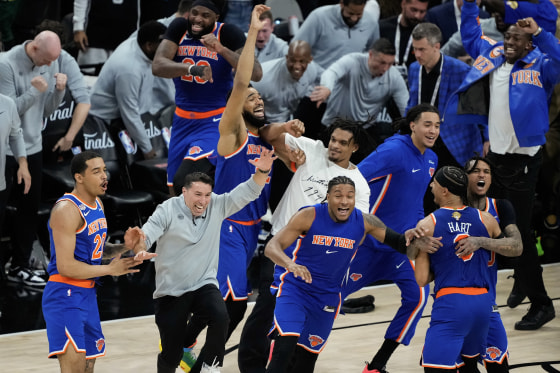
June 13, 2026: The New York Knickerbockers beat the San Antonio Spurs, 94-90 at the Frost Bank Center in San Antonio, Texas, winning Game 5 of the NBA Finals, and taking the NBA Championship.

This was a moment of great celebration for the New York Tri-State Area. It was the Knicks' 1st World Championship in 53 years:

May 10, 1973: The New York Knickerbockers beat the Los Angeles Lakers, 102-93, at the Forum in Inglewood, California, winning Game 5 of the NBA Finals, and taking the NBA Championship.

For the Knicks, this capped their greatest period ever: 1970 to 1973, 4 seasons, 3 trips to the Finals (all against the Lakers), 2 titles.

Their only 2 titles -- until this past Saturday night.

Hail the champions:

* William "Red" Holzman, head coach
* Eddie Donovan, general manager
* 6 Tom Riker, center
* 7 Dean "the Dream" Meminger, guard
* 10 Walt "Clyde" Frazier, guard
* 12 Dick Barnett, guard
* 15 Earl "the Pearl" Monroe, guard
* 17 Henry Bibby, guard
* 18 Phil Jackson, forward
* 19 Willis Reed, center, Captain
* 22 Dave "Double D" DeBusschere, forward
* 23 Luther Rackley, center
* 24 Bill Bradley, forward
* 32 Jerry Lucas, forward
* 40 John Gianelli, center
* 43 Harthorne Wingo, forward

Frazier, Barnett, Reed, DeBusschere and Bradley also played for the Knicks on their 1969-70 title. Jackson was in the organization at that time, but missed the entire season due to injury.

Members of the 1970 Knicks who were not also 1973 Knicks were center Nate Bowman (Number 17), forwards Don May (5), Dave Stallworth (9), Bill Hosket (20) and Jazzy Cazzie Russell (33); and guards Mike Riordan (6) and John Warren (16).

Frazier, Barnett, Reed, DeBusschere and Bradley would have their uniform numbers retired by the Knicks. Holzman would be honored with a banner with the number 613 on it, for the number of games he won as Knicks coach. Frazier, Jackson, Reed, DeBusschere, Bradley, Lucas and Holzman would be elected to the Basketball Hall of Fame. Frazier, Reed, DeBusschere and Lucas would be elected to the NBA's 50th Anniversary 50 Greatest Players -- though it should be noted that Lucas was elected for what he did with the Cincinnati Royals; he was a stabilizing veteran presence for the '73 Knicks. They were also selected for the 75th Anniversary 75 Greatest Players.

Bibby was the father of later NBA All-Star Mike Bibby. Bradley was elected to 3 terms in the U.S. Senate, representing New Jersey, and ran for President in 2000.

And, yes, kids, that Phil Jackson, the one who would coach the Chicago Bulls to 6 titles and the Lakers to 5. He was a decent player, not a great one. As was Pat Riley, who played for the Lakers against the Knicks in those Finals, and would later coach the Lakers to 4 titles, the Knicks into a Finals, and the Miami Heat to a title.

After one more year, Reed, DeBusschere and Lucas all retired, and the Knicks began to fall apart. Pearl, obtained from the Baltimore Bullets (forerunner of the Washington Wizards) after the Bullets beat the Knicks in the '71 Eastern Conference Finals, was the last to remain, in 1980.

The Knicks would have a mini-revival in the early 1980s with Bernard King, be stellar through most of the 1990s, reaching the Finals in 1994 and 1999, but be stymied, first by Larry Bird's Boston Celtics, then by Isiah Thomas' Detroit Pistons, then by Michael Jordan's Jackson-coached Bulls. Finally, the Knicks would collapse, because owner Charles Dolan and his son, team operator James Dolan, trusted Isiah to be general manager, and even coach.

Now, the Knicks are back, having won their 1st World Championship since 1973, 53 years. How long has it been?

*

The teams now named the Utah Jazz, the Dallas Mavericks, the Charlotte Hornets, the Miami Heat, the New Orleans Pelicans, the Orlando Magic, the Minnesota Timberwolves, the Toronto Raptors, the Memphis Grizzlies and the New Orleans Pelicans did not yet exist. The teams now named the Brooklyn Nets, the Indiana Pacers, the Denver Nuggets and the San Antonio Spurs did, in the American Basketball Association.

The Bullets were about to leave Baltimore for Washington, and were a long way from becoming the Wizards. There was an NFL team in Baltimore, but it was the Colts, not the Ravens. There was one in Houston, but it was the Oilers, not the Texans. 

The home of the Knicks and the NHL's Rangers was still being called "the New Madison Square Garden Center." It is now the only arena used by an NBA team then that are still used now -- although the Baltimore Civic Center (now the CFG Bank Arena), the Cobo Arena in Detroit (now the Huntington Bank Arena), the Milwaukee Arena (a.k.a. The MECCA, now the UW-Milwaukee Panther Arena), the Kansas City Municipal Auditorium, the Hofheinz Pavilion in Houston (now the Fertitta Center), the Arizona Veterans Memorial Coliseum in Phoenix, The Forum in Inglewood outside Los Angeles, the Oakland Coliseum Arena and the Portland Memorial Coliseum still stand, and are still being used.

The Islanders had just completed their 1st season, and the building they shared with the New York Nets of the ABA, the Nassau Coliseum, was a year and a half old. The Yankees, recently purchased by George Steinbrenner, and the Giants were terrible, and were still playing in Yankee Stadium, but only for a few more months, as the renovation would start in October. The Mets and the Jets were playing at Shea Stadium, and while the Jets were falling apart as Joe Namath's knees did, the Mets would have a lousy 1st 5 months -- and then a torrid September that would lead to a Pennant and very nearly a 2nd World Championship in 5 years.

The Devils' franchise had been created, but at this point it only existed on paper, as the Kansas City Scouts, to begin play in the fall of 1974. And there was the World Hockey Association's New York Raiders, playing at The Garden, but they were a mess and moved to South Jersey, fooling no one into thinking they were a Philadelphia team.

The biggest thing that would happen in New York Tri-State Area sports in 1973 was the Belmont Stakes, as Secretariat moved "like a tremendous machine" in winning by 31 lengths to clinch the Triple Crown.

1973 was the last season for NBA legend Wilt Chamberlain. Jerry West and Oscar Robertson, like Reed, DeBusschere and Lucas, would hang on for one more year. Lew Alcindor had just recently changed his name to Kareem Abdul-Jabbar. Julius "Doctor J" Erving would soon move from the ABA's Virginia Squires to the Nets. Bill Walton was still at UCLA, winning the recent National Championship, the 7th straight for coach John Wooden, in the middle of an 88-game winning streak.

Magic Johnson and Larry Bird were in junior high school. Michael Jordan, Patrick Ewing and Charles Barkley were in grade school. Shaquille O'Neal was a rather large baby. Kobe Bryant, Tim Duncan and LeBron James weren't born yet.

The same day the Knicks won the title, the Montreal Canadiens won their 18th Stanley Cup, beating the Chicago Blackhawks in Game 6 of the Finals. It was their 6th Cup in the last 9 seasons. The New England Whalers, then based in Boston, had just won the 1st WHA title, the AVCO Cup, beating ex-Blackhawk star Bobby Hull and his Winnipeg Jets. The Indiana Pacers were about to win their 3rd ABA title in the last 5 years, beating the Louisville-based Kentucky Colonels.

The defending World Champions in the other sports were the Oakland Athletics, with future Yankee legends Reggie Jackson and Catfish Hunter beating the Cincinnati Reds of Pete Rose, Johnny Bench and Joe Morgan; and the Miami Dolphins, who had won Super Bowl VII over the Washington Redskins to complete the only perfect NFL season in the playoff era (1932 to the present).

The Heavyweight Champion of the World was the undefeated George Foreman, who had just demolished Joe Frazier to take the title. Muhammad Ali had recently been dealt a loss and a broken jaw by Ken Norton, so it looked like Ali and Frazier were finished, and Foreman would be Champion for a while. Looks were deceiving.

The designated hitter had just debuted, Willie Mays' career was coming to a strange close, Hank Aaron had begun his approach to Babe Ruth's all-time record of 714 home runs, and Nolan Ryan had just pitched his 1st no-hitter and his 1st 19-strikeout game, on his way to a single-season record of 383 strikeouts.

Current Knicks coach Mike Brown was 3 years old. Giants coach John Harbaugh was 10. Rangers coach Mike Sullivan was 5. Islanders coach Peter DeBoer was about to turn 5. Jet coach Aaron Glenn was 10 months old. Yankee manager Aaron Boone was 2 months old. Nets coach Jordi Fernández, Mets manager Carlos Mendoza and Devils coach Sheldon Keefe weren't born yet.

The Olympic Games have since been held in America 4 times, Canada 3 times, twice each in Russia, Korea, Japan, China, France and Italy; and once each in Austria, Bosnia, Spain, Norway, Australia, Greece, Britain and Brazil. The World Cup has since been held in America, Mexico and Germany twice; and once each in Canada, Argentina, Spain, Mexico, Italy, France, Japan, Korea, South Africa, Brazil, Russia and Qatar.

There were 26 Amendments to the Constitution of the United States. Title IX had recently become law, and abortion had just been nationally legalized. The feminist and gay rights movements were underway.

The President of the United States was Richard Nixon, but the Senate was about to convene a special committee to investigate what was then being called "the Watergate matter." Nixon was now the only living President, as Harry Truman and Lyndon Johnson had both died within the last 5 months. Their widows, and  those of Dwight D. Eisenhower and John F. Kennedy, were still alive.

Spiro Agnew as Vice President, but, in probably the most amazing thing about Watergate, Nixon's Vice President would have to resign his office, and it would have absolutely nothing to do with Watergate.

Gerald Ford was House Minority Leader. Jimmy Carter was Governor of Georgia. Ronald Reagan was Governor of California. George H.W. Bush was out of elective office, but had recently been appointed Chairman of the Republican National Committee, replacing a young Senator named Bob Dole. Bush's son had just been discharged from the Texas Air National Guard -- whether he had shown up for duty in the preceding year remains a mystery. Bill Clinton and Hillary Rodham had just moved in together, renting a house in New Haven, Connecticut, where they were both students at Yale Law School.

Barack Obama was in junior high school in the city where he was born, Honolulu, Hawaii. Joe Biden was in his 1st year as a U.S. Senator. And Donald Trump and his father were about to be sued by the U.S. Department of Justice for racist renting practices. Melania Knauvss was 3 years old.

The Governor of New York was Nelson Rockefeller, although he would soon resign to run something called the Commission on Critical Choices for Americans. (It couldn't have been that critical, because until I first wrote this piece, in 2013, I'd never heard of it.) Lieutenant Governor Malcolm Wilson would assume the job.

The Mayor of New York was John Lindsay, whose 2nd term was limping to a pathetic close. Abe Beame, who had been City Comptroller when Lindsay beat him for the Mayoralty in 1965, held the job again and was running again, and would defeat John Marchi, a State Senator from Staten Island whose upset victory in the 1969 Republican Primary forced Lindsay to run for re-election as an independent -- and win. But Beame's Mayoralty would be even more troubled than Lindsay's, and pave the way for that of Ed Koch.

Another weird race was across the Hudson River in New Jersey. Governor William T. Cahill had proposed the State's 1st income tax. Not signed into law, merely proposed it. Charlie Sandman, a very conservative loudmouth who represented the southernmost portion of the State in Congress, ran against Cahill in the Republican Primary, and won. But he got slaughtered in the general election by Essex County Prosecutor Brendan Byrne, when it was revealed that a local mob boss was caught on tape saying Byrne was the one politician in the area who couldn't be bought. Byrne won 66 percent of the vote.

Then, the next year, he got the State income tax passed, and dropped to an approval rating of 17 percent. People began calling him "One-Term Byrne." Unlike Jim Florio nearly 20 years later, he shook off the stupid tax protests, and got re-elected in 1977 with 56 percent of the vote.

The Prime Minister of Canada was Pierre Trudeau. The monarch of Great Britain was Queen Elizabeth II -- that has now changed -- and the Prime Minister was Edward Heath, who, like Senator Edward Kennedy and the Queen's great-grandfather, King Edward VII, was nicknamed "Ted."

No Nobel Peace Prize was awarded in 1972, so its holder was still the 1971 recipient, Chancellor Willy Brandt of West Germany. The Pope was Paul VI. Pope Leo XIV, then Robert Francis Prevost, was 17 years old, and was about to graduate from St. Augustine Seminary High School in Holland, Michigan. It closed in 1977. There have since been 10 Presidents of the United States (11 if you count Trump twice -- I wouldn't even count him once), 13 Prime Ministers of Britain, and 6 Popes.

England's Football League was won by Liverpool in a close race over London's Arsenal. The FA Cup was won by second-division North-East club Sunderland in a shock over Yorkshire's mighty Leeds United. The European Cup, for the 3rd season in a row, was won by Johan Cruyff's powerful but beautiful Amsterdam club Ajax. Soon, Cruyff would move on to Spain's FC Barcelona, and build that club's system, and thus build significantly on the legend it already had.

The New York Cosmos -- not yet with Pele and Franz Beckenbauer -- were playing at Hofstra University's football stadium, now named James M. Shuart Stadium, across from the Jets' training complex and the Nassau Coliseum, and were dethroned as North American Soccer League Champions by the Philadelphia Atoms. Hardly anybody in North America cared.

Major novels of 1973 included Gravity's Rainbow by Thomas Pynchon, Breakfast of Champions by Kurt Vonnegut, The Princess Bride by William Goldman, Demon Seed by Dean Koontz (which would be made into a 1977 film in which Julie Christie plays a woman who gets impregnated by a computer), Rubyfruit Jungle by Rita Mae Brown, and Postern of Fate, the last novel written by Agatha Christie.

Robert Ludlum published The Matlock Caper, but it wasn't about a lawyer in Atlanta who looked like Andy Griffith -- or one in New York who looks like Kathy Bates. In non-fiction, Hunter S. Thompson published Fear and Loathing on the Campaign Trail '72, Peter Maas Serpico (the film verison with Al Pacino as the real-life New York cop would premiere in December), and Flora Rheta Schreiber Sybil.

J.R.R. Tolkien would live another 4 months. George R.R. Martin was teaching at Clarke University in Iowa. Stephen King was teaching at a high school in Maine, and his 1st novel, Carrie, had been accepted for publication the next year. J.K. Rowling was 7 years old.

No one had yet heard of George Smiley, the Punisher, Lestat de Lioncourt, Rocky Balboa, T.S. Garp, Arthur Dent, Jason Bourne, Hannibal Lecter, Celie Harris, Kinsey Millhone, Jack Ryan, Forrest Gump, John McClane, Alex Cross, Bridget Jones, Robert Langdon, Bella Swan, Leroy Jethro Gibbs, Lisbeth Salander, Katniss Everdeen, Walter White, John Wick or Maggie Bell.

Major movies released in the spring of 1973 included the film version of Godspell, an updated version of Raymond Chandler's story The Long Goodbye with Elliott Gould as Philip Marlowe and ex-Yankee pitcher Jim Bouton as the killer, Pat Garrett & Billy the Kid with James Coburn and Kris Kristofferson in the title roles and Bob Dylan with a cameo, the Anthony Hopkins & Claire Bloom version of Henrik Ibsen's play A Doll's House, the blaxploitation/feminist films Cleopatra Jones and Coffy, and, released the day before the Knicks won the title, Paper Moon, with real-life father and daugther Ryan and Tatum O'Neal as Depression-era con artists. (Ryan died in 2023. I wonder if he ever paid Tatum the $200.)

Gene Roddenberry had just seen his project Genesis II flop on CBS. George Lucas was about to release American Graffiti. Steven Spielberg was working on his 1st feature film, The Sugarland Express. The cartoon Super Friends was about to premiere, meaning that George Reeves would be succeeded as Superman (sort of) by Danny Dark, and Adam West as Batman by Olan Soule. Shannon Farnon became the voice of Wonder Woman. Roger Moore was about to debut as James Bond in Live and Let Die. Jon Pertwee was playing The Doctor.

Bonanza finally went off the air, while Gunsmoke hung on a little longer. Johnny Carson had recently moved The Tonight Show from New York to Los Angeles. M*A*S*H wrapped up its 1st season, All in the Family its 3rd. CBS had recently revived The Price Is Right, and was about to revive Match Game, which had aired on NBC from 1962 to 1969. Paul McCartney's 1st solo TV special had recently aired on ABC, to coincide with his Wings album Red Rose Speedway.

Paul's fellow ex-Beatle George Harrison released Living in the Material World. Bob Dylan was about to release "Knockin' On Heaven's Door." Elvis Presley had released the soundtrack to his recent TV special Aloha from Hawaii via Satellite. Frank Sinatra was about to start recording his comeback album, Ol' Blue Eyes Is Back. The Jackson 5 had released Skywriter.

Led Zeppelin were on tour in the U.S., including the Garden concert that would be filmed for The Song Remains the Same. David Bowie released Aladdin Sane, Bob Marley Catch a Fire, the Eagles Desperado, Paul Simon There Goes Rhymin' Simon, the Carpenters Now & Then, Earth Wind & Fire Head to the Sky, Chicago Chicago VI, Aretha Franklin Hey Now Hey (The Other Side of the Sky), Carole King Fantasy, and John Denver Farewell Andromeda. The Number 1 song in America was "Tie a Yellow Ribbon Round the Ole Oak Tree" by Tony Orlando & Dawn.

Robert Kardashian had just co-founded Radio & Records magazine, stepping aside from his legal practice. Bruce Jenner was training to better his 1972 Olympic performance in the decathlon -- 10th place. Kris Houghton was in high school. None of them had ever heard of each other.

Inflation was about to have its 1st big increase of the post-World War II era: What $1.00 bought then, $7.63 would buy now. A U.S. postage stamp cost 8 cents, and a Subway ride in New York 35 cents. The average price of a gallon of gas was 37 cents (but was about to soar thanks to the OPEC price hike), a cup of coffee 51 cents, a McDonald's meal (Big Mac, fries, shake) $1.47, a movie ticket $1.72, a new car $2,900, and a new house $35,100. The Dow Jones Industrial Average closed that day at 939.34.

The portable telephone had just been introduced by Motorola. Cordless home phones and the desktop computer were still a ways off. Steve Jobs, Bill Gates and Tim Berners-Lee were turning 18. Social media was the stuff of science fiction.

Skylab was launched, and became the biggest lemon in the history of space travel -- so far. Automatic teller machines were still a relatively new thing, and many people had never seen one. The very first home video game system, the Magnavox Odyssey, had been introduced the preceding September. There were heart transplants, liver transplants and lung transplants, and artificial kidneys, but no artificial hearts. There were birth control pills, but no Viagra.

In the Spring of 1973, the World Trade Center opened in New York, becoming the tallest building(s) in the world -- only to be topped just a month later by the Sears Tower in New York. The American Indian Movement ended their 10-week standoff at Wounded Knee, South Dakota. LexisNexis and Federal Express (FedEx) began operations. A military coup ended democracy in Greece. Mark Felt retired from the FBI -- and, at this point, only he, Washington Post reporter Bob Woodward, and Post editor Ben Bradlee knew he was Woodward's Watergate source, nicknamed "Deep Throat."

Noel Coward, and Pablo Picasso, and Jeannette Rankin died. She was the 1st woman elected to Congress, the Montana Representative who voted against America's entry into World War I, and then became the only member of either house of Congress to vote against America's entry into World War II. She lost her seat because of both votes, but was only able to come back the first time. Also dying in the Spring of 1973 were Robert Armstrong and Merian C. Cooper, the male lead and the director of King Kong.

Sasha Alexander, and Heidi Klum, and Neil Patrick Harris were born. So were sports stars Derek Lowe, Tedy Bruschi, Roberto Carlos and Haile Gebreselassie.

May 10, 1973. The New York Knicks were World Champions. It took them 53 years, 1 month and 3 days to do it again.

And now, they have overcome.

Sunday, June 14, 2026

The Knicks Bring New York a Championship

Congratulations to the New York Knickerbockers, World Champions of basketball.

The Knicks won Game 5 of the NBA Finals, beating the San Antonio Spurs, 94-90 at the Frost Bank Center in San Antonio, Texas. Yes, New York City messed with Texas.

The only game in the Finals that they lost was Game 3, when Donald Trump showed up at Madison Square Garden. As they say in New York, I'm not sayin', I'm just sayin'.

The Knicks have, historically, been a snakebit franchise. Along with the Boston Celtics, they are 1 of only 2 original NBA franchises from 1946 still in their original city. They reached the NBA Finals in 1951, 1952 and 1953, but lost them all. They moved from the old Garden, at 49th-50th Streets and 8th-9th Avenues, to the new Garden, at 31st-33rd Streets and 7th-8th Avenues, in 1968. There, they built a new Champion, winning the title in 1970, losing the Finals in 1972, and winning them again in 1973.

But then the dynasty of coach Red Holzman, captain Willis Reed and Walt Frazier got old. The Knicks had a good run in 1984 with Bernard King, but fell short. They had a (sometimes literally) hard-fighting team team in the 1990s, reaching the Finals in 1994 and 1999, but losing. And for most of the 21st Century, they've been mediocre at best.

But team president Leon Rose and general manager Gerrson Rosas have built a new Champion, coached by Mike Brown. Their 53-year drought was almost as long as the 54 years that the supposedly cursed New York Rangers, with whom they share the Garden, had from 1940 to 1994. But they went 53-29 in the regular season, and beat the Atlanta Hawks, then the Philadelphia 76ers in 4 straight, and then the Cleveland Cavaliers in 4 straight to reach the NBA Finals.

In all 5 games of the Finals, they came from behind to take the lead, including Game 3 that they ended up losing, anyway. They won Game 1 in San Antonio, 105-95. They won Game 2, 105-104. They lost Game 3 at home, 115-111. But in Game 4, the trailed by 29 points, and then launched the biggest comeback in NBA Finals history, before OG Anunoby's tip-in gave them a 107-106 victory. Tonight, Jalen Brunson, the captain, scored 45 points, a team Finals record, and they won, 94-90. The clock ran out at 11:28 PM on June 13, 2026. Brunson was named the Finals MVP.

Hail the Champions:

* Number 00, Jordan Clarkson, 34 years old, a 6-foot-5 guard from Tampa, and the University of Missouri.
* Number 2, Miles McBride, 25, a 6-2 guard from Cincinnati and West Virginia University.
* Number 3, Josh Hart, 31, a 6-5 forward from the Washington suburb of Silver Spring, Maryland, and Villanova University.
* Number 4, Pacôme Dadiet, 30, a 6-9 forward born to Ivorian parents in Aubagne, southern France. He did not attend college, either in France or in America.
* Number 5, Jose Alvarado, 28, a 6-feet-even guard from Queens and Georgia Tech.
* Number 8, Ogugua "OG" Anunoby, 28, a 6-foot-7 forward, born to Nigerian parents in London, grew up in Jefferson City, Missouri, and went to Indiana University.
* Number 11, Jalen Brunson, 29, a 6-2 guard from the Philadelphia suburb of Cherry Hill, New Jersey, and then the Chicago suburb of Lincolnshire, Illinois, and went to Villanova University.
* Number 13, Tyler Kolek, 25, a 6-2 guard from Cumberland, Rhode Island, and Marquette University.
* Number 20, Jeremy Sochan, 23, a 6-8 forward, born in Guymon, Oklahoma to an African-American father and a Polish mother, grew up in Milton Keynes, England, and played at Baylor University.
* Number 23, Mitchell Robinson, 28, a 7-foot-even center from Chalmette, Louisiana. He did not play in college.
* Number 25, Mikal Bridges, 29, a 6-6 guard from the Philadelphia suburb of Malvern, Pennsylvania and Villanova.
* Number 32, Karl-Anthony Towns, 30, a 7-foot-even center from Piscataway, New Jersey, playing at St. Joseph's High School of nearby Metuchen, and the University of Kentucky.
* Number 44, Landry Shamet, 29, a 6-5 guard from Kansas City, and Wichita State University.
* Number 51, Mohamed Diawara, 21, a 6-9 forward, born to Malian parents in Paris, and grew up there. Like his countryman Dadiet, he did not attend college.
* Number 55, Ariel Hukporti, 24, a 7-feet-even center, born to Togolese parents in Stralsund, in northeastern Germany. He also did not attend college.

The starting 5 are guards Brunson and Bridges, forwards Hart and Anunoby, and center Towns.

I've often said that a Knicks title would mean more to New York than a title for any other team. Not just because New York loves its basketball so much, but because the Knicks have a greater share of the local fandom over the Nets than the Yankees over the Mets, the Giants over the Jets, and the Rangers over the Islanders and the Devils.

And Knick fans have lived through a lot of disappointment, and even some utter crap, the specifics of which don't matter now. Although owner James Dolan did get on the microphone at the presentation of the Larry O'Brien Trophy and apologize to Knick fans for having taken so long.

The Knicks are the World Champions. Fully earned, fully deserved, and worthy of the great story that they have told.

Tuesday, April 21, 2026

April 21, 1951: The Bill Barilko Game and the Rochester Royals' Title

April 21, 1951, 75 years ago: Bill Barilko becomes hockey's version of Bobby Thomson -- nearly 6 months before Thomson becomes baseball's version of Barilko.

Barilko was a 24-year-old defenseman of Ukrainian descent, from the mining town of Timmins, Ontario. He had already helped the Toronto Maple Leafs win the Stanley Cup in 1947, 1948 and 1949. The 1951 Stanley Cup Finals against the Montreal Canadiens was unusual in that every game went to overtime.
Game 1, at Maple Leaf Gardens in Toronto, was won 5 minutes and 51 seconds in, on a goal by Sid Smith. Game 2 in Toronto was won after 2:55 by the Canadiens' Maurice Richard, a.k.a. "The Rocket," the greatest and most popular player in the sport at the time. The action shifted to the Montreal Forum, but the Leafs won Game 3 4:47 into overtime on a goal by Ted Kennedy. Then they won Game 4 5:15 into overtime on a goal by Harry Watson.
(Unlike the longtime U.S. Senator from Massachusetts and brother of President John F. Kennedy, who was one of many men named Edward who ended up being nicknamed "Ted" or "Teddy," the man who scored the Game 3 winner was born Theodore Samuel Kennedy, was nicknamed "Teeder," and was the Leafs' Captain at the time.)

The series returned to Toronto for Game 5. There was no scoring in the 1st period. Richard scored midway through the 2nd period, but Tod Sloan tied it back up. Paul Meger gave the Canadiens a 2-1 lead less than 5 minutes into the 3rd period, but Sloan equalized with just 32 seconds left in regulation.

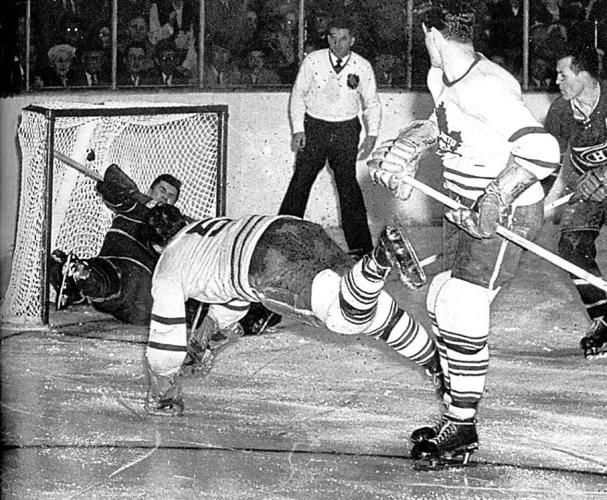
At the 2:53 mark of overtime, Barilko, much like Bobby Orr would be in overtime of Game 4 of the 1970 Finals, was tripped up, but still managed to get a shot off. It went past Canadien goalie Gerry McNeil, and the Leafs won the game 3-2, and the series 4-1.

"It was as clean as a hound's tooth," Toronto Daily Star writer Red Burnett said. "McNeil never had a chance." Hockey fans tend to blame goaltenders who give up big goals considerably less than baseball fans blame pitchers who give up big home runs. And so, McNeill, who would be the starting goalie when the Habs won the Cup in 1953, before giving way to Jacques Plante, would not live in infamy. He lived until 2004.
The most familiar photo of the goal, taken by Nat Turofsky

It was the Leafs' 4th Cup in the last 5 years, and their 10th overall. At the time, no other team had more: The Canadiens had 6.
Another angle, showing Barilko's face,
and that of Maurice Richard, who clearly knows it's over.

The Leafs were a great team, with 4 players who went on to be elected to the Hockey Hall of Fame: Centers Kennedy and Max Bentley, defenseman Fern Flaman, and goaltender Walter "Turk" Broda. Barilko could have become another of them: He was a classic "defensive defenseman," a hard checker who enjoyed rough play. He wasn't regarded as dirty, so no one begrudged him his status as a national hero across Canada -- at a time when there were only 6 teams in the National Hockey League, and just 2 of them in Canada, the Leafs and the Canadiens.

A little over 4 months after his epic goal, Barilko went on a fishing trip with his dentist, Henry Hudson. Hudson was a licensed pilot, and he took Barilko on a Fairchild 24 floatplane, from Timmins to Waskaganish, Quebec, on James Bay.

There was some irony in this. James Bay is an extension of Hudson Bay, where an earlier Henry Hudson, the discoverer of the river in New York that would be named for him, disappeared in June 1611, on a voyage to find the Northwest Passage.

Barilko and Hudson caught a few fish, and, the weekend over, on August 26, 1951, they boarded the Fairchild. Hudson headed it back for Timmins, about 400 miles away.

They never arrived. Plane disappearances in the northern reaches of North America were nothing new. The last attempt at the 1st nonstop flight between the European and North American continents before Charles Lindbergh successfully did it took off from France, and was believed to have been crashed in the woods of northern Maine, or the Canadian Province of New Brunswick, and has still never been found. But this was different: Bill Barilko, the man who had won the most recent Stanley Cup, a new national hero, was missing.

Barilko did not live long enough to build a Hall of Fame career. But the Leafs did retire his Number 5. Or, at least, they thought they had: In 1992, someone working in the front office discovered that, while no player had worn the uniform number in 41 years, there had never been an official retirement ceremony for it. One was held on October 17, 1992.

The Leafs stopped winning. Over the next 7 seasons, of the 14 available places in the Stanley Cup Finals, 7 were won by the Canadiens (in other words, they made it every year), 4 by the Detroit Red Wings, and 3 by the Boston Bruins. The Leafs rebuilt, and got back to the Finals in 1959 and 1960, but lost to the Canadiens both times.

On April 22, 1962, the Leafs won the Cup again, dethroning the Chicago Black Hawks in the Finals. Had Barilko not died, he would have been 35 years old, and could still have been playing. Certainly, Leafs head coach and general manager George "Punch" Imlach was known to favor veterans.

Just 45 days after that Cup win, on June 6, helicopter pilot Ron Boyd was flying about 60 miles north of Cochrane, Ontario, when he spotted the wreckage of a plane. He reported it, and it was discovered to be Dr. Henry Hudson's Fairchild 24. His body, and Barilko's, were remarkably well preserved in the cold after 11 years. The wreck and the records were examined, and it was determined that Hudson's inexperience as a pilot, too much cargo (too many fish?), and bad weather doomed the plane.

There was something poetic about Barilko being found only after the Leafs won the Cup again, beginning a run of 3 straight, and 4 in 7 years -- at which point Barilko would have been 40 and, knowing Imlach, could still have been getting game time.

But since the last of those Cups, in 1967, they have never even reached the Stanley Cup Finals again. This time, there was no harbinger of trouble, like a plane crash. It was just bad management.

*

April 21, 1951 was a Saturday. The NBA Championship was also decided that day, and also in overtime, but in a Game 7. The Rochester Royals defeated the New York Knicks, 79-75 at the Edgerton Park Arena in Rochester, New York.
Left to right: Bill Calhoun, Bob Davies, Paul Noel, Joe McNamee,
Arnie Risen, Jack Coleman, Arnie Johnson and Bobby Wanzer

For the Knicks: Max Zaslofsky and Vince Boryla each scored 16 points, Harry Gallatin 12, Nat "Sweetwater" Clifton (the 1st black player signed to an NBA contract) and Connie Simmons 11, Ernie Vandeweghe (father of future NBA player Kiki) 5, Dick McGuire (brother of Hall of Fame college coach and announcer Al) 4, and Ray Lumpp none.

It wasn't enough, as Arnie Risen scored 24, and former Seton Hall star Bob Davies scored 20. Scoring 2 points for the Royals in this game was William "Red" Holzman. Ed Mikan, brother of Minneapolis Lakers star George, was on the Royals' roster at the start of the season, but was traded.

The Knicks would win 3 straight NBA Eastern Division Championships, but lose the Finals all 3 times: This one to the Royals, and 1952 and '53 to the Lakers. It would take them until 1970 to win their 1st title, with Holzman as their coach. They won again in 1973. But haven't won one since, also losing in the Finals in 1972, 1994 and 1999.

At least the Knicks still exist. The Royals don't, at least not under that name. Rochester proved too small a market for a growing sports league. In 1957, they moved, becoming the Cincinnati Royals. In 1972, they moved again. Since Kansas City already had a baseball team called the Royals, they became the Kansas City Kings. And in 1985, they became the Sacramento Kings. In the early 2010s, they came close to moving yet again, to Anaheim and to Seattle, before the building of their new arena was negotiated. Come to think of it, Minneapolis lost the Lakers to Los Angeles in 1960.

Nevertheless, at their arena, the Golden 1 Center, the Kings still hang a banner proclaiming themselves to be the 1951 NBA Champions.
Davies, Wanzer, Risen, and Holzman as a coach have been elected to the Basketball Hall of Fame. The Kings retired Davies' Number 11. Nevertheless, when the NBA named its 50th Anniversary 50 Greatest Players in 1996, the '51 Royals were 1 of 4 teams with no representatives, the others being the 1947 Philadelphia Warriors, the 1948 Baltimore Bullets, and the 1979 Seattle SuperSonics.

Also on that day, actor Tony Danza was born.

Saturday, March 5, 2022

How to Be a New York Basketball Fan In Memphis -- 2022 Edition

This coming Friday, March 11, the New York Knicks will visit Memphis to play the Grizzlies. The Brooklyn Nets will do the same on March 23. This will complete the 2021-22 NBA season for my trip guides, as the Grizzlies were the 30th and last team to have done.

Memphis is a city with a lot of history, and a lot of problems. Poverty, crime and bigotry cast their shadows over its athletic, musical and religious legacies. I've often said that America only ever needed 2 Kings: Elvis Presley and Martin Luther King Jr., and they both died in Memphis before reaching the age of 43.

Before You Go. Memphis is in the South. Not the Deep South, but the Mid-South. In fact, their old arena was named the Mid-South Coliseum. However, Tennessee rejoined the Union a long time ago, and you won't need to bring a passport or change your money.

If you were going to a baseball game, or an early-season football game, the heat might be an issue. But this will be in mid-March, so even outside the arena, heat won't be a factor. Cold might be: For Sunday, the website of Memphis' main newspaper, The Commercial Appeal, is predicting the temperatures to be in the low 60s in daylight, but will drop to the high 30s at night.

Memphis, like most (but not all) of Tennessee, is in the Central Time Zone, an hour behind us. Adjust your timepieces accordingly.

Tickets. The Grizzlies averaged 15,478 fans per home game in 2019-20, the last pre-COVID season, 3rd-lowest in the NBA, ahead of only the Nets, the Minnesota Timberwolves, and the Atlanta Hawks. It was 87 percent of capacity, low considering that they're the only major league sports team in town. Many tickets could well be available.

Seats in the lower level, the 100 sections, go for $246 between the baskets and $115 behind them. Seats in the upper level, the 200 sections, are among the cheapest in the NBA, going for $31 and $26.

Getting There. It's 1,100 miles from Midtown Manhattan to Memphis. So your first instinct would be to fly. A a round-trip nonstop flight could cost over $700 on United Airlines. Memphis International Airport is 10 miles south of downtown, and the Number 20 bus can get you to downtown in under 40 minutes.

Greyhound can get you from New York to Memphis in a little under 30 hours, for $569 round-trip, $291 with advanced purchase, although you'd have to change buses in Richmond. The Greyhound station is at 203 Union Avenue.

Amtrak can't be used this week: The Lake Shore Limited train from New York to Chicago has been canceled for the time being. Even under normal conditions, Amtrak is a bit more complicated: There's no direct route from New York. You'd have to take the Lake Shore Limited out of Penn Station at 3:40 PM on Friday afternoon, arrive in Chicago at 9:45 AM on Saturday, stay over there until 8:05 PM, and take the City of New Orleans (the current version replaces the Illinois Central Railroad's Panama Limited "Night Train," instead of the old version made famous by the Steve Goodman/Arlo Guthrie song), arriving in Memphis at 6:27 AM on Sunday, the morning of the game. And, because of the holiday, it would be $556. At any rate (if you'll pardon the pun), the address for Memphis Central Station is 545 S. Main Street.

If you do drive, it's far enough that you should get someone to go with you, to trade off, especially if one can sleep while the other drives. Get into New Jersey, take Interstate 78 West into Pennsylvania. At Harrisburg, get on Interstate 81 South, and take that down through Maryland, West Virginia and Virginia, into Tennessee, where it flows into Interstate 40 West. Take that all the way across Tennessee. Exit 1 is for downtown.

If all goes well, you should spend a little over an hour in New Jersey, 2 hours and 45 minutes in Pennsylvania, 15 minutes in Maryland, half an hour in West Virginia, 6 and a half hours in Virginia, and 8 hours and 15 minutes in Tennessee, for a total of 19 hours and 15 minutes. Given rest stops in Pennsylvania, one at each end of Virginia, and 3 in Tennessee, and we're talking about a trip of at least 26 hours -- each way.

Once In the City. Founded in 1819, and named for the ancient capital city of Egypt, Memphis is in the southwestern corner of Tennessee, across the Mississippi River from Arkansas. Downtown is 13 miles from the Mississippi State Line. So, like New York, it has a "Tri-State Area." These States led to one of the names of its ABA team, the Tams: TAM, Tennessee, Arkansas, Mississippi.

Memphis is the largest city in Tennessee, with over 650,000 people, and a metropolitan area of over 1.4 million. That sounds like a lot, but it's actually the 2nd-smallest market in the NBA, ahead of only New Orleans, and it wouldn't be if New Orleans hadn't lost so many people after Hurricane Katrina. It would be easily the smallest in MLB, the smallest in the NFL except for New Orleans, and would rank ahead of only 2 NHL cities, Edmonton and Winnipeg.

Memphis always had a large black population, with downtown's Beale Street being known as the home of the blues -- culturally, if not exactly geographically, the midpoint between New Orleans (395 miles to the south) and Chicago (533 miles to the northeast). Two blocks north of Beale is Union Street, home to country music studio turned rock and roll historymaker Sun Records.

As late as the 1970 Census, 2 years after Martin Luther King was assassinated there, it was 60 percent white and 39 percent black. But the 2020 Census shows just how extensive "white flight" was: 63 percent black, 25 percent white, 10 percent Hispanic and 2 percent Asian. The east side is mostly white, the north and south sides (including the part where Graceland is located) mostly black. Across the river, West Memphis, Arkansas gets less black and more white as you move west. There were race riots in Memphis just after the Civil War in 1866, and in 1968 after Dr. King was killed there.

The sales tax in Tennessee is 7 percent, and within Shelby County, including Memphis, 9.25 percent, even higher than New York's. ZIP Codes for Memphis start with the digits 380 to 383. The Area Code is 901. The Memphis Light, Gas and Water Division (MLGW) handles the utilities for all of Shelby County.

Address numbers on east-west streets increase away from the River, and Madison Avenue separates north from south. Interstate 269 forms a partial beltway. The Memphis Area Transit Authority (MATA) runs buses and light-rail "trolleys," with a base fare of $1.75, plus 80 cents for each additional zone.

Going In. Federal Express was founded in Memphis, and aside from music companies is the corporation most associated with the city, which has certainly been helped by having bought the naming rights to the main sports arena. The official address of the FedEx Forum is 191 Beale Street, at S. 4th Street.

If you're driving, parking is to the southwest of the arena, at B.B. King Blvd. and Dr. Martin Luther King Avenue, and can be had for as little as $10.  If you're walking in from a downtown hotel, you'll most likely be going in from the north or the west.
The arena, a.k.a. The Grindhouse, opened in 2004, and has been home to the Grizzlies and the University of Memphis (formerly Memphis State University) Tigers basketball team ever since. The Nashville Predators hosted a preseason game there in 2006, and it hosts concerts, boxing and wrestling. The court is laid out east-to-west.
With the court set up for a Memphis Tigers game

Food. Memphis has a reputation as a city of fine Southern food, particularly barbecue. However, the Grizzlies' focus seems to be on Club Level restaurants, for the well-heeled customer: The Horseshoe Lounge, the Bud Light Bar, the Draft Room and the Blue Note Lounge.

On the Plaza Level (lower): Section 101 has Snax, including hot dogs, burgers, chicken tenders, nachos, pretzels and waffle fries; 103 has Dippin Dots; 104 has Chopsticks, Chinese food; 106 has Delta Grill, same as Snax, and Charles Vergos' Rendezvous, pork products; 107 has IPop Gourmet Popcorn; 109 has Pizza (an original name); 110 has Fowl Line, chicken products; 113 has World's Fair, same as Snax; and 118 has Memphis Burrito Co., Mexican food.

On Terrace Level (upper): 208 has Bandstands, same as Snax, and Pizza; 209 has Dippin Dots; 216 has IPop Gourmet Popcorn and Charles Vergos' Rendezvous; 224 has Rock-a-Belly's, same as Snax; and 232 has Wing Guru.

Apparently, at IPop, "Memphis Mix" is Buffalo Ranch and Caramel. So Memphis had to steal another city's idea? And "Grizzlies Mix" is blueberry, pineapple and white cheddar. Damn, that's disgusting. The Grizzlies deserve to never reach an NBA Finals for that alone.

Team History Displays. The Vancouver Grizzlies began as an NBA expansion team in 1995 -- only the Charlotte Bobcats/new Hornets are a newer franchise -- and moved to Memphis in 2001, not making the Playoffs until 2004.

So there isn't much history there. They've never won a title even at the Division level, and have no banners for such titles, don't hang a banner for their 1 visit to the Western Conference Finals, where they got swept by San Antonio in 2013.

So far, only 2 people associated with the team have been elected to the Basketball Hall of Fame: Hubie Brown, former Knicks head coach, who held the same post with the Grizzlies from 2002 to 2005; and Allen Iverson, who briefly played for them in 2009.

The Grizzlies have retired Number 50 for forward Zach Randolph, 2009-17. They also "retired a microphone" for Don Poier, who broadcast for the team from their 1995 inception through their 2001 move, until his death in 2005. They have announced that, once they've retired as active players, they will retire 9 for guard Tony Allen, 2010-17; 11 for guard Mike Conley Jr., 2007-19; and 33 for center Marc Gasol, 2008-19.

The only championship banners in the arena belong to the University of Memphis basketball team, winning the old Metro Conference in 1982, '84, '85 and '87; winning Conference USA in 2006, '07, '08, '09, '11, '12 and '13; and reaching the NCAA Final Four in 1973, '85 and 2008. However, their 1985 Final Four berth and their 2008 C-USA title and Final Four berth were vacated by NCAA sanctions.

The Memphis Tigers have 9 retired numbers: From the 1950s, 13, Forest Arnold, and 22, Win Wilfong; from the 1970s, 21, Larry Finch, 33, Ronnie Robinson, 35, Larry Kenon, and 44, John Gunn; from the 1980s, 24, Keith Lee, and 34, Elliott Perry; and from the 1990s, 25, Anfernee "Penny" Hardaway.
Not mentioned in the rafters is the American Basketball Association team known as the Memphis Pros in 1970-71 and 1971-72, the Memphis Tams (for the 3 States in the Memphis metro area: Tennessee, Arkansas and Mississippi) in 1972-73 and 1973-74, and the Memphis Sounds in 1974-75. They made the Playoffs only in their first and last seasons, and their stars included future New York Nets stars Wendell Ladner and Larry Kenon, future broadcaster Steve "Snapper" Jones, and Darel Carrier, who was named to the ABA All-Time Team, but mainly for what he'd done with the Louisville-based Kentucky Colonels.

The Grizzlies have not yet formed any real rivalries. They've had notable Playoff matchups with the Spurs, the Oklahoma City Thunder and, oddly, another franchise known for being a longtime loser, the Los Angeles Clippers. In fact, they may be the only team that considers the Clippers a rival but not the Lakers. Regional rivals would seem to be their fellow Southwest Division teams: The Spurs, the Dallas Mavericks, the Houston Rockets and the New Orleans Pelicans; and other Southern teams like the Thunder, the Charlotte Hornets and the Atlanta Hawks.

Stuff. The Grizzlies Den is located in the arena's Grand Lobby. Whether they sell hats with bear ears on them, I don't know. Smaller souvenir stands are located all around the arena.

As one of the NBA's newer teams, there are no NBA Finals DVD packages for the Grizzlies, and books about them are few and far between. In 2017, Jim Whiting published the Grizzlies' edition for the NBA: A History of Hoops series.

During the Game. Memphis people don't like Nashville people. That's about as far as rivalries go there. So as long as you don't make any wiseguy remarks about this being a North vs. South game, you shouldn't face anything beyond the usual nonviolent "My team rocks, your team sucks" talk.

A November 13, 2014 article on DailyRotoHelp ranked the NBA teams' fan bases, and listed the Grizzlies' fans as 22nd. The team has only been around for 21 years, and has reached the Conference Finals exactly once. Their legitimate number of Hall of Fame players is exactly zero. So there's been little about which for them to get excited about, or for which to generate any atmosphere. Until now: They have point guard Temetrius Jamel "Ja" Morant, only 22 years old, and already one of the best players in the game.

This Friday's game against the Knicks is Grizzlies Ford Scholars Night, with a promotion by "your Mid-South Ford Dealers." The March 23 game against the Nets is Adoptable Pet Night: The 1st 5,000 fans will receive a pet leash.

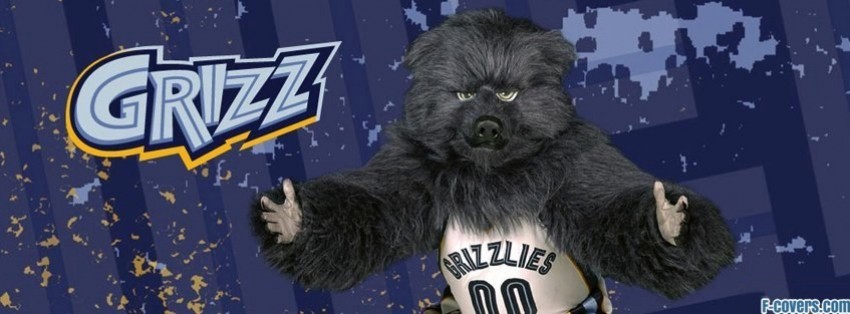
The Grizzlies' mascot is Grizz the Bear, and he won NBA Mascot of the Year in 2011. They don't have a regular National Anthem singer, instead holding auditions. As you might guess in a great music city like Memphis, the Grizzlies have been renowned for their in-game music. DJ Paul, with the town's "Bluff City" nickname in mind, recorded "We Don't Bluff (Memphis Grizzlies Theme)," while another rapper, calling himself Al Kapone, recorded "Whoop That Trick (Grizz Grindhouse Version)."
After the Game. If there was an NBA team in Nashville, Memphis fans wouldn't like them. But they're fine with pretty much everybody else, including their putative geographic rivals in Atlanta, New Orleans and Dallas. Knicks and Nets fans shouldn't get any hassling, as long as they didn't bring it on.

Beale Street, the "capital" of the blues, is not only home to the FedEx Forum but several places to go after the game, including The Hard Rock Cafe at 126, the Blues City Cafe at 138, B.B. King's at 143 (you may be familiar with the New York version on 42nd Street), Rum Boogie Cafe at 182, Silky O'Sullivan's at 183, Coyote Ugly at 326. But I can find no reference to any bars where fans of New York sports teams are known to gather.

If your game in Memphis is during the European soccer season (which this one is), the likeliest place to watch your favorite club is The Brass Door, 152 Madison Avenue, downtown.

Sidelights. Memphis has its problems, including crime and racial resentments. But, in spite of having only an NBA team, never an MLB team, and never an NFL team except for 1 season, there's still plenty to see there, from the sacred to the gloriously profane.

* Memphis Pyramid. The first arena to lure a major league team to Memphis played on the theme of the origin of the city's name, designed in the shape of an Egyptian-style pyramid. The 20,142-seat arena opened in 1991, and its troubles began immediately: The arena flooded because of poorly-designed drainage.

The Memphis Tigers moved right in for the 1991-92 season, and the arena attracted the moving Vancouver Grizzlies in 2001. It also hosted the 2002 fight in which Lennox Lewis ended the legend of Mike Tyson.

But, even though it was designed with basketball in mind, they apparently hadn't lived up to the NBA's standards, and the Grizzlies only intended to use it as a stopgap arena. At the age of just 13, both the Grizzlies and the Tigers moved to the new FedEx Forum, and the Pyramid's future was in doubt.

In 2015, Bass Pro Shops moved into a renovated Pyramid, and opened a megastore there. 1 Bass Pro Drive, at Front Street & Willis Avenue, a mile and a half north of downtown (so the location also wasn't very good). Number 20 bus from downtown.
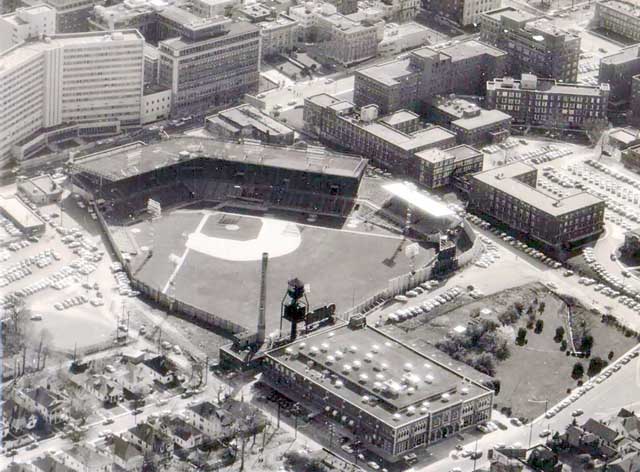
* Memphis' sports complex. For many years, this location included the Mid-South Fairgrounds, a minor-league ballpark, a football stadium and a sports arena, with Christian Brothers University just to the north. The Fairgrounds and the ballpark are gone, and the arena is closed, but the stadium is still in operation.

Built in 1963 and seating 10,085 people, the Mid-South Coliseum was best known as the home of the city's American Basketball Association franchise, known as the Memphis Pros in their 1st season in town, 1971-72; the Memphis Tams after being bought by Oakland A's owner Charlie Finley, 1972-74; and the Memphis Sounds in their last season, 1974-75, after Finley sold them. They moved to Baltimore to become the Claws, but, still feeling the effects of Finley's mismanagement, folded before ever playing a game in Charm City. The closest they got to a title was 1975 East Division Finals.
Memphis never again got close to attracting an NBA team until after the Pyramid was built, which rendered the Coliseum pretty much obsolete, with half as many seats and no modern amenities.

The Beatles played 2 shows there on August 19, 1966, but the evening show was marred by a firecracker being thrown onstage, leading the bandmembers, concerned over threats due to John Lennon's controversial "We're more popular than Jesus" comment, to think it was a gunshot. (This was 2 years before Martin Luther King was killed in the city, but 3 years after John F. Kennedy was killed in Dallas, and the Beatles really didn't want to go to Dallas.)

Elvis sang at the Coliseum, on March 16 and 20, 1974 and March 20, 1976. In 1997, 20 years after his death, his old band and backup singers (nearly all of them still alive at that point) reunited for the first time at the Coliseum, and presented "Elvis In Concert," with them playing and singing in front of a huge screen showing him from performances such as the 1973 Hawaii concert and from the documentaries Elvis: That's the Way It Is (1970) and Elvis On Tour (1972). A 25th Anniversary show was done at the Pyramid in 2002, and, despite the deaths of some bandmembers, these shows continue to be put together.

The Mid-South Coliseum continued to hold concerts, and remained the South's premier pro wrestling venue (as it had been since the mid-1960s), until, operating at a loss of $1 million a year, it was closed in 2006, but it still stands.

Memphis has never had an NHL or a WHA team. The closest current NHL team is the Nashville Predators, 212 miles away, but the Memphis-Nashville rivalry may complicate rooting interests. The next-closest team is the St. Louis Blues, 283 miles away.

The Liberty Bowl game was played in Philadelphia from 1959 to 1963, and indoors at what's now Boardwalk Hall in Atlantic City in 1964, before moving to the brand-new Memphis Memorial Stadium in 1965. The stadium was renamed Liberty Bowl Memorial Stadium in 1976.
Currently seating 59,308 people, it has a slope down to small end-zone seating sections, and a weird, curvy press box, making it similar to what the old Tampa Stadium "Big Sombrero" had. It's hosted the University of Memphis football team since it opened.

It's also briefly been home to several pro football teams: The Memphis Southmen of the World Football League in 1974 and '75, the Memphis Showboats of the USFL in 1984 and '85, the Memphis Mad Dogs of the CFL's ill-advised American experiment in 1995, and the Memphis Maniax of the XFL in 2001. It also hosted the Memphis Rogues of the old North American Soccer League in 1978, '79 and '80.

Most notably, when the Houston Oilers moved in 1996, they intended to play the 1997 and 1998 seasons at the Liberty Bowl, as the Tennessee Oilers, before moving to their new stadium in Nashville, 215 miles to the east, in 1999 as the Tennessee Titans.

But, despite having beaten Nashville to hosting regular-season NFL games, the people of Memphis were not willing to see a team they saw as both a lame duck and belonging to the despised Nashville, which inspired jealousy both as a State capital and as a competitor for the title of Music City, U.S.A. (a name Nashville actually calls itself). Despite going a respectable 8-8 (a fine 6-2 at home), they ended up getting the NFL's smallest crowds -- aside from the 1987 "Scab Bowls" -- since the 1950s. They averaged only 28,028 fans per home game, bottoming out at 17,071 for an October 12 win over Cincinnati. In contrast, they averaged 57,376 on the road. In other words, their road average would nearly have filled the Liberty Bowl, but their home average wouldn't have filled the Pyramid.

So team owner Bud Adams got the message, and figured, if he was going to get less than 40,000 fans to come out anyway, he might as well move to Nashville a year early, and put the team in Vanderbilt University's 41,000-seat stadium for a year until what's now named Nissan Stadium opened. 

Just yesterday, Moneywise published a list of the Worst College Football Stadiums, the bottom 19 percent of college football, 25 out of 129. The Liberty Bowl came in 7th: "The home of the Memphis Tigers looks futuristic -- for the 1960s. Liberty Bowl Memorial was built in 1965 and has not been aging well."

American Legion Field opened in 1963, seating 8,800 people, and the new Memphis Blues minor-league baseball team moved in for the 1968 season, and the name was changed to Blues Stadium. The Blues moved out, and the park was dark for 1977, but in 1978 a new version of the Memphis Chicks moved in, and were replaced by the Memphis Redbirds in 1998.

Both the Blues and the Chicks were Class AA teams, while the Redbirds have been a Class AAA team since they arrived. The Blues won Texas League Pennants in 1969 and 1973, just like their parent club at the time did in the National League, the Mets. Those were the only Pennants won at this ballpark.

After the 1977 season, the name of the ballpark was changed to Tim McCarver Stadium, after the native son catcher, then still active. Wanting a more modern facility, the Redbirds opened a new park in 2000, and McCarver Stadium was demolished in 2005. So not only did McCarver have the oddity of having a sports facility named after him while he was not only still alive, but still playing, but, like actress Helen Hayes and the 1st Broadway theater named for her, he actually outlived (and is still outliving at this writing) the ballpark named for him! A park with youth fields is now on the site.
Real grass in the outfield, artificial turf in the infield.

The complex is 5 miles southeast of downtown. The address for the Coliseum is 996 Early Maxwell Blvd., and that of the Bowl is 335 S. Hollywood Street. McCarver Stadium was at Early Maxwell Blvd. and Raymond Skinner Drive. Number 2 or 5 bus.

* AutoZone Park. Seating 14,384 people, this is one of the largest ballparks in the minor leagues. The Memphis Redbirds, a St. Louis Cardinals farm team, have played here since 2000. It also hosted the 1st 2 MLB Civil Rights Games, in 2007 and '08.
As part of the powerful Cardinal system, the Redbirds have won Pennants here in 2000 and 2009, making 12 Pennants for Memphis minor-league teams.

Memphis 901 FC, named for the city's Area Code, also play there, having begun play in 2019, in the USL Championship, the 2nd tier of American soccer. 200 Union Street at S. B.B. King Blvd. (formerly 3rd Street), downtown.

The new Nashville SC are the closest MLS team to Memphis, 211 miles away. Their start in 2020, and all the COVID nonsense since, means it remains to be seen whether the antagonism between the 2 cities might prevent West Tennesseans from embracing them.

* Site of Russwood Park. Memphis' 1st professional ballpark was built in 1896, and, still made mostly of wood, burned down on April 17, 1960, mere hours after a preseason exhibition game between the Chicago White Sox and Cleveland Indians.
The Memphis Chickasaws (or Chicks for short) won Pennants in the Class AA Southern Association in 1903, 1904, 1921, 1924, 1930, 1933, 1953 and 1955. Elvis sang there on the 4th of July 1956, and it hosted professional wrestling crowds of up to 18,000.
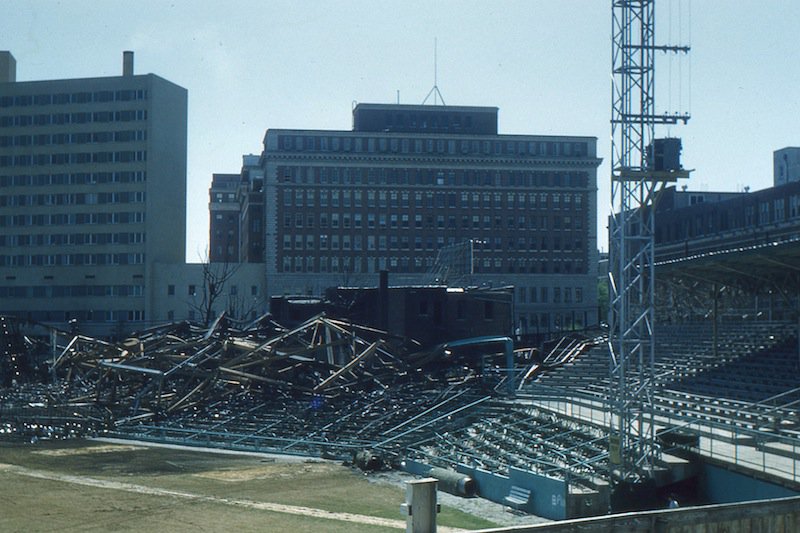
The bleachers after the fire

A post office is now on the site, adjacent to the University of Tennessee Health Science Center. 910 Madison Avenue at Pauline Street, about a mile and a half east of downtown. Number 102 bus.

* Martin Park. The Negro Leagues' Memphis Red Sox had a benefactor, black businessman J.B. Martin, so they were one of the few black teams that had their own ballpark. They played at Martin Park from 1923 to 1943, surviving the Great Depression, but not the manpower shortage of World War II.

A hardware store is on the site now. 494 East E.H. Crump Blvd., about 2 miles south of downtown. Bus 4.

According to an April 2014 article in The New York Times, the Yankees are actually the most popular MLB team in Memphis and the immediate environs, while the closest team, the Cardinals (283 miles to the north) are right behind; but the further you get from central Memphis, the more the Cardinals are preferred.

According to an article in the September 2014 edition of The Atlantic, alone among Tennessee's Counties, Shelby County's favorite NFL team is not the closest team, the Nashville-based Tennessee Titans, 212 miles away, reflecting the anti-State capital bias, but the Dallas Cowboys. This is also true for the northwestern corner of Mississippi, close to Memphis, as the rest of the State sides with the New Orleans Saints. Arkansas, however, goes for the Cowboys almost in their entirety, except for the southernmost part, bordering Louisiana, where the Saints are preferred.

Don't count on Memphis ever getting an MLB team, or another NFL team in spite of the built-in rivalry with the Titans.

* Museums. The FedEx Forum includes the Memphis Rock and Soul Museum. Beale Street, itself, is practically a living museum of music, especially the blues. The Sun Records studio, where Elvis, Johnny Cash, Roy Orbison, Jerry Lee Lewis and Carl Perkins all became stars, has been turned into a museum. 706 Union Street at Marshall Avenue, at the eastern edge of downtown. Also in a former studio, and before that a movie theater, the Stax Museum of American Soul Music is at 910 East Mclemore Avenue, 2 miles southeast of downtown. Number 4 bus.

But Memphis', and perhaps the entire South's, most important museum is The National Civil Rights Museum. It was established at the former Lorraine Motel, where Dr. Martin Luther King Jr. was shot and killed on April 4, 1968, while visiting Memphis to help striking black sanitation workers.

Aside from an explanatory plaque, and a white wreath on the balcony at the spot where Dr. King fell, the exterior of the building, including its 1960s-style sign, has been preserved exactly as it was on that horrible day. A pair of contemporary cars are parked out front, to match the ones shown in the famous photo of King's entourage pointing across the street, including Jesse Jackson and Andrew Young. 450 Mulberry Street, a couple of blocks from Memphis Central Station. Number 100 bus.

The Mason Temple, where Dr. King gave his last speech -- "I may not get there with you, but I want you to know, tonight, that we, as a people, will get to the Promised Land!" -- is at 930 Mason Street, a mile and a half south of downtown. Number 57 bus.
The 3 Presidents with connections to Tennessee are all well to the east of Memphis: Andrew Jackson and James Polk in Nashville, and Andrew Johnson in Greenville.

* Elvis sites. Memphis', and indeed Tennessee's, most famous structure isn't the FedEx Forum, or the Lorraine Motel, or Nashville's Ryman Auditorium/original Grand Ole Opry House, or the State House, or Andrew Jackson's Hermitage, or Neyland Stadium or the Thompson-Boling Center on the University of Tennessee campus in Knoxville. It's Elvis Presley's home, open to tours since his ex-wife and executor, Priscilla Presley, ordered it to fund the virtually bankrupt Elvis Presley Enterprises in 1982. (She had to wait until Elvis' father Vernon died, as he was still living there.)
Standing 8 miles south of downtown, a stone's throw from the airport and almost within walking distance of the Mississippi State Line, the name of the property was originally Graceland Farms. The site includes a house built in 1939, by Dr. Thomas Moore, whose wife Ruth was the niece of the farm's namesake, Grace Toof, who inherited it in 1894 from her father, Stephen C. Toof, who ran a commercial printing firm.

The Presley family's 1st home after Elvis got famous is at 1034 Audubon Avenue, but his fans soon visited in large enough numbers that it disturbed the neighbors. Elvis chose Graceland as his new home because it had enough land, nearly 14 acres, to isolate it from the street and its other houses, so his fans wouldn't bother the neighbors. He bought it in March 1957 for $102,500 (about $932,000 in today's money), and, over the next 20 years, sank over $500,000 into building it to his tastes. (Save your jokes.)

3764 Elvis Presley Blvd., which U.S. Route 51 south of downtown had already been named while he was still alive. Take any bus from downtown east to Madison Avenue, then the Number 42 bus. The trip takes a little under an hour. The house at 1034 Audubon is 9 miles southeast of downtown, but it's still a private residence, so don't bother anyone. Number 57 bus.
Elvis Aaron Presley died at Graceland on August 16, 1977 -- and anyone who says he's still alive is either referring to the legacy rather than the man, or is engaging in wishful thinking. (He'd be 84 years old this coming January, so he'd probably be dead by now anyway.) He was born on January 8, 1935, in Tupelo, Mississippi, a little over 100 miles to the southeast of Memphis. The city of Tupelo maintains the small house where he was born as a museum. 306 Elvis Presley Drive.

The Presley family first moved to Memphis in 1948. They lived in a rental house at 572 Poplar Avenue, now a vacant lot, just north of downtown. A year later, they moved to the Lauderdale Courts, essentially garden apartments, at 185 Winchester Avenue, Apartment 328. They stayed there until he got his big break in the Summer of 1954. Just north of downtown, near the bridge. Bus 56.

For a few months in late 1954 and early 1955, they rented a house at 2414 Lamar Avenue, on the southeast side of town. Again, Bus 56, but in the opposite direction. They spent early 1956 at another rental, a few blocks away (also via Bus 56) at 1414 Getwell Road. But he was on tour so much, he hardly saw this residence. By May 1956, it was Audubon Avenue; in March 1957, it was Graceland.

Aside from the preceding, Elvis sang in many places in and around Memphis. His first concerts, on July 17, 24 and 31, 1954, were at the Bon Air Club, at 4862 Summer Avenue. (Demolished. Bus 19) His first paid concert is said to have been at the Overton Park Shell (now the Levitt Shell) on July 30, 1954. He played it again on August 10, 1954 and August 5, 1955. 1928 Poplar Avenue. (Bus 50.)

He sang at the Eagle's Nest several times in 1954: August 7 and 27; September 4, 10, 11, 18, 24 and 25; October 1, 6, 9, 13, 15, 29 and 30; November 17 and December 10. Lamar Avenue (U.S. Route 78) and Winchester Road. (Demolished. Now a commercial area near the airport, hence the name. Bus 56 to 69)

He played the Goodwyn Institute on August 14, 1954. (127 Madison Avenue, downtown.) He played Bellevue Park on August 18, 1954. (Now Jesse Turner Park. 1310 S. Bellevue Blvd., or U.S. Route 51 -- which becomes Elvis Presley Blvd. Bus 56 to 42.) He played the VFW Club at Veterans of Foreign Wars Post 684 on August 20, 1954. (3709 E. Raines Rd. Bus 36 to 7.) He played the Hippodrome on August 28, 1954. (500 Beale Street, downtown.) He played on a flatbed truck at the opening of the Lamar-Airways Shopping Center on September 9, 1954. The truck's not still there, but the shopping center is. 2268 Lamar Avenue (Route 78) at Park Avenue. (Bus 56.)

He played the James M. Kennedy Veterans Hospital on September 21, 1954. (Now the Memphis VA Medical Center. 1030 Jefferson Avenue, downtown.) He played Memphis State University's auditorium on November 3, 1954. (Now the Michael D. Rose Theatre Lecture Hall at the University of Memphis. 507 University Street. Bus 5.) He played the auditorium at Bethel Springs High School on January 31, 1955. (The school is now defunct, possibly also demolished, and I can't find an address for it.) He played the Chickasaw Ballroom at the Hotel Chisca on March 9, 1956. (272 S. Main Street, downtown.)

The Ellis Auditorium was the scene of Elvis' graduation ceremony from Humes High School in 1953, and many shows he attended as a fan. He performed there on November 13 and December 19, 1955; February 6 and May 15, 1956; and February 25, 1961 -- aside from a benefit for Pearl Harbor survivors in Hawaii the next month, his last shows until the taping of his "1968 Comeback Special." Built in 1926, it was demolished in 1997, and replaced by the Memphis Cook Convention Center. 255 N. Main Street at Exchange Avenue, downtown.

He also played across the river, in West Memphis, Arkansas, at a place called "P and G," on December 8, 1954. I can find no further information about it. This is one of many concerts he gave in Arkansas in his early days, but the rest were considerably farther from Memphis. West Memphis can be reached from downtown by taking the Main Street Trolley from Main at G.E. Patterson to the William Hudson Transit Center, then transferring to Bus 78, the West Memphis Express.

The tallest building in Memphis has little imagination to its name, and, like many other buildings of the 1960s and '70s (in this case, 1965), not much imagination to its style, either. It's named simply 100 North Main, for its address. It's 433 feet tall: Never mind New York City, there are currently 21 buildings in New Jersey that are taller.

Before his daughter Miley became famous, I once joked that Billy Ray Cyrus should revive his career by starring in CSI: Memphis. After My Name Is Earl (not set in Memphis) ran its course, Jason Lee played a cop on the TV show Memphis Beat.

Many music-themed movies have used Memphis as both a setting and a film location, including the Johnny Cash story Walk the Line, the Jerry Lee Lewis story Great Balls of Fire, and the pimp-turned-rapper film Hustle and Flow. John Grisham used Memphis as a setting for some of his novels, and The Client, The Firm and The Rainmaker have been filmed there.

*

Memphis is more than history and music, as important as those things are. It's also the home of an NBA team that, while not yet very successful, has developed quite a following, and is now another good reason to visit this legendary city. 

Saturday, February 5, 2022

How to Be a New York Basketball Fan In Portland -- 2022 Edition

Next Saturday, February 12, the New York Knicks will visit the Portland Trail Blazers. The Brooklyn Nets did so on December 23, but that game coming so close to Christmas made travel recommendations difficult, so I postponed this Trip Guide until now.

Before You Go. Like its Pacific Northwest neighbors Seattle and Vancouver, Portland is notorious for rain. The game will be indoors, but you won't be indoors on the entire visit. The website for The Oregonian, Portland's major newspaper, says the temperatures will be in the high 50s by day and the high 30s by night on Saturday. But, unusually, they are predicting neither rain nor snow for the next week.

Portland is in the Pacific Time Zone, 3 hours behind New York. Adjust your timepieces accordingly.

Tickets. At the old Coliseum, the Blazers couldn't even fit in 13,000 people. From their 1977 title run until they moved out in 1995, the attendance was the same every night: 12,880, later 12,888. That was 814 consecutive sellouts.

Today, they're in the Moda Center, with 19,441 seats. They haven't sold out every game in the 20 years since they moved it, but they averaged 19,706 in 2019-20, before COVID shut everything down, so that's a sellout. Tickets will be tough to get.

But, for the moment, they are available, if very expensive. Tickets in the 100 Level are $389 between the baskets, and $162 behind them. In the 200 Level, $314 between and $108 behind. In the 300 Level, $66 between and $42 behind.

Getting There. Keep in mind, this game will be played on December 23. Meaning you will most likely be coming home on Christmas Eve. If you're not flying, you'll also be traveling on Christmas Day, when a lot of places will be closed, so driving would be the most complicated method of all. Not counting Amtrak, which is literally impossible at this point. In other words, if Portland is an NBA city that you really want to "cross off your list," my suggestion is to wait until next season.

It's 2,895 miles from Times Square to the Moda Center in Portland. In other words, if you're going, you're going to want to fly.

After all, even if you get someone to go with you, and you take turns, one drives while the other one sleeps, and you pack 2 days' worth of food, and you use the side of the Interstate as a toilet, and you don't get pulled over for speeding, you'll still need over 2 full days to get there. One way.

But, for future reference, if you really, really want to drive... Get onto Interstate 80 West in New Jersey, and stay on that through Pennsylvania, Ohio, Indiana, Illinois, Iowa, Nebraska, Wyoming and Utah. Outside Ogden, Utah, at Exit 168, switch to Interstate 84 West. Take that into Idaho and Oregon, all the way to the end of I-84.

Not counting rest stops, you should be in New Jersey for an hour and a half, Pennsylvania for 5:15, Ohio for 4 hours, Indiana for 2:30, Illinois for 2:45, Iowa for 5 hours, Nebraska for 6:45, Wyoming for 6:30, Utah for 3:30, Idaho for 5:30, and Oregon for 6:15. In total, that's around 49 1/2 hours. Given rest stops, we're talking more like 60 hours -- 2 1/2 days.

That's still faster than Greyhound (70 hours, changing buses 3 times, $451 round-trip, but it drops to $332 with advanced-purchase) and Amtrak (67 hours, changing in Chicago, $588 before booking sleeping arrangements). Union Station, which serves both carriers, is at 550 NW 6th Avenue. 6th & Hoyt station on MAX.

This time, though, you'd have to leave Port Authority at 12:05 AM on Monday, to arrive in Portland at 6:20 PM on Wednesday, over 24 hours before tipoff, making -- I swear, I am not making this up -- 6 bus changes: You'll have to transfer in Columbus (Ohio), Chicago, Minneapolis, Billings (Montana), Spokane and Stanfield (Oregon). So, why not take the next bus that could start you on the process to Portland? It won't arrive until Friday, a few hours after the game ends.

On Amtrak, you would leave Penn Station on the Lake Shore Limited at 3:40 PM Eastern Time on Wednesday, arrive at Union Station in Chicago at 9:50 AM Central Time on Thursday, and board the Empire Builder at 2:15 PM, and would reach Union Station in Portland at 10:10 AM Pacific Time on Saturday.

But COVID restrictions have wrought havoc with Amtrak. As a result, to get from New York to Portland by rail, you'll need at least 3 trains, possibly 4. So, no Amtrak this time.

A round-trip flight from Newark to Portland International Airport (whose call letters, PDX, have also become a nickname for the city) will almost certainly not be nonstop, but, if you're willing to leave early in the morning, you could get it for less than $300. The MAX Red Line will get you from the airport to downtown in 33 minutes.

Once In the City. Founded in 1845 as the end of the Oregon Trail, in the shadow of Mount Hood, legend has it that the name of the town was decided by a coin flip between 2 of the original settlers. Francis Pettygrove wanted to name the town after his hometown of Portland, Maine. Asa Lovejoy was from Groton, Massachusetts. Pettygrove won, and that's why the Knicks and the Nets don't play the Groton Trail Blazers.
Portland, a.k.a. the Rose City, has a population of around 653,000, and a metro area of about 3.2 million. It's still growing, but not as fast as it was in the 1980s and '90s, when a group successfully lobbied to slow down the suburban sprawl. It was named PLAN, for Prevent Los Angelization Now. It's about 75 percent white, 10 percent Hispanic, 8 percent Asian and 7 percent black.

The State of Oregon has no sales tax, and this covers the County of Multnomah and the City of Portland. The Willamette River is the divider between east and west, and Burnside Street, including its bridge over the river, is the divider between north and south. Portland has no beltway.

ZIP Codes in Oregon begin with the digits 97, and Portland and its suburbs use 970 and 971. The Area Code for Portland is 503, with 971 overlaid. Portland General Electric (PGE) runs the electricity. And, if you're from New Jersey, you'll like this: Oregon is the only other State in the Union where you do not have to pump your own gas.
TriMet, the area's public transit service, runs buses and the MAX light rail system. A single fare is $2.50, while a day pass is $5.00. They also run the WES Commuter Rail.
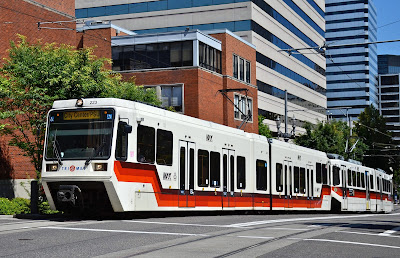
A MAX train, downtown

The capital of Oregon is Salem, about 50 miles southwest of downtown Portland. The 1st 2 State Houses were destroyed by fires in 1855 and 1935. The new State House opened in 1938, but it looks like a cross between an Art Deco church and a prison. Fortunately, the grounds are covered with examples of Oregon's natural beauty, but also include a pair of burned, broken pillars from its predecessor.
The State House in Salem

Going In. The official address of the Moda Center is 1 North Center Court Street. The building is bounded by Ramsay Way (named for former head coach Jack Ramsay) on the north, Wheeler Avenue on the east, Multnomah Street on the south and Center Court Street on the west. MAX reaches the arena via Rose Quarter and Interstate stations.

Definitely walk from your hotel or take public transit, because parking spaces are expensive, running around $22. If you do come in by MAX, you'll probably be entering through the south side of the arena.
Opening in 1995 as the Rose Garden, it was renamed for healthcare provider Moda Health in 2013. It is also home to the Western Hockey League's Portland Winterhawks (for some but not all games), and the Arena Football League's Portland Thunder. The court is aligned northwest to southeast.
The Blazers' former home, the Veterans Memorial Coliseum, is across Center Court Street. It opened in 1960, and was home to the Blazers from their 1970 debut until 1995, and the Winterhawks full-time from 1976 to 1995 and part-time since then.
The Coliseum

It hosted the 1965 NCAA Final Four, with UCLA beating Michigan in the Final. This was also the 1st Final Four to feature a New Jersey-based team, the Princeton squad led by future Knick and future U.S. Senator Bill Bradley. The Beatles performed at the Coliseum on August 22, 1965, and Elvis Presley sang there on November 11, 1970 and April 27, 1973.
The Moda Center, with the Coliseum behind it

Food. I couldn't find a section guide to the concession stands, but the arena website did say this:

Delicious icons from Portland's restaurant scene fill the Moda Center at the Rose Quarter.

Sandwich specialists Bunk Sandwiches will continue to bring Portland's favorite sandwiches to Trail Blazers fans. Pizzeria extraordinaire Sizzle Pie and Salt and Straw Ice Cream anchor the new local focus of the Moda Center menu. These new additions, returning fan favorites and fresh concepts created by the venue's food service partner, Levy Restaurants, are sure to please all who attend.
Levy Restaurants also recently unveiled new food concepts including Fowl Language, featuring fried chicken, wings, and chicken biscuit sandwiches. The Pines is a new bar on the 300 level which features craft beers, cocktails and extraordinary views of the Portland skyline. 

In addition to the new culinary experiences, Levy Restaurants also recently introduced a number of new food carts. Plum Tasty is a healthy food cart brought to you by Moda, where slow food is served fast.  It's a delicious way to dine during the game with mouth-watering food made fresh and healthy just for you, including vegetarian options and healthy grab 'n go snacks.  Plum Tasty is located at Entry A9 on the Main Concourse. Humble Slider features a variety of house-made sliders, and at the Polanco cart you can dine on nachos, tacos and more. The Cones cart serves hand-dipped ice cream cones with many toppings and dips for you to choose from.

The Club Level provides each guest with an exquisite variety of food and beverage options. Nook offers a range of vegan, vegetarian and gluten-free options. At the Hot Stone location you're able to pick from an excellent selection of artisan pizzas, pastas and salads.  Oven toasted sandwiches and 1/3 pound burgers are served at the Junction 5 location.  The Club Level also features Portland favorites such as Bunk Sandwiches, Cha Cha Cha traditional Mexican Food, and Salt and Straw farm to cone ice creams. 

Team History Displays. The Blazers aren't a particularly old team, nor an especially successful one. But they celebrate the history they do have heavily. They hang banners for their 1977 NBA Championship; their 1977, 1990 and 1992 Western Conference Championships; and their 1978, 1991, 1992, 1999, 2015 and 2018 Division titles.
A whopping 8 players, plus the head coach, the owner, and a broadcaster from their 1977 NBA Championship team have been honored with retired number banners. Retired are 13 for guard Dave Twardzik, 14 for guard Lionel Hollins, 15 for guard Larry Steele, 20 for forward Maurice Lucas, 30 for forward Bob Gross, 32 for center Bill Walton, 36 for forward Lloyd Neal, and 77, in honor of the year, for the coach, Dr. Jack Ramsay.

Number 1 for owner Larry Weinberg is in the rafters, but is still available to be worn by a player. A microphone is retired for broadcaster Bill Schonely.

Guard Geoff Petrie, the 1st player ever drafted by the Blazers in 1970, was 1971 NBA Rookie of the Year, but was traded for Lucas before the 1976-77 season. Nonetheless, the Blazers retired his Number 45. From the 1990 and 1992 Western Conference titles, they've retired the numbers of guards Clyde "the Glide" Drexler, 22; and Terry Porter, 30. In 2008, they had a dual-retirement ceremony for 30, for Gross and Porter.

The Blazers' retired number banners are, as far as I know, unique is sports, in that they have the honorees' signatures stitched onto them.
In addition to Walton, Drexler and Ramsay, Blazers in the Basketball Hall of Fame include guard Lenny Wilkens (the last season of his playing career, 1974-75, player-coach that year and coach only the next), guard Dražen Petrović (before he became a New Jersey Net), forward Scottie Pippen (for 4 seasons after he left the Chicago Bulls), and center Arvydas Sabonis. Rick Adelman, who coached them to the 1990 and '92 NBA Finals, has also been elected. Maurice Cheeks was Blazer coach for 4 years, but was elected for playing with the Philadelphia 76ers.

Walton, Drexler, Wilkens and Pippen were named to the NBA's 50th Anniversary 50 Greatest Players, but only Walton and Drexler for what they did in Portland. Those 4, plus Carmelo Anthony and current Blazer star Damian Lillard, were named to the NBA's 75th Anniversary 75 Greatest Players.

The Winterhawks have won the President's Cup as Champions of the Western Hockey League in 1982, 1998 and 2013, and the Memorial Cup in 1983 (making them the 1st team from outside Canada to win it) and 1998. 

Don't be confused by their banners: While the Chicago Blackhawks were originally stocked by players bought from the defunct Portland Rosebuds, the Winterhawks have not only a similar name but the same red & black colors and the same Indian Head logo as the Chicago team, and they even followed the "Black Hawks" by shortening their name from 2 words ("Winter Hawks") to 1, they are not a farm team of the Blackhawks.

Winter Hawks/Winterhawks alumni include Hall-of-Famers Mark Messier and Cam Neely, the brothers Dave & Wayne Babych, Adam Deadmarsh, Brandon Dubinsky, Ray Ferraro, the brothers Marcel & Marian Hossa, Clint Malarchuk, Brenden Morrow, the brothers Jim & Larry Playfair, Mike Vernon, and the brothers Blake & Glen Wesley.

There is an Oregon Sports Hall of Fame, at 4840 SW Western Avenue in Beaverton, about 7 miles southwest of downtown Portland. Buses 54 and 56 will drop you 2 blocks away. Members include Trail Blazers Bill Walton, Maurice Lucas, Dave Twardzik, Geoff Petrie, Clyde Drexler, Terry Porter, Jim Paxson, Jerome Kersey and Damon Stoudamire.

Among other inductees: Danny Ainge, a native of Eugene, played 2 seasons with the Blazers; Jim Barnett, an original Blazer in 1970, as is now known as the TV voice of the Golden State Warriors; Steve "Snapper" Jones, before becoming a broadcaster, played the 1975-76 season for the Blazers; and Gary Payton played at Oregon State, but played most of his Hall of Fame pro career for the Blazers' arch-rivals in Seattle. Which segues to...

The rivalry between the NBA's 2 Pacific Northwest teams -- not counting the 1995-2001 experiment with the Vancouver Grizzlies -- ended in 2008, after 38 seasons, with the Blazers trailing the Seattle SuperSonics 98-94 in games.

Stuff. The Trail Blazers Fan Shop is in the Moda Center, open during games, and 11 AM to 3 PM otherwise.

Amazon.com doesn't have any DVDs about the Blazers -- not even a retrospective of their 1977 title season. Just VHS tapes. They do have some books. Jack Scott wrote Bill Walton: On the Road With the Portland Trail Blazers after their title season of 1976-77. Walton and Wayne Thompson wrote Blazermania: This Is Our Story -- The Official History of the Portland Trail Blazers in 2010, on the team's 40th Anniversary. 

During the Game. Portland is a relatively safe city. The Blazers had a bit of a rivalry with the Seattle SuperSonics, but with the Sonics gone, PTB games are rather peaceful. They have no history of animosity with either the Knicks or the Nets, and as long as you don't provoke anybody, you'll be fine.

A November 13, 2014 article on DailyRotoHelp ranked the NBA teams' fan bases, and listed the Blazers' fans 3rd: "This is one of the more dedicated fan bases in all of professional sports... This is truly a fan base that would be crushed if the team were to leave town." A swipe at the underwhelming response of Seattle to losing the Sonics, perhaps?

The original version of the Pinwheel logo

The Blazers have perhaps the funkiest logo in sports: Designed by a cousin of team founder Harry Glickman (Harry is still alive at age 94), it's been called a "pinwheel," and represents 2 5-on-5 basketball teams lined up against each other, one wearing red, the other silver.
The current version

Neither of the New York teams' visits will feature a promotion. The Blazers hold auditions for National Anthem singers, rather than having a regular singer. Their theme song is an instrumental titled "Crazy" (with no connection to the Patsy Cline song of the same title). But the only notable fan chant is, "Let's go, Blazers!"

In addition to the BlazerDancers cheerleaders, a junior dance team composed of 8- to 11-year-old girls also performs at selected home games, as does a hip-hop dance troupe. Other regular in-game entertainment acts include a co-educational acrobatic stunt team which performs technically difficult cheers, a breakdancing squad known as the Portland TrailBreakers, and a pair of percussion acts.

The mascot is Blaze the Trail Cat, a mountain lion, which makes sense, given the Cascade Mountains in which Portland sits. Like the Gorilla in Phoenix and Hugo the Hornet in Charlotte, Blaze does trick dunks.
After the Game. Portland's reputation for safety, and their fans' reputation for being noisy but not nasty, will work in your favor. Both you and your car should be safe.

If you're hungry after the game, on Martin Luther King Blvd. at Hassalo Street, 6 blocks east of the arena, there's a Burgerville. On Hassalo, there's a Denny's, and around the corner, on Grand Avenue, there's a Red Robin. Spirit of 77 is a Blazers-themed bar at 500 NE MLK Blvd. at Lloyd Blvd., across from the Oregon Convention Center, a 5-minute walk from the Moda Center.

The Jolly Roger, at 1340 SE 12th Avenue at Madison Street, is known as a hangout for New York Giants fans. They may also be welcoming to Knicks or Nets fans. Bus 4 from Rose Quarter Transit Center. I have also heard that Kingston Bar & Grill is a Giant fans' bar. 2021 SW Morrison Street, at 20th Place, across from Providence Park.

If you visit Portland during the European soccer season, which we are now in, the likeliest place to watch your favorite club is at the Toffee Club, 1006 SE Hawthorne Blvd. Bus 14.

Sidelights. On November 30, 2018, Thrillist published a list of "America's 25 Most Fun Cities," and Portland came in 19th. Portland doesn't have much of a sports history besides the Blazers. But there are a few items worth mentioning, besides the Coliseum and the Moda Center.

* Providence Park. This started as a minor-league baseball field named Multnomah Field in 1893. It was replaced by Multnomah Stadium in 1926. The name has been changed to Civic Stadium in 1966, PGE Park in 2001, Jeld-Wen Field in 2011 and Providence Park in 2014.
In this photo, you can tell that it was designed for baseball.

At 21,444 seats, it was one of the largest ballparks in the minor leagues. It was home to the Pacific Coast League's Portland Beavers from 1956 to 1972, again from 1978 to 1993, and again from 2001 to 2010. They only won 1 Pennant there, in 1983, but won 4 Division titles: 1965, 1983, 1993 and 2004.

It was home to the Portland Mavericks of the Northwest League, the team with whom Jim Bouton began his post-Ball Four comeback and co-invented Big League Chew. It was home to the Portland Rockies of the Northwest League from 1995 to 2000. Currently, the city doesn't have a professional baseball team.

Portland State University plays football there, and both the University of Oregon and Oregon State University played "home" games on the site between 1894 and 1970. It was home to the Portland Storm, later the Portland Thunder, of the World Football League in 1974 and '75, and the Portland Breakers of the USFL in 1985.

The original Portland Timbers, of the original North American Soccer League, played there from 1975 to 1982. After the NASL folded, the Timbers were reconstituted, began play in 1985, folded again in 1990, started again in 2001, and joined Major League Soccer in 2011.

The Portland Thorns of the National Women's Soccer League began play there in 2013, and, like their masculine counterparts, are one of the best-supported teams in their league. They won the title in that 1st season, and won it again this year.

Civic Stadium hosted Soccer Bowl '77, in which Pelé and the New York Cosmos won the NASL title by beating the Seattle Sounders, making it Pelé's last competitive match. (I wonder if the Portland fans rooted against Seattle.) 

It hosted 4 games of the 1999 Women's World Cup, and 6 of the 2003 edition, 1 involving the U.S. It's hosted 4 games of the U.S. men's national team, 3 wins and a draw, most recently a 2013 win over Belize.

Elvis played one of the earliest stadium concerts at Multnomah Stadium on September 2, 1957. 1844 SW Morrison Street. Kings Hill/SW Salmon Street MAX station.

* Vaughn Street Park site. The PCL Beavers began playing at the 12,000-seat Vaughn Street Park in 1901. They won 8 Pennants there: 1901, 1906, 1910, 1911, 1913, 1914, 1936 and 1945. A fire in 1947 burned down the bleachers, which led to the Beavers giving up on it after the 1955 season, and moving to what's now Providence Park.

It's an industrial area now, and a plaque honoring the ballpark is on the site. 2401 NW Vaughn Street at 24th Avenue, about 2 miles northwest of downtown. Bus 15.
For now, the Hillsboro Hops, of the Northwest League, are the closest professional baseball team to Portland. They play at Ron Tonkin Field, a 3,534-seat ballpark built in 2013, and named for a local car dealer. 4460 NE Century Blvd., 14 miles west of downtown. MAX Blue Line to Orenco, then Bus 47.
* Portland Ice Arena site. From 1914 to 1926, the Portland Rosebuds played in the Pacific Coast Hockey Association. Their home was the Portland Ice Arena. In 1916, they won the PCHA title, and became the 1st American team to play in the Stanley Cup Finals, losing to the National Hockey Association Champions, the Montreal Canadiens.

(Don't mention this to Portland fans, but the next year, Seattle beat the Canadiens and became the 1st American city to actually win the Cup.)

The team included future Hall-of-Famers Dick Irvin Sr., Ernie "Moose" Johnson and Tommy Dunderdale, but folded in 1926, and its players were mostly brought east to form the Chicago Blackhawks.

From 1928 to 1941, the Arena was home to the Portland Buckaroos. Several teams of that name played in Portland until 1975, and were replaced by the Winterhawks in 1976. The Arena closed in 1953 and was demolished. NW 20th & 21st Avenues, Northrup & Marshall Streets, a mile west of Union Station. NW 21st & Northrup on MAX.
Portland has the NBA and MLS, but don't expect it to get teams in the other sports soon. Its population would rank it 24th in MLB, 21st in the NFL and 20th in the NHL. For the time being, the closest MLB, NFL and NHL teams are in Seattle, 173 miles away. 

An April 23, 2014 article in The New York Times shows that the most popular MLB team in Portland is the closest team, the Seattle Mariners, but it's not overwhelming: They average about 22 percent of Portland baseball fans, while the Yankees and Red Sox battle it out for 2nd place, in the 10s. 

The September 2014 issue of The Atlantic shows that the most popular NFL team in Portland, and in most of Oregon, is the Seattle Seahawks -- and while this was after the Hawks' Super Bowl XLVIII win, it was before they got into Super Bowl XLIX. Southwestern Oregon, closer to California than to Washington State, prefers the San Francisco 49ers, while southeastern Oregon prefers... the Dallas Cowboys, as does neighboring southwestern Idaho. Ew.

The University of Oregon is 114 miles south on I-5, in Eugene. It can be reached by Cascades Point bus from Union Station, although this will take 2 hours and 45 minutes and cost $26 -- each way. Oregon State University is 87 miles south, in Corvallis. You'd have to take at least 2 conveyances to get there, and it would cost $50.50 -- each way.

Portland's top museum is its Art Museum, at 1219 SW Park Avenue. The Oregon Historical Society Museum is across the street at 1200 SW Park. City Hall station on MAX. The Oregon Museum of Science & Industry is at 1945 SE Water Avenue. OMSI/SE Water station on MAX.

Oregon has never produced a President. The closest it's come is the years when an orphaned Herbert Hoover lived with an uncle growing up in Newberg, 25 miles southwest of downtown Portland. The Hoover-Minthorn House is at 115 S. River Street. There is a bus that goes there, but it's prohibitively expensive, so if you want to see it, you should rent a car.

As with Utah, the tallest building in Oregon is named the Wells Fargo Center. Not to be confused with the Philadelphia arena of the same name, this one opened in 1972, and looks it: It's rather dull architecture. It stands 546 feet at 1300 SW 5th Avenue. City Hall station on MAX.

The TV shows Bates Motel (based on the novel and film Psycho, which was set in fictional Fairvale, California), Eureka (in the fictional town of that name), and the Disney series Gravity Falls (ditto) were set in Oregon.

Specifically in Portland, Leverage, Portlandia, Grimm, Life Unexpected, and the brief 1990s CBS crime drama Under Suspicion were both filmed and set there. In The CW's Arrowverse series of superhero shows, Portland is used for establishing shots and maps of fictional Central City on The Flash, even though the show, like the other Arrowverse shows, is filmed in Vancouver.

Unfortunately, the most famous TV show set in Portland, thanks to the jokes Johnny Carson told about it on The Tonight Show, was one of NBC's all-time turkeys, the late 1970s McLean Stevenson sitcom Hello, Larry.

Films based in Oregon include Ice Cube's Are We There Yet? series, the Madonna bomb Body of Evidence, Drugstore Cowboy, Five Easy Pieces, The Goonies, Arnold Schwarzenegger's comedy Kindergarten Cop, The Lathe of Heaven, Mr. Brooks, Mr. Holland's Opus, My Own Private Idaho, Overboard, Paint Your Wagon (Clint Eastwood in a musical? Yes), Pay It Forward, the track & field movies Personal Best and Pre (the latter about Steve Prefontaine, the 1st athlete to endorse Oregon-based Nike footwear), The Postman (Kevin Costner's postapocalyptic film, a.k.a. "Kevin's Gate"), Seven Brides for Seven Brothers, Short Circuit, Stand By Me, and, of course, the film version (which he hated) of Ken Kesey's novel One Flew Over the Cuckoo's Nest.

And while it wasn't set in Oregon, Animal House was filmed on the University of Oregon campus.

*

And on that note, let me remind you that the city has the slogan "Keep Portland Weird." The Trail Blazers, with their odd history, are a part of that. This is not a threatening town, unless you don't like weird things.

But you're from New York (or New Jersey), so you're used to weird. You should be able to have fun in Portland.