Showing posts with label oregon. Show all posts

Thursday, February 5, 2026

Mickey Lolich, 1940-2026

Who is the all-time leader in batters struck out? Nolan Ryan. Among lefthanded pitchers? Randy Johnson. Before him? Steve Carlton. Before him?

Mickey Lolich.

The other three are in the Baseball Hall of Fame. Lolich is not.

Michael Stephen Lolich was born on September 12, 1940 in Portland, Oregon, to parents of Croatian descent. As a boy, a tricycle accident caused an injury that forced him to become lefthanded. A 1964 article in the Indianapolis News wrote, "He now eats, writes and bats right-handed, pitches left-handed and thinks sideways."

He went to Lincoln High School in Portland, whos alumni also include baseball star Johnny Pesky, basketball star Swede Halbrook, cartoon voice king Mel Blanc, Simpsons creator Matt Groening, ill-fated actress Rebecca Schaeffer, U.S. Senator Richard Neuberger, artist Mark Rothko and Beat Generation poet Gary Snyder.

He graduated in 1958, and was immediately signed by the Detroit Tigers. After a difficult introduction to the pros, where a sportswriter called him a "flamethrowing wildman," the Tigers loaned him to his hometown team, the Portland Beavers of the Pacific Coast League, where he learned control, and earned his way into the bigs.

He made his major league debut on May 12, 1963, pitching 2 scoreless innings of relief in a 9-3 Tiger loss to the Cleveland Indians at Tiger Stadium. He was put into the starting rotation in 1964, and went 18-9, and then 15-9 in 1965. In 1967, he was just 14-13, but led the American League in shutouts with 6, as the Tigers fell 1 games short of the Pennant.

The 1968 season was "The Year of the Pitcher." In the National League, Bob Gibson went 22-9 with a 1.12 ERA, the lowest in the post-1920 Lively Ball Era; Juan Marichal went 26-9; and Don Drysdale only went 14-12, but pitched a new record of 58 2/3rds consecutive scoreless innings.

In the American League, Sam McDowell, who pitched a complete-game victory in Lolich's debut, went 15-14, but had a 1.81 ERA, and led both Leagues in strikeouts with 283; his Cleveland teammate, Luis Tiant, went 21-9 and led the AL with 1.60; Mel Stottlemyre of the Yankees went 21-12 with 2.45; and Denny McLain became the 1st pitcher in 32 years to win 30 games in a season, going 31-6 with 280 strikeouts and a 1.96 ERA. Lolich had a very good season by most standards, going 17-9 with 3.19 and 197 strikeouts.

Following the near-miss and the riot of 1967, Detroit needed a winner, and the Tigers won their 1st Pennant in 23 years. But they ran smack into the defending World Champions, the St. Louis Cardinals, and in Game 1, Bob Gibson set a World Series record with 17 strikeouts, beating McLain. Lolich won Game 2, hitting a home run to aid his own cause. But the Cards won Game 3 and 4, with Gibson beating McLain again. They won Game 5, behind Lolich, then Game 6 behind McLain on short rest.

Manager Mayo Smith started Lolich in Game 7, on 2 days' rest, to face Gibson, on 3. Jim Northrup's 3-run triple in the 7th inning broke up a scoreless tie, and each team added a run in the 9th, but Lolich finished the job, and the Tigers won, 4-1, to win the World Series for the 1st time since 1945. Lolich joined Harry Brecheen of the 1946 Cardinals as only the 2nd lefthanded pitcher to win 3 games in a single World Series, and was named its Most Valuable Player.

While McLain's star would fall, Lolich remained one of the AL's top pitchers. He went 19-11 in 1969. The Tigers fell apart in 1970, in part due to McLain's shenanigans, but the team as a whole slumped, and McLain was only 14-19.

But he went 25-14 in 1971, leading the major leagues in wins, and in strikeouts with 308. But he lost the Cy Young Award to Vida Blue. In addition, Blue started the All-Star Game over him, even though it was at Tiger Stadium in Detroit. Lolich was, however, the 1st reliever used in the Game. In 1972, he went 22-14, made the last of his 3 All-Star Games, and helped the Tigers win the AL Eastern Division.

But the Tigers' 1967-72 core, led by Al Kaline, was getting old, and fell apart. Lolich went 16-15 in 1973, 16-12 in 1974, and 12-18 in 1975. The Tigers traded him to the Mets for Rusty Staub. Going from one aging team getting broken up to another, he was just 8-13 in 1976, and was upset with team management, especially manager Joe Frazier and his coaching staff. He retired.

He went back to the Detroit suburb of Rochester, Michigan, and opened a doughnut shop. Which was considered ironic, as he was considered fat in his time, the original "hefty lefty" or "portly portsider." He was considerably thinner, though, than later pitchers Terry Forster, David Wells and CC Sabathia. (And righthanders like Rod Beck, Rich Garces and Bartolo Colón.) Asked about it, he said that he rarely sampled his own product, and mentioned the old line, "Never trust a skinny cook."

He sat out the 1977 season, which allowed him to become a free agent. The San Diego Padres signed him, and he pitched 47 games for them over the next 2 seasons, mostly in relief, and retired after being released after the 1979 season. His career record was 217-191, with a 3.44 ERA, a 1.227 WHIP, and 2,832 strikeouts. He had surpassed Warren Spahn as the all-time leader in that category among lefthanded pitchers. He was soon surpassed as such by Steve Carlton, who was eventually surpassed by Randy Johnson.

With his former Tiger teammate Bill Freehan, he started 324 games, a new major league record for most starts together for a pitcher-catcher combination, or "battery." That record stood until 2022, when Adam Wainwright and Yadier Molina of the St. Louis Cardinals raised it to 328.

*

Should Mickey Lolich be in the Baseball Hall of Fame? Among lefthanded pitchers, he still ranks 5th all-time in strikeouts, behind Johnson, Carlton, CC Sabathia and Clayton Kershaw. Among lefties in the post-1947 Integration Era, he ranks 17th.

Baseball-Reference.com has a "Hall of Fame Monitor," on which a "Likely HOFer" is at 100. Lolich is at 99, suggesting that he falls just short. B-R also has "Hall of Fame Standards," which is weighted more toward career achievement, and on which the "Average HOFer" is at 50. Lolich is at 37, suggesting that he doesn't come all that close.

B-R also has "Similarity Scores," which, weighted toward players of the same position but not completely tied to them (except for pitchers), which shows the 10 players who are most statistically similar to that player. Lolich's Top 10 are Jim Bunning, Jerry Koosman, Jerry Reuss, Rick Reuschel, Luis Tiant, Curt Simmons, Billy Pierce, Jim Perry, Vida Blue and Joe Niekro. Of those, only Bunning is in the Hall, although Koosman, Tiant and Blue have their supporters.

Put it all together, and it looks like Lolich just doesn't quite make it. However, he was elected to the Michigan Sports Hall of Fame, and the Croatian-American Sports Hall of Fame.

In the late 1990s, he sold the doughnut shop and retired. He remained active in charity work, and served as a coach at the Tigers' baseball fantasy camp in their Spring Training facility at Lakeland, Florida.
He married Joyce Fleenor, and they were together for 61 years. They had 3 daughters: Kimberly, Stacy and Jody; and 3 grandsons.

Mickey Lolich died yesterday, February 4, 2026, at the age of 85, at a care center in the Detroit suburb of Sterling Heights, Michigan.

With his death, there are now 6 surviving players from the 1968 World Champion Detroit Tigers: Willie Horton, Denny McLain, Dick Tracewski, Mickey Stanley, John Hiller and Jon Warden.

Wednesday, November 19, 2025

November 19, 1975: "One Flew Over the Cuckoo's Nest" Premieres

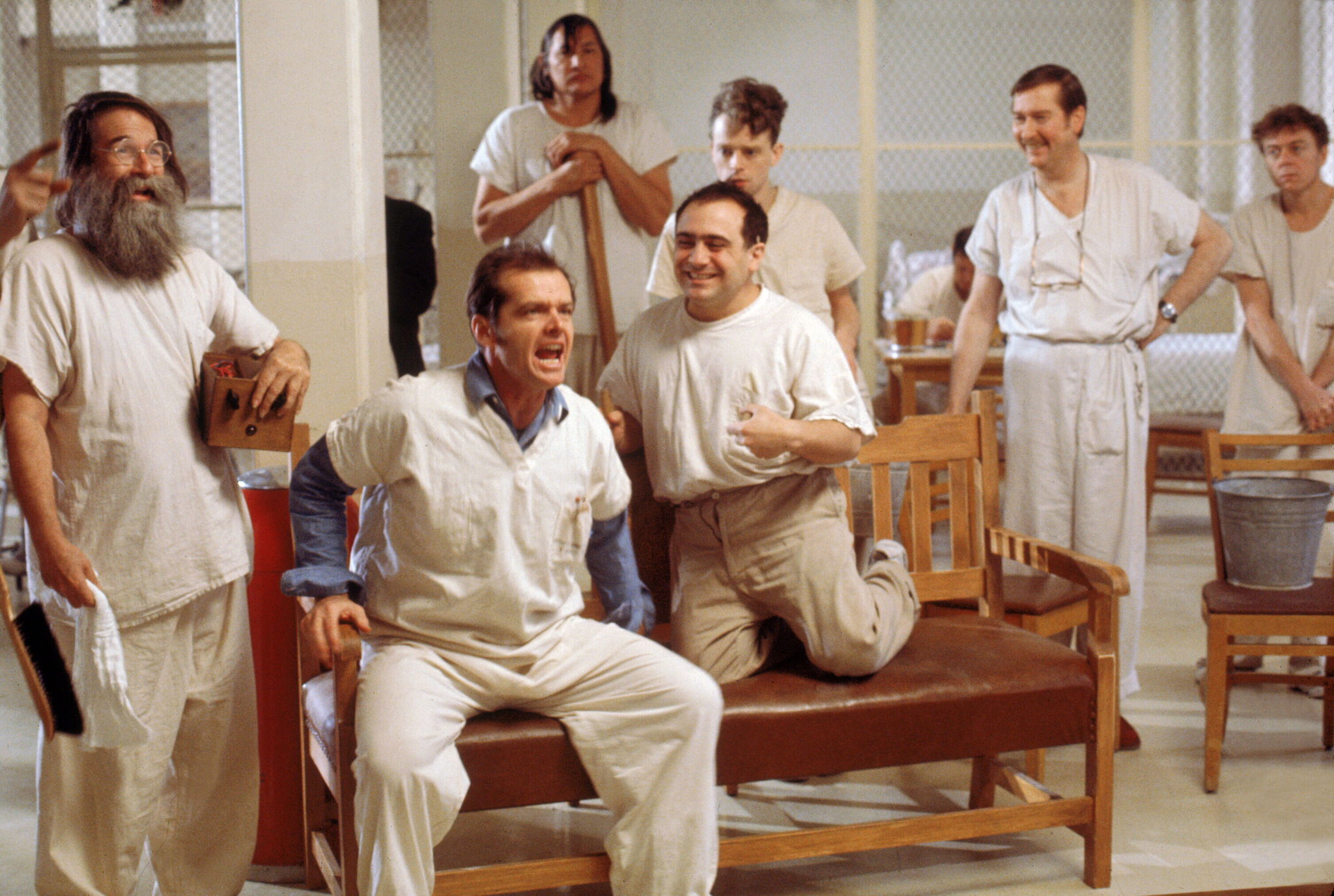
November 19, 1975, 50 years ago: One Flew Over the Cuckoo's Nest premieres, directed by Miloš Forman, and based on the 1962 novel by Ken Kesey. Kesey himself hated the film.

Maybe the film's star, Jack Nicholson, had something to do with it. After all, in 1980, Stanley Kubrick directed a film version of Stephen King's The Shining, and cast Nicholson as the lead, and King hated it.

Shortly after its publication, the novel had been produced on Broadway, starring Kirk Douglas. Gene Wilder, not yet a star, played Billy Bibbitt. Ed Ames, already a star, 6-foot-3, and, despite being Jewish, dark-skinned enough to have played Native Americans before and after, played Chief Bromden.

Douglas held the film rights to it, but it remained stuck in "development hell." He allowed his son, actor Michael Douglas, to produce the film. Michael hired Hal Ashby to direct, but Ashby decided that Kirk was now too old to play the lead, and Michael backed him up on this. When Forman, Kirk's first choice to direct but stuck in Communist Czechoslovakia, escaped to America, Ashby gracefully stepped aside, but Forman also maintained that Kirk was too old. (He was just short of turning 59 when the film was released.)

Oddly, Michael Douglas would have been about the right age (31 when the film was released), but things were already strained between him and his father, so he stepped aside, and served as producer only. Gene Hackman (45) and Marlon Brando (51) were also too old for the role, but were offered it, anyway. So were James Caan and Burt Reynolds, who were age-appropriate (35 and 39, respectively). All 4 turned it down. Nicholson (38) accepted.

The title comes from a nursery rhyme read to Chief Bromden as a child by his grandmother, mentioned in the book:

Vintery, mintery, cutery corn,
Apple seed and apple thorn,
Wire, briar, limber lock,
Three geese in a flock.
One flew East, one flew West,
And one flew over the cuckoo's nest.

It was filmed in the exact same place that the book takes place, the Oregon State Hospital, in the State capital of Salem, although the building where most of the action takes place has since been torn down. (Kesey lived most of his life in Oregon, and had worked as an orderly in that hospital.) Since it's a psychiatric hospital, the patients are "cuckoo," hence, "cuckoo's nest."

The film takes place in 1963, a year after the novel was published. We know it's 1963 because, when Randle Patrick McMurphy, played by Nicholson, asks the other inmates to imagine they're watching the World Series on television, he says that Sandy Koufax of the Los Angeles Dodgers is pitching against the New York Yankees.

McMurphy is 38, and has been arrested for assault many times. This time, he is convicted of the statutory rape of a 15-year-old girl. The film makes no effort to suggest that he was innocent. Let me make that clear: McMurphy is not the hero of the film, or any kind of hero.

He is sentenced to a State work farm, but wants to avoid hard labor. He pretends to be insane -- which, of course, is what Nicholson spent much of the 1970s and 1980s doing for a living, pretending to be insane -- so that he can be transferred to a psychiatric institution, and avoid hard labor. He would have been better off leaving well enough alone, and serving his sentence and doing the labor. Let me make this clear, as well: McMurphy was not as smart as he thought he was.

Louise Fletcher plays Mildred Ratched, the "Big Nurse" (big in power, not in physical size -- she's not especially tall, and not fat) who runs the ward. Like the character of Major Margaret "Hot Lips" Houlihan on the TV show M*A*S*H, she was an Army nurse. Unlike Margaret, she let her wartime experience turn her into a cold, passive-aggressive tyrant. She maintains her World War II-era hairstyle, as Kesey pointed out in the book that "life had stopped for her a long time ago." (In real life, years later, he ran into the woman on whom he modeled the character, recalling, "She was much smaller than I remembered, and a whole lot more human.")

She holds near-absolute power over the patients' access to medications, privileges, and basic necessities such as food and toiletries. She capriciously revokes these privileges whenever a patient displeases her. She maintains order, keeping the patients from acting out, either through antipsychotic and anticonvulsant drugs, or her own brand of psychotherapy, which consists mostly of humiliating patients into doing her bidding. They are terrified of her, and, since the doctors and the hospital administrators value order, they let her get away with it all. Let's make one more thing clear: The 1960s were not a golden age for the treatment of mental health.

Among the actors playing patients are Danny DeVito and Christopher Lloyd, not yet stars, and later reunited in the cast of the TV sitcom Taxi. Will Sampson, a 6-foot-7 member of the Muscogee Nation, plays Chief Bromden, a very tall Native American who acts as though he is deaf and mute. Brad Dourif, later to be the voice of Chucky in the Child's Play franchise, plays Billy Bibbitt.

McMurphy quickly realizes that some of the patients don't really belong there, and wouldn't be if people had just taken more care with them, especially Billy. McMurphy and Ratched begin a war of wills, which leads to her decision to have him given electroconvulsive therapy. It doesn't work, and only makes him more defiant. That inspires the other inmates.

But they're still too scared to stand up to Ratched. Murphy says he'll pick up the hydrotherapy console and throw it out the window, breaking it, and allowing the inmates to escape. He can't, as it's too heavy. He tells them, "At least I tried!"

Bromden reveals to McMurphy that he can hear and speak. They plan to escape. But first, McMurphy gets a hold of the ward's phone, and makes arrangements for what he calls "a Christmas party." He brings a pair of prostitutes over, with bottles of booze.

The next morning, Ratched sees the ward is a mess, and sees Billy and a prostitute named Candy sleeping naked together. She verbally abuses Billy, as always. This time, he stands up to her, and even loses his stutter. But she has one more "fear card to play": She threatens to tell his mother. He goes back to fear and stuttering, and is taken to the office. Billy breaks some glass, and slits his throat with it, killing himself. Upon learning this, McMurphy blames Ratched, and lunges at her, and tries to strangle her to death, before the orderlies can pull him off her.

Time passes without McMurphy being seen, and rumor spreads that he has escaped -- leaving Bromden behind, breaking his promise that they would do it together. But McMurphy is brought back to his bed. He has been lobotomized, and is now "a vegetable." Ratched appears to have won the war.

But Ratched has suffered the consequences of the attack: She is wearing a neck brace, and her voice is only a whisper. And McMurphy has kept his promise to Bromden, although not in the way he had hoped. Bromden carries out a "mercy killing," smothering McMurphy with a pillow, and ending his suffering. Bromden is strong enough to lift the hydrotherapy machine, and to throw it through the window. He escapes. Ratched and the orderlies can't stop him. The other inmates cheer -- but don't follow him. 

Bromden is the hero of the film. But, since neither the book nor the film have ever had an authorized sequel, we have no idea of what will happen to him afterward: Maybe he'll truly escape, maybe he'll get caught; maybe he can now "make it" in the outside world, maybe he can't. Given this, and given what happened to every inmate but Bromden, it's arguable that Ratched is still "the winner." The "bad guy" wins -- barely.

Bromden narrates the book, which, unlike the film, details his background: He became a paranoid schizophrenic due to his World War II experiences, and his white mother committed him to embarrass his Native father.

Another big difference from the book: McMurphy is considerably less violent in the film, which treats him as more of a con man than a serious threat. And the fishing trip isn't McMurphy hijacking a hospital bus on a whim, taking the patients with him, doing the fishing, and then taking them back rather than making it a permanent escape. In the book, it's planned by the doctors, but Ratched attempts to sabotage it.

The film was nominated for 8 Academy Awards, and swept the 5 major "Oscars": Best Picture for producer Michael Douglas, Best Director for Forman, Best Actor for Nicholson, Best Actress for Fletcher, and Best Adapted Screenplay for Laurence Hauben and Bo Goldman. The only other films to do that have been It Happened One Night in 1934 and The Silence of the Lambs in 1991.

Michael Douglas would later win Best Actor in 1988, for Wall Street. His 2nd wife, Catherine Zeta-Jones, would win Best Supporting Actress in 2003, for Chicago. Kirk Douglas was nominated for Best Actor 3 times, but never won an Oscar, in any capacity. Jack Nicholson has 12 acting nominations (only Meryl Streep, who's won 3 times out of 21 nominations, has more), and 3 wins: Along with One Flew Over the Cuckoo's Nest, he won Best Supporting Actor in 1983, for Terms of Endearment; and a 2nd Best Actor in 1997, for As Good As It Gets.

Laurence Hauben died in 1985, Will Sampson in 1987, Kirk Douglas in 2016 (at the age of 103), Miloš Forman in 2018, Louise Fletcher in 2022, and Bo Goldman in 2023. As of November 19, 2025, Jack Nicholson, Danny DeVito, Christopher Lloyd, Brad Dourif and Michael Douglas are still alive.

Thursday, May 8, 2025

May 8, 1945: V-E Day

I'm getting a little ahead of myself here. It was quite a week:

April 28, 1945: Former Italian dictator Benito Mussolini was executed.

April 29, 1945: Mussolini's corpse is hanged in Milan. Seeing this, Adolf Hitler, the dictator of Nazi Germany, knows he doesn't want the advancing Soviet Red Army to get their hands on him.

And U.S. troops liberate the Dachau concentration camp, outside Munich. It is believed that 32,000 people died there. Among those imprisoned were psychologist Bruno Bettelheim and the Rev. Martin Niemoller ("First they came for... ").

April 30, 1945: Hitler kills himself in his bunker in Berlin.

May 1, 1945: Nazi propaganda minister Joseph Goebbels follows with his own suicide in the bunker.

May 2, 1945: Nazi Generals Hans Krebs and Wilhelm Burgdorf commit suicide in the bunker. Martin Bormann, Hitler's private secretary, tries to escape, but doesn't get far, and also kills himself.

It's all over. Berlin has fallen. The Soviet Red Army raises the Red Flag over the Reichstag, the home of the German national legislature. It's just a matter of what remains of the Nazi government surrendering. What Hitler called "The Thousand-Year Reich" was dead after 12 years.

Soviet dictator Joseph Stalin had seen the photograph of the U.S. Marines raising the American flag on the Japanese island of Iwo Jima, and wanted a similar picture of the Soviet red banner with the yellow hammer and sickle over Berlin. He got it. The photographer was Yevgeny Khaldei. The soldier was 18-year-old Aleksei Kovalov -- no relation to the later hockey player of the same name. He later became a fireman in Kiev. Both men were Ukrainians, and both lived until 1997.
In late 1941, the Soviets were, perhaps, a mile away from losing the Eastern Front of the European Theater of World War II. Now, they had won what they called The Great Patriotic War.

May 3, 1945: The Nazis had their own version of the Titanic. And guess what: It sank. Unlike the original, it wasn't just due to incompetence. It had "help."

The SS Cap Arcona was launched in 1927. It was named after Cape Arkona on Rügen, Germany's largest island, on the Baltic Sea. It weighed 27,561 tons, compared to the 46,329 of the original RMS Titanic. It was 679 feet long, compared to the original's 889 feet. Cruising speed was close, 23 miles per hour to Titanic's 24. In other words, it was big, but not as big as the Titanic, the world's largest cruise liner when it first and last sailed in 1912.

Cap Arcona was the flagship of the Hamburg-South America line, and sailed between Hamburg, Germany's 2nd-largest city and largest port, and the east coast of South America. In 1940, the Kriegsmarine, the Nazi navy, took it over. In 1943, it was "cast" in the title role in Titanic, a Nazi propaganda film, designed to show that the British were incompetent because they built the "unsinkable," ill-fated Titanic. It had 3 smokestacks, instead of the 4 that Titanic had. But it was still big enough to be plausible.

In 1945, Cap Arcona became a prison ship, as the Nazis, aware that they were losing the war, and that the Allies had begun to liberate the concentration camps, began to evacuate their camps in occupied Norway and Denmark. On May 3, Cap Arcona was sunk off the coast of Neustadt -- fittingly, by Britain's Air Force -- and over 5,000 prisoners were killed. Compare that to the 1,500 who died on the real Titanic.

Same day: Ezra Pound, often called one of America's greatest poets, was arrested for treason. He was born in 1885 in Idaho. By 1908, he was already living in Italy, teaching there, and a published poet. He moved to London, and worked as foreign editor of American literary magazines. He introduced the world to Robert Frost, T.S. Eliot, James Joyce and Ernest Hemingway. Hemingway wrote in 1932 that, for poets born in the late 19th or early 20th century, not to be influenced by Pound would be "like passing through a great blizzard and not feeling its cold."

He blamed the horrors of World War I on international bankers, and moved to Italy, where he became a supporter of Mussolini, and later of Hitler and the leader of the British Union of Fascists, Oswald Mosley.

During World War II, Pound recorded hundreds of paid radio propaganda broadcasts for the Italian government, allied with the Nazis in the Axis. In these broadcasts, he attacked the U.S. government, and President Franklin D. Roosevelt in particular; the British government; international finance, Jews in general, and the Jewish influence on international finance; and munitions makers and arms dealers, accusing them of prolonging the war. Keeping with the Fascist theme, he used his broadcast to support the Holocaust, and to support eugenics, and urged U.S. soldiers to lay down their arms and surrender.

On May 3, 1945, Pound was arrested by the Italian Resistance, and was handed over to the U.S. Army. Ruled mentally unfit to stand trial, he was held at St. Elizabeths Hospital, a famed psychiatric facility in Washington, where he was diagnosed as a narcissist and a psychopath.
Despite being held there, his poetry collection The Pisan Cantos was published in 1948. He would continue work on the project, published in full in 1962 as The Cantos of Ezra Pound. Norman Mailer, a leftist author who despised Fascism, once said that he would rather read Pound than any of the Communist screenwriters known as the Hollywood Ten, because, he said, Pound was a better writer.

He was released in 1958, and, knowing he was not particularly welcome in America, returned to Italy, called America "an insane asylum," and gave a Fascist salute for the press. He died in Venice in 1972.

And another thing that happened on May 3, 1945: German rocket scientist Wernher von Braun and his brother Magnus surrender to American troops at Oberammergau, Bavaria.

Wernher von Braun had been a member of both the Nazi Party and the SS, and he designed the V-2 rocket that had killed thousands in raids on London. And yet, without him, America would not have gotten to the Moon – had the Soviets gotten him, the entire history of the world could have been changed.

Few have been so villainous and so heroic -- on the few occasions when one has been both, it has tended to go in the other direction. He died in 1977.

In 1960, Curd Jürgens, later to play a James Bond villain in The Spy Who Loved Me, played von Braun in I Aim at the Stars. Satirists Mort Sahl said the title should be extended to "...But Sometimes I Hit London."

In 1965, another satirist, Tom Lehrer, wrong a song titled "Wernher von Braun":

"Once the rockets go up
who cares where they come down?
That's not my department!"
says Wernher von Braun.

May 4, 1945: British Field Marshal Bernard Montgomery accepts the unconditional surrender of German forces in the Netherlands, Denmark, northwest Germany including all islands and all naval ships in those areas, at Lüneburg Heath, outside Hamburg.

May 5, 1945: The Mauthausen concentration camp, outside Linz, Austria, is liberated by the U.S. 11th Armored Division. Over 320,000 people were killed there. Among the survivors is Simon Wiesenthal, who goes on to become the world's foremost Nazi-hunter.

Canadian troops liberate Amsterdam. Today, the Dutch capital is home to 935,000 people, with a metropolitan area of 2.5 million, and is renowned as a center of art, culture, stylish soccer, and, well, naughtiness.

Also on this day: For all that Nazi Germany and Imperial Japan did to their various enemies in World War II, they could only hurt America from afar. Their respective saboteurs in America had a rather pathetic record. But there was one attack on the U.S. mainland that had, by any definition, some success.

"Balloon bombs" had been postulated as early as 1792 in France, but had never been considered practical until 1849, when the Austrian Empire used them on Venice, with some success, in the First War of Italian Independence.

Britain had used them on Nazi Germany in World War II. Japan had also tried them, as the only thing they could launch that could reach the U.S. mainland without getting shot down. On May 5, 1945, 6  civilians were killed near Bly, Oregon, when they discovered one of the balloon bombs (in Japanese, "Fu-Go") in Fremont National Forest, becoming the only fatalities from Axis action in the continental U.S. during the war.
A Fu-Go "balloon bomb"

Reverend Archie Mitchell (then age 27) and his pregnant wife Elsie (age 26) drove up Gearhart Mountain that day with 5 of their Sunday school students for a picnic. While Archie was parking the car, Elsie and the children discovered a balloon and carriage, loaded with an anti-personnel bomb, on the ground. A large explosion occurred, and the 4 boys -- Edward Engen (13), Jay Gifford (13), Dick Patzke (14) and Sherman Shoemaker (11) were killed instantly; while Elsie and Joan Patzke (13) died from their wounds shortly afterwards.

An Army investigation concluded that the bomb had likely been kicked or dropped, and that it had lain undisturbed for about 1 month before the incident. The U.S. press blackout was lifted on May 22 so the public could be warned of the balloon threat.

This would not be Rev. Mitchell's last experience in war. He served as a missionary to South Vietnam, and, along with 2 others, was taken captive by the Vietcong on May 30, 1962. None of them have been seen since.

A memorial, the Mitchell Monument, was built in 1950 at the site of the explosion. In 1987, a group of Japanese women involved in Fu-Go production as schoolgirls delivered 1,000 paper cranes to the victims' families as a symbol of peace and healing, and 6 cherry trees were planted at the site on the incident's 50th Anniversary in 1995.

May 7, 1945: Nazi Germany's surrender was authorized by Adolf Hitler's appointed successor as head of state, Reichspräsident Karl Dönitz, an Admiral. His administration was known as the Flensburg Government.

The act of military surrender was first signed at 2:41 AM on May 7 in SHAEF (Supreme Headquarters Allied Expeditionary Force) headquarters in Reims, France. A slightly modified document, considered the definitive German Instrument of Surrender, was signed on May 8 in Karlshorst, Berlin, at 10:43 PM local time. It read as follows:

The German High Command will at once issue orders to all German military, naval and air authorities and to all forces under German control to cease active operations at 23.01 hours Central European time on 8 May 1945.

In other words, 6:01 PM, U.S. East Coast time.

May 8, 1945: President Harry S Truman makes the announcement: It is Victory in Europe Day, or V-E Day.

Russia and some countries formerly in the Soviet Union celebrate V-E Day on May 9, as Germany's unconditional surrender entered into force at 11:01 PM on May 8, Central European Summer Time (6:01 PM, U.S. Eastern Time), and this corresponded with 12:01 AM on May 9, Moscow Time.

In Britain, though Winston Churchill ran the government as Prime Minister, crowds in London rushed to Buckingham Palace, chanting "We want the King!" Hearing it, King George VI, exhausted and aged by the war well beyond his 49 years, said, "The King wants his dinner." But he soon appeared on the balcony, in his Royal Navy uniform, with his wife Queen Elizabeth, and their daughters, Princesses Elizabeth and Margaret. Churchill soon appeared with them, with Minister of Labour Ernest Bevin leading the crowd in a singing of "For He's a Jolly Good Fellow."

(In Britain, the refrain to that chant is, "And so say all of us!" In America, it's "Which nobody can deny!")

In the United States, the event coincided with Truman's 61st birthday. He dedicated the victory to the memory of his predecessor, Franklin D. Roosevelt, who had died 26 days earlier. American flags remained at half-staff for the remainder of the 30-day mourning period. Great celebrations took place in many American cities, especially in New York's Times Square.

World War II would continue for another 3 months, until the Empire of Japan surrendered on August 14, which became known as V-J Day.

Tuesday, May 3, 2022

How to Be a Red Bulls Fan In Portland -- 2022 Edition

This Saturday, the New York Red Bulls host the Portland Timbers. This will be the only game this season between the Timbers and either of the MLS teams in the New York Tri-State Area. So I am going to simulate what would happen if the game were in Portland instead.

Before You Go. Like its Pacific Northwest neighbors Seattle and Vancouver, Portland is notorious for rain. The website for The Oregonian, Portland's major newspaper, says the temperatures will be in the low 50s during the day and the low 40s at night, and, yes, there will be rain. Fortunately, most of the stadium's stands are covered, but you won't be in the stadium for the entire trip.

Portland is in the Pacific Time Zone, 3 hours behind New York. Adjust your timepieces accordingly.

Tickets. Portland has only 2 teams in major league sports, the NBA and MLS. They also have a team in the National Women's Soccer League, and, more than any other city, they pack the joint for both MLS and the NWSL. The Timbers have averaged 21,144 fans per home game last season, a sellout, every season since being admitted to MLS. Tickets will be tough to get.

Fortunately, the nature of soccer means that an entire section is set aside for visiting fans. At Providence Park, that is Section 223, at the southwest corner (the right field corner, if they were still using the stadium's baseball setup). Tickets are $25.

Getting There. It's 2,895 miles from Times Square to downtown Portland, and 2,887 miles from Red Bull Arena to Providence Park. In other words, if you're going, you're going to want to fly.

After all, even if you get someone to go with you, and you take turns, one drives while the other one sleeps, and you pack 2 days' worth of food, and you use the side of the Interstate as a toilet, and you don't get pulled over for speeding, you'll still need over 2 full days to get there. One way.

But, for future reference, if you really, really want to drive... Get onto Interstate 80 West in New Jersey, and stay on that through Pennsylvania, Ohio, Indiana, Illinois, Iowa, Nebraska, Wyoming and Utah. Outside Ogden, Utah, at Exit 168, switch to Interstate 84 West. Take that into Idaho and Oregon, all the way to the end of I-84.

Not counting rest stops, you should be in New Jersey for an hour and a half, Pennsylvania for 5:15, Ohio for 4 hours, Indiana for 2:30, Illinois for 2:45, Iowa for 5 hours, Nebraska for 6:45, Wyoming for 6:30, Utah for 3:30, Idaho for 5:30, and Oregon for 6:15. In total, that's around 49 1/2 hours. Given rest stops, we're talking more like 60 hours -- 2 1/2 days.

That's still faster than Greyhound, 72 hours, changing buses in Denver, $496 round-trip, but it could drop to $414 with advanced purchase.

It's also faster than Amtrak: 69 1/2 hours. You'd leave Penn Station on the Lake Shore Limited at 3:40 PM on Thursday, arrive at Union Station in Chicago at 9:45 AM Central Time on Friday, switch to the Empire Builder at 2:15 PM, and arrive at Union Station in Portland at 10:10 AM Pacific Time on Sunday. Round-trip fare: $523, before booking sleeping arrangements).

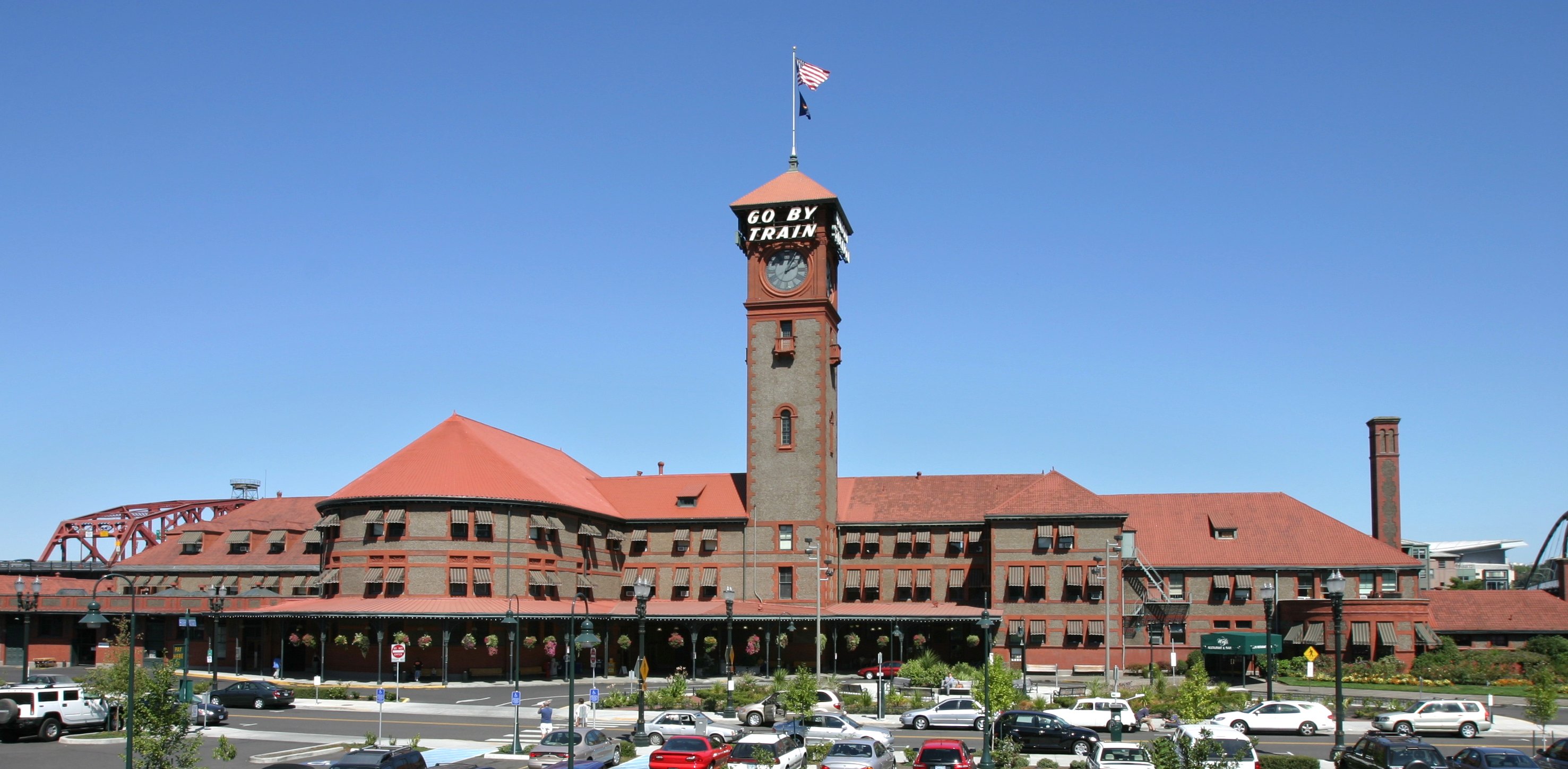
Union Station, which serves Amtrak and Greyhound, is at 550 NW 6th Avenue. 6th & Hoyt station on MAX. The "GO BY TRAIN" sign atop its clock tower is reminiscent of the "UNION STATION TRAVEL BY TRAIN" sign at its namesake in Denver.
A round-trip nonstop flight from Newark to Portland, for the distance, is quite cheap: It can be had for $647. It could be had cheaper, if you don't mind changing planes. The MAX Red Line will get you from the airport to downtown in 33 minutes.

Once In the City. Founded in 1845 as the end of the Oregon Trail, in the shadow of Mount Hood, legend has it that the name of the town was decided by a coin flip between 2 of the original settlers. Francis Pettygrove wanted to name the town after his hometown of Portland, Maine. Asa Lovejoy was from Groton, Massachusetts. Pettygrove won, and that's why the Red Bulls aren't playing the Groton Timbers next Sunday.

Portland, a.k.a. the Rose City or PDX (for its airport code) has a population of around 650,000, and a metro area of about 3.2 million. It's still growing, but not as fast as it was in the 1980s and '90s, when a group successfully lobbied to slow down the suburban sprawl. It was named PLAN, for Prevent Los Angelization Now. It's about 75 percent white, 10 percent Hispanic, 8 percent Asian and 7 percent black.

The State of Oregon has no sales tax, and this covers the County of Multnomah and the City of Portland. The Willamette River is the divider between east and west, and Burnside Street, including its bridge over the river, is the divider between north and south. Portland has no beltway.

ZIP Codes in Oregon begin with the digits 97, and Portland and its suburbs use 970 and 971. The Area Code for Portland is 503, with, appropriately enough, 971 overlaid. Portland General Electric (PGE) runs the electricity.

TriMet, the area's public transit service, runs buses and the MAX light rail system. A single fare is $2.50, while a day pass is $5.00. They also run the WES Commuter Rail.
A MAX train, downtown

The capital of Oregon is Salem, about 50 miles southwest of downtown Portland. The 1st 2 State Houses were destroyed by fires in 1855 and 1935. The new State House opened in 1938, but it looks like a cross between an Art Deco church and a prison. Fortunately, the grounds are covered with examples of Oregon's natural beauty, but also include a pair of burned, broken pillars from its predecessor.
The State House in Salem

Going In. The official address of Providence Park is 1844 SW Morrison Street. It's about a mile west of downtown, in the Goose Hollow neighborhood. Parking is cheap: Depending on the lot, you can get it for under $7.00. If you'd rather not drive, use Kings Hill/SW Salmon Street MAX station.
MAX station

This facility started as a minor-league baseball field named Multnomah Field in 1893. It was replaced by Multnomah Stadium in 1926. The name has been changed to Civic Stadium in 1966, PGE Park in 2001, Jeld-Wen Field in 2011 and Providence Park in 2014.

PGE is the local electric company, Portland Gas & Electric. Jeld-Wen makes doors, windows and related projects, and while their name was on the stadium, it was nicknamed the House of Pane. Providence Health & Services is a not-for-profit health care system affiliated with the Catholic Church. 
Civic Stadium in 1969

At 21,444 seats, it was one of the largest ballparks in the minor leagues. It was home to the Pacific Coast League's Portland Beavers from 1956 to 1972, again from 1978 to 1993, and again from 2001 to 2010. They only won 1 Pennant there, in 1983, but won 4 Division titles: 1965, 1983, 1993 and 2004.

From 1973 to 1977, it was home to the Portland Mavericks of the Northwest League, the team with whom Jim Bouton began his post-Ball Four comeback and co-invented Big League Chew. It was home to the Portland Rockies of the Northwest League from 1995 to 2000. Currently, the city doesn't have a professional baseball team.
Portland State University plays football there, and both the University of Oregon and Oregon State University played "home" games on the site between 1894 and 1970. It was home to the Portland Storm, later the Portland Thunder, of the World Football League in 1974 and '75, and the Portland Breakers of the USFL in 1985.
An overhead shot from 2009, before
sideline seating was built in the former left field,
making a return of baseball to the stadium impossible.

The original Portland Timbers, of the original North American Soccer League, played there from 1975 to 1982. It hosted Soccer Bowl '77, in which the New York Cosmos, led by Pelé in his last competitive match, defeated the Seattle Sounders. (I'm guessing the Portland crowd wasn't rooting for Seattle.)

After the NASL folded, the Timbers were reconstituted, began play in 1985, folded again in 1990, started again in 2001, and joined Major League Soccer in 2011. (There was never any question that the team would keep the old NASL name upon entry in to MLS.)

The Portland Thorns of the National Women's Soccer League began play there in 2013. While their masculine counterparts are one of the best-supported teams in MLS, the Thorns are the best-supported team in the NWSL. With this in mind, the stadium has now been expanded to 25,218 seats, with a rebuilding of the east stand.
Civic Stadium hosted Soccer Bowl '77, in which Pelé and the New York Cosmos won the NASL title by beating the Seattle Sounders. (I wonder if the Portland fans rooted against Seattle.) It hosted 4 games of the 1999 Women's World Cup, and 6 of the 2003 edition, 1 involving the U.S. It's hosted 4 games of the U.S. men's national team, 3 wins and a draw, most recently a 2013 win over Belize. It hosted 2 games of the 2013 CONCACAF Gold Cup. Elvis Presley played one of the earliest stadium concerts at Multnomah Stadium on September 2, 1957.
Pelé holding the NASL trophy,
after his last competitive match.

Visiting fans are instructed to enter at Gate 5, at the stadium's southwest corner. This will lead you right into Section 223, the section for visiting supporters. However, Providence Park being an old stadium, you'll have seats aimed straight ahead, and you'll have to turn your head to see nearly all of the action. The field has been artificial turf since 1969, and is aligned (more or less) north-to-south.

Catty-corner from Providence Park, on the southeast corner of 18th Avenue and Salmon Street is another stadium, used by adjacent Lincoln High School. As far as I know, neither the Timbers nor the Thorns use it as a training facility.

Did I say, "Catty-corner"? Like Veterans Stadium in Philadelphia had, Providence Park has a feral cat colony. It was first found in 1985, and may have been there even before the current stadium was built on the site in 1926. There are believed to be between 12 and 20 of them. Remember: Cats eat rats. So if you see one, leave it alone. It's on our side. And by "our," I don't mean "the Red Bulls," I mean "people," whether it knows that or not.

Food. Come for the food, stay for the soccer! Centerplate Catering runs the concession stands at Providence Park. These include Timber Pie, British-style meat pies provided by Pacific Pie Company; Timber Brat, a bratwurst stand; and the Thai Curry cart.

Four carts operate on a rotating schedule out of the Soccer City Grill concession stand, above Section 93 in the stadium's southeast corner. Big Ass Sandwiches serves, no, not "pork butt" (that comes a couple of paragraphs later), but what they call "Over-the-top sandwiches stuffed with sliced meats, french fries and bechamel sauce.

Nong's Khao Man Gai serves a "famous dish" of poached chicken and steamed rice with ginger sauce and a cup of broth. 808 Grinds, named for Hawaii's Area Code, serves heaping lates of Hawaiian plate lunch dishes like shoyu chicken (that'll show you) and Kahlua pig. (Hawaii meets Mexico.)

Porklandia Panini serves sandwiches. Bahn Mi Dog serves Vietnamese-style hot dogs. (Don't worry, they're made from beef and pork, not actual dogs.) Tillamook Quesadilla Cart serves 4 kinds of toasted quesadillas, including Bacon Mac 'n Cheese, Philly Cheesesteak (even when the opponent is the Philadelphia Union), Cubano and Grilled Chicken. The Wood Shed Roll serves a sandwich that features Carlton Farms pork butt (told ya) braised in Widmer beer, plus Tillamook White Cheddar cheese, wrapped in soft pretzel bun.

Olympia Provisions Charcuterie Box serves salami and pâté, Tillamook Cheese, crackers, and house-made marmalade. Bacon Bleu Cheese Tots are tater tots topped with Oregon Bleu Cheese, crumbled Zenner's bacon, chopped green onions, diced tomatoes, and chipotle ranch sauce.

There's a Tillamook Grilled Cheese Station, Carlton Farms Pulled Pork, and Tillamook Mac 'n Cheese Dog: A Zenner's quarter-pound hot dog on a Franz stadium roll smothered in house-made Tillamook Mac 'n Cheese.

Team History Displays. The original Portland Timbers played in the North American Soccer League from 1975 to 1982. In 1975, they reached the title game, the Soccer Bowl, but lost to the Tampa Bay Rowdies. Only 3 more times did they reach the league's final 4.

The new Timbers, who started in a minor league in 2001 and were admitted to MLS in 2010, have already surpassed their forebears. They won the 2015 MLS Cup, beating the Columbus Crew in the Final (in Columbus, no less), and also won the regular-season Western Conference title in 2013 and 2017.

The 2015 MLS Cup banner hangs under the roof by 3rd base -- excuse me, by the northeast corner. Next to it is the Portland Timbers Ring of Honor, with 5 honorees, all connected to the NASL version of the team. On the other side of the Ring of Honor is the Thorns' 2013 and 2017 NWSL Championship banners.
The Timbers, the Seattle Sounders and the Vancouver Whitecaps -- all named for teams that played in the NASL -- have competed for the Cascadia Cup since 2004. The Timbers have won it in 2009, 2010, 2012 and 2017 -- but not in 2015, despite winning the MLS Cup that season. As of the end of the 2021 season, it's Seattle 7, Vancouver 6, Portland 4.
A Timbers fan holding The Cascadia Cup up
at Providence Park

Clive Charles, an East End London man who played left back for West Ham United before playing with the old Timbers, stayed in town to coach the University of Portland team. He was managing the U.S. national team's Under-23 side when he died of cancer in 2003. The Timbers have retired his Number 3.
Clive Charles, playing for the original Timbers

The only other number they've retired is 5, worn by longtime fan Jim Serrill, a.k.a. Timber Jim, an actual timber-industry worker who became an unofficial mascot for the NASL Timbers, and stayed with the various incarnations of the team until retiring in 2008.
Timber Jim Serill

Also in the Ring of Honor, although not with their numbers retired, are John Bain, Jimmy Conway and Mick Hoban. Bain was a Scottish midfielder who played for Bristol City, and then for several American teams, including the old Timbers. He later managed a version of them, and has spent most of the last quarter-century coaching high school soccer in Portland.

Conway was an Irish midfielder who played for Dublin club Bohemian F.C., West London's Fulham, and Manchester City, before playing for the Timbers, and later coaching at and managing the minor-league version. Hoban is an English midfielder who played for Birmingham-based Aston Villa, before coming to the Timbers, and staying in town to work for Nike.

Stuff. Despite Oregon's association with Nike, another shoe company sponsors the Timbers' main shop. The adidas Timbers Team Store is at KeyBank Plaza, on the corner of SW 18th Avenue and SW Morrison Street, at the northeast corner of the stadium.

Michael Orr wrote a book about the original version of the team: The 1975 Portland Timbers: The Birth of Soccer City. Cascadia Clash: Sounders versus Timbers, by Geoffrey C. Arnold of The Oregonian and former Seattle goalie Kasey Keller, tells of the best rivalry in MLS. And, to commemorate last season's title, the staff of The Oregonian compiled Green & Golden: Portland Timbers' Historic March to the MLS Cup. There is also a team video available, titled Portland Timbers We Adore You.

During the Game. Portland is a relatively safe city. The Timbers have a bit of a rivalry with the Seattle Sounders, but that mellow Northwest vibe is going to hang over the stadium, and they're not going to get aggressive toward New Yorkers -- Timber Joey's chainsaw to the contrary. As long as you don't provoke anybody, you'll be fine.

Madison Shanley and Kyra Smith, both in their 20s, alternate singing the National Anthem, except for the 1st home game of the season, when the combined Timbers Army sings it.
Madison (left) and Kyra

The aforementioned Timber Jim had a trademark of cutting a round from a large log with a chainsaw every time the Timbers scored (those of you who are Rutgers fans will note the similarity to a player driving an ax into a stump in the corner of the stadium, keeping with the "Keep Chopping" theme), and presenting the round to the scorer after the game. He also cut a round for the goalkeeper if he kept a clean sheet. In 2008, the retiring Timber Jim was replaced by a younger man, Timber Joey, and the tradition continues.
Timber Joey

The main supporters group was founded in 2001 as the Cascade Rangers, a nod to the Northwestern mountain range. In 2002, due to complaints about being associated with bigoted Scottish club Rangers (and because the Timbers' green uniforms reminded people of Rangers' crosstown Glasgow arch-rivals, Celtic), the name of the group was changed to the Timbers Army.

They gather 4,000 strong in Section 107, which they call The Woodshed, right behind the north goal, and engage in all the European "ultra" traditions: Scarves, flags, drums, smoke bombs, and 90+ minutes of constant noise. They may well be the best supporters' group in North American soccer; certainly, they seem to have the most stamina and the biggest tifos. 
As you can see by the photo, the Army now pretty much takes up the entire north end (the old 3rd base stands). Individual sections have nicknames like the 101st Amphibious Assault, the 102nd Airborne Division, and so on. Section 208 is a group of older fans, nicknamed Del Boca Vista, after the fictional Florida retirement community on Seinfeld.

The Timbers are one of the few MLS teams that seeks out supporters from outside its home region. Among their clubs elsewhere in Oregon: The Capitol City Company in Salem, Echo Squadron in Eugene, the Mt. Bachelor Brigade in Central Oregon, the Jefferson Reserves in Southern Oregon (a region that once considered seceding to form a new State of Jefferson), and the Govy Brigade in the Mount Hood area.

But they also have fans elsewhere in the Northwest: The 1st Montana Volunteer Infantry, the Northern Alliance across the Columbia River in Vancouver, Washington State, the Midnight Sun Elite in Alaska, the Inland Ultras along the Washington-Idaho border, and Timbers Army: Covert Ops in the Seattle Area, Sounders territory).

They even have fan groups from outside the Northwest: The NYC Loggers, the D.C. Federal Reserves, the Heartland Regiment (Midwest), the Sunshine Squadron (Florida), the Lone Star Brigade (Texas), the Green and Golden Gate (Bay Area), even the London Timbers.

They sing their theme song "Portland Boys" at kickoff, "Rose City 'Til I Die" when a goal is scored against them, "You Are My Sunshine" in the 80th minute, and Elvis Presley's "Can't Help Falling In Love" in the 85th. They take chants not just from the traditional MLS sources of England, Italy and Latin America, but also from Greece, Russia and the Middle East.

There is some controversy over their take on a classic, as to whether it's disrespectful to women: "Portland Boys, we are here, steal your women and drink your beer!" Then, of course, there's their take on the Sex Pistols' "Anarchy in the U.K.":

I am a Timbers fan
And I am an Oregonian
I know what I want and I know how to get it
I wanna destroy Seattle scum
'Cause I... wanna be... Rose City!

Less controversial, because they were proactive, was the Timbers fans' handling of the YSA situation.When the visiting team goalie was mere feet away from them, getting ready for a goal kick, the fans would yell, "Ahhhhhhhh... " and when the ball was finally kicked, yell, "You suck, asshole!" Knowing that this might cast them in a harsh light during negotiations to get their team into MLS, the Timbers Army stamped the chant out, and it worked, as they were admitted to the league.

After the Game. Portland's reputation for safety, and their fans' reputation for being noisy but not nasty, will work in your favor. Both you and your car should be safe.

If you're hungry after the game, there's a Taco Bell 2 blocks away, at 21st & Burnside. Want something better? Okay: The Bunk Sandwiches Truck is parked outside the stadium, starting 2 hours before kickoff. Uno Mas, a fast-casual taqueria, offers a big lineup of little tacos, most priced around $2.50. The Boise Fry Company, while not exactly a British-style chip shop, is big on fries and their dips, and serves burgers as well. Both Uno Mas and Boise Fry are on West Burnside Street, at 1914 and 1902, respectively, a block north of the stadium.

The Jolly Roger, at 1340 SE 12th Avenue at Madison Street, is known as a hangout for New York Giants fans. They may also be welcoming to RBNY or NYCFC fans. Bus 4 from Rose Quarter Transit Center. I have also heard that Kingston Bar & Grill is a Giant fans' bar. 2021 SW Morrison Street, at 20th Place, across from Providence Park.

If you visit Portland during the European soccer season, which has just started again, the following clubs' supporters meet at the following locations:

* Arsenal: Beulahland, 118 Northeast 28th Avenue, about 2 miles east of downtown. Bus 20.

* Liverpool: Bazi Bierbrasserie, 1522 SE 32nd Avenue, about 3 miles east of downtown. Bus 14.

* Everton and Tottenham Hotspur: The Toffee Club, advertising itself as "an English football pub," and apparently owned by a fan of Everton, a.k.a. "The Toffees." 1006 SE Hawthorne Blvd. Bus 14. If you don't see your club mentioned, this is the likeliest place to see them. On the other hand, I saw a Newcastle fan say, "Toffee Club has the rudest staff out of any bar in Portland. It's a no go." That's not "any soccer bar," that's "any bar." Be aware of the possibility that he may be right.

* Manchester City: Lightning Will, 305 NW 21st Avenue, a mile and a half northwest of downtown and 5 blocks from Providence Park. Bus 15.

* Manchester United: Kells Irish Restaurant and Pub, 112 SW 2nd Avenue, downtown. Blue or Red Line to Skidmore Fountain.

* Chelsea: Pour Sports Bar & Grill, 832 SE Grand Avenue, about a mile east of downtown. Bus 6.

* West Ham United, Newcastle United, Real Madrid, Barcelona, Paris Saint-Germain, Juventus and Internazionale: 4-4-2 Soccer Bar, which calls itself the "Best true Soccer Pub in Portland!" Exclamation point theirs, not mine. However, the fact that U.S. outposts of what may be the 2 most passionate fan bases in the Premier League, both of the Spanish giants, the biggest club in France, and the 2 biggest clubs in Italy all like it says a lot. 1739 SE Hawthorne Blvd., about a mile and a half east of downtown. Bus 14.

* Bayern Munich: Prost! (Again, exclamation point theirs, not mine.) 4237 N. Mississippi Avenue, about 3 miles north of downtown. Bus 4.

Sidelights. On November 30, 2018, Thrillist published a list of "America's 25 Most Fun Cities," and Portland came in 19th. Being a relatively small city, albeit the 2nd-largest in America's Northwest, Portland doesn't have much of a sports history. But there are a few items worth mentioning.

* Memorial Coliseum and Moda Center. The home court of the NBA's Portland Trail Blazers has an official address of 1 North Center Court Street. The Moda Center is bounded by Ramsay Way (named for former head coach Jack Ramsay) on the north, Wheeler Avenue on the east, Multnomah Street on the south and Center Court Street on the west. MAX reaches the arena via Rose Quarter and Interstate stations.

Opening in 1995 as the Rose Garden, it was renamed for healthcare provider Moda Health in 2013. It is also home to the Western Hockey League's Portland Winterhawks (for some but not all games), and the Arena Football League's Portland Thunder. The court is aligned northwest to southeast.


The Blazers' former home, the Veterans Memorial Coliseum, is across Center Court Street. It opened in 1960, and was home to the Blazers from their 1970 debut until 1995, and the Winterhawks full-time from 1976 to 1995 and part-time since then. The Winterhawks have won the President's Cup as Champions of the Western Hockey League in 1982, 1998 and 2013, and the Memorial Cup in 1983 and 1998.
Moda Center (left) and Coliseum

It hosted the 1965 NCAA Final Four, with UCLA beating Michigan in the Final. This was also the 1st Final Four to feature a New Jersey-based team, the Princeton squad led by future Knick and future U.S. Senator Bill Bradley. The Beatles performed at the Coliseum on August 22, 1965, and Elvis Presley sang there on November 11, 1970 and April 27, 1973.

* Portland Ice Arena site. From 1914 to 1926, the Portland Rosebuds played in the Pacific Coast Hockey Association. Their home ice was the Portland Ice Arena. In 1916, now over 100 years ago, they won the PCHA title, and became the 1st American team to play in the Stanley Cup Finals, losing to the National Hockey Association Champions, the Montreal Canadiens. (Don't mention this to Portland fans, but the next year, Seattle became the 1st American city to actually win the Cup.)
The team included future Hall-of-Famers Dick Irvin Sr. (father of the legendary broadcaster), Ernie "Moose" Johnson and Tommy Dunderdale, but folded in 1926, and its players were mostly brought east to form the Chicago Blackhawks. This makes it interesting that Portland's current minor-league team is the Winterhawks, who share the Chicago team's Indian head logo.

From 1928 to 1941, the Arena was home to the Portland Buckaroos. Several teams of that name played in Portland until 1975, and were replaced by the Winterhawks in 1976. The Arena closed in 1953 and was demolished. NW 20th & 21st Avenues, Northrup & Marshall Streets, a mile west of Union Station. NW 21st & Northrup on MAX.

* Vaughn Street Park site. The PCL Beavers began playing at the 12,000-seat Vaughn Street Park in 1901. They won 8 Pennants there: 1901, 1906, 1910, 1911, 1913, 1914, 1936 and 1945. A fire in 1947 burned down the bleachers, which led to the Beavers giving up on it after the 1955 season, and moving to what's now Providence Park.

It's an industrial area now, and a plaque honoring the ballpark is on the site. 2401 NW Vaughn Street at 24th Avenue, about 2 miles northwest of downtown. Bus 15.
For now, the Hillsboro Hops, of the Northwest League, are the closest professional baseball team to Portland. They play at Ron Tonkin Field, a 3,534-seat ballpark built in 2013, and named for a local car dealer. 4460 NE Century Blvd., 14 miles west of downtown. MAX Blue Line to Orenco, then Bus 47.
Portland has the NBA and MLS, but don't expect it to get teams in the other sports soon, especially with its baseball stadium now reconfigured to make playing baseball there next to impossible. Its population would rank it 24th in MLB, 21st in the NFL and 20th in the NHL. For the time being, the closest MLB and NFL teams are in Seattle, 173 miles away; and the closest NHL team is in Vancouver, 314 miles away.

An April 23, 2014 article in The New York Times shows that the most popular MLB team in Portland is the closest team, the Seattle Mariners, but it's not overwhelming: They average about 22 percent of Portland baseball fans, while the Yankees and Red Sox battle it out for 2nd place, in the 10s.

The September 2014 issue of The Atlantic shows that the most popular NFL team in Portland, and in most of Oregon, is the Seattle Seahawks -- and while this was after the Hawks' Super Bowl XLVIII win, it was before they got into Super Bowl XLIX. Southwestern Oregon, closer to California than to Washington State, prefers the San Francisco 49ers, while southeastern Oregon prefers... the Dallas Cowboys, as does neighboring southwestern Idaho. Ew.

The University of Oregon is 114 miles south on I-5, in Eugene. It can be reached by Cascades Point bus from Union Station, although this will take 2 hours and 45 minutes and cost $26 -- each way. Oregon State University is 87 miles south, in Corvallis. You'd have to take at least 2 conveyances to get there, and it would cost $50.50 -- each way.

Portland's top museum is its Art Museum, at 1219 SW Park Avenue. The Oregon Historical Society Museum is across the street at 1200 SW Park. City Hall station on MAX. The Oregon Museum of Science & Industry is at 1945 SE Water Avenue. OMSI/SE Water station on MAX.

Oregon has never produced a President. The closest it's come is the years when an orphaned Herbert Hoover lived with an uncle growing up in Newberg, 25 miles southwest of downtown Portland. The Hoover-Minthorn House is at 115 S. River Street. There is a bus that goes there, but it's prohibitively expensive, so if you want to see it, you should rent a car.

As with Utah, the tallest building in Oregon is named the Wells Fargo Center. This one opened in 1972, and looks it: It's rather dull architecture. It stands 546 feet at 1300 SW 5th Avenue. City Hall station on MAX.

The TV shows Bates Motel (based on the novel and film Psycho, which was set in fictional Fairvale, California), Eureka (in the fictional town of that name), and the Disney series Gravity Falls (ditto) were set in Oregon.

Specifically in Portland, Leverage, Portlandia, Grimm, Life Unexpected, and the brief 1990s CBS crime drama Under Suspicion were both filmed and set there. In The CW's Arrowverse series of superhero shows, Portland is used for establishing shots and maps of fictional Central City on The Flash, even though the show, like the other Arrowverse shows, is filmed in Vancouver.

Unfortunately, the most famous TV show set in Portland, thanks to the jokes Johnny Carson told about it on The Tonight Show, was one of NBC's all-time turkeys, the late 1970s McLean Stevenson sitcom Hello, Larry.

Films based in Oregon include Ice Cube's Are We There Yet? series, the Madonna bomb Body of Evidence, Drugstore Cowboy, Five Easy Pieces, The Goonies, Arnold Schwarzenegger's comedy Kindergarten Cop, The Lathe of Heaven, Mr. Brooks, Mr. Holland's Opus, My Own Private Idaho, Overboard, Paint Your Wagon (Clint Eastwood in a musical? Yes), Pay It Forward, the track & field movies Personal Best and Pre (the latter about Steve Prefontaine, the 1st athlete to endorse Oregon-based Nike footwear), The Postman (Kevin Costner's postapocalyptic film, a.k.a. "Kevin's Gate"), Seven Brides for Seven Brothers, Short Circuit, Stand By Me, and, of course, the film version (which he hated) of Ken Kesey's novel One Flew Over the Cuckoo's Nest.

And while it wasn't set in Oregon, Animal House was filmed on the University of Oregon campus.

*

And on that note, let me remind you that the city has the slogan "Keep Portland Weird." The Timbers, with one of American soccer's longest histories, are a part of that. This is not a threatening town, unless you don't like weird things.

But you're from New York (or New Jersey), so you're used to weird. You should be able to have fun in Portland.