Showing posts with label berlin. Show all posts

Wednesday, August 12, 2026

August 12, 1936: The Biggest Baseball Crowd -- In Berlin?

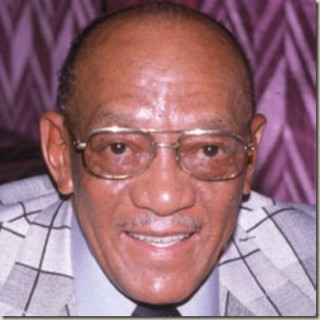
Bill Sayles. The "B" stands for "Brooklyn," not "Berlin."

August 12, 1936, 90 years ago: What was definitely the biggest crowd in baseball history to that point, and may still be, sees a game in... Nazi Germany?

After having been a "demonstration sport," rather than an actual competition, at the Olympic Games in Paris in 1900, and again in Stockholm, Sweden in 1912, baseball returned to Olympic display, though still not yet joining official Olympic competition, in 1936.

There was a single exhibition game, played at the Olympiastadion in Berlin. Since Olympic competitors had to be amateurs until 1992, all of the players in the game were Americans who had not yet played in the minor leagues, let alone in the major leagues. The umpire was Leslie Mann, whose 16-year major league career included playing as an outfielder for the 1914 World Series-winning "Miracle" Boston Braves. He had been among the leading advocates for putting baseball in the Olympics.

The "visiting team," the one batting 1st, was called the "U.S. Olympics." The "home team" was called the "World Champions." The game was set for 7 innings. The game was set for 8:00 PM, and for most of the players, this would be their 1st experience in a night game. (The 1st night game in MLB had been played the season before, at Crosley Field in Cincinnati, but that was still the only major league park with lights.)

Although the Olympiastadion was built for soccer and for track & field events, and didn't have room for a standard baseball field, I can find no reference to whether any accommodation was made for any "short fences."
The Berlin Olympiastadion

A crowd then estimated at 90,000 came out. Officially, the biggest crowd that had ever attended a single Major League Baseball game (rather than a doubleheader) was the 74,217 who were said to have attended the opening game of the original Yankee Stadium in 1923. (And that was almost certainly a lie, exaggerated by around 12,000 or so.)

But the Associated Press reported the crowd as being over 100,000, without getting any more specific than that. If so, then this remained a record for any baseball game until 2008, when 115,300 packed into the Los Angeles Memorial Coliseum for an exhibition game. Regardless of the actual total, neither the Chancellor of Germany at the time, Adolf Hitler, nor any official of the Nazi Party, was said to have attended.

For the U.S. Olympics, 1st baseman Bill Shaw hit a 2-run home run in the 1st inning. At the end of 6 innings, the World Champions led, 5–4. The Olympics scored in the top of the 7th to tie the game, before Les McNeece hit a solo home run, what would now be called a walkoff home run, in the bottom of the 7th, to win the game for the World Champions, 6-5.

Bill Sayles was the starting pitcher for the World Champions. He was the only player in this game who would go on to play in the major leagues: He pitched in 5 games for the Boston Red Sox in 1939, 18 for the New York Giants in 1943, and 5 for the Brooklyn Dodgers in 1943, with a record of 1-3, and an ERA of 5.61. Most likely, he made those 1943 appearances solely because of the manpower drain caused by the war the Nazis started. He lived on until 1996.

Baseball would once again be a demonstration sport at the Olympics in Helsinki, Finland in 1952, and then occasionally, until finally becoming an official competition sport in Barcelona, Spain in 1992. After 2008 in Beijing, it was dropped. It was restored for Tokyo in 2020 (2021), but dropped again for Paris in 2024. It will be restored for Los Angeles in 2028, with a 6-team tournament to be played entirely at Dodger Stadium, during a planned 11-day break in the Major League Baseball season.

Sunday, August 9, 2026

August 9, 1936: His Name Was Sohn Kee-chung

August 9, 1936, 90 years ago: Legendary journalist Lincoln Steffens died in Carmel-by-the-Sea, California. He was 70 years old.

Meanwhile, the marathon race is held in the Olympics in Berlin, Nazi Germany. Officially, it was won by Kitei Son of Japan, a nation that would soon be an ally of the Nazis.

Unofficially, it was a much better story.

His real name was Sohn Kee-chung. He was born on August 29, 1912, in Sinŭiju, in what is now North Korea. Since 1910, however, Korea had been part of the Empire of Japan. And so, any athletes from Korea were forced to compete for Japan, under their flag, and with Japanese names.

Between 1933 and 1936, Sohn Kee-chung ran 12 marathons, finishing in the top 3 in each, and won 9. On November 3, 1935, in the Japanese capital of Tokyo, he set a world record with a time of 2 hours, 26 minutes and 42 seconds.

In the 1936 Olympics, Sohn tried to sign his name in its correct Korean form. But it was not his legal name, and so he was forced to write it in, and compete, as Kitei Son. Another Korean, Nam Sung-yong, entered the marathon, and had to compete under his legal Japanese name, Nan Shōryū. Sohn won the race in 2 hours, 29 minutes, 19.2 seconds, breaking the Olympic record. Nam finished 3rd, winning the Bronze Medal.

The International Olympic Committee, not recognizing Korea as a member, credited both medals to Japan's total. Sohn refused to acknowledge the Japanese national anthem while it was played at his award ceremony, and later told reporters that he was ashamed to run for Japan.

In 1945, Allied forces forced the surrender of Japan, and Korea was free. But, as part of the peace treaty, a line was drawn at the 38th parallel, and Communist forces had control over the northern part, including Sohn's hometown of Sinŭiju. The Korea War resulted, from 1950 to 1953, and the new border was a diagonal across the country, but roughly around the 38th parallel.

Sohn was named the team manager for Korea's national track & field team. In 1947, his trainee, Suh Yun-Bok, won the Boston Marathon, breaking the record that Sohn had set in Tokyo in 1935. For the Opening Ceremony for the 1948 Olympics in London, the entire Korean team chose Sohn to be their flag bearer. In 1950, another Sohn trainee, Ham Kee-Young, won the Boston Marathon.

In 1988, the Olympics were held in Seoul, the capital of the Republic of Korea (a.k.a. South Korea). The final runner in the Olympic torch relay, receiving perhaps the greatest ovation anyone has ever received in an Olympic ceremony, was 75-year-old Sohn Kee-chung. He attended the 1992 Olympics in Barcelona, Spain, and saw Hwang Young-Cho win the Olympic marathon.
Sohn died on November 15, 2002. Nam Sung-young, who had worked with him at the Korean Sporting Association, had died a year earlier. On December 9, 2011, the IOC recognized Korean nationality of Sohn and Nam, and all other Korean athletes under the Empire of Japan, in their official profiles.

Wednesday, August 5, 2026

August 5, 1936: The Helene Mayer Story

August 5, 1936, 90 years ago: Helene Mayer wins a Silver Medal at the Olympics. Ordinarily, an athlete finishing 2nd in an Olympic event wouldn't be a big deal. This time, it is.

At 17, she won a Gold Medal in foil fencing at the 1928 Olympics in Amsterdam, and was a national hero in Weimar Germany. She competed again in 1932 in Los Angeles, but just before a match, she was told that her boyfriend had died in a military training exercise. This was only a year after losing her father. Shaken, she only finished 5th.

She stayed in America to attend college as an exchange student. But when Adolf Hitler seized power in 1933, her membership at her native fencing club was terminated, because she was Jewish. She taught at California colleges, and then in 1935 her German citizenship was canceled with the Nuremberg Laws.

There was a movement to boycott the 1936 Olympics, scheduled for Berlin. To avoid this, Nazi authorities chose her as the token Jew on the German Olympic team. She won a Silver Medal, and, on the podium, in an effort to protect her family, gave a Nazi salute.

She went back to America, and won the U.S. women's foil championship 8 times in 13 years from 1934 to 1946. In 1952, with World War II over and freedom back in place, but perhaps knowing she was dying, she returned to her homeland, and got married, spending her last months in happiness. She was posthumously elected to the U.S. Fencing Association Hall of Fame.

Helen Mayer died on October 10, 1953, of breast cancer, in Munich, Germany. She was only 42 years old.

Monday, August 3, 2026

August 3, 1936: Jesse Owens Beats Aryan Supremacy

August 3, 1936, 90 years ago: Nazi Germany's myth of racial supremacy is shattered by a black American.

The International Olympic Committee had awarded the 1936 Olympic Games to Germany in 1931, when it was still governed by the Weimar Republic. The Winter Games went to Garmisch-Partenkirchen, in Bavaria, on the nation's southern border, with Austria. The Summer Games went to the national capital, Berlin.

But in 1933, the National Socialist German Workers' Party -- Nationalsozialistische Deutsche Arbeiterpar, or "Nazi" Party -- came to power, and Adolf Hitler became Chancellor. Within another year, he had total control, and instituted the party's ideology, fascism: Nationalism, militarism, bigotry, and letting big business do whatever it wanted.

He also instituted his ideal of an "Aryan" "master race": White, blond hair, blue eyes, tall, physically strong. He, himself, was white, but not the other things.

And he falsely blamed Communists and Jews for Germany's defeat in World War I. Well before most people know what a "holocaust" was (originally, the word was used to mean a large fire), he was cutting Jewish people out of German society.

Like most dictators, he was not especially interested in sports. But, like many of them, someone talked him into using sports as propaganda for his ideals. And so, the 1936 Olympics, especially the Summer Games in Berlin, would be a spectacle celebrating "Aryan supremacy."

But a story which may be apocryphal (I hope it's true) shows that even his power was not absolute. In the Olympic Stadium (Olympiastadion) he had constructed for the Games, the restrooms had signs saying, "Dogs and Jews are not allowed." A representative of the International Olympic Committee told him to take it down.

Hitler: "When you come into a man's house, you don't tell him what he can and cannot put up!"

IOC official: "Excuse me, Mr. Chancellor, but when that five-ringed flag goes up over the stadium, it is no longer Germany. It is Olympia. And we are the masters there."

The signs came down.

*

James Cleveland Owens was born on September 12, 1913 in Oakville, Alabama. One thing Southern white people and Southern black people have in common is frequently addressing boys by their initials, so Owens was usually called "J.C."

When he was 9, the family moved north, as part of the "Great Migration" of African-Americans seeking to leave the segregated South in search of less prejudice and better jobs in the Northeast, the Midwest, and the West Coast. The fact that they moved to Cleveland, both his and his father's middle name (Henry Cleveland Owens), appears to have been a coincidence.

Upon arrival in school in Cleveland, the boy was asked his name. He said, "J.C. Owens." The teacher misheard this, and said, "Your name is Jesse?" Not wanting to contradict her, he said it was. And so he was Jesse Owens from then on.

He became Ohio's biggest high school track star. On May 25, 1935 -- the day after the 1st night game in Major League Baseball -- he competed for Ohio State University at the Big Ten Championships at Ferry Field, the former football facility at the University of Michigan in Ann Arbor.

He ran the 100-yard dash in 9.4 seconds, tying the world record. He set world records in the long jump (26 feet, 8 1/4 inches, a world record that would last for 25 years), the 220-yard sprint (20.3 seconds), and the 220-yard low hurdles (22.6 seconds). These 4 records were all set within a span of 45 minutes.

So when the U.S. Olympic Team set sail -- flying across the Atlantic Ocean was still too risky at that point -- for Germany in July 1936, Owens was considered one of the favorites in the 100 meters, the 200 meters, and the long jump. (Most of the world was now racing using the metric system, although the United States, as yet, was not.)

*

The Games began on August 1, and were the 1st sporting event ever televised, though only a few people in Germany had sets on which to watch it. The Nazis instituted many of the things we now associate with the Opening Ceremony of the Olympics, including the torch relay from Olympia, Greece into the stadium and the lighting of the cauldron; and the release of doves as a symbol of peace, although they used pigeons instead. When a cannon was fired as a salute, it literally scared the shit out of the pigeons, and many of the athletes got pooped on.

Established from the beginning in 1896 was the host country's head of state speaking before the crowd, and declaring the Games open. Hitler did this, in German, rather than French, the official language of the Olympics (he hated the French as much as he hated anyone else), or in English, by this point the semi-official language of the world. (As far as historians have been able to determine, German was the only language he spoke fluently.)

It's not always the head of state that does it. Sometimes, someone else is designated. In 1932, in Los Angeles, President Herbert Hoover sent Vice President Charles Curtis. In 1960, in Squaw Valley for the Winter Games, President Dwight D. Eisenhower sent Vice President Richard Nixon to his native California to do it. In 1980, President Jimmy Carter sent Vice President Walter Mondale. President Ronald Reagan did it himself in his adopted home State in Los Angeles in 1984, President Bill Clinton did it in Atlanta in 1996, and President George W. Bush did it in Salt Lake City in 2002.

When Britain has hosted: King Edward VII did it in 1908, King George VI did it in 1948, and Queen Elizabeth II did it in 2012, despite being 86 years old. When Australia hosted in 1956 and 2000, and when Canada did it in 1976 for the Summer Games, and 1988 and 2010 for the Winter Games, it was the Queen's representative, the Governor-General, who did it, even though the Queen was in attendance in Montreal in 1976, as her daughter, Princess Anne, was competing in the equestrian events.

The Parade of Nations had also been established from the beginning, and many of the countries' delegations followed the tradition of dipping their flag before the host nation's head of state. The American delegation refused to do this with the Stars & Stripes, and it had nothing to do with said head of state being a Fascist maniac. They were criticized for this, but stood their ground.

On August 2, Owens ran in the qualifying heats for the 100 meters. In the 1st, he tied the Olympic and world record. In the 2nd, he broke it. On August 3, the final was held, and Owens won it with a time of 10.3 seconds. Finishing 2nd was another black American, Ralph Metcalfe, who would later serve the South Side of Chicago in Congress from 1971 until his death in 1978.

Owens was now an Olympic Gold Medalist, and, by winning the Olympic 100-meter dash, he became recognized unofficially as "the fastest man in the world."

On August 4, Owens won the long jump, with 26 feet, 5 inches. Finishing 2nd was Luz Long of Germany, who did fit the Aryan profile. Owens was missing the tape and fouling, and, in a great display of sportsmanship, Long advised Owens to jump a bit short of the tape, just to be sure. It worked, and he had a 2nd Gold Medal.

On August 5, he won the 200 meters in 20.7 seconds. Finishing 2nd was a runner from UCLA, Matthew MacKenzie "Mack" Robinson. He had a younger brother, who went on to star in track, and other sports, at UCLA: Jack Roosevelt "Jackie" Robinson. So Owens now had 3 Gold Medals, fulfilling his goal.

On the 1st day, Hitler shook hands with the German victors only, and then left the stadium. International Olympic Committee president Henri de Baillet-Latour told him that he had to greet every medalist or none at all. Hitler opted for none at all, and skipped all further medal presentations.

His refusal to congratulate Owens had nothing to do with hating black people, or hating Americans. Nor was it personal. Owens was not "snubbed by Hitler." Owens responded to these claims at the time:

Hitler had a certain time to come to the stadium and a certain time to leave. It happened he had to leave before the victory ceremony after the 100 meters race began at 5:45 PM. But before he left, I was on my way to a broadcast, and passed near his box. He waved at me, and I waved back. I think it was bad taste to criticize the "man of the hour" in another country.

The final of the 4x100-meter sprint relay was to be held on August 9. The intended American competitors were Frank Wykoff (Des Moines, Iowa and of Dutch descent, having already taken Gold Medals in the event in 1928 and 1932), Foy Draper (from Texas and of English descent, and would be listed as missing in action in World War II), and 2 Jewish runners, Marty Glickman from New York and Sam Stoller from Cincinnati. (Glickman went on to become the 1st great New York sportscaster.)

But the President of the U.S. Olympic Committee was Avery Brundage, a racist and an anti-Semite, who was just fine with the Nazis. He decided that, since Hitler's boys had already been beaten by black men, it would be worse if they were beaten by Jews. So he benched Glickman and Stoller, and told Owens and Metcalfe that they would run in those men's places. Owens objected. Coach Dean Cromwell told him, "You'll do as you're told." With no recourse but to drop out, which would have been much worse, he ran the anchor leg, and the U.S. team won.

Owens had his 4th Gold Medal -- possibly the most unwelcome medal in Olympic history. This feat -- winning the Gold Medals of the 100 meters, the 200 meters, the 4x100-meter relay, and the long jump -- has only been done once since, by Carl Lewis in Los Angeles in 1984.

From a distance, Owens was hailed as a hero upon his return to America. Up close, he was still treated like any other black person in the 1930s. He found it difficult to make a living -- "You can't eat four gold medals," he said -- and took part in demeaning stunts to raise money. During World War II, the U.S. Office of Civilian Defense appointed Owens as director of a national fitness program for African Americans, but he lost this job when peace came. Like his contemporary, Joe Louis, the Heavyweight Champion of the World, he fell into trouble over his taxes. Unlike Louis, he eventually got out of it.
He became what he called "a professional good example." He became an American representative at the Olympics, and was particularly honored the next time a free and democratic Germany hosted, in Munich in 1972. He even did an American Express "Do you know me?" commercial. He died on March 31, 1980, of cancer, at age 66. He is buried at Oak Woods Cemetery in Chicago.

The Olympiastadion still stands, having undergone some renovations. It is the home of the biggest soccer team in the German capital, Hertha Berlin. It hosted 3 games in the 1974 World Cup, and 6 games in the 2006 World Cup, including the Final and a Quarterfinal. It hosted the 2015 UEFA Champions League Final, and the Final of Euro 2024. Having seated over 100,000 upon its opening, renovations and wider seats have brought capacity down to 74,475, but it is still the largest stadium in any German-speaking country.
In fact, the Olympiastadion in Berlin is 1 of 4 stadiums to have hosted an Olympic Games, a World Cup Final and a UEFA European Cup/Champions League Final. The others are the Olympiastadion in Munich, the old Wembley Stadium in London, and the Stade de France outside Paris.

Thursday, July 9, 2026

July 9, 2006: Zinedine Zidane's "Coup de Boule"

July 9, 2006, 20 years ago: The World Cup Final is held at the Olympiastadion in Berlin. ABC broadcasts it in America. France play Italy. Both teams tend to wear blue, thus France are Les Bleus, and Italy are gli Azzurri. On this occasion, Italy wore blue, while France wore white.
The Olympiastadion is 1 of 4 stadiums to have hosted an Olympic Games, a World Cup Final and a UEFA European Cup/Champions League Final. The others are the Olympiastadion in Munich, the old Wembley Stadium in London, and the Stade de France outside Paris.

Italy were loaded with legends: Gianluigi Buffon, Fabio Cannavaro, Andrea Pirlo, Francesco Totti, Luca Toni. This was a team so good, Daniele De Rossi and Alessandro Del Piero did not start and had to come on as substitutes, Alessandro Nesta and Filippo Inzaghi remained on the bench, and Paolo Maldini, still starting for AC Milan at age 38, was not even selected.

But France were equally laden with starpower, many of them holdovers from their 1998 triumph: Fabien Barthez, Lilian Thuram, David Trezeguet, Patrick Vieira, Thierry Henry, and Captain Zinedine Zidane. Others had developed since that win: Claude Makélélé, Florent Malouda, Sylvain Wiltord, Lasanna Diarra, Éric Abidal, Franck Ribéry. 

The key was Zidane: The midfielder, who had starred for Girondins de Bordeaux in his homeland, Juventus in Turin, Italy, and Real Madrid in Spain, had put the team, indeed his entire country, on his back, and led them to victory in 1998.

The son of Kabyle immigrants from France's former colony of Algeria, he was a symbol of reconciliation, as both nations were still dealing with the nasty war that Algeria fought for its independence from 1954 to 1962 -- having ended only 36 years before.

Although light-skinned enough to appear white -- unlike several national side teammates, including Henry, Vieira, Thuram, Trezeguet, and his Real Madrid teammate Makélélé -- he had faced prejudicial gestures large and small, including the insinuation that he was not truly, or not wholly, French.

Yet he went into that 2006 Final once again having led the team to glory. It was to be his last game: At age 34, he had announced his retirement as a player. Win or lose, it would be all over when the final whistle blew for this game.

In the 7th minute, Malouda, then playing his club football for Olympique Lyonnais, was knocked down in the box by Marco Materazzi of Internazionale Milano. If Materazzi were a hockey player, he wouldn't be a "pest": A good player who frequently plays rough; he'd be a "goon": A player whose sole purpose is to play rough, because he can't do anything else.

Horacio Elizondo, the Argentine selected to referee the game (because he was from neither team's continent), correctly awarded a penalty, and Zidane converted it. France led, 1-0.

The lead did not last long. In the 19th minute, Pirlo, the AC Milan legend, sent a hellacious corner kick into the box, and Materazzi, of all people, headed it past Barthez, the famously bald goalkeeper who was back with Olympique de Marseille after starring for them, Toulouse, AS Monaco and Manchester United.

In the 2nd half, Luca Toni, then of Florence-based Fiorentina, hit the crossbar with a shot, and then correctly had a headed goal disallowed as having been offside. Malouda was tackled in the box by Juventus' Gianluca Zambrotta, but was incorrectly not awarded another penalty. Arsenal legend Henry was stopped by Juventus goalie Buffon. Malouda skied a shot over the bar. Pirlo just missed with a free kick.

In extra time, Ribéry, then with Marseille and later to star for Bayern Munich, just missed. Buffon just barely knocked a Zidane header away.

And then, in the 110th minute, Materazzi pulled on Zidane's jersey, they exchanged words, and Zidane head-butted Materazzi right in the chest. In French soccer, this is known as a coup de boule -- literally, "stroke of ball" or "blow of ball," but also meaning "play of head." (The more familiar phrase coup d'état means "blow of state," and refers to the overthrow of a government.)

Elizondo did not see the incident. The 4th official, Luis Medina Cantalejo -- so respected that he not only officiated at 3 games of that World Cup, but was one of the few Spanish referees to officiate at La Liga games between arch-rivals Real Madrid and Barcelona, a rivalry so intense that foreign referees are nearly always assigned to oversee it -- told Elizondo through his headset that it had happened.

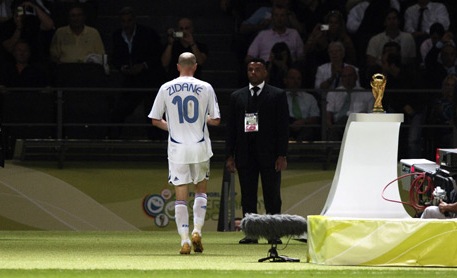
Elizondo properly showed Zidane a straight red card, making him the 4th player to be sent off in a World Cup Final, and the only player ever sent off in games of 2 separate World Cups. The scene of Zidane walking into the locker room, past the World Cup trophy but not even looking at it, is nearly as iconic as the coup de boule itself.
Extra time ended with the game still 1-1, so it went to penalties. Italy kicked first. Pirlo scored his penalty. Sylvain Wiltord, then with Lyon and previously the man whose goal past Barthez secured the League and Cup "Double" for Arsenal in 2002, made his. 1-1.

Materazzi was next for Italy, and made his penalty. Next for France was Trezeguet, facing his Juventus teammate Buffon. In extra time of the Euro 2000 Final, he had beaten Buffon with a shot. Under the rules then in place, it was a "golden goal": Automatic victory. This time, he was not a hero: He clanged his shot off the crossbar. 2-1 Italy.

De Rossi made his penalty. Abidal made his. Del Piero made his. Willy Sagnol made his for France. Finally, Fabio Grosso clinched the win for Italy: 5-3, with France's last shot not taken, seeing as how it would have been meaningless. Italia: Campioni del Mondo.
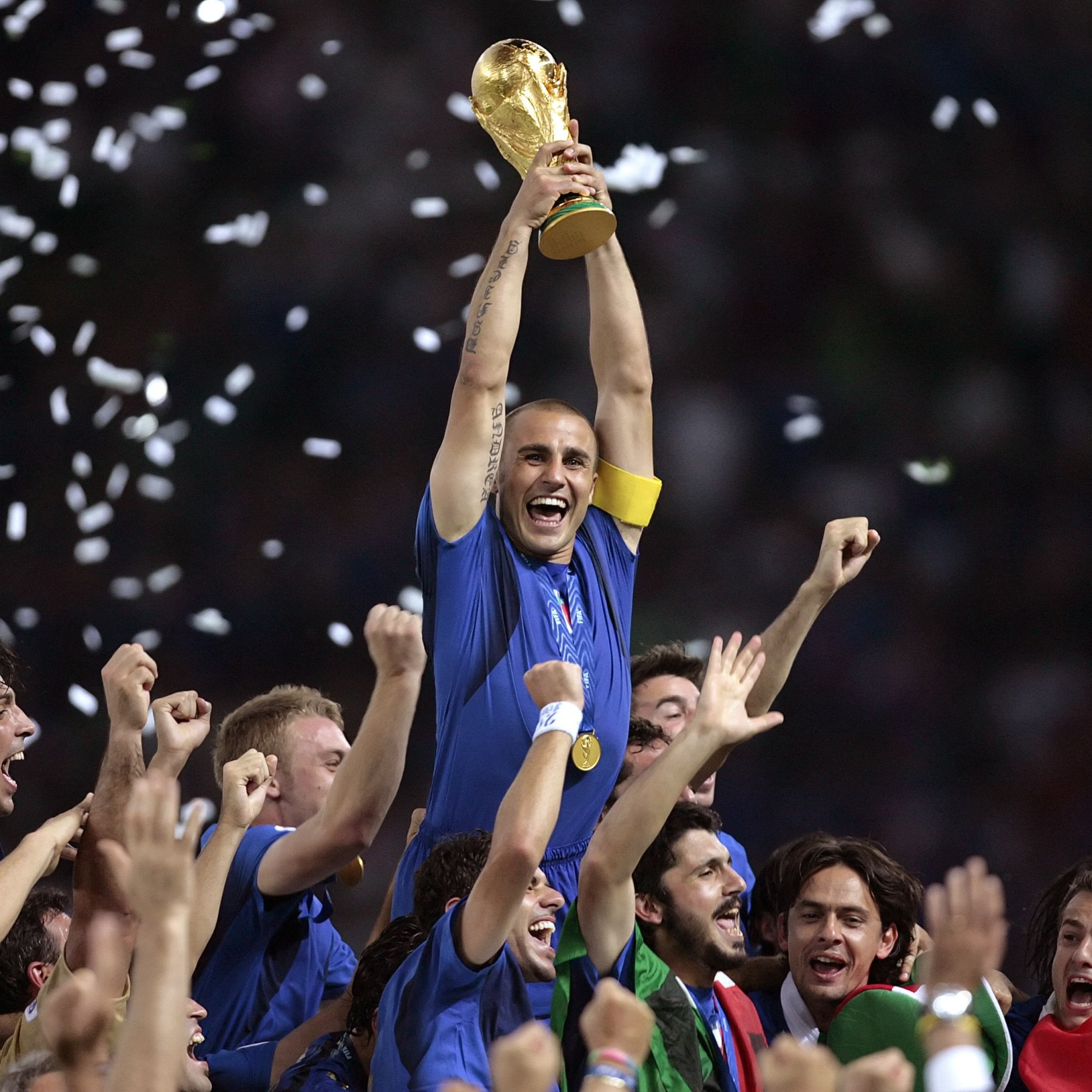
Fabio Cannavaro, as Captain, raising the Jules Rimet Trophy

Zidane, of course, was not available for the penalties.

Why did he do it? Three British newspapers -- The Times, The Sun, and the Daily Star, with varying degrees of reliability -- all hired lip-readers who were fluent in French and Italian to look at the tape, and to see what Materazzi had said to Zidane to provoke it. (Materazzi does not speak French, but Zidane played in Italy long enough to learn the language, and their exchange was entirely in Italian.)

The Times has a reputation for sterling journalism; The Sun and the Daily Star are considered lying right-wing propaganda rags. Yet the lip-readers hired by all 3 reported the exact same thing: They all said that Materazzi had called Zidane a "son of a terrorist whore."

It had been less than 5 years since the 9/11 attacks, and a year to the week after the 7/7 attacks on the London Underground (subway). Apparently, Materazzi was unaware that presuming that all Muslims are terrorists is not only bigoted, but stupid. To make matters worse, Zidane's mother was ill at the time.

Materazzi's version of events was a little different. He said he would never have insulted someone's mother, having lost his own when he was 15 years old. Without question, he had tugged on Zidane's shirt. The exchange of shirts is a postgame tradition that goes back decades, and Materazzi said that Zidane told him, "If you want my shirt, I will give it to you afterwards." Not an unreasonable request of a star of one of the finalists to one of the other finalist, and not an unreasonable response.

Materazzi said that his follow-up was, "I prefer the whore that is your sister." In other words, "Your sister puts out, and I'd like you to set me up with her." In other words, Materazzi admitted that he had gone too far.

But so had Zidane. There were about 10 minutes of play to go. Winning is the best revenge. A man as accomplished as Zidane -- 2 League titles in Italy and 1 in Spain, a Champions League win, a World Cup and a Euro title -- should have accepted this. Win the game, and you look like a champion, and the guy trying to provoke you looks like an idiot. Instead, the great Zizou looked like an easily provoked fool, and Materazzi an undeserved World Champion.

The play swept the world. Dozens of people posted their attempts at recreating it on the Internet. American TV shows parodied it. A song titled "Coup de Boule" hit Number 1 on the French music charts.

One moment can change not just a game, but a reputation, forever. Zidane stood to become the greatest hero in the history of French sport. Maybe he still is, anyway. But the first thing anyone thinks about when they hear his name is the coup de boule.

Thursday, May 8, 2025

May 8, 1945: V-E Day

I'm getting a little ahead of myself here. It was quite a week:

April 28, 1945: Former Italian dictator Benito Mussolini was executed.

April 29, 1945: Mussolini's corpse is hanged in Milan. Seeing this, Adolf Hitler, the dictator of Nazi Germany, knows he doesn't want the advancing Soviet Red Army to get their hands on him.

And U.S. troops liberate the Dachau concentration camp, outside Munich. It is believed that 32,000 people died there. Among those imprisoned were psychologist Bruno Bettelheim and the Rev. Martin Niemoller ("First they came for... ").

April 30, 1945: Hitler kills himself in his bunker in Berlin.

May 1, 1945: Nazi propaganda minister Joseph Goebbels follows with his own suicide in the bunker.

May 2, 1945: Nazi Generals Hans Krebs and Wilhelm Burgdorf commit suicide in the bunker. Martin Bormann, Hitler's private secretary, tries to escape, but doesn't get far, and also kills himself.

It's all over. Berlin has fallen. The Soviet Red Army raises the Red Flag over the Reichstag, the home of the German national legislature. It's just a matter of what remains of the Nazi government surrendering. What Hitler called "The Thousand-Year Reich" was dead after 12 years.

Soviet dictator Joseph Stalin had seen the photograph of the U.S. Marines raising the American flag on the Japanese island of Iwo Jima, and wanted a similar picture of the Soviet red banner with the yellow hammer and sickle over Berlin. He got it. The photographer was Yevgeny Khaldei. The soldier was 18-year-old Aleksei Kovalov -- no relation to the later hockey player of the same name. He later became a fireman in Kiev. Both men were Ukrainians, and both lived until 1997.
In late 1941, the Soviets were, perhaps, a mile away from losing the Eastern Front of the European Theater of World War II. Now, they had won what they called The Great Patriotic War.

May 3, 1945: The Nazis had their own version of the Titanic. And guess what: It sank. Unlike the original, it wasn't just due to incompetence. It had "help."

The SS Cap Arcona was launched in 1927. It was named after Cape Arkona on Rügen, Germany's largest island, on the Baltic Sea. It weighed 27,561 tons, compared to the 46,329 of the original RMS Titanic. It was 679 feet long, compared to the original's 889 feet. Cruising speed was close, 23 miles per hour to Titanic's 24. In other words, it was big, but not as big as the Titanic, the world's largest cruise liner when it first and last sailed in 1912.

Cap Arcona was the flagship of the Hamburg-South America line, and sailed between Hamburg, Germany's 2nd-largest city and largest port, and the east coast of South America. In 1940, the Kriegsmarine, the Nazi navy, took it over. In 1943, it was "cast" in the title role in Titanic, a Nazi propaganda film, designed to show that the British were incompetent because they built the "unsinkable," ill-fated TitanicIt had 3 smokestacks, instead of the 4 that Titanic had. But it was still big enough to be plausible.

In 1945, Cap Arcona became a prison ship, as the Nazis, aware that they were losing the war, and that the Allies had begun to liberate the concentration camps, began to evacuate their camps in occupied Norway and Denmark. On May 3, Cap Arcona was sunk off the coast of Neustadt -- fittingly, by Britain's Air Force -- and over 5,000 prisoners were killed. Compare that to the 1,500 who died on the real Titanic.

Same day: Ezra Pound, often called one of America's greatest poets, was arrested for treason. He was born in 1885 in Idaho. By 1908, he was already living in Italy, teaching there, and a published poet. He moved to London, and worked as foreign editor of American literary magazines. He introduced the world to Robert Frost, T.S. Eliot, James Joyce and Ernest Hemingway. Hemingway wrote in 1932 that, for poets born in the late 19th or early 20th century, not to be influenced by Pound would be "like passing through a great blizzard and not feeling its cold."

He blamed the horrors of World War I on international bankers, and moved to Italy, where he became a supporter of Mussolini, and later of Hitler and the leader of the British Union of Fascists, Oswald Mosley.

During World War II, Pound recorded hundreds of paid radio propaganda broadcasts for the Italian government, allied with the Nazis in the Axis. In these broadcasts, he attacked the U.S. government, and President Franklin D. Roosevelt in particular; the British government; international finance, Jews in general, and the Jewish influence on international finance; and munitions makers and arms dealers, accusing them of prolonging the war. Keeping with the Fascist theme, he used his broadcast to support the Holocaust, and to support eugenics, and urged U.S. soldiers to lay down their arms and surrender.

On May 3, 1945, Pound was arrested by the Italian Resistance, and was handed over to the U.S. Army. Ruled mentally unfit to stand trial, he was held at St. Elizabeths Hospital, a famed psychiatric facility in Washington, where he was diagnosed as a narcissist and a psychopath.
Despite being held there, his poetry collection The Pisan Cantos was published in 1948. He would continue work on the project, published in full in 1962 as The Cantos of Ezra Pound. Norman Mailer, a leftist author who despised Fascism, once said that he would rather read Pound than any of the Communist screenwriters known as the Hollywood Ten, because, he said, Pound was a better writer.

He was released in 1958, and, knowing he was not particularly welcome in America, returned to Italy, called America "an insane asylum," and gave a Fascist salute for the press. He died in Venice in 1972.

And another thing that happened on May 3, 1945: German rocket scientist Wernher von Braun and his brother Magnus surrender to American troops at Oberammergau, Bavaria.

Wernher von Braun had been a member of both the Nazi Party and the SS, and he designed the V-2 rocket that had killed thousands in raids on London. And yet, without him, America would not have gotten to the Moon – had the Soviets gotten him, the entire history of the world could have been changed.

Few have been so villainous and so heroic -- on the few occasions when one has been both, it has tended to go in the other direction. He died in 1977.

In 1960, Curd Jürgens, later to play a James Bond villain in The Spy Who Loved Me, played von Braun in I Aim at the Stars. Satirists Mort Sahl said the title should be extended to "...But Sometimes I Hit London."

In 1965, another satirist, Tom Lehrer, wrong a song titled "Wernher von Braun":

"Once the rockets go up
who cares where they come down?
That's not my department!"
says Wernher von Braun.

May 4, 1945: British Field Marshal Bernard Montgomery accepts the unconditional surrender of German forces in the Netherlands, Denmark, northwest Germany including all islands and all naval ships in those areas, at Lüneburg Heath, outside Hamburg.

May 5, 1945: The Mauthausen concentration camp, outside Linz, Austria, is liberated by the U.S. 11th Armored Division. Over 320,000 people were killed there. Among the survivors is Simon Wiesenthal, who goes on to become the world's foremost Nazi-hunter.

Canadian troops liberate Amsterdam. Today, the Dutch capital is home to 935,000 people, with a metropolitan area of 2.5 million, and is renowned as a center of art, culture, stylish soccer, and, well, naughtiness.

Also on this day: For all that Nazi Germany and Imperial Japan did to their various enemies in World War II, they could only hurt America from afar. Their respective saboteurs in America had a rather pathetic record. But there was one attack on the U.S. mainland that had, by any definition, some success.

"Balloon bombs" had been postulated as early as 1792 in France, but had never been considered practical until 1849, when the Austrian Empire used them on Venice, with some success, in the First War of Italian Independence.

Britain had used them on Nazi Germany in World War II. Japan had also tried them, as the only thing they could launch that could reach the U.S. mainland without getting shot down. On May 5, 1945, 6  civilians were killed near Bly, Oregon, when they discovered one of the balloon bombs (in Japanese, "Fu-Go") in Fremont National Forest, becoming the only fatalities from Axis action in the continental U.S. during the war.
A Fu-Go "balloon bomb"

Reverend Archie Mitchell (then age 27) and his pregnant wife Elsie (age 26) drove up Gearhart Mountain that day with 5 of their Sunday school students for a picnic. While Archie was parking the car, Elsie and the children discovered a balloon and carriage, loaded with an anti-personnel bomb, on the ground. A large explosion occurred, and the 4 boys -- Edward Engen (13), Jay Gifford (13), Dick Patzke (14) and Sherman Shoemaker (11) were killed instantly; while Elsie and Joan Patzke (13) died from their wounds shortly afterwards.

An Army investigation concluded that the bomb had likely been kicked or dropped, and that it had lain undisturbed for about 1 month before the incident. The U.S. press blackout was lifted on May 22 so the public could be warned of the balloon threat.

This would not be Rev. Mitchell's last experience in war. He served as a missionary to South Vietnam, and, along with 2 others, was taken captive by the Vietcong on May 30, 1962. None of them have been seen since.

A memorial, the Mitchell Monument, was built in 1950 at the site of the explosion. In 1987, a group of Japanese women involved in Fu-Go production as schoolgirls delivered 1,000 paper cranes to the victims' families as a symbol of peace and healing, and 6 cherry trees were planted at the site on the incident's 50th Anniversary in 1995.

May 7, 1945: Nazi Germany's surrender was authorized by Adolf Hitler's appointed successor as head of state, Reichspräsident Karl Dönitz, an Admiral. His administration was known as the Flensburg Government.

The act of military surrender was first signed at 2:41 AM on May 7 in SHAEF (Supreme Headquarters Allied Expeditionary Force) headquarters in Reims, France. A slightly modified document, considered the definitive German Instrument of Surrender, was signed on May 8 in Karlshorst, Berlin, at 10:43 PM local time. It read as follows:

The German High Command will at once issue orders to all German military, naval and air authorities and to all forces under German control to cease active operations at 23.01 hours Central European time on 8 May 1945.

In other words, 6:01 PM, U.S. East Coast time.

May 8, 1945: President Harry S Truman makes the announcement: It is Victory in Europe Day, or V-E Day.

Russia and some countries formerly in the Soviet Union celebrate V-E Day on May 9, as Germany's unconditional surrender entered into force at 11:01 PM on May 8, Central European Summer Time (6:01 PM, U.S. Eastern Time), and this corresponded with 12:01 AM on May 9, Moscow Time.

In Britain, though Winston Churchill ran the government as Prime Minister, crowds in London rushed to Buckingham Palace, chanting "We want the King!" Hearing it, King George VI, exhausted and aged by the war well beyond his 49 years, said, "The King wants his dinner." But he soon appeared on the balcony, in his Royal Navy uniform, with his wife Queen Elizabeth, and their daughters, Princesses Elizabeth and Margaret. Churchill soon appeared with them, with Minister of Labour Ernest Bevin leading the crowd in a singing of "For He's a Jolly Good Fellow."

(In Britain, the refrain to that chant is, "And so say all of us!" In America, it's "Which nobody can deny!")

In the United States, the event coincided with Truman's 61st birthday. He dedicated the victory to the memory of his predecessor, Franklin D. Roosevelt, who had died 26 days earlier. American flags remained at half-staff for the remainder of the 30-day mourning period. Great celebrations took place in many American cities, especially in New York's Times Square.

World War II would continue for another 3 months, until the Empire of Japan surrendered on August 14, which became known as V-J Day.

Monday, April 28, 2025

April 28-30, 1945: The Ends of the Dictators

April 28, 1945, 80 years ago: Benito Mussolini, the fascist dictator of Italy from 1922 to 1943, is captured by Communist partisans and executed. He was 61 years old, and few wept for him.

Mussolini was originally a journalist who entered politics as a Socialist. He served in the Italian Army in World War I, and was wounded in 1917. His experience shifted him from left to right. On October 28, 1922, thinking the postwar Italian national government weak, he led the Fascists in a March On Rome. The government fell rather than oppose him with the Army, and King Victor Emmanuel III appointed Mussolini to be the country's youngest Prime Minister ever to that point. He became known as Il Duce (The Leader).

After removing all political opposition through his secret police, and outlawing labor strikes, Mussolini and his followers consolidated power through a series of laws that transformed the nation into a one-party dictatorship. In 1924, he ordered the assassination of Giacomo Matteotti, the Leader of the country's Socialist Party. In 1929, he signed the Lateran Treaty with the Holy See, to establish Vatican City.

His supporters, including in America, liked to say, "He made the trains run on time." In fact, they ran no better under him than under the previous government. They also liked to say he put an end to the Mafia. This also wasn't true. It would be more accurate to say that he made a deal with the Mafia, a non-aggression pact: Leave my officials -- including policemen, prosecutors and judges -- alone, let them do as they please, or, rather, as I please; and I'll do the same for you.

He also wanted to build a new Roman Empire. He established a protectorate over nearby Albania, and in 1935 invaded Ethiopia, annexing it into Italian East Africa (comprised of the current nations of Somalia and Eritrea). From 1936 to 1939, he and Adolf Hitler, the dictatorial Chancellor of Nazi Germany, aided fellow fascist Francisco Franco in his takeover of Spain.

(This included Hitler sending his air force, the Luftwaffe, to bomb opposing cities; and Mussolini sending troops, which became known as Franco's Italian Army. In the 1970s, this name would be adapted by Italian-American fans of the Pittsburgh Steelers, who formed a fan club for the half-Italian, half-black running back Franco Harris. Not to be outdone, a group of black fans honored defensive tackle Joe Greene with "Mean Joe Greene's Ethiopian Brigade." Given what Mussolini's men did in Spain and Ethiopia, both names should already have been considered cringeworthy.)

With the onset of World War II, Mussolini brought Italy into the Axis with Nazi Germany and Imperial Japan. But the reputation of Italy having a weak army -- which both Mussolini and Giuseppe Garibaldi had taken advantage of in the preceding 80 years -- still held, as British and American troops kicked them out of North Africa, and then invaded Sicily, and finally the Italian mainland.

On July 25, 1943, his own Grand Council of Fascism passed a vote of no confidence in him, and the King who had appointed him dismissed him as Prime Minister after 21 years, and ordered his arrest. The King then agreed to an armistice with the Allies.

German paratroopers broke Mussolini out of prison, resulting in a civil war. The Allies did not intervene, since their focus had moved to Western Europe. This time, Mussolini did not have enough troops to even oppose the regular Italian Army.

On April 25, 1945, Mussolini took his mistress, Clara Petacci -- leaving his wife and 6 children behind -- along with 13 others, including Clara's brother, who was posing as a Spanish consul, and fled. They set out for adjoining and neutral Switzerland, intending to board a plane and escape to also-neutral Spain, under Franco's protection.

But on April 27, they were stopped by Communist partisans near Lake Como, just 20 miles from the Swiss border. On April 28, instead of being turned over to the United Nations, as per Allied agreement in the event that he should be captured, they were executed in a village named Giulini de Mezzegra, on the orders of a partisan named Walter Audisio.

The witnesses' accounts of his last words differed. One said that he was defiant to the end, telling them, "Aim at my heart!" One said that he was a coward, yelling, "No! No!" The other said that Mussolini said nothing at all as the rifles were raised.

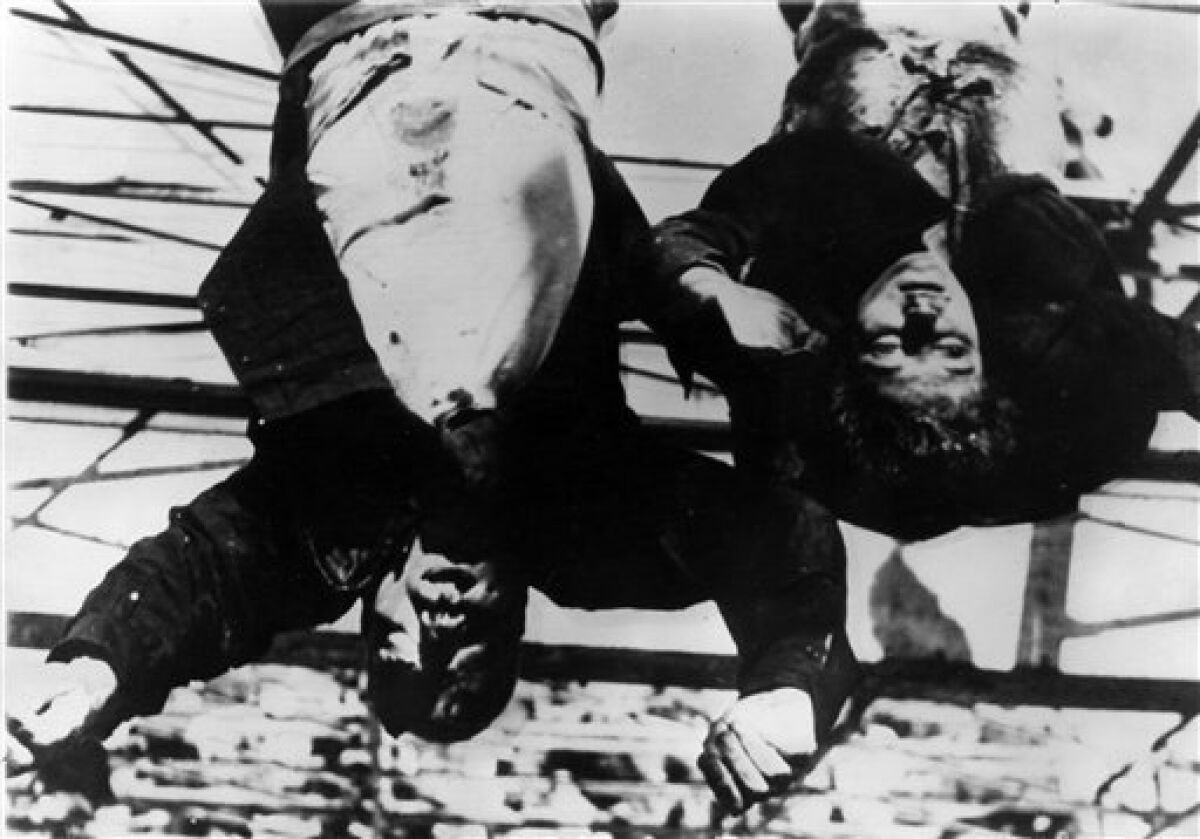
On April 29, the bodies of the executed were loaded in a van and moved to Milan, the largest city in northern Italy. They were dumped on the ground in the Piazzale Loreto, where people kicked them and spat on them. Finally, the bodies of Mussolini and the Petaccis were hung, upside-down, from the roof of an Esso gas station, and people threw stones at them.
Initially, Mussolini was buried in an unmarked grave. In 1946, his body was dug up and stolen by Fascist supporters. Four months later, it was recovered by the authorities, who then kept it hidden. In 1957, his remains were allowed to be interred in the Mussolini family crypt in his hometown of Predappio. His tomb has become a place of pilgrimage for neo-fascists, and the anniversary of his death is marked by neo-fascist rallies.

His granddaughter, Alessandra Mussolini, is a member of the European Parliament, and has been one of the leaders of far-right politics in Italy since the early 21st Century. Her son, Romano Mussolini, plays for SS Lazio, the Rome-based team known for a Fascist fan base. He says he has no interest in politics.

*

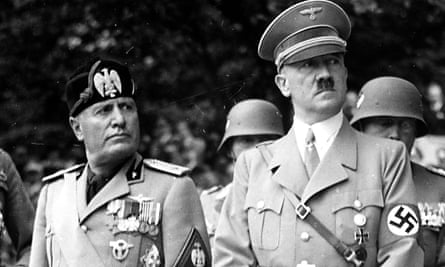
On April 30, upon hearing a report of what happened to Mussolini, and knowing that the Soviet Union's Red Army had Berlin surrounded, and that his own escape was unlikely, Hitler decided that he was not going to face the same fate. The Nazi dictator killed himself.
The famous, occasionally-imitated, Time cover

His wife, Eva Braun, had also committed suicide, with a cyanide pill. She was 33. The Nazi regime came to an end with the rump government's surrender 8 days later.

He knew the Red Army was closing in from the east. He knew the other Allies, America and Britain, were closing in from the west.

On April 22, he ordered General Felix Steiner to attack the Soviet troops attempting to encircle Berlin. Steiner could not raise enough troops to do so. Pretty much the only available fighters in Germany who weren't already in the Army were old men and children.

Steiner was no hero. He was arrested for war crimes, but after 3 years, he was released due to an inability to get enough evidence against him. He lived until 1966, still trying to rehabilitate the image of the German army, and in particular the SS.

In his Bunker, Hitler was told of Steiner's inability to raise troops, and he lost his composure. He now knew that defeat in World War II is inevitable. This event was dramatized in the 2004 German film Der Untergang, known as Downfall in the English-speaking world. Hitler was played by Austrian actor Bruno Ganz, and, since the scene was filmed in German, a language most non-Germans don’t understand, it became the basis for the "Hitler Rants Parodies" video series, with fake subtitles put on to match whatever joke the author wants to tell.

Hitler knew Berlin was surrounded. He had hoped to hold out until May 5, the anniversary of the death of Napoleon Bonaparte, his role model, who had come closer to conquering Russia than he had, actually reaching Moscow, but finding it burned and useless to him before returning.

But the reports that Hitler was getting suggested that the Soviets would get there sooner. And when he found out how his former Axis partner, Mussolini, had been treated after his capture, and especially after his execution, by Communists in his country, Hitler was determined to not fall into the hands of any of the Allied nations, especially the Soviets.

As the saying goes, the one service Hitler ever performed for humanity was to kill Hitler. But the regime he began on January 30, 1933, 12 years earlier -- including the war he started on September 3, 1939 -- had led to the deaths of 75 million people, military and civilian combined, including over 400,000 Americans.

The true depths of his depravity had already begun to reach the civilized world before word of his death had, as American, British and Soviet troops found the concentration camps where the Holocaust was carried out. In these camps, 11 million people died, some from murder, some from disease. And 6 million of those people who died, and many others who survived, were put there for no crime other than being Jewish.

So the death of Hitler could not be a wholly joyous occasion, because it was a reminder of all that he did, and all that he could have done had he won.

If you ever wonder which is worse, Fascism or Communism, consider this: The Soviets had the atomic bomb for 40 years, and never used it; the Chinese have had it for nearly 60 years, and have never used it; but if the Nazis had ever gotten it, there is no doubt that Hitler would have ordered its use.

His propaganda minister, Joseph Goebbels, and his wife, Magda, remained in the Bunker. On May 1, they fed their children poison, and then took their own lives. On May 2, Generals Hans Krebs and Wilhelm Burgdorf, both among those that Hitler asked to remain in the Bunker in the Downfall scene, committed suicide. The same day, Nazi Party Secretary Martin Bormann, who had fled the Bunker, realized capture by the Soviets was inevitable, and committed suicide. SS leader Heinrich Himmler escaped until he was captured by British troops, and committed suicide in their custody on May 23.

Most of the remaining Nazi high command was captured alive. They were tried in Nuremburg, site of some of the Party's infamous rallies, and convicted. These included Joachim von Ribbentrop, the Foreign Minister; Julius Streicher, the Nazis' top propaganda publisher; Hans Frank, Governor-General of occupied Poland; and the other 2 military leaders that Hitler had asked to stay in the Downfall scene, General Alfred Jodl, Chief of the Armed Forces, who had signed the surrender papers on V-E Day, and Field Marshal Wilhelm Keitel.

Not among the condemned, but scheduled to be so, was Reichsmarschall Hermann Göring, the highest-ranking Nazi official to have survived V-E Day. He had made an appeal, asking to be shot as a soldier instead of hanged as a common criminal, but the court refused. So he committed suicide with a potassium cyanide capsule the night before he was to be hanged.

Two more Fascist dictators, because they were neutral in The War, hung on: António Salazar had a stroke, and was removed from power in Portugal in 1968, dying in 1970, and democracy was restored in 1974; and Francisco Franco died in 1975, and, with the support of King Juan Carlos I, Spain went back to democracy.

Saturday, July 9, 2016

Top 5 Reasons You Can't Blame Zinedine Zidane for France Losing the 2006 World Cup

This Sunday, France will play Portugal in the Final of Euro 2016, at the Stade de France in Saint-Denis, a suburb of Paris. As France is the host nation, its team would seem to have a great advantage. But Portugal has Cristiano Ronaldo, often considered the best soccer player in the world. We shall see.

France previously won the European Football Championship in 1984 (also on home soil) and 2000, and the World Cup in 1998 (again, at home). But 10 years ago, an incident occurred that will be debated for as long as the sport is played, and it took this long for France to recover: For all their talent, they finished last in their group at Euro 2008, had a mutiny against their manager at the 2010 World Cup and lost all 3 of their Group Stage games, and lost in the Quarterfinals of Euro 2012 and the 2014 World Cup.

*

July 9, 2006, 10 years ago today: The World Cup Final is held at the Olympiastadion in Berlin. France play Italy.

Italy were loaded with legends: Gianluigi Buffon, Fabio Cannavaro, Andrea Pirlo, Francesco Totti, Luca Toni. This was a team so good, Daniele De Rossi and Alessandro Del Piero did not start and had to come on as substitutes, Alessandro Nesta and Filippo Inzaghi remained on the bench, and Paolo Maldini, still starting for AC Milan at age 38, was not even selected.

But France were equally laden with starpower, many of them holdovers from the 1998 triumph: Fabien Barthez, Lilian Thuram, David Trezeguet, Patrick Vieira, Thierry Henry, and Captain Zinedine Zidane. Others had developed since that win: Claude Makélélé, Florent Malouda, Sylvain Wiltord, Lasanna Diarra, Éric Abidal, Franck Ribéry. 

The key was Zidane: The midfielder, who had starred for Girondins de Bordeaux in his homeland, Juventus in Turin, Italy, and Real Madrid in Spain, had put the team, indeed his entire country, on his back, and led them to victory in 1998.

The son of Kabyle immigrants from France's former colony of Algeria, he was a symbol of reconciliation, as both nations were still dealing with the nasty war that Algeria fought for its independence from 1954 to 1962 -- having ended only 36 years before.

Although light-skinned enough to appear white -- unlike several national side teammates, including Henry, Vieira, Thuram, Trezeguet, and his Real Madrid teammate Makélélé -- he had faced prejudicial gestures large and small, including the insinuation that he was not truly, or not wholly, French.

Yet he went into that 2006 Final once again having led the team to glory. It was to be his last game: At age 34, he had announced his retirement as a player. Win or lose, it would be all over when the final whistle blew for this game.

*

In the 7th minute, Malouda, then playing his club football for Olympique Lyonnais, was knocked down in the box by Marco Materazzi of Internazionale Milano. If Materazzi were a hockey player, he wouldn't be a "pest": A good player who frequently plays rough; he'd be a "goon": A player whose sole purpose is to play rough, because he can't do anything else.

Horacio Elizondo, the Argentine selected to referee the game (because he was from neither team's continent), correctly awarded a penalty, and Zidane converted it. France led, 1-0.

The lead did not last long. In the 19th minute, Pirlo, the AC Milan legend, sent a hellacious corner kick into the box, and Materazzi, of all people, headed it past Barthez, the famously bald goalkeeper who was back with Olympique de Marseille after starring for them, Toulouse, AS Monaco and Manchester United.

In the 2nd half, Luca Toni, then of Florence-based Fiorentina, hit the crossbar with a shot, and then correctly had a headed goal disallowed as having been offside. Malouda was tackled in the box by Juventus' Gianluca Zambrotta, but was incorrectly not awarded another penalty. Arsenal legend Henry was stopped by Juventus goalie Buffon. Malouda skied a shot over the bar. Pirlo just missed with a free kick.

In extra time, Ribéry, then with Marseille and later to star for Bayern Munich, just missed. Buffon just barely knocked a Zidane header away.

And then, in the 110th minute, Materazzi pulled on Zidane's jersey, they exchanged words, and Zidane head-butted Materazzi right in the chest. In French soccer, this is known as a coup de boule -- literally, "stroke of ball" or "blow of ball," but also meaning "play of head." (The more familiar phrase coup d'état means "blow of state," and refers to the overthrow of a government.)

Elizondo did not see the incident. The 4th official, Luis Medina Cantalejo -- so respected that he not only officiated at 3 games of that World Cup, but was one of the few Spanish referees to officiate at La Liga games between arch-rivals Real Madrid and Barcelona, a rivalry so intense that foreign referees are nearly always assigned to oversee it -- told Elizondo through his headset that it had happened.

Elizondo properly showed Zidane a straight red card, making him the 4th player to be sent off in a World Cup Final, and the only player ever sent off in games of 2 separate World Cups. The scene of Zidane walking into the locker room, past the World Cup trophy but not even looking at it, is nearly as iconic as the coup de boule itself.
Extra time ended with the game still 1-1, so it went to penalties. Italy kicked first. Pirlo scored his penalty. Sylvain Wiltord, then with Lyon and previously the man whose goal past Barthez secured the League and Cup "Double" for Arsenal in 2002, made his. 1-1.

Materazzi was next for Italy, and made his penalty. Next for France was Trezeguet, facing his Juventus teammate Buffon. In extra time of the Euro 2000 Final, he had beaten Buffon with a shot. Under the rules then in place, it was a "golden goal": Automatic victory. This time, he was not a hero: He clanged his shot off the crossbar. 2-1 Italy.

De Rossi made his penalty. Abidal made his. Del Piero made his. Willy Sagnol made his for France. Finally, Fabio Grosso clinched the win for Italy: 5-3, with France's last shot not taken, seeing as how it would have been meaningless. Italia: Campioni del Mondo.

Zidane, of course, was not available for the penalties.

Why did he do it? Three British newspapers -- The Times, The Sun, and the Daily Star, with varying degrees of reliability -- all hired lip-readers who were fluent in French and Italian to look at the tape, and to see what Materazzi had said to Zidane to provoke it. (I don't know if Materazzi speaks French, but Zidane played in Italy long enough to learn the language.)

The Times has a reputation for sterling journalism; The Sun and the Daily Star are considered lying right-wing propaganda rags. Yet the lip-readers hired by all 3 reported the exact same thing: They all said that Materazzi had called Zidane a "son of a terrorist whore."

It had been less than 5 years since the 9/11 attacks, and a year to the week after the 7/7 attacks on the London Underground (subway). Apparently, Materazzi was unaware that presuming that all Muslims are terrorists is not only bigoted, but stupid. To make matters worse, Zidane's mother was ill at the time.

Materazzi's version of events was a little different. He said he would never have insulted someone's mother, having lost his own when he was 15 years old. Without question, he had tugged on Zidane's shirt. The exchange of shirts is a postgame tradition that goes back decades, and Materazzi said that Zidane told him, "If you want my shirt, I will give it to you afterwards." Not an unreasonable request of the Captain of one of the finalists to the other, and not an unreasonable response.

Materazzi said that his follow-up was, "I prefer the whore that is your sister." In other words, "Your sister puts out, and I'd like you to set me up with her." In other words, Materazzi admitted that he had gone too far.

But so had Zidane. There were about 10 minutes of play to go. Winning is the best revenge. A man as accomplished as Zidane -- 2 League titles in Italy and 1 in Spain, a Champions League win, a World Cup and a Euro title -- should have accepted this. Win the game, and you look like a champion, and the guy trying to provoke you looks like an idiot. Instead, the great Zizou looked like an easily provoked fool, and Materazzi an undeserved World Champion.

The play swept the world. Dozens of people posted their attempts at recreating it on the Internet. American TV shows parodied it. A song titled "Coup de Boule" hit Number 1 on the French music charts.

*

Top 5 Reasons You Can't Blame Zinedine Zidane for France Losing the 2006 World Cup

First, let me do a reason that didn't make the cut: The Best of the Rest.

The Second Malouda Penalty. Had it been correctly awarded, it would have been 2-1 France, there never would have been extra time, and the coup de boule would never have happened. Zidane would have gone out a winner, he and his country would have had a 2nd World Cup win, and Materazzi would have gone down in history as a dirty player whose dirtiness cost his country a penalty and a World Cup win.

The reason this isn't one of the top 5 is that Buffon was one of the greatest goalies of all time, pretty much at his peak, and could have stopped the penalty.

5. The Other French Players. Zidane scored penalties against Portugal in the Semifinal and Italy in the Final. Other than that, France hadn't scored since Thierry Henry's goal in the 57th minute of the Quarterfinal win over Brazil. From then until the penalty stage of the Final, that was 243 minutes without a goal from open play.

So, for all their talent, France weren't exactly lighting up the scoreboard. In other words, had the coup de boule not happened, and the game had remained 11 vs. 11, given how France were playing at the time, there wasn't a great chance of them scoring in the last 10 minutes of extra time anyway. Italy certainly didn't look like they were exhausted.

Which brings us to...

4. The Italian Defense. In the 1960s, both Milan clubs, AC Milan and Internazionale (or "Inter"), became known for a defensive style called catenaccio -- "padlock." AC Milan used it to win the European Cup in 1963 and 1969, and Inter won it in 1964 and 1965 and lost the Final in 1967.

From that point onward, defense was viewed as the highest virtue in calcio (the Italians' word for soccer). The great sportswriter for La Gazzetto dello Sport, Gianni Brera, effectively Italy's Grantland Rice, once wrote that the ideal calcio game would end 0-0.

In the 1970s and '80s, Juventus would dominate the Italian game with a rugged defense led by goalkeeper Dino Zoff, sweeper Gaetano Scirea and left back Claudio Gentile. By the time AC Milan became great again in the late 1980s, their merging of Italian catenaccio (the aforementioned Paolo Maldini and his defensive partner Franco Baresi) and the Dutch-Surinamese combo of totalvoetbaal (the superb striker Marco Van Basten) and samba (midfielders Ruud Gullit and Frank Rijkaard) made the Italians appreciate attack again. But defense was still what Italian fans preferred.

How good was the 2006 Italy defense? In 7 matches, including their Semifinal win over Germany and their Final win over France that both went to extra time, they did not allow a single goal from open play to the opposing team. The only goals they allowed were Zidane's penalty in the Final, and an own goal by Cristian Zaccardo of Palermo that forged a 1-1 tie with, of all teams, the U.S. That's 690 minutes, 7 2/3rds games' worth of soccer, and not 1 single solitary goal was scored by the opposition from open play.

Which brings us to...

3. Gianluigi Buffon. The legendary keeper -- still going strong in 2016, by the way; it seems as though his 1st manager for Italy was Julius Caesar -- is on the short list for the title of greatest goalkeeper of all time.

He was immense throughout the 2006 World Cup, including the Final. While it is true he didn't stop Zidane's penalty in the 7th minute, and Trezeguet's miss in the penalty kick phase wasn't directly his doing, had Zidane (whose last season at Juventus was the season before Buffon's 1st there) been available, Buffon might have stopped him.

Which brings us to...

2. David Trezeguet. He missed. I did say that Buffon wasn't directly responsible. But it's worth noting that Trezeguet then played for Juventus. He practiced penalties against Buffon. Which means they knew each other's tendencies. Did that make Trezeguet the ideal guy to try one against Buffon? Maybe, but it also made Buffon the ideal guy to try to stop Trezeguet. Perhaps there was some mind game in there that we didn't see, but a Juve fan would have -- the soccer equivalent of an inside joke.

If Trezeguet had made his kick, then, instead of ending 5-3 to Italy, it would have been 5-4, with France having a chance to send the penalties to sudden death. And then, who knows what would have happened.

Which brings us to...

1. Penalties are a crapshoot. You simply never know. Great players miss them. England fans still wince over the misses of Stuart Pearce and Chris Waddle in the 1990 World Cup Semifinal vs. Germany, Gareth Southgate getting stopped by Germany's Andreas Köpke in the Euro 1996 Semifinal, and Paul Ince and David Batty missing against Argentina in the 1998 World Cup Quarterfinal. In the 2006 Quarterfinal, Portugal's goalie Ricardo had stopped England's Frank Lampard, Steven Gerrard and Jamie Carragher.

Roberto Baggio was one of Juventus' and Italy's greatest players, and was known as a great penalty-taker. Yet his miss, over the crossbar, in the 1994 Final cost Italy the World Cup. Just the other day, Lionel Messi had a miss nearly identical to Baggio's, which helped cost Argentina the 2016 Copa America.

If "the Divine Ponytail" and "the Greatest Player of All Time" (which Messi most certainly is not) missed such important shots, maybe Zidane, if available, would have missed his, and France would have lost anyway.

VERDICT: Not Guilty. While Zidane bears some responsibility for France losing the 2006 World Cup Final, there were plenty of other factors at work. He is not solely, or even primarily, responsible for the defeat.