Showing posts with label v-e day. Show all posts

Thursday, May 8, 2025

May 8, 1945: V-E Day

I'm getting a little ahead of myself here. It was quite a week:

April 28, 1945: Former Italian dictator Benito Mussolini was executed.

April 29, 1945: Mussolini's corpse is hanged in Milan. Seeing this, Adolf Hitler, the dictator of Nazi Germany, knows he doesn't want the advancing Soviet Red Army to get their hands on him.

And U.S. troops liberate the Dachau concentration camp, outside Munich. It is believed that 32,000 people died there. Among those imprisoned were psychologist Bruno Bettelheim and the Rev. Martin Niemoller ("First they came for... ").

April 30, 1945: Hitler kills himself in his bunker in Berlin.

May 1, 1945: Nazi propaganda minister Joseph Goebbels follows with his own suicide in the bunker.

May 2, 1945: Nazi Generals Hans Krebs and Wilhelm Burgdorf commit suicide in the bunker. Martin Bormann, Hitler's private secretary, tries to escape, but doesn't get far, and also kills himself.

It's all over. Berlin has fallen. The Soviet Red Army raises the Red Flag over the Reichstag, the home of the German national legislature. It's just a matter of what remains of the Nazi government surrendering. What Hitler called "The Thousand-Year Reich" was dead after 12 years.

Soviet dictator Joseph Stalin had seen the photograph of the U.S. Marines raising the American flag on the Japanese island of Iwo Jima, and wanted a similar picture of the Soviet red banner with the yellow hammer and sickle over Berlin. He got it. The photographer was Yevgeny Khaldei. The soldier was 18-year-old Aleksei Kovalov -- no relation to the later hockey player of the same name. He later became a fireman in Kiev. Both men were Ukrainians, and both lived until 1997.
In late 1941, the Soviets were, perhaps, a mile away from losing the Eastern Front of the European Theater of World War II. Now, they had won what they called The Great Patriotic War.

May 3, 1945: The Nazis had their own version of the Titanic. And guess what: It sank. Unlike the original, it wasn't just due to incompetence. It had "help."

The SS Cap Arcona was launched in 1927. It was named after Cape Arkona on Rügen, Germany's largest island, on the Baltic Sea. It weighed 27,561 tons, compared to the 46,329 of the original RMS Titanic. It was 679 feet long, compared to the original's 889 feet. Cruising speed was close, 23 miles per hour to Titanic's 24. In other words, it was big, but not as big as the Titanic, the world's largest cruise liner when it first and last sailed in 1912.

Cap Arcona was the flagship of the Hamburg-South America line, and sailed between Hamburg, Germany's 2nd-largest city and largest port, and the east coast of South America. In 1940, the Kriegsmarine, the Nazi navy, took it over. In 1943, it was "cast" in the title role in Titanic, a Nazi propaganda film, designed to show that the British were incompetent because they built the "unsinkable," ill-fated TitanicIt had 3 smokestacks, instead of the 4 that Titanic had. But it was still big enough to be plausible.

In 1945, Cap Arcona became a prison ship, as the Nazis, aware that they were losing the war, and that the Allies had begun to liberate the concentration camps, began to evacuate their camps in occupied Norway and Denmark. On May 3, Cap Arcona was sunk off the coast of Neustadt -- fittingly, by Britain's Air Force -- and over 5,000 prisoners were killed. Compare that to the 1,500 who died on the real Titanic.

Same day: Ezra Pound, often called one of America's greatest poets, was arrested for treason. He was born in 1885 in Idaho. By 1908, he was already living in Italy, teaching there, and a published poet. He moved to London, and worked as foreign editor of American literary magazines. He introduced the world to Robert Frost, T.S. Eliot, James Joyce and Ernest Hemingway. Hemingway wrote in 1932 that, for poets born in the late 19th or early 20th century, not to be influenced by Pound would be "like passing through a great blizzard and not feeling its cold."

He blamed the horrors of World War I on international bankers, and moved to Italy, where he became a supporter of Mussolini, and later of Hitler and the leader of the British Union of Fascists, Oswald Mosley.

During World War II, Pound recorded hundreds of paid radio propaganda broadcasts for the Italian government, allied with the Nazis in the Axis. In these broadcasts, he attacked the U.S. government, and President Franklin D. Roosevelt in particular; the British government; international finance, Jews in general, and the Jewish influence on international finance; and munitions makers and arms dealers, accusing them of prolonging the war. Keeping with the Fascist theme, he used his broadcast to support the Holocaust, and to support eugenics, and urged U.S. soldiers to lay down their arms and surrender.

On May 3, 1945, Pound was arrested by the Italian Resistance, and was handed over to the U.S. Army. Ruled mentally unfit to stand trial, he was held at St. Elizabeths Hospital, a famed psychiatric facility in Washington, where he was diagnosed as a narcissist and a psychopath.
Despite being held there, his poetry collection The Pisan Cantos was published in 1948. He would continue work on the project, published in full in 1962 as The Cantos of Ezra Pound. Norman Mailer, a leftist author who despised Fascism, once said that he would rather read Pound than any of the Communist screenwriters known as the Hollywood Ten, because, he said, Pound was a better writer.

He was released in 1958, and, knowing he was not particularly welcome in America, returned to Italy, called America "an insane asylum," and gave a Fascist salute for the press. He died in Venice in 1972.

And another thing that happened on May 3, 1945: German rocket scientist Wernher von Braun and his brother Magnus surrender to American troops at Oberammergau, Bavaria.

Wernher von Braun had been a member of both the Nazi Party and the SS, and he designed the V-2 rocket that had killed thousands in raids on London. And yet, without him, America would not have gotten to the Moon – had the Soviets gotten him, the entire history of the world could have been changed.

Few have been so villainous and so heroic -- on the few occasions when one has been both, it has tended to go in the other direction. He died in 1977.

In 1960, Curd Jürgens, later to play a James Bond villain in The Spy Who Loved Me, played von Braun in I Aim at the Stars. Satirists Mort Sahl said the title should be extended to "...But Sometimes I Hit London."

In 1965, another satirist, Tom Lehrer, wrong a song titled "Wernher von Braun":

"Once the rockets go up
who cares where they come down?
That's not my department!"
says Wernher von Braun.

May 4, 1945: British Field Marshal Bernard Montgomery accepts the unconditional surrender of German forces in the Netherlands, Denmark, northwest Germany including all islands and all naval ships in those areas, at Lüneburg Heath, outside Hamburg.

May 5, 1945: The Mauthausen concentration camp, outside Linz, Austria, is liberated by the U.S. 11th Armored Division. Over 320,000 people were killed there. Among the survivors is Simon Wiesenthal, who goes on to become the world's foremost Nazi-hunter.

Canadian troops liberate Amsterdam. Today, the Dutch capital is home to 935,000 people, with a metropolitan area of 2.5 million, and is renowned as a center of art, culture, stylish soccer, and, well, naughtiness.

Also on this day: For all that Nazi Germany and Imperial Japan did to their various enemies in World War II, they could only hurt America from afar. Their respective saboteurs in America had a rather pathetic record. But there was one attack on the U.S. mainland that had, by any definition, some success.

"Balloon bombs" had been postulated as early as 1792 in France, but had never been considered practical until 1849, when the Austrian Empire used them on Venice, with some success, in the First War of Italian Independence.

Britain had used them on Nazi Germany in World War II. Japan had also tried them, as the only thing they could launch that could reach the U.S. mainland without getting shot down. On May 5, 1945, 6  civilians were killed near Bly, Oregon, when they discovered one of the balloon bombs (in Japanese, "Fu-Go") in Fremont National Forest, becoming the only fatalities from Axis action in the continental U.S. during the war.
A Fu-Go "balloon bomb"

Reverend Archie Mitchell (then age 27) and his pregnant wife Elsie (age 26) drove up Gearhart Mountain that day with 5 of their Sunday school students for a picnic. While Archie was parking the car, Elsie and the children discovered a balloon and carriage, loaded with an anti-personnel bomb, on the ground. A large explosion occurred, and the 4 boys -- Edward Engen (13), Jay Gifford (13), Dick Patzke (14) and Sherman Shoemaker (11) were killed instantly; while Elsie and Joan Patzke (13) died from their wounds shortly afterwards.

An Army investigation concluded that the bomb had likely been kicked or dropped, and that it had lain undisturbed for about 1 month before the incident. The U.S. press blackout was lifted on May 22 so the public could be warned of the balloon threat.

This would not be Rev. Mitchell's last experience in war. He served as a missionary to South Vietnam, and, along with 2 others, was taken captive by the Vietcong on May 30, 1962. None of them have been seen since.

A memorial, the Mitchell Monument, was built in 1950 at the site of the explosion. In 1987, a group of Japanese women involved in Fu-Go production as schoolgirls delivered 1,000 paper cranes to the victims' families as a symbol of peace and healing, and 6 cherry trees were planted at the site on the incident's 50th Anniversary in 1995.

May 7, 1945: Nazi Germany's surrender was authorized by Adolf Hitler's appointed successor as head of state, Reichspräsident Karl Dönitz, an Admiral. His administration was known as the Flensburg Government.

The act of military surrender was first signed at 2:41 AM on May 7 in SHAEF (Supreme Headquarters Allied Expeditionary Force) headquarters in Reims, France. A slightly modified document, considered the definitive German Instrument of Surrender, was signed on May 8 in Karlshorst, Berlin, at 10:43 PM local time. It read as follows:

The German High Command will at once issue orders to all German military, naval and air authorities and to all forces under German control to cease active operations at 23.01 hours Central European time on 8 May 1945.

In other words, 6:01 PM, U.S. East Coast time.

May 8, 1945: President Harry S Truman makes the announcement: It is Victory in Europe Day, or V-E Day.

Russia and some countries formerly in the Soviet Union celebrate V-E Day on May 9, as Germany's unconditional surrender entered into force at 11:01 PM on May 8, Central European Summer Time (6:01 PM, U.S. Eastern Time), and this corresponded with 12:01 AM on May 9, Moscow Time.

In Britain, though Winston Churchill ran the government as Prime Minister, crowds in London rushed to Buckingham Palace, chanting "We want the King!" Hearing it, King George VI, exhausted and aged by the war well beyond his 49 years, said, "The King wants his dinner." But he soon appeared on the balcony, in his Royal Navy uniform, with his wife Queen Elizabeth, and their daughters, Princesses Elizabeth and Margaret. Churchill soon appeared with them, with Minister of Labour Ernest Bevin leading the crowd in a singing of "For He's a Jolly Good Fellow."

(In Britain, the refrain to that chant is, "And so say all of us!" In America, it's "Which nobody can deny!")

In the United States, the event coincided with Truman's 61st birthday. He dedicated the victory to the memory of his predecessor, Franklin D. Roosevelt, who had died 26 days earlier. American flags remained at half-staff for the remainder of the 30-day mourning period. Great celebrations took place in many American cities, especially in New York's Times Square.

World War II would continue for another 3 months, until the Empire of Japan surrendered on August 14, which became known as V-J Day.

Friday, August 14, 2020

August 14, 1945: V-J Day + 75


August 14, 1945, 75 years ago today: V-J Day, Victory over Japan. Afraid of the United States of America unleashing further nuclear devastation, as on the cities of Hiroshima on August 6 and Nagasaki on August 9, the Empire of Japan surrenders to the Allies, ending World War II. V-E Day, Victory In Europe, had been on May 8, the day after Nazi Germany signed their articles of surrender.

This is an update of a post I did on the 70th Anniversary of V-J Day.

Every anniversary, the number of living World War II veterans becomes fewer and fewer. An 18-year-old kid who enlisted toward the end would now be 93 years old.

For this reason, we must keep the facts of what everyone who survived it, including on "the home front," would call "The War" for the rest of their lives, alive.

The Axis -- Nazi Germany, Fascist Italy, and the Empire of Japan -- had to be defeated, dismantled, and replaced by governments more like America's than like what they had before.

If that meant allying with the British Empire, the French Empire, and the Union of Soviet Socialist Republics, whose own leaders weren't exactly paragons of democracy, then so be it. The British and the French got better after The War; the Soviet Union did not.

When the U.S. Army began reaching the Nazis' concentration camps, which led to the deaths of 11 million people, 6 million of them Jews, General Dwight D. Eisenhower, later to become President of the United States, called for photographers and film crews to document what was found. He believed that, eventually, prominent people would deny that what became known as The Holocaust had occurred, and he wanted irrefutable proof that its horrors had happened. "Ike" turned out to be right.

*

Some of the information in this post comes from the extensive site Baseball in Wartime, run by Gary Bedingfield.

All told, there were 1,343 men who both played in the major leagues and served in World War II. All but 5 of them served in the armed forces of the U.S. 1 major league player served in the Cuban Army: Pitcher Adrian Zabala. 4 were Canadian: Hank Biasatti and Dick Fowler in the Army, and Joe Krakauskas and Phil Marchildon of the Royal Canadian Air Force. Biasatti was a 1st baseman, the other Canadians were pitchers.

1 man served in the OSS, the Office of Strategic Services, the predecessor to the CIA: Moe Berg, the longtime backup catcher who spoke multiple languages -- a side effect when you grew up in Newark, New Jersey in the 1920s, and definitely a plus when you served your country in the 1930s and 1940s.

566 served in the U.S. Army, including Hall-of-Famers Luke Appling, Bobby Doerr, Warren Spahn, Red Schoendienst, Monte Irvin, Hoyt Wilhelm and (broadcasters' wing) Joe Garagiola.

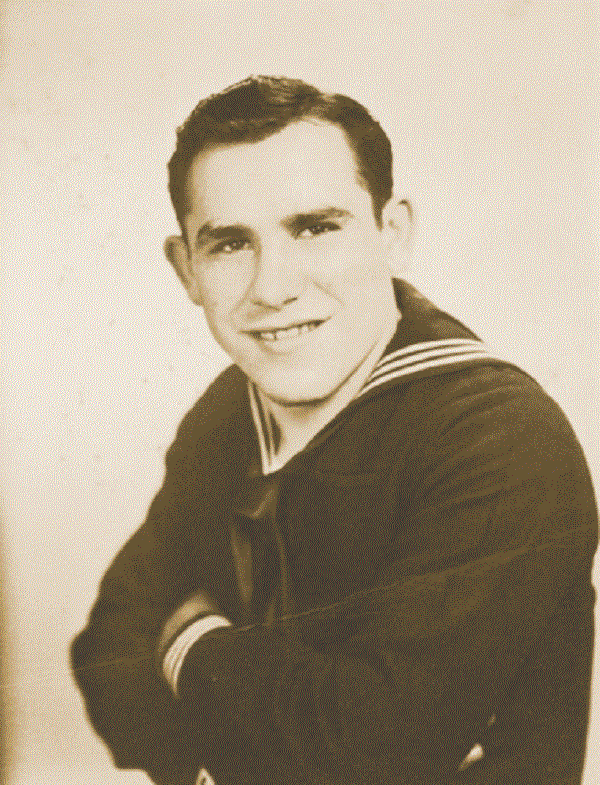
466 served in the U.S. Navy, including HOFers Mickey Cochrane, Bill Dickey, Charlie Gehringer, Harold "Pee Wee" Reese, Phil Rizzuto, Stan Musial, Bob Lemon, and the 1 man involved in the D-Day invasion of June 6, 1944 who would go on to play in MLB: Lawrence Peter "Yogi" Berra, pictured above in his Navy uniform. A year later, Yogi "won his first world championship." And, by far, his most important one.

180 served in the U.S. Army Air Force -- which wouldn't be separated from the Army as the U.S. Air Force until after The War, in 1947 -- including HOFers Joe DiMaggio, Hank Greenberg and Enos Slaughter.

68 served in the U.S. Marine Corps, including HOFers Ted Williams and Ted Lyons, and should-be HOFer Gil Hodges. So did a pair of HOF broadcasters, Jack Brickhouse (not surprising, he seemed like a really gruff guy) and Ernie Harwell (very surprising, since he seemed like such a gentle soul).

At one point, Lyons pitched for a Marine team against a USAAF team, and DiMaggio was on it. Lyons said, "I enlisted to get away from DiMaggio, and, now, here he is!"

50 served in the U.S. Coast Guard, the most notable of them being Yankee star (hard to call him a "Yankee Legend" since he doesn't have a Plaque in Monument Park -- maybe he should, given his WWII service and his nickname of "Ol' Reliable") Tommy Henrich.

7 served in the U.S. Merchant Marine, including Yankee slugger Charlie Keller.

There were 2 major leaguers killed in The War. Neither was a star:

Elmer John Gedeon, born April 15, 1917 in Cleveland. He was an All-American in track and a letterwinner in baseball and football at the University of Michigan. He appeared in 5 major league games, all with the Washington Senators in September 1939, 4 as CF, 1 as RF. He wore Number 34. Had 3 hits in 15 at-bats, for a .200 batting average. He played for the Charlotte Hornets -- not the World Football League team, or either of the NBA franchises that have had the name, but a minor-league baseball team.

He was drafted into the Army in 1941, and was assigned to the Army Air Force. He crashed in a B-25 bomber training mission in 1942, but survived, and resumed pilot training. Captain Gedeon was shot down in a B-26 over St. Pol, France on April 20, 1944. He had just turned 27. There is no mention of him at Nationals Park in Washington. Nor was there at its predecessors, Robert F. Kennedy Stadium and Griffith Stadium.
Also wearing Number 34 for the Senators was Bert Shepard, a pitcher who lost a leg when his plane was shot down, but used a prosthesis, and pitched 1 game for the Senators in 1945, and continued to pitch in the minor leagues until 1954.

Harry Mink O'Neill, born May 8, 1917 in Philadelphia. He graduated from Gettysburg College, within walking distance of the site of the greatest battle of the American Civil War. At GC, he played baseball, football and basketball. He played 1 inning with the Philadelphia Athletics, also in 1939, on July 23, as a defensive replacement at catcher, wearing Number 30, and never came to bat -- making him a true "Moonlight Graham."
He enlisted in the Marine Corps in 1942. He survived being shot by a Japanese sniper at the Battle of Saipan. 1st Lieutenant O'Neill was killed in the Battle of Iwo Jima on March 6, 1945. He was not quite 28. There is no mention of him at Citizens Bank Park in Philadelphia. Nor was there at its predecessors, Veterans Stadium and Shibe Park/Connie Mack Stadium.

There is one other possibility: Charles Andrew Frye of Hickory, North Carolina was born in 1913, and pitched in 15 major league games, all with the 1940 Philadelphia Phillies. With a terrible team, he went 0-6 with a 4.65 ERA. He pitched 2 more seasons in the minors, enlisted, and was discharged on December 22, 1944 -- 8 months before V-J Day, and listed as 154 pounds, about 20 under his playing weight. But his weight and the timing together, and it's not proof of an illness contracted during his service, but does suggest it.

Charlie Frye died on May 25, 1945, in Hickory, of a ruptured gastric ulcer, 5 months after his discharge. So, officially, he isn't a former MLB player who died as a result of his military service in World War II. Unofficially, the evidence that he should be counted as one is, as he was upon his discharge, rather thin. Perhaps more information is needed.
By a macabre coincidence, the only major leaguer believed to have been killed in the Korean War was also born in 1917, and also appeared in the majors only briefly in 1939:

Bob Neighbors of Talihina, Oklahoma, the St. Louis Browns and the U.S. Air Force. He played 7 games at shortstop. (Strangely, there is no known record of what uniform number he wore. Baseball-Reference.com doesn't have one. Nor does Jack Looney's fantastic book Now Batting, Number... which charts baseball uniform numbers from the first-ever experiment with them in 1916 right up to 2005, just before the book's publication.)

He enlisted in 1942, and unlike most players, stayed in the service after the War, rising to the rank of Major. Like Gedeon, he flew a B-26. His plane was reported missing in 1952, and his body has never been found. There is no mention of him at the new Busch Stadium, nor was there at its predecessors, Busch Memorial Stadium and Sportsman's Park.

*

Today, exactly 75 years after V-J Day, we are down to 16 men who are living veterans of both World War II and Major League Baseball: 

* Cloyd Boyer, born September 1, 1927, from Alba, Missouri. He pitched for his home-State St. Louis Cardinals 1949 to 1952. He returned to the majors with the first edition of the other Missouri team of the era, the 1955 Kansas City Athletics. He was the brother of All-Star 3rd basemen Ken and Clete (a Yankee star).

* Bobby Brown, born October 25, 1924 in Seattle, grew up in San Francisco. A 3rd baseman, he played for the Yankees from 1947 to 1954. He is the last surviving member of the Yankees' '47 and '49 title winners. He was Yogi's roommate at the time. He also won rings in '50 and '51. Then he returned to the service, in the Korean War.

He became a cardiologist, and served as President of the American League from 1984 to 1994. He should not be confused with the Bobby Brown who helped the Yankees win the 1981 Pennant, a black outfielder.

* Billy DeMars, born August 25, 1925, from Brooklyn. He was a shortstop, mostly with the Browns. He became a longtime coach, including the hitting instructor for the Phillies in their 1976-83 quasi-dynasty. He is 1 of 8 surviving former Browns. He is also 1 of 7 surviving former Philadelphia Athletics, and the last living man to have played for Connie Mack.

* Carl Erskine, born December 13, 1926, from Anderson, Indiana. A pitcher, he spent his entire career with the Dodgers, from 1948 in Brooklyn to 1959 in Los Angeles. He is the last surviving player featured in Roger Kahn's book about the 1952-53 Dodgers, The Boys of Summer.

* Johnny Groth, born July 23, 1926, from Chicago. A center fielder, mostly with the Tigers, he played in 157 games in 1950, a record until the 162-game schedule was instituted in 1961. (Players get credit for statistics in games that are called due to rainouts when tied.)

* Chris Haughey, born October 3, 1925, from Astoria, Queens. "Bud" Haughey's major league debut was on his 18th birthday, the last game of the 1943 season, as a pitcher for his hometown Dodgers. It was also his last major league game. Dodger legend Gil Hodges also made his big-league debut in this game.

* Howie Judson, born February 16, 1926, from Hebron, Illinois, outside Chicago. A pitcher, went 1-14 for the 1949 White Sox, and was unotherwise unremarkable.

* Ed Mickelson, born September 9, 1926, from Ottawa, Illinois, also outside Chicago. Despite getting 1,374 hits in minor league play, the 1st baseman's major league career was fleeting, with brief callups with the 1950 Cardinals, 1953 Browns and 1957 Cubs.

* Larry Miggins, born August 20, 1925, from The Bronx. An outfielder, he had end-of-season callups with the Cardinals in 1948 and 1952.

* Robert J. "Bob" Miller, born June 16, 1926, from Detroit. A pitcher, he went 42-42 over 10 season with the Phillies, including pitching in the 1950 World Series for the "Whiz Kids." He and Curt Simmons are the last 2 surviving players from that team. He later served as the head coach at the University of Detroit Mercy. His sons Pat and Bob also became baseball coaches.

He should not be confused with the 2 Bob Millers who not only both played for the 1962 Mets, but even roomed together, and, whenever the phone would ring, would answer, "Hello, Bob Miller here."

* Bobby Morgan, born June 29, 1926, from Oklahoma City. 3B, starred with the Montreal Royals, had a callup with the Dodgers in 1950, spent '51 back in Montreal, and filled in for Billy Cox with the Dodgers in '52 and '53, appearing in 3 World Series games. Also played with the Phils, Cards and Cubs until 1958.

* William Edward "Eddie" Robinson, born December 15, 1920, from Paris, Texas. A 1st baseman, he is the last surviving member of the last Cleveland Indians team to win the World Series, in 1948. A 4-time All-Star, he had 3 100+ RBI seasons, with the White Sox and A's.

He came to the Yankees in the infamous 1953 trade that sent Vic Power to the A's. He helped the Yankees win the 1955 Pennant, although he did not win a World Series with them. He closed his career with the 1957 Orioles.

He later served in the front offices of the Orioles, Houston Astros, A's, Atlanta Braves, Texas Rangers, including 5 seasons (1972-76) as Braves general manager and 5 (1978-82) as Rangers GM. He losed his active baseball career as a scout for the Red Sox, the only 1 of the original 8 AL teams for whom he didn't play. Currently the oldest living ex-MLB player, if he lives at least another 4 months and change, he will be 100 years old.

* Frank Saucier, born May 28, 1926, from Leslie, Missouri. An outfielder, he was The Sporting News' Minor League Player of the Year with the San Antonio Missions in 1950. He played 18 games with his hometown St. Louis Browns in 1951, going just 1-for-14.

He is best remembered for a game in which he barely played: On August 19, 1951, he began the game in right field, and was listed as the Browns' leadoff batter, but never came to bat. Instead, he was removed for a pinch-hitter, the 3-foot-7 midget Eddie Gaedel. His baseball opportunity apparently at an end, re-enlisted, serving in the Korean War.

* Bobby Shantz, born September 26, 1925, from Pottstown, Pennsylvania. Though listed at just 5-foot-6 and 139 pounds, he was the last of the many great pitchers brought to the Philadelphia Athletics by manager-owner Connie Mack. In 1952, he went 24-7 for an A's team that went 79-75. Despite the 4th place finish, he was named AL MVP.

He moved with the A's to Kansas City, and in 1957, he came to the Yankees in one of the many lopsided trades that led people to think that, as had been the case before the A's moved in, that Kansas City was still a "Yankee farm team." He went 11-5 and led the AL with a 2.45 ERA, helping the Yankees win the Pennant. He won a World Series ring in 1958, but did not appear in the Series. He pitched 3 Series games each in 1957 and 1960.

He was traded to the Pirates, then became an original Houston Colt .45 (Astro) in the 1962 expansion draft. He closed his career with another hometown team, the ill-fated 1964 Phillies, but their epic collapse was hardly his fault: In 14 games, 11 in relief, he had a 2.25 ERA at age 39.

A 3-time All-Star, his career record was 119-99. He won Gold Gloves the 1st 8 seasons they were given out, 1957 to 1964. In 2003, he was one of several surviving A's players invited to Veterans Stadium, as the Interleague schedule allows the A's to play their 1 game in Philadelphia since 1954. (I was there.) His brother Billy Shantz (1927-1993) was a teammate on both the A's and the Yankees.

* Willard Wayne Terwilliger (who went by his middle name), born June 27, 1925, from Clare, Michigan. 

A 2nd baseman, he debuted with the Cubs in 1949, and played for both the Dodgers and the Giants before they moved. He is 1 of only 4 surviving men on both rosters, combined, from the Bobby Thomson game on October 3, 1951. (The others are Dodgers Carl Erskine and Tommy Brown, and Giant Willie Mays.) He is 1 of 16 surviving former Brooklyn Dodgers, 1 of 14 surviving former New York Giants, and 1 of 27 surviving former "old" Washington Senators, the ones who moved to become the Minnesota Twins in 1960-61.

He closed out his career with the A's in 1960. He coached in the Yankees system, and was the 3rd base coach for the "new" Washington Senators when they moved to become the Texas Rangers in 1971-72. He coached on teams managed by Ted Williams and Don Zimmer in Texas, before winning rings as Tom Kelly's 3rd base coach with the 1987 and 1991 Twins. He returned to the Dallas area to coach the independent league Fort Worth Cats (named for the old Texas League team), and left them and retired from baseball for good after the 2010 season, at age 85.

* George Rezin Elder Jr., born March 10, 1921, from Lebanon, Kentucky. An outfielder, he played 41 games in the majors, all with the St. Louis Browns in the 2nd half of the 1949 season.

UPDATE: Howie Judson died on August 18, 2020. Bob Miller died on November 27, 2020. Billy DeMars died on December 10, 2020. Wayne Terwilliger died on February 3, 2021. Bobby Brown died on March 25, 2021. Johnny Groth died on August 7, 2021. Cloyd Boyer died on September 20, 2021. Eddie Robinson died on October 4, 2021. Chris Haughey died on April 24, 2022. George Elder died on July 7, 2022. Bobby Morgan died on June 1, 2023.

That leaves 5: Carl Erskine, Ed Mickelson, Larry Miggins, Frank Saucier and Bobby Shantz.

*

With the death of Hall-of-Fame Red Sox 2nd baseman and Army veteran Bobby Doerr at age 99 on November 13, 2017, there were no more living men who played in MLB in the 1930s. With the death of A's pitcher and Army veteran Fred Caliguiri at 100 on November 30, 2018, there were no more living men who debuted in MLB before the Pearl Harbor naval base at Honolulu, Hawaii was bombed by the Japanese, bringing America into The War.

There are 4 remaining men who played in MLB during World War II:

* Eddie Robinson, 99, who debuted on September 9, 1942, and last played on September 15, 1957.
* Chris Haughey, 94, his only appearance coming on October 3, 1943.
* Eddie Basinski, 97, who did not serve, May 20, 1944 to July 4, 1947.
* Tommy "Buckshot" Brown, 91, who was too young to serve, August 3, 1944, and remains the 2nd-youngest MLB player ever, to September 25, 1953.

Basinski is the last surviving player who played in the "Tricornered Game" in which the Giants, Dodgers and Yankees all played against each other to sell war bonds at the Polo Grounds in 1944; and the last surviving player mentioned in Dave Frischberg's song "Van Lingle Mungo."

Brown remains the 2nd-youngest MLB player ever, behind Joe Nuxhall, who got shelled in 1 inning for the Cincinnati Reds in 1944, shortly before turning 16, returned to the majors from 1952 to 1965, mostly for the Reds, and became a broadcaster for them.

UPDATE: As I said, Robinson died on October 4, 2021. And Basinski died on January 8, 2022. That leaves 2: Haughey and Brown.

*

The best baseball player killed in World War II was Eiji Sawamura. When an All-Star team of U.S. players toured Japan in the Autumn of 1934, he was 17, and pitched against them, striking out Charlie Gehringer, Babe Ruth, Lou Gehrig and Jimmie Foxx, all in a row. But he lost the game 2-1 because he gave up a home run to Gehrig.

From 1936 to 1943, he pitched for the Tokyo Kyogin, the team that became known as the Yomiuri Giants, helping them win 4 Pennants, pitching 3 no-hitters, and winning the league's Most Valuable Player award in 1937.
On December 2, 1944, he was 1 of 2,134 men killed when the Hawaii Maru, a ship named for Japan's victory at Pearl Harbor ("maru" is Japanese for "ship"), was sunk by the submarine USS Sea Devil off the coast of Yakushima Island in the East China Sea.

The Yomiuri Giants retired his Number 14. In 1947, the Sawamura Award for Japan's best pitcher was established, 9 years before America had its equivalent, the Cy Young Award. He was a charter inductee into the Japanese Baseball Hall of Fame in 1959.

There appear to have been 20 former NFL players killed in World War II. Two of them played for the New York Giants, Al Blozis and Jack Lummus. Plaques in their memory were placed on the center field clubhouse at the Polo Grounds, and both have been honored in the Giants' Ring of Honor. Blozis' Number 32 has been retired.
Al Blozis

(Lummus' plaque was found in 2005, and the football Giants bought it and put it on display. The whereabouts of the other Polo Grounds plaques are unknown.) 

The best football player killed in World War II never played a down of professional ball. Nile Kinnick, winner of the 1939 Heisman Trophy as a two-way back at the University of Iowa, turned down a contract from the NFL version of the Brooklyn Dodgers, who had drafted him.
Instead, he enrolled in law school, since he was considering a career in politics. There are still living Republicans in Iowa who believe that, had he lived, he would have beaten John F. Kennedy in the 1960 Presidential election. Of course, that presumes that he would have beaten Richard Nixon, either for the Republican nomination for President that year, or for the Vice Presidential nomination under Dwight D. Eisenhower in 1952.

Kinnick left law school to enlist in the Navy -- 3 days before the attack on Pearl Harbor -- and was killed during a flight training accident off the coast of Venezuela on June 2, 1943. The University of Iowa retired his Number 24, and, in 1972, renamed Iowa Stadium for him: Kinnick Stadium.

There were 2 former NHL players killed in World War II: Joe Turner, a goaltender who played only 1 game, for the Detroit Red Wings against the Toronto Maple Leafs on February 5, 1942. Despite being Canadian, he enlisted in the U.S. Army. On December 13, 1944, he was lost in action with in the Hurtgen Forest of Germany.
And Dudley "Red" Garrett was a defenseman who played 23 games for the New York Rangers in the 1942-43 season. He was serving aboard the HMCS Shawinigan when it was sunk by the Nazi submarine U-1228 in Cabot Strait, off the coast of Newfoundland, on November 25, 1944. He was only 20.
The NBA wasn't founded until 1946, so none of its former players were killed in World War II. Nor have any been killed in any war. Nor can I find a reference to any prominent college player, who hadn't yet gotten to play in a pro league, who was killed in World War II.

There have been so many soccer teams, all over the world and especially in Europe, that a definitive list of players fitting any category is difficult. Given what happened to records in Germany, Italy, and the Soviet Union, we may never know how many "footballers" from those countries were lost in action in World War II.

There appear to have been at least 73 British players who were killed as a result of their military service in that war, 5 of them Scottish, the rest English. The best of them may have been Herbie Roberts, a centreback for North London team Arsenal, who helped them win the Football League in 1931, '33, '34 and '35, and the FA Cup in 1930 and '36, before dying of a blood disease, not in combat, on June 19, 1944, at 39. He was 1 of 9 players who had played for Arsenal who were lost.
*

The East Brunswick Veterans' Memorial, at the Civic Center off Ryders Lane, has a memorial dating to 1949, to 12 natives of the Township who were killed in action in World War II: Adam Albrecht, Edward Biernacki, Casper Fetyko, Milton Finkelstein, Constantine Haransky, Henry Jensen, Lawrence Kossman, William Kossman, Joseph Mihalichko, Edward Modzelewski, Alex Volgyi and Alfred Wolff.

The Kossmans were brothers. Lawrence was killed in the Philippines on December 30, 1944. William, and also Haranski and Jensen, were killed on February 10, 1944, in the Battle of Anzio in Italy. Albrecht was killed in Italy 7 days later, and while I do not have further detail, it seems likely that his death was also during the Anzio campaign.

Albrecht, Biernacki, Fetyko, Jensen, the Kossmans, Mihalichko, Modzelewski and Wolff have streets named after them in the Township. So does Michael Lonczak, killed in action in Germany, but whose name, for a reason I don't know, does not appear on the memorial. Also with streets named for them are the 4 we lost in Vietnam, and the 1 each we lost in Afghanistan and Iraq. We lost 1 in the Civil War and 4 in World War I, but none of them has a street named for him.

Of the 4 we lost in World War I, 3 were actually stateside, in the Spanish Flu epidemic that ended up killing twice as many people as the war. Joseph Crandall died in combat, and had a school named after him, just 2 blocks from the town's WWI memorial, at the American Legion Post.

Friday, August 14, 2015

Living Veterans of World War II and Major League Baseball

August 14, 1945, 70 years ago today: V-J Day, Victory over Japan. Afraid of more nuclear devastation, Japan surrenders to the Allies, ending World War II.

Every anniversary, the number of living World War II veterans becomes fewer and fewer. An 18-year-old kid who enlisted toward the end would now be 88 years old.

Some of the information in this post comes from the extensive site Baseball in Wartime, run by Gary Bedingfield.

As of today, there are 67 living men who bought fought in World War II and played in Major League Baseball. Here they are, with 5 members of the Baseball Hall of Fame, in bold; and 10 former Yankees, underlined (and 1 player is in both categories):

* Richard "Dick" Adams, born April 8, 1920, from Stockton, California. 1B, 37 games with the 1947 Philadelphia Athletics.

* Robert "Bob" Addis, born November 6, 1925, from Barberton, Ohio. OF, signed by the Yankees but never played for them, playing mostly with the Boston Braves and Chicago Cubs from 1950 to 1953.

* Vic Barnhart, born September 1, 1922, from Hagerstown, Maryland. SS & 3B, played 74 games with the 1944, '45 and '46 Pittsburgh Pirates.

* Lawrence Peter "Yogi" Berra, born May 12, 1925, from St. Louis. The only veteran of both D-Day and MLB. C & OF, he is the last surviving member along with Bobby Brown (see below) of the 1947 and 1949 World Champion Yankees. Also won World Series in 1950, '51, '52, '53, '56, '58, '61 and '62 -- a record 10 rings. Also coach with World Champion Mets in '69 and Yankees in '77 and '78. Only man to manage both Yankees (1964) & Mets (1973) to Pennants. Is now the earliest living manager of a Pennant winner. Hall of Fame. All-Century Team. Monument Park. Number 8 retired. American Icon -- and that would be true even if he hadn't served. But he did.

* Cornelius "Neil" Berry, born January 11, 1922, from Kalamazoo, Michigan. SS, debuted with Detroit Tigers in 1948. Member of last St. Louis Browns team in 1953 and 1st Baltimore Orioles team in 1954.

* Cloyd Boyer, born September 1, 1927, from Alba, Missouri. Pitched from home-State St. Louis Cardinals 1949 to 1952. Returned to majors with the first edition of the other Missouri team of the era, the 1955 Kansas City Athletics. Brother of All-Star 3rd basemen Ken and Clete (a Yankee star).

* Bobby Brown, born October 25, 1924 in Seattle, grew up in San Francisco. 3B, 1947 to 1954 Yankees. Not only a surviving '47 and '49 Yankee with Yogi, but was Yogi's roommate at the time. Also won rings in '50 and '51. Then returned to the service, in the Korean War. Became a cardiologist. President of the American League 1984 to 1994. Should not be confused with the Bobby Brown who helped the Yankees win the 1981 Pennant, a black outfielder.

* Hector Harold "Hal" Brown, born December 11, 1924, from Greensboro, North Carolina. P, 1951 to 1964, mostly with Baltimore, member of Orioles Hall of Fame. Made 2 appearances for Yankees in 1962, not enough to get a ring.

* George Burpo, born June 19, 1922, from Jenkins, Kentucky. Pitched 2 games for Cincinnati Reds in 1946.

* Fred Caliguiri, born October 22, 1918, from West Hickory, Pennsylvania. Pitched 18 games for the 1941 and '42 Philadelphia Athletics.

* Eddie Carnett, born October 21, 1916, from Santa Ana, California. OF, played 2 games for the 1941 Boston Braves before going into the service, got his discharge, and played with the 1944 Chicago White Sox and 1945 Cleveland Indians.

* Dick Cole, born May 6, 1926, from Long Beach, California. SS, mostly for the Pittsburgh Pirates. Served again in Korean War.

* Jack Crimian, born February 17, 1926, from Philadelphia. Pitched 74 MLB games, 54 of them for the 1956 Kansas City Athletics.

* Billy DeMars, born August 25, 1925, from Brooklyn. SS, mostly with the Browns. Became a longtime coach, including the hitting instructor for the Phillies in their 1976-83 quasi-dynasty.

* Bobby Doerr, born April 7, 1918, from Los Angeles. 2B for the Red Sox, Number 1 retired. He is currently the oldest living member of the Baseball Hall of Fame.

* Bill Endicott, born September 4, 1918, from Acorn, Missouri. LF, played for the Cardinals in their 1946 World Championship season, but was not on the Series roster. He is their oldest living player.

* Carl Erskine, born December 13, 1926, from Anderson, Indiana. P, spent his entire career with the Dodgers, from 1948 in Brooklyn to 1959 in Los Angeles. Also the last surviving player featured in Roger Kahn's book The Boys of Summer.

(Don Newcombe is also still alive, but was not featured in that book -- mainly because it focused on players that Kahn covered as the Dodger beat writer for the New York Herald Tribune during the 1952 and 1953 seasons. Newk, too young to have served in World War II, missed both of those seasons in their entirety, due to serving in the Army during the Korean War. Whitey Ford of the Yankees, also too young to have served in WWII, missed all of '51 and '52 while serving in Korea, but was discharged in time to pitch in '53.)

* Dave "Boo" Ferriss, born December 4, 1921, from Shaw, Mississippi. P, a rookie with the Red Sox' 1946 Pennant winners. Arm trouble shortened his career, but he became a successful coach at Delta State University in Mississippi.

* Joe Garagiola, born February 12, 1926, from St. Louis. Grew up across the street from Yogi. Also C, won World Series as rookie with 1946 Cardinals, also playing for Pirates and Cubs. Wrapped up career with 1954 Giants, but was not on WS roster. Became one of American's favorite sportscasters, working for Yankees, Cardinals, and for NBC's Game of the Week and postseason broadcasts. Received Ford Frick Award, the broadcasting equivalent of Hall of Fame election. (While he broadcast for the Yankees, he didn't play for them, so his name is not underlined here.)

* Ned Garver, born December 25, 1925, from Ney, Ohio. P, managed to go 20-12 for a last-place St. Louis Browns team in 1951. Also pitched for the Tigers and A's, finishing up with the expansion 1961 Los Angels Angels. Went 129-157, and would be better-remembered with better support.

* George Genovese, born February 22, 1922, from Staten Island. Appeared in 3 games for the 1950 Washington Senators, as a pinch-hitter and a pinch-runner. Never played the field. Was a SS and a 2B in the minors.

* Harvey Gentry, born May 27, 1926, from Winston-Salem, North Carolina. OF, played pro ball from 1947 to 1956, but I initially missed him on this list because he only appeared in 5 major league games, making 1 pinch-hitting appearance in each, notching a single and a walk. They were in the 1954 season with the Giants, but he didn't get a World Series ring.

* Johnny Groth, born July 23, 1926, from Chicago. CF, mostly with the Tigers. Played in 157 games in 1950, a record until the 162-game schedule was instituted in 1961. (Players get credit for statistics in games that are called due to rainouts when tied.)

* Chuck Harmon, born April 23, 1924, from Washington, Indiana. 3B, mostly for the Reds and Cardinals.

* Don Hasenmayer, born April 4, 1927, from Roslyn, Pennsylvania. Infielder for the Phillies right after the War, hardly played in the majors.

* Chris Haughey, born October 3, 1925, from Astoria, Queens. His major league debut was on his 18th birthday, the last game of the 1943 season, as a pitcher for his hometown Dodgers. It was also his last major league game. Dodger legend Gil Hodges also made his big-league debut in this game.

* Val Heim, born November 4, 1920, from Plymouth, Wisconsin. LF, was a late callup to the White Sox in 1942, went off to war, and never returned to the majors.

* Johnny Hetki, born May 12, 1922, from Leavenworth, Kansas. P, was in the majors from 1945 to 1954, mostly with the Reds, with a career record of 18-26.

* Lee "Lefty" Howard, born November 11, 1923, from Staten Island. P, made 5 appearances in late-season callups to the Pirates in 1946 and '47.

* Montford "Monte" Irvin, born February 25, 1919 in Haleburg, Alabama, grew up in East Orange, New Jersey. Starred with the Newark Eagles of the Negro Leagues, then with the Giants. Stole home plate on Yogi Berra in the 1951 World Series -- and, unlike Jackie Robinson 4 years later, was unquestionably safe. Led NL in RBIs that year. .293 lifetime MLB average. The last surviving member of the Hall of Fame who was elected due in part to Negro League achievements.

* Ransom "Randy" Jackson, born February 10, 1926, from Little Rock. 3B, a 1954 and '55 All-Star while with the Cubs. Was also with the Dodgers when they moved.

* Howie Judson, born February 16, 1926, from Hebron, Illinois. P, went 1-14 for the 1949 White Sox, and was unotherwise unremarkable.

* Robert Leroy "Bob" Kuzava, born May 28, 1923, from the Detroit suburb of Wyandotte, Michigan. P, pitched in the majors on and off from 1946 to 1957. Was stuck in the Indians' minor-league system during their 1948 title run. Made up for it after being traded first to the Senators, then to the Yankees. The Yanks gave up 3 pitchers for him: Tom Ferrick, Bob Porterfield and Fred Sanford (not the Sanford & Son character). In nearly 4 full seasons as a Yankee, went 23-20 with a 3.39 ERA and 13 saves. Closed out the clinching games of the 1951 and 1952 World Series, and also won a ring in 1953.

* Omar "Turk" Lown, born May 30, 1924, from Brooklyn. P, aside from 11 games with the 1958 Reds, spent his entire career in Chicago, first with the Cubs, then on the South Side, including with the Pennant-winning 1959 "Go-Go White Sox," going 9-2 with 15 saves -- believe it or not, that was enough to lead the league at the time.

* Harry MacPherson, born July 10, 1926, from Johnson, Massachusetts. P, was one of several teenagers briefly brought up to his hometown team to fill out the roster during The War, in his case the Boston Braves, pitching all of 1 inning on August 14, 1944. Went into the service the next year anyway, and never returned to the majors, washing out in the minors in 1951.

* Dick Manville, born December 25, 1926, from Des Moines, Iowa. P, he got degrees from Harvard and Yale, but his big-league experience consisted of 1 game for the 1950 Braves and 11 for the 1952 Cubs.

* Sabath "Sam" Mele, born January 21, 1922, from Astoria, Queens. RF, he was the nephew of major leaguers Tony and Al Cuccinello. His nickname came from his initials, S.M. Played baseball and basketball at NYU, at a time when sports, particularly basketball, still meant something there.

Batted .302 as a rookie for the 1947 Red Sox. Like Doerr, Ferris and McCall, he played on the star-crossed 1948 Red Sox, but was traded to the Senators before their shocking 1949 ending. Led the AL with 36 doubles in 1951, and topped out with 94 RBIs that season, reaching his home run peak the next year with 16. Also played for the White Sox, Reds, Orioles and Indians, and made a return to Boston.

Returned to the "old Senators" as a scout, then a coach, and was with them when they moved to become the Minnesota Twins in 1961. In 1965, led the Twins to their 1st Pennant. Was fired in 1967, and has never managed again. Returned to the Red Sox as a scout. Is now the oldest living manager of a Pennant winner.

* Ed Mickelson, born September 9, 1926, from Ottawa, Illinois. Despite getting 1,374 hits in minor league play, his major league career was fleeting, with brief callups with the 1950 Cardinals, 1953 Browns and 1957 Cubs.

* Ed Mierkowicz, born March 6, 1924, from Wyandotte, Michigan. He and Kuzava were friends. LF, he was a rookie with the Tigers when the won the 1945 World Series. He turned out to be the last surviving player from that team. He remained in the majors as a backup outfielder through 1950. Later served as a scout with the Milwaukee Braves and the Kansas City Athletics.

* Larry Miggins, born August 20, 1925, from The Bronx. OF, had end-of-season callups with the Cardinals in 1948 and 1952.

* Robert J. "Bob" Miller, born June 16, 1926, from Detroit. P, went 42-42 over 10 season with the Phillies, including pitching in the 1950 World Series for the "Whiz Kids." Later served as the head coach at the University of Detroit Mercy. His sons Pat and Bob also became baseball coaches. He should not be confused with the 2 Bob Millers who not only both played for the 1962 Mets, but even roomed together, and, whenever the phone would ring, would answer, "Hello, Bob Miller here."

* Fenton Mole, born June 14, 1925, from San Leandro, California. 1B, had a cup of coffee with the Yankees in 1949, playing 10 games, and didn't make it onto the World Series roster.

* Alex Monchak, born March 5, 1917, from Bayonne, New Jersey. SS, played 19 games for the Phillies in 1940, went off to war, and never returned to the majors, yet from 1949 to 1957 built a tidy little career for himself as a player-manager in the low minors. winning 4 Pennants. Was a coach with Chuck Tanner as he managed the White Sox, A's, Pirates and Braves, including the 1979 World Championship. He is now the oldest living ex-Phillie, and is believed to be the 3rd-oldest ex-player.

* Bobby Morgan, born June 29, 1926, from Oklahoma City. 3B, starred with the Montreal Royals, had a callup with the Dodgers in 1950, spent '51 back in Montreal, and filled in for Billy Cox with the Dodgers in '52 and '53, appearing in 3 World Series games. Also played with the Phils, Cards and Cubs until 1958.

* Steve Nagy, born May 28, 1919, from Franklin, New Jersey -- the one in Sussex County, not the one in Somerset County. P, went to Seton Hall University, made 6 appearances with the 1947 Pirates, and 9 more with the 1950 Senators.

Remained in the high minors until 1958, going 121-109, for such esteemed submajor clubs as the Montreal Royals, Indianapolis Indians, Sacramento Solons, San Francisco Seals, Seattle Rainiers and Buffalo Bisons. Probably a victim of the 16-team, 25-man-roster, 400-major-league-job MLB of 1901 to 1960; had he come along 20 years later, debuting at the dawn of the Expansion Era, he probably would have spent a lot more time in the majors.

He's the oldest living former Washington baseball player, and the oldest living former player for the franchise now known as the Minnesota Twins.

* Irving "Irv" Noren, born November 29, 1924, born in Jamestown, New York but grew up in Pasadena, California. Played all 3 OF positions. A 1954 All-Star, won World Series with the Yankees in 1952, '53 and '56. One of a very few players to win a World Series and a major pro basketball championship, as he played on the 1947 Chicago American Gears, National Basketball League Champions, alongside the great George Mikan. Also played for the Senators, A's, Cards, Cubs and Dodgers between 1950 and 1960. A coach on the Oakland A's 1972, '73 and '74 World Champions.

* Len Okrie, born July 16, 1923, from Detroit. C, caught 42 games in the major leagues, all but the last for the Senators, and that 1 for the Red Sox. Was still playing in the minors in 1957.

* Harry Perkowski, born September 6, 1922, from Dante, Virginia. P, for the Reds from 1947 to 1954, plus 1955 with the Cubs.

* Marv Rackley, born July 25, 1921, from Seneca, South Carolina. LF, made his major league debut with the Dodgers on April 15, 1947, the same day as Jackie Robinson. Along with Ralph Branca (who was 18 on V-J Day and did not serve in World War II), 1 of the last 2 of Jackie's 1947 teammates. Played on the Dodgers' 1947 and 1949 Pennant winners, and in the 1949 World Series. Also briefly played with the Pirates and Reds.

* Allen "Al" Richter, born February 7, 1927, from Norfolk, Virginia. SS, was a Red Sock for 5 games in 1951 and 1 more in 1953.

* William Edward "Eddie" Robinson, born December 15, 1920, from Paris, Texas. 1B, he is the last surviving member of the last Cleveland Indians team to win the World Series, in 1948. A 4-time All-Star, he had 3 100+ RBI seasons, with the White Sox and A's.

Came to the Yankees in the infamous 1953 trade that sent Vic Power to the A's. Helped the Yankees win the 1955 Pennant, although did not win a World Series with them. Closed his career with the 1957 Orioles.

He is the oldest living ex-Yankee and the oldest living ex-Detroit Tiger. Later served in the front offices of the Orioles, Houston Astros, A's, Atlanta Braves, Texas Rangers, including 5 seasons (1972-76) as Braves general manager and 5 (1978-82) as Rangers GM. Closed his active baseball career as a scout for the Red Sox, the only 1 of the original 8 AL teams for whom he didn't play.

* Ed Samcoff, born September 1, 1924, from Sacramento. 2B, a member of Casey Stengel's 1948 Oakland Oaks that won the Pacific Coast League pennant, went the opposite way from the A's: Oakland to Philadelphia, with no stop in Kansas City in between. Played 4 games for the 1951 A's. Despite a decent PCL record, that was his last pro season.

* Mike Sandlock, born October 17, 1915, from Greenwich, Connecticut. C, is believed to be the oldest living ex-MLB player. Played 2 games with the Braves in 1942, went off to war, came back, played 30 games with the Braves in 1944, played 99 games with the Dodgers in 1945 and '46, and then played in the Dodgers' farm system for the St. Paul Saints, Montreal Royals and Hollywood Stars. Former Dodger president Branch Rickey, by 1953 running the Pirates, must have seen something he liked, because he brought Sandlock back up for one more run in the majors, for 64 games with the 1953 Pirates.

After playing 1954 with the Pacific Coast League version of the San Diego Padres, he retired at age 39. Approaching his 100th birthday this fall, he is still active with the Baseball Assistance Team (BAT), providing aid to indigent retired ballplayers.

* Frank Saucier, born May 28, 1926, from Leslie, Missouri. OF, was Sporting News Minor League Player of the Year with the San Antonio Missions in 1950. Played 18 games with his hometown St. Louis Browns in 1951, going just 1-for-14.

Is best remembered for a game in which he barely played: On August 19, 1951, he began he game in right field, and was listed as the Browns' leadoff batter, but never came to bat. Instead, he was removed for a pinch-hitter, the 3-foot-7 midget Eddie Gaedel. His baseball opportunity apparently at an end, re-enlisted, serving in the Korean War.

* Harold "Hal" Schacker, born April 6, 1925, from Brooklyn. P, pitched in 6 games with the 1945 Braves. had a 20-win season in the low minors in 1948, but was done by 1950.

* Carl Scheib, born January 1, 1927 in Gratz, Pennsylvania, grew up in Philadelphia, where, coincidentally, he attended Simon Gratz High School. P, appeared with his hometown A's before the War, and became a mound mainstay with them after it. Went 14-8 in 1948, and 11-7 in 1952, the A's last 2 good seasons before moving to Oakland, let alone Kansas City. Between them, Scheib and Bobby Shantz went 35-14 for the '52 A's; the rest of the staff went a combined 44-61.

Played all but 3 games of his career with the A's, closing with the 1954 Cardinals. Continued pitching in the Texas League until 1957.

* Albert Fred "Red" Schoendienst, born February 3, 1923, from Germantown, Illinois, near St. Louis. 2B, nearly didn't make it in baseball due to an eye injury, which also frustrated the Army into discharging him early, allowing him to debut with the Cardinals in 1945.

Led the NL in stolen bases in 1945, doubles in 1950 and hits in 1957. Won World Series with the Cards in 1946 and the Milwaukee Braves in 1957. Survived tuberculosis in 1959 to play another 4 seasons. A 10-time All-Star, returned to St. Louis to close his playing career, closing with a .289 average.

A coach on the Cards' 1964 World Champions, he managed them from 1965 to 1976, taking them to back-to-back World Series, winning in 1967 and losing in 1968. Has remained as a coach and now a special instructor. Briefly interim manager in 1980 and 1990. The Cards retired his Number 2 after his election to the Hall of Fame, and dedicated a statue to him outside the current version of Busch Stadium. Is now the earliest living, and oldest living, manager of a National League Pennant winner.

* Bobby Shantz, born September 26, 1925, from Pottstown, Pennsylvania. P, though listed at just 5-foot-6 and 139 pounds, was the last of the many great pitchers brought to the Philadelphia Athletics by manager-owner Connie Mack. In 1952, went 24-7 for an A's team that went 79-75. Despite the 4th place finish, he was named AL MVP.

Moved with the A's to Kansas City, and in 1957 came to the Yankees in one of the many lopsided trades that led people to think that, as had been the case before the A's moved in, that Kansas City was still a "Yankee farm team." Went 11-5 and led the AL with a 2.45 ERA, helping the Yankees win the Pennant. Won a World Series ring in 1958, but did not appear in the Series. Pitched 3 Series games each in 1957 and 1960.

Was traded to the Pirates, then became an original Houston Colt .45 (Astro) in the 1962 expansion draft. Closed his career with another hometown team, with the ill-fated 1964 Phillies, but their epic collapse was hardly his fault: In 14 games, 11 in relief, he had a 2.25 ERA at age 39.

A 3-time All-Star, his career record was 119-99. Won Gold Gloves the 1st 8 seasons they were given out, 1957 to 1964. In 2003, was one of several surviving A's players -- others included the aforementioned Carl Scheib, and the now-deceased Eddie Joost and Gus Zernial -- invited to Veterans Stadium, as the Interleague schedule allows the A's to play their 1 game in Philadelphia since 1954. (I was there.) His brother Billy Shantz (1927-1993) was a teammate on both the A's and the Yankees.

* Neill Sheridan, born November 20, 1921, from Sacramento. Played 2 games with the Red Sox in 1948, 1 as a pinch-hitter and the other as a pinch-runner, never playing the field in the majors. Was a genuine star in the PCL, with several teams, most notably the San Francisco Seals.

* Charlie Silvera, born October 13, 1924 in San Francisco. C, a Yankee from 1948 to 1956, closing with the Cubs in 1957. Long Yogi's backup, never had more than 148 plate appearances in a season. But, since there had to be a backup catcher on the World Series roster just in case, he won 6 World Series rings, despite only appearing in 1 Series game (Game 2 in 1949). Coached under former teammate Billy Martin in Minnesota, Detroit and Texas, but never on the Yankees.

* Bob Spicer, born April 11, 1925, from Richmond, Virginia. P, appeared in 2 games for the A's in 1955 and 2 more in '56, a total of 5 innings, without a decision.

* Dick Starr, born March 2, 1921, from Kittanning, Pennsylvania. P, pitched 4 games with the Yankees in 1947, but did not appear on the World Series roster. Pitched 1 more in 1948, then spent the rest of his career with AL bottom-feeders St. Louis and Washington, going 12-24 in 93 appearances.

* Chuck Stevens, born July 10, 1918, from Long Beach, California. 1B, played 4 games for the Browns in 1941, went off to war, didn't make it back to the majors until 1946, spent 1947 in the minors, came back to the top in 1948, and that was it in the majors, all with the Browns.

Begging the question: If you couldn't stick with the St. Louis Browns, how good could you really have been? Begging the answer: Good enough to reach the major leagues, which is better than most of us will ever be.

* Paul Stuffel, born March 22, 1927, from Canton, Ohio. P, pitched 3 games for the Phillies' 1950 Pennant-winning "Whiz Kids," but did not make their World Series roster. Pitched 2 more games in 1952 and 2 more in '53, all for the Phillies.

* Willard Wayne Terwilliger (who went by his middle name), born June 27, 1925, from Clare, Michigan. May be the last surviving veteran of both the Battle of Iwo Jima and Major League Baseball. 2B, debuted with the Cubs in 1949, played for both the Dodgers and the Giants before they moved. He is 1 of only 7 surviving men on both rosters, combined, from the Bobby Thomson game on October 3, 1951. (The others are Dodgers Don Newcombe, Ralph Branca, Carl Erskine and Tommy Brown; and Giants Willie Mays and Monte Irvin.) He closed out his career with the A's in 1960. He coached in the Yankees system, and was 3B coach for the Washington Senators when they moved to become the Texas Rangers in 1971-72. He coached on teams managed by Ted Williams and Don Zimmer in Texas, before winning rings as Tom Kelly's 3B coach with the 1987 and 1991 Twins. He returned to the Dallas area to coach the independent league Fort Worth Cats (named for the old Texas League team), and is still involved with them at age 90.

* Waldon "Wally" Westlake, born November 8, 1920, from Sacramento. OF, an All-Star for the 1951 Pirates, played for the Indians in the 1954 World Series, and now the oldest living Cincinnati Red.

* George Yankowski, born November 19, 1922, from Cambridge, Massachusetts. C, played 6 games for the 1942 A's, then returned to the majors in 1949 for 12 games with the White Sox.

*

The list of living MLB veterans of WWII could also include Dave Garcia, born September 15, 1920, from East St. Louis, Illinois. He never played in the majors, having played in the minors from 1939 to 1957. He managed the California Angels in the late 1970s and the Indians in the early 1980s.

All told, there were 1,343 men who both played in the major leagues and served in World War II. And, 70 years after the War's end, just 66 of them are still alive -- just under 5 percent.

1 major league player served in the Cuban Army: Pitcher Adrian Zabala. 4 were Canadian: Hank Biasatti and Dick Fowler in the Army, and Joe Krakauskas and Phil Marchildon of the Royal Canadian Air Force. Biasatti was a 1st baseman, the other Canadians were pitchers.

1 man served in the OSS, the Office of Strategic Services, the predecessor to the CIA: Moe Berg, the longtime backup catcher who spoke multiple languages -- a plus when you grew up in Newark, New Jersey in the 1920s, as well as when you served your country in the 1930s and 1940s.

566 served in the U.S. Army, including Hall-of-Famers Luke Appling, Bobby Doerr, Warren Spahn, Red Schoendienst, Monte Irvin, Hoyt Wilhelm and (broadcasters' wing) Joe Garagiola.

466 served in the U.S. Navy, including HOFers Mickey Cochrane, Bill Dickey, Charlie Gehringer, Pee Wee Reese, Phil Rizzuto, Stan Musial, Bob Lemon and Yogi Berra.

180 served in the U.S. Army Air Force -- which wouldn't be separated from the Army as the U.S. Air Force until after the War, in 1947 -- including HOFers Joe DiMaggio, Hank Greenberg and Enos Slaughter.

68 served in the U.S. Marine Corps, including HOFers Ted Williams and Ted Lyons (who, at one point, pitched for a Marine team against a USAAF team and said, "I enlisted to get away from DiMaggio, and, now, here he is!"), and should-be HOFer Gil Hodges. So did a pair of HOF broadcasters, Jack Brickhouse (not surprising, he seemed like a really gruff guy) and Ernie Harwell (very surprising, since he seemed like such a gentle soul).

50 served in the U.S. Coast Guard, the most notable of them being Yankee star (hard to call him a "Yankee Legend" since he doesn't have a Plaque in Monument Park -- maybe he should, given his WWII service and his nickname of "Ol' Reliable") Tommy Henrich.

7 served in the U.S. Merchant Marine, including Yankee slugger Charlie Keller.

*

There were 2 major leaguers killed in The War. Neither was a star:

Elmer John Gedeon, born April 15, 1917 in Cleveland. An All-American in track and a letterwinner in baseball and football at the University of Michigan. Appeared in 5 major league games, all with the Washington Senators in September 1939, 4 as CF, 1 as RF. Wore Number 34. Had 3 hits in 15 at-bats, for a .200 batting average. Played for the Charlotte Hornets -- not the World Football League team, or either of the NBA franchises that have had the name, but a minor-league baseball team.

Drafted into the Army in 1941. Assigned to the Army Air Force. Crashed in a B-25 training mission in 1942, but survived, and resumed pilot training. Captain Gedeon was shot down in a B-26 over St. Pol, France on April 20, 1944. He had just turned 27. There is no mention of him at Nationals Park in Washington. Nor was there at its predecessors, Robert F. Kennedy Stadium and Griffith Stadium.

Harry Mink O'Neill, born May 8, 1917 in Philadelphia. A graduate of Gettysburg College, where he played baseball, football and basketball. Played 1 inning with the Philadelphia Athletics, also in 1939, on July 23, as a defensive replacement at catcher, wearing Number 30, and never came to bat -- a true "Moonlight Graham."

Enlisted in the Marine Corps in 1942. Survived being shot by a Japanese sniper at the Battle of Saipan. 1st Lieutenant O'Neill was killed in the Battle of Iwo Jima on March 6, 1945. He was not quite 28. There is no mention of him at Citizens Bank Park in Philadelphia. Nor was there at its predecessors, Veterans Stadium and Shibe Park/Connie Mack Stadium.

By a macabre coincidence, the only major leaguer believed to have been killed in the Korean War was also born in 1917, and also appeared in the majors only briefly in 1939

Bob Neighbors of Talihina, Oklahoma, the St. Louis Browns and the U.S. Air Force. He played 7 games at shortstop. (Strangely, there is no known record of what uniform number he wore. Baseball-Reference.com doesn't have one. Nor does Jack Looney's fantastic book Now Batting, Number... which charts baseball uniform numbers from the first-ever experiment with them in 1916 right up to 2005, just before the book's publication.)

He enlisted in 1942, and unlike most players, stayed in the service after the War, rising to the rank of Major. Like Gedeon, he flew a B-26. His plane was reported missing in 1952, and his body has never been found. There is no mention of him at the new Busch Stadium, nor was there at its predecessors, Busch Memorial Stadium and Sportsman's Park.

*

UPDATE: The following players listed have since died:

* From August 14 to December 31, 2015: Alex Monchak on September 12, Yogi Berra on September 22, Hal Schacker on October 2, Neill Sheridan on October 15, George Genovese on November 15, Hal Brown on December 17, George Burpo on December 20.

* In 2016: Monte Irvin on January 11, Bob Spicer on February 27, Joe Garagiola on March 23, Harry Perkowski on April 20, Turk Lown on July 8, Mike Sandlock on April 4 (5 months after his 100th birthday), Steve Nagy on August 2, Neil Berry on August 24, Dick Adams on September 14, Eddie Carnett on November 4 (15 days after his 100th birthday), Bob Addis on November 15, Boo Ferriss on November 24, Bill Endicott on November 26.

* In 2017: Dick Starr on January 18, Harry MacPherson on February 19, Fenton Mole on February 20, Ned Garver on February 26, Vic Barnhart on April 13, Sam Mele on May 1, Bob Kuzava on May 15, his close friend Ed Mierkowicz on May 19, Al Richter on October 29, and Bobby Doerr on November 13.

* In 2018: Carl Scheib on March 24, Ed Samcoff on March 29, Len Okrie on April 12, both Lefty Howard and Marv Rackley on April 24, Dave Garcia on May 22, Chuck Stevens on May 28, Red Schoendienst on June 6, Harvey Gentry on July 1, Paul Stuffel on September 9, Dick Cole on October 18, and Fred Caliguiri on November 30 (shortly after his 100th birthday).

* In 2019: Johnny Hetki on January 10, Jack Crimian on February 11, Dick Manville on February 13, Chuck Harmon on March 19, Randy Jackson on March 20, Wally Westlake on September 6, Charlie Silvera on September 7, Irv Noren on November 14, Val Heim on November 21.

* In 2020: Don Hasenmayer on January 28, George Yankowski on February 25.

This means that, as of August 14, 2020, 75 years after V-J Day, we are down to 15 men who are living veterans of both World War II and Major League Baseball: Cloyd Boyer, Bobby Brown, Billy DeMars, Carl Erskine, Johnny Groth, Chris Haughey, Howie Judson, Ed Mickelson, Larry Miggins, Bob Miller, Bobby Morgan, Eddie Robinson, Frank Saucier, Bobby Shantz and Wayne Terwilliger.

With Doerr's death, there are no more living men who played in MLB in the 1930s. With Caliguiri's death, there are no more living men who debuted in MLB before Pearl Harbor was bombed, bringing America into The War.

There are 4 remaining men who played in MLB during World War II:

* Eddie Robinson, 98, September 9, 1942 to September 15, 1957.
* Chris Haughey, 93, his only appearance coming on October 3, 1943.
* Eddie Basinski, 96, appears not to have served, May 20, 1944 to July 4, 1947.
* Tommy "Buckshot" Brown, 91, too young to serve, August 3, 1944, remains the 2nd-youngest MLB player ever, to September 25, 1953.

*

The East Brunswick Veterans' Memorial, at the Civic Center off Ryders Lane, has a memorial dating to 1949, to 12 natives of the Township who were killed in action in World War II: Adam Albrecht, Edward Biernacki, Casper Fetyko, Milton Finkelstein, Constantine Haransky, Henry Jensen, Lawrence Kossman, William Kossman, Joseph Mihalichko, Edward Modzelewski, Alex Volgyi and Alfred Wolff.

The Kossmans were brothers. According to the East Brunswick Public Library, also at the Civic Center, both of them, and also Haranski and Jensen, were killed on February 10, 1944, in the Battle of Anzio in Italy. Albrecht was killed in Italy 7 days later, and while the Library does not go into further detail, it seems likely that his death was also during the Anzio campaign.

Albrecht, Biernacki, Fetyko, Jensen, the Kossmans, Mihalichko, Modzelewski and Wolff have streets named after them in the Township. So does Michael Lonczak, killed in action in Germany, but whose name, for a reason I don't know, does not appear on the memorial. Also with streets named for them are the 4 we lost in Vietnam, and the 1 each we lost in Afghanistan and Iraq. We lost 1 in the Civil War and 4 in World War I, but none of them has a street named for him.

Of the 4 we lost in World War I, 3 were actually stateside, in the Spanish Flu epidemic that ended up killing twice as many people as the war. Joseph Crandall died in combat, and had a school named after him, just 2 blocks from the town's WWI memorial, at the American Legion Post.