Showing posts with label bill freehan. Show all posts

Thursday, February 5, 2026

Mickey Lolich, 1940-2026

Who is the all-time leader in batters struck out? Nolan Ryan. Among lefthanded pitchers? Randy Johnson. Before him? Steve Carlton. Before him?

Mickey Lolich.

The other three are in the Baseball Hall of Fame. Lolich is not.

Michael Stephen Lolich was born on September 12, 1940 in Portland, Oregon, to parents of Croatian descent. As a boy, a tricycle accident caused an injury that forced him to become lefthanded. A 1964 article in the Indianapolis News wrote, "He now eats, writes and bats right-handed, pitches left-handed and thinks sideways."

He went to Lincoln High School in Portland, whos alumni also include baseball star Johnny Pesky, basketball star Swede Halbrook, cartoon voice king Mel Blanc, Simpsons creator Matt Groening, ill-fated actress Rebecca Schaeffer, U.S. Senator Richard Neuberger, artist Mark Rothko and Beat Generation poet Gary Snyder.

He graduated in 1958, and was immediately signed by the Detroit Tigers. After a difficult introduction to the pros, where a sportswriter called him a "flamethrowing wildman," the Tigers loaned him to his hometown team, the Portland Beavers of the Pacific Coast League, where he learned control, and earned his way into the bigs.

He made his major league debut on May 12, 1963, pitching 2 scoreless innings of relief in a 9-3 Tiger loss to the Cleveland Indians at Tiger Stadium. He was put into the starting rotation in 1964, and went 18-9, and then 15-9 in 1965. In 1967, he was just 14-13, but led the American League in shutouts with 6, as the Tigers fell 1 games short of the Pennant.

The 1968 season was "The Year of the Pitcher." In the National League, Bob Gibson went 22-9 with a 1.12 ERA, the lowest in the post-1920 Lively Ball Era; Juan Marichal went 26-9; and Don Drysdale only went 14-12, but pitched a new record of 58 2/3rds consecutive scoreless innings.

In the American League, Sam McDowell, who pitched a complete-game victory in Lolich's debut, went 15-14, but had a 1.81 ERA, and led both Leagues in strikeouts with 283; his Cleveland teammate, Luis Tiant, went 21-9 and led the AL with 1.60; Mel Stottlemyre of the Yankees went 21-12 with 2.45; and Denny McLain became the 1st pitcher in 32 years to win 30 games in a season, going 31-6 with 280 strikeouts and a 1.96 ERA. Lolich had a very good season by most standards, going 17-9 with 3.19 and 197 strikeouts.

Following the near-miss and the riot of 1967, Detroit needed a winner, and the Tigers won their 1st Pennant in 23 years. But they ran smack into the defending World Champions, the St. Louis Cardinals, and in Game 1, Bob Gibson set a World Series record with 17 strikeouts, beating McLain. Lolich won Game 2, hitting a home run to aid his own cause. But the Cards won Game 3 and 4, with Gibson beating McLain again. They won Game 5, behind Lolich, then Game 6 behind McLain on short rest.

Manager Mayo Smith started Lolich in Game 7, on 2 days' rest, to face Gibson, on 3. Jim Northrup's 3-run triple in the 7th inning broke up a scoreless tie, and each team added a run in the 9th, but Lolich finished the job, and the Tigers won, 4-1, to win the World Series for the 1st time since 1945. Lolich joined Harry Brecheen of the 1946 Cardinals as only the 2nd lefthanded pitcher to win 3 games in a single World Series, and was named its Most Valuable Player.

While McLain's star would fall, Lolich remained one of the AL's top pitchers. He went 19-11 in 1969. The Tigers fell apart in 1970, in part due to McLain's shenanigans, but the team as a whole slumped, and McLain was only 14-19.

But he went 25-14 in 1971, leading the major leagues in wins, and in strikeouts with 308. But he lost the Cy Young Award to Vida Blue. In addition, Blue started the All-Star Game over him, even though it was at Tiger Stadium in Detroit. Lolich was, however, the 1st reliever used in the Game. In 1972, he went 22-14, made the last of his 3 All-Star Games, and helped the Tigers win the AL Eastern Division.

But the Tigers' 1967-72 core, led by Al Kaline, was getting old, and fell apart. Lolich went 16-15 in 1973, 16-12 in 1974, and 12-18 in 1975. The Tigers traded him to the Mets for Rusty Staub. Going from one aging team getting broken up to another, he was just 8-13 in 1976, and was upset with team management, especially manager Joe Frazier and his coaching staff. He retired.

He went back to the Detroit suburb of Rochester, Michigan, and opened a doughnut shop. Which was considered ironic, as he was considered fat in his time, the original "hefty lefty" or "portly portsider." He was considerably thinner, though, than later pitchers Terry Forster, David Wells and CC Sabathia. (And righthanders like Rod Beck, Rich Garces and Bartolo Colón.) Asked about it, he said that he rarely sampled his own product, and mentioned the old line, "Never trust a skinny cook."

He sat out the 1977 season, which allowed him to become a free agent. The San Diego Padres signed him, and he pitched 47 games for them over the next 2 seasons, mostly in relief, and retired after being released after the 1979 season. His career record was 217-191, with a 3.44 ERA, a 1.227 WHIP, and 2,832 strikeouts. He had surpassed Warren Spahn as the all-time leader in that category among lefthanded pitchers. He was soon surpassed as such by Steve Carlton, who was eventually surpassed by Randy Johnson.

With his former Tiger teammate Bill Freehan, he started 324 games, a new major league record for most starts together for a pitcher-catcher combination, or "battery." That record stood until 2022, when Adam Wainwright and Yadier Molina of the St. Louis Cardinals raised it to 328.

*

Should Mickey Lolich be in the Baseball Hall of Fame? Among lefthanded pitchers, he still ranks 5th all-time in strikeouts, behind Johnson, Carlton, CC Sabathia and Clayton Kershaw. Among lefties in the post-1947 Integration Era, he ranks 17th.

Baseball-Reference.com has a "Hall of Fame Monitor," on which a "Likely HOFer" is at 100. Lolich is at 99, suggesting that he falls just short. B-R also has "Hall of Fame Standards," which is weighted more toward career achievement, and on which the "Average HOFer" is at 50. Lolich is at 37, suggesting that he doesn't come all that close.

B-R also has "Similarity Scores," which, weighted toward players of the same position but not completely tied to them (except for pitchers), which shows the 10 players who are most statistically similar to that player. Lolich's Top 10 are Jim Bunning, Jerry Koosman, Jerry Reuss, Rick Reuschel, Luis Tiant, Curt Simmons, Billy Pierce, Jim Perry, Vida Blue and Joe Niekro. Of those, only Bunning is in the Hall, although Koosman, Tiant and Blue have their supporters.

Put it all together, and it looks like Lolich just doesn't quite make it. However, he was elected to the Michigan Sports Hall of Fame, and the Croatian-American Sports Hall of Fame.

In the late 1990s, he sold the doughnut shop and retired. He remained active in charity work, and served as a coach at the Tigers' baseball fantasy camp in their Spring Training facility at Lakeland, Florida.
He married Joyce Fleenor, and they were together for 61 years. They had 3 daughters: Kimberly, Stacy and Jody; and 3 grandsons.

Mickey Lolich died yesterday, February 4, 2026, at the age of 85, at a care center in the Detroit suburb of Sterling Heights, Michigan.

With his death, there are now 6 surviving players from the 1968 World Champion Detroit Tigers: Willie Horton, Denny McLain, Dick Tracewski, Mickey Stanley, John Hiller and Jon Warden.

Monday, March 31, 2014

Detroit's All-Time Baseball Team

I was pleased to see that the team the Yankees would face on August 30, 2006, what would have been my the 100th birthday of my grandfather, an original "Bleacher Creature," was the Tigers, a team he would have recognized.

Too bad the Tigers had to ruin it -- or, rather, Scott Proctor had to ruin it, when, one strike away from nailing down the win while Mariano Rivera was rested after pitching 3 days in a row, gave up a home run to Craig Monroe. The Tigers went on to win the AL Central Division, then beat the Yankees in the Division Series, then beat the Oakland Athletics for the Pennant, before losing the World Series to the St. Louis Cardinals.

7. Detroit's All-Time Baseball Team

Despite the fact that northwestern Ohio is closer to Detroit than to Cleveland, and that region's highest-ranked team, the Toledo Mud Hens, has been a Tigers farm club since 1987 (and has been so, on and off, since 1934), I've limited the Tigers' "region" to just the State of Michigan, including the Upper Peninsula, which is closer to Milwaukee and Minneapolis.

An interesting note: The Mud Hens are best known for their unusual team name, and for being the favorite team of Toledo native actor Jamie Farr, and his best-known character, M*A*S*H Corporal Max Klinger. Prior to his assignment as company clerk (including an eventual promotion to Sergeant), Klinger was so desperate to get out of the Army that he would try all kinds of things (including, most frequently, wearing women's clothing) to convince the Army that he was psychologically unfit for military service.

A "mud hen" or marsh hen is another name (or two) for a bird that is indigenous to the marshlands where the Maumee River flows into Lake Erie. The bird is most often called (by people who study birds) the American Coot. So Klinger, who wasn't really crazy except about the Mud Hens, really was "crazy as a coot!" In another irony, in 1952, the team left Toledo, was replaced by a new Mud Hens in 1953, and that team left after 1955, leaving the city without baseball until yet another ud Hens arrived in 1965, and has stayed ever since.

Anyway, this team has lots of Michigander-turned-Tigers, plenty of power, and one amazing pitching staff, with a good mix of righties and lefties, power and finesse, starters and relievers. I wouldn't want to put my hitters up against them.

Another note of interest: There are also some University of Michigan Wolverines on here (Michigan is the "Wolverine State"), as well as some Michigan State University Spartans. The Detroit team became the "Tigers" because their socks had orange and black stripes. Whether this was reminiscent of actual tigers or Princeton University, whose teams are called the Tigers, depends on who's telling the story.

But it was at Princeton, in orange on black (since revived, but reversed to black on orange) that Herbert "Fritz" Crisler developed the famous "winged" helmet design that he brought to Michigan in yellow (or "maize" as they put it) on navy blue.

1B John Mayberry of Northwestern H.S. in Detroit. A 2-time All-Star with the Kansas City Royals, he finished 2nd to Fred Lynn in the 1975 balloting for American League Most Valuable Player. He moved on to the Toronto Blue Jays, and closed his injury-shortened career with the Yankees in 1982. He hit 255 home runs and had an OPS+ of 123.

His son John Jr. now plays for the Phillies, and was born in Kansas City, and thus qualifies for that region's team, by birth if not yet by performance.

2B Charlie Gehringer of Fowlerville. Considering the performances of Nap Lajoie, Eddie Collins and Rogers Hornsby earlier in the 20th Century, I am going to say that Gehringer is the best 2nd baseman of the last 85 years. He was a local guy all the way, going to the University of Michigan, playing his entire career for the Tigers, and living in Michigan for his entire life.

Known as "the Mechanical Man" for his effortless, usually flawless fielding, he had a lifetime batting average of .320, and OPS+ of 124, and 2,839 hits including 574 doubles and 146 triples. In 1929 he led the AL in runs, hits, doubles, triples and stolen bases. He led in runs and hits again in 1934, cracked a staggering 60 doubles in 1936, and led in batting with a .371 average in 1937, earning him the MVP. He was the AL's starting 2nd baseman in the first 6 All-Star Games.

He was elected to the Hall of Fame. The Tigers retired his Number 2, and dedicated a statue of him at Comerica Park dedicated by the Tigers. When The Sporting News announced its 100 Greatest Baseball Players in 1999, he came in at Number 46.

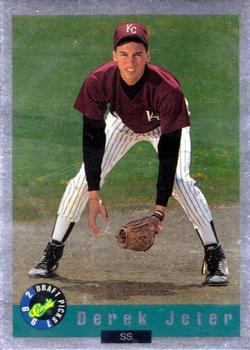
SS Derek Jeter of Kalamazoo. He started out as a Jersey boy: He was born in Pequannock, Morris County; lived the 1st 4 years of his life in West Milford, Passaic County; and spent a lot of time at his grandparents' house in North Arlington, Bergen County.

But it's where he was trained to play baseball that counts for these teams, and he grew up in "Kazoo" and played at Kalamazoo Central H.S. (In the photo above, "KC" stands for "Kalamazoo Central" -- not "Kansas City.") The Yankees chose him with their 1st pick in the 1992 Draft.

And the rest is history: A .312 batting average, 3,316 hits (he will soon surpass Paul Molitor for most hits of anyone born after April 1941), 525 doubles, 65 triples, 256 home runs (certainly a decent total for a shortstop batting righthanded at Yankee Stadium), a 117 OPS+, 13 All-Star Games, 5 Gold Gloves, 16 postseason appearances, including 7 Pennants, 5 World Championships, and the 2000 World Series MVP. He also holds club records for most seasons (he's about to start his 20th, breaking the record of 19 he shared with Mariano Rivera and 18 by Mickey Mantle) and games (2,602 coming into 2014, breaking the record of 2,401 set by Mantle).

Honorable Mention to Mickey Stanley of Grand Rapids, who was mainly an outfielder, but got moved to short in mid-1968 when Tiger legend Al Kaline returned from an injury, which got Ray Oyler out of the lineup (he was a great fielder but was so hopeless with the bat he made Rey Ordonez look like Cal Ripken) and got the Tigers to a 103-win season and a World Championship.

3B Chris Sabo of Novi. The National League Rookie of the Year in 1988, he made 3 All-Star teams and helped the Cincinnati Reds win the 1990 World Series. Injuries insured that his last full season would come at age 31 and his last game at 34, but for a while it looked like the sky was the limit. He was elected to the Reds Hall of Fame.

LF Willie Horton of Northwestern H.S. in Detroit, although born in Virginia. Another local guy who went on to his hometown Tigers. By the time I saw him in the late 1970s, he was a fat guy playing out the string and bouncing around the AL, looking for someone to acquire him as a DH.

But he was a 4-time All-Star, who had a 120 OPS+, 325 home runs, and 3 100-RBI seasons – his first at age 22 with the '65 Tigers, and his last at 36 with the '79 Seattle Mariners. For all his power hitting, he's probably best remembered for Game 5 of the 1968 World Series at Tiger Stadium, when he threw out Lou Brock, the best baserunner of that era, at the plate, turning the Series around and leading to the Tiger victory.

The Tigers retired his Number 23 and dedicated a statue to him at Comerica Park -- thus far, the only such honoree who isn't yet in the Baseball Hall of Fame. He was a major league coach for a few years, including with his former Tiger manager Billy Martin on the Yankees, and now works in the Tigers' front office. He is regarded as a good guy by all who know him, not just by Tiger fans.

He definitely should not be confused with Willie Horton the convicted felon, who was used by the Republican Party as a symbol of how 1988 Democratic Presidential nominee Michael Dukakis was "soft on crime." (Like hell he was: It was his opponent, George H.W. Bush, who was Vice President in the Iran-Contra Administration.)

Honorable Mention to Charlie "Paw Paw" Maxwell of Lawton. Although his 1st big-league team was the Red Sox, this is another Michigander who played for the Tigers. Twice an All-Star, he was a member of the 1961 Tiger team that won 101 games, but finished 8 games behind the Yankees. Career OPS+ of 116.

CF Ron LeFlore of Detroit. A wild story. He served time in the State Prison of Southern Michigan (a.k.a. Jackson State Penitentiary) for armed robbery, played on the prison baseball team, and his talents reached then-Tigers manager Billy Martin (who always seemed to be one incident away from the Big House himself, and I don't mean the University of Michigan's football stadium).

LeFlore was paroled, and although Martin was fired by the time he reached the majors, he was one of the players who helped the Tigers, who had collapsed following the aging of the Kaline-era team, revitalize into a respectable organization again. Before Rickey Henderson, Tim Raines and Vince Coleman, there was Ron LeFlore, who went from stealing money from liquor stores to stealing bases: 58 in 1976, 68 in '78, 78 in '79, and (by then with the Montreal Expos) 97 in 1980.

Injuries ended his career at age 34, and he went to umpiring school, but flunked out. He has since managed in the minor leagues, but has twice been arrested for failing to pay child support – including following the closing ceremonies at Tiger Stadium in 1999. And in 2011, he lost a leg to cardiovascular disease. After Roots, but before Reading Rainbow and Star Trek: The Next Generation, LeVar Burton starred in the 1979 CBS TV-movie One In a Million: The Ron LeFlore Story.

RF Hazen Shirley "Kiki" Cuyler of Harrisville. That's "Kigh-kigh" and "Kye-ler," not "Kee-kee" or whatever else you might think it is. And if you were born "Hazen Shirley (Last Name)," you'd think "Kiki" was an improvement, too.

He batted .321 lifetime, and had an OPS+ of 125, 2,299 hits, 394 doubles, 157 triples, and 328 stolen bases, leading the NL 4 times. He helped the Pittsburgh Pirates win the 1925 World Series, but was mysteriously benched late in the 1927 season. It didn't cost the Pirates the Pennant, and his presence probably wouldn't have stopped the Yankees (who swept) from winning that World Series, but he was still traded to the Chicago Cubs after the season.

Big mistake: The Cubs won Pennants with Cuyler in 1932 and 1935, and the Pirates didn't win another until 1960. He was elected to the Hall of Fame, although none of the uniform numbers he wore after they became common have been retired. (He wore 3 as a Cub.)

Honorable Mention to Kirk Gibson of Waterford. Like Steve Garvey, he played both baseball and football at Michigan State. Unlike Garvey, he won a Big 10 football title with the Spartans, in 1978. (However, a previous coach had gotten them put on probation, and they couldn't go to the Rose Bowl.)

Two Sports Illustrated covers should catch your eye. One was in spring training 1980, calling him a "RIP ROARIN' ROOKIE." He had to wait until 1981 to really break out, batting .328. In 1984, he helped the Tigers to win the World Series against the San Diego Padres, hitting 2 homers in the clinching Game 5, the 2nd an 8th-inning blast into Tiger Stadium's upper deck off Goose Gossage. 

But just a year later, in the 1985-86 off-season, he was again on the cover of SI, as "THE MAN NOBODY WANTS." It was the time of the team owners' "collusion," and he was forced to sign a new 2-year contract with the Tigers.

After 1987, when the Tigers won another Division title, they wouldn't re-sign him. Big mistake: They just missed the AL East title in 1988, and it would be 19 years before they reached the postseason again. Meanwhile, the Dodgers signed him, and he won the NL's MVP that season as the Dodgers won the Pennant. Injuries to both legs meant he only came to bat once in the World Series, but it was a game-winning home run in Game 1, off Oakland's Dennis Eckersley, who then coined the phrase "walkoff home run."

But injuries kicked in, and only twice more did Gibson have at least 400 plate apperances. He returned to the Tigers and hit 23 homers with 72 RBIs in the strike-shortened 1994, but he lasted only one more season, finishing with a .268 batting average (but an OPS+ of 123) and 255 home runs. But he'll be forever remembered for 2 World Series home runs, 1 at Tiger Stadium and 1 at Dodger Stadium, with Jack Buck's words for CBS standing out: "I don't believe what I just saw!"

He became a broadcaster, and is now the manager of the Arizona Diamondbacks, having taken them to the 2011 NL West title.

C Bill Freehan of Royal Oak. Yes, another Tiger, and also another University of Michigan grad. While Tiger Stadium was a great hitter's park, catcher is not usually a slugger's position, but he hit 200 home runs to go with a 112 career OPS+. It's his glove that gets remembered, though, and he won 4 Gold Gloves, and he made 11 All-Star teams.

His best season, with 25 homers and 84 RBIs, appropriately came in 1968 when the Tigers won the World Series – and, of course, someone had to be on the receiving end of that Horton throw so it could nail Brock.

Honorable Mention to Ernie Whitt of Detroit. With Carlton Fisk as their catcher, the Red Sox could afford to leave Whitt unprotected in the 1977 expansion draft, and he became the Toronto Blue Jays' main catcher in the 1980s. He made the AL All-Star team in 1985 as the Jays won the AL East to reach the postseason for the 1st time. He's now a roving instructor in the Phillies' organization, and has managed Team Canada in the Pan American Games and the World Baseball Classic.

SP Hal Newhouser of Wilbur Wright H.S. in Detroit. Another Tiger, he went 29-9 with a 2.22 ERA in 1944. He went 25-9 with a 1.81 in 1945, and the Tigers won the World Series. Baseball rosters depleted by World War II draft callups and enlistments, you say? In 1946, when the boys came back, Newhouser went 26-9 with a 1.94 ERA. He slipped to 17-17 the next season, but went 21-12 in 1948, 18-11 in 1949 and 15-13 in 1950. Think about that: In 7 seasons, he won 141 games. (In those 1st 3 years, he went 70-21!)

Trouble was, outside of those 7 seasons, he only won another 67. He hurt his arm in 1950, and that caused him to retire at age 34, but not before winning another Pennant as a reliever with the 1954 Cleveland Indians. His final record of 207-150 was pretty strong, and his ERA+ of 130 was exceptional. He was elected to the Hall of Fame, and the Tigers retired his Number 16 and dedicated a statue of him at Comerica Park.

SP Billy Pierce of Highland Park. That's the one north of Detroit, not the one north of Chicago, the one north of Dallas, or the one in Central Jersey across the river from New Brunswick. Here's one the Tigers had, but let get away, selling him to the Chicago White Sox after the 1948 season.

He won at least 12 games in every season but one from 1950 to 1960, and at least 14 in every season but 2 from 1951 to 1962. He led the AL in strikeouts in 1953, led it in ERA with 1.97 in 1955, and led it in complete games in 1956, '57 and '58. He won 20 in 1956 and did it again in 1957. Strangely, one of his weaker seasons was 1959, when he went 14-15, but the White Sox won their only Pennant between 1919 and 2005.

After the 1961 season the White Sox traded him and Don Larsen (yes, that one) to the San Francisco Giants for 4 guys you don't need to know about. Big mistake for the White Sox: Pierce went 16-6 and helped the Giants win the NL Pennant in 1962, and he was the winning pitcher in Game 6 of the World Series (although he also lost Game 3 and the Yankees beat the Giants in Game 7.) Still, the White Sox would go on to retire his Number 19, and erected a statue of him at U.S. Cellular Field, as he went 186-152 for them, 211-169 overall with an ERA+ of 119.

SP Jim Kaat of Zeeland. "Kitty" debuted in 1959 with the original Washington Senators, and turned out to be the last active player who'd played with them. He moved with them as they became the Minnesota Twins in 1961, and in 1962 he went 18-14.

He went 18-11 for the Twins' 1st Pennant winner in 1965, outdueling Sandy Koufax in Game 2 before Koufax returned the favor in Games 5 and 7. He went 25-13 in 1966. An arm injury in the next-to-last game of the 1967 season, against the Red Sox, may have cost the Twins the Pennant that weekend, but he pitched the Twins to the 1st 2 AL Western Division titles in 1969 and '70.

Traded to the White Sox, he won 21 in 1974 and 20 in 1975. Traded to the Philadelphia Phillies, he helped them reach the postseason in 1976, '77 and '78. He spent parts of the '79 and '80 seasons with the Yankees, who moved him to the bullpen, and in 1982 he finally won a World Series, appearing 4 times in the Series for the St. Louis Cardinals at age 43. He retired after one more season to become one of baseball's best broadcasters.

His career record is 283-237. His ERA is 3.45, but his ERA+ is 108, and his WHIP is 1.259. He has 2,461 strikeouts and only 1,083 walks. He won 16 Gold Gloves, formerly a record for pitchers, and was a 3-time All-Star. He reached the postseason 7 times and just missed 3 others.

On Baseball-Reference.com, their Hall of Fame Monitor has him at 130 out of 100, meaning he absolutely should be in; their HOF Standards have him at 44 out of 50, meaning he comes close but doesn't make it.

Of his 10 Most Similar Pitchers, 7 are in the Hall: Robin Roberts, Fergie Jenkins, Eppa Rixey, Bert Blyleven, Early Wynn, Burleigh Grimes and Red Ruffing. Another, Jamie Moyer, is not yet eligible. That leaves Frank Tanana, who shouldn't be in, and Tommy John, who should. John is the only 20th or 21st Century pitcher with more wins eligible for the Hall of Fame but not in. Yet Kaat has not been elected to the Hall, as either a player or a broadcaster. That's just wrong.

SP Bob Welch of Hazel Park. He reached the majors at age 21, splitting between starting and relieving for the 1978 Los Angeles Dodgers. In Game 2 of the World Series, he came in to relieve and ended the game by striking out Reggie Jackson with the bases loaded. Everybody remembers that, but they tend to forget that Reggie got his revenge in a big, or at least very long, way by clobbering a Welch fastball deep into the San Gabriel Mountains in Game 6 as the Yankees clinched.

The Game 2 heroics didn't give Welch a swelled head, nor did the Game 6 setback faze him, as he became one of baseball's most reliable starters, helping the Dodgers reach the postseason 5 times and the Oakland Athletics 4, winning the World Series with the 1981 Dodgers and the 1990 A's. Like his Oakland teammate, Dennis Eckersley, he battled alcoholism for years before overcoming it and becoming the pitcher everyone thought he could become.

In 1990, he went 27-6 for the A's, his 27 wins representing the most in the majors since Steve Carlton in 1972, and no one other than Carlton or Welch has even reached 26 since Denny McLain's 31 in 1968. Welch must've overexerted himself that season, because he only won 35 more games, but finished his career at a fine 211-146. B-R doesn't have him even close to the Hall of Fame, but he had a good career.

SP John Smoltz of Lansing and Michigan State University. Not content to wait for him to reach the majors and needing to shore up their rotation for the 1987 AL East race, his home-State Tigers traded him to the Atlanta Braves for the aging Doyle Alexander. It worked in the short term, as they won the Division but lost the Pennant.

In the long term, the Braves benefited as few teams have ever benefited from a trade. From the ages of 22 to 32, he was one of the best starters in baseball, topping out at 24-8 – winning 29 games counting the All-Star Game and the postseason, the most since Denny McLain's 32 in 1968 – with 276 strikeouts in 1996, winning the NL Cy Young Award.

At 33, an injury kept him out all season. From 34 to 37, he was one of the game's best relievers, setting the NL record which still stands with 55 saves in 2002. At 38, 39 and 40 he was again one of baseball's top starters, going 16-9 in 2006 – though it says something about the way the game has changed that his 16 wins were enough to lead the NL that season.

He has moved into broadcasting, and will be eligible for the Hall of Fame next year. He should have no trouble getting in. He was an 8-time All-Star. He won 213 games (losing just 155) and saving 154 others. His career ERA+ is 125, his WHIP 1.176. He is a member of the 3,000 Strikeouts Club

And he reached the postseason 14 times (13 with the Atlanta Braves, not counting 2000 when he was hurt all season, and the last with the Cardinals), and his 15 postseason wins are 2nd all-time to Andy Pettitte, against just 4 losses. (However, he has only one World Championship, with the '95 Braves. Don't blame him, however. In 1991 he pitched 9 shutout innings in Game 7 before the bullpen lost to the Twins. And 2 of those losses were in the World Series to the Yankees, to Pettitte in Game 5 in '96 and Roger Clemens in Game 4 in '99.) The Braves have retired his Number 29. And a friend of his named Eldrick "Tiger" Woods says that he's the best golfer in baseball.

The Michiganders who didn't make the all-time Detroit-area starting rotation could fill out 2 more pretty good rotations: Steve Gromek of Hamtramck; Art Houtteman and the aforementioned Frank Tanana, both of Detroit's Central Catholic H.S.; Milt Pappas of Detroit's Cooley H.S., Rick Wise of Jackson (but grew up in Portland, Oregon), Steve Trout (born in Detroit while his father Paul "Dizzy" Trout pitched for the Tigers), Scott Sanderson and Derek Lowe of Dearborn (but both Trout and Sanderson grew up in the Chicago suburbs), Jim Abbott of Flint and the University of Michigan, Steve Avery of Taylor, and, somewhat less honorably because of his connection with the 1919 Black Sox Scandal, Eddie Cicotte of Springwells, who was 209-148 when he was banned for life at age 36, having gone 28-12 at 33, 29-7 at 35 and 21-10 at 36.

RP Dr. Mike Marshall of Adrian and Michigan State University. He has a degree in kinesiology from MSU, which means he is well-versed in how the various parts of the human body move. He put his theories to work, suggesting that a pitcher actually benefits by throwing more, not less. This is probably why he is not a pitching coach today.

But he might have known what he was doing. In 1973, with the Montreal Expos, he made 92 appearances, all in relief, for a new major league record, finishing 73 and saving 31. In 1974, traded to the Dodgers for an aging Willie Davis (not one of the trades that ensured the Expos would eventually move, it only seems like it), he broke that record by appearing in 106 games, finishing 83 and saving 21, going 15-12 with a 2.42 ERA and a 1.186 WHIP, becoming the 1st reliever in either league to win the Cy Young Award.

The Dodgers won the Pennant that season, his only postseason appearance, and he saved their only win of the World Series in Game 2 but got tagged with the loss in the clinching Game 5.

Apparently, for team owners' and GMs' tastes, he was too much of an egghead and too much of a flake, as he bounced around the majors. In 1979, with the Twins, he set the AL record for most appearances with 90, finishing 84 and saving 32. But, at 36, that was the last time anyone trusted him as a regular reliever.

He wrapped it up 2 years later, going 3-2 with a 2.61 ERA in 20 appearances for a terrible Mets team. Overall, he was 97-112, ERA 3.14, but ERA+ 119. He is not related to another Mike Marshall who played for the Dodgers, who came from the Chicago suburbs and became an All-Star outfielder in the 1980s.

As with the rotation, the Michigan bullpen is very strong: Bob Kuzava of Wyandotte (who closed out the 1951 and '52 World Series for the Yankees), Phil "the Vulture" Regan of Wayland (went 14-1 with 21 saves for the Pennant-winning '66 Dodgers, and was also the top reliever on the ill-fated '69 Cubs), Dick "the Monster" Radatz of Detroit (saved a then-record-tying 29 games for the weak '64 Red Sox), Bill Campbell of Highland Park (17-5 for a not-that-strong '76 Twins and 31 saves for the '77 Red Sox), and Jim Kern of Gladwin, a 3-time All-Star who went 13-5 with a 1.57 ERA for the '79 Rangers, but a year later lost his control so badly – 3-11 with a 4.83 ERA – that he told reporters, "I'm working on a new pitch, it's called a 'strike.'"

MGR Joe Altobelli of Eastern H.S. in Detroit. It wasn't easy succeeding Earl Weaver as manager of the Orioles, but in his 1st season, 1983, he took them to the World Championship. He had previously gotten the Giants to an 89-win, 3rd-place season in 1978, and coached with the Yankees in the 1981 World Series. He briefly played 1st base and the outfield for the Indians in the 1950s, and, like Kaat, was an original member of the Twins in 1961.

I considered Bill Virdon, born in Hazel Park, but he grew up in West Plains, Missouri, so it can't be him. A good outfielder who won the 1955 NL Rookie of the Year with the Cardinals, he moved on to the Pirates and won the World Series in 1960 and led the NL in triples and won a Gold Glove in 1962. As a manager, he got the Pirates to an NL East title in 1972 and nearly another in '73, the Yankees nearly to an AL East title in '74, the Houston Astros nearly to the NL West in '79, getting them one in '80, and nearly another in '81.

Monday, August 16, 2010

Detroit's All-Time Baseball Team

The Yankees begin a 4-game series with the Detroit Tigers tonight at the new Stadium. The Tigers are one of the 8 original American League teams, having reached the postseason 13 times (1907, '08, '09, '34, '35, '40, '45, '68, '72, '84, '87, 2006 and '09), winning 10 Pennants (1907, '08, '09, '34, '35, '40, '45, '68, '84 and 2006) and 4 World Series (1935, 1945, 1968 and 1984).

I was pleased to see that the team the Yankees would face on August 30, 2006, what would have been my the 100th birthday of my grandfather, an original "Bleacher Creature," was the Tigers, a team he would have recognized. Too bad the Tigers had to ruin it -- or, rather, Scott Proctor had to ruin it, when, one strike away from nailing down the win while Mariano Rivera was rested after pitching 3 days in a row, gave up a home run to Craig Monroe.

The Tigers went on to win the AL Central Division, then beat the Yankees in the Division Series, then beat the Oakland Athletics for the Pennant, before losing the World Series to the St. Louis Cardinals. Last season, they were in the Division race to the end, but lost a Playoff game to the Minnesota Twins, as they did in 2006. Unlike 2006, however, they didn't get the Wild Card and back into the Playoffs that way; I am still counting 2009 as a "Playoff apperance," since they had to play a previously unscheduled 163rd game.

The Tigers were in or close to first place for most of this season, but have slumped badly and are now 3 games under .500. A season not unlike that of the Mets.

Detroit's All-Time Baseball Team

Despite the fact that northwestern Ohio is closer to Detroit than to Cleveland, and that region's highest-ranked team, the Toledo Mud Hens, has been a Tigers farm club since 1987 (and has been so, on and off, since 1934), I've limited the Tigers' "region" to just the State of Michigan, including the Upper Peninsula, which is closer to Milwaukee and Minneapolis.

An interesting note: The Mud Hens are best known for their unusual team name, and for being the favorite team of Toledo native actor Jamie Farr, and his best-known character, M*A*S*H Corporal Max Klinger. Prior to his assignment as company clerk (including an eventual promotion to Sergeant), Klinger was so desperate to get out of the Army that he would try all kinds of things (including, most frequently, wearing women's clothing) to convince the Army that he was psychologically unfit for military service.

A "mud hen" or marsh hen is another name (or two) for a bird that is indigenous to the marshlands where the Maumee River flows into Lake Erie. The bird is most often called (by people who study birds) the American Coot. So Klinger, who wasn't really crazy except about the Mud Hens, really was "crazy as a coot!"

Anyway, this team has lots of Michiganians-turned-Tigers, plenty of power, and one amazing pitching staff, with a good mix of righties and lefties, power and finesse, starters and relievers. I wouldn't want to put my hitters up against them.

Another note of interest: There are also some University of Michigan Wolverines on here (Michigan is the "Wolverine State"), as well as some Michigan State University Spartans. The Detroit team became the "Tigers" because their socks had orange and black stripes. Whether this was reminiscent of actual tigers or Princeton University, whose teams are called the Tigers, depends on who's telling the story. But it was at Princeton, in orange on black (since revived, but reversed to black on orange) that Herbert "Fritz" Crisler developed the famous "winged" helmet design that he brought to Michigan in yellow (or "maize" as they put it) on navy blue.

1B John Mayberry of Northwestern H.S. in Detroit. A 2-time All-Star with the Kansas City Royals, he finished 2nd to Fred Lynn in the 1975 balloting for American League Most Valuable Player. He moved on to the Toronto Blue Jays, and closed his injury-shortened career with the Yankees in 1982. He hit 255 home runs and had an OPS+ of 123.

His son John Jr. now plays for the Phillies, and was born in Kansas City and thus qualifies for that region’s team, by birth if not yet by performance.

2B Charlie Gehringer of Fowlerville. Considering the performances of Nap Lajoie, Eddie Collins and Rogers Hornsby earlier in the 20th Century, I am going to say that Gehringer is the best second baseman of the last 80 years. He was a local guy all the way, going to the University of Michigan, playing his entire career for the Tigers, and living in Michigan for his entire life.

Known as "the Mechanical Man" for his effortless, usually flawless fielding, he had a lifetime batting average of .320, and OPS+ of 124, and 2,839 hits including 574 doubles and 146 triples. In 1929 he led the AL in runs, hits, doubles, triples and stolen bases. He led in runs and hits again in 1934, cracked a staggering 60 doubles in 1936, and led in batting with a .371 average in 1937, earning him the MVP.

He was the AL's starting 2nd baseman in the 1st 6 All-Star Games. Hall of Fame, Number 2 retired and statue at Comerica Park dedicated by the Tigers.

SS Derek Jeter of Kalamazoo. Born in Pequannock, New Jersey, and lived the first 4 years of his life in neighboring West Milford. But it's where he was trained to play baseball that counts, and he grew up in "Kazoo" and played at Kalamazoo Central H.S. (That's what the "KC" stands for in the photo above; it has nothing to do with the Kansas City Royals, whose style it copies.) The Yankees chose him with their 1st pick in the 1992 Draft, and the rest is history.

Honorable Mention to Mickey Stanley of Grand Rapids, who was mainly an outfielder, but got moved to short in mid-1968 when Tiger legend Al Kaline returned from an injury, which got Ray Oyler out of the lineup (he was a great fielder but was so hopeless with the bat he made Ordonez look like Ripken) and got the Tigers to a 103-win season and a World Championship.

3B Chris Sabo of Novi. The National League Rookie of the Year in 1988, he made 3 All-Star teams and helped the Cincinnati Reds win the 1990 World Series. Injuries insured that his last full season would come at age 31 and his last game at 34, but for a while it looked like the sky was the limit. He was just elected to the Reds Hall of Fame.

LF Willie Horton of Northwestern H.S. in Detroit, although born in Virginia. Another local guy who went on to his hometown Tigers. By the time I saw him in the late 1970s, he was a fat guy playing out the string and bouncing around the AL, looking for someone to acquire him as a DH.

But he was a 4-time All-Star, who had a 120 OPS+, 325 home runs, and 3 100-RBI seasons – his first at age 22 with the '65 Tigers and his last at 36 with the '79 Seattle Mariners. For all his power hitting, he’s probably best remembered for Game 5 of the 1968 World Series at Tiger Stadium, when he threw out Lou Brock, the best baserunner of that era, at the plate, turning the Series around and leading to the Tiger victory.

Number 23 retired and statue dedicated at Comerica Park. He was a major league coach for a few years, including with his former Tiger manager Billy Martin on the Yankees, and now works in the Tigers' front office. He is regarded as a good guy by all who know him, not just by Tiger fans.

He is definitely not to be confused with the convicted felon who was used by the Republican Party as a symbol of how 1988 Democratic Presidential nominee Michael Dukakis was "soft on crime." (Like hell he was, it was his opponent, George H.W. Bush, who was Vice President in the Iran-Contra Administration.)

Honorable Mention to Charlie "Paw Paw" Maxwell of Lawton. Although his 1st big-league team was the Red Sox, this is another Michigander who played for the Tigers. Twice an All-Star, he was a member of the 1961 Tiger team that won 101 games, but finished 8 games behind the Yankees. Career OPS+ of 116.

CF Ron LeFlore of Detroit. A wild story. He served time in the State Prison of Southern Michigan (a.k.a. Jackson State Penitentiary) for armed robbery, played on the prison team, and his talents reached then-Tigers manager Billy Martin (who always seemed to be one incident away from the Big House himself, and I don't mean the University of Michigan's football stadium). LeFlore was paroled, and although Martin was fired by the time he reached the majors, he was one of the players who helped the Tigers, who had collapsed following the aging of the Kaline-era team, revitalize into a respectable organization again.

Before Rickey Henderson, Tim Raines and Vince Coleman, there was Ron LeFlore, who went from stealing money from liquor stores to stealing bases: 58 in 1976, 68 in '78, 78 in '79, and (now with the Montreal Exops) 97 in '80.

Injuries ended his career at age 34, and he went to umpiring school, but flunked out. He has since managed in the minor leagues, but has twice been arrested for failing to pay child support – including following the closing ceremonies at Tiger Stadium in 1999. After Roots, but before Reading Rainbow and Star Trek: The Next Generation, LeVar Burton starred in the 1979 CBS TV-movie One In a Million: The Ron LeFlore Story.

His story is similar to that of another Tiger, William "Gates" Brown, a star on their 1968 World Champions, but he was born and raised outside Columbus, Ohio, with the Tigers signing him out of prison, also for armed robbery, so he would qualify for Cincinnati's all-time regional team.

RF Hazen Shirley "Kiki" Cuyler of Harrisville. That's "KIGH-kigh" and "KIGH-ler," not "KEE-kee" and whatever else you might think it is. And if you were born "Hazen Shirley (Last Name)," you'd think "Kiki" (sometimes written as "Ki-Ki") was an improvement, too.

He batted .321 lifetime, OPS+ 125, 2,299 hits, 394 doubles, 157 triples, and 328 stolen bases, leading the NL 4 times. He helped the Pittsburgh Pirates win the 1925 World Series, but was mysteriously benched late in the 1927 season. It didn't cost the Pirates the Pennant, and his presence probably wouldn't have stopped the Yankees (who swept) from winning that World Series, but he was still traded to the Chicago Cubs after the season.

Big mistake: The Cubs won Pennants with Cuyler in 1932 and 1935, and the Pirates didn't win another until 1960. Hall of Fame, although none of the uniform numbers he wore after they became common have been retired. (He wore 3 as a Cub.)

Honorable Mention to Kirk Gibson of Waterford. Like Steve Garvey, he played both baseball and football at Michigan State. Unlike Garvey, he won a Big 10 football title with the Spartans, in 1978. (However, a previous coach had gotten them put on probation, so they couldn't go to the Rose Bowl.) Two Sports Illustrated covers catch your eye. One was in spring training 1980, calling him a "RIP ROARIN' ROOKIE." He had to wait until 1981 to really break out, batting .328. In 1984, he helped the Tigers to win the World Series against the San Diego Padres, hitting 2 homers in the clinching Game 5, the 2nd an 8th-inning blast into Tiger Stadium's upper deck off Goose Gossage.

But just a year later, in the 1985-86 off-season, he was again on the cover of SI, as "THE MAN NOBODY WANTS." It was the time of the team owners' "collusion," and he was forced to sign a new 2-year contract with the Tigers.

After 1987, when the Tigers won another Division title, they wouldn't re-sign him. Big mistake? It would be 19 years before they reached the postseason again. The Dodgers signed him, and he won the NL's MVP that season as the Dodgers won the Pennant. Injuries to both legs meant he only came to bat once in the World Series, but it was a game-winning home run in Game 1, off Oakland's Dennis Eckersley, who then coined the phrase "walkoff home run."

But injuries kicked in, and only twice more did Gibson have at least 400 plate apperances. He returned to the Tigers and hit 23 homers with 72 RBIs in the strike-shortened 1994, but he lasted only one more season, finishing with a .268 batting average (but an OPS+ of 123) and 255 home runs. But he'll be forever remembered for 2 World Series home runs, one at Tiger Stadium and one at Dodger Stadium, with Jack Buck's words for CBS standing out: "I don't believe what I just saw!"

C Bill Freehan of Royal Oak. Yes, another Tiger, and also another University of Michigan grad. While Tiger Stadium was a great hitter's park, catcher is not usually a slugger's position, but he hit 200 home runs to go with a 112 career OPS+. It's his glove that gets remembered, though, and he won 4 Gold Gloves, and he made 11 All-Star teams. His best season, with 25 homers and 84 RBIs, appropriately came in 1968 when the Tigers won the World Series – and, of course, someone had to be on the receiving end of that Horton throw so it could nail Brock.

Honorable Mention to Ernie Whitt of Detroit. With Carlton Fisk as their catcher, the Red Sox could afford to leave Whitt unprotected in the 1977 expansion draft, and he became the Toronto Blue Jays' main catcher in the 1980s. He made the AL All-Star team in 1985 as the Jays won the AL East to reach the postseason for the first time. He's now the manager of the Clearwater Threshers in the Florida State League.

SP Hal Newhouser of Wilbur Wright H.S. in Detroit. Another Tiger, he went 29-9 with a 2.22 ERA in 1944. He went 25-9 with a 1.81 in 1945, and the Tigers won the World Series. Baseball rosters depleted by World War II draft callups and enlistments, you say? In 1946, when the boys came back, Newhouser went 26-9 with a 1.94 ERA. He slipped to 17-17 the next season, but went 21-12 in 1948, 18-11 in 1949 and 15-13 in 1950.

Think about that: In 7 seasons, he won 141 games. (In those 1st 3 years, he went 70-21!) Trouble was, outside of those 7 seasons, he only won another 67. He hurt his arm in 1950, and that caused him to retire at age 34, but not before winning another Pennant as a reliever with the 1954 Cleveland Indians. His final record of 207-150 was pretty strong, and his ERA+ of 130 was exceptional. Hall of Fame, Number 16 retired and statue dedicated at Comerica Park.

SP Billy Pierce of Highland Park. That's the one north of Detroit, not the one north of Chicago, the one north of Dallas, or the one in Central Jersey across the river from New Brunswick. Here's one the Tigers let get away, selling him to the Chicago White Sox after the 1948 season.

He won at least 12 games in every season but one from 1950 to 1960, and at least 14 in every season but 2 from 1951 to 1962. He led the AL in strikeouts in 1953, led it in ERA with 1.97 in 1955, and led it in complete games in 1956, '57 and '58. He won 20 in 1956 and did it again in 1957. Strangely, one of his weaker seasons was 1959, when he went 14-15, but the White Sox won their only Pennant between 1919 and 2005.

After the 1961 season the White Sox traded him and Don Larsen (yes, that one) to the San Francisco Giants for 4 guys you don't need to know about. Big mistake for the White Sox: Pierce went 16-6 and helped the Giants win the NL Pennant in 1962, and he was the winning pitcher in Game 6 of the World Series (although he also lost Game 3 and the Yankees beat the Giants in Game 7.)

Still, the White Sox would go on to retire his Number 19, and erected a statue of him at U.S. Cellular Field, as he went 186-152 for them, 211-169 overall with an ERA+ of 119. According to Baseball-Reference.com, his 10 Most Similar pitchers, statistically, include only 2 Hall-of-Famers, Newhouser and Catfish Hunter. Strangely, that list includes Tigers Newhouser, Hooks Dauss and Mickey Lolich; and Michiganders Newhouser, Milt Pappas and Bob Welch.

SP Jim Kaat of Zeeland. "Kitty" debuted in 1959 with the original Washington Senators, and turned out to be the last active player who'd played with them. He moved with them to become the Minnesota Twins in 1961, and in 1962 went 18-14. He went 18-11 for the Twins' 1st Pennant winner in 1965, outdueling Sandy Koufax in Game 2 before Koufax returned the favor in Games 5 and 7. He went 25-13 in 1966. An arm injury in the next-to-last game of the 1967 season, against the Red Sox, may have cost the Twins the Pennant that weekend, but he pitched the Twins to the first 2 AL Western Division titles in 1969 and '70.

Traded to the White Sox, he won 21 in 1974 and 20 in 1975. Traded to the Philadelphia Phillies, he helped them reach the postseason in 1976, '77 and '78. He spent parts of the '79 and '80 seasons with the Yankees, who moved him to the bullpen, and in 1982 finally won a World Series, appearing 4 times in the Series for the St. Louis Cardinals at age 43. Retired after one more season to become one of baseball’s best broadcasters.

His career record is 283-237. Of his Baseball-Reference.com 10 Most Similar Pitchers, 8 are in the Hall, all but Tommy John and Bert Blyleven. Those are also the only 20th or 21st Century pitchers with more wins eligible for the Hall of Fame but not in. (UPDATE: Blyleven is now in, too.)

B-R's Hall of Fame Monitor, where a "Likely HOFer" is at 100, has Kaat at 130; its Hall of Fame Standards, where the "Average HOFer" is at 50, has him at 44. His ERA is 3.45, but his ERA+ is 108, and his WHIP is 1.259. He has 2,461 strikeouts and only 1,083 walks. He won 16 Gold Gloves, formerly a record for pitchers, and was a 3-time All-Star. He reached the postseason 7 times and just missed 3 others. Yet he has not been elected to the Hall, as either a player or a broadcaster. That's just wrong.

SP Bob Welch of Hazel Park. He reached the majors as a 21-year-old, splitting between starting and relieving for the 1978 Los Angeles Dodgers. In Game 2 of the World Series, he came in to relieve, and ended the game by striking out Reggie Jackson with the bases loaded. Everybody remembers that, but they tend to forget that Reggie got his revenge in a big, or at least very long, way by clobbering a Welch fastball deep into the San Gabriel Mountains in Game 6 as the Yankees clinched. 

It didn't faze Welch, as he became one of baseball's most reliable starters, helping the Dodgers reach the postseason 5 times and the Oakland Athletics 4, winning the World Series with the 1981 Dodgers and the 1990 A's. Like his Oakland teammate, Dennis Eckersley, he battled alcoholism for years before overcoming it and becoming the pitcher everyone thought he could become.

In 1990, he went 27-6 for the A's, his 27 wins representing the most in the majors since Steve Carlton in 1972, and no one other than Carlton or Welch has even reached 26 since Denny McLain's 31 in 1968. Welch must've overexerted himself that season, because he only won 35 more games, but finished his career at a fine 211-146. B-R doesn't have him even close to the Hall of Fame, but he had a good career.

SP John Smoltz of Lansing and Michigan State University. Not content to wait for him to reach the majors and needing to shore up their rotation for the 1987 AL East race, his home-State Tigers traded him to the Atlanta Braves for the aging Doyle Alexander. It worked in the short term, as they won the Division but lost the Pennant.

In the long term, the Braves benefited as few teams have ever benefited from a trade. From the ages of 22 to 32, he was one of the best starters in baseball, topping out at 24-8 – winning 29 games counting the All-Star Game and the postseason, most since Denny McLain's 32 in 1968 – with 276 strikeouts in 1996, winning the NL Cy Young Award.

At 33, an injury kept him out all season. From 34 to 37, he was one of the game's best relievers, setting the NL record which still stands with 55 saves in 2002. At 38, 39 and 40, he was again one of baseball's top relievers, going 16-9 in 2006 – though it says something about the way the game has changed that his 16 wins were enough to lead the NL that season.

He has officially retired and moved into broadcasting, and will be eligible for the Hall of Fame in 2015. He should have no trouble getting in. He was an 8-time All-Star. He won 213 games (losing just 155) and saving 154 others. His career ERA+ is 125, his WHIP 1.176. He is a member of the 3,000 strikeout club. And he reached the postseason 14 times (13 with the Atlanta Braves, not counting 2000 when he was hurt all season, and the last with the Cardinals), and his 15 postseason wins are 2nd all-time to Andy Pettitte, against just 4 losses. (However, he has only one World Championship, with the '95 Braves. Don’t blame him, however. In 1991 he pitched 9 shutout innings in Game 7 before the bullpen lost to the Twins. And 2 of those losses were in the World Series to the Yankees, to Pettitte in Game 5 in '96 and Roger Clemens in Game 4 in '99.)

The Braves have retired his Number 29. And a friend of his named Eldrick "Tiger" Woods says that he's the best golfer in baseball.

The Michiganders who didn't make the all-time Detroit-area starting rotation could fill out 2 more pretty good rotations: Steve Gromek of Hamtramck, Art Houtteman and Frank Tanana, both of Detroit's Central Catholic H.S.; Milt Pappas of Detroit's Cooley H.S., Rick Wise of Jackson (but grew up in Portland, Oregon), Steve Trout (born in Detroit while his father Paul "Dizzy" Trout pitched for the Tigers), Scott Sanderson and Derek Lowe of Dearborn (but both Trout and Sanderson grew up in the Chicago suburbs), Jim Abbott of Flint and the University of Michigan, Steve Avery of Taylor, and, somewhat less honorably because of his connection with the 1919 Black Sox Scandal, Eddie Cicotte of Springwells, who was 209-148 when he was banned for life at age 36, having gone 28-12 at 33, 29-7 at 35 and 21-10 at 36.

RP Dr. Mike Marshall of Adrian. He has a degree in kinesiology from Michigan State, which means he is well-versed in how the various parts of the human body move. He put his theories to work, suggesting that a pitcher actually benefits by throwing more, not less. This is probably why he is not a pitching coach today.

But he might have known what he was doing. In 1973, with the Montreal Expos, he made 92 appearances, all in relief, for a new major league record, finishing 73 and saving 31. In 1974, traded to the Dodgers for an aging Willie Davis (not one of the trades that ensured the Expos would eventually move, it only seems like it), he broke that record by appearing in 106 games, finishing 83 and saving 21, going 15-12 with a 2.42 ERA and a 1.186 WHIP, becoming the 1st reliever in either league to win the Cy Young Award. The Dodgers won the Pennant that season, his only postseason appearance, and he saved their only win of the World Series in Game 2 but got tagged with the loss in the clinching Game 5.

Apparently, he was too much of an egghead and too much of a flake, as he bounced around the majors. In 1979, with the Twins, he set the AL record for most appearances with 90, finishing 84 and saving 32. But, at 36, that was the last time anyone trusted him as a regular reliever. He wrapped it up 2 years later, going 3-2 with a 2.61 ERA in 20 appearances for a terrible Mets team. Overall, he was 97-112, ERA 3.14, but ERA+ 119. He is not related to another Mike Marshall who played for the Dodgers, who came from the Chicago suburbs and became an All-Star outfielder in the 1980s.

As with the rotation, the Michigan bullpen is very strong: Bob Kuzava of Wyandotte (who closed out the 1951 and '52 World Series for the Yankees), Phil "the Vulture" Regan of Wayland (went 14-1 with 21 saves for the Pennant-winning '66 Dodgers and was also the top reliever on the ill-fated '69 Cubs), Dick "the Monster" Radatz of Detroit (saved a then-record-tying 29 games for the weak '64 Red Sox), Bill Campbell of Highland Park (17-5 for a not-that-strong '76 Twins and 31 saves for the '77 Red Sox), and Jim Kern of Gladwin, a 3-time All-Star who went 13-5 with a 1.57 ERA for the '79 Rangers, but a year later lost his control so badly – 3-11 with a 4.83 ERA – that he told reporters, "I'm working on a new pitch: It's called a 'strike.'"

MGR Joe Altobelli of Eastern H.S. in Detroit. It wasn't easy succeeding Earl Weaver as manager of the Baltimore Orioles, but in his 1st season, 1983, he took them to the World Championship. He had previously gotten the Giants to an 89-win, 3rd-place season in 1978, and coached with the Yankees in the 1981 World Series. He briefly played 1st base and the outfield for the Indians in the 1950s, and was an original member of the Twins in 1961.

I considered Bill Virdon, born in Hazel Park, but he grew up in West Plains, Missouri, so it can't be him. A good outfielder who won the 1955 NL Rookie of the Year with the Cardinals, he moved on to the Pirates and won the World Series in 1960 and led the NL in triples and won a Gold Glove in 1962. As a manager, he got the Pirates to an NL East title in 1972 and nearly another in '73, the Yankees nearly to an AL East title in '74, the Houston Astros nearly to the NL West in '79, getting them one in '80, and nearly another in '81.