
Alex Groza
October 20, 1951, 75 years ago: Alex Groza, Ralph Beard and Dale Barnstable of the Indianapolis Olympians are arrested for taking bribes from gamblers to "shave points" while they were at the University of Kentucky. When the dust settled in 1952, they were banned from the NBA for life. UK got its 1952-53 season canceled, and was banned from competing in the NCAA Tournament and the NIT in 1954.
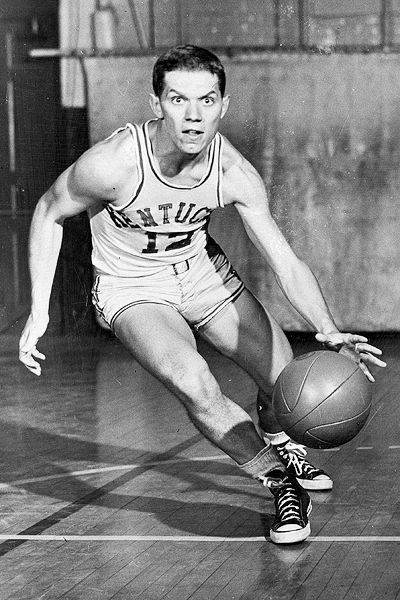
Ralph Beard
Barnstable allegedly took $500 ($6,430 in 2026 dollars), but never confessed. Nor did Groza, whose alleged "cut" was never publicly revealed.
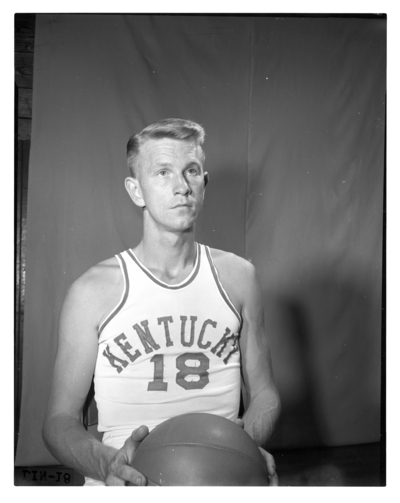
Dale Barnstable
Beard admitted that he took $700 -- just over $9,000 in 2022 money -- but denied that he had ever shaved points in a game. He claimed that Frank Hogan, the Manhattan District Attorney, conspired with Podoloff of the NBA and Cardinal Francis Spellman, the Archbishop of New York, to go after Midwestern players in an effort to protect players at Catholic colleges.
Beard may have had a point, for want of a better choice of words. The point-shaving scandal also devastated the programs at New York's 3 main non-Catholic basketball schools. City College of New York won both the NCAA Tournament and the NIT in 1950, but some of its players were accused, and the program was never the same again. Nor were their arch-rivals, New York University. Nor was the leading program in Brooklyn, Long Island University.
But the leading Catholic programs in New York? Fordham University in The Bronx wasn't targeted, but that didn't matter much, because they weren't all that successful in basketball. Same with another Bronx school, Manhattan College, a Catholic school that had, as their name suggests, once been based in Manhattan. But St. John's University, in Queens, was the only successful New York City basketball program to emerge from the scandal unscathed and still winning.
If Spellman and Hogan conspired to knock off CCNY, NYU and LIU, while protecting St. John's and Fordham, then they were doing more to "fix" entire college basketball seasons, and defraud young men out of their entire careers, than organized crime had done to fix individual games.
An aside: When John F. Kennedy ran for President in 1960, at a time when no Catholic had ever been elected to that office, he asked Spellman what he should say if someone asks him whether he believes, as Catholic doctrine says, that the Pope is infallible in matters of faith. Spellman said of the Pope at the time, Pius XII, formerly named Eugenio Pacelli and a native of Rome, "All I know is, he keeps calling me 'Spillman.'"
And yet, in that election, Spellman endorsed Richard Nixon. Why? Kennedy was told by his aide Dave Powers that it was personal: "Spellman is the most powerful Catholic in the country. When you become president, you will be." In 1964, with JFK dead, Spellman endorsed his successor, Lyndon Johnson.
Spellman was Archbishop of New York from 1939 until his death in 1967. He now has high schools named after him in The Bronx, and in Brockton, Massachusetts, hometown of champion boxers Rocky Marciano and Marvelous Marvin Hagler. However, since his death, rumors of him being a pedophile priest have been made public.
In 1953-54, Kentucky, still banned from the postseason, went 25-0, and the Helms Foundation declared them -- not NCAA Champion LaSalle or NIT Champion Holy Cross -- the 1954 National Champions.
Groza, brother of Pro Football Hall-of-Famer Lou Groza, would later coach in college and in the ABA. Beard tried to play professional baseball, but his gambling connection got him banned from that sport as well. He became a scout for the ABA's Kentucky Colonels, and worked in the pharmaceutical industry. Barnstable wasn't playing in the pros anyway, but had gotten a job as a high school coach in Louisville, and was fired from that job as a result of the scandal. He later became a successful seller of air filters, and won senior golf tournaments. But none of the 3 were were ever involved in the NBA again, as their bans were never lifted.
Groza died in 1995, Beard in 2007, Barnstable in 2019. Though Groza's Number 15 and Beard's Number 12 were both retired by their school, and each lived to see the honor, neither has ever been elected to the Basketball Hall of Fame. Barnstable's Number 18 has not been retired.
*
Also on October 20, 1951, Drake University of Des Moines, Iowa plays football against Oklahoma A&M – the name will be changed to Oklahoma State in 1958 – at Lewis Field in Stillwater, Oklahoma.
Drake quarterback Johnny Bright, one of the 1st black players to receive serious consideration for the Heisman Trophy, is assaulted by white A&M defensive tackle Wilbanks Smith. "Unnecessary roughness"? Smith knocked Bright unconscious 3 times in the 1st 7 minutes of the game, the last time breaking his jaw.
A&M won the game, 27-14. It was Drake's 1st loss of the season. Photographs of what becomes known as "the Johnny Bright Incident," by Don Ultang and John Robinson, were featured on the front page of the next day’s Des Moines Register, and won the Pulitzer Prize.

Neither his school nor the Missouri Valley Conference disciplined Smith, nor did the Conference discipline the school or any of its coaches, in any way. As a result, Drake left the league in protest. So did Bradley University of Peoria, Illinois, also integrated by that point. The NCAA issued new rules about blocking and tackling, and mandated better head protection, including facemasks for helmets. The NFL followed suit in 1954.
Drake returned to the MVC for sports other than football in 1956, and for football in 1971. In 1978, along with the entire MVC, Drake dropped its program to NCAA Division I-AA, then to NCAA Division III in 1987, and back to I-AA (now the Football Championship Subdivision, or FCS) in 1991, where they remain. Today, aside from this incident, Drake's athletics department is best known for the Drake Relays, 2nd only to the Penn Relays as America's leading track & field meet.
Bright recovered from his injuries, played one last game at the college level, and finished 5th in the 1951 Heisman Trophy balloting, which was won by Dick Kazmaier of Princeton, who will likely remain the last Ivy Leaguer to win it. (Ed Marinaro of Cornell finished 2nd in 1971, and remains the last one to even come close. He later played a cop on the TV drama Hill Street Blues.)
Drafted by the Philadelphia Eagles, Bright didn't want to play there -- not because he thought Philadelphia was a racist city (long before Dick Allen and Curt Flood thought so, and Jackie Robinson had been already notoriously subjected to racist abuse there), but because he knew there were a lot of Southern players in the NFL. He would play in Canada, and receive many honors (or, as they would spell it, "honours") there, including 3 straight Grey Cups with the Edmonton Eskimos.

When he retired in 1964, he was the CFL's all-time leading rusher, with 10,909 yards, a total then surpassed in the NFL only by Jim Brown, but Brown's amazing 5.2 yards per carry, often cited as a reason why he's the game's greatest ever player, never mind running back, is actually surpassed by Bright, with 5.5, making him North America's all-time leader in that stat at the time. Only 2 CFL players have passed him in rushing yardage since.
He is a member of the team's Wall of Honour and the College Football and Canadian Football Halls of Fame. Drake retired his Number 43 (he wore 24 with the team then nicknamed the "Esks") and named the field at Drake Stadium after him. After serving as a teacher and principal at an Edmonton high school, he died in 1983 from complications from surgery. Ernie Davis of Syracuse became the 1st black Heisman winner in 1961.

With some irony, the name of his pro team was cited as racist, insensitive to Native North Americans. In 2020, the name was dropped. With the CFL having canceled its entire season due to COVID restrictions, they didn't have to play a season as "The Edmonton Football Team." In 2021, they became the Edmonton Elks, allowing them to keep their familiar "EE" helmet logo, and projecting a favorable image: Western Canada has lots of elks, a strong animal with good speed for its size.
Built in 1920, Lewis Field was expanded significantly after 1951, and in 2002 was renamed for an oil baron who graduated from Oklahoma State and had contributed heavily to the school: Boone Pickens Stadium.

OSU offered Drake a formal apology for the actions of Wilbanks Smith -- in 2005, 54 years later, and 22 years after Bright's death.
In 2012, Smith gave an interview. He said that, when the Drake Bulldogs and the Oklahoma A&M Cowboys played each other in 1950, a Drake player had purposely hit an A&M player, and injured him, and he wanted revenge. He pointed out that he had hit the returning offending Drake player, who was white, in the same game the same way he had hit Bright. He did not play pro football, and worked as an engineer for Exxon. He died in 2020, at the age of 90.


No comments:
Post a Comment