Showing posts with label walt frazier. Show all posts

Monday, June 15, 2026

How Long It's Been: The Knicks Won an NBA Championship (UPDATE)

NOTE: This is an update of a piece I wrote on the 40th Anniversary, in 2013.

June 13, 2026: The New York Knickerbockers beat the San Antonio Spurs, 94-90 at the Frost Bank Center in San Antonio, Texas, winning Game 5 of the NBA Finals, and taking the NBA Championship.

This was a moment of great celebration for the New York Tri-State Area. It was the Knicks' 1st World Championship in 53 years:

May 10, 1973: The New York Knickerbockers beat the Los Angeles Lakers, 102-93, at the Forum in Inglewood, California, winning Game 5 of the NBA Finals, and taking the NBA Championship.

For the Knicks, this capped their greatest period ever: 1970 to 1973, 4 seasons, 3 trips to the Finals (all against the Lakers), 2 titles.

Their only 2 titles -- until this past Saturday night.

Hail the champions:

* William "Red" Holzman, head coach
* Eddie Donovan, general manager
* 6 Tom Riker, center
* 7 Dean "the Dream" Meminger, guard
* 10 Walt "Clyde" Frazier, guard
* 12 Dick Barnett, guard
* 15 Earl "the Pearl" Monroe, guard
* 17 Henry Bibby, guard
* 18 Phil Jackson, forward
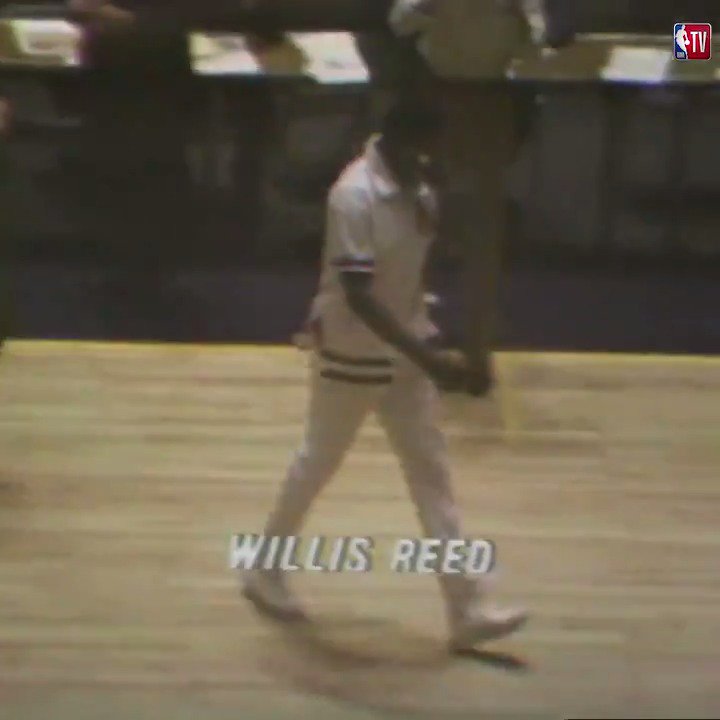
* 19 Willis Reed, center, Captain
* 22 Dave "Double D" DeBusschere, forward
* 23 Luther Rackley, center
* 24 Bill Bradley, forward
* 32 Jerry Lucas, forward
* 40 John Gianelli, center
* 43 Harthorne Wingo, forward

Frazier, Barnett, Reed, DeBusschere and Bradley also played for the Knicks on their 1969-70 title. Jackson was in the organization at that time, but missed the entire season due to injury.

Members of the 1970 Knicks who were not also 1973 Knicks were center Nate Bowman (Number 17), forwards Don May (5), Dave Stallworth (9), Bill Hosket (20) and Jazzy Cazzie Russell (33); and guards Mike Riordan (6) and John Warren (16).

Frazier, Barnett, Reed, DeBusschere and Bradley would have their uniform numbers retired by the Knicks. Holzman would be honored with a banner with the number 613 on it, for the number of games he won as Knicks coach. Frazier, Jackson, Reed, DeBusschere, Bradley, Lucas and Holzman would be elected to the Basketball Hall of Fame. Frazier, Reed, DeBusschere and Lucas would be elected to the NBA's 50th Anniversary 50 Greatest Players -- though it should be noted that Lucas was elected for what he did with the Cincinnati Royals; he was a stabilizing veteran presence for the '73 Knicks. They were also selected for the 75th Anniversary 75 Greatest Players.

Bibby was the father of later NBA All-Star Mike Bibby. Bradley was elected to 3 terms in the U.S. Senate, representing New Jersey, and ran for President in 2000.

And, yes, kids, that Phil Jackson, the one who would coach the Chicago Bulls to 6 titles and the Lakers to 5. He was a decent player, not a great one. As was Pat Riley, who played for the Lakers against the Knicks in those Finals, and would later coach the Lakers to 4 titles, the Knicks into a Finals, and the Miami Heat to a title.

After one more year, Reed, DeBusschere and Lucas all retired, and the Knicks began to fall apart. Pearl, obtained from the Baltimore Bullets (forerunner of the Washington Wizards) after the Bullets beat the Knicks in the '71 Eastern Conference Finals, was the last to remain, in 1980.

The Knicks would have a mini-revival in the early 1980s with Bernard King, be stellar through most of the 1990s, reaching the Finals in 1994 and 1999, but be stymied, first by Larry Bird's Boston Celtics, then by Isiah Thomas' Detroit Pistons, then by Michael Jordan's Jackson-coached Bulls. Finally, the Knicks would collapse, because owner Charles Dolan and his son, team operator James Dolan, trusted Isiah to be general manager, and even coach.

Now, the Knicks are back, having won their 1st World Championship since 1973, 53 years. How long has it been?

*

The teams now named the Utah Jazz, the Dallas Mavericks, the Charlotte Hornets, the Miami Heat, the New Orleans Pelicans, the Orlando Magic, the Minnesota Timberwolves, the Toronto Raptors, the Memphis Grizzlies and the New Orleans Pelicans did not yet exist. The teams now named the Brooklyn Nets, the Indiana Pacers, the Denver Nuggets and the San Antonio Spurs did, in the American Basketball Association.

The Bullets were about to leave Baltimore for Washington, and were a long way from becoming the Wizards. There was an NFL team in Baltimore, but it was the Colts, not the Ravens. There was one in Houston, but it was the Oilers, not the Texans. 

The home of the Knicks and the NHL's Rangers was still being called "the New Madison Square Garden Center." It is now the only arena used by an NBA team then that are still used now -- although the Baltimore Civic Center (now the CFG Bank Arena), the Cobo Arena in Detroit (now the Huntington Bank Arena), the Milwaukee Arena (a.k.a. The MECCA, now the UW-Milwaukee Panther Arena), the Kansas City Municipal Auditorium, the Hofheinz Pavilion in Houston (now the Fertitta Center), the Arizona Veterans Memorial Coliseum in Phoenix, The Forum in Inglewood outside Los Angeles, the Oakland Coliseum Arena and the Portland Memorial Coliseum still stand, and are still being used.

The Islanders had just completed their 1st season, and the building they shared with the New York Nets of the ABA, the Nassau Coliseum, was a year and a half old. The Yankees, recently purchased by George Steinbrenner, and the Giants were terrible, and were still playing in Yankee Stadium, but only for a few more months, as the renovation would start in October. The Mets and the Jets were playing at Shea Stadium, and while the Jets were falling apart as Joe Namath's knees did, the Mets would have a lousy 1st 5 months -- and then a torrid September that would lead to a Pennant and very nearly a 2nd World Championship in 5 years.

The Devils' franchise had been created, but at this point it only existed on paper, as the Kansas City Scouts, to begin play in the fall of 1974. And there was the World Hockey Association's New York Raiders, playing at The Garden, but they were a mess and moved to South Jersey, fooling no one into thinking they were a Philadelphia team.

The biggest thing that would happen in New York Tri-State Area sports in 1973 was the Belmont Stakes, as Secretariat moved "like a tremendous machine" in winning by 31 lengths to clinch the Triple Crown.

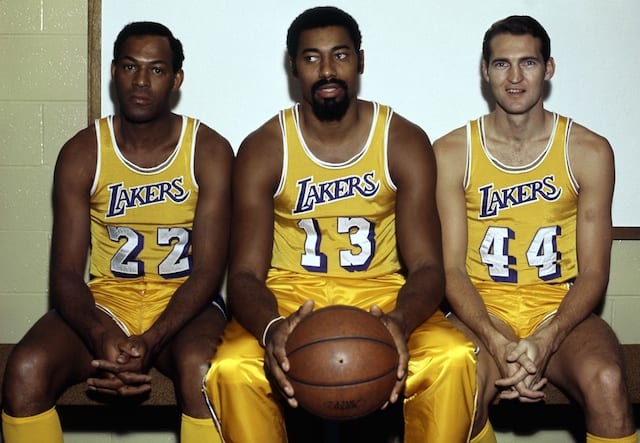
1973 was the last season for NBA legend Wilt Chamberlain. Jerry West and Oscar Robertson, like Reed, DeBusschere and Lucas, would hang on for one more year. Lew Alcindor had just recently changed his name to Kareem Abdul-Jabbar. Julius "Doctor J" Erving would soon move from the ABA's Virginia Squires to the Nets. Bill Walton was still at UCLA, winning the recent National Championship, the 7th straight for coach John Wooden, in the middle of an 88-game winning streak.

Magic Johnson and Larry Bird were in junior high school. Michael Jordan, Patrick Ewing and Charles Barkley were in grade school. Shaquille O'Neal was a rather large baby. Kobe Bryant, Tim Duncan and LeBron James weren't born yet.

The same day the Knicks won the title, the Montreal Canadiens won their 18th Stanley Cup, beating the Chicago Blackhawks in Game 6 of the Finals. It was their 6th Cup in the last 9 seasons. The New England Whalers, then based in Boston, had just won the 1st WHA title, the AVCO Cup, beating ex-Blackhawk star Bobby Hull and his Winnipeg Jets. The Indiana Pacers were about to win their 3rd ABA title in the last 5 years, beating the Louisville-based Kentucky Colonels.

The defending World Champions in the other sports were the Oakland Athletics, with future Yankee legends Reggie Jackson and Catfish Hunter beating the Cincinnati Reds of Pete Rose, Johnny Bench and Joe Morgan; and the Miami Dolphins, who had won Super Bowl VII over the Washington Redskins to complete the only perfect NFL season in the playoff era (1932 to the present).

The Heavyweight Champion of the World was the undefeated George Foreman, who had just demolished Joe Frazier to take the title. Muhammad Ali had recently been dealt a loss and a broken jaw by Ken Norton, so it looked like Ali and Frazier were finished, and Foreman would be Champion for a while. Looks were deceiving.

The designated hitter had just debuted, Willie Mays' career was coming to a strange close, Hank Aaron had begun his approach to Babe Ruth's all-time record of 714 home runs, and Nolan Ryan had just pitched his 1st no-hitter and his 1st 19-strikeout game, on his way to a single-season record of 383 strikeouts.

Current Knicks coach Mike Brown was 3 years old. Giants coach John Harbaugh was 10. Rangers coach Mike Sullivan was 5. Islanders coach Peter DeBoer was about to turn 5. Jet coach Aaron Glenn was 10 months old. Yankee manager Aaron Boone was 2 months old. Nets coach Jordi Fernández, Mets manager Carlos Mendoza and Devils coach Sheldon Keefe weren't born yet.

The Olympic Games have since been held in America 4 times, Canada 3 times, twice each in Russia, Korea, Japan, China, France and Italy; and once each in Austria, Bosnia, Spain, Norway, Australia, Greece, Britain and Brazil. The World Cup has since been held in America, Mexico and Germany twice; and once each in Canada, Argentina, Spain, Mexico, Italy, France, Japan, Korea, South Africa, Brazil, Russia and Qatar.

There were 26 Amendments to the Constitution of the United States. Title IX had recently become law, and abortion had just been nationally legalized. The feminist and gay rights movements were underway.

The President of the United States was Richard Nixon, but the Senate was about to convene a special committee to investigate what was then being called "the Watergate matter." Nixon was now the only living President, as Harry Truman and Lyndon Johnson had both died within the last 5 months. Their widows, and  those of Dwight D. Eisenhower and John F. Kennedy, were still alive.

Spiro Agnew as Vice President, but, in probably the most amazing thing about Watergate, Nixon's Vice President would have to resign his office, and it would have absolutely nothing to do with Watergate.

Gerald Ford was House Minority Leader. Jimmy Carter was Governor of Georgia. Ronald Reagan was Governor of California. George H.W. Bush was out of elective office, but had recently been appointed Chairman of the Republican National Committee, replacing a young Senator named Bob Dole. Bush's son had just been discharged from the Texas Air National Guard -- whether he had shown up for duty in the preceding year remains a mystery. Bill Clinton and Hillary Rodham had just moved in together, renting a house in New Haven, Connecticut, where they were both students at Yale Law School.

Barack Obama was in junior high school in the city where he was born, Honolulu, Hawaii. Joe Biden was in his 1st year as a U.S. Senator. And Donald Trump and his father were about to be sued by the U.S. Department of Justice for racist renting practices. Melania Knauvss was 3 years old.

The Governor of New York was Nelson Rockefeller, although he would soon resign to run something called the Commission on Critical Choices for Americans. (It couldn't have been that critical, because until I first wrote this piece, in 2013, I'd never heard of it.) Lieutenant Governor Malcolm Wilson would assume the job.

The Mayor of New York was John Lindsay, whose 2nd term was limping to a pathetic close. Abe Beame, who had been City Comptroller when Lindsay beat him for the Mayoralty in 1965, held the job again and was running again, and would defeat John Marchi, a State Senator from Staten Island whose upset victory in the 1969 Republican Primary forced Lindsay to run for re-election as an independent -- and win. But Beame's Mayoralty would be even more troubled than Lindsay's, and pave the way for that of Ed Koch.

Another weird race was across the Hudson River in New Jersey. Governor William T. Cahill had proposed the State's 1st income tax. Not signed into law, merely proposed it. Charlie Sandman, a very conservative loudmouth who represented the southernmost portion of the State in Congress, ran against Cahill in the Republican Primary, and won. But he got slaughtered in the general election by Essex County Prosecutor Brendan Byrne, when it was revealed that a local mob boss was caught on tape saying Byrne was the one politician in the area who couldn't be bought. Byrne won 66 percent of the vote.

Then, the next year, he got the State income tax passed, and dropped to an approval rating of 17 percent. People began calling him "One-Term Byrne." Unlike Jim Florio nearly 20 years later, he shook off the stupid tax protests, and got re-elected in 1977 with 56 percent of the vote.

The Prime Minister of Canada was Pierre Trudeau. The monarch of Great Britain was Queen Elizabeth II -- that has now changed -- and the Prime Minister was Edward Heath, who, like Senator Edward Kennedy and the Queen's great-grandfather, King Edward VII, was nicknamed "Ted."

No Nobel Peace Prize was awarded in 1972, so its holder was still the 1971 recipient, Chancellor Willy Brandt of West Germany. The Pope was Paul VI. Pope Leo XIV, then Robert Francis Prevost, was 17 years old, and was about to graduate from St. Augustine Seminary High School in Holland, Michigan. It closed in 1977. There have since been 10 Presidents of the United States (11 if you count Trump twice -- I wouldn't even count him once), 13 Prime Ministers of Britain, and 6 Popes.

England's Football League was won by Liverpool in a close race over London's Arsenal. The FA Cup was won by second-division North-East club Sunderland in a shock over Yorkshire's mighty Leeds United. The European Cup, for the 3rd season in a row, was won by Johan Cruyff's powerful but beautiful Amsterdam club Ajax. Soon, Cruyff would move on to Spain's FC Barcelona, and build that club's system, and thus build significantly on the legend it already had.

The New York Cosmos -- not yet with Pele and Franz Beckenbauer -- were playing at Hofstra University's football stadium, now named James M. Shuart Stadium, across from the Jets' training complex and the Nassau Coliseum, and were dethroned as North American Soccer League Champions by the Philadelphia Atoms. Hardly anybody in North America cared.

Major novels of 1973 included Gravity's Rainbow by Thomas Pynchon, Breakfast of Champions by Kurt Vonnegut, The Princess Bride by William Goldman, Demon Seed by Dean Koontz (which would be made into a 1977 film in which Julie Christie plays a woman who gets impregnated by a computer), Rubyfruit Jungle by Rita Mae Brown, and Postern of Fate, the last novel written by Agatha Christie.

Robert Ludlum published The Matlock Caper, but it wasn't about a lawyer in Atlanta who looked like Andy Griffith -- or one in New York who looks like Kathy Bates. In non-fiction, Hunter S. Thompson published Fear and Loathing on the Campaign Trail '72, Peter Maas Serpico (the film verison with Al Pacino as the real-life New York cop would premiere in December), and Flora Rheta Schreiber Sybil.

J.R.R. Tolkien would live another 4 months. George R.R. Martin was teaching at Clarke University in Iowa. Stephen King was teaching at a high school in Maine, and his 1st novel, Carrie, had been accepted for publication the next year. J.K. Rowling was 7 years old.

No one had yet heard of George Smiley, the Punisher, Lestat de Lioncourt, Rocky Balboa, T.S. Garp, Arthur Dent, Jason Bourne, Hannibal Lecter, Celie Harris, Kinsey Millhone, Jack Ryan, Forrest Gump, John McClane, Alex Cross, Bridget Jones, Robert Langdon, Bella Swan, Leroy Jethro Gibbs, Lisbeth Salander, Katniss Everdeen, Walter White, John Wick or Maggie Bell.

Major movies released in the spring of 1973 included the film version of Godspell, an updated version of Raymond Chandler's story The Long Goodbye with Elliott Gould as Philip Marlowe and ex-Yankee pitcher Jim Bouton as the killer, Pat Garrett & Billy the Kid with James Coburn and Kris Kristofferson in the title roles and Bob Dylan with a cameo, the Anthony Hopkins & Claire Bloom version of Henrik Ibsen's play A Doll's House, the blaxploitation/feminist films Cleopatra Jones and Coffy, and, released the day before the Knicks won the title, Paper Moon, with real-life father and daugther Ryan and Tatum O'Neal as Depression-era con artists. (Ryan died in 2023. I wonder if he ever paid Tatum the $200.)

Gene Roddenberry had just seen his project Genesis II flop on CBS. George Lucas was about to release American Graffiti. Steven Spielberg was working on his 1st feature film, The Sugarland Express. The cartoon Super Friends was about to premiere, meaning that George Reeves would be succeeded as Superman (sort of) by Danny Dark, and Adam West as Batman by Olan Soule. Shannon Farnon became the voice of Wonder Woman. Roger Moore was about to debut as James Bond in Live and Let Die. Jon Pertwee was playing The Doctor.

Bonanza finally went off the air, while Gunsmoke hung on a little longer. Johnny Carson had recently moved The Tonight Show from New York to Los Angeles. M*A*S*H wrapped up its 1st season, All in the Family its 3rd. CBS had recently revived The Price Is Right, and was about to revive Match Game, which had aired on NBC from 1962 to 1969. Paul McCartney's 1st solo TV special had recently aired on ABC, to coincide with his Wings album Red Rose Speedway.

Paul's fellow ex-Beatle George Harrison released Living in the Material World. Bob Dylan was about to release "Knockin' On Heaven's Door." Elvis Presley had released the soundtrack to his recent TV special Aloha from Hawaii via Satellite. Frank Sinatra was about to start recording his comeback album, Ol' Blue Eyes Is Back. The Jackson 5 had released Skywriter.

Led Zeppelin were on tour in the U.S., including the Garden concert that would be filmed for The Song Remains the Same. David Bowie released Aladdin Sane, Bob Marley Catch a Fire, the Eagles Desperado, Paul Simon There Goes Rhymin' Simon, the Carpenters Now & Then, Earth Wind & Fire Head to the Sky, Chicago Chicago VI, Aretha Franklin Hey Now Hey (The Other Side of the Sky), Carole King Fantasy, and John Denver Farewell Andromeda. The Number 1 song in America was "Tie a Yellow Ribbon Round the Ole Oak Tree" by Tony Orlando & Dawn.

Robert Kardashian had just co-founded Radio & Records magazine, stepping aside from his legal practice. Bruce Jenner was training to better his 1972 Olympic performance in the decathlon -- 10th place. Kris Houghton was in high school. None of them had ever heard of each other.

Inflation was about to have its 1st big increase of the post-World War II era: What $1.00 bought then, $7.63 would buy now. A U.S. postage stamp cost 8 cents, and a Subway ride in New York 35 cents. The average price of a gallon of gas was 37 cents (but was about to soar thanks to the OPEC price hike), a cup of coffee 51 cents, a McDonald's meal (Big Mac, fries, shake) $1.47, a movie ticket $1.72, a new car $2,900, and a new house $35,100. The Dow Jones Industrial Average closed that day at 939.34.

The portable telephone had just been introduced by Motorola. Cordless home phones and the desktop computer were still a ways off. Steve Jobs, Bill Gates and Tim Berners-Lee were turning 18. Social media was the stuff of science fiction.

Skylab was launched, and became the biggest lemon in the history of space travel -- so far. Automatic teller machines were still a relatively new thing, and many people had never seen one. The very first home video game system, the Magnavox Odyssey, had been introduced the preceding September. There were heart transplants, liver transplants and lung transplants, and artificial kidneys, but no artificial hearts. There were birth control pills, but no Viagra.

In the Spring of 1973, the World Trade Center opened in New York, becoming the tallest building(s) in the world -- only to be topped just a month later by the Sears Tower in New York. The American Indian Movement ended their 10-week standoff at Wounded Knee, South Dakota. LexisNexis and Federal Express (FedEx) began operations. A military coup ended democracy in Greece. Mark Felt retired from the FBI -- and, at this point, only he, Washington Post reporter Bob Woodward, and Post editor Ben Bradlee knew he was Woodward's Watergate source, nicknamed "Deep Throat."

Noel Coward, and Pablo Picasso, and Jeannette Rankin died. She was the 1st woman elected to Congress, the Montana Representative who voted against America's entry into World War I, and then became the only member of either house of Congress to vote against America's entry into World War II. She lost her seat because of both votes, but was only able to come back the first time. Also dying in the Spring of 1973 were Robert Armstrong and Merian C. Cooper, the male lead and the director of King Kong.

Sasha Alexander, and Heidi Klum, and Neil Patrick Harris were born. So were sports stars Derek Lowe, Tedy Bruschi, Roberto Carlos and Haile Gebreselassie.

May 10, 1973. The New York Knicks were World Champions. It took them 53 years, 1 month and 3 days to do it again.

And now, they have overcome.

Friday, October 15, 2021

How to Go to a New York Knicks Game -- 2021-22 Edition

The Major League Baseball and Major League Soccer seasons are coming to their respective closes. Football season is well underway. Hockey season has just started. Now, basketball season is about to arrive.

The New York Knickerbockers, or Knicks for short, open at home to the Boston Celtics on this coming Wednesday, October 20. Under head coach Tom Thibodeau and general manager Scott Perry, they seem to be getting their act together again.

The team formerly known as the New Jersey Americans, the New York Nets and the New Jersey Nets, now the Brooklyn Nets, open the day before, away to the defending World Champion Milwaukee Bucks, and have their home opener on the following Sunday, October 24, against the Charlotte Hornets.

Since the Knicks are the more popular club, I'll start with them.

Before You Go. In New York and North Jersey, anything is possible as far as the weather goes, but since you'll be mainly indoors, and you'll probably be taking the Subway to The Garden, it won't be nearly as much of an issue as it would be going to Yankee Stadium, Citi Field or MetLife Stadium.

It's the Eastern Time Zone, so you don't have to worry about fiddling with your timepieces if you actually are a Knicks fan, or a fan of any of the teams in the East visiting them. It's 1 hour ahead of the Central Time Zone, 2 hours ahead of Mountain, and 3 hours ahead of Pacific.

Tickets. This is a big question mark. Of course, you should have your tickets purchased online before you go. Buying a ticket from a scalper in front of The Garden is nearly always a bad idea. Even if you can afford it, and it's not a counterfeit ticket (always a risk), the principle of the thing should prevent you from doing so.

That said, the Knicks up-and-down recent history means that tickets could well be available to most games. You're going to find it tough to get seats to see LeBron James and the Miam-- I mean, the Cleve-- I mean, the Los Angeles Lakers. And maybe to see Steph Curry and the recently-dynastic Golden State Warriors. But most other teams shouldn't be automatic sellouts.

And, thus far, the Nets' move to Brooklyn hasn't drummed up much interest in a rivalry with the Knicks, so even those games (at least, at The Garden) should be available.

The Knicks averaged 18,980 fans per game in 2019-20, 95.8 percent of capacity, but a lot of those tickets sold late. And, since I'm doing this a few days before the regular season starts, and you have 41 home dates from which to choose, you should be able to get to see a good game or two, if not the specific games you want.

Even without scalpers getting involved, Knicks tickets are notoriously expensive. Courtside seats run $380 -- and that's on Ticketmaster, not from a scalper. 100 Level seats run $235 between the baskets and $162 behind them. 200 Level seats cost $100 between and, oddly, more from behind, $162. 400 Level seats are $85. And the 300 Level seats -- once the 400 Level and known as "the Blue Seats" for the color of their paint, the color of the air due to all the cigarette smoke that used to be allowed inside but is no longer, and the color of the language that tended to emanate from the patrons -- go for $110.

Getting There. For reasons that will soon become clear, I'm advising you to get to New York/New Jersey by a means other than driving: Plane, train, bus. Hotels in the City are ridiculously expensive, and you may be better off getting a hotel outside, in New Jersey or Westchester or Long Island; adding the cost of public transportation -- New Jersey Transit, Metro-North or the Long Island Rail Road -- will still be cheaper than most Manhattan hotels.

Madison Square Garden was built on top of Pennsylvania Station, the northern (or eastern) anchor of the old Pennsylvania Railroad. If you live near any Amtrak station, you can get to The Garden. This is especially true if you live in a city on the Northeast Corridor, from Boston to Washington: In 5 hours or less, you can get from your hometown to The Garden.
7th Avenue entrance to Penn Station and The Garden

Because of its attachment to Penn Station, The Garden is also accessible by commuter rail, both New Jersey Transit and the LIRR; and by multiple Subway lines: The 8th Avenue lines, the A, C and E; the 7th Avenue lines, the 1, 2 and 3; and, a block away at 6th Avenue, the 6th Avenue lines, the B, D and F; the Broadway lines, N, Q and R; and the Port Authority Trans-Hudson (PATH) system from New Jersey.

If you came into The City on a Greyhound bus, Port Authority Bus Terminal is at 42nd Street and 8th Avenue, just 1 stop on the A, C or E train from The Garden, whose station is listed as "34th St - Penn Station."

Once In the City. The city of New Amsterdam, and the colony of New Netherland, was founded by the Dutch in 1624. In 1664, the English took over, and named both city and colony New York, for the Duke of York, brother of King Charles II. As none of Charles' many children were legitimate, when he died in 1685, that brother became King James II -- and his reign did not end well, and let's leave it at that.

New York County, a.k.a. the Borough of Manhattan, was also named for James. "Manahatta" was an Indian word meaning "island of many hills." Kings County was named for King Charles, but the Dutch name Breuckelen stuck, and it became the City, and after 1898 the Borough, of Brooklyn. Queens County, or the Borough of Queens, was named for King Charles' Portuguese wife, Catherine of Braganza.

Richmond County was named for one of Charles' sons, Charles Lennox, Earl of Richmond, but the Dutch name Staaten Eylandt stuck, and it became the Borough of Staten Island. And Jonas Bronck settled the land north of Manhattan, which became known as Bronck's Land, which somehow morphed into "The Bronx." Apparently, the "The" became attached because of the Bronx River that passes through it, as rivers are still frequently called that: The Hudson is, although never "The Harlem" or "The East." Anyway, it's the Borough of The Bronx and Bronx County.

When the British occupied Manhattan after driving George Washington's Continental Army out in 1776, they burned it, and this is why there are very few remaining pre-19th Century buildings anywhere in the City (unlike such other Revolutionary-era cities as Boston and Philadelphia). After the British went home, the City's port, and location between 2 rivers, made it the richest in the Western Hemisphere, and was a big reason why America became a world power over the next 200 years.

New York has been the most populous city in America since surpassing Philadelphia in the post-Revolutionary period, and now has about 8.6 million people living in the Five Boroughs. The City is also part of "the New York Metropolitan Area" or "the New York Tri-State Area," which includes parts of New York State not in the City (such as Long Island, Nassau and Suffolk Counties; and the Lower Hudson Valley, such as Westchester County) and the States of New Jersey and Connecticut. Total population: About 23.9 million.

New York has a street grid, but doesn't quite follow a centerpoint system. For the east-west numbered Streets in Manhattan, below Washington Square Park, Broadway is the divider between the East Side and the West Side; above Washington Square to the Harlem River, it's 5th Avenue; in The Bronx, it's Jerome Avenue.

North of 14th Street, streets will be a bit easier to navigate, as they will follow the 1811 grid plan. South of 14th Street, you may end up as confused, as this oldest part of the City doesn't always pay attention to the grid.

The fact that the buildings are, and look, older lends them a "film noir" look. If you're a comic book fan, there's a running gag that Metropolis, hometown of the optimistic superhero Superman, is Manhattan north of 14th Street on a beautiful spring day; while Gotham City, hometown of the brooding crimefighter Batman, is Manhattan south of 14th Street, a few minutes after midnight, on a cold rainy day in November.

In the grid, Manhattan has (almost exclusively) numbered streets running (more or less) east-west, and (mostly) numbered avenues running (more or less) north-south. The numbered streets go up to 264th Street in The Bronx. Brooklyn and Queens also have numbered streets and numbered avenues, but they're a lot more confusing; when someone in New York says, "34th Street" or "5th Avenue," 95 percent of the time, they'll mean the one in Manhattan.

"Lower Manhattan" or "Downtown" is pretty much everything south of 14th Street, including Houston Street (pronounced HOW-stin, not HYOO-stin like the Texas city), which is, effectively, Zero Street. "Uptown" is pretty much everything in Manhattan north of 59th Street, from the southern edge of Central Park upward. "Midtown" is between 14th and 59th, and is where most of the touristy stuff is.

On the East Side, the Avenues go 5th, Madison, Park (which takes the place of 4th Avenue above Union Square), Lexington, 3rd, 2nd, 1st, York, East End. Numbered Streets will reach an address of 1 at 5th, 100 at Park, 200 at 3rd, 300 at 2nd, 400 at 1st. On the Lower East Side, this extends to 500 at Avenue A, 600 at Avenue B, 700 at Avenue C and 800 at Avenue D. (A, B, C and D, hence the nickname for this neighborhood: "Alphabet City.") The Franklin D. Roosevelt Drive, a.k.a. the FDR Drive, formerly the East River Drive and once so dangerous it was said that FDR stood for "Falling Down Roadway," separates the island from the East River.

On the West Side, the Avenues go 6th, a.k.a. Avenue of the Americas, Lenox Avenue or Malcolm X Blvd. above Central Park; 7th, a.k.a. Fashion Avenue, or Adam Clayton Powell Jr. Blvd. above Central Park; 8th, Central Park West above 59th Street, or Frederick Douglass Blvd. above Central Park; 9th, Columbus Avenue above 59th, or Morningside Drive above 110th; 10th, Amsterdam Avenue above 59th; 11th, West End Avenue above 59th, merging with Broadway at 108th; and Riverside Drive. The West Side Highway, a.k.a. the Joe DiMaggio Highway, separates the island from the Hudson River.

The north-south numbered Avenues start with 1 at their southern ends, and the addresses go up going Uptown, but there's no set pattern (such as every X blocks = 100 house numbers), and they vary as to where they begin: 

Broadway, The Battery at the island's southern tip; 1st and 2nd, Houston Street; 3rd, 9th Street; Lexington, 21st Street; Park, 32nd Street (Park Avenue South extends to 17th Street); Madison, 23rd Street (at Madison Square); 5th, Washington Square North (roughly, 6th Street); 6th, Franklin Street (the only numbered Avenue below Houston, so it's about -12th Street); 7th, 11th Street (7th Avenue South extends to Carmine Street, roughly at Houston or Zero); 8th, Bleecker Street (roughly 10th Street at that point); 9th, Gansevoort Street (roughly 12th Street); 10th and 11th, 13th Street; 12th, 22nd Street.

The outlier is Broadway, which starts at the southern tip of Manhattan (known as The Battery), and remains more or less straight until 10th Street, at which point it curves to (more or less) the northwest, until 78th Street, at which point it straightens out again. However, this northerly description I gave forces me to point out that, like 2nd, Lexington, 5th, 7th, 9th and 11th Avenues, Broadway traffic runs Downtown. The Uptown-running Avenues are 1st, 3rd, Madison, 6th, 8th and 10th. Park Avenue is the only one that goes both ways.

Where Broadway intersects with the numbered avenues, there are frequently "squares," although this does not accurately reflect the actual shapes of the intersections. These include:

* Union Square, at 14th Street and Park Avenue.
* Madison Square, at 23rd Street and 5th Avenue.
* Herald Square, at 34th Street and 6th Avenue.
* Times Square, at 42nd Street and 7th Avenue.
* Columbus Circle, at 59th Street and 8th Avenue.
Times Square

The Subway system looks complicated, and it is. The blue lines (A, C & E), orange lines (B, D & F) and red lines (1, 2 & 3) are on the West Side; the green lines (4, 5 & 6) on the East Side; the yellow lines (N, Q & R) go from the East Side when Downtown to the West Side in Midtown, and then cross over to Queens. A single ride is $2.75, and you're better off getting a multi-ride MetroCard. There will be a $1.00 charge for a new card.
Pennsylvania Station, a.k.a. Penn Station, is between 31st and 33rd Streets, between 7th and 8th Avenues. Port Authority Bus Terminal is between 40th and 42nd Streets, between 8th and 9th Avenues. They are one stop apart on the Subway's A, C and E trains. Outside Port Authority, there is a statue of Jackie Gleason dressed as bus driver Ralph Kramden on The Honeymooners, one of a series of statues commissioned by cable network TV Land.

When you get to your hotel, Penn Station or Port Authority, if you have time to read, go to a Hudson News stand and pick up copies of The New York Times and the Daily News. Believe me, reading the New York papers on your computer or smartphone just isn't the same. In many ways, New York was a city built on newspapers, and there's nothing like turning the page of the Times or the Daily News to find another good story, especially the City features and the sports section, to get a feel for what people in The City are really thinking and feeling.

Don't read the New York Post. Like anything owned by Rupert Murdoch, it's a bunch of right-wing lies with an occasionally good sports section added. The Times and the Daily News, however, are not only manned by responsible journalists, but have great sports sections. The Times is the face New York City likes to show the rest of the world. The Daily News is the face the City prefers to show itself. The Post is a face only a mother could love. Not my mother, though. Nor hers.

The sales tax in New York City is 8.875 percent, in New Jersey 7 percent. ZIP Codes for Manhattan begin with the digits 100 (including the Knicks' team offices, in 10001), with a few examples of 101 (including the Madison Square Garden Corporation, at 10119, and the Rangers' team offices, in 10121) and 102.

New York's Area Code started as 212, but 718 was split off in 1984, for Brooklyn, Queens and Staten Island. The Bronx was also split off and moved to 718 in 1992. Now, only Manhattan has 212, with 917 overlaid in 1992, 646 in 1999, and 332 will be added this coming June 10. The Tri-State Area has 2 "beltways": Interstate 278, the Belt Parkway, within The City; and Interstate 287, in both New Jersey and Westchester County. The City's electricity is run by the Consolidated Edison Company, a.k.a. Con Edison or Con Ed.

So where does the City's nickname, the Big Apple, come from? There are plenty of theories, including a debunked one about a brothel owner named Eve. In his 1909 book The Wayfarer in New York, Edward S. Martin wrote, "Kansas is apt to see in New York a greedy city... It inclines to think that the big apple gets a disproportionate share of the national sap." But this earliest known usage didn't catch on. 

John J. Fitz Gerald, horse racing reporter for the New York Morning Telegraph, first used it on May 3, 1921: "J.P. Smith, with Tippity Witchel and others of the L.T. Bauer string, is scheduled to start for 'the big apple' to-morrow." He used it frequently thereafter. Supposedly, jazz musicians soon took it up, and spread the name across the country. Variations include Los Angeles as the Big Orange and Tampa as the Big Guava.

About 36 percent of the City's population is foreign-born. The racial breakdown is 33 percent non-Hispanic white, 29 percent Hispanic (white or black), 25 percent African-American, and 12 percent Asian.

Non-Hispanic whites have slightly less than a majority in Manhattan (48 percent), non-Hispanic whites still have a slight plurality over non-Hispanic blacks in Brooklyn (35 to 34 percent), The Bronx is majority Hispanic (53 percent), non-Hispanic whites have the slimmest of margins over Hispanics in Queens (both about 27 percent) with Asians close behind at 23 percent, with Staten Island being the whitest (64 percent), most conservative, most bigoted, and all-around nastiest Borough.

Among Hispanics, Puerto Ricans outnumber Dominicans 2 to 1 and Mexicans 4 to 1. Among blacks, there is roughly an even split between the descendants of Caribbeans (the Jamaica neighborhood of Queens does have a considerable number of Jamaicans) and those whose ancestors were taken directly from Africa to America. In each case, they are mostly the descendants of slaves, but that would not be true for the City's recent immigrants from Africa.

Breaking it down among Asians, about 5 percent of the City's population is Chinese, 3 percent Middle Eastern, 2.7 percent Indian, 1 percent Korean, and Filipinos, Japanese and Vietnamese, in that order, having less than 1 percent. Aside from Lower Manhattan's Chinatown, most of the City's Chinese live in Queens, particularly in or around Flushing. Queens and Brooklyn have most of the City's Middle Easterners, while Queens and the East 20s in Manhattan have most of the Indians. The low West 30s in Midtown Manhattan are Koreatown.

Among non-Hispanic whites, New York's Top 10 specific ethnicities are: Italian, 8.2 percent; Irish, 5.3; German, 3.6; Russian, 3.1; Polish, 2.8; English, 1.9 Greek, 1.0; French, 0.9, Hungarian, 0.7; and Ukrainian, 0.6.

With "urban renewal," most of the old neighborhoods as they would have been known in the days of 3 baseball teams and 1 team each in the other sports are gone. The Irish remain all over. The Belmont section of The Bronx, Ozone Park in Queens, and the Brooklyn neighborhoods of Bay Ridge, Bensonhurst and Dyker Heights are more Italian than Manhattan's Greenwich Village and Little Italy.

Brighton Beach in Brooklyn is Russian and Ukrainian. Greenpoint in Brooklyn is Polish. Astoria in Queens is Balkan, especially Greek and Croatian. And the Lower East Side is a little of everything, but more Eastern Europeans of all varieties than anything else, even if the Hispanics living there call it "Loisaida."

In terms of religion, the City is 23 percent Protestant, 22 percent Catholic, and, surprisingly, only 2 percent Jewish. A whopping 37 percent chose not to tell the Census Bureau. There are still notable Jewish enclaves in Manhattan (the Lower East Side and the Upper East Side), The Bronx (Riverdale), and Brooklyn (Borough Park, more Orthodox and "Old World" than the others).

That ethnic mix has sometimes had ugly results. Manhattan had pro-slavery riots in 1834, riots between native-born citizens and Irish immigrants in the notorious Five Points neighborhood in 1835, the Draft Riots during the American Civil War in 1863, the Orange Riots between Irish of Protestant and Catholic faiths in 1870 and 1871, a race riot in Lower Manhattan in 1900; and race riots in response to police brutality in Harlem in 1935, 1943 and 1964.
There was also a riot on Wards Island in the East River in 1868, the Stonewall Riot that launched the modern gay rights movement in 1969, the Hard Hat Demonstration of 1970 that was a backlash against the various liberal movements of the era, looting during the black out of 1977, the Crown Heights Riot in Brooklyn in 1991; and the reactions to the police's handling of the Howard Beach Incident in Queens in 1986, the Central Park Jogger attack in 1989, the torture of Abner Louima in 1997, and the police's murders of Amadou Diallo in 1999 and Eric Garner in 2012.
Being outside the city doesn't necessarily offer protection, either. There was an anti-German riot in Hoboken in 1851, an anti-Communist riot in Peekskill in 1949, and the Newark Riot of 1967 that spilled over into nearby Plainfield, New Jersey.
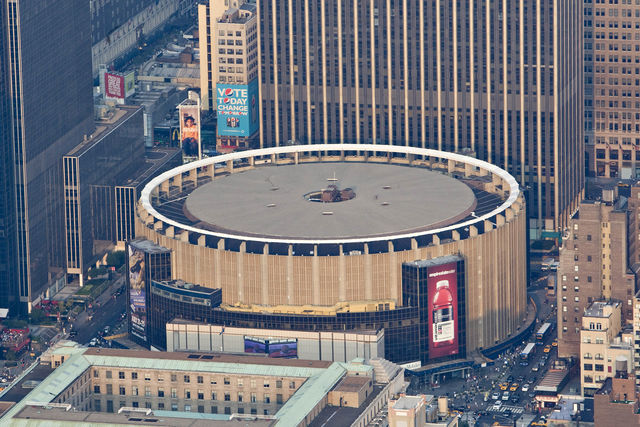
Going In. The 4th and current version of Madison Square Garden is 1 of 10 arenas shared by an NBA team and an NHL team. It has only one real entrance, and that's on the 7th Avenue side. You'll see giant posters referencing the current Knick and Ranger squads, and historic moments that occurred at The Garden.
Besides those involving the home team, these include: The 1st fight between Muhammad Ali and Joe Frazier, on March 8, 1971 (the 2nd was also held there, on January 28, 1974, but was far less significant because neither man then held the title), Nadia Comaneci performing the 1st perfect 10 in an international gymnastics meet (before doing it again later in the year at the Olympics at the Montreal Forum), and various concerts and political conventions.
Once your ticket is scanned, you will be directed to a "tower" at one of the "corners" of this completely round arena: Tower A (33rd & 8th), Tower B (33rd & 7th), Tower C (31st & 7th) or Tower D (31st & 8th). These are escalator towers, and will make it easier for you to find your seating section.

Although I am a Devils fan and I hate the Rangers (I'd say I hate their guts, but they are completely gutless), the only things I didn't like about The Garden as a structure are these escalator towers (they take too long, going either up or down) and the narrowness of the concourses (about half the width of those at the Prudential Center, and no wider than those at the inadequate Nassau Coliseum before its recent renovation). Improving these was among the recent "The Garden Transformed" renovation.

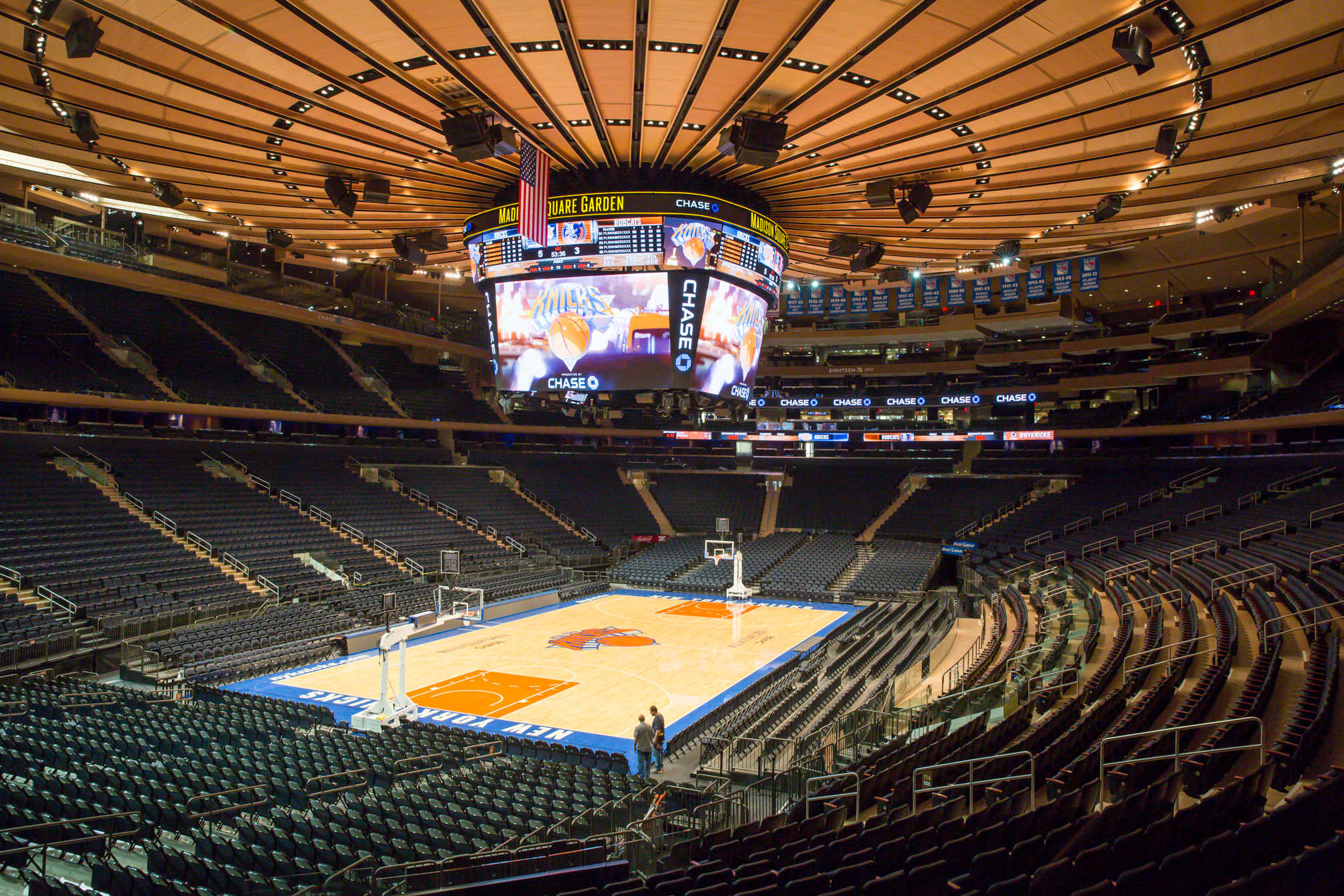
The 100 and 200 Levels are now accessed by the Madison Concourse on the building's 6th Floor. The 300 and 400 Levels are accessed by the Garden Concourse on the 10th Floor. The old color system of red seats down below, white in the middle and blue up top is long gone. So is the system that replaced it, of purple seats in the 100 and 200 Levels and aquamarine in the 300 and 400s. They're all purple now. Fortunately, there really isn't a bad seat in the house, not even in the 400 Level, and the sound carries spectacularly well.
Food. Although New York is one of the world's great food cities, The Garden isn't exactly known for great food. There are specialty stands of interest, though. The 10th Floor has Garden Market between Towers B & C (on the 7th Avenue side), and the 6th Floor has one behind Sections 108 and 115.

Also on the 6th Floor, there is Carlos and Gabby's Kosher & Mexican Grill (I don't know whether to say, "Oy vey!" or "iAy caramba!") at 111, and Senzai Sushi at 118. Ice cream is available at 110, and 16 Handles Frozen Yogurt at 115. "Coffee and Deserts" are at 114.

Team History Displays. The NBA was founded in 1946, and the Knicks and the Boston Celtics are the only original franchises that celebrated their 70th Anniversary -- or even their 20th -- in their original city. So there is some history, although the good parts are receding further and further into the distance.

The Knicks and Rangers hang banners for their titles and their retired numbers. The Knicks banners are as follows:

* NBA Championships: 1970 and 1973.

* Conference Championships (other than the preceding): 1951, 1952, 1953, 1972, 1994 and 1999.

* Division Championships (other than the preceding): 1971, 1989, 1993 and 2013.
The Knicks have 9 retired numbers:

* Guards: 10, Walt "Clyde" Frazier, 1967-77, and now broadcaster; 12, Dick Barnett, 1965-74; and 15, retired for 2 guards, for Dick McGuire, 1949-57, and chief scout that set up the early 1970s Knick champions; and Earl "the Pearl" Monroe, 1972-80.

* Forwards: 22, Dave DeBusschere, 1969-74; and 24, Bill Bradley, 1967-77, and a U.S. Senator from New Jersey 1979-97.

* Centers: 19, Willis Reed, 1964-74; and 33, Patrick Ewing, center 1985-2000. (Reed's number was the 1st retired, in 1976.)

* Head Coach: 613, representing the number of regular-season coaching wins for Red Holzman, 1967-82.
If you're keeping track, McGuire's is the only one from before the 1970 title, and Ewing's is the only one from after the 1973 title, so if you're expecting Bernard King's 30, John Starks' 3, Charles Oakley's 34, or Carmelo Anthony's 7 to go up, forget it.

All of the retired number honorees are in the Basketball Hall of Fame except Barnett. The other Hall-of-Famers who can be said to have gotten in on the basis of their Knick tenures are: 1950s guard Richie Guerin (who wore 9, not a common number, so perhaps it should be retired), 1950s forward Nat "Sweetwater" Clifton (8, ditto, and also the 1st black Knick), 1950s forward Harry Gallatin, and 1980s forward Bernard King (30).

Jerry Lucas, a star with the Cincinnati Royals most of his career, wrapped things up with the Knicks (32), and helped to win the 1973 title. Other Knicks who got into the Hall of Fame mainly based on what they did elsewhere include 1960s guard Tom Gola (6), 1960s center Walt Bellamy  (8), and coaches Hubie Brown, Rick Pitino and Larry Brown.

Frazier, Monroe, Reed, DeBusschere, Lucas and Ewing were named to the NBA's 50th Anniversary 50 Greatest Players. (UPDATE: Each of them was also named to the 75th Anniversary 75 Greatest Players, as was Carmelo Anthony. So was Jason Kidd, but he only spent 1 season, his last, with the Knicks. So was Bob McAdoo, who should have been chosen for the 50th Anniversary, but wasn't.)

(UPDATE: In 2022, the Hall of Fame gave Frazier its Curt Gowdy Media Award, having previously honored Marty Glickman in 1991, Marv Albert in 1997 and John Andariese in 2014.)

There are 8 Knicks who have been inducted into the Madison Square Garden Walk of Fame: McGuire, Gallatin, Holzman, Reed, Frazier, Bradley, DeBusschere and Ewing. Teresa Weatherspoon is the only New York Liberty player elected thus far. St. John's coaches Joe Lapchick and Lou Carnesecca have also been inducted. So has City College of New York coach Nat Holman. Other basketball players inducted for their Garden performances have been George Mikan, Bob Cousy, Bill Russell, Wilt Chamberlain, Oscar Robertson, Kareem Abdul-Jabbar, Carol Blazejowski, Larry Bird and Michael Jordan.

Rangers inducted are Howell, Giacomin, Gilbert, Esposito and Messier. Other hockey players inducted are Maurice Richard, Gordie Howe, Bobby Orr and Wayne Gretzky.

Also elected have been boxers Jack Dempsey, Joe Louis, Sugar Ray Robinson, Rocky Marciano, Muhammad Ali, Joe Frazier and Oscar De La Hoya; tennis players Rod Laver, Billie Jean King, Chris Evert, John McEnroe, Martina Navratilova and Steffi Graf; track stars Jesse Owens, Glenn Cunningham, Carl Lewis and Jackie Joyner-Kersee; figure skater Scott Hamilton; Vince McMahon, if you consider "professional wrestling" to be a sport; media figures Bob Wolff, Marv Albert and George Kalinsky; and music figures George Harrison, The Rolling Stones, The Grateful Dead, Elton John and Billy Joel. 
Traditionally, the Knicks' biggest rival, and easily their oldest, is their fellow charter members of the NBA, the Boston Celtics. In their 1st 74 seasons of not-so-peaceful coexistence, the Celtics have beat the Knicks 332 times, while the Knicks have won just 214.

The Garden was home to the New York Liberty from their 1997 inception until 2008. They spent the next 3 seasons at the Prudential Center in Newark due to the renovation known as "The Garden Transformed," returned to the Garden from 2012 to 2017, and were then moved to the Westchester County Center in White Plains. They won the WNBA's Eastern Conference in 1997, 1999, 2000 and 2002, but have never won a title. 

In addition to the Knicks' and Rangers' banners, 2 music legends were honored with banners at The Garden: Bronx-born, Long Island-raised Billy Joel had a Number 12 banner, for the Garden record 12 straight sellout concerts he played in 2006; and Elton John, who had played The Garden more than any other musical performer, including for the 60th time on his 60th birthday, got a Number 60 banner for that occasion. He's now played it 64 times -- each and every one a sellout.

However, Billy has now broken both records, and is now The Garden's "artist in residence," doing a show a month there. He has now passed the 100 mark, and a banner hangs in honor of the achievement.
"Today, I am your champion, and I may have won your hearts."
But you've still got game, we won't forget your name.
We hope you're still here for many more years, regardless of the charts.

(UPDATE: Another musical personality -- I won't say "legend" -- was given a banner at The Garden in 2022, former One Direction singer Harry Styles.)

There aren't, however, banners honoring some other landmark concerts at The Garden, though some of these are mentioned at the entrance:

* February 11, 1968: Bob Hope and Bing Crosby opened what was then officially called "The Madison Square Garden Center" with a USO event.

* August 1, 1971: George Harrison hosted the Concert for Bangladesh, also including fellow ex-Beatle Ringo Starr, Bob Dylan and Eric Clapton. (While the Beatles did play New York on all 3 of their North American tours, they did not play the old Garden, which generally did not book rock and roll shows. Instead, they played Carnegie Hall, the Paramount Theater in Times Square, the Forest Hills tennis stadium in Queens and Shea Stadium twice.)

* June 9, 10 and 11, 1972: Elvis Presley became the 1st performer to sell out what was still being called "The New Garden" 3 times, and a 4th show was added (a matinee on the 10th).

* August 30, 1972: John Lennon led the Plastic Ono Band at "The One to One Concert," a benefit for children with developmental disabilities, which was recorded for the album (and filmed for the movie) Live in New York City. It turned out to be his last full-length concert appearance. This is how big John was at that time: Stevie Wonder, already one of the greatest musical personalities of the 20th Century, opened for him.

* July 27 to 29, 1973: Led Zeppelin played the shows that formed the concert film The Song Remains the Same.

* October 13, 1974: Frank Sinatra, with Woody Herman and his orchestra backing him up, titled the recorded concert for his, and the building's, love of boxing: "The Main Event."

* November 28, 1974: Elton John played on Thanksgiving night, and invited Lennon onto the stage with him to sing "Whatever Gets You Through the Night," "Lucy in the Sky with Diamonds" and "I Saw Her Standing There." This turned out to be Lennon's last public musical performance.

* October 16, 1992: Columbia Records celebrated the 30th Anniversary of their release of Dylan's 1st album with a tribute concert, which Neil Young nicknamed "Bobfest." It included Harrison, Clapton, Wonder, Young, Johnny Cash, Willie Nelson, John Mellencamp, Tom Petty, and, controversially since she'd just torn up a picture of the Pope on Saturday Night Live, Sinead O'Connor.

Dylan, whose performances range from clear to mumbled to totally unpredictable, was at the top of his game -- he had to be, with that lineup.

* September 7 and 10, 2001: An all-star show honoring Michael Jackson featured several performers singing his songs, before The Gloved One himself closed the shows. The day after the 2nd show was September 11, so this was the last big New York event before the attacks. And, as it turned out, it was Jackson's last concert. He was planning a big tour in 2009, but his death prevented it.

* October 20, 2001: The Concert for New York City raised funds for rebuilding after the attacks. David Bowie opened and Ex-Beatle Paul McCartney closed a show that included Joel, John, Clapton, Mick Jagger and Keith Richards from the Rolling Stones, The Who (it was John Entwistle's last concert before he died), Bon Jovi, and Jay-Z and Beyoncé (who performed with Destiny's Child).

Michael Jackson did not perform, but his sister Janet did. Melissa Etheridge's microphone went out while she was singing "Come to My Window," but the crowd sang along and allowed her to finish the song. She also sang "Born to Run," although I don't know why Bruce Springsteen wasn't there. It may have been the biggest array of talent ever brought together for a single concert. As Mick said, "If there's one thing we've learned from all of this, it's that you don't fuck with New York!"

* September 20, 2005: From the Big Apple to the Big Easy, raising funds for rebuilding New Orleans and nearby communities devastated by Hurricane Katrina 3 weeks earlier. Performers included Elton, Simon & Garfunkel, John Fogerty, Bette Midler and Jimmy Buffett.

* December 12, 2012: The "12-12-12" Concert raised funds for relief of Hurricane Sandy. Springsteen opened, and this was one of the few times that he and Joel have ever appeared together. It also featured McCartney and the surviving members of Nirvana, the Stones, Roger Daltrey and Pete Townshend of The Who, Clapton, Bon Jovi, Roger Waters of Pink Floyd, Alicia Keys, Sean Combs and Kanye West.

For all the events at the 4 buildings named Madison Square Garden, there are no statues, inside or outside. However, the 5,600-seat auditorium attached to The Garden's west (8th Avenue) side was named the Felt Forum, in honor of the man who oversaw the building's construction, Irving Mitchell Felt. It was renamed the Paramount Theater in 1991, The Theater at Madison Square Garden in 1997, the WaMu Theater (for Washington Mutual bank) in 2007, The Theater at Madison Square Garden again in 2009, and it was just renamed the Hulu Theater at Madison Square Garden. Most fans still call it the Felt Forum, though.

And 8th Avenue, from 31st to 33rd Street, separating The Garden and Penn Station to the east from the James A. Farley Post Office to the west, is named Joe Louis Plaza. Louis, Heavyweight Champion of the World from 1937 to 1949, fought at the old Garden 12 times. He also fought 12 times at the old Yankee Stadium, twice at the Polo Grounds, and once at the Hippodrome at 43rd & 6th, for a total of 27 fights in New York, out of the 69 times he got into the ring, 39 percent of his fights.

The 1st Ali-Frazier fight was 1 of 8 fights for the Heavyweight Championship of the World to be held at the current Garden. The others: Frazier defeating Jimmy Ellis, February 16, 1970; Ali hanging on to beat Earnie Shavers, September 29, 1977; Larry Holmes beating Mike Weaver, June 22, 1979; Riddick Bowe beating Michael Dokes, February 6, 1993; the draw that robbed Lennox Lewis of a win in his 1st fight with Evander Holyfield, March 13, 1999; Lewis' win over Michael Grant, April 29, 2000; and Andy Ruiz Jr.'s knockout of Anthony Joshua on June 1, 2019, to win the WBA and IBF Heavyweight Championships.

Stuff. There are souvenir stands all over The Garden, including at the front entrance. The Garden teams also now have the MSG Team Store open a block away at the Manhattan Mall at Herald Square.

There are many good books about the Knicks. Sadly, their team stores do not seem to sell them, and the Borders store that was at the Penn Plaza complex is gone. You'll have to get them elsewhere. Alan Hahn and Knick legend Bernard King collaborated on New York Knicks: The Complete Illustrated History, tracking the team from its 1946 founding to the book's 2012 publication.

In 2003, Dennis D'Agostino published Garden Glory: An Oral History of the New York Knicks, which, understandably, focused on the glory years after the new Garden opened in 1968, to 1973. Along the same lines, longtime New York Times basketball writer Harvey Araton published When the Garden Was Eden: Clyde, the Captain, Dollar Bill, and the Glory Days of the New York Knicks, which was made into a documentary for ESPN's 30 for 30 series -- as was June 17, 1994, the night a Knicks NBA Finals game at The Garden competed for TV time with the O.J. Simpson Bronco chase in Los Angeles. (Clyde was Frazier, the Captain was Reed, and Dollar Bill was Bradley.)

The NBA has released 2 standard team DVDs: NBA Dynasty Series -- New York Knicks -- The Complete History (well, it was complete when it was released in 2005), and The Essentials: Five All-Time Great Games of the New York Knicks. Unfortunately, the latter set does not include either of their title clinchers, Game 7 in 1970 (and ESPN Classic has shown the original ABC broadcast many times, so we know that one exists, intact and in full color) and Game 5 in 1973, both over the Lakers.

The 5 games in question are a 1984 deciding Game 5 against the Detroit Pistons, showing Bernard King at his peak; Game 7 of the 1994 Conference Finals against the Indiana Pacers, with Knick bête noire Reggie Miller; Game 5 of the 1999 1st round against the already-hated Miami Heat; Game 3 of the 1999 Conference Finals against the Pacers; and, for those fans whose knowledge doesn't even go back to the Ewing years, a 2012 thriller against the Chicago Bulls.

During the Game. A November 13, 2014 article on DailyRotoHelp ranked the NBA teams' fan bases, and listed the Knicks' fans at 4th. It cites the constant sellouts, but also ignores the fact that a lot of those seats are sold but not filled, and points out that the huge fan base makes those sellouts possible.

Although New Yorkers and New Jerseyans can be intense, a visiting fan will probably be safe attending a Knick game at Madison Square Garden, even if you're wearing gear of the opposing team. All the same, exercise discretion if you're wearing Boston Celtics stuff. Any other team's fans will most likely be subject to nothing more than a few verbal jabs.

A Ranger game is another matter entirely: I don't recommend that to anyone. Ranger fans are animals. Ironically, they're pretty much the same people. Why hockey makes them animals and basketball merely passionate fans, who knows.

Much of the fun of going to a Knick game is spotting the celebrities. Spike Lee is the most noticeable one, but know this: When the Knicks finally won their 1st title on May 8, 1970, Spike, then 12 years old, was there, at the top of the building, in what was then the Blue Seats. So he's been at it that long, and before the glory.

Woody Allen, then a superstar standup comic and beginning his career as a film director, was already at courtside. Jay-Z and Beyoncé haven't been around since the former bought into the Nets, but you can probably still find comedians like Jerry Seinfeld, Paul Reiser, Richard Lewis, Chris Rock and Tracy Morgan. Actor Richard Gere still goes, and you might see Samuel L. Jackson.

One celebrity you will not see at a Knicks game these days is Marvin Cooper, a.k.a. Dancing Harry. He was a Baltimore Bullets fan who danced in honor of Earl Monroe. When the Knicks traded for the Pearl early in the 1971-72 season, Cooper went up Interstate 95, and started dancing at Knick games. He would even wiggle his fingers at the opposition, in an attempt to put a hex on them. Teams didn't have dance squads in those days, so this was something new.

After the 1973 title, Knick president Ned Irish told him he couldn't dance in the aisle anymore. He did it anyway, and was kicked out. So he went out to Long Island to dance for the Nets. Being an ABA team, they took whatever they could get, and let him do his act, and they won the 1974 ABA title. The Indiana Pacers hired him for the 1975 ABA Playoffs, but they fell short. He soon returned to Baltimore to care for his ill mother. As of 2016, he was still alive, and noted that the Knicks haven't won the NBA title since they got rid of him. The Curse of Dancing Harry?

(In case you're wondering: No, Larry Goodman, a.k.a. Dancin' Larry at the Ranger games, does not dance at Knick games. The Lakers also once had a Dancing Barry, who danced in a suit, but wearing a half a basketball on his head, with eyeholes cut out.)

The Knicks do not have a regular National Anthem singer, as the Rangers did with the late John Amirante. But celebrities are frequently on hand to sing it. The Knicks do not have a mascot. Nor do they have cheerleaders, but they do have the Knicks City Dancers. This shouldn't surprise anyone who knows that the Madison Square Garden Corporation now owns Radio City Music Hall, home of the Rockettes.

If you're watching on TV, you may hear one of the announcers, in the tradition of Marv Albert, refer to the action moving toward "the 8th Avenue side of the building" or "the 7th Avenue side of the building." Watching on TV, the 8th Avenue side is to the left of the screen, the 7th Avenue side to the right.

The Knicks have used "Go New York, Go New York, Go!" as their fight song since 1993.

After the Game. New York's reputation as a high-crime city hasn't been true in years. And Knick fans, much more so than Ranger or Yankee Fans, are likely to leave you alone on your way out. You'll be directed to one of the escalator towers at the corners, but this will take a while.

There are dozens of bars around The Garden that are popular among postgamers. If this is your 1st time in New York, and you don't know them, my advice is to ignore the chain restaurants, and just follow people who look like they know where they're going. If you got a hotel, and nothing around The Garden appeals to you (I don't see why at least 1 wouldn't), there may be a bar more to your liking near your hotel.

If you're a fan of an NBA team not in the New York Tri-State Area, these bars have been known to cater to fans from the cities/metro areas in question:

* Atlanta Hawks: The Watering Hole, 106 E. 19th Street. 4, 5, 6, L, N or R Train to Union Square.
* Boston Celtics: The Joyce Public House (named for Irish novelist James Joyce, and formerly a Tir Na Nog outlet), 315 W. 39th Street. A Train to 42nd Street. (Professor Thom's, at 219 2nd Avenue, has permanently closed.)
* Charlotte Hornets: Brother Jimmy's, 116 E. 16th Street. 4, 5, 6, L, N or R Train to Union Square.
* Chicago Bulls: Kelly's, 12 Avenue A. F Train to 2nd Avenue.
* Cleveland Cavaliers: The Liberty Bar, 29 W. 35th Street. B, D, F, N or R Train to Herald Square. (The previous place, Manny's On Second, went out of business even before COVID.)
* Dallas Mavericks: Hurley's, 232 W. 48th Street. C or E Train to 50th Street.
* Denver Nuggets: Stout, 133 W. 33rd Street. 1, 2 or 3 Train to 34th Street-Penn Station.
* Detroit Pistons: Amity Hall, 80 W. 3rd Street. A, C or E Train to W. 4th Street. (The previous place, Mercury Bar East, went out of business even before COVID.)
* Golden State Warriors: Kent Ale House, 51 Kent Avenue, in the Williamsburg section of Brooklyn. G Train to Nassau Avenue. (The previous place, Finnerty's at 221 2nd Avenue, has permanently closed.)
* Houston Rockets: Hill Country Barbecue, 30 W. 26th Street. N or R Train to 28th Street.
* Indiana Pacers: Keats, 842 2nd Avenue. 4, 5, 6 or 7 Train to Grand Central.
* Los Angeles Clippers & Lakers: Taqueria St. Mark's Place, 79 St. Mark's Place. 6 Train to Astor Place.
* Memphis Grizzlies: SideBar, 120 E. 15th Street. 4, 5, 6, L, N or R Train to Union Square.
* Miami Heat: Slattery's, 8 E. 36th Street. B, D, F, N or R Train to Herald Square.
* Milwaukee Bucks: The Kettle of Fish, 59 Christopher Street. 1 Train to Christopher Street-Sheridan Square. In the 1950s, this bar was based on Macdougal Street, a few blocks away, and was a notoriously rough bar. It should be safe now, unless you're wearing a Chicago Bears jersey. (The previous place, Mad River at 1442 3rd Avenue, has permanently closed.)
* Minnesota Timberwolves: Bar None, 98 3rd Avenue. L Train to 3rd Avenue.
* New Orleans Pelicans: d.b.a., 41 1st Avenue. F Train to 2nd Avenue.
* Oklahoma City Thunder: The Ainsworth, 45 E. 33rd Street. B, D, F, N or R Train to Herald Square, and also 3 blocks east of The Garden.
* Orlando Magic: Carragher's, the bar owned by and named for Liverpool soccer legend Jamie Carragher, 228 W. 39th Street. A, C or E Train to 4nd Street.
* Philadelphia 76ers: Shorty's, 219 E. 23rd Street. 4, 5 or 6 Train to 23rd Street.
* Phoenix Suns: Standings, 43 E. 7th Street. 6 Train to Astor Place. (NOTE: The previous place, Foley's at 18 W. 33rd Street, closed due to COVID. The owner is looking for a new space to host Foley's when restrictions fully end.)
* Portland Trail Blazers: Unknown. One possibility, since fans of the University of Oregon and soccer's Portland Timbers gather there: Legends, 6 W. 33rd Street, 2 blocks west of The Garden.
* Sacramento Kings: Unknown. Since Sacramento is also in Northern California, you might be able to try the aforementioned Warriors' bar, the Kent Ale House.
* San Antonio Spurs: Triumph Brooklyn, 105 Metropolitan Avenue in Williamsburg. L to Bedford Avenue.
* Toronto Raptors: Grey Bar, 43 W. 26th Street. R or W Train to 26th Street. (Manitoba's at 99 Avenue B and Van Diemen's at 383 3rd Avenue both catered to Canadians living in New York, but both are now out of business.)
* Utah Jazz: Unknown. A possibility, since the University of Utah is also in Salt Lake City, and their fans meet here: The Australian, 20 W. 38th Street. B, D or F Train to 42nd Street.
* Washington Wizards: Dorrian's Red Hand, 1616 2nd Avenue. Q Train to 86th Street.

If you're visiting New York during the European soccer season, as we are now in, there are many places where you can watch your favorite team. The best "football pub" in The City, and, indeed, in the country, is The Football Factory, downstairs at Legends NYC, at 6 West 33rd Street, across from the Empire State Building, and 2 blocks east from The Garden. B, D, F, N, Q or R train to 34th Street-Herald Square.

Sidelights. This is where I discuss other sports-related sites in the metropolitan area in question, and then move on to tourist attractions that have no (or little) connection to sports. Since most people reading this will be from the Tri-State Area, I'll keep it short as possible.

There is a Madison Square, where 23rd Street, 5th Avenue & Broadway all come together. The 1st 2 buildings to be named Madison Square Garden went up across from it, in 1879 and 1891, respectively, at 26th & Madison.
The 1879 Garden

The 2nd Garden hosts a few prizefights, including 2 for the Heavyweight Championship of the World: Jess Willard's only successful defense of it, over Frank Moran on March 25, 1916; and Jack Dempsey's knockout of Bill Brennan on December 14, 1920. It also hosted the 1924 Democratic Convention, which, under the old 2/3rds rule, went to 103 ballots before compromising and nominating John W. Davis for President, and he lost badly to incumbent Calvin Coolidge.
The 1891 Garden

The New York Life Insurance Company held the mortgage on the 2nd Garden, and in 1925 decided it wanted the land for its headquarters, which still stands on the site (the official address is 51 Madison Avenue). It's about a mile south of the new Garden.

But Tex Rickard, who ran the boxing promotions at The Garden, had made so much money (mainly off promoting fights of Heavyweight Champion Jack Dempsey, that he could afford to build a new Garden all by himself. He did so, at 49th Street & 8th Avenue. This building, now usually referred to as "the old Garden," became "the Mecca of Basketball" and "the Mecca of Boxing."

And the fights it hosted included some legendary ones. Joe Louis successfully defended the Heavyweight Championship of the World there against Nathan Mann on February 23, 1938; John Henry Lewis, in the 1st Heavyweight Title fight between 2 black boxers, on January 25, 1939 Arturo Godoy on February 9, 1940; Johnny Paychek (not the later country singer) on March 29, 1940; Red Burman on January 31, 1941; Buddy Baer (Max's brother) on January 9, 1942; Abe Simon on March 27, 1942; and, in a decision that many observers thought should have gone the other way, Jersey Joe Walcott on December 5, 1947.

Louis seemed to have settled things by beating Walcott at Yankee Stadium 6 months later, then retiring. Ezzard Charles won what amounted to an elimination tournament for the title, then rendered the title undisputed by beating Louis, who came out of retirement because he needed money for a big tax bill, on September 27, 1950. Charles then defended the title against Lee Oma on January 12, 1951.

On October 26, 1951, an increasingly desperate Louis got back into the Garden ring to face the rising Rocky Marciano, who idolized Louis, but knocked out the hopelessly out of shape ex-champ. He visited Louis in his dressing room afterward, and both men cried.

Marciano never fought in the Garden again, and the old Garden hosted just 1 more Heavyweight Title fight. Muhammad Ali had refused to fight there because they insisted on introducing him under his birth name, Cassius Clay, because that was the name on his boxing license. Ali got it changed, and on March 22, 1967, he was introduced as Muhammad Ali, and knocked out Zora Folley. It was his last fight before being stripped of the title for refusing to accept being drafted.

From 1935 until its closing in 1968, it became famous for its basketball doubleheaders, both collegiate and professional. It hosted what we would now call the NCAA Final Four in 1943 (Wyoming over Georgetown), 1944 (Utah over Dartmouth), 1945 (Oklahoma A&M, which became Oklahoma State in 1958, over New York University), 1946 (Oklahoma State over North Carolina), 1947 (Holy Cross over Oklahoma), 1948 (Kentucky over Baylor) and 1950 (City College over Bradley).

But in 1951, the college basketball point-shaving scandal hit, and all the schools that used the old Garden as a secondary home court -- NYU, CCNY, St. John's, Long Island University and Fordham -- were hit. (Only St. John's would survive as a legitimate program, and still use the new Garden as a home court for games where ticket demand exceeded an on-campus facility.)

The NIT suffered, and, while it's still held at the new Garden today, it was so degraded in the eyes of the public that the NCAA Champion became viewed as the National Champion. The Final Four has only been held in the Tri-State Area once since, in 1996 at the Meadowlands (Kentucky over Syracuse), and unless MetLife Stadium or Citi Field gets a dome, it will never happen here again.

The old Garden was torn down shortly after the new Garden opened, and a skyscraper called Worldwide Plaza is on the site now. Underneath, the 50th Street station on the Subway's C & E lines has a mural depicting events at the old Garden.
It was torn down shortly after the new Garden opened, and a skyscraper called Worldwide Plaza is on the site now. Underneath, the 50th Street station on the Subway's C & E lines has a mural depicting events at the old Garden. It's about a mile north of the new Garden.
The 1925 Garden

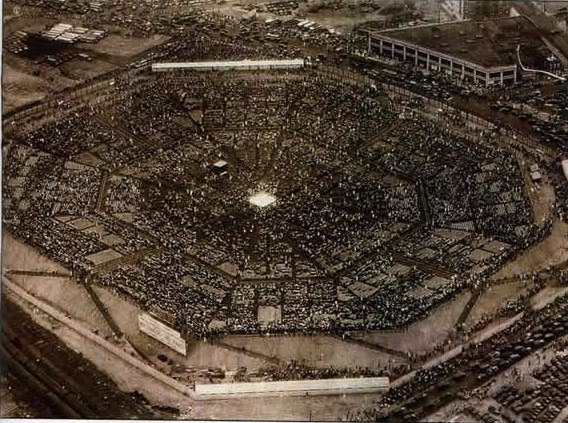
Unwilling to put Summer prizefights inside The Garden (due to the heat in those pre-air-conditioning days, as much as to the limited seating capacity), and also unwilling to pay the big rents charged by the Yankees for their Stadium or the baseball Giants for the Polo Grounds, in 1932, the Garden Corporation built the Madison Square Garden Bowl, a 72,000-seat open-air facility in Long Island City, Queens. It wasn't much: just a lot of aluminum benches in an octagon around a boxing ring. Nothing else could be held there.
It hosted 4 fights for the Heavyweight Championship of the World. On June 21, 1932, Max Schmeling was defeated by Jack Sharkey. On June 29, 1933, barely over a year later, Sharkey was stunned by Primo Carnera, the 6-foot-7 Italian known as the Ambling Alp. On June 14, 1934, Carnera was in turn knocked out by Max Baer. Soon, somebody (who it was depends on who's telling the story) yelled, "The joint is jinxed!"

The Bowl's reputation as "The Jinx Bowl" was certified exactly one year later, on June 13, 1935, when Baer was defeated by Jim Braddock, the Cinderella Man. After that, no one wanted to fight in the Jinx Bowl. Braddock waited 2 years before defending his crown, and went to Chicago where Joe Louis knocked him out at Comiskey Park.

The Garden Corporation gave up, and started paying rent on Yankee Stadium for big fights. The Bowl was demolished during World War II, to make way for a U.S. Army mail depot. Today, there's retail on the site, including the well-known auto dealership Major World. 34-60 48th Street, or 43-40 Northern Blvd. if you prefer. E Train to Steinway Street, then 8 blocks east on 34th Avenue.

The 1st professional basketball team in New York City was the New York Celtics, who were formed in 1914, but had to disband in 1917 due to World War I. A year later, a new team was formed, called "The Original Celtics." They played at the 2nd Garden from 1918 to 1925, and the 3rd Garden from then until 1930, when the Great Depression forced them to fold. The Boston Celtics, founded with the NBA in 1946, bear no official connection to them.

They featured 4 men who would later be elected to the Basketball Hall of Fame. Oddly, none of these "Celtics" was Irish. John Beckman and Henry “Dutch” Dehnert were among the best players of the Roaring Twenties. Two others are mainly remembered as coaches now: Nat Holman of City College of New York, and Joe Lapchick of St. John’s and the early Knicks.

Both the Giants (1925-55) and the Jets (1960-63) used to play at the Polo Grounds. So did the baseball Giants (1890-1957), the Yankees (1913-22) and the Mets (1962-63). 155th Street & 8th Avenue in Upper Manhattan. D train to 155th Street. Definitely visit in daylight only.

The original Yankee Stadium, the former home of the Yankees (1923-2008) and the Giants (1956-73), was on the south side of 161st Street at River Avenue. The new Stadium is on the north side. It's about 6 1/2 miles north of The Garden. D or 4 train to 161st Street.

Shea Stadium, the former home of the Mets (1964-2008) and Jets (1964-83), and where the Yankees played while the old Yankee Stadium was being renovated (1974-75), was in Flushing Meadow, Queens, just to the west of the new Mets ballpark, Citi Field. The Giants played 1 season there, 1975. Across Roosevelt Avenue is the Billie Jean King National Tennis Center, site of the U.S. Open, including stadiums named for Arthur Ashe and Louis Armstrong (a big sports fan, including tennis, who lived his last years nearby in Corona). 7 train to Mets-Willets Point. About 8 miles east of the Garden.

The Meadowlands complex, home to the Giants since 1976, the Jets since 1984, the Devils from 1982 to 2007, the Nets from 1981 to 2010, and the New York Red Bulls (until 2005, the New York/New Jersey MetroStars) from 1996 to 2009, is accessible by New Jersey Transit rail, but only on football games days. Otherwise, you'll have to take the New Jersey Transit 320 bus from Port Authority. About 8 miles west of the Garden.

Now, the Nets play at the Barclays Center in Brooklyn, and the Islanders will join them there for the 2015-16 season. 620 Atlantic Avenue & Flatbush Avenue. 2, 3, 4, 5, D, N or R train to Atlantic Avenue. About 5 miles southeast of the Garden.

The Islanders have moved into the Barclays Center as well, after playing their 1st 43 years at the Nassau Coliseum. The Nets also played their best years (1971-77) there. 1255 Hempstead Turnpike in Hempstead (the mailing address is Uniondale). Long Island Rail Road (LIRR) from Penn Station to Hempstead Terminal, then transfer to N70, N71 or N72 bus. About 27 miles east of the Garden.

On December 19, 2017: A deal was announced, to build a new arena for the Islanders at Belmont Park, in Elmont, in Nassau County, just over the City Line, thus returning the Isles to The Island. They plan to have it ready for the 2020-21 season.

The Devils now play at the Prudential Center in Newark. So does the basketball team at Seton Hall University of South Orange. 165 Mulberry Street & Edison Place. New Jersey Transit rail from New York's Penn Station to Newark's station of the same name. About 11 miles southwest of the Garden.

The New York Red Bulls have played at Red Bull Arena in Harrison since 2010. 600 Cape May Street. PATH to Harrison. Also about 11 miles southwest of the Garden.

The Giants played half of 1973 and all of 1974 at the Yale Bowl in New Haven, Connecticut. Metro-North from Grand Central to New Haven, then walk from Union Station to Chapel Street, and take the F bus. About 78 miles northeast of the Garden.

Of the other notable sports-playing colleges in the area, St. John's University is in Jamaica, Queens, about 12 miles east; Columbia University's Baker Field/Wien Stadium is at the northern tip of Manhattan at 220th Street & Broadway, 10 miles north; the U.S. Military Academy (a.k.a. "Army") is in West Point, Orange County, 55 miles north; Syracuse's Carrier Dome is 248 miles to the northwest; Rutgers' High Point Solutions Stadium is in Piscataway, New Jersey, 39 miles southwest; and Princeton's Powers Field is 52 miles southwest.

However, because of the distance involved, I'd say forget the New Jersey, Long Island and Connecticut places, unless you're a sports nut with a car and more than 1 day to spare.

If you have a car and more than 1 day (and more than a little money) to spend in and around New York, I do recommend the American Museum of Natural History (79th Street & Central Park West, C train to 81st Street), the Metropolitan Museum of Art (82nd Street & 5th Avenue, 4, 5 or 6 train to 86th Street and then walk 3 blocks west to 5th Avenue), and the observation deck of the Empire State Building (34th Street & 5th Avenue, 2 blocks from The Garden, B, D, F, N, Q or R train to 34th Street-Herald Square and walk 1 block east).

There have been 2 Presidents born in New York City. And the 1st would have slapped the 2nd. Theodore Roosevelt Birthplace National Historic Site, a recreation of the townhouse where TR was born in 1858, is at 28 East 20th Street. N or R train to 23rd Street. Donald Trump was born at Jamaica Hospital, at 89-00 Van Wyck Expressway in Kew Gardens. E train to Jamaica-Van Wyck.

However, I can't recommend the Statue of Liberty, as it's not cheap, it's time-consuming both to get there and to get through, and the view from the crown isn't what you might hope. And the new World Trade Center isn't open yet, and the 9/11 Memorial is expensive and has long lines.

Beach distances from Madison Square Garden, in miles:

* New York: Coney Island, Brooklyn, 13; Midland Beach, Staten Island, 15; City Island, Bronx, 16; Rockaway Beach, Queens, 17; Long Beach, 25; Jones Beach, 34; Fire Island, 53; Southampton, 90; Montauk, 122.

* New Jersey: Sandy Hook, 53; Long Branch, 57; Asbury Park, 59; Belmar, 61; Point Pleasant, 66; Seaside Heights, 83; Long Beach Island, 100; Atlantic City, 128; Ocean City, 132; Wildwood, 157; Cape May, 160.

*

The New York Knicks haven't won a title in 45 years. Since James Dolan became controlling owner on January 1, 1999, they have won a total of 1 NBA Finals game. At times, it seems like they aren't even relevant anymore. But -- and this is just my personal opinion -- I believe that, if you told the average New Yorker that he could pick any single team to win another World Championship, and that one team would win it in its current or next upcoming season, I think you'd get more votes for the Knicks than any other team.

True, the Jets have waited longer, and the Mets will get a lot of frustrated votes, but that city truly loves basketball, and they want so badly for the Knicks to put themselves in position to make a long Playoff run, where anything is possible.

If you follow these instructions carefully, you'll be able to get in, through and out of a Knicks game safely. Not without stress, to be sure, and I can't guarantee a win (I'm Uncle Mike, not Broadway Joe), but safely.

Friday, May 8, 2020

May 8, 1970: The Knicks Triumphant

May 8, 1970, 50 years ago: The moment that New York Knickerbockers fans had been waiting for finally arrived. Although, given what was seen the year before, with the New York Jets winning Super Bowl III and the New York Mets winning the World Series, it was far closer to a "miracle" than "guaranteed."

The Knicks (almost nobody calls them by their full name) were founded in 1946, as a charter franchise in the Basketball Association of America, which became the National Basketball Association in 1949. They and the Boston Celtics are the only 2 charter franchises still playing in their original cities. The only other charter franchise still playing is the Philadelphia Warriors, who moved to San Francisco in 1962, and have been known as the Golden State Warriors since 1971.

The Knicks reached the NBA Finals in 1951, but lost in 7 games to the Rochester Royals, who are now the Sacramento Kings. They reached the Finals again in 1952, losing to the Minneapolis Lakers in 7. They reached the Finals again in 1953, losing to the Lakers in 5. They had not reached the Finals since.

The Lakers, on the other hand, won the 1948 National Basketball League title, and were admitted into the NBA, where they then won 5 of the next 6 titles. In 1959, they lost the Finals to the Celtics. After the 1960 season, they were moved to Los Angeles, where they won the Western Division title in 1962, 1963, 1965, 1966, 1968 and 1969 -- and lost to the Celtics every single time, including in 7 games in '62, '66 and '69.

By this point, the Knicks had been rebuilt under head coach William "Red" Holzman (who had played for the '51 Royals), chief scout Dick McGuire (who had been a star on those early 1950s teams), and general manager Eddie Donovan. Playing at the new Madison Square Garden that had opened in 1968 were future Hall-of-Famers Willis Reed, Walt Frazier, Dave DeBusschere and Bill Bradley.
Red Holzman

In 1969, the Knicks got to the Eastern Division Finals, losing to the Celtics. The 1969-70 season was when it all seemed to be coming together. They had an 18-game winning streak, an NBA record (but for only 2 more years).

In the Playoffs, despite the presence of Earl "the Pearl" Monroe, one of the few players who could match "Clyde" Frazier for flashiness, the Knicks beat the Baltimore Bullets in 7 games. Then, despite the presence of Alcindor and already-all-time great Oscar Robertson, the Knicks beat the Milwaukee Bucks, to reach their 1st NBA Finals in 17 years.
Clyde. 'Nuff said.

Let's put this in perspective. At this point, the Yankees had won 20 World Series. The Giants had won 4 NFL Championships. The Rangers had won 3 Stanley Cups. And in the preceding 16 months, the Jets had won the Super Bowl, and then the Mets had won the World Series. The Jets had only been in existence since 1960, the Mets since 1962. The Knicks had been a founding franchise of the NBA, in 1946, and in 24 years had never won a Championship. They needed one.

In their way were the Lakers, who had 3 of the defining figures of the NBA's 1st quarter-century: Wilt Chamberlain, the best player the game has ever known; Elgin Baylor, the 1st man to really make the game stylish; and Jerry West, the best shooter the sport had yet seen and a really good defensive player, too. The Knicks would have home-court advantage, but they were huge underdogs. The Lakers seemed to have both talent and hunger on their side.
Elgin Baylor, Wilt Chamberlain and Jerry West

*

April 24, 1970. Game 1 at The Garden. It was surprisingly easy for the Knicks, as they won, 124-112.

April 27, 1970, Game 2 at The Garden. So much for easy. The Lakers struck back, and won 105-103.

April 29, 1970, Game 3 at The Forum, in the Los Angeles suburb of Inglewood, California. The Knicks thought they had the game won when DeBusschere made a basket with 3 seconds left. But then came the first true "buzzer-beater" in NBA history: West fired a shot from behind half-court, and it went in. No 3-point field goals in those days (although the American Basketball Association used it), so this sent the game to overtime.

Instead of being stunned by West's shot, the Knicks showed their professionalism, and got the job done, winning anyway 112-108.

May 1, 1970, Game 4 at The Forum. The Lakers had already shown the Knicks that they weren't going to give up without a fight, and they tied the series up again, winning this game 121-115 in overtime.

May 4, 1970, Game 5 at The Garden. A surreal day. Earlier, on the campus of Kent State University in the Cleveland suburb of Kent, Ohio, a demonstration was held, protesting President Richard Nixon's decision to expand the Vietnam War to Cambodia. This would have disastrous consequences for Southeast Asia, both short-term and long-term. Ohio National Guardsmen shot 13 students, resulting in 4 deaths and 1 permanent paralysis.

Al Albert was a student at Kent State at the time. His brother, Marv Albert, was a broadcaster for the Knicks, the Jets, and the New York Rangers. Marv had heard of the massacre, and, not knowing the names of the dead and the wounded, had made some calls to find out if his brother was all right. He had to broadcast the 1st half of the game not knowing. Finally, during halftime, he was handed a note saying that Al had been reached, and was fine, that he was nowhere near the demonstration.

In the middle of Game 5, Knick Captain Reed went down with a torn thigh muscle. Up until then, he had been keeping Chamberlain in check. But without Reed, their biggest physical presence and their emotional leader, the Knicks were in trouble. 
DeBusschere stepped up, and kept Chamberlain from running riot across the Garden floor, and the Knicks won, 107-100.

May 6, 1970, Game 6 at The Forum. Without Reed available, this was the least close game of the series. Chamberlain ran riot across the Forum floor, and the Lakers won, 135-113. To put that in perspective, until this point, the highest point total in the series was the Knicks' 124 in Game 1; the Lakers' highest, 121 in Game 4.
Wilt Chamberlain and Walt Frazier

It meant that the Knicks needed Reed for Game 7. And the nature of his injury made it look like he wouldn't be available. At this point, pretty much everybody expected the Lakers to win the game easily, and thus win the title.

*

This is what the world was like on May 8, 1970, 50 years ago:

There were 14 teams in the NBA, 7 each in an Eastern and Western Division. These included the Baltimore Bullets (now the Washington Wizards), the Cincinnati Royals (now the Sacramento Kings), the San Francisco Warriors (who would move to Oakland for the 1971-72 season, and change their name to the Golden State Warriors), the Seattle SuperSonics (now the Oklahoma City Thunder), and the San Diego Rockets (who became the Houston Rockets in 1971).

This was the season in which NBA officials switched from traditional striped referee shirts to short-sleeved gray shirts, which they have worn ever since. This was also the rookie season for the man who had led UCLA to 3 straight National Championships and an 88-2 record, Lew Alcindor of the Milwaukee Bucks. He would lead them to the title in 1971. After another season, he would announce his conversion to Islam, and the change of his name to Kareem Abdul-Jabbar. 

After the 1970 Finals, 3 expansion teams would be created: The Cleveland Cavaliers, the Portland Trail Blazers, and the Buffalo Braves (now the Los Angeles Clippers). The NBA was realigned into an Eastern and Western Conference, each with 2 Divisions.

Madison Square Garden -- or, as the arena, then just past its 2nd "birthday," was still being called, "the New Madison Square Garden Center" -- is the only NBA arena used in the 2019-20 season that was being used in the 1969-70 season.

The arenas then used by the Lakers, the Bucks, the Bullets, the Rockets, the Detroit Pistons, the Atlanta Hawks and the Phoenix Suns still stand, but those teams have since moved. The 1st arena used by Portland, starting the next season, also still stands, but no longer hosts NBA games. The Indiana Pacers, who would win the ABA Championship, were playing in an arena that still stands, but they no longer use it.

Madison Square Garden is also the only 1970 NHL arena still in use. Lambeau Field in Green Bay is the only 1970 NFL stadium still in use, and only 5 Major League Baseball stadiums from that year are still in use.

The Knicks, the Lakers since moving to Los Angeles, the Bucks, the Warriors since moving to the Bay Area, the Trail Blazers, the Bullets, the Sonics, the Pistons, the Rockets, the Chicago Bulls, the San Antonio Spurs, the Miami Heat, the Dallas Mavericks, the Cleveland Cavaliers and the Toronto Raptors had not yet won an NBA Championship. 

The Bucks, the Suns, the Trail Blazers, the Sonics, the Rockets, the Bulls, the Spurs, the Pacers, the Heat, the Mavericks, the Cavaliers, the Orlando Magic, the Utah Jazz, the team now known as the Brooklyn Nets  had not yet made the NBA Finals.

The Spurs, the Pacers, the Nets and the Denver Nuggets were in the ABA. And the Cavaliers, the Trail Blazers, the Clippers, the Magic, the Jazz, the Heat, the Mavericks, the Raptors, the Charlotte Hornets, the Memphis Grizzlies and the New Orleans Pelicans did not yet exist.

All of these facts are no longer true.

The NBA was close to celebrating its 25th Anniversary. Its Commissioner was J. Walter Kennedy. Its original Commissioner (1946-63), Maurice Podoloff, was not only still alive, but was older than the sport itself: He was born in 1890, and basketball was invented in 1891.

Chamberlain and West were still active. So was Oscar Robertson. Bill Russell had retired only a year earlier.

The defining basketball players of my youth? As I said, Kareem was a rookie. Elvin Hayes was in his 2nd season. Pete Maravich and Dave Cowens were seniors in college. Julius Erving and Bill Walton were in high school. Moses Malone, Bernard King and Larry Bird were in junior high. Earvin Johnson was 10 years old, and nobody had yet thought to call him "Magic." Isiah Thomas was 9. John Stockton was 8. Clyde Drexler, Patrick Ewing, Hakeem Olajuwon, Michael Jordan and Charles Barkley were 7. Karl Malone was 6.

The 1970 NBA Finals was the 1st NBA Finals shown live on television. But this would not hold. As late as the clinching Game 6 in 1980, the games would be shown only on tape delay, and this proved to be so embarrassing that the NBA and TV got closer together. Perhaps a little too close.

Current Knicks head coach Mike Miller was 6 years old. Current Lakers head coach Frank Vogel wasn't born yet. Barry Trotz of the Islanders was 7, David Quinn of the Rangers was 3, and the rest of the head coaches/managers of New York Tri-State Area teams weren't born yet: Chris Armas of the Red Bulls in 1972, Aaron Boone of the Yankees in 1973; Jacque Vaughn of the Nets, Alan Nasreddine of the Devils, and Ronny Deila of NYCFC all in 1975; Adam Gase of the Jets in 1978, Luis Rojas of the Mets and Joe Judge of the Giants in 1981, and Walt Hopkins of the Liberty in 1985.

The Knicks and Lakers were attempting to dethrone the Celtics as NBA Champions. The Boston Bruins, thanks to a "flying goal" from Bobby Orr, were about to complete a sweep of the St. Louis Blues, to win the Stanley Cup, dethroning the Montreal Canadiens. And the Mets and Jets were titleholders in their leagues. The Heavyweight Champion of the World was Joe Frazier -- with an asterisk, if you believe the title was unfairly stripped from Muhammad Ali.

The Olympic Games have since been held in America 4 times, Canada 3 times, Japan twice, Russia twice, Korea twice, Germany, Austria, Bosnia, France, Spain, Norway, Australia, Greece, Italy, China, Britain and Brazil. The World Cup has since been held in Mexico and Germany twice each, and once each in America, Argentina, Spain, Italy, France, Japan, Korea, South Africa, Brazil and Russia.

There were 25 Amendments to the Constitution of the United States. You had to be at least 21 years old to vote, but 18 to be drafted -- as writer P.F. Sloan and singer Barry McGuire put it, "You're old enough to kill, but not for votin'." The 26th Amendment, reducing the voting age to 18, would be passed by Congress, and then ratified by the States, the next year.

The Environmental Protection Agency would begin operation the following December 2. The 1st gay pride parade would be held in 7 weeks, on the 1st anniversary of the Stonewall Riot. Title IX and Ms. magazine were 2 years away; legalized abortion, 3 years away. The idea that people of the same gender could marry with all the rights and protections of regular couples was considered ridiculous -- but then, so was the idea that corporations were "people" and entitled to the rights thereof.

The President of the United States was Richard Nixon. Former Presidents Lyndon Johnson and Harry Truman, their wives, and the widows of John F. Kennedy and Dwight D. Eisenhower were still alive. Gerald Ford was the House Minority Leader. Jimmy Carter was about to be elected Governor of Georgia. Ronald Reagan was about to be re-elected Governor of California. George H.W. Bush was a Congressman, but was about to be defeated in a run for the Senate.

Bill Clinton was in his Rhodes Scholarship at Oxford University, and had recently -- legally, if suspiciously -- avoided being drafted into the Vietnam War. George W. Bush was serving in the Texas Air National Guard. Donald Trump got a deferment. Barack Obama was 8 years old. Joe Biden also had a medical deferment, and his was far less suspicious. He had just begun the practice of law, and was launching his 1st run for office, for New Castle County Council in Delaware, which he would win.

The Governor of the State of New York was Nelson Rockefeller. The Mayor of the City of New York was John Lindsay. The Governor of New Jersey was William T. Cahill. As for the current occupants of those offices: Governors Andrew Cuomo and Phil Murphy were then both 12 years old, and Mayor Bill de Blasio was celebrating his 9th birthday on May 8, 1970.

Canada's Prime Minister was Pierre Trudeau. He was young (50), dashing and charismatic. It was as if John F. Kennedy was singing lead for the Beatles – in French. Canada was also about to get its first Major League Baseball team, the Montreal Expos. And a group called The Guess Who was about to become Canada's biggest rock band ever (to that point). For the first time ever, Canada was hip -- and I don't mean "tragically hip." Especially if you were an American worrying about being drafted. Trudeau's son Justin was born a year and a half later.

The Pope was Paul VI. The current Pope, Francis, then Jorge Mario Bergoglio, would not be ordained until later in the year. René Samuel Cassin, The United Nations' International Labor Organization had recently been awarded the Nobel Peace Prize.

Elizabeth II was Queen of England -- that still hasn't changed -- but she was just 44 years old. Britain's Prime Minister was Harold Wilson. There have since been 10 Presidents of the United States, 9 Prime Ministers of Britain and 5 Popes. There were still surviving veterans of the Spanish-American War and the Boer War.

The English Football League was won by Everton, the "blue club of Liverpool." The FA Cup was won by West London team Chelsea, their 1st time winning it. Feyenoord of Rotterdam became the 1st team from the Netherlands to win the European Cup.

Major novels of 1970 included Deliverance by James Dickey, The Bluest Eye by Toni Morrison, The Paper Chase by John Jay Osborn Jr., QB VII by Leon Uris, Papillon by Henri Charriere, The Gang That Couldn't Shoot Straight by New York Daily News writer Jimmy Breslin, and Jonathan Livingston Seagull by Richard Bach -- which my all-time sports hero, Reggie Jackson, then a 23-year-old slugger with the Oakland Athletics, would later claim as his favorite book, outside of The Bible.

In children's literature, Roald Dahl wrote The Fantastic Mr. Fox, Maurice Sendak wrote In the Night Kitchen, and Judy Blume wrote Are You There, God? It's Me, Margaret. In non-fiction, Alvin Toffler wrote Future Shock, Arthur Janov wrote The Primal Scream (and would soon have former Beatle John Lennon as one of his followers), Dee Brown wrote Bury My Heart at Wounded Knee, Helene Hanff wrote 84 Charing Cross Road, and baseball pitcher Jim Bouton published his diary of the 1969 season, which made many people laugh and other people steam: Ball Four.

J.R.R. Tolkien was still alive. Stephen King was a senior at the University of Maine. George R.R. Martin was a senior at Northwestern University. J.K. Rowling was 4 years old.

No one had yet heard of Spenser, Lestat de Lioncourt, T.S. Garp, Arthur Dent, Jason Bourne, Hannibal Lecter, Kinsey Millhone, Celie Harris, Forrest Gump, Jack Ryan, Alex Cross, Bridget Jones, Robert Langdon, Lisbeth Salander, Bella Swan or Katniss Everdeen.

Major films released in the Spring of 1970 included Patton, A Man Called Horse, Too Late the Hero and Beneath the Planet of the Apes. This was during the brief George Lazenby period for James Bond. Jon Pertwee had just taken over as The Doctor. Adam West was the most recent live-action Batman, Bob Holliday the most recent live-action Superman. Gene Roddenberry was figuring out what to do after Star Trek. Neither George Lucas nor Steven Spielberg had yet directed a feature film.

No one had yet heard of Dirty Harry Callahan, Cheech & Chong, John Shaft, Paul Kersey, Leatherface, Rocky Balboa, Howard Beale, Michael Myers, Jake & Elwood Blues, Max Rockatansky, Jason Voorhees, Ash Williams, John Rambo, the Terminator, the Ghostbusters, Freddy Krueger, Marty McFly, Robocop, John McClane, Jay & Silent Bob or Austin Powers.

All My Children had just debuted on ABC, and 23-year-old Susan Lucci had made her debut as 15-year-old Erica Kane. The Hollywood Palace, ABC's Saturday night, pre-taped, Los Angeles attempt to rip off CBS' Sunday night, live, New York-based The Ed Sullivan Show, wrapped up after 6 years, with Bing Crosby hosting the last installment, as he had the first. But Sullivan only lasted another year anyway.

No one had yet heard of Mary Richards, Keith Partridge, Archie Bunker, Kwai Chang Caine, Fred Sanford, Bob Hartley, Theo Kojak, Arthur Fonzarelli, Barney Miller, J.R. Ewing, Mork from Ork, William Adama, Arnold Jackson, Ken Reeve, Bo & Luke Duke, or any of the legendary TV characters of the 1980s, 1990s, 2000s and 2010s.

Robert Kardashian was in law school, Bruce Jenner in college, and Kris Houghton in high school. As far as I know, none of them had ever met the others.

The Number 1 song in America was "ABC" by the Jackson 5. Paul McCartney had announced the breakup of the Beatles 28 days earlier. The Supremes had also just broken up. Elvis Presley had been a smash in his Las Vegas debut. Bob Dylan had recently released Nashville Skyline, and Frank Sinatra had released A Man Alone, an album of songs by Rod McKuen.

Inflation was such that what $1.00 bought then, $6.65 would buy now. A U.S. postage stamp cost 6 cents, and a New York Subway ride 30 cents. The average price of a gallon of gas was 33 cents, a cup of coffee 44 cents, a McDonald's meal (Big Mac, fries, shake) 94 cents, a movie ticket $1.55, a new car $3,543, and a new house $27,000. The Dow Jones Industrial Average closed that day, a Friday, at 717.73.

The tallest building in the world was still the Empire State Building in New York, but construction was already underway on the original World Trade Center in New York and the Sears Tower in Chicago. There were telephones in cars, but not yet mobile telephones that you could walk around with.

This would be the 1st year that more American homes had color televisions than didn't. Automatic teller machines were still a relatively new thing, and many people had never seen one. There were no home video games, and the existence of ARPANET, the original Internet, was still new and known to very few people. Steve Jobs was 15 years old, Bill Gates and Tim Berners-Lee were 14.

There were heart transplants, liver transplants and lung transplants, and artificial kidneys, but no artificial hearts. There were birth control pills, but no Viagara.

In the Spring of 1970, the Apollo 13 mission was launched, but a malfunction meant it couldn't land on the Moon, and the astronauts barely managed to return to Earth safely. A gas explosion in the construction on the subway system of Osaka, Japan killed 79 people. An avalanche killed 74 people at a hospital in the French Alps. An earthquake killed 70,000 people in Peru. Israel bombed what they thought was a terrorist site in Bahr el-Bagar, Egypt, instead hitting a school, killing 47 children. The People's Republic of China launched its 1st satellite.

In America, the 1st Earth Day was celebrated. A tornado killed 26 people in Lubbock, Texas. American Motors introduced the AMC Gremlin. Legendary hockey goaltender Terry Sawhcuk died from injuries sustained a few days earlier in a fight with teammate Ron Stewart, a fight he admitted he'd started. Stewart was cleared of wrongdoing. Basketball star Maurice Stokes also died, as the result of a long-term battle with a head injury sustained in a game. United Auto Workers president Walter Reuther was killed in a suspicious plane crash.

It had been 11 weeks since the convictions of five of the Chicago Seven (which were overturned 2 years later). Nixon signed the Public Health Cigarette Smoking Act, banning cigarette advertising on television. And he ordered U.S. military activity in Cambodia, which he thought would aid the Vietnam War effort.

This seemed to break his promise that he was winding the war down. This led to protests around the country, and led not only to the aforementioned Kent State Massacre, and another shooting that killed 2 at Jackson State University in Mississippi the following week, but, on the morning of Game 7 of the NBA Finals, a counter-demonstration, known as the Hard Hat Demonstration.

It was construction workers marching down 5th Avenue, in support of Nixon and the war, even attacking people protesting them near City Hall and Wall Street. Blue-collar guys marching in New York, in support of the war, and against civil rights. The conservative backlash to a decade of liberalism was well and truly on. The day of Martin Luther King was done, and the day of Archie Bunker had begun.

Ed Begley Sr., and Gypsy Rose Lee, and Baseball Hall-of-Famer Ray Schalk died. Melania Knauss (Trump), and Nicklas Lidstrom, and Andre Agassi were born. On the very day of that Game 7, Luis Enrique, star player and manager for Spanish soccer giants FC Barcelona, and now manager of the Spain national team, was born.

That's what the world was like on May 8, 1970. And, at what could have been their moment of greatest triumph, Knick fans were at their moment of greatest despair.

*

There were 19,500 paying customers at The Garden that Friday night. Among them, Woody Allen was sitting courtside. Also from Brooklyn, but sitting up at the very top, in what were then known as the Blue Seats, was 13-year-old Shelton "Spike" Lee, who would also later become a renowned film director, and would also eventually be sitting courtside. And the one thing on the minds of Woody, Spike, and everybody in between was, "Will Willis play?"

On radio station WHN, 1050 AM (now WEPN, the flagship of ESPN Radio), Marv Albert himself asked, "The big question is, 'Will Willis Reed play tonight?'" Shortly, he got his answer, "And here comes Willis! The crowd is going wild!"
Reed limped out onto the court for warmups, and hit a few shots. The Lakers stopped and watched. It was over: He was in their heads. They were already beaten.

When the game began, Willis dragged his bad leg around the court, took the Knicks' 1st 2 shots, and made them both. It was effectively over. Willis played only 27 of the 48 minutes. That was more than enough.

Everyone remembers it as The Willis Reed Game. But Frazier had his best game: 36 points to lead all players, 19 assists to lead all players, 7 rebounds. Barnett had 21 points. DeBusschere had 18 points and 17 rebounds. Bradley had 17, Nate Bowman 6, Mike Riordan 5, Dave Stallworth 4, Cazzie Russell 2.

Despite 28 points from West, 21 points and 24 rebounds from Chamberlain, and 19 points from Baylor, the Knicks won 113-99, and were World Champions for the 1st time. It became a particular point of pride for the Knicks that they held the Lakers to under 100 points in that Game 7.
Nationally, the game was broadcast on ABC. In the locker room afterward, Howard Cosell told Reed, "You exemplify the very best that the human spirit can offer."
Cosell (before his infamous toupee, but dripping with champagne),
Reed and Holzman

The Knicks finally had their title, and this game has only grown in New York sports legend. It's one of those games where a person who doesn't remember it must think that the venue must have held a million people, because that's how many people have said they were there that day.

In 1997, NBC had a promo for their sitcom Mad About You, with the following exchange:

Jamie Buchman (Helen Hunt): "What was the most amazing moment of your life?"

Paul Buchaman (Paul Reiser): "Okay, you ready? 1970, NBA Finals, Game 7, Willis Reed limps onto the court, scores 4 points, Knicks win. I was there."

Jamie: "For me, it was our wedding."

Paul: "Okay, ask me that same question again." (Too late, fool.)

In 2006, as part of the league's 60th Anniversary celebrations, the NBA took an online poll to determine "The NBA's 60 Greatest Playoff Moments." Willis Reed taking the court on May 8, 1970 came in 3rd, behind Michael Jordan's last shot to clinch the 1998 title for the Chicago Bulls, and Magic Johnson switching to center for an injured Kareem Abdul-Jabbar to win the 1980 title for the Lakers.

The moment is still there. Willis limping up the court is up there with the fans storming the field at Shea 7 months earlier, and Joe Namath waving that "We're Number 1" finger 14 months earlier. There have been huge moments since: The Yankees and Mets having many, the Giants having their Super Bowl wins, the Islanders winning 4 Stanley Cups, the Devils 3, and the Rangers the 1 that "will last a lifetime!"

But the Knicks have won just 1 title since, and that 1972-73 title just didn't have a signature moment that everybody remembers. Ask the average Knick fan how many games the Finals took, or if the title was clinched at home or on the road, or who the leading scorer was in the clincher, and they might not even know. (It was Game 5, at The Forum, and Earl "the Pearl" Monroe, obtained from Baltimore early in the 1971-72 season, scored 23. It was May 10, and the Knicks won 102-93.)

*

The Knicks lost the 1971 Eastern Conference Finals to the Baltimore Bullets; got to the NBA Finals again in 1972, after trading for Monroe and Jerry Lucas, but lost to the Lakers;  then beat the Lakers for the title in 1973. But Reed, DeBusschere and Lucas all retired after the 1974 season, and that was it for that generation of Knicks.

They didn't get back to the Finals until 1994, losing to the Houston Rockets in 7 games. They made it back in 1999, losing to the San Antonio Spurs in 5. They got back to the Eastern Conference Finals in 2000, losing to the Indiana Pacers. Since then, in 19 completed seasons, they have won a grand total of 9 Playoff games, and just 1 Playoff series, the last of each coming in 2013.

Oddly, the 1970 title looms larger than the last title in 1973. That's probably because the '73 title just didn't have an iconic moment like "And here comes Willis!" The fact that the '70 Finals went the full 7 games, and the '73 Finals didn't, may also have something to do with it. Also, nobody thought it would be that memorable in the long term, because everyone thought the Knicks would win another title.

But after the Bernard King-led team of the early 1980s got broken up -- physically and organizationally -- and then the Patrick Ewing-led team of the 1990s kept crashing into the Chicago Bulls, the Pacers and the Miami Heat, and James Dolan began running The Garden's operations, the greatness seemed to drift further into the past. This is also true of the other team he runs at The Garden, the NHL's New York Rangers.

Eddie Donovan left his post as general manager after the 1970 title, to take the same job with the expansion Buffalo Braves, and was named NBA Executive of the Year in 1974. He died in 2001, at the age of 78.

Red Holzman was both head coach and GM for the Knicks through 1977. He was brought back in 1978, and stayed through 1982, retired, and never coached again. He died in 1998, at 78.

Dick McGuire continued to work in the Knicks' front office until his death in 2010, at 84.

Nate Bowman was lost to Donovan's Braves in the 1970 Expansion Draft. He played in the NBA through 1973, and died in 1984.

Bill Hosket was also lost to the Braves in the 1970 Expansion Draft, he retired after the 1972 season, and ended up running a sports foundation in his native Ohio. He is 73.

Don May was also lost to the Braves in the 1970 Expansion Draft, and played in the NBA until 1975. He is 74.

John Warren was also lost in the 1970 Expansion Draft, but to the Cleveland Cavaliers. He played for them through 1974, and retired. He is 73.

Cazzie Russell was traded to the Golden State Warriors in 1971, played in the NBA until 1978, and went into coaching, at a high school in Columbus, Ohio. He then served as head coach at Savannah College of Art and Design, and assistant coach at Armstrong State University -- in each case, until the school discontinued the sport. At 75 (76 next month), he is now an assistant coach with the women's team at Flagler College.

Mike Riordan was included in the 1971 trade with the Bullets for Earl Monroe, and stayed with them until 1977, moving with them to Washington in 1973, and just missing their 1978 NBA title. He is 74.

Dave Stallworth was sent to the Bullets in a different trade, in 1972, and briefly returned to the Knicks in 1974 before retiring. He died in 2017, at 75.

Dick Barnett retired after the 1973 title, got a doctorate in education at Fordham University, and is now retired from teaching sports management at St. John's. He is 83.

Willis Reed retired in 1974, went into coaching, and succeeded Holzman as Knick head coach in 1977. He didn't do well, and was fired after just 1 season. He later coached the Nets and Creighton University, and worked in the front office of the team now known as the New Orleans Pelicans, in his home State of Louisiana. He is 77. (UPDATE: He died in 2023, at 80.)

Dave DeBusschere retired in 1974, took a front office job with the New York Nets, and became the last Commissioner of the ABA, steering 4 of its teams into the NBA: The Nets, the Pacers, the Spurs, and the Denver Nuggets. He became the Knicks' director of basketball operations, and as luck (or, perhaps, Commissioner David Stern) would have it, he got the top pick in the 1985 NBA Draft, and used it on Patrick Ewing. He died in 2003, at 62.
Dave DeBusschere and David Stern at the 1985 Draft

Bill Bradley stayed with the Knicks through 1977, retired, and ran for the U.S. Senate as a Democrat from New Jersey. He was elected in 1978, 1984 and 1990, retiring before the 1996 elections. So many people thought, even while he was leading Princeton University to the 1965 NCAA Final Four, that he might run for President someday. He only did so once, in 2000, and finished 2nd to Vice President Al Gore in Democratic Party Primary Delegates. He is 76.

Walt Frazier stayed with the Knicks through 1977, and was traded to the Cleveland Cavaliers, retiring in 1980. He became a Knick broadcaster, still known for his spectacular suits, and adding rhyming slang to his legend. At 75, he remains the greatest basketball player, and the coolest athlete, in New York Tri-State Area history. Yes, cooler than Joe Namath.
Willis Reed, Walt Frazier and Bill Bradley
with the 1970 NBA Championship trophy

Phil Jackson, injured for the 1969-70 season, was a key reserve on the 1972-73 title, and remained with the Knicks through 1978. He won 6 NBA titles as coach of the Bulls, and 5 more with the Lakers, but his tenure as the Knicks' GM was a disaster. He is 74.
Phil Jackson

Marv Albert remained the voice of the Knicks until 1997, when a scandal that we really don't need to get into here forced his resignation. He would return to calling NBA games, but for the Nets and for national networks. He is 78, turning 79 next month. His son Kenny Albert broadcasts for Fox Sports, and has filled in on the occasional Knick broadcast since 2009.
He's not still broadcasting for the Knicks.
But is he still broadcasting basketball? "Yessssssss!"

Reed, Frazier, DeBusschere, Bradley and McGuire have been elected to the Basketball Hall of Fame as players. Holzman and Jackson have been elected as coaches. Reed, Frazier and DeBusschere were named to the NBA's 50th Anniversary 50 Greatest Players in 1996. (UPDATE: All were also named to the NBA's 75th Anniversary 75 Greatest Players in 2021, with no new additions like Bradley.)

The Knicks have retired the uniform numbers of Frazier (10), Barnett (12), McGuire (15), Reed (19), DeBusschere (22) and Bradley (24). They also hung a banner for Holzman, featuring the number of games he won as their coach (613). Earl Monroe wasn't with them in 1970, but he was on their 1973 title team, and 15 was retired for him before someone realized it should have been retired for McGuire first. They now share it. Russell's Number 33 is also retired, but for Ewing, not him.

The early 1970s New York Knicks get talked about as the epitome of team basketball, of Red Holzman's vision. Actually, they weren't doing anything that Red Auerbach's Boston Celtics weren't doing throughout the 1960s. But you know the New York media.

Due to the Coronavirus epidemic, there has not yet been an official celebration for the 50th Anniversary of the 1970 Knicks. Bill Bradley has suggested that one will happen at the start of the next season, whenever that may be.

But the 1970 Knicks are always celebrated. The mind of Red. The courage of Willis. The flash of Clyde. The ruggedness of Double D. The awareness of Dollar Bill. And the passion of the New York fans.
Like the 1969 New York Mets and the 1969 New York Jets, the 1970 New York Knicks are still special.