Showing posts with label portland trail blazers. Show all posts

Monday, May 27, 2024

Bill Walton, 1952-2024

If Bill Walton had never existed, and someone tried to create a fictional character based on him, no one would believe it.

William Theodore Walton III was born on November 5, 1952 in the San Diego suburb of La Mesa, California. His older brother Bruce (1951-2019) was a guard for the Dallas Cowboys from 1973 to 1975, his last game being Super Bowl X, which they lost to the Pittsburgh Steelers.

Like Bruce, his younger sister Cathy, and youngest brother Andy, he went to Helix High School in La Mesa. Other notable Helix graduates include football players Reggie Bush and Alex Smith, and actor Dennis Hopper. Between his sophomore and junior years, he grew from 6-foot-1 to 6-foot-7; by the time he graduated, he was 6-foot-11.

But his injury curse had already began: At Helix, he broke an ankle, a leg, and several bones in his feet. Before his sophomore season, he underwent surgery to repair torn cartilage on his left knee. He still managed to lead Helix to 49 straight wins and 2 State Championships.

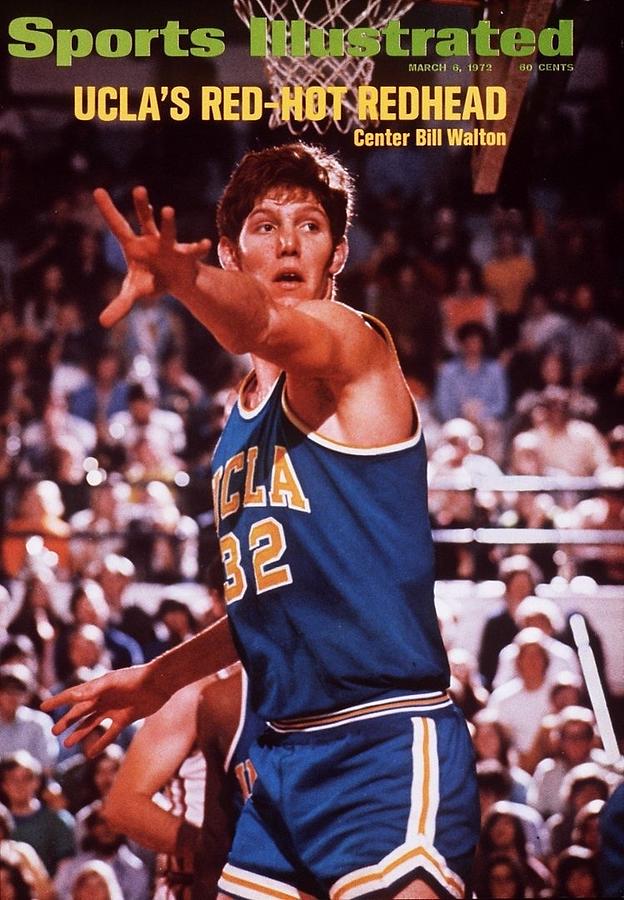
Bill Walton was a loner, Dottie. A rebel. Yet he wanted to play basketball for the best coach in the college game, John Wooden of the University of California at Los Angeles. Having already led UCLA to the National Championship in 1964, 1965, 1967, 1968, 1969 and 1970, Wooden wanted him, too, and may have been the only coach who could make him fulfill his potential.

Until 1972, NCAA rules prohibited freshmen from playing on varsity teams, except in emergency conditions; so Wooden won the 1971 National Championship without Walton. Together, they won the National Championship in 1972 and 1973, and forged an 88-game winning streak from January 23, 1971 to January 19, 1974 that remains the record for men's college basketball. This included Walton's 21-for-22 shooting in the 1973 Final against Memphis State. In 1973, the Amateur Athletic Union (AAU) gave him the James E. Sullivan Memorial Award, as America's outstanding amateur athlete.

This was in spite of Walton's choice not to play for the U.S. team in the 1972 Olympics in Munich, Germany. At the time, it was thought to be because of his opposition to the Vietnam War. But it wasn't true: It was due to his bad experience at the 1970 World Championships, in Yugoslavia, under coach Hal Fisher. In a 2004 interview with ESPN, Walton said, "For the first time in my life, I was exposed to negative coaching and the berating of players, and the foul language, and the threatening of people who didn't perform."

In the men's basketball final, the U.S. controversially lost to the Soviet Union, 51-50. According to Russian sports historian Robert Edelman, "When they saw who was and wasn't on the U.S. team, that's when they started feeling like they'd actually have a chance. They followed American basketball closely, and they knew that no Walton was going to be a big deal." James Forbes was on that U.S. team, and he said, "If he plays, all of this becomes academic." Much like, that same month, if Bobby Orr hadn't been hurt, or if the NHL had led WHA defector Bobby Hull play for Canada, that hockey "Summit Series" doesn't go to the last minute of the last game.

(Speaking of Edelman: I heavily recommend his 2012 book about one of the world's great soccer teams, also a good work of Soviet national history: Spartak Moscow: A History of the People's Team in the Workers' State.)

A joke went around that "UCLA" stood for "U Can't Lose to Anybody." On January 19, 1974, UCLA traveled to play Notre Dame away. Coached by Richard "Digger" Phelps, and led by a freshman from Washington, D.C. named Adrian Dantley, the Fighting Irish -- who, 3 years earlier, were the last team to beat UCLA -- were 9-0, and ranked Number 2. Unlike UCLA's 1968 loss to the University of Houston at a packed Astrodome, this game was not billed beforehand as a "Game of the Century."

Had it been, it would have lived up to the hype. UCLA led by 11 points with 4 minutes to play. But Notre Dame went on a tear, and, with 6 seconds to go, took their 1st lead of the game, 71-70. One last-gasp effort by Walton missed, and the streak was over. (The University of Connecticut women's team broke the record with a 90-game streak, 2008-10.)

People who met Bill Walton were advised to never, ever mention this game to him. In his 1993 memoir Nothing But Net, he said it still bothered him. He complained about it many times afterward.

One week later, on January 26, there was a rematch at Pauley Pavilion in Los Angeles, and UCLA got its revenge, 94-75. Notre Dame finished the season 26-3, losing to Michigan in the NCAA Tournament's round of 16.

UCLA would get to the Semifinal, then lose to a North Carolina State team led by David Thompson. N.C. State then beat Marquette for the title. Without the graduating Walton, Wooden led UCLA to 1 last National Championship in 1975, and retired, winning 10 in 12 years. No other school has won that many. UCLA has since won an 11th title, in 1995.

Did I mention that Walton was a rebel? He wanted to grow his hair long, and to grow a beard. Wooden told him no. Walton took the high road, and calmly explained to Wooden that he was an adult, over age 18, and had the right to express himself that way; and, as an employee of a State university, Wooden had no right to stop him.

Wooden -- who also continued to call his previous big star, Kareem Abdul-Jabbar, formerly named Lew Alcindor, "Lewis," and Kareem let him because of his high regard for him -- said, "William, I respect your right to express yourself. I'm sorry to see you go." Wooden was right: He did have the right to set rules for his players, and that if Walton wanted to break those rules, he would not play.

Walton's senior year, 1973-74, was the time of Watergate. He took a sheet of stationery with the UCLA masthead on it, wrote a letter on it, demanding that President Richard Nixon resign, and got all the UCLA basketball players to sign it. He then gave it to Wooden to sign. Wooden wouldn't sign it. Not because he thought Nixon should stay in office, but because the letter was on official UCLA stationery, and sending it would be tantamount to the school making the resignation demand its official policy. And Wooden was not willing to compromise the school that way. Walton understood.

*

Walton was drafted by the Portland Trail Blazers. At first, he looked like tennis star Bjorn Borg: The Swede had long blond hair, wore a headband, and, just as some hockey players grow "playoff beards," he grew a beard only during Wimbledon. Walton had red hair, but the Blazers' red jerseys and a matching red headband were even redder than the hair and beard he was finally allowed to grow.
But hippie-ish Portland was his kind of place. He rode a bicycle from his apartment to the Portland Memorial Coliseum. He became a vegetarian, and began meditating. He began leaving tickets for his favorite band, the epitome of hippiedom: The Grateful Dead. He claimed to have seen them play over 850 concerts, including joining them on drums in a 1978 concert. At the Pyramids in Egypt. The band nicknamed him "Grateful Red."

Walton would later compare the Dead to a basketball team: There were five of them, they were a team, people traveled around to watch them perform, and their performances often included improvisation. "Of course," he said, "unlike a basketball team, the Grateful Dead have no opponents, unless you consider the police."

But the injury bug struck him again. He played only 35 games in 1974-75, rendering him unable to win the NBA's Rookie of the Year. (His UCLA teammate, Jamaal Wilkes, won it.) He was limited to 51 games in 1975-76. And he played 65 out of the 82 games in 1976-77.

But it was enough. The Blazers' head coached was Dr. Jack Ramsay, a Philadelphia native with a doctorate in education from the University of Pennsylvania. He had been the general manager of the Philadelphia 76ers when they won the 1967 NBA Championship. Blazers owner Larry Weinberg and general manager Harry Glickman hired Ramsay away from the Buffalo Braves in 1976.

And that 1st season in Portland, even more than the 68-13 1966-67 title season in Philadelphia, was Ramsay's masterstroke. A record of 49-33 was not particularly outstanding. But, talent-wise, they were: With Bill Walton at center; Maurice Lucas, Bob Gross, Corky Calhoun, Larry Steele and Lloyd Neal as forwards; and Lionel Hollins, Johnny Davis and Dave "Pinball" Twardzik as guards, the Blazers played the kind of artistic basketball that had rarely been seen: By the early 1970s New York Knicks, or maybe by one team or another in the ABA, but that was it.

In the Playoffs, the Blazers beat the Chicago Bulls, 2 games to 1; the Denver Nuggets, 4 games to 2; and the Los Angeles Lakers in 4 straight, including a signature dunk by Walton over his fellow UCLA graduate Kareem. In the Finals, the 76ers won the 1st 2 games, but the Blazers won the last 4, including a thrilling clincher in Portland in Game 6, 109-107. Walton was named the Most Valuable Player of the Finals.

In the locker room after that game, Ramsay -- who had previously coached Wilt Chamberlain in Philadelphia -- told the media, "I've never coached a better player, I've never coached a better competitor, and I've never coached a better person than Bill Walton." Walton, who, by this point, had ditched the headband and the long hair, but not the beard, said little: He was still badly affected by a stutter that he would later overcome. But his smile told the story.
Left to right: Jack Ramsay, Larry Weinberg,
Bill Walton & NBA Commissioner Larry O'Brien.
The championship trophy is now named for O'Brien.

For 11 months, from March 29, 1977 to February 28, 1978, the Portland Trail Blazers They went 70-15, counting the Playoffs, winning the franchise's 1st (and still only) NBA Championship. Walton was named the NBA's MVP in 1978. Boston Globe columnist and ESPN correspondent Bob Ryan said that this team played the game of basketball as well as it has ever been played.
Ryan also called them "the greatest what-if story in the history of basketball. If that team stays healthy, and stays together, I think we're looking at 3 out of 4, 4 out of 6."
It may have been even better than that. The next 2 NBA Western Conference titles were won by the Seattle SuperSonics, a good team, but with only one Hall-of-Famer, and he wasn't even considered their best player yet: Dennis Johnson. The Lakers got Earvin "Magic" Johnson for the 1979-80 season, so the Blazers probably don't reach the Finals that year. But in 1981, the Houston Rockets had a losing record, and made the Playoffs as the West's 6th seed. The Blazers could have reached 3 straight Finals, and 4 out of 5, before the Lakers totally took over the West.
But on February 28, 1978, Bill Walton, the Trail Blazers' fulcrum, broke his foot. Although he returned for 2 games of the Playoffs that year, he was never the same player again, and it took the Blazers a decade to recover. He was unhappy about the way the team's medical staff handled him, and demanded a trade. They wouldn't do it, and he sat out the 1978-79 season -- not that his injury left him with another choice.
Following his retirement, Walton and the Blazer organization reconciled. But the team has never truly replaced him. Their quest for another dominating big man led them in 1984 to draft Sam Bowie instead of Michael Jordan, and in 2007 to draft Greg Oden instead of Kevin Durant. As with Walton, both Bowie and Oden had already had a major injury, and both would see their pro careers ruined by additional injuries.
When ESPN did an episode of The Top 5 Reasons You Can't Blame... on drafting Bowie instead of Jordan, one of the reasons was "The Curse of Bill Walton." Walton was interviewed for the show, and, with a smile, knowing that it wasn't a curse that he'd actually placed on the team, he said, "Blame me." 
*
His contract having run out, he signed with his hometown team, the San Diego Clippers. But his injuries recurred. In 1979-80, Walton played only 14 games. He missed the 1980-81 season. He missed the 1981-82 season. He played 33 games in 1982-83. In other words, from February 28, 1978 to October 28, 1983, 5 1/2 years, he played only 47 of a possible 443 games -- 10.6 percent. As he said in 1981, after one of his surgeries, "Minor surgery is what they do to someone else."

He managed to get into 55 games in 1983-84. But it was too late for the team. A healthy hometown hero might have brought a sellout of 14,000 fans to the San Diego Sports Arena (now named the Pechanga Arena) for every game. But without the key figure, no one wanted to spend their money to watch professional basketball.
Number 7 is Bobby "Bingo" Smith.
Both men would get their numbers retired:
Smith by Cleveland, Walton by Portland,
and neither by the Clippers.

"When you fail in your hometown, that's as bad as it gets, and I love my hometown," Walton said. "I wish we had NBA basketball here, and we don't, because of me. It's my greatest failure as a professional in my entire life: I could not get the job done in my hometown. It is a stain and stigma on my soul that is indelible. I'll never be able to wash that off, and I carry it with me forever."

Walton was a bit hard on himself. He didn't get hurt on purpose. But if he had been healthy, maybe the Clippers would have survived in San Diego, instead of being moved to Los Angeles, where they were a joke franchise for nearly 30 years, and have still only reached the Conference Finals once in 54 seasons, in 3 cities: In 2021, losing to the Phoenix Suns.

He played 67 games for the Clippers in 1984-85, their 1st season in Los Angeles. Then Red Auerbach, president of the Boston Celtics, pulled off his last great transaction: He sent the Clippers Cedric "Cornbread" Maxwell and a 1st-round draft pick, eventually wasted on Arvydas Sabonis, then stuck behind the Iron Curtain, for Walton.

In the 1985-86 season, the Celtics went 67-15, including 40-1 at the Boston Garden. Ironically, it was Portland who dealt them their only home loss, on December 6. Walton, now 33, saw that Kevin McHale, a future Hall-of-Famer, was wearing his usual Number 32. So he added 3 plus 2, and wore Number 5.

Walton backed up center Robert Parish, with forwards McHale and Larry Bird, the on-court leader of that team, and the most popular player in Celtic history. The guards were Danny Ainge and the aforementioned Dennis Johnson. Also notable on that team was guard Rick Carlisle, who went on to coach the Dallas Mavericks to the 2011 NBA Championship, and the Indiana Pacers into this year's Eastern Conference Finals.

On a 1996 ESPN broadcast to debate the greatest NBA team ever, in which he also made the aforementioned comments about the '77 Blazers, Ryan nominated the '86 Celtics, calling them "the team that could beat you the most different ways. He said his best argument was that it was the only team that ever brought a healthy Bill Walton off the bench. Being the backup center was key for Walton: Not having the burden of being the starter, and averaging 19 minutes per game, instead of the 33 he usually averaged when healthy, he was able to play in 80 of the 82 regular-season games.

He also played in 14 of the 16 Playoff games: In all 3 of the Celtics' 3-game sweep of the Bulls, in all 5 of the Celtics' win over the Atlanta Hawks, in all 4 of the Celtics' 4-game sweep of the Milwaukee Bucks, and in 4 of the 6 games in the Finals, where the Celtics beat the Rockets, for their 16th NBA Championship, their 3rd in 6 years, and Walton's 2nd, making him one of the few players to win with 2 different teams.

Between them, the 7-foot-1 Parish and the 6-foot-11 Walton had little trouble against the Rockets' "Twin Towers" of 7-feet-even Hakeem Olajuwon and the 7-foot-4 Ralph Sampson. Sampson, next to Walton, is the patron saint of great college players whose injuries kept them from reaching their true pro potential.

Ryan called Walton "the most influential player ever to lace up a pair of sneakers." Walton was an all-time great, but Ryan knows better than that: He is old enough to have seen Bill Russell and Bob Cousy play against Wilt Chamberlain. Theoretically, he's old enough to have seen George Mikan play. But Ryan also said that Bird and Walton, playing together, "It was sinful. It was almost pathetic." He said, "They raised basketball to the level of something almost spiritual." Walton himself said, "Playing basketball with Larry Bird is like singing with Jerry Garcia."
Left to right: Walton, Bird, Parish

But it was only to be for that 1 season. He was injured again the next season, and played only 10 regular-season games. He played in the 1987 Finals, which the Celtics lost to the Lakers. He was 34 years old. He never played again. He still held out hope of a comeback, but finally announced his retirement in 1990.

"I would love to play one more game", Walton said he wished. "But then I would want to play another one. And another one. But I will take one."

*

The fact that he became a broadcaster surprised people who knew him. He credited the 1st great NBA broadcaster, Marty Glickman, with helping him overcome it. As Walton said:

I'm a stutterer. I never spoke to anybody. I lived most of my life by myself. But as soon as I got on the court, I was fine. But in life, being so self-conscious, red hair, big nose, freckles and goofy, nerdy looking face, and can't talk at all. I was incredibly shy and never said a word. Then, when I was 28, I learned how to speak. It's become my greatest accomplishment of my life, and everybody else's biggest nightmare.

He worked for CBS in 1990 and 1991, NBC from 1990 to 2002, the Clippers from 1990 to 2002, and ABC/ESPN from 2002 to 2009. He had to step aside due to terrible back pain and the subsequent spinal-fusion surgery. It was so bad, he could not walk into the hospital.

He was able to return to broadcasting in 2010, 2 seasons for the Sacramento Kings. In 2012, he returned to ESPN, and also joined the Pac-12 Network, broadcasting games on the West Coast, to stay close to home in San Diego. His hippie mindset led to some odd opinions on the air, endearing him to some, but not all.

Walton and his 1st wife, Susie, were married from 1979 to 1989. They had 4 sons: Adam, Nathan, Luke and Chris. In 1991, Bill married Lori Matsuoka, and they were together until death did they part.

Luke Walton, 6-foot-8, was a forward, was with the Lakers when they won the 2009 and 2010 NBA Championships. The Waltons thus became the 3rd father-son tandem to both win NBA titles, following the Matt Guokasas (Sr., 1947 Philadelphia Warriors; Jr., 1967 Philadelphia 76ers) and the Barrys (Rick, 1975 Golden State Warriors; Brent, 2005 and 2007 San Antonio Spurs). Luke was an assistant coach to Steve Kerr on the Golden State Warriors' 2015 title, was the Lakers' head coach from 2016 until 2019, and was the Sacramento Kings' head coach from then until 2021. Since 2022, he has been an assistant coach for the Cleveland Cavaliers.

Bill Walton was named to the Basketball Hall of Fame. The NBA named him to its 50th Anniversary 50 Greatest Players and its 75th Anniversary 75 Greatest Players. UCLA made its 1st 2 basketball retired numbers Kareem's Number 33 and Walton's Number 32. The Trail Blazers also retired his Number 32. (The Celtics retired Number 5, but for a later player, Kevin Garnett.)

He was elected to the San Diego Hall of Champions, the California Sports Hall of Fame, and the Oregon Sports Hall of Fame. In 2016, a statue of him was unveiled at Ski Beach Park in the Mission Bay section of San Diego.

In his life, he underwent 39 surgeries. Still, echoing baseball icon Lou Gehrig, he said, "I'm the luckiest guy on Earth." 

Bill Walton moved to a new plane of existence today, May 27, 2024. He was 71 years old, and had cancer.
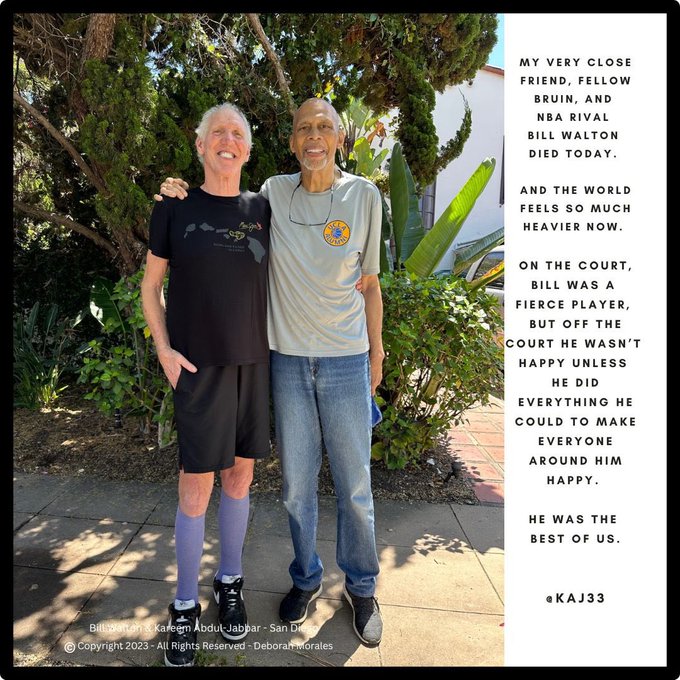
Kareem's tribute
 
Hosting ESPN's Around the Horn today, Tony Reali said, "He will be lovingly referred to as an American original. I would like to respectfully question that, because that would mean that he was from this planet. And we all know Bill traveled intergalactically and on a multiverse plane."

On that same show, Clinton Yates pointed out that it was "almost poetically memorable" that Walton passed away at the same time as the league in which UCLA played, and for whom he broadcast, known in its last few years as the Pac-12.

Some other tributes:

* Larry Bird: "I am very sorry about my good friend, Bill Walton. I love him as a friend and teammate. It was a thrill for me to play with my childhood idol and together we earned an NBA Championship in 1986. He is one of the greatest ever to play the game. I am sure that all of my teammates are as grateful as I am that we were able to know Bill, he was such a joy to know and he will be sorely missed."

* Magic Johnson: "From shooting jump shots to making incredible passes, he was one of the smartest basketball players to ever live. Bill was a great ambassador for college basketball and the NBA, and he will be sorely missed."

* Julius Erving, another playing and style icon turned broadcaster: "I am sad today hearing that my comrade & one of the sports worlds most beloved champions & characters has passed. Bill Walton enjoyed life in every way. To compete against him & to work with him was a blessing in my life. Sorry for your loss Walton family. We’ll miss him too."

* John Fogerty, leader of rock band Creedence Clearwater Revival: "So sad that our friend Bill Walton has passed away. He was truly a very special and joyful person and his megawatt smile made everyone smile! His enthusiasm for life and all things rock and roll was unstoppable and we miss you Bill! Our love and prayers to Lori and family."

* Barack Obama, former President, basketball fan: "Bill Walton was one of the greatest basketball players of all time – a champion at every level and the embodiment of unselfish team play. He was also a wonderful spirit full of curiosity, humor and kindness. We are poorer for his passing."

Once, appearing on an ESPN broadcast, tie-dyed T-shirt on, a Hawaiian lei around his neck, he said, "It doesn't get any better than this."

We all have our definitions of that. But who am I to try to convince Bill Walton of mine?

Saturday, February 5, 2022

How to Be a New York Basketball Fan In Portland -- 2022 Edition

Next Saturday, February 12, the New York Knicks will visit the Portland Trail Blazers. The Brooklyn Nets did so on December 23, but that game coming so close to Christmas made travel recommendations difficult, so I postponed this Trip Guide until now.

Before You Go. Like its Pacific Northwest neighbors Seattle and Vancouver, Portland is notorious for rain. The game will be indoors, but you won't be indoors on the entire visit. The website for The Oregonian, Portland's major newspaper, says the temperatures will be in the high 50s by day and the high 30s by night on Saturday. But, unusually, they are predicting neither rain nor snow for the next week.

Portland is in the Pacific Time Zone, 3 hours behind New York. Adjust your timepieces accordingly.

Tickets. At the old Coliseum, the Blazers couldn't even fit in 13,000 people. From their 1977 title run until they moved out in 1995, the attendance was the same every night: 12,880, later 12,888. That was 814 consecutive sellouts.

Today, they're in the Moda Center, with 19,441 seats. They haven't sold out every game in the 20 years since they moved it, but they averaged 19,706 in 2019-20, before COVID shut everything down, so that's a sellout. Tickets will be tough to get.

But, for the moment, they are available, if very expensive. Tickets in the 100 Level are $389 between the baskets, and $162 behind them. In the 200 Level, $314 between and $108 behind. In the 300 Level, $66 between and $42 behind.

Getting There. Keep in mind, this game will be played on December 23. Meaning you will most likely be coming home on Christmas Eve. If you're not flying, you'll also be traveling on Christmas Day, when a lot of places will be closed, so driving would be the most complicated method of all. Not counting Amtrak, which is literally impossible at this point. In other words, if Portland is an NBA city that you really want to "cross off your list," my suggestion is to wait until next season.

It's 2,895 miles from Times Square to the Moda Center in Portland. In other words, if you're going, you're going to want to fly.

After all, even if you get someone to go with you, and you take turns, one drives while the other one sleeps, and you pack 2 days' worth of food, and you use the side of the Interstate as a toilet, and you don't get pulled over for speeding, you'll still need over 2 full days to get there. One way.

But, for future reference, if you really, really want to drive... Get onto Interstate 80 West in New Jersey, and stay on that through Pennsylvania, Ohio, Indiana, Illinois, Iowa, Nebraska, Wyoming and Utah. Outside Ogden, Utah, at Exit 168, switch to Interstate 84 West. Take that into Idaho and Oregon, all the way to the end of I-84.

Not counting rest stops, you should be in New Jersey for an hour and a half, Pennsylvania for 5:15, Ohio for 4 hours, Indiana for 2:30, Illinois for 2:45, Iowa for 5 hours, Nebraska for 6:45, Wyoming for 6:30, Utah for 3:30, Idaho for 5:30, and Oregon for 6:15. In total, that's around 49 1/2 hours. Given rest stops, we're talking more like 60 hours -- 2 1/2 days.

That's still faster than Greyhound (70 hours, changing buses 3 times, $451 round-trip, but it drops to $332 with advanced-purchase) and Amtrak (67 hours, changing in Chicago, $588 before booking sleeping arrangements). Union Station, which serves both carriers, is at 550 NW 6th Avenue. 6th & Hoyt station on MAX.

This time, though, you'd have to leave Port Authority at 12:05 AM on Monday, to arrive in Portland at 6:20 PM on Wednesday, over 24 hours before tipoff, making -- I swear, I am not making this up -- 6 bus changes: You'll have to transfer in Columbus (Ohio), Chicago, Minneapolis, Billings (Montana), Spokane and Stanfield (Oregon). So, why not take the next bus that could start you on the process to Portland? It won't arrive until Friday, a few hours after the game ends.

On Amtrak, you would leave Penn Station on the Lake Shore Limited at 3:40 PM Eastern Time on Wednesday, arrive at Union Station in Chicago at 9:50 AM Central Time on Thursday, and board the Empire Builder at 2:15 PM, and would reach Union Station in Portland at 10:10 AM Pacific Time on Saturday.

But COVID restrictions have wrought havoc with Amtrak. As a result, to get from New York to Portland by rail, you'll need at least 3 trains, possibly 4. So, no Amtrak this time.

A round-trip flight from Newark to Portland International Airport (whose call letters, PDX, have also become a nickname for the city) will almost certainly not be nonstop, but, if you're willing to leave early in the morning, you could get it for less than $300. The MAX Red Line will get you from the airport to downtown in 33 minutes.

Once In the City. Founded in 1845 as the end of the Oregon Trail, in the shadow of Mount Hood, legend has it that the name of the town was decided by a coin flip between 2 of the original settlers. Francis Pettygrove wanted to name the town after his hometown of Portland, Maine. Asa Lovejoy was from Groton, Massachusetts. Pettygrove won, and that's why the Knicks and the Nets don't play the Groton Trail Blazers.
Portland, a.k.a. the Rose City, has a population of around 653,000, and a metro area of about 3.2 million. It's still growing, but not as fast as it was in the 1980s and '90s, when a group successfully lobbied to slow down the suburban sprawl. It was named PLAN, for Prevent Los Angelization Now. It's about 75 percent white, 10 percent Hispanic, 8 percent Asian and 7 percent black.

The State of Oregon has no sales tax, and this covers the County of Multnomah and the City of Portland. The Willamette River is the divider between east and west, and Burnside Street, including its bridge over the river, is the divider between north and south. Portland has no beltway.

ZIP Codes in Oregon begin with the digits 97, and Portland and its suburbs use 970 and 971. The Area Code for Portland is 503, with 971 overlaid. Portland General Electric (PGE) runs the electricity. And, if you're from New Jersey, you'll like this: Oregon is the only other State in the Union where you do not have to pump your own gas.
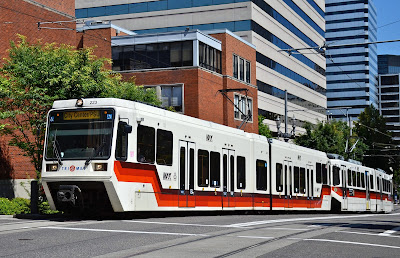
TriMet, the area's public transit service, runs buses and the MAX light rail system. A single fare is $2.50, while a day pass is $5.00. They also run the WES Commuter Rail.
A MAX train, downtown

The capital of Oregon is Salem, about 50 miles southwest of downtown Portland. The 1st 2 State Houses were destroyed by fires in 1855 and 1935. The new State House opened in 1938, but it looks like a cross between an Art Deco church and a prison. Fortunately, the grounds are covered with examples of Oregon's natural beauty, but also include a pair of burned, broken pillars from its predecessor.
The State House in Salem

Going In. The official address of the Moda Center is 1 North Center Court Street. The building is bounded by Ramsay Way (named for former head coach Jack Ramsay) on the north, Wheeler Avenue on the east, Multnomah Street on the south and Center Court Street on the west. MAX reaches the arena via Rose Quarter and Interstate stations.

Definitely walk from your hotel or take public transit, because parking spaces are expensive, running around $22. If you do come in by MAX, you'll probably be entering through the south side of the arena.
Opening in 1995 as the Rose Garden, it was renamed for healthcare provider Moda Health in 2013. It is also home to the Western Hockey League's Portland Winterhawks (for some but not all games), and the Arena Football League's Portland Thunder. The court is aligned northwest to southeast.
The Blazers' former home, the Veterans Memorial Coliseum, is across Center Court Street. It opened in 1960, and was home to the Blazers from their 1970 debut until 1995, and the Winterhawks full-time from 1976 to 1995 and part-time since then.
The Coliseum

It hosted the 1965 NCAA Final Four, with UCLA beating Michigan in the Final. This was also the 1st Final Four to feature a New Jersey-based team, the Princeton squad led by future Knick and future U.S. Senator Bill Bradley. The Beatles performed at the Coliseum on August 22, 1965, and Elvis Presley sang there on November 11, 1970 and April 27, 1973.
The Moda Center, with the Coliseum behind it

Food. I couldn't find a section guide to the concession stands, but the arena website did say this:

Delicious icons from Portland's restaurant scene fill the Moda Center at the Rose Quarter.

Sandwich specialists Bunk Sandwiches will continue to bring Portland's favorite sandwiches to Trail Blazers fans. Pizzeria extraordinaire Sizzle Pie and Salt and Straw Ice Cream anchor the new local focus of the Moda Center menu. These new additions, returning fan favorites and fresh concepts created by the venue's food service partner, Levy Restaurants, are sure to please all who attend.
Levy Restaurants also recently unveiled new food concepts including Fowl Language, featuring fried chicken, wings, and chicken biscuit sandwiches. The Pines is a new bar on the 300 level which features craft beers, cocktails and extraordinary views of the Portland skyline. 

In addition to the new culinary experiences, Levy Restaurants also recently introduced a number of new food carts. Plum Tasty is a healthy food cart brought to you by Moda, where slow food is served fast.  It's a delicious way to dine during the game with mouth-watering food made fresh and healthy just for you, including vegetarian options and healthy grab 'n go snacks.  Plum Tasty is located at Entry A9 on the Main Concourse. Humble Slider features a variety of house-made sliders, and at the Polanco cart you can dine on nachos, tacos and more. The Cones cart serves hand-dipped ice cream cones with many toppings and dips for you to choose from.

The Club Level provides each guest with an exquisite variety of food and beverage options. Nook offers a range of vegan, vegetarian and gluten-free options. At the Hot Stone location you're able to pick from an excellent selection of artisan pizzas, pastas and salads.  Oven toasted sandwiches and 1/3 pound burgers are served at the Junction 5 location.  The Club Level also features Portland favorites such as Bunk Sandwiches, Cha Cha Cha traditional Mexican Food, and Salt and Straw farm to cone ice creams. 

Team History Displays. The Blazers aren't a particularly old team, nor an especially successful one. But they celebrate the history they do have heavily. They hang banners for their 1977 NBA Championship; their 1977, 1990 and 1992 Western Conference Championships; and their 1978, 1991, 1992, 1999, 2015 and 2018 Division titles.
A whopping 8 players, plus the head coach, the owner, and a broadcaster from their 1977 NBA Championship team have been honored with retired number banners. Retired are 13 for guard Dave Twardzik, 14 for guard Lionel Hollins, 15 for guard Larry Steele, 20 for forward Maurice Lucas, 30 for forward Bob Gross, 32 for center Bill Walton, 36 for forward Lloyd Neal, and 77, in honor of the year, for the coach, Dr. Jack Ramsay.

Number 1 for owner Larry Weinberg is in the rafters, but is still available to be worn by a player. A microphone is retired for broadcaster Bill Schonely.

Guard Geoff Petrie, the 1st player ever drafted by the Blazers in 1970, was 1971 NBA Rookie of the Year, but was traded for Lucas before the 1976-77 season. Nonetheless, the Blazers retired his Number 45. From the 1990 and 1992 Western Conference titles, they've retired the numbers of guards Clyde "the Glide" Drexler, 22; and Terry Porter, 30. In 2008, they had a dual-retirement ceremony for 30, for Gross and Porter.

The Blazers' retired number banners are, as far as I know, unique is sports, in that they have the honorees' signatures stitched onto them.
In addition to Walton, Drexler and Ramsay, Blazers in the Basketball Hall of Fame include guard Lenny Wilkens (the last season of his playing career, 1974-75, player-coach that year and coach only the next), guard Dražen Petrović (before he became a New Jersey Net), forward Scottie Pippen (for 4 seasons after he left the Chicago Bulls), and center Arvydas Sabonis. Rick Adelman, who coached them to the 1990 and '92 NBA Finals, has also been elected. Maurice Cheeks was Blazer coach for 4 years, but was elected for playing with the Philadelphia 76ers.

Walton, Drexler, Wilkens and Pippen were named to the NBA's 50th Anniversary 50 Greatest Players, but only Walton and Drexler for what they did in Portland. Those 4, plus Carmelo Anthony and current Blazer star Damian Lillard, were named to the NBA's 75th Anniversary 75 Greatest Players.

The Winterhawks have won the President's Cup as Champions of the Western Hockey League in 1982, 1998 and 2013, and the Memorial Cup in 1983 (making them the 1st team from outside Canada to win it) and 1998. 

Don't be confused by their banners: While the Chicago Blackhawks were originally stocked by players bought from the defunct Portland Rosebuds, the Winterhawks have not only a similar name but the same red & black colors and the same Indian Head logo as the Chicago team, and they even followed the "Black Hawks" by shortening their name from 2 words ("Winter Hawks") to 1, they are not a farm team of the Blackhawks.

Winter Hawks/Winterhawks alumni include Hall-of-Famers Mark Messier and Cam Neely, the brothers Dave & Wayne Babych, Adam Deadmarsh, Brandon Dubinsky, Ray Ferraro, the brothers Marcel & Marian Hossa, Clint Malarchuk, Brenden Morrow, the brothers Jim & Larry Playfair, Mike Vernon, and the brothers Blake & Glen Wesley.

There is an Oregon Sports Hall of Fame, at 4840 SW Western Avenue in Beaverton, about 7 miles southwest of downtown Portland. Buses 54 and 56 will drop you 2 blocks away. Members include Trail Blazers Bill Walton, Maurice Lucas, Dave Twardzik, Geoff Petrie, Clyde Drexler, Terry Porter, Jim Paxson, Jerome Kersey and Damon Stoudamire.

Among other inductees: Danny Ainge, a native of Eugene, played 2 seasons with the Blazers; Jim Barnett, an original Blazer in 1970, as is now known as the TV voice of the Golden State Warriors; Steve "Snapper" Jones, before becoming a broadcaster, played the 1975-76 season for the Blazers; and Gary Payton played at Oregon State, but played most of his Hall of Fame pro career for the Blazers' arch-rivals in Seattle. Which segues to...

The rivalry between the NBA's 2 Pacific Northwest teams -- not counting the 1995-2001 experiment with the Vancouver Grizzlies -- ended in 2008, after 38 seasons, with the Blazers trailing the Seattle SuperSonics 98-94 in games.

Stuff. The Trail Blazers Fan Shop is in the Moda Center, open during games, and 11 AM to 3 PM otherwise.

Amazon.com doesn't have any DVDs about the Blazers -- not even a retrospective of their 1977 title season. Just VHS tapes. They do have some books. Jack Scott wrote Bill Walton: On the Road With the Portland Trail Blazers after their title season of 1976-77. Walton and Wayne Thompson wrote Blazermania: This Is Our Story -- The Official History of the Portland Trail Blazers in 2010, on the team's 40th Anniversary. 

During the Game. Portland is a relatively safe city. The Blazers had a bit of a rivalry with the Seattle SuperSonics, but with the Sonics gone, PTB games are rather peaceful. They have no history of animosity with either the Knicks or the Nets, and as long as you don't provoke anybody, you'll be fine.

A November 13, 2014 article on DailyRotoHelp ranked the NBA teams' fan bases, and listed the Blazers' fans 3rd: "This is one of the more dedicated fan bases in all of professional sports... This is truly a fan base that would be crushed if the team were to leave town." A swipe at the underwhelming response of Seattle to losing the Sonics, perhaps?

The original version of the Pinwheel logo

The Blazers have perhaps the funkiest logo in sports: Designed by a cousin of team founder Harry Glickman (Harry is still alive at age 94), it's been called a "pinwheel," and represents 2 5-on-5 basketball teams lined up against each other, one wearing red, the other silver.
The current version

Neither of the New York teams' visits will feature a promotion. The Blazers hold auditions for National Anthem singers, rather than having a regular singer. Their theme song is an instrumental titled "Crazy" (with no connection to the Patsy Cline song of the same title). But the only notable fan chant is, "Let's go, Blazers!"

In addition to the BlazerDancers cheerleaders, a junior dance team composed of 8- to 11-year-old girls also performs at selected home games, as does a hip-hop dance troupe. Other regular in-game entertainment acts include a co-educational acrobatic stunt team which performs technically difficult cheers, a breakdancing squad known as the Portland TrailBreakers, and a pair of percussion acts.

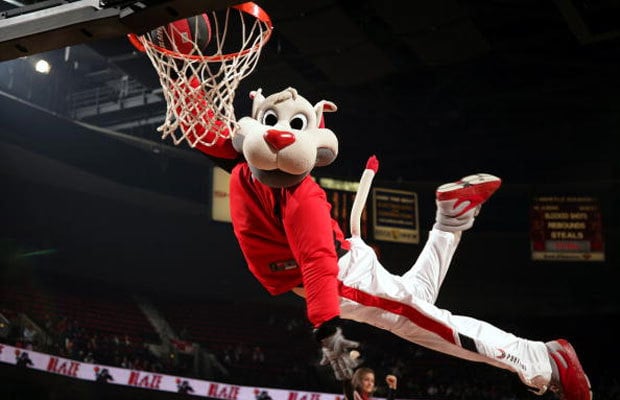
The mascot is Blaze the Trail Cat, a mountain lion, which makes sense, given the Cascade Mountains in which Portland sits. Like the Gorilla in Phoenix and Hugo the Hornet in Charlotte, Blaze does trick dunks.
After the Game. Portland's reputation for safety, and their fans' reputation for being noisy but not nasty, will work in your favor. Both you and your car should be safe.

If you're hungry after the game, on Martin Luther King Blvd. at Hassalo Street, 6 blocks east of the arena, there's a Burgerville. On Hassalo, there's a Denny's, and around the corner, on Grand Avenue, there's a Red Robin. Spirit of 77 is a Blazers-themed bar at 500 NE MLK Blvd. at Lloyd Blvd., across from the Oregon Convention Center, a 5-minute walk from the Moda Center.

The Jolly Roger, at 1340 SE 12th Avenue at Madison Street, is known as a hangout for New York Giants fans. They may also be welcoming to Knicks or Nets fans. Bus 4 from Rose Quarter Transit Center. I have also heard that Kingston Bar & Grill is a Giant fans' bar. 2021 SW Morrison Street, at 20th Place, across from Providence Park.

If you visit Portland during the European soccer season, which we are now in, the likeliest place to watch your favorite club is at the Toffee Club, 1006 SE Hawthorne Blvd. Bus 14.

Sidelights. On November 30, 2018, Thrillist published a list of "America's 25 Most Fun Cities," and Portland came in 19th. Portland doesn't have much of a sports history besides the Blazers. But there are a few items worth mentioning, besides the Coliseum and the Moda Center.

* Providence Park. This started as a minor-league baseball field named Multnomah Field in 1893. It was replaced by Multnomah Stadium in 1926. The name has been changed to Civic Stadium in 1966, PGE Park in 2001, Jeld-Wen Field in 2011 and Providence Park in 2014.
In this photo, you can tell that it was designed for baseball.

At 21,444 seats, it was one of the largest ballparks in the minor leagues. It was home to the Pacific Coast League's Portland Beavers from 1956 to 1972, again from 1978 to 1993, and again from 2001 to 2010. They only won 1 Pennant there, in 1983, but won 4 Division titles: 1965, 1983, 1993 and 2004.

It was home to the Portland Mavericks of the Northwest League, the team with whom Jim Bouton began his post-Ball Four comeback and co-invented Big League Chew. It was home to the Portland Rockies of the Northwest League from 1995 to 2000. Currently, the city doesn't have a professional baseball team.

Portland State University plays football there, and both the University of Oregon and Oregon State University played "home" games on the site between 1894 and 1970. It was home to the Portland Storm, later the Portland Thunder, of the World Football League in 1974 and '75, and the Portland Breakers of the USFL in 1985.

The original Portland Timbers, of the original North American Soccer League, played there from 1975 to 1982. After the NASL folded, the Timbers were reconstituted, began play in 1985, folded again in 1990, started again in 2001, and joined Major League Soccer in 2011.

The Portland Thorns of the National Women's Soccer League began play there in 2013, and, like their masculine counterparts, are one of the best-supported teams in their league. They won the title in that 1st season, and won it again this year.

Civic Stadium hosted Soccer Bowl '77, in which Pelé and the New York Cosmos won the NASL title by beating the Seattle Sounders, making it Pelé's last competitive match. (I wonder if the Portland fans rooted against Seattle.) 

It hosted 4 games of the 1999 Women's World Cup, and 6 of the 2003 edition, 1 involving the U.S. It's hosted 4 games of the U.S. men's national team, 3 wins and a draw, most recently a 2013 win over Belize.

Elvis played one of the earliest stadium concerts at Multnomah Stadium on September 2, 1957. 1844 SW Morrison Street. Kings Hill/SW Salmon Street MAX station.

* Vaughn Street Park site. The PCL Beavers began playing at the 12,000-seat Vaughn Street Park in 1901. They won 8 Pennants there: 1901, 1906, 1910, 1911, 1913, 1914, 1936 and 1945. A fire in 1947 burned down the bleachers, which led to the Beavers giving up on it after the 1955 season, and moving to what's now Providence Park.

It's an industrial area now, and a plaque honoring the ballpark is on the site. 2401 NW Vaughn Street at 24th Avenue, about 2 miles northwest of downtown. Bus 15.
For now, the Hillsboro Hops, of the Northwest League, are the closest professional baseball team to Portland. They play at Ron Tonkin Field, a 3,534-seat ballpark built in 2013, and named for a local car dealer. 4460 NE Century Blvd., 14 miles west of downtown. MAX Blue Line to Orenco, then Bus 47.
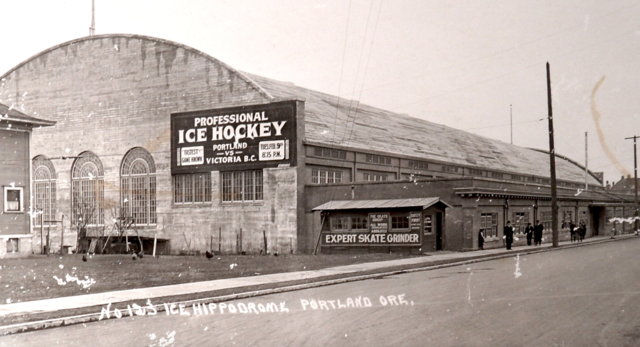
* Portland Ice Arena site. From 1914 to 1926, the Portland Rosebuds played in the Pacific Coast Hockey Association. Their home was the Portland Ice Arena. In 1916, they won the PCHA title, and became the 1st American team to play in the Stanley Cup Finals, losing to the National Hockey Association Champions, the Montreal Canadiens.

(Don't mention this to Portland fans, but the next year, Seattle beat the Canadiens and became the 1st American city to actually win the Cup.)

The team included future Hall-of-Famers Dick Irvin Sr., Ernie "Moose" Johnson and Tommy Dunderdale, but folded in 1926, and its players were mostly brought east to form the Chicago Blackhawks.

From 1928 to 1941, the Arena was home to the Portland Buckaroos. Several teams of that name played in Portland until 1975, and were replaced by the Winterhawks in 1976. The Arena closed in 1953 and was demolished. NW 20th & 21st Avenues, Northrup & Marshall Streets, a mile west of Union Station. NW 21st & Northrup on MAX.
Portland has the NBA and MLS, but don't expect it to get teams in the other sports soon. Its population would rank it 24th in MLB, 21st in the NFL and 20th in the NHL. For the time being, the closest MLB, NFL and NHL teams are in Seattle, 173 miles away. 

An April 23, 2014 article in The New York Times shows that the most popular MLB team in Portland is the closest team, the Seattle Mariners, but it's not overwhelming: They average about 22 percent of Portland baseball fans, while the Yankees and Red Sox battle it out for 2nd place, in the 10s. 

The September 2014 issue of The Atlantic shows that the most popular NFL team in Portland, and in most of Oregon, is the Seattle Seahawks -- and while this was after the Hawks' Super Bowl XLVIII win, it was before they got into Super Bowl XLIX. Southwestern Oregon, closer to California than to Washington State, prefers the San Francisco 49ers, while southeastern Oregon prefers... the Dallas Cowboys, as does neighboring southwestern Idaho. Ew.

The University of Oregon is 114 miles south on I-5, in Eugene. It can be reached by Cascades Point bus from Union Station, although this will take 2 hours and 45 minutes and cost $26 -- each way. Oregon State University is 87 miles south, in Corvallis. You'd have to take at least 2 conveyances to get there, and it would cost $50.50 -- each way.

Portland's top museum is its Art Museum, at 1219 SW Park Avenue. The Oregon Historical Society Museum is across the street at 1200 SW Park. City Hall station on MAX. The Oregon Museum of Science & Industry is at 1945 SE Water Avenue. OMSI/SE Water station on MAX.

Oregon has never produced a President. The closest it's come is the years when an orphaned Herbert Hoover lived with an uncle growing up in Newberg, 25 miles southwest of downtown Portland. The Hoover-Minthorn House is at 115 S. River Street. There is a bus that goes there, but it's prohibitively expensive, so if you want to see it, you should rent a car.

As with Utah, the tallest building in Oregon is named the Wells Fargo Center. Not to be confused with the Philadelphia arena of the same name, this one opened in 1972, and looks it: It's rather dull architecture. It stands 546 feet at 1300 SW 5th Avenue. City Hall station on MAX.

The TV shows Bates Motel (based on the novel and film Psycho, which was set in fictional Fairvale, California), Eureka (in the fictional town of that name), and the Disney series Gravity Falls (ditto) were set in Oregon.

Specifically in Portland, Leverage, Portlandia, Grimm, Life Unexpected, and the brief 1990s CBS crime drama Under Suspicion were both filmed and set there. In The CW's Arrowverse series of superhero shows, Portland is used for establishing shots and maps of fictional Central City on The Flash, even though the show, like the other Arrowverse shows, is filmed in Vancouver.

Unfortunately, the most famous TV show set in Portland, thanks to the jokes Johnny Carson told about it on The Tonight Show, was one of NBC's all-time turkeys, the late 1970s McLean Stevenson sitcom Hello, Larry.

Films based in Oregon include Ice Cube's Are We There Yet? series, the Madonna bomb Body of Evidence, Drugstore Cowboy, Five Easy Pieces, The Goonies, Arnold Schwarzenegger's comedy Kindergarten Cop, The Lathe of Heaven, Mr. Brooks, Mr. Holland's Opus, My Own Private Idaho, Overboard, Paint Your Wagon (Clint Eastwood in a musical? Yes), Pay It Forward, the track & field movies Personal Best and Pre (the latter about Steve Prefontaine, the 1st athlete to endorse Oregon-based Nike footwear), The Postman (Kevin Costner's postapocalyptic film, a.k.a. "Kevin's Gate"), Seven Brides for Seven Brothers, Short Circuit, Stand By Me, and, of course, the film version (which he hated) of Ken Kesey's novel One Flew Over the Cuckoo's Nest.

And while it wasn't set in Oregon, Animal House was filmed on the University of Oregon campus.

*

And on that note, let me remind you that the city has the slogan "Keep Portland Weird." The Trail Blazers, with their odd history, are a part of that. This is not a threatening town, unless you don't like weird things.

But you're from New York (or New Jersey), so you're used to weird. You should be able to have fun in Portland.

Friday, May 17, 2019

How Do the Warriors Compare to Other NBA Dynasties?

The Golden State Warriors won a dramatic Game 2 of the NBA Western Conference Finals last night, 114-111, at home to the Portland Trail Blazers.

It has often been noted that no Playoff series is truly over until the home team has lost at least once. And, to their credit, the Blazers have pushed the Warriors very hard. They are a very good team going up against an even better team.

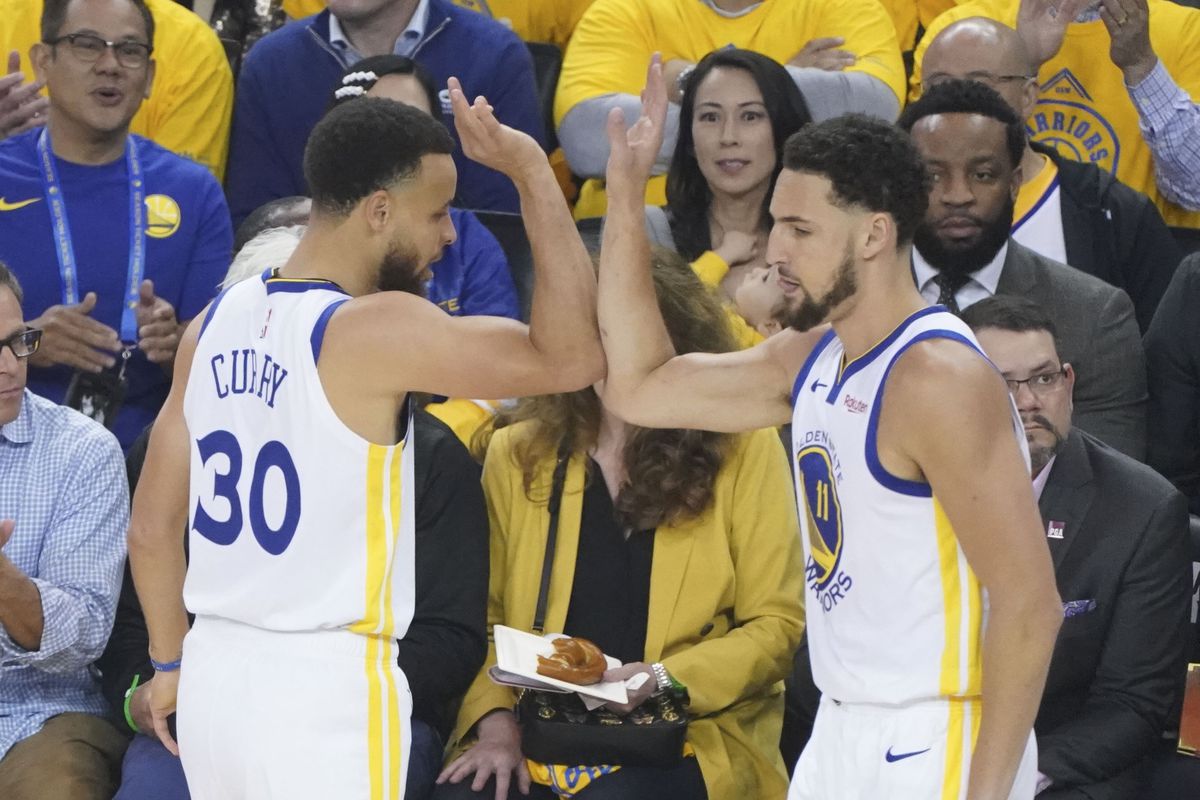
But the Warriors are a better team. Keep in mind, they've won their last few games with Kevin Durant being injured. How great are the warriors, in a historical context? If they win the championship again this year, that will be 4 titles in 5 seasons. And, for 1 game in the 2016 Finals, they would be going for 5 straight.

The Celtics of the 1960s won 8 straight, though the level of their competition can be called into question. The Celtics of the '80s won 3 titles in 6 years. The Lakers of the '80s won 5 titles in 9 years. The Bulls of the '90s won 6 titles in 8 years. The Lakers of the early 2000s won 3 straight titles. And the Heat of the early 2010s made 4 straight Finals, but only won 2 of them.

1. 2000-02 Los Angeles Lakers, 3 straight Championships: 45-13, .776

2. 2015-19 Golden State Warriors, 5 years, 4 Finals, 2 Championships, and counting? 73-24, .753

3. 1991-98 Chicago Bulls, 8 years, 6 Championships: 102-36, .739

4. 1980-89 Los Angeles Lakers, 10 years, 8 Finals, 5 Championships: 115-44, .723

5. 1949-53 Minneapolis Lakers, 6 years, 5 Championships: 45-19, .703

6. 2011-14 Miami Heat, 4 years, 4 Finals, 2 Championships: 59-28, .678

7. 1957-69 Boston Celtics, 13 years, 12 Finals, 11 Championships: 111-59, .645

8. 1981-87 Boston Celtics, 7 years, 5 Finals, 3 Championships: 73-43, .629

9. 1970-73 New York Knicks, 4 years, 3 Finals, 2 Championships: 40-24, .625

Before I compiled this list, I said on Twitter that the 2010s Warriors are even more dominant than the 1990s Bulls. I decided to look at the numbers, to see if I was right, or if I was just making a wild guess that turned out to be very wrong. As it turned out, I was, at least for the moment, ever-so-slightly, right.

And while the early 2000s Lakers look like the best of these teams, record-wise, 3 seasons is a comparatively small sample. Extend it to a 4th season, and they didn't do as well in the 2003 Playoffs. Extend it to a 5th season, and they made the Finals again, but the "superteam" got embarrassed by the more workmanlike, team-oriented, so far no players in the Basketball Hall of Fame Detroit Pistons.

Add the 19-15 Playoff record of the 2003 and '04 Lakers, and the 2000-04 Playoff record becomes 64-28: .696. That's still a fantastic percentage, ahead of either Celtic dynasty, but below the 2010s Warriors, the 1990s Bulls and the 1980s Lakers -- and it moves the 2010s Warriors to the top spot.

*

Another thing about the 2010s Warriors: People who hate them, and especially those who hate Kevin Durant for bolting the Oklahoma City Thunder for the Warriors, just so he could get his ring, seemed to have no problem with:

* LeBron leaving Cleveland twice, first to join Dwyane Wade in Miami, then going back, and then again to build another title winner with the Lakers (which is now incredibly unlikely to happen).

* Kevin Garnett leaving Minnesota to join Paul Pierce and Ray Allen in Boston.

And, if they go back far enough...

* Karl Malone leaving Utah to join Shaquille O'Neal and Kobe Bryant in L.A., which didn't work.

* Shaq leaving Orlando for L.A., and them for Miami.

* Allan Houston leaving Detroit and...

* Larry Johnson leaving Charlotte, both to join Patrick Ewing in New York, and it didn't work.

* Dennis Rodman leaving San Antonio and...

* Ron Harper leaving Cleveland to join Michael Jordan in Chicago.

* Clyde Drexler leaving Portland to join Hakeem Okajuwon in Houston.

* Bill Walton leaving the L.A. Clippers and...

* Dennis Johnson leaving Seattle, both to join Larry Bird in Boston.

* Moses Malone leaving Houston to join Julius Erving in Philadelphia.

* Bob McAdoo leaving New Jersey and...

* Jamaal Wilkes leaving Golden State, both to join Kareem Abdul-Jabbar and Magic Johnson in L.A.

* Earl Monroe leaving Baltimore and...

* Jerry Lucas leaving San Francisco, both to join Willis, Clyde, Double D and Dollar Bill in New York.

* Oscar Robertson leaving Cincinnati to join Kareem (then still Lew Alcindor) in Milwaukee.

* Wilt Chamberlain leaving San Francisco to join Hal Greer in Philadelphia, and then leaving them to join Jerry West and Elgin Baylor in L.A.

* Bailey Howell leaving Baltimore to join Bill Russell and John Havlicek in Boston.

In other words, lots of players have done exactly what Durant did, some successfully, some not. I can understand hating him if you hate all the Warriors. But don't hate him for doing what your favorite player (especially if it's LeBron) may have already done.

*

Days until the New York Red Bulls play again: 2, on Sunday afternoon at 1:00, home to defending MLS Champions Atlanta United.

Days until Arsenal play again: 12, on Wednesday, at 2:45 PM New York time, against fellow Londoners Chelsea, but at the Olympic Stadium (not that the Olympics will every be scheduled for there) in Baku, Azerbaijan, in the UEFA Europa League Final. If Arsenal, who new manager Unai Emery guided to a 5th place finish in the Premier League, when just a little less stupid stubbornness on his part would have gotten them to 3rd, win the game, they qualify for next season's UEFA Champions League. If they lose, they don't, unless UEFA does what it's threatening to do, and ban Manchester City from the competition for a year due to financial irregularities.

Days until the next Yankees-Red Sox series begins: 13, on Thursday, May 30, at Yankee Stadium II.

Days until the next Women's World Cup kicks off: 21,  on Friday, June 7, in France. Just 3 weeks. The U.S. team is 3-time and defending Champions.

Days until the Red Bulls next play a "derby": 22, on Saturday night, June 8, against the Philadelphia Union, at Talen Energy Stadium in Chester, Pennsylvania. The next game against New York City FC will be on Sunday night, July 14, at Red Bull Arena. The next game against the New England Revolution will be on Saturday night, August 17, at Red Bull Arena. The next game against D.C. United will be on Wednesday night, August 21, at Audi Field in Washington.

Days until the U.S. national soccer team plays again: 32, on Tuesday, June 18, against the South American nation of Guyana, at the brand-new Allianz Field in St. Paul, home of Minnesota United, in the opener of the 2019 CONCACAF Gold Cup. A little over a month.

Days until the Yankees and Red Sox play each other in London: 43, on June 29. A little over 6 weeks.

Days until Arsenal play in America: 59. Under 2 months. On July 15, they will visit the Denver suburbs to play the Colorado Rapids. On July 17, they will visit the Los Angeles suburbs to play Bayern Munich. On July 20, they will visit Charlotte to play AS Roma. And on July 23, they will visit the Redskins' stadium in the Washington suburbs to play Real Madrid. This almost certainly means no Emirates Cup this Summer.

Days until the next North London Derby: Unknown, as both Premier League matches, and a League Cup match, have been played this season. The next season starts on August 10, which is 85 days from now, but the PL never puts a Derby on the opening weekend. The Gunners and Spurs usually play each other in N5 in October or November, and then in N17 in February or March.

Days until Rutgers University plays football again: 106on August 31, home to the University of Massachusetts. About 15 weeks.

Days until East Brunswick High School plays football again: Unknown, because the 2019 schedule hasn't been released yet. Usually, the next season begins on the 1st Friday in September, which would be September 6, which would be 112 days. It has been announced that East Brunswick and its arch-rivals, Old Bridge, will no longer play each other on Thanksgiving Day. In fact, many of the local Thanksgiving rivalries have been moved back to the opening night, September 6. Whenever the Big Green play the Purple Bastards, it will be under a new head coach, because Bob Molarz, in charge for the last 6 seasons, has resigned.

Days until the New Jersey Devils play again: Unknown. Traditionally, a new NHL season begins on the 1st Thursday in October, which would be October 3, which is 139 days from now. Under 5 months. The new schedule is usually released around June 20 or so. We shall see.

Days until the New Jersey Devils next play a local rival: Unknown. But the Devils never open against either the New York Rangers, a.k.a. The Scum; the New York Islanders; or the Philadelphia Flyers, a.k.a. The Philth.

Days until the next Rutgers-Penn State football game: 197, on Saturday, November 30, at Beaver Stadium in State College, Pennsylvania. A little over 6 months.

Days until my 50th Birthday, at which point I can join AARP and get discounts for travel and game tickets: 215, on December 18, 2019. A shade over 7 months.

Day until the premiere of the final Star Wars film, Episode IX: The Rise of Skywalker: 217, on December 20, 2019.

Days until the Baseball Hall of Fame vote is announced, electing Derek Jeter: 249on January 21, 2020. A little over 8 months.

Days until the next Summer Olympics begins in Tokyo, Japan: 434, on July 24, 2020. A little over a year, or a little over 14 months.

Days until the next Presidential election, when we can dump the Trump-Pence regime and elect a real Administration: 536on November 3, 2020. Under a year and a half, or under 18 months.

Days until a fully-Democratic-controlled Congress can convene, and the Republicans can do nothing about it: 597, on January 3, 2021. A little over a year and a half, or under 19 months.

Days until Liberation Day: 614at noon on January 20, 2021. Under 2 years, or a little over 20 months. Note that this is liberation from the Republican Party, not just from Donald Trump. Having Mike Pence as President wouldn't be better, just differently bad, mixing theocracy with plutocracy, rather than mixing kleptocracy with plutocracy.

Days until the next Winter Olympics begins in Beijing, China: 994, on February 4, 2022. Under 3 years, or under 33 months.

Days until the next World Cup is scheduled to kick off: 1,284, on November 21, 2022, in Qatar. A little over 3 1/2 years, or a little over 42 months. The charges of corruption against Qatar may yet mean that they will lose the tournament, in which case it will be moved to a nation where it would not be too hot to play it in June and July.