Showing posts with label golden state warriors. Show all posts

Sunday, August 9, 2026

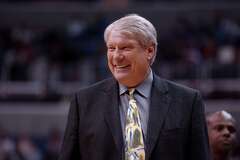
Don Nelson, 1940-2026

Don Nelson was a basketball lifer. He had an interesting career as a player, but he became more interesting as a coach.

Donald Arvid Nelson was born on May 15, 1940 in Muskegon, Michigan, right across Lake Michigan from Milwaukee. He grew up in a farm outside Sherrard, Illinois, in the Quad Cities region that straddles the Mississippi River in Illinois and Iowa. He graduated from Rock Island High School, 2 years ahead of Ken Bowman, a center who helped the Green Bay Packers win the 1st 2 Super Bowls.

Milton "Sharm" Scheuerman was the head basketball coach at the University of Iowa, and a Rock Island High graduate, and recruited Nelson. He also recruited Brooklyn high school star Connie Hawkins, but Hawkins was caught up in a gambling scandal. Despite never being charged with a crime, Hawkins was kicked out of school, and banned from the NBA, playing in the ABL, AAU ball, and the ABA before his ban was lifted.

At a time when the NCAA Tournament only invited 24 teams, and from a conference only the Champion, Iowa finished 2nd to Ohio State team of Jerry Lucas and John Havlicek in 1961, and missed the Tournament. "If Connie had stayed, we would have had a great team," Nelson said. "I feel we could have edged out Ohio State my junior and senior years." Nelson was named a 3rd-term All-America in 1962.

He was taken by the Chicago Zephyrs in the 3rd round of the 1962 NBA Draft. After 1 season, he was waived, claimed by the Los Angeles Lakers. They reached the Finals in each of his 2 seasons with them, but lost both to the Boston Celtics.

He was released, but the Celtics must have liked what they saw, because they signed him as a free agent. He helped them win the 1966, '68 and '69 NBA titles. He remained with them through their rebuilding, and helped them win the title again in 1974 and '76, at which point he retired as a player. In 1973, he was inducted into the Illinois Basketball Coaches Association Hall of Fame as a player. The Celtics retired his Number 19 in 1978.

*

His son Donnie remembers the family sitting in a Maid Rite restaurant in Moline, Illinois (one of the "Quad Cities," along with Rock Island, and Davenport and Bettendorf, Iowa), and Don saying he had three choices: sell cars, become an NBA referee, or accept an assistant's job under Milwaukee coach Larry Costello. They voted 5–0 for the Milwaukee job, which paid $25,000.

The Bucks got off to a 3-15 start in 1976-77, and Costello, despite having led the Bucks to the 1971 NBA Championship and the 1974 NBA Finals, which they lost to "Nellie" and the Celtics, was fired. Nelson was named head coach. At the end of the season, only 37 years old, he was also given the general manager's job. He built a team around speed, and not caring about height, often letting shorter but faster players guard taller but slower ones.

The result of "Nellie Ball" was 7 straight Division titles: 1980 in the Midwest Division; then, after an NBA realignment, 6 in the Central Division, in 1981, '82, '83, '84, '85 and '86. He was named NBA Coach of the Year in 1983 and '85. But the closest he could get to a title was reaching the Eastern Conference Finals 3 times, in 1983, '84 and '86.
In 1985, Jim Fitzgerald sold the Bucks to department store mogul and future U.S. Senator Herb Kohl. Nelson didn't get along with him, but he had gotten along with Fitzgerald. In 1986, Fitzgerald bought a different NBA team, the Golden State Warriors. After a season as a broadcaster, Nellie accepted the head coaching job with the Warriors, and even bought an ownership stake.

Again using a run-and-gun style, he coached them for 6 seasons, building an offense known as Run TMC, after the rap group Run-DMC, for Tim Hardaway Sr., Mitch Richmond and Chris Mullin. He was awarded a 3rd Coach of the Year trophy in 1992. But he only won 2 Playoff series, and resigned during the 1994-95 season.

He was hired to coach the New York Knicks for 1995-96, replacing Pat Riley. But Riley had built a defense-oriented team, and Nellie Ball didn't work with them. When he recommending trading the team's marquee player, Patrick Ewing, so that enough salary cap space would be available to make an offer to Shaquille O'Neal, who was unhappy with the Orlando Magic and wanted to play in a big market, that was the last straw for Knicks management: He was canned on March 8, 1996. Shaq ended up going to the Los Angeles Lakers.

In 1997, he was hired as head coach and general manager of the Dallas Mavericks. It took him 4 seasons to turn them from dreadful to a Playoff team, and in 2003, the Mavs won the Midwest Division and reached the Western Conference Finals. But that was as close as he would get, and he resigned late in the 2004-05 season.
In 2006, Mullin, now the Warriors' GM, brought Nelson back to Oakland. He won 16 of their last 21 games, squeezing into the Playoffs as the 8th seed, and upset his former team, the Mavericks, in the 1st round. This was only the 3rd time an NBA 8th seed had beaten a 1st seed, and the 1st time since the 1st round went to a best 4-out-of-7.

But he never got them into the Playoffs again. On April 7, 2010, the Warriors beat the Minnesota Timberwolves, 116-107 at the Target Center in Minneapolis, giving Nelson his 1,333rd career coaching win, surpassing Lenny Wilkens for the most in history. He held that record until 2022, when he was surpassed by Gregg Popovich. He retired at the end of that season, with a record of 1,335-1,063 (.557).

In all, he coached 17 members of the Basketball Hall of Fame. With the Bucks: Alex English, Bob Dandridge, Sidney Moncrief, his former Celtics teammate Dave Cowens, Nate "Tiny" Archibald, Bob Lanier and Jack Sikma. With the Warriors: Chris Mullin, Ralph Sampson, Mitch Richmond, Tim Hardaway, Šarūnas Marčiulionis and Chris Webber. With the Knicks: Patrick Ewing. With the Mavericks: Steve Nash, Dirk Nowitzki, Dennis Rodman briefly, and Hardaway again. 

He coached 6 of the 9 players to have had their uniform numbers retired by the Bucks: 10, Dandridge; 4, Moncrief; 16, Lanier; 32, Brian Winters, 2, Junior Bridgeman; and 8, Marques Johnson. Only 1 of his Warriors players had his number retired: Mullin, 17. Ewing had his Number 33 retired by the Knicks, and Nowitzki had his Number 41 retired by the Mavs.

He was elected into the Iowa Sports Hall of Fame in 1983, the Quad City Sports Hall of Fame in 1987, the University of Iowa Athletics Hall of Fame in 1989, and the Basketball Hall of Fame in 2012. In 1996, in coordination with the NBA's 50th Anniversary, he was named one of their Top 10 Coaches. In 2021, in coordination with the NBA's 75th Anniversary, he was named one of their Top 15 Coaches.

He married twice, and had 7 children and 15 grandchildren. His son, Donn Charles Nelson, known as Donnie Nelson, played basketball at Wheaton College in Wheaton, Illinois -- making it up to a school that his father had turned down to go to Iowa. Donnie became an assistant to his father the 1st time around with the Warriors, and with the Mavericks, and in between to Dannie Ainge with the Phoenix Suns. From 2005 to 2021, he was the Mavs' GM, helping to build teams that won 3 Division titles, 2 Western Conference titles, and the 2011 NBA Championship.

In 2012, 50 years after leaving the University of Iowa, Don Nelson finally completed his degree there. He settled on a farm on the Hawaiian Island of Maui, where he grew flowers, coffee and cannabis. He hosted poker games, where he was joined by celebrities like country singer Willie Nelson and actor Woody Harrelson, who are also fond of the last of those crops.

"I know how far I've come from being a hog farmer," Nelson said. "I've come a long, long way from being some country kid. I got in the fast lane, and I've stayed there a long time. I've done pretty well."
But his health began to fail, and earlier this year, he moved back to the mainland, to the Dallas suburb of Frisco, Texas. He suffered a stroke, was admitted to hospice care, and died today, August 9, 2026, at the age of 86.

Friday, June 19, 2026

June 19, 2016: "Believeland" Beats 73-9

June 19, 2016, 10 years ago: This was the 2nd of 4 straight seasons in which the Golden State Warriors faced the Cleveland Cavaliers in the NBA Finals. It was also the season in which the Warriors set a new NBA record for wins in a season, going 73-9.

It was the 1 of the 4 Finals that the Warriors lost.

In 1967, the Philadelphia 76ers set a new record for wins in an NBA regular season: 68. In 1972, the Los Angeles Lakers broke it, with 69. In 1996, the Chicago Bulls broke that, with 72. And all 3 of them won the NBA Championship.

In 2016, the Warriors, defending NBA Champions, won 73. With Steve Kerr coaching Stephen Curry, Draymond Green, Andre Iguodala and Klay Thompson, all of them probably headed for the Basketball Hall of Fame, it seemed like no one could stop them.

Certainly not the Cleveland Cavaliers, whom they beat in the previous year's Finals. LeBron James had abandoned them -- or been chased out, depending on who you believe -- after the 2010 season, having played 7 seasons and led them to a single Finals, in 2007. With the Miami Heat, he played 4 seasons, reached the Finals every year, and won in 2012 and 2013.

For Cleveland, and for Northern Ohio, there had not been a World Championship in any sport since the Browns won the 1964 NFL Championship -- effectively, Super Bowl -II. The Browns had lost the NFL Championship Game in 1965, '68 and '69; and the AFC Championship Game in the seasons of 1986, '87 and '89.

The Indians (who became the Guardians in 2022) hadn't won a World Series since 1948, or a Pennant since 1954, or even been in a Pennant race since 1959, before winning the American League Pennant in 1995 and 1997, losing the World Series both times. They also reached the AL Championship Series in 1998 and 2007, but lost both times.

The Cavaliers reached the NBA Eastern Conference Finals in 1976 and 1992, before Akron, Ohio native LeBron arrived in 2003. He led them to the NBA Finals in 2007, but lost to the San Antonio Spurs. They never seemed to give him enough supporting players, and so he left, winning titles in Miami, before coming home to new Cavs ownership, to try again.

He got them to the Finals in 2015, but the Warriors won. And when the Warriors jumped out to a 3-1 lead in the 2016 Finals -- winning Game 1, 104-89; winning Game 2, 110-77; losing Game 3, 120-90; and winning Game 4, 108-97 -- it looked bad for LeBron.

But the Cavs won Game 5 in Oakland, 112-97. They won Game 6 in Cleveland, 115-101. It all came down to a Game 7 in Oakland. The host Warriors should have won.

The day before, The day before Game 7, Cavaliers coach Tyronn Lue took his players to the famous San Quentin Prison in Marin County, north of San Francisco. He showed them the now-retired electric chair, and Lue told them, "That's pressure, not a Game 7."

Game 7 was close, with 20 lead changes and 11 ties. It was the only game in the series to have a final margin of fewer than 10 points. At halftime, the Warriors led 49–42. But they failed to score a basket during the last 4:39 of the game.

With the score tied at 89, and 1:50 remaining in regulation, LeBron delivered what became known as "The Block," on a layup attempt by Andre Iguodala. Kyrie Irving made a 3-point field goal over Stephen Curry to give Cleveland a 92–89 lead with 53 seconds left.

Kevin Love forced Curry into a contested three-pointer, which he missed. LeBron made 1 of 2 free throws, putting them 4 points ahead with only 10.6 seconds left. The Cavaliers fouled Draymond Green with 6.5 seconds remaining. Curry and Marreese Speights each missed a 3, and time expired.

LeBron led all Cavaliers with 27 points and became only the 3rd player ever in NBA history to record a triple-double in an NBA Finals Game 7, with 27 points, 11 assists and 11 rebounds. Lue, a reserve guard on the 2000 and 2001 Lakers, became the 14th person to win an NBA Championship as a player and as a head coach.

(The other 2 players with a triple-double in an NBA Finals Game 7 were Lakers. In 1969, Jerry West lived up to his nickname, "Mr. Clutch": He had 42 points, 13 rebounds and 12 assists, but the Lakers lost to the Boston Celtics, anyway. In 1988, James Worthy lived up to his nickname, "Big Game James": He had 36 points 16 rebounds and 10 assists, and the Lakers beat the Detroit Pistons.)

The Cavaliers became the first team in NBA history to come back from a 3–1 series deficit to win the NBA Finals. They became the 1st NBA Champion to clinch all their playoff series on the road since the 1999 San Antonio Spurs, and the 1st road team to win a Finals Game 7 since the 1978 Washington Bullets.

The Cavaliers won their 1st championship in franchise history, in their 46th season. What's more, it ended a 52-year major league sports championship drought for Northern Ohio, since the Cleveland Browns won the 1964 NFL Championship. It was the 1st World Championship for any Ohio team since the Cincinnati Reds won the 1990 World Series, almost 36 years.

For Cleveland, and for Northern Ohio, all was forgiven with LeBron. "Believeland" had believed in him, and he had rewarded that belief. This remains the only NBA Finals in which a single player has led both teams in points, assists, steals, and blocks. A parade was held, ending in a ceremony at City Hall, attended by Jim Brown of the 1964 Browns.

Was there a carryover? Not really: The Warriors got up and beat the Cavs in the Finals in 2017 and '18. The Indians got to extra innings of Game 7 of the World Series in 2016, as they had in 1997 -- but, as in that season, they lost. And it took the Browns until 2020 to make the Playoffs again.

LeBron ended up going to 8 straight NBA Finals, 9 in 10 years, and 10 in 14. But it was a mixed record: He won with the Heat in 2012 and '13, with the Cavs in 2016, and with the Lakers in 2020; but he lost with the Cavs in 2007, '15, '17 and '18, and with the Heat in 2011 and '14. He went 4-6 in Finals. compare that to Bill Russell, 11-1; Wilt Chamberlain, 2-4; John Havlicek, 7-0; Kareem Abdul-Jabbar, 6-4; Magic Johnson, 5-4; Michael Jordan, 6-0; Shaquille O'Neal, 4-2; Kobe Bryant, 5-2; Tim Duncan, 5-1; and Curry, 4-2.

LeBron may be the NBA's all-time leading scorer. And, as the de facto (if not official) head coach and general manager of the Lakers, one of the most successful teams in any sport, he might be the most powerful single player in the history of North American sports.

But the "GOAT" -- Greatest Of All Time? Not by a long shot.

Sunday, June 14, 2026

NBA Championships, 1947-2026

Ties broken by Finals appearances, then by Conference Finals appearances:

1. Boston Celtics, 18: 1957, 1959, 1960, 1961, 1962, 1963, 1964, 1965, 1966, 1968, 1969, 1974, 1976, 1981, 1984, 1986, 2008, 2024
2. Los Angeles Lakers, 17: 1949, 1950, 1952, 1953, 1954 (each of the preceding as Minneapolis Lakers), 1972, 1980, 1982, 1985, 1987, 1988, 2000, 2001, 2002, 2009, 2010, 2020; also won NBL Championship, 1948
3. Golden State Warriors, 7: 1947, 1956 (both as Philadelphia Warriors), 1975, 2015, 2017, 2018, 2022
4. San Antonio Spurs, 6: 1999, 2003, 2005, 2007, 2011, 2014; lost 2 Finals, 2013, 2026
5. Chicago Bulls, 6: 1991, 1992, 1993, 1996, 1997, 1998; no Finals losses
6. New York Knicks, 3: 1970, 1973, 2026; lost 6 Finals: 1951, 1952, 1953, 1972, 1994, 1999
7. Philadelphia 76ers, 3: 1955 (as Syracuse Nationals), 1967, 1983; lost 5 Finals: 1954, 1977, 1980, 1982, 2001
8. Detroit Pistons, 3: 1989, 1990, 2004; lost 4 Finals: 1955, 1956 (both as Fort Wayne Pistons), 1988, 2005
9. Miami Heat, 3: 2006, 2012, 2013; lost 3 Finals: 2011, 2020, 2023
10. Oklahoma City Thunder, 2: 1979 (as Seattle SuperSonics), 2025; lost 3 Finals: 1978, 1996 (as Sonics), 2012 
11. Houston Rockets, 2: 1994, 1995; lost 2 Finals: 1981, 1986
12. Sacramento Kings, 1: 1951 as Rochester Royals; won NBL Championship, 1946; lost no NBA Finals
13. Milwaukee Bucks, 2: 1971, 2021; lost 1 Finals: 1974
14. Cleveland Cavaliers, 1: 2016; lost 4 Finals: 2007, 2015, 2017, 2018; lost 4 Conference Finals: 1976, 1992, 2009, 2026
15. Atlanta Hawks, 1: 1958 as St. Louis Hawks; lost 3 Finals: 1957, 1960, 1961 (as St. Louis Hawks); lost 10 Conference Finals: 1956, 1959, 1963, 1964, 1966, 1967 (each of those as St. Louis Hawks), 1969, 1970, 2015, 2021
16. Washington Wizards, 1: 1978 as Washington Bullets; lost 3 Finals: 1971 (as Baltimore Bullets), 1975, 1979 (both as Washington Bullets); lost 1 Conference Finals: 1965 (as Baltimore Bullets)
17. Portland Trail Blazers, 1: 1977; lost 2 Finals: 1990, 1992; lost 4, Conference Finals: 1991, 1999, 2000, 2019 
18. Dallas Mavericks, 1: 2011; lost 2 Finals: 2006, 2024; lost 3 Conference Finals: 1988, 2003, 2022
19. Denver Nuggets, 1: 2023; lost no NBA Finals; lost 1 ABA Finals: 1976; lost 4 Conference Finals: 1978, 1985, 2009, 2020
20. Toronto Raptors, 1: 2019; lost no Finals; lost 1 Conference Finals: 2016
21. Indiana Pacers, won 2 ABA Championships: 1970, 1972, 1973; 0-2 in NBA Finals
22. Brooklyn Nets, won ABA Championship: 1974 and 1976 as New York Nets; 0-2 in NBA Finals as New Jersey Nets
23. Phoenix Suns, 0-3 in NBA Finals: 1976, 1993, 2021
24. Orlando Magic, 0-2 in NBA Finals: 1995, 2009
25. Utah Jazz, 0-2 in NBA Finals: 1997, 1998
26. Minnesota Timberwolves, 0-3 in Conference Finals: 2004, 2024, 2025
27. Los Angeles Clippers, 0-1 in Conference Finals, 2021
28. Memphis Grizzlies, 0-1 in Conference Finals: 2013
29. Charlotte Hornets, 0-4 in Conference Semifinals: 1993, 1998, 2001, 2002
30. New Orleans Pelicans, 0-2 in Conference Semifinals: 2008, 2018

Tuesday, April 14, 2026

Deserve's Got Everything to Do With It: 2026 Basketball Edition

Little Bill Daggett (Gene Hackman): "I don't deserve this! To die like this!"
Will Munny (Clint Eastwood): "Deserve's got nothing to do with it!"
-- Unforgiven, 1992, directed by Eastwood
As I occasionally (but not annually) do, I am ranking Playoff teams by how much they, and their fanbases, deserve to win a World Championship. This time, the NBA:
20. Oklahoma City Thunder, West 1st seed.
May Deserve Because: They've proven themselves to be worthy champions. And their fans have proven themselves worthy of a great team, which was not obvious when the team arrived in 2008.
May Not Deserve Because: They just won the title last year. They don't need another. Ownership sure doesn't deserve it: These are the guys who moved the Seattle SuperSonics, and they're now trying to build a new arena -- to replace the new arena they already have! What gives? Also, it's a conservative city, in a very red State. They don't deserve another title!
19. Miami Heat, East 10th seed, play-in team.
May Deserve Because: Honestly, I can't think of a good reason, unless you mean finally throwing off 27 years of conservative Mayors last year. Bam Adebayo and Tyler Herro are interesting players, but not especially deserving. South Florida has a lot of ex-New Yorkers and ex-New Jerseyans, but, by itself, that doesn't help much.
May Not Deserve Because: One of America's most conservative cities, in one of America's most conservative States. They've won the title as recently as 2013, and been in the Finals as recently as 2023. There's no "guy to root for." And there's a reason those ex-New Yorkers and ex-New Jerseyans moved there: Because they wanted to get away from the multicultural society that their area has become.
18. Boston Celtics, East 2nd seed.
May Deserve Because: Boston is a liberal city, in a liberal State. And... that's about it.
May Not Deserve Because: The Celtics won the title as recently as 2024, and they've won more than any other team. They don't need another. And it's not like they have a great player who wasn't a part of that 2024 team, and hasn't won one.
17. Los Angeles Lakers, West 4th seed.
May Deserve Because: Los Angeles is a liberal city, in a Blue State. And that's about it.
May Not Deserve Because: They last won in 2020. How many more do they need? LeBron James certainly doesn't deserve another title.
16. San Antonio Spurs, West 2nd seed.
May Deserve Because: Victor Wembanyana is a special player.
May Not Deserve Because: They're in Texas. They last won in 2014, not that long ago. And Wembayana is only 22. He will, most likely, have many more chances. To put that in perspective: When they won their 1st NBA titles, LeBron James was 27, Michael Jordan was 28, Wilt Chamberlain was 30, Oscar Robertson was 32, Julius Erving was 33, and Jerry West was 34.
15. Golden State Warriors, West 10th seed, play-in team.
May Deserve Because: San Francisco is regarded as the liberal city, and California as the Blue State. Steve Kerr is rightly one of the most admired men in the NBA, maybe the most admired, now that Gregg Popovich has retired from coaching. Steph Curry is beloved. He and some of the Warriors have won titles, but his brother Seth Curry and Jimmy Butler have not. But Butler won't win one this time, as he is unavailable due to a season-ending injury.
May Not Deserve Because: The Dubs have dominated the West, winning it 6 of the last 11 seasons, including 4 NBA Championships. They don't need another. I wouldn't mind if they did, especially if they beat a Red State team in the Finals. But they don't need it.
14. Denver Nuggets, West 3rd seed.
May Deserve Because: Denver is a liberal city, in a Blue State. Nikola Jokić is probably the best player in the world this season.
May Not Deserve Because: They won in 2023, which is very recent. Nobody on the team needs a title all that badly.
13. Cleveland Cavaliers, East 4th seed.
May Deserve Because: Cleveland is a liberal city. And the city has won only 1 World Championship since 1964, so they deserve it. James Harden and Donovan Mitchell are legends who probably deserve to win a title.
May Not Deserve Because: Cleveland's status as a liberal city, but it hasn't been able to turn Ohio away from being a Red State. Harden is a jerk. And that 1 title was the Cavs, only in 2016.
12. Houston Rockets, West 5th seed.
May Deserve Because: Houston is a liberal city. The Rockets haven't won a title, or even been to the Finals, since 1995.
May Not Deserve Because: Houston is still in Texas, among the reddest of the Red States. As a city, it last won a title in 2022, with the Astros *. And their biggest star is Kevin Durant, not exactly a player who needs another title.
11. Toronto Raptors, East 5th seed.
May Deserve Because: Toronto is a liberal city, in a liberal country. Brandon Ingram deserves a title.
May Not Deserve Because: The Raptors only won in 2019.
10. Orlando Magic, East 8th seed, play-in team.
May Deserve Because: Orlando has never won a Championship, in any sport, unless you count the Orlando Pride winning the National Women's Soccer League title in 2024.
May Not Deserve Because: Florida is a Red State. And the Magic have no "He really deserves it" guy.
9. Atlanta Hawks, East 6th seed.
May Deserve Because: Atlanta is a liberal city. The Hawks haven't won a title since 1958, when they were in St. Louis. Indeed, since coming to Atlanta in 1970, they've only made the Conference Finals twice, in 2015 and 2021.
May Not Deserve Because: Georgia is still a Red State. Atlanta has proven itself to be a rotten sports city. While the Hawks haven't won a title, the city last won one only in 2021, with the Braves. And there's no especially-deserving player.
8. Phoenix Suns, West 7th seed, play-in team.
May Deserve Because: The Suns have never won a title in 55 seasons, going 0-3 in the Finals. The only title for an Arizona-based team is the 2001 Diamondbacks *. Devin Booker deserves a title. And the Phoenix area is full of ex-Chicago people.
May Not Deserve Because: One of America's most conservative cities, and it's in what's usually still a Red State.
7. Charlotte Hornets, East 9th seed, play-in team.
May Deserve Because: Charlotte is a blue city that, on occasion, has made North Carolina a Blue State. While Raleigh won a Stanley Cup in 2006, Charlotte has never won a title, with the Hornets never having reached the Conference Finals, and the Carolina Panthers having gone 0-2 in Super Bowls.
May Not Deserve Because: North Carolina is still a blue State, and there's no "guy to root for."
6. Detroit Pistons, East 1st seed.
May Deserve Because: Detroit is a liberal city, usually turning Michigan to be a Blue State. The city hasn't had a title since the 2008 Red Wings, and the Pistons haven't won since 2004 or been in the Finals since 2005. Just 2 seasons ago, they completed a run of season with only 20, 23, 17 and 14 wins, including a 28-game losing streak, tied for the longest losing streak in NBA, and major league sports, history. Their comeback under head coach J.B. Bickerstaff (son of former NBA coach Bernie) and general manager Trajan Langdon (former Duke star) has been remarkable.
May Not Deserve Because: The only reason I can think of is that they don't have a standout "He deserves it" guy. Cade Cunningham might be on his way, but he's not a legend yet. And 2004 wasn't that long ago.
5. Philadelphia 76ers, East 7th seed, play-in team. 
May Deserve Because: Philadelphia is a great city. It's a liberal city. Pennsylvania is a Blue State. It's been 43 years since they last won it all. It would make a few people I know happy, since I only live only 64 miles away. Joel Embiid deserves a title.
May Not Deserve Because: Their fans have been known to be a bit rough. And Kyle Lowry already has a title, with the 2019 Toronto Raptors.
4. Los Angeles Clippers, West 9th seed, play-in team.
May Deserve Because: Los Angeles is a liberal city, in a Blue State. The Clippers are not the lordly Lakers: The franchise has been playing for 56 years, as the Buffalo Braves from 1970 to 1978, the San Diego Clippers from then until 1984, and the Los Angeles Clippers since. Their fans have suffered, especially in comparison to Laker fans. Bradley Beal deserves a title, but he is injured an unavailable. And they are no longer owned by the racist real-estate developer Donald Sterling. They are owned by Steve Ballmer, one of the more sympathetic super-rich guys.
May Not Deserve Because: Head coach Tyronn Lue has already won a title, with the 2016 Cleveland Cavaliers. So has Brook Lopez, with the 2021 Milwaukee Bucks. Other than that, no big reason.
3. Portland Trail Blazers, West 8th seed, play-in team.
May Deserve Because: Portland is a liberal city, and it keeps Oregon a Blue State. It's been 48 years since they last won it all, although the Portland Thorns won the NWSL title in 2022. Damian Lillard deserves a title, but has been injured all season.
May Not Deserve Because: Can't think of a good reason, although one of the current Blazers, Jrue Holiday, already has 2 titles, with the 2021 Milwaukee Bucks and the 2024 Boston Celtics. So he doesn't need another. It would help his Hall of Fame candidacy, but it wouldn't assure his election.
2. New York Knicks, East 3rd seed.
May Deserve Because: New York is the greatest city in the world, a liberal city in a Blue State. But unless you want to count the WNBA or soccer teams, it hasn't won a World Championship in any sport since the Giants in 2012. The Knicks haven't won one since 1973 -- 53 years. Jalen Brunson, Karl-Anthony Towns, Mikal Brunson and OG Anuoby are good guys who deserve a title. It's time.
May Not Deserve Because: Knick fans already think they know more about basketball than anybody. They might become insufferable if their team actually wins another title. And does James Dolan actually deserve a title? No.
1. Minnesota Timberwolves, West 6th seed.
May Deserve Because: Minneapolis is a liberal city, in a Blue State, and has suffered this calendar year. The City and the State have not won a title in any sport since the 1991 Twins. The T-Wolves have played since 1989, and while they've been to the Conference Finals in each of the last 2 seasons before this one, the city hasn't been to the NBA Finals since the 1954 Minneapolis Lakers. And if we're going by who's played a long time to earn a title, the T-Wolves have the most guys: Mike Conley Jr., Rudy Gobert, Kyle Anderson and Julius Randle.
May Not Deserve Because: I can't think of a good reason, unless you boycott Minneapolis-based Target, which has its name on both the T-Wolves' arena and the Twins' ballpark.
So there you have it: The Minnesota Timberwolves deserve to win the 2026 NBA Championship, more than any other team.
UPDATE: 2 beat 16. Better than usual.

Sunday, May 25, 2025

May 25, 1975: The Warriors Are Golden

May 25, 1975, 50 years ago: The most stunning upset in the history of the NBA Finals is completed.

The Baltimore Bullets had made the NBA Finals in 1971, but got swept by the Milwaukee Bucks. They moved down the Baltimore-Washington Parkway to Washington in 1973. Well, not quite: After playing a few home games at the University of Maryland's Cole Field House while waiting for their new arena to be finished, they settled at that new arena, the Capital Centre in suburban Landover, Maryland, just outside the Capital Beltway.

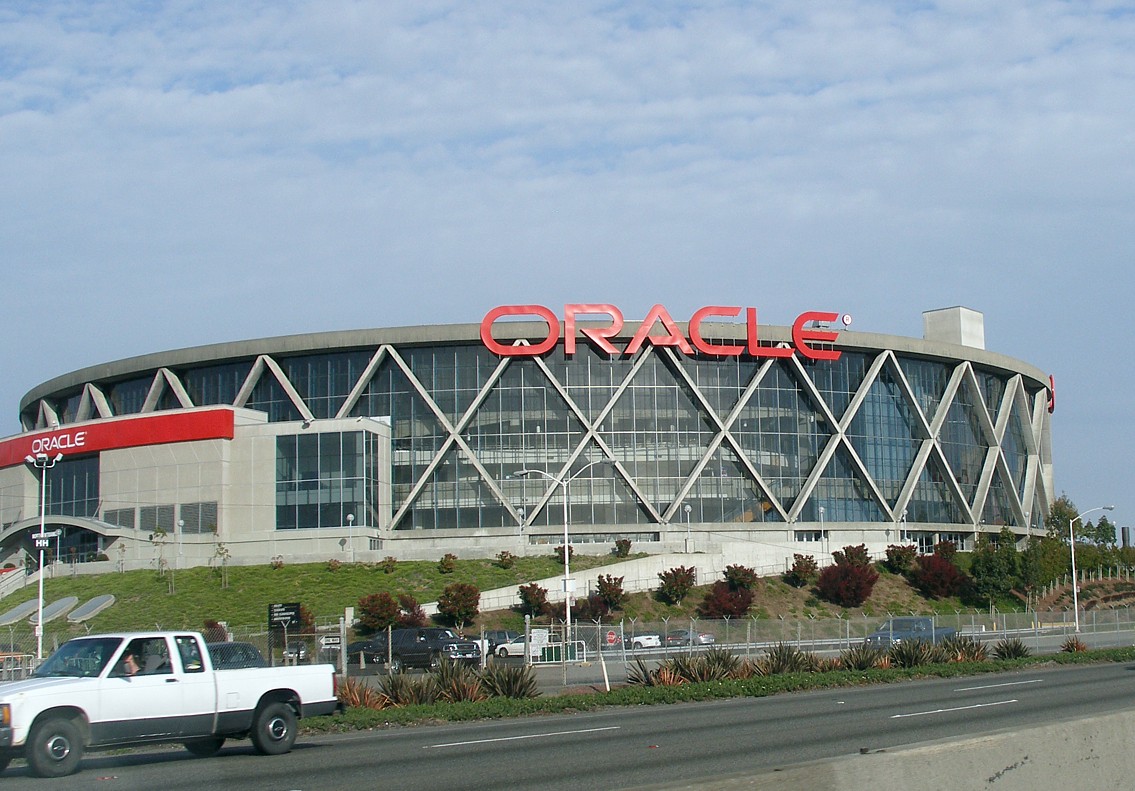
They played the 1973-74 season as the Capital Bullets, before changing their name to the Washington Bullets. And, in 1974-75, led by Wes Unseld and Elvin Hayes, they reached the NBA Finals again. Their opponents would be another team that went through more name changes than was necessary. The Philadelphia Warriors were a charter franchise in the NBA in 1946, but moved to San Francisco in 1962. In 1971, they moved across San Francisco Bay to Oakland, but took on the name "Golden State Warriors."

Much like baseball's California Angels, who tried to draw fans Statewide in an effort to draw more fans than the nearby Los Angeles Dodgers, the Warriors weren't fooling anybody with their Statewide name. At least, unlike the Angels, they no longer had to compete with another team: The ABA's Oakland Oaks had moved in 1969, becoming the Washington Caps, and then the Virginia Squires in 1970.

Coached by former Boston Celtics star K.C. Jones, the Bullets went 60-22, and won the Central Division. They beat the Buffalo Braves in the Eastern Conference Semifinals, and the defending Champion Celtics in the Conference Finals.

Coached by former Warriors player Al Attles, Golden State went 48-34, and won the Pacific Division. They beat the Seattle SuperSonics in the Western Conference Semifinals, and the Chicago Bulls in the Conference Finals.

In spite of having won 12 fewer games than the Bullets, and having lost 3 out of 4 regular-season games against them, the Warriors were the top seed in the West, while the Bullets were the 2nd seed in the East. Still, the Bullets were heavily favored, with many observers predicting a sweep.

They got a sweep, all right, but not in the direction they expected. Game 1 was played at the Cap Centre, and Phil Smith came off the bench to score 20 points in 31 minutes, and the Warriors won, 101-95.

The odds seemed to be against the Warriors, because the Oakland Coliseum Arena was unavailable, as they were hosting the Ice Follies. Games 2 and 3 were moved to the Warriors' former home, the Grand National Livestock Pavilion, a.k.a. the Cow Palace, across the City Line in Daly City, California. Not on their usual home court, could the Warriors possibly win?

Yes, they could; and, yes, they did. They erased an early 13-point Washington lead thanks to 36 points from Rick Barry, and won Game 2, 92-91. Barry, probably best known as one of the greatest free-throw shooters ever, scored 38 points in Game 3, and the Warriors won, 109-101.

Keith Wilkes, later to change his name to Jamaal Wilkes and help the Lakers win titles in the 1980s, held Hayes to just 29 points in the 1st 3 games. Over that stretch, the Warriors' bench outscored the Bullets' bench, 115-53.

Game 4 was played back in Landover, and featured a fight that was started when the Bullets' Mike Riordan fouled Barry hard. Attles, a former guard known as The Destroyer, ran onto the court to defend his fellow New Jerseyan -- Attles was from Newark, Barry from 2 towns away in Roselle Park -- and "took one for the team," getting physical with Riordan and getting thrown out of the game, so Barry wouldn't be. Assistant coach Joe Roberts coached the Warriors the rest of the way.

The fight seemed to take the fight out of the Bullets, as they blew a 14-point lead, and the Warriors won, 96-95. The San Francisco Bay Area had its 1st NBA Championship.

The District of Columbia would have to wait until 1978, when the Bullets beat the SuperSonics. The Sonics reversed that result the following year. The capital team, which renamed itself the Washington Wizards in 1997, the year they moved into the District proper, into what's now named the Capital One Arena, haven't been to the Eastern Conference Finals since.

The Warriors also struggled a lot, until the Stephen Curry era began, and they won 4 titles and made 2 other Finals. Indeed, given how much basketball talent came out of the D.C. and Bay areas, great high school players and great college programs, the pro team in D.C. has seriously-under-achieved, and so did the pro team in the Bay Area until 2015.

From May 25 to October 22, 1975, 150 days, not just the San Francisco Bay Area, but specifically the City of Oakland, held the World Championships of baseball and basketball at the same time. It was part of an extraordinary 10-year run from December 31, 1967 to January 1, 1978, that saw Oakland win 5 American League Western Division titles; win 10 AFC Western Division titles, and reach the AFL or AFC Championship Game 9 times, including 2 Championships; reach the NBA Western Conference Finals 4 times, winning once; culminating in winning 3 World Series, a Super Bowl, an NBA Championship, an ABA Championship, and a National Professional Soccer League Championship:

* Oakland Clippers, 1967 NPSL Champions.
* Oakland Raiders, 1967 AFL Champions, 1976 NFL Champions.
* Oakland Oaks, 1969 ABA Champions.
* Oakland Athletics, 1972, 1973 and 1974 World Champions.
* Golden State Warriors, 1975 NBA Champions.

All this, while, across the Bay, San Francisco lost the Warriors to Oakland, saw the Giants and the 49ers continually let their city down, and nearly lost the Giants to Toronto.

However, by the time that 10-year period ended, the City of Oakland would lose its NHL team, its ABA team, and its NPSL team; and set in motion the process that would eventually cause it to see its NBA team move back across San Francisco Bay, and lose its MLB team, and lose its NFL team, gain it back, and lose it again.

Wednesday, June 12, 2024

Jerry West, 1938-2024

The two greatest figures in the history of the National Basketball Association are Red Auerbach and Jerry West. That cannot be disputed.

Wilt Chamberlain was a greater player. So were Magic Johnson and Michael Jordan. Phil Jackson was a better coach. Maurice Podoloff, the 1st Commissioner, and David Stern, the longest-serving Commissioner, shaped the league more in an official capacity. But in terms of shaping the history of the league, it's Red and Jerry.

Jerome Allen West was born on May 28, 1938 in Chelyan, West Virginia, 17 miles up the Kanawha River from the State capitol of Charleston, and on the bank of Cabin Creek, leading to a hick nickname he hated, "Zeke from Cabin Creek." He had an abusive father, and his brother was killed in the Korean War, a combination he later admitted made him introverted. He was cut by the head basketball coach at East Bank High School for being too short.

He grew to 6 feet even, and his endless practice made him the best basketball player, maybe the best athlete, in his State's history. On March 24, 1956, he led East Bank to the State Championship. Thereafter, every year on March 24, until the school closed in 1999, the name of the school was changed for the day to West Bank High School.

He got West Virginia University into the NCAA Final Four in 1959, losing to the University of California, coached by Pete Newell and led by Darrall Imhoff, in the Final. He was an easy selection for the U.S. team at the 1960 Olympics in Rome, coached by Newell. Not only did they win the Gold Medal, but that entire team was collectively elected to the Basketball Hall of Fame. Meaning that some of them were elected twice: Newell, West, Oscar Robertson, Jerry Lucas and Walt Bellamy.

The rest of the team: Imhoff, Jay Arnette, Bob Boozer, Terry Dischinger, Allen Kelley, Lester Lane, Adrian "Odie" Smith, and a holdover from the 1956 Gold Medalists, Burdette Haldorson. This was the best basketball team ever assembled, until the "Dream Team" of 1992. How good were they? Lucas' Ohio State teammate John Havlicek only made it as an alternate.

He was drafted by the Los Angeles Lakers, and was a rookie in their 1st season after moving from Minneapolis, 1960-61, joining Elgin Baylor. He was an All-Star in all 14 seasons in which he played in the NBA, and became known as one of the best shooters, and one of the best passers, in NBA history. He was named Most Valuable Player of the 1969 Finals, even though the Lakers lost, the only player from the losing team ever so honored.

In 1970, despite the team eventually losing the game and the series, he launched a 60-foot shot to send Game 3 of the Finals into overtime. In spite of the defeat, it's considered one of the greatest shots in NBA history. Shots like that gave him a much better nickname than "Zeke from Cabin Creek," or the one that Baylor gave him because of his country accent, "Tweety Bird." Shots like that gave him the nickname "Mr. Clutch."

And he is "The Logo": In 1969, Alan Siegel, following up his design of the Major League Baseball logo that bears a resemblance to Harmon Killebrew, used a photograph of West dribbling with his left hand, to design the NBA logo. There is some dispute about the picture: Siegel claimed it was by Wen Roberts, but it appears the photo at the top of this post is the one, and that photo is credited to the great Sports Illustrated photographer Walter Iooss Jr. So when you hear of someone being called an "icon," know that this term is usually used as an exaggeration. Jerry West was The Logo: He was literally an icon.

In the 1971-72 season, with Baylor retiring, the Lakers finally put it all together. Coach Bill Sharman, as West's predecessor as the game's best shooter while with the Boston Celtics, led West, Wilt Chamberlain, Gail Goodrich, Keith Erickson and Jim McMillian -- and a backup guard named Pat Riley -- to the team's 1st NBA Championship in Los Angeles, after going 0-7 in the Finals, 0-8 if you count their last Finals defeat in Minneapolis.

This run included a 33-game winning streak, the longest in the history of major league sports. (While the 1979-80 Philadelphia Flyers, and some European soccer teams, have had longer unbeaten streaks, that included ties.) They avenged their 1970 defeat to the New York Knicks.

*

But the legacy of Jerry West was just getting warmed up. He was the Lakers' head coach from 1976 to 1979, chief scout from 1979 to 1982, and general manager from 1982 to 2002. He built the Laker dynasties of 1980-91 and 2002-10. At the 2001 title parade, Kobe Bryant, whom West talked the Lakers into acquiring in a trade after the Charlotte Hornets drafted him out of high school, wore West's Number 44 jersey instead of his own Number 8.

He wanted a new challenge, and moved on to the Memphis Grizzlies. He had no luck there, retiring in 2007, but in 2011 he joined the board of the Golden State Warriors, who won 4 titles as a result of his involvement. He went back to Los Angeles, with the Clippers, whom he got to their 1st-ever trip to the Western Conference Finals in 2021.

After going 1-for-9 in the Finals as a player, he officially had 9 rings, though he had a hand in building 15 titles. That's the most of anybody in NBA history except for longtime Boston Celtics head coach, general manager and team president Red Auerbach, who won 16.
His Number 44 has been retired by both WVU and the Lakers, and statues of him are outside the WVU Coliseum in Morgantown and the Crypto.com Arena. The stretch of U.S. Route 19 that runs past the Coliseum, named Monongahela Boulevard for most of its run, is named Jerry West Boulevard. (Elsewhere in town, U.S. Route 119 is named for another WVU graduate: Don Knotts Boulevard.)

He was named to the Basketball Hall of Fame and the NBA's 50th Anniversary 50 Greatest Players. When the ceremony for the 50 Greatest was held at the 1997 All-Star Game in Cleveland, 47 players showed up. One, Pete Maravich, was already dead. One, Shaquille O'Neal, was injured, couldn't play in the game, and simply refused to show up. His name was heavily booed when it was announced. The other was West, who was in the hospital, recovering from surgery.

He was able to attend the 2022 ceremony for the 75th Anniversary 75 Greatest Players. That same year, The Athletic ranked him 14th on their list of the greatest players ever. In 2019, in a rare decision of his that I agreed with, Donald Trump awarded him the Presidential Medal of Freedom.

He married his college sweetheart, Martha Jane Kane, in 1960. They divorced in 1976. They had three sons: David, Mark, and Michael. Jerry married his second wife, Kristine "Karen" Bua, in 1978. They had two sons, Ryan and Jonnie. Jonnie played guard for West Virginia, like his father, and married professional golfer Michelle Wie in 2019.

After being in ill health for a year, Jerry West died today, June 12, 2024. He was 86 years old.

NBA Commissioner Adam Silver: "Jerry West was a basketball genius and a defining figure in our league for more than 60 years. He distinguished himself not only as an NBA champion and an All-Star in all 14 of his playing seasons, but also as a consummate competitor who embraced the biggest moments."

Kareem Abdul-Jabbar: "The reason Jerry West is the logo for the NBA is because he embodied the qualities we admire in our best athletes: skills as a player, dedication as a teammate, and integrity as a person. He was my coach, and my advisor, but mostly he was my friend."

Byron Scott, part of the Laker dynasty of the 1980s, who later coached the New Jersey Nets to the 2002 and '03 Finals: "It’s because of Jerry West that there was even 'Showtime.' It’s because of you that I am who I am today. You believed in me when no one else did and for that I’m forever grateful. You will always be my 'Basketball Dad'. I love you Logo my heart is broken. You will be missed."

Adrian Wojnarowski, ESPN: "Jerry West lived a profound basketball and American life — iconic as a player, executive and looming figure in the history of the game. He was an MVP, a champion, a gold medalist, a dynasty-builder and literally the league’s logo. His loss leaves a massive void."

Michael Jordan: "I am so deeply saddened at the news of Jerry's passing. He was truly a friend and a mentor. Like an older brother to me. ... Rest in Peace, Logo."

Paul George, Clippers All-Star: "We will always remember you for your undeniable legacy, and more importantly, greatness as a human being."

LeBron James: "My thoughts and prayers goes out to your wonderful family! Forever love Jerry! Rest in Paradise my guy!"

Friday, October 28, 2022

October 28, 1962: The Cuban Missile Crisis Is Resolved

Herbert Block (Herblock) cartoon in The Washington Post,
November 1, 1962: JFK says, "Let's get a lock for this thing."

October 28, 1962: The Cuban Missile Crisis is resolved, as Soviet Premier Nikita Khrushchev
announces that he has ordered the removal of Soviet missile bases in Cuba, as demanded by President John F. Kennedy.

In a secret deal between them, JFK agrees to the withdrawal of U.S. missiles from Turkey. The fact that the Turkey part of the deal is not made public makes it look like the Soviets have backed down, rather than that the deal was a true compromise.

Much of the world thought that this was it, that World War III was assured, that the NFL and AFL games of this day might be the last sporting events that they'd ever see, or even that they would be prevented. They weren't, and the world moved on.

One event the world moved on to was the Nuclear Test Ban Treaty, signed on July 26, 1963 by JFK, Khrushchev, and British Prime Minister Harold Macmillan, banning nuclear testing in the atmosphere -- including above the Arctic Circle.

*

October 28, 1962 was a Sunday. The baseball season ended on October 16, as the New York Yankees beat the San Francisco Giants 1-0 in Game 7 of the World Series, the 1st Series to be between a team on the Atlantic Coast and a team on the Pacific Coast. (The Dodgers had already been in a World Series since their move from Brooklyn to Los Angeles, in 1959, but their opponent was the Chicago White Sox, not a coastal team. The Dodgers won it.)

There was 1 NBA game played that day. The Cincinnati Royals beat the San Francisco Warriors, 131-130 at the Cincinnati Gardens. The Warriors were in their 1st season on the Coast, after playing in Philadelphia. They changed their name to the Golden State Warriors in 1971.

Wilt Chamberlain scored 53 points and grabbed 27 rebounds. Just another day at the office for the greatest basketball player who ever lived. But Oscar Robertson, himself a serious contender for that title, scored 36 to lead the team now named the Sacramento Kings to victory.

For the NHL, this was the "Original Six" era, and 4 of the 6 played. The New York Rangers lost to the Chicago Black Hawks, 5-3 at the old Madison Square Garden. And the Detroit Red Wings beat the Toronto Maple Leafs, 2-0 at the Olympia Stadium in Detroit. The Montreal Canadiens and the Boston Bruins did not play.

And there was football. In the NFL, at the original Yankee Stadium. Y.A. Tittle tied an NFL record with 7 touchdown passes, and the New York Giants beat the Washington Redskins 49-34.

Tittle is 1 of 8 NFL quarterbacks to have thrown 7 touchdown passes in a single game. Sid Luckman of the Chicago Bears did it against the Giants in 1943. Adrian Burk of the Philadelphia Eagles did it against the Redskins in 1954. Although it was in the AFL, the NFL counts George Blanda of the Houston Oilers doing it against the New York Titans (the Jets) in 1961. Joe Kapp of the Minnesota Vikings did it against the Baltimore Colts in 1969.

It was done twice in 2013, by Peyton Manning of the Denver Broncos against the Baltimore Ravens, and by Nick Foles of the Philadelphia Eagles against the Oakland Raiders. In 2015, the Giants were victimized again, by Drew Brees of the New Orleans Saints.

Also on October 28, 1962:

* The Green Bay Packers beat the Baltimore Colts, 17-6 at Memorial Stadium in Baltimore. Johnny Unitas was the greatest quarterback of the era, but Vince Lombardi was the best coach and the best general manager, and had built the best team. From September 24, 1961 to September 13, 1964, the Packers went 38-5-1, including winning the 1961 and 1962 NFL Championship Games.

* The Cleveland Browns beat their arch-rivals, the Pittsburgh Steelers, 41-14 at Forbes Field in Pittsburgh.

* The St. Louis Cardinals beat the Dallas Cowboys, 28-24 at the Cotton Bowl in Dallas.

* The Detroit Lions beat the Chicago Bears, 11-3 at Tiger Stadium in Detroit.

* The Philadelphia Eagles beat the Minnesota Vikings, 31-21 at Metropolitan Stadium in the Minneapolis suburb of Bloomington, Minnesota.

* And the Los Angeles Rams beat their arch-rivals, the San Francisco 49ers, 28-14 at Kezar Stadium in San Francisco.

In the upstart American Football League:

* The New York Titans beat the San Diego Chargers, 23-3 at the Polo Grounds in New York. The Titans changed their name to the New York Jets the next year.

* The Boston Patriots beat the Oakland Raiders, 26-16 at Boston University Field. The stadium would be renamed Nickerson Field in 1964, and the team would be renamed the New England Patriots upon their move to suburban Foxborough, Massachusetts in 1971.

* The Dallas Texans beat the Houston Oilers, 31-7 at Jeppesen Stadium in Houston. The teams would meet again in the AFL Championship Game, and the Texans won. The next year, though, tired of trying to compete for attention with the NFL's Cowboys, they moved, becoming the Kansas City Chiefs.

* The Buffalo Bills beat the Denver Broncos, 45-38 at Bears Field in Denver. Bears Field would be expanded and turned into the original Mile High Stadium.

Friday, April 22, 2022

April 22, 1947: The 1st NBA Champions

April 22, 1947, 75 years ago: The Basketball Association of America, the league that became the National Basketball Association 2 years later, crowns its first Champions.

The Philadelphia Warriors won the Eastern Division Playoffs, while the Chicago Stags won the Western Division Playoffs. The Finals got underway at the Philadelphia Arena, at 4530 Market Street in West Philadelphia, adjacent to the 46th Street station on the Market Street Elevated line, now known as SEPTA's Market-Frankford Line.

In those pre-24-second-shot-clock days, the Warriors won Game 1, 84-71. Joe Fulks, the league's 1st-ever scoring champion, scored 37 points.

(In a 1996 ESPN special about picking the greatest NBA team of all time, Bob Ryan of The Boston Globe, born 14 months before this 1st NBA Finals in nearby Trenton, New Jersey, suggested that the 1954 institution of the shot clock was a demarcation line, and, before that, no team, and no player, could be taken seriously among the all-time greats, because the game was just too different. He singled out Fulks: "I'm not going to kid you: I don't think Jumpin' Joe Fulks makes it in today's NBA, except maybe as a 12th man." In other words, the last man on the bench.)

The Warriors also won Game 2, 85-74, even though their leading scorer in this game scored only 18. This was Howie Dallmar, who had led Stanford University to the 1942 NCAA Tournament title.

The series moved out to the Chicago Stadium for Game 3. But only 2,209 fans came out, leaving about 20,000 empty seats. The days when a team going for a professional basketball league's championship meant everything to Chicago were far off into the future. The Warriors won this one, too, 75-72.

The Stags managed to avoid a sweep, by winning Game 4, 74-73, led by 20 points from Max Zaslofsky. But back in Philadelphia, on April 22, in front of a full house of 8,221, the Warriors finished the Stags off, 83-80. Fulks scored 34. Color footage survives, even though the accompanying music sounds more like the 1920s than the 1940s.

The team's head coach, general manager and owner was Eddie Gottlieb, born in 1898 in Kyiv, Ukraine, but grew up in South Philadelphia. He founded the South Philadelphia Hebrew Association team, or the Philadelphia SPHAs, the top pro basketball team in the Northeast in the 1930s and early 1940s. It's been suggested that the Warriors can be traced to this team, and some players did move from the SPHAs to the Warriors. However, the SPHAs continued in the minor American Basketball League for a few years. Gottlieb died in 1979.

Hail the Champions:

* 5, guard Angelo Musi, from West Philadelphia and the city's Temple University, born in 1918, died in 2009.
* 6, guard Jerry Fleishman, from Brooklyn and New York University (NYU), 1922-2007.
* 7, guard Jerry Rullo, from Southwest Philadelphia and Temple, 1922-2016, the last survivor of this team.
* 8, guard, George Senesky, from South Philadelphia and the city's St. Joseph's University, 1922-2001.
* 9, guard, Ralph Kaplowitz, from The Bronx and NYU, 1919-2009.
* 10, Joe Fulks, from Kuttawa, Kentucky and Murray State, 1921-1976.
* 12, forward Howie Dallmar, from San Francisco and Stanford, 1922-1991.
* 14, forward Matt Guokas, from West Philadelphia and St. Joseph's, 1915-1993. He later served as the public address announcer for the Philadelphia Eagles.
* 15, guard Pete Rosenberg, from South Philadelphia and, despite being Jewish, St. Joseph's, 1918-1997.
* 16, center Art Hillhouse, from Rutherford, New Jersey, and Long Island University in Brooklyn, 1916-1980.

The following season, the Warriors reached the Finals again, but lost to the original version of the Baltimore Bullets. They would win the NBA Championship again in 1956, coached by Senesky, and led by former Philadelphia collegiate stars Tom Gola of La Salle and Paul Arizin of Villanova.

Starting in 1952, the Warriors began playing more games at the Convention Hall of the Philadelphia Civic Center. The Philadelphia Arena burned down in 1983.

In 1962, the Warriors were bought and moved to San Francisco, taking the name Golden State Warriors in 1971. In 1963, the Syracuse Nationals were moved to become the Philadelphia 76ers. In 1967, led by Wilt Chamberlain, they won the NBA Championship. Also among their players was Matt Guokas Jr., making him and Matt Sr. the 1st father-son combination to both win NBA titles. Also among their players was Billy Cunningham, who coached the 76ers to the 1983 NBA Championship. They've been to just 1 NBA Finals since, in 2001.

The Stags weren't even that lucky. They made the Playoffs every year they were in the NBA, but they were only in it 4 years, folding in 1950. The Chicago Bulls arrived in 1966, but didn't win their 1st title until 1991, with Michael Jordan. 

Sunday, January 23, 2022

How to Be a New York Basketball Fan In the Bay Area -- 2022 Edition

This coming Saturday, January 29, the Brooklyn Nets will visit the Golden State Warriors. The New York Knicks will do so on February 10.

Since the last time I did a Trip Guide for the Warriors, they have moved from Oakland back across the Bay to San Francisco, opened a new arena, seen their dynasty crumble, and rebuilt themselves back into one of the NBA's top teams -- all in a little over 3 years.

Before You Go. The San Francisco Bay Area has inconsistent weather. San Francisco, in particular, partly because it's bounded by water on three sides, is the one city I know of that has baseball weather in football season and football weather in baseball season. Or, as Mark Twain, who worked for a San Francisco newspaper during the Civil War, put it, "The coldest winter I ever spent was a summer in San Francisco." The game will be indoors, but you won't be indoors on the entire trip.

SFgate.com, the website of the San Francisco Chronicle, is predicting the high 50s for daylight on Saturday, and the high 40s for the evening. You'll need a jacket, but not a Winter jacket.

As with the rest of California, Oakland is in the Pacific Time Zone, 3 hours behind New York. Adjust your timepieces accordingly.

Tickets. The Warriors averaged 18,064 fans per game in 2019-20, a sellout every game, before COVID shut everything down. And, since we can now call them a perennial championship contender (in spite of the brief collapse), tickets might be hard to come by.

Get ready to call a mortgage broker: The Warriors might now have the most expensive tickets in the league.Tickets in the Lower Level, the 100 sections, are a whopping $1,100 courtside, and $550 behind the baskets. In the Upper Level, the 200 sections, they're $290 between the baskets and $220 behind.

Getting There. It's 2,906 miles from Midtown Manhattan to the Chase Center in San Francisco. This is the longest Knicks or Nets roadtrip there is, and will remain so, unless Adam Silver or some future Commissioner decides to put a franchise in London or Tokyo. In other words, if you're going, you're flying.

You think I'm kidding? Even if you get someone to go with you, and you take turns, one drives while the other one sleeps, and you pack 2 days' worth of food, and you use the side of the Interstate as a toilet, and you don't get pulled over for speeding, you'll still need over 2 full days. Each way.

But, if you really, really want to drive... Get onto Interstate 80 West in New Jersey, and – though incredibly long, it's also incredibly simple – you'll stay on I-80 for almost its entire length, which is 2,900 miles from Ridgefield Park, just beyond the New Jersey end of the George Washington Bridge, to the San Francisco end of the San Francisco-Oakland Bay Bridge.

After crossing the Bay Bridge, you'll need Exit 2A for I-280, the Embarcadero Freeway. From I-280 South, you'll take Exit 56, turning left onto 18th Street, and then left on 3rd Street. (No, that's not a typo: 18th Street and 3rd Street intersect each other.) The Chase Center will be on your right.

Not counting rest stops, you should be in New Jersey for an hour and a half, Pennsylvania for 5:15, Ohio for 4 hours, Indiana for 2:30, Illinois for 2:45, Iowa for 5 hours, Nebraska for 7:45, Wyoming for 6:45, Utah for 3:15, Nevada for 6:45, and California for 3:15. That's almost 49 hours, and with rest stops, and city traffic at each end, we're talking 3 full days.

That's still faster than Greyhound and Amtrak. Greyhound does stop in Oakland, at 2103 San Pablo Avenue at Castro Street. But the trip averages about 80 hours, depending on the run, and will require you to change buses 2, 3, 4 or even 5 times. And you'd have to leave no later than Wednesday morning to get there by Saturday gametime. Round-trip fare is $479, but it can drop to $330 with advanced purchase.

On Amtrak, you would leave Penn Station on the Lake Shore Limited at 3:40 PM on Wednesday, arrive at Union Station in Chicago at 10:12 AM Central Time on Thursday, and switch to the California Zephyr at 2:00 PM, arriving at Emeryville, California at 4:10 PM Pacific Time on Saturday.

IMPORTANT: On this occasion, Amtrak is a bad idea. Leaving on Wednesday would cut it too close: Tipoff for Warriors vs. Nets on Saturday is at 5:30. And you can't push it back, starting from New York on Tuesday and arriving on Friday, because Amtrak has already canceled the California Zephyr going west out of Chicago on Wednesday, and the one going east out of Emeryville on Sunday. You could leave on Monday and arrive on Thursday, then leave on the next Monday and get back to New York on the next Thursday, giving yourself 2 extra days in San Francisco, but also the expense of another 2 nights in a hotel. 

Round-trip fare: $601. And you're still only in Emeryville, in the East Bay, north of Oakland. To get to downtown San Francisco, you'd have to take Bus F over the Bay Bridge to the Transbay Terminal downtown, which would take about 23 minutes, and cost $6.00.

Getting back, the California Zephyr leaves Emeryville at 9:10 AM, arrives in Chicago at 2:50 PM 2 days later, and the Lake Shore Limited leaves at 9:30 PM and arrives in New York at 6:23 PM the next day. So we're talking a Wednesday to the next week's Wednesday operation by train.

Newark to San Francisco International Airport (SFO) is, at this time, a cheap flight, actually cheaper than the train or the bus: Round-trip, non-stop, could cost just $363 on United Airlines. The N streetcar gets you from SFO to downtown in 24 minutes, for $12.60.

Once In the City. Believe it or not, San Francisco -- founded in 1776 by the Spanish as a Catholic mission, and named for St. Francis of Assisi -- has fewer people living within its city limits than neighboring San Jose. It's now the 4th-largest city in California, behind Los Angeles, San Diego and San Jose -- whereas, not that long ago, it trailed only L.A. in the entire Western U.S. But that's due to those cities' growth, not to San Fran's shrinkage: It's home to 875,000 people, and there are 9.5 million people in the Bay Area overall, including Oakland, San Jose, and the suburbs of all 3 cities.

Important to note: Do not call the city "Frisco." They hate that. "San Fran" is okay. And, like New York (sometimes more specifically, Manhattan), area residents tend to call it "The City." For a time, the Golden State Warriors, then named the San Francisco Warriors, actually had "THE CITY" on their jerseys. They will occasionally bring back throwback jerseys saying that.

The sales tax in California is 6.5 percent, and it rises to 8.75 percent within the City of San Francisco. However, food and pharmaceuticals are exempt from sales tax. (Buying marijuana from a street dealer doesn't count as such a "pharmaceutical," and pot brownies wouldn't count as such a "food." Although he probably wouldn't charge sales tax -- then again, it might be marked up so much the sales tax would actually be a break.)

Since 2003, the San Francisco Examiner, once the starting point of William Randolph Hearst's media empire, has been a free daily, run outside Hearst Media. Ironically, Hearst Media now owns the paper's longtime competitor, the San Francisco Chronicle. Other Bay Area papers include the Oakland Tribune and the San Jose Mercury News.

There isn't really a "city centerpoint," although street addresses seem to start at Market Street, which runs diagonally across the southeastern sector of the city, and contains the city's 8 stops on the Bay Area Rapid Transit (BART) subway system. There's also the MUNI (short for "Municipal") light rail system. Interstates 280 and 680 form a "beltway" for San Jose, but San Francisco and Oakland don't have them.
The MUNI "Worm Logo"

BART rides are accessed with a Clipper Card. An initial purchase fee is $3.00. A BART ride within San Francisco is $2.10; going from downtown to Daly City, where the Cow Palace is, is $3.50; going from downtown SF to downtown Oakland is $3.70, from downtown SF to the Oakland Coliseum complex is $4.50; and from downtown SF to Berkeley is $4.35.

The maximum fare, if you stay on the West side of the Bay, is $5.05 from Embarcadero to Millbrae. The highest fare, other than for trips to San Francisco and Oakland International Airports, is $8.85. The BART system switched from subway tokens to farecards in 2005.
A BART train

ZIP Codes for San Francisco start with the digits 940 and 941, and the Area Code is 415, overlaid by 628. San Francisco's electric company is called Pacific Gas & Electric (PG&E). In addition to being the wealthiest metro area in the country, ahead of New York and Washington, the Bay Area is one of the most ethnically diverse, with 32 percent of the population being foreign-born.

Of the 9 Counties usually included in "the Bay Area," 42 percent of the population is white, 24 percent Hispanic (the vast majority of those being of Mexican descent), 18 percent East Asian (highest in the world outside of Asia, except for Vancouver), 7 percent black, 4 percent South Asian, 4 percent Middle Eastern, and half a percent each Native American and Pacific Islander.

San Francisco became well-known for its Chinatown, as Chinese and Chinese Americans are the largest ethnic group in San Francisco itself, with 21 percent. Daly City, just south of the city, home to the Cow Palace arena, is 58.4 percent Asian, the highest percentage in the U.S. outside of Hawaii. San Jose has more Filipinos than any city outside the Philippines, and more Vietnamese than any city outside Vietnam. In total numbers of Asians, New York ranks 1st in the nation, Los Angeles 2nd, San Jose 3rd and San Francisco 4th.

The City also became well-known for its North Beach neighborhood, which became its "Little Italy," and the West Coast hub of the Beat Generation in the 1950s. The Mission District, once mostly Irish, is now mostly Central American, particularly Salvadoran and Guatemalan.

Despite its name, Russian Hill hasn't had much of a Russian presence in over 200 years. That was not the case with the Castro District, where even after Russia sold Alaska to the U.S. in 1867, there were significant numbers of people from the Russian Empire, including, at the time, Finland. In the early 20th Century, it was known as Little Scandinavia, because Norwegians, Swedes and Danes joined the Finns there.

During the Great Depression, just as Southerners went to Southern California in search of work, working-class people of Irish, Italian and Polish descent went to San Francisco, especially the Castro. And many closeted soldiers and sailors, returning from the Pacific Theater of World War II, decided to stay instead of going home, and built the largest gay village in America except for New York's Greenwich Village. Just as Haight-Ashbury led the way for the Hippies, for gay America, the Seventies were their "Sixties."

Oakland has a black majority, and became known as the birthplace of the Black Panther Party and, along with South Central Los Angeles, the West Coast rap scene. As recently as 1970, 1 out of 7 San Franciscans was black, but as the black middle class grew, they were able to afford better places to live, and, in recognition of Oakland's role, abandoned "The Harlem of the West," once the home of a thriving jazz scene (part of what attracted the Beat writers), and headed for the East Bay. San Jose has a Hispanic plurality, which may be a big reason why Major League Soccer put a team there, instead of in San Francisco or Oakland.

Despite its image as a city of peace and love, San Francisco, and the surrounding Bay Area, have had their share of civic strife. There were riots in Watsonville, outside Santa Cruz, against Filipinos in 1930; the Berkeley Police crushing the People's Park movement in 1969; the "White Night" in 1979, after the acquittal-on-lesser-charges of former San Francisco Supervisor Dan White for his assassination the year before of Mayor George Moscone and openly gay Supervisor Harvey Milk; and a riot in Oakland in 2009.

San Francisco has always been a parochial city. I don't mean in a religious sense. I mean that it has always looked down on Oakland and the East Bay, which have always resented the more established city because of it, more than New Jersey has ever resented New York.

This even extends to sports: Because Orlando Cepeda, Willie McCovey and Juan Marichal reached the major leagues in San Francisco, and Willie Mays was an established star brought in from another city, he has never been as loved by Giants fans as those others. Frank Conniff of the New York Journal-American, perhaps the only man ever to interview both men, wrote, "This is the damnedest city. They cheer Khrushchev and boo Willie Mays." (Khrushchev had visited San Francisco as part of his 1960 U.S. tour.)

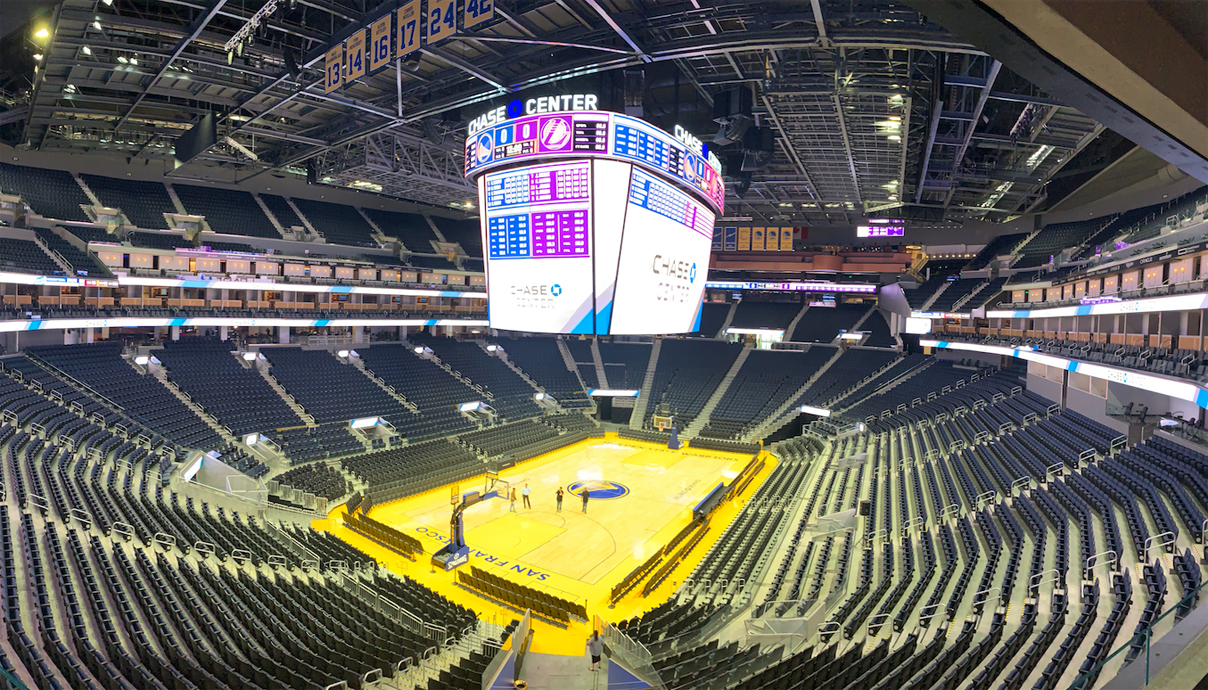
Going In. The Chase Center, named for JPMorgan Chase (formerly Chase Manhattan Bank), opened on September 6, 2019. In spite of the move back across the Bay after 48 years in Oakland, they have kept the "Golden State" name.
It is about 2 miles southeast of downtown, off the Central Basin of the San Francisco Bay, bounded by Warriors Way (formerly Gene Friend Way) on the north, Terry A. Francois Boulevard on the east, 16th Street on the south and 3rd Street on the west. It's about 8 blocks south of the Giants' Oracle Park. The official address is 1 Warriors Way. It can be accessed by Light Rail K or T streetcar to UCSF / Chase Center station. (That's University of California at San Francisco.) If you drive in, parking is going to set you back $50.

The first event at the arena was indicative of the many contradictions of San Francisco: Metallica and the San Francisco Symphony. In addition to the Warriors, the University of San Francisco plays some basketball games there, when they feel they can attract a bigger crowd than their 3,000-seat Sobrato Center (formerly the War Memorial Gymnasium) can hold. This is fair play, since the Warriors played some home games there from 1962 to 1967.
Food. San Francisco, due to being a waterfront city and a transportation and freight hub, has a reputation as one of America's best food cities. Unfortunately, the Chase Center website doesn't have a concessions map. Fortunately, I found a website with some recommendations, but it doesn't get any more specific as to a location than "Located in the Stadium's Concourse":

* Sam's Chowder House: Popcorn Shrimp, Lobster Rolls, Crab Fries, Clam Chowder
* La Corneta: Burritos with Chicken, Beef and Pork
* Big Nate's BBQ, probably named after the late Warriors Hall-of-Famer Nate Thurmond: Beef Brisket and Pulled Pork Sandwiches
* Hot Dog Bill's, including "Burger Dogs," apparently a combination of a hot dog and a hamburger
* Bakesale Betty: Chicken Fingers, Fried Chicken Sandwiches, Fries

Team History Displays. Until the 2015-16 NBA season began, the Warriors had their banner for the 1 title they'd won in the Bay Area flanked by the 2 they'd won in Philadelphia, and those, in turn, flanked by their retired numbers.

Now, they have the NBA Championship banners in sequence: Philadelphia 1946-47, Philadelphia 1955-56, Golden State 1974-75, Golden State 2014-15, Golden State 2016-17, Golden State 2017-18. They do not, however, hang banners for their Conference titles in which they lost the NBA Finals, in 1948, 1964, 1967 and 2016; or for their other Division title, in 1976.
The numerical sequence of their retired numbers also works well, as the 3 lowest retired numbers, hung to the left of the title banners, are of players who played in Philadelphia, and made the 1962 move across the continent: 13, center Wilt Chamberlain; 14, forward Tom Meschery; and 16, guard Al Attles. All of them played on the 1964 team that reached the Finals, and all of them played in the 1967 Finals -- although, in Wilt's case, it was against the Warriors for the new Philadelphia team, the 76ers. Attles also coached them to the 1975 NBA Championship.

The numbers to the right of the title banners are: 17, guard Chris Mullin, a star of the 1980s and '90s (and, as New Yorkers, you may note that he is now head coach at St. John's, where he played for Lou Carnesecca); 24, forward Rick Barry, the Roselle Park, New Jersey native who bridged the "San Francisco" and "Golden State" eras, winning an ABA title with the Oakland Oaks and an NBA title with the Warriors in the same building; and 42, center Nate Thurmond, who reached the Finals with them in 1964 and 1967, but was gone by 1975.
Photo from the 2017-18 season.
Banners for 2015 and 2017, but not 2018.

Chamberlain, Barry, Thurmond and Mullin are in the Basketball Hall of Fame. So is Jamaal Wilkes, a member of the 1975 team (he was named Keith Wilkes at the time) who also won titles with the Lakers. So is Šarūnas Marčiulionis, the Lithuanian legend who reluctantly starred with the Soviet national team, and wore 13 with the Warriors before it was retired for Wilt.

The Warriors do not honor players who played the bulk of their careers with them in Philadelphia, such as 1947 original Joe Fulks, the NBA's 1st-ever scoring leader; and 1956 titlists Neil Johnston, Paul Arizin, Tom Gola and Guy Rodgers. All 4 of those are in the Hall of Fame. Also playing at least 3 seasons with the team and in the Hall of Fame are Andy Phillip (Philadelphia), Robert Parish and Mitch Richmond.

Nor do the Warriors have any fan-viewable honors for non-uniformed personnel: Eddie Gottlieb, the founder who owned the team for their entire Philadelphia history and coached their 1947 NBA Champions; George Senesky, who played on their 1947 NBA Champions and coached their 1956 NBA Champions; Frank Mieuli, who bought the team from Gottlieb in 1962, moved them to San Francisco, and owned them until 1986; Alex Hannum, who coached their 1964 Conference Champions; Bill Sharman, who coached their 1967 Conference Champions; Pete Newell, the former University of California coach (1959 National Champions) who served as a scout for several years; and Don Nelson, head coach 1988-95 and 2006-10. All of these but Senesky and Mieuli are in the Hall of Fame.

Arizin and Fulks were named to the NBA's 25th Anniversary Team in 1971. Chamberlain was named to the 35th Anniversary Team in 1980. Arizin, Chamberlain, Thurmond and Barry were named to the NBA's 50th Anniversary 50 Greatest Players in 1996. Arizin, Chamberlain, Thurmond, Barry, Steph Curry and Kevin Durant were named to the NBA's 75th Anniversary 75 Greatest Players in 2021. 

The Bay Area Sports Hall of Fame (BASHOF) is unusual in that its exhibits are spread over several locations. Barry, Thurmond and Attles are honored at the Oakland Coliseum. Two are honored at San Francisco International Airport: Mullen at Gate 85, and Meschery at Gate 88. Frank Mieuli, their 1st owner in the Bay Area, Bill Cartwright, Mitch Richmond and Tim Hardaway have been elected, but their plaques have not yet been placed. Chamberlain has not yet been honored.

Following their 2018 NBA Championship, Sports Illustrated named the Warriors' entire team as their Sportspeople of the Year.

Warriors vs. Los Angeles Lakers was a bit of a rivalry in the 1960s, following such other Northern California vs. Southern California rivalries as Seals-Angels in the Pacific Coast League, Cal-UCLA, Giants-Dodgers and 49ers-Rams. But since the Warriors' 1975 title, it has been rare that both teams have been good at the the same time. LeBron James' arrival in L.A. may change that.

The Lakers lead the rivalry 257-170, 198-119 since both teams have been in California, and have won 6 of the 7 Playoff series between them. The Warriors won in 1967, and the Lakers have won in 1968, 1969, 1973, 1977, 1987 and 1991.

Stuff. The Warriors Shop is on the north side of the Chase Center. There, you can get merchandise of all kinds, including with the "CITY," "BAY" and "TOWN" (referencing Oakland) logos.

As you might guess, the Warriors' 2015 return to glory brought out celebratory books. Bay Area News Group (BANG), which publishes the San Jose Mercury News, published Golden Boys: The Golden State Warriors' Historic 2015 Championship Season. KCI Sports Publishing came out with Striking Gold - Golden State Warriors NBA Champions. For 2017, BANG published Gold Standard: The Golden State Warriors' Dominant Run to the 2017 NBA Championship. And in 2018, THREE: The Warriors' Remarkable Climb to the Dynasty's Third Championship.

For this team's signature player, Marcus Thompson wrote Golden: The Miraculous Rise of Steph Curry. (Seeing as how his father, Dell Curry, was also a pretty good baller, Steph's rise is superb, but hardly a miracle.)

For a discussion of their 1975 title season, and any other part of their history, you may have to settle for the Warriors' edition in the NBA's A History of Hoops series, written by Nate Frisch, with poor timing: Just 5 months later, and it would have been published with the new championship. Official DVD highlight packages for the 2015, 2017 and 2018 Finals have been released by the NBA.

During the Game. A November 13, 2014 article on DailyRotoHelp, ranked the NBA teams' fan bases, and listed the Warriors' fans 7th, in the top quartile of the league. This was written before the run to the 2015 title, and it called them "a loud, exciting bunch of fans."

This is not a Raider game. Nor is this a baseball Giant game where you might be wearing Dodger gear. This is a Warrior game, and even if you were wearing Laker gear (and you're not), you'd almost certainly be safe. Given the high prices of tickets, you're going to be considerably safer at a Warriors game than at a Raiders game (if the Raiders were still in Oakland).

Still: In spite of your New York (and possibly Brooklyn) origins, and their team name, don't yell out the iconic (and ad-libbed) line from the classic New York film The Warriors: "Warr-i-ors! Come out and play-ay!"

The Warriors -- a.k.a. The W's in print and The Dubs when spoken -- do not have a mascot. They do have cheerleaders. They do not have a regular National Anthem singer, but during the 2015 Playoffs, they had a good-luck charm in 10-year-old San Jose kid Nayah Damasen: They won every Playoff game at which she sang it.

The band Stroke 9 recorded a theme song, "Dem Dubs Doh" (Them Dubs, Though), to the tune of Jack Jones' legendary theme from The Love Boat. However, the best fan chant you're going to here is the rather generic, "Let's go, Warriors!" I suppose it could be worse: "GSW" stands for "Golden State Warriors," but it also stands for "gunshot wound."

After the Game. Listening to conservatives, you might think San Francisco is a barren hellscape of crime and drugs. Funny, that's what San Franciscans think about their beloved "heartland" (if we presume the drug is meth or oxycodone). Again, Dubs fans are not Raider fans. Don't antagonize anyone, and you'll be fine.

The Chase Center is in the middle of a complex called Thrive City, and there are restaurants around it: Harmonic Brewing to the north, Miller & Lux steakhouse to the east, and Dumpling Time to the west.

What's that? You've already paid through the nose for your game ticket, and you don't want to have to take out a loan for a postgame meal? Unfortunately, most of the area around Thrive City is the UCSF campus, without many places to eat and/or drink. You may have to head back downtown.

There are three bars in the Lower Nob Hill neighborhood of San Francisco that are worth mentioning. Aces, at 998 Sutter Street & Hyde Street in San Francisco's Lower Nob Hill neighborhood, is said to have a Yankee sign out front and a Yankee Fan as the main bartender. It's also the home port of Mets, NFL Giants, Knicks and Rangers fans in the Bay Area.

R Bar, at 1176 Sutter & Polk Street, is the local Jets fan hangout. The Wreck Room, at 1390 California Street at Hyde Street, has also been cited as a Jet fans' bar. Greens Sports Bar, at 2239 Polk at Green Street, is also said to be a Yankee-friendly bar. And a recent Thrillist article, citing the best sports bar in each State, named the Kezar Pub, at 770 Stanyan Street across from the eponymous stadium, as the best one in California.

The Kezar Pub is also rated as one of the best bars to watch European soccer games. If you visit the Bay Area during that sport's season (which is in progress), these San Francisco bars are also recommended, due to their early openings: Maggie McGarry's, 1353 Grant Avenue, Bus 30; and Danny Coyle's, 668 Haight Street, MUNI N Line or Bus 6. Sadly, The Mad Dog in the Fog, at 530 Haight Street, was a victim of the long-term COVID shutdown.

Lefty O'Doul's, named for the legendary ballplayer who was the longtime manager of the Pacific Coast League's San Francisco Seals, was at 333 Geary Street, corner of Powell Street, just 3 blocks from the Powell Street BART station and right on a cable car line. But a dispute between the operators of the restaurant and the owners of the building meant its closing in 2017. 

Sidelights. On November 30, 2018, Thrillist published a list of "America's 25 Most Fun Cities," and, as you might expect from the nation's 4th largest metropolitan area, the San Francisco Bay Area came in 4th. It has a very rich sports history:

* Seals Stadium. Home of the PCL's San Francisco Seals from 1931 to 1957, the Mission Reds from 1931 to 1937, and the Giants in 1958 and '59, it was the first home professional field of the DiMaggio brothers: First Vince, then Joe, and finally Dom all played for the Seals in the 1930s. The Seals won Pennants there in 1931, '35, '43, '44, '45, '46 and '57 (their last season).

It seated just 18,500, expanded to 22,900 for the Giants, and was never going to be more than a stopgap facility until the Giants' larger park could be built. It was demolished right after the 1959 season, and the site now has a Safeway grocery store.

Bryant Street, 16th Street, Potrero Avenue and Alameda Street, in the Mission District. Hard to reach by public transport: The Number 10 bus goes down Townsend Street and Rhode Island Avenue until reaching 16th, but then it's an 8-block walk. The Number 27 can be picked up at 5th & Harrison Streets, and will go right there.

* Kezar Stadium. The 49ers played here from their 1946 founding until 1970, the Raiders spent their inaugural 1960 season here, and previous pro teams in the city also played at this facility at the southeastern corner of Golden Gate Park, a mere 10-minute walk from the fabled corner of Haight & Ashbury Streets.

High school football, including the annual City Championship played on Thanksgiving Day, used to be held here as well. Bob St. Clair, who played there in high school, college (University of San Francisco) and the NFL in a Hall of Fame career with the 49ers, has compared it to Chicago's Wrigley Field as a "neighborhood stadium."

After the 49ers left, it became a major concert venue. Rocky Marciano defended the Heavyweight Championship of the World there on May 16, 1955, knocking British fighter Don Cockell out in the 9th round.

The original 60,000-seat structure was built in 1925, and was torn down in 1989 (a few months before the earthquake, so there's no way to know what the quake would have done to it), and was replaced in 1990 with a 9,000-seat stadium, much more suitable for high school sports. The original Kezar, named for one of the city's pioneering families, had a cameo in the Clint Eastwood film Dirty Harry. Frederick & Stanyan Streets, Kezar Drive and Arguello Blvd. MUNI light rail N train.

* Candlestick Park. Home of the Giants from 1960 to 1999, the NFL 49ers from 1970 to 2013, and the Raiders in the 1961 season, this may be the most-maligned sports facility in North American history. Its seaside location (Candlestick Point) led to spectators being stricken by wind (a.k.a. The Hawk), cold, and even fog.

It was open to the Bay until 1971, including the 1962 World Series between the Yankees and the Giants, and was then enclosed to expand it from 42,000 to 69,000 seats for the Niners. It also got artificial turf for the 1970 season, one of the 1st stadiums to have it – though, to the city's credit, it was also the 1st NFL stadium and the 2nd MLB stadium (after Comiskey Park in Chicago) to switch back to real grass.

It is easily the most-hated venue in the history of North American sports. But its finest hour came on October 17, 1989, just before Game 3 of the World Series, when the Loma Prieta Earthquake struck. Over 60,000 people were inside the stadium, and they all got out okay, because the stadium's reinforced concrete held, with only minor damage.

The Giants only won 2 Pennants there, and never a World Series. But the 49ers won 5 Super Bowls while playing there, with 3 of their 6 NFC Championship Games won as the home team. The NFL Giants did beat the 49ers there in the 1990 NFC Championship Game, scoring no touchdowns but winning 15-13 thanks to 5 Matt Bahr field goals. ABC and ESPN hosted Monday Night Football at Candlestick 36 times, the most of any stadium.
The Beatles played their last "real concert" ever at the 'Stick on August 29, 1966. Only 25,000 people came out, a total probably driven down by the stadium's reputation and John Lennon's comments about religion on that tour. 

The U.S. national soccer team played their 4th and final match there on May 27, 2014, a win over Azerbaijan. On July 12 of that year, nearly 30 years after their Super Bowl XIX matchup, legendary quarterbacks Joe Montana of the 49ers and Dan Marino of the Miami Dolphins led teams in a flag football game there, with the proceeds going to charity. On July 26, MLS' San Jose Earthquakes hosted the last sporting event held there, a "friendly" with Spanish team Atletico Madrid, losing 4-3 in a shootout. And Paul McCartney, having played its 1st concert with the Beatles 48 years earlier, played its last concert on August 14, the last scheduled show before the place was demolished.

A plan to build retail and housing units on the site has stalled, and an RV Park is currently the only thing on its site. Ironically, since it replaced the original Kezar Stadium, 5,000 of Candlestick's seats went to the new Kezar.

The best way by public transport isn't a good one: The KT light rail at 4th & King Streets, at the CalTrain terminal, to 3rd & Gilman Streets, and then it's almost a mile's walk down Jagerson Avenue. So unless you're driving/renting a car, or you're a sports history buff who has to see the place, I wouldn't blame you if you crossed it off the list.

* Cow Palace. The more familiar name of the Grand National Livestock Pavilion, this big barn just south of the City Line in Daly City has hosted just about everything, from livestock shows and rodeos to the 1956 and 1964 Republican National Conventions, nominating Dwight D. Eisenhower and Barry Goldwater, respectively, for President. (Yes, the Republicans came here, not the "hippie" Democrats, although they did hold their 1984 Convention downtown at the George Moscone Convention Center, 747 Howard Street at 4th Street, nominating Walter Mondale.)
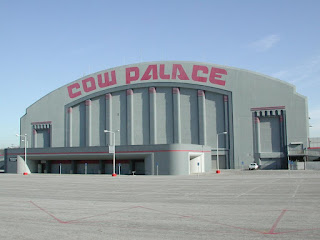
The '64 Convention is where New York's Governor Nelson Rockefeller refused to be booed off the podium when he dared to speak out against the John Birch Society – the Tea Party idiots of their time – and when Senator Goldwater was nominated, telling them, "I would remind you, my fellow Republicans, that extremism in the defense of liberty is no vice! And I would remind you also that moderation in the pursuit of justice is no virtue." (Personally, I think that extremism in the defense of liberty is no defense of liberty.)

Built in 1941, it is one of the oldest remaining former NBA and NHL sites, having hosted the NBA's Warriors (then calling themselves the San Francisco Warriors) from 1962 to 1971, the NHL's San Jose Sharks from their 1991 debut until their current arena could open in 1993, and several minor-league hockey teams. It hosted 1 fight for the Heavyweight Championship of the World, with Ezzard Charles defending the title by beating Pat Valentino on October 14, 1949.

The 1960 NCAA Final Four was held here, culminating in Ohio State, led by Jerry Lucas and John Havlicek (with future coaching legend Bobby Knight as the 6th man) beating local heroes and defending National Champions California, led by Darrall Imhoff.

The Beatles played here on August 19, 1964 and August 31, 1965, and Elvis sang here on November 13, 1970 and November 28 & 29, 1976. It was the site of Neil Young's 1978 concert that produced the live album Live Rust and the concert film Rust Never Sleeps, and the 1986 Conspiracy of Hope benefit with Joan Baez, Lou Reed, Sting and U2.

The acoustics of the place, and the loss of such legendary venues as the Fillmore West and the Winterland Ballroom, make it the Bay Area's holiest active rock and roll site. 2600 Geneva Avenue at Santos Street, in Daly City. 8X bus.

* Sobrato Center. From their 1962 arrival until moving to Oakland in 1971, the Warriors played several home games at the War Memorial Gymnasium at the University of San Francisco. It opened in 1958, thanks to the revenues from USF's 1955 and 1956 National Championships led by future Boston Celtics stars Bill Russell and K.C. Jones. But it only seats 3,0000, so it was never a viable permanent home for an NBA team.

In 2019, it was renamed the Sobrato Center, for John and Susan Sobrato, Silicon Valley tycoons who donated $15 million for its renovation. 2335 Golden Gate Avenue at Roselyn Terrace. Bus 31.
USF's Memorial Gym

* Oracle Park. Home of the Giants since 2000, It was known as Pacific Bell Park through the 2003 season, SBC Park in 2004 and 2005, and AT&T Park from 2006 to 2018. It has been better for the Giants than Candlestick -- aesthetically, competitively, financially, you name it. Winning 3 World Series since it opened, it's been home to The Freak (Tim Lincecum) and The Steroid Freak (Barry Bonds).

It's hosted some college football games, and a February 10, 2006 win by the U.S. soccer team over Japan. 24 Willie Mays Plaza, at 3rd & King Streets.

* Mechanic's Pavilion. Knowing that the drying up of the Gold Rush had put many of the original "Forty-Niners" out of work, with no educational background to support them, a group of charitable San Franciscans opened the Mechanics' Institute in 1854. It offered classes in woodworking, mechanical drawing, industrial design, electrical science, applied mathematics and ironwork. It is often said to be the predecessor of the University of California system.

In 1865, the adjoining Mechanic's Pavilion was built, hosting several major events, including a speech by President Theodore Roosevelt on his 1902 tour of the country.

This also included 4 fights for the Heavyweight Championship of the World, each time with a Californian defending the title: "Gentleman Jim" Corbett against Tom Sharkey on June 24, 1896 (a draw, thus allowing Corbett to retain the title); Jim Jeffries against Gus Ruhlin on November 15, 1901; Jeffries against Corbett on August 14, 1903 (the 10th-round knockout turning out to be Corbett's last fight); and Jeffries against Jack Munroe on August 26, 1904 (after which Jeffries retired, only to return and get clobbered by Jack Johnson in Reno in 1910).

The 1906 earthquake and fire destroyed Mechanic's Pavilion, but the men running the Mechanics' Institute kept it going and helped with the rebuilding of the city. Today, membership in the Institute is still open to the pubic, offering the full services of the library, and to the chess room, home of the oldest continuously operating chess club in the Western Hemisphere. 57 Post Street, off Kearny Street, downtown.

* Emeryville Park. Also known as Oaks Park, this was the home of the Pacific Coast League's Oakland Oaks from 1913 until 1955. The Oaks won Pennants there in 1927, '48, '50 and '54.

Most notable of these was the 1948 Pennant, won by a group of players who had nearly all played in the majors and were considered old, and were known as the Nine Old Men (a name often given to the U.S. Supreme Court). These old men included former Yankee 1st baseman Nick Etten, the previous year's World Series hero Cookie Lavagetto of the Brooklyn Dodgers (an Oakland native), Hall of Fame catcher Ernie Lombardi (another Oakland native), and one very young player, a 20-year-old 2nd baseman from Berkeley named Billy Martin.

Their manager? Casey Stengel. Impressed by Casey's feat of managing the Nine Old Men to a Pennant in a league that was pretty much major league quality, and by his previously having managed the minor-league version of the Milwaukee Brewers to an American Association Pennant, Yankee owners Dan Topping and Del Webb hired Casey to manage in 1949. Casey told Billy that if he ever got the chance to bring him east, he would, and he was as good as his word.

Pixar Studios has built property on the site. 45th Street, San Pablo Avenue, Park Avenue and Watts Street, Emeryville, near the Amtrak station. Number 72 bus from Jack London Square.

* Frank Youell Field. This was another stopgap facility, used by the Raiders from 1962 to 1965, a 22,000-seat stadium that was named after an Oakland undertaker – perhaps fitting, although the Raiders didn't yet have that image. Interestingly from a New York perspective, the first game here was between the Raiders and the forerunners of the Jets, the New York Titans.

It was demolished in 1969. A new field of the same name was built on the site for Laney College. East 8th Street, 5th Avenue, East 10th Street and the Oakland Estuary. Lake Merritt BART station.

* Oakland-Alameda County Coliseum complex. The Oakland Coliseum complex is 6 1/2 miles from downtown Oakland, 18 miles from downtown San Francisco, and 35 miles from downtown San JoseThe Bay Area Rapid Transit (BART) subway line has a Coliseum stop, which can be accessed from nearly every city in the Bay Area. The official address of the Coliseum complex, including the Arena, is 7000 Coliseum Way.

The complex includes the stadium that has been home to the A's since 1968; and to the NFL's Oakland Raiders from 1966 to 1981, and again from 1995 to 2019. It also includes the Oracle Arena, a somewhat-renovated version of the Oakland Coliseum Arena, home to the Warriors on and off since 1966, and continuously from 1971 to 2019, except for a one-year hiatus in San Jose while it was being renovated, 1996-97.

The Oakland Clippers, the only champions the National Professional Soccer League would know, played at the Coliseum in 1967 and 1968, beating the Baltimore Bays 4-1 in the 2nd leg of the 1967 NPSL Final to win 4-2 on aggregate, before the NPSL merged with the North American Soccer League the next year. The Bay Area's former NHL team, the Oakland Seals/California Golden Seals, played at the arena from 1967 to 1976.

The Coliseum faces east, away from San Francisco, and is 6 miles northwest of downtown Oakland. From the outside, it won't look like much, mainly because it was mostly built below ground. Above ground, you'll be seeing only the upper deck. If you come in by BART, you'll almost certainly be coming in from the east.
The Oakland Coliseum Arena opened on November 9, 1966, and became home to the Warriors in 1971 -- at which point they changed their name from "San Francisco Warriors" to "Golden State Warriors," as if representing the entire State of California had enabled the "California Angels" to take Los Angeles away from the Dodgers, and it didn't take L.A. away from the Lakers, either.
The arena also hosted the Oakland Oaks, who won the American Basketball Association title in 1969; the Oakland Seals, later the California Golden Seals (didn't work for them, either), from 1967 to 1976; the Golden Bay Earthquakes of the Major Indoor Soccer League; and select basketball games for the University of California from 1966 to 1999. It's also been a major concert venue, and hosted the Bay Area's own, the Grateful Dead, more times than any other building: 66. Elvis Presley sang at the Coliseum Arena on November 10, 1970 and November 11, 1972.

In 1996-97, the arena was gutted to expand it from 15,000 to 19,000 seats. (The Warriors spent that season in San Jose, groundsharing with the Sharks.) This transformed it from a 1960s arena that was too small by the 1990s into one that was ready for an early 21st Century sports crowd. It was renamed The Arena in Oakland in 1997, and the Oracle Arena, for the computer technology company, in 2005. The court runs east-to-west, and that ceiling might remind you of Madison Square Garden.

* Howard Terminal Ballpark. On November 28, 2018, the A's announced that they'd chosen the Howard Terminal as the site for a 34,000-seat ballpark, which, presuming they clear all the necessary permissions, and come up with all the funding themselves as they say they will -- no government money and therefore no taxes -- they can begin construction in time to open for the 2025 season. I know that sounds like a distant future to those of us who grew up in the 1970s and '80s, but it's only 3 seasons away now.

1 Market Street, 3 blocks west of the Clay Street Ferry Terminal, 5 blocks west of Jack London Square, and 8 blocks south of downtown. From Oakland City Center: Bus 72 to Jack London Square. By BART: Lake Merritt Station, then Bus 62 or 72 to 7th & Market, then 8 blocks south.)

* California Memorial Stadium. Home of Stanford's arch-rivals, the University of California, at its main campus in Berkeley in the East Bay. (The school is generally known as "Cal" for sports, and "Berkeley" for most other purposes.) Its location in the Berkeley Hills makes it one of the nicest settings in college football.

But it's also, quite literally, on the Hayward Fault, a branch of the San Andreas Fault, so if "The Big One" had hit during a Cal home game, 72,000 people would have been screwed. With this in mind, the University renovated the stadium, making it safer and ready for 63,000 fans in 2012. So, like their arch-rivals Stanford, they now have a new stadium on the site of the old one.

The old stadium hosted 1 NFL game, and it was a very notable one: Due to a scheduling conflict with the A's, the Raiders played a 1973 game there with the Miami Dolphins, and ended the Dolphins' winning streak that included the entire 1972 season and Super Bowl VII. 76 Canyon Road, Berkeley. Downtown Berkeley stop on BART; 5 1/2 miles from downtown Oakland, 14 from downtown San Francisco, 48 from downtown San Jose.

* Stanford Stadium. This is the home field of Stanford University in Palo Alto, down the Peninsula from San Francisco. Originally built in 1921, it was home to many great quarterbacks, from early 49ers signal-caller Frankie Albert to 1971 Heisman winner Jim Plunkett to John Elway. It hosted Super Bowl XIX in 1985, won by the 49ers over the Miami Dolphins – 1 of only 2 Super Bowls that ended up having had a team that could have been called a home team. (The other was XIV, the Los Angeles Rams losing to the Pittsburgh Steelers at the Rose Bowl.)

It also hosted San Francisco's games of the 1994 World Cup, a game of the 1999 Women's World Cup, and the soccer games of the 1984 Olympics, even though most of the events of those Olympics were down the coast in Los Angeles. It hosted 10 games by the U.S. national team, totaling 4 wins, 2 losses, 2 draws.

The original 85,000-seat structure was demolished and replaced with a new 50,000-seat stadium in 2006. Arboretum Road & Galvez Street. Caltrain to Palo Alto, 36 miles from downtown Oakland, 35 from downtown San Francisco, 19 from downtown San Jose.

* Levi's Stadium. The new home of the 49ers, whose naming rights were bought by the San Francisco-based clothing company that popularized blue jeans all over the world, opened in 2014. It is nicknamed "The Field of Jeans."

In 2016, it hosted Super Bowl 50, with the Denver Broncos beating the Carolina Panthers; and an NHL Stadium Series outdoor hockey game there this past February, with the Sharks losing to their arch-rivals, the Los Angeles Kings.

It hosted a game of the 2016 Copa America, its 1st match by the U.S. national soccer team, but we lost 2-0 to Colombia. It annually hosts the Pacific-12 Conference Championship Game, and in 2019 (for the 2018 season) it will host the College Football Playoff National Championship. It has been selected by the U.S. Soccer Federation as a finalist to be one of the host venues for the 2026 World Cup. (UPDATE: It was chosen.)

Before construction, the address of the site was 4701 Great America Parkway at Old Glory Lane in Santa Clara, next to California's Great America park, outside San Jose. Now, the official address of Levi's Stadium is 4900 Marie P. DeBartolo Way, after the mother of former 49ers owner and newly-elected Pro Football Hall-of-Famer Eddie DeBartolo. If you're going to apply to the U.S. Postal Service to make it 4900, why not 4949? The intersection is Marie P. DeBartolo Way and Tasman Drive. It's 46 miles southeast of downtown San Francisco, 39 miles southeast of downtown Oakland, and 9 miles northwest of downtown San Jose.

CalTrain from downtown San Francisco to Santa Clara station. California's Great America theme part is next-door. From downtown San Jose, take the 916 trolley.

* SAP Center at San Jose. Formerly the San Jose Arena and the HP Pavilion, this building has hosted the NHL's San Jose Sharks since 1993. The Warriors played here in 1996-97, while their Oakland arena was being renovated. If you're a fan of the TV show The West Wing, this was the convention center where the ticket of Matt Santos and Leo McGarry was nominated. The Three Tenors -- Luciano Pavarotti, Placido Domingo and José Carreras -- sang there on December 29, 1999. 525 W. Santa Clara Street at Autumn Street, across from the Amtrak & CalTrain station.

* PayPal Park. Known as Avaya Stadium from its 2015 opening until 2020, the new stadium for MLS' San Jose Earthquakes is soccer-specific and seats 18,000 people. On July 28, 2016, it hosted the MLS All-Star Game, with North London giants Arsenal defeating the MLS All-Stars 2-1.

On March 24, 2017, it hosted its 1st match of the U.S. men's national soccer team, a 6-0 win over Honduras in a 2018 World Cup Qualifying match. On February 2, 2019, it hosted a 2-0 USMNT win over Costa Rica. It has hosted matches of the U.S. women's soccer team, and has also hosted rugby.

1123 Coleman Avenue & Newhall Drive. It is 3 1/2 miles from downtown San Jose, 41 miles from downtown Oakland, and 46 from downtown San Francisco. ACE (Altamont Commuter Express) to Great America-Santa Clara.

This is actually the 3rd version of the San Jose Earthquakes. The 1st one played in the original North American Soccer League from 1974 to 1984, at Spartan Stadium, renamed CEFCU Stadium (pronounced "SEF-kyu") in 2016, for Citizens Equity First Credit Union.

This facility has been home to San Jose State University sports since 1933. It was a neutral site hosting Soccer Bowl '75, in which the Tampa Bay Rowdies beat the Portland Timbers 2-0. It's hosted 3 games of the U.S. national team, most recently a 2007 loss to China, and games of the 1999 Women's World Cup.

On November 19, 2018, Moneywise compiled a list of their Worst College Football Stadiums, the bottom 19 percent of college football, 25 out of 129. Spartan Stadium, now named CEFCU Stadium, came in 5th-worst: The article called the New Deal era stadium "tired," and cited bad concessions and the fact that the field was Astroturf, the original artificial turf that has proven so dangerous, and not a more modern, safer synthetic grass like FieldTurf.

1251 S. 10th Street, San Jose. San Jose Municipal Stadium, home of the Triple-A San Jose Giants, is a block away at 588 E. Alma Avenue. From either downtown San Francisco or downtown Oakland, take BART to Fremont terminal, then 181 bus to 2nd & Santa Clara, then 68 bus to Monterey & Alma.

The 2nd version of the Quakes played at Spartan Stadium from 1996 to 2005, but ran into financial trouble, and got moved to become the Houston Dynamo. The 3rd version was started in 2008, and until 2014 played at Buck Shaw Stadium, now called Stevens Stadium, at 500 El Camino Real in Santa Clara, on the campus of Santa Clara University. Also accessible by the Santa Clara ACE station.

Despite all its contributions to women's soccer, the Bay Area no longer has a professional women's soccer team. The National Women's Soccer League (NWSL) is about to debut expansion teams in Los Angeles and San Diego, and already had West Coast teams in Seattle and Portland. But not, for the moment, anywhere near San Francisco.

The San Jose CyberRays of the Women's United Soccer Association (WUSA), captained by 1999 penalty hero Brandi Chastain, played at Spartan Stadium from 2001 to 2003, winning the 2001 league title.

FC Gold Pride won the 2010 title in the league named Women's Professional Soccer (WPS), but couldn't sustain itself financially, and folded immediately thereafter. Pioneer Stadium, Hayward. 25800 Carlos Bee Blvd., on the campus of California State University-East Bay, in Hayward. About 28 miles from San Francisco, 19 from Oakland, 28 from San Jose. BART to Hayward, then Bus 60.

In spite of the Raiders' now-abandoned return, the 49ers were more popular -- according to a 2014 Atlantic Monthly article, even in Alameda County. This is also true for the Giants, more popular in Alameda County than the A's. The Raiders remain more popular in the Los Angeles area, a holdover from their 1982-94 layover, and also a consequence of L.A. not having had a team since, although that has since changed.

In addition to the preceding venues, Elvis Presley sang at the Auditorium Arena (now the Kaiser Convention Center, near the Laney College campus in Oakland) early in his career, on June 3, 1956 and again on October 27, 1957; and the San Francisco Civic Auditorium (now the Bill Graham Civic Auditorium, 99 Grove Street at Polk Street) on October 26, 1957. This is also where the 1920 Democratic Convention was held, nominating James M. Cox, who lost to Warren Harding.

While Fresno is nearly 200 miles southeast, it's closer to San Francisco than it is to Los Angeles. Elvis sang at Fresno's Selland Arena on April 25, 1973 and May 12, 1974. 700 M Street at Ventura Street.

No President has ever been born, or has ever grown up, in the San Francisco Bay Area. But Herbert Hoover, 1929-33, was part of the 1st class at Stanford, from 1891 to 1895, and he and his wife, Lou Henry Hoover, maintained a home there from 1920 until her death in 1944, at which point he moved to the Waldorf Towers in New York. The house is now the official residence of the president -- of Stanford. It is not open to the public. 623 Mirada Avenue, across the campus from the stadium.

Stanford runs a think tank named for the 31st President, the Hoover Insitution, and exhibits inside the Hoover Tower on campus. 550 Serra Mall.

Yankee Legend Joe DiMaggio, who grew up in San Francisco and later divided his time between there and South Florida, is buried at Holy Cross Cemetery in Colma, on the Peninsula. 1500 Mission Road & Lawndale Blvd. BART to South San Francisco, then about a 1-mile walk.

The Fillmore Auditorium was at Fillmore Street and Geary Boulevard, and it still stands and hosts live music. Bus 38L. Winterland Ballroom, home of the final concerts of The Band (filmed as The Last Waltz) and the Sex Pistols, was around the corner from the Fillmore at Post & Steiner Streets. And the legendary corner of Haight & Ashbury Streets can be reached via the 30 Bus, taking it to Haight and Masonic Avenue and walking 1 block west.

Oakland isn't much of a museum city, especially compared with San Francisco across the Bay. But the Oakland Museum of California (10th & Oak, Lake Merritt BART) and the Chabot Space & Science Center (10000 Skyline Blvd., not accessible by BART) may be worth a look.

San Francisco, like New York, has a Museum of Modern Art (SFMOMA), at 151 3rd Street, downtown. The California Palace of the Legion of Honor is probably the city's most famous museum, in Lincoln Park at the northwestern corner of the city, near the Presidio and the Golden Gate Bridge. (Any of you who are Trekkies, the Presidio is a now-closed military base that, in the Star Trek Universe, is the seat of Starfleet Command and Starfleet Academy.)

The Palace of Fine Arts isn't just an art museum, it has a theater that hosted one of the 1976 Presidential Debates between Gerald Ford and Jimmy Carter -- the one where Ford said, "There is no Soviet domination in Eastern Europe." 3301 Lyon Street. Bus 30.

Fort Mason, on the north shore of the city, includes the Fort Mason Center for Arts & Culture. Which includes the San Francisco Museum of Modern Art. The park's Great Meadow was the site of James Brown's last concert, on August 20, 2006.

The tallest building in Northern California is the new Salesforce Tower, downtown, at 415 Mission Street, rising 1,070 feet. Another new skyscraper, slightly higher, recently opened in Los Angeles, slightly higher, so the Salesforce Tower isn't the tallest building in California, much less the American West. But, in San Francisco, it did supersede the iconic Transamerica Pyramid, 853 feet high, opening in 1972 at 600 Montgomery Street, also downtown.

And don't forget to take a ride on one of them cable cars I've been hearing so dang much about.

While San Francisco has been the setting for lots of TV shows (from Ironside and The Streets of San Francisco in the 1970s, to Full House and Dharma & Greg in the 1990s), Oakland, being much less glamorous, has had only one that I know of: Hangin' With Mr. Cooper, comedian Mark Curry's show about a former basketball player who returns to his old high school to teach. The 2010-15 NBC series Parenthood, loosely based on the 1989 film of the same name, was set in Berkeley.

In contrast, lots of movies have been shot in Oakland, including a pair of baseball-themed movies shot at the Coliseum: Moneyball, based on Michael Lewis' book about the early 2000s A's, with Brad Pitt as general manager Billy Beane; and the 1994 remake of Angels In the Outfield, filmed there because a recent earthquake had damaged the real-life Angels' Anaheim Stadium, and it couldn't be repaired in time for filming.

Oakland's status as a Navy city has allowed some nautical-themed films to be filmed there, including the 1934 pirate classic Treasure Island, various versions of The Sea Wolf, the World War I-themed film Hell's Angels (predating the Oakland-based motorcycle gang founded in 1948 and taking the name), the World War II film Thirty Seconds Over Tokyo, and Star Trek IV: The Voyage Home.

That movie filmed at Naval Air Station Alameda, where, as Commander Pavel Chekov (Walter Koenig) put it, "It's vhere they keep the nuclear wessels." (At least he didn't say, "Nucular.") They were allowed to film aboard the aircraft carrier USS Ranger, standing in for the USS Enterprise, which was away at sea during filming; the Enterprise's call sign, CVN-65, was painted over the Ranger's CVN-61.

Movies set in San Francisco often have scenes filmed in Oakland's wealthy hillside home areas, including Pal Joey, Mahogany, Basic Instinct, and the James Bond film A View to a Kill. The Jim Belushi film The Principal and Janet Jackson's gang-themed debut, Poetic Justice, were Oakland all the way. Robin Williams, a San Francisco native, filmed scenes from Mrs. Doubtfire and Flubber in Oakland. And the aforementioned George Lucas made his first film, THX-1138, in Oakland in 1970.

The Fan, about a fan's obsession with a Giants player, filmed at Candlestick Park. So did Experiment In Terror, Freebie and the Bean, and Contagion.

For legal reasons, the CBS medical drama Trapper John, M.D., starring former Bonanza star Pernell Roberts as Dr. John McIntyre, was said to be a sequel to the film version of M*A*S*H, where Trapper was played by Elliott Gould, not the TV show, where he was played by Wayne Rogers. Thus we have the oddity of Trapper working in a hospital in San Francisco, the hometown (well, the neighboring suburb of Mill Valley, in Marin County, was) of the man who replaced him at the 4077th MASH, B.J. Hunnicutt (Mike Farrell).

Wayne Rogers did play a doctor in a series set in San Francisco, after leaving M*A*S*H, starring with Lynn Redgrave in the 1979-82 sitcom House Calls, set it what was then the present day. Other series set in San Francisco include (separated by category, then by chronological order) the police dramas Ironside, The Streets of San Francisco, McMillan and Wife, Hooperman, Nash Bridges and Monk; the sci-fi/fantasy shows Sliders and Charmed; the family drama Party of Five; and the sitcoms Phyllis, Too Close for Comfort, My Sister Sam, Suddenly Susan, Dhrama & Greg, and Disney's That's So Raven.

The 1957-63 CBS Western Have Gun - Will Travel established the Hotel Carlton in San Francisco as the base of operations for the man known only as Paladin (Richard Boone). Today, there is a hotel by that name in the city, at 1075 Sutter Street in the Nob Hill section.

*

So, if you can afford it, go on out and join your fellow Knick or Net fans in going coast-to-coast, and take on the Golden State Warriors. They should inspire your team. After all, the Knicks (in the NBA) and the Nets (in the ABA) also haven't won a league title since the mid-1970s. If the Warriors can do it, there is hope!