Showing posts with label 2017. Show all posts

Monday, October 2, 2023

5 Times the Yankees Won the Pennant, But Shouldn't Have (And 5 Times They Didn't, But Should Have)

Sometimes, the better team doesn't win. Sometimes, the more deserving team doesn't win. Frequently, the Yankees are the more deserving team. But, in the immortal words of Clint Eastwood, "Deserve's got nothin' to do with it."

5 Times the Yankees Won the Pennant, But Shouldn't Have -- And...

5 Times They Didn't, But Should Have

These are in chronological order, rather than alternating between "Should Have" and "Shouldn't Have":

10. Should Have: 1904. For the first time, and not for the last, an American League Pennant comes down to New York and Boston. The last day of the season features a doubleheader at Hilltop Park, at 165th Street & Broadway in Manhattan's Washington Heights.

The New York Highlanders, forerunners of the Yankees, need to sweep the Boston Americans, forerunners of the Red Sox, in order to win. Otherwise, Boston will win it. Hilltop Park seats about 16,000, but there's perhaps 30,000 jammed into the confines, including thousands of standees roped off in the massive outfield area.

Pitching the 1st game for the Highlanders is Jack Chesbro, who has already won 41 games, which remains the single-season record for pitching from 60 feet, 6 inches away. And that's pronounced CHEESE-bro, not CHEZ-bro.

With the score 2-2 in the top of the 9th and Lou Criger on 3rd base, Chesbro throws a spitball – then a legal pitch – but it's a wild pitch, going over the head of his catcher, Jim "Deacon" McGuire, and Criger scores the Pennant-winning run. The Yankees win the nightcap, 1-0, but it's meaningless, as the Red Sox-to-be win the Pennant.

9. Shouldn't Have: 1922. The only time the St. Louis Browns won the Pennant, before moving in 1954 to become the Baltimore Orioles, was in 1944. But their 1922 team was considerably more talented, and also won more games, 93, compared to the 88 they won in 1944. But they lost the Pennant to the Yankees by 1 game.

The Browns nearly won it because Babe Ruth had spent much of the season squandering his great talents with carousing; and also because they had a pitcher the Yankees traded away to them, and would later reacquire, Urban Shocker. That trade nearly cost them the Pennant in 1921 and 1922, and it probably did cost them the Pennant in 1920 and 1924. They got him back, and he was key to winning the Pennant in 1926 and 1927.

8. Shouldn't Have: 1955. They finished 3 games ahead of the Cleveland Indians, despite being in kind of a transition between the teams of the Reynolds-Lopat-Raschi rotation and Phil Rizzuto at shortstop, and the Mickey-Yogi-Whitey teams of the late 1950s.

Plus, the Naps/Indians/Guardians have only won 6 Pennants in 123 years. And while it wouldn't have meant quite as much for the Brooklyn Dodgers to win their one and only World Series by beating Cleveland, it would have meant more to the Yankees to not have been the team they beat.

7. Should Have: 1980. Talent-wise, the Kansas City Royals have never been a better team than the Yankees, except maybe in 2014. (No, not even in their World Championship seasons of 1985 and 2015.) Certainly not in 1980, when the Yankees had a much tougher Division. (They won 103 games, and still beat Baltimore by only 3 games; K.C. won 97, and were 14 ahead of Oakland.) Plus, the Royals were as dirty as ever that season. Seriously: You'd have to be a hardcore hick to believe that George Brett ever deserved to win a Pennant.

6. Should Have: 1986. Maybe they were better in 1985, and getting revenge over the Royals for '80 would have felt great. But I'm going for '86. The California Angels proved they were there for the taking. And it would have set up a Subway Series with the Mets. And Dave Righetti was no Calvin Schiraldi -- or Bob Stanley. And Don Mattingly was no Bill Buckner. It would have humiliated the Met fans to see their "inevitable" World Championship ruined, by the team they hate the most, at their Flushing Toilet. As happened in 2000, although the Yankees did enter that Series as the favorites.

Interlude: 1994. Acting Commissioner Bud Selig screwed the Yankees over that season, but then, he screwed over a lot of teams, especially the Chicago White Sox, the Cleveland Indians, and the Montreal Expos. I can't say the Yankees deserved to win it more than those teams did.

5. Shouldn't Have: 1996. This might be sacrilege, but the Yankees did kind of limp into the Playoffs, nearly blowing the AL East title to the Orioles, and coming damn close to going down 2 games to 0 to the Texas Rangers in the AL Division Series. Throw it the Jeffrey Maier play in Game 1 of the AL Championship Series against the Orioles, and how badly they were beaten in the 1st 2 games of the World Series against the Atlanta Braves, and, arguably, the Yankees were really, really lucky.

Then again, they'd been really unlucky in the preceding 15 years. So, in this case, "Shouldn't Have" is a bit of a stretch.

4. Shouldn't Have: 2000. Yes, we beat the Mets in the World Series, and it was wonderful. It was also nerve-wracking, and probably took a year off my life. And we lost 16 of 19 heading into the Playoffs, nearly blowing the Division to the Red Sox. And we nearly blew the ALDS to the Oakland Athletics. Maybe if the A's had won the Pennant, they would've gotten a new ballpark, and wouldn't now be in danger of moving to an antiseptic airplane hangar in Las Vegas.

3. Shouldn't Have: 2003. Of all the Yankee teams accused of using performance-enhancing drugs, this one is the most-accused. Who knows: If Aaron Boone doesn't hit that home run, then, with Mariano Rivera done for the night, the Yankees probably lose the game in the 12th inning or onward; the Red Sox get out-cheated by the Florida Marlins (remember: They had steroid cheat Iván Rodríguez), and maybe they then fall apart, and don't win the Pennant and the World Series in 2004 and 2007, and we're still chanting "1918!"

Also, if Boone doesn't hit that home run, he probably never gets named manager of the Yankees.

2. Should Have: 2011. It all seemed to be coming together. Derek Jeter got his 3,000th career hit. Mark Teixeira and Curtis Granderson each hit 39 home runs, while Robinson Canó had 28, and each of them had at least 111 RBIs. CC Sabathia went 19-8, and Iván Nova went 16-4, notching the most wins by a Yankee rookie pitcher in 43 years. Best of all, they came from behind to win the Division, while the Red Sox had yet another September collapse, and missed the Playoffs completely.

And then the Yankees lost the AL Division Series to the Detroit Tigers. Their 3 losses were by a combined 4 runs. Nova was injured, but Joe Girardi started him in the decisive Game 5, anyway, and he could only go 2 innings, allowing 2 runs. Had Girardi started Phil Hughes, the Yankees would have won. The Pennant and the World Series were there for the taking: Neither the Texas Rangers nor the team that beat them in the World Series, the St. Louis Cardinals, was particularly impressive.

1. Should Have: 2017. Not just because it was Aaron Judge's rookie year and he hit 52 home runs. Think of how many Yankees looked like the wave of the future, and ended up massive disappointments and heartily booed. Gary Sánchez. Aaron Hicks. Didi Gregorius. Luis Severino. Dellin Betances. Chad Green. Domingo Germán. Not to mention the veteran Jacoby Ellsbury.

It ended up a waste of great seasons by Judge, Sánchez, Gregorius, Green, Sabathia, David Robertson, Brett Gardner, Starlin Castro and Matt Holliday. It was also the last, best chance for Masahiro Tanaka, who didn't have such a great season. Nor did Aroldis Chapman, who, at the least, won it the previous season with the Chicago Cubs.

They didn't win the AL East, but beat the Minnesota Twins in the AL Wild Card Game, came from 2-0 down to beat Cleveland 3-2 in the AL Division Series, and came from 2-0 down to lead the Houston Astros 3-2 in the AL Championship Series.

But they needed to win a 4th game in Houston, and, in Games 6 and 7 combined, went 10-for-63, a .159 batting average, against Justin Verlander (whom general manager Brian Cashman refused to acquire from the Detroit Tigers, and let the Astros get him) and Charlie Morton. And the Astros scored 11 runs in those 2 games -- by cheating, as we later found out.

Wednesday, September 20, 2023

How Long It's Been: Arsenal Played a Champions League Match

This afternoon, at 3:00 PM U.S. Eastern Time, Arsenal Football Club, a professional soccer team of whom I am both a fan and a supporter -- and, as some of their own "fans" have proven, there is a difference -- will play a UEFA Champions League match.

They will be at home, at the Emirates Stadium in North London, and will play Philips Sport Vereniging, or "Philips Sport Association," of Eindhoven, in the Netherlands. (Eindhoven is in Brabant. Not "Holland." Saying someone from Brabant is for "Holland" is like calling a Scotsman "English" -- or a Texan a "Yankee.") That team was formed by Philips, the former electronics giant, which is now focused on health technology. Along with Ajax in Amsterdam and Feyenoord in Rotterdam, they are one of the "Big Three" of Dutch soccer, and were 2nd in the Dutch league, the Eredivisie, last season.

Arsenal made the Champions League every season from 1998-99 to 2016-17. They never won it, and only reached the Final once, in 2006. They got to the knockout stage every season from 2003-04 to 2016-17, but lost in the Round of 16 every season from 2010-11 onward. (The role that the officiating played in these defeats is a story for another time.)

To some fans, getting there every year was a great success. To others, getting there every year, but losing in this fashion, was a failure. And seeing other English teams -- Manchester United, Liverpool, Chelsea, and now Manchester City, with Nottingham Forest and Aston Villa having previously done so -- win it was considered unfortunate by the former group, and a grand humiliation by the latter.

And yet, once Arsène Wenger, the manager who built this achievement, and had also won 3 Premier League titles and a record 7 FA Cups, including 2 "Doubles" and the 2003-04 "Invincible" season, left in 2018, the latter group seemed to be just fine with missing the CL entirely, and reaching the Final of the secondary European tournament, the UEFA Europa League, under new manager Unai Emery.

Well, that Final was a disastrous loss to Chelsea, and the team's best player, Mesut Özil, could be seen yelling at Emery, "I swear to God, you are not a coach!" And he proved it the next season, giving Arsenal its worst start in memory. He was fired, replaced as a caretaker manager by former team star Freddie Ljungberg, until another former Arsenal star, Mikel Arteta, could be acquired. He took Arsenal to the 2020 FA Cup, and to a 2nd place finish last season, and into the CL this season.

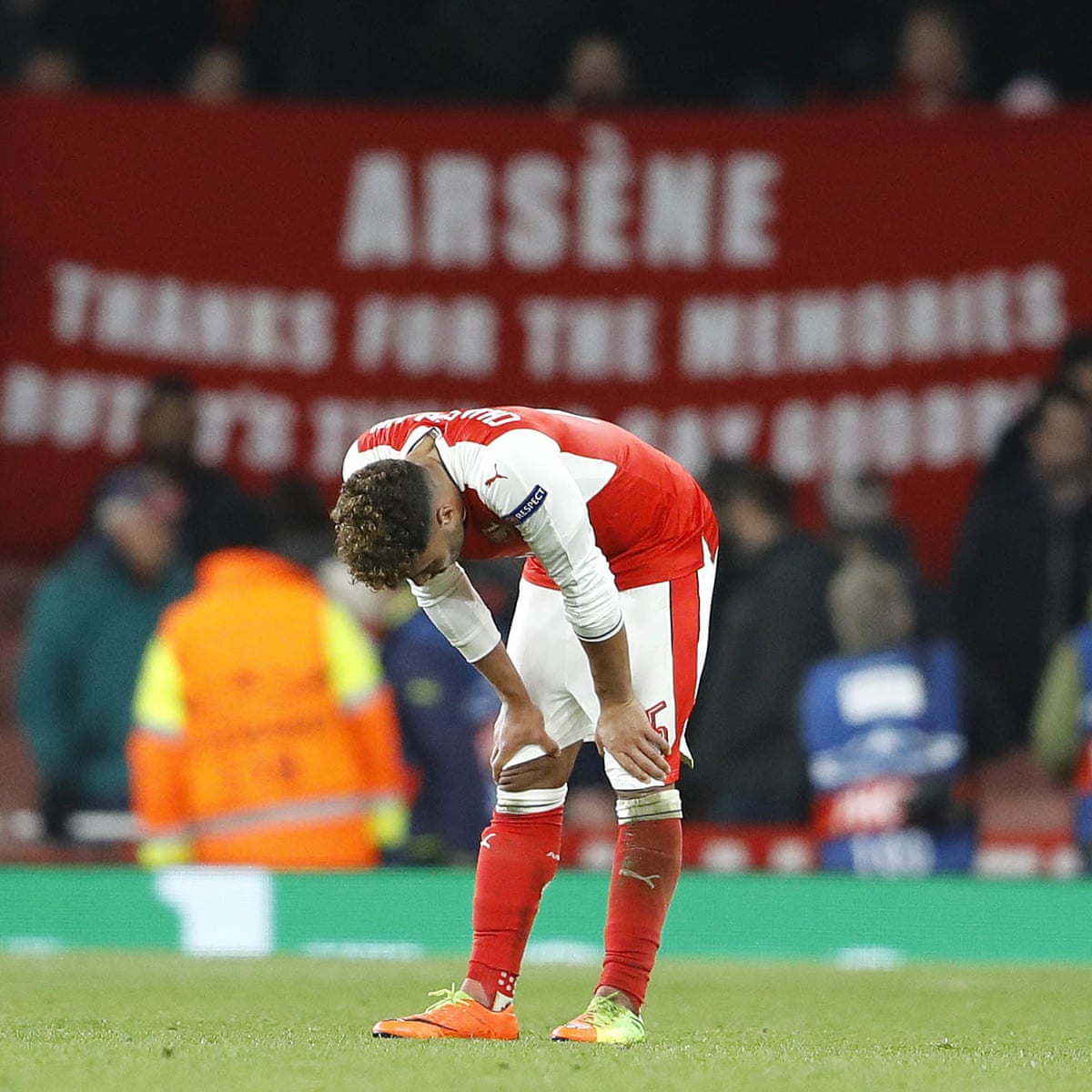
And so, Arsenal will take the pitch today against PSV. It will be their 1st Champions League match since March 7, 2017, a 5-1 loss to Bayern Munich at the Emirates, completing a 10-2 aggregate loss, to then as now, the dominant team in Germany.

I would tell you what I wrote about it at the time, but, apparently, I wrote nothing about it at the time. Though I did write about Arsenal the day before, ripping the "Wenger Out Brigade," pointing out that he had spent a lot of money on "world-class players," and it hadn't worked. Therefore, in their "diseased minds," as I put it, it must be his fault, not the players', and certainly not the WOB's for giving in to their demands.

It's been 6 years, 6 months and 12 days. How long has that been?

*

Here was Arsenal's starting XI: Goalkeeper David Ospina; right back Héctor Bellerín; centerbacks Shkodran Mustafi and Laurent Koscielny; left back Nacho Monreal; midfielders Granit Xhaka, Alex Oxlade-Chamberlain and Aaron Ramsey; right wing Theo Walcott; left wing Alexis Sánchez; and centre forward Olivier Giroud.

Substitutes who got into the game, all in the 72nd minute: Mesut Özil for Alexis, Francis Coquelin for Ramsey, and Lucas Pérez for Giroud. Listed as available substitutes, but not getting into the game: Goalkeeper Petr Čech, left back Kieran Gibbs, and centreback Gabriel Paulista.

Among those on the roster, but not listed for the game, due to injury, insufficient experience, or perhaps some other reason: Goalkeeper Emiliano Martínez; centrebacks Per Mertesacker and Rob Holding; midfielders Santi Cazorla, Mohamed Elneny and Ainsley Maitland-Niles; and forwards Danny Welbeck and Alex Iwobi.

Of those 26 players, 6 1/2 years later, only 1 is still on the Arsenal roster: Elneny.

Let the record show that Arsenal were leading 1-0 (albeit trailing 5-2 on aggregate) on a goal by Walcott when Koscielny was sent off with a bogus red card in the 53rd minute, and that all 5 of Bayern's goals came after that.

This Arsenal team finished 5th in the Premier League, 18 points behind League winners Chelsea and 1 point behind 4th-place Liverpool, keeping them out of the 2018-19 Champions League. But they won the FA Cup, beating Chelsea in the Final. Real Madrid of Spain beat Juventus of Turin, Italy in the Champions League Final.

The titleholders in American sports were the Chicago Cubs in baseball (it still doesn't seem possible), the New England Patriots in football, the Cleveland Cavaliers in basketball, the Pittsburgh Penguins in hockey, and the Seattle Sounders were the holders of the MLS Cup. The WBA and the IBF recognized Anthony Joshua as the Heavyweight Champion of the World, while the WBC recognized Deontay Wilder.

Since then, the Houston Astros and the Washington Nationals have won their 1st World Series, the Philadelphia Eagles their 1st NFL Championship since 1960, and the Kansas City Chiefs their 1st Super Bowl since 1970; the Toronto Raptors their 1st NBA Championship, and the Milwaukee Bucks their 1st since 1971; and the Washington Capitals, the St. Louis Blues and the Vegas Golden Knights their 1st Stanley Cups.

The Atlanta Braves and the Texas Rangers have opened new ballparks; the San Diego Chargers have moved to Los Angeles, and the Oakland Raiders have moved to Las Vegas; the Chargers, the Raiders, the Los Angeles Rams, and the Atlanta Falcons have opened new stadiums; the Golden Knights and the Seattle Kraken have begun play; and those NHL expansion teams, the New York Islanders, the Arizona Coyotes, the Detroit Red Wings and Pistons, the Milwaukee Bucks and the Golden State Warriors have opened new arenas.

All the major league sports teams in the New York Tri-State Area have changed their manager or head coach at least once. As hard as it is to believe, the senior field boss in New York now is Aaron Boone of the Yankees, hired on December 4, 2017.

Duck Dynasty, Pretty Little Liars, Once Upon a Time, The Americans, The Unbreakable Kimmy Schmidt, Veep, Game of Thrones and Drunk History were still on the air.

And Queen Elizabeth II, Chuck Berry, Whitey Ford and Tom Seaver, among others, have since died.

March 7, 2017. Arsenal played a UEFA Champions League game. They have not played one since.

That ends today. Hopefully, in victory.

Sunday, June 26, 2022

How to Be a Yankee Fan In Houston -- 2022 Edition

This coming Thursday, the Yankees travel to Houston to start a series with the Astros, who have knocked them out of the postseason in 2015, 2017 and 2019, and have been the only American League team to have really given them trouble so far this season.

So, how are they cheating this time?

The Astros have long been an iconic franchise, despite not having ever won a World Series, or even a World Series game, until 2017. They were 0-7 in postseason series until 2004, took until 2005 (44 seasons) to win their 1st Pennant, and got swept in the World Series by the Chicago White Sox, but finally pulled it all together in the 1st year of the Trump Maladministration.

They are iconic for good reasons, as the team of such legendary players as Rusty Staub, Jimmy Wynn, Cesar Cedeno, J.R. Richard, Nolan Ryan, Mike Scott, Craig Biggio and Jeff Bagwell. And as the hosts of The Bad News Bears In Breaking Training. And as participants in some storied series, including the 1980, 1986 and 2005 National League Championship Series. And as having tied in with Houston's aerospace industry.

And, to their credit, while, upon their debut in 1962, they publicized themselves as the 1st Major League Baseball team in the South, they did not encourage racism, Confederate battle flags, the playing of "Dixie" or "rebel yells."

They are also iconic for bad reasons, as the 1st team to build a dome, as the 1st to install artificial turf, and for their garish 1970s "Rainbow Brite" uniforms. And they did lay the Texas-themed stuff on a bit thick, though, with the cowboy hats and the gun images, due to their original 1962-64 name, the Houston Colt .45's. And, more than any other team -- including the Boston Red Sox, whose actions have not only been worse, but longer-lasting -- they have been "punished" for cheating. 

But they are remembered. Unlike certain other teams, who tend to drop out of the spotlight when they're no longer good, and make you forget that they exist (the other MLB team in Texas comes to mind), the Astros have stayed in the baseball fan's consciousness.

It still seems strange to me to see the Houston Astros in the American League, just as it's strange to see the Milwaukee Brewers in the National League. But, that's the way it is now.

Before You Go. Weather in "The Bayou City" can be bad, which is why the Aatrodome and now the retractable-roof Minute Maid Park were built. Heat and humidity. It could be a little jarring next week. The Houston Chronicle is predicting low 90s for the afternoons, high 70s for the evenings, and rain for all 4 days. The roof will be closed.

Houston is in the Central Time Zone, so you'll be an hour behind New York time. Although Texas was a Confederate State, you won't need to bring your passport or change your money.

Tickets. The Astros averaged 35,351 in 2019, the last pre-COVID season. That still leaves them a bit short of the park's current listed capacity of 42,060 seats. Getting tickets should not be a problem.

In spite of using "Dynamic Pricing," due to it being the Yankees in town, tickets are cheaper than we're used to in New York. Pretty much the only seats available for this series are in the upper deck, at $56.

Getting There. It's 1,629 miles from Times Square in New York to downtown Houston, and 1,637 miles from Yankee Stadium to Minute Maid Park. You're probably thinking that you should be flying.

Flying to Houston George Bush Intercontinental Airport (that's named for the father, not the son) can be done for as little as $478. Considering how far it is, that is rather cheap. Bus 102 will get you from the airport to downtown in an hour and 20 minutes.

Since the Monday after this series is the 4th of July, a lot of Amtrak runs are sold out this weekend. So I'm going to skip the train for this entry. For future reference, the last time I did this, it would have cost you $462 round-trip.

And don't be fooled by the fact that Houston's Union Station and the ballpark are next-door to each other, because Amtrak uses a different station a mile away. So let's just forget Amtrak, and move on.

Greyhound allows you to leave Port Authority Bus Terminal at 10:30 PM Saturday night, and arrive at Houston at 4:10 on Monday, a trip of 42 hours and 40 minutes. It would require changing buses in Atlanta on Sunday night.

It's $820 round-trip, but it can drop to as low as $575 with advanced purchase. You're better off spending a little extra and flying. The Houston Greyhound station is at 2121 Main Street, a mile and a half from the ballpark.

If you actually think it's worth it to drive, get someone to go with you so you'll have someone to talk to and one of you can drive while the other sleeps. You'll be taking Interstate 78 across New Jersey and into Pennsylvania to Harrisburg, where you'll pick up Interstate 81 and take that through the narrow panhandles of Maryland and West Virginia, down the Appalachian spine of Virginia and into Tennessee, where you'll pick up Interstate 40, stay on that briefly until you reach Interstate 75, and take that until you reach Interstate 59, which will take you into Georgia briefly and then across Alabama and Mississippi, and into Louisiana, where you take Interstate 12 west outside New Orleans. Take that until you reach Interstate 10. Once in Texas, Exit 770 will get you to downtown Houston.

If you do it right, you should spend about an hour and a half in New Jersey, 3 hours in Pennsylvania, 15 minutes in Maryland, half an hour in West Virginia, 5 and a half hours in Virginia, 3 hours and 45 minutes in Tennessee, half an hour in Georgia, 4 hours in Alabama, 2 hours and 45 minutes in Mississippi, 4 hours and 30 minutes in Louisiana and 2 hours in Texas. Including rest stops, and accounting for traffic, we're talking about a 40-hour trip.

Even if you're only going for one game, no matter how you got there, get a hotel and spend a night. You'll be exhausted otherwise. Trust me, I know: Trains and buses are not good ways to get sleep.

Once In the City. Houston was founded in 1836 as Allen's Landing, and was renamed for Sam Houston, "the Father of Texas." It would take until December 29, 1845 for Texas to be admitted to the Union as the 28th State. It seceded from the Union on February 23, 1861, and was readmitted on March 30, 1870.

There are 2.2 million people in Houston proper, making it the 4th-largest in America, and 6.3 million in the metropolitan area, making it 5th. But with multiple teams, it's only the 10th-largest market in the NBA, and the 7th-largest in MLB and the NFL.

The weather in Houston is so bad! (How bad is it?) A "bayou" (BYE-yoo) is a body of water, typically found in a flat, low-lying area, and can be either an extremely slow-moving stream or river, often with a poorly-defined shoreline, or a marshy lake or wetland. And Houston is known as the Bayou City.

When people talk about "the bayou," they usually mean Louisiana. But Southeast Texas is also bayou country, and it frequently leaves Houston hot, humid and muggy. It's a breeding ground for mosquitoes. The Astrodome had to be built not just to promote Houston, or to protect people from the heat, but to protect them from the bugs. Sandy Koufax of the Los Angeles Dodgers said, "Some of those mosquitoes are twin-engine jobs."

Fortunately, just as there's an overhead walkway system in Minneapolis, and an "Underground City" in Montreal, in their cases to protect pedestrians from their cities' notoriously cold Winter, there is a "Houston Tunnel System," begun in the 1930s, and inspired by New York itself, by the system under Rockefeller Center. Regardless of how much this may help, remember to stay hydrated.

The sales tax in the State of Texas is 6.25 percent, but in the City of Houston it goes up to 8.25 percent. The city doesn't appear to have a "centerpoint," where the address numbers start at 1, but there is a Main Street, running northeast/southwest. ZIP Codes in the Houston area start with the digits 77. The Area Codes are 713, with 281, 346 and 832 as overlays.
Houston has not 1, not 2, but 3 beltways: Interstate 610, a.k.a. the Inner Loop; Beltway 8, a.k.a. the Sam Houston Tollway; and State Highway 99, a.k.a. the Grand Parkway.

Like most Texas cities now, Houston has a Hispanic plurality, if not yet a majority: 44 percent. It's about 26 percent white, 24 percent black, and 6 percent Asian. It's mostly white on the west side; mostly black on the south, northwest and northeast sides; and mostly Hispanic on the north, east and southeast sides.

Houston, and South Texas, have had some racial disturbances. On August 13, 1906, in Brownsville on the Rio Grande (the border between Texas and Mexico), a white bartender was killed and a Hispanic policeman was wounded by gunshots. The blame fell on a segregated unit of black soldiers at nearby Fort Brown.

Following a U.S. Army Inspector General's report, President Theodore Roosevelt, in his role as Commander-in-Chief, ordered dishonorable discharges for 167 of those soldiers, costing them pensions and the right to serve in federal service jobs. This is a blot on TR's record, and in 1972, President Richard Nixon pardoned them and rewrote their discharges as honorable.

There were 21 deaths in a riot in Houston on August 23, 1917, when members of the all-black 24th United States Infantry Regiment at Camp Logan fought back against the all-white Houston Police Department. After a series of courts-martial that could only have been a kangaroo court, there were 19 executions, and 41 soldiers were sentenced to life imprisonment.

There was a race riot in Beaumont, about 85 miles east of Houston, on June 15, 1943, with 3 deaths. On May 17, 1967, there was a riot on the campus of the historically-black Texas Southern University, leading to the death of a police officer and the arrests of 500 students. But once it was found that the officer had died from "friendly fire," the ricochet of a fellow officer's bullet, all charges against the students were dropped. And there was a race riot in the Moody Park neighborhood of north Houston on May 7, 1978, with no deaths.

There is a light rail system, called METRORail, but you probably won't need it to get from a downtown hotel to the ballpark. One zone is $1.25, and the price rises to $4.50 for 4 zones, so a daypass is a better bargain at $3.00.
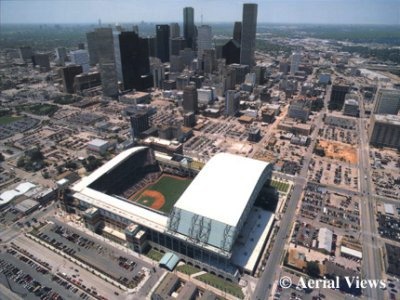
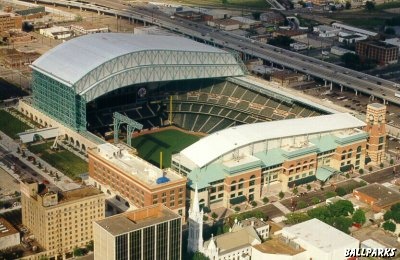
Going In. Minute Maid Park is in Downtown Houston. The mailing address is 501 Crawford Street. Parking is $15. METRORail to Convention District. Crawford Street bounds the left field side, Texas Avenue the 3rd base side, Hamilton Street the 1st base side and Congress Street the right field side. The ballpark points due north, but that won't matter, since its only "open" side, left field, has a window that doesn't face any neat-looking skyscrapers.
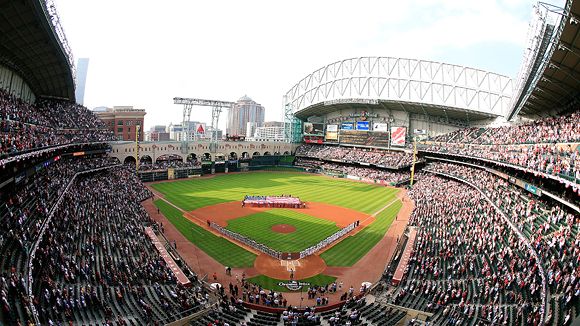
Unlike the Astrodome, "the Juice Box" has real grass. Also unlike its infamous predecessor, it is definitely a hitter's park. The left-field pole is just 315 feet from home plate, with the Crawford Boxes (named for the street) above. Left-center is 362, deep left-center is 404, center is 436 (the deepest current fence in MLB), right-center is 373, and the right-field pole is 326.
With roof open

Originally named Enron Field when it opened in 2000, the park was nicknamed Ten Run Field -- before Enron became the largest bankruptcy ever to that point, and Coca-Cola bought the naming rights and stuck the Minute Maid brand name, which it owns, on the stadium.

This change in the stadium name, but not in the propensity for offense, led Yankee broadcaster John Sterling, during an Interleague game there, to tell partner Charlie Steiner, "You know, Charlie, I understand that, at Minute Maid Park, the balls are juiced." To which Steiner said, "Ah, that's just pulp fiction."
With roof closed

Left field features a CITGO sign, but that and the 315-foot distance -- and the cheating -- are the only things that will remind anyone of Fenway Park in Boston. While a rail line does go past Fenway, the Red Sox don't incorporate that into the park. Here, they do, with an old-style steam locomotive chugging past for each Astro home run. It pulls a boxcar loaded with oranges, presumably for Minute Maid production.
The train, with the pre-2017 championship banners

The ballpark's longest home run is a 469-foot drive by Jake Marsinick on June 18, 2017. There's some dispute as to who hit the longest home run at the Astrodome, but it's usually credited to a 500-footer hit by Jimmy Wynn on April 12, 1970.

The home plate is the one used at the Astrodome, so the Astros have been using the same one since 1965. Center field features Tal's Hill, an incline in the mode of Cincinnati's old Crosley Field. It's named for Tal Smith, longtime Astro executive. And, like the pre-renovation old Yankee Stadium and Tiger Stadium in Detroit, the flagpole is on the field and in play. Above the Hill is the Phillips 66 Home Run Pump, a mockup of an old-style gasoline pump that displays how many Astro home runs have been hit there since the 2000 opening.

The foul poles have Chick-fil-A cows on them, reading "EAT MOR FOWL," as opposed to the chain's usual "EAT MOR CHIKN." When an Astro hits one of these "fowl poles" on the fly, every fan in attendance gets a coupon for a free chicken sandwich. Hunter Pence, now with the San Francisco Giants, was the first to hit the left-field pole, and former Met Kazuo Matsui was the first to hit the right-field pole.

The Houston College Classic is a baseball tournament that includes hometown schools the University of Houston and Rice University, and other schools, usually Texas schools. The ballpark has also hosted soccer, boxing and concerts.

Food. Being a "Wild West" city, you might expect Houston to have Western-themed stands with "real American food" at its ballpark. Being a Southern State, you might also expect to have barbecue. And you would be right on both counts. They have Tex-Mex food at Goya Latin Cafe and La Cantina at Section 119, El Real Fajita at 131, Kickin' Nachos at 114 and 427, Maverick Smokehouse at 124 and 410, Taqueria and Grille at 216, and Rosa's Cantina at 411 (almost certainly named for the place in the Marty Robbins song "El Paso," even if that is on the other side of the State).

They work the train theme with All Aboard at 109, Union Station at 113, Dining Car Grill at 125, Whistle Stop Libations at 218 and Chew Chew Express at 416.

There's also stands with baseball-themed names: Baseball Bar at 207 and Little Biggs Slider Cart at 111. Chinese food is at Larry's Big Bamboo at 118 and Little Bamboo at 422, and there are 5 Papa John's Pizza stands. And there are several Blue Bell Ice Cream stands.

According to a recent Thrillist article, the best thing to eat at Minute Maid Park is the brisket at Texas Smoke, at 125 and 406. The company's owner, celebrity chef Bryan Caswell, is an Astros fan.

Team History Displays. The Astros, like the Mets, celebrated their 50th Anniversary season in 2012, so they now have plenty of history. However, also like the Mets, it's a very hit-and-miss history.

Stanchions representing their titles are on a light tower above the left field wall, next to the train: Their 2017 World Series win; their 2005 and 2019 Pennants; their NL Western Division titles of 1980 and '86; their NL Central Division titles of 1997, '98, '99 and 2001; and their 2018  and '21 AL Western Division titles.
The 2017 banner tends to stand out.
And not just because it was obtained by cheating.
Yes, I said it again.

The club's retired numbers crown the scoreboard in right field. Officially, there are 9 of them: 32, 1960s pitcher Jim Umbricht, who died of cancer while still a young player; 40, 1970s pitcher Don Wilson, who also died while still active; 24, 1960s-70s outfielder Jimmy Wynn; 25, 1970s outfielder Jose Cruz; 49, 1970s pitcher, 1990s manager, and on-again-off-again broadcaster Larry Dierker; 34, 1980s pitcher Nolan Ryan, a Houston-area native; 33, 1980s pitcher Mike Scott; and the 2 men who got the Astros through their 1990s and 2000s postseason berths, 5, 1st baseman Jeff Bagwell, and 7, 2nd baseman Craig Biggio.
The universally-retired 42 for Jackie Robinson, who was already elected to the Hall of Fame before the Astros ever played a game, is also on that wall. This is somewhat appropriate, seeing as how the Astros were the 1st MLB team to play in a former Confederate State, and putting his number with the Astros' retired numbers is an effective acknowledgment that the arrival of Robinson and other nonwhite players was a good thing.

Not on that wall, and not officially retired, but neither has it been reissued, is the 57 of 1990s pitcher Darryl Kile, who died while with the St. Louis Cardinals in 2002.

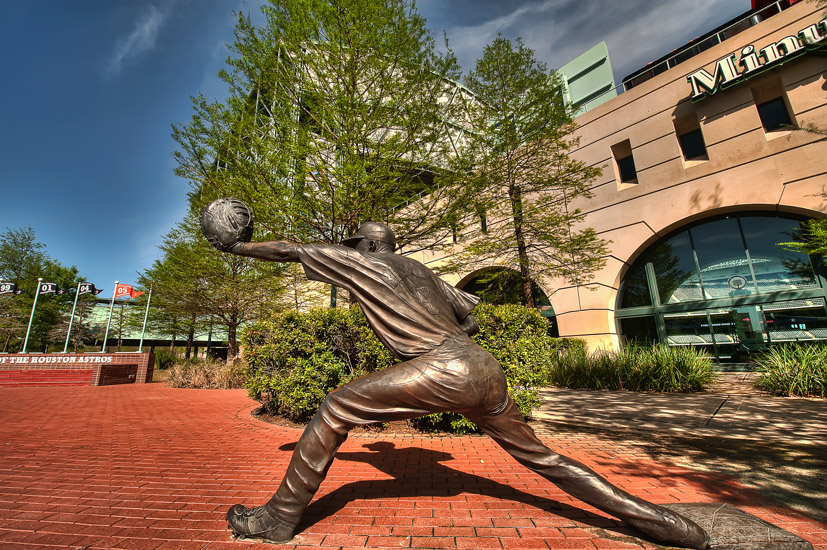
Statues of Bagwell and Biggio are located in the exterior of the ballpark, in a space known as The Plaza at Minute Maid Park. The Plaza also displays pennants for all Astros division and league championships, as well as several plaques to commemorate notable Astros and their achievements.
Biggio and Bagwell were the 1st players elected to the Baseball Hall of Fame with Astro caps on their plaques. Also having played for the Astros and in the Hall are Nellie Fox, Robin Roberts, Eddie Mathews, Joe Morgan, Nolan Ryan, Don Sutton, Randy Johnson and Ivan Rodriguez. To this list can be added Leo Durocher, who ended his long in-uniform baseball career as the Astros' manager in 1972 and '73; and broadcasters Gene Elston and Milo Hamilton.

Of those, only Biggio, Bagwell, Morgan and Ryan were Astros more than just briefly, although Mathews hit his 500th career home run with him. Ryan was with the Astros when he pitched his 5th no-hitter, surpassed Walter Johnson's 3,508 strikeouts to become the all-time leader, and became the 1st pitcher to strike 4,000 batters out. As the 1969 Astros sang, to the tune of a Tom Lehrer song and as quoted by pitcher Jim Bouton in his book Ball Four, "It Makes a Fellow Proud to Be an Astro."

The Astros established a team Hall of Fame in 2019. Included are:

* From the 1960s: Morgan, Wynn, Umbricht, Wilson, Dierker, Elston, founding owner Roy Hofheinz, 3rd baseman Bob Aspromonte (a Brooklyn native whose 1971 tenure with the Mets made him the last active former Brooklyn Dodger), and executive Tal Smith.

* From the 1970s: Wynn, Wilson, Dierker, Elston, Hofheinz, Smith, Cruz, pitcher J.R. Richard (whose 1980 stroke cut short a likely Hall of Fame career and may have cost the Astros at least 1 title), pitcher Joe Niekro, center fielder César Cedeño, and 1st baseman Bob Watson.

* From the 1980 Division Champions: Dierker as a broadcaster, Elston, Smith, Cruz, Niekro, Cedeño, Ryan, and outfielder Terry Puhl.

* From the 1986 Division Champions: Dierker as a broadcaster, Elston, Smith, Cruz, Ryan, Scott, Puhl and Hamilton.

* From the 1997, '98, '99 and 2001 Division Champions: Dierker as manager, Smith, Hamilton, Bagwell, Biggio, 1st baseman Lance Berkman; and pitchers Shane Reynolds, Roy Oswalt and Billy Wagner.

* From the 2005 Pennant winners: Smith, Hamilton, Bagwell, Biggio, Berkman and Oswalt. No members of their 2015-present title area have yet been elected.

Bagwell, Biggio, Morgan (a Texas native), Mathews (a Texarkana native), Berkman (a New Braunfels native who attended Houston's Rice University), Ryan (an Alvin native), Roberts and Dierker have been elected to the Texas Sports Hall of Fame, which is located in Waco. So have 2004-06 Astros Roger Clemens, born in Ohio but grew up in the Houston suburbs with Ryan as his hero; and Andy Pettitte, born in Louisiana but grew up in the Houston suburbs with Clemens as his hero. So have 1960s infielder Pete Runnels (a Lufkin native) and 1960s scout Lee Ballanfant (a Waco native).

Ryan and Clemens with Ryan as his hero, were named to the Major League Baseball All-Century Team in 1999, although Clemens hadn't yet thrown a pitch for the Astros. That same year, they and Morgan were named to The Sporting News' 100 Greatest Baseball Players. In 2006, Astro fans chose Ryan for the DHL Hometown Heroes poll. In 2022, ESPN named its 100 Greatest Baseball Players. Among players who played significant time for the Astros, Clemens was ranked 17th, Morgan 37th, Ryan 42nd, and Justin Verlander 72nd. Neither Biggio nor Bagwell made that list.

The Astros started playing the Rangers in the regular season when Interleague Play began in 1997, and have played each other within the American League since 2013. Since 2001, the winner of the season's Lone Star Series has received the Silver Boot. The Rangers lead the all-time series, 125-111, and the seasons are evenly divided at 9-9, with 4 splits. But the Astros were the 1st of the 2 to win a Pennant, and the 1st to win a World Series. (The Astros' cheating worked; the Rangers' cheating, mostly steroids, not as well.)


Stuff. Minute Maid Park has a Team Store in the left field corner of the ballpark, selling standard team-store gear. This being Texas, cowboy-style hats with the team logo are available.

A 50th Anniversary (1962-2012) team video is available, and so is a CD of longtime Astro broadcaster Milo Hamilton (who is probably best known not for any of his Astros' calls but for calling Hank Aaron's 715th home run while with the Braves). And Major League Baseball Projections has released a commemorative DVD series about the 2017 World Championship.

As for books about the team, as you might have guessed, the World Series win, following a nasty hurricane, led to a commemorative book: Joe Holley has written Hurricane Season: The Unforgettable Story of the 2017 Houston Astros and the Resilience of a City. Sara Gilbert (not the Roseanne actress) has published a 50th Anniversary retrospective, with the not-very-imaginative title of The Story of the Houston Astros. Jose De Jesus Ortiz and former Astro catcher Brad Ausmus commemorated the 2005 Pennant season with Houston Astros: Armed and Dangerous.

During the Game. A recent Thrillist article on "Baseball's Most Intolerable Fans" ranked Astro fans 27th -- that is, the 4th most tolerable. Having played 56 seasons before winning a single World Series game has dampened the traditional Texas arrogance: As the article puts it:

Despite being Texans, and thus genetically predisposed to boasting and scorning other people's brisket, the fanbase that supports the Astros evokes many of the same feelings as the -- gasp -- Brewers fans: long suffering, and non-threatening to opposing fans.

Winning it all has changed them. Like Red Sox fans, they either honestly believe their team didn't cheat, or that it was justified to counter their opponents' cheating.

If you were wearing Dallas Cowboy gear to a Houston Texans game, or Texas Longhorns gear to a Texas A&M Aggies game (or vice versa), you might be in trouble. But Astro fans aren't especially hostile to New Yorkers, so safety shouldn't be an issue. (Nor would it be if you were wearing Dallas Mavericks or San Antonio Spurs gear to a Houston Rockets game.)

None of these Astros-Yankees games will feature a promotion. This season, the Astros are wearing a 60th Anniversary patch on their uniforms.
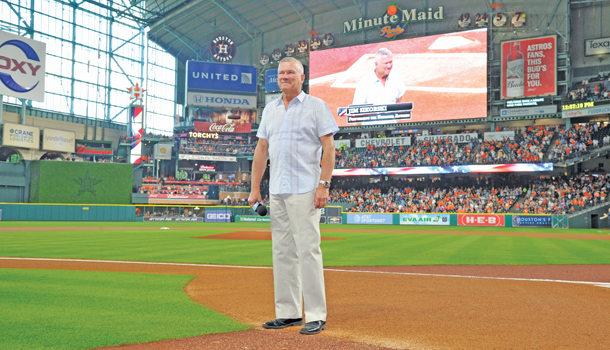
Jim Sikorski of the Houston Grand Opera has been the Astros' National Anthem singer since 1980 -- and has been openly gay almost the whole time, a rare thing in both Texas and baseball. Astro fans do not seem to have a problem with this.
Jim Sikorski

Their mascot is Orbit, a "little green man" alien, tying in with the Astrodome's space-age theme. When the new park opened, he was replaced with Junction Jack, a jackrabbit dressed in an old-time railroad engineer's uniform, tying in with the train theme. But fans wanted Orbit back, and in 2013, he returned and Jack was dumped.
Orbit is not touching Adrian Beltre.

During the 7th inning stretch, after playing "Take Me Out to the Ballgame," the Astros play that classic Texan song "Deep in the Heart of Texas." Their postgame victory song is "My Texas," by the Josh Abbot Band (featuring Pat Green).

After the Game. Houston is a comparatively low-crime city, and as long as you behave yourself, they'll probably behave themselves, win or lose.

Post-COVID, there appears to be no go-to bar for New Yorkers living in the Houston Area. Biggio's, a restaurant owned by the Astro legend, is at 1777 Walker Street, 3 blocks south of the ballpark. To the north, a block down Hamilton, at Franklin Street, is a place with a much better name: Joystix. Sadly (if you're looking to have drinks and fun after the game), this is a place that sells old pinball machines and video games, not a 1980s nostalgia place (which would tie in with the Astros' most successful period until 1997), not a combination 1980s-style mall (or beach boardwalk) arcade and modern bar. It's probably just as well: Can you imagine the combination of Pac-Man and beer (or worse, Missile Command and whiskey)?

If your visit to Houston is during the European soccer season, and you want to watch your favorite club play, the best place to do so is The Richmond Arms, 5920 Richmond Drive, 8 miles west of downtown. Bus 20 to Sage Road & San Felipe Road, then transfer to Bus 32 to Fountainview Drive at Richmond Drive.

Sidelights. On November 30, 2018, Thrillist published a list of "America's 25 Most Fun Cities," and Houston came in 18th. Houston's sports history isn't all wrapped up in the Astrodome. There are other sites worth visiting.

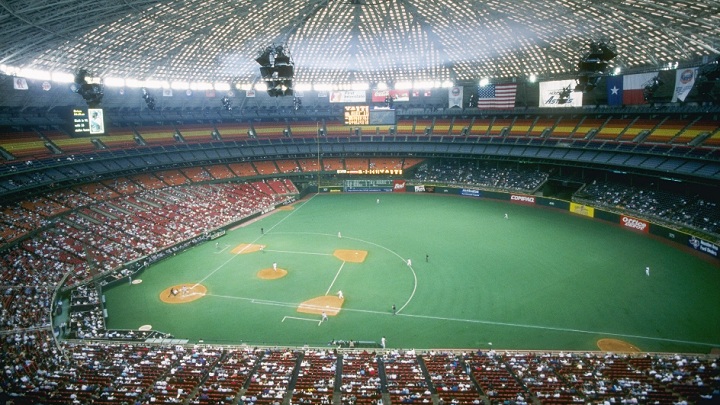
In 1965, the Astrodome opened, and was nicknamed "The Eighth Wonder of the World." It sure didn't seem like an exaggeration at the time: The first roofed sports stadium in the world. (Supposedly, the Romans built stadia with canvas roofs, but that's hardly the same thing.)
The 1st game at the Astrodome was an exhibition game on April 9, 1965, between the Astros and the Yankees, who were about to begin their collapse from their Dynasty, although that wasn't clear yet. President Lyndon B. Johnson and First Lady Claudia "Lady Bird" Johnson, both Texans, were on hand, but it was Governor John Connally who threw out the first ball. Mickey Mantle hit the stadium's 1st home run, but the Astros won 2-1 in 10 innings. The Yankees would not play in Houston again until Interleague play, in 2003.

Three days later, on April 12, 1965, the 1st regular-season game was played, and the Astros lost 2-0 to the Philadelphia Phillies, thanks to a home run by Dick Allen (the 1st home run there that counted) and a shutout by Chris Short.
In the beginning, with skylights, real grass,
and the center field scoreboard, huge for its time.

Fielders lost the ball in the Sun due to the roof's skylights. So they were painted over. Then the grass died. So they contacts Monsanto, which had been experimenting with artificial grass. They called it ChemGrass. The Astros called it AstroTurf, installed in on March 19, 1966, and a legend was born.

Once, the Astrodome was flashy enough to be the site of movies like The Bad News Bears in Breaking Training and Murder at the World Series. Both were released in 1977. In the latter, the Astros, who had never yet gotten close to a Pennant, played the Series against the Oakland Athletics, who had just gotten fire-sold by owner Charlie Finley.
In the 1980s, with the famed scoreboard
removed for seating expansion

The Astros played there until 1999, and then moved into Enron Field/Minute Maid Park for the 2000 season. The AFL/NFL's Oilers played at the Astrodome from 1968 (thus becoming the 1st pro football team to play on artificial turf), to 1996, when they moved to Tennessee to become the Titans.
The Astrodome also hosted the legendary 1968 college basketball game between Number 1 UCLA (with Kareem Abdul-Jabbar, then still Lew Alcindor) and Number 2 University of Houston (whose Elvin Hayes led them to victory, before falling to UCLA in that year's Final Four), the 1971 Final Four (UCLA beating Villanova in the Final), and the cheese-tastic 1973 tennis match between Billie Jean King and Bobby Riggs, the "Battle of the Sexes."

The Astrodome hosted 3 fights for the Heavyweight Champion of the World, with the defending Champion winning all 3 by knockout: Muhammad Ali over Cleveland Williams on November 14, 1966; Ali over Ernie Terrell on February 6, 1967; and Larry Holmes over Randall "Tex" Cobb on November 26, 1982.

In 1971, Evel Knievel sold the place out on back-to-back nights, jumping his motorcycle over 13 cars both times. He talked about jumping over the Dome itself, but that was one idiotic idea that was never attempted.

The Dome's 1st concert was on December 17, 1965. The Supremes sang. As the opening act. For Judy Garland, who got paid $43,000 for one show -- about $400,000 in today's money. She sang 13 songs in 40 minutes, concluding with, of course, "Over the Rainbow." This was before the Astros adopted the Rainbow Brite uniforms.

Elvis Presley sang there on February 27, 28 and March 1, 1970 and on March 3, 1974. It hosted Selena's last big concert before her murder in 1995, and when Jennifer Lopez starred in the film Selena, it was used for the re-creation of that concert.

In 2004, the same year NRG (then Reliant) Stadium hosted the Super Bowl (which was won by... Janet Jackson, I think), the Astrodome was used to film a high school football playoff for the film version of Friday Night Lights, and the old Astros 1980 and 1986 division title banners can be clearly seen.

In 2002, the new NFL team, the Houston Texans, began play next-door to the Astrodome, at NRG Stadium, which, like Minute Maid Park, has a retractable roof. Suddenly, the mostly-vacant Astrodome seemed, as one writer put it, like a relic of a future that never came to be. (This same writer said the same thing of Shea Stadium and, across Roosevelt Avenue, the surviving structures of the 1964 World's Fair.)

Today, though, the Astrodome seems, like the Republican Party that held a ridiculously bigoted Convention there in 1992, stuck in the past, and not just because they renominated failed President George H.W. Bush. The former Eighth Wonder of the World is now nicknamed the Lonely Landmark, and while it served as a shelter for people displaced from New Orleans by Hurricane Katrina in 2005, since 2008, when it was hit with numerous code violations, only maintenance workers and security guards have been allowed to enter.

In 2019, the Harris County Commissioners, the Dome's overseers, approved the Astrodome Revitalization Project, which would have raised the stadium's floor to use the space underneath as a huge parking garage; and, later in the year, scrapped the plan. There is now no plan for what to do with the Astrodome.
The former Eighth Wonder of the World, dwarfed by its replacement

NRG Stadium hosted the Final Four in 2011 (Connecticut beating Butler in the Final), and in 2016 (Villanova beating North Carolina). In 2005, when Hurricane Katrina hit New Orleans and rendered the Superdome unusable for that season, it hosted the Bayou Classic, the annual Thanksgiving Saturday football game and battle of the bands between Louisiana's Grambling State and Southern University.

NRG Stadium hosted the Final Four in 2011 (Connecticut beating Butler in the Final), and earlier this year (Villanova beating North Carolina). It hosted Super Bowl LI in 2017, with (take your pick: The Atlanta Falcons choking, or the New England Patriots cheating). It hosted 4 games each in the CONCACAF Gold Cups of 2005 and 2007, and 2 games each in that tournament in 2009, 2011, 2019 and 2021.

It will host the 2023 NCAA Final Four and the 2023-24 College Football National Championship Game, and it has been approved by FIFA to be one of the host venues for the 2026 World Cup.

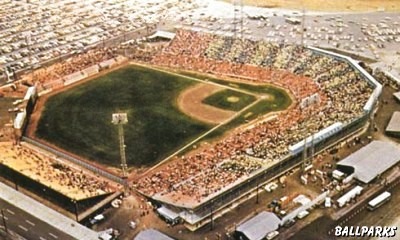
It was built roughly on the site of Colt Stadium, which was the baseball team's home in their 1st 3 seasons, 1962, '63 and '64, when they were known as the Houston Colt .45's (spelled with the apostrophe), before moving into the dome and changing the name of the team. The climate-controlled stadium was necessary because of not just the heat and the humidity, but because of the mosquitoes.
Later, seeing the artificial turf that was laid in the Astrodome for 1966 after the grass died in the first season, due to the skylights in the dome having to be painted due to the players losing the ball in the sun, Koufax, he of the mosquito quip, said, "I was one of those guys who pitched without a cup. I wouldn't do it on this stuff." And Dick Allen of the Philadelphia Phillies, looking at the first artificial field in baseball history, said, "If a horse can't eat it, I don't want to play on it."

The Astrodome hosted a 1988 match between the national soccer teams of the U.S. and Ecuador, which Ecuador won. NRG Stadium has hosted 3 such matches, a 2008 draw with Mexico, a 2011 win over Panama, and a 2016 loss to Argentina in the Copa America. The Mexico team has made it a home-away-from-home, playing several matches there.

The NRG complex, including the Astrodome, is at 8400 Kirby Drive at NRG Parkway. METRORail to Stadium Park/Astrodome station.

The NBA's Houston Rockets played at the Summit, later known as the Compaq Center, from 1975 to 2003. Elvis sang at The Summit on August 28, 1976. It's been converted into the Lakewood Church Central Campus, a megachurch presided over by Dr. Joel Osteen. 3700 Southwest Freeway at Timmons Lane. Number 25 bus.

The Houston Aeros, with Gordie Howe and his sons Mark and Marty, won the World Hockey Association championships of 1974 and 1975, while playing at the Sam Houston Coliseum, before moving into the Summit in 1975 and folding in 1978. Elvis sang there on October 13, 1956, and the Beatles played there on August 19, 1965. It was built in 1937 and demolished in 1998.

It replaced Sam Houston Hall, where the 1928 Democratic Convention nominated Governor Alfred E. Smith of New York, who thus became the 1st Catholic nominated for President by a major party. The Hobby Center for the Performing Arts is now on the site. 801 Bagby Street, at Rusk Street, downtown. METRORail to Theater District station.

The nearest NHL team to Houston is the Dallas Stars, 242 miles away. If Houston had an NHL team, its metropolitan area would rank 10th in population in the NHL.

The Houston Oilers played at Jeppesen Stadium from 1960 to 1964. They won the 1960 AFL Championship Game there, won the 1961 title game on the road, and lost the 1962 title game there -- and, as the Oilers and the Tennessee Titans, haven't gone as far as the rules allowed them to since 1961.

Built in 1942, it became Robertson Stadium, and was the former home of the University of Houston football team and the former home of MLS' Houston Dynamo. The new UH football facility, TDECU Stadium, has been built at the site. 3874 Holman Street at Cullen Blvd. METRORail to Robertson Stadium/UH/TSU station.

The Dynamo have moved to PNC Stadium (formerly BBVA Compass Stadium), at 2200 Texas Avenue at Dowling Street. The NWSL's Houston Dash have played there since their 2014 inception. Within walking distance of downtown. It is also the home field of the football team at Texas Southern University, which won the National Championship of black college football in 1952 and 2010. On January 29, 2013, it hosted its 1st U.S. national team match, a 0-0 draw with Canada.

The USMNT played there again on March 26, 2019, a 1-1 draw with Chile. The U.S. women's team beat Mexico 6-2 there on April 8, 2018. The USMNT played there again on March 26, 2019, a 1-1 draw in a friendly with Chile. It hosted 6 games of the 2021 CONCACAF Gold Cup.

The Oilers played the 1965, '66 and '67 seasons at Rice Stadium, home of Rice University. Although built in 1950 and probably already obsolete, it seated a lot more people than did the Astrodome, and so Super Bowl VIII was played there instead of the Astrodome in January 1974, and the Miami Dolphins won it -- and haven't won a Super Bowl since. It has been significantly renovated, and Rice still uses it. University Blvd. at Greenbriar Street, although the mailing address is 6100 S. Main Street. Number 700 bus.

Before there were the Astros, or even the Colt .45's, there were the Houston Buffaloes. The Buffs played at Buffalo Stadium, a.k.a. Buff Stadium, for most of their history, from 1928 to 1961, when the Colt .45's made them obsolete.
They were a farm team of the St. Louis Cardinals, and as a result, in its last years Buff Stadium was renamed Busch Stadium. The Cardinal teams of the 1930s that would be known as the "Gashouse Gang" first came together in Houston, with Dizzy and Daffy Dean, Joe Medwick, Pepper Martin and Enos Slaughter. Later Buff stars included Cleveland Indians 3rd baseman Al Rosen, Pittsburgh Pirates pitcher Wilmer "Vinegar Bend" Mizell, Negro League legend Willard Brown, Cardinal MVP Ken Boyer, and Phillies shortstop Ruben Amaro Sr. (father of later GM Ruben Amaro Jr.).

Wanting to lure in more customers, but also to beat the infamous Houston heat, lights were installed in 1930, 5 years before any major league park had them. The Buffs won 8 Texas League Pennants: 1928, 1931, 1940, 1947, 1951, 1954, 1956 and 1957. A martial arts school is on the site now. 1600 Cullen Blvd., at Leeland Street, about 2 1/2 miles southeast of downtown. Number 20 bus.

There's another notable sports site in Houston: The U.S. Military Entry Processing Station, in the Customs House, where Muhammad Ali, then living and training in Houston, had to report to fulfill his draft obligation. He did report there, on April 28, 1967, and refused to be drafted. (To be fair, they did call his birth name, Cassius Clay, not his legal name, Muhammad Ali.) Ali was convicted of draft evasion and stripped of the Heavyweight Title. He stayed out of prison on appeal, and the case went all the way to the Supreme Court, which overturned the conviction.

The Customs House is still standing, and still used in part by the U.S. Department of Defense. 701 San Jacinto Street. Central Station on METRORail.

In addition to the preceding, Elvis sang at Hofheinz Pavilion on November 12, 1971; and June 4 and 5, 1975. He also sang at the City Auditorium on October 8, 1955 and April 21, 1956. It's better known as the venue where R&B singer Johnny Ace mistakenly shot himself before a show on Christmas Day, December 25, 1954. The Jones Hall for the Performing Arts replaced it in 1966. 615 Louisiana Street at Capitol Street, downtown.

Also, early in his career, Elvis sang in Houston at the Paladium Club (8100 S. Main Street, near the Astrocomplex) on November 26, 27 and 28, 1954; Cook's Hoedown (603 Capitol Street, around the corner from Jones Hall) on November 27 and December 28, 1954, and April 24 and August 7, 1955; Magnolia Gardens (12044 Riverside Street, no public transit) on April 24, May 22, June 19 and August 7, 1955; and Eagles Hall at 2204 Louisiana Street on January 1 and March 19, 1955 (2204 Louisiana Street, downtown). All of these have since been demolished.

Elvis sang near the University of Texas campus in Austin, 160 miles to the northwest, at Dessau Hall on March 17, 1955, the Sportscenter on August 25, 1955, the Skyline Club on January 18, 1956, and the Municipal Auditorium on March 28, 1977. And he sang near the Texas A&M campus, 100 miles to the northwest, at the Rodeo Grounds in Bryan on August 23, 1955 and the G. Rolle White Coliseum in College Station on October 3, 1955;

Elvis also sang in South Texas at the City Auditorium in Beaumont, 85 miles to the northeast, on June 20 and 21, 1955 and January 17, 1956; at the football stadium at Conroe High School, 40 miles to the north, on August 24, 1955; in Corpus Christi, 200 miles to the southwest, at the Hoedown Club on July 3, 1955 and the Memorial Coliseum on April 16, 1956; in Galveston, 50 miles to the southeast, at the City Auditorium on January 16, 1956; at the baseball field in Gonzales, 130 miles to the west, on August 26, 1955; at Woodrow Wilson High School in Port Arthur, 90 miles to the east on November 25, 1955; and at Southwest Texas State University (LBJ's alma mater, now "Texas State"), 165 miles to the west, on October 6, 1955.

There are other places that might be considered "South Texas" where he sang, I include them with "West Texas" when I do this for the San Antonio Spurs.

The tallest building in Houston, and in all of Texas, is the JPMorgan Chase Tower, formerly the Texas Commerce Tower. It was built in 1982 at 600 Travis Street at Texas Avenue, downtown, and stands 1,002 feet tall, rising 75 stories above the concrete over the bayou. It is the tallest 5-sided building in the world.

Houston's version of New York's American Museum of Natural History is the Houston Museum of Natural Science, in Hermann Park, at Main Street and Hermann Park Drive. The Houston Museum of Fine Arts is at 1001 Bissonnet Street, just 5 blocks away. Both can be reached by METRORail via the Museum District station.

Of course, the name "Houston" is most connected with two things: Its namesake, the legendary Senator, Governor and war hero Sam Houston, and the Johnson Space Center, the NASA control center named after President Lyndon B. Johnson, who, as Senate Majority Leader, wrote the bill creating NASA and the Space Center, because he thought it would bring a lot of jobs and money to Houston (and he was right).

Most historic sites relating to Sam, however, are not in the city that bears his name. As for reaching the Johnson Space Center, it's at 2101 NASA Parkway and Saturn Lane. The Number 249 bus goes there, so if you don't have a car, Houston, you won't have a problem.

George H.W. Bush and his wife Barbara Bush lived in Houston after his Presidency. Both died in 2018, and were buried at the George Bush Presidential Library, at Texas A&M University, 100 miles away in College Station. As a former baseball player, Bush is the only President so far who had his Library designed by HOK, designer of several sports facilities including our own MetLife Stadium.

The Alley Theatre, downtown at 615 Texas Avenue, opened in 1968, and in 1976 hosted the Vice Presidential debate between Senators Walter Mondale and Bob Dole. This is where Dole named World War I, World War II, and the Korean and Vietnam Wars as "all Democrat wars" -- forgetting that the Republicans wanted America to get into all but World War II, and didn't want that one because they liked the Nazis' anti-union status; and that it was actually the Republicans who got us into Vietnam.

There have been a few TV shows set in Houston, but the only one that lasted was Reba, starring country singer Reba McIntire. But it was filmed in Los Angeles, so if you're a fan, you won't find the house in Houston.

Congressman Matthew Santos, a Houston native played by Jimmy Smits, was inaugurated as President on the last episode of The West Wing. Of interest to me was Outlaws, in which a sheriff tried to capture his former gang, but all 5 of them were transported from 1899 to 1986. Realizing they needed each other, they teamed up, and, with the gold that was transported with them, they bought what they needed and formed a private detective agency. It lasted just 1 season.

Films set in Houston, in addition to the sports-themed ones, include Brewster McCloud (which also used the Astrodome), Logan's Run (which used the Houston Hyatt Regency for some scenes),
Telefon (set there but filmed in California), Terms of Endearment, Reality Bites, and, perhaps most iconically, Urban Cowboy.

*

Houston can be hot, but it's a good sports town, and, best of all, it's not Dallas. So there can be a good old time in the hot town tonight.

Wednesday, May 25, 2022

How to Be a New York Soccer Fan In Minnesota -- 2022 Edition

The New York Red Bulls do not travel to St. Paul to play Minnesota United FC this season. But New York City FC do, this coming Saturday night.

Before You Go. A January 30, 2019 article on Thrillist admitted what most of us already suspected: Taking into account that people in Alaska are generally nuts, and don't mind what would, statistically, be worse, Minnesota has the worst Winters of any State. Fortunately, this is Memorial Day Weekend, so the weather will be a lot warmer.

You should consult the Minneapolis Star-Tribune and St. Paul Pioneer Press websites for their forecasts. They're predicting the low 80s for the afternoons, and the mid-60s for the evenings, but also rain, on both Saturday and Sunday. So while the legendary Minnesota cold will not be hitting you, you should still bring an umbrella. In fact, if you have a list that you want to cross Minnesota United off, maybe you should wait until next season.

Minnesota is in the Central Time Zone, 1 hour behind New York. Adjust your timepieces accordingly.

Tickets. The stadium seats 19,400, so their average home attendance in 2019, the last pre-COVID season and the 1st season of the stadium, 19,748, was a sellout. Then again, this being soccer, you'll be in the away fans' sections anyway, in Section 108, in the northeast corner. Tickets are $33.

Getting There. It's 1,199 road miles from Times Square in New York to Nicollet Mall in downtown Minneapolis (the spot where Mary Tyler Moore threw her hat in the air in the opening sequence of her 1970-77 CBS sitcom), and 1,182 miles from Red Bull Arena to Allianz Field. Knowing this, your first reaction is going to be to fly out there.

Note that this is Memorial Day Weekend, so choices may be fewer and more expensive than usual.

If you order now, you could get a round-trip nonstop flight on United Airlines from Newark to Minneapolis-St. Paul International Airport for under $600. When you get there, the Number 55 light rail takes you from the airport to downtown in under an hour, so at least that is convenient.

Bus? Not a good idea. Greyhound runs 3 buses a day between Port Authority and Minneapolis, all with at least one transfer, in Chicago and possibly elsewhere as well. The total time, depending on the number of stops, is between 26 and 31 hours, and costs $717 round-trip, more than flying, although it could drop to as little as $452 with advanced purchase.

The Greyhound terminal is at 950 Hawthorne Avenue, at 9th Street North, just 3 blocks from Nicollet Mall, 2 from the Target Center arena, and from there just across the 7th Street overpass over Interstate 394 from Target Field.

Train? An even worse idea. Amtrak will make you leave Penn Station on the Lake Shore Limited at 3:40 PM Eastern Time, arrive at Union Station in Chicago at 9:50 AM Central Time, and then the Empire Builder, their Chicago-to-Seattle run, will leave at 2:15 PM and arrive at Union Depot in St. Paul (not Minneapolis) at 10:03 PM -- after the game would end. So you'd have to leave New York on Thursday afternoon.

From there, 214 4th Street E., you'd have to take the Light Rail Green Line to downtown Minneapolis. It's $368 round-trip -- potentially, cheaper than the bus. And you'd probably have to spent not one but two nights in a hotel.

Warning: A big chunk of the Amtrak journey is already sold out. So, forget the train this time.

If you decide to drive, it's far enough that it will help to get someone to go with you and split the duties, and to trade off driving and sleeping. You'll need to get into New Jersey, and take Interstate 80 West. You'll be on I-80 for the vast majority of the trip, through New Jersey, Pennsylvania and Ohio. In Ohio, in the western suburbs of Cleveland, I-80 will merge with Interstate 90. From this point onward, you won't need to think about I-80 until you head home; I-90 is now the key, through the rest of Ohio and Indiana.

Just outside Chicago, I-80 will split off from I-90, which you will keep, until it merges with Interstate 94. For the moment, though, you will ignore I-94. Stay on I-90 through Illinois, until reaching Madison, Wisconsin, where you will once again merge with I-94. Now, I-94 is what you want, taking it into Minnesota and the Twin Cities, with Exit 235B being your exit for the University of Minnesota area, and Exit 233A for downtown Minneapolis.

If you do it right, you should spend about an hour and a half in New Jersey, 5 hours and 15 minutes in Pennsylvania, 4 hours in Ohio, 2 and a half hours in Indiana, an hour and a half in Illinois, 2 and a half hours in Wisconsin, and half an hour in Minnesota. That's 17 hours and 45 minutes. Counting rest stops, preferably halfway through Pennsylvania and just after you enter both Ohio and Indiana, outside Chicago and halfway across Wisconsin, and accounting for traffic in New York, the Chicago suburbs and the Twin Cities, it should be no more than 23 hours, which would save you time on both Greyhound and Amtrak, if not on flying.

Once In the City. Like the baseball Twins (who arrived in 1961), the NFL Vikings (ditto), the NBA Timberwolves (1989), the NHL Wild (2000), and the departed NHL North Stars (1967-1993), the soccer team is called "Minnesota," because they didn't want to slight either one of the "Twin Cities."

Well, these "twins" are not identical: They have different mindsets, and, manifesting in several ways that included both of them having Triple-A teams until the MLB team arrived, and the teams were known to feud as much as San Francisco and Oakland, Dallas and Fort Worth, Baltimore and Washington, if not as much as Manhattan and Brooklyn.

Minneapolis has about 414,000 people, St. Paul 302,000, and the combined metropolitan area a little under 4.2 million, ranking 16th in the U.S. -- roughly the combined population of Manhattan, The Bronx and Staten Island -- or that of Manhattan and Queens. Denver is the only metropolitan area with teams in all 4 sports (and now, all 5 if you count MLS) that's smaller. The market is 20th in population in MLB, 18th in the NFL, and 17th in the NBA, the NHL and MLS. And, despite being the smaller city, St. Paul is the State capital.
The State House in St. Paul

As Twins founding owner Calvin Griffith said, with glee and bigotry, when he moved the Washington Senators there, the people of Minnesota are white -- but no longer overwhelmingly so. The Twin Cities' white population is down to 70 percent, as immigrants come in from Latin America and Africa. Minneapolis, in particular, is now 62 percent white, 19 percent black, 11 percent Hispanic, 6 percent Asian, and 2 percent Native American.

Minneapolis dealt with a race riot on its North Side on July 19, 1967; and the racially-motivated police murders of Philando Castile in suburban Falcon Heights on July 6, 2016; and George Floyd on the city's South Side on May 25, 2020.

"Minneapolis" is a combination of the Dakota tribal word for water, and the Greek word for city. It was founded in 1867 with the name St. Anthony Falls, and, of course, St. Paul, founded in 1854, is also named for an early Christian saint. In Minneapolis, Hennepin Avenue separates the numbered Streets from North and South, and the Mississippi River is the "zero point" for the Avenues, many (but not all) of which also have numbers.

Each city once had 2 daily papers, now each is down to 1: Minneapolis had the Star and the Tribune, merged in 1982; St. Paul the Pioneer and the Dispatch, merged into the Pioneer Press and Dispatch
in 1985, with the Dispatch name dropped in 1990. Today, they are nicknamed the Strib and the Pi Press.

The sales tax in the State of Minnesota is 6.875 percent. It's 7.775 percent in Minneapolis' Hennepin County, and 7.625 percent in St. Paul's Ramsey County. Bus and Light Rail service is $2.25 per ride during rush hours, $1.75 otherwise.
Light Rail, Stadium Village station

ZIP Codes in Minnesota start with the digits 54 and 55; with Minneapolis having 553, 554 or 555; and St. Paul having 550 and 551. The Area Codes are 612 for Minneapolis, 507 for its suburbs, and 651 for St. Paul. Interstates 494 and 694 are the Twin Cities' "beltway." Xcel Energy supplies electricity, and CenterPoint Energy supplies gas.

Going In. "MNUFC" (always abbreviated like that, not "MUFC" like Manchester United) plays at Allianz Field. Like the new stadiums of European soccer giants Bayern Munich of Germany and Juventus of Turin, Italy, it is named for Munich-based Allianz, the world's largest insurance company.
The address is 400 N. Snelling Avenue, in St. Paul, at the intersection of St. Anthony Avenue, just off I-94/U.S. 12/U.S. 52, about 3 miles west of downtown St. Paul and 6 miles east of downtown Minneapolis. Green Line light rail to Snelling Avenue. If you drive in, parking is $20.
The stadium seats 19,400, and supposedly has capability to be expanded to 24,474. The field is aligned north-to-south, and the surface is natural grass. Last year, the Loons hosted Hertha Berlin of Germany (losing 1-0), Aston Villa of Birmingham, England (losing 3-0), and C.F. Pachuca of Mexico (playing to a 2-2 draw). On June 18, 2019, the U.S. men's national team (USMNT) kicked off the 2019 CONCACAF Gold Cup at Allianz, beating Guyana 4-0.
Looking toward the north end, including the Brew Hall

Food. Considering that Minnesota is Big Ten Country, you would expect their stadium to have lots of good food, in particular that Midwest staple, the sausage. They don't disappoint. According to an article in the Star Tribune:

Kiosks serving Mexican cuisine, Southern barbecue and Indian fare are meant to reflect the diversity of the St. Paul neighborhood where the new stadium is located — and to entice soccer’s global fan base...


Carolina pulled pork sandwich from Handsome Hog, available at four Hungry Loon stands.... 

While the sprawling space faces the soccer pitch, the Brew Hall is open to anyone during games, and even when the team is away. (It will eventually be open Thursdays through Sundays.)

Team History Displays. They're in their 6th MLS season. As the song about Chelsea FC goes, they ain't got no history. Well, that's no longer true: Last year, they reached the Final of the U.S. Open Cup. And in 2020, they reached the MLS Cup Semifinals. But they have no championships, and no retired numbers, and thus no displays in the stadium for either.

Stuff. The Black and Blue Team Store is in the northwest corner of the stadium. In their 6th season, there are no books or videos about the team.

During the Game. You're fans of one of the New York Tri-State Area teams. Not fans of any Wisconsin or Chicago team. They're Minnesota fans. They're not going to bother you, as long as you don't bother them. Or make jokes about the cold. Or reference Betty White's Rose character from the fictional town of St. Olaf, Minnesota on The Golden Girls.
Stephanie Varone at the Twins' Target Field

Stephanie Varone is the club's regular National Anthem singer, as she is for the Twins, Vikings and Timberwolves, but not the Wild. Their mascot is PK, which, I'm presuming, stands for Penalty Kick. He's a Loon.

No, I don't mean he's crazy. The loon is a bird found in the wild in Minnesota. (Not to be confused with the NHL's Minnesota Wild.) It is also widely found in Canada, and is shown on the back of the Canadian $1.00 coin, a.k.a. the loonie. While the phrase "laughing like a loon" is well-known, and a loon's call does rather sound like a laugh, the word "loony" is actually short for "lunatic," and has no connection to the bird.
MNUFC's main supporters' group is called Dark Clouds, sitting (and standing) in the East End, Sections 22 and 23. There's also True North Elite and the Mill City Ultras, smaller groups that sit (and stand) in Section 21. These groups seem to accept the former closest MLS team, the Chicago Fire, as their arch-rivals, calling them the Chicago Tire Fire. (Dumpster Fire?)
Like Manchester United, they have adapted "The Battle Hymn of the Republic" as "Glory, glory, Minnesota, as the Loons go marching on, on, on!" Like many clubs, they adapted the Depeche Mode song: "When I see the Loons play, I go out of my head, I just can't get enough, I just can't get enough!" And, like many clubs, they adapted "When the Saints Go Marching In," as "When the Loons... "

To the tune of "When Johnny Comes Marching Home":

We come from the cold and frozen North! Go Loons, go Loons!
And for our club our hearts forever true, stay true!
We love our boys in Black & Blue!
One heart, one voice, this song's for you!
Minnesota, boys in Black & Blue!

To the tune of "He's Got the Whole World In His Hands," they sing, "You came a long way just to lose!" The 2nd verse is, "You came a long way to play like crap!" And if the home team wins, the home fans will sing "Wonderwall" by Oasis.

After the Game. Minneapolis and St. Paul are relatively safe cities. As long as you don't go out of your way to antagonize anybody, you should be all right.

With Snelling Avenue to the west, and St. Anthony Avenue to the south, most of the nearby places to eat are to the north, at the Midway Shopping Center and Midway Marketplace, including a McDonald's, a Hardee's, a Little Caesars, a Subway, a Starbucks, a Noodles and Company, and a Peking Garden.

Near the team's former home, TCF Bank Stadium on the UM campus, there are a few fast food joints, including a Buffalo Wild Wings at 2001 University Avenue. Most of them are along Washington Avenue, 2 blocks south of the stadium. The most famous Minnesota sports bar, Stub & Herb's, has been parked at 227 SE Oak Street, on the corner of Washington, since 1939, when UM football was not only good, but great. 

If you want to be around other New Yorkers, I'm sorry to say that listings for where they tend to gather are slim. O'Donovan's Irish Pub, in Minneapolis at 700 1st Avenue North at 7th St., downtown, is said to cater to football Giants fans. Jet fans are said to go to the Lyndale Tap House, at 2937 Lyndale Avenue South, but that's 2 1/2 miles southwest of downtown Minneapolis. Number 4 bus.

Another restaurant that may be of interest to New York baseball fans is Charley's Grill. It was popular among visiting players from other American Association cities when they came to play the Millers and the Saints. Legend has it that, when the Yankees gathered for spring training in 1961, they were trying to figure out which restaurants in the new American League cities were good, and someone who'd recently played for the Denver Bears mentioned Charley's. But Yogi Berra, who'd gone there when the Yanks' top farm team was the Kansas City Blues, said, "Nobody goes there anymore. It's too crowded."

(That Yogi said the line is almost certainly true, but the restaurant in question was almost certainly Ruggiero's, a place in his native St. Louis at which he and his neighbor Joe Garagiola waited tables as teenagers.)

Well, no one goes there anymore. There is still a restaurant in its space at the Depot Renaissance Minneapolis Hotel, but it's now called Milwaukee Road. Downtown, at 225 3rd Avenue South at 2nd Street.

If you visit Minnesota during the European soccer season, which gets underway about a month from now, you can find fans and games of your favorite club at the following places:

* Arsenal: Ninth Street Soccer and Coffee, 801 SE 9th Street, on the University/St. Paul side of the river. Bus 4.

* Liverpool, Chelsea, Manchester City and Barcelona: Brit's Pub, 1110 Nicollet Mall. Several downtown bus lines. If you don't see your club in this listings, Brit's is probably your best bet.

* Manchester United and Newcastle United: Merlin's Rest, 3601 E. Lake Street, about 3 1/2 miles southeast of downtown. Light rail to Lake Street Midtown, then Bus 21 to Lake Street & 36th Avenue.

* Everton: La Doña Cervecería, 241 Fremont Avenue North, a mile west of downtown. Bus 9.

* Tottenham: Palmers, 500 Cedar Avenue, across Interstate 35W (whose bridge famously collapsed in 2007 and has since been replaced) from downtown, in the Bohemian Flats area. Green Line to West Bank.

* Bayern Munich: The Local, 931 Nicollet Mall. Several downtown bus lines.

* Juventus: Nomad World Pub, which has been voted the State's best "football pub." Be advised that Dark Clouds members gather here before and after MNUFC games, so this might not be the best choice after the Red Bulls (or NYCFC) have played them. 501 Cedar Avenue, in West Bank, about a mile and a half east of downtown. Bus 22 from Nicollet Mall. 

Sidelights. On November 30, 2018, Thrillist published a list of "America's 25 Most Fun Cities," and Minneapolis came in 23rd. 

Minnesota's sports history is long, but very uneven. Teams have been born, moved in, moved around, and even moved out. But there are some local sites worth checking out.

Originally known as NSC Minnesota, and then the Minnesota Stars, Minnesota United began play in 2010, and, except for the occasional game moved to the Metrodome for more seats, played its home games at a 10,000-seat stadium at the National Sports Center in Blaine, about 15 miles north of downtown Minneapolis, before getting promoted to MLS. 1700 105th Avenue NE at Davenport Street NE. Hard to reach by public transportation: You'll need at least 2 buses, and to then walk a mile and a half.
TCF Bank Stadium, designed to look like the old red-brick horseshoe college football stadiums of the 1920s, is on the campus of the University of Minnesota, across the Mississippi River from most of Minneapolis, 3 miles due east of Nicollet Mall and the homes of the Twins and T-Wolves. The official address is 420 SE 23rd Avenue. In 2021, it was renamed Huntington Bank Stadium.

Coming from downtown, you would take the Green Line light rail to Stadium Village stop. If you're going by light rail, you're most likely going to enter via the open west end of the horseshoe. If you're driving, you'll be taking I-94 back across the river, to Exit 235B, and probably parking at the enclosed east end of the stadium. Parking can be had for as low as $5.00. This being Big Ten country, tailgating is encouraged.

The stadium opened in 2009, allowing the University of Minnesota Golden Gophers to play home games on campus as they did at Memorial Stadium from 1924 to 1981. Their alumni were sick of playing in the cold, so when the Metrodome opened for the Twins and Vikings in 1982, they wanted in (figuratively and literally). But, even during winning seasons (which have been few and far between since the 1960s), attendance was lousy. So an on-campus facility was built.
Before moving in for the 2014 and '15 seasons, the Vikings played a home game there in 2010, following a snow-caused collapse of the Metrodome roof. The Vikings lost to the Chicago Bears, and it turned out to be Brett Favre's last NFL game. It's also hosted an outdoor game for UM hockey, and on February 21, 2016, it played host to a 6-1 win by the Wild over the Chicago Blackhawks. It hosted a match between soccer teams Manchester City of England and Olympiacos of Athens, Greece.

Memorial Stadium, a.k.a. "Old Memorial," seated 56,000 people, and was across University Avenue from where the new stadium now stands. The McNamara Alumni Center and the University Aquatic Center are on the site. The Vikings had played a home game at "Old Memorial" in 1969, due to a conflict with a Twins Playoff game at Metropolitan Stadium.

Across Oak Street from the new stadium's west end, on opposite sides of 4th Street, are the University's basketball and hockey homes. The Gophers play their basketball games at Williams Arena, a classic old barn built in 1928. The 1951 NCAA Final Four was held there, with Kentucky beating Kansas State in the Final. The hockey equivalent, the Frozen Four, was held there in 1958 and 1966.

Across 4th Street from Williams is Mariucci Arena, home of the hockey team that has won National Championships in 1974, '76, '79, 2002 and '03. Named for John Mariucci, a member of the Chicago Blackhawks' 1938 Stanley Cup winners who coached the Gophers. The arena was built in 1993, after the team previously played hockey at Williams.

Legend has it that 4th Street is the "Positively 4th Street" used as the title of a song by former UM student Robert Zimmerman, a.k.a. Bob Dylan, although, as is often the case with Dylan songs, there is no mention of the title in the song. Whether the "friend" who's "got a lot of nerve" was a fellow UM student, I don't know. It's also been suggested that the 4th Street in question is the one in New York's Greenwich Village.

* U.S. Bank Stadium and site of the Hubert H. Humphrey Metrodome. Home of the Twins from 1982 to 2009, the University of Minnesota football team from 1982 to 2008, the NFL's Vikings from 1982 to 2013, and the NBA's Timberwolves in their inaugural season of 1989-90, that infamous blizzard and roof collapse in 2010 brought the desire to get out and build a new stadium for the Vikes to the front burner, and it finally led to action. Until then, there were threats that the Vikes would move, the most-mentioned possible destinations being Los Angeles and San Antonio.

The Twins won the 1987 and 1991 World Series at the Metrodome – going 8-0 in World Series games in the Dome, and 0-6 in Series games outside of it. The Vikings, on the other hand, were just 6-4 in home Playoff games there – including an overtime defeat in the 1998 NFC Championship Game after going 14-2 in the regular season.

From October 19, 1991 to April 6, 1992, the Metrodome hosted 3 major events in less than 6 months: The World Series (Twins over Atlanta Braves), Super Bowl XXVI (Washington Redskins over Buffalo Bills), and the NCAA Final Four (Duke beating Michigan in the Final). It also hosted the Final Four in 2001 (Duke won that one, too, over Arizona).

In May 2012, faced with the serious possibility of the Vikings moving without getting a suitable stadium, the Minnesota State legislature approved funding for a new stadium for the Vikings, to be built on the site of the Metrodome and on adjoining land.

In a piece of poetic justice, just as the damn thing was (with considerable ballyhoo) built and completed ahead of schedule and under budget, so did the demolition take place. The people of Minnesota seemed to be proud of its having been built on the cheap and on time, but it served its purpose, to keep the Twins and Vikings from moving for a generation, and now replacement stadiums are achieving the same purpose.

U.S. Bank Stadium is now open, and the Vikings continued the Minnesota-Wisconsin rivalry by beating the Green Bay Packers in its 1st regular season game. Last August 3, it hosted a preseason tour soccer match in which Chelsea beat AC Milan 3-1. It will host Super Bowl LII in February 2018, and the 2019 NCAA Final Four. 900 South 5th Street at Centennial (Kirby Puckett) Place. Metrodome station on Light Rail.

* Target Field. Home of the Twins since 2010, it gives Minnesota's baseball team its 1st true ballpark after a half-century of waiting, rather than the Bloomington ice tray and the Homerdome. The official address is 1 Twins Way, along 3rd Avenue N., between 5th and 7th Streets. It has its own stop on the light rail system. The NHL held its 2022 Winter Classic at Target Field, and the Wild lost to the St. Louis Blues, 6-4.

* Mall of America and sites of Metropolitan Stadium and the Metropolitan Sports Center. In contrast to their performance at the Metrodome, the Vikings were far more successful at their first home, while the Twins were not (in each case, playing there from 1961 to 1981).

The Vikings reached 4 Super Bowls while playing at The Met, while the Twins won Games 1, 2 and 6 of the 1965 World Series there, but lost Game 7 to the Los Angeles Dodgers on a shutout by Sandy Koufax. (So the Twins are 11-1 all-time in World Series home games, but 0-9 on the road.) The Vikings were far more formidable in their ice tray of a stadium, which had no protection from the sun and nothing to block an Arctic blast of wind.

In fact, The Met had one deck along the 3rd base stands and in the right field bleachers, two decks from 1st base to right field and in the left field bleachers, and three decks behind home plate. Somebody once said the stadium looked like an Erector set that a kid was putting together, before his mother called him away to dinner and he never finished it. At 45,919 seats, it had a capacity that was just fine for baseball; but at 48,446, it was too small for the NFL.

The Minnesota Kicks of the old North American Soccer League played at The Met from 1976 to 1981, reaching Soccer Bowl '76 before losing to the Toronto Metros, and also winning Division titles in 1977, 1978 and 1979. Notable players included Luton Town midfielder Alan West, West Bromwich Albion defender Alan Merrick, Middlesbrough striker Alan Willey, Kaizer Chiefs (South Africa) striker Patrick "Ace" Ntsoelengoe, and, easily the most famous, although he didn't have much left by his 1978 season with the Kicks, legendary Arsenal forward Charlie George.
Prior to the 1961 arrivals of the Twins and Vikings, The Met hosted the Minneapolis Millers from 1956 to 1960, and 5 NFL games over the same stretch, including 4 "home games" for the Packers. (Viking fans may be sickened over that, but at least University of Minnesota fans can take heart in the University of Wisconsin never having played there.)

The experiments worked: The Met, built equidistant from the downtowns of Minneapolis and St. Paul, in the southern suburb of Bloomington, was awarded the MLB and NFL teams, and Midway Stadium, built in 1957 as the new home of the St. Paul Saints (at 1000 N. Snelling Avenue in the city of St. Paul, also roughly equidistant from the two downtowns), struck out, and was used as a practice field by the Vikings before being demolished in 1981.

The NHL's Minnesota North Stars played at the adjoining Metropolitan Sports Center (or Met Center) from 1967 to 1993, before they were moved to become the Dallas Stars by owner Norm Green, earning him the nickname Norm Greed. The Stars reached the Stanley Cup Finals in 1981 and 1991, but never won the Cup until 1999 when they were in Dallas. Larry Holmes successfully defended the Heavyweight Championship of the World at the Met Center on July 7, 1980, knocking out Minnesota native Scott LeDoux.

The Beatles played at Metropolitan Stadium on August 21, 1965 -- making 1 of only 3 facilities to host an All-Star Game, a Finals and a Beatles concert in the same year. (The others were the Boston Garden and Maple Leaf Gardens in 1964.) Elvis Presley sang at the Met Center on November 5, 1971 and October 17, 1976.

8000 Cedar Avenue South, at 80th Street -- near the airport, although legends of planes being an issue, as with Shea Stadium and Citi Field, seem to be absent. A street named Killebrew Drive, and the original location of home plate, have been preserved. A 45-minute ride on the Number 55 light rail (MOA station).

* Site of Nicollet Park. Home of the Millers from 1912 to 1955, it was one of the most historic minor-league parks, home to Ted Williams and Willie Mays before they reached the majors. With the Met nearing completion, its last game was Game 7 of the 1955 Junior World Series, in which the Millers beat the International League Champion Rochester Red Wings. A few early NFL games were played there in the 1920s, including home games by a team a team known as the Minneapolis Marines and the Minneapolis Red Jackets. A bank is now on the site. Nicollet and Blaisdell Avenues, 30th and 31st Streets. Number 465 bus.

* Site of Lexington Park. Home of the Saints from 1897 to 1956, it wasn't nearly as well regarded, although it did close with a Saints win over the arch-rival Millers. The site is now occupied by retail outlets. Lexington Parkway, University Avenue, Fuller & Dunlap Streets.

* Xcel Energy Center and site of the St. Paul Civic Center. Home of the NHL's Minnesota Wild since their debut in 2000, and site of the 2008 Republican Convention that nominated John McCain for President and Sarah Palin for Vice President. (The GOP met in Minneapolis in 1892, renominating President Benjamin Harrison at the Industrial Exposition Building at 101 Central Avenue SE. It was torn down in 1940, and condos are on the site now.)

The Three Tenors -- Luciano Pavarotti, Placido Domingo and José Carreras -- sang at the Xcel Center on December 16, 2002. The place is a veritable home and hall of fame for hockey in Minnesota, the most hockey-mad State in the Union, including the State high school championships that were previously held at the Civic Center.

That building was the home of the Minnesota Fighting Saints of the World Hockey Association from 1973 to 1977. The Fighting Saints had played their first few home games, in late 1972, at the St. Paul Auditorium.

The Civic Center hosted the Frozen Four in 1989, 1991 and 1994. The Xcel has hosted it in 2002 and 2011, and will again in 2018. It hosted the Big Ten Hockey Tournament in 2014 and 2016.

Elvis sang at the Civic Center on October 2 and 3, 1974, and April 30, 1977. The Civic Center is also where Bruce Springsteen and Courteney Cox filmed the video for Bruce's song "Dancing In the Dark."

199 Kellogg Blvd. West, at 7th Street, at W. 7th Street, in downtown St. Paul, about 9 miles from downtown Minneapolis. The Number 94 bus goes straight there from downtown Minneapolis, in about 25 minutes. The Green Line light rail goes from Nicollet Mall to St. Paul Central Station. From there, it's a 15-minute walk to the arena. Total travel time: About 40 minutes.

The arena is the westernmost part of the RiverCentre complex, which includes the Roy Wilkins Auditorium, the Saint Paul RiverCentre and the Ordway Center for the Performing Arts. The Wilkins, formerly the St. Paul Auditorium, was built in 1932. On May 13, 1956, early in his career, Elvis Presley sang there in the afternoon, and at the Minneapolis Auditorium in the evening.

* Target Center. Separated from Target Field by I-394 and 2nd Avenue, this arena has been home to the NBA's Minnesota Timberwolves since the team debuted shortly after its 1989 opening. The T-Wolves have only made the Western Conference Finals once, and are probably best known as the team Kevin Garnett and GM (and Minnesota native) Kevin McHale couldn't get over the hump, before Garnett went to McHale's former team, the Boston Celtics.

The Minnesota Lynx also play here, and have become the WNBA's answer to the San Antonio Spurs, winning league titles in odd-numbered years: 2011, 2013 and 2015. 600 N. 1st Avenue at 6th Street.

* Site of Minneapolis Auditorium. Built in 1927, from 1947 to 1960 this was the home of the Minneapolis Lakers – and, as Minnesota is "the Land of 10,000 Lakes" (11,842, to be exact), now you know why a team in Los Angeles is named the Lakers. (The old Utah Jazz coach Frank Layden said his team and the Lakers should switch names, due to L.A.'s "West Coast jazz" scene and the Great Salt Lake: "Los Angeles Jazz" and "Utah Lakers" would both make more sense than their current names.)

The Lakers won the National Basketball League Championship in 1948, then moved into the NBA and won the Championship in 1949, 1950, 1952, 1953 and 1954. In fact, until the Celtics overtook them in 1963, the Minneapolis Lakers were the most successful team in NBA history, and have still won more World Championships than all the other Minnesota major league teams combined: Lakers 5, Twins 2, the rest a total of 0. (Unless you count the Lynx, who make it Lakers 5, everybody else 5.)

They were led by their enormous (for the time, 6-foot-10, 270-pound) center, the bespectacled (that's right, he wore glasses, not goggles, on the court) Number 99, George Mikan. The arrival of the 24-second shot clock for the 1954-55 season pretty much ended their run, although rookie Elgin Baylor did help them reach the Finals again in 1959.

Elvis sang there early in his career, on May 13, 1956. The Auditorium was demolished in 1989, and the Minneapolis Convention Center was built on the site. 1301 2nd Ave. South, at 12th Street. Within walking distance of Target Field, Target Center and the Metrodome.

* Minneapolis Armory. Built in 1936 for the Minnesota National Guard, the Lakers used it as their home court part-time throughout their Minneapolis tenure, and full-time in their final season in Minneapolis, 1959-60. Ironically, the owner of the Lakers who moved them to Los Angeles was Bob Short – who later moved the "new" Washington Senators, the team established to replace the team that moved to become the Twins.

It was later the video-filming site for Minneapolis native Prince's "1999" and Aerosmith's "I Don't Want to Miss a Thing." It's been kept standing as a parking lot. 500 6th Street, downtown.

* Duluth. Minnesota's largest city outside the Twin Cities region is 155 miles to the northeast, at the western edge of Lake Superior. It was home to the State's 1st NFL team. They played the 1923, '24 and '25 team as the Duluth Kelleys, because they were sponsored by the Kelley-Duluth Hardware Store. They played the 1926 and '27 season as the Duluth Eskimos, and featured Hall-of-Famers Ernie Nevers and John "Johnny Blood" McNally.

They played at Athletic Park, which opened in 1903 and served as home of the minor-league Duluth White Sox from 1903 to 1916, and the Duluth Dukes from 1934 to 1940. It seated 6,000, and was replaced by the 4,2000-seat Wade Stadium on the same site in 1941. That was home to the Dukes until 1970, to a new Duluth-Superior Dukes from 1993 to 2002, and to the Duluth Huskies since 2003. In their various leagues, the Dukes/Huskies won Pennants in 1937, 1956, 1961, 1963, 1969, 1970 and 1997. 101 N. 35th Avenue West, about 3 miles southwest of downtown.

The 6,764-seat Duluth Entertainment Center hosted the hockey team at the University of Minnesota at Duluth from 1966 to 2010, one of the better hockey programs (if not as accomplished as their cousins down in Minneapolis). It also hosted the Frozen Four in 1968 and 1981, and Elvis on October 16, 1976 and April 29, 1977. The 6,726-seat Amsoil Arena -- smaller, but much more convenient -- was built next-door in 2010, and UMD moved in. Both are downtown and have an address of 350 Harbor Drive.

* Museums. The Twin Cities are very artsy, and have their share of museums, including one of the five most-visited modern art museums in the country, the Walker Art Center, at 1750 Hennepin Avenue. Number 4, 6, 12 or 25 bus. The Minneapolis Institute of Arts is at 2400 3rd Avenue South. Number 17 bus, then walk 2 blocks east on 24th Street. The Science Museum of Minnesota is at 120 W. Kellogg Blvd. in St. Paul, across from the Xcel Center.

Fort Snelling, originally Fort Saint Anthony, was established by the U.S. Army in 1819, where the Mississippi and Minnesota rivers meet, to guard the Upper Midwest. It served as an Army post until World War II. It is now a museum, with historical demonstrations based on its entire history, from the post-War of 1812 period to the Civil War, from the Indian Wars to the World Wars. 101 Lakeview Avenue in St. Paul, across from the airport. An hour's ride on the light rail Blue Line.

Minnesota is famous for Presidential candidates that don't win. Governor Harold Stassen failed to get the Republican nomination in 1948, and then ran several more times, becoming, pardon the choice of words, a running joke. Senator Eugene McCarthy opposed Lyndon Johnson in the Democratic Primaries in 1968, but lost his momentum when Robert Kennedy got into the race and LBJ got out, then ran in 1976 as a 3rd-party candidate and got 1 percent of the popular vote.

Vice President Walter Mondale was the Democratic nominee in 1984, losing every State but
Minnesota in his loss to Ronald Reagan. In the 2012 election cycle, the moderate former Governor Tim Pawlenty and the completely batty Congresswoman Michele Bachmann ran, and neither got anywhere.

Most notable is Hubert Horatio Humphrey. Elected Mayor of Minneapolis in 1945 and 1947, he became known for fighting organized crime, which put a price on his head, a price it was unable to pay off.  In 1948, while running for the U.S. Senate, he gave a speech at the Democratic Convention, supporting a civil rights plank in the party platform, a movement which culminated in his guiding the Civil Rights Act of 1964 through the Senate as Majority Whip. He ran for the Democratic nomination for President in 1960, but lost to John F. Kennedy, then was elected LBJ's Vice President in 1964.

He won the nomination in 1968, but lost to Richard Nixon by a hair. He returned to the Senate in 1970, and ran for President again in 1972, but lost the nomination to George McGovern. He might have run again in 1976 had his health not failed, as cancer killed him in 1978 at age 66. His wife Muriel briefly held his Senate seat.

Not having been President (he's come closer than any other Minnesotan ever has), he has no Presidential Library, but there is the Hubert H. Humphrey School of Public Affairs at the University of Minnesota, 301 19th Avenue South, only a short walk from the Dome that would be named for him. Hubert and Muriel are laid to rest in Lakewood Cemetery, 3600 Hennepin Avenue. Number 6 bus.

The tallest building in Minnesota is the IDS Center, at 80 South 8th Street at Marquette Avenue, rising 792 feet high. The tallest in the State outside Minneapolis is Wells Fargo Place, at 30 East 7th Street at Cedar Street in St. Paul, 472 feet.

Nicollet Mall is a pedestrians-only shopping center that stretches from 2nd to 13th Streets downtown. At 7th Street, in front of Macy's, in roughly the same location that Mary Tyler Moore as Mary Richards threw her hat in the air in the opening to The Mary Tyler Moore Show, is a statue of "Mare" doing that. However, the show had no location shots in Minneapolis.
The dedication: Bronze Mary at left, Real Mary at right

Mary's statue was the 1st in a series commissioned by TV Land that now includes Jackie Gleason as Ralph Kramden in The Honeymooners outside Port Authority Bus Terminal, Henry Winkler in
Happy Days (a statue known as the Bronze Fonz) in Milwaukee, Bob Newhart as Bob Hartley in The Bob Newhart Show in Chicago, Andy Griffith and Ron Howard as Andy and Opie Taylor in The Andy Griffith Show in Raleigh, Elizabeth Montgomery as Samantha Stephens in the "witch city" of Salem, Massachusetts (even though Bewitched was set in Westport, Connecticut), and Elvis Presley outside the Blaisdell Center in Honolulu where he played the concert for his 1973 TV special.

The Many Loves of Dobie Gillis, Little House On the Prairie and Orphan Black were set in Minnesota, although not shot there. The Adventures of Rocky & Bullwinkle was set in the fictional town of Frostbite Falls, Minnesota. Of course, being animated, it had no location shots.

The sitcom Coach, which aired on ABC from 1989 to 1996, was set at Minnesota State University. At the time, there was not a real college with that name. But in 1999, Mankato State University was renamed Minnesota State University, Mankato; and in 2000, Moorhead State University became Minnesota State University, Moorhead.

The University of Minnesota was originally a model for the school on the show, but withdrew its support: Although some game action clearly shows the maroon and gold of the Golden Gophers, the uniforms shown in most scenes were light purple and gold. In one Season 1 episode, the Gophers are specifically mentioned as one of the Screaming Eagles' opponents, suggesting that Minnesota State might have been in the Big Ten. Show creator Barry Kemp is a graduate of the University of Iowa -- like Wisconsin, a major rival of the Gophers -- and most of the exterior shots you see of the campus were filmed there. In addition, the main character, Hayden Fox, was named after then-Iowa coach Hayden Fry. No scenes were actually shot in Minnesota, not even Hayden's oft-snowy lake house.

Movies filmed in Minnesota include the baseball films Little Big League and Major League: Back to the Minors, the George Clooney 1920s football film Leatherheads, The Bishop's Wife (1947, later remade as The Preacher's Wife), Airport (the 1970 film that helped inspire the decade's disaster film craze), the Western The Great Northfield, Minnesota Raid, the Grumpy Old Men movies, Kevin Smith's Mallrats, Juno, and, most memorably due to its use of the Minnesota accent, the Coen Brothers' Fargo (which now has a TV version shot there).

St. Paul is the capital of the State of Minnesota. The Capitol Building is at University Avenue and Capital Blvd. It's a half-hour ride from downtown on the Number 94 bus (named because most of its route is on I-94).

*

Bob Wood, a native of Kalamazoo, Michigan, and a graduate of Michigan State University, wrote a pair of sports travel guides: Dodger Dogs to Fenway Franks, about his 1985 trip to all 26 stadiums then in MLB; and Big Ten Country, about his 1988 trip to all the Big Ten campuses and stadiums. (Penn State, Nebraska, and soon-to-be members Rutgers and Maryland were not yet in the league).

The Metrodome was the only stadium that featured in both books, although if either were updated to reflect current reality, it would feature in neither. In Big Ten Country, Wood said, "Now, don't get me wrong. It's not that I don't like Minneapolis. How can you not like Minneapolis?... No, Minneapolis is lovely. It's the Metrodome that sucks!"

Thankfully, the Metrodome is gone, the Vikings now play in a new stadium on the site, the Twins also play in a new stadium that actually feels like a ballpark, and the Golden Gophers and Minnesota United play in a proper on-campus stadium, while MNUFC have opened a stadium of their own.

From what I understand, Minneapolis and St. Paul are still terrific cities, including for sports. A New York soccer fan should definitely take in a game against Minnesota United there.