Showing posts with label san francisco. Show all posts

Monday, June 29, 2026

June 29, 1776: The Presidio of San Francisco

The calendar year 1776 was a pivotal one on the Atlantic Coast of North America. Most Americans know that. What many may not be aware of is that it was also a pivotal year on the Pacific Coast.

June 29, 1776: El Presidio Real de San Francisco, or The Royal Fortress of Saint Francis, is established, marking the birth of what would become the City of San Francisco. It was named for St. Francis of Assisi, not St. Francis Xavier or any other St. Francis.

A "presidio," meaning a jail or a fortification, was a fortified base established by the Spanish Empire, mainly between the 16th and 18th Centuries in areas under their control or influence. The term is derived from the Latin word "praesidium," meaning protection or defenseThis may seem strange to people who think of St. Francis of Assisi as a pacifist.

In the Mediterranean Sea and the Philippines, the presidios were outposts of the Christian defense against Islamic raids. In the Americas, the fortresses were built to protect against raids by pirates, rival colonial powers, and Native Americans. Later, having gained their independence from Spain, the Mexicans garrisoned the Spanish presidios on their northern frontier, and followed the same pattern in unsettled frontier regions such as the Presidio de Sonoma in California, and the Presidio de Calabasas in Arizona.

The Presidio of San Francisco was a simple fort made of adobe, brush, and wood. It was often damaged by earthquakes or heavy rains. In 1783, its company had only 33 men. Presidio soldiers' duties were to support Mission Dolores by controlling Indian workers in the Mission and farming, ranching, and hunting to supply themselves and their families. Support from Spanish authorities in Mexico was minimal.

In 1821, Mexico became independent of Spain. The Presidio received even less support from Mexico. Residents of Alta California, which included the Presidio, debated separating from Mexico. In 1835, the Presidio garrison, led by Mariano Vallejo, relocated to Sonoma, 40 miles to the north.

In 1846, the Mexican-American War began. American settlers and adventurers in Sonoma staged the Bear Flag Revolt against Mexican rule. The U.S. Army occupied the Presidio, which began a long era of directing operations to control and protect Native Americans as headquarters for scattered Army units on the West Coast.

From 1898 to 1906, The Presidio became the nation's center for assembling, training, and shipping out forces to the Spanish-American War in the Philippine Islands and the subsequent Philippine Insurrection. President Theodore Roosevelt visited in 1903. Troops from there were instrumental in providing security and fighting fires following the earthquake of 1906.

From 1914 to 1916, General John J. Pershing served as commanding officer, a prelude to his leadership in World War I. For that war, The Presidio produced the 30th Infantry Regiment, which the French nicknamed "The Rock of the Marne" for its service at the pivotal Second Battle of the Marne in 1918.

U.S. Route 101 was extended through the Presidio with the opening of the Golden Gate Bridge in 1937 and the MacArthur Tunnel in 1940. Due to the Pacific Theater of World War II, The Presidio again became a major U.S. Army facility.

Afterward, it was responsible for all U.S. Army forces in the Western U.S., including training, supplies, and deployment. This went on to include supporting roles in the Korean, Vietnam and Persian Gulf Wars, and hosting the signing of the ANZUS Treaty between the U.S. and the Pacific nations of Australia and New Zealand. In 1994, the Army closed The Presidio, and transferred control of it to the National Park Service.

In the future imagined by the Star Trek franchise, The Presidio became the headquarters for the United Federation of Planets' Starfleet Command, including Starfleet Academy.

Also on June 29, 1776: The Battle of Turtle Gut Inlet was fought, off the coast of what is now Wildwood Crest, New Jersey. It was an important, early naval victory for the Continental Navy and the man who went on to become known as the "Father of the American Navy," Captain John Barry.

It was the first privateer battle of the War of the American Revolution, and turned out to be the only battle of that war fought in Cape May County, the southernmost County of New Jersey.

Sunday, March 29, 2026

Yankees Start Season With Sweep of Giants

Barring inclement weather, or a more drastic reason for postponement, today will be the last Sunday without Yankee baseball until at least October 4. (That day could have a postseason game.) That gives me plenty of time to summarize the season-opening series away to the San Francisco Giants.

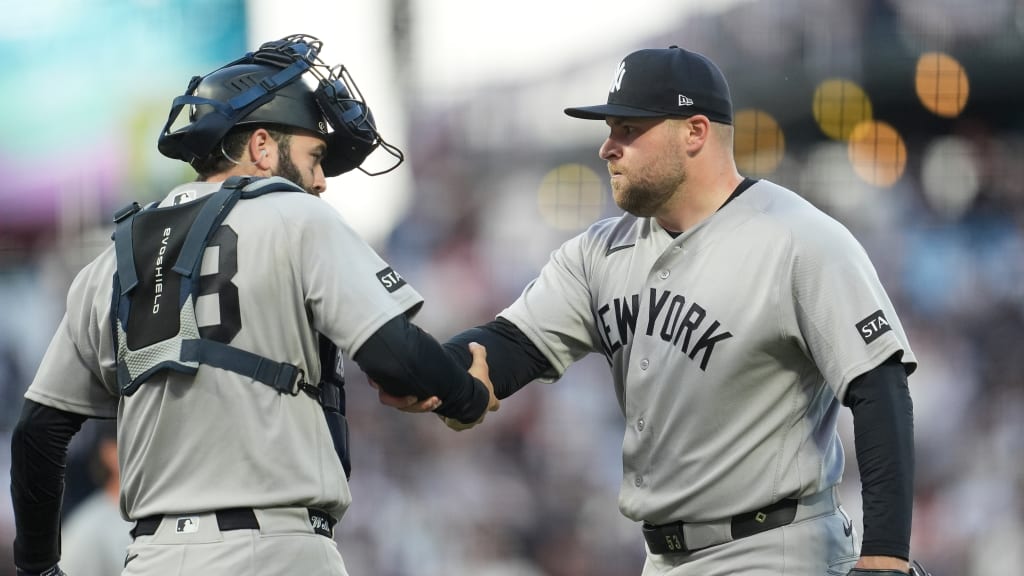
This past Wednesday, the Yankees opened the 2026 season at Oracle Park in San Francisco, and beat the Giants, 7-0. After a day off on Thursday, Cam Schlittler started. Through 5 1/3rd innings, he had allowed just 1 baserunner, a double by Heliot Ramos in the 2nd inning.

Aaron Judge continued to strike out, but he also hit his 369th career home run, tying him with Ralph Kiner, Todd Helton, and the still-active Manny Machado on the all-time list. And Giancarlo Stanton hit his 454th home run. He is Major League Baseball's active leader.

These homers gave Schlittler a 3-0 lead. He had thrown only 68 pitches, 49 of them for strikes. There was absolutely no good reason to take him out.

Boone took him out, and brought in Fernando Cruz. He walked a batter, but allowed no more baserunners. Tim Hill pitched a perfect 7th, Doval a perfect 8th, and David Bednar survived a leadoff walk and ended the game. So, how many Yankees does it take to pitch a one-hit shutout? This time, 5.

It was the 1st time the Yankees had opened the season with back-to-back shutout wins since 1967. But that wasn't a good sign: The Yankees finished 9th out of 10 teams in the single-division American League that year.

Nevertheless: 18 innings, no runs, 4 hits, 4 walks. Pretty snazzy pitching.

*

And then last night was the Fox Saturday Game of the Week. With Gerrit Cole, Carlos Rodón and Clarke Schmidt unavailable, and 2024 American League Rookie of the Year Luis Gil apparently no longer trusted by Yankee management to be a starter, Will Warren was given the start. Between the game being on Fox, and the Yankees having a pitcher named Warren -- Adam Warren was even worse -- I was not optimistic.

In the top of the 5th, Judge hit his 370th home run, surpassing Kiner, Helton and Machado, and tying Gil Hodges. So far, this season, he is 2-for-13, a batting average of .154, an on-base percentage that is also .154, and 7 strikeouts. But both of those hits are home runs, so he has 3 RBIs, his slugging percentage is .615, and his OPS+ is 122.

Warren got through 4 1/3rd innings, allowing 1 run on 5 hits and 2 walks, the 2nd of those walks having just happened when Boone relieved him. Headrick finished the 5th inning with no damage. Bird pitched the 6th and most of the 7th, Hill pitched the rest of the 7th and all of the 8th, and Bednar allowed a hit and a walk in the 9th, bringing the winning run to the plate, but induced a double play to end it. Yankees 3, Giants 1. Bird was credited with the win.

So: 27 innings, 1 run, 13 hits, 7 walks. Cliché Alert: They say pitching is 75 percent of baseball. If so, then that's a very good reason why the Yankees are 3-0.

*

Next up on the all-time home run list: For Stanton, the next names are José Canseco and Adam Dunn, each with 462; for Judge, his own Yankee teammate, Paul Goldschmidt, with 372, followed by Rocky Colavito, with 374.

This day begans with the Los Angeles Dodgers also 3-0; while the Mets, the Atlanta Braves, the Miami Marlins, the Milwaukee Brewers, the St. Louis Cardinals and the Toronto Blue Jays have started 2-0.

The Yankees head up the coast to face the Seattle Mariners at T-Mobile Park. The Monday and Tuesday games start at 9:40 PM Eastern Time (6:40 Pacific/local), while the Wednesday game is at 4:10 PM (1:10 local). Then, after a day off, on Friday, at 1;35 PM, we have the home opener, against the Miami Marlins.

Let's see how far the Yankees can take this season-opening streak, and this season.

Tuesday, October 7, 2025

October 7, 1955: Allen Ginsberg Howls

October 7, 1955, 70 years ago: Allen Ginsberg gives the 1st public reading of his poem "Howl," at the Six Gallery in the North Beach section of San Francisco.

The poets reading that night were, in order: Philip Lamantia, Michael McClure, Philip Whalen, Ginsberg and Gary Snyder. The organizer was Kenneth Rexroth. They were introduced by Lawrence Ferlinghetti, who also owned the nearby City Lights Bookstore. Both Rexroth and Ferlinghetti were published poets, but neither read his work that night. Jack Kerouac, already a published novelist but 2 years away from his magnum opus On the Road being published, refused to read his own poetry, but cheered the other writers on, and passed a jug of wine around.

"Howl" is best remembered for its opening:

I saw the best minds of my generation destroyed by madness, starving hysterical naked,
dragging themselves through the negro streets at dawn looking for an angry fix,
angelheaded hipsters burning for the ancient heavenly connection to the starry dynamo in the machinery of night,
who poverty and tatters and hollow-eyed and high sat up smoking in the supernatural darkness of cold-water flats floating across the tops of cities contemplating jazz,
who bared their brains to Heaven under the El and saw Mohammedan angels staggering on tenement roofs illuminated,
who passed through universities with radiant cool eyes hallucinating Arkansas and Blake-light tragedy among the scholars of war,
who were expelled from the academies for crazy & publishing obscene odes on the windows of the skull,
who cowered in unshaven rooms in underwear, burning their money in wastebaskets and listening to the Terror through the wall...

And so on. But the part that sticks out to me is Part II, in which Ginsberg compares America's consumer culture to a Canaanite god, usually in the form of a giant bull and demanding the sacrifice of children, mentioned in the Old Testament as Molech (MOLL-ick) or Moloch (MOH-lock):

What sphinx of cement and aluminum bashed open their skulls and ate up their brains and imagination?

Moloch! Solitude! Filth! Ugliness! Ashcans and unobtainable dollars! Children screaming under the stairways! Boys sobbing in armies! Old men weeping in the parks!

Moloch! Moloch! Nightmare of Moloch! Moloch the loveless! Mental Moloch! Moloch the heavy judger of men!
Moloch the incomprehensible prison! Moloch the crossbone soulless jailhouse and Congress of sorrows! Moloch whose buildings are judgment! Moloch the vast stone of war! Moloch the stunned governments!
Moloch whose mind is pure machinery! Moloch whose blood is running money! Moloch whose fingers are ten armies! Moloch whose breast is a cannibal dynamo! Moloch whose ear is a smoking tomb!
Moloch whose eyes are a thousand blind windows! Moloch whose skyscrapers stand in the long streets like endless Jehovahs! Moloch whose factories dream and croak in the fog! Moloch whose smokestacks and antennae crown the cities!
Moloch whose love is endless oil and stone! Moloch whose soul is electricity and banks! Moloch whose poverty is the specter of genius! Moloch whose fate is a cloud of sexless hydrogen!...

Moloch! Moloch! Robot apartments! invisible suburbs! skeleton treasuries! blind capitals! demonic industries! spectral nations! invincible madhouses! granite cocks! monstrous bombs! 
They broke their backs lifting Moloch to Heaven!
Moloch in whom I sit lonely! Moloch in whom I dream angels! Crazy in Moloch!

Moloch had appeared in literature before. In his 1667 Paradise Lost, John Milton described him as a child-eating fallen angel, a "horrid king besmeared with blood / Of human sacrifice, and parents’ tears." Charles Dickens mentioned him in his 1848 novella The Haunted Man. In his 1862 novel Salammbô, set in Carthage during the Mercenary Revolt after the First Punic War in 237 BC, Gustauve Flaubert described Moloch as a god who represents the destructive power of the Sun.

"Howl" became the subject of an obscenity trial, for its profanity and sexual imagery, including the homosexual inferences made by Ginsberg, one of the few openly gay celebrities of the era. It was Ferlinghetti and his store, for selling the book, that were sued, not Ginsberg for writing it. On October 3, 1957, Judge Clayton W. Horn ruled that the poem was not obscene, and could be publicly sold.

As a native of Paterson, New Jersey and a New York resident for most of his life, he certainly had the opportunity to face sports. He was invited to read a poem and throw out a ceremonial first ball before a San Francisco Giants game on June 1, 1994. The Giants lost, 1-0 to the Atlanta Braves, in front of 28,808 fans, the biggest audience one of his readings had ever received. The poem was not well-received, but, 2 days short of his 68th birthday, he threw a strike from the mound.
Ginsberg admitted that day that he had never previously been inside a baseball stadium, except once for a Rolling Stones concert. "I'm just a four-eyed sissy," he remarked that day. In contrast, Kerouac was a star football player and track performer in high school, who washed out at Columbia University.

Certainly, the 1955 edition of Ginsberg wouldn't have been surprised at the move of the Brooklyn Dodgers to Los Angeles just 2 years later; at the corporations buying the naming rights to stadiums and arenas; or at the massive amounts of money that TV networks pay to televise sports, to the point where the NFL teams could lock their stadiums and not admit one single fan to a game, and not collect one single admission fee, and still make a profit.

Kerouac died in 1969, Ginsberg in 1997, Whalen in 2002, Lamantia in 2005, McClure in 2020, and Ferlinghett in 2021, at the age of 101. As of October 7, 2025, Snyder is the only reader from that night still alive.

October 7, 1955 was a Friday. Classical cellist Yo-Yo Ma was born.

Friday, September 5, 2025

September 5 & 22, 1975: The Assassination Attempts On President Gerald Ford

September 5, 1975, 50 years ago: President Gerald Ford faces an assassination attempt on a visit to Sacramento, the capital of California.

Ford, for 25 years a Republican Congressman from Michigan, had been nominated for Vice President by President Richard Nixon, seemingly because he was liked by everybody in Washington and offended hardly anybody. He replaced Spiro Agnew, who resigned the office on October 10, 1973, due to his conviction for income tax evasion. On August 9, 1974, Nixon resigned due to his role in the Watergate scandal, and Ford, who was planning to retire after the 1976 election if the Republicans didn't take Congress in 1974, which would have made him Speaker of the House, became the 38th President of the United States.

Ford started with a lot of goodwill, but, a month into his Presidency, he pardoned Nixon. This infuriated many people, and seemed to make him a lame duck before he even announced that he was running for a term of his own in 1976. A recession was underway, but people blamed him for it instead of Nixon (or the Democratic Party). Ford had nothing to do with causing the recession, but his efforts to fix it were, thus far, falling short.

He was visiting the city to attend the annual Sacramento Host Breakfast, a gathering of wealthy California business leaders at the Sacramento Convention Center. The new Governor, Jerry Brown -- Edmund G. Brown Jr., son of former Governor Edmund G. "Pat" Brown -- refused to attend, because he wanted to show them, after 8 years of the archconservative Ronald Reagan, the new Governor wasn't going to be their friend.

To spite Brown, a Democrat, who was already talking about running for President in 1976 -- or, perhaps, to counter-spite him -- they invited President Ford, a Republican, as was Reagan. Ford, who had become President 13 months earlier upon the resignation of Richard Nixon, knew that winning a term of his own would be difficult, and that California would be crucial. (This included in the Republican Primaries, in which Reagan was expected to run.) So he accepted.

In August 1975, The New York Times printed an article detailing Ford's visit to California in September. It included the fact that, as a Congressman from Michigan, he had voted against the Clean Air Act of 1970.

This angered Lynette Alice Fromme. Born on October 22, 1948 in the Los Angeles suburb of Santa Monica, California, As a child, she was a member of the Westchester Lariats, a Los Angeles-based dance group that appeared on The Lawrence Welk Show -- and had even been invited to perform at the White House, when Dwight D. Eisenhower was President. As far as I know, this is the only time that someone who would go on to attempt to assassinate a President would visit the White House before that President took office.

In 1967, she became a follower of cult leader Charles Manson. Another of his followers, George Spahn, noticed that she made a sound like a squeak when he touched her, so he gave her the nickname "Squeaky." She was not charged in connection with the Tate-Labianca Murders, unlike Manson and some of his other followers.

In 1975, she was 26 years old, still committed to the imprisoned Manson, and paranoid about the environment. When she saw the article about Ford, she saw a chance to strike a blow for both the environment and Manson.
Ford was crossing L Street from the Senator Hotel to the State Capitol, shaking hands, at 10:02 AM. Fromme got within 2 feet of him. In his memoir, Ford wrote, "As I stopped, I saw a hand come through the crowd in the first row, and that was the first active gesture that I saw, but in the hand there was a gun."

Fromme didn't know that she needed to pull back the gun slide to insert a cartridge into the pistol's chamber. She pulled the trigger, and nothing happened. Secret Service Agent Larry Buendorf grabbed the gun, and forced Fromme to the ground. Other Agents pulled Ford away, and dragged him to the Capitol's entrance.

Ford was unhurt, and, when the Agents determined that the threat was over, he resumed his schedule, including meeting with Governor Brown. He returned to Washington that night.

*

September 22, 1975: Gerald Ford becomes the 1st President to face 2 close assassination attempts. And they happen just 18 days, and 86 miles, apart.

It had been 3 years since Governor George Wallace had been shot and paralyzed while running for President, 5 years since Pope Paul VI had faced an assassin with a knife, 7 years since Dr. Martin Luther King and Senator Robert F. Kennedy were shot and killed, 10 years since Malcolm X was shot and killed, and 12 years since President John F. Kennedy and NAACP executive Medgar Evers were shot and killed. Still, Ford said he would not stop meeting with the people.

He made another trip to California on September 22. He was in San Francisco, for a meeting of the World Affairs Council. He returned to the city's famed St. Francis Hotel, off Union Square. At 3:30 PM, he walked out of the hotel's Post Street entrance, and stopped short of his limousine to wave the crowd, when a shot rang out.

The shot missed Ford's head by about 5 inches. On the film, he can be heard yelling, "Hey!" A bystander named Oliver Sipple grabbed the shooter's arm as she pulled the trigger a 2nd time. Her shot hit John Ludwig, a taxi driver standing outside the hotel. He also survived.

San Francisco Police Captain Timothy Hettrich grabbed the shooter, and pulled her gun away. The Secret Service shoved Ford into his limo. Donald Rumsfeld, then his White House Chief of Staff, covered him, and the limo was sped back to San Francisco International Airport, where Air Force One was waiting. After waiting for First Lady Betty Ford to arrive, the plane returned to Washington.

The shooter was Sara Jane Moore. Born on February 15, 1930, in Charleston, West Virginia as Sara Jane Kahn, the former accountant had been married and divorced 5 times, with 4 children. She had no connection to either Fromme or Manson, but had become fascinated by another crime in San Francisco, the kidnapping of Patty Hearst.
The day before the shooting, the San Francisco Police Department arrested her on an illegal handgun charge. They decided to call the Secret Service, and they evaluated her, they confiscated her .44 caliber revolver and 113 rounds of ammunition... and they told the SFPD to let her go, as they believed she posed no danger to the President's visit the next day.

They were wrong. The next day, September 22, she bought a new gun, a .38 caliber revolver, a cheap one, a Charter Arms Bulldog -- a smaller version of the one David Berkowitz began using in New York the next year, becoming known as the .44-Caliber Killer and the Son of Sam. The sight on Moore's gun was 6 inches off. That's why, despite being only 40 feet away, she missed Ford. She pleaded guilty.

Before her sentencing, she said, "Am I sorry I tried? Yes and no. Yes, because it accomplished little except to throw away the rest of my life. And, no, I'm not sorry I tried, because, at the time, it seemed a correct expression of my anger." She was sentenced to life in prison.

Ford lost the California Primary to Reagan in 1976, and almost lost the nomination to him. He won it, and did win California in the general election, but narrowly lost both the popular vote and the Electoral Vote to former Governor Jimmy Carter of Georgia. In 1981, he opened his Presidential Museum in his hometown of Grand Rapids, Michigan. The U.S. Attorney's office in Sacramento donated Fromme's gun to the Museum. Ford lived until 2006.

Fromme was convicted of attempted murder, and sentenced to life in prison. On Christmas Eve 1987, she escaped, but was captured 2 days later. She was released in 2009, after serving 34 years.
In 1979, as Fromme had, Moore escaped from prison but was soon recaptured. In 2005, she was released from prison, after serving 32 years. At that time, she said, "I am very glad I did not succeed. I know now that I was wrong to try."
 
As of September 5, 2022, Fromme is 72 years old, and lives with a fellow ex-con in Marcy, New York, outside Syracuse. Unlike most of Manson's followers, she has never renounced him. Moore is 92 years old, and lives in Northern California.

Oliver Sipple was a decorated Marine in the Vietnam War, but it was apparently saving Ford's life that made him a well-known hero. The Secret Service officially commended him, and Ford sent him a thank-you letter.
But the popular San Francisco Chronicle columnist Herb Caen was tipped off to the fact that Sipple was gay, and had worked for Harvey Milk, then running for the City's version of a City Council, the Board of Supervisors. (Milk would lose that election, but won in 1977, before being assassinated in 1978.)

Caen asked Milk if he should reveal this information, and Milk said yes, because the wider public needed to see that gay people could be heroes. Caen did not ask Sipple, whose life went into a tailspin. His parents, in Detroit, refused to see him for years. He sued for invasion of privacy, and lost. He started drinking heavily, and died in 1989, only 47 years old.

As for the other injured man, John Ludwig, he'd already been through a lot, having fled Nazi Germany, only to end up in Shanghai, China when it was occupied by Imperial Japan, and he was shot by a Japanese soldier. He survived, working with the Chinese resistance at the age of 12, and was reunited with his family in San Francisco in 1948. He became a taxi driver. retired to Sacramento (the site of the 1st assassination attempt, something of an irony), published a memoir in 2004, and died in 2015, age 81.

About Captain Timothy Hettrich, who grabbed Moore's gun, the only information I can find is that he was still alive as of 2006.

UPDATE: Sara Jane Moore died on September 24, 2025, 2 days after the 50th Anniversary of her attempt, at the age of 95.

Thursday, November 14, 2024

It Was About the Hat, Not the Message

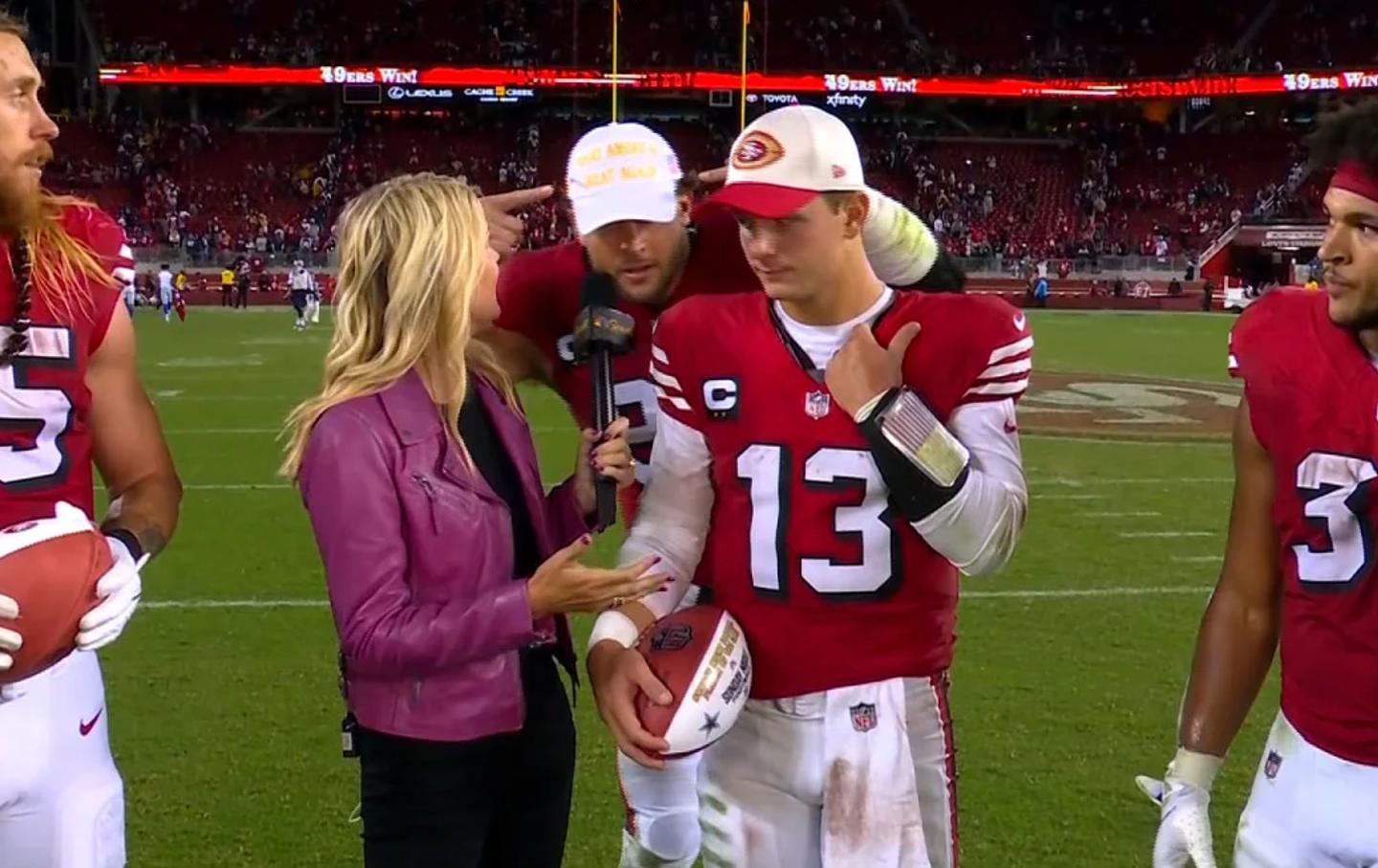
The NFL has fined Nick Bosa of the San Francisco 49ers $11,225 for wearing a MAGA hat on the sideline.

The fine wasn't for the message on the hat. I suspect that most of the owners of the 32 NFL teams would be fine with it.

But the NFL has this fetish about conformity. The league will fine you for wearing your socks wrong. When Johnny Unitas of the Baltimore Colts, possibly the greatest quarterback of all time, died in 2002, Peyton Manning, then playing for the Indianapolis version of the Colts, wanted to pay tribute by wearing Unitas' signature item, black high-top cleats, in his next game. The NFL said no, and you'll be fined if you do.

When Pat Tillman, formerly of the Arizona Cardinals, died in combat in Afghanistan in 2004, every player wore a #40 sticker on his helmet for their next game. But when Jake Plummer, his quarterback in college (Arizona State) and the NFL, wanted to continue to wear the sticker for the rest of the season, the NFL refused to allow it.

So much for supporting our troops.

Bosa has a history of garbage: Racist and homophobic tweets, praising Trump's call for violence against protesters; multiple tweets that purport that illegal immigrants and refugees cause crime; and multiple Instagram posts with hashtags that included "the N-word," pro-rape language, and a homophobic slur. He is a bad person.

In the leadup to the 2019 NFL Draft, the outgoing Ohio State defensive end took to Twitter and called former 49ers quarterback Colin Kaepernick a "clown" for his protests against police brutality and racial inequality. (They were never teammates.) He said he had to delete that tweet, because "There is a chance I might end up in San Francisco" -- a team based in the American city most identified with liberalism, even more so than New York and Boston. After being drafted by the 49ers in 2019, Bosa apologized for the posts in a press conference.

The NFL had a problem with the hat itself, regardless of message. It had no problem with the specific message of the hat. They should have. It was indicative of a larger problem.

And all this has been relatively early in Bosa's career, so we would be on shaky ground if we blamed CTE.

Sunday, August 11, 2024

August 11, 1934: Alcatraz Federal Penitentiary Opens

August 11, 1934, 90 years ago: The United States Penitentiary, Alcatraz Island, opens on an island in San Francisco Bay. It had been a U.S. Army fort since 1859, and had included a military prison since 1912.

"Alcatraz" is a Spanish word meaning "the gannet," for the pelican-like birds that the original Spanish settlers found on the island. As a military prison, among those housed there were conscientious objectors from serving in World War I, including Philip Grosser, who called it "America's Devil's Island," after the French island prison off the coast of French Guiana in South America.

Alcatraz was intended for prisoners who continuously caused trouble at other federal prisons. It would be a "last resort prison," to hold "the worst of the worst," from whom there was no hope of rehabilitation. The island became adapted and used as a prison after the buildings were modernized and security increased.

Given this high security and the island's location in the cold waters and strong currents of San Francisco Bay, prison operators believed Alcatraz to be escape-proof and America's strongest prison. On August 11, 1934, the first batch of 137 prisoners arrived at Alcatraz from the U.S. Penitentiary in Leavenworth, Kansas.

The three-story cellhouse included the four main cell blocks – A-block through D-block, the warden's office, visitation room, the library, and the barber shop. The prison cells typically measured 9 feet by 5 feet and 7 feet high. They were primitive and lacked privacy, furnished with a bed, desk, washbasin, a toilet on the back wall, and few items other than a blanket.

Black prisoners were segregated from other inmates in cell designation. D-Block housed the worst inmates, and 6 cells at its end were designated "The Hole." Prisoners with behavioral problems were sent to these for periods of often brutal punishment.

The dining hall and kitchen extended from the main building. Prisoners and staff ate three meals a day together, and, contrary to tradition, many prisoners said Alcatraz had considerably better food than other prisons in which they'd served. The prison hospital was located above the dining hall.

Working at the prison was considered a privilege for inmates. Those who earned privileges were employed in the Model Industries Building and the New Industries Building during the day, actively involved in providing for the military in jobs such as sewing and woodwork, and performing various maintenance and laundry chores.

The best-known inmate was former Chicago organized crime boss Al Capone. He had served in the federal prison in Atlanta from 1931 to 1934, and had paid off guards to allow him to continue running his rackets. There was no chance of that at Alcatraz. But it turned out to be unnecessary: He developed symptoms of tertiary syphilis, and was given compassionate release in late 1939, after a psychologist determined that he now had the mind of a 12-year-old boy. He lived another 7 years. Other notable crime figures from the 1930s that got sent to "The Rock" were Alvin "Creepy" Karpis and George Barnes, a.k.a. Machine Gun Kelly.

As Capone ran things in Chicago, so did Meyer "Mickey" Cohen run them in Los Angeles. Like Capone, the charge on which he was eventually nailed was income tax evasion. He also didn't serve in Alcatraz for long, from 1961 to 1963. After that, he was transferred to Atlanta, and was released in 1972 after developing cancer. He died 4 years later. Ellsworth "Bumpy" Johnson was the "Godfather of Harlem," and was in Alcatraz from 1954 to 1963, at which point he was paroled. He lived another 5 years.

In 1962, Burt Lancaster starred in the film Birdman of Alcatraz, as convicted murderer Robert Stroud. In fact, the title was a misnomer: As the film makes clear, while Stroud had been allowed to keep and study birds in his cell at Leavenworth, he was not allowed to do so at Alcatraz. And while the film portrayed him as alternating between psychotic and sympathetic, he was far from it.

He was in Alcatraz from 1942 to 1959, at which point his ill health got him transferred to the United States Medical Center for Federal Prisoners in Springfield, Missouri, where he died in 1963, a day before the assassination of President John F. Kennedy.

An escape attempt on May 2, 1946 resulted in what became known as "The Battle of Alcatraz": Six men attempted to escape, but, seeing the odds against them, three turned back. The other three were killed by U.S. Marines stationed on the island.

No one ever escaped from Alcatraz. The legend that anyone did comes from an attempt on June 11, 1962: Armed robber Frank Morris, and bank-robbing brothers John and Clarence Anglin, made their way through a ventilation shaft, slid down a kitchen vent pipe, then climbed perimeter fences lined with barbed wire, before making their way to an inflated raft. They tried to reach Angel Island, 2 miles to the north.

On June 14, a U.S. Coast Guard cutter found a paddle about 200 yards off Angel Island. Later that day, in the same area, workers on a private boat found a wallet, whose contents suggested it belonged to one of the Anglins. On June 21, shreds of cloth believed to be remnants of the raft were found on a beach near the Golden Gate Bridge. The FBI's report stated, "The individuals' personal effects were the only belongings they had, and the men would have drowned before leaving them behind." The reason people still cling to the belief that the escape was successful is that the bodies were never found. They are likely at the bottom of the Bay.

A 1959 report indicated that the facility was over 3 times more expensive to run than the average American prison. The problem was made worse by the buildings' structural deterioration from exposure to salt spray, which would require $5 million to fix. Major repairs began in 1958, but by 1961, engineers considered the prison a lost cause. Attorney General Robert F. Kennedy submitted plans for a new maximum-security institution at Marion, Illinois. Alcatraz was closed on March 21, 1963, and its prisoners moved to other federal pens.

Alcatraz has been reopened as a public museum. It is one of San Francisco's major tourist attractions, operated by the National Park Service's Golden Gate National Recreation Area, attracting some 1.5 million visitors annually. Visitors arrive by boat and are given a tour of the cellhouse and island, and a slide show and audio narration with anecdotes from former inmates, guards and rangers on Alcatraz.

Tuesday, July 16, 2024

July 16, 1964: Extremism In the Defense of Liberty

July 16, 1964, 60 years ago: Senator Barry M. Goldwater of Arizona accepts the Republican Party's nomination for President, at their National Convention, at the Grand National Livestock Pavilion, a.k.a. the Cow Palace, just outside San Francisco in Daly City, California.

The site of the 1964 Republican National Convention may surprise people who know San Francisco as the most liberal city in America, which might not even be accurate. But, like all cities, San Francisco has its "old money" conservative elite. And this was the 2nd time the Grand Old Party had held its convention at the Cow Palace, built in 1940 for rodeo shows but later adapted for professional sports and concerts. They had previously nominated Dwight D. Eisenhower for a 2nd term there in 1956.

Then 55 years old, Goldwater was a Presbyterian, but had a Jewish grandfather, as the family name was originally Goldwasser. This makes the 1964 Republican Convention the closest either major party has ever come to nominating a Jewish person for President.

He was also very Western, living on a ranch outside Phoenix, with a solar-powered flagpole: Every morning, when the Sun came up, it raised the Stars & Stripes; every evening, when the Sun went down, the mechanism lowered the flag into a box.

A bomber pilot in World War II, Goldwater had been elected to the Phoenix City Council, and in 1952 defeated an incumbent Democrat for the U.S. Senate. Re-elected in 1958, he thought he could be the conservative alternative in 1960 to Vice President Richard Nixon, once considered the anti-Communist hard right's man, but now widely seen as more moderate -- the very thing that gave him a legitimate chance of election.

No true conservative had been elected President since 1928, and that was Herbert Hoover, on whose watch the Great Depression began, and whose policies were seen as having made it worse, leading to his landslide loss to Franklin Roosevelt in 1932. Every Republican nominee since had basically said, "We accept the New Deal, but we can do it better, and more efficiently, and with fewer Communists."

But there was another alternative to Nixon in 1960: Governor Nelson Rockefeller of New York, who had replaced a previous holder of his office, 1944 and 1948 Presidential nominee Thomas Dewey, as the leader of the moderate-to-liberal Eastern wing of the GOP. He wanted to be President, too. But he also wanted to win. So he invited Nixon to his apartment, and made a deal where he would endorse Nixon to hold off any conservative challenge. It became known as "The Compact of Fifth Avenue."

So, at the 1960 Republican Convention in Chicago, Goldwater told his supporters that they could take their party back, if they were properly organized: "Let's grow up, conservatives!"

Whether the conservative movement, as it came to be known, "grew up" is debatable: Conservatism has often listed from side to side, from old and stuffy to very childish. But they were very well organized, and, on the morning of November 22, 1963, with Nixon branded as a "loser," Goldwater and Rockefeller were the 2 leaders for the Party's nomination in 1964.

That day, John F. Kennedy, who had beaten Nixon in 1960, was assassinated. In his memoir, Goldwater admitted that his chance of winning had died with Kennedy. The 2 men had been friendly rivals, and Goldwater had really looked forward to a clash of ideas with JFK.

But with Vice President Lyndon B. Johnson now President, and sure to be the Democratic nominee in 1964, any chance for a real clash of ideas was doomed: LBJ would do anything to win, including "making Kennedy's ghost his running mate." His actual Vice Presidential nominee turned out to be Senator Hubert Humphrey of Minnesota, but he essentially "ran with JFK" every bit as much as Harry Truman ran with Franklin Roosevelt in 1948.

Goldwater told his advisers that he didn't want to run against Johnson. They told him that he had to do it, anyway, as the best way to continue the building of the conservative takeover of the Republican Party. To use a sports analogy, they were asking him to sacrifice himself, to "take one for the team."

And so he ran. He ran his campaign as a moral crusade, to bring down government spending, to end welfare programs that encouraged "immoral behavior," and to stand up to the Communist world better than the Democrats had.

His supporters took the "morality" thing even further, citing the fact that Rockefeller had divorced his first wife and quickly remarried -- as if that had anything to do with his qualifications for the job. When Goldwater refused to campaign in the Oregon Primary, and Rockefeller went, accompanied by signs saying, "He cared enough to come," Goldwater knew that the California Primary was it: Win it, or you're out.

And when Margaretta "Happy" Rockefeller gave birth to Nelson Rockefeller Jr. just 3 days before the Primary, it bolstered the "morality" argument by reminding voters of Rocky's divorce and remarriage. Goldwater won California, and clinched the nomination.

But right after that came the Senate's vote on the Civil Rights Act of 1964. Most of those voting against it were Southern Democrats. But Goldwater voted against it -- on constitutional grounds, he said. But the vote tarred him as a racist, even though he wasn't one. The fact that Senator Strom Thurmond of South Carolina switched from Democratic to Republican after LBJ signed the bill, and then endorsed Goldwater, didn't help Goldwater at all.

Then came the Convention, and it set the standard for future ugly GOP Conventions to come in 1992, 2004 and 2016. Goldwater chose Representative William E. Miller of New York, then also the Chairman of the Republican National Committee, as his Vice Presidential nominee, "Because he drives Lyndon Johnson nuts."

There was a proposed plank for the Party platform denouncing "extremist groups," specifically mentioning, on the left, the Communist Party; and, on the right, the Ku Klux Klan and the John Birch Society. They did not specifically mention liberal groups like Americans for Democratic Action (ADA), Students for a Democratic Society (SDS), or the Student Nonviolent Coordinating Committee (SNCC). The Black Panther Party had not yet been founded.

The problem was, many of Goldwater's supporters were in the Birch Society. When Rockefeller came on to speak in favor of the plank, Goldwater supporters in the seats tried to boo him off the stage. It was a disgraceful spectacle, but Rocky stood up to them, and finished his speech. The plank was easily voted down, making the GOP look like extremists.
So, to use another sports analogy, Goldwater knew he needed a home run for his speech. He started off well: "This Party, with its every action, every word, every breath, and every heartbeat, has but a single resolve, and that is freedom. Freedom made orderly for this nation by our constitutional government. Freedom under a government limited by laws of nature and of nature's God. Freedom, balanced, so that order, lacking liberty, will not become the slavery of the prison cell; balanced, so that liberty, lacking order, will not become the license of the mob and of the jungle."

He knew that if he attacked the late President Kennedy and his policies, he had no chance. So he attacked the Democratic way in general: "During four futile years, the administration which we shall replace has distorted and lost that faith. It has talked and talked and talked and talked the words of freedom. Now, failures cement the wall of shame in Berlin. Failures blot the sands of shame at the Bay of Pigs. Failures mark the slow death of freedom in Laos. Failures infest the jungles of Vietnam."

This was a few days before what became known as the Gulf of Tonkin Incident. At the time, Berlin and Cuba were more familiar to Americans than Vietnam. At the time JFK took office, even Laos was more familiar.

Goldwater gave a few more platitudes about freedom, and fired a few more potshots at the Democrats. And then he addressed the need for unity within the Party's own ranks:

Anyone who joins us in all sincerity, we welcome. Those who do not care for our cause, we don't expect to enter our ranks in any case.

And let our Republicanism, so focused and so dedicated, not be made fuzzy and futile by unthinking and stupid labels.


Johnson would not go on to say it, but I can imagine a still-living Kennedy responding to this by saying, "I would remind you, my fellow Americans, that extremism in the defense of liberty is no defense of liberty."

What Johnson did go on to say was, "Extremism in the defense of liberty is an unpardonable vice. And moderation in the pursuit of justice is the highest virtue."

The Goldwater campaign produced buttons saying, "In your heart, you know he's right." The Johnson campaign produced buttons countering this, saying, "In your guts, you know he's nuts." And it produced other suggestions that he was too extreme to be President, including an ad known as the Daisy Spot.

Goldwater ended up winning only 6 States: His home State of Arizona, barely, and 5 Southern States who liked his apparent stance on civil rights. 

Thursday, April 25, 2024

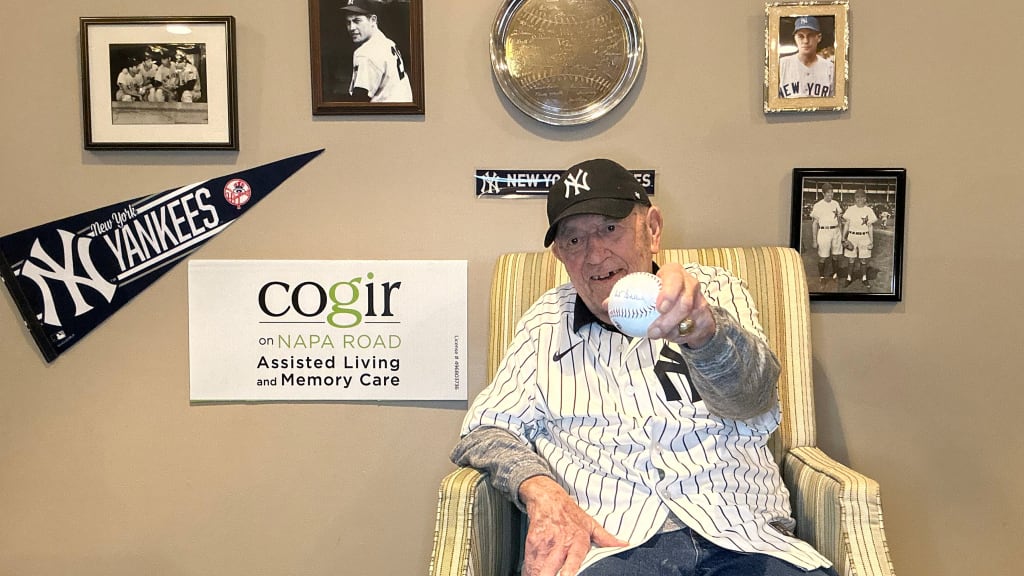
Happy 100th Birthday, Art Schallock!

April 25, 1924, 100 years ago: Arthur Lawrence Schallock is born outside San Francisco in Mill Valley, California. In other words, if the M*A*S*H character B.J. Hunnicutt, said to be from Mill Valley, were a real person, they could have been in the same class at school.

Art graduated from Tamalpais High School in Mill Valley, which has a rather distinguished alumni corps, even with B.J. being fictional: Baseball figures Tony Freitas, Sam Chapman, Joe DeMaestri and Nyjer Morgan; football star Matt Hazeltine; sportscaster Pete Gross; actors Eve Arden, Pat Paulsen, Kathleen Quinlan, Cassandra Webb, Merritt Butrick, Courtney Thorne-Smith and Beth Behrs; and music figures John and Mario Cipollina, Chris Chaney and Tupac Shakur. Unfortunately, it's also the Alma Mater of Anton LaVey, the founder of the Church of Satan.

During World War II, he served as a radio operator on the aircraft carrier USS Coral Sea. He was signed by the Brooklyn Dodgers in 1947. He never got to Ebbets Field, because, on July 12, 1951, the Dodgers traded him to the New York Yankees for Eddie Malone, a catcher who, as it turned out, had already played his last major league game; and Bob Landeck, a pitcher who, as it turned out, would never play a first, although he did play for eventual major league cities Kansas City and Toronto.

Four days later, on July 16, 1951, Art made his major league debut. Wearing Number 26, he was the Yankees' starting pitcher against the Detroit Tigers, at Briggs Stadium (later Tiger Stadium) in Detroit. He did not get out of the 3rd inning, but the Yankees won anyway, 8-6, thanks to home runs by Yogi Berra and Joe Collins. Neither Joe DiMaggio nor Mickey Mantle played in the game: DiMaggio got a day off, and Mantle had been sent down to the minors, before being brought back up.

Art appeared in 11 games that season, starting 6, and had a 3-1 record with a 3.88 ERA. He was placed on the World Series roster, but did not appear in any of the games. He was in the minor leagues for most of the next 3 seasons, making 2 major league appearances in 1952 and 7 in 1953. He was not on the Yankees' World Series roster in 1952, but he was in 1953. Now wearing Number 38, he pitched the last 2 innings of Game 4, and was not responsible for the Yankees losing the game. The Yankees won the Series, so he received a World Series ring.

He spent most of the 1954 season on loan to the Oakland Oaks of the Pacific Coast League, so he was back in his home region, going 12-4. He made 6 appears in the majors that season. The Yankees waived him on May 11, 1955, and the Baltimore Orioles picked him up. They put him in their bullpen, and he had a record of 3-5. He spent the 1956 season with the Seattle Rainiers of the PCL, and then hung 'em up. His major league record was 6-7, with 1 save, a 4.02 ERA, and a 1.703 ERA.

He and his wife, Dona Bernard, were married for 76 years until her death in 2023. They had 2 children and 5 grandchildren. He still lives north of San Francisco, in Sonoma, in what's known as "California Wine Country."
Art Schallock had a very ordinary career, stat-wise. But he is still alive at age 100, is the oldest living former major league baseball player, and is the last surviving former teammate of Joe DiMaggio. He wasn't on the World Series roster in 1952, but he was in 1951 and 1953, making him the last survivor of those Yankee World Championship teams.

Sunday, January 14, 2024

January 14, 1954: Joe DiMaggio Marries Marilyn Monroe

January 14, 1954, 70 years ago: Joe DiMaggio marries Marilyn Monroe at City Hall in Joe's hometown of San Francisco.

Joe, the biggest baseball star of his generation, was 39 years old. Marilyn, one of the biggest actresses of the time, but not yet the biggest, was 27. Each became a much bigger public figure by marrying the other.

Each had been married once before. In 1937, after his great rookie season for the Yankees, DiMaggio was in demand, and was cast in the film Manhattan Merry-Go-Round. It was the only film in which he ever appeared. Also in it was a blonde actress named Dorothy Arnold. (I suppose you could say that Joe had a type.)

They got married in a Catholic ceremony in San Francisco in 1939, and their son Joe Jr. was born in 1941. The marriage began to fail during World War II, and when she left him, Joe enlisted in the U.S. Army. He was assigned to the Army Air Forces (the Air Force was not separated from the Army until 1947), and was still in the service in 1944 when the divorce was finalized.

Marilyn was born Norma Jeane Mortensen, in Los Angeles, but her family situation was every bit as messed-up as Joe's was stable. She grew up using her mother's maiden name for her last name, calling herself Norma Jeane Baker. At age 16, the family situation got worse, and she was threatened with being sent back to an orphanage. Rather than accept that, she married a 21-year-old neighbor, James Dougherty.

The Doughertys were not happy. Right after World War II ended, Marilyn got a modeling job offer, but was told they didn't accept married women. So she left him, and they were divorced in 1946. Jim Dougherty became a Los Angeles police officer, and later taught criminal justice at a college in Maine. He died in 2005, insisting to the end that if Marilyn had turned down the job offer and stayed married to him, she would have been happy.

She signed with Columbia Pictures, took her alliterative stage name, and, like the Mexican-American Margarita Cansino, a.k.a. Rita Hayworth, had her ordinary-blonde hair dyed platinum blonde. Her contract at Columbia was brief, and she moved on to 20th Century Fox. Her small roles in All About Eve and The Asphalt Jungle led to bigger roles, including Gentlemen Prefer Blondes, pairing her up with a brunette with, to put it politely, a similar figure: Jane Russell. Jane had also married a sports legend, Los Angeles Rams quarterback Bob Waterfield. That marriage lasted from 1943 to 1968.

At first, Marilyn didn't want to meet Joe, thinking he would be just another arrogant athlete. But something clicked, and, since Joe was still recognized as married by the Roman Catholic Church, they had a civil ceremony at San Francisco's City Hall.

They honeymooned in Japan. While there, the USO asked Marilyn to make the short flight over to Korea, where, although the Korean War was over, there were still a lot of servicemen stationed. She went, and sang and posed for them. Upon returning to Tokyo, she told her husband, "Oh, Joe, you never heard such cheering!" Missing it, he sadly said, "Yes, I have."

They were a mismatch. She wanted to keep her star rising. He wanted her to stay at home and be a good little Italian housewife. (She was of Scandinavian descent.) The only thing they seemed to agree on was that they both wanted children. But Marilyn had endometriosis, and she couldn't carry a pregnancy to term.

On September 14, 1954, Marilyn stood in front of the Trans-Lux 52nd Street Theater (since demolished), and filmed a scene for the film The Seven Year Itch, in which she stood over a grate for the Lexington Avenue Subway, and a passing train billowed up her white dress. Director Billy Wilder, a known "dirty old man," filmed take after take, even though she got it right every time. Although what appeared on film turned out to be rather tame, especially by today's standards, the film poster was more revealing.

Joe was furious at this. But, rather than take his frustrations out on Wilder, he took them out on Marilyn. He took her into the lobby of the theater, and there was a shouting match. Depending on whose version of the story you believe, he may even have hit her. It has long been believed that he was physically abusive to her in private.
The following month, upon returning to Los Angeles, Marilyn filed for divorce. The following year, she began an affair with Arthur Miller, the playwright who wrote Death of a Salesman. They married in a Jewish ceremony in 1959, and Marilyn was 4 months pregnant when she filmed Some Like It Hot, also directed by Wilder, making her curvier and bouncier than ever: As Jack Lemmon said, in character, "Will you look at that! It's like Jell-O on springs!" But she lost the baby, and her marriage to Miller disintegrated.

They divorced in early 1961, and Marilyn was committed to a psychiatric clinic. Upon hearing this, Joe stepped back into her life, and got her out. They made some public appearances together, and it looked like they might remarry.

But on August 5, 1962, Marilyn was found dead in her Los Angeles house, only 36 years old. The cause was an overdose of barbiturates, though it is still debated as to whether it was intentional.
DiMaggio organized her funeral. He barred several of her friends from attending, including President John F. Kennedy, believing the rumor that Jack and Marilyn had had an affair. He also barred Frank Sinatra, although Marilyn always denied having fooled around with Frank.

Joe and Frank were not just the 2 most famous Americans of Italian descent, but had once been close friends. They even "raided" somebody's house, thinking that the owner was fooling around with Marilyn. They had the wrong house, and nearly got in legal trouble for what became known as "The Wrong Door Raid."

Joe ended their friendship over Marilyn. An attempt to reconcile them at a Los Angeles restaurant in 1995 fell through, and the feud lasted until Sinatra's death in 1998.

For 20 years, Joe left flowers at Marilyn's grave 3 times a week. He stopped when he found out they were being taken as souvenirs. When he attended sports memorabilia shows, the rules for getting Joe's autograph included not mentioning Marilyn or giving him anything to sign with her in it, even if the picture had both of them. At least once, when presented with such a picture, he got up and left without a word.

At memorabilia conventions, Joe flat-out refused to sign anything having to do with Marilyn. I have, however, seen a photograph of a baseball signed by Joe and Marilyn, except she signed it "Norma Jeane DiMaggio."

Despite having been linked with a few women over the years, including Miss Americas Lee Meriwether and Marian McKnight, actress Gloria DeHaven, and, as late as the 1980s, actress Morgan Fairchild, Joe DiMaggio never remarried after his divorce from Marilyn Monroe, or even publicly confirmed that he was dating anyone. Joe's last words prior to his death on March 8, 1999, according to his attorney Morris Engelberg, were, "I'll finally get to see Marilyn." Joe's brother Dom, himself a star center fielder, denied this.
Still, both Joe DiMaggio and Marilyn Monroe loom large in the American consciousness, partly due to their connection to each other. In 1989, with Joe still alive, Billy Joel wrote "We Didn't Start the Fire," rhyming "DiMaggio" with "Monroe." In 1990, Madonna did the same thing in her song "Vogue." Both songs hit Number 1. Madonna had previously copied Marilyn's performance of "Diamonds Are a Girl's Best Friend" in Gentlemen Prefer Blondes for the video for her hit "Material Girl."

Wednesday, August 2, 2023

August 2 & 3, 1923: The Death of Warren Harding -- and the Struggle to Inaugurate Calvin Coolidge

August 2, 1923, 100 years ago: Warren Gamaliel Harding, the 29th President of the United States, dies in office, halfway through the 3rd year of his term. He was 57 years old.

The former newspaper editor was a U.S. Senator from Ohio when he was elected President in a landslide in 1920. He was handsome, charming, and promised "a return to normalcy" after the turbulent Progressive Era, World War I, and its difficult aftermath. Actually, he never used the words "return to normalcy" in any speech. What he said was:

America's present need is not heroics, but healing; not nostrums, but normalcy; not revolution, but restoration; not agitation, but adjustment; not surgery, but serenity; not the dramatic, but the dispassionate; not experiment, but equipoise; not submergence in internationality, but sustainment in triumphant nationality.

Things had considerably calmed down in America during his time in office, and he was still popular in the Summer of 1923. He even posed for a photo with the biggest star in baseball, the Yankees' Babe Ruth.
Legend has it that Ruth, whose many alliterative nicknames could have included the Imperator of Informality, once asked the President of the United States, "Hot as hell, ain't it, Prez?" It's not clear whether the President in question was Harding, who might have appreciated it, or his successor, Calvin Coolidge, who certainly would not have.

So he was still popular in the Summer of 1923, when the Teapot Dome scandal broke out. Unlike such later scandals as Richard Nixon's Watergate, Ronald Reagan's Iran-Contra, Bill Clinton's relationship with Monica Lewinsky, and the many scandals of George W. Bush and Donald Trump, this one was, and remains, a bit complicated.

Teapot Dome was an oil reserve in Wyoming, one of three set aside for the use of the U.S. Navy in the event of a national emergency. In May 1921, Harding signed an executive order transferring control of the reserves from the Department of the Navy to the Department of the Interior. Secretary of the Navy Edwin Denby agreed to this, and Secretary of the Interior Albert Fall now had control.

In July 1921, California-based oilman Edward Doheny offered Fall a bribe of $100,000 -- about $1.7 million in today's money -- for permission to drill at Teapot Dome. The weird part is, after Harding was gone, Fall was convicted of accepting this bribe in 1929 -- the 1st Cabinet member ever to go to prison for actions in office -- but Doheny was acquitted of offering it in 1930.
Teapot Rock, above Teapot Dome

The scandal had begun to break, and Harding's bid for re-election was less than a year and a half away. He called his Secretary of Commerce into his office. He asked the Secretary, if he were President, and knew of a scandal in his Administration, what would he do? The Secretary said he would come completely clean. The Secretary's name was Herbert Hoover, and he would eventually become President. He didn't have a scandal like Teapot Dome in his Administration. He should have been no more unlucky than that.

Harding did not come clean. Instead, he ran away. No, he didn't resign. He went on what he called a "Voyage of Understanding," a train trip all over the continent. He became the 1st sitting President to visit Canada, and then the 1st to visit Alaska, which would still be a Territory until gaining Statehood in 1959.

On his way back south, he visited Seattle, and gave a speech at the University of Washington on July 27. That night, he called his doctor, Charles E. Sawyer, complaining of abdominal pain. Sawyer diagnosed an "acute gastrointestinal attack," and that's what the press was told. Somehow, it got out that Harding had eaten some tainted crabmeat in Alaska.

On July 29, Harding arrived in San Francisco, and checked into the Palace Hotel, and had a relapse. It wouldn't be publicly revealed until after his death, but, like his immediate predecessor, Woodrow Wilson, Harding was already a sick man when he became President, with a few years of heart problems, which were flaring up again. His wife, Florence, known as "The Duchess," was with him, and she wasn't very healthy, either, with a chronic kidney condition.
At 7:30 PM Pacific Time, in their room at the Palace, Florence was reading a flattering article about him, published by The Saturday Evening Post: "A Calm Review of a Calm Man." She paused, and he said, "That's good. Go on, read some more." She did, for a few seconds, until she noticed him twisting and gasping for air. She called the doctors, but it was too late: He was dead. 

Mrs. Harding did not permit an autopsy for her husband. A rumor got around that she had poisoned him -- possibly to protect him from the rising scandal; or possibly out of revenge for something the public didn't know at the time, his voracious womanizing, including an affair that resulted in the only child he would ever have.

That wouldn't be known for a few years. At first, the country was deeply saddened by the death of a popular President. But before the Harding Tomb could be completed in 1929, it had all come out, and he became regarded as one of the worst Presidents the country had ever had: As scandalous as Richard Nixon, as dumb as George W. Bush, and as horny as Bill Clinton.

Whatever Mrs. Harding knew, she took to the grave, on November 21, 1924, less than a year and a half after her husband, and just after he would have had to face the voters again.

*

Harding died at 10:30 PM Eastern Time. Now, a new President of the United States must be sworn in. It becomes the most difficult Inauguration in the office's history. Not because of any external threat, real or imagined. And not because of any resistance to the peaceful transfer of power. But because of simple logistics, and the technology of the time.

The Secret Service had to find the Vice President, Calvin Coolidge, former Governor of Massachusetts. Like Harding, he was escaping the Summer heat of Washington, D.C., staying at his family's homestead in Plymouth, Vermont, where he had been born on July 4, 1872. (This makes him, to this day, the only person born on the nation's birthday to become President.)

This was 1923, and less than half of all American homes had telephones. And the Coolidge Homestead did not have a telephone. But it shouldn't have been that hard to send a telegram. Well, they couldn't reach the Coolidge Homestead by telegram, either.

So, Secret Service Agents had to drive up from Boston, and knock on the front door of the Coolidge Homestead in the middle of the night. The unwitting new President's father, John Coolidge, a former Vermont State Senator, a notary public, and a justice of the peace, answered the door. The Agents discovered that this rural home -- 150 miles northwest of Boston, 100 miles northeast of Albany, and 100 miles southeast of Vermont's largest city, Burlington -- didn't even have electricity. The ceremony had to be conducted by candlelight.

At 2:47 AM Eastern Time -- meaning that, less than 100 years ago, there was a time when the nation didn't have a working President for over 4 hours -- Calvin Coolidge was administered the Oath of Office by his father, becoming the 30th President of the United States. 
Artist's depiction of the Inauguration. There was no photographer present.

When John was asked by a reporter a few days later how he knew he could swear his son in, he said, "I didn't know that I couldn't." The legal basis for him being the person to swear the President in is a bit vague: He wasn't actually a judge, and every other person who has ever sworn a President in has been, at the very least, a judge.

Most have been the Chief Justice of the United States. This includes Salmon Chase, swearing in Andrew Johnson after the assassination of Abraham Lincoln in 1865; Harlan Stone, swearing in Harry Truman after the death of Franklin Roosevelt in 1945; and Warren Burger, swearing in Gerald Ford after the resignation of Richard Nixon in 1974. The others:

* April 30, 1789, George Washington, Federal Hall, New York: Robert Livingston, Chancellor of New York. In other words, the State's Chief Justice. There wasn't yet a Chief Justice of the country, because there wasn't yet a Supreme Court, because the Justices of that Court hadn't yet been appointed by the President, because there wasn't yet a President.

* April 6, 1841, John Tyler, Indian Queen Hotel, Washington: William Cranch, Chief Judge of the U.S. Circuit Court of the District of Columbia.

* July 10, 1850, Millard Fillmore, House of Representatives Chamber, U.S. Capitol, Washington: Cranch again.

* September 20, 1881, Chester Arthur, his apartment, New York: John R. Brady, a Justice of the Supreme Court of the State of New York.

* September 14, 1901, Theodore Roosevelt, Ansley Wilcox House, Buffalo, New York: John R. Hazel, Judge of the U.S. District Court for the Western District of New York.

* November 22, 1963, Lyndon Johnson, aboard Air Force One, Love Field, Dallas: Sarah T. Hughes, Judge of the U.S. District Court for the Northern District of Texas. She remains the only woman to administer the Oath of Office to an incoming President.

Thus sworn in by his father, President Calvin Coolidge went back to bed, helping to feed the legend that he slept too much while he was President. The next morning, Coolidge was driven to Rutland, Vermont, where he took a train to Boston, and then another to Washington, where, just to be on the safe side, he was sworn in again, by a federal Judge, Adolph A. Hoehling Jr.

Calvin Coolidge ran for a term of his own in 1924, and, untainted by the Teapot Dome scandal that had engulfed Harding, won easily. On March 4, 1925, at the Capitol, he got a proper Inauguration, sworn in by the Chief Justice, himself a former President, William Howard Taft.

Would Harding have been re-elected, given the booming economy, even with Teapot Dome and the subsequent scandal in the U.S. Department of Justice, which sent his Attorney General and former campaign manager, Harry Daugherty, to prison? Maybe, because the Democrats were badly divided.

But since Coolidge wasn't involved in the scandals at all, he cruised to an easy victory, as the nation decided to follow the Republican slogan, "Keep Cool and Keep Coolidge."

John Coolidge died in 1926. Calvin Coolidge did not run for a 2nd full term in 1928, and left office on March 4, 1929, with the Inauguration of Herbert Hoover. He died on January 5, 1933. His Presidency had so little drama, and Coolidge himself had so little personality, that, when the writer Dorothy Parker was informed that he had died, she said, "How can you tell?"