Showing posts with label vermont. Show all posts

Tuesday, November 12, 2024

My Ranking of the States, 2024 Edition

I previously did this in 2015 and 2020. This time, I'm using different parameters. Or, rather, one parameter: How well did you oppose Fascism in the 2024 election? In other words: What percent of your popular vote went to Kamala Harris, instead of Donald Trump or any other candidate?

The Good

-. District of Columbia: 92.5
1. Vermont: 64.3
2. Maryland: 61.5
3. Massachusetts: 61.3
4. Hawaii: 60.6
5. California: 58.2
6. Washington: 58.0
7. Delaware: 56.6
8. Connecticut: 56.5
9. New York: 55.8
10. Oregon: 55.6
11. Rhode Island: 55.7
12. Colorado: 54.2
13. Illinois: 53.8
14. Maine: 52.2
15. Virginia: 51.8
16. New Mexico: 51.8
17. New Jersey: 51.7
18. Minnesota: 51.1
19. New Hampshire: 50.9

The Bad

20. Wisconsin: 48.9
21. Georgia: 48.5
22. Pennsylvania: 48.5
23. Michigan: 48.3
24. North Carolina: 47.7
26. Arizona: 46.5

Aside from North Carolina, each of those States went for Joe Biden last time, but flipped to Trump this time.

The Ugly

27. Ohio: 43.9
28. Florida: 43.0
29. Iowa: 42.7
30. Texas: 42.4
31. Kansas: 41.0
32. South Carolina: 40.4
33. Alaska: 40.4
34. Missouri: 40.1
35. Indiana: 39.7
36. Nebraska: 38.9
37. Montana: 38.4
38. Utah: 38.3
39. Louisiana: 38.2
40. Mississippi: 37.3
41. Tennessee: 34.5
42. Alabama: 34.2
43. South Dakota: 34.2
44. Kentucky: 33.9
45. Arkansas: 33.5
46. Oklahoma: 31.9
47. North Dakota: 30.8
48. Idaho: 30.4
49. West Virginia: 27.9
50. Wyoming: 26.1 (Gee, thanks, Liz Cheney.)

The last time each State voted for the Democratic Party's candidate for President:

* 2024, Kamala Harris: California, Colorado, Connecticut, Delaware, District of Columbia, Hawaii, Illinois, Maine, Maryland, Massachusetts, Minnesota, New Hampshire, New Jersey, New Mexico, New York, Oregon, Rhode Island, Vermont, Virginia, Washington.

* 2020, Joe Biden: Arizona, Georgia, Michigan, Nevada, Pennsylvania, Wisconsin.

* 2012, Barack Obama: Florida, Iowa, Ohio.

* 2008, Barack Obama: Indiana, North Carolina.

* 1996, Bill Clinton: Arkansas, Kentucky, Louisiana, Missouri, Tennessee, West Virginia. Clinton was a Southerner, but that didn't help Al Gore 4 years later. By that point, the South had stopped caring about geography, and cared more about religion, guns, and white supremacy.


* 1964, Lyndon Johnson: Alaska, Idaho, Kansas, Montana, Nebraska, North Dakota, Oklahoma, South Dakota, Utah, Wyoming. These are Western States with a libertarian streak.

Wednesday, August 2, 2023

August 2 & 3, 1923: The Death of Warren Harding -- and the Struggle to Inaugurate Calvin Coolidge

August 2, 1923, 100 years ago: Warren Gamaliel Harding, the 29th President of the United States, dies in office, halfway through the 3rd year of his term. He was 57 years old.

The former newspaper editor was a U.S. Senator from Ohio when he was elected President in a landslide in 1920. He was handsome, charming, and promised "a return to normalcy" after the turbulent Progressive Era, World War I, and its difficult aftermath. Actually, he never used the words "return to normalcy" in any speech. What he said was:

America's present need is not heroics, but healing; not nostrums, but normalcy; not revolution, but restoration; not agitation, but adjustment; not surgery, but serenity; not the dramatic, but the dispassionate; not experiment, but equipoise; not submergence in internationality, but sustainment in triumphant nationality.

Things had considerably calmed down in America during his time in office, and he was still popular in the Summer of 1923. He even posed for a photo with the biggest star in baseball, the Yankees' Babe Ruth.
Legend has it that Ruth, whose many alliterative nicknames could have included the Imperator of Informality, once asked the President of the United States, "Hot as hell, ain't it, Prez?" It's not clear whether the President in question was Harding, who might have appreciated it, or his successor, Calvin Coolidge, who certainly would not have.

So he was still popular in the Summer of 1923, when the Teapot Dome scandal broke out. Unlike such later scandals as Richard Nixon's Watergate, Ronald Reagan's Iran-Contra, Bill Clinton's relationship with Monica Lewinsky, and the many scandals of George W. Bush and Donald Trump, this one was, and remains, a bit complicated.

Teapot Dome was an oil reserve in Wyoming, one of three set aside for the use of the U.S. Navy in the event of a national emergency. In May 1921, Harding signed an executive order transferring control of the reserves from the Department of the Navy to the Department of the Interior. Secretary of the Navy Edwin Denby agreed to this, and Secretary of the Interior Albert Fall now had control.

In July 1921, California-based oilman Edward Doheny offered Fall a bribe of $100,000 -- about $1.7 million in today's money -- for permission to drill at Teapot Dome. The weird part is, after Harding was gone, Fall was convicted of accepting this bribe in 1929 -- the 1st Cabinet member ever to go to prison for actions in office -- but Doheny was acquitted of offering it in 1930.
Teapot Rock, above Teapot Dome

The scandal had begun to break, and Harding's bid for re-election was less than a year and a half away. He called his Secretary of Commerce into his office. He asked the Secretary, if he were President, and knew of a scandal in his Administration, what would he do? The Secretary said he would come completely clean. The Secretary's name was Herbert Hoover, and he would eventually become President. He didn't have a scandal like Teapot Dome in his Administration. He should have been no more unlucky than that.

Harding did not come clean. Instead, he ran away. No, he didn't resign. He went on what he called a "Voyage of Understanding," a train trip all over the continent. He became the 1st sitting President to visit Canada, and then the 1st to visit Alaska, which would still be a Territory until gaining Statehood in 1959.

On his way back south, he visited Seattle, and gave a speech at the University of Washington on July 27. That night, he called his doctor, Charles E. Sawyer, complaining of abdominal pain. Sawyer diagnosed an "acute gastrointestinal attack," and that's what the press was told. Somehow, it got out that Harding had eaten some tainted crabmeat in Alaska.

On July 29, Harding arrived in San Francisco, and checked into the Palace Hotel, and had a relapse. It wouldn't be publicly revealed until after his death, but, like his immediate predecessor, Woodrow Wilson, Harding was already a sick man when he became President, with a few years of heart problems, which were flaring up again. His wife, Florence, known as "The Duchess," was with him, and she wasn't very healthy, either, with a chronic kidney condition.
At 7:30 PM Pacific Time, in their room at the Palace, Florence was reading a flattering article about him, published by The Saturday Evening Post: "A Calm Review of a Calm Man." She paused, and he said, "That's good. Go on, read some more." She did, for a few seconds, until she noticed him twisting and gasping for air. She called the doctors, but it was too late: He was dead. 

Mrs. Harding did not permit an autopsy for her husband. A rumor got around that she had poisoned him -- possibly to protect him from the rising scandal; or possibly out of revenge for something the public didn't know at the time, his voracious womanizing, including an affair that resulted in the only child he would ever have.

That wouldn't be known for a few years. At first, the country was deeply saddened by the death of a popular President. But before the Harding Tomb could be completed in 1929, it had all come out, and he became regarded as one of the worst Presidents the country had ever had: As scandalous as Richard Nixon, as dumb as George W. Bush, and as horny as Bill Clinton.

Whatever Mrs. Harding knew, she took to the grave, on November 21, 1924, less than a year and a half after her husband, and just after he would have had to face the voters again.

*

Harding died at 10:30 PM Eastern Time. Now, a new President of the United States must be sworn in. It becomes the most difficult Inauguration in the office's history. Not because of any external threat, real or imagined. And not because of any resistance to the peaceful transfer of power. But because of simple logistics, and the technology of the time.

The Secret Service had to find the Vice President, Calvin Coolidge, former Governor of Massachusetts. Like Harding, he was escaping the Summer heat of Washington, D.C., staying at his family's homestead in Plymouth, Vermont, where he had been born on July 4, 1872. (This makes him, to this day, the only person born on the nation's birthday to become President.)

This was 1923, and less than half of all American homes had telephones. And the Coolidge Homestead did not have a telephone. But it shouldn't have been that hard to send a telegram. Well, they couldn't reach the Coolidge Homestead by telegram, either.

So, Secret Service Agents had to drive up from Boston, and knock on the front door of the Coolidge Homestead in the middle of the night. The unwitting new President's father, John Coolidge, a former Vermont State Senator, a notary public, and a justice of the peace, answered the door. The Agents discovered that this rural home -- 150 miles northwest of Boston, 100 miles northeast of Albany, and 100 miles southeast of Vermont's largest city, Burlington -- didn't even have electricity. The ceremony had to be conducted by candlelight.

At 2:47 AM Eastern Time -- meaning that, less than 100 years ago, there was a time when the nation didn't have a working President for over 4 hours -- Calvin Coolidge was administered the Oath of Office by his father, becoming the 30th President of the United States. 
Artist's depiction of the Inauguration. There was no photographer present.

When John was asked by a reporter a few days later how he knew he could swear his son in, he said, "I didn't know that I couldn't." The legal basis for him being the person to swear the President in is a bit vague: He wasn't actually a judge, and every other person who has ever sworn a President in has been, at the very least, a judge.

Most have been the Chief Justice of the United States. This includes Salmon Chase, swearing in Andrew Johnson after the assassination of Abraham Lincoln in 1865; Harlan Stone, swearing in Harry Truman after the death of Franklin Roosevelt in 1945; and Warren Burger, swearing in Gerald Ford after the resignation of Richard Nixon in 1974. The others:

* April 30, 1789, George Washington, Federal Hall, New York: Robert Livingston, Chancellor of New York. In other words, the State's Chief Justice. There wasn't yet a Chief Justice of the country, because there wasn't yet a Supreme Court, because the Justices of that Court hadn't yet been appointed by the President, because there wasn't yet a President.

* April 6, 1841, John Tyler, Indian Queen Hotel, Washington: William Cranch, Chief Judge of the U.S. Circuit Court of the District of Columbia.

* July 10, 1850, Millard Fillmore, House of Representatives Chamber, U.S. Capitol, Washington: Cranch again.

* September 20, 1881, Chester Arthur, his apartment, New York: John R. Brady, a Justice of the Supreme Court of the State of New York.

* September 14, 1901, Theodore Roosevelt, Ansley Wilcox House, Buffalo, New York: John R. Hazel, Judge of the U.S. District Court for the Western District of New York.

* November 22, 1963, Lyndon Johnson, aboard Air Force One, Love Field, Dallas: Sarah T. Hughes, Judge of the U.S. District Court for the Northern District of Texas. She remains the only woman to administer the Oath of Office to an incoming President.

Thus sworn in by his father, President Calvin Coolidge went back to bed, helping to feed the legend that he slept too much while he was President. The next morning, Coolidge was driven to Rutland, Vermont, where he took a train to Boston, and then another to Washington, where, just to be on the safe side, he was sworn in again, by a federal Judge, Adolph A. Hoehling Jr.

Calvin Coolidge ran for a term of his own in 1924, and, untainted by the Teapot Dome scandal that had engulfed Harding, won easily. On March 4, 1925, at the Capitol, he got a proper Inauguration, sworn in by the Chief Justice, himself a former President, William Howard Taft.

Would Harding have been re-elected, given the booming economy, even with Teapot Dome and the subsequent scandal in the U.S. Department of Justice, which sent his Attorney General and former campaign manager, Harry Daugherty, to prison? Maybe, because the Democrats were badly divided.

But since Coolidge wasn't involved in the scandals at all, he cruised to an easy victory, as the nation decided to follow the Republican slogan, "Keep Cool and Keep Coolidge."

John Coolidge died in 1926. Calvin Coolidge did not run for a 2nd full term in 1928, and left office on March 4, 1929, with the Inauguration of Herbert Hoover. He died on January 5, 1933. His Presidency had so little drama, and Coolidge himself had so little personality, that, when the writer Dorothy Parker was informed that he had died, she said, "How can you tell?"

Monday, November 2, 2020

Top 5 Reasons You Can't Blame Alf Landon for Losing 46 States in the 1936 Election

 
November 3, 1936: President Franklin D. Roosevelt defeats his Republican opponent, Governor Alfred M. Landon of Kansas, winning 46 out of 48 States, all but Vermont and Maine. He wins 523 Electoral Votes, Landon just 8. FDR wins 60.8 percent of the popular vote, to Landon's 36.5 percent.

Landon's next-best States? He won almost 48 percent in New Hampshire, almost 46 percent in his native Kansas, almost 45 percent in Delaware. If he had won those States, the Electoral Vote would have been 507-24 Roosevelt.

There were 8 other States where he got at least 40 percent. But even if he had won all of those, it would still have been 406-125 Roosevelt.
 
Top 5 Reasons You Can't Blame Alf Landon for Losing 46 States in the 1936 Election

5. The Curse of Herbert Hoover. The American people did not trust the Republican Party. It had been just 4 years since the depth of the Great Depression.

4. Landon's Supporters. There were crazy people on the right wing back then, too, and they made the GOP look not like the bunch of moderates their big names claimed to be, and Landon actually was, but like a bunch who couldn't be trusted.

3. The Media. The major newspaper chains were all Republican-owned, and behind Landon. And in an era when they were the entirety of the media, Landon might have been a great candidate. He was smart, honest, and understood that he served the public, not the other way around. But this was now the era of radio and newsreels. He wasn't well-suited to it. FDR was.

2. The Republican Field. The GOP didn't have anyone else who could beat FDR, either. Most of their big guns who had been elected in the Congressional elections of 1918, '20, '24 and '28 had been beaten in the elections of 1922, '26, '30, '32 and '34.

1. Franklin Delano Roosevelt. He was the master politician of his era, and his New Deal worked. Not perfectly, of course, but for the people for whom it did work, it was the difference between destitution and a living.
VERDICT: Not Guilty. Landon never had a chance. No matter what he had done, he would have lost.

FDR would be elected to a 3rd term in 1940, and a 4th in 1944, dying in office in 1945. Landon would serve out his term as Governor, return to the oil industry where he had made his money, and never ran for office again. He lived to be 100 years old, dying in 1987. His daughter, Nancy Landon Kassebaum, served Kansas in the U.S. Senate.

Sunday, March 4, 2018

Top 10 Athletes From Vermont

March 4, 1791: Vermont is admitted to the Union as the 14th State, the 1st after the original 13.

Top 10 Athletes From Vermont

Of the 38 men born in Vermont who have gone on to play Major League Baseball, the 2 best actually grew up in neighboring New Hampshire: Carlton Fisk of Charlestown, and George "Birdie" Tebbetts of Nashua. Fisk was born in Bellows Falls, Vermont, across the Connecticut River, because that was the closest hospital to Charlestown.

Of the 10 men born in Vermont who have gone on to play in the National Football League, only 3 grew up, and thus were trained to play the sport, in the Green Mountain State: Phil Branon of Fairbanks, who played 1 game at tackle for the Cleveland Bulldogs in 1925; Peter Bove of Rutland, who played 3 games at guard for the Newark Tornadoes in 1930; and Bob Yates of the State capital of Montpelier, an offensive lineman who played for the Boston Patriots in their AFL days, 1961-65.

Vermont is the only State that has never produced a National Basketball Association player. This doesn't make a whole lot of sense, partly because basketball is an indoor sport, so the State's long Winter won't make a difference in training; and partly because Southern Vermont is not far from Springfield, Massachusetts, where the sport was invented.

The best basketball player from the State is Keith Cieplicki of South Burlington, who starred at the College of William & Mary in Virginia, and was drafted by the Los Angeles Lakers in 1985 -- when they might have been the best NBA team ever, and he didn't make the team. Like his father, who was his high school coach, he went into coaching.

Only 2 National Hockey League players have been born in Vermont. One, you'll see in the Top 10. The other is Graham Mink of Stowe, a right wing who played 7 games for the Washington Capitals between 2003 and 2009, and was otherwise a career minor-leaguer.

So, here's the Top 10:

Honorable Mention to Ernie Johnson of Brattleboro. He only went 40-23 in a 10-year big-league career, but that included winning the 1957 World Series with the Milwaukee Braves. He is better remembered as a broadcaster for the Atlanta version of the team, and even more so for being the father of broadcaster Ernie Johnson Jr.

Honorable Mention to Suzy and Rick Chaffee of Rutland. Suzy washed out at the 1968 Winter Olympics in Grenoble, France, but, in the 1st Olympics ever broadcast on American TV in color, she caught people's attention with her bright skintight skisuit. She then became an advocate for the legislation that became Title IX, but is probably best remembered for her lip balm commercials: "Call me Suzy Chapstick." Her brother Rick also competed at Grenoble in 1968, and at Sapporo in 1972.

10. Bill Koch of Guilford. He won the Silver Medal in the 30-kilometer cross country ski race at the 1976 Winter Olympics in Innsbruck, Austria. (Those Games were supposed to be held in Denver, but local voters rejected funding for them in an election, and Innsbruck, who had hosted in 1964, had the facilities, so they got it.)

9. Billy Kidd of Stowe. He won the Silver Medal in the slalom at the 1964 Winter Olympics in Innsbruck, Austria.

8. Ray Fisher of Middlebury. He went 100-94 as a major league pitcher, pitching for the Yankees from 1910 to 1917. He missed 1918 serving in World War I, then won the World Series with the Cincinnati Reds.

He went on to become the head coach at the University of Michigan from 1921 to 1958, desegregating the team in 1923. He won 15 Big Ten titles and the 1953 National Championship. The school's baseball stadium is now named Ray Fisher Field.

In 1982, he was invited to Old-Timers' Day as the oldest living Yankee, age 95. He was wheeled onto the field and got a nice hand -- after broadcaster Frank Messer told the crowd, truthfully, that it was Fisher's 1st visit to Yankee Stadium. He had pitched for the team at Hilltop Park and the Polo Grounds, but retired before the big ballyard in The Bronx opened. He died 3 months later.

7. Ray Collins of Colchester. He went 84-62 as a pitcher for the Boston Red Sox, including 20 wins in 1914. He helped them win the 1912 and 1915 World Series. He later served as head coach at the University of Vermont, and in the State legislature.

6. Barbara Cochran of Richmond. She won a Gold Medal in the slalom at the 1972 Winter Olympics in Sapporo, Japan. She is 1 of 4 siblings to have won National Championships in skiing, along with sisters Marilyn and Lindy and brother Robert. Her son Ryan Cochran-Siegle just competed in the Winter Olympics in Pyeongchang, South Korea.

5. Clarence DeMar of South Hero. In 1910, he ran his 1st marathon, the Boston Marathon, then by far the most prestigious in the Western Hemisphere. He finished 2nd. Then doctors detected a heart murmur, and told him not to run anymore. He didn't listen, and in 1911 won the race with a course record.

The heart murmur didn't keep him out of Harvard University, from which he graduated, or the U.S. Army in World War I. He won the Boston Marathon again in 1922, 1923, 1924, 1927 and 1930. In other words, he won 6 Boston Marathons after being told his heart could kill him if he tried.

"Clarence DeMarathon" ran 3 Olympic marathons, finishing poorly in Stockholm in 1912 and in Amsterdam in 1928, but winning a Bronze Medal in Paris in 1924. He was still running the Boston Marathon at age 65, and still running competitively at 69. When he died at 70, it wasn't the heart problem that killed him, it was cancer.

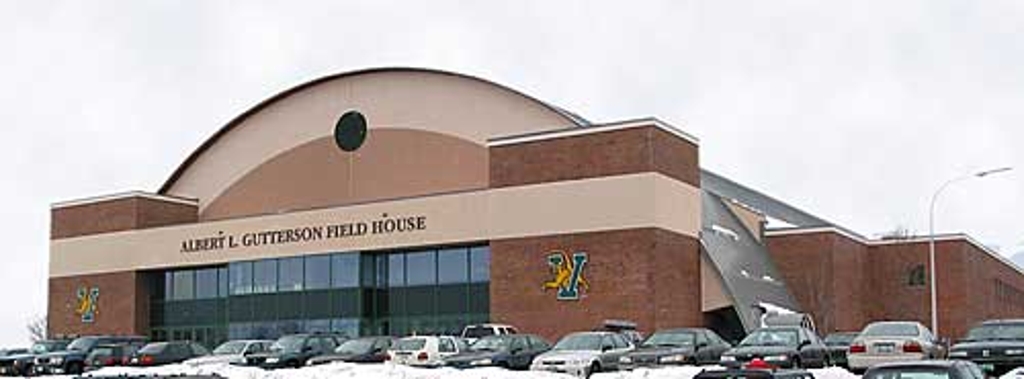
4. Albert Gutterson of Springfield. He won the Gold Medal in the long jump at the 1912 Olympics in Stockholm, jumping 24 feet, 11 1/8th inches. He is the only Vermont native to win a Gold Medal in the Summer Olympics. The University of Vermont named its arena the Albert Gutterson Field House.

3. Larry Gardner of Enosburg Falls. The 3rd baseman for the Boston Red Sox, a teammate of the aforementioned Ray Collins, hit his team's only home run in the 1912 World Series, and his sacrifice fly in the 10th inning of the deciding Game 8 (Game 2 was called for darkness with a tie score) drove in the winning run. He also helped them win the 1915 and 1916 World Series, homering in consecutive games in 1916.

His former Boston teammates Tris Speaker and Smoky Joe Wood brought him to the Cleveland Indians, and he helped them win the World Series in 1920, leading the team with 118 RBIs. He topped out the next year with 120 RBIs and a .319 average.

He finished with a .289 lifetime batting average, and his 1,931 hits lead all Vermont-trained players. He's also the all-time home run leader -- with 27. His RBI total is also the all-time leader: 934. It was the Dead Ball Era. (Fisk would be an easy leader in either category, but, as I said, he grew up in New Hampshire.) The Red Sox elected him to their team Hall of Fame.

2. Andrea Mead Lawrence of Rutland. In 1952 in Oslo, she became the 1st American skier of either gender to win 2 Winter Olympic Gold Medals, taking the slalom and the giant slalom. Her husband David Lawrence was also on the U.S. team at those Olympics.

1. John LeClair of St. Albans. A 5-time All-Star, the left wing was one of the overtime heroes that led the Montreal Canadiens to the 1993 Stanley Cup. He was traded to the Philadelphia Flyers, and became the 1st American-born, and the 1st American-trained, player to score at least 50 goals in 3 straight seasons.
He, Eric Lindros and Mikael Renberg formed the "Legion of Doom Line" that won the 1997 NHL Eastern Conference Championship, and lost the Eastern Conference Finals to the New Jersey Devils in 1995 and 2000, and to the Tampa Bay Lightning in 2004.

He was also a member of the U.S. team that won the 1996 World Cup of Hockey, and a Silver Medal at the 2002 Winter Olympics in Salt Lake City. He finished his career with 406 goals. He is not yet in the Hockey Hall of Fame, but he should be.

Friday, February 3, 2017

How to Go to a Vermont Hockey Game

Continuing my bid to do sports-theme Trip Guides for all 50 States, I present one for the University of Vermont, and its premier team, its men's ice hockey team.

On Friday, February 10, and Saturday, February 11, the Vermont Catamounts will play home games against their arch-rivals, the University of New Hampshire Wildcats. Both games start at 7:05 PM.

Before You Go. The University of Vermont, or "UVM," is at 44.48 degrees North latitude. That is further north than Boston and Toronto, as far north as Minneapolis, and the only major league cities further north are Portland and Seattle. So it could be colder.

For both Friday and Saturday, the Burlington Free Press website is predicting 18 degrees for daylight, 9 degrees for night, with a 20 percent chance of snow on Friday and a 40 percent chance on Saturday. Bundle up, and be careful.

Vermont is in the Eastern Time Zone, so you won't have to fiddle with your timepieces.

The U.S.-Canadian border is 43 miles north, and downtown Montreal about 95 miles north. If you want to take a side trip, you'll need your passport. And you'll have to change your money. As I write this, US$1.00 = C$1.30, and C$1.00 = US 77 cents.

Tickets. Gutterson Fieldhouse seats only 4,035. That's not much, and UVM-UNH is a rivalry. If you can get them, tickets are $25.

Getting There. It's about 300 miles, depending on which northerly route you take, from Midtown Manhattan to the UVM campus in Burlington. There is a Burlington International Airport, but with everything you'd have to do at the airport at either end, it really doesn't pay to fly.

If you're driving, the best way to get there is to take Interstate 87 past Albany, where the New York State Thruway becomes the Adirondack Northway, to Exit 20. Take NY Route 149 to U.S. Route 4, then cross the State Line and turn left on Vermont Route 22A. Take that until it merges with U.S. Route 7, and drive that right to the UVM campus.

Amtrak does not go to Burlington. Greyhound does, but it takes 11 hours, and you'll have to change buses -- not at Albany, which you might guess as a halfway point, but at South Station in Boston. So, instead of going almost due north, you'll be going northeast, then northwest. Round-trip fare is $112, and the station is at 2 S. Prospect Street. If you buy online, or at Port Authority, make sure you specify "Burlington, University of Vermont," or you'll end up at the Airport, which is in South Burlington, 2 1/2 miles east of the campus.

Once In the City. Vermont was first settled by the French, so its name is probably les Verts Monts -- literally, the Green Mountains, which is the name of the mountain range. (The one in New Hampshire, the northernmost of the Appalachians, is the White Mountains.)
It is the only State with green license plates.

Vermont was the 14th State admitted to the Union, the 1st other than the Original 13 Colonies, on March 4, 1791. The University of Vermont was founded the same year. It is home to only 624,000 people, about 94 percent of them white, 1.9 percent Hispanic, 1.8 percent Asian, 1.2 percent black.

Burlington, easily the State's largest city (but not that large: Only about 42,000 permanent residents, or slightly more than a sellout at Citi Field), was named for Richard Boyle, 3rd Earl of Burlington and 4th Earl of Cork, a British architect of the early 17th Century.
ZIP Codes in Vermont start with the digits 05. The Area Code is 802. Green Mountain Power Corporation runs the State's electricity. The State capital is Montpelier, 37 miles to the southeast. With 7,855 people, it is the smallest State capital in the country. Vermont has a 6 percent sales tax, which rises to 7 percent in Burlington. Bernie Sanders, before running for President in 2016, and serving in both houses of Congress, was Mayor of Burlington from 1981 to 1989.
The State House in Montpelier

It's 189 miles between the campuses of the universities of Vermont and New Hampshire, although the State line is only about half that: Dartmouth College, in Hanover, is just 95 miles from UVM. As I said, it's 95 miles north from UVM to Montreal. Albany is 150 miles to the south, the Baseball Hall of Fame in Cooperstown is 195 miles to the southwest, and Boston is 216 miles to the southeast.
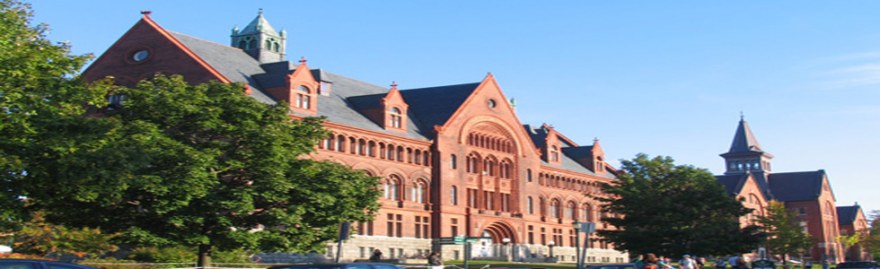
The centerpiece of the UVM campus is The Old Mill (shown above), built in 1825, at 94 University Place. Although Burlington has a Main Street, the north-south address divider is Pearl Street, 5 blocks north. There is no east-west divider: Address numbers rise the further east you get from Lake Champlain.
Church Street Marketplace

Speaking of which, during the Summer -- in 2017, from June 16 to September 25 -- a ferry will take you across the lake, 10 miles, to Port Kent, New York. Cars are $30, and foot passengers are $8.00. In each case, that's each way. The ride takes about 1 hour. The Burlington Terminal is at 1 King Street.
The M/V Champlain, part of the Burlington-Port Kent Ferry fleet

Green Mountain Transit provides local bus service. A single fare is $1.25. The State has no beltway.

It's about 200 miles from the UVM campus to the Atlantic Ocean, at Portland, Maine. But there are beaches just a few miles away at Lake Champlain.

Notable UVM graduates include:

* Sports other than hockey: 1910s Boston Red Sox players Larry Gardner and Ray Collins, Albert Gutterson (more about him later), Villanova basketball coach Rollie Massimino, 1964 Winter Olympic skiing Gold Medalist Billy Kidd, 1967 St. Louis Cardinal World Series winner Jack Lamabe, 1972 Winter Olympic skiing Gold Medalist Barbara Cochran, baseball pitcher Kirk McCaskill. Also, sportscasters Jack Arute and Ryen Russillo.

* Politics: First Lady Grace Coolidge, Vice President William Wheeler, Governors Madeleine Kunin and Phil Scott of Vermont, Governor John Osborne of Wyoming, Senator Charles Waterman of Colorado.

* Philosophy: Educator John Dewey, Nobel Peace Prize winner Jody Williams.

* Literature: E. Annie Proulx, Jessica Seinfeld (chef, cookbook author, and Mrs. Jerry).

Going In. The Albert L. Gutterson Field House, a.k.a. "The Gut," is at 147 Spear Street, about a mile and a half southeast of downtown. There is an adjacent Gutterson Garage and Lot, and it's free after 3:30 PM, but it fills up quickly. Most likely, you'll have to park on the street, at a meter, as there are no lots.
Gutterson, Class of 1912, was UVM's 1st Olympian. He won the long jump at the 1912 Olympics in Stockholm, Sweden, and among the competitors he beat out was Jim Thorpe. He later became an engineer, and lived until 1965, long enough to see the Field House bearing his name open.

It opened in 1963. Like many old hockey rinks, it has a round roof that may also remind you of old roller-skating rinks. The way it's built, it looks like it has more seats behind the goals than it does along the sidelines. But this gives it a very intimate feeling. The rink is laid out east-to-west.
The State high school hockey championships are held there, and it is about to become home to the Vermont Bucks, a team in the new CAN-AM Indoor Football League.

Food. College sports arenas are notorious for not having good food options. Most concession stands are very basic. No alcoholic beverages are served.

Team History Displays. Despite their in-State popularity, the Catamounts have not been particularly successful. They've won Hockey East only once, in 1996. They reached the NCAA Tournament Frozen Four that season,and also in 2009, but that's it. They've only made the Tournament at all once since 2010, in 2014.

Viktor Stålberg, Class of 2009, currently plays for the Rangers. Former Ranger Martin St. Louis, Class of 1997, is the only player with his uniform number retired, 8. The school also produced John LeClair '91 and Tim Thomas '97. 
Martin St. Louis, getting his Number 8 retired

Stuff. Your best bet is the University Bookstore, at the Dudley H. Davis Student Center, at 590 Main Street (U.S. Route 2). Don't expect to find any books or videos about UVM hockey.

During the Game. This is not a Boston Bruins game -- or even, to cite the closest NHL team, a Montreal Canadiens game. You have a 99 percent chance of being safe, as long as you don't start anything.

What's a "catamount"? A mountain lion, which makes sense, given the State's name, and its nickname, the Green Mountain State. The school's costumed mascot is named Rally.
After the Game. You and your car should both be safe. The Skinny Pancake, a well-known diner, is open until 12:30 AM. 633 Main Street, a 10-minute walk north of the FieldHouse.

If you're staying overnight, Friday into Saturday (or Saturday into Sunday), and want to watch your favorite European soccer team play, there's a Rí Rá Irish Pub, at 123 Church Street downtown.

Sidelights. Burlington is a nice little college town, with not much to keep anyone occupied if they're not into such places.

UVM plays basketball at the 3,266-seat Roy L. Patrick Gymnasium, just to the north of Gutterson Field House, and having the same address, 97 Spear Street. They play in the American East Conference (as opposed to the hockey team, which plays in Hockey East), and have won 7 Conference titles in the regular season, the last in 2014; and 5 conference tournaments, the last in 2012. Winning the conference tournament is the only way it can qualify for the NCAA Tournament, and only in 2005 has it won a game to even advance to the Round of 32.
Patrick Gym

The best-known former Vermont basketball player isn't known as a Vermonter, or as a player. He's from Hillside, New Jersey, graduated Hillside High in the Class of '52, and UVM '56. He's better known as a coach: Rollie Massimino, who took Villanova to the 1985 National Championship.

UVM had a football team from 1886 to 1974, but it was discontinued. Centennial Field is nearly a mile east of the main campus, at 287 Colchester Avenue. It seats 5,000 people, and still hosts UVM soccer.

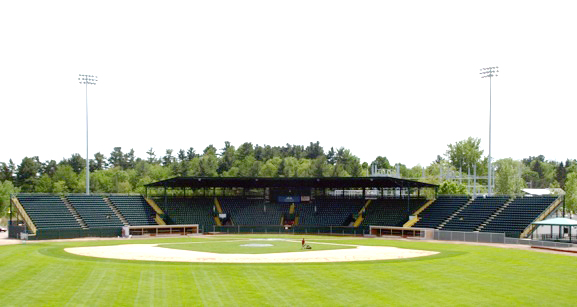
An adjoining baseball park, also named Centennial Field, opened in 1922, seats 4,415, and hosts the Vermont Lake Monsters of the New York-Penn League, the league that also includes New York City's Brooklyn Cyclones and Staten Island Yankees.
Named for "Champ," the Loch Ness-like monster that supposedly lives in Lake Champlain, the team is now a farm club of the Oakland Athletics, and was previously one of the Montreal Expos, from 1994 to 2005 -- meaning that it kept the Expos name for a year after its nearby parent club moved away. It won the NYPL Pennant in 1996, and also won Division titles in 1995 and 2011.

The closest teams in the NHL and MLS are in Montreal: The Canadiens are 95 miles north, the Impact 99. The closest teams in the other sports are the Boston teams, to the southeast: The Celtics (and Bruins) 215, the Red Sox 217, and the New England Patriots 241. In spite of being closer to Montreal than to Boston, the American and New England identities take hold: The most popular teams in each sport are the BoSox, the Pats, the B's, the C's, and the Revs.

Burlington isn't exactly a major concert center. Nor is anyplace else in Vermont. Neither Elvis Presley nor the Beatles ever gave a concert there.

Nor is it big on museums, although it has the Robert Hull Fleming Museum of Art and Anthropology, at 61 Colchester Avenue, across from the University of Vermont Medical Center. The Shelburne Museum, displaying folk art, is at 6000 Shelburne Road, 7 miles south of downtown Burlington. The Ethan Allen Homestead, home of the hero who won the Battle of Ticonderoga during the War of the American Revolution, is open for tours. The address is 1 Ethan Allen Homestead, off Route 127, about 3 miles northwest of downtown.

Vermont has produced 2 Presidents, both Republicans who were Vice President and had to take office when the President died. Chester Arthur Historic Site is the birthplace of the 21st President, but the family only lived there a brief time. 4588 Chester A. Arthur Road in Fairfield, 40 miles northeast of Burlington. Like Barack Obama, and also Andrew Jackson, he had enemies who said he was foreign-born: His father was an Irishman who immigrated to Canada before marrying a Vermont woman, and his birthplace is only 20 miles from the border.

He grew up outside Schenectady, and spent his political career in New York. He was living at 123 Lexington Avenue, in the Kips Bay building that now includes Kalustyan's Deli on the ground floor, when President James Garfield died on September 19, 1881, following being shot on July 2. Arthur was sworn in there, and then went to Washington, and filled out Garfield's term until March 4, 1885. He returned to his Manhattan apartment, but had kidney disease, and died a year and a half later, and is buried outside Albany.

Calvin Coolidge is, thus far, the only President born on the 4th of July, in 1872, at Plymouth Notch, Vermont. The farm once known as the Coolidge Homestead is now named President Calvin Coolidge State Historic Site. He grew up there, but spent his adult life in Massachusetts, where he served as Mayor of Northampton and Governor, before being elected Vice President with Warren Harding in 1920. He had graduated from Amherst College in Massachusetts, but his wife, the former Grace Goodhue, graduated from the University of Vermont -- so UVM has produced a First Lady, if not a President.

On August 3, 1923, Coolidge was staying with his father at the Homestead. Unable to reach the house, in a very rural area, via telegraph or telephone, as they didn't have either, the Secret Service had to drive in and inform him in person that Harding had died the night before. Since the house didn't have electricity, either, he was sworn in by the light of a kerosene lamp -- by his father, a former State legislator and a notary public. When asked how he knew he could swear his son in, he said, "I didn't know that I couldn't." The 30th President, like Arthur, hurried back to Washington, and was sworn in again, just in case.

He filled out Harding's term, and was elected to a term of his own in 1924, but, in 1927, he famously said, "I do not choose to run for President in 1928." He left office on March 4, 1929, returned to Northampton, and died there in 1933 -- like Arthur, before the completion of the term after he left, so both would have died in office had they sought and won another term.

He was buried at Plymouth Notch Cemetery, on Lynds Hill Road, just half a mile south of the homestead, at 3780 Vermont Route 100A, 101 miles southeast of Burlington, and 247 miles northeast of Times Square.

Don't look for tall buildings in Burlington, or anywhere in Vermont. The tallest is the Decker Towers complex, at 230 St. Paul Street. It's low-income housing, rising 11 stories, or 124 feet.

Several TV sitcoms have done episodes on that great test of relationships, the weekend getaway in Vermont. I've seen at least 2 TV couples reject the idea of moving from Manhattan to Vermont because they can't get good Chinese food delivered.

But the only major TV show set in the State was Bob Newhart's 1980s sitcom Newhart, set in the real town of Norwich. And it would have worked far better as a 2-hour "fish out of water" movie than as an ongoing series.

This is backed up by how many movies treat Vermont as a strange place where urbanites don't really fit in: Mr. Deeds Goes to Town, Nothing Sacred, White Christmas, The Trouble with Harry, Baby Boom, Funny Farm, State and Main, and Hope Springs. Not comedies, but also showing Vermont's strangeness, and occasionally its unfairness, are Dark Victory, Dead Poets Society, What Lies Beneath and Sucker Punch.

*

Vermont is farms and small towns, and a notable hockey team. That's about it. If that's your cup of tea, go up and have some fun. Me? It's a nice place to visit, but I wouldn't want to live there.

Wednesday, January 4, 2017

Greatest Basketball Player from Each State

Ironically, this photo was taken at a baseball game.
New York's greatest basketball player was a Brooklyn Dodger fan,
and remained a Dodger fan upon arriving at UCLA,
while Michigan's greatest basketball player now owns the Dodgers.

Remember, it's not where they were born, it's where they were trained.

Alabama: Charles Barkley.
Alaska: Carlos Boozer.
Arizona: Sean Elliott.
Arkansas: Scottie Pippen.
California: Bill Russell. (Ahead of Bill Sharman and Bill Walton.)
Colorado: Chauncey Billups.
Connecticut: Calvin Murphy.
Delaware: Joey Graham. (Slightly ahead of Stephen Graham, his twin brother.)
District of Columbia: Elgin Baylor. (Ahead of Adrian Dantley.)
Florida: Vince Carter.
Georgia: Walt "Clyde" Frazier.
Hawaii: Cedric Ceballos.
Idaho: Luke Ridnour.
Illinois: Isiah Thomas. (Ahead of George Mikan.)
Indiana: Oscar Robertson. (Yes, ahead of Larry Bird.)
Iowa: Kirk Hinrich.
Kansas: Lionel Hollins.
Kentucky: Dave Cowens.
Louisiana: Willis Reed. (Ahead of Bob Pettit and Karl Malone.)
Maine: Jeff Turner.
Maryland: Reggie Lewis.
Massachusetts: Patrick Ewing.
Michigan: Earvin "Magic" Johnson.
Minnesota: Kevin McHale.
Mississippi: Spencer Haywood.
Missouri: Bill Bradley.
Montana: Mike Lewis.
Nebraska: Bob Boozer. (No relation to Carlos.)
Nevada: Greg Anthony.
New Hampshire: Matt Bonner.
New Jersey: Shaquille O'Neal. (Ahead of Rick Barry.)
New Mexico: Bill Bridges.
New York: Kareem Abdul-Jabbar. (Close call over Julius Erving.)
North Carolina: Michael Jordan. (Big Apple born, Tar Heel trained.)
North Dakota: Phil Jackson. (Yes, the coach. He was a decent player.)
Ohio: John Havlicek. (Yes, better than LeBron James.)
Oklahoma: Ray Allen.
Oregon: Danny Ainge.
Pennsylvania: Wilt Chamberlain. (No, not Pete Maravich.)
Rhode Island: Marvin Barnes.
South Carolina: Kevin Garnett.
South Dakota: Mike Miller.
Tennessee: Penny Hardaway.
Texas: Clyde Drexler.
Utah: Arnie Ferrin.
Vermont: Keith Cieplicki. (Vermont is the only State with no NBA players.)
Virginia: Moses Malone. (Ahead of David Robinson and Allen Iverson.)
Washington: John Stockton.
West Virginia: Jerry West.
Wisconsin: Downtown Freddie Brown.
Wyoming: Ken Sailors.

U.S. Virgin Islands: Tim Duncan.

Yes, Hondo ahead of LeBron. More titles. Also, the very thing LeBron's fans use as his best argument, his versatility, ends this argument: No player was ever more versatile than John Havlicek.

And from each country with at least 10 NBA players:

Argentina: Manu Ginobili.
Australia: Luc Longley.
Bosnia: Vladimir Radmanovic.
Brazil: Nene Hilario.
Canada: Steve Nash. (South Africa-born, British Columbia-raised.)
Croatia: Peja Stojakovic.
France: Tony Parker.
Germany: Dirk Nowitzki.
Lithuania: Sarunas Marciulionis. (Tough call over Arvydas Sabonis.)
Russia: Andrei Kirilenko.
Senegal: DeSagana Diop.
Serbia: Vlade Divac.
Spain: Pau Gasol.

Wednesday, April 2, 2014

New England's All-Time Baseball Team

If "Red Sox Nation" has borders -- and, as I've said before, we really need to deport some people back within those borders -- those borders contain the following States in their entirety: Massachusetts, Rhode Island, Vermont, New Hampshire and Maine.

Connecticut is usually included in the New England region. However, not all of Connecticut is in Red Sox territory. Connecticut has 8 Counties, and Fairfield and Litchfield are absolutely in the New York Tri-State Area. Middlesex, New London, Tolland and Windham are part of Red Sox Nation.

The wild card is New Haven County, with the city of New Haven, including Union Station (the terminus of the Metro-North Commuter Railroad's New Haven Line) and the campus of Yale University being kind of a "Romulan Neutral Zone" between Yankee/Met territory and Red Sox territory.

I've often joked that Connecticut is divided by what I call the Bristol Line, which goes from the northwest corner of the State, curving through Torrington, Bristol and Waterbury, before going down the Quinnipiac River into New Haven, New Haven Harbor and Long Island Sound.

Bristol is the home of ESPN's studios, 121 miles from Fenway Park and 100 miles from Yankee Stadium, yet their Red Sox bias seems so obvious to most Yankee Fans that we call it NESPN -- a combination of ESPN, Entertainment & Sports Programming Network (the "E" allows it to show events that are not real sports, such as golf, auto racing and "mixed martial arts"); and NESN, New England Sports Network.

Fortunately, having to decide who from New Haven County should be on the Red Sox territorial team, and who should be on the Yankees' or Mets' territorial team, proved unnecessary. While Yale has produced some great baseball players, there haven't been a whole lot of really good players from New Haven County. The best one that I could legitimately put in Red Sox Nation was Jack Barry, the shortstop, and least-heralded member, of the inaptly named "$100,000 Infield" of Connie Mack's 1910-14 Philadelphia Athletics dynasty. There is one New Haven County native in the Hall of Fame, and that's Roger Connor, but he played most of his career for the New York Giants, and thus was eligible for the Mets' territorial team, where I gave him an Honorable Mention.

3. New England's All-Time Baseball Team

I didn't find anyone from Maine, aside from a pair of 19th Century players who made the Honorable Mentions. Nor any players who grew up in Vermont, although I have three Honorable Mentions who were born there. For the record, there have been 651 Major League Baseball players who were born in Massachusetts, 193 in Connecticut, 77 in Maine, 75 in Rhode Island, 51 in New Hampshire and 37 in Vermont.

Strangely, this team, very solid at most positions, doesn't have an overwhelming pitching staff. It's got 3 starters in the Hall of Fame, and 1 more who maybe should be, but 2 of those starters pitched in baseball's Bronze Age, if not its Stone Age, so it's not clear that they would have been stars in the modern era.

In fact, of the 8 starting nonpitchers, only 1 played after 1937. So this really is an "all-time" team, but not really an "all times" team. Still, I wouldn't overlook the talent, even that part of it that played in the Administrations of Grover Cleveland, Benjamin Harrison and William McKinley.

1B Jeff Bagwell of Killingworth, Connecticut. (That's in their Middlesex County, definitely on "the Boston side of Connecticut.") The Red Sox could have had this local guy, who was actually born in the City of Boston. But, with Wade Boggs at 3rd base and Mo Vaughn at 1st, they thought he wasn't necessary. On August 30, 1990, while he was 22 years old andstill at Double-A New Britain, they traded him to the Houston Astros for reliever Larry Andersen.

Now, the Sox did need bullpen help, and they did win the American League Eastern Division that season, so it's not nearly as bad a trade as everyone thinks, 25 years on. Besides, if the Sox had kept Bags, would they have ever gotten David Ortiz?

Bags reached the Astros in 1991, the season after the trade, and was their regular 1st baseman for 15 years. His career OPS+ was 149, he collected 2,314 hits including 488 doubles and 449 home runs (easily the Astros' all-time leader). He won the National League's Rookie of the Year award in 1991 and its Most Valuable Player award in 1994, and nearly did so again in 1997 and 1999. Six times he batted .300, peaking at .368 in 1994. Eight times he had at least 100 RBIs, peaking at 135 in 1997. 

Without him, the Houston Colt .45's/Astros franchise has played 37 seasons and reached the postseason 3 times, with no postseason series wins to its credit; with him, 15 seasons, 6 trips to the postseason, and their first Pennant in 2005.

His Number 5 has been retired by the Astros, but he is not yet in the Hall of Fame, having gone through 4 elections without getting the necessary 75 percent of the vote. Baseball-Reference.com has him at 150 out of 100 on is Hall of Fame Monitor, and 59 out of 50 on its Hall of Fame Standards, both making him an easy choice.

On their 10 Most Similar Players to him, Frank Thomas and Willie Stargell are in; Albert Pujols probably will be; Fred McGriff should be; Carlos Delgado, Vladimir Guerrero and Todd Helton could be; Jason Giambi and Andres Galarraga won't get in; and David Ortiz might get in even though he's been exposed as a steroid cheat, simply because he's gotten away with it thus far. If the voters are not voting for Bagwell because they suspect him of steroid use, they need to know that he has never been seriously accused of it.

2B Napoleon "Nap" Lajoie of Woonsocket, Rhode Island. (Woonsocket was an Indian tribe in the era.) Also known as Larry, he starred for the Philadelphia Phillies in the late 1890s before jumping to the newly-formed American League in 1901. That year, he won the AL's 1st Triple Crown.

Depending on whose figures you believe, he either batted .422 for the highest average in AL history, or batted .426 for the highest average in either league since 1894. (See the outfielders.) Due to an injunction the Phillies got that prevented him from playing within the city limits of Philadelphia, he was traded to the Cleveland Blues, who made him player-manager and were renamed the Naps in his honor. (After he retired, they became the Indians -- see the right fielders below.)

In a particularly dead part of the Dead Ball Era, he had 4 100-RBI seasons. He had a lifetime batting average of .338 (5 batting titles, including, famously, a somewhat tainted one in a race with Ty Cobb in 1910), OPS+ 150, 3,242 hits, 657 doubles, 163 triples, 82 homers (good for the era), and 1,599 RBIs (great for the era).

He never managed a Pennant winner, but in 1908 got the Indians to within half a game of the Detroit Tigers. (No, I don't know why the Tigers didn't make up their 154th game.) He was one of the earliest inductees into the Hall of Fame. When The Sporting News announced its 100 Greatest Baseball Players in 1999, he came in at Number 29, even though he played his last game 83 years earlier.

Honorable Mention to Davey Lopes of East Providence, Rhode Island, a slick-fielding speedster who starred for the Dodgers before becoming one of the game's top coaches and briefly the manager of the Milwaukee Brewers.

Honorable Mention to Jerry Remy of Somerset, Massachusetts, who gave the Red Sox a few good years before becoming one of their broadcasters. As the fan-elected "President of Red Sox Nation," RemDawg has become Boston's answer to Phil Rizzuto in New York, Richie Ashburn in Philadelphia, Herb Score in Cleveland, Ron Santo in Chicago and Mike Shannon in St. Louis.

Honorable Mention to Frank Grant of Pittsfield, Massachusetts. Elected to the Hall of Fame in 2006 in an attempt to find overlooked black players who had been unable to play in the segregated pre-1947 major leagues, he may have been the first great black baseball player. Playing from 1886 to 1903 for teams in Buffalo, New York and Philadelphia, he may, due to length of time and segregation, have been the most-forgotten great player ever.

SS Walter "Rabbit" Maranville of Springfield, Massachusetts. In 1914, he helped his "hometown" Boston Braves go on a "Miracle" run and win the World Series. He remained one of the NL's best sortstops through the 1910s and '20s, leaving the Braves in 1921 and returning in 1929, staying long enough to play on their truly awful 1935 squad. He was never a great hitter, but he did get 2,605 hits, including 380 doubles and 117 triples, and his 291 steals were good for the era. He is in the Hall of Fame.

3B Harold "Pie" Traynor of Somerville, Massachusetts. For a long time, he was considered by many observers to be the best 3rd baseman of all time, mainly for his glove. There was no Gold Glove award in the 1920s and '30s, but his bat is quite capable of speaking for itself. He batted .320 lifetime, peaking with .366 in 1930, and had 2,416 hits and 7 100-RBI seasons, despite playing his home games at spacious Forbes Field.

He helped the Pittsburgh Pirates win the 1925 World Series and the 1927 Pennant. He was the NL's starting third baseman in the 1st 2 All-Star Games, 1933 and '34. He also managed the Pirates, and nearly got them a Pennant in 1938. (But see the catchers below.) Hall of Fame, Number 20 retired. When The Sporting News announced its 100 Greatest Baseball Players in 1999, he came in at Number 70.

Honorable Mention to Larry Gardner of Enosburg Falls, Vermont. He played on the Red Sox' World Champions of 1912, 1915 and 1916, before his former Boston teammate Tris Speaker, managing and playing center field for the Indians, traded for him, and together they won another World Series in 1920. A career .289 hitter, he had a 109 OPS+, 301 doubles, 165 stolen bases, and 2 100+ RBI seasons.

Is that really enough to get him on this list? Maybe not, but he singled home the winning run of the 1912 World Series. He later coached the baseball team at the University of Vermont, and is in both the Boston Red Sox and Vermont Sports Halls of Fame.

Honorable Mention to two New England guys who went on to star not for the Red Sox, but for the Yankees: Robert "Red" Rolfe of Penacook, New Hampshire, who starred on the Yanks' 1932-43 teams, and was named by Yankee broadcaster Mel Allen as the best 3rd basemen he ever saw; and Mike "Pags" Pagliarulo of Medford, Massachusetts, who kept them in the 1985-88 Pennant races with his great glove and lefty power.

LF Joe Kelley of Cambridge, Massachusetts. Starred with the Baltimore Orioles and Brooklyn Superbas (the Dodgers-to-be) of the 1890s (along with fellow Hall-of-Famer Wilbert Robinson of Bolton, Massachusetts, who nearly makes this team as a catcher or a manager), and then with the Cincinnati Reds of the 1900s.

He batted .317 lifetime, and had an OPS+ of 133 and 2,220 hits, despite having his last full season at age 34. He won Pennants in Baltimore in 1894, '95 and '96, and in Brooklyn in 1899 and 1900.

CF Hugh Duffy of Cranston, Rhode Island. That's him in the photo at the top of this post. He was a "hometown hero" who starred with the Boston Beaneaters (forerunners of the Braves) in the 1890s. In 1894, he was long believed to have batted .438, the highest batting average any player has ever had in a single major league season; a later check of the facts revealed it was in fact .440.

Lifetime, he hit .326, with a 122 OPS+, 2,293 hits and 8 100-RBI seasons, despite not having a full season after age 32. He helped the Beaneaters win Pennants in 1891, '92, '93, '97 and '98. Hall of Fame.

He later managed the Red Sox, White Sox and Phillies, and scouted for the Red Sox from 1924 until his death at age 87 in 1954, making him the last survivor of the 1890s Beaneaters. That's Duffy in the photo above.

Honorable Mention to George Gore of Hartland, Maine. Known as "Piano Legs," stolen base records from his era are incomplete, and we don't have totals for him from 1879 to 1885, but he's credited with 170 from 1886 to 1892, so his actual total may be roughly double that, well over 300.

He batted .301, had an OPS+ of 136, and in 1880 he led the NL with a .360 batting average. He won NL Pennants with the Chicago White Stockings (the franchise that became the Cubs, not the AL's White Sox) in 1880, '81, '82, '85 and '86, and with the New York Giants in 1888 and '89.

RF Tommy McCarthy of Boston, Massachusetts. He played with Duffy on the 1890s Beaneaters, and they were known as the Heavenly Twins. He batted "only" .292 lifetime (not that great in that era), and last played at age 32, so he may not belong in the Hall of Fame. So why is he in it? Well, 4 times he batted .300, he had a pair of 100-RBI seasons, and he stole 468 bases, great in any era.

Honorable Mention to Louis Sockalexis of Indian Island, Maine. A member of the Penobscot tribe, he may have been the 1st Native American to play in the major leagues (reports are sketchy on an earlier player named Jim Toy), at a time when the "Indian Wars" were still fresh in American memory. (The Wounded Knee Massacre happened less than 7 years before his big-league debut.)

He was a baseball star at the University of Notre Dame well before it became known as a football school. Debuting with the NL's Cleveland Spiders in 1897, he batted .338 with 3 homers, 42 RBIs and 16 stolen bases. So far, so good.

But on July 4 of that season, he jumped out of the window of a Cleveland brothel, and hurt his ankle when he fell. He was never the same player, and between his injury and his increasing drinking, he only lasted 2 more seasons. Drinking and tuberculosis led to heart trouble, and he died in 1913, only 42 years old.

The legend that the Cleveland Indians were named in his memory, and the one that they were named in memory of the Native Americans who once lived on the shore of Lake Erie, are bogus. After Lajoie left, they needed a new name for the 1915 season. The owners of the team asked sportswriters for their opinion. Since the Boston Braves were the defending World Champions, "Indians" was suggested, and the name stuck. It had nothing to do with Louis Sockalexis, "the original Cleveland Indian."

Honorable Mention to Tony Conigliaro of Revere, Massachusetts, whose day in the sun was longer than Sockalexis', but still all too brief. From April 16, 1964 to August 18, 1967, Tony C was the pride of the Boston metro area. He was just 22 years old, and already had 110 home runs for the Red Sox, including an AL-leading 32 in 1965. Then he was hit in the head with a pitch from California Angels pitcher Jack Hamilton, damaging his batting eye.

He missed the '67 run-in and World Series, and the entire '68 season. He came back strong in '69 and '70, but his eyesight began to fade, and despite a comeback attempt in '75, he was, as the U.S. version of Fever Pitch said, finished at 26. He auditioned to be a Sox broadcaster in 1982, but on the way back, he suffered a heart attack, and remained hospitalized until his death in 1990, only 45.

Of all the what-if stories in Sox history, his may well be the saddest. The team elected him to its Hall of Fame, but with good eyesight, and a righthanded swing tailor-made for the Green Monster, he could have made the big one in Cooperstown.

C Gordon "Mickey" Cochrane of Bridgewater, Massachusetts. What, not Carlton Fisk, born in Bellows Falls, Vermont and raised in Charlestown, New Hampshire? (Hall of Fame, Number 27 retired by the Red Sox and Number 72 retired by the White ones, who've also dedicated a statue of him at U.S. Cellular Field.)

Nor Rich Gedman of Worcester, Massachusetts and the '86 Red Sox? Not even Charles "Gabby" Hartnett of Woonsocket, Rhode Island, a Hall-of-Famer who backstopped the Cubs to 4 Pennants, including the great comeback and 20-game winning streak of 1935, and the comeback of 1938 when, as player-manager, he hit the "Homer in the Gloamin'" to put them in 1st place to stay?

No, as loaded as this position is for New England, none of those was ever considered the greatest catcher ever. Cochrane was, until surpassed by Bill Dickey (and then by Yogi Berra and possibly Johnny Bench). There were no Gold Gloves in those days, but he regarded as a great-fielding catcher. He batted .320 lifetime, with a 128 OPS+.

He led the Philadelphia Athletics to Pennants in 1929, '30 and '31, then was sold to the Detroit Tigers when Connie Mack needed a lot of cash, and led the Tigers to Pennants, as both manager and catcher, in '34 (MVP despite Lou Gehrig winning the Triple Crown) and '35. World Champion 1929, 1930 and 1935. Sadly, his career was ended in 1937 when Yankee pitcher Irving "Bump" Hadley (another Massachusetts guy, from Lynn) beaned him. Like Tony C, never really recovered, although he did live on until 1962.

Neither the A's (2) nor the Tigers (3) have ever retired his number, but the Hall-of-Famer has been honored by the Phillies with election to the Philadelphia Baseball Wall of Fame, and the Tigers with National Avenue, which ran behind the third-base stands at Tiger Stadium, being renamed Cochrane Avenue.

And in 1931, at the end of the A's dynasty, a young Oklahoma zinc miner named Elvin "Mutt" Mantle named his son after the great A's catcher. Fortunately, as the son said in his own Hall of Fame induction speech, he wasn't named Gordon Mantle. He was named Mickey Mantle. When The Sporting News announced its 100 Greatest Baseball Players in 1999, Mickey Cochrane came in at Number 65.

SP Tim Keefe of Cambridge, Massachusetts. It's hard to judge how good a pitcher was if he played his last game in 1893, the year the distance from the pitcher's mound to home plate was moved from 50 feet to 60 feet, 6 inches. He starred for the Giants, winning 42 games in 1886, and pitched them to NL Pennants in 1888 and '89. He finished 342-225, with an ERA of 2.63 (127 ERA+, meaning he was great compared to the other pitchers of his time), and a fine WHIP of 1.123.

But in that 1893 season, having gone 19-16 with a 2.36 ERA in 39 starts for the Phillies the year before, he dropped to 10-7 with a 4.40 ERA in just 22 starts. The new distance probably doomed him, but then, he was 36 and perhaps on the way down anyway. He is in the Hall of Fame.

SP John Clarkson of Cambridge, Massachusetts. He was 4 years younger than Keefe (although didn't live nearly as long, dying in 1909 at age 48), so they may have known each other well. Clarkson also benefited greatly from the 50-foot pitching distance. Nevertheless, he had a fine career record of 328-178, with a 2.81 ERA (134 ERA+), a WHIP of 1.209, and won NL Pennants with the Chicago White Stockings (Cubs) in 1885 and '86, and with the Boston Beaneaters (Braves) in 1891. 

With that shorter distance, he started 70 games in 1885, completed all of them, and won 53; in 1889, he started 73, completed all but one, and won 49. But in 1893, the 1st season of the sixty-and-six distance, he dropped from 17-10 to 16-17, and then to 8-10, and was done at age 32. Still, he is in the Hall of Fame.

SP Jack Chesbro of North Adams, Massachusetts. Happy Jack was a man. A man who won 49 games for the Pennant-winning Pittsburgh Pirates in 1901 and '02, then was part of the league-jumping that made the AL's solid footing possible. In 1903, as the first ace of the New York Highlanders (the team that became the Yankees), went 21-15.

Then, in 1904, he went 41-12, the most wins any pitcher has ever had under the 60-and-6 distance, although it should be noted that this was the Dead Ball Era, when there were not going to be any real home run threats, so pitchers didn't have to throw so many hard pitches and thus could pitch longer.

But he's best remembered not for any of those 41 wins, but for the 12th loss, as his 9th-inning wild pitch cost the Yankees the run that lost the opener of a final-day doubleheader to the Boston Puritans (Red Sox), clinching the Pennant not for Chesbro's employers but for his hometown team. 

He remained a terrific pitcher despite some not very good Highlander teams, but by 1909, age 35, he was burned out, pitching one last game… for the Red Sox. He finished 198-132, with a 2.68 ERA. He is in the Hall of Fame. And that's pronounced CHEESE-bro, not CHEZ-bro as I long believed.

SP Wild Bill Donovan of Lawrence, Massachusetts. He had cups of coffee with the Superbas (Dodgers) in their 1899 and 1900 Pennant seasons, then won 25 games with the 1901 Superbas (who didn't win the Pennant). He went an amazing 25-4 for the Tigers in 1907, and that doesn't include a performance in a September 30 game against the Athletics that was called due to darkness after 17 grueling innings, a game that, while the A's didn't lose it, pretty much exhausted them and ensured they wouldn't win the race.

The Tigers won 3 straight Pennants, 1907, '08 and '09, and over those seasons Donovan went 51-18 with an ERA of 2.17. He finished 185-139, 2.69 ERA, 1.245 WHIP. But he is not in the Hall of Fame, and, according to Baseball-Reference.com, of the 10 most statistically similar pitchers, only 1 is in: Chesbro. He later became a Yankee executive, but was killed in a train crash after the 1923 season.

SP Tom Glavine of Billerica, Massachusetts. He had a superb record of 305-203 in the majors, and is the only pitcher to win his 300th game in a Met uniform. Don't remind Met fans of that, though: Greg Prince of the blog Faith and Fear In Flushing calls him the Manchurian Brave. Glavine went 244-147 for Atlanta, and just 15-10 for Flushing, including the disastrous 2007 season finale, before returning to the Braves for 1 more season.

He had 5 20-win seasons for the Braves, and helped them reach the postseason season every year from 1991 to 2002 – except for 1994, of course. He pitched on 5 Pennant winners with the Braves (1991, '92, '95, '96 and '99) and nearly another with the Mets (2006). He was also an All-State hockey player at Billerica High School, but he chose his pro sport wisely. The Braves have retired his Number 47. He just got elected to the Hall of Fame, not that Met fans care.

Honorable Mention to Ray Fisher of Middlebury, Vermont. He pitched for the Highlanders/Yankees from 1910 to 1917, missed 1918 due to serving in World War I, then won the 1919 World Series with the Reds. His best season was 1915, going 18-11. From 1921 to 1958, he was the head coach at the University of Michigan. In 1982, shortly before his death at age 95, he was wheeled onto the field for Old-Timers' Day, and got a nice hand. It was the first time he had ever been inside Yankee Stadium.

Honorable Mention to Wilbur Wood of Belmont, Massachusetts. The knuckleballer went 164-156 for his career, and with an ERA+ of 114, I have to wonder what he could have done if he didn't spend most of his career with mediocre teams. He pitched most of his career with the White Sox, getting into Pennant races in 1967, '72 and '77, but most other years they were mediocre.

He won 106 games in just 5 seasons, 1971 to '75, including 24 each in '72 and '73. (In '73, he went 24-20; the only pitcher since to both win and lose 20 in the same season was, you guessed it, another knuckleballer, Phil Niekro.) He started at least 42 games in each of those 5 seasons, and we may never see another pitcher start 40 in a season unless they raise the mound back to its pre-1969 height of 15 inches.

Unfortunately, his string of workhorse seasons ended in 1976 when Ron LeFlore of the Detroit Tigers hit a comebacker that broke his kneecap. Wood retired after 2 more seasons. He was one of the few players ever who threw lefthanded but batted righthanded.

Honorable Mention to Chris Carpenter of Exeter, New Hampshire. After 6 seasons as basically a .500 pitcher with the Toronto Blue Jays, he was released, then picked up by the Cardinals. Good pickup: He went 21-5 in 2005 (winning the NL Cy Young Award) and 17-4 with a League-leading 2.24 ERA in 2009. A 3-time All-Star, he finished 144-94, and reached 5 postseasons with the Cards, including winning titles in 2006 and 2011.

RP Jeff Reardon of Dalton, Massachusetts. "The Terminator" didn't earn that nickname early in his career, because he didn't get the job done for the Mets. But then, how many save chances did the Mets give him from August 25, 1979 (his debut) until May 29, 1981, when they traded him? They sent him to the Montreal Expos, with Dan Norman (the 4th-best of the 4 guys they got for Tom Seaver), for former All-Star Ellis Valentine, and this was yet another BMT: Bonehead Met Trade: Valentine spent the rest of his career battling injuries, while Reardon retired as the major leagues’ all-time leader with 367 saves – 357 of them after leaving Flushing Meadow.

He had a career ERA+ of 122 and a WHIP of 1.199. He reached the postseason with the Expos in 1981, the Twins in 1987 (getting the final out of the World Series), the Red Sox in 1990 and the Braves in 1992. He just missed in 1994, as he closed his career with the Yankees, but the strike hit and that was it. He is eligible for the Hall of Fame, but I don't think he'll make it.

The all-time New England bullpen is pretty strong: Setting up Reardon can be Stu Miller of Northampton, Massachusetts; Steve "Bedrock" Bedrosian of Methuen, Massachusetts; Rob Dibble of Southington, Connecticut; and Brian Wilson of Londonderry, New Hampshire.

Bob Stanley was born in Portland, Maine, and went on to pitch for the Red Sox. Of course, he did give up the actual winning homer in the 1978 Playoff, to Reggie Jackson, and then throw those 2 fatal pitches toward Mookie Wilson in 1986. This is where Red Sox fans point out that "Steamer" is actually ineligible for this team, because, while he was born in New England, he actually went to high school in... Kearny, New Jersey. But do either the Yankees or the Mets want to claim him for their territorial teams? We may be crazy, but even Met fans aren't that stupid!

MGR Connie Mack of East Brookfield, Massachusetts. Born Cornelius Alexander McGillicuddy, he said he shortened his name so it would fit into a box score. It's hard to connect him to any city other than Philadelphia, even though, with his suits that never changed with the time and his thin, taciturn face and "Lace Curtain Irish" accent, he seemed like an old-time New England schoolmaster, or Parker Fennelly in those "Pepperidge Farm remembers" commercials.

A good catcher in the 1880s, he managed in the big leagues for 56 years, the last 50 with the Philadelphia Athletics from 1901 to 1950. Why so long? Because he was always at least a part-owner of the A's, and was sole owner from the early 1930s onward. Like George Steinbrenner, he built one dynasty (1910-14), messed it up, and then built another (1929-31). Unlike Steinbrenner, however, he messed up the second one, too, and both times over money: He had to dump salary because of the 1914-15 Federal League, and he lost all his savings in the 1929 stock market crash.

But his A's won 9 Pennants and 5 World Series: 1910, 1911, 1913, 1929 and 1930. He was elected to the Hall of Fame in 1937, its second class, while he was still an active owner and manager. After his increasing senility led to a family squabble that forced him out as manager and active owner, his sons were broke and forced to sell the team. But the Phillies remained in Shibe Park, renamed it Connie Mack Stadium, and erected a statue of him that now stands outside Citizens Bank Park.

I take Connie over Leo Durocher of West Springfield, Massachusetts. Although Leo was a winner, he was also a deeply evil man. Connie Mack may have been cheap, even when he didn't have to be, but he was a generous soul, and was beloved, known as the Grand Old Man of Baseball.