Showing posts with label jeff bagwell. Show all posts

Thursday, May 3, 2018

Houston's Top 10 Athletes

Yao Ming and Hakeem Olajuwon

This week, the Yankees are in Houston to play the Astros, the defending World Champions.

Houston's Top 10 Athletes

Honorable Mention to Joe Morgan, 2nd base, Houston Astros, 1963-71 and 1980.
Baseball's greatest 2nd baseman since World War II (but a really annoying broadcaster), he has become so identified with Cincinnati's Big Red Machine that it's easy to forget that he played more seasons with the 'Stros than with any other team. This includes helping them win their 1st Division title in 1980.

Honorable Mention to Gordie Howe, right wing, Houston Aeros, 1973-77. On the one hand, it was the World Hockey Association, and it was only 4 years. On the other hand, show me another guy who could win the Most Valuable Player award of any league with the pretense of being "major" at age 46. It was the Gary Davidson Trophy, named for the league's founder. After Gordie won it in 1974, the name was changed to the Gordie Howe Trophy.

Together with his sons Mark and Marty, he helped the Aeros reach the Finals 3 times, winning twice. I don't care what league you're in: If you can score 121 goals in 4 years in your mid-40s, you deserve to be called "Mr. Hockey."

Honorable Mention to Houston Oilers in the Pro Football Hall of Fame, who didn't otherwise make this Top 10: George Blanda, Ken Houston, Elvin Bethea, Charlie Joiner, Curley Culp, Robert Brazile, Mike Munchak, Bruce Matthews and Warren Moon. Some of them might have made this list had they spent their entire careers with the Oilers.

Honorable Mention to J.J. Watt, defensive end, Houston Texans, 2011-present. A 4-time Pro Bowler, he's been named NFL Defensive Player of the Year in 2012, 2014 and 2015. In 2017, following their fundraising after Houston was hit by Hurricane Harvey, he and José Altuve of the Astros were named Sportsmen of the Year by Sports Illustrated.

Honorable Mention to Houston Rockets in the Basketball Hall of Fame, who didn't otherwise make this Top 10, any one of whom could easily have made the Top 10 had they spent their entire careers in Houston: Moses Malone, Ralph Sampson, Clyde Drexler, Charles Barkley, Yao Ming, Dikembe Mutombo and Tracy McGrady.

Honorable Mention to Houston Dynamo stars DaMarcus Beasley, Brad Davis, Brian Ching and Pat Onstad.

10. Mario Williams, defensive end, Houston Texans, 2006-11. Oh, how Texans fans ranted when their team chose Williams with the top pick in the 2006 NFL Draft, instead of native son Vince Young, one of the best quarterbacks in college football history -- and it got worse for them when Young was drafted by the former Houston team, now the Tennessee Titans.

But just as the Philadelphia Eagles got it right in 1999 when they drafted Donovan McNabb instead of the people's choice, Ricky Williams (another University of Texas star), the Texans got this one right. Maybe Young would have had a good pro career playing for a coach other than Jeff Fisher. But Williams has had a good pro career, making 4 Pro Bowls (in with Houston, 2 with Buffalo, and becoming the team's 1st real star. He last played in 2016 with the Miami Dolphins.

9. José Altuve, 2nd base, Houston Astros, 2011-present. Already a 5-time All-Star, he's won 3 American League batting titles, 2 stolen base titles, a Gold Glove, and the 2017 AL Most Valuable Player. In 2017, he led the Astros to their 1st World Championship, and, as I said, he and Watt were named SI's Sportsmen of the Year last year. His lifetime batting average is .317, and, turning 28 next week, he already has 1,293 hits and 232 stolen bases.

8. Andre Johnson, wide receiver, Houston Texans, 2003-14. Somebody has to be the greatest player in the Texans' brief history, and he's the 1st guy they named to their Ring of Honor.

Here's why: 7 Pro Bowls, 1,062 receptions, for 14,185 yards and 70 touchdowns. Having finished his career with, oddly, the former Houston team, the Tennessee Titans, he will be eligible for the Pro Football Hall of Fame in 2022.

7. Yao Ming, center, Houston Rockets, 2002-11. Given the hype around the 7-foot-6 Yao upon his arrival from China and the Shanghai Sharks, it would have been easy to call him the Ichiro Suzuki of basketball. He didn't quite rise to that level, but it wasn't for a lack of trying. He made 8 NBA All-Star Games, the Rockets retired his Number 11, and he's been elected to the Basketball Hall of Fame.

6. Nolan Ryan, pitcher, Houston Astros, 1980-88. Probably the greatest baseball player from Houston or its suburbs, we can only count what he did in the 9 years he pitched in his hometown. This included 3 Playoff berths, a 106-94 record, 1,866 strikeouts, and a no-hitter. The Astros retired his Number 34.

5. Calvin Murphy, guard, Houston Rockets, 1971-83. In 1967, at Norwalk High School, he was named Mr. Basketball USA -- the best high school basketball player in the entire country. In his honor, the school's address is now 23 Calvin Murphy Road. He attended Niagara University in Buffalo, and was drafted by the Rockets in 1970. They moved to Houston the next year, and he played for them his entire career.

At 5-foot-9, he may have been the shortest great basketball player ever. He was an All-Star in 1979, and helped them reach their 1st NBA Finals in 1981. He set records, since broken, for highest single-season free throw percentage and most consecutive free throws made. The Rockets retired his Number 23. He is in the Basketball Hall of Fame.

4. Earl Campbell, running back, Houston Oilers, 1978-84. The relative brevity of his career keeps him from being ranked higher, possibly even Number 1. But the 1977 Heisman Trophy winner was, at the time, right there with Walter Payton as the NFL's best runner.

In his 1st 3 seasons in the NFL, he led the League in rushing all 3 years, was named Offensive Player of the Year all 3 years, led the League in rushing touchdowns twice, and was named NFL Rookie of the Year in 1978 and MVP in 1979. He made 5 Pro Bowls, and rushed for 9,407 yards and 74 touchdowns. But his style took its toll, and not only did he play his last game at age 30, but he's got back problems so severe that he's used a wheelchair the last few years.

Lester Hayes, a nasty cornerback for the Oakland Raiders, said, "Earl Campbell was put on this Earth to play football. Cliff Harris, one of those Dallas Cowboys that you just loved to hate, called him "the hardest-hitting running back I ever played against." And his Oilers coach, Bum Phillips, one of the game's great quipsters, was asked if he was "in a class by himself." Bum said, "I don't know. But if he ain't, it don't take long to call the roll."

He was elected to the College and Pro Football Halls of Fame. The Oilers retired his Number 34 before they moved. When the team moved to Tennessee and began its Titans Hall of Fame, he was named to it, even though he never played in Tennessee. In 1999, The Sporting News ranked him 33rd on their list of the 100 Greatest Football Players. In 2010, the NFL Network ranked him 55th on their 100 Greatest Players.

3. Jeff Bagwell, 1st base, Houston Astros, 1991-2005. He was born on May 27, 1968, the same exact day as Frank Thomas, also a big strong 1st baseman who ended up in the Baseball Hall of Fame. "Bags" played his entire career with the Houston Astros, batting .297, and is their all-time leader with 449 home runs.

A 4-time All-Star, he was National League Rookie of the Year in 1991, won the NL MVP and a Gold Glove in 1994, and helped the Astros reach the postseason in 1997, 1998, 1999, 2001 and 2004, before, in his final season, getting them their 1st Pennant in 2005. By a weird twist of fate, they played Thomas' Chicago White Sox, who won, though Thomas was injured. The Astros retired his Number 5.

2. Craig Biggio, 2nd base, Houston Astros, 1988-2007. A 7-time All-Star, he collected 3,060 hits, including 668 doubles and 291 home runs. The former is a total exceeded in history only by Tris Speaker, Ty Cobb, Stan Musial and Pete Rose (in other words, nobody currently under the age of 77); the latter is a pretty good total, considering he played his home games in the Astrodome for the 1st half of his career.

He was no one-dimensional player: He stole 414 bases, including 50 in 1998 and was leading the National League when the Strike of '94 hit. He also had 44 doubles, and was a legitimate threat to the single-season record of 67 set by Earl Webb of the 1931 Boston Red Sox; he topped out at 56 in 1999. And he won 4 Gold Gloves.

He helped the Astros reach 6 postseasons, including the 2005 World Series. He, Bagwell and Derek Bell formed an attack known as the Killer B's. The Astros retired his Number 7, and he's in the Baseball Hall of Fame.

1. Hakeem Olajuwon, center, Houston Rockets, 1984-2001. Between UH's "Phi Slamma Jamma" and leading the Rockets to 3 of their 4 NBA Finals thus far, he is easily the greatest figure in the history of Houston sports.

A 12-time All-Star, Hakeem was the Most Valuable Player of the regular season and the NBA Finals in 1994, when he led the Rockets to their 1st title. In 1995, he led them to their 2nd title, and was named Finals MVP again, the award now named the Bill Russell Award. That season, he had been joined by his Phi Slamma Jamma teammate, Clyde Drexler. With Hakeeem the Dream and Clyde the Glide reunited, a sign was held up in The Summit during the clinching Game 4 of the Finals against the Orlando Magic: "HEY CLYDE WHAT'S YOUR RING SIZE?"

Two years later, the Rockets were back in the Conference Finals, but lost to the Utah Jazz, including Karl Malone, known as "The Mailman" because he delivers. That same fan, noting the day of the week on which Game 6 was being played, held up a sign saying, "THERE'S NO MAIL ON SUNDAY!" But the other Jazz superstar, John Stockton, hit a buzzer-beater to send the Jazz to their 1st NBA Finals.

The Rockets retired Hakeem's Number 34, and he was named to the Basketball Hall of Fame and, while still active, to the NBA's 50th Anniversary 50 Greatest Players.

Since his retirement, the Rockets have moved from The Summit to the Toyota Center, which could easily be called The House That Hakeem Built. The Summit has been converted to the "megachurch" owned by Dr. Joel Osteen. Something tells me Osteen is not happy that a black Muslim from Africa got more cheers in that building than he ever will.

Tuesday, January 9, 2018

Top 10 Athletes From Connecticut

January 9, 1788: Connecticut becomes the 5th State to ratify the Constitution of the United States.

Top 10 Athletes From Connecticut

This one's going to be a little tricky, because the University of Connecticut has produced so many great basketball players, men and women, but few of them have actually been from Connecticut. This is also true of the UConn Huskies' great inter-regional rivals, Duke University and the University of North Carolina; and the UConn Lady Huskies' great inter-regional rivals, the University of Tennessee.

Yale University, in New Haven, has also had many great athletes, but few of them have come from the Nutmeg State, either.

Very Honorable Mention to Walter Camp of New Haven. But not so much for what he did as a player. It's for his role as an innovator. He only invented football. Okay, not quite, but pretty much everything that made football America's most popular sport in the 20th Century was invented by either him or a man he coached at Yale, Amos Alonzo Stagg.

At the age of 14, he attended the 1873 meeting where representatives of Yale, Columbia, Rutgers and Princeton created the 1st governing body of American football, the Intercollegiate Football Association. At the time, it was still a variation on soccer. By the time he entered Yale in 1875, Harvard, having gone to Montreal to play McGill University, had begun to change it into a game that more resembled rugby.

He played halfback at Yale, graduating in 1880. That year, there was a rules convention for college football, and Camp proposed that the contested scrimmage known to rugby be replaced with a line of scrimmage, where the team with the ball started with uncontested possession. There it is: The moment American football was truly "invented," and Walter Camp was the inventor.

Camp also had the number of players on a side reduced from 15 to 11, with a 7-man line and a 4-man backfield. He also invented the center snap, the downs system, and the two-point safety. He also created the concept of the All-American team, college football's all-star system. At the age of 33 -- the same age at which Thomas Jefferson wrote the Declaration of Indepedence, and at which Jesus is usually said to have died and risen -- he was already known as "The Father of Football."

He was also a pretty good coach, going 67-2 at Yale from 1888 to 1892, and 12-3-3 at newly-opened Stanford from December 1892 to 1895. And on Christmas Day 1894, he and his protege Stagg played the 1st truly intersectional football game, at the Haight Street Grounds in San Francisco -- in a way, inventing the holiday-season bowl game. Stagg's University of Chicago team beat Stanford 24-4.

Camp died in 1925, 65 years old. He lived long enough to see professional football become a reality, and to see the founding of the National Football League. He did not quite live long enough to see Red Grange make the NFL financially viable, and he certainly couldn't have imagined it would become the colossus it had already become by the time Stagg died in 1965, at age 102.

Honorable Mention to Dorothy Hamill of Greenwich, Fairfield County. Like that other 1976 Olympic hero, Bruce Jenner, she had, as Whitney Houston sang in the theme song for the 1988 Games, "One moment in time." But that moment, in which she won the ladies' figure skating Gold Medal in Innsbruck, Austria will live forever.

Honorable Mention to Baseball Hall-of-Famers from Connecticut. Roger Connor of Waterbury, New Haven County, was the top slugger of the 1880s, helping the New York Giants win Pennants in 1888 and 1889. It was his total of 138 career home runs that was the record that Babe Ruth broke on his way to 714.

Jim O'Rourke of Bridgeport, Fairfield County, was an outfielder who batted .311 lifetime, and was a teammate of Connor's on the 1888 and '89 Giants. He also won Pennants with the Boston Red Stockings in the National Association in 1873, '74 and '75; and in the National League with the Red Stockings in 1877 and '78, and the Providence Grays in 1879. In 1904, he came out of retirement to play 1 more game for the Giants. At 54, he became, and remains, the oldest player in an NL game and the oldest player ever to get a hit in an MLB game.

Ned Hanlon of Montville, New London County, was a center fielder who helped the Detroit Wolverines win the 1887 NL Pennant, but it's as a manager that he got into the Hall of Fame -- 89 years after he last wore a major league uniform. He managed the NL version of the Baltimore Orioles to the Pennant in 1894, '95 and '96.

He moved to the Brooklyn team, which was sort-of named after him, as there was a circus troupe known as Hanlon's Superbas -- hence, the early Dodgers were known as the Brooklyn Superbas. He managed them to Pennants in 1899 and 1900, the last "world championships" they would win until the 1955 World Series.

Honorable Mention to Ken Strong of West Haven, New Haven County. He starred for 4 different professional football teams in the New York Tri-State Area: The NFL's Staten Island Stapletons and New York Giants, the 1936-37 AFL's New York Yankees, and the American Association's Jersey City Giants. A running back and kicker, he helped the Giants reach 6 NFL Championship Games, winning the title in 1934. The Giants retired his Number 50.

Honorable Mention to Andy Robustelli of Stamford, Fairfield County. A 7-time Pro Bowler, he won NFL Championships with the 1951 Los Angeles Rams and the 1956 Giants. He and Strong are both in the Pro Football Hall of Fame.

Honorable Mention to Harry Jacunski of New Britain, Hartford County. The 2-way end was a member of Fordham University's 1937-38 line known as the Seven Blocks of Granite, He was then an All-Pro as a rookie with the Green Bay Packers in 1939, helping them win the NFL Championship. He won another title with them in 1944, and was named to their team Hall of Fame.

This one is a little personal. My family and the Jacunskis have been friends for 50 years, and my parents lived in Bloomfield, New Jersey, next-door to Harry's son Dick, his wife Lynn, and their 3 daughters when I was born. I met Harry a few times, and he bore the effects of early pro football: While his mind was still clear into his mid-80s, I can't recall ever seeing him stand up.

Speaking of towns named Bloomfield...

Honorable Mention to Dwight Freeney of Bloomfield, Hartford County. One of the top defensive ends of his generation, he's been to 7 Pro Bowls. He won Super Bowl XLI with the Indianapolis Colts, and went to Super Bowl LI with the Atlanta Falcons last year. He's now with the Detroit Lions. He was named to the NFL's 2000s All-Decade Team, and will probably end up in the Pro Football Hall of Fame.

Honorable Mention to John Williamson of New Haven. "Super John" won ABA Championships with the New York Nets in 1974 and 1976, and he was still with them when they entered the NBA and moved to Rutgers and then to the Meadowlands. The team retired his Number 23, and has kept it retired after moving to Brooklyn.

Honorable Mention to Nykesha Sales of Bloomfield, Hartford County. A forward, she played for UConn's undefeated National Champions in 1995, and was an 8-time WNBA All-Star with the Orlando Miracle and her home-State Connecticut Sun.

Honorable Mention to Scott Burrell of Hamden, New Haven County. He starred in both baseball and basketball at UConn, and played 8 years in the NBA, winning the title with the Chicago Bulls in 1998.

Honorable Mention to Jennifer Rizzotti of New Fairfield, Fairfield County. With the UConn dynasty, she won the National Championship in 1995, and in 1996 won both the Wade Trophy as player of the year -- women's basketball's "Heisman" -- and the Honda-Broderick Cup as the outstanding female collegiate athlete of the schoolyear. She won WNBA Championships with the Houston Comets in 1999 and 2000.

She coached the University of Hartford to the America East Conference title in the regular season 3 times and in its tournament 4 times. She is now the head coach at George Washington University in D.C.

Honorable Mention to Alyssa Naeher of Bridgeport, Fairfield County. As the backup goalkeeper to Hope Solo, she did not play in the 2015 Women's World Cup, but was a member of the winning U.S. team. She also starred in basketball in high school.

Honorable Mention to George Springer of New Britain, Hartford County. Despite a name that sounds like that of an English aristocrat, George Chelston Springer III has ancestry from Puerto Rico and Panama. He seemed set up for sport greatness: His father, George II, played in the 1976 Little League World Series, and played football at UConn. His mother, Laura, was a gymnast. His sisters, Nicole and Lena, were college softball players. Even his fiancée, Charlise Castro, is a former athlete, a softball player at the University of Albany.

But there's setups, and then there's setups. On their June 25, 2014 cover, Sports Illustrated featured him, wearing a Houston Astros 1970s throwback uniform, and said that the Astros would win the 2017 World Series. This was because of the many high draft picks they'd gotten after being terrible for a few years.

Did "The Dreaded SI Cover Jinx" strike him? Yes: A month later, he went on the Disabled List, and missed the rest of the season. But a funny thing happened on the way to jinxdom: He helped the Astros win the American League Wild Card the next year, and then the next year, led the AL in plate appearances.

In 2017, he was moved from right field to center field, made the All-Star Game, and helped the Astros win the Pennant. He then tied the record of Reggie Jackson and Chase Utley, and hit 5 home runs in the World Series, including 1 in Game 7 (which neither Reggie nor Chase did, as both their Series ended in 6), and was named Series Most Valuable Player as the Astros won their 1st World Championship.

Dishonorable Mention to Bill Romanowski of Vernon, Tolland County. The linebacker made 2 Pro Bowls, and reached the Super Bowl with the San Francisco 49ers (winning XXIII and XXIV), the Denver Broncos (winning XXXII and XXXIII), and the Oakland Raiders (losing XXXVII).

But he was one of the nastiest and most-fined players in NFL history, and was outed as a steroid user. He is eligible for the Pro Football Hall of Fame, and if he were judged on his play alone, he might get in. But he'll never get in.

Now, the Top 10:

10. Jonathan Quick of Hamden, New Haven County. The Los Angeles Kings' goaltender won the Conn Smythe Trophy as Playoff MVP as he helped them win their 1st Stanley Cup in 2012 -- unfortunately, beating my Devils to do it.

In 2014, he won the William M. Jennings Trophy for lowest goals-against average. Jennings was an old-time executive for the New York Rangers, so it's somewhat appropriate that the Kings then beat the Rangers for another Cup. Quick is a 2-time All-Star.

9. Chris Drury of Trumbull, Fairfield County. In 1989, he pitched Trumbull's team to the Little League World Series title. He had just turned 13 (having been 12 when the season began, making him eligible), and, like most LLWS winners, this was as far as he would ever get in baseball.

But he was good at another sport. His 113 goals make him the all-time leading scorer in the long, proud hockey history of Boston University. He is also the only BU player with 100 goals and 100 assists. In 1998, he won the Hobey Baker Award as the best collegiate hockey player -- hockey's "Heisman Trophy." The next season, with the Colorado Avalanche, he won the Calder Memorial Trophy as NHL Rookie of the Year, making him the 1st (and still only) player ever to win both the Baker and the Calder.

In 2001, he helped the Avalanche win the Stanley Cup, unfortunately beating my Devils in the Finals. He was Captain of the Buffalo Sabres for 3 seasons and of the Rangers for 3 more. He finished his NHL career with 255 goals, and is now the general manager of the Rangers' farm team, back in Connecticut, the Hartford Wolf Pack.

8. Jeff Bagwell of Killingworth, Middlesex County. He was born on May 27, 1968, the same exact day as Frank Thomas, also a big strong 1st baseman who ended up in the Baseball Hall of Fame. "Bags" played his entire career with the Houston Astros, batting .297, and is their all-time leader with 449 home runs.

A 4-time All-Star, he was National League Rookie of the Year in 1991, won the NL MVP and a Gold Glove in 1994, and helped the Astros reach the postseason in 1997, 1998, 1999, 2001 and 2004, before, in his final season, getting them their 1st Pennant in 2005. By a weird twist of fate, they played Thomas' Chicago White Sox, who won, though Thomas was injured. The Astros retired his Number 5.

7. Calvin Murphy of Norwalk, Fairfield County. In 1967, at Norwalk High School, he was named Mr. Basketball USA -- the best high school basketball player in the entire country. In his honor, the school's address is now 23 Calvin Murphy Road. He attended Niagara University in Buffalo, and was drafted by the San Diego Rockets in 1970. They moved to Houston the next year, and he played for them his entire career.

At 5-foot-9, he may have been the shortest great basketball player ever. He was an All-Star in 1979, and helped the Rockets reach their 1st NBA Finals in 1981. He set records, since broken, for highest single-season free throw percentage and most consecutive free throws made. The Rockets retired his Number 23. He is in the Basketball Hall of Fame.

6. Bill Rodgers of Newington, Hartford County. The greatest marathon runner in American history, he won the Boston Marathon in 1975, 1978, 1979 and 1980, and the New York City Marathon in 1976, 1977, 1978 and 1979. He also won marathons in Baltimore, Miami, Houston, Toronto, Rio de Janeiro, Stockholm, Kyoto and Melbourne.

Unfortunately, his Olympic experience wasn't nearly as successful: He finished 40th in Montreal in 1976, he missed 1980 in Moscow because of the U.S. boycott, and by 1984 in Los Angeles, he was 36 years old.

5. Floyd Little of New Haven. After Jim Brown and Ernie Davis, he continued the Syracuse University tradition of great running backs with the Number 44. He then played 9 seasons with the Denver Broncos, making 2 AFL All-Star Games and 3 NFL Pro Bowls, and leading the NFL in rushing in 1971.

Syracuse and the Broncos both retired Number 44 for him, and the Broncos also elected him to their Ring of Fame. He has been elected to the College and Pro Football Halls of Fame.

4. Willie Pep of Middletown, Middlesex County. Born Guglielmo Papaleo, "The Will o' the Wisp" was Featherweight Champion of the World for all but 4 months between 1942 and 1950. He was famed for his fights with Sandy Saddler, losing the title in their 1st fight, regaining it in their 2nd, losing it again in their 3rd, and unable to get it back in their 4th.

The Ring magazine named him Fighter of the Year for 1945. He won his 1st 62 professional fights, and was 134-1-1 when he first lost to Saddler. His final record was an astounding 229-11-1. He fought from 1940 to 1966. Do the math: He averaged almost 9 victorious fights a year for over a quarter of a century. Today, fighting half that often would be considered unsafe. He did have dementia pugilistica -- what was once known as "being punch-drunk" -- in his last years.

The Associated Press named him the greatest featherweight of the 20th Century, and he is in the International Boxing Hall of Fame.

3. Kristine Lilly of Wilton, Fairfield County. The midfielder was part of the University of North Carolina's women's soccer dynasty, winning 4 straight National Championships. She was a member of the U.S. team that won the 1st Women's World Cup in 1991, the Olympic Gold Medal in Atlanta in 1996 and Athens in 2004, and the 1999 Women's World Cup. With her 1999 teammates, Sports Illustrated honored her as one of the Sportswomen of the Year.

She captained the U.S. team from 2004 to 2008, and is a member of the U.S. Soccer Hall of Fame.

2. Steve Young of Greenwich, Fairfield County. A direct descendant of Mormon pioneer Brigham Young, and a graduate of the University that bears his name, while born in the Mormon home State of Utah, he grew up on what became Metro-North's New Haven Line.

After finishing 2nd in the Heisman Trophy voting in 1983, he was drafted by the Tampa Bay Buccaneers, but nobody wanted to play for them at that time, so he took the money and ran, to the USFL, with the most ridiculous contract in sports history. Even the Mets' still-running deal with Bobby Bonilla wasn't this whacked-out, since, even with their Madoff-banjaxed finances, the Mets can afford it. The Los Angeles Express gave him a 10-year, $40 million contract, with an annuity paid out over 40 years. But the Express were bankrupt, and Young settled for $1.4 million.

He then became the most frustrated quarterback in NFL history (with only Doug Flutie as a legitimate contender for that title), as he suffered through 2 seasons in Tampa, then got stuck behind Joe Montana on the San Francisco 49ers, winning 2 Super Bowl rings despite not throwing a pass in either Super Bowl XXIII or Super Bowl XXIV.

An injury to Montana in the 1990 NFC Championship Game opened the door for him. He made 7 Pro Bowls, was named NFL MVP in 1992 and 1994, and in the 1994 season, he took the Niners all the way, winning Super Bowl XXIX. He threw 6 touchdown passes in the game, breaking Montana's single-game Super Bowl record, and was named the game's MVP.

BYU and the 49ers both retired his Number 8. (Oddly, despite a team history going back to 1946, he is the only 49er to wear that number.) He was elected to the College and Pro Football Halls of Fame -- and while he wasn't the 1st lefthanded quarterback to win a Super Bowl (Ken Stabler was, 18 years earlier), Young was the 1st to be elected to Canton. He was named to The Sporting News' 100 Greatest Football Players and the NFL Network's 100 Greatest Players.

And he no longer stands in anyone's shadow: Not in his ancestor's, not in Jim McMahon's at BYU, not in Joe Montana's in San Francisco, and not in Donald Trump's in the USFL.

1. Brian Leetch of Cheshire, New Haven County. As regular readers of this blog know, I am a New Jersey Devils fan, and I hate the New York Rangers. The 1994 NHL Eastern Conference Final between them still sticks in my craw. But the achievements of Leetch cannot be dismissed.

Born in Corpus Christi, Texas, he grew up in Cheshire, closer to the Hartford Whalers than to the Rangers. In 1988-89, he set an NHL record that still stands with 23 goals by a rookie defenseman, and was awarded the Calder Memorial Trophy as NHL Rookie of the Year.

A 10-time All-Star, he won the James Norris Memorial Trophy as the NHL's top defenseman in 1992 and 1997. In 1994, when the Rangers won the Stanley Cup, he was awarded the Conn Smythe Trophy as Playoffs MVP, the 1st American to receive it. And, in 1996, he captained the U.S. team to the World Cup of Hockey.
You didn't really think I was going to
show him in a Ranger shirt, did you?

He was named to the Hockey Hall of Fame, The Hockey News' 100 Greatest Players in 1998 (while still active), and the NHL's 100th Anniversary 100 Greatest Players in 2017. At the retirement ceremony for his Number 2 in 2008, no less than Mark Messier called him the greatest Ranger of all time. This was backed up a year later in Russ Cohen and John Halligan's 100 Ranger Greats.

Tuesday, January 24, 2017

Living Members of the Baseball Hall of Fame as of January 24, 2017

With the new elections, and the deaths of some, it is time to update this list.

A player is counted as a Hall-of-Famer with the team if he played at least 4 seasons with them. Teams are ranked in order of most HOFers.

1. St. Louis Cardinals, 9: Red Schoendienst (elected as player, also managed them to a title), Bob Gibson, Lou Brock, Orlando Cepeda, Steve Carlton (7 seasons), Bruce Sutter, Ozzie Smith, Whitey Herzog (manager-executive), Tony LaRussa (manager). Joe Garagiola last year.

2. Baltimore Orioles, 8: Brooks Robinson, Luis Aparicio, Frank Robinson, Jim Palmer, Eddie Murray, Cal Ripken, Roberto Alomar, Jon Miller (broadcaster).

3. Cincinnati Reds, 8: Frank Robinson, Johnny Bench, Tony Perez, Joe Morgan, Tom Seaver (6 seasons with Reds), Barry Larkin, Ken Griffey Jr., Marty Brennaman (broadcaster).

4. New York Yankees, 8: Whitey Ford, Reggie Jackson, Rich "Goose" Gossage, Dave Winfield, Rickey Henderson, Wade Boggs, Joe Torre (manager) and Tony Kubek (broadcaster). Again, Garagiola died last year.

5. Atlanta Braves, 8: Hank Aaron, Phil Niekro, Tom Glavine, Greg Maddux, John Smoltz, Bobby Cox (manager), Joe Torre (managed them in between Cox's 2 tenures there, also a player), John Schuerholz (executive).

6. Boston Red Sox, 7: Bobby Doerr, Carl Yastrzemski, Carlton Fisk, Jim Rice, Dennis Eckersley, Wade Boggs, Pedro Martinez.

7. Chicago Cubs, 6: Billy Williams, Ferguson Jenkins, Bruce Sutter, Ryne Sandberg, Andre Dawson, Greg Maddux.

8. New York Mets, 6: Tom Seaver, Mike Piazza, Tom Glavine (5 seasons), Pedro Martinez (4 seasons), Joe Torre (manager), Tim McCarver (broadcaster).

9. San Francisco Giants, 6: Willie Mays, Orlando Cepeda, Willie McCovey, Juan Marichal, Gaylord Perry, Jon Miller (broadcaster).


10. Chicago White Sox, 6: Luis Aparicio, Goose Gossage (5 years with them), Carlton Fisk, Frank Thomas, Tim Raines, Tony LaRussa (manager).

11. Los Angeles Dodgers, 6: Sandy Koufax, Don Sutton, Mike Piazza, Tommy Lasorda (manager), Vin Scully (broadcaster), Jamie Jarrin (broadcaster).

12. Oakland Athletics, 5: Reggie Jackson, Rollie Fingers, Rickey Henderson, Dennis Eckersley, Tony LaRussa (manager).

13. Texas Rangers, 5: Ferguson Jenkins, Gaylord Perry, Nolan Ryan, Ivan Rodriguez, Eric Nadel (broadcaster).

14. San Diego Padres, 5: Dave Winfield, Ozzie Smith, Rollie Fingers, Goose Gossage, Dick Enberg (broadcaster).

15. Los Angeles Angels of Anaheim, 5: Nolan Ryan, Rod Carew, Reggie Jackson, Bert Blyleven, Dick Enberg (broadcaster).

16. Milwaukee Brewers, 5: Robin Yount, Paul Molitor, Rollie Fingers, Bud Selig (owner), Bob Uecker (broadcaster).


17. Houston Astros, 4: Joe Morgan, Nolan Ryan, Craig Biggio, Jeff Bagwell.

18. Philadelphia Phillies, 4: Jim Bunning, Steve Carlton, Mike Schmidt, Pat Gillick (executive).


Montreal Expos, 4: Andre Dawson, Tim Raines, Pedro Martinez, Dave Van Horne (broadcaster).

19. Kansas City Royals, 4: George Brett, Whitey Herzog (manager), John Schuerholz (executive), Denny Matthews (broadcaster).

20. Detroit Tigers, 3: Al Kaline, Jim Bunning, Ivan Rodriguez.

21. Seattle Mariners, 3: Randy Johnson, Ken Griffey Jr., Pat Gillick (executive).

22. Toronto Blue Jays, 3: Roberto Alomar, Pat Gillick (executive), Tony Kubek (broadcaster).

Milwaukee Braves, 2: Hank Aaron, Red Schoendienst.

23. Minnesota Twins, 2: Rod Carew, Bert Blyleven.

24. Pittsburgh Pirates, 2: Bill Mazeroski, Bert Blyleven.

25. Miami Marlins, 2: Felo Ramirez and Dave Van Horne (both broadcasters).

26. Cleveland Indians, 1: Gaylord Perry. 116 seasons, 1 living HOFer. Jim Thome will be eligible next year.

New York Giants, 1: Willie Mays.

Brooklyn Dodgers, 1: Vin Scully (broadcaster).

Washington Senators, 1: Bob Wolff (broadcaster). 

27. Arizona Diamondbacks, 1: Randy Johnson.

28. Washington Nationals, 1: Frank Robinson (manager).

29. Tampa Bay Rays, none.

30. Colorado Rockies, none.

Baseball Hall-of-Famers By Team, 2017 Edition

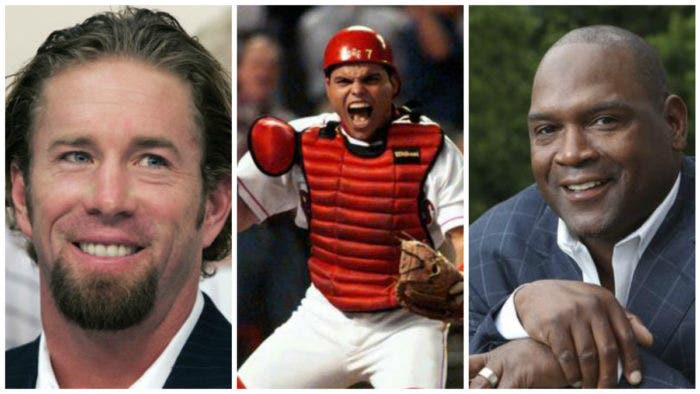
With the announcement of the elections of Jeff Bagwell, Tim Raines, Ivan Rodriguez (left to right in the above photo), John Schuerholz, Bud Selig, and Ford Frick Award winner Bill King, it is time to update this list.

A player is counted as a Hall-of-Famer with the team if he played at least 4 seasons with them. However, there will be the occasional exception. Teams are ranked in order of most HOFers.

If there is a tie, it will be broken by which team has more players, as opposed to those who were elected in other categories. If there is still a tie, then I go to which has more non-broadcasters. If it's still a tie, which has more players whose contributions were mostly with that club. If it's still a tie, which team has played fewer seasons will be ranked ahead -- since, for example, 5 HOFers is more impressive for a team that's been around since 1977 than it would be for one that's been around since 1961.

Teams that no longer exist in that form will be listed in italics and in the position where they would be ranked if they still did.

Players are listed in chronological order of when they arrived at the club, then managers, then broadcasters.

1. New York Yankees, 39: It almost works out to 1 for every Pennant the team has won:

Clark Griffith (the team's first manager, elected as a pitcher and he was still a solid pitcher while he was their manager), Willie Keeler, Jack Chesbro, Frank "Home Run" Baker, Waite Hoyt, Herb Pennock, Babe Ruth, Lou Gehrig, Tony Lazzeri, Earle Combs, Bill Dickey, Red Ruffing, Lefty Gomez, Joe DiMaggio, Joe Gordon, Phil Rizzuto, Yogi Berra, Johnny Mize, Whitey Ford, Mickey Mantle, Enos Slaughter, Jim "Catfish" Hunter, Reggie Jackson, Rich "Goose" Gossage, Dave Winfield, Rickey Henderson, Wade Boggs.

Also, managers Miller Huggins, Joe McCarthy, Casey Stengel and Joe Torre; owner Jacob Ruppert; executives Ed Barrow and George Weiss; broadcasters Mel Allen, Red Barber, Joe Garagiola, Jerry Coleman (played for the Yankees but elected as a broadcaster, first for the Yankees, then for the Padres) and Tony Kubek (played for the Yankees but elected as a broadcaster).

Bucky Harris managed the Yankees to the 1947 World Championship, but was only their manager for 2 seasons (1947 & '48), so I'm not counting him with the Yankees. In this case, according to the rule I set, I have to count Rickey Henderson as a Yankee. If Lou Piniella is ever elected as a manager, I wouldn't be able to count him as a Yankee HOFer, since he wouldn't be elected as a player and only managed them for 3 seasons.

Rizzuto was also a longtime broadcaster. Lee MacPhail was elected for what he did as American League President, not as Yankee general manager. Bernie Williams and Paul O'Neill are now eligible, and Don Mattingly will, in a few years, become eligible once again, through the Veterans' Committee -- but in all 3 cases, let's not kid ourselves. And then there's Roger Clemens: Even if he does get in, would you want to count him as a Yankee? George Steinbrenner, now being dead, is now eligible through the Veterans' Committee.

Tim Raines was a Yankee for only 3 years, although 2 of them were title seasons. Ivan Rodriguez was a Yankee for about 3 minutes. So neither of them can be included here.

2. St. Louis Cardinals, 30: Charlie Comiskey (played for them before managing and owning teams elsewhere), Jake Beckley, Roger Bresnahan, Rogers Hornsby (won a World Series as their player-manager), Jesse Haines, Grover Cleveland Alexander, Jim Bottomley, Charles "Chick" Hafey, Burleigh Grimes, Frankie Frisch (elected as a player, won a World Series as their player-manager), Dizzy Dean, Joe Medwick, Johnny Mize, Enos Slaughter, Stan Musial, Red Schoendienst (elected as player, also managed them to a title), Bob Gibson, Lou Brock, Orlando Cepeda, Steve Carlton (7 seasons), Bruce Sutter, Ozzie Smith.

Also, Miller Huggins (manager, also played several years for the Cards), Billy Southworth (manager, also played for them), Whitey Herzog (manager-executive), Tony LaRussa (manager), Branch Rickey (executive), Harry Caray (broadcaster), Jack Buck (broadcaster), Joe Garagiola (broadcaster).

Jesse Burkett won a batting title with the Cards, but only played 3 seasons with them, so he just misses qualifying. On the other hand, Cepeda didn't even play 3 full seasons with the Cards, but his tenure included the 1967 title and the 1968 Pennant, and he, as much as Gibson, was a symbol of that team, and he may be better remembered as a Cardinal than as a Giants, so I'm bending the rule for him. Leo Durocher was a good player for the Cards, but was elected as a manager and never managed them, so he doesn't qualify here.

Mark McGwire and Jim Edmonds did not qualify on enough ballots, and won't be eligible again until they qualify under the Veterans Committee. Surprisingly, longtime owner Gussie Busch has never been elected.

New York Giants, 26: Roger Connor, Buck Ewing, Tim Keefe, Mickey Welch, John Montgomery Ward, Roger Bresnahan, Christy Mathewson, Joe McGinnity, George Davis, Richard "Rube" Marquard, Dave Bancroft, Ross Youngs, Frankie Frisch, George "Highpockets" Kelly, Fred Lindstrom, Travis Jackson, Bill Terry, Mel Ott, Carl Hubbell, Johnny Mize, Monte Irvin, Willie Mays, Hoyt Wilhelm.

Also, John McGraw (manager, also played for them), Leo Durocher (manager), Russ Hodges (broadcaster).

Casey Stengel played for the Giants, but was elected as a manager, so I can't count him as a Giant HOFer.  

Counting all figures who played or managed at least one game for the Giants, in New York and San Francisco, they have 76, more than any other team; however, many of those were with the club only briefly. But even by my definitions, they are ahead of the arch-rival Dodgers.

3. Chicago Cubs, 27: Adrian "Cap" Anson, Mike "King" Kelly, Clark Griffith (elected as a pitcher for them, later a manager and owner elsewhere), Joe Tinker, Johnny Evers, Frank Chance (elected as a player but should have been elected as a manager instead), Mordecai "Three-Finger" Brown, Grover Cleveland Alexander, Hazen "Kiki" Cuyler, Lewis "Hack" Wilson, Charles "Gabby" Hartnett (also managed them to a Pennant), Rogers Hornsby, Billy Herman, Ernie Banks, Billy Williams, Ron Santo, Ferguson Jenkins, Bruce Sutter, Ryne Sandberg, Andre Dawson, Greg Maddux (spent enough time with them).

Also, Al Spalding (elected as an executive but was also a great pitcher), Frank Selee (manager), Joe McCarthy (manager, managed them to a Pennant before going to the Yankees), Leo Durocher (manager), Jack Brickhouse (broadcaster), Harry Caray (broadcaster).

Sammy Sosa is eligible, but he's not getting in. Lee Smith is eligible, but now that he's no longer the all-time saves leader, the biggest reason for electing him is gone. If Lou Piniella is elected as a manager, I'll have to count him as a Cub HOFer, since he managed them for 4 seasons.

Lou Boudreau was a beloved broadcaster for the Cubs after his playing and managing career, but never played or managed for them, and so I can't count him as a Cub HOFer. Santo was also a longtime broadcaster. Surprisingly, longtime owner Phillip K. Wrigley is not in.

4. Pittsburgh Pirates, 23: James "Pud" Galvin, Vic Willis, John "Honus" Wagner, Fred Clarke (elected as a player, also won Pennants as their manager), Jack Chesbro, Jake Beckley, Max Carey, Hazen "Kiki" Cuyler, Waite Hoyt (5 seasons with them), Harold "Pie" Traynor (also managed them), Paul Waner, Lloyd Waner ("Big Poison" and "Little Poison," though Lloyd was actually taller), Joseph "Arky" Vaughan, Al Lopez (elected as a manager but was an All-Star catcher for the Pirates), Ralph Kiner, Bill Mazeroski, Roberto Clemente, Willie Stargell, Bert Blyleven.

Also, Bill McKechnie (manager), Barney Dreyfuss (owner), Branch Rickey (executive), Bob Prince (broadcaster).

Blyleven was only a Pirate for 3 seasons, but I'm bending the rule because he was a key cog on their last World Championship team in 1979. Barry Bonds is eligible, but while the stance against steroid cheats is softening, he still, for the moment, falls under the category of, "Who's kidding who?"

Boston Braves, 22: Harry Wright (player and manager), George Wright, Al Spalding, Jim "Orator" O'Rourke, James "Deacon" White, Charlie "Old Hoss" Radbourne, Mike "King" Kelly, John Clarkson, Charles "Kid" Nichols, Cy Young, Hugh Duffy, Tommy McCarthy (he and Duffy were known as "the Heavenly Twins"), Billy Hamilton, Vic Willis, Jimmy Collins, Johnny Evers, Walter "Rabbit" Maranville, Dave Bancroft.

Also, Frank Selee (manager), Bill McKechnie (manager, though with no success with the Braves), Casey Stengel (ditto, also played for Braves), Billy Southworth (manager).

5. Boston Red Sox, 22: Jimmy Collins (elected as a player but also managed them to the first World Series title in 1903), Cy Young, Tris Speaker, Harry Hooper, Babe Ruth (6 seasons with Sox before going to Yanks), Herb Pennock (7 seasons before Yanks), Red Ruffing (also 7 seasons before Yanks), Joe Cronin (elected as a player, but also managed them to the 1946 Pennant, though unlike Collins had already retired as a player; was also longtime AL President), Rick Ferrell, Jimmie Foxx, Lefty Grove, Bobby Doerr, Ted Williams, Carl Yastrzemski, Carlton Fisk, Jim Rice, Dennis Eckersley, Wade Boggs, Pedro Martinez.

Also, Dick Williams (manager, no relation to Ted), Tom Yawkey (owner), Curt Gowdy (broadcaster).

I am bending the rule slightly for Dick Williams, who only managed 3 seasons for the Red Sox, but 1 of them, 1967, was the most important season in the club's modern history. Roger Clemens and Curt Schilling are eligible, although I don't know if they will ever get in, despite being members of the 3,000 Strikeout Club, and Clemens is also a member of the 300 Win Club.

At age 98 and having debuted in the major leagues in 1937, Doerr is now the oldest and earliest living member of the Hall of Fame, and even the oldest and earliest living former MLB player. Luis Aparicio played 3 seasons for the Red Sox, so by my rule he is not eligible to be counted with them. Eckersley, however, played 7 seasons with them, so I have to count him with them, and with their living HOFers for as long as he lives.

It was long suspected that owner Jean Yawkey would become the first woman elected to the Hall of Fame, but Effa Manley, who owned the Negro Leagues' Newark Eagles, is in, while Mrs. Yawkey is still out.

6. Chicago White Sox, 22: Ed Walsh, George Davis, Eddie Collins, Ray Schalk, Red Faber, Ted Lyons, Luke Appling, Nellie Fox, Luis Aparicio, Early Wynn, Hoyt Wilhelm, Goose Gossage (5 years with them), Carlton Fisk, Frank Thomas, Tim Raines, Al Lopez (manager), Tony LaRussa (manager), Charlie Comiskey (owner), Bill Veeck (owner), Jack Brickhouse (broadcaster), Bob Elson (broadcaster), Harry Caray (broadcaster).

Although Clark Griffith pitched for them in their 1st 2 seasons and won the 1st American League Pennant as their manager, those 2 seasons are not enough to qualify with the White Sox. Although Tom Seaver notched his 300th victory with the Pale Hose, he pitched for them in just 3 seasons, and can't be counted as one of their HOFers.

Brooklyn Dodgers, 21: Willie Keeler, Joe Kelley, Richard "Rube" Marquard, Zack Wheat, Burleigh Grimes, Charles "Dazzy" Vance, Joseph "Arky" Vaughan, Billy Herman, Joe Medwick, Pee Wee Reese, Jackie Robinson, Duke Snider, Roy Campanella, Ned Hanlon (manager), Wilbert Robinson (manager), Leo Durocher (elected as a manager but was also a good player), Walter Alston (manager), Branch Rickey (owner), Walter O'Malley (owner), Red Barber (broadcaster), Vin Scully (broadcaster).

Casey Stengel played 6 seasons for the Dodgers, and was good, but not Hall of Fame good.  He managed 3 seasons for them; in spite of their poor performance under him, had he managed them for 1 more season, he would still qualify as one of theirs under my rule.  Dick Williams played 5 seasons for them, but was elected as a manager and never managed the Dodgers.  Owner Charles Ebbets is not in.


7. Cincinnati Reds, 18: Bid McPhee, Jake Beckley, Joe Kelley, Sam Crawford, Edd Roush, Eppa Rixey, Ernie Lombardi, Frank Robinson, Johnny Bench, Tony Perez, Joe Morgan, Tom Seaver (6 seasons with Reds), Barry Larkin, Ken Griffey Jr., Bill McKechnie (manager), Sparky Anderson (manager), Red Barber (broadcaster), Marty Brennaman (broadcaster).

Pete Rose, of course, is ineligible. John Franco is not yet in, but if he gets in, he pitched enough seasons with the Reds to qualify for this list. If Lou Piniella is elected as a manager, I'll count him as a Reds HOFer: He only managed them for 3 seasons, but 1 was a World Championship season. Miller Huggins played several years for the Reds, but was elected as a Yankee manager.

Longtime owner Powel Crosley and GM Bob Howsam should be in, but they're not. Waite Hoyt broadcast for the Reds, and was beloved in that role, but has not been given the Ford Frick Award, so I can't count him with the Reds.

And while 2 members of the 1st openly professional baseball team, the 1869-70 Cincinnati Red Stockings, are in the Baseball Hall of Fame, Harry and George Wright -- the other Wright Brothers who "invented" something important in American life -- that team was not the same team as the current Reds franchise, which began in the old American Association of 1882 and joined the NL in 1892.

8. Cleveland Indians, 16: Napoleon "Nap" Lajoie, Elmer Flick, Addie Joss, Tris Speaker (elected as player but also managed them to a title), Stan Coveleski, Joe Sewell, Earl Averill, Bob Feller, Lou Boudreau, Bob Lemon, Larry Doby, Early Wynn, Gaylord Perry, Al Lopez (manager), Bill Veeck (owner), Jimmy Dudley (broadcaster).

Satchel Paige reached the majors with the Indians, but only pitched 2 seasons for them; although I can count him with 3 different Negro League teams on this list, I can't count him with any major league team. Indeed, that fact is the reason I've included the Negro League teams on this list, along with moved and defunct major league teams.

Jim Thome will probably make it, but, barring a major shift in voters' attitudes, Manny Ramirez is probably out of luck.

9. Detroit Tigers, 16: Sam Crawford, Ty Cobb, Harry Heilmann, Henry "Heinie" Manush, Charlie Gehringer, Goose Goslin, Hank Greenberg (the last 3 nicknamed the "G-Men" in those early days of the FBI), Mickey Cochrane (elected as a player, also managed them to 2 Pennants), Hal Newhouser, George Kell, Al Kaline, Jim Bunning, Ivan Rodriguez, Hughie Jennings (manager, also played for the team), Sparky Anderson (manager), Ernie Harwell (broadcaster).

Jack Morris, Alan Trammell and Lou Whitaker are all eligible, but it's doubtful that any of them will ever get in. Kaline and Kell were also longtime broadcasters. Longtime owners Frank Navin, Walter Briggs and John Fetzer are not yet in. Former executive Will Harridge is in, but for what he did as President of the AL, so I can't count him as a Tiger HOFer.

10. Philadelphia Phillies, 16: Billy Hamilton, Ed Delahanty, Sam Thompson, Grover Cleveland Alexander, Eppa Rixey, Dave Bancroft, Chuck Klein, Richie Ashburn, Robin Roberts, Jim Bunning, Steve Carlton, Mike Schmidt, Harry Wright (manager), Pat Gillick (executive), By Saam (broadcaster), Harry Kalas (broadcaster).

Ashburn was also a longtime broadcaster for the Phils. If Curt Schilling and Jim Thome get in, they can be counted with the Phillies. Pete Rose, of course, is ineligible.

Philadelphia Athletics, 13: Eddie Plank, Rube Waddell, Frank "Home Run" Baker, Chief Bender, Eddie Collins, Herb Pennock, Al Simmons, Mickey Cochrane, Jimmie Foxx, Lefty Grove, George Kell, Connie Mack (owner-manager), By Saam (broadcaster).

11. Baltimore Orioles, 12: Brooks Robinson, Hoyt Wilhelm, Robin Roberts (4 seasons with O's), Luis Aparicio, Frank Robinson, Jim Palmer, Eddie Murray, Cal Ripken, Roberto Alomar, Earl Weaver (manager), Chuck Thompson (broadcaster), Jon Miller (broadcaster).

Although he won his only World Series with the Orioles, we don't usually associate Aparicio with them, but he did play 5 seasons with them, so, by my own rule, I've got to count him here. Same with Robin Roberts, who played 4 seasons in Baltimore. Rafael Palmeiro is eligible, but he's not getting in.

Frank Cashen should be in as an executive. Dick Williams played enough seasons with the O's to qualify, but was elected as a manager and never managed them, so he doesn't qualify as an O's HOFer.

Washington Senators, 11: Walter Johnson, Bucky Harris (elected as a manager but was also a great player), Sam Rice, Henry "Heinie" Manush, Goose Goslin, Joe Cronin (elected as a player but also managed them to a Pennant), Rick Ferrell, Early Wynn, Clark Griffith (owner), Arch McDonald (broadcaster), Bob Wolff (broadcaster). 

No, you can't count Ted Williams as a manager.

12. Los Angeles Dodgers, 10: Duke Snider (played 5 seasons for them in L.A.), Don Drysdale, Sandy Koufax, Don Sutton, Mike Piazza, Walter Alston (manager), Tommy Lasorda (manager), Walter O'Malley (owner), Vin Scully (broadcaster), Jamie Jarrin (broadcaster).

Steve Garvey is not getting in. Pedro Martinez started out with the Dodgers, but only played 2 seasons for them.

13. New York Mets, 10: Tom Seaver, Gary Carter, Mike Piazza, Tom Glavine (5 seasons), Pedro Martinez (4 seasons), Casey Stengel (manager, 4 seasons), Joe Torre (manager), Lindsey Nelson (broadcaster), Bob Murphy (broadcaster), Tim McCarver (broadcaster). So that's 3 broadcasters, 3 managers, and 5 players.

Still, you didn't realize the Mets had so many, did you? And that's without counting Ralph Kiner, who was elected as a Pirates' player, not as a Mets' broadcaster. Nor can you count Richie Ashburn, Duke Snider, Warren Spahn, Willie Mays or Nolan Ryan -- and why would you want to count Eddie Murray, Rickey Henderson or Roberto Alomar as Mets?

I had previously counted Yogi Berra, but while he managed them for 4 seasons, including winning a Pennant, he was elected to the Hall as a player, not as a manager, and so I can't count him as a Met HOFer. As for Torre: Yes, he managed in 4 seasons for them. They were awful then, and there wasn't much he could do about it, but he now counts as a Met Hall-of-Famer. Although I notice that, unlike Yogi and Willie, he wasn't invited to the farewell ceremony at Shea Stadium in 2008.

Frank Cashen should be in as an executive. If John Franco is ever elected, you can count him.

14. Atlanta Braves, 9: Hank Aaron, Phil Niekro, Tom Glavine, Greg Maddux, John Smoltz, Bobby Cox (manager), Joe Torre (managed them in between Cox's 2 tenures there, also a player), John Schuerholz (general manager), Milo Hamilton (broadcaster).

Fred McGriff, Chipper Jones and Andruw Jones will be listed with them if they are elected. Don Sutton broadcasts for the Braves, but can't be counted among their HOFers. Former owners Bill Bartholomay and Ted Turner are not in, nor do I ever expect them to be elected.

15. Oakland Athletics, 9: Jim "Catfish" Hunter, Reggie Jackson, Rollie Fingers, Rickey Henderson, Dennis Eckersley, Dick Williams (manager), Tony LaRussa (manager), Lon Simmons (broadcaster), Bill King (broadcaster).

Mark McGwire is eligible, but he's not getting in. Owner Charlie Finley is eligible, but I don't think he'll ever get in, either. I am bending the rule slightly for Williams, who only managed 3 seasons for the A's, but got them into the postseason in all 3, including 2 World Championships.

Weird: By my rules, even though the A's gained a Hall-of-Famer, they got passed in the rankings by a team that did not gain a player or a manager.

Chicago American Giants (Negro Leagues), 8: Andrew "Rube" Foster (also manager and owner), Bill Foster (a.k.a. Willie Foster, Rube's brother), Cristobal Torriente, Pete Hill, George "Mule" Suttles, John Henry "Pop" Lloyd, Norman "Turkey" Stearnes, Willie Wells.

Kansas City Monarchs (Negro Leagues), 8: Jose Mendez, Leroy "Satchel" Paige, James "Cool Papa" Bell, Wilber "Bullet" Rogan, Norman "Turkey" Stearnes, Andy Cooper (also manager), Hilton Smith, J.L. Wilkinson (owner).

Bell played 3 seasons for them, but because Negro League players bounced around as much as international soccer players do, and also like club soccer there were often loan deals involved, I'll bend my 4-season rule. John "Buck" O'Neil, 1st baseman and manager, is not in the Hall of Fame, a terrible oversight, especially given that his contributions to the game include what he did in the last 15 or so years of a very long life.

Jackie Robinson played his first season in professional baseball, 1945, with the Monarchs. They were also the first pro team of Ernie Banks. But neither was elected on the basis of anything he did in Kansas City.

16. San Diego Padres, 8: Dave Winfield, Ozzie Smith, Rollie Fingers, Goose Gossage, Tony Gwynn, Dick Williams (manager), Jerry Coleman (broadcaster), Dick Enberg (broadcaster).

Yes, the Wizard and the Goose each played 4 seasons in Mission Valley. Considering how many they have in a comparatively short history, you shouldn't also count Willie McCovey, Gaylord Perry or Roberto Alomar. Longtime owner Ray Kroc, who saved the team from being moved to Washington in 1974, is not in. Steve Garvey, who is not my Padre, is not getting in.

17. Houston Astros, 8: Joe Morgan, Nolan Ryan, Craig Biggio, Jeff Bagwell, Gene Elston (broadcaster), Milo Hamilton (broadcaster), Harry Kalas (broadcast 6 seasons for them before joining the Phillies' broadcast team).

Roger Clemens is eligible, but only played 3 seasons with the Astros, and, even with his legal exoneration, he may never get in.

Homestead Grays (Negro Leagues), 7: Cumberland "Cum" Posey (pitcher, then manager, then owner), Smokey Joe Williams, Josh Gibson, Buck Leonard, James "Cool Papa" Bell, Jud Wilson, Ray Brown.

Oscar Charleston and Judy Johnson each played 2 seasons for them, but I'm not willing to bend the rules THAT much. Gibson was known as the Black Babe Ruth, Leonard as the Black Lou Gehrig, and together they were known as the Thunder Twins or the Dynamite Twins. Williams was sometimes known as Cyclone Joe, sometimes as Smokey Joe (but never as Smokin' Joe, like boxer Frazier).

As for Posey, "Cum" was short for "Cumberland," and it is possible that, like James "Pud" Galvin, his nickname was not considered sexually explicit in his time. As an athlete, he was probably better in football, and Wendell Smith, the leading black sportswriter of the between-the-wars years and a winner of the Hall's Taylor Spink Award for media work, called him "the smartest man in Negro baseball and certainly the most successful."

Newark Eagles (Negro Leagues), 7: George "Mule" Suttles, Ray Dandridge, Leon Day, James "Biz" Mackey (also manager), Monte Irvin, Larry Doby, Effa Manley (owner, the only woman in the Baseball Hall of Fame). Don Newcombe also played for the Eagles, and if his service there is counted, I believe that it makes him worthy of election to the Hall, but he hasn't been elected.

18. San Francisco Giants, 7: Willie Mays, Orlando Cepeda, Willie McCovey, Juan Marichal, Gaylord Perry, Lon Simmons (broadcaster), Jon Miller (broadcaster).

Barry Bonds is eligible, but who's kidding who? And I'm surprised that longtime owner Horace Stoneham isn't in, and that neither is his son-in-law, Chub Feeney, a Giant executive who became President of the NL.

Montreal Expos, 6: Gary Carter, Andre Dawson, Tim Raines, Pedro Martinez, Dick Williams (manager), Dave Van Horne (broadcaster). If Larry Walker gets in, they can be counted with the Expos. Duke Snider could not, although he broadcast for the Expos and had played in Montreal for the Dodgers' farm team, the Montreal Royals. So did Tommy Lasorda.

Baltimore Orioles, AA & NL 1882-1899, 6: John McGraw, Wilbert Robinson, Hughie Jennings, Willie Keeler, Joe Kelley, Ned Hanlon (manager).

While McGraw, Robinson and Jennings were all elected as managers, all could have been elected on the basis of their playing for the old Orioles. Indeed, to this day, McGraw has the highest lifetime batting average of any 3rd baseman, .334. Dan Brouthers played 2 seasons with them, the 1894 and '95 Pennant seasons, but can't be counted with them.

St. Louis Browns, 6: Bobby Wallace, George Sisler, Rogers Hornsby (also managed them), Rick Ferrell, Branch Rickey (executive), Bill Veeck (owner).

Rube Waddell, Goose Goslin, Heinie Manush and Satchel Paige just miss, each having played 3 seasons for the Browns. That was also the length of time that Veeck owned the team, but since he (and his one-at-bat midget Eddie Gaedel) are now the people most identified with this team, I'm bending the rule for him.

Pittsburgh Crawfords (Negro Leagues), 5: Oscar Charleston, Satchel Paige, Josh Gibson, James "Cool Papa" Bell, WIlliam "Judy" Johnson.

19. Texas Rangers, 5: Ferguson Jenkins, Gaylord Perry, Nolan Ryan, Ivan Rodrgiuez. Eric Nadel (broadcaster). Bert Blyleven pitched just 2 seasons for them. Rafael Palmeiro and Juan Gonzalez are eligible, but who's kidding who? No, you can't count Ted Williams as a manager. And I sure hope former owner George W. Bush is never elected; since the team won nothing while he was in control, that seems safe.

20. Minnesota Twins, 5: Harmon Killebrew, Rod Carew, Bert Blyleven, Kirby Puckett, Herb Carneal (broadcaster).

Tom Kelly could be elected as a manager, but Tony Oliva seems unlikely to ever be elected as a player, having missed in the most recent Vets' Committee election by a single vote. No, you can't count Dave Winfield, Paul Molitor, or, if he ever gets in, Jack Morris: Although hometown heroes, none played 4 seasons with the Twins. Founder Calvin Griffith is not in, nor should he be.

21. Los Angeles Angels of Anaheim, 5: Nolan Ryan, Rod Carew, Reggie Jackson, Bert Blyleven, Dick Enberg (broadcaster). Jim Edmonds will have to wait for the Veterans Committee. Founder-owner Gene Autry is not in, but should be.

22. Milwaukee Brewers, 5: Robin Yount, Paul Molitor, Rollie Fingers, Bud Selig (owner), Bob Uecker (broadcaster). No, you can't count Hank Aaron, because, while he played 14 seasons in Milwaukee, only 2 of those were for the Brewers.

Milwaukee Braves, 4: Warren Spahn, Eddie Matthews, Hank Aaron, Red Schoendienst. Joe Torre began his playing career with them, but can't be counted here.

Buffalo Bisons (NL 1879-1885), 4: Dan Brouthers, Jim "Orator" O'Rourke, James "Deacon" White, James "Pud" Galvin.

23. Kansas City Royals, 4: George Brett, Whitey Herzog (manager), John Schuerholz (executive), Denny Matthews (broadcaster). Founder-owner Ewing Kauffman, surprisingly, is not in.

24. Toronto Blue Jays, 4: Roberto Alomar, Pat Gillick (executive), Tom Cheek (broadcaster), Tony Kubek (broadcaster). No, you can't count Dave Winfield, Rickey Henderson, Paul Molitor or Frank Thomas. Or Roger Clemens, if he ever gets in.

Lincoln Giants/Brooklyn Royal Giants (Negro Leagues), 3: Louis Santop, Smokey Joe Williams, John Henry "Pop" Lloyd. Imagine that, a Brooklyn team called the Giants. What the heck, from 1944 to 1948, the NFL had a Boston Yanks (defunct); and, in the 1961-62 season, the NBA had a Chicago team called the Packers (today's Washington Wizards).

Cuban Giants (Negro Leagues, based in New York), 3: Frank Grant, Sol White, Pete Hill. Unlike the later Cuban Stars and New York Cubans, both also based in New York, this 1880s-90s team had no Cubans: They were called "Cuban" so their all-black roster would be better accepted. Grant has been called the best black player of the 19th Century.

Detroit Stars (Negro Leagues), 3: Pete Hill, Andy Cooper, Norman "Turkey" Stearnes. Stearnes now has a statue at Comerica Park, alongside several Tiger greats.

Indianapolis ABCs (Negro Leagues), 3: Oscar Charleston, Ben Taylor, James "Biz" Mackey (also managed them). A later team, the Indianapolis Clowns, was the first professional team of Hank Aaron.

Philadelphia Giants (Negro Leagues), 3: Sol White, Pete Hill, John Henry "Pop" Lloyd.

Philadelphila Hilldale (Negro Leagues), 3: Martin DiHigo, James "Biz" Mackey (also managed them), William "Judy" Johnson.

St. Louis Stars (Negro Leagues), 3: George "Mule" Suttles, James "Cool Papa" Bell, Willie Wells.

Cuban Stars (Negro Leagues, based in New York), 3: Jose Mendez, Martin Dihigo, Alex Pompez (owner).

25. Seattle Mariners, 3: Randy Johnson, Ken Griffey Jr., Pat Gillick (executive). Edgar Martinez is eligible, but I don't think he'll ever get in. If Lou Piniella is elected as a manager, I'll have to count him as a Mariner HOFer.

Providence Grays (NL 1878-1885), 2: John Montgomery Ward, Charlie "Old Hoss" Radbourn. Their 1879 Pennant was managed by original 1869 Cincinnati Red Stocking George Wright, but he only played with them for 2 seasons.

Cleveland Spiders (NL, 1887-1899), 2: Cy Young and Jesse Burkett.

Detroit Wolverines (NL, 1881-1888), 2: Sam Thompson, Ned Hanlon (elected as a manager but played 8 seasons for them). Dan Brouthers and Deacon White played 3 seasons for them.

26. Miami Marlins, 2: Felo Ramirez and Dave Van Horne (both broadcasters). Ivan Rodriguez was only a Marlin for 1 season, although it was a World Championship season. If Gary Sheffield gets in, he can be counted as a Marlin, but I don't think he's getting in. No, you can't count Miami native Andre Dawson, although he did close his career with the club and is now working in their front office. So is Tony Perez, who briefly managed the team, but you can't count him, either.

Baltimore Black Sox (Negro Leagues), 2: Jud Wilson, Ben Taylor. This team is not to be confused with the Elite Giants.

Washington/Baltimore Elite Giants (Negro Leagues), 2: James "Biz" Mackey (also manager), Roy Campanella. And that's pronounced EE-light, not the usual Eh-LEET.

Birmingham Black Barons (Negro Leagues), 2: George "Mule" Suttles, Satchel Paige. Willie Mays played his first professional season, 1948, for the Black Barons, but only that 1 season, so he can't be counted here.

Kansas City Stars (Negro Leagues), 2: James "Cool Papa" Bell, Willard Brown.

New York Cubans (Negro Leagues), 2: Martin DiHigo, Alex Pompez. Although DiHigo and Pompez were also involved with the Cuban Stars, and that team was also based in New York, it was not the same team as the New York Cubans. Like several of the Negro League owners, Pompez got some funding from the black organized crime bosses of the era, and eventually turned state's evidence to avoid prison. He later worked as an unofficial scout for the New York/San Francisco Giants, helping to sign Hispanic stars like Orlando Cepeda, Juan Marichal, and the Alou brothers.

Philadelphia Stars (Negro Leagues), 2: James "Biz" Mackey (also manager), Jud Wilson.

27. Arizona Diamondbacks, 1: Randy Johnson. If Curt Schilling gets in, he can be counted with them.

28. Washington Nationals, 1: Frank Robinson, their 1st manager, was already in the Hall long before MLB returned to D.C., but he did manage for them for 5 years, 1 more than my rules require. But you can't count the HOFers from this franchise's previous incarnation, the Montreal Expos.

Bacharach Giants (Negro Leagues), 1: John Henry "Pop" Lloyd.  This team played its home games in Atlantic City, and were named for Harry Bacharach, who was that city's Mayor on and off from 1912 to 1935. He was played by John Rue on the TV series "Boardwalk Empire." Lloyd stayed in Atlantic City after he retired, died there, and a youth baseball facility there is named for him.

Harrisburg Giants (Negro Leagues), 1: Oscar Charleston.

San Antonio Black Bronchos (Negro Leagues, pronounced like Broncos), 1: Smokey Joe Williams.

29. Tampa Bay Rays, none: If Fred McGriff gets in, he can be counted with them. Wade Boggs cannot. Nor, if he is ever elected as a manager, can Lou Piniella.

30. Colorado Rockies, none: If Larry Walker gets in, he can be counted with them.

Kansas City Athletics, none: No player in the Hall of Fame was with the A's in their K.C. tenure for at least 4 seasons.

Wednesday, January 18, 2017

Rock, Bags and Pudge for the Hall. Who Else Deserved It?

Tim Raines is in the Baseball Hall of Fame. I have wanted that for years -- and would still have wanted it if he had never played a game for the Yankees. He will almost certainly have a Montreal Expos cap on in the picture on his plaque.

Jeff Bagwell is also elected. Also overdue. Fantastic hitter, and probably the best player the Houston Astros have ever had. (It could also be Craig Biggio. Nolan Ryan was only there for 9 seasons.)

Ivan Rodriguez is elected. He joins Mike Piazza, elected last year, and who has both confessed and denied the use of performance-enhancing drugs.
So, now, there is no reason to not also elect Barry Bonds, Mark McGwire, Sammy Sosa, Rafael Palmeiro, Manny Ramirez, Gary Sheffield, Curt Schilling and... Alex Rodriguez and Roger Clemens.

Or are they just paving the way to elect the most notorious steroid cheat of all time, David Ortiz, and to keep sticking it to A-Rod and the Rocket? We shall see.
*

A player needs 75 percent of the vote to get in via the Baseball Writers Association of America. Bagwell got 86 percent. So did Raines. Rodriguez got 76 percent -- and, of the 3, he was the only one in his 1st year on the ballot.

Of the guys who didn't make it on this ballot...

* Jorge Posada, Magglio Ordonez, Edgar Renteria, Jason Varitek, Tim Wakefield, Casey Blake, Pat Burrell, Orlando Cabrera, Mike Cameron, J.D. Drew, Carlos Guillen, Derrek Lee, Melvin Mora, Arthur Rhodes, Freddy Sanchez and Matt Stairs, all in their 1st year on the ballot, got less than 5 percent of the vote, and will thus never appear on another ballot of the Baseball Writers Association of America. Their future hopes, if any, rest with the Committee on Veterans. Don't expect any of them to ever make it.

* Trevor Hoffman, in his 2nd year, got 74 percent. He missed by the slimmest of margins. This suggests that he will get in next year, when the 1st-time eligibles will include Jim Thome (should be an easy choice), Chipper Jones (likely, though not necessarily on the 1st try), Omar Vizquel (ditto), Scott Rolen (possible, but probably not on the 1st try), Andruw Jones (ditto), Johnny Damon (probably won't make it until he reaches the Veterans' Committee) and Johan Santana (forget it).

* Vladimir Guerrero, in his 1st year, got 71 percent. This also suggests he'll get in, so, next year, it should be him, Hoffman, Thome, and possibly also Chipper.

* Edgar Martinez, in his 8th year, got 58 percent. I think he'll also have to wait for the Vets' Committee. I don't think he should get in. He just doesn't have the career stats, and the stats that he does have are inflated by playing home games in the Seattle Kingdome.

* Mike Mussina, another Yankee hero, in his 4th year, got 51 percent. Might he also have to wait for the Vets' Committee? That's a travesty.

* Lee Smith, in his 15th and final year on the ballot, got 34 percent. He's done by the way of the Writers. It's up to the Vets' Committee now. The problem is, the best reason to vote for him was that he was the all-time saves leader -- and now, he ranks 3rd, so that reason is gone.

* Larry Walker, in his 7th year, got 22 percent. Another who will probably have to wait for the Vets' Committee. He's a borderline case, not helped by having Coors Field in Denver as a home park for much of his career (hitting stats inflated by the thin air). I like him, but should he get in? The usual answer is something to the effect of, "If you can't immediately say, 'Yes,' then the answer is 'No.'"

* Fred McGriff, in his 8th year, got 21 percent. Come on, this guy hit 493 home runs, as many as Lou Gehrig, and (as far as we can tell) without pharmaceutical enhancement. And while he played 5 seasons in Atlanta and 2 at Wrigley Field, he also played 5 in Toronto, 2 in San Diego, 5 in Tampa Bay and 1 in Dodger Stadium. He belongs. But he'll probably have to wait until the Vets' Committee.

* Jeff Kent, in his 4th year, got 16 percent. The all-time leader in HRs by a 2nd baseman, but not a well-liked guy. Vets' Committee? Maybe.

* Billy Wagner, in his 2nd year, got 10 percent. Among lefthanders and among National League pitchers, only John Franco has more saves (by 2: 424 to 422). But Franco isn't in the Hall, and I don't think he ever will be. I don't think Wags will be, either.

Of all the players on the ballot, only 2 players had a lower percentage than last year: Schilling and Wagner.

*

Now, for the elephants in the room: The steroid users, those caught and those suspected.

* Roger Clemens, accused but never proven, 5th year: 54 percent. He gained 9 percent over last year. He won't get in in 2018, but the 2019 debutants, aside from Mariano Rivera, aren't obvious: Andy Pettitte (himself tainted due to his one-time use to recover from an injury in 2002), Miguel Tejada (caught cheating), Lance Berkman (suspected, but never proven, and probably wouldn't have gotten in anyway), Roy Halladay (clean, as far as we know, but a career ended early due to injury means he'll probably have to wait) and Todd Helton (clean, as far as we know).

* Barry Bonds, caught, 5th year: 54 percent -- 1 less vote than Clemens. Unless that 1 voter was going by the fact that Clemens went to court and beat the rap, while Bonds went to court and didn't beat it, I don't know how you split your vote: Either both should get in, or neither. Bonds also gained 9 percent over the year before. He might also have to wait until 2019.

* Curt Schilling, suspected, 5th year: 45 percent. He lost 7 percent over last year. It could be due to his political stances, but that's never stopped anybody from getting in before. If anything, baseball as an institution is conservative -- and we're talking about the institution of the game, not the players, who are members of a labor union (even if they, themselves, are somewhere to the right of General Patton). But Schilling could also be hurt by the way he's conducted himself, including his fraud case in Rhode Island. Still, unless you can prove he cheated, then his 3,000+ strikeouts and his big game reputation should put him in.

* Manny Ramirez, caught, 1st year: 24 percent. He'll probably have to wait as long as Bonds and the rest eventually end up waiting.
* Gary Sheffield, caught, 3rd year: 13 percent. He gained 2 percent over last year. It could be a while.

* Sammy Sosa, suspected, 5th year: 8 percent. He gained 2 percent over last year. It could also be a while, because, while he's never been caught, he really made himself look guilty during the St. Patrick's Day Massacre.
Speaking of guys whose chances were probably killed by that Congressional hearing of March 17, 2005:
* Mark McGwire, confessed: Dropped off the ballot last year, having received only 12 percent.

* Rafael Palmeiro, caught: Dropped off the ballot in 2004, having received only 4 percent.

*

Among the steroid cheats: If it no longer matters, then, of course, they should all get in. But if it does still matter, then, the least you can do is ask: Who would have put up Hall-worthy numbers if they'd never taken the stuff -- or hadn't been caught?
Would have made it anyway: Both Rodriguezes, Bonds, Ramirez, Schilling and Clemens.
Would not have made it anyway: Piazza, McGwire, Sosa, Palmeiro, Sheffield and Ortiz.
Regardless, Induction Day in the Summer of 2022 -- the 1st time A-Rod and the Big Fat Lying Cheating Bastard are eligible -- could end up being, as Arte Johnson would have said on Laugh-In, "Verrry intereshting... but shtupid."

Wednesday, January 7, 2015

Analyzing the 2015 Baseball Hall of Fame Vote

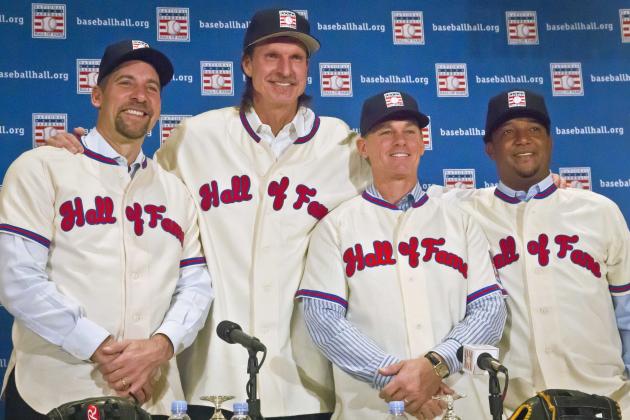
Left to right: John Smoltz, Randy Johnson,
Craig Biggio and Pedro Martinez

Randy Johnson: 534 votes, 97.3 percent. Over 300 wins and over 4,000 strikeouts, more than any lefthander in history, and one of the most dominant pitchers of his era. A jerk, but he belongs.

Pedro Martinez: 500 votes, 91.1 percent. Over 3,000 strikeouts, and one of the most dominant pitchers of his era. A jerk, but he belongs.

John Smoltz: 455 votes, 82.9 percent. Over 3,000 strikeouts, and won 213 games despite essentially missing 2 years and then spending 3 years in he bullpen, where he had 154 saves. And, by all accounts, a nice guy. He belongs.

Craig Biggio: 454 votes, 82.7 percent. Over 3,000 hits. It took a few years, but the voters finally recognized that he belongs.

There can be no reasonable objection to any of these. Even Don Zimmer, had he lived 1 more year, would have agreed with that.

As for those who didn't make it:

Mike Piazza: 384 votes, 69.9 percent. Whether I like him, or his teams (I despise both the Mets and the Dodgers) is irrelevant. There are only 3 questions as to whether a player gets in. First: Does he have the stats? Second: If he doesn't quite have the stats, are there other factors that might put him over the top, such as winning, historical significance, or character? And, third: Is any of the preceding compromised by cheating?

In Piazza's case: First, yes, he has the stats; second, since the answer to the first was yes, we don't need to consider this; and, third, that's the $64 million question. He needed 412 voters to say, "I don't see enough evidence that he cheated, so he should be in," and fell short by 28. Is he paying for his own sins, or for those of others?

It could be that, since there is no method (at least, not that the general public knows of) for expelling a member once he's already elected, the voters of the Baseball Writers Association of America (BBWAA) don't want to put someone in who might later be exposed as someone who should be kicked out. Hence, while proof of performance-enhancing drugs has never been publicly shown for either Piazza or his 2000 bête noire Roger Clemens, the writers may still think that the proof is out there, just waiting to be found.

Until that proof is found, they should be in. If that's not good enough for you, then put in a procedure for kicking out the unworthy -- and I don't mean the statistically unworthy, as some people believe is the case for certain honorees. (I won't name names here.)

Jeff Bagwell: 306 votes, 55.7 percent. He won a Rookie of the Year, an MVP (and nearly 2 others), and a Gold Glove. From 1993 to 2003, he was one of the top 5 hitters in the game -- and from 1993 to 1999, he had to do that in the pitching-friendly Astrodome, not the homer-happy Minute Maid Park. He batted .297 lifetime, hit 449 home runs, and (while this is generally not a stat Hall voters look at, it should be) his OPS+ was 149, meaning he was 49 percent better at producing offense than the average player of his time.

Like Piazza, he is being denied because he did it in the Steroid Era; unlike Piazza, against whom there is some evidence (if inconclusive), there is no serious accusation against Bagwell. True, he had many years of good production and then dropped off precipitously, but he was 37. That's hardly unusual. It wasn't due to suspicious injury, and he hasn't had health problems since. I don't think he used PEDs. Put him in.

Tim Raines: 302 votes, 55.0 percent. .294 BA, 2,605 hits, 7 All-Star berths, 2 World Series rings, 808 stolen bases. Let me say that again: Eight hundred and eight stolen bases. Drugs? Orlando Cepeda and Ferguson Jenkins battled drugs, and they're in. Raines overcome drugs, too. There is no logical reason to keep him out.

Curt Schilling: 215 votes, 39.2 percent. Again, whether you like a player is irrelevant. You don't like his attitude? You don't like what he did to your teams? You don't like his politics? Fine, but we're not deciding whether to elect him to the Hall of Friends, it's the Hall of Fame. Curt Schilling is an ass on multiple levels. But he has over 3,000 strikeouts, won 216 games in the Five Man Rotation Era (a few pitchers with fewer, in the Four Man Rotation Era, are in), made 6 All-Star Teams, and was 11-2 with a 2.23 ERA in postseason play.

Does he have sufficient achievements? Yes. Did he come by them honestly? Ah, now we're getting into a gray area.

There are people who, once he becomes eligible, would keep out Andy Pettitte for his admission of a small mistake. Schilling was every bit the Roger Clemens acolyte that Pettitte was, and he played on the most steroid-boosted team of all time, the 2004-08 Boston Red Sox. And he started having suspicious injuries at 36. And he went bald quickly. And he developed cancer (which is now in remission). All symptoms of steroid use. And still, nobody has tested the blood on that sock.

Why? Because, if true, it would be the final nail in the coffin of the myth of the wonderful Red Sox story: We already know that David Ortiz and Manny Ramirez were dirty lowdown lying cheating bastards, even if some of "us" choose to let that go; "we" don't want to hear that Schilling cheated, too. "We" don't want to hear the answer, so "we" don't want to ask the question.

Roger Clemens: 206 votes, 37.5 percent;
Barry Bonds: 202 votes, 36.8 percent;
Gary Sheffield: 64 votes, 11.7 percent;
Mark McGwire: 55 votes, 10.0 percent;
Sammy Sosa: 36 votes, 6.6 percent;
Rafael Palmeiro: Already once got less than 5 percent, off the BBWAA ballot permanently.

Bonds and Palmeiro got caught, it's been reported that Sosa was as well, McGwire confessed, and Sheffield implicated himself, so they never get in.

Clemens still denies it, and the evidence against him (that we've seen) has thus far been a flop. "Innocent until proven guilty," and nobody has proven a thing against him. Statistically, it's an easy choice. So unless you've got better evidence than we've yet seen, to hell with your personal feelings about him: He should be in. Last year, despite the feelings of betrayal that many Red Sox fans still have about him, the Sox put him in their team Hall of Fame. If they can do it... Not that I want the Yankees to put him in Monument Park...

Lee Smith: 166 votes, 30.2 percent. The argument in his favor was that he was the all-time leader in saves. He hasn't been that for many years. He doesn't get in.

Edgar Martinez: 148 votes, 27.0 percent. A .312 BA, 514 doubles, a 147 OPS+... but just 2,247 hits, 309 homers, and never appeared in a World Series. Maybe he, Randy Johnson, Ken Griffey Jr. and the unrelated Tino Martinez saved Major League Baseball in the Pacific Northwest in 1995. That's reason to elect them to the Seattle Mariners Hall of Fame. The Baseball Hall of Fame has a higher standard. The Big Unit has made it, and, barring a shocking set of circumstances, Junior will make it when he becomes eligible next year. Edgar and Tino will never make it.

Alan Trammell: 138 votes, 25.1 percent. One of the best shortstops in baseball from the late 1970s to the early 1990s, but the only way he gets in is if the Hall brings back the only-used-once "multiple entry" standard. It was used for Joe Tinker, Johnny Evers and Frank Chance. It can also be suggested that Don Drysdale didn't quite have the stats, and that the only reason he got in was to complete a dual entry with Sandy Koufax. Separately, Trammell and Lou Whitaker don't get in; together, with the impact they had, they could. (This could also be used to let in the Yankee pitching triad of Allie Reynolds, Eddie Lopat and Vic Raschi, not that I expect either event to happen.)

Mike Mussina: 135 votes, 24.6 percent. He won 270 games in the Five Man Rotation Era, despite being a righthanded pitcher in parks that were heavily titled toward lefthanded hitters: Camden Yards and the old Yankee Stadium. Come on, this should be a cinch. That he didn't get in this season, with 3 worthy first-timers and the already-denied easy case Biggio, is understandable. But not even 25 percent? That's a slap in the face to one of the best pitchers of a hitting-happy era.

Jeff Kent: 77 votes, 14.0 percent. He hit more home runs at the position of 2nd base than any player in history. And, again: Likability isn't supposed to be an issue. But his career home run total is 377; if that's all you got, then you need more stats. BA, .290; OPS+, 123; hits, 2,461; not enough. Doubles, 560, a good figure, but not enough to drag him over the line. All-Star berths, 5, also not enough to make a difference. Never renowned for his baserunning or his fielding. Reached the postseason with 4 different teams, but only 1 Pennant and no rings.

By the standards that Baseball-Reference.com uses (this post is already long enough, so I wont' get into those here), he should be in. But I don't see it. No, Kent doesn't get in.

Fred McGriff: 71 votes, 12.9 percent. He hit 493 home runs, as many as Lou Gehrig, and as far as anyone knows, he did it honestly. And he didn't even crack 13 percent? He, too, is paying for the sins of others. If he got the 7 more he needed for 500, would he be in? It shouldn't matter: He should be in.

Larry Walker: 65 votes, 11.8 percent. A tougher call than Edgar. BA, .313; OPS+, 141; home runs, 383; doubles, 471. And while he benefited from Coors Field in Denver, he also had to hit in the Montreal Olympic Stadium.

Now, in this era, 383 isn't a lot of home runs, but it's 1 more than Jim Rice, and he's in. And Walker was a better all-around player than Rice. He won 3 batting titles (peaking at .379 -- guys just haven't hit like that in the post-World War II era) and 7 Gold Gloves. He also won an MVP, which, unlike Rice, he deserved. (Rice hit 46 homers in 1978? Walker hit 49 in 1997. Rice had 406 total bases? Walker had 409. And Rice is basically in because of that one season, when Ron Guidry was the most valuable player any team has ever had for a single season, and should have gotten the award -- and he's not in the Hall.)

That said, 383 homers shouldn't, by itself, get you in. And Walker doesn't have the career hits (2,160) or the postseason success (only 1 Pennant, and the 2004 St. Louis Cardinals got swept by the Red Sox). But by the standards Baseball Reference uses, he should be in, and I agree.

Don Mattingly: 50 votes, 9.1 percent, 15th and last year on the ballot, so he's done. From 1984 to 1989, he was one of the 3 best players in baseball. From 1990 to 1995, he was just another good player. And then he was done. Having one-third of a career as an all-time great, one-third as less than that, and one-third not at all only works if you're as good as Sandy Koufax. Mattingly was not as good as Koufax. Perhaps the Veterans' Committee will put him in, once he becomes eligible for them.

Nomar Garciaparra: 30 votes, 5.5 percent. From 1997 to 2003, he sure looked like a future Hall-of-Famer: Who bats .372 as a righthanded hitter in the post-World War II era? But he just dropped off the map. A brief return to nice stats in 2006 didn't save him, he was only 34 when he was last a regular, and played his last game when he was 36.

BA, .313; OPS+, 124; hits, 1,747; homers, 229; batting titles, 2; All-Star berths, 6; Gold Gloves, none; baserunning, also not a boost; postseason berths, 5, with 3 different teams, but no Pennants -- indeed, the Red Sox didn't win a Pennant and a World Series until they got rid of him. No, Nomar doesn't make it to Cooperstown.

The following players, each in his 1st year on the ballot, got less than 5 percent of the vote, and will not be on next year's ballot:

Carlos Delgado: 21 votes, 3.8 percent. He hit 473 home runs, more than Carl Yastrzemski and Dave Winfield, and slightly less than Stan Musial and Willie Stargell, despite playing his entire career in pitchers' parks: 12 years at the SkyDome/Rogers Centre in Toronto, 1 at Sun Life Stadium in Miami, 3 at Shea Stadium in New York and the last few games of his career at Shea's successor, Citi Field.

As far as we know, he was clean. Seems to be a nice guy. Anytime prior to the 1994 strike, without evidence of steroid use, 473 homers would have gotten you in. Since then, everybody's a suspect. (You'll notice that, in this rare year when 4 players got in via the BBWAA, 3 were pitchers.)

Troy Percival: 4 votes, 0.7 percent. For the moment, with Mariano Rivera and Trevor Hoffman, each League's all-time leader in saves, not yet eligible, we don't really know what gets a reliever in. There are currently 5 pitchers in based mainly on what they did as relievers -- not counting Smoltz, who's in mainly for what he did as a starter: Hoyt Wilhelm, Rollie Fingers, Bruce Sutter, Goose Gossage and Dennis Eckersley.

Eck has 390 saves, Fingers 341, Gossage 310, Sutter 300, Wilhelm 227. Percival has 358 saves, more than all of these except Eck. If we're talking combined wins plus saves, it's Eckersley 587, Fingers 455, Gossage 434, Percival 393, Wilhelm 370, Sutter 368. World Series rings: Fingers has 3, the rest, 1 each.

If it's about Percival having a career losing record, so does Fingers, and he wasn't kept out. Wilhelm can be explained by being the pioneer who really made relief pitching something to focus on. But if Sutter is in, why not Percival? Maybe he just wasn't great enough for long enough.

Aaron Boone and Tom Gordon: 2 votes, 0.4 percent. One home run, no matter how significant, does not get you into the Hall of Fame. And while Gordon was a very good relief pitcher, he was not a Hall-of-Fame quality player.

Darin Erstad: 1 vote, 0.2 percent. From 1997 to 2000, he was one of the best players in the game. But from 2001 to 2005, despite 2 Gold Gloves (at 2 different positions: Center field in 2002 and 1st base in 2004) and a ring (2002 Anaheim Angels), he was just another good player. And then, in 2005, at age 30, his stats dropped precipitously, and starting in 2006 he played far fewer games, due to injury. He played his last game at just 35. Throw in an outlier of a great season in 2000 (shades of Brady Anderson), and he sure looks like a steroid case. There's no serious charge against him, but he does fit the profile. Even if he didn't cheat, statistically, he's not close to Cooperstown worthiness.

Brian Giles, Jason Schmidt, Cliff Floyd, Jermaine Dye, Rich Aurilia, Tony Clark and Eddie Guardado: No votes, 0.0 percent. The only surprise here is that Dye got no votes. He hit 325 home runs, made the All-Star team twice, had 4 100+ RBI seasons, reached the postseason with 3 different teams, and won the 2005 World Series with the Chicago White Sox. That's not enough to make it, but he should have gotten at least a few votes.

UPDATE: Piazza was elected in 2016, Bagwell and Raines in 2017, Trammell in 2018; Smith, Martinez and Mussina in 2019. Everyone else mentioned here is still on the outside looking in.