Showing posts with label steve young. Show all posts

Wednesday, January 29, 2025

January 29, 1995: Steve Young Proves His Point

January 29, 1995, 30 years ago: Super Bowl XXIX is played at Joe Robbie Stadium (now named Hard Rock Stadium) in suburban Miami Gardens, Florida, capping the NFL's 75th Season celebrations. The San Francisco 49ers, appropriately, score 49 points to beat the San Diego Chargers, with 26.

While it is the 5th Super Bowl win for the 49ers, it remains the only Super Bowl appearance for the Chargers, who did win an AFL Championship in 1963. Despite their coming within 14 seasons, no one played on all 5 49er title teams.

Steve Young not only breaks out of the shadow of Joe Montana, but surpasses him in a way, setting a Super Bowl record with 6 touchdown passes. Deion Sanders becomes the 1st man to play in both a World Series and a Super Bowl. He is still the only one. Although he didn't win in either of his World Series appearances with the Atlanta Braves, he went on to win another Super Bowl with the Dallas Cowboys the next season.

It was the 2nd win as 49er head coach George Seifert, following the 1st 3, won by Bill Walsh, to whom he was defensive coordinator.

The 49ers have since been in 3 Super Bowls, losing them all. The Chargers, who moved to Los Angeles for the 2017 season, have lost their only AFC Championship Game appearance since this game.

Monday, March 6, 2023

March 6, 1983: The USFL Begins Play

March 6, 1983, 40 years ago: The United States Football League plays its first games.

You don't remember the USFL? Even if you're over 40, that's not surprising. Its detractors called it the USeless Football League and the Undeniably Sorry Football League.

It could have succeeded. Indeed, the timing seemed to be right: The NFL was coming off a season in which there had been a strike, canceling almost half the season. Fans should have been willing to take something new: A professional football league playing in the Spring, when there was no pro football to watch.

But the timing wasn't right, at least according to the calendar. The 1st season started on March 6, when the NBA and NHL seasons were coming down the home stretch. The Championship Game was held on July 17, just as baseball's 2nd half was getting underway.

Had the league started in early May, by which point all but a few teams would have been eliminated from the NBA Playoffs and the Stanley Cup Playoffs, and the Championship Game on August 28, the last Sunday before the NFL season started, then, for most of the season, they would have only had baseball to contend with, as the North American Soccer League was already fading into irrelevance.

Here were the original 12 teams, in alphabetical order, and what else they had to compete with nearby at the time:

* Arizona Wranglers. No NFL, MLB or NHL at the time, just the NBA's Phoenix Suns. Played at Sun Devil Stadium, which was (and is) owned by Arizona State University, so even if there had been an NFL team playing there at the time, it couldn't have kept the Wranglers out. This was a good market for the USFL.

* Birmingham Stallions. Nothing: No MLB, no NBA, no NHL, and while the State of Alabama considers college and high school football to be a religion, there is no NFL team there. (This is also the case for several other Southern States, and for basketball in Kentucky. It is also why the Pacers have never been more popular than IU and Purdue in Indiana, and why no pro basketball team has succeeded in North Carolina.) Played at Legion Field. This was a good market for the USFL.

* Boston Breakers. Everything: The Celtics and Bruins, both perennial postseason teams at that point, and the Red Sox in April. Played at Nickerson Field, the 21,000-seat stadium of Boston University, where the Patriots played in their first few AFL seasons. The Patriots wouldn't let them play at what was then named Sullivan Stadium (formerly Schaefer Stadium, later Foxboro Stadium), and Boston College wouldn't let them use their Alumni Stadium, which was also larger than Nickerson. This franchise should never have been placed in Boston, even though the Patriots were a joke franchise at the time.

* Chicago Blitz. Everything: The Bulls and Blackhawks, both perennial postseason teams at the point, and the Cubs and White Sox in April. Played at Soldier Field, which was (and is) city-owned, so the Bears couldn't keep them out. Too many distractions for the fan dollar, but Chicago was the 3rd-biggest market and a football-mad one, so they had to have a Chicago team.

* Denver Gold. There was then no MLB or NHL team, but the NBA's Nuggets were a perennial postseason team. Played at Mile High Stadium, which was city-owned, so the Broncos couldn't keep them out. Still, the Broncos were a good team at the time, and the "Broncomania" that began with their 1st good season in 1973, and was seriously hyped up during their run to the Super Bowl in the 1977 season, had hardly abated. So this was a bad market for the USFL.

* Los Angeles Express. Everything: The Lakers and Kings, both perennial postseason teams at that point, and the Dodgers and the team then known as the California Angels in April. Played at the Los Angeles Coliseum, which was (and is) city-owned, so the Raiders, then using it as their home field, couldn't keep them out. Plus the Rams were still in the area, playing at Anaheim Stadium. But L.A. was the 2nd-biggest market, so they had to have an L.A. team.

* Michigan Panthers. Everything: The Pistons and Red Wings weren't very good at this point, but had solid fan bases that would not abandon them; and the Tigers in April. Played at the Silverdome, which was owned by its municipality, the Detroit suburb of Pontiac, so the Lions couldn't keep them out. The Lions were a good team at this point, and playing football in nice weather got canceled out by the dome, so as much as the State of Michigan loves its football, putting a franchise there was a bad idea.

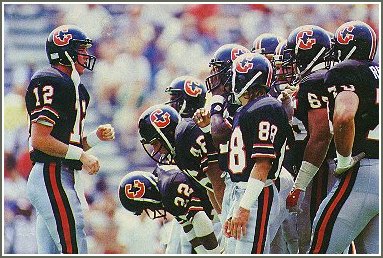
* New Jersey Generals. Everything: The Knicks, Rangers and Islanders, all perennial postseason teams at that point, plus the Nets, who were (unusual for them) in the middle of back-to-back Playoff seasons; the Devils, finishing their terrible 1st season; and the Yankees and Mets in April. Played at Giants Stadium in the Meadowlands, which was State-owned, so the Giants couldn't keep them out. But New York was the biggest market, so they had to have a "New York" team, yet they took advantage of the ill feelings of New Jerseyans (including myself) who were mad at the Giants for moving to the State but not changing their names. More on this in a moment.

* Oakland Invaders. No NHL team then. The NBA's Golden State Warriors were pretty weak: New York sportscaster Spencer Christian called them "the Golden Stink Warriors." Neither the San Francisco Giants nor the Oakland A's were any good at the time. The 49ers across San Francisco Bay had just had a letdown season after winning the Super Bowl the season before, and no one foresaw the Niners becoming the NFL's dominant team over the next decade. And the Raiders had split down the Coast a year earlier, leaving the Oakland Coliseum, then as now owned by Alameda County (so the Raiders couldn't have kept them out anyway), available for football all year long. And they would pick up all the Raider fans still angry about the team abandoning the East Bay. So the nation's 4th-largest market was a good one for the USFL experiment.

* Philadelphia Stars. Everything: The 76ers and Flyers, both perennial postseason teams at that point, and the Phillies in April. Played at Veterans Stadium, which was city-owned, so the Eagles couldn't keep them out. But Philly was in a rare period where all its teams had recently been good, so while the Eagles had collapsed the preceding fall, the timing was still bad for a Spring football team based in Philadelphia. But Philly was a market both big and football-mad, and so the team was put there.

* Tampa Bay Bandits. Nothing: No MLB, no NBA, no NHL, and the NFL wasn't starting again until September. Played at Tampa Stadium, "the Big Sombrero," which was city-owned, so the Buccaneers couldn't keep them out. And the Bucs stunk then, so this was a good market for the USFL.

* Washington Federals. No MLB team at that point, but the NBA's Bullets (now Wizards) and the NHL's Capitals; neither was then good, but both were there. Played at Robert F. Kennedy Stadium, which was owned by the federal government, so the Redskins couldn't keep them out. But while putting a team in the Nation's Capital seemed like a must, putting a team in the same town as the Redskins -- who were not only a wildly popular institution in the town but had just won the Super Bowl a few weeks before -- was financial suicide.

A league needs big names. At first, the biggest names were the coaches. New Jersey was coached by Chuck Fairbanks, who had led the University of Oklahoma to 3 Big Eight titles and the Patriots to their first AFC East title. Jim Stanley had led Oklahoma State to a Big Eight title, and was appointed to coach the Michigan franchise. Chicago was coached by George Allen, who had led the Redskins to the 1972 NFC title.

Oakland was coached by John Ralston, who had won 2 conference titles each at Utah State and Stanford, and had guided the Broncos to NFL respectability. Ralston's successor with the Broncos was Red Miller, who led them to the 1977 AFC Championship, and was hired to run the Denver franchise. Philadelphia was coached by Jim Mora Sr., who was not yet a big name, but he had coached at Stanford, UCLA, and the universities of Colorado and Washington, and had been an NFL assistant; he coached Philadelphia.

Tampa Bay was coached by Steve Spurrier, not yet "the ol' ball coach" who led his alma mater, the University of Florida, to SEC dominance and a National Championship, but was already a Heisman Trophy-winning quarterback, a respected college assistant, and the biggest living name in Florida collegiate football -- unless you want to count actor Burt Reynolds, a Florida State alum, and a part-owner of the team. The team was named after his character in Smokey and the Bandit, although their logo was a Wild West desperado on a charging horse. The Bandits were Spurrier's 1st head coaching job.

Burt is dead now, and he was never a particularly good actor. It's hard to explain to kids today just how big he was in the late Seventies and early Eighties. Like another guy who played college football in Florida, Dwayne "The Rock" Johnson -- but with a Southern drawl, a classic mustache, and a series of toupees that changed with the styles of natural hair.
"For the good old American life: For the money,
for the glory, and for the fun. Mostly for the money."

Los Angeles was coached by Hugh Campbell, who was not yet a big name in the U.S., but had coached the Edmonton Eskimos to the last 5 Grey Cups, the "Super Bowl" of the Canadian Football League (and had also played on a Grey Cup winner with the Saskatchewan Roughriders in 1966). His predecessor with the Esks (now the Edmonton Elks) was Ray Jauch, also not yet a big name in the U.S., but he had coached the Esks to the 1975 Grey Cup (and had also played on a Grey Cup winner with the Winnipeg Blue Bombers in 1959); he coached the Washington franchise.

Boston was coached by Dick Coury, who had previous insurgent-league experience, coaching the Portland Storm of the 1974-75 World Football League. Birmingham was coached by Rollie Dotsch, a respected assistant under Dan Devine at the University of Missouri and Notre Dame, and in the NFL under Fairbanks in New England and Chuck Noll in Pittsburgh. Arizona was coached by Doug Shivley, who'd been an assistant in New Orleans and Atlanta and at several colleges.

*

I was 13 years old when the USFL began, and I was very excited about the New Jersey Generals. At the time, I hated the Jets, because most of their fans were Met fans, and I hated the Mets. This was due to geography (both then played at Shea Stadium in Queens and also tapped into the Long Island fan base) and timing (both arrived in the early 1960s, just in time to take on Baby Boomers not steeped in Yankee & Giant traditions, and both won their leagues' championships in calendar year 1969). Until the Mets and Giants both won their leagues' 1986 championships (in that season if not that calendar year), it would never have occurred to 95 percent of Met fans to root for the Giants.

And I hated the Giants because of their refusal to acknowledge that they played in my home State by changing their name. The Generals admitted that they were based in the New York City market, but playing in New Jersey. They had Herschel Walker, one of the best running backs the college game had ever seen, a smart, personable young man. (It would be a long time before we knew about his personal demons, which, thankfully, haven't ruined him.) And I loved their helmet logo, a five-star general's ring of stars with leaf clusters.

As Theodore Roosevelt said about his 1912 Progressive Party, "Unhampered by tradition, uncorrupted by power, undismayed by the magnitude of the task, the new party offers itself as the instrument of the people, to sweep away old abuses." To me, and to many other fans, especially after the Strike of '82, the NFL represented established interest, corporate power, regimentation. True, I wasn't yet mature enough to think in those terms, but I could certainly feel it, watching games of what was already being called the No Fun League.

The USFL represented a clean slate. A chance to have a team without the connections to the Giants, then 27 years without a title and pretty frustrating since then, even if you did like them; or to the Jets, who had just come within 1 game of the Super Bowl, but were symbolized by Mark Gastineau, whose long hair, "porn 'stache," and obnoxious behavior made him the favorite player, and the Jets the favorite team, of "ginkers," what we called metalheads in East Brunswick in the Egregious Eighties.

The Generals had no past, and while this meant that we couldn't glory in their 1932, 1947, 1956, 1961 or 1977 titles (as we could with the Yankees), it also meant there was no dark age (as the Giants and Knicks were still in and the Yankees had been in from 1965 to 1975). There was no glory, but no shame, either.

And this was coming on the back of the Nets, who were in New Jersey and (all too briefly) winning; and the Devils, who were wrapping up their 1st season, playing horribly, but the novelty hadn't worn off yet, so we new Devils fans didn't care. The Generals, playing in a league where all the teams were expansion teams, would have a chance to win right from the start.

I was excited. I was buzzing. I was jazzed.

I was monumentally disappointed.

*

Is it possible for a league to be made by one game? People who study the history of the NFL seem to think so: It was when Red Grange took his "Galloping Ghost" fame from the University of Illinois into the Polo Grounds in 1925 and sold it out, and, although his Chicago Bears beat the Giants that day, the gate receipts from a 70,000-seat sellout saved the Giant franchise, thus making football in the New York market viable, thus making professional football in America viable. (This probably also killed off the best chance professional soccer had to make it in America for half a century.)

Is it possible for a league to be ruined by one game? From my perspective, it was. The Generals had signed the league's biggest coup, the sitting Heisman Trophy winner, Herschel Walker, lured out of his senior season at the University of Georgia and being a sure top pick in the 1984 NFL Draft by money and lots of it. But the Generals had no defense, and their 1st game, televised live on ABC, with the great college football voice Keith Jackson doing play-by-play, ended with the Los Angeles Express beating the Generals, 20-15, in front of just 32,008 fans, meaning the Coliseum had over 60,000 empty seats.
Other 1st-week games in the USFL: In the 1st game to be played, Tampa Bay beat Boston 21-17; Michigan beat Birmingham 9-7, Philadelphia beat Denver 13-6, Chicago beat Washington 28-7, and Oakland beat Arizona 24-0.

The Generals lost their 2nd game, too, losing 25-0 to the Stars at the Vet. They lost their 3rd game, their 1st home game at the Meadowlands (or, I was I was calling it then, "Generals Stadium"), 32-9 to the Bandits. They lost their 4th game, 31-21 to Boston at the Meadowlands.

As Stars coach Mora would later say when he was coaching the Indianapolis Colts, "Playoffs? Don't talk about Playoffs! You kidding me? Playoffs? I just hope we can win a game!"

Finally, the Generals went on a bit of a hot streak: They beat Arizona in Tempe, 35-21; then lost a home game to Michigan, 21-6, then got their 1st home win, 23-22 over a pathetic Washington squad; then lost in overtime in Chicago, 17-14; then beat Denver at Mile High, 34-29. Winning 3 out of 5 is good.

Then they lost their next 3, killing their momentum. They closed the season doing what a New York-area team should not do: They lost to a New England team, losing 34-10 in Boston. In the USFL's 18-game regular season, they finished 6-12, and didn't make the Playoffs.

Philadelphia won the Atlantic Division, Michigan the Central, Oakland (with a mere 9-9 record) the Pacific, and Chicago (tied for the Central lead but lost the tiebreaker) got the only Wild Card berth for the Playoffs. Philly beat Chicago at the Vet, Michigan beat Oakland in Pontiac, and in the USFL Championship Game, played on July 17, 1983, on neutral ground at Mile High in Denver, the Michigan Panthers, starring former University of Michigan receiver Anthony "The Darter" Carter, beat the Philadelphia Stars, 24-22.
Carter and the Panthers

*

The standard of play wasn't great, but it wasn't abject misery, as claimed by the media, which was in the pocket of the NFL. Don't forget: While ABC did the USFL's games, it also did Monday Night Football, and thus had a vested interest in the NFL's dominance. Even so, it was the 3rd-largest network, and both CBS and NBC had it in their interest for the USFL to fail.

If a sportswriter wanted to be interviewed for his football knowledge on a major network, he had to treat the USFL like a minor league. And not like in soccer, where England's 2nd division (now oddly named "The Championship") is a standard not that far below the 1st division ("The Premier League"), which would have been close to the USFL's actual performance level: The USFL was treated by the national media as if it was, truly, minor-league. And, as baseball pitcher turned sportscaster turned author Jim Bouton taught us, "The minor leagues are all very minor." (Though Bouton made an exception for Triple-A baseball's Hawaii Islanders.)

In management terms, the USFL was a colossal mess. The Denver Gold were a prime example: Red Miller feuded with management, so they fired him in midseason, and brought in his former Bronco quarterback, Craig Morton, who had just retired as a player, and had never coached before.

The L.A. Express were losing money left and right, and made a huge mistake the next season, signing Steve Young, the Brigham Young University quarterback who had nearly won the Heisman Trophy the year before, to an enormous contract, comparable in its excess to that of Alex Rodriguez, in its deferred payments to that of Bobby Bonilla, and in its results to that of Kevin Brown, who, lest we forget, was once considered good enough of a pitcher to get MLB's 1st contract worth a total over $100 million.
Steve Young, wondering if the money
he was promised was worth it

The USFL was also failing spectacularly at the box office. Leading the league in percent of stadium capacity filled were the Boston Breakers, with 61 percent -- but that meant they were getting 12,817 at Nickerson, which seated 21,000 at the time. Denver, which hadn't played to an unsold seat at a Bronco game since 1976 (and still hasn't, except for the Scab Year of 1987), had the highest average attendance, but even their 41,736 was only 56 percent. Tampa Bay had 39,896, but that was just 55 percent.

New Jersey (35,004), Oakland (31,211) and Arizona (25,776) also topped 25,000, but Birmingham's 22,046 was shockingly low for the football-mad State of Alabama, and L.A.'s 19,002 and Chicago's 18,133 were unacceptable for big markets. Even the teams that made it to the title game weren't packing 'em in: Michigan averaged 22,250, Philadelphia 18,650. These would have been unacceptable attendances even by the standards of 1983 baseball. Washington bottomed out at 13,850, in contrast to the Redskins, who hadn't played to an unsold seat since World War II.

Birmingham coach Dotsch, perhaps, said it best:

Every good coach has a game plan. In this case, the USFL got away from the game plan. There's no question we did, or I'll say the USFL did. I don't think we (meaning the Stallions) did, or Tampa Bay did. Hindsight is much better than foresight, I know, but things were done that hurt us. We didn't go crazy. We lost the fewest dollars of any USFL team. We were always the poorest team in the playoffs, but we held our own, and I'm proud of that. We did a good job with what we had. We won a lot more than we lost, and that's the biggest thing.
*

Clearly, the smart thing for the USFL to do would have been to look at which markets were doing well, and which markets didn't have as much competition in other sports, and move the failing teams (even if they were playing well) to lesser-tapped markets for the Spring of 1984.

Clearly, the USFL did not do the smart thing.

They moved the Breakers from Boston to New Orleans, where the only major league team in place was the Saints, who stunk at the time, and didn't own the Superdome. (The State of Louisiana did, and still does.) That wasn't a bad move, and attendance did jump to 30,557.
John Walton, who quarterbacked in the Continental Football League,
the WFL, the NFL (Philadelphia) and the USFL (the Breakers).

But the league made a huge mistake in expanding from 12 to 18 teams. A tremendous sub-mistake was making one of the added teams the Pittsburgh Maulers, who signed Heisman winner Mike Rozier of Nebraska. Ed DeBartolo, owner of the NHL's Penguins, and father of 49ers owner Eddie DeBartolo, seemed like the right guy to own a Pittsburgh team in the USFL... if putting a USFL team in Pittsburgh had been the right thing to do.

It wasn't. It wasn't just that the Pittsburgh area had lost so many jobs, and with it so many people, who went elsewhere to look for work. It was that the Steelers owned that market. In Western Pennsylvania, here's how sports popularity went at the time: 1. Steelers; 2. Penn State; 3. Pirates; 4. University of Pittsburgh football; 5. Uh, do we still have a hockey team?

Giving the Maulers purple uniforms didn't help. And what's a "mauler," anyway? The helmet logo was a guy in a hard hat swinging a sledgehammer, suggesting a factory or mill worker. Right, remind the people of Western Pennsylvania of the jobs they'd been losing like crazy for the last 20 years.
Rozier, looking for a pass from Glenn Carano, while Jim Lohmann blocks.
You've never heard of Carano or Lohmann? That's not surprising.

The Maulers' 1st game saw them lose to Birmingham, whose quarterback was Cliff Stoudt, reviled as Terry Bradshaw's inadequate backup with the Steelers, and the locals at Three Rivers Stadium threw snowballs at him. Rozier, a native of Camden, New Jersey, did not have the same impact in the USFL as Walker, and his pro career was a disappointment (although not an outright bust, as he later did all right for the Houston Oilers). The Maulers finished tied with Washington for the league's worst record, 3-15.

Seeing the Southeast as underserved -- Texas and Florida had NFL teams, but the rest of the old Confederacy then had only Atlanta and New Orleans in the NFL -- and seeing how Birmingham was working out, the USFL expanded to include the Memphis Showboats and the Jacksonville Bulls, playing at the Liberty Bowl and the Gator Bowl, respectively.

Memphis was respectable mainly for one reason: Defensive end Reggie White, who played in the State at the University of Tennessee. They were coached by Franklin "Pepper" Rodgers, who'd done well at the stadium for Memphis State (now the University of Memphis). But Lindy Infante, already a respected NFL assistant, couldn't get much out of the Bulls.
Reggie White

The USFL also expanded into the Southwest. Putting a team in Dallas to compete with the Cowboys would have been lunacy, but the Oilers were awful at the time, so they put in the Houston Gamblers, coached by Jack Pardee, a former linebacker who'd been an All-American at Texas A&M and All-Pro with the Rams and Redskins, and had coached the Bears and Redskins to Playoff berths. The Gamblers signed University of Miami quarterback Jim Kelly, and won the Central Division.
Jim Kelly, apparently trying to invent an alternative to the huddle

Putting a team in San Antonio seemed to make sense, as the city had only the NBA's Spurs. But longtime Texas A&I (not A&M) coach Gil Steinke couldn't get the Gunslingers into gear. Putting a team in Oklahoma, where they could peel off Sooner fans, and fans who were a long way from Dallas and Kansas City, seemed to make sense, and hiring former Steeler defensive coordinator Woody Widenhofer as head coach and former Buccaneers quarterback Doug Williams were good moves. And the Oklahoma Outlaws had cool uniforms, black jerseys with a nasty-looking desperado on their helmets. But they went nowhere.
Doug Williams had Jimmie Giles in Tampa before this,
and Gary Clark and Ricky Sanders in Washington after this.
In Tulsa, he had... the other Mel Gray.

And in the oddest transaction in pro football history, the owners of the Chicago Blitz and the Arizona Wranglers traded their entire franchises. Including rosters, coaching staffs, and front office personnel. Where Chicago had been good and Arizona terrible in '83, the reverse was true in '84.

L.A. got Steve Young, and former San Diego Charger quarterback John Hadl as coach, and they won the Pacific Division. Philadelphia had the best record in the league at 16-2, edging New Jersey for the Atlantic Division title.

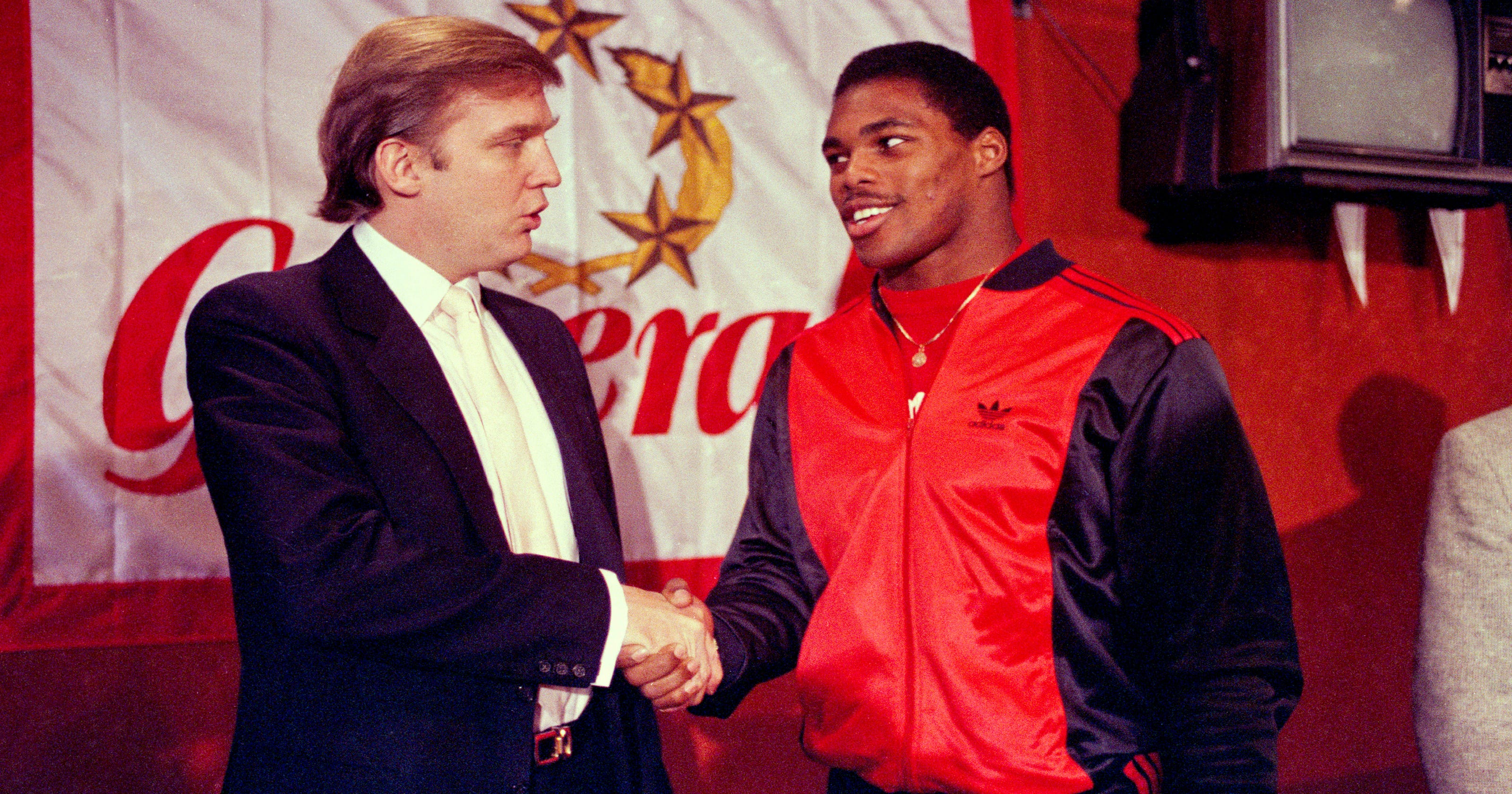
The Generals had been sold to Donald Trump, who brought in Walt Michaels, who'd coached the Jets to the AFC Championship Game in the '82 season, and former Cleveland Browns quarterback Brian Sipe, thus giving the Herschel-centric offense more diversity.
One of these men would later be treated for mental illness,
and the results are inconclusive. The other hasn't been treated
for mental illness, but became President.

(Supposedly, Trump originally wanted to lure Don Shula away from the Miami Dolphins, but balked when Shula wanted a free condo in the newly-opened Trump Tower. Somehow, I suspect, the older Trump would have accepted this, as the means to an end.)

The Generals lost to the Stars in the 1st round of the Playoffs, as former Penn State quarterback Chuck Fusina, running back Kelvin Bryant, and linebacker Sam Mills flattened Jersey's team. In the longest game in the history of professional football, one which went to a 3rd overtime (Sports Illustrated's article on it was titled "It Was a Game and a Half"), Young led Los Angeles to dethrone defending champion Michigan, 27-21. Birmingham beat Tampa Bay, 36-17, and Arizona beat Houston, 17-16.
Kelvin Bryant. Like the Phillies, the Stars had uniforms
that really clashed with the horrid artificial turf at The Vet.
Unlike the Phillies and especially the Eagles, the uniforms
went great with the stadium's seat-color scheme.

In the Conference Championships, Arizona beat L.A., 35-23; and Philly beat Birmingham, 20-10. The title game was played at Tampa Stadium, and Philly beat Arizona, 23-3.
This is what a USFL Championship ring looks like.

*

Did the USFL learn from its '83 and '84 mistakes? Partly. The league was contracted to 14 teams. Chicago and Pittsburgh were out. Michigan and Oakland were merged, keeping the Oakland Invaders name. Oklahoma and Arizona were merged, becoming the Arizona Outlaws, with the colors somewhat merged and Oklahoma's logo kept.

There were moves. To take advantage of the fact that the Baltimore Colts had been moved to Indianapolis, the USFL should have moved the Washington Federals to Baltimore. Instead, they moved their most successful team, the Philadelphia Stars, down Interstate 95.

But a legal wrangle prevented them from moving to Memorial Stadium for 1985, so they went to Byrd Stadium at the University of Maryland, inside the Capital Beltway in College Park. So while they had the name "Baltimore Stars," they were a lot closer to Washington. This cut their per-game attendance in half, from 28,668 in '84 to a dismal 14,275 in '85.

The Federals were moved, to Central Florida, an untapped market, to become the Orlando Renegades. Their coach was Lee Corso, a big name in the State, as he'd been Florida State's coach. Did this work out? As Corso would say in his later ESPN punditry career, "Not so fast, my friend!" The 'Gades finished 5-13, with an average attendance of 24,136. Each figure was better than they achieved in Washington, but still awful.

And the Breakers were moved again, to Oregon, where they became the Portland Breakers. True, Portland only had the NBA's Trail Blazers, but anybody who was an NFL fan in Oregon was either a Seattle Seahawks fan, or rooted for a faraway team like the Raiders, Steelers or Cowboys. And the L.A. Express crashed and burned: Their owners were bankrupt, and even with Young, they were just 3-15, with an average attendance of 8,415.

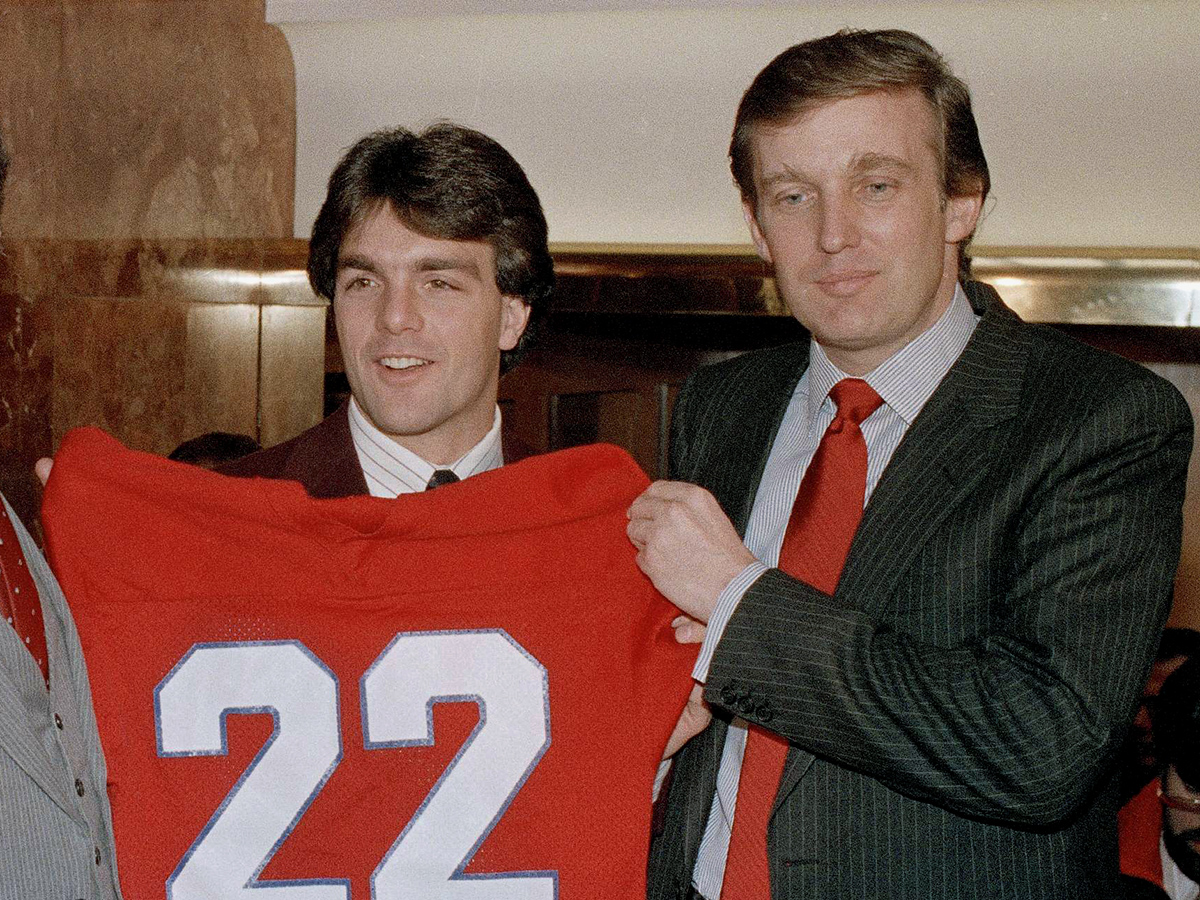
In the quarterfinals, Birmingham beat Houston 22-20, Memphis beat Denver 48-7, Oakland beat Tampa Bay 30-27, and Baltimore beat New Jersey 20-17 -- another Heisman winner, quarterback Doug Flutie, then considered "too short for the NFL," getting the Generals into the Playoffs, but no further.
One is a very small man. The other is a Heisman Trophy winner.
Alas, Flutie was a Republican, and continues to support Trump.
Trump was the first "Flutie Flake."

In the semifinals, Baltimore beat Birmingham 28-14, and Oakland beat Memphis 28-19. In the Championship Game, Baltimore (formerly Philadelphia) beat Oakland (sort of getting revenge on Michigan for the first title game), 28-24, at Giants Stadium.

The date was July 14, 1985. The USFL never played another game. Although this occurrence was suspected by many at the time, and knowing it would have surprised very few people, no one knew it for sure.

*

Later that year, the USFL announced that their challenge to the NFL was going to be full, starting in 1986: They were going to a Fall schedule, going head-to-head with the big boys. And they had sued the NFL on antitrust grounds. The USFL sought damages of $567 million, which, under antitrust law, would have been tripled to $1.7 billion if the jury found in their favor.

The USFL gave the NFL a chance to settle, proposing 2 remedies: Either force the NFL to negotiate new television contracts with only 2 networks, or force the NFL to split into two competing 14-team leagues, each limited to a contract with one major network.

Each NFL franchise was named as a co-defendant, with the exception of the Raiders, whose owner Al Davis was a major witness for the USFL, and had been excluded from the lawsuit in exchange for his testimony.

ABC announcer Howard Cosell was also a key witness for the USFL -- and this, more than his personality, his drinking, or his referring to Alvin Garrett of the Redskins, a black receiver, as "that little monkey" during a recent game, probably doomed him to being fired from Monday Night Football.

The lawyer for the USFL, Harvey Myerson, had what he felt were 3 "smoking guns":
1. A memo from March 1973 to NFL broadcasting director Robert Cochran, from attorney Jay Moyer, stating that an "open network" might be open to the "invitation to formation of a new league."
2. A memo from August 1983 from Jack Donlan, NFL management council executive director, to his staff. The memo laid out plans for NFL teams to "increase salary offers to USFL to existing players or run the risk of losing them."
3. A memo from a Harvard University professor named Michael Porter, which included a plan to "Conquer" the United States Football League.
The case went to trial in the Spring of 1986, and lasted 42 days. On July 29, 1986, the jury handed down its verdict: They declared the NFL a "duly adjudicated illegal monopoly," and found that the NFL had "willfully acquired and maintained monopoly status through predatory tactics." In other words, guilty as charged.
However, the jury rejected the USFL's other claims. They found that the USFL had changed its strategy to a more risky goal of a merger with the NFL. Furthermore, the switch to an Autumn schedule caused the loss of several major markets. It has been established that Trump, as owner of the Generals, specifically wanted to force a merger, knowing that the majority of teams would be eliminated.
Most importantly, the jury found that the NFL did not attempt to force the USFL off television. In essence, the jury felt that, while the USFL was harmed by the NFL's de facto monopolization of pro football in the United States, most of its problems were due to its own mismanagement(In each of these cases, the emphasis is mine, not the jury's.)

The jury awarded the USFL only one dollar in nominal damages, which was tripled under antitrust law to three dollars. It later emerged that the jury incorrectly assumed that the judge could increase the award.

Almost immediately upon announcement of the verdict, the USFL accepted that it was a Pyhrric victory, and announced it was suspending operations for the 1986 season, with the intent of returning in 1987. Players signed to contracts were free to sign with NFL (or other professional) teams immediately.

The USFL was now some $160 million in debt. With nearly all of its players under contract to the NFL and the Canadian Football League, Commissioner Harry Usher announced the league would stay shuttered in 1987 as well. In 1990, now basically a shell of a corporation (if not a "shell corporation," a term with which Trump is well familiar), the USFL finally received a check for $3.76 in damages, the additional 76 cents representing interest earned while the ultimately failed appeal had continued. (Factoring inflation in, that's about $8.41 in 2022 money.)

*
So what is the USFL's legacy? Actually, when you look at it, it could hardly be seen to have been a waste of time:
* Four players from the league made the Pro Football Hall of Fame: Steve Young went on to quarterback the 49ers to a title, Jim Kelly led the Buffalo Bills into 4 Super Bowls, Reggie White became a terror on defense for the Eagles and helped the Green Bay Packers win a Super Bowl, and Los Angeles Express offensive tackle Gary Zimmerman protected John Elway for 2 Bronco titles.

* The Redskins used some players who'd gotten their profiles raised in the USFL to win the title in the 1987 season. Oklahoma/Arizona's Doug Williams became the 1st black quarterback to play in, and the 1st to win, a Super Bowl, throwing passes to Jacksonville's Gary Clark and Houston's Ricky Sanders, and handing off to Philadelphia/Baltimore's Kelvin Bryant.

* Herschel Walker is not in Canton, but he should be: It's the Pro Football Hall of Fame, not the National Football League Hall of Fame. He gained 8,225 rushing yards and 4,859 receiving yards in the NFL, scoring 82 touchdowns. Put that together with his USFL stats, and that's 13,787 rushing yards, 6,843 receiving yards, and 143 touchdowns. Those are easily Hall-worthy numbers.

His NFL career is best remembered for the Cowboys trading him to the Minnesota Vikings for 5 players and 6 draft picks, which became a huge part of the Cowboys' quasi-dynasty of the 1990s. Herschel never won a ring, but he made the Playoffs with the Vikings, the Eagles and a return to the Cowboys, where he closed his career after the 1997 season. He also returned to the Meadowlands in 1995, with the Giants, but they didn't make the Playoffs that year. (The less said about his 2022 run for U.S. Senator from Georgia, the better.)

* Steve Spurrier moved on to Duke University, and revived their football program, giving them one of their few good periods, before going home to Gainesville and leading the University of Florida to glory.

* Doug Flutie was signed by the Chicago Bears after the USFL folded, but coach Mike Ditka didn't give him much of a shot. So he went to the CFL, and won Grey Cups with the Vancouver-based BC Lions, the Calgary Stampeders and the Toronto Argonauts.

Finally, the Bills gave him a shot, and, as Kelly's successor, he led them to the Playoffs. He would also do so with the San Diego Chargers, and closed his career in with his "hometown" Patriots (he grew up in Natick, on the opposite site of Boston from Foxborough, but was actually born outside Baltimore), backing up Tom Brady, and pulling off a trick that would have been in character for the USFL: On New Year's Day 2006, faking an extra point attempt as the holder, he dropped back and scored on a dropkick, something that hadn't been done, or even tried, in the NFL since 1941. That left...

* Sean Landeta as the last former USFL player still active. He'd been the Stars' punter, and won 2 Super Bowls with the Giants. He then bounced around, but reached the Playoffs with the Buccaneers, Packers, Eagles and Rams, before wrapping it up with the Giants in 2006, 21 years after the last USFL game.

* Houston's Jack Pardee and Darrel "Mouse" Davis (who took the Denver Gold reins in '85) both took the Gamblers' "run-and-shoot offense" elsewhere, Pardee racking up big scores as head man at the University of Houston, and Davis becoming the offensive coordinator of the Detroit Lions, helping them to what remains their last decent period.

* The USFL, like the 1960s AFL and the 1970s WFL, used the 2-point conversion. The NFL finally adopted it in 1994.

* Many high school football teams named the Panthers adopted the Michigan Panthers' helmet design for their own, and some still use it, decades after the Panthers folded.

* Perhaps the most lasting legacy of the USFL is its stock footage. Rather than pay the NFL the enormous licensing fees for use of their games, many TV shows and advertising agencies (for their commercials) have used USFL game footage to simulate people watching football games.

As Billy Joel, who released his album An Innocent Man shortly after the USFL's 1st season, would say, "There are not many who remember. They say a handful still survive." And many of those who do remember would like to forget.

Not me. On the 20th Anniversary, I wrote this piece for the song-parody website Amiright.com.

Long live The Three Dollar League!

Wednesday, January 29, 2020

How Long It's Been: The San Francisco 49ers Won a Super Bowl

I did one of these for the Kansas City Chiefs, for whom it's now been 50 years, half a century. Now, it's time to do it for their opponents in Super Bowl LIV, the San Francisco 49ers, for whom it's been half as long, 25 years, a quarter of a century.

This will be the Niners' 7th appearance in a Super Bowl, and their 3rd at the current home of the Miami Dolphins. It was named Joe Robbie Stadium, for the Dolphins' founding owner, from its opening on August 16, 1987 until August 25, 1996. This period included the Niners' wins in Super Bowls XXIII , over the Cincinnati Bengals); and XXIX, over the team then known as the San Diego Chargers. It also included the founding of MLB's Florida Marlins, who began play there in 1993.

It was then known as Pro Player Park until September 9, 1996, then tweaked slightly to Pro Player Stadium until January 9, 2005. Pro Player was the sports division of clothing company Fruit of the Loom. This period included the Marlins' wins in the 1997 and 2003 World Series.

It was just Dolphins Stadium from January 10, 2005 to April 7, 2006, then the S was dropped and it was Dolphin Stadium until May 7, 2009. Then the Dolphins and the stadium were bought by a group led by Stephen Ross, which also included Florida-based singer Jimmy Buffett, and, to help market a beer Jimmy was selling, it was renamed Land Shark Stadium until January 5, 2010.

After 2 weeks as just "Dolphin Stadium" again, naming rights then went to an insurance company, and it was Sun Life Stadium until January 31, 2016, a period that included the Marlins' 2012 move to Marlins Park, on the site of the previous Dolphins stadium, the Orange Bowl, and their change of name to the Miami Marlins. The current Dolphins stadium was New Miami Stadium until August 16, 2016, and it's been Hard Rock Stadium, for the Hard Rock Cafe chain of restaurants, since then.

That's 10 different names in 33 years of operation. That's even worse than the new arena of the Philadelphia 76ers and Flyers.

As for the 49ers' other Super Bowls: They won XVI over the Bengals at the since-demolished Pontiac Silverdome in the Detroit suburbs, they won XIX over the Dolphins at the since-rebuilt Stanford Stadium in Palo Alto in their own suburbs, they won XXIV over the Denver Broncos at the Superdome in New Orleans, and they lost XLVII to the Baltimore Ravens at the Superdome.

The 49ers were so successful, for so long, that it's hard to believe there was a time when they were a joke franchise. They were 2-14 in back-to-back seasons in 1978 and '79. Then a new regime came in, and turned them around, making them perhaps the most talent-laden NFL team ever.

Quaterbacks Joe Montana and Steve Young, receivers Jerry Rice and Terrell Owens, defensive linemen Fred Dean, Charles Haley, Rickey Jackson and Chris Doleman, and defensive backs Ronnie Lott and Deion Sanders are all in the Hall of Fame. So are head coach Bill Walsh and team owner Eddie DeBartolo.

Players from this period of 49er history who are not in Canton, but probably should be, include receiver Dwight Clark, running back Roger Craig, center Randy Cross, guard Guy McIntyre, linebacker Ken Norton Jr., and George Seifert, who replaced Walsh as head coach in 1989.

From 1981 to 2002, in 22 seasons, they made the Playoffs 18 times, won the NFC Western Division 14 times, won at least 1 Playoff game 13 times, reached the NFC Championship Game 10 times, reached the Super Bowl 5 times, and won all 5, including 4 in the 9 seasons from 1981 to 1989.

In 2011, '12 and '13, they went 36-11-1, made it to the NFC Championship Game all 3 times, and reached Super Bowl XLVII, although they lost it. This was when Colin Kaepernick was an All-Pro quarterback, before he became a symbol of civil rights protest. Now, they are back.

True, there were some bad seasons mixed in there, including 2-14 in 2004 and 2016, and 4-12 in 2005 and 2018. But they are back.

They had previously been good in the 1950s, including 1957 when they tied the Detroit Lions for the NFL Western Division title, but lost a Playoff; and in the early 1970s, when they won the 1st 3 NFC West titles and got to back-to-back NFC Championship Games, losing both to the Dallas Cowboys, a Playoff rivalry that would be renewed in the 1990s: From 1992 to 1997, either the 49ers or the Cowboys would be in the NFC Championship Game every year; and they played each other in it the 1992, '93 and '94 seasons.

But while they have had some success since, the San Francisco 49ers haven't won a World Championship since Super Bowl XXIX, on January 29, 1995, 25 years ago today. How long has that been?

*

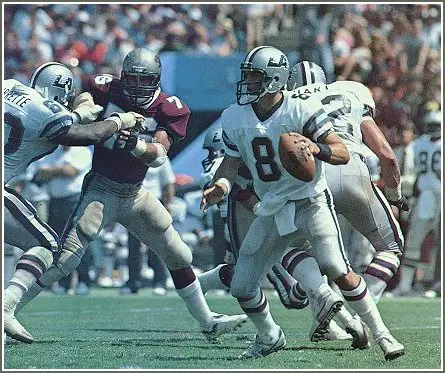
The 1994-95 season was the NFL's 75th, and there were a lot of celebrations, including the occasional wearing of "throwback uniforms." The 49ers chose to go with their 1950s version, as seen in the photo of Steve Young above, with "drop shadow numerals."

Since then, the 49ers have moved from Candlestick Park, at the southeastern corner of San Francisco (6 miles from downtown), to Levi's Stadium in Santa Clara, closer to downtown San Jose (7 miles) than to downtown San Francisco (45 miles).

To put it another way: Whereas once they were about as close to downtown SF as the Meadowlands is to Times Square, they are now that close to downtown SJ, and further from the downtown of the city in their name than any other team currently in North America's Big Five leagues.

In addition to the 49ers, every NFL team has since moved to a new stadium at least once, with 5 exceptions: The Dolphins still play at Hard Rock Stadium, the Chiefs still play at Arrowhead Stadium, the Green Bay Packers still play at Lambeau Field, the New Orleans Saints still play at the Superdome, and the Buffalo Bills still play at what was then named Ralph Wilson Stadium (now New Era Field).

With the Raiders having since moved back to Oakland and now back out, to Las Vegas, the Oakland Athletics are the only San Francisco Bay Area team still playing in the same stadium where they had played in 1994(-95). And except for the Knicks and Rangers at Madison Square Garden, every one of the New York Tri-State Area teams has moved (counting NYCFC, which didn't exist yet, which is also true of the Red Bulls, but they've moved once as well).

So have the NFL's Los Angeles Rams, Cleveland Browns (restored) and Houston Oilers. The NBA's Toronto Raptors, Vancouver Grizzlies and Charlotte Bobcats began play, but the Grizzlies moved to Memphis, and the Bobcats replaced the Charlotte Hornets, who moved to New Orleans. The Seattle SuperSonics moved to become the Oklahoma City Thunder, and the New Jersey Nets have just become the Brooklyn Nets. In the NHL, the Quebec Nordiques became the Colorado Avalanche, the old Winnipeg Jets became the Phoenix Coyotes, and the Hartford Whalers became the Carolina Hurricanes. The Nashville Predators, Atlanta Thrashers, Minnesota Wild and Columbus Blue Jackets began play, but the Thrashers became the new Winnipeg Jets. MLS, the WNBA and the NWSL have all since been founded.

The defending World Champions were the Dallas Cowboys in the NFL, the Houston Rockets in the NBA, the Rangers in the NHL (ugh, but the Devils were about to change that), and, in MLB, well, officially, the Toronto Blue Jays, but technically nobody, since there was no 1994 World Series. George Foreman was in his improbable 2nd reign as Heavyweight Champion of the World.

The Broncos, the New England Patriots, the Tampa Bay Buccaneers, the New Orleans Saints and the Seattle Seahawks have each since won their 1st NFL Championship. The Philadelphia Eagles have won their 1st since it began to be called the Super Bowl.

The Atlanta Braves, the Florida Marlins, the Arizona Diamondbacks, the team currently known as the Los Angeles Angels, the Houston Astros and the Washington Nationals have since won their 1st World Series. The Giants have won their 1st since moving to San Francisco. The Boston Red Sox have since broken a drought of 86 years, the Chicago White Sox 88 years, and the Chicago Cubs 108 years.

The San Antonio Spurs, the Miami Heat, the Dallas Mavericks, the Cleveland Cavaliers and the Toronto Raptors have won their 1st NBA Championship. The New Jersey Devils, the Colorado Avalanche, the Dallas Stars, the Tampa Bay Lightning, the Carolina Hurricanes, the Anaheim Ducks, the Los Angeles Kings, the Washington Capitals and the St. Louis Blues have won their 1st Stanley Cup.

Football legends Don Hutson, Sammy Baugh, Jay Berwanger, Sid Luckman, Otto Graham, Elroy Hirsch, Don Blanchard, Glenn Davis, Chuck Bednarik and Doak Walker were still alive.

Ray Lewis and Peyton Manning were in college. Tom Brady and Drew Brees were in high school. Eli Manning, Troy Polamalu and Ben Roethlisberger were in junior high. Aaron Rodgers was 11 years old. Matt Ryan was 9; Clay Matthews and Ndamukong Suh were 8; Colin Kaepernick was 7; Richard Sherman, Russell Wilson and Nick Foles were 6; Cam Newton and Rob Gronkowski were 5; Odell Beckham Jr. was 4; Dak Prescott and Jimmy Garoppolo were 3; Michael Thomas was almost 2; and Baker Mayfield, Joey Bosa, Patrick Mahomes, Joe Burrow, Lamar Jackson, Sam Darnold, Kyler Murray and Tua Tagovailoa weren't born yet.

Current Chiefs coach Andy Reid was an assistant coach with the Green Bay Packers. Current 49ers coach Kyle Shanahan was in high school in the suburbs of Denver, where his father Mike was head coach of the Broncos.

Barry Trotz of the Islanders was the head coach of the Portland Pirates, a minor-league hockey team in Maine. Mike Miller of the Knicks was the head coach at Texas State University. David Quinn of the Rangers was an assistant coach at Northeastern University in Boston.

Aaron Boone of the Yankees was playing in the Cincinnati Reds' farm system. Alain Nasreddine of the Devils was playing for the minor-league Chicoutimi Saguenéens. Chris Armas of the Red Bulls was playing for the minor-league Long Island Rough Riders. Ronny Deila of NYCFC was playing for Odds Ballklubb in Skien, Norway. Kenny Atkinson of the Nets was playing in Spain's basketball league. Luis Rojas of the Mets and Adam Gase of the Jets were in high school. Joe Judge of the Giants was in junior high school. And Walt Hopkins of the Liberty was 9 years old.

The Olympic Games have since been held in America (twice), Japan, Australia, Greece, Italy, China, Canada, Britain, Russia, Brazil and Korea -- and had never previously been held in South America. The World Cup has been held in France, Japan, Korea, Germany, South Africa, Brazil and Russia -- and had never previously been held in Asia and Africa, or in a joint venture (2002 in Japan and Korea).

The idea that people of the same gender could marry each other, and have all the legal rights of married couples, was considered absurd. But so was the idea that corporations were "people," and entitled to all the rights thereof. Clarence Thomas, Ruth Bader Ginsburg and Stephen Breyer were the only Justices then on the U.S. Supreme Court who are still on it now.

Bill Clinton was in his 1st term as President. George W. Bush had just been inaugurated as Governor of Texas. George H.W. Bush, Ronald Reagan, Jimmy Carter, Gerald Ford and their wives, and Lady Bird Johnson were all still alive. (Reagan, Mrs. Johnson, and Mr. and Mrs. Ford have since died.) Barack Obama was teaching constitutional law at the University of Chicago. Joe Biden was the ranking Democrat on the Senate Foreign Relations Committee. Donald Trump was with his 2nd wife, and the idea of him entering politics was ridiculous.

The Governor of California was Pete Wilson, a hard-line conservative Republican who loved the death penalty and hated immigrants. The idea that California would rebel against him and became one of the most reliably Democratic States was considered a pipe dream. But it happened. He had hoped to ride his re-election in 1994 to the Presidency in 1996, as former Governor Ronald Reagan had done, but he dropped out before 1995 was over. The Mayor of San Francisco was Frank Jordan. Wilson and Jordan are both still alive, in their 80s.

Current Governor Gavin Newsom was a real estate developer, specializing in restaurants and hotels. Current Mayor London Breed (that's her real name) was at the University of California at Davis, outside Sacramento -- putting her, at least in terms of physical distance, closer to the Governor of her State than to the Mayor of her City.

The Governor of New York was George Pataki. Current Governor Andrew Cuomo was Assistant Secretary of Housing and Urban Development. The Mayor of New York City was Rudy Giuliani. Current Mayor Bill de Blasio was an aide to Congressman Charlie Rangel. The Governor of New Jersey was Christine Todd Whitman. Current Governor Phil Murphy was running the European office of Goldman Sachs in Frankfurt, Germany.

The holders of the Nobel Peace Prize were Yitzhak Rabin, Shimon Peres and Yasser Arafat -- and now we know how that worked out. The Pope was John Paul II. The current Pope, Francis, then Jorge Mario Bergoglio, was Archbishop of Oca, Spain.

There were still surviving veterans of World War I, the Easter Rising, the Bolshevik Revolution and the Mexican Revolution. There were still living survivors of the Johnstown Flood of 1889, the Galveston Hurricane of 1900, the General Slocum disaster of 1904, the Triangle Shirtwaist Factory fire of 1911, the sinkings of the Titanic and the Lusitania, and the workers on the Panama Canal.

The Prime Minister of Canada was Jean Chretien, and of Britain John Major. The monarch was Queen Elizabeth II -- that hasn't changed. Manchester United were the holders of both the Premier League and the FA Cup, but were about to cede the former to Blackburn Rovers of Lancashire and the latter to Everton of Liverpool. There have since been 4 Presidents of the United States, 5 Prime Ministers of Britain and 3 Popes.

Major novels of 1995 included The Horse Whisperer by Nicholas Evans, Independence Day by Richard Ford, The Rainmaker by John Grisham, High Fidelity by Nick Hornby and Angela's Ashes by Frank McCourt. Timothy Findley published a novel titled The Piano Man's Daughter. It was not about Alexa Ray Joel.

None of the Harry Potter, A Song of Ice and Fire/Game of Thrones, Bridget Jones, Twilight or
Hunger Games novels had yet been published. And no one had yet heard of Robert Langdon, Lisbeth Salander or Bella Swan.

Major films of early 1995 included Higher Learning, Murder in the First, Before Sunrise, Miami Rhapsody, Boys on the Side, Billy Madison, and the Western The Quick and the Dead. Pierce Brosnan's 1st outing as James Bond, Goldeneye, would premiere the following November. Dean Cain was playing Superman on TV, but Val Kilmer's turn as Batman on film would be a pathetic mess. And Sylvester McCoy was still the last man to play The Doctor.

Television shows that had aired, or were about to air, their final first-run episodes were Empty NestBlossomFull HouseMatlock and Northern Exposure. Newly-debuted were NewsRadio,
Sliders and the entire WB and UPN networks (eventually to merge), including Star Trek: Voyager. Soon to debut were Ned & Stacey (the 1st series to star Debra Messing), Caroline in the CityJAGMADtvThe Drew Carey Show, and a show only slightly more cartoonish than that one, Pinky and the Brain. And yet, it was the Yankees who ended up taking over the world.

No one had yet heard of Ash Ketchum, Carrie Bradshaw, Tony Soprano, Jed Bartlet, Master Chief, Jack Bauer, Omar Little, Rick Grimes, Wynonna Earp, Leroy Jethro Gibbs, Michael Bluth, Michael Scott, Don Draper, Walter White, Jax Teller, Richard Castle, Leslie Knope, Sarah Manning, Jane "Eleven" Hopper or Maggie Bell.

The Number 1 song in America was "Creep" by TLC. The surviving members of the Beatles were finishing The Beatles Anthology. Michael Jackson released HIStory. Tupac Shakur got married in prison.

Kourtney Kardashian and Pink were 16. Michelle Williams (both of them), Ben Savage, Kim Kardahsian, Christina Aguilera, Alicia Keys, Kelly Rowland, Hayden Christensen and Jessica Alba were 14. Natalie Portman, Beyonce Knowles, Britney Spears, Sienna Miller and Kirsten Dunst were 13. Prince William, Matt Smith and Anne Hathaway were 12. Prince Harry and Khloe Kardashian were 10.

Lady Gaga was 9, Rob Kardashian Jr. 8, Kevin Jonas and Rihanna 7, 7, Joe Jonas 5, Daniel Radcliffe and Emma Watson 4. So was Sarah Hyland, and the rest of the Modern Family kids had not yet been born. Nor had Kendall and Kylie Jenner. Louis Tomlinson was 3. Selena Gomez, Demi Lovato, Nick Jonas, Miley Cyrus and Zayn Malik were 2. The other One Direction singers, Liam Payne, Nial Horan and Harry Styles, had yet to reach a 2nd birthday. Justin Bieber was about to have his 1st, so he wasn't a "Boyfriend," he was a "Baby."

Inflation has been such that what $1.00 bought then, $1.71 would buy now. A U.S. postage stamp was 32 cents. A New York Subway token was $1.25. The average price of a gallon of gas was $1.20, a cup of coffee $1.74, a McDonald's meal $5.29, a movie ticket $4.35, a new car $17,900, and a new house $158,900. The Dow Jones Industrial Average closed the preceding Friday at 3,857.99.

The tallest building in the world was the Sears Tower in Chicago. The Internet was still new to most of us. Most of us had never heard of Microsoft or Netscape or America Online. There was no Facebook, no YouTube, no Twitter, no Instagram and no Pinterest. VHS videotapes were still the dominant way of recording and playing back movies and TV shows. Mobile phones were still roughly the size of the communicators on Star Trek. The birth control pill was long-established, but there was, as yet, no Viagra.

In the Winter of 1995, the World Trade Organization was established. Valeri Polyakov became the 1st person to complete and entire year in space, about Russia's Mir space station. An earthquake killed over 5,000 people in China. President Clinton extended a bailout to Mexico to keep its economy from collapsing.

Rose Kennedy, and Peter Cook, and former Middleweight Champion Carlos Monzón died. Megan Thee Stallion, and Leonard Fournette, and Arsenal players Calum Chambers and Héctor Bellerín
were born.

January 29, 1995. The San Francisco 49ers won the Super Bowl. It was their 5th win. There has not yet been a 6th.

They will have the chance for that 6th Super Bowl win this Sunday, playing the Kansas City Chiefs -- one team trying to break a drought of 25 years, the other a drought of 50 years.

Tuesday, January 9, 2018

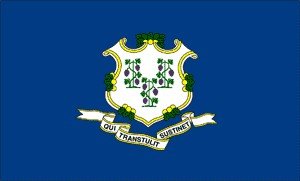
Top 10 Athletes From Connecticut

January 9, 1788: Connecticut becomes the 5th State to ratify the Constitution of the United States.

Top 10 Athletes From Connecticut

This one's going to be a little tricky, because the University of Connecticut has produced so many great basketball players, men and women, but few of them have actually been from Connecticut. This is also true of the UConn Huskies' great inter-regional rivals, Duke University and the University of North Carolina; and the UConn Lady Huskies' great inter-regional rivals, the University of Tennessee.

Yale University, in New Haven, has also had many great athletes, but few of them have come from the Nutmeg State, either.

Very Honorable Mention to Walter Camp of New Haven. But not so much for what he did as a player. It's for his role as an innovator. He only invented football. Okay, not quite, but pretty much everything that made football America's most popular sport in the 20th Century was invented by either him or a man he coached at Yale, Amos Alonzo Stagg.

At the age of 14, he attended the 1873 meeting where representatives of Yale, Columbia, Rutgers and Princeton created the 1st governing body of American football, the Intercollegiate Football Association. At the time, it was still a variation on soccer. By the time he entered Yale in 1875, Harvard, having gone to Montreal to play McGill University, had begun to change it into a game that more resembled rugby.

He played halfback at Yale, graduating in 1880. That year, there was a rules convention for college football, and Camp proposed that the contested scrimmage known to rugby be replaced with a line of scrimmage, where the team with the ball started with uncontested possession. There it is: The moment American football was truly "invented," and Walter Camp was the inventor.

Camp also had the number of players on a side reduced from 15 to 11, with a 7-man line and a 4-man backfield. He also invented the center snap, the downs system, and the two-point safety. He also created the concept of the All-American team, college football's all-star system. At the age of 33 -- the same age at which Thomas Jefferson wrote the Declaration of Indepedence, and at which Jesus is usually said to have died and risen -- he was already known as "The Father of Football."

He was also a pretty good coach, going 67-2 at Yale from 1888 to 1892, and 12-3-3 at newly-opened Stanford from December 1892 to 1895. And on Christmas Day 1894, he and his protege Stagg played the 1st truly intersectional football game, at the Haight Street Grounds in San Francisco -- in a way, inventing the holiday-season bowl game. Stagg's University of Chicago team beat Stanford 24-4.

Camp died in 1925, 65 years old. He lived long enough to see professional football become a reality, and to see the founding of the National Football League. He did not quite live long enough to see Red Grange make the NFL financially viable, and he certainly couldn't have imagined it would become the colossus it had already become by the time Stagg died in 1965, at age 102.

Honorable Mention to Dorothy Hamill of Greenwich, Fairfield County. Like that other 1976 Olympic hero, Bruce Jenner, she had, as Whitney Houston sang in the theme song for the 1988 Games, "One moment in time." But that moment, in which she won the ladies' figure skating Gold Medal in Innsbruck, Austria will live forever.

Honorable Mention to Baseball Hall-of-Famers from Connecticut. Roger Connor of Waterbury, New Haven County, was the top slugger of the 1880s, helping the New York Giants win Pennants in 1888 and 1889. It was his total of 138 career home runs that was the record that Babe Ruth broke on his way to 714.

Jim O'Rourke of Bridgeport, Fairfield County, was an outfielder who batted .311 lifetime, and was a teammate of Connor's on the 1888 and '89 Giants. He also won Pennants with the Boston Red Stockings in the National Association in 1873, '74 and '75; and in the National League with the Red Stockings in 1877 and '78, and the Providence Grays in 1879. In 1904, he came out of retirement to play 1 more game for the Giants. At 54, he became, and remains, the oldest player in an NL game and the oldest player ever to get a hit in an MLB game.

Ned Hanlon of Montville, New London County, was a center fielder who helped the Detroit Wolverines win the 1887 NL Pennant, but it's as a manager that he got into the Hall of Fame -- 89 years after he last wore a major league uniform. He managed the NL version of the Baltimore Orioles to the Pennant in 1894, '95 and '96.

He moved to the Brooklyn team, which was sort-of named after him, as there was a circus troupe known as Hanlon's Superbas -- hence, the early Dodgers were known as the Brooklyn Superbas. He managed them to Pennants in 1899 and 1900, the last "world championships" they would win until the 1955 World Series.

Honorable Mention to Ken Strong of West Haven, New Haven County. He starred for 4 different professional football teams in the New York Tri-State Area: The NFL's Staten Island Stapletons and New York Giants, the 1936-37 AFL's New York Yankees, and the American Association's Jersey City Giants. A running back and kicker, he helped the Giants reach 6 NFL Championship Games, winning the title in 1934. The Giants retired his Number 50.

Honorable Mention to Andy Robustelli of Stamford, Fairfield County. A 7-time Pro Bowler, he won NFL Championships with the 1951 Los Angeles Rams and the 1956 Giants. He and Strong are both in the Pro Football Hall of Fame.

Honorable Mention to Harry Jacunski of New Britain, Hartford County. The 2-way end was a member of Fordham University's 1937-38 line known as the Seven Blocks of Granite, He was then an All-Pro as a rookie with the Green Bay Packers in 1939, helping them win the NFL Championship. He won another title with them in 1944, and was named to their team Hall of Fame.

This one is a little personal. My family and the Jacunskis have been friends for 50 years, and my parents lived in Bloomfield, New Jersey, next-door to Harry's son Dick, his wife Lynn, and their 3 daughters when I was born. I met Harry a few times, and he bore the effects of early pro football: While his mind was still clear into his mid-80s, I can't recall ever seeing him stand up.

Speaking of towns named Bloomfield...

Honorable Mention to Dwight Freeney of Bloomfield, Hartford County. One of the top defensive ends of his generation, he's been to 7 Pro Bowls. He won Super Bowl XLI with the Indianapolis Colts, and went to Super Bowl LI with the Atlanta Falcons last year. He's now with the Detroit Lions. He was named to the NFL's 2000s All-Decade Team, and will probably end up in the Pro Football Hall of Fame.

Honorable Mention to John Williamson of New Haven. "Super John" won ABA Championships with the New York Nets in 1974 and 1976, and he was still with them when they entered the NBA and moved to Rutgers and then to the Meadowlands. The team retired his Number 23, and has kept it retired after moving to Brooklyn.

Honorable Mention to Nykesha Sales of Bloomfield, Hartford County. A forward, she played for UConn's undefeated National Champions in 1995, and was an 8-time WNBA All-Star with the Orlando Miracle and her home-State Connecticut Sun.

Honorable Mention to Scott Burrell of Hamden, New Haven County. He starred in both baseball and basketball at UConn, and played 8 years in the NBA, winning the title with the Chicago Bulls in 1998.

Honorable Mention to Jennifer Rizzotti of New Fairfield, Fairfield County. With the UConn dynasty, she won the National Championship in 1995, and in 1996 won both the Wade Trophy as player of the year -- women's basketball's "Heisman" -- and the Honda-Broderick Cup as the outstanding female collegiate athlete of the schoolyear. She won WNBA Championships with the Houston Comets in 1999 and 2000.

She coached the University of Hartford to the America East Conference title in the regular season 3 times and in its tournament 4 times. She is now the head coach at George Washington University in D.C.

Honorable Mention to Alyssa Naeher of Bridgeport, Fairfield County. As the backup goalkeeper to Hope Solo, she did not play in the 2015 Women's World Cup, but was a member of the winning U.S. team. She also starred in basketball in high school.

Honorable Mention to George Springer of New Britain, Hartford County. Despite a name that sounds like that of an English aristocrat, George Chelston Springer III has ancestry from Puerto Rico and Panama. He seemed set up for sport greatness: His father, George II, played in the 1976 Little League World Series, and played football at UConn. His mother, Laura, was a gymnast. His sisters, Nicole and Lena, were college softball players. Even his fiancée, Charlise Castro, is a former athlete, a softball player at the University of Albany.

But there's setups, and then there's setups. On their June 25, 2014 cover, Sports Illustrated featured him, wearing a Houston Astros 1970s throwback uniform, and said that the Astros would win the 2017 World Series. This was because of the many high draft picks they'd gotten after being terrible for a few years.

Did "The Dreaded SI Cover Jinx" strike him? Yes: A month later, he went on the Disabled List, and missed the rest of the season. But a funny thing happened on the way to jinxdom: He helped the Astros win the American League Wild Card the next year, and then the next year, led the AL in plate appearances.

In 2017, he was moved from right field to center field, made the All-Star Game, and helped the Astros win the Pennant. He then tied the record of Reggie Jackson and Chase Utley, and hit 5 home runs in the World Series, including 1 in Game 7 (which neither Reggie nor Chase did, as both their Series ended in 6), and was named Series Most Valuable Player as the Astros won their 1st World Championship.

Dishonorable Mention to Bill Romanowski of Vernon, Tolland County. The linebacker made 2 Pro Bowls, and reached the Super Bowl with the San Francisco 49ers (winning XXIII and XXIV), the Denver Broncos (winning XXXII and XXXIII), and the Oakland Raiders (losing XXXVII).

But he was one of the nastiest and most-fined players in NFL history, and was outed as a steroid user. He is eligible for the Pro Football Hall of Fame, and if he were judged on his play alone, he might get in. But he'll never get in.

Now, the Top 10:

10. Jonathan Quick of Hamden, New Haven County. The Los Angeles Kings' goaltender won the Conn Smythe Trophy as Playoff MVP as he helped them win their 1st Stanley Cup in 2012 -- unfortunately, beating my Devils to do it.

In 2014, he won the William M. Jennings Trophy for lowest goals-against average. Jennings was an old-time executive for the New York Rangers, so it's somewhat appropriate that the Kings then beat the Rangers for another Cup. Quick is a 2-time All-Star.

9. Chris Drury of Trumbull, Fairfield County. In 1989, he pitched Trumbull's team to the Little League World Series title. He had just turned 13 (having been 12 when the season began, making him eligible), and, like most LLWS winners, this was as far as he would ever get in baseball.

But he was good at another sport. His 113 goals make him the all-time leading scorer in the long, proud hockey history of Boston University. He is also the only BU player with 100 goals and 100 assists. In 1998, he won the Hobey Baker Award as the best collegiate hockey player -- hockey's "Heisman Trophy." The next season, with the Colorado Avalanche, he won the Calder Memorial Trophy as NHL Rookie of the Year, making him the 1st (and still only) player ever to win both the Baker and the Calder.

In 2001, he helped the Avalanche win the Stanley Cup, unfortunately beating my Devils in the Finals. He was Captain of the Buffalo Sabres for 3 seasons and of the Rangers for 3 more. He finished his NHL career with 255 goals, and is now the general manager of the Rangers' farm team, back in Connecticut, the Hartford Wolf Pack.

8. Jeff Bagwell of Killingworth, Middlesex County. He was born on May 27, 1968, the same exact day as Frank Thomas, also a big strong 1st baseman who ended up in the Baseball Hall of Fame. "Bags" played his entire career with the Houston Astros, batting .297, and is their all-time leader with 449 home runs.

A 4-time All-Star, he was National League Rookie of the Year in 1991, won the NL MVP and a Gold Glove in 1994, and helped the Astros reach the postseason in 1997, 1998, 1999, 2001 and 2004, before, in his final season, getting them their 1st Pennant in 2005. By a weird twist of fate, they played Thomas' Chicago White Sox, who won, though Thomas was injured. The Astros retired his Number 5.

7. Calvin Murphy of Norwalk, Fairfield County. In 1967, at Norwalk High School, he was named Mr. Basketball USA -- the best high school basketball player in the entire country. In his honor, the school's address is now 23 Calvin Murphy Road. He attended Niagara University in Buffalo, and was drafted by the San Diego Rockets in 1970. They moved to Houston the next year, and he played for them his entire career.

At 5-foot-9, he may have been the shortest great basketball player ever. He was an All-Star in 1979, and helped the Rockets reach their 1st NBA Finals in 1981. He set records, since broken, for highest single-season free throw percentage and most consecutive free throws made. The Rockets retired his Number 23. He is in the Basketball Hall of Fame.

6. Bill Rodgers of Newington, Hartford County. The greatest marathon runner in American history, he won the Boston Marathon in 1975, 1978, 1979 and 1980, and the New York City Marathon in 1976, 1977, 1978 and 1979. He also won marathons in Baltimore, Miami, Houston, Toronto, Rio de Janeiro, Stockholm, Kyoto and Melbourne.

Unfortunately, his Olympic experience wasn't nearly as successful: He finished 40th in Montreal in 1976, he missed 1980 in Moscow because of the U.S. boycott, and by 1984 in Los Angeles, he was 36 years old.

5. Floyd Little of New Haven. After Jim Brown and Ernie Davis, he continued the Syracuse University tradition of great running backs with the Number 44. He then played 9 seasons with the Denver Broncos, making 2 AFL All-Star Games and 3 NFL Pro Bowls, and leading the NFL in rushing in 1971.

Syracuse and the Broncos both retired Number 44 for him, and the Broncos also elected him to their Ring of Fame. He has been elected to the College and Pro Football Halls of Fame.

4. Willie Pep of Middletown, Middlesex County. Born Guglielmo Papaleo, "The Will o' the Wisp" was Featherweight Champion of the World for all but 4 months between 1942 and 1950. He was famed for his fights with Sandy Saddler, losing the title in their 1st fight, regaining it in their 2nd, losing it again in their 3rd, and unable to get it back in their 4th.

The Ring magazine named him Fighter of the Year for 1945. He won his 1st 62 professional fights, and was 134-1-1 when he first lost to Saddler. His final record was an astounding 229-11-1. He fought from 1940 to 1966. Do the math: He averaged almost 9 victorious fights a year for over a quarter of a century. Today, fighting half that often would be considered unsafe. He did have dementia pugilistica -- what was once known as "being punch-drunk" -- in his last years.

The Associated Press named him the greatest featherweight of the 20th Century, and he is in the International Boxing Hall of Fame.

3. Kristine Lilly of Wilton, Fairfield County. The midfielder was part of the University of North Carolina's women's soccer dynasty, winning 4 straight National Championships. She was a member of the U.S. team that won the 1st Women's World Cup in 1991, the Olympic Gold Medal in Atlanta in 1996 and Athens in 2004, and the 1999 Women's World Cup. With her 1999 teammates, Sports Illustrated honored her as one of the Sportswomen of the Year.

She captained the U.S. team from 2004 to 2008, and is a member of the U.S. Soccer Hall of Fame.

2. Steve Young of Greenwich, Fairfield County. A direct descendant of Mormon pioneer Brigham Young, and a graduate of the University that bears his name, while born in the Mormon home State of Utah, he grew up on what became Metro-North's New Haven Line.

After finishing 2nd in the Heisman Trophy voting in 1983, he was drafted by the Tampa Bay Buccaneers, but nobody wanted to play for them at that time, so he took the money and ran, to the USFL, with the most ridiculous contract in sports history. Even the Mets' still-running deal with Bobby Bonilla wasn't this whacked-out, since, even with their Madoff-banjaxed finances, the Mets can afford it. The Los Angeles Express gave him a 10-year, $40 million contract, with an annuity paid out over 40 years. But the Express were bankrupt, and Young settled for $1.4 million.

He then became the most frustrated quarterback in NFL history (with only Doug Flutie as a legitimate contender for that title), as he suffered through 2 seasons in Tampa, then got stuck behind Joe Montana on the San Francisco 49ers, winning 2 Super Bowl rings despite not throwing a pass in either Super Bowl XXIII or Super Bowl XXIV.

An injury to Montana in the 1990 NFC Championship Game opened the door for him. He made 7 Pro Bowls, was named NFL MVP in 1992 and 1994, and in the 1994 season, he took the Niners all the way, winning Super Bowl XXIX. He threw 6 touchdown passes in the game, breaking Montana's single-game Super Bowl record, and was named the game's MVP.

BYU and the 49ers both retired his Number 8. (Oddly, despite a team history going back to 1946, he is the only 49er to wear that number.) He was elected to the College and Pro Football Halls of Fame -- and while he wasn't the 1st lefthanded quarterback to win a Super Bowl (Ken Stabler was, 18 years earlier), Young was the 1st to be elected to Canton. He was named to The Sporting News' 100 Greatest Football Players and the NFL Network's 100 Greatest Players.

And he no longer stands in anyone's shadow: Not in his ancestor's, not in Jim McMahon's at BYU, not in Joe Montana's in San Francisco, and not in Donald Trump's in the USFL.

1. Brian Leetch of Cheshire, New Haven County. As regular readers of this blog know, I am a New Jersey Devils fan, and I hate the New York Rangers. The 1994 NHL Eastern Conference Final between them still sticks in my craw. But the achievements of Leetch cannot be dismissed.

Born in Corpus Christi, Texas, he grew up in Cheshire, closer to the Hartford Whalers than to the Rangers. In 1988-89, he set an NHL record that still stands with 23 goals by a rookie defenseman, and was awarded the Calder Memorial Trophy as NHL Rookie of the Year.

A 10-time All-Star, he won the James Norris Memorial Trophy as the NHL's top defenseman in 1992 and 1997. In 1994, when the Rangers won the Stanley Cup, he was awarded the Conn Smythe Trophy as Playoffs MVP, the 1st American to receive it. And, in 1996, he captained the U.S. team to the World Cup of Hockey.
You didn't really think I was going to
show him in a Ranger shirt, did you?

He was named to the Hockey Hall of Fame, The Hockey News' 100 Greatest Players in 1998 (while still active), and the NHL's 100th Anniversary 100 Greatest Players in 2017. At the retirement ceremony for his Number 2 in 2008, no less than Mark Messier called him the greatest Ranger of all time. This was backed up a year later in Russ Cohen and John Halligan's 100 Ranger Greats.

Wednesday, March 6, 2013

Remembering the USFL: 30 Years Later

March 6, 1983, 30 years ago today: The United States Football League plays its first games.

You don't remember the USFL? Even if you're over 35, that's not surprising. Its detractors called it the USeless Football League and the Undeniably Sorry Football League.

It could have succeeded. Indeed, the timing seemed to be right: The NFL was coming off a season in which there had been a strike, canceling almost half the season. Fans should have been willing to take something new: A professional football league playing in the Spring, when there was no pro football.

But the timing wasn't right, at least according to the calendar. The 1st season started on March 6, when the NBA and NHL seasons were coming down the home stretch. The Championship Game was held on July 17, just as baseball's 2nd half was getting underway.

Had the league started in early May, by which point all but a few teams would have been eliminated from the NBA Playoffs and the Stanley Cup Playoffs, and the Championship Game on August 28, the last Sunday before the NFL season started, then, for most of the season, they would have only had baseball to contend with, as the North American Soccer League was already fading into irrelevance.

Here were the original 12 teams, and what else they had to compete with nearby at the time:

* Arizona Wranglers. No NFL, MLB or NHL at the time, just the NBA's Phoenix Suns. Played at Sun Devil Stadium, which was (and is) owned by Arizona State University, so even if there had been an NFL team playing there at the time, it couldn't have kept the Wranglers out. This was a good market for the USFL.

* Birmingham Stallions. Nothing: No MLB, no NBA, no NHL, and while the State of Alabama considers college and high school football to be a religion, there is no NFL team there. (This is also the case for several other Southern States, and for basketball in Kentucky. It is also why the Pacers have never been more popular than IU and Purdue in Indiana, and why no pro basketball team has succeeded in North Carolina.) Played at Legion Field. This was a good market for the USFL.

* Boston Breakers. Everything: The Celtics and Bruins, both perennial postseason teams at that point, and the Red Sox in April. Played at Nickerson Field, the 21,000-seat stadium of Boston University, where the Patriots played in their first few AFL seasons. The Patriots wouldn't let them play at what was then named Sullivan Stadium (formerly Schaefer, later Foxboro), and Boston College wouldn't let them use their larger Alumni Stadium. This franchise should never have been placed in Boston, even though the Patriots were a joke franchise at the time.

* Chicago Blitz. Everything: The Bulls and Blackhawks, both perennial postseason teams at the point, and the Cubs and White Sox in April. Played at Soldier Field, which was (and is) city-owned, so the Bears couldn't keep them out. Too many distractions for the fan dollar, but Chicago was the 3rd-biggest market and a football-mad one, so they had to have a Chicago team.

* Denver Gold. There was then no MLB or NHL team, but the NBA's Nuggets were a perennial postseason team. Played at Mile High Stadium, which was city-owned, so the Broncos couldn't keep them out. Still, the Broncos were a good team at the time, and the "Broncomania" that began with their 1st good season in 1973, and was seriously hyped up during their run to the Super Bowl in the 1977 season, had hardly abated. So this was a bad market for the USFL.

* Los Angeles Express. Everything: The Lakers and Kings, both perennial postseason teams at that point, and the Dodgers and the team then known as the California Angels in April. Played at the Los Angeles Coliseum, which was (and is) city-owned, so the Raiders, then using it as their home field, couldn't keep them out. Plus the Rams were still in the area, playing at Anaheim Stadium. But L.A. was the 2nd-biggest market, so they had to have an L.A. team.

* Michigan Panthers. Everything: The Pistons and Red Wings weren't very good at this point, but had solid fan bases that would not abandon them; and the Tigers in April. Played at the Silverdome, which was owned by its municipality, the Detroit suburb of Pontiac (it is now privately owned), so the Lions couldn't keep them out. The Lions were a good team at this point, and playing football in nice weather got canceled out by the dome, so as much as the State of Michigan loves its football, putting a franchise there was a bad idea.

* New Jersey Generals. Everything: The Knicks, Rangers and Islanders, all perennial postseason teams at that point, plus the Nets, who were (unusual for them) in the middle of back-to-back Playoff seasons; the Devils, finishing their terrible 1st season; and the Yankees and Mets in April. Played at Giants Stadium in the Meadowlands, which was State-owned, so the Giants couldn't keep them out. But New York was the biggest market, so they had to have a "New York" team, yet they took advantage of the ill feelings of New Jerseyans (including myself) who were mad at the Giants for moving to the State but not changing their names. More on this in a moment.

* Oakland Invaders. No NHL team then. The NBA's Golden State Warriors were pretty weak. Neither the San Francisco Giants nor the Oakland A's were any good at the time. The 49ers across San Francisco Bay had just had a letdown season after winning the Super Bowl the season before, and no one foresaw the Niners becoming the NFL's dominant team. And the Raiders had split down the Coast a year earlier, leaving the Oakland Coliseum, then as now owned by Alameda County (so the Raiders couldn't have kept them out anyway), available for football all year long. And they would pick up all the Raider fans still angry about the team abandoning the East Bay. So the nation's 4th-largest market was a good one for the USFL experiment.

* Philadelphia Stars. Everything: The 76ers and Flyers, both perennial postseason teams at that point, and the Phillies in April. Played at Veterans Stadium, which was city-owned, so the Eagles couldn't keep them out. But Philly was in a rare period where all its teams had recently been good, so while the Eagles had collapsed the preceding fall, the timing was still bad for a Spring football team based in Philadelphia. But Philly was a market both big and football-mad, and so the team was put there.

* Tampa Bay Bandits. Nothing: No MLB, no NBA, no NHL, and the NFL wasn't starting again until September. Played at Tampa Stadium, "the Big Sombrero," which was city-owned, so the Buccaneers couldn't keep them out. And the Bucs stunk then, so this was a good market for the USFL.

* Washington Federals. No MLB team at that point, but the NBA's Bullets (now Wizards) and the NHL's Capitals; neither was then good, but both were there. Played at Robert F. Kennedy Stadium, which was (and is) owned by the federal government, so the Redskins couldn't keep them out. But while putting a team in the Nation's Capital seemed like a must, putting a team in the same town as the Redskins -- who were not only a wildly popular institution in the town but had just won the Super Bowl a few weeks before -- was financial suicide.

A league needs big names. At first, the biggest names were the coaches. New Jersey was coached by Chuck Fairbanks, who had led the University of Oklahoma to 3 Big Eight titles and the Patriots to their first AFC East title. Jim Stanley had led Oklahoma State to a Big Eight title, and was appointed to coach the Michigan franchise. Chicago was coached by George Allen, who had led the Redskins to the 1972 NFC title.

Oakland was coached by John Ralston, who had won 2 conference titles each at Utah State and Stanford, and had guided the Broncos to NFL respectability. Ralston's successor with the Broncos was Red Miller, who led them to the 1977 AFC Championship, and was hired to run the Denver franchise. Philadelphia was coached by Jim Mora Sr., who was not yet a big name, but he had coached at Stanford, UCLA, and the universities of Colorado and Washington, and had been an NFL assistant; he coached Philadelphia.

Tampa Bay was coached by Steve Spurrier, not yet "the ol' ball coach" who led his alma mater, the University of Florida, to SEC dominance and a National Championship, but was already a Heisman Trophy-winning quarterback, a respected college assistant, and the biggest living name in Florida collegiate football -- unless you want to count actor Burt Reynolds, a Florida State alum, and a part-owner of the team, named after his character in Smokey and the Bandit, although their logo was a Wild West desperado on a charging horse. The Bandits were Spurrier's 1st head coaching job.

Burt is an old man now, washed-up as far as acting goes. And he was never a particularly good actor. It's hard to explain to kids today just how big he was in the late Seventies and early Eighties. Like another guy who played college football in Florida, Dwayne "The Rock" Johnson -- but with a Southern drawl, a classic mustache, and a series of toupees that changed with the styles of natural hair.
"For the good old American life: For the money,
for the glory, and for the fun. Mostly for the money."

Los Angeles was coached by Hugh Campbell, who was not yet a big name in the U.S., but had coached the Edmonton Eskimos to the last 5 Grey Cups, the "Super Bowl" of the Canadian Football League (and had also played on a Grey Cup winner with Saskatchewan in 1966). His predecessor with the Esks (I know, dumb nickname, but they're a very successful franchise) was Ray Jauch, also not yet a big name in the U.S., but he had coached the Esks to the 1975 Grey Cup (and had also played on a Grey Cup winner with the Winnipeg Blue Bombers in 1959); he coached the Washington franchise.

Boston was coached by Dick Coury, who had previous insurgent-league experience, coaching the Portland Storm of the 1974-75 World Football League. Birmingham was coached by Rollie Dotsch, a respected assistant under Dan Devine at the University of Missouri and Notre Dame, and in the NFL under Fairbanks in New England and Chuck Noll in Pittsburgh. Arizona was coached by Doug Shivley, who'd been an assistant in New Orleans and Atlanta and at several colleges.

*

I was 13 years old when the USFL began, and I was very excited about the New Jersey Generals.  At the time, I hated the Jets, because most of their fans were Met fans, and I hated the Mets. This was due to geography (both then played at Shea Stadium in Queens and also tapped into the Long Island fan base) and timing (both arrived in the early 1960s, just in time to take on Baby Boomers not steeped in Yankee & Giant traditions, and both won their leagues' championships in calendar year 1969). Until the Mets and Giants both won their leagues' 1986 championships (in that season if not that calendar year), it would never have occurred to 95 percent of Met fans to root for the Giants.

And I hated the Giants because of their refusal to acknowledge that they played in my home State by changing their name. The Generals admitted that they were based in the New York City market, but playing in New Jersey. They had Herschel Walker, one of the best running backs the college game had ever seen, a smart, personable young man. (It would be a long time before we knew about his personal demons, which, thankfully, haven't ruined him, and now appear to be under control.) And I loved their helmet logo, a five-star general's ring of stars with leaf clusters.

As Theodore Roosevelt said about his 1912 Progressive Party, "Unhampered by tradition, uncorrupted by power, undismayed by the magnitude of the task, the new party offers itself as the instrument of the people, to sweep away old abuses." To me, and to many other fans, especially after the Strike of '82, the NFL represented established interest, corporate power, regimentation. True, I wasn't yet mature enough to think in those terms, but I could certainly feel it, watching games of what was already being called the No Fun League.

The USFL represented a clean slate. A chance to have a team without the connections to the Giants, then 27 years without a title and pretty frustrating since then, even if you did like them; or to the Jets, who had just come within 1 game of the Super Bowl, but were symbolized by Mark Gastineau, whose long hair, "porn 'stache," and obnoxious behavior made him the favorite player, and the Jets the favorite team, of "ginkers," what we called metalheads in East Brunswick in the Egregious Eighties.

The Generals had no past, and while this meant that we couldn't glory in their 1932, 1947, 1956, 1961 or 1977 titles (as we could with the Yankees), it also meant there was no dark age (as the Giants and Knicks were still in and the Yankees had been in from 1965 to 1975). There was no glory, but no shame, either.

And this was coming on the back of the Nets, who were in New Jersey and (all too briefly) winning; and the Devils, who were wrapping up their 1st season, playing horribly, but the novelty hadn't worn off yet, so we new Devils fans didn't care. The Generals, playing in a league where all the teams were expansion teams, would have a chance to win right from the start.

I was excited. I was buzzing. I was jazzed.

I was monumentally disappointed.

*

Is it possible for a league to be made by one game? People who study the history of the NFL seem to think so: It was when Red Grange took his "Galloping Ghost" fame from the University of Illinois into the Polo Grounds in 1925 and sold it out, and, although his Chicago Bears beat the Giants that day, the gate receipts from a 70,000-seat sellout saved the Giant franchise, thus making football in the New York market viable, thus making professional football in America viable. (This probably also killed off the best chance professional soccer had to make it in America for half a century.)

Is it possible for a league to be ruined by one game? From my perspective, it was. The Generals had signed the league's biggest coup, the sitting Heisman Trophy winner, Herschel Walker, lured out of his senior season at the University of Georgia and being a sure top pick in the 1984 NFL Draft by money and lots of it. But the Generals had no defense, and their 1st game, televised live on ABC, with the great college football voice Keith Jackson doing play-by-play, ended with the Los Angeles Express beating the Generals, 20-15, in front of just 32,008 fans, meaning the Coliseum had over 60,000 empty seats.

Other 1st-week games in the USFL: In the 1st game to be played, Tampa Bay beat Boston 21-17, Michigan beat Birmingham 9-7, Philadelphia beat Denver 13-6, Chicago beat Washington 28-7, and Oakland beat Arizona 24-0.

The Generals lost their 2nd game, too, losing 25-0 to the Stars at the Vet. They lost their 3rd game, their 1st home game at the Meadowlands (or, I was I was calling it then, "Generals Stadium"), 32-9 to the Bandits. They lost their 4th game, 31-21 to Boston at the Meadowlands.

As Stars coach Jim Mora would later say when he was coaching the New Orleans Saints, "Playoffs?" Don't talk about Playoffs! You kidding me? Playoffs? I just hope we can win a game!"

Finally, the Generals went on a bit of a hot streak: They beat Arizona in Tempe, 35-21; then lost a home game to Michigan, 21-6, then got their 1st home win, 23-22 over a pathetic Washington squad; then lost in overtime in Chicago, 17-14; then beat Denver at Mile High, 34-29. Winning 3 out of 5 is good.

Then they lost their next 3, killing their momentum. They closed the season doing what a New York-area team should not do: They lost to a New England team, losing 34-10 in Boston. In the USFL's 18-game regular season, they finished 6-12, and didn't make the Playoffs.

Philadelphia won the Atlantic Division, Michigan the Central, Oakland (with a mere 9-9 record) the Pacific, and Chicago (tied for the Central lead but lost the tiebreaker) got the only Wild Card berth for the Playoffs. Philly beat Chicago at the Vet, Michigan beat Oakland in Pontiac, and in the Championship Game, played on July 17, 1983, on neutral ground at Mile High in Denver, the Michigan Panthers, starring former University of Michigan receiver Anthony "The Darter" Carter, beat the Philadelphia Stars, 24-22.
Carter and the Panthers

*

The standard of play wasn't great, but it wasn't abject misery as claimed by the media, which was in the pocket of the NFL. Don't forget, while ABC did the USFL's games, it also did Monday Night Football, and thus had a vested interest in the NFL's dominance. Even so, it was the 3rd-largest network, and both CBS and NBC had it in their interest for the USFL to fail.

If a sportswriter wanted to be interviewed for his football knowledge on a major network, he had to treat the USFL like a minor league. And not like in soccer, where England's 2nd division (now oddly named "The Championship") is a standard not that far below the 1st division ("The Premier League"), which would have been close to the USFL's actual performance level: The USFL was treated by the national media as if it was, truly, minor-league. And, as baseball pitcher turned sportscaster turned author Jim Bouton taught us, "The minor leagues are all very minor." (Though Bouton made an exception for Triple-A baseball's Hawaii Islanders.)

In management terms, the USFL was a colossal mess. The Denver Gold were a prime example: Red Miller feuded with management, so they fired him in midseason, and brought in his former Bronco quarterback, Craig Morton, who had just retired as a player, and had never coached before.

The L.A. Express were losing money left and right, and made a huge mistake the next season, signing Steve Young, the Brigham Young University quarterback who had nearly won the Heisman Trophy the year before, to an enormous contract, comparable in its excess to that of Alex Rodriguez, in its deferred payments to that of Bobby Bonilla, and in its results to that of Kevin Brown, who, lest we forget, was once considered good enough of a pitcher to get MLB's 1st contract worth a total over $100 million.
Steve Young, wondering if the money
he was promised was worth it

The USFL was also failing spectacularly at the box office. Leading the league in percent of stadium capacity filled were the Boston Breakers, with 61 percent -- but that meant they were getting 12,817 at Nickerson, which seated 21,000 at the time. Denver, which hadn't played to an unsold seat at a Bronco game since 1976 (and still hasn't, except for the Scab Year of 1987), had the highest average attendance, but even their 41,736 was only 56 percent. Tampa Bay had 39,896, but that was just 55 percent.

New Jersey (35,004), Oakland (31,211) and Arizona (25,776) also topped 25,000, but Birmingham's 22,046 was shockingly low for the football-mad State of Alabama, and L.A.'s 19,002 and Chicago's 18,133 were unacceptable for big markets. Even the teams that made it to the title game weren't packing 'em in: Michigan averaged 22,250, Philadelphia 18,650. These would have been unacceptable attendances even by the standards of 1983 baseball. Washington bottomed out at 13,850, in contrast to the Redskins, who hadn't played to an unsold seat since World War II.

Birmingham coach Dotsch, perhaps, said it best:

Every good coach has a game plan. In this case, the USFL got away from the game plan. There's no question we did, or I'll say the USFL did. I don't think we (meaning the Stallions) did, or Tampa Bay did. Hindsight is much better than foresight, I know, but things were done that hurt us. We didn't go crazy. We lost the fewest dollars of any USFL team. We were always the poorest team in the playoffs, but we held our own, and I'm proud of that. We did a good job with what we had. We won a lot more than we lost, and that's the biggest thing.
*

Clearly, the smart thing for the USFL to do was to look at which markets were doing well, and which markets didn't have as much competition in other sports, and move the failing teams (even if they were playing well) to lesser-tapped markets for the Spring of 1984.

Clearly, the USFL did not do the smart thing.

They moved the Breakers from Boston to New Orleans, where the only major league team in place was the Saints, who stunk at the time, and didn't own the Superdome. (The State of Louisiana did, and still does.) That wasn't a bad move, and attendance did jump to 30,557.
John Walton, who quarterbacked in the Continental Football League,
the WFL, the NFL (Philadelphia) and the USFL (the Breakers).

But the league made a huge mistake in expanding from 12 to 18 teams. A tremendous sub-mistake was making one of the added teams the Pittsburgh Maulers, who signed Heisman winner Mike Rozier of Nebraska. Ed DeBartolo, owner of the NHL's Penguins, and father of 49ers owner Eddie DeBartolo, seemed like the right guy to own a Pittsburgh team in the USFL... if putting a USFL team in Pittsburgh had been the right thing to do.

It wasn't. It wasn't so much that the Pittsburgh area had lost so many jobs, and with  it so many people, who went elsewhere to look for work. It was that the Steelers owned that market. In Western Pennsylvania, here's how sports popularity went at the time: 1. Steelers; 2. Penn State; 3. Pirates; 4. University of Pittsburgh football; 5. Uh, do we still have a hockey team?

Giving the Maulers purple uniforms didn't help. And what's a "mauler," anyway? The helmet logo was a guy in a hard hat swinging a sledgehammer, suggesting a factory or mill worker. Right, remind the people of Western Pennsylvania of the jobs they'd been losing like crazy for the last 20 years.
Rozier, looking for a pass from Glenn Carano, while Jim Lohmann blocks.
You've never heard of Carano or Lohmann? That's not surprising.

The Maulers' 1st game saw them lose to Birmingham, whose quarterback was Cliff Stoudt, reviled as Terry Bradshaw's inadequate backup with the Steelers, and the locals at Three Rivers Stadium threw snowballs at him. Rozier, a native of Camden, New Jersey, did not have the same impact in the USFL as Walker, and his pro career was a disappointment (although not an outright bust, as he later did all right for the Houston Oilers). The Maulers finished tied with Washington for the league's worst record, 3-15.

Seeing the Southeast as underserved -- Texas and Florida had NFL teams, but the rest of the old Confederacy then had only Atlanta and New Orleans in the NFL -- and seeing how Birmingham was working out, the USFL expanded to include the Memphis Showboats and the Jacksonville Bulls, playing at the Liberty Bowl and the Gator Bowl, respectively.

Memphis was respectable mainly for one reason: Defensive end Reggie White, who played in the State at the University of Tennessee. They were coached by Franklin "Pepper" Rodgers, who'd done well at the stadium for Memphis State (now the University of Memphis). But Lindy Infante, already a respected NFL assistant, couldn't get much out of the Bulls.
The USFL also expanded into the Southwest. Putting a team in Dallas to compete with the Cowboys would have been lunacy, but the Oilers were awful at the time, so they put in the Houston Gamblers, coached by Jack Pardee, a former linebacker who'd been All-American at Texas A&M and All-Pro with the Rams and Redskins, and had coached the Bears and Redskins to Playoff berths. The Gamblers signed University of Miami quarterback Jim Kelly, and won the Central Division.
Jim Kelly, apparently trying to invent an alternative to the huddle

Putting a team in San Antonio seemed to make sense, as the city had only the NBA's Spurs. But longtime Texas A&I (not A&M) coach Gil Steinke couldn't get the Gunslingers into gear. Putting a team in Oklahoma, where they could peel off Sooner fans, and fans who were a long way from Dallas and Kansas City, seemed to make sense, and hiring former Steeler defensive coordinator Woody Widenhofer as head coach and former Buccaneers quarterback Doug Williams were good moves. And the Oklahoma Outlaws had cool uniforms, black jerseys with a nasty-looking desperado on their helmets. But they went nowhere.
Doug Williams had Jimmie Giles in Tampa,
and Gary Clark and Ricky Sanders in Washington.
In Tulsa, he had... the other Mel Gray.

And in the oddest transaction in pro football history, the owners of the Chicago Blitz and Arizona Wranglers traded their entire franchises. Including rosters, coaching staffs, and front office personnel. Where Chicago had been good and Arizona terrible in '83, the reverse was true in '84.

L.A. got Steve Young, and former San Diego Charger quarterback John Hadl as coach, and they won the Pacific Division. Philadelphia had the best record in the league at 16-2, edging New Jersey for the Atlantic Division title.

The Generals had been sold to Donald Trump, who brought in Walt Michaels, who'd coached the Jets to the AFC Championship Game in the '82 season, and former Cleveland Browns quarterback Brian Sipe, thus giving the Herschel-centric offense more diversity.
One of these men would later be treated for mental illness.
The other hasn't been, but became President.

(Supposedly, Trump originally wanted to lure Don Shula away from the Miami Dolphins, but balked when Shula wanted a condo in Trump Tower. Somehow, I suspect, the older Trump would have accepted this.)

The Generals lost to the Stars in the 1st round of the Playoffs, as former Penn State quarterback Chuck Fusina, running back Kelvin Bryant, and linebacker Sam Mills flattened Jersey's team. In the longest game in the history of professional football, one which went to a 3rd overtime (Sports Illustrated's article on it was titled "It Was a Game and a Half"), Steve Young led Los Angeles to dethrone defending champion Michigan, 27-21. Birmingham beat Tampa Bay, 36-17, and Arizona beat Houston, 17-16.
Kelvin Bryant. Like the Phillies, the Stars had uniforms
that really clashed with the horrid artificial turf at The Vet.

In the Conference Championships, Arizona beat L.A., 35-23, and Philly beat Birmingham, 20-10. The title game was played at Tampa Stadium, and Philly beat Arizona, 23-3.
This is what a USFL Championship ring looks like.

*

Did the USFL learn from its '83 and '84 mistakes? Partly. The league was contracted to 14 teams. Chicago and Pittsburgh were out. Michigan and Oakland were merged, keeping the Oakland Invaders name. Oakland and Arizona were merged, becoming the Arizona Outlaws, with the colors somewhat merged and Oklahoma's logo kept.

There were moves. To take advantage of the fact that the Baltimore Colts had been moved to Indianapolis, the USFL should have moved the Washington Federals to Baltimore. Instead, they moved their most successful team, the Philadelphia Stars, down Interstate 95.

But a legal wrangle prevented them from moving to Memorial Stadium for 1985, so they went to Byrd Stadium at the University of Maryland, inside the Capital Beltway in College Park. So while they had the name "Baltimore Stars," they were a lot closer to Washington. This sent their per-game attendance from 28,668 in '84 to a dismal 14,275 in '85.

The Federals were moved, to Central Florida, an untapped market, to become the Orlando Renegades. Their coach was Lee Corso, a big name in the State as he'd been Florida State's coach. Did this work out? As Corso would say in his later ESPN punditry career, "Not so fast, my friend!" The 'Gades finished 5-13, with an average attendance of 24,136, better than they were in Washington, but still awful.

And the Breakers were moved again, to Oregon, where they became the Portland Breakers. True, Portland only had the NBA's Trail Blazers, but anybody who was an NFL fan in Oregon was either a Seattle Seahawks fan, or rooted for a faraway team like the Raiders, Steelers or Cowboys. And the L.A. Express crashed and burned: Their owners were bankrupt, and even with Steve Young, they were just 3-15, with an average attendance of 8,415.

In the quarterfinals, Birmingham beat Houston 22-20, Memphis beat Denver 48-7, Oakland beat Tampa Bay 30-27, and Baltimore beat New Jersey 20-17 -- another Heisman winner, quarterback Doug Flutie, then considered "too short for the NFL," getting the Generals into the Playoffs, but no further.
One is a very small man. The other is a Heisman Trophy winner.
Alas, Flutie was a Republican, and continues to support Trump.

In the semifinals, Baltimore beat Birmingham 28-14, and Oakland beat Memphis 28-19.  In the Championship Game, Baltimore (formerly Philadelphia) beat Oakland (sort of getting revenge on Michigan for the first title game), 28-24, at Giants Stadium.

The date was July 14, 1985. The USFL never played another game. Although this was suspected by many, no one knew it for sure.

*

Later that year, the USFL announced that their challenge to the NFL was going to be full, starting in 1986: They were going to a Fall schedule, going head-to-head with the big boys. And they had sued the NFL on antitrust grounds. The USFL sought damages of $567 million, which, under antitrust law, would have been tripled to $1.7 billion if the jury found in their favor.

The USFL gave the NFL a chance to settle, proposing 2 remedies: Either force the NFL to negotiate new television contracts with only 2 networks, or force the NFL to split into two competing 14-team leagues, each limited to a contract with one major network.

Each NFL franchise was named as a co-defendant, with the exception of the Raiders, whose owner Al Davis was a major witness for the USFL, and had been excluded from the lawsuit in exchange for his testimony.

ABC announcer Howard Cosell was also a key witness for the USFL -- and this, more than his personality, his drinking, or his referring to a black receiver as "that little monkey" during a game, probably doomed him to being fired from Monday Night Football.

The lawyer for the USFL, Harvey Myerson, had what he felt were 3 "smoking guns":
1. A memo from March 1973 to NFL broadcasting director Robert Cochran, from attorney Jay Moyer stating that an "open network" might be open to the "invitation to formation of a new league."
2. A memo from August 1983 from Jack Donlan, NFL management council executive director, to his staff. The memo laid out plans for NFL teams to "increase salary offers to USFL to existing players or run the risk of losing them."
3. A memo from a Harvard professor named Michael Porter, which included a plan to "Conquer" the United States Football League.
The case went to trial in the Spring of 1986 and lasted 42 days. On July 29, 1986, the jury handed down a verdict that was a Pyrric victory. The jury declared the NFL a "duly adjudicated illegal monopoly," and found that the NFL had "willfully acquired and maintained monopoly status through predatory tactics." In other words, guilty as charged.
However, the jury rejected the USFL's other claims. They found that the USFL had changed its strategy to a more risky goal of a merger with the NFL. Furthermore, the switch to an Autumn schedule caused the loss of several major markets. It has been established that Trump, as owner of the Generals, specifically wanted to force a merger, knowing that the majority of teams would be eliminated.
Most importantly, the jury found that the NFL did not attempt to force the USFL off television. (Emphasis mine.) In essence, the jury felt that, while the USFL was harmed by the NFL's de facto monopolization of pro football in the United States, most of its problems were due to its own mismanagement

The jury awarded the USFL only one dollar in nominal damages, which was tripled under antitrust law to three dollars. It later emerged that the jury incorrectly assumed that the judge could increase the award.

Almost immediately upon announcement of the verdict, the USFL announced it was suspending operations for the 1986 season, with the intent of returning in 1987. Players signed to contracts were free to sign with NFL (or other professional teams) immediately.

The USFL was now some $160 million in debt. With nearly all of its players under contract to the NFL and the Canadian Football League, Commissioner Harry Usher announced the league would stay shuttered in 1987 as well. In 1990, now basically a shell of a corporation (if not a "shell corporation," a term with which Trump is well familiar), the USFL finally received a check for $3.76 in damages in 1990, the additional 76 cents representing interest earned while the ultimately failed appeal had continued. Notably, 23 years after being written, that check has not yet been cashed.

*

So what is the USFL's legacy? Actually, when you look at it, it could hardly be seen to have been a waste of time:

* Four players from the league made the Pro Football Hall of Fame: Steve Young went on to quarterback the 49ers to a title, Jim Kelly led the Buffalo Bills into 4 Super Bowls, Reggie White became a terror on defense for the Eagles and helped the Green Bay Packers win a Super Bowl, and Los Angeles Express offensive tackle Gary Zimmerman protected John Elway for 2 Bronco titles.

* The Redskins used some players who'd gotten their profiles raised in the USFL to win the title in the 1987 season. Oklahoma/Arizona's Doug Williams became the 1st black quarterback to play in, and the 1st to win, a Super Bowl, throwing passes to Jacksonville's Gary Clark and Houston's Ricky Sanders, and handing off to Philadelphia/Baltimore's Kelvin Bryant.

* Herschel Walker is not in Canton, but he should be: It's the Pro Football Hall of Fame, not the National Football League Hall of Fame. He gained 8,225 rushing yards and 4,859 receiving yards in the NFL, scoring 82 touchdowns. Put that together with his USFL stats, and that's 13,787 rushing yards, 6,843 receiving yards, and 143 touchdowns. Those are easily Hall-worthy numbers.

His NFL career is best remembered for the Cowboys trading him to the Minnesota Vikings for 5 players and 6 draft picks, which became a huge part of the Cowboys' quasi-dynasty of the 1990s. Herschel never won a ring, but he made the Playoffs with the Vikings, the Eagles and a return to the Cowboys, where he closed his career after the 1997 sesaon. He also returned to the Meadowlands in 1995, with the Giants, but they didn't make the Playoffs that year.

* Steve Spurrier moved on to Duke University, and revived their football program, giving them one of their few good periods, before going home to Gainesville and leading the University of Florida to the prominence that it still enjoys. Even if, at times, he does seem like a redneck version of Manchester United soccer manager Alex Ferguson.

* Doug Flutie was signed by the Chicago Bears after the USFL folded, but coach Mike Ditka didn't give him much of a shot. So he went to the CFL, and won Grey Cups with the Vancouver-based BC Lions, the Calgary Stampeders and the Toronto Argonauts.

Finally, the Bills gave him a shot, and, as Kelly's successor, he led them to the Playoffs. He would also do so with the San Diego Chargers, and closed his career in with his "hometown" Patriots (he grew up in Natick, on the opposite site of Boston from Foxboro, but was actually born outside Baltimore), backing up Tom Brady and pulling off a trick that would have been in character for the USFL: On New Year's Day 2006, faking an extra point attempt as the holder, he dropped back and scored on a dropkick, something that hadn't been done, or even tried, in the NFL since 1941. That left...

* Sean Landeta as the last former USFL player still active. He'd been the Stars' punter, and won 2 Super Bowls with the Giants. He then bounced around, but reached the Playoffs with the Buccaneers, Packers, Eagles and Rams, before wrapping it up with the Giants in 2006, 21 years after the last USFL game.

* Houston's Jack Pardee and Darrel "Mouse" Davis (who took the Denver Gold reins in '85) both took the Gamblers' "run-and-shoot offense" elsewhere, Pardee racking up big scores as head man at the University of Houston, and Davis becoming the offensive coordinator of the Detroit Lions, helping them to what remains their last decent period.

* The USFL, like the 1960s AFL and the 1970s WFL, used the 2-point conversion. The NFL finally adopted it after the USFL used it.

* Many high school football teams named the Panthers, including Perth Amboy here in Middlesex County, New Jersey, adopted the Michigan Panthers' helmet design for their own, and some still use it, 29 years after the Panthers folded.

* Perhaps the most lasting legacy of the USFL is its stock footage. Rather than pay the NFL the enormous licensing fees for use of their games, many TV shows and advertising agencies (for their commercials) have used USFL game footage to simulate people watching football games.

It's been 30 years. As Billy Joel would say, "There are not many who remember. They say a handful still survive." And many of those who do remember would like to forget.

Not me. On the 20th Anniversary, I wrote this piece for the song-parody website Amiright.com.

Long live The Three Dollar League!