Showing posts with label san diego chargers. Show all posts

Tuesday, December 23, 2025

December 23, 1995: Snowballs at the Meadowlands

December 23, 1995, 30 years ago: The New York Giants close their season in ignominious fashion -- and the result is far from the worst of it.

They were playing the San Diego Chargers, at Giants Stadium in the Meadowlands. It's important to note that the Giants have no rivalry with the Chargers. This was only the 7th time the 1925-established NFL mainstays and the 1960-established original AFL team had played each other in the regular season. The Giants had won at Yankee Stadium in 1971, at Shea Stadium in 1975, at Giants Stadium in 1986, and at Jack Murphy Stadium in San Diego in 1989. The Chargers had won at The Murph in 1980 and at Giants Stadium in 1983.

None of those games had been particularly contentious. Indeed, even this game had no incidents between the Giant players and the Charger players.

For the Giants, it was a bad season, by any measure. They started out 0-3, closed to within 3-5, fell to 3-9, got up to 5-9, and went into this game 5-10. The Chargers had started 4-7, but had won 4 straight, and had a chance to make the Playoffs if they beat the Giants and other games went their way.

There had been significant snowfall the day before, and only 50,243 fans, out of a possible 78,000+, showed up. While the seats at Giants Stadium had been cleared of snow, there was still a lot of it lying around, waiting for angry -- or, at least mischievous -- fans to turn them into snowballs. At least in the 1st half, they only threw them at each other, because they were pleased with the product on the field: The Giants went into the locker room up 17-3.

This score was understandable: There was snow all around, and the temperature was 34 degrees, 24 with the wind chill. The New York-based team was used to this kind of weather. The San Diego-based team was not.

But a funny thing happened on the way to the Giants giving their fans a Merry Christmas: They ended up giving their fans a big lump of coal instead. The Chargers scored a touchdown, but it was still 17-10 Giants after 3 quarters.

By this point, the snowballs were flying from the stands, then onto the field. Bob Sheppard, who had been the Yankees' public address announcer since 1951 and the Giants' since 1956, put his best "Voice of God" to work on the crowd, telling them that the game could be forfeited if the barrage continued.

On the 1st play of the 4th quarter, referee Ron Blum called time-out. He went over to the Charger sideline to call up to the booth, and ask for a repeat of the threat. A fan threw a snowball in his direction. Except it wasn't a snowball: It was an iceball, much harder. And it didn't hit Blum: It hit Sid Brooks, the Chargers' equipment manager, right in the face, knocking him out.

The game should have been forfeited right there. Maybe it would have been, if Charger head coach Bobby Ross had spoken up at that moment. But he didn't, and it wasn't.

The Chargers completed their drive with a touchdown, and the game was tied. On their next drive, Junior Seau hit Giant quarterback Dave Brown, whose throw had been intended for the end zone. Instead, Shaun Gayle -- now with the Chargers, he had been an All-American sprinter in college and a member of the Chicago Bears' 1985-86 "Super Bowl Shuffle" team -- intercepted it, and returned it 99 yards for a touchdown. Well before he reached the end zone, fans sitting there began throwing snowballs at him. Many got as far as him, but none hit him.

The Giants fumbled on their next possession, and John Carney kicked a field goal for the final score: Chargers 27, Giants 17. It was one thing for the Giants to humiliate their fans, which had happened before. It was another thing for the fans to humiliate each other, and the players.

Giants management announced that any snowball-thrower who could be identified would be banned from the Meadowlands Sports Complex for life, even if that meant revoking his season ticket. Six such spectators were identified, including one who ended up on the back page of the New York Daily News. Giants management also bought a full-page ad in the next day's San Diego Union-Tribune -- the Sunday edition -- apologizing to the people of San Diego for the incident.

By a quirk in the NFL schedule, the New York Jets were scheduled to play at Giants Stadium the very next day. The New Jersey Sports and Exposition Authority, operator of the stadium, went into overdrive to get all the snow removed from the stadium before kickoff. Given that the Jets were going in 3-12 under the already-much-maligned head coach Rich Kotite, a 2nd angry fanbase was possible. But the snow was cleared, there were no incidents, and the Jets lost to the New Orleans Saints, 12-0.

The Chargers did end up making the Playoffs. Since then, they've played the Giants 7 times. The Giants won in San Diego in 1998. The Chargers won in San Diego in 2005 and 2013, at the Meadowlands in 2009 and 2017; following their move back to Los Angeles, at SoFi Stadium in Inglewood, California in 2022, 11 days ago; and the Giants won at the Meadowlands this past September 28.

None of those games had any incidents, either. Only the one on Christmas weekend 1995.

Wednesday, January 29, 2025

January 29, 1995: Steve Young Proves His Point

January 29, 1995, 30 years ago: Super Bowl XXIX is played at Joe Robbie Stadium (now named Hard Rock Stadium) in suburban Miami Gardens, Florida, capping the NFL's 75th Season celebrations. The San Francisco 49ers, appropriately, score 49 points to beat the San Diego Chargers, with 26.

While it is the 5th Super Bowl win for the 49ers, it remains the only Super Bowl appearance for the Chargers, who did win an AFL Championship in 1963. Despite their coming within 14 seasons, no one played on all 5 49er title teams.

Steve Young not only breaks out of the shadow of Joe Montana, but surpasses him in a way, setting a Super Bowl record with 6 touchdown passes. Deion Sanders becomes the 1st man to play in both a World Series and a Super Bowl. He is still the only one. Although he didn't win in either of his World Series appearances with the Atlanta Braves, he went on to win another Super Bowl with the Dallas Cowboys the next season.

It was the 2nd win as 49er head coach George Seifert, following the 1st 3, won by Bill Walsh, to whom he was defensive coordinator.

The 49ers have since been in 3 Super Bowls, losing them all. The Chargers, who moved to Los Angeles for the 2017 season, have lost their only AFC Championship Game appearance since this game.

Thursday, December 26, 2024

December 26, 1964: The Buffalo Bills Triumphant

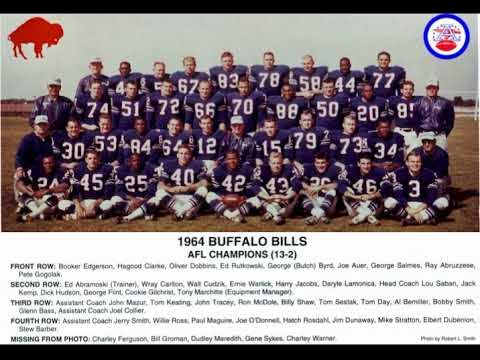
December 26, 1964, 60 years ago: The American Football League Championship Game is played for the 1964 season.

The season before, the San Diego Chargers, coached by Sid Gillman, had won the title, showing football fans that the AFL wasn't just a pass-happy "basketball league": It could feature good defense, too. The Buffalo Bills, coached by Lou Saban, followed the same path, with a defense led by end Ron McDole, tackle Tom Sestak, and linebacker Mike Stratton.

The Chargers would regret letting quarterback Jack Kemp go, as the Bills had acquired him to run their offense. Protected by a future Hall-of-Famer, guard Billy Shaw, he could hand off to running back Carlton Chester "Cookie" Gilchrist, or pass to receiver Elbert Dubenion.

There was once a common trivia question: Name the men wearing Number 32 who won the Most Valuable Player awards in the American League, the National League, the NFL and the AFL in 1963. But the question was no good: Elston Howard, Sandy Koufax, Jim Brown and Gilchrist won their respective awards, but, while the other 3 players wore 32, Gilchrist wore 34.

The Bills went 12-2 in 1964. They dropped 48 points on the Houston Oilers, and scored at least 30 points in 6 other games. Their only losses were on November 15, 36-28 at home to the Boston Patriots; and on December 6, 16-13 away to the Oakland Raiders.

As it was an even-numbered year, it was the Eastern Division winners' turn to host the AFL Championship Game, and the Bills welcomed the defending Champion Chargers into War Memorial Stadium. Built in 1938, it was already dilapidated, known as "The Old Rockpile." Buffalo native Brock Yates, a screenwriter who created the race upon which the Cannonball Run movies were based, said that it "looks as if whatever war it was a memorial to had been fought within its confines." And it was small: At 40,242 seats, its capacity would prove too small when the AFL and the NFL merged in 1970, so the Bills had to build a larger stadium.
In the 1st quarter, Tobin Rote threw a 26-yard touchdown pass to Dave Kocourek, to put the Chargers up, 7-0. But they never scored again. The Bills' defense was symbolized by Stratton hitting Keith Lincoln midway through the 1st quarter, breaking a rib and knocking him out of the game. It was the most famous defensive play in AFL history.
Pete Gogolak and his brother Charley, natives of Hungary, became pro football's 1st "soccer-style kickers," approaching the placement from the side and hitting the ball with the instep of the foot, rather than the traditional straight-on, hit-with-the-toes style. Pete kicked a field goal late in the 1st quarter, and another in the 2nd. In between, Kemp guided the Bills down to where Wray Carlton could score on a 4-yard run. In the 4th quarter, Kemp scored on a quarterback sneak. The Bills won, 20-7.
The Bills won the AFL Championship again in 1965, again beating the Chargers; then lost the 1966 AFL Championship Game to the Kansas City Chiefs. Saban would leave, then return as head coach, and lead the Bills to the AFC Wild Card Playoff berth in 1974.
Like basketball coach Larry Brown, Saban was known, somewhat unfairly, for never staying in the same place for very long, also serving as head coach for the Boston Patriots, the Denver Broncos, and several college teams. He died in 2009. His son, Nick Saban, in junior high school at the time of the Bills' AFL titles, would win 7 National Championships in the college ranks. Unlike many father & son coaching pairs, they never coached together. Indeed, while Lou was head coach at Army in 1979, Nick was an assistant coach at Navy in 1982.
The Bills had won the last 2 AFL Championships before the AFL Champion was allowed to play the NFL Champion for a World Championship, and had lost the game that would have put them in Super Bowl I. It would take until the 1990 season before they finally got into a Super Bowl. And they got into 4 in a row, something no other franchise has done. And yet, they lost all 4, and only the 1st one was all that close (although they were leading the 4th at the half).
The Bills have become to the NFL what the Chicago Cubs once were to baseball, the sport's "lovable losers" with a history of close calls breaking the hearts of some of the most passionate fans in the sport. From 1964 onward, they have been 1 of the last 2 teams standing 6 times, something only 7 other teams have done.
But the fact that the Bills' titles came before the advent of the Super Bowl means that they get discounted: Even before the distance of time became what it is now, NFL fans had come to regard any title won before the Super Bowl, NFL or AFL, as not a "real" championship.
As it stands, through Christmas 2024, no team based in, or near, Buffalo has ever won a major league sports championship. The NHL's Sabres are 0-for-2 in Stanley Cup Finals, and the NBA's Braves, like the Sabres a 1970 expansion team, moved in 1978. Due to Canadian COVID restrictions, the Toronto Blue Jays had to play some "home games" at Buffalo's Sahlen Field in 2020 and '21. Before that, there hadn't been a Major League Baseball team in Buffalo since the 1914-15 Blues of the Federal League; before that, the Bisons of the National League, who folded after the 1885 season. And none of those teams won a Pennant.
Unless you count soccer as a major league sport in North America, with the 1971 Rochester Lancers and the 2016 Western New York Flash, then the last World Championship won by a team that can be considered "Western New York" remains the 1955 NBA Champion Syracuse Nationals. If you don't count Syracuse as "Western," then it's the 1951 NBA Champion Rochester Royals.

Maybe this is the year the Bills finally pull it off. Then again, the Detroit Lions -- the team in which Ralph Wilson had a minority interest before becoming the founding owner of the Bills -- are also closer than they've ever been since their last title, in 1957. If Super Bowl LIX is Bills vs. Lions, one fanbase will be happier than ever, and the other will face the greatest letdown yet.

Friday, January 5, 2024

January 5, 1964: A Title for San Diego

 
January 5, 1964, 60 years ago: The American Football League Championship Game is played for the 1963 season. It marks a turning point for the League. In its 1st 3 seasons, it was a pass-happy league, without much defense. But now, a team was able to combine big offense with big defense.

Barron Hilton received the Los Angeles franchise of the AFL at its founding in 1959. He named the team the Chargers, after the credit card he founded, Carte Blanche. He was the son of hotel magnate Conrad Hilton, the brother of Elizabeth Taylor's 1st husband Conrad Nicholson Hilton Jr. a.k.a. Nicky Hilton, and the grandfather of Paris and Nicky Hilton. He turned out to be the last surviving member of "The Foolish Club," the 8 original AFL owners.

After reaching the 1st AFL Championship Game in the 1960 season, he realized that, even with his money, he couldn't compete with the NFL's Rams and college football's USC and UCLA for the attention of Los Angeles' football fans. So he moved the team down the Coast, and they became the San Diego Chargers. They reached the title game again in 1961, with the same result, losing to the Houston Oilers.

Head coach Sid Gillman built a high-powered offense, with 2 quarterbacks, Tobin Rote and John Hadl. Rote had filled in for an injured Bobby Layne, and led the Detroit Lions to victory in the 1957 NFL Championship Game, 59-10 over the Cleveland Browns. It was a bit of foreshadowing. Oddly, Hadl had also been drafted by the Lions, but the AFL offered more money than the NFL.
Sid Gillman

These passers' favorite target was Lance Alworth, whose running reminded someone of a deer, and so he was nicknamed "Bambi." He would end up as the 1st former AFL player elected to the Pro Football Hall of Fame. (Contrary to what some people believe, it's not the NFL Hall of Fame.) Gillman's offense also had running backs Paul Lowe and Keith Lincoln, tight end Jacque MacKinnon, guard Walt Sweeney, and offensive tackle Ron Mix. Mix would join Alworth in Canton.
Lance Alworth

But it was the defense that marked the '63 Chargers as being different from previous AFL teams. They were one of the teams in the 1960s that called its defensive line "The Fearsome Foursome": Ends Ron Nery and Earl Faison, and tackles Ernie Ladd (also a successful professional wrestler, before that competition became a scripted joke) and Bill Hudson. The linebackers were pretty good, too: Chuck Allen, Frank Buncom and Emil Karas.
Ernie Ladd

Another distinctive feature of San Diego's 1st major league sports team was their uniforms. It wasn't just the lightning bolts on the helmets. From 1960 to 1973, they wore jerseys that had been called "collegiate blue" (probably a reference to UCLA, with whom they shared the Los Angeles Coliseum in 1960), "electric blue" (which matched the "charger" theme) and "powder blue" (which is what it usually gets called today).

The Chargers went 11-3, their only losses coming at the hands of the Denver Broncos and, twice, the Oakland Raiders. They won the AFL Western Division, which meant that, being that it was an odd-numbered year, they would get to host the AFL Championship Game at Balboa Stadium.
Their opponents were the Boston Patriots, who finished only 7-6-1, but that was good enough to tie the Buffalo Bills for 1st place in the Eastern Division. And 2 of the losses were to the Chargers. To be fair, 5 of the 6 losses were by 7 points or less, and the Pats did beat the Bills in Buffalo in a Playoff to get to the Championship Game.

The title game -- postponed a week, due to the postponement of the regular-season games of November 24, 1963, and that due to the assassination of President John F. Kennedy 2 days earlier -- would not be close. It turned out to be the biggest blowout in the 10-year history of AFL Championship Games. Since the 1970 merger with the NFL, only once has the winning team in the AFC Championship Game matched the Chargers' point total, the 1990-91 Buffalo Bills; and no team has surpassed it. No team has scored this many in the NFC Championship Game, either.

The Chargers wasted little time. Rote took a quarterback sneak for a touchdown. Lincoln scored on a 67-yard run. The Patriots scored on Larry Garron's 7-yard touchdown run, to close to within 14-7, but that was as close as they would get. Lowe ran 58 yards for a touchdown, and it was 21-7 San Diego after a quarter.

George Blair of the Chargers and Gino Cappelletti of the Patriots traded field goals in the 2nd quarter. But the fact that the Chargers were able to score 24 points in the 1st half, none of them on touchdown passes, was telling. Before the half ended, Rote threw a 14-yard touchdown pass to Don Norton, and it was 31-10.

Rote threw a 48-yard touchdown pass to Alworth in the 3rd quarter, and was relieved by Hadl in the 4th. But this proved not to be a mercy move by Gillman: Hadl threw a 25-yard touchdown pass to Lincoln, and later scored on a sneak. Final score: Chargers 51, Patriots 10. It remained the most dominating performance in the AFL's 10-year history.

The Chargers reached the Championship Game again in 1964 and 1965, losing to the Bills both times. The Kansas City Chiefs won the AFL title in 1966 and 1969; the Raiders in 1967; and the New York Jets in 1968. Each of these teams had a "Mad Bomber" quarterback -- Jack Kemp, Len Dawson, Daryle Lamonica and Joe Namath, respectively -- but each also followed the Chargers in the other way, too: The philosophy that "Defense wins championships."

Charger fans, and aficionados of the old AFL, are convinced that the Chargers could have beaten the NFL Champion Chicago Bears had there been a Super Bowl at the time. They are wrong: The Bears had a defense unlike any the AFL had yet seen, including on the Chargers.
This is what a Chargers championship ring looks like.
But "World Champions"? No.

The Chargers appeared in 5 of the 10 AFL Championship Games; the Oilers, 4; the Bills and the Chiefs, 3 each; the Raiders, 2; the Patriots and the Jets, 1 each; and the Denver Broncos, and the expansion Miami Dolphins and Cincinnati Bengals, none.

But the Chargers got old, and by 1973, as mentioned by the sportswriter character Oscar Madison on the TV series The Odd Couple, they and the Oilers were the 2 worst teams in the NFL. Alworth got a Super Bowl ring, but it was with the 1971-72 Dallas Cowboys.

In 1974, the Chargers switched to dark blue jerseys and helmets. In 1978, they became one of a few teams that preferred to wear white jerseys at home, and it did look better. They went back to dark blue at home in 1984, occasionally wore powder blue as "throwback uniforms" for a few years, and in 2019, their 60th season, they began wearing powder blue as their regular home color. They have also gone back to the white helmets.

The Chargers reached the 1981 AFC Championship Game, but lost it to the Bengals. They reached the 1994 AFC Championship Game, and beat the Pittsburgh Steelers in a thriller, but got clobbered by the San Francisco 49ers in Super Bowl XXIX. They reached the 2007 AFC Championship Game, but lost to the Patriots, revenge finally achieved.

In 1966, Barron Hilton sold the Chargers to Gene Klein. In 1984, Klein, who loved football but hated the business of it, sold the team to Alex Spanos. In his memoir, First Down and a Billion, he closed every chapter with the words, "Thank you, Alex."

In 1967, the Chargers moved to San Diego Stadium, which was renamed Jack Murphy Stadium in 1981 and Qualcomm Stadium in 1997. Spanos handed control of the team over to his son Dean in 1993, and Dean Spanos, a member of a billionaire family, continually demanded that either the City of San Diego or the County of San Diego use taxpayer money to build him a new stadium. He threatened to move the team back to Los Angeles, or perhaps to another city, if he didn't get the stadium.

A ballot initiative only got 43 percent of the vote, and so Dean proved he wasn't bluffing, and moved the team back to its original home. San Diego fans were angry, but seem to value their integrity more than their football team.  

The 1963 Chargers remain the only major league sports team in San Diego that has gone as far as the rules of the time have allowed them to go. The San Diego Padres have won National League Pennants in 1984 and 1998, but lost the World Series each time.

The city lost the NBA's Rockets (1967-71) to Houston and the NBA's Clippers (1978-84) to Los Angeles. It's never had an NHL team or an MLS team. The ABA's Conquistadors and the WHA's Mariners each folded before their respective leagues did. And neither the WFL (1974-75) nor the USFL (1983-85) saw fit to put a team in what was already being called "America's Finest City," despite the Chargers being in decline on both occasions, with the Don Coryell "Air Coryell" teams being successful in between.

The San Diego Sockers won the Major Indoor Soccer League title 10 times in 11 seasons from 1982 to 1992, but, despite its name, the MISL could hardly be called major league. The old North American Soccer League could have been called that, but the Sockers never got past the Semifinals.

There has been speculation of a "curse" on San Diego sports. The most common one is that it is the result of letting Alworth go after the 1970 season, hence "The Curse of Bambi." What's more, the fact that the Chargers' title came before the advent of the Super Bowl means that it gets discounted: Even before the distance of time became what it is now, NFL fans have come to regard any title won before the Super Bowl, NFL or AFL, as not a "real" championship. And the fact that it came in the sad interregnum between the Kennedy assassination and the arrival of The Beatles is another reason it tends to get forgotten.

As for the Patriots, who changed their name to the New England Patriots when they moved to suburban Foxborough, Massachusetts in 1971, they didn't make the Playoffs again until 1976, didn't reach the Super Bowl until the 1985 season, and didn't win one until the 2001 season. After that, though, they were off to the races.

There are 14 surviving players from the 1964 AFL Champion San Diego Chargers: Lance Alworth, Ron Mix, Gerry McDougall, Paul Lowe, Dick Westmoreland, Dick Harris, George Blair, Bobby Jackson, Bud Whitehead, Don Rogers, Bobby Lane, Larry Park, Paul Maguire and Bob Petrich.

Monday, January 10, 2022

January 10, 1982: Dwight Clark Makes The Catch

January 10, 1982, 40 years ago: It is a hinge moment in the National Football League, the end of one era, and the beginning of another.

From 1966 to 1981, 16 seasons, under head coach Tom Landry, the Dallas Cowboys had made the Playoffs 15 times (missing only in 1974), won their Division 12 times, won 18 postseason games, reached 11 NFL or NFC Championship Games, reached 5 Super Bowls, and won 2 of them. They had produced Hall-of-Famers, great comebacks on offense, and a united known as "the Doomsday Defense."

They had won Super Bowl VI in 1972, and Super Bowl XII in 1978, and also lost Super Bowls V, X and XIII. Following their Super Bowl XII win, they began advertising themselves as "America's Team." There was some reason for that: They had gained a nationwide following. Part of this was due to CBS, which had the NFC's TV contract at the time, putting them on TV nearly every week, to the point where people who hated the Cowboys said that "CBS" stood for "Cowboys Broadcasting System."

Ask fans of the New York Giants, the Philadelphia Eagles and the Washington Redskins who their arch-rivals were, and they wouldn't say any of the other nearby teams. It was the team that, geographically speaking, didn't belong in the NFC East, but was. They would all have said, "The Dallas Cowboys," possibly with a qualifier starting with the letter F or the letter G.

And the retirement of Hall of Fame quarterback Roger Staubach, following the 1979 season, didn't slow them down much. In 1980 and 1981, with Danny White having replaced him, and still having Hall-of-Famers like running back Tony Dorsett and linebacker Randy White, they again reached the NFC Championship Game in those seasons. For 1980, they lost to the Philadelphia Eagles. For 1981, they would play the San Francisco 49ers.

The 49ers began play in 1946, in the All-America Football Conference. In 1950, they entered the NFL. For most of their early history, they were usually good, but never anything special. They won the AAFC Western Division title in 1949, but lost the league's Championship Game to the Cleveland Browns. They tied for the Western Division title in 1957, but lost a Playoff to the Detroit Lions. They won the NFC Western Division in 1970, '71 and '72, but lost to the Cowboys all 3 times, the 1st 2 in the NFC Championship Game.

And then they collapsed. In 1978, they finished just 2-14. In 1979, team owner Edward J. DeBartolo Jr. hired Stanford coach Bill Walsh as head coach and general manager. Walsh had been an assistant coach for the Cincinnati Bengals, and thus a student of team owner Paul Brown, who, as head coach of the Browns in the 1940s and '50s, revolutionized football offense.

(Eddie DeBartolo developed shopping malls, including the Brunswick Square Mall in my hometown of East Brunswick, New Jersey, along with his father, Edward Sr., who owned the NHL's Pittsburgh Penguins. The family is from Youngstown, Ohio, slightly closer to Pittsburgh than to Cleveland.)

Walsh began rebuilding the team. In 1979, they finished 2-14 again. Then Walsh drafted Notre Dame quarterback Joe Montana. (Both Edward DeBartolos were also Notre Dame graduates.) The improvement was noticeable, as they went 6-10 in 1980.

But nobody imagined the jump that would occur in 1981. After a 1-2 start -- losing to the Lions in Detroit, beating the Chicago Bears at home, and losing to the Falcons in Atlanta -- the Niners nearly ran the table, to finish 13-3. Their only loss was 15-12 at home to the Browns. They avenged their loss to the Falcons, clobbered the Cowboys 45-14 at Candlestick Park, and beat their arch-rivals, the Los Angeles Rams, twice.

They won the NFC West for the 1st time in 9 years. In the Division Playoff, they beat the New York Giants, 38-24 at Candlestick. Now, they were set to play the Cowboys for a trip to Super Bowl XVI. If the Cowboys were to win, it would be their 6th World Championship Game. For the 49ers, it would be their 1st.

*

This is what the world was like on January 10, 1982:

There was an NFL team in Baltimore, but it was the Colts, not the Ravens. There was one in Houston, but it was the Oilers, not the Texans. The Cardinals were still in St. Louis. The Rams were the only team in Los Angeles. The Raiders were about to leave Oakland for L.A., and the idea that the Chargers would ever leave San Diego was ridiculous.

The 49ers had never won a Super Bowl. This was also true for the Rams, the Cardinals, the Chicago Bears, the New York Giants, the Denver Broncos, the New England Patriots, the Tampa Bay Buccaneers, the Seattle Seahawks, the New Orleans Saints and the Philadelphia Eagles. (The Bears, the Giants, the Cardinals and the Eagles, at least, had won NFL Championships in the pre-Super Bowl years.)

The 49ers had never even been to a Super Bowl. This was also true for the Bears, the Patriots, the Chargers, the Buccaneers, the Seahawks, the Saints, the Cincinnati Bengals, the Buffalo Bills, the Atlanta Falcons and the Houston Oilers/Tennessee Titans franchise. And the Carolina Panthers, the Jacksonville Jaguars, the Houston Texans, and, sort of, the Ravens didn't even exist.

All of those facts are no longer true.

Only 4 teams played their 2021 seasons in the same stadiums in which they played their 1981 seasons: The Bills, the Saints, the Green Bay Packers and the Kansas City Chiefs. Madison Square Garden is the only 1981-82 season arena remaining in both the NBA and the NHL. And only 6 Major League Baseball teams are still using the same stadiums they used in 1982: The Boston Red Sox, the Chicago Cubs, the Oakland Athletics, the Kansas City Royals, and both Los Angeles-area teams.

Chicago Bears founder and NFL co-founder George Halas was still running his team. Also still alive were fellow NFL pioneers Red Grange, Bronko Nagurski, Fritz Pollard and Clarke Hinkle. So was Jim Crowley, the last surviving member of "The Four Horsemen of Notre Dame."

Most of the defining players of my childhood were still active, although Mean Joe Greene was about to retire, and Roger Staubach, Larry Csonka and O.J. Simpson had all done so after the 1979 season.


Lawrence Taylor, Marcus Allen, Herschel Walker, John Elway, Dan Marino, Bo Jackson, Jerry Rice, Steve Young and Bruce Smith were in college. Troy Aikman and Deion Sanders were in high school. Emmitt Smith and Brett Favre were 12 years old, Kurt Warner was 10, Terrell Davis was 9, Ray Lewis was 6, Peyton Manning was 5, Tom Brady was 4, Drew Breese was about to turn 3, Eli Manning was 1, Troy Polamalu was 9 months old, and Ben Roethlisberger, Aaron Rodgers and Colin Kaepernick weren’t born yet.


The current coach of the New York Giants (as of this writing, he may be fired by the time you read this), Joe Judge, had just been born. Jets coach Robert Saleh was about to turn 3. Tom Thibodeau of the Knicks was an assistant coach at Salem State University outside Boston. Lindy Ruff of the Devils was playing for the Buffalo Sabres. Buck Showalter of the Mets was playing for the Yankees' farm team, the Nashville Sounds. Gerard Gallant of the Rangers was playing for the Sherbrooke Castors of the Quebec Major Junior Hockey League. Barry Trots of the Islanders was playing for the Regina Pats to the Western Hockey League.


Aaron Boone of the Yankees was 8 years old. Steve Nash of the Nets was 7. Ronny Deila of NYCFC was 6. Gerhard Struber of the Red Bulls was about to turn 5. And Liberty coach Walt Hopkins wasn't born yet.


The defending World Champions were the Oakland Raiders in football, the Philadelphia Phillies in baseball, the Boston Celtics in basketball and the New York Islanders in hockey. The Heavyweight Champion of the World was Larry Holmes.


The Olympic Games have since been held in America 3 times; twice each in Canada, Korea and Japan; and once each in Bosnia, France, Spain, Norway, Australia, Greece, Italy, China, Britain, Russia and Brazil. The World Cup has since been held in America, Mexico, Italy, France, Japan, Korea, Germany, South Africa, Brazil and Russia.


There were 26 Amendments to the Constitution of the United States. (There are now 27.) The idea that people of the same gender could get married and have all the benefits of marriage was considered ridiculous. But then, so was the idea that corporations were "people" and entitled to all the rights thereof. No person then on the Supreme Court is still on it now, and Sandra Day O'Connor is the only Justice on it then who is still alive.


The President of the United States was Ronald Reagan. George H.W. Bush was his Vice President. Jimmy Carter, Gerald Ford, Richard Nixon, their wives, and the widows of Lyndon Johnson, John F. Kennedy and Harry Truman were still alive.


Bill Clinton was running to regain the office of Governor of Arkansas. George W. Bush was running an energy business into the ground in Texas. Barack Obama was at Columbia University in New York. Donald Trump was beginning to make a name for himself in real estate -- and not a good one. Joe Biden was in his 2nd term as a U.S. Senator from Delaware. And Kamala Harris was at Howard University in Washington.


The Governor of California was Jerry Brown, and the Mayor of San Francisco was Dianne Feinstein. The Governor of the State of New York was Hugh Carey, the Mayor of the City of New York was Ed Koch, and the Governor of New Jersey was Brendan Byrne, but Tom Kean was a few days away from being inaugurated as his replacement.


The current holders of those offices? Gavin Newsom was in high school. London Breed was 7 years old. Kathy Hochul was attending law school at the Catholic University of American is Washington. Eric Adams was attending the John Jay College of Criminal Justice, part of the City University of New York (CUNY) system. And Phil Murphy was at the University of Pennsylvania's Wharton School of Business in Philadelphia.


There were still survivors of the Spanish-American War, the Boer War, the Russo-Japanese War, the Potemkin Mutiny, and the crew of the RMS Titanic. The Office of the United Nations High Commissioner for Refugees was awarded the Nobel Peace Prize.


The Pope was John Paul II. The current Pope, Francis, then Father Jorge Mario Bergoglio, was rector of the Philosophical and Theological Faculty of San Miguel in his native Argentina. The Prime Minister of Canada was Pierre Trudeau, father of the current holder of the office, Justin Trudeau; and of Britain, Margaret Thatcher. The head of state for both nations was Queen Elizabeth II -- that hasn't changed. There have since been 6 Presidents of the United States, 6 Prime Ministers of Britain, and 3 Popes.

Birmingham-based Aston Villa were the defending Champions of England's Football League, and went on to win that year's European Cup. They would succeed Liverpool FC as holders of that trophy, and Liverpool would succeed them as League Champions. Tottenham Hotspur of North London were the holders of the FA Cup, and would repeat as such.


Major novels of 1982 included The Color Purple by Alice Walker, Battlefield Earth by Scientology salesman L. Ron Hubbard, North and South by John Jakes, Mistral's Daughter by Judith Krantz, The Parsifal Mosiac by Robert Ludlum, Space by James Michener, Master of the Game by Sidney Sheldon, The BFG by Roald Dahl, War Horse by Michael Morpurgo, Shoeless Joe by W.P. Kinsella (on which the film Field of Dreams would be based), Fevre Dream by George R.R. Martin (that's how the future Game of Thrones author spelled it), and Pet Sematary and The Running Man by Stephen King.


Bruce Feirstein wrote Real Men Don't Eat Quiche, John Naisbitt Megatrends, and Tom Peters In Search of Excellence. And 17-year-old J.K. Rowling took the entrance exam for Oxford University, but failed.


Not many major films were released in the Winter of 1982. Holdovers from the 1981 Christmas season included Absence of Malice, Sharky's Machine, Chariots of Fire, Taps, and Neighbors, which turned out to be John Belushi's last film.


Gene Roddenberry was working on Star Trek II: The Wrath of Khan, George Lucas on Star Wars:  Episode VI: Return of the Jedi, and Steven Spielberg on E.T.: The Extra-Terrestrial. Roger Moore was playing James Bond, Peter Davison was playing The Doctor, and Christopher Reeve was playing Superman. But the last live-action Batman was still Adam West, and the last live-action Spider-Man was still Nicholas Hammond.


Fame and Late Night with David Letterman had just debuted on television. Soon to close their runs were Late Night with Tom Snyder, In Search of... , The Lawrence Welk Show, WKRP in Cincinnati, The Incredible Hulk with Lou Ferrigno, Mork & Mindy, and the greatest cop show of all time, the ABC sitcom Barney Miller.


Robert and Kris Kardashian were still married to each other. Kourtney and Kim had been born, but not yet Khloe and Rob. The following week would be the last week of the old Match Game with Gene Rayburn. The panelists were Skip Stephenson, Brett Somers, Charles Nelson Reilly, Melinda O. Fee, McLean Stevenson and Betty White.


The Number 1 song in America was "Physical" by Olivia Newton-John. Ozzy Osbourne played in Des Moines, Iowa, and had what he thought was a rubber bat thrown at him onstage. He bit its head off. As it turned out, it was a real bat, still alive. A month later, he was arrested in San Antonio, for pissing on The Alamo. Pat Benatar married her guitarist Neil Giraldo. They're still together.


Inflation was such that what $1.00 bought then, $2.80 would buy now. A U.S. postage stamp cost 20 cents, and a New York Subway ride 75 cents. The average price of a gallon of gas was $1.31, a cup of coffee $1.10, a McDonald's meal (Big Mac, fries, shake) was $2.40, a movie ticket $2.94, a new car $9,903, and a new house $81,200. The Dow Jones Industrial Average closed the preceding Friday at 866.53.


The tallest building in the world was the Sears Tower in Chicago. There were mobile phones, but they were still big enough to be called "bricks." The leading home video game system was the Atari VCS. (It was renamed the Atari 2600 later in the year, when the Atari 5200 SuperSystem came out.) There were Apple II computers, and the Commodore 64 was introduced the week before. But the Internet as we know it did not exist. There were heart transplants, liver transplants and lung transplants, and artificial kidneys, but no artificial hearts.


At the beginning of 1982, Air Florida Flight 90 crashed upon takeoff from Washington National Airport, the closest airport to the White House, just 5 months after President Reagan had fired the air traffic controllers. This crash killed 78 people. Did the public hold this against Reagan? No. In fact, in 1998, a Republican-controlled Congress voted to rename the airport in question after him.


AT&T settled the lawsuit filed against it by the federal government, and "Ma Bell" agreed to divest itself of its "Baby Bells." The first computer virus was discovered. And in Great Britain, temperatures were their lowest in the 20th Century, and unemployment reached its highest level since World War II. The Conservative Party government of Prime Minister Margaret Thatcher could not be blamed for the former, but it could be blamed for the latter.


Victor Buono, and Hans Conried, and Paul Lynde died. Kate Middleton, and Dontrelle Willis, and Dwyane Wade were born.


That's what the world was like on January 10, 1982, when the San Francisco 49ers and the Dallas Cowboys played at Candlestick Park in San Francisco, for the NFC Championship and a trip to Super Bowl XVI.


*


But first, at 1:00 PM Eastern Time, the Cincinnati Bengals hosted the San Diego Chargers at Riverfront Stadium in Cincinnati, for the AFC Championship.


Eight days earlier, the Chargers had beaten the Miami Dolphins at the Orange Bowl, in an overtime thriller that was dangerously hot and humid. The weather conditions for this game couldn't have been more different. It was 9 degrees below zero Fahrenheit, and the wind chill factor dropped it to 59 below. It was the coldest game in NFL history, even colder than the 1967 NFL Championship Game in Green Bay, known as the Ice Bowl.


This one became known as the Freezer Bowl. And Cincinnati isn't even known for being especially cold, unlike its cross-State rival Cleveland. Nevertheless, 46,302 people showed up for this game.


For going from the dry heat of San Diego to the humidity of Miami to the frigidity of Cincinnati, the Chargers should have gotten hazard pay. They committed 4 turnovers, the Bengals jumped out to a 10-0 lead in the 1st quarter, and the game was never really in doubt. The Bengals won, 27-7, and were AFC Champions for the 1st time.


The NFC Championship Game kicked off at 2:00 Pacific Time, 5:00 Eastern Time. Candlestick Park was infamous for its winds, and baseball games there, especially at night, could be cold -- although not as cold as Cincinnati was on this day, or Green Bay has been for many Packers games. In fact, it was 52 degrees and sunny, with hardly any wind. I've often said that San Francisco is the only city with baseball weather in football season and football weather in baseball season.


The Cowboys' 1st drive came to nothing. Montana made the most of this, and took the Niners downfield, resulting in an 8-yard touchdown pass to Freddie Solomon. The Cowboys came back with a field goal by Rafael Septién. The 49ers fumbled on their next possession, leading to Danny White throwing a 26-yard touchdown pass to Tony Hill. After 1 quarter, it was 10-7 Dallas.


In the 2nd quarter, Everson Walls of the Cowboys intercepted Montana in the end zone. Timing is everything, I suppose: This is not the play from the game for which we remember Walls. But the 49ers forced the Cowboys to punt, and Montana threw a 20-yard touchdown pass to Dwight Clark. Now, it was 14-10 San Francisco. And this is not the play from the game for which we remember Montana and Clark, either.


For years, fans complained that the Cowboys got favorable calls from the officials. Ronnie Lott, a rookie who went on to become perhaps the greatest defensive back of all time, intercepted a pass, but this was wiped out by a pass interference call. So, instead of 49er ball, it was a 35-yard Cowboy gain. And Tony Dorsett scored on a 5-yard run to make it 17-14 Dallas.


Late in the half, the 49ers recovered a fumbled punt in Dallas territory, but on a later play, Clark was called for an illegal block, and Montana then fumbled the ball away. Early in the 3rd quarter, Montana had another turnover, as he was intercepted by Randy White. But Danny White was then intercepted by Bobby Leopold, and this time, the Montana got the job done, driving the Niners until Johnny Davis ran 2 yards for a touchdown. It was 21-17 San Francisco.


Septién kicked a field goal early in the 4th quarter to make it 21-20. And Walls recovered a fumble, and Danny White threw a 21-yard touchdown pass to Doug Cosbie, and it was 27-21 Dallas. Walls intercepted Montana again, but the Cowboys couldn't convert, and had to punt. The 49ers got the ball back at their own 11, with 4:54 left in regulation.


What followed was one of the epic drives in NFL history. It included 30 yards of rushing by Elliott, and Solomon rushing for 15 and catching 2 passes for 18. With 58 seconds left, the Niners were at 3rd-and-goal on the Cowboy 6.


Walsh pulled a play out of the old Paul Brown playbook. He called it "Change Left Slot - Sprint Right Option." He had his offense practice it many times. But it had never been done with Clark as the 1st choice.


Montana took the snap. He rolled to his right. But Solomon was covered. He saw Clark in the end zone, and threw. Clark was covered by Walls, but jumped.


If he hadn't caught it... The Cowboys would have won the game, and might have won Super Bowl XVI. Instead of losing the next season's NFC Championship Game, this new generation of Cowboys would have had the confidence to win that, and Super Bowl XVII, too. They were 12-4 in 1983, but lost to the Rams in the 1st Round. Maybe they would have won that, too, although it's hard to imagine them turning around the 38-9 loss the Redskins had to the Raiders. So they could have extended the Cowboy legacy with 3 more Super Bowls and 2 more wins.


And the 49ers? Walsh would have remained head coach, and Carmen Policy was soon brought in as general manager. They would have won eventually, but they wouldn't have won as much as they did. They might have been a one-and-done, instead of a dynasty of 4-for-4, and 2 other NFC Championship Games, in 10 seasons.


Instead, Clark did make what became known as The Catch. "I don't know what got me up there," Clark said. "It must have been God, or something." He got it: Touchdown, 49ers. Ray Wersching kicked the extra point, and it was 28-27 49ers.


But there were still 51 seconds to play, and the Cowboys only needed a field goal. And the Niners needed a key tackle by rookie cornerback Eric Wright on Drew Pearson to prevent a touchdown. On the next play, Lawrence Pillers sacked Danny White, forcing a fumble, which was recovered by Jim Stucky. Game over.


The photo above, by Walter Iooss Jr., became the cover of Sports Illustrated. It made Clark a legend, even if he wasn't as good as receiver as Solomon, or his later teammates Jerry Rice, Russ Francis or John Taylor. He died in 2018, from the effects of Lou Gehrig's disease.


The 49ers went on to win Super Bowl XVI, beating the Bengals, 26-21 at the Silverdome in the Detroit suburb of Pontiac, Michigan. After a losing season in 1982, they reached the NFC Championship Game in 1983, losing to the Redskins. In 1984, they went 15-1 in the regular season, and won Super Bowl XIX, beating the Miami Dolphins.


Having drafted Rice, they reached the Playoffs in 1985, 1986 and 1987. They won Super Bowl XXIII, winning a rematch with the Bengals; and Super Bowl XXIV, beating the Denver Broncos. Montana became the greatest quarterback of all time, and Rice the greatest receiver. DeBartolo, Walsh, Montana, Rice, Lott, Fred Dean and Charles Haley have been elected to the Pro Football Hall of Fame. Policy, Roger Craig, Randy Cross and Guy McIntyre should probably also be elected.


In the 1990 NFC Championship Game, the 49er dynasty game to an end, as they lost to the New York Giants, who went on to win Super Bowl XXV. Everson Walls, burned by The Catch, was a key figure on that Giants defense, so he gained a measure of redemption.


While this was going on, the Cowboys were falling apart, sold, and rebuilt. In 1992, '93 and '94, the Cowboys played the 49ers in the NFC Championship Game. The Cowboys won for '92 and '93, winning Super Bowls XXVII and XXVIII.


The 49ers won in 1994, with Steve Young having taken over at quarterback for Montana, and led them to win Super Bowl XXIX. They did so with former Chicago Bears Super Bowl MVP Richard Dent, and longtime New Orleans Saints linebacker Rickey Jackson, who won his 1st title. Both of them probably secured their Hall of Fame elections with this win. The 49ers also had Deion Sanders that season, but he signed with the Cowboys the next season, and they won Super Bowl XXX, without having to go through the 49ers in the Playoffs. Both teams remained Playoff-capable for the rest of the 1990s.

Sunday, January 2, 2022

January 2, 1982: The Kellen Winslow Game

January 2, 1982, 40 years ago: History calls it "The Epic in Miami" or "The Kellen Winslow Game." Sports Illustrated called it "The Game No One Should Have Lost." San Diego Chargers fans called it "The Greatest Game Ever Played." Miami Dolphins fans call it "The Miracle That Died."

The AFC Eastern Division Champion Dolphins hosted the AFC Western Division Champion Chargers at the Orange Bowl. Despite a starting time of 5:00 PM, it was hot, 88 degrees. That shouldn't have bothered a team from San Diego. But, like Arizona, San Diego usually has a dry heat. This game also came with a lot of humidity, and that would have seemed to favor the Miami team.

The 1st quarter was all Chargers. Dan Fouts, engineer of head coach Don Coryell's "Air Coryell" attack, drove them down the field, but all they could get was a 32-yard field goal from Rolf Benirschke. Still, their much-maligned defense forced the Dolphins to punt, and Wes Chandler returned that punt 56 yards for a touchdown.

The Dolphins fumbled the ensuing kickoff, and the Chargers recovered. They drove until Chuck Muncie scored from 1 yard out. And then Glen Edwards intercepted Dolphin quarterback David Woodley, setting up a touchdown pass from Fouts to James Brooks. At the end of the 1st quarter, the Chargers led, 24-0. The game looked over already.

The 2nd quarter didn't start out to disabuse anyone of that notion: The Dolphins' next drive was an incompletion, 2 sacks and a fumble. Finally, head coach Don Shula pulled young quarterback David Woodley, and replaced him with veteran Don Strock, who had waited for years behind Hall-of-Famer Bob Griese. Strock got the Dolphins moving, and Uwe von Schamann kicked a 34-yard field goal to get them onto the ledger.

(Benirschke was the Boston-born, San Diego-raised son of a German immigrant, who overcame ulcerative colitis to become a star kicker; while von Schamann was a German immigrant, who moved to Fort Worth, Texas as a teenager and switched from soccer to American-style football.)

Now, the game was going the Dolphins' way: They forced a fumble by Fouts, and Strock took his team down the field and threw a touchdown pass to Joe Rose. The Dolphins' defense, known as the Killer B's for all their players with names beginning with B -- Bob Baumhower, Doug Betters, Kim Bokamper, Doug Barnett, Bob Brudzinski, and the brothers Glenn and Lyle Blackwood -- held the Chargers, and Coryell chose to sent Benirschke out to try a 55-yard field goal, which fell a little short.

That gave the Dolphins great field position. Shula was in his 29th season in the NFL, his 22nd as a coach, his 19th as a head coach, and his 12th with the Dolphins -- totals that would eventually reach 43, 36, 33 and 26, respectively -- and he was a very conservative coach, not known for calling trick plays. This time, with 6 seconds left in the half and the ball on the Charger 40-yard line, he called one: Strock threw to Duriel Harris, who caught the ball, and immediately lateraled to Tony Nathan, who took it in for a touchdown. At halftime, it was Chargers 24, Dolphins 17, and anybody's ballgame.

Early in the 3rd quarter, Strock threw a 15-yard touchdown pass to Rose. The Chargers had now blown a 24-point lead: The game was tied.

Finally, the Chargers woke up. Fouts led them 60 yards in 6 plays, and threw a 25-yard touchdown pass to Kellen Winslow. Along with Ozzie Newsome of the Cleveland Browns, Winslow was considered the best tight end in the game at the time. But Strock came right back, and threw a touchdown pass to his own tight end, Bruce Hardy. It was 31-31, and still only in the 3rd quarter.

Late in the quarter, Charlie Joiner, a future Hall-of-Famer, slipped, allowing Lyle Blackwood to intercept Fouts, and to then lateral the ball to Gerald Small, who took it to the Charger 15. On the 1st play of the 4th quarter, Nathan ran 12 yards for a touchdown. For the 1st time in the game, the Dolphins led: 38-31.

Now, the clock was the Dolphins' ally, just the way Shula liked it. They kept the ball on the ground, and tried to run the clock out. But with 4:39 left in regulation, Louie Kelcher stripped the ball from Andra Franklin, and Pete Shaw recovered the ball on the Charger 18. Fouts took control, got the Chargers to the Dolphin 9, and, with 1:06 left threw a pass intended for Winslow. It went over his head, but was caught in the end zone by Brooks. It was 38-38.

The Dolphins had time for one more drive, but could only get to the Charger 26. von Schamann tried a game-winning field goal, but Winslow deflected it with his fingertips. This hot, humid, wild game was not done yet: It was going to overtime.

Both teams were tired. Both teams were dehydrated. Both teams wanted it over quickly. Many people in the stadium remembered a game the Dolphins had played 10 years earlier, beating the Kansas City Chiefs in a game that went to a 2nd overtime. That game was in Kansas City, and the weather was unseasonably warm. The people in the Orange Bowl would have taken that at this point.

The Chargers won the coin toss, and got inside the Dolphin 10, but got no further. Benirschke came on for a 27-yard field goal attempt. It should have been easy. But the snap and hold were both bad, and the kick went wide left. The Dolphins took this great chance, and got close enough for von Schamann to try a 35-yard field goal. But he kicked it low, and Leroy Jones became the 2nd Charger player of the game to block a field goal attempt.

The Chargers took over on their own 16. Fouts got his team a little closer, and a little closer, with the exception of a 39-yard catch by Joiner. Finally, he got close enough for Benirschke to try a field goal from 29 yards out. It was good: After 73 minutes and 52 seconds, the final score was Chargers 41, Dolphins 38.

This game set new NFL Playoff records: Most points by both teams (79), most total yards by both teams (1,036), and most passing yards by both teams (809). Strock had 403 yards passing, still a record, regular season or Playoff, for any NFL quarterback coming off the bench. Fouts completed 33 of 53 passes for 433 yards, a new team record. Each of those totals was a new NFL Playoff record.

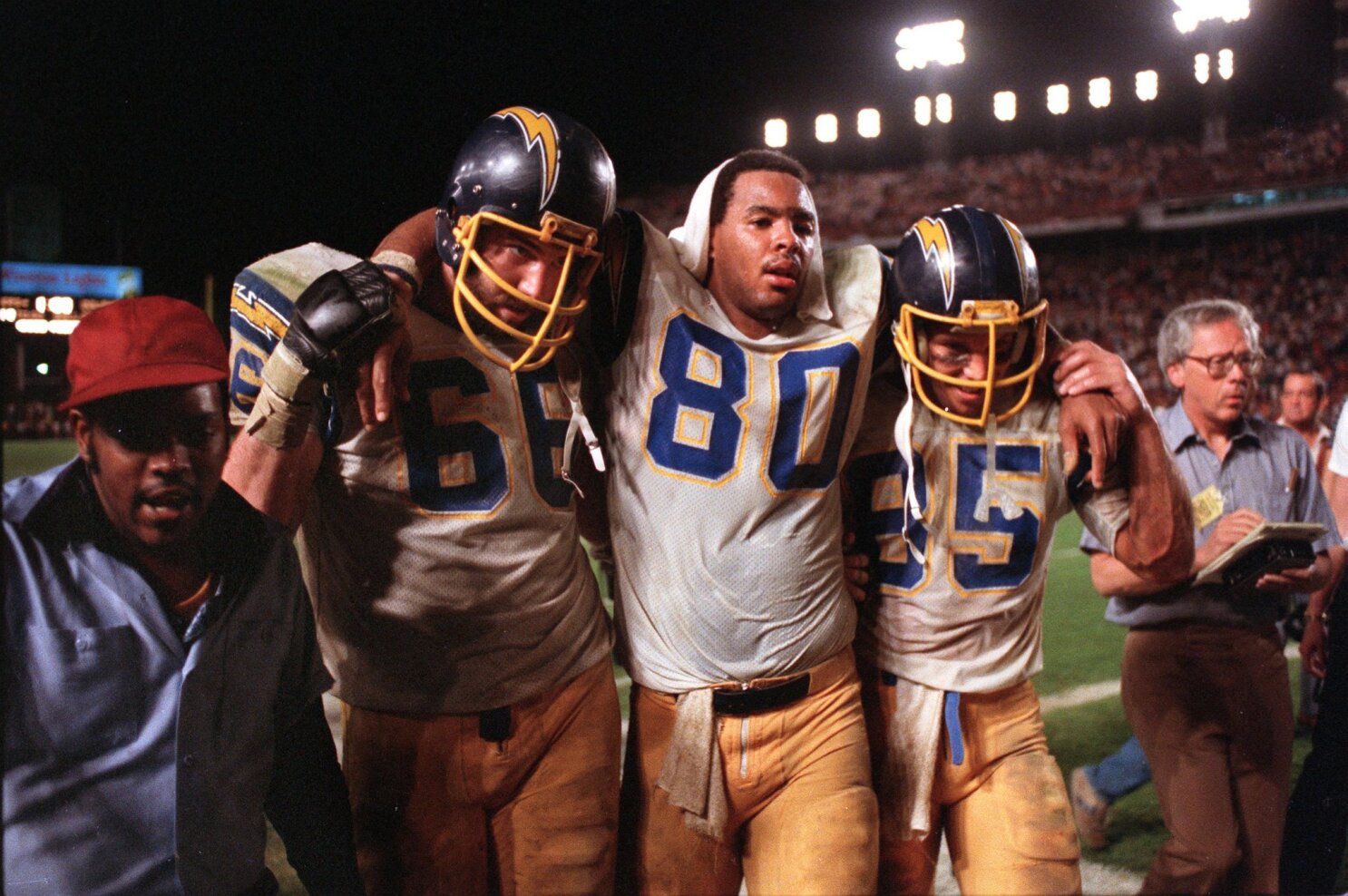
But what everyone remembers is Kellen Winslow. He caught 13 passes, then an NFL Playoff record, for 166 yards and a touchdown. During the game, he was treated for a pinched nerve in his shoulder, a cut on his lip that needed 3 stitches, dehydration and cramps. The defining image of the game was of Winslow being helped off the field by offensive tackle Billy Shields and receiver Eric Sievers.

He cited the 3rd fight between Muhammad Ali and Joe Frazier, in 1975: "I've never felt so close to death before. That's what Muhammad Ali said in Manila, and that's how I felt out there at the end."

Coryell said, "There has never been a game like this. It was probably the most exciting game in pro football history." Sure, he could say that: His team won, so he didn't have to explain why they had blown a 24-point lead. But Shula, who blew a 4th-quarter lead at home, agreed with him: "A great game, maybe the greatest ever." And Bryant Gumbel, calling the game for NBC, said, "If you didn't like this football game, you didn't like football."

Just 8 days later, the Chargers played the AFC Championship Game against the Cincinnati Bengals -- and it was the biggest shift in temperature in the history of sports, from 88 degrees to 9 degrees below zero. With the name "Ice Bowl" already taken, this one was called the "Freezer Bowl," and they couldn't handle it, losing 27-7. The Chargers never got this close to the Super Bowl again for 13 years.

The Dolphins, on the other hand, got back the next season, though they lost Super Bowl XVII to the Washington Redskins.

Wednesday, December 23, 2020

December 23, 1995: Snowballs at the Meadowlands

December 23, 1995, 25 years ago: The New York Giants close their season in ignominious fashion -- and the result is far from the worst of it.

They were playing the San Diego Chargers, at Giants Stadium in the Meadowlands. It's important to note that the Giants have no rivalry with the Chargers. This was only the 7th time the 1925-established NFL mainstays and the 1960-established original AFL team had played in the regular season. The Giants had won at Yankee Stadium in 1971, at Shea Stadium in 1975, at Giants Stadium in 1986, and at Jack Murphy Stadium in San Diego in 1989. The Chargers had won at The Murph in 1980 and at Giants Stadium in 1983.

None of those games had been particularly contentious. Indeed, even this game had no incidents between the Giant players and the Charger players.

For the Giants, it was a bad season, by any measure. They started out 0-3, closed to within 3-5, fell to 3-9, got up to 5-9, and went into this game 5-10. The Chargers had started 4-7, but had won 4 straight, and had a chance to make the Playoffs if they beat the Giants and other games went their way.

There had been significant snowfall the day before, and only 50,243 fans, out of a possible 78,000+, showed up. While the seats at Giants Stadium had been cleared of snow, there was still a lot of it lying around, waiting for angry -- or, at least mischievous -- fans to turn them into snowballs. At least in the 1st half, they only threw them at each other, because they were pleased with the product on the field: The Giants went into the locker room up 17-3.

This was understandable: There was snow all around, and the temperature was 34 degrees, 24 with the wind chill. The New York-based team was used to this kind of weather. The San Diego-based team was not.

But a funny thing happened on the way to the Giants giving their fans a Merry Christmas: They ended up giving their fans a big lump of coal instead. The Chargers scored a touchdown, but it was still 17-10 Giants after 3 quarters.

By this point, the snowballs were flying from the stands, the  onto the field. Bob Sheppard, who had been the Yankees' public address announcer since 1951 and the Giants' since 1956 put his best "Voice of God" to work on the crowd, telling them that the game could be forfeited if the barrage continued.

On the 1st play of the 4th quarter, referee Ron Blum called time-out. He went over to the Charger sideline to call up to the booth, and repeat the threat. A fan threw a snowball in his direction. Except it wasn't a snowball: It was an iceball, much harder. And it didn't hit Blum: It hit Sid Brooks, the Chargers' equipment manager, right in the face, knocking him out.

The game should have been forfeited right there. It wasn't. The Chargers completed their drive with a touchdown, and the game was tied. ON their next drive, Junior Seau hit Giant quarterback Dave Brown, whose throw had been intended for the end zone. Instead, Shaun Gayle -- now with the Chargers, he had been an All-American sprinter in college and a member of the Chicago Bears' 1985-86 "Super Bowl Shuffle" team -- intercepted it, and returned it 99 yards for a touchdown. Well before he reached the end zone, fans sitting there began throwing snowballs at him. Many got as far as him, but none hit him.

The Giants fumbled on their next possession, and John Carney kicked a field goal for the final score: Chargers 27, Giants 17. It was one thing for the Giants to humiliate their fans, which had happened before. It was another thing for the fans to humiliate each other, and the players.

Giants management announced that any snowball-thrower who could be identified would be banned from the Meadowlands Sports Complex for life, even if that meant revoking his season ticket. Six such spectators were identified, including one who ended up on the back page of the New York Daily News. Giants management also bought a full-page at in the next day's San Diego Union-Tribune -- the Sunday edition -- apologizing to San Diego for the incident.

By a quirk in the NFL schedule, the New York Jets were scheduled to play at Giants Stadium the very next day. The New Jersey Sports and Exposition Authority, operator of the stadium, went into overdrive to get all the snow removed from the stadium before kickoff. Given that the Jets were going in 3-12, a 2nd angry fanbase was possible. But the snow was cleared, there were no incidents, and the Jets lost to the New Orleans Saints, 12-0.

The Chargers did end up making the Playoffs. Since then, they've played the Giants 6 times. The Giants won in San Diego in 1998. The Chargers won in San Diego in 2005 and 2013, at the Meadowlands in 2009 and 2017, and, following their move back to Los Angeles, at SoFi Stadium in Inglewood, California 11 days ago. None of those games had any incidents, either. Only the one on Christmas weekend 1995.

Wednesday, August 14, 2019

Top 10 Great Things About the AFL (& 3 Bad Things)

August 14, 1959, 60 years ago: The founding meeting of what was soon named the American Football League is held in Chicago. That city would not have a team in this league, the 4th to assume the name. (Previous AFLs operated in 1926, 1936-37 and 1940-41.)

The 8 founding teams that would begin play in September 1960 were, in alphabetical order:

* The Boston Patriots. With their move to suburban Foxborough, Massachusetts in 1971, they were renamed the New England Patriots.
* The Buffalo Bills. A team with that name had played in the All-America Football Conference from 1946 to 1949.
* The Dallas Texans. They were moved and renamed the Kansas City Chiefs in 1963. The team was owned by the League's founder, Lamar Hunt. Today, the AFC Championship trophy is named for him.
* The Denver Broncos.
* The Houston Oilers. They were moved to Memphis and renamed the Tennessee Oilers in 1997, moved to Nashville in 1998, and renamed the Tennessee Titans in 1999.
* The Los Angeles Chargers. They were moved to San Diego in 1961, and back to the Los Angeles market in 2016.
* The New York Titans. They were renamed the New York Jets in 1963.
* The Oakland Raiders. They were moved to Los Angeles in 1982, moved back to Oakland in 1995, and are now preparing to move to Las Vegas for the 2020 season.

In 1966, the AFL would add the Miami Dolphins. In 1968, it would add the Cincinnati Bengals. From 1966 to 1970, having made peace in their wild war with the established National Football League, the process of merging the 2 leagues into the modern NFL was undertaken.

The 1960s AFL was the most successful "rebel league" in U.S. sports history. You could argue that the NHL was, but it was an all-Canadian league at the start. In baseball, the National League wasn't really a "rebel league." The American League did get to make peace with the National League in 1902.
AFL Founder Lamar Hunt

But people didn't really think of "Major League Baseball" as a single entity at that time. It can be argued that MLB didn't become such an entity until the establishment of the Office of the Commissioner of Baseball in 1920, or even until 2000, when the AL and the NL were rendered team groupings only, with a single baseball and a single set of umpires for both Leagues.

Compare the number of teams that were absorbed into the established league:

* 1926 AFL: None.
* 1936-37 AFL: 1, the Cleveland (later Los Angeles) Rams.
* 1940-41 AFL: None.
* 1946-49 AAFC: 3, the Cleveland Browns, the San Francisco 49ers, and the original Baltimore Colts, who soon failed.
* 1960-69 AFL: 10, all of them.
* 1961-62 American Basketball League: None. It had 8 teams, including in 6 cities that didn't then have NBA teams. Cleveland, the San Francisco Bay Area and Washington would get NBA teams; Kansas City had one, but lost it.
* 1967-76 American Basketball Association: 4, the New York (now Brooklyn) Nets, the Denver Nuggets, the Indiana Pacers and the San Antonio Spurs. It had 12 franchises in all. Of these cities in which those teams played, the following now have NBA teams, in addition to the preceding: Charlotte, Dallas, Houston, Memphis, Miami, Minneapolis, New Orleans, Salt Lake City and Washington. Kansas City and San Diego got teams, but lost them.
* 1972-79 World Hockey Association: 4, the Edmonton Oilers, the original Winnipeg Jets (now the Arizona Coyotes), the Quebec Nordiques (now the Colorado Avalanche) and the Hartford Whalers (now the Carolina Hurricanes). Besides the preceding, the NHL would also put teams in Calgary, Cleveland (failed), the Miami area, New Jersey, Ottawa and Phoenix.
* 1974-75 World Football League: None. It had teams in 8 cities that did not then have NFL teams. Only 2 of those cities now have them: Charlotte and Jacksonville.
* 1983-85 United States Football League: None. It had teams in 10 cities that did not then have NFL teams. 3 of those cities would get NFL teams long-term: Baltimore, Jacksonville and Phoenix; 2 others would get them temporarily: Memphis and Oakland.
* 2001 XFL: None.
* 2019 Alliance of American Football: None.

*

Top 3 Bad Things About the AFL

3. The Patriots. Let's not forget that the bad things about the Patriots did not begin with Bill Belichick cheating. Patriot fans still whine about "The Ben Dreith Game," in the 1976 AFC Division Playoff against the Raiders. Dreith, considered one of the NFL's top referees -- he had been a referee for the AFL's entire existence -- was accused of making crucial calls against the Pats, or failing to make them against the Raiders. It got to the point where he wasn't allowed to officiate a game involving the Patriots again until the strike year of 1987.

There was team vice president Chuck Sullivan, son of owner Billy Sullivan, getting into a shoving match with some Raider players after beating them in the 1985-86 Playoffs, claiming, "We're just getting back for Jack Tatum, and all the crap that their football team has put on our football team over the years."

In 1988, a bankrupt Billy Sullivan sold the team to Remington razor company chairman Victor Kiam. In 1990, there was an incident in the locker room between Patriot players and sportswriter Lisa Olson, then of the Boston Herald. Kiam stood by his players (understandable, if wrong) with a rather vulgar statement about Olson (inexcusable). The controversy led him to sell the team to James Orthwein in 1992.

Orthwein wasn't much better. He tried to blackmail the City of Boston and the Commonwealth of Massachusetts into building him a new stadium to replace Foxboro Stadium, which was basically a 60,000-seat high school stadium in the suburbs halfway between the downtowns of Boston and Providence. If he didn't get it, he'd move the team. He played Boston and Baltimore off each other. A cousin of St. Louis Cardinals owner Augie Busch and a major stockholder in Anheuser-Busch, he played Boston and St. Louis off each other.

But it didn't matter whether the City or the State would have caved in, because the Sullivans lost the stadium and the land around it to a paper magnate, who wouldn't let the Pats out of their lease. In 1994, Orthwein sold the team to him. His name was Robert Kraft, and he still owns the team today.

He would also play Boston off Baltimore and St. Louis. But both of those cities got teams in the next couple of years. Finally, he cut a deal with Governor John Rowland of Connecticut to build what's now Pratt & Whitney Stadium in East Hartford. If the deal had gone through, he could have kept the "New England Patriots" name. But he was double-dealing, and Massachusetts gave him what he wanted to build a new stadium next-door to the old one, leaving Rowland and the Hartford area high and dry. (Rowland would later go to prison. Twice.)

All this, before Kraft hired Bill Belichick and drafted Tom Brady, and the cheating began. The Patriots were already a sickening franchise. Which segues into...

2. Al Davis. First, his record: 1950-51, offensive line coach at Adelphi University on Long Island; 1953, head coach of the football team at the Army's Fort Belvoir in the Virginia suburbs of Washington; 1954, scout for the Baltimore Colts 1955-56, offensive line coach at The Citadel in South Carolina; 1957-59, offensive line coach at USC; 1960-62, receivers coach for the Chargers; 1963-65, head coach of the Raiders; 1966, briefly Commissioner of the AFL; 1966-2011, general manager of the Raiders; 1966-71, part owner; 1972-2011, principal owner -- or, as he always called himself, the "managing general partner."

He was innovative, and he built an iconic team, with legendary characters like coach John Madden, Ben Davidson, Ken "the Snake" Stabler, Ted Hendricks (known as both "the Mad Stork" and "Kick 'em in the Head Ted"), Lester Hayes, John Matuszak, Lyle Alzado, and so on. However, not all the reasons that the team became iconic were good.

They were mean, to the point of the incident to which Chuck Sullivan referred: Raiders safety Jack Tatum hitting Patriots receiver Darryl Stingley into paralysis in 1978 -- in a preseason exhibition game. They were hopped up on all kinds of drugs, from cocaine to amphetamines to steroids. And team management, with Davis taking the lead, ignored their complaints of injuries, to the point where some of them were hopelessly crippled as they got old -- if they lived long enough to get old.

And then there were the fans, in their costumes, some playing off the Raiders' "pirate" image. Darth Vader masks have been common since Star Wars came out in 1977. But some fans dress like biker gang members -- slightly appropriate, as Oakland is the birthplace of the most famous motorcycle gang of them all, the Hell's Angels. (The titular gang in the TV show Sons of Anarchy operated out of the fictional town of Charming, said to be in California's Central Valley, which includes Sacramento and Fresno, which could be considered Raider territory.)

A visit to a Raider home game can be truly scary, in ways that Americans usually don't see unless they go to certain stadiums in European or South American soccer. Al Davis never denounced such things. By remaining silent on the matter, he gave this behavior his tacit approval. He wanted people, especially opposing teams, to be scared of the Raiders.

And, of course, Davis moved the team from Oakland to Los Angeles in 1982, and back in 1995, and was threatening to move again when he died in 2011. His son Mark Davis is now in the process of moving them to Las Vegas. It's bad enough that the Raiders pissed their loyal hometown of Oakland off once, but now, they're doing it again. I guess the crabapple didn't fall far from the tree.
"Just win, baby." He didn't care how.

1. The Spectacle of the Super Bowl. It's just too much. Whereas certain competitions used to call their finale, officially or otherwise, "the World Series of (our game)," such as golf and poker, now, a big event is called "the Super Bowl of (it)," to the point where the Daytona 500, usually held a weekend or two after the Super Bowl, has led NASCAR fans to say their season starts with "our Super Bowl."

People speculate about not just the participants, but the National Anthem singer and the halftime show performer, of the Super Bowl -- before the exhibition season even starts. And winning the Super Bowl has become so important that the aforementioned John Madden has said, "The biggest difference in sports is between the team that wins the Super Bowl and the team that loses it. The team that loses it feels worse than the teams that didn't even make it." He was an assistant coach when the Raiders lost Super Bowl II, and the head coach when they won Super Bowl XI, taking 9 years to get back to the big game and win it. So he knew.

And if it hadn't been for the AFL, the NFL's championship game would have remained simply that: "The National Football League Championship Game." It might now be hyped beyond what Frank Gifford or Johnny Unitas or Paul Hornung experienced when they played in it, but it wouldn't be THE SUPER BOWL, America's secular high holy day.

*

However, it is worth it to mention:

Top 10 Great Things About the AFL

Honorable Mention. Tailgating at Arrowhead. Okay, technically, I can't include this one in the Top 10, since Arrowhead Stadium didn't open until 1972, after the merger. But it's been said that, if you go to a Kansas City Chiefs home game, you can smell the parking lot before you can see the stadium. And that's a good thing. All that barbecue.

Honorable Mention. The Two-Point Conversion. The AFL used it, the NFL didn't. College football had adopted it in 1958. The World Football League, which played in the 1974 and '75 seasons, used it. The Canadian Football League adopted it in 1975. The United States Football League used it in the 1983, 1984 and 1985 seasons. Finally, the NFL adopted it in 1994.

10. The Myth of Broadway Joe. Joe Namath's career completion percentage was 50.1. His passer rating was 65.5. He threw a lot more interceptions (220) than touchdown passes (173). Only once, in 1972, did he lead his league (either the AFL, 1965 to 1969, or the NFL, 1970 to 1977) in touchdown passes.

In 13 seasons, only twice did he make the Playoffs, appearing in only 3 Playoff games, winning 2. In other words, Joe Namath may have been one of the most exciting figures in sports in the LBJ and Nixon years, but he wasn't that great of a quarterback. There was more sizzle than steak. The myth far exceeds the man.

But there is good reason for that myth. The 2 postseason games he won were the 1968 AFL Championship Game and Super Bowl III. The fact that he did it in New York made it bigger. And while he wasn't huge, stat-wise, he was doing what he did on not 1 but 2 bad knees. His courage allowed him to fight on when it might have been better to ask out of the game. Instead, he won games the Jets probably should have lost.

Broadway Joe Namath was an icon of cool, and, if only once, an icon of victory. His 1 Super Bowl appearance, a win, carries more weight than Tom Brady's 9 appearances and 6 wins -- even if you foolishly believe Brady did all that fair and square.
9. Buffalo Wings. Baseball gave American cuisine hot dogs and Cracker Jack. Football gave it Buffalo-style chicken wings. It all started in 1964, at the Anchor Bar, at 1047 Main Street at North Avenue, not far from the since-demolished War Memorial Stadium, where the Bills were on their way to the 1st of back-to-back AFL Championships.

Its proximity to "the Old Rockpile" made it a good stopover after Bills games. It was there during the 1964 season that the son of the couple who owned it brought some hungry friends over on a Friday night (not a game night), but all his mother had left in the kitchen was chicken wings, a part of the chicken not traditionally eaten up to that point. So she boiled them, made up a spicy sauce, and glazed the wings with the sauce. The boys couldn't get enough of them. Buffalo sauce and Buffalo wings were born. The bar is still in the family.
It all started here.

8. The Redemption of Old War Horses. The AFL gave guys who got pushed out of the NFL a 2nd chance. George Blanda had been dumped as quarterback of the Chicago Bears, but the Oilers took him, and he led them to the 1st 2 League titles, in 1960 and 1961. He then went on to the Raiders, helping them reach Super Bowl II, and showed remarkable longevity, starting at quarterback in the NFL at 43, and both playing that position and kicking field goals at 48.
George Blanda, the oldest "old war horse" in NFL history

Similarly, Tobin Rote, who had filled in for an injured Bobby Layne and led the Detroit Lions to the 1957 NFL Championship, was let go, but took over for an injured John Hadl and led the Chargers to the 1963 AFL Championship.

Johnny Unitas, Jack Kemp and Len Dawson were all cut by the Pittsburgh Steelers. Unitas quarterbacked the Baltimore Colts to NFL glory. Kemp led the Bills to the 1964 and 1965 AFL Championships. And Dawson did it for the Texans/Chiefs in 1962, 1966 and 1969, including losing Super Bowl I and winning Super Bowl IV. Okay, none really fit the pattern -- Unitas did it in the NFL, Dawson was just 27 in 1962, and Kemp was 29 in 1964 -- but the AFL did give Dawson and Kemp the second chances they deserved.

Let's not forget Paul Brown: The man who moved football offense into the modern era as head coach of the Cleveland Browns had been fired in 1962. In hindsight, it was a good idea, as the Browns won the NFL Championship just 2 years later. But Brown became owner, general manager, and head coach of an AFL expansion team, the Cincinnati Bengals, in 1968. By 1970, the 1st season after the merger, he had not only won the AFC Central Division, but beaten out the Browns to do it.

He eventually lived long enough to see the Bengals win 2 AFC titles, but lost Super Bowls XVI and XXIII. Both times, it was to the San Francisco 49ers, coach by one of his former assistants, Bill Walsh. The 2nd time, the Bengals' coach was their 1st quarterback, who got his chance through Brown: Sam Wyche.
Paul Brown and Sam Wyche

7. Horses. Several college football teams have horses and riders as part of their pageantry, most notably USC with Traveler. The AFL frequently tried to appeal to the college football fan by doing things associated with the college game, like mascots (live and otherwise) and bands.

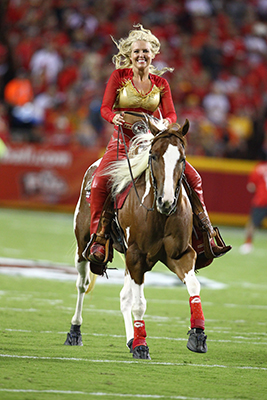
The Chiefs had a mascot, a horse named Warpaint, who was ridden around the field before every game and after every Chief touchdown, by Bob Johnson, who wore full Indian regalia, including a headdress. The current version, Warpaint III, is ridden by a Chiefs cheerleader, not wearing Native American regalia. Warpaint is also the name of the team's weekly game program.
Susie Derouchey aboard Warpaint III

Not to be outdone, the Broncos, as you might expect, also have a live horse mascot, Thunder, ridden onto the field before every game by Ann Judge-Wegener, leading the team on behind them, including their man in a horse costume, Miles (for the Mile High City).
6. The Rivalries. The ones the Jets had with the Dolphins and Patriots came later, but the one they had with the Raiders, hoo, boy.

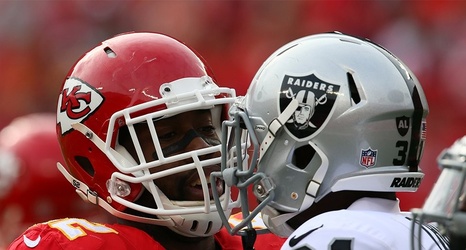
The ones the Raiders had with the Jets, Dolphins, Patriots and Chargers would come later, but the one they had with the Chiefs became intense in the late 1960s, and remains so today. The Chiefs (as the Dallas Texans) founded the AFL, but the Raiders came to define it.
"You hate me and I hate you!"
"So at least we understand each other."

5. Making Minor-League Cities Major. Buffalo. Houston. San Diego. Oakland. Denver. A little later, Miami. Before the AFL, none of these cities had a major league team in any sport. By 1971, each had had an NBA team. By 1993, all but Buffalo had an MLB team. By 1974, all had had either an NHL or a WHA team.

(UPDATE: Buffalo still hasn't had a permanent major league baseball team -- upper- or lower-case -- since 1915, and if you don't count the Federal League, not since 1885. But the COVID epidemic forced the Toronto Blue Jays out of Canada, and they had to play "home games" in Buffalo in 2020 and 2021, until the restrictions were lifted.)

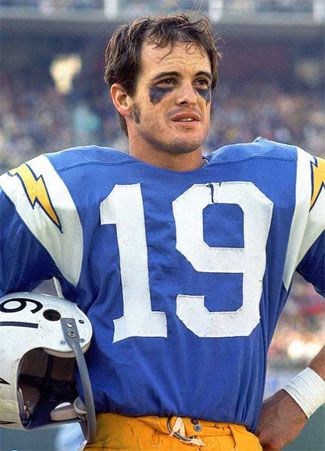
4. The Charger Uniforms. It's not just the lightning bolts on the helmets. From 1960 to 1973, they wore jerseys that had been called "collegiate blue" (probably a reference to UCLA, with whom they shared the Los Angeles Coliseum in 1960), "electric blue" (which matched the "charger" theme) and "powder blue" (which is what it usually gets called today).
Lance Alworth, the AFL's greatest receiver,
wearing the original version

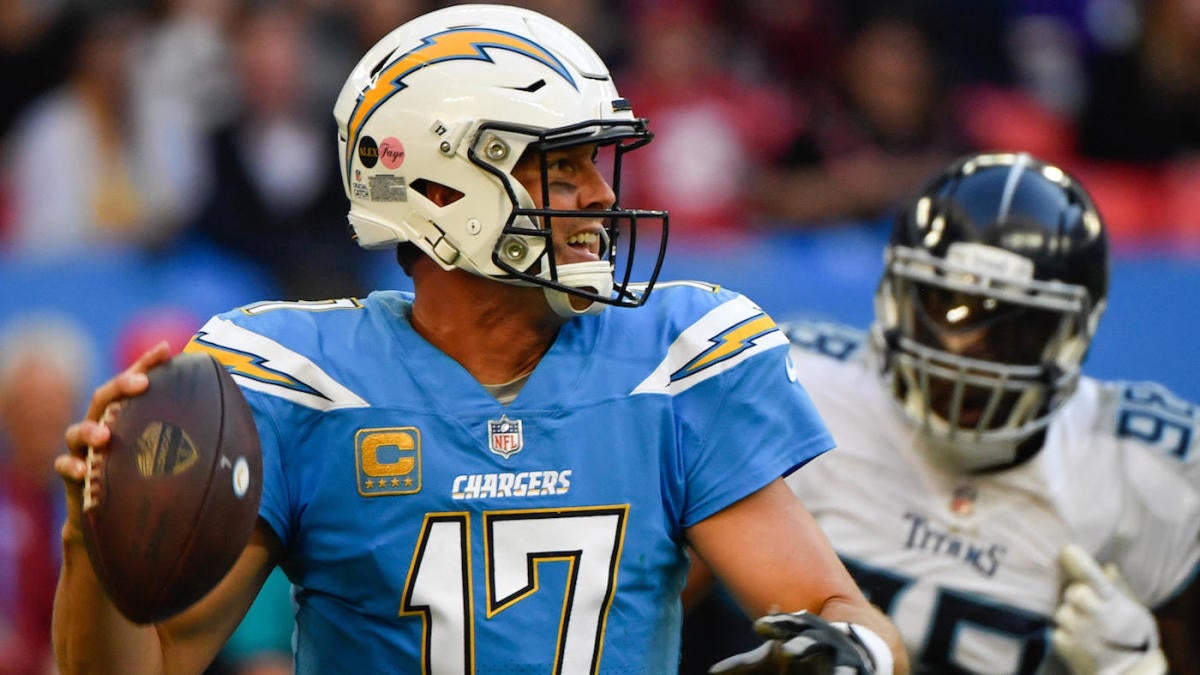
In 1974, they switched to dark blue jerseys and helmets. In 1978, they became one of a few teams that preferred to wear white jerseys at home, and it did look better. (In my opinion, this is also true for the Washington Redskins and the Dallas Cowboys.) They went back to dark blue at home in 1984, occasionally wore powder blue as "throwback uniforms" for a few years, and have announced that, in 2019, their 60th season, they will be wearing powder blue as their regular home color. They have also gone back to the white helmets.
Philip Rivers wearing the current version

3. John Madden. Before he became the video game guy, before he was the great commercial pitchman, before he was the best TV analyst the sport has ever known, he was a great coach. Coaching the Raiders from 1969 to 1978 (and the 2 seasons before that as linebackers coach), he went 112-39-7, including the Playoffs.

In 10 seasons, he never won fewer than 8 games (and they played 14 games a season until 1978, his last, when it became 16), won 7 AFL or AFC Western Division titles, reached 7 AFL or AFC Championship Games, and won Super Bowl XI in the 1976-77 season.

He kept his team loose by understanding them. He had one rule: Be on time. Other than that, he didn't care what you were like off the field. The players were grateful, and respected him. Even if they didn't always understand him: Once, during a tough game, he told them, "Don't worry about the horse being blind: Just load the wagon!"
The Coach and his Outback Steakhouse-sponsored
customized Madden Cruiser bus

Madden is still alive, at age 83, and does a talk show on San Francisco radio station KCBS. In one of the great ironies of American public life, while he hasn't gotten on an airplane since a panic attack on a flight in 1979, his wife Virginia -- they are approaching their 60th Anniversary as well -- is a licensed pilot.

(UPDATE: John Madden died on December 28, 2021, at 85. He might have been the only human being who was beloved by fans of all 32 teams.)

2. The Passing Game. The big argument against the NFL in the 1960s was that it was "too boring," "too conservative." How could anyone say that about a league that had Johnny Unitas, Bart Starr, Sonny Jurgensen and the young but already scrambling Fran Tarkenton?

Easy: Because, for all its T-formation passing opportunities, the NFL was still a run-first league, following the advice of Ohio State coach Woody Hayes: "There are three things that can happen when you throw the football, and two of them are bad," meaning an incompletion or an interception.

The AFL needed fans. And it needed TV viewers. How to get them? Put the ball in the air, and let the chips fall where they may. When Joe Namath said, before Super Bowl III, that there were 4 or 5 quarterbacks in the AFL better than Earl Morrall of the Colts, he wasn't just blowing smoke: The Jets had Namath, the Chiefs had Dawson, the Bills had Kemp, the Chargers had Hadl, and the Raiders had Blanda and Daryle "the Mad Bomber" Lamonica.

By the end of the 1970s, the passing-defense rules had been changed. In the 1980s, the NFL became like the 1960s AFL.

1. The Community of the Super Bowl. Did I say it was "America's secular high holy day"? Yes, I did. It brings people together, to cheer on a great team, or maybe to boo an undeserving one.
Fans with Chiefs and Packers pennants in the end zone
of the Los Angeles Memorial Coliseum,
Super Bowl I, January 15, 1967

And it all began because the AFL wanted to prove it was as good as the NFL. Well, by September 1970, there was only the NFL -- but it was better than it was before, because of the AFL.