Showing posts with label western new york. Show all posts

Friday, February 6, 2026

February 6, 1826: “The Last of the Mohicans” Is Published

Daniel Day-Lewis in the 1992 film version

February 6, 1826, 200 years ago: The Last of the Mohicans by James Fenimore Cooper is published. It has been called the 1st great American novel.

It's also been called the 1st Western novel, as what we now call Western New York was, in a way, America's first "frontier."

James Fenimore Cooper was born on September 15, 1789 in Burlington, New Jersey, across the Delaware River from Philadelphia. But it would be near the source of the Delaware River, at Lake Otsego in Central New York, where his family would settle. Named for his father, Judge and eventual Congressman William Cooper, it became "Cooperstown."

James was admitted to Yale University at the age of 13, and expelled at 16 for a string of pranks. He enlisted in the U.S. Navy, served 2 years, and married Susan de Lancey, having a son and a daughter. In 1820, he published his first novel, Precaution. In 1823, with The Pioneers, he began what became known as The Leatherstocking Tales, which led to Cooperstown's section of New York becoming known as "Leatherstocking Country."
James Fenimore Cooper

The 1826 installment, The Last of the Mohicans: A Narrative of 1757, became the best-known. Cooper's hero, Natty Bumppo, was a precursor to Tarzan: Born to white parents in the Province of New York (one of Britain's "Thirteen Colonies"), raised by Native Americans of the Delaware tribe, educated by his own people, and a fearless warrior.

Like Babe Ruth, James Brown and fictional boxer Apollo Creed, he had a lot of nicknames. The best-remembered is "Hawkeye," but he was also called "Trapper," inspiring two characters in the M*A*S*H franchise. On that show, Dr. Benjamin Franklin Pierce (played by Alan Alda) said that his father, also a doctor, nicknamed him "Hawkeye" after Bumppo, since it was his favorite book.

Bumppo's nicknames also included "Leatherstocking," "Straight-Tongue," "The Pigeon," "The Lap-Ear," "Pathfinder"; and, for his skill with a rifle, "Deerslayer" and "La Longue Carabine": The Long Rifle. The Tales tell of his life from 1740 to 1806, including the American Revolution.

Cooper wrote 5 novels about Bumppo, and also wrote seafaring novels, and what would now be considered historical fiction. He died on September 14, 1851, the day before his 62nd birthday, in Cooperstown.

Natty Bumppo has been played in film version of The Last of the Mohicans by Harry Lorraine in 1920, Harry Carey (not "Caray") in 1932, Randolph Scott in 1936, Kenneth Ives in a BBC production in 1971, Steve Forrest in an NBC TV-movie 1977, and Daniel Day-Lewis in 1992. In fitting with the whole "first frontier" idea, Carey and Scott had already become known as actors in Western films.

Thursday, December 26, 2024

December 26, 1964: The Buffalo Bills Triumphant

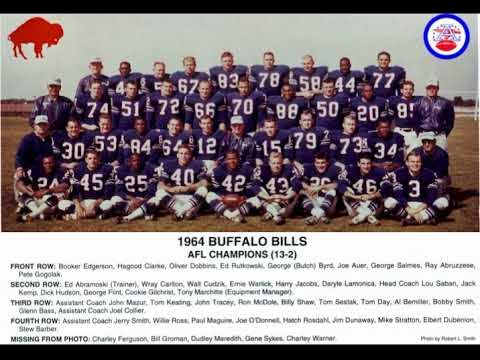
December 26, 1964, 60 years ago: The American Football League Championship Game is played for the 1964 season.

The season before, the San Diego Chargers, coached by Sid Gillman, had won the title, showing football fans that the AFL wasn't just a pass-happy "basketball league": It could feature good defense, too. The Buffalo Bills, coached by Lou Saban, followed the same path, with a defense led by end Ron McDole, tackle Tom Sestak, and linebacker Mike Stratton.

The Chargers would regret letting quarterback Jack Kemp go, as the Bills had acquired him to run their offense. Protected by a future Hall-of-Famer, guard Billy Shaw, he could hand off to running back Carlton Chester "Cookie" Gilchrist, or pass to receiver Elbert Dubenion.

There was once a common trivia question: Name the men wearing Number 32 who won the Most Valuable Player awards in the American League, the National League, the NFL and the AFL in 1963. But the question was no good: Elston Howard, Sandy Koufax, Jim Brown and Gilchrist won their respective awards, but, while the other 3 players wore 32, Gilchrist wore 34.

The Bills went 12-2 in 1964. They dropped 48 points on the Houston Oilers, and scored at least 30 points in 6 other games. Their only losses were on November 15, 36-28 at home to the Boston Patriots; and on December 6, 16-13 away to the Oakland Raiders.

As it was an even-numbered year, it was the Eastern Division winners' turn to host the AFL Championship Game, and the Bills welcomed the defending Champion Chargers into War Memorial Stadium. Built in 1938, it was already dilapidated, known as "The Old Rockpile." Buffalo native Brock Yates, a screenwriter who created the race upon which the Cannonball Run movies were based, said that it "looks as if whatever war it was a memorial to had been fought within its confines." And it was small: At 40,242 seats, its capacity would prove too small when the AFL and the NFL merged in 1970, so the Bills had to build a larger stadium.
In the 1st quarter, Tobin Rote threw a 26-yard touchdown pass to Dave Kocourek, to put the Chargers up, 7-0. But they never scored again. The Bills' defense was symbolized by Stratton hitting Keith Lincoln midway through the 1st quarter, breaking a rib and knocking him out of the game. It was the most famous defensive play in AFL history.
Pete Gogolak and his brother Charley, natives of Hungary, became pro football's 1st "soccer-style kickers," approaching the placement from the side and hitting the ball with the instep of the foot, rather than the traditional straight-on, hit-with-the-toes style. Pete kicked a field goal late in the 1st quarter, and another in the 2nd. In between, Kemp guided the Bills down to where Wray Carlton could score on a 4-yard run. In the 4th quarter, Kemp scored on a quarterback sneak. The Bills won, 20-7.
The Bills won the AFL Championship again in 1965, again beating the Chargers; then lost the 1966 AFL Championship Game to the Kansas City Chiefs. Saban would leave, then return as head coach, and lead the Bills to the AFC Wild Card Playoff berth in 1974.
Like basketball coach Larry Brown, Saban was known, somewhat unfairly, for never staying in the same place for very long, also serving as head coach for the Boston Patriots, the Denver Broncos, and several college teams. He died in 2009. His son, Nick Saban, in junior high school at the time of the Bills' AFL titles, would win 7 National Championships in the college ranks. Unlike many father & son coaching pairs, they never coached together. Indeed, while Lou was head coach at Army in 1979, Nick was an assistant coach at Navy in 1982.
The Bills had won the last 2 AFL Championships before the AFL Champion was allowed to play the NFL Champion for a World Championship, and had lost the game that would have put them in Super Bowl I. It would take until the 1990 season before they finally got into a Super Bowl. And they got into 4 in a row, something no other franchise has done. And yet, they lost all 4, and only the 1st one was all that close (although they were leading the 4th at the half).
The Bills have become to the NFL what the Chicago Cubs once were to baseball, the sport's "lovable losers" with a history of close calls breaking the hearts of some of the most passionate fans in the sport. From 1964 onward, they have been 1 of the last 2 teams standing 6 times, something only 7 other teams have done.
But the fact that the Bills' titles came before the advent of the Super Bowl means that they get discounted: Even before the distance of time became what it is now, NFL fans had come to regard any title won before the Super Bowl, NFL or AFL, as not a "real" championship.
As it stands, through Christmas 2024, no team based in, or near, Buffalo has ever won a major league sports championship. The NHL's Sabres are 0-for-2 in Stanley Cup Finals, and the NBA's Braves, like the Sabres a 1970 expansion team, moved in 1978. Due to Canadian COVID restrictions, the Toronto Blue Jays had to play some "home games" at Buffalo's Sahlen Field in 2020 and '21. Before that, there hadn't been a Major League Baseball team in Buffalo since the 1914-15 Blues of the Federal League; before that, the Bisons of the National League, who folded after the 1885 season. And none of those teams won a Pennant.
Unless you count soccer as a major league sport in North America, with the 1971 Rochester Lancers and the 2016 Western New York Flash, then the last World Championship won by a team that can be considered "Western New York" remains the 1955 NBA Champion Syracuse Nationals. If you don't count Syracuse as "Western," then it's the 1951 NBA Champion Rochester Royals.

Maybe this is the year the Bills finally pull it off. Then again, the Detroit Lions -- the team in which Ralph Wilson had a minority interest before becoming the founding owner of the Bills -- are also closer than they've ever been since their last title, in 1957. If Super Bowl LIX is Bills vs. Lions, one fanbase will be happier than ever, and the other will face the greatest letdown yet.

Tuesday, January 4, 2022

How to Be a Jets Fan In Buffalo -- 2021-22 Edition

The bad news: This Sunday, January 9, the New York Jets will travel to play the only NFL team that actually plays its home games in the State of New York: The Buffalo Bills, no longer coached by former Jet coach Rex Ryan. And the Bills, for the moment, are a very good team.

The good news: After the game, "JETS" will no longer stand for "Just End The Season," but it will be over. For teams that missed the Playoffs, anyway.

These two teams played their 1st-ever regular season games against each other, on September 11, 1960, at the Polo Grounds in Upper Manhattan. The Jets, then known as the New York Titans, beat the Buffalo Bills, 27-3. Attendance: 10,250. The return match, on October 16 at War Memorial Stadium, was a 17-13 Titans victory in front of 14,998. Only once all season, home or away, did the Titans top 21,000, and the Bills never reached 26,000.

Suffice it to say, this game will have a lot more people attending, regardless of the weather.

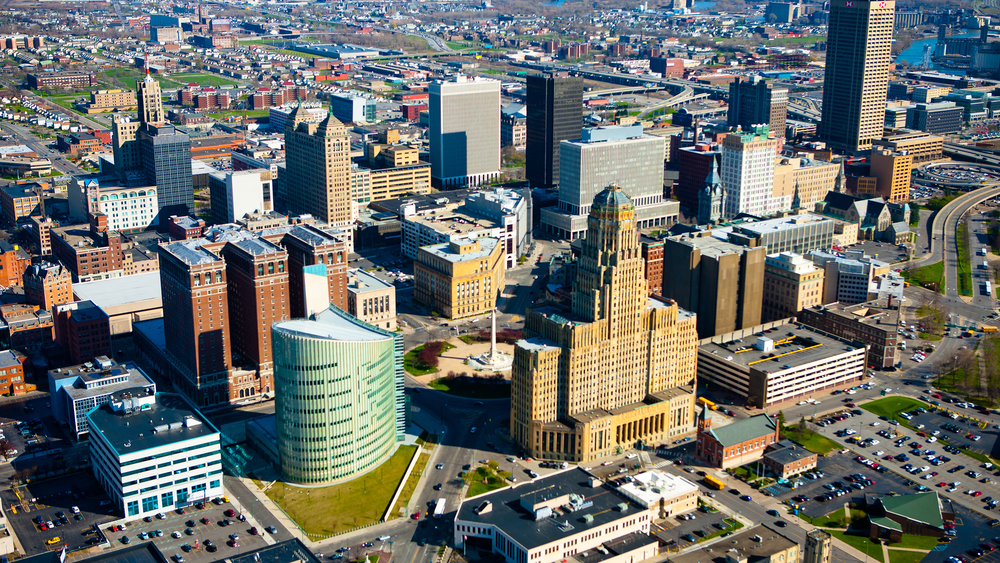
Before You Go. Buffalo is located on the Niagara River, between Lakes Erie and Ontario. As a result, the region is known for cold weather, and it faced a particularly nasty snowstorm in the Winter of 2014-15. Orchard Park, the suburb in which the Bills' stadium squats, is right on Lake Erie, and while it's slightly more inland than downtown Buffalo, the wind is actually worse at that spot.

This being early January, the stereotypical Buffalo cold will be an issue. The Buffalo News (I know, not an imaginative name for a newspaper, but it's the only daily the city has left) is predicting temperatures for Sunday afternoon to be in the low 40s in daylight and the low 20s at night. They're also predicting rain for during the game. If you go, bundle up and bring an umbrella. Better yet: If you're concerned about COVID, and you're a fan who wants to cross Buffalo off your list and hasn't yet done it, the fact that the Jets and the Bills are in the same Division means you can wait until next season. (Can't saym "next year" at this point.)

Buffalo may be considerably to the west of New York City and New Jersey, and it is, geographically and culturally, more of a Midwestern city than a Northeastern one. But it is still in the Eastern Time Zone, so you won't have to fiddle with your timepieces.

However, since it is on the Canadian border, and there are tourist attractions nearby (including Niagara Falls, which now has legalized gambling as well as its natural wonder, the falls itself), you might want to bring your passport, as they'll send you back over the border without one. Right now, the exchange rate really favors the U.S.: US$1.00 = C$1.27, while C$1.00 = U.S. 79 cents.
The Peace Bridge, connecting Buffalo with Fort Erie, Ontario

Tickets. In spite of its passionate fan base, the Bills are averaging only 96 percent of capacity in the 2019 season, the last one pre-COVID: 68,839 fans out of 73,079 seats. (It was 80,020 until wider seats were installed in 1998.)

With the Bills still being the sports team in Western New York, tickets may still be hard to come by. Fortunately, they have among the least expensive tickets in the NFL. Seats in the lower level, the 100 sections, are $156 along the sidelines, and $65 in the end zones. The 200 sections are all sold-out club seats on the sidelines, but the end zone seats are $40. In the upper level, the 300 sections, seats are $65 along the sidelines, with no end-zone seats in that level.

Getting There. It's 375 road miles from Times Square to Niagara Square in downtown Buffalo, and 358 miles from MetLife Stadium to New Era Field in Orchard Park. Buffalo is one of those cities that's too close to fly to, but to far to get there any other way. United Airlines offers round-trip nonstop flights for as little as $519. If you do fly in, the Number 24 bus will get you from Buffalo Niagara International Airport, 11 miles northeast of downtown, in about 50 minutes.

Amtrak's Maple Leaf, its New York-to-Toronto service, leaves Penn Station at 7:15 AM, and arrives at Buffalo's Exchange Street Station at 3:14 PM, just under 8 hours later (if it's on time). Its return trip leaves Buffalo on Monday at 12:55 PM and arrives at Penn Station at 9:55 PM. It's $136 round-trip -- given Amtrak's standards, that's quite cheap considering the distance. The station is at Exchange & Washington Streets, just 3 blocks north of the arena, although you'll still have to get to the stadium.

Greyhound runs 7 buses a day from New York's Port Authority Bus Terminal to Buffalo. Round-trip fare is $228, but it can drop to $130 with advanced purchase. The terminal is at 181 Ellicott Street at Eagle Street, just 7 blocks north of the Sabres' arena. Again, you will still have to get to the stadium.

If you do drive, get into New Jersey to Interstate 80, and take it all the way across the State. Shortly after crossing the Delaware River and entering Pennsylvania, take I-380, following the signs for Scranton, until reaching I-81. (If you've driven to a game of the Yankees' Triple-A farm team, the Scranton/Wilkes-Barre Yankees, you already know this part.) Take I-81 north into New York State. (If you've driven to a game of the Mets' Double-A farm team, the Binghamton Mets, you already know this part.) Continue on I-81 past Binghamton and to Syracuse, where you'll get on the New York State Thruway, which, at this point, is I-90. Continue on the Thruway west, past Rochester, to Buffalo.

Once in the area, take I-90 to U.S. Route 219/Southern Expressway South, to State Route 179/Milestrip Road West, to Abbott Road South. Once you cross over U.S. Route 20, the stadium will be on your left.

With 2 rest stops -- I recommend on one side of the Delaware or the other, and another around Syracuse -- you should be able to make the trip in about 7 hours.

Once In the City. Western New York was first settled by the French, and they called the Niagara River "Beau Fleuve," meaning "good flow." The English, just as they turned the Dutch village of "Vlissingen" into the Queens neighborhood of "Flushing," turned "Beau Fleuve" into the similar-sounding "Buffalo." The original name has nothing to do with bison.

Buffalo likes to call itself the Queen City of the Great Lakes, as opposed to Cincinnati, the Queen City of the Midwest; Charlotte, the Queen City of the Southeast; and Seattle, the Queen City of the Northwest. It's also known as the Nickel City (for the buffalo-head nickels used from 1913 to 1938), the City of Good Neighbors (probably due to their international border), and, left over from their World's Fair, the 1901 Pan-American Exposition, the City of Light (but no one will ever confuse it with Paris).  

Founded in 1789, Buffalo is home to just under 260,000 people. Before "white flight," it was over twice that, around 580,000 in 1950. The metropolitan area is home to 1.2 million according to the U.S. Census Bureau. However, that doesn't count Niagara Falls, or environs over the border; that pushes it to about 1.6 million. ZIP Codes for Western New York start with the digits 14. The Area Code is 716, with 585 overlaid.

Buffalo's electricity is run by New York State Electric and Gas (NYSEG). The city is about 46 percent white, 39 percent black, 11 percent Hispanic and 3 percent Asian. On June 26, 1967, Buffalo became one of several cities to have a race riot during the 1967 "Long Hot Summer." They were lucky to have no deaths. And there was a prison riot at the Attica Correctional Facility, 33 miles to the east, from September 9 to 13, 1971, that killed 32 inmates and 11 officers.

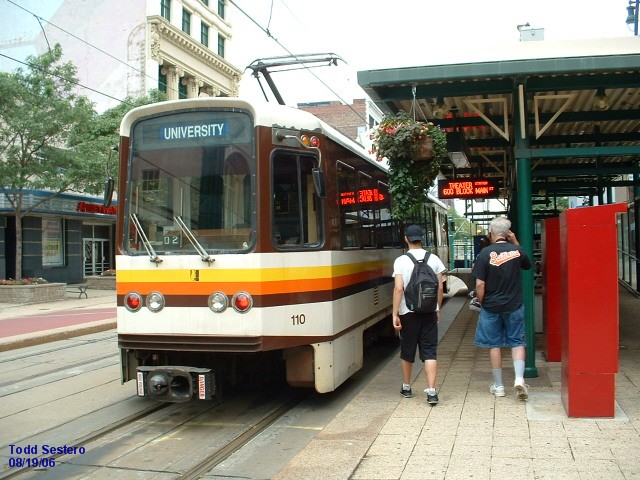
Buffalo is in the State of New York, but not in the City of New York, so the sales tax is 7 percent. There's no centerpoint for addresses: They move up as you move north and east. The Niagara Frontier Transportation Authority runs buses and a light rail, extending from Erie Canal Harbor downtown up Main Street the University of Buffalo campus in University Heights. It's free from its Harbor terminus until it goes underground at Tupper Street, $2.00 underground. Interstates 90 (the New York State Thruway), 190 (the Niagara Thruway) and 290 (the Youngmann Memorial Highway) form a "beltway."
Buffalo Metro Rail


Going In. The official address of the Bills' stadium is 1 Bills Drive, about 10 1/2 miles southeast of downtown. The Number 14 bus gets to Abbott Road and Southwestern Blvd., a mile from the stadium. Counting walking that last mile, it should take about an hour and 10 minutes. If you drive in from downtown, it should take about 25 minutes. Parking is $25, and tailgating seems to be almost a requirement.
Opened as Rich Stadium in 1973, named for the Rich family that runs the Buffalo-based food products company, it was renamed Ralph Wilson Stadium for the Bills' founder-owner in 1998. In 2015, it was renamed New Era Field, after the sporting goods company. In 2021, it was renamed Highmark Stadium, after a healthcare company. The only soccer-specific stadium in Pittsburgh, where Highmark is headquartered, is also named Highmark Stadium.

(Oddly, M&T Bank is headquartered in Buffalo, but, instead, bought the naming rights to the Baltimore Ravens' stadium.)

When the wind comes blasting in off Lake Erie, Highmark rivals Green Bay's Lambeau Field, Chicago's Soldier Field and Cleveland's FirstEnergy Stadium as the coldest in the NFL. The fact that it's open-air, having no protection of any kind, doesn't help.

But it is arguably the most famous building in the State of New York, outside the City of New York. It is the focal point of Western New York, as the Bills are the region's most successful and iconic sports team, despite their many failures -- although, to be fair, while the 2nd of their 4 straight Super Bowl losses was 17-0 at the half, it ended 37-24, and only the 3rd of their 4 straight Super Bowl losses was an out-and-out blowout.

Originally seating 80,020, the installation of wider seats has dropped capacity to 71,608, which still makes it the largest stadium in the State. (The old Yankee Stadium, even before the renovation, only had a little over 67,000 seats. The Carrier Dome in Syracuse seats 50,000.)
The field, which is "A-Turf Titan," the 3rd artificial turf laid in the stadium since its 1973 opening, is laid out east-to-west, which causes problems with both the Sun and the wind. The Bills' previous stadium, War Memorial Stadium, always had real grass, but they haven't played a regular-season home game on God's own playing surface since 1972.

"The Ralph" has also hosted State high school playoffs, soccer games, concerts, and the 1st-ever NHL Winter Classic on January 1, 2008, in front of what was then a record crowd for an NHL game, 71,217. The Sabres lost to the rival Pittsburgh Penguins, in overtime on a Sidney Crosby goal. (Just how NHL Commissioner Gary Bettman wanted it, hmmmm... )

Syracuse University played its home games there in 1979, as the demolished Archbold Stadium was replaced on the same site by the Carrier Dome. And it's hosted concerts from the beginning, the 1st being Lynyrd Skynyrd, with warmup acts the James Gang (including future Eagle -- the band, not the Philadelphia football team -- Joe Walsh) and Emerson, Lake & Palmer, on July 26, 1974.

Other concerts there: The Rolling Stones in 1975, 1978, 1997 and 2015; Elton John in 1976 (opener: Boz Scaggs) and 1994 (his Face to Face Tour with Billy Joel), Fleetwood Mac in 1978, The Who in 1982 and 1989, The Jacksons' Victory Tour in 1984, Bob Dylan and Tom Petty & the Heartbreakers in 1986, the Monsters of Rock Tour headlined by Van Halen in 1988, the Grateful Dead in 1989 and 1993, Guns N' Roses in 1992 and (sort of) 2017, the Dave Matthews Band in 2001, One Direction in 2015, U2 in 2017, and Beyoncé and Jay-Z in 2018. This August, they will host a metalfest with Def Leppard, Motley Crue, Poison and Joan Jett.

On September 12, 2017, Thrillist had an article ranking all 31 NFL stadiums. The home of the Bills didn't come off well, only 29th, or 3rd from the bottom: 

New Era Field (née Ralph Wilson Stadium, née Rich Stadium) feels like a high school football stadium if you plopped an upper bowl on it. But first, you drive 30 minutes outside Buffalo proper to Orchard Park, a town of 29,000 people, to mingle with 72,000 fans who look, act, and drink like Rob Ryan. The tailgating is legendary, with guys in Bryce Paup jerseys powerbombing each other through tables. These maniacs stick it out through awful blizzards and worse football, seeing how the Bills haven't sniffed the playoffs since the Clinton administration. 

On November 3, 2020, MoneyWise posted an article on the worst NFL stadiums, and the Bills' stadium came in 5th, with the weather and the long bathroom lines being the big complaints.

It has been alleged that the stadium is cursed, because it was built on the site of a ancient village of the Wenro tribe, and next-door to a cemetery. And that's why the Bills haven't won a Super Bowl since it opened. Okay, then how do you explain their failure to win one between the 1966-67 establishment of the Super Bowl and the 1972-73 season, the last one at War Memorial Stadium?

Really, it's not the stadium jinxing the Bills. It's the fact that the Miami Dolphins dominated the AFC East in the 1970s and early '80s, and the New England Patriots have dominated it in the 21st Century.

New Bills owner Terry Pegula has discussed a new stadium, with the current proposal being for the parking lot on the west side of Abbott Road, across from the current stadium on the east side. The hope is to get all the official stuff done in time to start construction next year, and be ready to open for the 2027 season. As with the agreement that New Era were allowed to back out of, Highmark would retain naming rights for the new stadium.

Food. Syracuse and Binghamton in New York, and Harrisburg and State College in Pennsylvania, are where the Northeast starts to turn into the Midwest. With a heavy Central and Eastern European heritage, Buffalo is big on sausages, and tailgate parties at the Bills' stadium are practically a sacrament.

Concessions are run by Delaware North, the Buffalo-based company that also runs them for the Sabres' arena and Boston's new TD Garden. (Delaware North the TD Garden and the Bruins.) Although no detailed map of concessions is available online, a Tim Hortons is at the west end of the stadium, the Coors Light Sports Bar is at the east end, and a Dinosaur Barbecue stand is mentioned, so those of you who've gone to their restaurant in Newark, a block from the Prudential Center, will be familiar with it.

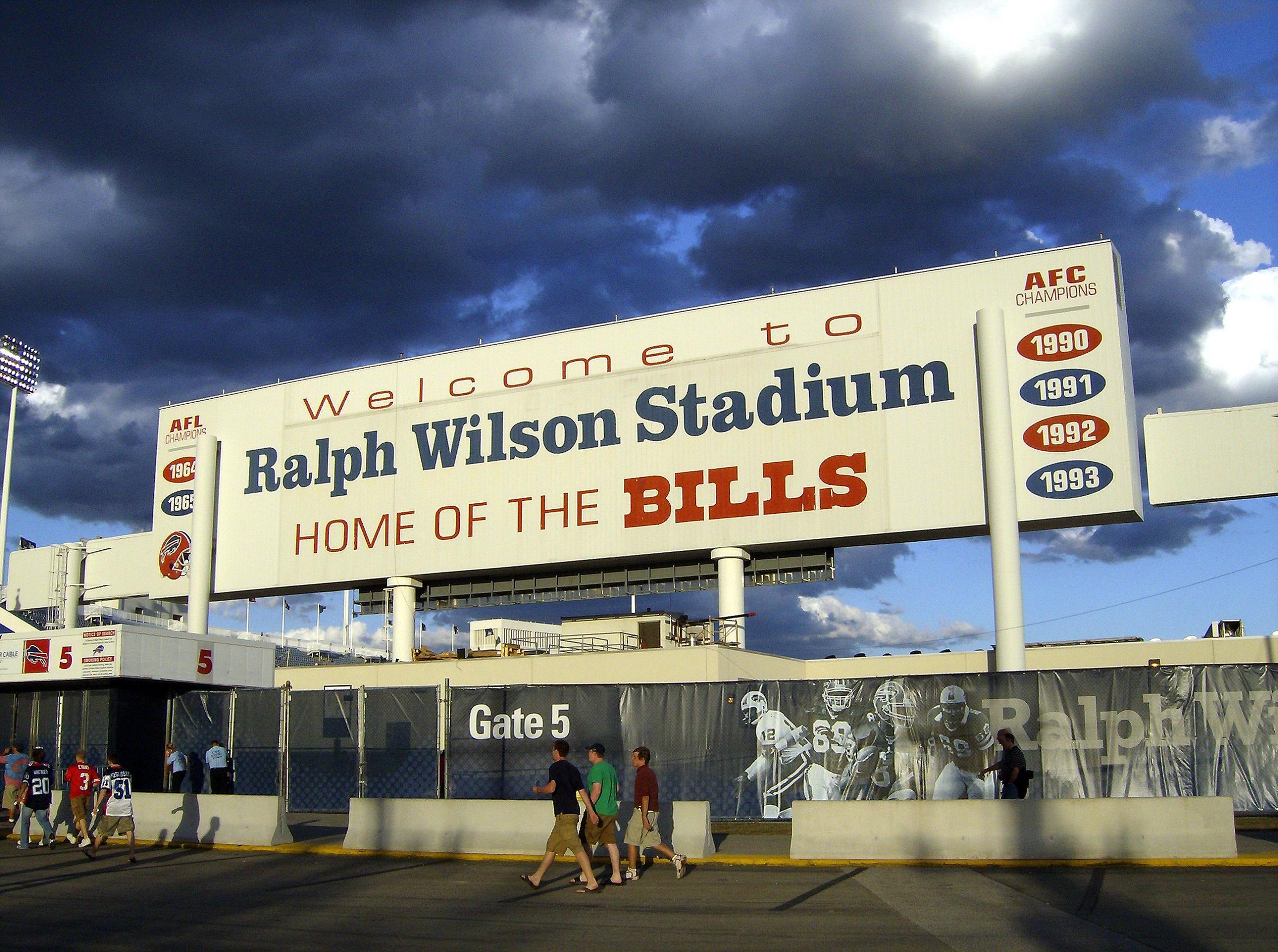
Team History Displays. Outside Gate 5, under the big west end scoreboard and next to the Bills Store, the Bills have a display for their AFL Championships of 1964 and 1965, and their AFC Championships of 1990, 1991, 1992 and 1993. They also have a mural showing some team legends.
Not officially shown there are seasons where they won their Division but fell short of the AFL or AFC Championship: 1966, 1980, 1988, 1989, 1995 and 2020. They've won Wild Cards in 1963, 1974, 1981, 1996, 1998, 1999, and then broke what had been the longest current NFL Playoff drought in 2017. They've already clinched a Playoff berth for 2021, and if they win this game, that will make them AFC East Champions for the 9th time.

The Bills have 3 officially retired numbers, all from players from their 1990s AFC Champions: The 12 of quarterback Jim Kelly, the 34 of running back Thurman Thomas, and the 78 of defensive end Bruce Smith.

There are 4 others that are unofficially retired. One is for another 1990s player, receiver Andre Reed, 83. Three are for players from the 1960s, including their 1964 and 1965 AFL Champions: 44, receiver Elbert Dubenion; and 66, guard Billy Shaw.

Previously, 15 was considered unofficially retired for quarterback and later political figure Jack Kemp; and 34 was considered unofficially retired for both Thomas and 1960s running back Carlton Chester "Cookie" Gilchrist.

And then there's 32, for 1970s running back O.J. Simpson. It's a good thing that number was never officially retired, because, if it was, there might be a display of it somewhere in the stadium, and lots of parents would have to do some explaining to their kids. In fact, since 1974 was the only Playoff season of his career -- though he did help USC win the 1967 National Championship -- it was joked that O.J. didn't have a good defense until 1994.

Regardless of all the things O.J. has done, Ralph Wilson said he would never reissue the number. With his death, and the incoming of the Pegula regime, the number is back in circulation. Running back Senorise Perry wore it in 2019, and cornerback Rachad Wildgoose has it now.

When the Bills started in 1960, they had stationery and other team merchandise showing a player carrying a ball and wearing Number 31. This was supposed to refer to "the spirit of the team." As a result, 31 has been given out sparingly. It's only been worn in a regular-season game by 2 players, 1 on an emergency basis after his regular uniform was damaged. Number 1 is also rarely used, though if there's a reason, it has never been publicly revealed. Receiver Emmanuel Sanders just became the 1st player to wear it in 19 years.

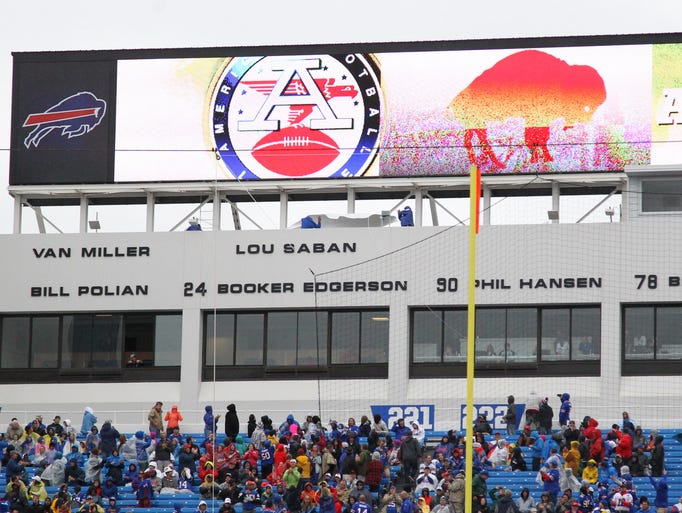
The Bills have a Wall of Fame, with 29 men elected, plus the fans as "The 12th Man":

* Spanning the eras: Owner Ralph Wilson, team executive Pat McGroder, trainer Edward Abromski and broadcaster Van Miller.

* 1960s: Gilchrist, Shaw, Dubenion, head coach Lou Saban, quarterback (and future political star) Jack Kemp, guard Bob Kalsu (1 of 2 pro football players killed in action in the Vietnam War), defensive tackle Tom Sestak, linebacker Mike Stratton, cornerback Booker Edgerson and safety George Saimes. Gilchrist was never inducted during his lifetime, as he demanded an appearance fee, and Wilson wouldn't give him one. He died in 2011, and will be inducted on October 29, at halftime of the game against the Oakland Raiders.

* 1970s: Simpson, quarterback Joe Ferguson, guard Joe DeLamielleure, defensive back Robert James.

* 1980s: Center Jim Ritcher, defensive tackle Fred Smerlas, linebacker Darryl Talley.

* 1990s: Ritcher, Talley, Kelly, Thomas, Reed, Smith, head coach Marv Levy, center Kent Hull, receiver Steve Tasker, defensive end Phil Hansen, and general manager Bill Polian.

* No player has yet been inducted from the 2000s or the 2010s, which have been a dark period in team history.
There are 9 Bills players in the Pro Football Hall of Fame: Simpson, Shaw, Kelly, DeLamielleure, Thomas, Smith, Reed, receiver James Lofton (4 seasons near the end of his career, including 3 Super Bowls), and receiver Terrell Owens (only the 2009 season). Wilson, Levy and Polian have also been elected.

Shaw, Stratton, Sestak, Saimes, Gilchrist, offensive tackle Stew Barber, defensive end Ron McDole, defensive tackle Tom Keating and cornerback Butch Byrd were named to the AFL's All-Time Team. Simpson was named to the NFL's 75th Anniversary Team, right before his arrest. Despite the crime and the media circus thereof, he was named to The Sporting News' 100 Greatest Football Players in 1999, and to the NFL Network's 100 Greatest Players in 2010. Bruce Smith was also named to each of those lists. Simpson and Smith were the only Bills named to the NFL's 100th Anniversary Team in 2019.

The Bills have had 3 Heisman Trophy winners. O.J. won it at USC in 1968. Quarterback Doug Flutie, with the Bills from 1998 to 2000, won it with Boston College in 1984. And another USC running back, winning it in 2005 but having to give it back, was Reggie Bush, a Bill in 2016.

While the Bills are reasonably close to them in distance, the Cleveland Browns and Pittsburgh Steelers are not in their Division, and the Hamilton Tiger-Cats and Toronto Argonauts are not even in their country, let alone League. In the AFC East, the Bills actually lead their all-time rivalry with the Jets, 66-56, but trail the Patriots 77-46-1 (33-8 since Bill Belichick became Patriots coach and starting cheating), and trail the Dolphins 61-54-1 (although they have won the last 7 meetings).

Stuff. The Bills Store is located in the stadium's west end. It has the usual items you'll find in a team store, possibly including hats with buffalo horns. Souvenir stands are also around the stadium.

With Western New York being a small and declining market, there aren't very many books about the Bills. Coach Levy collaborated with Joseph Valerio to write Second to None: The Relentless Drive and the Impossible Dream of the Super Bowl Bills, which has since been made into an ESPN 30 for 30 documentary. Tasker combined with Sal Maiorana to write Buffalo Bills: The Complete Illustrated History in 2010. Similarly, in 2009, the NFL released a History of the Buffalo Bills DVD.

During the Game. A recent Thrillist article on "The Most Obnoxious Fans In the NFL" ranked Bills fans 24th, about 3/4 of the way from most obnoxious to least, saying:

Bills fans should be much sadder. The Super Bowl quadfecta. The ABSOLUTE FORWARD PASS in the playoffs in Tennessee in 2000. The quarterbacks named Manuel and Edwards and Brohm and Holcomb and Thad Lewis and one-s-short-of-perfect Losman. The snow. And yet, you remain an industrially jovial, generally adorable bunch full of Labatt Blue and misbehavior, but never hate.  

From September 1 to 7, 2017, at the height of the NFL National Anthem protest controversy, FiveThirtyEight.com polled fans of the 32 NFL teams, to see where they leaned politically. Despite including fans from black neighborhoods and "Socialist" Canada, Bills fans were rated 2.2 percent more conservative than liberal. They were 1 of 6 teams whose fans were more conservative than liberal. Maybe it's the fact that they elected Jack Kemp to Congress 9 times after he retired as a player, helping to make him a conservative icon.

Safety will not be an issue. While the old War Memorial Stadium was in an iffy neighborhood (now considerably safer), Highmark Stadium isn't in any neighborhood. Like the Packers, the Bills have their own undyingly loyal fans that support them in a small local market where the Winter weather produces conditions that would send others blitzing for the exits in many of the more temperate NFL cities. Just don't remind anyone of the 4 straight Super Bowl losses, and both you and your car should be safe.

The Bills hold auditions for singing the National Anthem, as opposed to having a regular singer. With every score, the fans sing a customized version of the classic Isley Brothers song "Shout" that includes some specially adapted lyrics to suit the home team. Their mascot is named, as may not surprise you, Billy Buffalo.


After the 2014 season, the Bills dropped their cheerleading squad, the Buffalo Jills, and are now 1 of 6 NFL teams that doesn't have cheerleaders. The others are the the Giants, the Pittsburgh Steelers, the Cleveland Browns, the Chicago Bears and the Green Bay Packers. But they do have a team drumline, the Stampede Drumline.
Bills fans like to refer to themselves as the "Bills Mafia." Because of its status as a border area, the Buffalo-Niagara Falls region has had an organized crime problem going back at least as far as Prohibition in the 1920s. The movie You Kill Me starred Ben Kingsley as a hitman for the city's Polish Mob.

The best-known Bills fan was Ezra Castro, a Mexican-American from the Dallas area, who nonetheless rooted for Buffalo, wore a Bills-themed bandito outfit reminiscent of the early 20th Century revolutionary Francisco "Pancho" Villa, and a mask in the tradition of Mexican wrestlers, a.k.a. luchadores. He called himself Pancho Billa.
When he was 7 years old, his Cowboy fan father let him choose his own favorite team. He said he wanted a team with Mexican flag colors: Green, white, red. "But there's not one," he said, which is still true, "and I went with the red, white and blue charging Buffalo logo over the Patriots."

By the time the Bills got good again in 2017, he had become the team's best-known and most popular fan, living in Dallas but getting to every home game and several away games. Sadly, he died of cancer on May 14, 2019, sending Western New York into mourning.

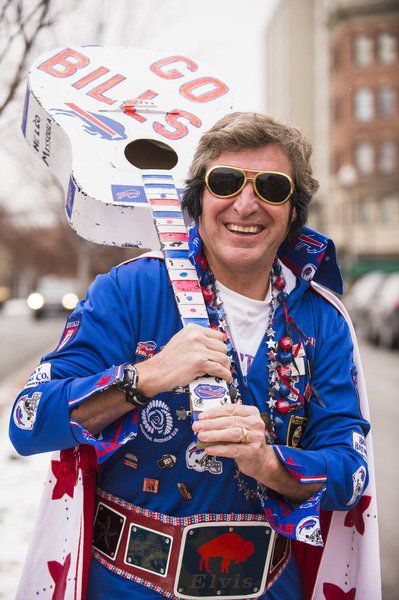
There's also John Lang, the Bills Elvis. In 1992, the Lockport, New York native put on fake sideburns, sunglasses and a jumpsuit, and brought a guitar into The Ralph, to win a bet that he could get a camera on him and put him on the scoreboard's TV screen. He won, but his fellow fans wouldn't let him make it a one-shot deal. So he still plays the King.
No word on whether a Bills loss has ever
made him check into a Heartbreak Hotel.

And then there's Frank Barber of Corning, New York, who wears a mask similar to the one worn by Anthony Hopkins in The Silence of the Lambs -- a movie whose other villain was nicknamed Buffalo Bill. Barber calls himself HannaBill Lecter.
At Lambeau Field, looking to have a cold lunch.

Until 1994, the Bills did not have an official fight song. But after getting sick of hearing "Bear Down, Chicago Bears" during a loss at Soldier Field, Marv Levy promised the team that if they won their next game, he would write them one. They beat the Miami Dolphins, and he was as good as his word. I wouldn't have told him to quit his day job, but it's decent

Go Bills, for we are here to cheer for you!
Go Bills, we are your fans so true!
With victory in sight
we'll yell with all our might!
So go Bills, fight Bills, go!
Come on, let's win for Buffalo!
Marv said that Bruce Smith asked him for a rap version. He said, "I told him I don't do rap." It's just as well, given Kenny Dalglish's performance with his Liverpool F.C. players in "The Anfield Rap" in 1988.

After the Game. Buffalo, like any other city, has crime issues. But the rivalry between the Jets and the Bills, despite going all the way back to the founding of the AFL and each team's 1st game, is minimal. The Bills have even less of a rivalry with the Giants, despite Super Bowl XXV (which, to be fair, was over a quarter of a century ago). Your greatest danger leaving a Bills game is traffic, and the weather that might make it worse.

I can find no reference to any bar in Buffalo where fans of New York sports teams tend to gather or are especially welcomed. But O'Neill's Stadium Inn, at 3864 Abbott Road at Route 20, is a short walk from the stadium. And, once you get back downtown, there are plenty of bars that serve both the Sabres' arena and the Bisons' ballpark.

Iron Works, in a former, well, ironworks, is on Illinois Street, on the east side of the arena. There's a Tim Hortons at Main & Scott Streets, which is understandable, since Buffalo borders Canada and Horton was on the Sabres' roster when he died. This store includes a memorial to the Buffalo Memorial Auditorium. On Mississippi Street, across from the main parking lot, is a bar named Cobblestone. Further up Main Street, you can take a left turn on Pearl Street and try Pearl Street Grill & Brewery.

Buffalo's most famous eating & drinking establishment is the Anchor Bar. It's a bit of a trek from the arena on foot, but the light rail gets close, at the Allen/Medical Campus station. Its proximity to the site of War Memorial Stadium made it a good stopover after Bills games. It was there on March 4, 1964 that Dominic Bellissimo, son of owners Frank and Teressa, saw some hungry friends come in a Friday night, but all his mother had left in the kitchen was chicken wings, a part of the chicken not traditionally eaten. So she boiled them, made up a spicy sauce, and glazed the wings with the sauce, and the boys couldn't get enough of them. Buffalo sauce and Buffalo wings were born.

The bar is still in the family. I visited Buffalo in 2004, and made sure to visit. I can't handle spicy food, but they make a Monte Cristo sandwich that is out of this world. 1047 Main Street at North Avenue.

There are now 14 locations: 4 in Western New York, including at Buffalo Niagara International Airport; 4 in Ontario, including 1 in Toronto and 1 in Hamilton; 3 in Texas, including 1 in San Antonio; and in Frederick, Maryland; Kennesaw, Georgia; and outside Los Angeles in Orange, California.

If you visit Buffalo during the European soccer season, as we are now in, the leading "football pub" in town is Mes Que, named for the slogan of Spanish superclub FC Barcelona: Mes Que Un Club -- "More Than a Club." 1420 Hertel Avenue at N. Park Avenue, about 5 miles north of downtown. Bus 11. Ironically, the local Barcelona fan club doesn't meet there, instead meeting 2 blocks away, at Wellington Pub, at 1541 Hertel Avenue at Wellington Road.

Sidelights. Buffalo has a long sports history, although it's not a very good one. On February 3, 2017, Thrillist made a list ranking the 30 NFL cities (New York and Los Angeles each having 2 teams), and Buffalo came in 27th, 4th from the bottom. Their description of Buffalo is withering:

Buffalo is like if a mid-tier Canadian city crept across the border and hoped no one would notice it just hanging out up there in the far reaches of New York, sipping a Labatt tallboy and trying to keep snow off its faded Thurman Thomas jersey via an also-faded Bills starter jacket, the orange hue of wing sauce still staining its cheeks from a recent trip to Anchor Bar as it ponders engaging in a zesty round of parking-lot sex. You know, metaphorically speaking.

Nevertheless, there are some places worth visiting in the city, some of them sports-related:

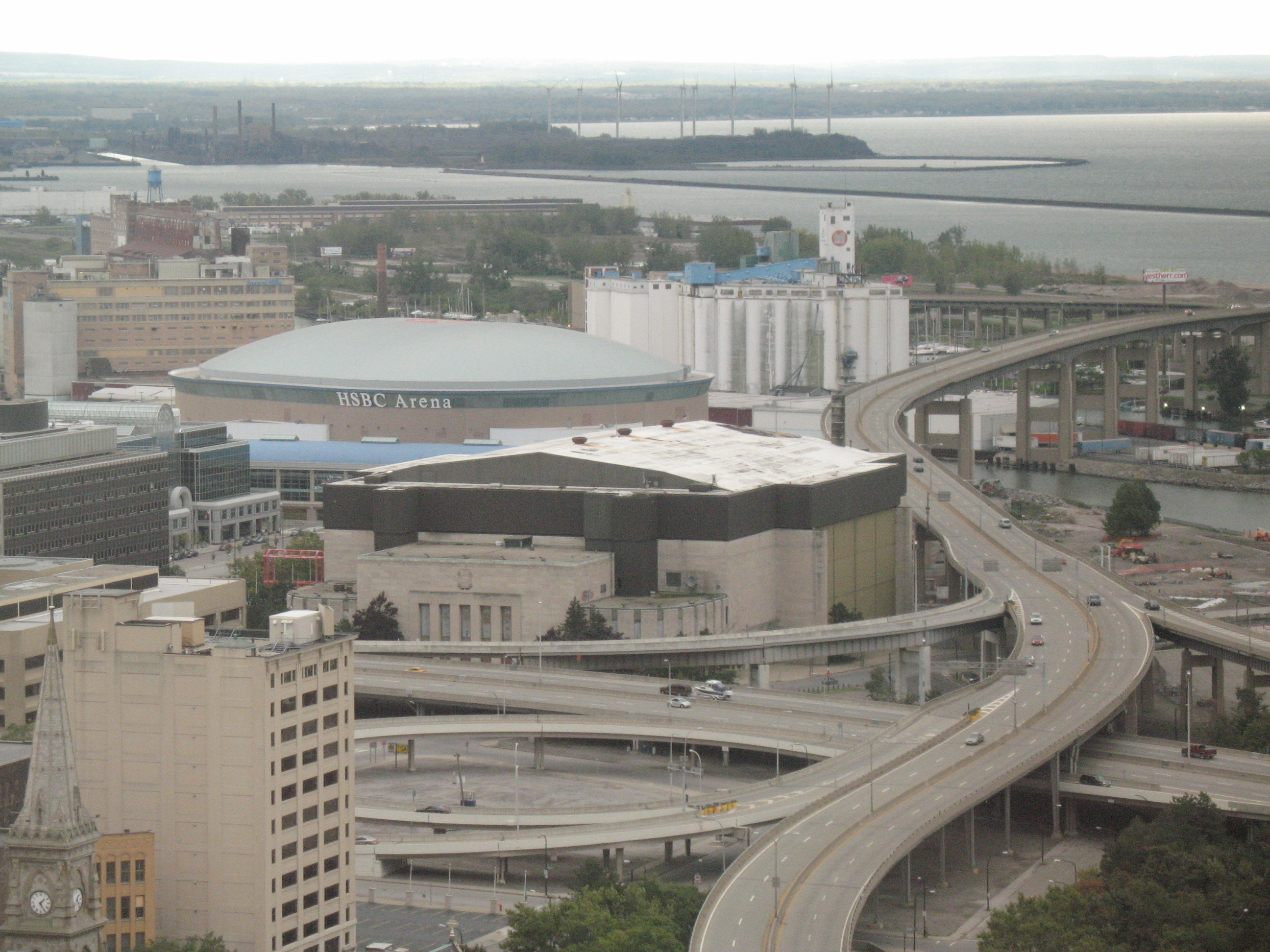
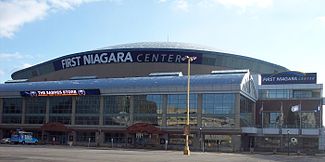
* KeyBank Center. The current home of the Sabres was known as the Crossroads Arena during planning, but naming rights were bought by Marine Midland Bank, and it became the Marine Midland Arena when it opened in 1996. That bank was bought out, and the arena became the HSBC Arena in 1999, before First Niagara Financial group bought HSBC in 2011. Although the banks were not rebranded, the arena was renamed. It got renamed again in 2016, as KeyBank bought out HSBC.

In addition to the Sabres, the arena also hosts the Buffalo Bandits of the National Lacrosse League. On occasion, the minor-league Rochester Americans and the basketball team of St. Bonaventure University in Olean, New York play games that have a greater ticket demand than their arenas can fulfill.

It hosted hockey's version of the NCAA's Final Four, the Frozen Four, in 2003 and 2019. It also hosted the now-defunct Buffalo Destroyers of the Arena Football League. And, as you might guess, it is Western New York's leading concert facility.

The official address of the arena is One Seymour H. Knox III Plaza, after the founding owner of the Sabres, who had it built. It's at the corner of Washington & Perry Streets, downtown. Special Events Station on Metro Rail.

* Site of Buffalo Memorial Auditorium. Opening on October 14, 1940, it was home to the Buffalo Bisons of the American Hockey League from 1940 to 1970, the ill-fated Buffalo Bisons of the National Basketball League (forerunners of today's Atlanta Hawks) in 1946, the NBA's Buffalo Braves (forerunners of the Los Angeles Clippers) from 1970 to 1978, and the Sabres from 1970 to 1996.
The Aud. The new arena, then known as the HSBC Arena,
was built only a block away.

Like the Boston Garden and Chicago Stadium, "The Aud" had a rink that was shorter and narrower than the usual NHL rink size, 200 by 85 feet, and was allowed to keep it after that was made a rule. (The new arena has the standard size.)

It hosted the NHL All-Star Game in 1978, and 2 fights for the Heavyweight Championship of the World: Joe Louis defending the title against Johnny Davis on November 14, 1944; and Ezzard Charles defending it against Freddie Beshore on August 15, 1950 -- both of them, successfully.

It was also Western New York's longtime concert center. The Beatles never played there, but Elvis Presley sang there on April 1, 1957; April 5, 1972; and June 25, 1976. A year later, Led Zeppelin played there for 3 hours straight, without a break. It was also a major boxing and pro wrestling facility.

It was demolished in 2009, and the site is now home to The Ralph C. Wilson, Jr. Children's Museum, named for the Bills' founding owner. It includes The Ice at Canalside, a skating rink, so while hockey is no longer played there, you can skate there. Main & Scott Streets, only a block away from its replacement. Erie Canal Harbor station on Metro Rail.

Since the Buffalo Braves, left to become the San Diego Clippers, the Knicks, the Boston Celtics, the Los Angeles Lakers, and whatever team LeBron James plays for (now the Lakers) pretty much divide fandom. Oddly, the 2 closest NBA teams, the Toronto Raptors (98 miles away) and Cleveland Cavaliers (189 miles), don't factor in much (or, at least, the Cavs don't when they don't have LeBron); yet once you cross the border into Ontario, the Raptors are easily the plurality team (but not a majority one, not even in Toronto itself).

Roughly the same proportion holds true for Rochester (NBA's Royals 1946-57), 75 miles to the east; but once you get to Syracuse (NBA's Nationals 1949-63), 150 miles to the east, you start to get into solid Knicks territory.

The closest thing the Buffalo area has to a major league basketball team now is the Niagara River Lions, of the National Basketball League of Canada. They play at the 4,030-seat Meridian Centre, which they share with the Ontario Hockey League's Niagara IceDogs. 1 IceDogs Way, St. Catherine's, Ontario, 31 miles northwest of downtown Buffalo.

* Sahlen Field. Buffalo doesn't have a Major League Baseball team, and hasn't since the ill-fated Federal League of 1914-15. But it has been one of the great minor league cities, home to the Triple-A Buffalo Bisons, who play at Sahlen Field, named for a local hot dog packing company. It was built in 1988 as Pilot Field, named for the travel plaza and convenience store company.

It was designed to seat 19,500 people, making it one of the largest stadiums ever to host regular minor-league baseball, but expandable to 40,000 by putting a 2nd deck on the mezzanine, in the hopes that Buffalo would get an expansion team or a moved team in the 1990s. But it was passed over for both the 1993 and the 1998 expansions.

The Bisons have won 3 International League Pennants since moving in, in 1997, 1998 and 2004. They made the Playoffs in 12 of the park's 1st 17 seasons, although in none of the last 13, counting 2018. So the new ballpark has been (mostly) good to them. It now has a listed seating capacity of 17,600, making it the largest current minor-league stadium.

Due to COVID restrictions, Sahlen Field hosted all 26 of the Blue Jays' "home games" in the 2020 season, and their 1st 34 of 2021. 275 Washington Street, between Swan & Exchange Streets. Seneca station on the light rail.

The Bisons have, in the 1960s and in this current decade, been a Mets farm team., and are now a Toronto Blue Jays farm team. Nevertheless, the Yankees are the most popular team here, getting a majority of support (low 50s percent in pretty much all of the Buffalo area, high 50s in Rochester, 60s in Syracuse).

In spite of the Jays' recent Sahlen sojourn, there will, almost certainly, never be another MLB team in Buffalo or elsewhere in Western New York. Population-wise, its metropolitan area would rank dead last in MLB, and it's not even close: It's got about 800,000 fewer people than 30th-place Milwaukee. You could throw in the Ontario portion of the Niagara Falls area, which the U.S. Census Bureau doesn't because it's in Canada, and it would still have about 400,000 fewer people than Milwaukee.

It would also be 27th in the NBA, ahead of only New Orleans, Oklahoma City and Memphis. It is 30th in the NFL, ahead of only Jacksonville and New Orleans; and 26th in the NHL, last among U.S. cities, ahead of only Ottawa, Calgary, Edmonton and Winnipeg.

In spite of their comparative closeness (especially considering that radio signals can, unlike cars, easily cross Lake Ontario), the Blue Jays, at 98 miles the closest MLB team, don't make a dent in it at all: The Boston Red Sox are the 2nd-most popular team here, the Mets 3rd. (That did not change due to the Jays' 2015-16 success.) The next-closest team, the Pittsburgh Pirates, don't get any traction until you reach the southwestern corner of New York State; the Cleveland Indians, not that much further away than the Pirates, almost nothing -- this despite the Bisons having been members of both the Tribe's and the Bucs' farm systems in the last 25 years.

The closest MLS team is Toronto FC, 97 miles away. The closest U.S.-based MLS team, the Columbus Crew, is 321 miles away.

* Site of War Memorial Stadium. Built in 1937 as Civic Stadium, It was renamed War Memorial Stadium in 1960, the year the Bisons and the AFL's Buffalo Bills moved in. It seated 46,500 people, making it one of the largest stadiums in minor-league baseball, but the smallest in the NFL after the 1970 merger with the NFL. It was this reason, rather than its deteriorating neighborhood, advancing age and rundown appearance that led the Bills to build a larger stadium.

The Bisons won just 1 Pennant there, in 1961, but had some eventually legendary names suit up for them there, including Hall-of-Famers Ferguson Jenkins in 1962 and Johnny Bench in 1966 and '67. Unlike the Bills, they did leave due to the collapse of the neighborhood and the stadium looking like it would collapse as well.

The Bills won the AFL Championship here in 1964 and 1965, the only 2 times they've ever gone as far as the rules allowed them to go. These were the last 2 times the AFL Champion was unable to face the NFL Champion in a World Championship Game. In 1966, with the chance to go to the 1st AFL-NFL World Championship Game, retroactively renamed Super Bowl I, the Bills lost the AFL Championship Game to the Kansas City Chiefs. Not until the 1990 season would they reach the Super Bowl.

In 1983, the movie version of Bernard Malamud's novel The Natural was filmed there. Robert Redford and director Barry Levinson, not having computer-generated imagery (CGI) to create an old-time ballpark for them, needed an old ballpark, but not one that was easily identifiable, like Fenway Park with its Green Monster left-field wall, Wrigley Field with its ivy-covered walls and distinctive bleachers, or Comiskey Park with its pinwheeled scoreboard.

War Memorial was available. The story takes place in 1939, when the stadium was new. But by 1983, it was so run-down that it looked like it hadn't had any maintenance since the Great Depression, and appeared much older. By this point, it was known as The Old Rockpile. Buffalo native Brock Yates, a screenwriter who created the race upon which the Cannonball Run movies were based, said that it "looks as if whatever war it was a memorial to had been fought within its confines."
It was demolished in 1988, after the Bisons left. A new high school sports complex, the Johnnie B. Wiley Recreation Center, was built on the site. 1100 Jefferson Avenue. Summer-Best station on Metro Rail, then 5 blocks east on Best Street.
Baseball field at the Wiley Center. That white thing
in the background is a gate from the Rockpile that was left standing.

* Soccer in Western New York. Ironically, while Wrigley Field was available for The Natural, a scene in the film that supposedly took place at Wrigley was instead filmed at Buffalo's All-High Stadium, with a matte painting giving it an upper deck in those pre-CGI days. Built in 1926, it was demolished and rebuilt in 2007, seats about 5,000 people, and hosts high school football, and hosted 2 pro soccer teams: FC Buffalo and the Western New York Flash.

2885 Main Street at Mercer Avenue, behind Bennett High School. LaSalle station on the light rail. It is now named after Robert B. Rich Sr., original namesake of the Bills' new stadium and founder of Buffalo-based Rich Foods, now owned by his son Robert Jr., who, as I said, is in the Sabres' Hall of Fame, and is also the owner of the Bisons baseball team. His son Robert III played Roy Hobbs' son in The Natural.

The Western New York Flash were in United Women's Soccer, after the previous team with the name was moved to become the North Carolina Courage. They won the league title in Women's Professional Soccer (WPS) in 2011, and in the National Women's Soccer League (NWSL) in 2016, but were dissolved this year, anyway.

The Rochester Lancers played in the American Soccer League from 1967 to 1969, and then in the original North American Soccer League from 1970 to 1980. They were ASL runners-up in 1968, Division Champions the next 3 years, and 1970 NASL Champions.

They played at the 20,000-seat Aquinas Memorial Stadium, and hosted the 1st leg of the 1970 Final, defeating the Washington Darts 3-0. In the return leg at Robert F. Kennedy Stadium in Washington, the Darts won 3-1, but the Lancers took the title 4-3 on aggregate.

The stadium was on the campus of the Aquinas Institute, a Catholic high school, and in 1974 was renamed Holleder Memorial Stadium, for Major Don Holleder, an Aquinas and West Point football star from Buffalo, who was killed in Vietnam in 1967, after having already been awarded the Distinguished Service Cross, the Silver Star and the Bronze Star.

The stadium was built in 1949 and torn down in 1985. An industrial park is now on the site. 50 Holleder Parkway, about 4 miles northwest of downtown. Bus 16.

* Site of Offermann Stadium. The Bisons played in 2 separate stadiums at Ferry Street and Michigan Avenue, starting in 1889, in a wooden stadium with the name Buffalo Baseball Park. In 1924, a new Bison Stadium of concrete and steel opened on the site. In 1935, it was renamed for the team's owner, Frank J. Offermann, who had just died.
The Bisons won International League Pennants there in 1933, 1936 and 1957, before moving a few blocks away to War Memorial Stadium for the 1960 season. The future Hall-of-Famers who played for the Bisons at Buffalo Baseball Park were Jimmy Collins, Herb Pennock, Bucky Harris; at Offermann, they were Ray Schalk, Lou Boudreau and Jim Bunning.

The Buffalo pro football team, known as the All-Stars from 1915 to 1917, the Niagaras in 1918, the Prospects in 1919, the All-Americans from 1920 to 1923, the Bisons in 1924 and 1925, the Rangers in 1926, and the Bisons again from 1927 to 1929, played on the site, before the Depression did them in.

The Buffalo Performing Arts High School is now on the site. 450 Masten Avenue. Utica station on Metro Rail.

Another early pro football team in the area, the Tonawanda Kardex Lumbermen, named for the American Kardex company that sponsored it, played from 1913 to 1920, then entered the NFL for the 1921 season -- but played only 1 game against an NFL team, and then folded, making them the least-playing franchise in NFL history. They played against non-NFL teams that season, but their one and only NFL game was against the Rochester Jeffersons in Rochester, a 45-0 win by the home team. Which, I suppose, also makes the Lumbermen the worst team in NFL history.

They played at Tonawanda High School, in Tonawanda, 9 miles north of downtown Buffalo. Bus 25 to Broad Street and Main Street, then a 25-minute walk west.

And the Rochester Jeffersons, the other Western New York team to have played in the early NFL? They were one of the 1st pro football teams ever established, in 1898. They won the New York Professional Football League title in 1916. They played at Sheehan's Field from 1898 to 1915, at Rochester's baseball park from 1916 to 1922, and at Edgerton Park in 1923 to 1925.

* Site of Olympic Park. The true glory days of Buffalo baseball? It might have been when the Buffalo Bisons was the name of a National League team, from 1879 to 1885. They played their last 2 seasons at Olympic Park, including their best season, 1884, when they went 64-47 and finished 3rd, albeit 19 1/2 games out. They had Hall-of-Famers Jim "Orator" O'Rourke (player-manager), Dan Brouthers and Jim "Pud" Galvin.
But, even then, Buffalo wasn't really big enough to support a major league team, and the Bisons went bust after the 1885 season, returning as a minor-league club in 1889. From 1886 to 1888, an all-black team named the Cuban Giants, featuring Hall-of-Fame 2nd baseman Frank Grant, played at Olympic Park. Buffalo's entry in the 1890 Players' League also played there.

Houses now stand on the site. Richmond Avenue & Summer Street, 7 blocks west of Main. Summer-Best station on Metro Rail.

* Site of Riverside Park. The 1st home of the Bisons wasn't much more than wooden bleachers, but it was home to Hall-of-Famers O'Rourke, Brouthers, Galvin, John Montgomery Ward, and Old Hoss himself, Charley Radbourn. As with Olympic Park, houses are now on the site. Fargo & West Avenues, Rhode Island & Vermont Streets. Number 3 or 5 bus from downtown.

* UB Stadium. Opening in 1993, this stadium has hosted University of Buffalo football, and saw the Bulls reach Division I-A (now FBS) status in 1999, now a member of the Mid-American Conference. The construction of a new field house in one end zone reduced its seating capacity to 25,000, and it isn't much to look at, but it's Buffalo's college football stadium, especially since Syracuse is 150 miles away. 102 Alumni Arena, 14 miles northeast of downtown. University station on the light rail, then transfer to Number 35 bus.
On November 19, 2018, MoneyWise compiled a list of their Worst College Football Stadiums, the bottom 19 percent of college football, 25 out of 129. UB Stadium was ranked 13th, using the words "uncomfortable" and "pretty average."

* Museums. Buffalo is a medium-sized city, but it's got a big city's history. The Buffalo History Museum is at One Museum Court. The closest thing the city has to a Metropolitan Museum of Art, the colonnaded Albright-Knox Gallery, is nearby at 1285 Elmwood Avenue. For each, take the Number 20 bus from downtown.

The Buffalo & Erie County Naval and Military Park is at One Naval Park Cove, along the Niagara River, a short walk from Erie Canal Harbor Station. The Buffalo Museum of Science, their Hayden Planetarium/Franklin Institute, is at 1020 Humboldt Parkway. Number 6 bus from downtown to Guilford Street, then walk 3 blocks north.

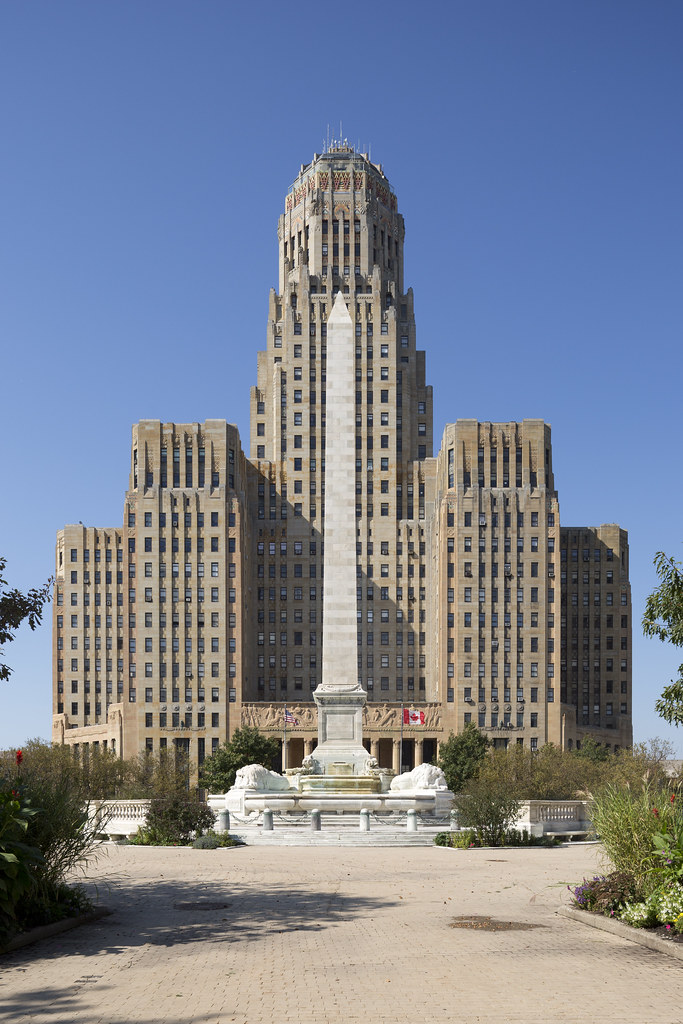
Buffalo's City Hall, a brown brick building on Niagara Square downtown, has statues of 2 Presidents who have called the city home: Millard Fillmore and Grover Cleveland. Despite a campaign to get one for Cleveland, the city and its environs do not have a Presidential Library.

No home of Cleveland's survives in the area (his birthplace in Caldwell and his last home in Princeton, both in New Jersey, still stand), but the Millard Fillmore Museum, his one surviving home, is at 24 Shearer Avenue in suburban East Aurora. Number 70 bus, taking about an hour.

Cleveland is buried in Princeton, but Fillmore is buried in Buffalo's Forest Lawn Cemetery. Delaware & Delavan Avenues. Delavan/Canisius station on Metro Rail, then walk 5 blocks west on Delavan. Or Number 25 bus from downtown.

Buffalo, specifically the Temple of Music at the Pan-American Exposition, is where President William McKinley was shot on September 6, 1901. The site of the Exposition has long since been replaced with middle-class housing. 52 Fordham Drive, in the Elmwood section of town. Number 20 bus to Elmwood & Fordham. Within a 5-minute walk of the History Museum and Albright-Knox.

McKinley died 8 days later, at the house of prominent Buffalo politician John G. Milburn, which has since been torn down and replaced with parking for Canisius High School (not Canisius University). 1168 Delaware Avenue at Cleveland Avenue. Utica station on Metro Rail, or Number 25 bus from downtown. While McKinley doesn't have a statue in Buffalo, he does have the McKinley Monument in the middle of Niagara Square, across from City Hall and the Fillmore and Cleveland statues.
Niagara Square, with the McKinley Monument
in front of City Hall

Notified of the President's death, Vice President Theodore Roosevelt rushed to Buffalo, and was sworn in as the nation's 26th President at the home of a friend, Ansley Wilcox. It is now the Theodore Roosevelt Inaugural History Site, and is open to tours. (I took the tour in 2004, and it's well worth it.) 641 Delaware Avenue at North Avenue. Allen/Medical Campus station on Metro Rail -- just 3 blocks west on North from the Anchor Bar.

Joe McCarthy, who managed the Yankees from 1931 to 1946, winning 8 Pennants and 7 World Series (a record he shares with Casey Stengel), is buried at Mount Olivet Cemetery, 4000 Elmwood Avenue in Kenmore. Bus 25 to Delaware Avenue & Orchard Loop.

Across the river, Fort Erie, Ontario is the site of Old Fort Erie, a major location in the French and Indian War, the War of the American Revolution, and the War of 1812 -- all on the British side, of course.

Niagara Falls, Ontario, in addition to being the home of the Falls themselves and 2 casinos, was the site of the Battle of Lundy's Lane, a major War of 1812 event that included Laura Secord walking 20 miles to warn British troops, in effect not only making her Canada's "Paul Revere," but out-Revere-ing him -- and even topping Sybil Ludington, the 17-year-old Connecticut girl who outrode Revere and saved Danbury, Connecticut.

These locations, of course, are across the border, making them difficult to reach except by car. And remember to bring your passport and change your money. The Number 40 bus goes from downtown Buffalo to Niagara Falls, New York, taking a little under an hour. You can, however, walk across both the Peace Bridge between Buffalo and Fort Erie, and the Rainbow Bridge between NFNY and NFO -- if, as I said, you have your passport.

On the New York side, the Niagara Falls Convention Center stood at 310 4th Street from 1973 to 2002. It was a home court for Niagara University basketball from 1973 to 1981. Elvis sang there on June 24, 1974 and July 13, 1975. It was demolished, and the Seneca Niagara Casino & Hotel was built on the site.

Other places in New York State -- aside from Madison Square Garden and the Nassau Coliseum -- where Elvis sang are the Onondaga County War Memorial at 800 S. State Street in Syracuse (now the Oncenter War Memorial Arena, home of the NBA's Syracuse Nationals from 1951-63) on July 25 and 27, 1976; the Rochester Community War Memorial Arena at 1 War Memorial Square (now the Blue Cross Arena, home of the NBA's Rochester Royals from 1955 to 1957) on July 26, 1976 and May 25, 1977; and the Broome County Veterans Memorial Arena at 1 Stuart Street in Binghamton (now the Floyd L. Maines Veterans Memorial Arena) on May 26 and 27, 1977.

One Seneca Tower, formerly One HSBC Center and Marine Midland Center, is the tallest building in Western New York. Built in 1972, it stands 529 feet, and is at Main & Seneca, across from the ballpark. It isn't much to look at, being typical of late Sixties and early Seventies architecture.

Buffalo isn't a glamorous city, and TV shows and movies set their tend to emphasize this. The only 2 TV shows I can remember being set there are, not surprisingly, both comedies, and both on NBC: Dabney Coleman's Buffalo Bill, in 1983 and '84; and Christina Applegate's Jesse, from 1998 to 2000. The ABC soap opera General Hospital and its now-defunct spinoff Port Charles are set in Port Charles, hits about whose location suggest that it's a stand-in for Rochester, 76 miles east of Buffalo.

The best-known movie set in Buffalo is Buffalo '66, directed by Buffalonian Vincent Gallo and starring him as an ex-con whose mother blames his birth for the Bills losing the 1966 AFL title game and missing out on the 1st Super Bowl. He took the fall for a crime he didn't commit, after he couldn't pay money he lost betting on the Bills to win Super Bowl XXV. He gets out 5 years later, and is determined to kill the kicker who missed the game-winning field goal, here named "Scott Wood" instead of Scott Norwood like in real life. (Gallo is not particularly clever, not even in real life.)

Also set partly in Buffalo is You Kill Me, starring Ben Kingsley as an alcoholic hitman for the local Polish mob, who gets sent to San Francisco to dry out. The difference between troubled but glamorous San Francisco, including love interest Tea Leoni, and dreary Buffalo is stark, but intentional.

*

Buffalo has its problems, but it gets a bum rap. The city has a lot to offer, including 2 great sports franchises, a lot of history, and some great food. Check it out.

Friday, December 24, 2021

How to Be a Devils Fan In Buffalo -- 2012-22 Edition

This coming Wednesday night, December 29, the New Jersey Devils head to Western New York to take on the Buffalo Sabres.

Before You Go. Buffalo is located on the Niagara River, between Lakes Erie and Ontario. As a result, it is known for cold weather and nasty snowstorms. That probably won't a problem this time: The Buffalo News (I know, not an imaginative name for a newspaper, but it's the only daily the city has left) is predicting temperatures for Wednesday to be in the mid-30s by day and the high 20s at night. They are also predicting rain, but not snow.

Buffalo may be considerably to the west, but it is still in the Eastern Time Zone, so you won't have to fiddle with your timepieces. But it is on a national border, and if you want to go into Canada, you'll need to bring your passport. Right now, US$1.00 = C$1.28, while C$1.00 = U.S. 78 cents. Of course, with COVID restrictions, you might not be allowed.
The Peace Bridge, connecting Buffalo with Fort Erie, Ontario

Tickets. The Sabres averaged 17,076 fans per game, just 90 percent of capacity, in 2019-20 before COVID shut everything down. A lot of those fans come from across the river in Canada, many from Niagara Falls and Hamilton, Ontario. These are people who, sick of the hype over the Toronto Maple Leafs and the ticket prices at the Scotiabank Arena, and without an NHL team in Hamilton, look at the Sabres as an affordable alternative. (Sabres vs. Leafs is as big a rivalry as Sabres vs. Pittsburgh Penguins.)

It should also be noted that Western New York has storied minor-league teams, the Rochester Americans and the Syracuse Crunch. These people are used to the cold weather necessary to play outdoor hockey, and they love indoor hockey, too.

The Sabres are using what baseball teams call "dynamic pricing." Fortunately, the Devils are a "Silver" opponent, not a "Gold" one. Tickets for the lower bowl, the 100 sections, are $127 for center ice and $55 for the end zones. For the upper bowl, the 300 sections, they're $41 for center ice and $32 for the end zones.

Getting There. It's 363 road miles from the Prudential Center in downtown Newark to the KeyBank Center in downtown Buffalo. Buffalo is one of those cities that's too close to fly to, but too far to get there any other way.

You would think, being so close, nonstop flights would be available. If you're lucky, you can get a nonstop round-trip flight on United Airlines for under $400. But getting it nonstop is the issue: You may have to change planes in an out-of-the-way city like Philadelphia or Charlotte. You might be able to get a nonstop, cheaper flight from a smaller airline; but, remember, it's like the difference between the major leagues and the minor leagues. If you do fly in, the Number 24 bus will get you from Buffalo Niagara International Airport, 11 miles northeast of downtown, in about 50 minutes.

Amtrak's Maple Leaf, its New York-to-Toronto service, leaves Penn Station at 7:15 AM, and arrives at Buffalo's Exchange Street Station at 3:14 PM, just under 8 hours later (if it's on time). Its return trip leaves Buffalo the next day at 12:55 PM and arrives at Penn Station at 9:55 PM. It's $165 round-trip. The station is at Exchange & Washington Streets, just 3 blocks north of the arena.

Greyhound runs 7 buses a day from New York's Port Authority Bus Terminal to Buffalo, taking about 9 hours. Round-trip fare is $303, but it can drop to $163 with advanced purchase. The terminal is at 181 Ellicott Street at Eagle Street, just 7 blocks north of the arena.

If you do drive, get into New Jersey to Interstate 80, and take it all the way across the State. Shortly after crossing the Delaware River and entering Pennsylvania, take I-380, following the signs for Scranton, until reaching I-81. (If you've driven to a game of the Yankees' Triple-A farm team, the Scranton/Wilkes-Barre Yankees, you already know this part.) Take I-81 north into New York State. (If you’ve driven to a game of the Mets' Double-A farm team, the Binghamton Mets, you already know this part.) Continue on I-81 past Binghamton and to Syracuse, where you'll get on the New York State Thruway, which, at this point, is I-90. Continue on the Thruway west, past Rochester, to Buffalo.

With 2 rest stops -- I recommend on one side of the Delaware or the other, and another around Syracuse -- you should be able to make the trip in about 7 hours.

Once In the City. Western New York was first settled by the French, and they called the Niagara River "Beau Fleuve," meaning "good flow." The English, just as they turned the Dutch village of "Vlissingen" into the Queens neighborhood of "Flushing," turned "Beau Fleuve" into the similar-sounding "Buffalo." The original name has nothing to do with bison.

Buffalo likes to call itself the Queen City of the Great Lakes, as opposed to Cincinnati, the Queen City of the Midwest; Charlotte, the Queen City of the Southeast; and Seattle, the Queen City of the Northwest. It's also known as the Nickel City (for the buffalo-head nickels used from 1913 to 1938), the City of Good Neighbors (due to their international border), and, left over from their World's Fair, the 1901 Pan-American Exposition, the City of Light (but no one will ever confuse it with Paris, which is also called that).  

Founded in 1789, Buffalo is home to just under 260,000 people. Before "white flight," it was over twice that, around 580,000 in 1950. The metropolitan area is home to 1.2 million according to the U.S. Census Bureau. However, that doesn't count Niagara Falls and environs over the border; that pushes it to about 1.6 million. ZIP Codes for Western New York start with the digits 14. The Area Code is 716, with 585 overlaid. Interstates 90 (the New York State Thruway), 190 (the Niagara Thruway) and 290 (the Youngmann Memorial Highway) form a "beltway."

Buffalo's electricity is run by New York State Electric and Gas (NYSEG). The city is about 46 percent white, 39 percent black, 11 percent Hispanic and 3 percent Asian. On June 26, 1967, Buffalo became one of several cities to have a race riot during the 1967 "Long Hot Summer." They were lucky to have no deaths. And there was a prison riot at the Attica Correctional Facility, 33 miles to the east, from September 9 to 13, 1971, that killed 32 inmates and 11 officers.

Buffalo is in the State of New York, but not in the City of New York, so the sales tax is 7 percent. There's no centerpoint for addresses: They move up as you move north and east. The Niagara Frontier Transportation Authority runs buses and a light rail extending from Erie Canal Harbor downtown up Main Street the University of Buffalo campus in University Heights. It's free from its Harbor terminus until it goes underground at Tupper Street, $2.00 underground.
Going In. The KeyBank Center was known as the Crossroads Arena during planning, but naming rights were bought by Marine Midland Bank, and it became the Marine Midland Arena when it opened in 1996. That bank was bought out, and the arena became the HSBC Arena in 1999, before First Niagara Financial Group bought HSBC in 2011. Although the banks were not rebranded, the arena was renamed the First Niagara Center. But KeyBank bought First Niagara in 2016, and rebranded both the banks and the arena.

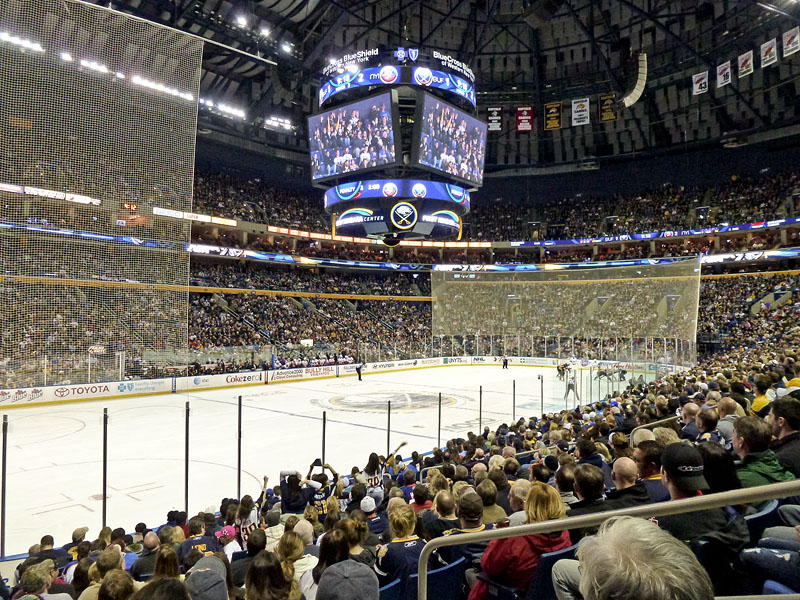
The official address of the arena is One Seymour H. Knox III Plaza, after the founding owner of the Sabres, who had it built. It's at the corner of Washington & Perry Streets. Parking is $13. If you drive in, you will probably be parking at the Mississippi Street lot, and entering the arena from the north side. If you take the light rail in, use Special Events Station, and walk down Main Street to the arena's west end. The rink is aligned east-to-west, and the Sabres attack twice toward the arena's east end.
In addition to the Sabres, the arena also hosts the Buffalo Bandits of the National Lacrosse League. In 2003, it hosted the NCAA's hockey equivalent of the Final Four, the Frozen Four.

On occasion, the minor-league Rochester Americans and the basketball team of St. Bonaventure University play games that have a greater ticket demand than their arenas can fulfill. It also hosted the now-defunct Buffalo Destroyers of the Arena Football League. And, as you might guess, it is Western New York's leading concert facility.
Food. Syracuse and Binghamton in New York, and Harrisburg and State College in Pennsylvania, are where the Northeast starts to turn into the Midwest (and vice versa). With a heavy Central and Eastern European heritage, Buffalo is big on sausages, and tailgate parties at the Bills' stadium are practically a sacrament. But it's too cold to tailgate at hockey games, so, inside, the food has to be good.

Delaware North Corporation operates the concession stands, as it does at MetLife Stadium at the Meadowlands, and at TD Garden in Boston. (It also owns the Garden and the Boston Bruins, but not the Sabres.)

The 100 Level has Outside Blue Zone Bar near Aisle 4, and South Food Court outside Aisle 16. The 300 Level has West Food Court outside Aisle 2. Among the offerings are, no surprise Buffalo wings, originally known as Buffalo-style chicken wings; and the area's other signature food, roast beef au jus on a caraway seed roll. The German word for caraway is "kummelweck," and the sandwich is known as "Beef on a weck." I know, it sounds like something a person with a speech impediment would say. But it's good, if you don't mind needing to floss afterward. Perry's ice cream, a local brand, is also sold at the arena.

Team History Displays. Original owner Seymour Knox III -- whose grandfather co-founded Woolworth's with his cousins Frank and Charles Woolworth -- chose "Sabres" as the team's name for 2 reasons: He didn't want yet another Buffalo sports team to be called the Bisons, and a sabre is a sword useful on both offense and defense, and traditionally carried by a leader.

The Sabres' championship banners hang in the arena's northeast corner. Unusually, they are multicolored, and not just due to the changes in uniform color scheme over nearly half a century.

They include the Sabres' 1975 and 1999 Conference Championships; the President's Trophy for finishing with the overall best record in 2007; and Division titles in 1975, 1980, 1981, 1997, 2007 and 2010.
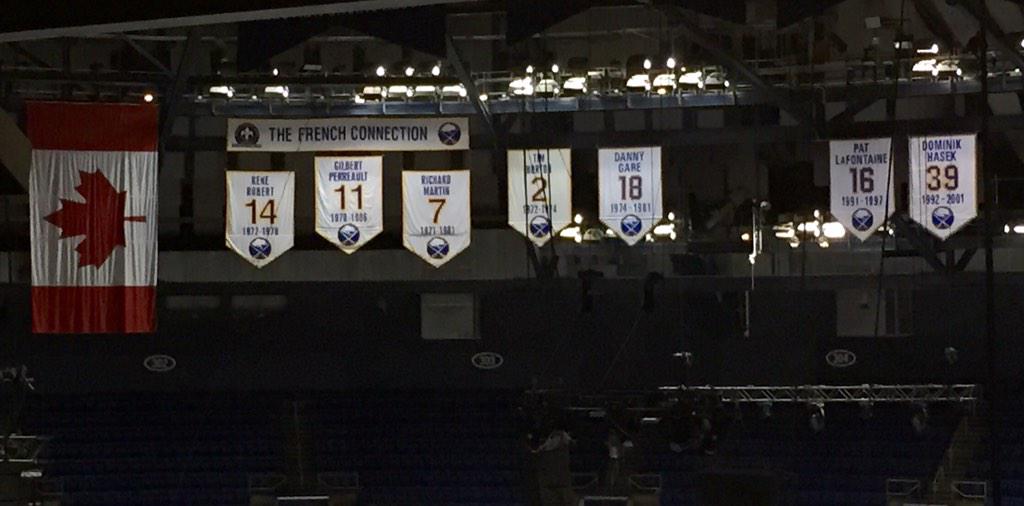
The Sabres have 7 retired numbers. Three of them are hung on banners together, since they were for the players of their 1970s "French Connection Line": 7, left wing Rick Martin; 11, center Gilbert Perrault; and 14, right wing Rene Robert. Those names are pronounced "Rik Mahr-TANN" (as with Brodeur), "Zhil-BEAR Pear-ROH," and "Reh-NAY Roh-BEAR." These banners hang in the arena's northwest corner. Alumni Plaza, on the arena's northeast corner, has a statue of them.
The other retired numbers are adjacent to theirs, on the north side, in chronological order: 2, 1970s defenseman Tim Horton; 18, 1970s right wing Danny Gare; 16, 1990s center Pat LaFontaine; and 39, 1990s goaltender Dominik Hasek. There are also banners honoring the founding owners, the brothers Seymour and Northrup Knox, with their initials, SHK and NRK, standing in for numbers.
Alexander Mogilny, who helped the Devils win the 2000 Stanley Cup, began his NHL career with the Sabres, and wore 89 to celebrate his 1989 defection from the Soviet Union. The Sabres have not given it out since he left, and former Islander Cory Conacher, who usually wore 89 since he was born in 1989, switched 88 out of respect to Mogilny. (He's a member of hockey's famed Conacher family, and played at Canisius College in Buffalo.)

In addition, a Sabre, goalie Martin Biron, was the last NHL player to wear Number 00, in 1996, before the NHL banned its use. (It wasn't to be difficult regarding uniform policy, like the NFL might have done. It was a technical issue: Their website's software simply didn't accept 00 as a number. Microsoft Excel has trouble with it, too.) You might remember Ranger goalie turned broadcaster John Davidson wearing 00, after having previously worn another number usually associated with goalies, 30.

In the southeast corner, the arena has banners for the Bandits' 4 NLL titles (1992, 1993, 1996 and 2008), and 3 retired numbers: Thomas Gardner (34), and the brothers Darris (43) and Rich Kilgour (16).

The Sabres have a team Hall of Fame, with 42 members, quite a lot for a team that's only been around for 51 years:

* From their beginning era, 1970 to 1974, but not 1974-75: Horton, original coach and general manager George "Punch" Imlach (who'd built the Maple Leafs' 1960s Stanley Cup winners), head coach Joe Crozier.

* From their 1975 Wales Conference Champions: Perrault, Martin, Robert, the Knox brothers, part-owner Robert Swados, part-owner Fred Hunt, goaltender Roger Crozier (apparently, no relation to Joe), defenseman Jim Schoenfeld (who coached the Devils to their 1st Playoff run in 1988), defenseman Bill Hajt, defenseman Jerry Korab, center Don Luce, center and later broadcaster Jim Lorentz, left wing Craig Ramsay, trainer Frank Christie, scout Rudy Migay, public address announcer Milt Ellis, broadcasters Ted Darling and Rick Jeanneret (Darling died in 1996, Jeanneret is still at it), and the last original employee still with the team, equipment manager Robert "Rip" Simonick.

* From the 1980s (but not going back to 1975): Goalie Don Edwards, defenseman Mike Ramsey, defenseman Phil Housley, defenseman Larry Playfair, left wing Dave Andreychuk, and right wing Mike Foligno (former Devils assistant and father of Minnesota Wild and former Sabres player Marcus Foligno and Columbus Blue Jackets captain Nick Foligno). Scotty Bowman, who coached the Sabres in the early 1980s, is in the Hockey Hall of Fame, but not in the Sabres' Hall of Fame.

* From the 1990s (but not including 1999): LaFontaine, Mogilny, center Dale Hawerchuk, and executive George Strawbridge, whose aid while Seymour Knox was dying helped build the arena and keep the team in Buffalo.

* From the 1999 Eastern Conference Champions: Hasek, part-owner Robert Rich Jr., scout Mike Racicot, and team sales leader David Forman.

Also elected have been sportswriters Jack Gatecliff, Dick Johnston, Jim Kelley and Wayne Redshaw. Can you imagine a sports team in New York City electing sportswriters to its hall of fame? One in Boston? In Philadelphia?!? In Buffalo, the Sabres have done it.

Perreault played on the Team Canada that beat the Soviet Union in the 1972 "Summit Series," and as such is honored with that Team Canada in Canada's Walk of Fame. So is Bowman, for his overall contributions to the game. Speaking of beating the Soviets, Rob McClanahan and the aforementioned Mike Ramsey played on the 1980 U.S. Olympic hockey team.

Horton, Perreault and Hasek were named to The Hockey News' 100 Greatest Players in 1998. Perreault, LaFontaine and Hasek were named to the NHL's 100th Anniversary 100 Greatest Players in 2017. (Oddly, LaFontaine is not yet in the Hockey Hall of Fame.) Housley, Hasek, and Teppo Numminen, the Winnipeg Jets/Phoenix Coyotes star who spent the last few years of his career with the Sabres, have been elected to the International Ice Hockey Federation (IIHF) Hall of Fame. Knox, Bowman, Housley and LaFontaine have received the Lester Patrick Trophy, for contributions to hockey in America.

At first glance, the Sabres' biggest rivalry would be regional and intranational, with the Pittsburgh Penguins. They came into the League within 3 years of each other, and there are those who believe that the Pens were admitted in The Great Expansion of 1967 at Buffalo's expense, with the Sabres arriving in 1970. They faced each other in the 1st NHL Winter Classic. The Pens lead the rivalry 104-75-35, and have won the only 2 Playoff series between them, in 1979 and 2001.

But the Sabres' closest rivals are the Toronto Maple Leafs, over the border. The Sabres lead that one 117-83-18, and have won the only Playoff series between them, the 1999 NHL Eastern Conference Finals.

Although not in Buffalo, or even in the United States, but near Buffalo, the Memorial Cup, the championship of Canadian junior hockey, was won by the Ontario-based St. Catherine's Teepees in 1954 and 1960, and by the Niagara Falls Flyers in 1965 and 1968.

Stuff. The Sabres Store is located in the arena's west end. It has the usual items you'll find in a team store, possibly including hats with buffalo horns. Souvenir stands are also around the arena.

With Western New York being a small and declining market, there aren't very many books about the Sabres. The best history of the team, now well out of date and not including the 1999 Playoff run, remains Sabres: 26 Seasons in Buffalo's Memorial Auditorium, by Ross Brewitt. Don't expect to find team videos, either, probably because they haven't won the Stanley Cup, meaning there's no Cup season highlight package.

During the Game. A November 19, 2014 article on The Hockey News' website ranked the NHL teams' fan bases, and listed the Sabres' fans 18th: "Tumbled to bottom of standings, but attendance held. A sign of faithful fans." That sure sounds like Buffalo, and Western New York as a whole, to me.

Safety will not be an issue. Downtown Buffalo is relatively crime-free, and Buffalonians have next to nothing against New Jerseyans. But they are proud of their city, for all its drawbacks. Don't antagonize them, and they won't respond.
Anthem singer Doug Allen

This game will not feature a promotion. Doug Allen sings the National Anthems at Sabres games. He even named his official website AnthemGuy.com. The team's mascot, instead of a sword-wielding buffalo as the team's logo might suggest, is Sabretooth, a sabretoothed tiger. Before games, he rappels from the ceiling to the ice while rock music plays, and has also been known to ride a four-wheeler on the ice while followed by a spotlight.
Sabretooth at the 2008 NHL Winter Classic,
which the Sabres hosted at the Bills' stadium

He has a T-shirt bazooka, which he uses to shoot shirts into the crowd, and plays Sabres chants on a drum. (Which our own N.J. Devil also does.) His autograph can be obtained on the mezzanine level of the arena, within his custom-built playhouse.

The main fan chant is "Let's Go, Buffalo!" The Sabres' goal song is "Song 2" by Blur -- a.k.a. "Woo Hoo!" They appear not to have a postgame victory song, but then, rooting for the visiting team, you won't want to hear it anyway.

After the Game. Buffalo, like any other city, has crime issues. But there is no rivalry between the Sabres and any of the New York Tri-State Area teams, especially the Devils. You and your car should both be safe.

I can find no reference to any bar in Buffalo where fans of New York sports teams tend to gather or are especially welcomed. But there are plenty of bars that serve both the KeyBank Center and Sahlen Field, the home of the city's Triple-A baseball team.

Iron Works, in a former, well, ironworks, is on Illinois Street, on the east side of the arena. There's a Tim Hortons at Main & Scott Streets, which is understandable, since Buffalo borders Canada and Horton was on the Sabres' roster when he died. This store includes a memorial to the Buffalo Memorial Auditorium. On Mississippi Street, across from the main parking lot, is a bar named Cobblestone. Further up Main Street, you can take a left turn on Pearl Street and try Pearl Street Grill & Brewery.

Buffalo's most famous eating & drinking establishment is the Anchor Bar. It's a bit of a trek from the arena on foot, but the light rail gets close, at the Allen/Medical Campus station. Its proximity to the site of War Memorial Stadium made it a good stopover after Bills games. It was there on March 4, 1964 that Dominic Bellissimo, son of owners Frank and Teressa, saw some hungry friends come in a Friday night, but all his mother had left in the kitchen was chicken wings, a part of the chicken not traditionally eaten. So she boiled them, made up a spicy sauce, and glazed the wings with the sauce, and the boys couldn't get enough of them. Buffalo sauce and Buffalo wings were born.

The bar is still in the family. I visited Buffalo in 2004, and made sure to visit. I can't handle spicy food, but they make a Monte Cristo sandwich that is out of this world. 1047 Main Street at North Avenue.

There are now 14 locations: 4 in Western New York, including at Buffalo Niagara International Airport; 4 in Ontario, including 1 in Toronto and 1 in Hamilton; 3 in Texas, including 1 in San Antonio; and in Frederick, Maryland; Kennesaw, Georgia; and outside Los Angeles in Orange, California.

If you visit Buffalo during the European soccer season, as we are now in, the leading "football pub" in town is Mes Que, named for the slogan of Spanish superclub FC Barcelona: Mes Que Un Club -- "More Than a Club." 1420 Hertel Avenue at N. Park Avenue, about 5 miles north of downtown. Bus 11. Ironically, the local Barcelona fan club doesn't meet there, instead meeting 2 blocks away, at Wellington Pub, at 1541 Hertel Avenue at Wellington Road.

Sidelights. Buffalo has a long sports history, although it's not a very good one. Here are some of the highlight locations, and some other places worth visiting in the city:

* Site of Buffalo Memorial Auditorium. Opening in 1940, it was home to the Buffalo Bisons of the American Hockey League from 1940 to 1970, the ill-fated Buffalo Bisons of the National Basketball League (forerunners of today's Atlanta Hawks) in 1946, the NBA's Buffalo Braves (forerunners of the Los Angeles Clippers) from 1970 to 1978, and the Sabres from 1970 to 1996.
The Aud. The new arena, then known as the HSBC Arena,
was built only a block away.

Like the Boston Garden and Chicago Stadium, "The Aud" had a rink that was shorter and narrower than the usual NHL rink size, 200 by 85 feet, and was allowed to keep it after that was made a rule. (The new arena has the standard size.)

It hosted the NHL All-Star Game in 1978, and 2 fights for the Heavyweight Championship of the World: Joe Louis defending the title against Johnny Davis on November 14, 1944; and Ezzard Charles defending it against Freddie Beshore on August 15, 1950 -- both of them, successfully.

It was also Western New York's longtime concert center. The Beatles never played there, but Elvis Presley sang there on April 1, 1957, April 5, 1972 and June 25, 1976. In 1973, Led Zeppelin played there for 3 hours straight, without a break. It was also a major boxing and pro wrestling facility.

It was demolished in 2009, and the site remains vacant. Main & Scott Streets, only a block away from its replacement. Erie Canal Harbor station on the light rail.

The area's only NBA team, the Buffalo Braves, left to become the San Diego Clippers. Now, the Knicks, Boston Celtics, Los Angeles Lakers and Miami Heat pretty much divide fandom. Oddly, the 2 closest NBA teams, the Toronto Raptors (98 miles away) and Cleveland Cavaliers (189 miles), don't factor in much; yet once you cross the border into Ontario, the Raptors are easily the plurality team (but not a majority one, not even in Toronto itself). Roughly the same proportion holds true for Rochester (NBA's Royals 1946-57, 75 miles east of downtown Buffalo), but once you get to Syracuse (NBA's Nationals 1949-63, 150 miles east), you start to get into solid Knicks territory.

The closest thing the Buffalo area has to a major league basketball team now is the Niagara River Lions, of the National Basketball League of Canada. They play at the 4,030-seat Meridian Centre, which they share with the Ontario Hockey League's Niagara IceDogs. 1 IceDogs Way, St. Catherine's, Ontario, 31 miles northwest of downtown Buffalo.

* Sahlen Field. Buffalo doesn't have a Major League Baseball team, and hasn't since the ill-fated Federal League of 1914-15. But it has been one of the great minor league cities, home to the Triple-A Buffalo Bisons, who play at Sahlen Field, built in 1988 as Pilot Field.

It was designed to seat 19,500 people, making it one of the largest stadiums ever to host regular minor-league baseball, but expandable to 40,000 by putting a 2nd deck on the mezzanine, in the hopes that Buffalo would get an expansion team or a moved team in the 1990s.
But the city was passed over for Denver and Miami in the 1991 decision to expand for 1993. The other possibilities were Tampa Bay and Washington. Another vote was held in 1995, to take effect in 1998, but Buffalo wasn't even accepted as a finalist: They chose Washington, Orlando, and the cities that were chosen as new franchises, Phoenix and Tampa Bay. Washington got the Montreal Expos in 2004 to become the Nationals in 2005.

But the Bisons have won 3 International League Pennants since moving in, in 1997, 1998 and 2004. They made the Playoffs in 12 of the park's 1st 18 seasons, although in none of the last 12. So the new ballpark has been (mostly) good to them. It now has a listed seating capacity of 16,907, making it the largest current minor-league stadium. 275 Washington Street, between Swan & Exchange Streets. Seneca station on the light rail.

Notable players who have played for the Bisons since it opened include Manny Ramirez, Tim Wakefield, Bartolo Colon, Brian Giles, Travis Hafner, Freddy Garcia, Cliff Lee, Victor Martinez, Magglio Ordonez, Ike Davis, R.A. Dickey and Jeremy Guthrie.

The Toronto Blue Jays played all their 2020 home games, and home games in the 1st half of the 2021 season, at Sahlen Field. But there will, almost certainly, never be another MLB team in Buffalo. Today, even if Niagara Falls (both sides of the border) and Hamilton, Ontario were counted, Buffalo would still have fewer people than the current smallest metro area in MLB, Milwaukee. That's why they're still on the outside looking in.

It would also be 28th in the NBA, ahead of only New Orleans, Oklahoma City and Memphis. It is 31st in the NFL, ahead of only New Orleans; and 28th in the NHL, last among U.S. cities, ahead of only Ottawa, Calgary, Edmonton and Winnipeg.

The Bisons have, in the 1960s and in this current decade, been a Mets farm team. Nevertheless, the Yankees are the most popular team here, getting a majority of support (low 50s percent in pretty much all of the Buffalo area, high 50s in Rochester, 60s in Syracuse).

In spite of their comparative closeness (especially considering that radio signals can, unlike cars, easily cross Lake Ontario), the Blue Jays, at 98 miles the closest MLB team, don't make a dent in it at all: The Boston Red Sox are the 2nd-most popular team here, the Mets 3rd. (Whether that will change due to the Jays' 2015 success remains to be seen.) The next-closest team, the Pittsburgh Pirates, don't get any traction until you reach the southwestern corner of New York State; the Cleveland Indians, not that much further than the Pirates, almost nothing -- this despite the Bisons having been members of both the Tribe's and the Bucs' farm systems in the last 20 years (now, the Blue Jays').

The closest NBA team is the Toronto Raptors, 98 miles away; the closest U.S. based NBA team, the Cleveland Cavaliers, 189 miles. The closest MLS team is Toronto FC, 97 miles; the closest U.S.-based MLS team, the Columbus Crew, 321 miles.

* Site of War Memorial Stadium. Built in 1937 as Civic Stadium, It was renamed War Memorial Stadium in 1960, the year the Bisons and the AFL's Buffalo Bills moved in. It seated 46,500 people, making it one of the largest stadiums in minor-league baseball, but the smallest in the NFL after the 1970 merger with the NFL. It was this reason, rather than its deteriorating neighborhood, advancing age and rundown appearance that led the Bills to build a larger stadium.

The Bisons won just 1 Pennant there, in 1961, but had some eventually legendary names suit up for them there, including Hall-of-Famers Ferguson Jenkins in 1962 and Johnny Bench in 1966 and '67. Unlike the Bills, they did leave due to the collapse of the neighborhood and the stadium looking like it would collapse as well.

The Bills won the AFL Championship here in 1964 and 1965, the only 2 times they've ever gone as far as the rules allowed them to go. These were the last 2 times the AFL Champion was unable to face the NFL Champion in a World Championship Game. In 1966, with the chance to go to the 1st AFL-NFL World Championship Game, retroactively renamed Super Bowl I, the Bills lost the AFL Championship Game to the Kansas City Chiefs. Not until the 1990 season would they reach the Super Bowl.

In 1983, the movie version of Bernard Malamud's novel The Natural was filmed there. Robert Redford and director Barry Levinson, not having computer-generated imagery (CGI) to create an old-time ballpark for them, needed an old ballpark, but not one that was easily identifiable, like Fenway Park with its Green Monster left-field wall, Wrigley Field with its ivy-covered walls and distinctive bleachers, or Comiskey Park with its pinwheeled scoreboard.

War Memorial was available. The story takes place in 1939, when the stadium was new. But by 1983, it was so run-down that it looked like it hadn't had any maintenance since the Great Depression, and appeared much older. By this point, it was known as The Old Rockpile. Buffalo native Brock Yates, a screenwriter who created the race upon which the Cannonball Run movies were based, said that it "looks as if whatever war it was a memorial to had been fought within its confines."
It was demolished in 1988, after the Bisons left. A new high school sports complex, the Johnnie B. Wiley Recreation Center, was built on the site. 1100 Jefferson Avenue. Summer-Best station on the light rail, then 5 blocks east on Best Street.

* Soccer in Western New York. Ironically, while Wrigley Field was available for The Natural, a scene in the film that supposedly took place at Wrigley was instead filmed at Buffalo's All-High Stadium, with a matte painting giving it an upper deck. Built in 1926, it was demolished and rebuilt in 2007, seats about 5,000 people, and hosts high school football, and hosted 2 pro soccer teams: FC Buffalo and the Western New York Flash.

2885 Main Street at Mercer Avenue, behind Bennett High School. LaSalle station on the light rail. It is now named after Robert B. Rich Sr., original namesake of the Bills' new stadium and founder of Buffalo-based Rich Foods, now owned by his son Robert Jr., who, as I said, is in the Sabres' Hall of Fame, and is also the owner of the Bisons baseball team. His son Robert III played Roy Hobbs' son in The Natural.

The Western New York Flash were in United Women's Soccer, after the previous team with the name was moved to become the North Carolina Courage. They won the league title in Women's Professional Soccer (WPS) in 2011, and in the National Women's Soccer League (NWSL) in 2016, but were dissolved in 2018.

The Rochester Lancers played in the American Soccer League from 1967 to 1969, and then in the original North American Soccer League from 1970 to 1980. They were ASL runners-up in 1968, Division Champions the next 3 years, and 1970 NASL Champions.

They played at the 20,000-seat Aquinas Memorial Stadium, and hosted the 1st leg of the 1970 Final, defeating the Washington Darts 3-0. In the return leg at Robert F. Kennedy Stadium in Washington, the Darts won 3-1, but the Lancers took the title 4-3 on aggregate.

The stadium was on the campus of the Aquinas Institute, a Catholic high school, and in 1974 was renamed Holleder Memorial Stadium, for Major Don Holleder, an Aquinas and West Point football star from Buffalo, who was killed in Vietnam in 1967, after having already been awarded the Distinguished Service Cross, the Silver Star and the Bronze Star.

The stadium was built in 1949 and torn down in 1985. An industrial park is now on the site. 50 Holleder Parkway, about 4 miles northwest of downtown. Bus 16.

* Site of Offermann Stadium. The Bisons played in 2 separate stadiums at Ferry Street and Michigan Avenue, starting in 1889, in a wooden stadium with the name Buffalo Baseball Park. In 1924, a new Bison Stadium of concrete and steel opened on the site. In 1935, it was renamed for the team's owner, Frank J. Offermann, who had just died.
The Bisons won International League Pennants there in 1933, 1936 and 1957, before moving a few blocks away to War Memorial Stadium for the 1960 season. The future Hall-of-Famers who played for the Bisons at Buffalo Baseball Park were Jimmy Collins, Herb Pennock, Bucky Harris; at Offermann, they were Ray Schalk, Lou Boudreau and Jim Bunning.

The Buffalo pro football team, known as the All-Stars from 1915 to 1917, the Niagaras in 1918, the Prospects in 1919, the All-Americans from 1920 to 1923, the Bisons in 1924 and 1925, the Rangers in 1926, and the Bisons again from 1927 to 1929, played on the site, before the Depression did them in.

The Buffalo Performing Arts High School is now on the site. 450 Masten Avenue. Utica station on the light rail.

Another early pro football team in the area, the Tonawanda Kardex Lumbermen, named for the American Kardex company that sponsored it, played from 1913 to 1920, then entered the NFL for the 1921 season -- but played only 1 game against an NFL team, and then folded, making them the least-playing franchise in NFL history. They played against non-NFL teams that season, but their one and only NFL game was against the Rochester Jeffersons in Rochester, a 45-0 win by the home team. Which, I suppose, also makes the Lumbermen the worst team in NFL history. They played at Tonawanda High School, in Tonawanda, 9 miles north of downtown Buffalo. Bus 25 to Broad Street and Main Street, then a 25-minute walk west.

And the Rochester Jeffersons, the other Western New York team to have played in the early NFL? They were one of the 1st pro football teams ever established, in 1898. They won the New York Professional Football League title in 1916. They played at Sheehan's Field from 1898 to 1915, at Rochester's baseball park from 1916 to 1922, and at Edgerton Park in 1923 to 1925.

* Site of Olympic Park. The true glory days of Buffalo baseball? It might have been when the Buffalo Bisons was the name of a National League team, from 1879 to 1885. They played their last 2 seasons at Olympic Park, including their best season, 1884, when they went 64-47 and finished 3rd, albeit 19 1/2 games out. They had Hall-of-Famers Jim "Orator" O'Rourke (player-manager), Dan Brouthers and Jim "Pud" Galvin.
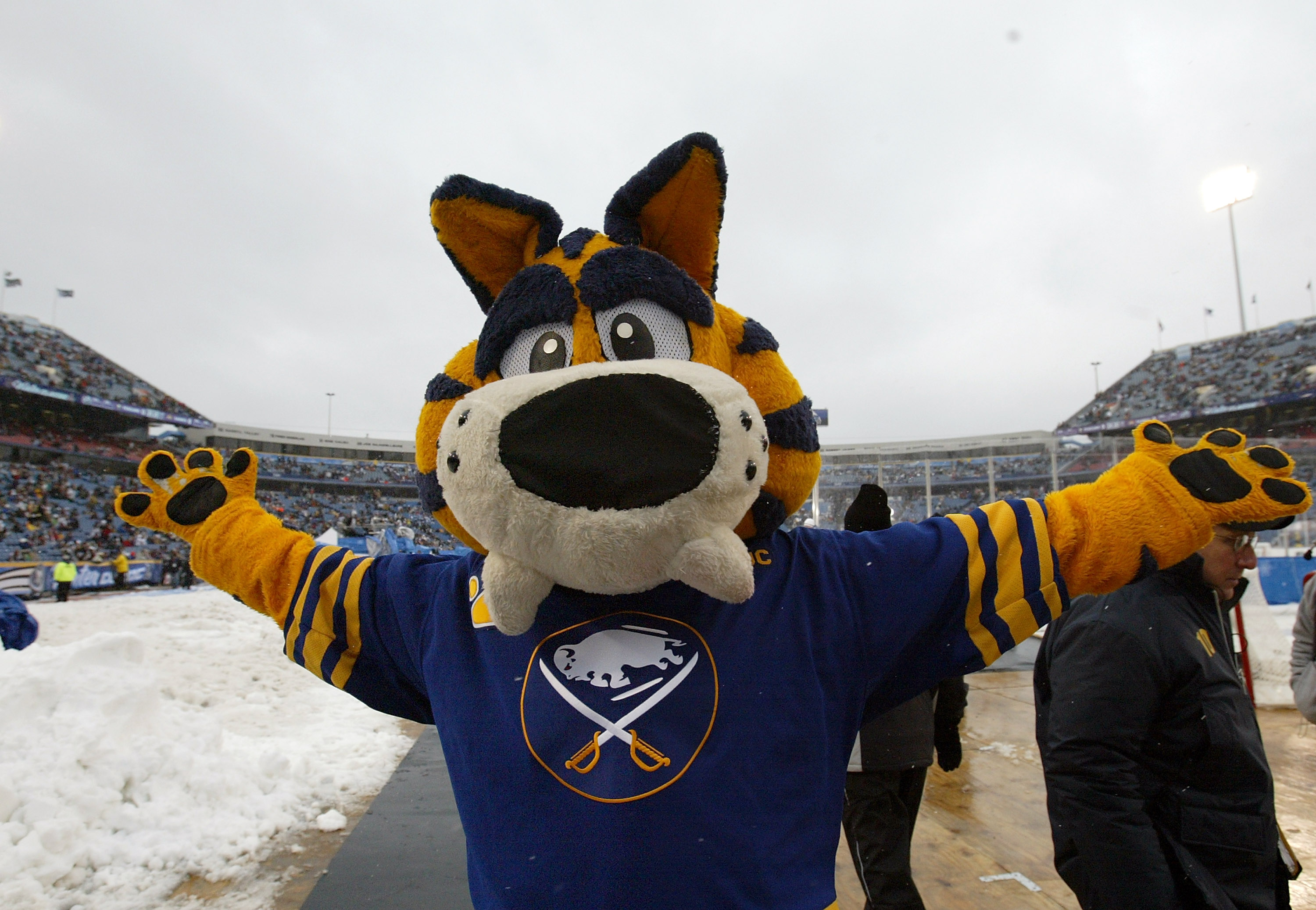
But, even then, Buffalo wasn't really big enough to support a major league team, and the Bisons went bust after the 1885 season, returning as a minor-league club in 1889. From 1886 to 1888, an all-black team named the Cuban Giants, featuring Hall-of-Fame 2nd baseman Frank Grant, played at Olympic Park. Buffalo's entry in the 1890 Players' League also played there.

Houses now stand on the site. Richmond Avenue & Summer Street, 7 blocks west of Main. Summer-Best station on the light rail.

* Site of Riverside Park. The 1st home of the Bisons wasn't much more than wooden bleachers, but it was home to Hall-of-Famers O'Rourke, Brouthers, Galvin, John Montgomery Ward, and Old Hoss himself, Charley Radbourn. As with Olympic Park, houses are now on the site. Fargo & West Avenues, Rhode Island & Vermont Streets. Number 3 or 5 bus from downtown.

* Highmark Stadium. Opened as Rich Stadium in 1973, it was renamed Ralph Wilson Stadium for the Bills' founder-owner in 1998, and sporting-goods company New Era bought the naming rights to it, and to any replacement stadium, in 2015, before giving those rights up earlier this year. It was renamed Highmark Stadium, after a health care company, in 2021.

It's 10 miles southeast of the city, in the suburb of Orchard Park, further from water than the downtown arena, but the water in question isn't the Niagara River here, it's Lake Erie, and when the wind comes blasting in, it rivals Green Bay's Lambeau Field and Cleveland's new stadium as the coldest in the NFL. The fact that it's open-air, having no protection of any kind, doesn't help.

But it is arguably the most famous building in the State of New York, outside the City of New York. It is the focal point of Western New York, as the Bills are the region's most successful and iconic sports team, despite their many failures: While they reached 4 straight Super Bowls, 1991 to 1994, they lost them all -- although, to be fair, only the 3rd was a blowout.

Originally seating 80,020, the installation of wider seats has dropped capacity to 71,870, which still makes it the largest stadium in the State. (The old Yankee Stadium, even before the renovation, only had a little over 67,000 seats. The Carrier Dome in Syracuse seats 50,000.)
It hosted the 1st-ever NHL Winter Classic on January 1, 2008, but the Sabres lost to the rival Pittsburgh Penguins, in overtime on a Sidney Crosby goal. (Just how NHL Commissioner Gary Bettman wanted it, hmmmm... ) Syracuse University played its home games there in 1979, as the demolished Archbold Stadium was replaced on the same site by the Carrier Dome. And it's hosted concerts from the beginning, including both the Rolling Stones and One Direction this year.

New owner Terry Pegula has discussed a new stadium, but there is, as yet, no official proposal. It has been suggested that eminent domain laws will prevent the building of a new stadium within the City of Buffalo. Most likely, the Bills will be playing at "The Ralph" at least through the mid-2020s. The official address is One Bills Drive, in Orchard Park. Abbott Road, off Southwestern Blvd. (U.S. Route 20). Number 14 bus from downtown, taking about an hour.

* UB Stadium. Opening in 1993, this stadium has hosted University of Buffalo football, and saw the Bulls reach Division I-A (now FBS) status in 1999, now a member of the Mid-American Conference. They are planning to expand it by 2020. For the moment, it seats 31,000, and isn't much to look at, but it's Buffalo's college football stadium, especially since Syracuse is 150 miles away. 102 Alumni Arena, 10 miles northeast of downtown. University station on the light rail, then transfer to Number 35 bus.
* Museums. Buffalo is a medium-sized city, but it's got a big city's history. The Buffalo History Museum is at One Museum Court. The closest thing the city has to a Metropolitan Museum of Art, the colonnaded Albright-Knox Gallery, is nearby at 1285 Elmwood Avenue. For each, take the Number 20 bus from downtown.

The Buffalo & Erie County Naval and Military Park is at One Naval Park Cove, along the Niagara River, a short walk from Erie Canal Harbor Station. The Buffalo Museum of Science, their Hayden Planetarium/Franklin Institute, is at 1020 Humboldt Parkway. Number 6 bus from downtown to Guilford Street, then walk 3 blocks north.

Buffalo's City Hall, a brown brick building on Niagara Square downtown, has statues of 2 Presidents who have called the city home: Millard Fillmore and Grover Cleveland. Despite a campaign to get one for Cleveland, the city and its environs do not have a Presidential Library.

No home of Cleveland's survives in the area (his birthplace in Bloomfield and his last home in Princeton, both in New Jersey, still stand), but the Millard Fillmore Museum, his one surviving home, is at 24 Shearer Avenue in suburban East Aurora. Number 70 bus, taking about an hour. Cleveland is buried in Princeton, but Fillmore is buried in Buffalo's Forest Lawn Cemetery. Delaware & Delavan Avenues. Delavan/Canisius station on the light rail, then walk 5 blocks west on Delavan. Or Number 25 bus from downtown.

Buffalo, specifically the Temple of Music at the Pan-American Exposition, is where President William McKinley was shot on September 6, 1901. The site of the Exposition has long since been replaced with middle-class housing. 52 Fordham Drive, in the Elmwood section of town. Number 20 bus to Elmwood & Fordham. Within a 5-minute walk of the History Museum and Albright-Knox.

McKinley died 8 days later, at the house of prominent Buffalo politician John G. Milburn, which has since been torn down and replaced with parking for Canisius High School (not Canisius University). 1168 Delaware Avenue at Cleveland Avenue. Utica station on the light rail, or Number 25 bus from downtown. While McKinley doesn't have a statue in Buffalo, he does have the McKinley Monument in the middle of Niagara Square, across from City Hall and the Fillmore and Cleveland statues.
Niagara Square, with the McKinley Monument
in front of City Hall

Notified of the President's death, Vice President Theodore Roosevelt rushed to Buffalo, and was sworn in as the nation's 26th President at the home of a friend, Ansley Wilcox. It is now the Theodore Roosevelt Inaugural History Site, and is open to tours. (I took the tour in 2004, and it's well worth it.) 641 Delaware Avenue at North Avenue. Allen/Medical Campus station on the light rail -- just 3 blocks west on North from the Anchor Bar.

Joe McCarthy, who managed the Yankees from 1931 to 1946, winning 8 Pennants and 7 World Series (a record he shares with Casey Stengel), is buried at Mount Olivet Cemetery, 4000 Elmwood Avenue in Kenmore. Bus 25 to Delaware Avenue & Orchard Loop.

Across the river, Fort Erie, Ontario is the site of Old Fort Erie, a major location in the French and Indian War, the War of the American Revolution, and the War of 1812 -- all on the British side, of course.

Niagara Falls, Ontario, in addition to being the home of the Falls themselves and 2 casinos, was the site of the Battle of Lundy's Lane, a major War of 1812 event that included Laura Secord walking 20 miles to warn British troops, in effect not only making her Canada's "Paul Revere," but out-Revere-ing him -- and even topping Sybil Ludington, the 17-year-old Connecticut girl who outrode Revere and saved Danbury, Connecticut.

These locations, of course, are across the border, making them difficult to reach except by car. And remember to bring your passport and change your money. The Number 40 bus goes from downtown Buffalo to Niagara Falls, New York, taking a little under an hour. You can, however, walk across both the Peace Bridge between Buffalo and Fort Erie, and the Rainbow Bridge between NFNY and NFO -- if, as I said, you have your passport.

On the New York side, the Niagara Falls Convention Center stood at 310 4th Street from 1973 to 2002. It was a home court for Niagara University basketball from 1973 to 1981. Elvis sang there on June 24, 1974 and July 13, 1975. It was demolished, and the Seneca Niagara Casino & Hotel was built on the site.

Other places in New York State -- aside from Madison Square Garden and the Nassau Coliseum -- where Elvis sang are the Onondaga County War Memorial at 800 S. State Street in Syracuse (now the Oncenter War Memorial Arena, home of the NBA's Syracuse Nationals from 1951-63) on July 25, 26 and 27, 1976; the Rochester Community War Memorial Arena at 1 War Memorial Square (now the Blue Cross Arena, home of the NBA's Rochester Royals from 1955 to 1957) on May 25, 1977; and the Broome County Veterans Memorial Arena at 1 Stuart Street in Binghamton (now the Floyd L. Maines Veterans Memorial Arena) on May 26 and 27, 1977.

One Seneca Tower, formerly One HSBC Center and Marine Midland Center, is the tallest building in Western New York. Built in 1972, it stands 529 feet, and is at Main & Seneca, across from the ballpark. It isn't much to look at, being typical of late Sixties and early Seventies architecture.

Buffalo isn't a glamorous city, and TV shows and movies set their tend to emphasize this. The only 2 TV shows I can remember being set there are, not surprisingly, both comedies, and both on NBC: Dabney Coleman's Buffalo Bill, in 1983 and '84; and Christina Applegate's Jesse, from 1998 to 2000. The ABC soap opera General Hospital and its now-defunct spinoff Port Charles are set in Port Charles, hits about whose location suggest that it's a stand-in for Rochester, 76 miles east of Buffalo.

The best-known movie set in Buffalo is Buffalo '66, directed by Buffalonian Vincent Gallo and starring him as an ex-con whose mother blames his birth for the Bills losing the 1966 AFL title game and missing out on the 1st Super Bowl, and who took the fall for a crime he didn't commit after he can't pay money he lost betting on the Bills to win Super Bowl XXV. He gets out 5 years later, and is determined to kill the kicker who missed the game-winning field goal, here named "Scott Wood" instead of Scott Norwood like in real life. (Gallo is not particularly clever, not even in real life.)

Also set partly in Buffalo is You Kill Me, starring Ben Kingsley as an alcoholic hitman for the local Polish mob, who gets sent to San Francisco to dry out. The difference between troubled but glamorous San Francisco, including love interest Tea Leoni, and dreary Buffalo is stark, but intentional.

*

Buffalo has its problems, but it gets a bum rap. The city has a lot to offer, including 2 great sports franchises, a lot of history, and some great food. Check it out.