Showing posts with label afl championship game. Show all posts

Thursday, December 26, 2024

December 26, 1964: The Buffalo Bills Triumphant

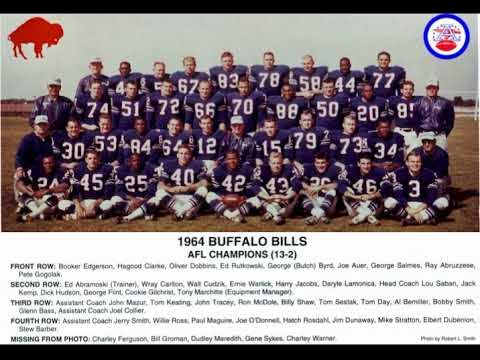
December 26, 1964, 60 years ago: The American Football League Championship Game is played for the 1964 season.

The season before, the San Diego Chargers, coached by Sid Gillman, had won the title, showing football fans that the AFL wasn't just a pass-happy "basketball league": It could feature good defense, too. The Buffalo Bills, coached by Lou Saban, followed the same path, with a defense led by end Ron McDole, tackle Tom Sestak, and linebacker Mike Stratton.

The Chargers would regret letting quarterback Jack Kemp go, as the Bills had acquired him to run their offense. Protected by a future Hall-of-Famer, guard Billy Shaw, he could hand off to running back Carlton Chester "Cookie" Gilchrist, or pass to receiver Elbert Dubenion.

There was once a common trivia question: Name the men wearing Number 32 who won the Most Valuable Player awards in the American League, the National League, the NFL and the AFL in 1963. But the question was no good: Elston Howard, Sandy Koufax, Jim Brown and Gilchrist won their respective awards, but, while the other 3 players wore 32, Gilchrist wore 34.

The Bills went 12-2 in 1964. They dropped 48 points on the Houston Oilers, and scored at least 30 points in 6 other games. Their only losses were on November 15, 36-28 at home to the Boston Patriots; and on December 6, 16-13 away to the Oakland Raiders.

As it was an even-numbered year, it was the Eastern Division winners' turn to host the AFL Championship Game, and the Bills welcomed the defending Champion Chargers into War Memorial Stadium. Built in 1938, it was already dilapidated, known as "The Old Rockpile." Buffalo native Brock Yates, a screenwriter who created the race upon which the Cannonball Run movies were based, said that it "looks as if whatever war it was a memorial to had been fought within its confines." And it was small: At 40,242 seats, its capacity would prove too small when the AFL and the NFL merged in 1970, so the Bills had to build a larger stadium.
In the 1st quarter, Tobin Rote threw a 26-yard touchdown pass to Dave Kocourek, to put the Chargers up, 7-0. But they never scored again. The Bills' defense was symbolized by Stratton hitting Keith Lincoln midway through the 1st quarter, breaking a rib and knocking him out of the game. It was the most famous defensive play in AFL history.
Pete Gogolak and his brother Charley, natives of Hungary, became pro football's 1st "soccer-style kickers," approaching the placement from the side and hitting the ball with the instep of the foot, rather than the traditional straight-on, hit-with-the-toes style. Pete kicked a field goal late in the 1st quarter, and another in the 2nd. In between, Kemp guided the Bills down to where Wray Carlton could score on a 4-yard run. In the 4th quarter, Kemp scored on a quarterback sneak. The Bills won, 20-7.
The Bills won the AFL Championship again in 1965, again beating the Chargers; then lost the 1966 AFL Championship Game to the Kansas City Chiefs. Saban would leave, then return as head coach, and lead the Bills to the AFC Wild Card Playoff berth in 1974.
Like basketball coach Larry Brown, Saban was known, somewhat unfairly, for never staying in the same place for very long, also serving as head coach for the Boston Patriots, the Denver Broncos, and several college teams. He died in 2009. His son, Nick Saban, in junior high school at the time of the Bills' AFL titles, would win 7 National Championships in the college ranks. Unlike many father & son coaching pairs, they never coached together. Indeed, while Lou was head coach at Army in 1979, Nick was an assistant coach at Navy in 1982.
The Bills had won the last 2 AFL Championships before the AFL Champion was allowed to play the NFL Champion for a World Championship, and had lost the game that would have put them in Super Bowl I. It would take until the 1990 season before they finally got into a Super Bowl. And they got into 4 in a row, something no other franchise has done. And yet, they lost all 4, and only the 1st one was all that close (although they were leading the 4th at the half).
The Bills have become to the NFL what the Chicago Cubs once were to baseball, the sport's "lovable losers" with a history of close calls breaking the hearts of some of the most passionate fans in the sport. From 1964 onward, they have been 1 of the last 2 teams standing 6 times, something only 7 other teams have done.
But the fact that the Bills' titles came before the advent of the Super Bowl means that they get discounted: Even before the distance of time became what it is now, NFL fans had come to regard any title won before the Super Bowl, NFL or AFL, as not a "real" championship.
As it stands, through Christmas 2024, no team based in, or near, Buffalo has ever won a major league sports championship. The NHL's Sabres are 0-for-2 in Stanley Cup Finals, and the NBA's Braves, like the Sabres a 1970 expansion team, moved in 1978. Due to Canadian COVID restrictions, the Toronto Blue Jays had to play some "home games" at Buffalo's Sahlen Field in 2020 and '21. Before that, there hadn't been a Major League Baseball team in Buffalo since the 1914-15 Blues of the Federal League; before that, the Bisons of the National League, who folded after the 1885 season. And none of those teams won a Pennant.
Unless you count soccer as a major league sport in North America, with the 1971 Rochester Lancers and the 2016 Western New York Flash, then the last World Championship won by a team that can be considered "Western New York" remains the 1955 NBA Champion Syracuse Nationals. If you don't count Syracuse as "Western," then it's the 1951 NBA Champion Rochester Royals.

Maybe this is the year the Bills finally pull it off. Then again, the Detroit Lions -- the team in which Ralph Wilson had a minority interest before becoming the founding owner of the Bills -- are also closer than they've ever been since their last title, in 1957. If Super Bowl LIX is Bills vs. Lions, one fanbase will be happier than ever, and the other will face the greatest letdown yet.

Friday, January 5, 2024

January 5, 1964: A Title for San Diego

 
January 5, 1964, 60 years ago: The American Football League Championship Game is played for the 1963 season. It marks a turning point for the League. In its 1st 3 seasons, it was a pass-happy league, without much defense. But now, a team was able to combine big offense with big defense.

Barron Hilton received the Los Angeles franchise of the AFL at its founding in 1959. He named the team the Chargers, after the credit card he founded, Carte Blanche. He was the son of hotel magnate Conrad Hilton, the brother of Elizabeth Taylor's 1st husband Conrad Nicholson Hilton Jr. a.k.a. Nicky Hilton, and the grandfather of Paris and Nicky Hilton. He turned out to be the last surviving member of "The Foolish Club," the 8 original AFL owners.

After reaching the 1st AFL Championship Game in the 1960 season, he realized that, even with his money, he couldn't compete with the NFL's Rams and college football's USC and UCLA for the attention of Los Angeles' football fans. So he moved the team down the Coast, and they became the San Diego Chargers. They reached the title game again in 1961, with the same result, losing to the Houston Oilers.

Head coach Sid Gillman built a high-powered offense, with 2 quarterbacks, Tobin Rote and John Hadl. Rote had filled in for an injured Bobby Layne, and led the Detroit Lions to victory in the 1957 NFL Championship Game, 59-10 over the Cleveland Browns. It was a bit of foreshadowing. Oddly, Hadl had also been drafted by the Lions, but the AFL offered more money than the NFL.
Sid Gillman

These passers' favorite target was Lance Alworth, whose running reminded someone of a deer, and so he was nicknamed "Bambi." He would end up as the 1st former AFL player elected to the Pro Football Hall of Fame. (Contrary to what some people believe, it's not the NFL Hall of Fame.) Gillman's offense also had running backs Paul Lowe and Keith Lincoln, tight end Jacque MacKinnon, guard Walt Sweeney, and offensive tackle Ron Mix. Mix would join Alworth in Canton.
Lance Alworth

But it was the defense that marked the '63 Chargers as being different from previous AFL teams. They were one of the teams in the 1960s that called its defensive line "The Fearsome Foursome": Ends Ron Nery and Earl Faison, and tackles Ernie Ladd (also a successful professional wrestler, before that competition became a scripted joke) and Bill Hudson. The linebackers were pretty good, too: Chuck Allen, Frank Buncom and Emil Karas.
Ernie Ladd

Another distinctive feature of San Diego's 1st major league sports team was their uniforms. It wasn't just the lightning bolts on the helmets. From 1960 to 1973, they wore jerseys that had been called "collegiate blue" (probably a reference to UCLA, with whom they shared the Los Angeles Coliseum in 1960), "electric blue" (which matched the "charger" theme) and "powder blue" (which is what it usually gets called today).

The Chargers went 11-3, their only losses coming at the hands of the Denver Broncos and, twice, the Oakland Raiders. They won the AFL Western Division, which meant that, being that it was an odd-numbered year, they would get to host the AFL Championship Game at Balboa Stadium.
Their opponents were the Boston Patriots, who finished only 7-6-1, but that was good enough to tie the Buffalo Bills for 1st place in the Eastern Division. And 2 of the losses were to the Chargers. To be fair, 5 of the 6 losses were by 7 points or less, and the Pats did beat the Bills in Buffalo in a Playoff to get to the Championship Game.

The title game -- postponed a week, due to the postponement of the regular-season games of November 24, 1963, and that due to the assassination of President John F. Kennedy 2 days earlier -- would not be close. It turned out to be the biggest blowout in the 10-year history of AFL Championship Games. Since the 1970 merger with the NFL, only once has the winning team in the AFC Championship Game matched the Chargers' point total, the 1990-91 Buffalo Bills; and no team has surpassed it. No team has scored this many in the NFC Championship Game, either.

The Chargers wasted little time. Rote took a quarterback sneak for a touchdown. Lincoln scored on a 67-yard run. The Patriots scored on Larry Garron's 7-yard touchdown run, to close to within 14-7, but that was as close as they would get. Lowe ran 58 yards for a touchdown, and it was 21-7 San Diego after a quarter.

George Blair of the Chargers and Gino Cappelletti of the Patriots traded field goals in the 2nd quarter. But the fact that the Chargers were able to score 24 points in the 1st half, none of them on touchdown passes, was telling. Before the half ended, Rote threw a 14-yard touchdown pass to Don Norton, and it was 31-10.

Rote threw a 48-yard touchdown pass to Alworth in the 3rd quarter, and was relieved by Hadl in the 4th. But this proved not to be a mercy move by Gillman: Hadl threw a 25-yard touchdown pass to Lincoln, and later scored on a sneak. Final score: Chargers 51, Patriots 10. It remained the most dominating performance in the AFL's 10-year history.

The Chargers reached the Championship Game again in 1964 and 1965, losing to the Bills both times. The Kansas City Chiefs won the AFL title in 1966 and 1969; the Raiders in 1967; and the New York Jets in 1968. Each of these teams had a "Mad Bomber" quarterback -- Jack Kemp, Len Dawson, Daryle Lamonica and Joe Namath, respectively -- but each also followed the Chargers in the other way, too: The philosophy that "Defense wins championships."

Charger fans, and aficionados of the old AFL, are convinced that the Chargers could have beaten the NFL Champion Chicago Bears had there been a Super Bowl at the time. They are wrong: The Bears had a defense unlike any the AFL had yet seen, including on the Chargers.
This is what a Chargers championship ring looks like.
But "World Champions"? No.

The Chargers appeared in 5 of the 10 AFL Championship Games; the Oilers, 4; the Bills and the Chiefs, 3 each; the Raiders, 2; the Patriots and the Jets, 1 each; and the Denver Broncos, and the expansion Miami Dolphins and Cincinnati Bengals, none.

But the Chargers got old, and by 1973, as mentioned by the sportswriter character Oscar Madison on the TV series The Odd Couple, they and the Oilers were the 2 worst teams in the NFL. Alworth got a Super Bowl ring, but it was with the 1971-72 Dallas Cowboys.

In 1974, the Chargers switched to dark blue jerseys and helmets. In 1978, they became one of a few teams that preferred to wear white jerseys at home, and it did look better. They went back to dark blue at home in 1984, occasionally wore powder blue as "throwback uniforms" for a few years, and in 2019, their 60th season, they began wearing powder blue as their regular home color. They have also gone back to the white helmets.

The Chargers reached the 1981 AFC Championship Game, but lost it to the Bengals. They reached the 1994 AFC Championship Game, and beat the Pittsburgh Steelers in a thriller, but got clobbered by the San Francisco 49ers in Super Bowl XXIX. They reached the 2007 AFC Championship Game, but lost to the Patriots, revenge finally achieved.

In 1966, Barron Hilton sold the Chargers to Gene Klein. In 1984, Klein, who loved football but hated the business of it, sold the team to Alex Spanos. In his memoir, First Down and a Billion, he closed every chapter with the words, "Thank you, Alex."

In 1967, the Chargers moved to San Diego Stadium, which was renamed Jack Murphy Stadium in 1981 and Qualcomm Stadium in 1997. Spanos handed control of the team over to his son Dean in 1993, and Dean Spanos, a member of a billionaire family, continually demanded that either the City of San Diego or the County of San Diego use taxpayer money to build him a new stadium. He threatened to move the team back to Los Angeles, or perhaps to another city, if he didn't get the stadium.

A ballot initiative only got 43 percent of the vote, and so Dean proved he wasn't bluffing, and moved the team back to its original home. San Diego fans were angry, but seem to value their integrity more than their football team.  

The 1963 Chargers remain the only major league sports team in San Diego that has gone as far as the rules of the time have allowed them to go. The San Diego Padres have won National League Pennants in 1984 and 1998, but lost the World Series each time.

The city lost the NBA's Rockets (1967-71) to Houston and the NBA's Clippers (1978-84) to Los Angeles. It's never had an NHL team or an MLS team. The ABA's Conquistadors and the WHA's Mariners each folded before their respective leagues did. And neither the WFL (1974-75) nor the USFL (1983-85) saw fit to put a team in what was already being called "America's Finest City," despite the Chargers being in decline on both occasions, with the Don Coryell "Air Coryell" teams being successful in between.

The San Diego Sockers won the Major Indoor Soccer League title 10 times in 11 seasons from 1982 to 1992, but, despite its name, the MISL could hardly be called major league. The old North American Soccer League could have been called that, but the Sockers never got past the Semifinals.

There has been speculation of a "curse" on San Diego sports. The most common one is that it is the result of letting Alworth go after the 1970 season, hence "The Curse of Bambi." What's more, the fact that the Chargers' title came before the advent of the Super Bowl means that it gets discounted: Even before the distance of time became what it is now, NFL fans have come to regard any title won before the Super Bowl, NFL or AFL, as not a "real" championship. And the fact that it came in the sad interregnum between the Kennedy assassination and the arrival of The Beatles is another reason it tends to get forgotten.

As for the Patriots, who changed their name to the New England Patriots when they moved to suburban Foxborough, Massachusetts in 1971, they didn't make the Playoffs again until 1976, didn't reach the Super Bowl until the 1985 season, and didn't win one until the 2001 season. After that, though, they were off to the races.

There are 14 surviving players from the 1964 AFL Champion San Diego Chargers: Lance Alworth, Ron Mix, Gerry McDougall, Paul Lowe, Dick Westmoreland, Dick Harris, George Blair, Bobby Jackson, Bud Whitehead, Don Rogers, Bobby Lane, Larry Park, Paul Maguire and Bob Petrich.

Sunday, January 29, 2023

NFL Championship Game Appearances, 1932-2023

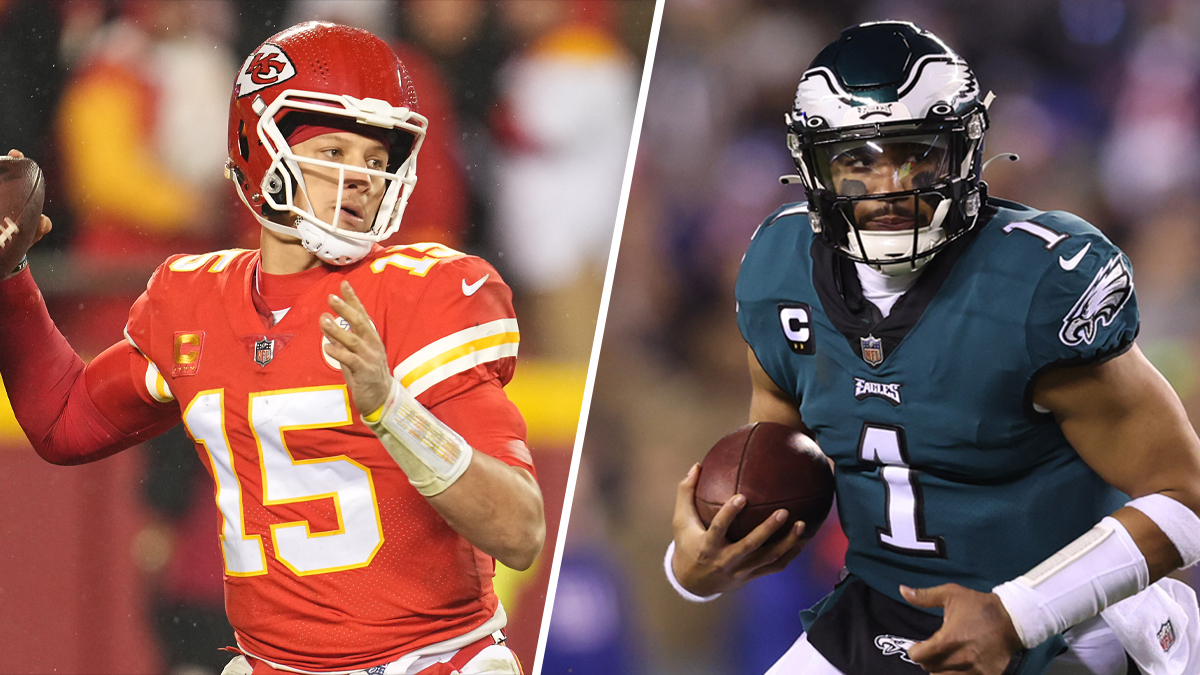
NFL Championship Game appearances, counting this season's, between the Philadelphia Eagles and the Kansas City Chiefs -- including from before the Super Bowl era, with all teams listed under their current names, and ties broken by most wins, and then by most recent:


1. New York Giants 19

2. Green Bay Packers 13

3. Chicago Bears 13

4. New England Patriots 11

5. Los Angeles Rams 10

6. Washington Commanders 10

7. Cleveland Browns 9

8. Pittsburgh Steelers 8

9. Dallas Cowboys 8

10. Philadelphia Eagles 8

11. Denver Broncos 8

12. San Francisco 49ers 7

13. Indianapolis Colts 7

14. Detroit Lions 6

15. Las Vegas Raiders 5

16. Kansas City Chiefs 5

17. Miami Dolphins 5

18. Buffalo Bills 4

19. Minnesota Vikings 4

20. Seattle Seahawks 3

21. Arizona Cardinals 3

22. Cincinnati Bengals 3

23. Tampa Bay Buccaneers 2

24. Baltimore Ravens 2

25. Atlanta Falcons 2

26. Carolina Panthers 2

27. New Orleans Saints 1

28. New York Jets 1

29. Tennessee Titans 1

30. Los Angeles Chargers 1
31. Jacksonville Jaguars none, but reached 3 AFC Championship Games
32. Houston Texans none, hasn't yet reached an AFC Championship Game

The Rams reached 1 as the Cleveland Rams, and 2 as the St. Louis Rams. The Commanders reached 1 as the Boston Redskins, the rest as the Washington Redskins. The Colts reached 5 as the Baltimore Colts. The Lions reached 1 as the Portsmouth Spartans. The Raiders reached 4 as the Oakland Raiders, and 1 as the Los Angeles Raiders. The Cardinals reached 2 as the Chicago Cardinals. The Chargers reached their 1 as the San Diego Chargers.

NFL and AFL Championships, including pre-title game wins, 1920-31:

1. Green Bay 13

2. Chicago 11 (Bears 9, Cardinals 2)

3. New York 9 (Giants 8, Jets 1)

4. Cleveland 9 (Browns 4, Canton Bulldogs 3, Rams 1, Akron Pros 1)

5. Pittsburgh 8

6. San Francisco Bay Area 8 (49ers 5, Oakland Raiders 1 in AFL & 2 SB)

7. New England 7 (Patriots 6, Providence Steam Roller 1)

8. Dallas 6 (Cowboys 5 NFL, Texans 1 AFL)

9. Washington 5

10. Philadelphia 5 (Eagles 4, Frankford Yellow Jackets 1)

11. Baltimore 5 (Colts 3, Ravens 2)

12. Detroit 4

13. Kansas City 4 (Chiefs 2 in AFL, 2 Super Bowls)

14. Los Angeles 3 (Rams 2, Raiders 1)

15. Tampa Bay 2

16. Denver 2

17. Miami 2

18. Buffalo 2 (Bills 1964 and 1965 in AFL)

19. Houston 2 (Oilers 1960 and 1961 in AFL)

20. Seattle 1

21. New Orleans 1

22. Indianapolis 1

23. St. Louis 1

24. San Diego 1 (Chargers 1963 in AFL)

25. Minnesota 1 (Vikings 1969 NFL, lost Super Bowl)

26. Arizona 0-1 in title games

27. Tennessee 0-1

28. Atlanta 0-2

29. Carolina 0-2

30. Cincinnati 0-3

31. Las Vegas none

32. Jacksonville none