Showing posts with label new jersey. Show all posts

Thursday, October 22, 2026

October 22, 1926: The Tragedy of Harry Greb

October 22, 1926: Harry Greb, a former Middleweight Champion of the World, dies in Atlantic City, New Jersey. He was only 32 years old.

Edward Henry Greb was born on June 6, 1894 in Pittsburgh, leading to his nicknames: "The Pittsburgh Windmill," "The Smoke City Wildcat" and "The Pittsburgh Bearcat." I thought his surname might have been shortened (either by him or his father) from a longer one, either Slavic or Italian, but, apparently, that was it, and he was of German descent.

By 1915, he was fighting world-class opposition, including 2 fights, though not sanctioned for the title, against Middleweight Champion George Chip. He lost both fights by what was then called a "newspaper decision." In 1917, he set a record that will almost certainly never be broken with 37 officially sanctioned fights in a single year -- an average of 1 every 9.8 days. He won 34 of them. He beat Barney "Battling" Levinsky, the Light Heavyweight Champion, although, again, the title was not officially on the line. Starting in 1918, he won 52 straight fights, including fights against Levinsky, and Billy Miske and Mike Gibbons, both of whom would later fight Jack Dempsey for the Heavyweight Championship.

In 1921, during a fight with light heavyweight Kid Norfolk, he was thumbed in the right eye, which is believed to have resulted in a retinal tear. He would eventually lose all sight in the eye, and lose some vision in his left eye as well. He kept this a secret from everybody except his wife and his closest friends. If even one State boxing commission found out, it would have notified the commissions in the other 47 States then in the Union, and Greb wouldn't have been able to box anywhere in America.

Despite the injury, Greb won the fight via a newspaper decision, and got a fight for the American light heavyweight title. On May 23, 1922, he faced champion Gene Tunney at the 2nd Madison Square Garden. In the 1st round, Greb broken Tunney's nose. Somehow, Tunney, a wealthy and cultured man who had learned to box while serving in the Marine Corps during World War I, managed to avoid getting knocked down, let alone out. Greb was announced as the winner, and The Ring magazine named it Fight of the Year.

It was the only professional fight Tunney ever lost. They fought at the 2nd Garden again on February 23, 1923, and Tunney won by a split decision. They fought there a 3rd time on December 10, 1923, and Tunney won by a unanimous decision. They fought a 4th time, on September 17, 1924 at the Olympic Arena in Cleveland, and it was ruled a draw. They fought a 5th time on March 27, 1925 at the St. Paul Auditorium in Minnesota, and Tunney won another unanimous decision.

A boxer facing a man 5 times? Greb fought Levinsky 6 times, and won them all. He also faced former Light Heavyweight Champion Tommy Loughran 6 times, losing the 4th, drawing the 6th, and winning the rest.

On August 31, 1923, Greb finally got his shot at a World Championship, winning a unanimous decision over Middleweight Champion Johnny Wilson at the Polo Grounds. He successfully defended the title 5 times, including a rematch against Wilson at The Garden in 1924; and one over then-Welterweight, later Middleweight, Champion Mickey Walker, "The Toy Bulldog," at the Polo Grounds in 1925.

On February 26, 1926, 2 months after the 3rd Madison Square Garden, the building that would become known as "The Old Garden," opened, he lost the title in a split decision to Theodore "Tiger" Flowers, who thus became the 1st black fighter to win the Middleweight title. After winning 2 tuneup fights, Greb fought a rematch, but Flowers won on an even more controversial split decision. This time, the fans stormed the ring to protest the outcome. Greb later stated, "Well, that was one fight I won, if I ever won any."

Officially, he won 108, lost 8, and drew 3. Of those 8 losses, 3 were to Tunney and 2 were to Flowers. Of those 108 wins, 33 of them were over 16 different members of the International Boxing Hall of Fame, and Greb is still the all-time leader in that category.

But he had to retire. His health, as had his face, had taken a beating. Not only did he have to have his right eye removed and replaced with a glass prosthesis, but damage to his nose had led to breathing issues. It forced him to turn down a job as a sparring partner for Dempsey, who was about to defend the Heavyweight Championship against Tunney in Philadelphia. Knowing both men's styles well, Greb was sure that Tunney would win that fight. He was right, and Tunney won the rematch as well, which became known as the "Long Count Fight."

Greb saw the 1st Dempsey-Tunney fight, but not the 2nd. He checked into a hospital in Atlantic City for surgery, but complications set in, causing a heart attack that killed him on October 22, 1926. He has been called the greatest middleweight fighter of all time, and one of the very greatest boxers, pound-for-pound, who has ever lived. But the thing that stands out the most about him isn't his fight totals, or his holding of a championship for 3 years, but the fact that he was the only man ever to beat Tunney, who remains the only man ever to retire while still Heavyweight Champion and stay retired.

Monday, October 19, 2026

October 19, 1946: The Rutgers-Princeton "Cannon War"

"Big Cannon," with Nassau Hall behind it

October 19, 1946, 80 years ago: Princeton beats Rutgers, 14-7 at Rutgers Stadium. An attempt to steal the cannon proves even more embarrassing for RU.

Rutgers University is in New Brunswick, in Middlesex County, New Jersey. (The stadium is across the Raritan River, in Piscataway.) Princeton University is in the town of the same name, in Mercer County. They are separated by 17 miles of State Route 27. In 1869, Rutgers beat Princeton in "the first college football game," in New Brunswick, hence Rutgers calls itself "the Birthplace of College Football."

Two cannons were left on the Princeton campus after the War of the American Revolution, although neither of them were used in the Battle of Princeton of January 3, 1777, as is often claimed. "Big Cannon" is located behind Nassau Hall in the center of the quadrangle there, called "Cannon Green," and "Little Cannon" is situated between Whig and Clio Halls.

For the War of 1812, Big Cannon was transported to New Brunswick to help defend the city against potential attack by the British, remaining on the Rutgers campus, where it was used for training during and after the American Civil War of 1861-65 by Rutgers cadets, until it was taken back to Princeton in 1875 by the "Princeton Blues," a local militia.

On the night of April 25, 1875, 10 members of the Rutgers Class of 1877 set out to take Big Cannon from Princeton. However, they were unable to move it, so instead they returned to New Brunswick with Little Cannon. Princeton responded with a raid on Rutgers, stealing some muskets, and the presidents of the colleges exchanged polite but demanding correspondence. Eventually, a joint committee settled the matter, and Little Cannon was returned to Princeton, escorted by the New Brunswick Police Chief. In other words, Rutgers was forced to cave.

On October 19, 1946, a contingent of Rutgers men slipped onto the Princeton campus, and again tried to steal the famed Big Cannon. This attempt was even more disastrous than the first. They attached one end of a heavy chain to the cannon and the other to their car, a Ford. Surprised by Princeton students and the police, they gunned the engine of the car so hard that the car, weighted down by the cannon, was torn in half. The Rutgers students managed to escape, but with neither the car nor the cannon.
This is what a 1946 Ford looks like.
This was not a little car.

On the eve of the annual Rutgers-Princeton game of 1971, Big Cannon was apparently "stolen" again. A 5-foot-deep hole was found where the cannon sat. Campus police were baffled that the cannon had been taken, given its extreme weight. After crime photos were taken, it appears that a hole had simply been dug next to Big Cannon, and the dirt from the hole used to bury it. The kind of trickery that New Jersey native David Copperfield would have used to make people think the cannon had "disappeared."
Reports appeared in the Rutgers newspaper, the Daily Targum, as well as nearby papers such as the New Brunswick-based Daily Home News, the Princeton Packet and The Times of Trenton. (Rutgers won the game, 33-18.)

With Rutgers having committed to "big-time" (sometimes written as "bigger time") football, and Princeton having committed to the smaller-time Ivy League, the schools haven't played each other in football since 1980, a 44-13 Rutgers win in Piscataway, although they still play each other in other sports.
Big Cannon at Princeton is routinely painted red by Rutgers students, particularly in the week leading to Rutgers commencement, as well as on other notable Rutgers dates. In November 2011, a group of Rutgers students who went to paint the cannon in Princeton brought a video camera with them and made a documentary about the tradition.
The footage became part of a larger project about the history of the Cannon War and its perception in the minds of current students today. The film, Knights, Tigers, and Cannons. Oh My!, by Zack Morrison, premiered at the New Jersey Film Festival in September 2012, and won the award for Best Student Film. 

Saturday, October 10, 2026

October 10, 1976: Giants Stadium Opens, New Jersey Joins the Major Leagues

October 10, 1976, 50 years ago: Giants Stadium opens at the Meadowlands Sports Complex in East Rutherford, Bergen County, New Jersey. The New York Giants football team doesn't own it -- the State of New Jersey does, and operates it through the New Jersey Sports & Exposition Authority. But, for the 1st time in their 52-season history, the Giants have a home field where they get priority for scheduling.

What they don't get is exclusive use. The New York Jets will move in for the 1984 season. The football team at Rutgers University will also use it for home games too big for their 23,000-seat on-campus stadium from 1976 to 1992, for their entire 1993 season when their stadium is rebuilt, and occasionally from 1994 onward.

Other college football games will be played there, including the short-lived Kickoff Classic and the even-shorter-lived Garden State Bowl. A few high school State Championship games will be played there. Lots of soccer games, including the New York Cosmos (1977-84), the New York/New Jersey MetroStars/Red Bulls (1996-2009), and games of the 1994 World Cup. Lots of concerts. And a 1995 Mass by Pope John Paul II.

What the Giants also don't get is a successful debut. In front of a sellout crowd of 76,042, they are beaten 24-14 by the Dallas Cowboys. However, for the most part, the stadium will be good to the Giants, and they win 7 NFC Eastern Division titles, 4 NFC Championships and 3 Super Bowls while playing there, until they and the Jets move into the new MetLife Stadium next-door in 2010.

For those of us growing up in New Jersey at the time, Giants Stadium was huge. Not just big in physical size, but in terms of how it raised our profile. We were "major league," and could stand alongside New York City and Philadelphia with pride.

Not everybody liked the place. In 1997, Tim Green, a former defensive end for the Atlanta Falcons, and an analyst for Fox Sports, published The Dark Side of the Game: My Life in the NFL. In it, he discussed his opinions on various NFL stadiums. Here is the entirety of his entry on Giants Stadium: "Football in a can. Curse the Giants for ever leaving Yankee Stadium."

He had a point: The place was impressively big, and functioned well, but it was no architectural marvel, the artificial turf was hard, the real grass that replaced it was choppy, the concourses were concrete and poorly lit, and the food wasn't very good. Unless you were from New Jersey and felt the symbolism of what the place meant for your home State, Giants Stadium was not special.

And that wind. Known as "The Hawk," it often left the place terribly cold. When the stadium was replaced in 2010, with what became known as MetLife Stadium, the State spent $1.6 billion on it, and couldn't get rid of the old stadium's biggest problem: The wind was every bit as bad.

*

October 10, 1976 was a Sunday. The New York Jets beat the Buffalo Bills, 17-14 in front of 59,110 at Shea Stadium. Maybe having the Giants and the Jets both playing at home on the same day wasn't a good idea. At any rate, the Jets' 1st touchdown was scored by Ed Marinaro, who in 1971 played for Cornell University, and finished 2nd to Auburn quarterback Pat Sullivan for the Heisman Trophy, the closest any Ivy League player has since 1937. Marinaro later played a police officer on the NBC drama Hill Street Blues, as did former UCLA basketball player Michael Warren.

Joe Namath did not win the Heisman Trophy as the quarterback at the University of Alabama. Nor did Richard Todd. On this day, Namath was 3-for-11 for 21 yards and a touchdown, but also threw an interception. Todd was 4-for-11 for 58 yards. O.J. Simpson did win the Heisman, for Southern California in 1968, and rushed for 53 yards for the Bills.

Baseball's Playoffs were underway. In Game 2 of the American League Championship Series, the Kansas City Royals beat the New York Yankees, 7-3 at Royals Stadium in Kansas City. (It was renamed Kauffman Stadium in 1993.) But the Yankees would win the series in Game 5, on a walkoff home run by Chris Chambliss.

In Game 2 of the National League Championship Series, the Cincinnati Reds beat the Philadelphia Phillies, 6-2 at Veterans Stadium in Philadelphia. The Reds would complete the sweep 2 days later, and beat the Yankees in the World Series.


October 10, 1956: New York Baseball: "There's No Tomorrow"

October 10, 1956, 70 years ago: Game 7 of the World Series is played at Ebbets Field in Brooklyn. A pair of Jersey boys start: Johnny Kucks (pronounced like "cooks") of Hoboken, Hudson County, for the New York Yankees; Don Newcombe of Elizabeth, Union County, for the Brooklyn Dodgers. The New York Post's headline reads:
Kucks vs. Newk and…
THERE’S
NO
TOMORROW

(Sorry, I looked for a photo of it online, and couldn't find it.)

The Post is right: Win or lose, this is it for one of the best seasons in New York baseball history, as the Yankees had Mickey Mantle's Triple Crown and Most Valuable Player; the Dodgers had a fantastic Pennant race, over the Cincinnati Reds, the St. Louis Cardinals, and the Milwaukee Braves, edging the Braves by 1 game, a season highlighted by no-hitters from Carl Erskine and former Giant nemesis Sal Maglie; and the World Series had Don Larsen's perfect game in Game 5 and a 1-0 10-inning Dodger win in Game 6.
This is Game 7. This is it.
The Yankees turn out to be "it": They shell Newk, with 2 homers from Yogi Berra and a grand slam from Bill "Moose" Skowron. Kucks hardly needs to pitch a shutout, but does, and the Yankees win, 9-0. The Dodgers had been World Champions of baseball for 372 days.
Johnny Kucks
The last out turns out to be the last play in the career of Jackie Robinson: He strikes out swinging, but Yogi drops the ball, a flash of the Mickey Owen and Tommy Henrich play 15 years earlier. His weight up and his speed down, but his instincts as keen as ever, Robinson sees what's happening, and runs to 1st base. But, as I said, his great speed is gone, and Yogi quickly picks up the ball, and throws him out. Jackie retires 2 months later.
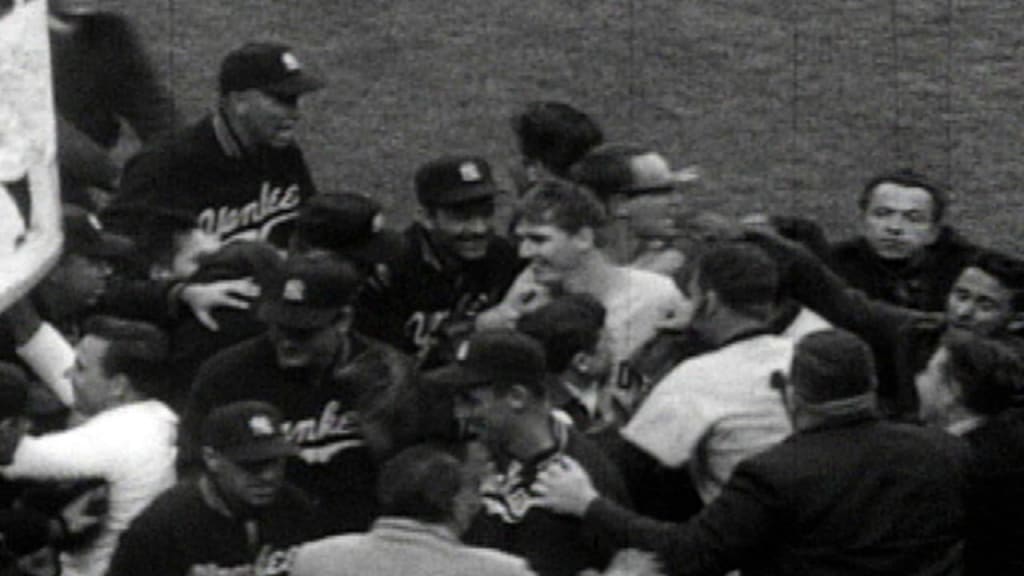
The Yankees' on-field celebration

What no one knows at the time -- not Robinson, not even Dodger owner Walter O'Malley -- is the extent of the finality of this game. It is not just the end of a terrific baseball season. It is the last Subway Series game for 44 years -- 33 years if you count the 1989 "BART Series."
Remember: It's only a Subway Series if it's a World Series. Nobody ever went to a regular-season game between the Brooklyn Dodgers and the New York Giants and called it a "Subway Series." And if they did, they'd be told, by fans of either team, "Go home, you're drunk." (The thought of being on drugs wouldn't have occurred to most baseball fans at the time.)
It is the last home game in a World Series for a National League team from New York for 13 years. And it is the last postseason game that Ebbets Field, or Brooklyn, will ever host. The next season, the Giants will announce they are moving to San Francisco, and the Dodgers will announce they are moving to Los Angeles.
"There's no tomorrow," indeed.
Bobby Richardson is the last surviving member of the 1956 World Champion New York Yankees.

Friday, September 4, 2026

The Kind of Rutgers Loss Schiano's Hiring Was Meant to Stop

September 23, 1995, Giants Stadium, East Rutherford, New Jersey: Penn State 59, Rutgers 34. This was the game at Giants Stadium where Joe Paterno ran up the score, and Rutgers coach Doug Graber got in his face at the end, and Penn State's jackass fans called Graber out for having no class.

November 23, 1996, Notre Dame Stadium, South Bend, Indiana: Notre Dame 62, Rutgers 0. Live to a national audience on NBC. Losing away to the Fighting Irish was to be expected, but 62-0?

October 9, 1997, Rutgers Stadium, Piscataway, New Jersey: Syracuse 50, Rutgers 3. I was there. RU finished 0-11.

September 19, 1998, Carrier Dome, Syracuse, New York: Syracuse 70, Rutgers 14.

October 24, 1998, Rutgers Stadium: Tulane 52, Rutgers 28. Tulane hanging 52 on us? At home?

October 9, 1999, Rutgers Stadium: Virginia Tech 58, Rutgers 20. I was there, watching Michael Vick and a swarming defense led by Corey Moore destroy the Scarlet Knights. Somehow, in my mind, this got conflated with the '98 Syracuse game, which wasn't even at home, and entered my memory as, "I saw Michael Vick and Virginia Tech beat Rutgers, 70-14." The truth was bad enough. Oddly, Rutgers beat Syracuse that season, 24-21, the only win in a 1-10 season.

September 30, 2000, Rutgers Stadium: Miami 64, Rutgers 6.

September 8, 2001, Orange Bowl, Miami, Florida: Miami 61, Rutgers 0. This was the 1st game of the Greg Schiano regime, Round 1.

September 29, 2001, Rutgers Stadium: Connecticut 20, Rutgers 19. One point, but Rutgers was not supposed to be losing to UConn. In basketball, yes; in football, no.

October 13, 2001, Veterans Stadium, Philadelphia, Pennsylvania: Temple 30, Rutgers 5. Rutgers was not supposed to be losing to Temple. In basketball, yes; in football, no.

November 3, 2001, Mountaineer Field, Morgantown, West Virginia: West Virginia 80, Rutgers 7. These games run together so much, I thought I remembered being at this game, at Rutgers Stadium. Instead, it was on the road. I know I saw Rutgers get destroyed at home by the Mountaineers at some point. This season ended 2-9, but the losses were more painful than in the 0-11 and 1-10 seasons.

August 31, 2002, Rutgers Stadium: Villanova 37, Rutgers 19. Rutgers was not supposed to be losing to Villanova. In basketball, yes; in football, no.

September 7, 2002, Rutgers Stadium: University of Buffalo 34, Rutgers 11. I was there. Rutgers was not supposed to be losing to Buffalo. In any sport.

October 12, 2002, Rutgers Stadium: West Virginia 40, Rutgers 0. Maybe this was the West Virginia loss at home I was thinking of. RU finished 1-11.

November 11, 2005, L&N Stadium, Louisville, Kentucky: Louisville 56, Rutgers 5. RU seemed to have finally turned the corner under Schiano, going 7-4 and reaching a real bowl game for the first time ever. But this was a bad loss, shown nationally on ESPN2.

November 18, 2006, Nippert Stadium, Cincinnati, Ohio: University of Cincinnati 30, Rutgers 11. Coming just 9 days after the epic ESPN-prime win over Number 3 Louisville, it was like RU had fumbled the best chance it would ever have. Losing this game, and to West Virginia in double overtime 2 weeks later, cost RU the Big East title and the bid that Louisville got to the Orange Bowl.

September 7, 2009, Rutgers Stadium: Cincinnati 47, Rutgers 15. I was there. The season was over by halftime of the opening game.

November 20, 2010, Nippert Stadium: Cincinnati 69, Rutgers 38. Okay, the Bearcats had a good run. But the days when teams could score a point a minute on RU should have been long over. After the season, instead of staying to "finish the job," Schiano left, to coach the NFL's Tampa Bay Buccaneers. He flopped, miserably.

October 27, 2012, High Point Solutions Stadium (the first renaming of Rutgers Stadium): Kent State 35, Rutgers 23. Rutgers is not supposed to lose to Kent State. That's why the 1st game at the rebuilt stadium, on September 3, 1994, had Kent State as the opponent. RU won that, 28-9. Not this.

October 18, 2014, Ohio Stadium, Columbus: Ohio State 56, Rutgers 17. Welcome to the Big Ten Conference, Scarlet Knights.

October 1, 2016, Ohio Stadium: Ohio State 58, Rutgers 0.

October 8, 2016, High Point Solutions Stadium: Michigan 78, Rutgers 0. Ohio State were ranked Number 2 in the country. Michigan, Number 4. And RU had to play them in back-to-back games. Refresh my memory: Why was joining the Big Ten a good idea?

September 9, 2017, High Point Solutions Stadium: Eastern Michigan 16, Rutgers 13. We're losing at home to Mid-American Conference teams now? Get used to it.

September 15, 2018: David Booth Kansas Memorial Stadium, Lawrence, Kansas: Kansas 55, Rutgers 14. This is another opponent where losing to them in basketball is understandable, but not in football, and not by this much. The season ended 1-11, although 3 were by 7 points or less.

The name of the stadium was changed to SHI Stadium in 2019. Greg Schiano, Rutgers' Deadbeat Dad, returned in 2020. Things weren't going so well, but not too badly, until...

September 3, 2026, SHI Stadium: University of Massachusetts 37, Rutgers 21. UMass hadn't won a game all last season. And this was supposed to be 1 of 2 games for RU that was clearly winnable, the other being Howard at home.
At halftime, with the score 28-7, a reporter for the Big Ten Network asked Schiano what was happening, and he said, "We're just a little bit out of whack right now." Ya think, Greg?

This was the kind of Rutgers' loss Schiano's hiring was meant to stop. The 1st time, and the 2nd time.

Instead, it was just another embarrassment for the school that played and won the first college football game, and hasn't done much since.

Sunday, August 16, 2026

August 16, 1951: The Delaware Memorial Bridge Opens

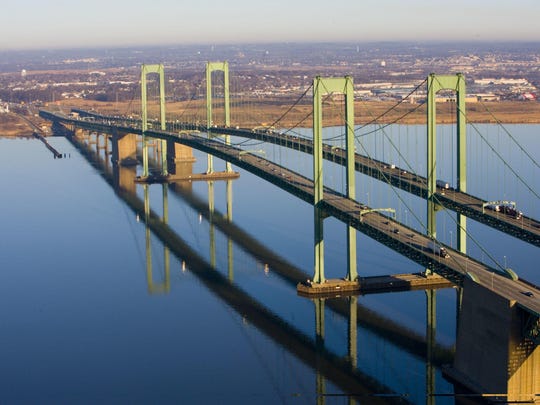
August 16, 1951, 75 years ago: The Delaware Memorial Bridge opens, connecting New Castle, New Castle County, Delaware and Pennsville, Salem County, New Jersey, over the Delaware River. It is operated by the Delaware River and Bay Authority.

It is 5 miles southeast of Rodney Square in Wilmington; 34 miles southwest of Center City, Philadelphia; 50 miles north of Legislative Hall (Delaware's State Capitol building) in Dover, 118 miles southwest of Midtown Manhattan; 70 miles northwest of Atlantic City; 73 miles northeast of downtown Baltimore; 91 miles northwest of Rehoboth Beach; and 108 miles northeast of downtown Washington, D.C.

Until 1926, the year what's now known as the Ben Franklin Bridge opened between Philadelphia and Camden, there was no way to get from Delaware's largest city, Wilmington in New Castle County, to New Jersey, except by train. But if, say, you only needed to go 20 miles to Salem, New Jersey, it made no sense to make the 30-mile train trip to Philadelphia, and then another 40 miles to Salem. The aforementioned Bridge only made things a little easier.

A ferry was established as a stopgap measure. Some stopgap: After debating whether a bridge or a tunnel should be built, Congress approved construction of a bridge in 1946. It finally opened 5 years later, bannered as U.S. Route 40 (which had been using the ferry). Soon, it became the southern end of the New Jersey Turnpike. In 1956, the Delaware Turnpike opened, connecting each State's most important highway.

The opening of the Turnpikes put too many cars on the span, and a 2nd bridge was ordered. On September 12, 1968, what's now the westbound span (toward Delaware) was opened, with the original span carrying eastbound traffic (toward New Jersey). In addition to Route 40, the "Twin Span" now carried Interstate 295. Its 174-foot-high towers are arguably the most famous structures in Delaware.

Even though the Bridges were 84 miles from the house in Central Jersey where I grew up, if a trip takes me in that direction, getting over the eastbound span meant I was back in New Jersey, so it felt like I was close to home, just as it did when I would come through the Lincoln Tunnel getting back from New York, 36 miles from home.

Wednesday, July 1, 2026

July 1, 1926: The Benjamin Franklin Bridge Opens

July 1, 1926, 100 years ago: The Delaware River Bridge opens, connecting Philadelphia, Pennsylvania and Camden, New Jersey, over the river in question. For the next 3 years, it is the longest suspension bridge ever built.

The name was changed to the Benjamin Franklin Bridge in 1955, named for Philadelphia's favorite son, since the Walt Whitman Bridge, to the south and also over the Delaware, had been approved.

It connects the downtowns of Pennsylvania's largest city and southern New Jersey's largest city, and carries Interstate 676 and U.S. Route 30, and the PATCO Speedline subway railroad. Because it's close to downtown, it's often used for panoramic photographs of the city.

It was preceded as a Delaware River bridge by:

* 1884: The Calhoun Street Bridge in Trenton.
* 1896: The rail-only Delair Bridge.
* 1903: The Morrisville-Trenton Railroad Bridge.
* 1913: The West Trenton Railroad Bridge.

And it has been followed by:

* 1928: The Lower Trenton Bridge, the one with the big letters on each side, reading, "TRENTON MAKES THE WORLD TAKES."
* 1929: The Tacony-Palmyra Bridge, N.J. and Pennsylvania Route 73.
* 1931: The Burlington-Bristol Bridge, N.J. and Pennsylvania Route 413.
* 1951: The original, now-eastward span of the Delaware Memorial Bridge, Interstate 295 and U.S. Route 40.
* 1952: The Trenton-Morrisville Toll Bridge, U.S. Route 1.
* 1956: The Delaware River-Turnpike Toll Bridge, part of the Pearl Harbor Memorial Turnpike Extension, connecting the New Jersey Turnpike with the Pennsylvania Turnpike, Interstate 276.
* 1957: The Walt Whitman Bridge, Interstate 76.
* 1961: The original Scudder Falls Bridge, which was eventually bannered as Interstate 95.
* 1968: The 2nd, westward span of the Delaware Memorial Bridge.
* 1974: The Commodore Barry Bridge, U.S. Route 322.
* 1976: The Betsy Ross Bridge, N.J. and Pennsylvania Route 90.
* 2019: The new Scudder Falls Bridge.

Although not as famous as the Brooklyn Bridge in New York or the Golden Gate Bridge in San Francisco, both of which tend to get destroyed in disaster movies, the Ben Franklin Bridge was shown seriously damaged in the 2023 film Shazam: Fury of the Gods.

Thursday, June 11, 2026

June 11, 1986: East Brunswick High School Wins Its 1st County Baseball Title

Photo shown in the next day's Home News.
Yes, at the time, we wore a green variation on the
Houston Astros' "Rainbow Brite" uniforms.

June 11, 1986, 40 years ago: I was at the baseball field of the Memorial Stadium complex in New Brunswick, New Jersey, watching the final of the 1st Greater Middlesex Conference Tournament, the successor to the Middlesex County Tournament. Dear Old Alma Mater was playing.

East Brunswick High School played Madison Central -- the Old Bridge-based school now known as Old Bridge High School. Here's the starting lineup for Da Bears, coached by Lou Kosa, better known as the school's girls' soccer coach, builder of the best such program in the State:

* Batting 1st, the right fielder, a lefthanded sophomore, Number 1, Craig Semchyshyn. Normally, underclassmen did not make the starting lineup, but "Semy" stepped in due to an injury to a senior. He turned out to be an ideal leadoff man, his speed allowing him to beat out some infield hits (including some good bunts), steal bases, and get to some tough plays in the outfield.

He starred for the team for the next 2 years, although when the Class of '86 and then the Class of '87 players graduated, the team around him was not what it had been in 1984 (County final), '85 (nearly won Conference title) and '86.

* Batting 2nd, the 3rd baseman, a righthanded senior, Number 30, Keith Motusesky. Also the leader of the E.B. basketball team that won the GMC Red Division and Central Jersey Group IV (largest enrollment classification) title the preceding winter. "Mot" could also play catcher.

* Batting 3rd, the shortstop, a righthanded senior, Number 6, Ken Wainczak. Probably our best all-around player, "Check" (a shortening of his name, not his ethnicity, as I think he was Polish like me rather than Czech) was in the mold already formed by Robin Yount, Alan Trammell and the young Cal Ripken Jr., of shortstops no longer being spindly, good-field-no-hit types, rather becoming big guys with power, presaging the era of Derek Jeter, Alex Rodriguez and Nomar Garciaparra.

* Batting 4th, the 1st baseman, a lefthanded senior, Number 11, Mike Cioffi. He had a very good glove, he was our 2nd starting pitcher, and I don't think E.B. has ever had a player who could hit the ball farther.

Earlier in the season, in an otherwise unpleasant loss to Woodbridge, he hit one that I paced off at 492 feet. In retrospect, having read books about long-distance home runs, I probably measured wrong -- or, perhaps, the measurements on the outfield fences at the former EBHS baseball field (since totally redone with FieldTurf, and with dugouts that wouldn't be condemned by the health inspector) were wrong.

But in another game that season, at Perth Amboy, then forced to play their home games at their football stadium, resulting in a mirror image of the Los Angeles Memorial Coliseum when the Dodgers played there (right field was much too close, rather than left field), he hit a ball over the houses on Myrtle Street across from the stadium. That had to be at least 450 feet. (Too bad we lost that game, too, but better times were coming and he would be a big part of it.)

* Batting 5th, the 2nd baseman, a righthanded junior, Number 5, Don Marchiselli. "March" also played a bit of 3rd base, and when he got a hold of a pitch, the opposing 3rd baseman learned why the position is called the hot corner.

* Batting 6th, the left fielder, a righthanded junior, Number 7, Andy Wang. Although E.B. already had a large South Asian population at that time (much more interested in cricket than baseball, although they did perform on our soccer, field hockey and track teams), we didn't have a lot of East Asians then. A few of them were on the track team, but Andy was good with both the bat and the glove.

* Batting 7th, the center fielder, a lefthanded senior, Number 10, John Breen. Normally the right fielder, "Breener" moved over due to another player's injury. Three brothers, three good baseball players, three different schools: His older brother Bill had pitched no-hitters for the East Brunswick campus of Middlesex County Vo-Tech H.S. (now named the Middlesex County Magnet School), and younger brother Sean starred for St. Joseph's of Metuchen. John went on to become an East Brunswick policeman.

* Batting 8th, the catcher, a righthanded senior, Number 20, Rich Helmold. The son and namesake of the head coach of the town's team in the Middlesex County league of American Legion baseball, Rich was a Crash Davis type, a catcher you did not cross up, who would remind you, "Don't think, Meat, just throw." And "Cheese" (I have no idea how he got that nickname) could hit, too. There was no weak spot in this lineup.

* Batting 9th, the designated hitter, a lefthanded senior, Number 3, Rich Loninger. This was the injury I mentioned earlier: "Los" was a good fit as a center fielder and as a leadoff man, but he got hurt shortly before the tournament began. The final was his 1st appearance in the tournament.

* Pitching, a righthanded starter, Number 41, Steve Hochman. A serious Met fan, Hoch (pronounced like "Hock") wore 41 in honor of Tom Seaver, and even copied Tom Terrific's pitching motion, overhand with his right knee brushing the ground with a permanent dirt-stain.

One time, in American Legion Ball, an opposing pitcher took the mound wearing 41, and was awful. Steve said, "He's making Seaver look like an asshole." His coach wisely benched the scrub, and brought in a pitcher wearing Number 36, and he wasn't much better. This was before David Cone reached the majors with the Mets, let alone came to the Yankees and wore 36, so I said, "He's making Robin Roberts look bad." Hochman gave me this dirty look. I hope it meant he was suggesting that Roberts wasn't as good as Seaver. Or maybe it was because he'd already gotten into the University of Michigan, and Roberts was a Michigan State graduate.

Steve's brother Brad, a year behind him, was also on the baseball team, and a star on the soccer team. Another brother, Brandon, was a key cog on the next E.B. team to win a County baseball title, in 1991.
Head Coach Lou Kosa

*

If Connie Mack was right, and "Pitching is 75 percent of baseball," then Steve's Spring 1986 performance can be Exhibit A for the prosecution. He was the reason we went from entering the tournament 11-12 – having been eliminated from the State Tournament in the 1st round the day before the County Tournament began – and the 12th seed to reaching the final.

Hochman struck out 14 batters against heavily favored Carteret in the 1st round. On the bench, we were wondering what the school record was. Being the school's resident trivia freak, they figured I would know, but I didn't. Wayne Beck, a sophomore on the '86 team, told us he thought it was 17, set by his father, also named Wayne Beck, back in 1966, when the school won its 1st Central Jersey Group IV title in the sport. As far as I know, he was correct, but I don't know if that record has since been broken. We won the game, 6-4.

Three days later, in the quarterfinal, against GMC Gold Division (small-school) Champion Harold G. Hoffman High School (which has since reverted to its original name of South Amboy H.S.), Hoch fanned 11 batters in just 5 innings, with Jim Craig (a junior righthander, no relation to the 1980 U.S. Olympic hockey goalie of the same name) finishing the game. (New Jersey high school baseball games are 7 innings, barring a tie.) We won, 15-1.

Don't be fooled by the score, or by the fact that Hoffman was a small school (barely 300 students): They did win their Division, and were then perennial contenders for the Central Jersey Group I title.

Next up was the semifinal against South Plainfield, Champions of the GMC White Division, soon to win the Central Jersey Group II title, and ranked Number 1 in the entire State by the Star-Ledger, the Newark-based largest newspaper in the State. Were we intimidated?

If we were, it wasn't for long: We kicked the stuffing out of them, 16-4, crushing the horsehide in support of Cioffi, who threw some serious smoke. (Well, serious by the standards of New Jersey high school ball.)

South Plainfield was led by Phil Aiello, like Cioffi a lefthanded 1st baseman and pitcher, and we clobbered him. One of the spectators that day, waiting for his own semifinal against Old Bridge, was yet another lefty 1st baseman-pitcher, Chuck Frobosilo of Sayreville, a school which had just clinched its 3rd straight Conference title (the Middlesex County Athletic Conference in 1984 & '85, and the GMC Red Division in '86). This game was such a laugher, literally so, that we were joking with him that this game pretty much clinched the Home News' Middlesex County Player of the Year award for him (and he did get it, over Aiello).

Part of the reason we scored 31 runs in 2 games, and ended up scoring 51 in the 4 games of the tournament, was the field dimensions. From the 1990s onward, GMC Tournament games have been played at the home field of the higher-seeded school until the Final. In the 1990s, the Final was played at the immaculate, professional-quality field of East Brunswick Vo-Tech. Since the turn of the 21st Century, it's been played at TD Bank Ballpark in Bridgewater, home of the independent Atlantic League's Somerset Patriots, even though it's in an adjoining County. But in the 1980s, the entire tournament was played at the Memorial Stadium complex in New Brunswick.

New Brunswick High School was established in 1875, as the 1st public high school in Middlesex County. It had played its football games at the complex since 1940, with the press box of the (thankfully now-renovated) football stadium being strangely a few yards off midfield.

When they moved off their old campus at Livingston Avenue (State Route 26) & Comstock Street and opened their new school in 1967, they built it on Livingston between 9th and 12th Streets, with Joyce Kilmer Avenue (the "Trees" poet, killed in combat in World War I, was born on that street when it was Codwise Avenue) behind it and the stadium on that street.

Behind the stadium was the old Pennsylvania Railroad tracks, by this point (as they still are) used by Amtrak and New Jersey Transit, and whenever an event is held there, it's fun to watch the trains go by. The baseball field, on the 9th Street side of Joyce Kilmer Avenue, is limited by the tracks, and has a chain-link fence that is 300 feet all the way around, but is 20 feet high to discourage cheap home runs. It does not, however, discourage cheap doubles, and the Bears were smacking the ball all over the yard.

A new NBHS was built on the other side of the tracks, on Somerset Street (State Route 27), in 2010, and the previous high school was repurposed as a middle school. But the stadium complex remains their home for outdoor sports.

*

We dusted off South Plainfield to advance to the final, and Madison Central did the same by upsetting Sayreville. In 1986, Madison was the closest divisional opponent to EBHS in terms of distance. A few others, such as E.B. Tech, Spotswood and South River -- once much larger, and the school to which East Brunswick 9th-to-12th graders were sent up until 1958, and thus our original rivals -- were closer, but had smaller enrollments, so we could only play them in County Tournaments. Because of distance, Madison was considered a rival, but not really our biggest rival.

St. Joseph's of Metuchen, a school which took so many E.B. athletes in the 1970s and '80s that they were nicknamed "East Brunswick Catholic," would have been our biggest rival, except they had no football team. (They finally debuted a varsity football team in 2011.) They said they never recruited, absolutely insisting on this. As New Jersey native Jim Bouton would say, "Yeah, surrrre!"

And, in this era, we had some legendary football games against J.P. Stevens H.S. of Edison, including games that decided the Conference and Central Jersey Group IV Championships. It would be a little longer, with some nasty defeats, including two terrible State Playoff football losses, before Madison, and its successor Old Bridge, became the unquestioned school that we hated the most.

Still, we already didn't like them, and the feeling was very mutual. Even more than the Township of East Brunswick, the Township of Old Bridge had a reputation for ginkers. If you're not a Middlesex County native and are not familiar with this term, you probably have your own term for this type: Ginkers were the 1970s & '80s successors to the greasers of the '50s, liking "hair metal" as opposed to greasers' love of Elvis and the 1950s rock and roll pioneers.

These were guys who needed to take 3 or 4 steps up in class and articulation before they could be celebrated in a Bruce Springsteen song. They were more like the kid in John Mellencamp's song "Pink Houses," with the greasy hair and the greasy smile, who knows that nothing better than what he's got now will ever be his destination, unless he wises up. Think Judd Nelson as John Bender in The Breakfast Club, Scott Valentine as Nick Moore on Family Ties, or Ashton Kutcher as Michael Kelso on That '70s Show.

There were a few ginker types on EBHS' athletic teams, but not many. Cigarettes reduce lung power, and nicotine is not exactly a performance-enhancing drug. But the guys at the 2 high schools Old Bridge had at the time, Madison Central and Cedar Ridge, they took the cake. And probably robbed the bakery in the process. Nah, they didn't rob anything. They were too lazy.

*

But it wouldn't have mattered if the Madison hitters were all in tip-top condition: We crushed them. In the top of the 1st inning, Semchyshyn and Motusesky both reached base, and Wainczak stepped up. He cranked one down the left-field line. It cleared the high fence, and this was no cheap shot: It was an absolute no-doubt-abouter.

I've often said this was "the longest home run ever hit," because it went onto the tracks and landed on a passing Amtrak train that carried it all the way to Florida. Now, I don't have any proof that this happened -- Amtrak and NJT trains went past all night, but the homer didn't hit any of them -- but I looked for this ball, and it was nowhere to be found. The only thing I can think of is that it did leave the complex and land on the tracks. And I wasn't about to go onto the tracks and find out. Wherever it went, everybody associated with E.B. was over the moon.

Hochman was dealing. We built up a 7-0 lead, and it looked like we would win easily. Well, it wasn't that easy: In the 4th inning, Madison rallied, made it 7-3, and loaded the bases with 2 out. A shot went to dead center, and it looked like it would clatter off the high fence for a double, scoring at least 2 and making this a game again. But Breen (playing out of his usual position, mind you) made a leaping grab, and the rally was stymied.

That was it: They couldn't touch Hoch, as if Seaver (who, by this point, was wrapping up his brilliant career) himself were on the mound, and we tacked on a few more runs, for the 14-3 final score.

This was E.B.'s 25th season of varsity baseball. We had never won the County Title under the old format, and only reached 1 final, losing to Edison 2 years earlier. This would be our 1st title, if we could finish it off. At 10:02 PM on June 11, 1986, Steve Hochman did just that: His arm must've felt like Swiss cheese at this point, but he fired an aspirin past Rob Jessup, who started the game as the opposing pitcher, but had long since been moved off the mound. He swung and missed. Strike 3.

The mighty mighty Bears were County Champions. Well, Greater Middlesex Conference Champions, but since the only County school not in the GMC was Piscataway (which joined 2 years later), and they didn't reach the sectional final or win their league, it's safe to say E.B. was County Champions.

As one of the student managers on that team, it was, at the time, the happiest moment in my life. For the 1st time ever, my 3 great loves all came together: East Brunswick, baseball, and winning.

*

In 1991, at East Brunswick Vo-Tech, East Brunswick won the Tournament again, beating South Plainfield in the Final. They did it again in 1997, also at E.B. Tech, beating Woodbridge's John F. Kennedy H.S., just 1 day after beating Edison at Hamilton's Mercer County Park for the Central Jersey Group IV title. In 2005, they won the Tournament Final, beating St. Joe's at TD Bank Ballpark in Bridgewater. I was in attendance for each of these. I was not there in 2016, 30 years after winning the 1st one, when they won the 5th one, defeating J.P. Stevens at Bridgewater. 

Tuesday, May 26, 2026

May 26, 1956: The Garden State Parkway Opens

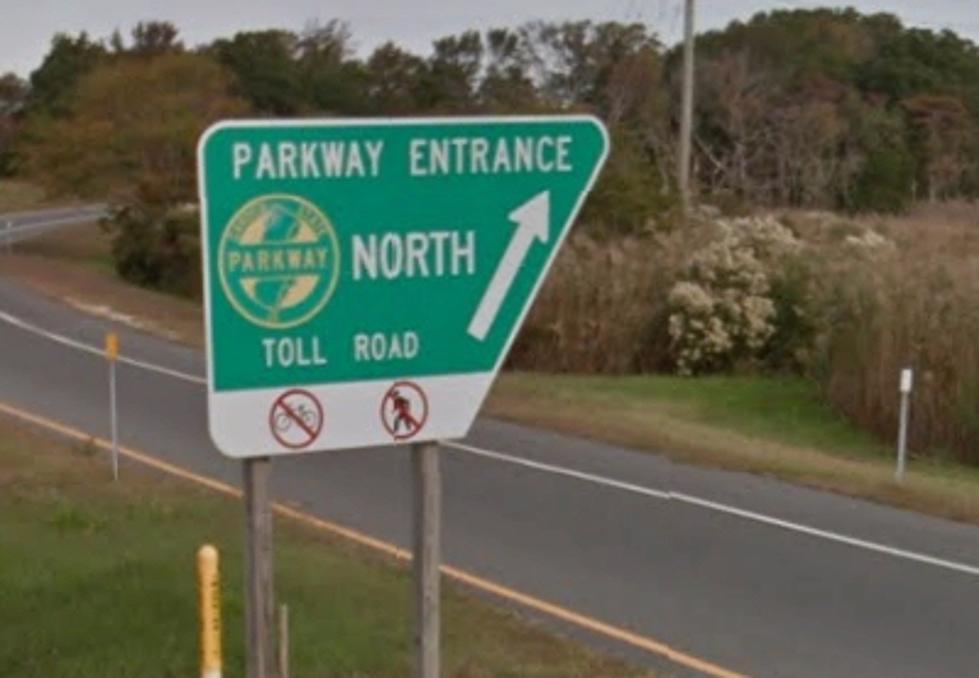
May 26, 1956, 70 years ago: The Great Egg Harbor Bridge opens, over Great Egg Harbor Bay in southern New Jersey, connecting Somers Point in Atlantic County with Upper Township in Cape May County. With this opening, the Garden State Parkway is fully open.

A 2nd bridge, taking northbound traffic, was added in 1972. The original, southbound bridge was replaced in 2016; the northbound one, in 2019.

Like the New Jersey Turnpike, which opened in 1951, the Parkway was the brainchild of Alfred E. Driscoll, Governor of New Jersey from 1947 to 1954. Just as the Turnpike was designed to ease the traffic flow of U.S. Route 1 in North and Central Jersey, and U.S. Route 130 in South Jersey, the Parkway was meant to do the same thing for U.S. Route 9.

Of course, it didn't work out that way. The huge growth of New Jersey's suburbs meant that the traffic on both 1 and 9 -- which merge in Woodbridge, Middlesex County, near the interchange that is Turnpike Exit 11 and Parkway Exit 129, and then go up together to the George Washington Bridge -- filled up anyway. But it's still better to have the 2 big superhighways than not. Similarly, the Atlantic City Expressway opened in 1964, but has never really eased Shorebound traffic on U.S. Route 30.

The Parkway runs the spine of New Jersey, paralleling Route 9, at times running concurrent with 9. It starts in Lower Township, Cape May County, with an interchange labeled "Exit 0," 2 1/2 miles north of the beach in Cape May City. The exits, more or less, match the mileposts. Exits 9, 10 and 11 were at-grade interchanges, complete with traffic lights, until grade-separated interchanges replaced them in 2014. (Bumper stickers for Cape May contain the legend "EXIT 0," much as those for Montauk, at the eastern end of New York's Long Island, read "THE END."

It goes from Cape May County to Atlantic County at the aforementioned Great Egg Harbor Bridge, near Exit 29. Atlantic City can be accessed via Exits 37 (U.S. Routes 40 and 322), 38 (the Atlantic City Expressway, that road's Exit 7) and 40 (U.S. Route 30).

Exits 50 and 52 are the only ones in Burlington County. In Ocean County, Exit 63 accesses New Jersey Route 72 and Long Beach Island; and Exit 82, N.J. Route 37 and Seaside Heights. In Monmouth County, Exit 100 is for N.J. Route 33 and Asbury Park; Exit 105 is for N.J. Route 36, the Monmouth Mall in Eatontown, and the Monmouth Park horse racing track in Oceanport; and Exit 116 is the only access point for the PNC Bank Arts Center (formerly the Garden State Arts Center) in Holmdel. You can't access this concert facility any way except through the Parkway.

At Exit 120, the Parkway enters Middlesex County. After Exit 125, it crosses the Raritan River, via a bridge named for Driscoll. Exit 127 is an interchange with Interstate 287, U.S. Route 9, and N.J. Route 440, with ramps so tangled, it is known as "Spaghetti Junction." At Exit 129, it connects with the New Jersey Turnpike/Interstate 95 and its Exit 11. It intersects with U.S. Route 1 at Exit 130. At Exit 131 in Woodbridge, it passes under Amtrak's Northeast Corridor, formerly the Pennsylvania Railroad.
Heading southbound, approaching Exit 129

Exits 135 to 142 are in Union County, including Exit 142, an interchange with Interstate 78, which connects the Parkway with Newark Liberty International Airport. Exits 143 to 151 are in Essex County, including 145, in my parents' hometown of Newark, an interchange with Interstate 280; and 148, 149, 150 and 151, in my original hometown of Bloomfield.

Passaic County includes Exits 153, 154, 155 and 156. Exit 153 intersects with N.J. Route 3, providing access to the Meadowlands Sports Complex. Exits 157 to 172 are in Bergen County. Exit 159 is an interchange with Interstate 80. Exit 161 provides access to the Garden State Plaza Mall in Paramus. Exit 172 is in Montvale. From here, the Parkway continues north, over the State Line, as the Garden State Parkway Connector to the New York State Thruway.

Unlike the Turnpike, which only has toll booths at the exits, the Parkway has 11 toll barriers, leaving drivers "nickel-and-dimed" from Cape May County to Bergen County.

Also unlike the Turnpike, which is bannered as Interstate 95 from Exit 6 northward, the Parkway has never been part of the Interstate Highway System, created the same year that the Parkway opened. As part of the Interstate System, the federal government did not absorb existing state toll roads, as federal funding is typically meant for toll-free, interconnected national routes.

Rather, it is part of the National Highway System, and while there are absolutely no signs along it mentioning it as such, it is officially New Jersey Route 444. This allows New Jersey to collect tolls on the road, but also to ban trucks from any part of its length, and they are banned from Exit 105 northward. By law, an Interstate Highway must allow commercial traffic. And that's why the Parkway is not bannered as part of Interstate 91, 93, 95, 97 or 99.

Sunday, May 24, 2026

May 24, 1626: Peter Minuit Buys Manhattan

May 24, 1626, 400 years ago: Peter Minuit buys Manhattan Island from the native Indians for $24. Or so the legend says.

The truth is a bit more complicated.

Henry Hudson, an English explorer, had sailed up the Hudson River on September 2, 1609, claiming a large swath of land for the Dutch Republic. The Hudson Valley, up to present-day Albany and Schenectady, in what became the State of New York; Long Island, including what is now the Boroughs of Brooklyn and Queens, and Nassau County, named for the ruling house of the Netherlands; what is now the western half of Connecticut; the entirety of New Jersey; much of southeastern Pennsylvania, including what became Philadelphia; northernmost Delaware; and the northeastern corner of Maryland. This colony became known as New Netherland. Its capital, occupying the southern tip of Manhattan Island, was named New Amsterdam, after the mother country's capital.
"Manhattan" was a word from the language of the Native Americans living there, the Lenape tribe, meaning "the place where we get bows" -- in other words, the wood to make bows for arrows. One of the many legends of early New York that has proven to not be true is that it was originally "Manahatta," meaning "place of many hills," although the island does have many hills.

Peter Minuit was born in Wesel, Germany between 1580 and 1585 into a Calvinist family that had moved from the city of Tournai, presently part of Wallonia in Belgium, then controlled by Spain, in order to avoid Spanish Catholic authorities, who were not favorably disposed toward Protestants. Minuit married Gertrude Raedts in 1613. She was from a wealthy family, and she probably helped him establish himself as a broker.

Minuit joined the Dutch West India Company, and was sent with his family to New Netherland in 1625 to search for tradable goods other than the animal pelts that then were the major product coming from New Netherland. He returned in the same year, and in 1626 was appointed the new director of New Netherland. He sailed to North America and arrived in the colony on May 4, 1626.

He is credited with purchasing the island of Manhattan, from Native Americans in exchange for traded goods valued at 60 guilders. That figure came from a letter by a representative of the Dutch States-General and member of the board of the Dutch West India Company, Pieter Janszoon Schagen, to the States-General in November 1626. In 1844, New York historian John Romeyn Brodhead converted the figure of Fl 60 (or 60 guilders) to US$24. By 2006, 60 guilders in 1626 was worth approximately $1,000 in current dollars, according to the Institute for Social History of Amsterdam.

The original inhabitants of the area were unfamiliar with the European notions and definitions of ownership rights. For the Indians, water, air and land could not be traded; therefore, it is likely that both parties probably went home with totally different interpretations of the sales agreement. The Lenape probably thought they were the ones who got the great deal.

A contemporary purchase of rights in nearby Staten Island, to which Minuit also was party, involved duffel cloth, iron kettles, axe heads, hoes (garden tools -- the prostitutes came later), wampum, drilling awls, "Jew's harps" and "diverse other wares."

In 1632, the Dutch West India Company recalled Governor Minuit, essentially firing him for corruption. So political corruption in New York City goes back that far. He left the Netherlands, and in 1637, having made a deal with Sweden, he sailed up the Delaware River, and established the colony of New Sweden.

The following year, he was at sea, and his ship was lost in a hurricane. Without his guidance, New Sweden never had a chance, as the mother country was losing what became known as the Thirty Years War, ending its status as a European power. In 1655, the Dutch reclaimed New Sweden as part of New Netherland.

In 1664, as part of the Anglo-Dutch War, England conquered New Amsterdam without firing a shot. Although the Netherlands ended up winning the war, England got to keep New Netherland. It renamed both the colony and its capital city New York, after the Duke of York, brother of King Charles II. He later became King James II.

Monday, April 13, 2026

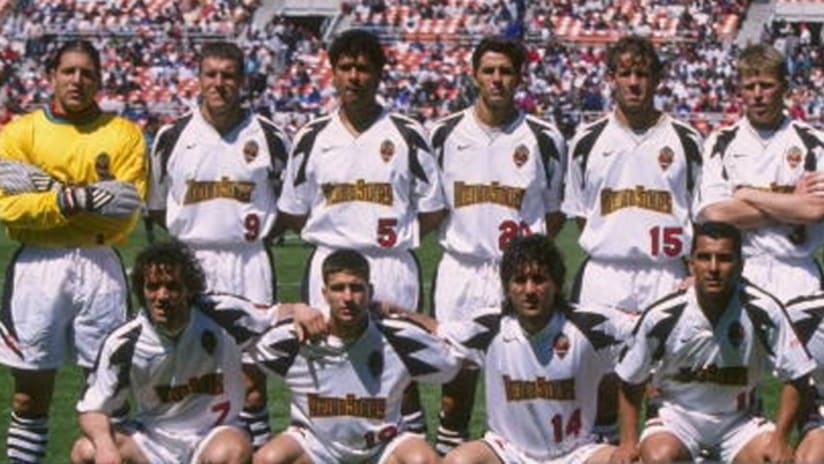
April 13, 1996: The MetroStars (Red Bulls) Debut

April 13, 1996, 30 years ago: The sports rivalry between the New York and Los Angeles metropolitan areas, dormant in soccer since the Los Angeles Aztecs folded after the 1980 North American Soccer League season, resumes, as each area's 1st team in Major League Soccer began play, against each other.

At the Rose Bowl in suburban Pasadena, California, the Los Angeles Galaxy played the New York/New Jersey MetroStars. A crowd of 69,225 attended, and the game was broadcast nationally on ABC.

Cobi Jones opened the scoring for the Galaxy, in the game's 37th minute. Arash Noamouz scored another in the 56th minute. Giovanni Savarese pulled one back for the MetroStars in the 77th, but that was as close as they would get: L.A. won, 2-1.

The "Gals" have gone on to win 5 MLS Cups. The MetroStars, or "Metro" for short, became the New York Red Bulls in 2005, but they and the New England Revolution are the only original MLS teams that have not yet won an MLS Cup.

Despite having had such stars as Savarese, Peter Vermes, Tony Meola, Tab Ramos, Clint Mathis, Lothar Matthäus, Eddie Pope, Juan Pablo Ángel, Thierry Henry, Dax McCarty, Tim Cahill, Sacha Kljestan, and the brothers Shawn and Bradley Wright-Phillips, the Red Bulls haven't gone all the way. They've won the Supporters' Shield, the overall regular-season title, in 2013, '15 and '18; and also finished 1st overall in the Eastern Conference in 2000, '10 and '16. They've reached the MLS Cup Final in 2008 and 2024, but never won it. They've also reached the Final of the U.S. Open Cup in 2003 and '17, but never won that, either.

Tuesday, March 31, 2026

March 31, 1976: The Karen Ann Quinlan Case

March 31, 1976, 50 years ago: The Supreme Court of the State of New Jersey rules in the case of In re Quinlan, that Karen Ann Quinlan, a hospital patient in a persistent vegetative state, can be disconnected from her ventilator.

Karen had been born on March 29, 1954 in Scranton, Pennsylvania, and grew up in Roxbury, Morris County, New Jersey. She graduated from Morris Catholic High School in Denville, and worked several jobs, moving to a house in Byram, Sussex County, with 2 roommates.

On April 15, 1975, she attended a friend's birthday party at a local bar. Having eaten almost nothing for 2 days, as part of a crash diet, she got drunk and took a Valium pill. Her friends took her home, and discovered her not breathing. She was taken to a hospital in Newton, Sussex County, but never regained consciousness. Unresponsive, she was taken to St. Clare's Hospital in Denville, which was better able to handle her condition: A persistent vegetative state.

After doctors refused the request of her parents, Joseph and Julia Quinlan, to disconnect her ventilator, her parents filed suit to get her disconnected. They believed that her still being connected constituted extraordinary means of prolonging her life.

Interestingly, both sides used Catholic theology to make their cases: The defense, that life must be preserved at all costs; the plaintiffs, that "extraordinary measures" to preserve life are a contradiction of God's will, citing a Papal message from Pope Pius XII in 1957.

The State Supreme Court ruled in the parents' failure, and the respirator was disconnected. Karen's feeding tube was not: Her parents did not consider that to be "extraordinary measures." As a result, Karen lived on until June 11, 1985. She had been in a coma for 10 years. Her case has affected the practice of medicine and law around the world. A significant outcome of her case was the development of formal ethics committees in hospitals, nursing homes and hospices. 

Friday, March 20, 2026

March 20, 1976: Rutgers Basketball Reaches the Final Four

March 20, 1976, 50 years ago: The men's basketball team of Rutgers, the State University of New Jersey, beats the Virginia Military Institute, a.k.a. VMI, at the Greensboro Coliseum in Greensboro, North Carolina. This advances them to a record of 31-0, and to the NCAA Semifinal at The Spectrum in Philadelphia. Rutgers has reached the Final Four.

One of nine "colonial colleges," which opened before American independence in 1776, Rutgers was best known as the site of the 1st American football game in 1869. But, since then, sports successes had been few and far between.

Now, under coach Tom Young, they had a basketball team that was ready to challenge the rest of the country. The usual starting lineup was guards Mike Dabney and Eddie Jordan, forwards Phil "the Thrill" Sellers and Hollis Copeland, and center "Jammin'" James Bailey, a freshman.

It was one thing to beat regional rivals like Princeton and Seton Hall (also in New Jersey); Columbia, Fordham, Manhattan College and Long Island University (New York City); the University of Pennsylvania and Temple (Philadelphia); Bucknell, Lehigh and Lafayette (Northeastern Pennsylvania); the University of Delaware; the Naval Academy (Maryland); American University (Washington, D.C.); the University of Connecticut; and Boston College.

But beating bigger teams was another thing. On December 4, 1975, they beat Big Ten team Purdue. Between Christmas and New Year's, they went to Greenville, South Carolina to play in the Poinsettia Classic, and beat The Citadel (not a big deal) and Georgia Tech (which was a big deal). They beat West Virginia at Madison Square Garden on February 5.

By this point, home games at the 3,200-seat College Avenue Gymnasium, built in 1931 after a fire burned down the previous gym on the site, roughly on the site of that first college football game, in New Brunswick, Middlesex County, New Jersey, were next to impossible to get into unless you were a student. It got so loud, paint chips fell from the ceiling. (I have had this confirmed by an RU graduate, Class of '76.) The decision to build a new arena was made.
The College Avenue Gym

Rutgers beat the University of Pittsburgh, then Syracuse. On March 1, they closed the regular season at home to St. Bonaventure, still undefeated at 25-0. The Bonnies took an early lead, but the Scarlet Knights came back, and won, 85-80. They entered the ECAC Metro Tournament at Princeton's Jadwin Gymnasium, and beat LIU and St. John's -- schools from Brooklyn and Queens, respectively -- to go 28-0.
It was on to the NCAA Tournament. This was only the 2nd time RU had made the Tournament, having gotten in the year before, and going out in the 1st Round. They had gotten to the Semifinals of the NIT in 1967, with future North Carolina State coach Jim Valvano playing for them.

They played Princeton -- not in New Jersey, but at the Providence Civic Center in Rhode Island. (It's now named the Amica Mutual Pavilion.) It was the closest game of the season, but Rutgers beat their ancient rivals, 54-53.

On to the Regional Semifinal, in Greensboro. Connecticut was not yet the power it would become, and Rutgers won, 93-79. That led to the Regional Final, also in Greensboro, against VMI. This time, Rutgers was solidly favored, and won, 91-75. They were undefeated. They were 31-0. They were ranked Number 4 in the country. And they were on their way to the Final Four.

Hail the Heroes:

* Number 12, a 6-foot-5-inch senior forward from Brooklyn, New York: Phil Sellers.
* Number 20, a 6-9 freshman center from Boston, Massachusetts: James Bailey.
* Number 22, a 6-3 sophomore guard from Washington, D.C.: Stanford Nance.
* Number 24, a 6-7 senior center from Parsippany, Morris County, New Jersey: Bruce Sherer.
* Number 30, a 6-1 junior guard from D.C.: Eddie Jordan.
* Number 32, a 6-4 senior guard from East Orange, Essex County, New Jersey: Mike Dabney.
* Number 34, a 6-5 sophomore forward from Trenton, Mercer County, New Jersey: Hollis Copeland.
* Number 42, a 6-2 junior guard from Queens, New York: Mark Conlin.
* Number 44, a 6-2 senior guard from Queens: Jeff Kleinbaum.
* Number 50, a 6-5 sophomore guard from East Rockaway, Long Island, New York: Steve Hefele.
* Number 52, a 6-7 senior center from Hackettstown, Warren County, New Jersey: Mike Palko.
* And Number 54, a 6-7 freshman forward from Belleville, Essex County, New Jersey: Abdel Anderson.

Since it was 1976, the Bicentennial year, the Final Four, and the All-Star Games for MLB, the NBA and the NHL, were held in Philadelphia. On March 27, against the University of Michigan, ranked Number 9 entering the Tournament, the bubble finally burst. The Wolverines jumped out to an early lead, and the Knights just couldn't get into their game. Michigan won, 86-70, and RU were 31-1.

In those days, there was a 3rd Place Game, and Rutgers lost that, too, 106-92 to defending National Champion UCLA, to finish 31-2. Indiana, coached by Bobby Knight, and featuring future NBA players Kent Benson, Scott May and Quinn Buckner, beat Michigan, and completed an undefeated season, 32-0. There hasn't been an undefeated season in college basketball since.

Calendar year 1976 was magical for Rutgers: In the Autumn, the football team also went undefeated, 11-0, but was not invited to a bowl game.

In 1977, Rutgers moved into the Rutgers Athletic Center, a.k.a. The RAC (pronounced like "rack"), across the Raritan River from New Brunswick, on the Livingston Campus in Piscataway. From 1986 to 2019, it was named the Louis Brown Athletic Center, after a donation from Brown's family.

Now named the Jersey Mike's Arena, it only seats 9,000, and has never been very good. Plans for renovation, or for a new arena in downtown New Brunswick, have been floated, but it looks like the current nondescript chunk of concrete is going to stay.

The College Avenue Gym still stands, and hosts the RU wrestling and volleyball programs.

Rutgers made the NCAA Tournament again in 1979, getting to the Sweet Sixteen. They made it again in 1983, getting to the 2nd Round. In 1989, they made it as Champions of the Atlantic-10 Tournament. They made it again in 1991. Both times, they went out in the 1st Round. They didn't make it again until 2021, but made it again in 2022.

Despite being the team's top player, Phil Sellers played just 1 season in the NBA, with the 1976-77 Detroit Pistons. Hollis Copeland played 2 seasons with the New York Knicks. James Bailey lasted 9 seasons, playing for both the Knicks and the New Jersey Nets, among other teams.

Eddie Jordan had the most successful pro career, playing 7 seasons, 3 of them with the Nets, and 3 with the Los Angeles Lakers, including winning the 1982 NBA Championship. He later coached the NBA's Sacramento Kings, Washington Wizards and Philadelphia 76ers.

Tom Young started at Rutgers in 1973, and coached them until 1985, when he was lured away by Old Dominion University in Norfolk, Virginia. He later served as an assistant to Jordan on the Wizards. He died on March 20, 2022, the 36th Anniversary of his Final Four achievement.

Phil Sellers died on September 19, 2023. The remaining players are still alive.

Sunday, February 15, 2026

February 15, 1726: Abraham Clark, New Jersey Declaration Signer

February 15, 1726, 300 years ago: Abraham Clark is born in Elizabethtown, in the Province of New Jersey. In 1855, Elizabethtown was incorporated as the City of Elizabeth, the seat of the newly-created Union County.

Like George Washington, Clark was taught to be a surveyor. Like John Adams and Thomas Jefferson, he became a lawyer. He became known as "the poor man's councilor," as he offered to defend poor men who could not afford a lawyer. He married Sarah Hatfield, and they had 10 children. Alas, as New Jersey was the last State in the North to abolish slavery, Clark was a slaveholder. (There was partial abolition in 1804, but full abolition only came with the ratification of the 13th Amendment to the Constitution in 1865.)

Clark was elected as Clerk of the Provincial Assembly, and then as High Sheriff of Essex County. In 1776, with New Jersey's delegates to the Continental Congress at Philadelphia divided on the issue of independence, new delegates were elected: Clark, John Hart, John Witherspoon, Francis Hopkinson and Richard Stockton.

On July 2, 1776, they all voted in favor of independence. On July 4, 1776, the day the Declaration of Independence was officially approved, Clark wrote a letter to Colonel Elias Dayton, saying, "It is gone so far, that we must now be a free independent State, or a conquered country... We can die here but once."
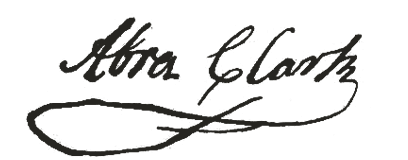
Clark's signature on the Declaration

(Dayton, 1737-1807, was a fellow Elizabeth native, a merchant, who rose to the rank of Brigadier General. His son, Jonathan, became the youngest signer of the Constitution of the United States.)

Clark remained in the Continental Congress through 1778, when he was elected as Essex County's Member of the New Jersey Legislative Council. He had 2 sons fighting in the war, and they were captured by the British, and incarcerated on the prison ship HMS Jersey, docked at Wallabout Bay, which later became the Brooklyn Navy Yard.

He served in Congress again from 1780 to 1783, and from 1786 to 1788. At the Annapolis Convention of 1786, Clark was one of New Jersey's 3 representatives, and formally motioned for the Constitutional Convention, although he was not a delegate to it.

He ran for the U.S. Senate for the 1st Congress in 1788, but lost. He ran for the U.S. House of Representatives for the 2nd Congress in 1790, and won. He was still serving when he died on September 15, 1794, in Rahway, New Jersey, at the age of 68.

He is buried at Rahway Cemetery. The adjoining Township of Clark is named for him, and so is Abraham Clark High School in the neighboring Borough of Roselle, where he lived. His original house burned down, but in 1941, a replica was built on the site, at 101 West 9th Avenue.