This Thursday night at 7:00, the New Jersey Devils play away to the Philadelphia Flyers.
There are a few teams that Devils fans don't like. The New York Islanders. The Boston Bruins. The Pittsburgh Penguins. The Washington Capitals. The Toronto Maple Leafs. The Ottawa Senators. The Los Angeles Kings.
But the only team, outside of the New York Rangers, a.k.a. The Scum, that we out-and-out hate is the Flyers, a.k.a. The Philth or Philthy.
This is due to factors that precede the Devils' very existence: In the 1970s, the Flyers were the Broad Street Bullies, their players taking cheap shots at their opponents, dropping the gloves to fight at the drop of a hat, and on occasion even going into the stands to fight opposing fans.
Their fans were no better, openly encouraging such behavior. All the time that the Flyers played at The Spectrum, from 1967 to 1996, they were among the nastiest creatures in the game. While things have been toned down a bit at the Wells Fargo Center, any visiting fan -- especially a Devils, Rangers, Islanders, Capitals, Bruins and above all a cross-Pennsylvania Penguins fan -- should be on his guard.
But that doesn't mean you can't go down and enjoy the experience. I have, a couple of times, and even came away with a win (once).
Before You Go. Philadelphia is just down the road, so it's in the Eastern Time Zone, and you don't have to worry about fiddling with various timepieces. And the weather will be almost identical to what you'd have on the same day in New Jersey or New York.
Still, check
the combined website for the Philadelphia newspapers, the
Inquirer and the
Daily News, before you head out. For the moment, it looks like, for next Thursday, temperatures in Philly will be in the high 40s at night. If you wear a Devils jersey to games, that should be enough. If you don't, a light jacket should suffice, and, of course, if it gets hot inside, you can remove it: Unlike at the Spectrum, you should have enough room for it under your seat. They're also predicting a 15 percent chance of rain, so you probably won't need an umbrella, which you couldn't bring into the arena anyway.
Tickets. The Flyers averaged 19,270 fans per home game last season -- that's nearly 99 percent of official capacity. So, yes, order your tickets ahead of time.
Lower level sections, the 100 Level, run $120 to $145 between the goals, and $107 to $136 behind them. Upper level sections, the 200 Level, run $52 to $120 throughout.
Getting There. It's 99 miles from Times Square in Manhattan to City Hall in Center City Philadelphia, and 90 miles from the Prudential Center in downtown Newark to the Wells Fargo Center in South Philadelphia.
This is close enough that a typical Devils fan could leave his house, drive to the Prudential Center, pick up some friends, head down to the WFC, watch a game, head back, drop his friends off, and and drive home, all within 7 hours. But it's also close enough that you could spend an entire day in Philadelphia, and, hopefully, you've already done this. Having done so many times myself, I can tell you that it's well worth it.
If you are driving, you’ll need to get on the New Jersey Turnpike. If you’re not "doing the city," but just going to the game, take the Turnpike's Exit 3 to NJ Route 168, which forms part of the Black Horse Pike, to Interstate 295. (The Black Horse Pike later becomes NJ Route 42, US Route 322 and US Route 40, going into Atlantic City. Not to be confused with the White Horse Pike, US Route 30, which also terminates in A.C.)
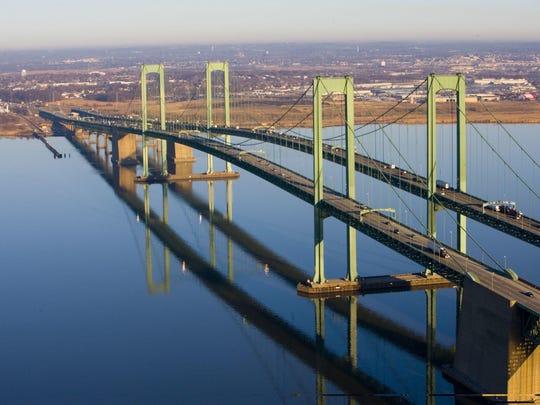
Take I-295 to Exit 26, which will get you onto Interstate 76 and the Walt Whitman Bridge into Philly. Signs for the ballpark will soon follow, and the park is at 11th Street and Pattison Avenue (though the mailing address is "1 Citizens Bank Way").
From anywhere in New York City, allow 2½ hours for the actual drive, though from North Jersey you might need only 2, and from Central Jersey an hour and a half might suffice. But you’ll need at least another half-hour to negotiate the last mile or so, including the parking lot itself.
If you don't want to drive, there are other options, but the best one is the train. Philadelphia is too close to fly, just as flying from New York (from JFK, LaGuardia or Newark) to Boston, Baltimore and Washington, once you factor in fooling around with everything you gotta do at each airport, doesn't really save you much time compared to driving, the bus or the train.
And I strongly recommend
not taking the bus. If you do, once you see Philadelphia's Greyhound terminal, at 10th & Filbert Streets in Center City, the nation's 2nd-busiest behind New York’s Port Authority Bus Terminal, you'll say to yourself, "I never thought I'd say this to myself, but thank God for Port Authority!"
The Philly terminal is a disgrace. I don't know how many people are in Atlantic City on an average summer day, when both the beaches and the casinos are full (I'm guessing about half a million, or one-third the size of Philly), but it has a permanent population of 40,000 people, compared to the 1.6 million of Philadelphia, and it has a bus station of roughly equal size and far greater cleanliness than Philly’s. Besides, Greyhound service out of Newark's Penn Station is very limited, and do you really want to go out of New Jersey into Manhattan just to get across New Jersey into Philadelphia?
If you can afford Amtrak, and that will be $110 round-trip between Newark and Philly, it takes about an hour and a half to get from Penn Station in downtown Newark to the 30th Street Station at 30th & Market Streets, just across the Schuylkill River from Center City. Unlike the dull post-1963 Penn Station, this building is an Art Deco masterpiece from 1933, and is the former corporate headquarters of the Pennsylvania Railroad. (Ironically, it never had the official name "Pennsylvania Station" or "Penn Station.") You might recognize its interior from the Eddie Murphy film
Trading Places. (If you can't afford Amtrak, or if you can but you’d rather save money, I’ll get to what to do in a minute.)
West front of 30th Street Station, with Center City in background
This is a 7:00 PM puck-drop, which should give you enough time to get from the sports complex back to 30th Street in time to catch the 10:28 PM
Palmetto back to Metropark or Newark. If not, the last train of the night from 30th Street to Newark Penn is a
Northeast Regional at 11:04 PM, and gets back at 12:10 AM.
Interior of 30th Street Station
From 30th Street Station, you can take a cab that will go down I-76, the Schuylkill Expressway, to I-95, the Delaware Expressway, to South Broad Street to the Sports Complex. I would advise against this, though: When I did this for a Yankees-Phillies Interleague game at the Vet in 1999, it was $15. It's probably $25 now.
Philadelphia and Toronto are the only 2 cities left on the North American continent, as far as I know, that still use tokens rather than farecards (or "MetroCards" as New York's MTA calls them) or tickets for their subways. One ride on a SEPTA subway train is $2.25, cheaper than New York's, but they don’t sell single tokens at booths. They come in packs of 2, 5 and 10, and these packs are damn hard to open. Two cost $3.60; five are $9.00, and a ten-pack costs $18.00. They are also available for bulk purchase.
From 30th Street, take the Market-Frankford Line to 15th Street (that's just one stop), where you’ll transfer to the Broad Street Line at City Hall Station. Being a Met fan, you’ll notice that the MFL’s standard color is blue, while the BSL’s is orange. Blue and orange. Don’t think that means they want to make Met, Knick or Islander fans feel at home, though.
From City Hall, if you're lucky, you’ll get an express train that will make just 2 stops, Walnut-Locust and AT&T (formerly "Pattison" -- yes, they sold naming rights to one of their most important subway stations). But you’ll want to save your luck for the game itself, so don't be too disappointed if you get a local, which will make 7 stops: Walnut-Locust, Lombard-South, Ellsworth-Federal, Tasker-Morris, Oregon, Snyder and AT&T. The local should take about 10 minutes, the express perhaps 7 minutes.
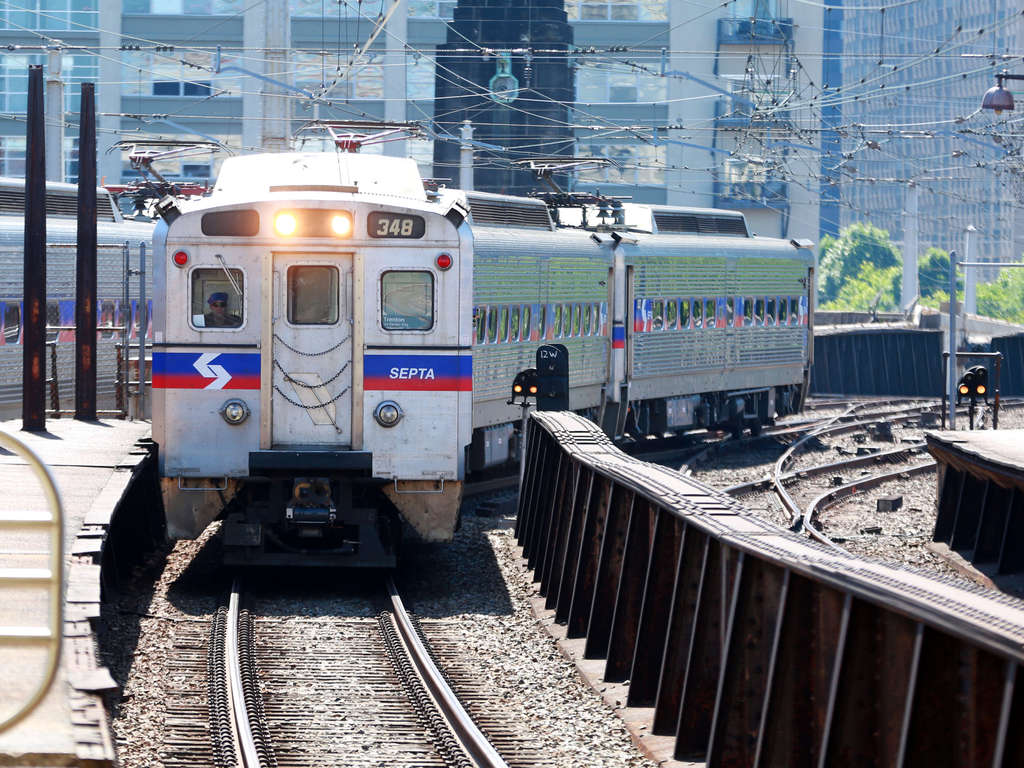
If you don’t want to take Amtrak, your other rail option is local. At Newark Penn, you can buy a combined New Jersey Transit/SEPTA ticket to get to Center City Philadelphia. Take NJT's Northeast Corridor Line out of Penn Station to the Trenton Transit Center. This station recently completed a renovation that has already turned it from an absolute hole (it was so bad, it made Philly’s bus station look like Grand Central) into a modern multimodal transport facility. At Trenton, transfer to the SEPTA commuter rail train that will terminate at Chestnut Hill East, and get off at Suburban Station, at 17th Street & John F. Kennedy Blvd. (which is what Filbert Street is called west of Broad Street). Getting off there, a pedestrian concourse will lead you to the City Hall station on the Broad Street Line, and then just take that to Pattison.

Because there will be a lot more stops than there are on Amtrak (especially the SEPTA part), it will take 2 hours and 10 minutes, but you’ll spend $43 round-trip, about what you'd spend on a same-day purchase on Greyhound, and less than half of what you'd be likely to spend on Amtrak. However, again, time will be an issue: The last SEPTA Trenton Line train of the night that will connect to an NJT train leaves Suburban Station at 11:57 PM (and the NJT train it will connect to won't get to Penn Station until 2:46 AM), so this might not be an option for you this time, either.
The subway’s cars are fairly recent, and don’t rattle much, although they can be unpleasant on the way back from the game, especially if it's a football game and they're rammed with about 100 Eagles fans who've spent the game sweating and boozing and are still loaded for bear for anyone from outside the Delaware Valley. It’s highly unlikely anyone will give you anything more than a little bit of verbal on the subway ride into the Sports Complex, while they might give a little more gusto to the verbal on the ride back. But despite Philly sports fans' reputation, this will not be the equivalent of the London Underground on a Saturday afternoon in the 1980s: They might tell you that your team sucks (even if your team is ahead of theirs in the standings), but that’s about the worst you’ll get.
Once In the City. Philadelphia is a Greek word meaning "brotherly love," a name given to it by its founder, William Penn, in 1683. So the city is nicknamed "The City of Brotherly Love." The actions and words of its sports fans suggest that this is ridiculous. Giants coach Bill Parcells was once caught on an NFL Films production, during a game with the Eagles at the Vet, saying to Lawrence Taylor, "You know, Lawrence, they call this 'the City of Brotherly Love,' but it's really a banana republic." And Emmitt Smith, who played for that other team Eagles fans love to hate, the Dallas Cowboys, also questioned the name: "They don't got no love for no brothers."
Center City, with the Ben Franklin Bridge in the foreground
On a map, it might look like Penn Square, surrounding City Hall, is the centerpoint, but this is just geographic, and only half-refers to addresses. Market Street is the difference between the north-south numbering on the numbered Streets. But the Delaware River is the start for the east-west streets, with Front Street taking the place of 1st Street. Broad Street, which intersects with Market at City Hall/Penn Square, takes the place of 14th Street.
In the Colonial and Revolutionary periods, Philadelphia was the largest city in America, before being overtaken by New York. As recently as 1970, it had about 2 million people. But "white flight" after the 1964 North Philadelphia riot led to the population dropping to just over 1.5 million in 2000. It has inched back upward since then. The metro area as a whole -- southeastern Pennsylvania, South Jersey and most of Delaware -- is about 7 million, making it the 6th-largest in the country, behind New York, Los Angeles, Chicago, San Francisco and Boston.
The sales tax is 6 percent in the Commonwealth of Pennsylvania (Massachusetts, Virginia and Kentucky are also "commonwealths" in their official State names), 8 percent within the City of Philadelphia.
Going In. The Philadelphia sports complex is at Broad Street and Pattison Avenue, about 3 1/2 miles south of Center City. It once included Sesquicentennial/Municipal/John F. Kennedy Stadium (1926-1992), The Spectrum (1967-2009), and Veterans Stadium (1971-2004). The arena now known as the Wells Fargo Center was built on the site of JFK Stadium. Citizens Bank Park, the new home of the Phillies, was built to the east of The Vet. And Lincoln Financial Field was built south of the new ballpark, and east of the Spectrum.
The Sports Complex, sometime between 1971 and 1992.
Top to bottom: The Vet, The Spectrum and JFK Stadium.
There is plenty of parking in the complex, including a lot on the site of The Vet. But you'll be a lot better off if you take the subway. Not really because of the price of parking: At $16, it's one of the cheaper fares in baseball. But traffic is going to be awful. The first time I went to a sporting event in Philadelphia, it was a 4th of July celebration at the Vet, and 58,000 people showed up to see the Phils face the Houston Astros, with Nolan Ryan pitching. The game and the fireworks combined did not last as long as it took to get out of the parking lot and onto the Walt Whitman Bridge: 2 hours and 40 minutes. Trust me: Take the freakin' subway.
Coming out of the AT&T subway station, you’ll walk down Pattison Avenue, with a parking lot on the former site of Veterans Stadium to your left, and the site of the Spectrum to your right.
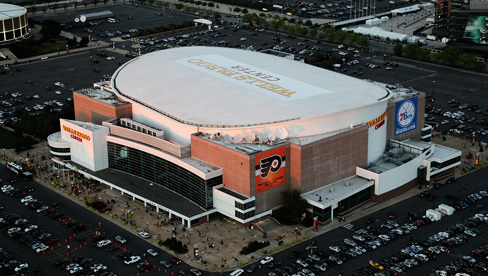
Further to your right is the successor to the Spectrum, the Wells Fargo Center, named for the banking and insurance company. This building is 19 years old and is now under its 5th name. The official address is 3601 S. Broad Street.
It was built on the site of John F. Kennedy Stadium, formerly Municipal Stadium, a 105,000-seat structure that hosted all kinds of events, from the Army-Navy Game to heavyweight title fights (Gene Tunney taking the title away from Jack Dempsey in 1926 and Rocky Marciano doing the same to Jersey Joe Walcott in 1952), from the occasional Eagles game that was too big for Shibe Park in the 1940s and ’50s to the U.S. half of Live Aid in 1985. And it hosted the Phils' victory celebration in 1980, with its huge capacity coming in handy. By that point, it was crumbling, and it surprised no one when it was demolished to make way for the new arena.
The new arena began as Spectrum II, then, as naming rights were sold and banks bought out other banks, it became the CoreStates Center, the First Union Center (Flyer fans liked calling it "The F.U. Center"), the Wachovia Center, and now the Wells Fargo Center. It is 1 of 10 arenas currently housing both an NBA team and an NHL team.
It was as the First Union Center that it hosted the 2000 Republican Convention, nominating George W. Bush for President; next July, presumably under the name Wells Fargo Center, it will host the 2016 Democratic Convention. (The Democrats
met at Convention Hall, now Boardwalk Hall, in Atlantic City in 1964. 2301
Boardwalk at Mississippi Avenue. Atlantic City Rail Line from 30th Street
Station.)
Villanova University also uses the arena for basketball games that have a ticket demand greater than their on-campus Pavilion can satisfy. And, like The Spectrum before it, it's hosted NCAA Tournament games, although it's now considered too small to host the Final Four, as The Spectrum did in 1976 and 1981 (with Indiana University winning both times).
The arena has also been home to Arena Football's Philadelphia Soul since 2004. They've been in 3 ArenaBowls, winning in 2008. The arena has not, however, hosted an ArenaBowl.
Inside the arena, concourses are wide and well-lit, a big departure from the Spectrum. Escalators are safe and nearly always work, as opposed to the Vet, which did not have escalators, only seemingly-endless ramps. Getting to your seat should be easy.
Yes, that's a lot of orange.
No, the Dutch soccer team doesn't play there.
The Flyers attack twice toward the south end of the arena.
Food. From the famed Old Original Bookbinder's (125 Walnut Street at 2nd, now closed) and Le Bec Fin (1523 Walnut at 16th) to the Reading Terminal Market (Philly's "South Street Seaport" at 51 N. 12th St at Filbert) to the South Philly cheesesteak giants Pat's, Geno's and Tony Luke’', Philly is a great food city and don't you ever forget it. The variety of food available at the Wells Fargo Center is unbelievable. Little of it is healthy (no surprise there), but all of it is good.
On the lower Main Concourse Level, the South Jersey restaurant chain P.J. Whelihan's has stands behind both goals. Tim Hortons, the Canadian doughnut chain founded by the Toronto Maple Leafs legend, has stands at all 4 corners. Chickie's & Pete's, whose main outlet is nearby at 1526 Packer Avenue (near the also-famed Celebre's Pizza), has stands on the west side and in the northeast corner, to sell their fish and their "crab fries" -- French fries with Old Bay seasoning mix, not fries with crabmeat. The northeast corner also has that wonderful junk food staple of Pennsylvania Dutch country (and the Jersey Shore), funnel cake. The legendary South Street pizzeria Lorenzo & Sons has stands on both the east and west sides. Each of these brands can also be found on the upper, Mezzanine Concourse Level.
Team History Displays. The banners honoring Flyer achievements are at the arena's north end; those for the 76ers, at the south end.
The Flyers hang banners for their 1973-74 and 1974-75 Stanley Cup wins (both banners displaying the seasons that way -- for the sub-Cup banners, I'll keep it simple); their 1975, 1976, 1977, 1980, 1985 and 1987 Prince of Wales Conference titles; their 1997 and 2010 Eastern Conference titles; and for their regular-season Division titles of 1968, 1974, 1975, 1976, 1977, 1980, 1983, 1985, 1986, 1987, 1995, 1996, 2000, 2002, 2004 and 2011.
(You're reading that right: In both 1995 and 2000, when the Devils won the Cup, and beat the Flyers in the Conference Finals both times, the Flyers won the Atlantic Division in the regular season.)
The Flyers have 5 numbers officially retired. In 2012, they retired the Number 2 of 1982-92 defenseman Mark Howe (Gordie's son, and a Hockey Hall-of-Famer in his own right). So far, he's the only Flyer retired number honoree who was not a member of their back-to-back 1970s Cups.
The 1st Flyer player to get his number retired was 1970-74 defenseman Barry Ashbee, Number 4. The 2nd, and the 1st Flyer player to get into the Hall of Fame, was Bernie Parent, goaltender 1967-79 (missing 1971-73 in the World Hockey Association). Unfortunately, both had their careers prematurely ended by eye injuries, in Ashbee's case against the Rangers during the 1974 Playoffs. He stayed on as an assistant coach, but died of leukemia in 1977. The other 2 are Captain Bobby Clarke, center, 1969-84 and their first genuine superstar; and Bill Barber, left wing, 1972-84.
Howe's 2 had yet to be retired when this photo was taken.
Two others should be mentioned. Pelle Lindbergh, goaltending hero of the 1985 Playoffs, was killed early the next season when he drove drunk coming home from a party in South Jersey and crashed into a school. His Number 31 has not been retired, but neither has it been given out since.
And Eric Lindros, controversially stripped of the Captaincy by then-GM Clarke and then had his Flyer career ended by Scott Stevens' shoulder in Game 7 of the 2000 Conference Finals, wore Number 88, and no Flyer has since. Since he represented the Flyers, not his next team the Rangers, in the Winter Classic Alumni Game at Citizens Bank Park on New Year's Eve 2011, before the Flyers-Rangers game the next day, it can be presumed that he and the Flyers have buried the hatchet.
It should be noted that Clarke is usually called "Bobby" when you refer to him as a player, and "Bob" when you refer to him as a coach and executive. Flyer fans still adore Bobby Clarke, but they didn't much like Bob Clarke, seeing him no longer as their guy, but as a stooge for ownership.
Alongside the 5 retired number banners in the rafters, the Flyers have 3 banners honoring 23 figures from team history in the Flyers Hall of Fame: Ed Snider, the only owner the team has ever had in its 48 years of existence; Cup-winning head coach Fred Shero and GM Keith Allen; longtime broadcaster Gene Hart; 1974 and '75 Cup-winning players Clarke, Parent, Barber, Ashbee, Rick MacLeish, Gary Dornhoefer, Reggie Leach, Joe Scott, Ed Van Impe, Joe Watson, Dave Poulin and Dave "the Hammer" Schultz; 1980s players Howe, Tim Kerr, Brian Propp and Ron Hextall; and 1990s players Lindros, John LeClair and Eric Desjardins.
Lindbergh has not yet been inducted, probably because they would have to explain to kids and victims of drunk driving why a drunk driver is in there. Which is probably also, along with his fraud conviction and imprisonment, why the Phillies haven't elected Lenny Dykstra -- who included Devils legend Ken Daneyko among those he defrauded -- to the Philadelphia Baseball Wall of Fame.
Clarke, Parent and Lindros were named to
The Hockey News' 100 Greatest Players in 1998.
There are also banners honoring music legends Bruce Springsteen and Billy Joel. Each has their number of sellout concerts in the city on his banner (all venues combined): Bruce, 53; Billy, 48. Although Bruce has a higher total, Billy holds the sellout record at the WFC: 18. (The Grateful Dead had the most sellouts at the Spectrum, but there is nothing reflecting this at the WFC.)
On the lower concourse, the Flyers also have displays honoring the history of the team, including a tribute to the 1974 and 1975 Cup winners. I have never been to a 76ers game there, so I don't know if they have a similar display when they play, but if they do, it wasn't shown during my Devils-Flyers visits.
There were 4 statues outside The Spectrum. One was of Sylvester Stallone in character as Rocky Balboa. That one has been moved, appropriately enough, to the Philadelphia Museum of Art, not far from the steps he ran up in every movie. One was for Julius "Dr. J" Erving of the 76ers. The other 2 were for the Flyers. One was titled "Score!" depicting Gary Dornhoefer's overtime goal against the Minnesota North Stars in the 1973 Playoffs. It bears a striking resemblance to Bobby Orr's "Flying Goal" that wont the 1970 Stanley Cup for the Boston Bruins.
"Score!" This was taken outside The Spectrum.
Another was for Kate Smith, whose recording of "God Bless America," played in place of "The Star-Spangled Banner," was a good luck charm for the Flyers, to the point where she was invited to sing it live before Game 6 of the 1974 Stanley Cup Finals, which they won for their 1st title.
The Dr. J, Score! and Kate Smith statues have been moved to Xfinity Live! on the site of The Spectrum. A statue of Fred Shero has since been added. Outside the Wells Fargo Center, a statue has been added for Wilt Chamberlain, who played for the Warriors and the 76ers.
Clarke played on the Team Canada that beat the Soviet Union in the 1972 "Summit Series." But no member of the Gold Medal-winning 1980 U.S. Olympic team ever played for the Flyers.
Stuff. The Flyers have a team store, run by Forty Seven Brand ('47), in the northwest corner of the lower concourse, which is also open on non-game days.
You might expect to see DVDs in the store, including
NHL History of the Philadelphia Flyers, taking the team from its 1967 beginning to its 40th Anniversary in 2007; and the
Philadelphia Flyers 10 Greatest Games set. Based on a fans' vote, they are shown from 10th through 1st.
I'll list them chronologically: Clarke's overtime winner taking Game 2 of the 1974 Stanley Cup Finals, The Cup clinchers of 1974 and 1975, the 1976 win over the Soviet Red Army, the 1979 win in Boston that gave them an NHL record of 29 straight games unbeaten (they extended it to 35), Kerr scoring 4 goals in 1 period against the Rangers at the Garden in the 1985 Playoffs, J.J. Daigneault winning Game 6 of the 1987 Finals in overtime against the Edmonton Oilers, Keith Primeau scoring to win the 5-overtime epic with Pittsburgh in the 2000 Playoffs, Jeremy Roenick scoring in overtime to win a 2004 Playoff series against the Toronto Maple Leafs, and Game 6 of that year's Conference Finals against the Tampa Bay Lightning (though the Bolts won Game 7).
What you might not expect to find in a Flyers team store is books. I'm not suggesting that Flyer fans are illiterate...
In 2000, Philly-based sportswriter Jay Greenberg published
Full Spectrum: The Complete History of the Philadelphia Flyers Hockey Club. But if you really want to get a feel for Philly sports, get these 3, all co-written by WIP host Glen Macnow with one of his colleagues:
The Great Philadelphia Fan Book with Anthony Gargano,
The Great Philadelphia Sports Debate with Angelo Cataldi (who is Philly's answer to Mike & the Mad Dog, all in one guy), and
The Great Book of Philadelphia Sports Lists, with Ed Gudonis, a.k.a. Big Daddy Graham, also a Philly and Jersey Shore-based standup comic and a great guy who writes a regular column for
Philadelphia magazine.
During the Game. A
November 19, 2014 article on The Hockey
News' website ranked the
NHL teams' fan bases, and listed the Flyers' fans 6th, 2nd among U.S.-based teams behind Chicago: "Attendance holds steady even when Flyers have the odd down season."
Unlike most venues in North American sports, a Flyers home game -- and an Eagles home game, but not so much the Phillies and 76ers -- carries with it the specter of fan violence. For the most part, Flyer fans might give you some verbal abuse, but very few with take to the level of violence, even when drunk.
Besides, in spite of 1995 and 2000,
they hate the Penguins more than the Devils.
The best thing to keep in mind if you're a visiting fan, especially if you're wearing team gear, is to not instigate anything. And
definitely don't chant, "Rangers suck! Flyers swallow!"
The Flyers have a choice of pregame patriotic songs: Either they'll go with Kate Smith's recording of "God Bless America," or the National Anthem will be sung by Lauren Hart, recording artist and daughter of the late Hall of Fame broadcaster Gene Hart. Their goal song is "Booyah" by Showtek, replacing "My Songs Know What You Did In the Dark" by Fall Out Boy, which was
not popular among Flyer fans.
The Flyers do not have a mascot. They briefly had a creature named Slapshot in 1976, but the fans did not take to it, and he was withdrawn before the next season began.
The "Let's go" chant is different from those used by all 3 New York Tri-State Area teams: Instead of hitting the 1st and 3rd syllables, as in, "LET'S go, DEV-ils!" they hit the1st and 4th: "LET'S go, Fly-ERS!" It's a little weird the first time you hear it. It's also a little weird every time you hear it thereafter.
This game will be a Dollar Dog Night, sponsored by the Flyers' hot dog maker, Dietz & Watson.
After the Game. Philadelphia is a big city, with all the difficulties of big cities as well as many of the perks of them. Especially at night, the risk of Flyer fans getting rough increases, as they’ve had time to drink, but not by much. Again, don't antagonize them, especially if the Devils win, and you'll probably be okay.
What you should do at the end of the game depends on what time it is and how you got there. If you took the train(s) down, you shouldn’t have too much trouble getting back onto the subway, and to Suburban Station, in time to catch the 10:45 PM SEPTA train back to Trenton, which will allow you to get the 12:10 AM NJ Transit train back to New York, arriving at Penn Station at 1:35 AM. If, for whatever reason (extra innings, you stopped somewhere along the way, something else), you end up missing this train, there will be another an hour later, but the NJT train it connects to at Trenton at will be the last train of the night.
If you drove down, and you want to stop off for a late dinner and/or drinks (except, of course, for the designated driver), the nearby Holiday Inn at 9th Street & Packer Avenue has a bar that is co-owned by former Eagles quarterback, now ESPN pundit, Ron Jaworski. As I mentioned earlier, the original outlet of Chickie’s & Pete’s is at 15th & Packer. Right next to it is a celebrated joint, named, appropriately enough, Celebre Pizzeria.
(The legend is true: Richie Ashburn and his broadcast partners, Harry Kalas, Chris Wheeler and Andy Musser mentioned their great-tasting pizzas on the air so often that, since Phils broadcasts were then sponsored by a pizzeria chain, they couldn't mention Celebre’s anymore. So, just as Ashburn's New York counterpart, Phil Rizzuto, liked to mention birthdays and food, especially Italian food, on the air, "Whitey" rattled off a few birthday wishes, and said, "And I'd like to wish a Happy Birthday to the Celebre's twins, Plain and Pepperoni! Say, Wheels, how old are Plain and Pepperoni?" And Wheeler said, "Oh, about 20 minutes, I hope!" Sure enough, 20 minutes later, the delivery of the 2 pizzas was made. And nobody fired Richie Ashburn -- although he died from a diabetes-induced heart attack in 1997, and his eyesight was already getting bad enough that he was getting pressured to retire, and was considering it. He died at the Grand Hyatt adjacent to Grand Central, during a Phils roadtrip to play the Mets -- and he wasn't alone as initially reported: He had his mistress with him.)
The legendary Pat's and Geno's Steaks, arch-rivals as intense as any local sports opponents, are across 9th Street from each other at Passyunk Avenue in the Italian Market area. My preference is Pat's, but Geno's is also very good. Be advised, though, that the lines at both are of Shake Shack length, because people know they're that good. Also, Pat's was "the original Soup Nazi": You have to have your cash ready, and you have to quickly order your topping, your style of cheese, and either "wit" or "widdout" -- with or without onions. I haven't been there in a while, but I've been there often enough that I have a "usual": "Mushroom, whiz, wit." Both Pat's and Geno's are open 24 hours, but, because of the length of the line, unless you drove down to the game, I would recommend not going there after the game, only before (if you can make time for it). Broad Street Line to Ellsworth-Federal, then 5 blocks east on Federal, and 1 block south on 9th.
There is one place I know of in Philadelphia that caters to New York fans: The Tavern on Broad, at 200 S. Broad Street at Walnut, seems to be the headquarters of the local Giants fan club. The Fox & Hound, at 1501 Spruce Street in Center City, is also said to be accommodating to Giants fans. Jet fans are said to be welcome at Revolution House, at 200 Market Stret in Old City.
A particular favorite restaurant of mine is the New Deck Tavern, at 3408 Sansom Street in University City, on the Penn campus. You can also pick up a sandwich, a snack or a drink at any of several Wawa stores in and around the city. If you came in via Suburban Station, there's one at 1707 Arch, a 5-minute walk away; if the game lasts 3 hours or less, you have a shot at getting in, getting your order, getting out, and getting back to the station in time to catch your train.
If your visit to Philly is during the European soccer season (which is in progress), you can probably watch
your favorite club at Fadó Irish Pub, at 1500 Locust Street in Center City. Be advised that this is home to supporters' groups for Manchester United, Liverpool, Tottenham Hotspur and Celtic FC; so if you're not particularly fond of any of those teams, you might want to stay away.
Sidelights. The Philadelphia sports complex once included 3 buildings that have all been replaced and demolished: From north to south, the Vet, the Spectrum and JFK Stadium. The arena now known as the Wells Fargo Center was built on the site of JFK Stadium. Citizens Bank Park, the new home of the Phillies, was built to the east of The Vet. And Lincoln Financial Field was built south of the new ballpark, and east of the Spectrum.
* Sesquicentennial/Municipal/JFK Stadium. Built in 1926 for a 150th Anniversary (Sesquicentennial of American independence) world's fair in Philadelphia, this 105,000-seat horseshoe (open at the north end) was designed for football, but one of its earliest events was a fight for the Heavyweight Championship of the World. For the 1st time, that title changed hands on a decision, rather than on a knockout. But Gene Tunney so decisively outfought champion Jack Dempsey that no one disputed it. (When they had their rematch a year later, at Soldier Field in Chicago, that was another story.)
The stadium was renamed Municipal Stadium in 1931 (sometimes it was called simply Philadelphia Stadium), and, due to being (roughly) halfway between the service academies, became the site of the Army-Navy Game from 1936 to 1941, and again from 1945 to 1979, before it was moved to The Vet.
The Eagles played home games there from 1936 to 1939, and select games thereafter, including the 1950 season opener that was, as soccer fans would call it, a "Charity Shield" game: The 2-time defending NFL Champion Eagles vs. the Cleveland Browns, 4-time titlists in the All-America Football Conference. The Browns were 47-4-3 over the AAFC's 4-season history; the Eagles, 22-3-1 over the last 2 years, thanks to a 5-2 alignment that was the 1st defensive unit to have a memorable nickname: Before San Diego and Los Angeles had a Fearsome Foursome, Philly had a Suicide Seven.
Some people then called it "The Game of the Century," and some now think of as an unofficial "first Super Bowl" -- ironic, since neither team has won an NFL Championship in the Super Bowl era, and the Browns haven't even been to a Super Bowl yet. Playing on a Saturday night -- making it, sort of, not just "the 1st Super Bowl" but "the 1st Monday Night Football game" -- in front of 71,237 fans, still the largest crowd ever to watch a football game in Philadelphia (and nearly double the capacity of Shibe Park, which really limited the Eagles' attendance), the Browns beat the Eagles 35-10, stunning football fans all over the nation. The Eagles never recovered, while the Browns won the NFL title that year, and appeared in 7 title games in 8 years, winning 3.
In 1964, Municipal Stadium was renamed John F. Kennedy Stadium. On August 16, 1966, the Beatles played there. On July 13, 1985, it hosted the American end of Live Aid. But that show exposed to the world that it already falling apart. The Rolling Stones, who had packed the place on their 1981
Tattoo You tour, chose the considerably smaller Vet for
Steel Wheels in 1989. It was demolished in 1992, and the new arena opened on the site in 1996.
* The Spectrum. This modern (for its time) arena opened in 1967, and 2 teams at the opposite ends of the competitive, uh, spectrum moved in: The 76ers, the NBA's defending Champions; and the Flyers, an NHL expansion team. Although the Flyers won inspirational (and confrontational) Stanley Cups in 1974 and '75, they also lost in the Finals in 1976, '80, '85 and '87. And while the Sixers won the 1983 NBA title in a dominating season-long performance, they also lost in the Finals in 1977, '80 and '82, and were lost after a couple of puzzling Draft Day trades in 1986.
The Spectrum hosted the NCAA Final Four in 1976 and 1981, both times won by Bobby Knight's Indiana. Since 1976 was the Bicentennial year, it also hosted the NBA and NHL All-Star Games. The Vet also hosted baseball's All-Star Game that year. And the Spectrum was the site of both fights between Philly native Rocky Balboa and Apollo Creed, the former in the first
Rocky, on New Year's Day 1976, and the latter in
Rocky II, on Thanksgiving of that year. (All the movies' fights were actually filmed at the Los Angeles Sports Arena, due to its proximity to Hollywood.)
The Spectrum was also a big arena for college basketball: Villanova used it for home games that were too big for its on-campus Pavilion, the Atlantic 10 Conference used it for its tournament, and it hosted NCAA Tournament games at the sub-Final Four level, including the 1992 thriller that put Duke into the Final Four at Kentucky's expense, thanks to the last-second shot of Christian Laettner. The first rock concert there was by Cream, on their 1968 farewell tour. The last, and the last public event there, was by Pearl Jam in 2009.
Elvis Presley sang at The Spectrum on November 8, 1971; June 23, 1974 (2 shows), June 28, 1976; and May 28 1977.
The Spectrum became, in the words of its promoters, "America's Showplace" and the most-used sports arena in the world. This was a blessing and a curse: They could make a lot of money off of it, but it was limited. So Spectacor, the company that owned the Spectrum and the Sixers, built Spectrum II -- which, in a series of naming-rights changes due to bigger banks swallowing old ones, became the CoreStates Center, the First Union Center (Flyer fans loved calling it "the F.U. Center"), the Wachovia Center and now the Wells Fargo Center.

From 1996 to 2009, the arenas stood side-by-side. The main Spectrum tenants said goodbye as follows: The Flyers with an exhibition game on September 27, 2008, with all their former Captains on hand, as the Fly Guys beat the Carolina Hurricanes 4-2; Villanova with the building's last college basketball game on January 28, 2009, a win over the University of Pittsburgh; and on March 13, 2009, the Sixers beat the Chicago Bulls 104-101 in a special regular-season game.
The Spectrum was demolished the next year, and replaced in part with a live concert venue called "Xfinity Live!" (Yes, the exclamation point is included in the official name.) This structure now hosts the statues that were outside the Spectrum. A hotel is planned for the rest of the Spectrum site.
* Veterans Stadium. When it opened on April 10, 1971, it was considered state of the art and wonderful. And, as the Phillies had a great team from 1976 to 1983, reaching 6 postseasons in 8 years, winning 2 Pennants and the 1980 World Series, it became beloved by Phils fans. The Eagles, too, had a resurgence in the late 1970s, and hosted and won the 1980 NFC Championship Game. The Vet was seen as everything that Connie Mack Stadium was not: New instead of old, in good shape instead of falling apart, in a safe place instead of a ghetto (unless you were a New York Giants or Dallas Cowboys fan), and representative of victory instead of defeat.
The Eagles had a down period in the mid-1980s, but rebounded toward the end of the decade. But the Phils had collapsed, and the Vet's faults began to be seen: It was ugly, the sight lines were bad for baseball, and the turf was bad for everything, from eyes to knees. By the time the Phils won the Pennant in 1993, Camden Yards had opened just down the road in Baltimore, and suddenly everyone wanted a "retro park," and no one wanted a "cookie-cutter stadium."
It took a few more years, and a lot of complaints from opposing NFL players that the stadium was deteriorating and the turf was dangerous, for a new stadium to be approved. The Eagles closed the Vet out with a shocking and devastating loss to the Tampa Bay Buccaneers in the 2002 NFC Championship Game, and the Phils did so with a loss to the Atlanta Braves on September 28, 2003. The Eagles had already moved into their new stadium by that point, and the Phils moved into theirs the next April, a few days after the Vet's demolition. The baseball and football sculptures that were outside have been placed on Pattison Avenue, in front of the parking lot where the Vet once stood.
The Vet hosted the Army-Navy Game every year from 1980 to 2001, except for 1983, 1989, 1993, 1997 and 2000. (The 1983 game was played at the Rose Bowl, the 2000 game at the new Ravens' stadium in Baltimore, and the rest, as well as the 2002 game, at the Meadowlands.) Various pro soccer teams, including the North American Soccer League's Philadelphia Atoms, also played there.
* Citizens Bank Park. It opened in 2004, and the Phils were in the Playoff race until September that year. In 2005 and '06, they were in it until the last weekend. In 2007, they won the Division. In 2008, they won the World Series. In 2009, they won another Pennant. In 2010 and '11, they won the Division -- 5 straight Playoff berths, and 8 seasons in the ballpark with all good-to-great seasons. Only in 2012, when injuries flurried in and the team suddenly seemed to get old all at once, did the bad times return.
Baker Bowl was a dump. Shibe Park/Connie Mack Stadium was already neglected due to Mack's strapped finances by the time the Phils arrived, and by the time they left the neighborhood was a ghastly ghetto. The Vet was a football stadium. CBP is a
ballpark, and a great one. (Okay, on January 2, 2012, it was a hockey rink. To make matters worse, the Flyers lost to the one team I would want them to beat, the Rangers.)
"The Bank" has statues of Phils greats like Richie Ashburn and Mike Schmidt, great food like Greg Luzinski's Bull's Barbecue, and lots and lots of souvenirs, some of which
don't involve the Phillie Phanatic. And, with the Phils now being terrible, tickets are easier to get.
* Lincoln Financial Field. The new home of the Eagles has seen them make the Playoffs more often than not, and reach the Super Bowl in the 2004 season. And fan behavior, while still rowdy, is not as criminal as it was at The Vet: No more municipal court under the stands is necessary.
"The Linc" has hosted the Army-Navy Game every year since it opened, except for 2007 and 2011. It will also not host it this year or in 2016, as Baltimore will on those occasions. It's hosted 3 games of the U.S. National Soccer Team, games of the 2003 Women's World Cup, an MLS All-Star Game, and several games by touring European teams such as Manchester United, Glasgow Celtic and A.C. Milan.
If you drove down, or you came by train early on Saturday and have the whole day to yourself before a 7:05 gametime, in addition to the other stadiums and arenas at the Sports Complex, there are lots of interesting locations for you to check out. Remember that, although the city's centerpoint is technically Broad & Market Streets, where City Hall is, the numbering of north-south streets starts at the Delaware River, so that Broad takes the place of 14th Street.
* Deliverance Evangelistic Church. This was the site of Shibe Park, renamed Connie Mack Stadium in 1952. This is where the A's played from 1909 to 1954, the Phils from 1938 to 1970, and the Eagles in 1940, and from 1942 to 1957. The A's played World Series there in 1910, '11, '12, '13, '14, '29, '30 and '31, and the Phils (against the Yanks) in '50.
The Eagles played and won the 1948 NFL Championship Game there, beating the Chicago Cardinals 7-0 in a snowstorm, and also won the NFL title in '49 (though the title game was played in Los Angeles against the Rams). The Frankford Yellow Jackets sometimes used it in the 1920s, winning the 1926 NFL Championship. On October 14, 1948, shortly after Israel declared its independence, its national soccer team faced the U.S. at Shibe Park, shortly after doing so at Yankee Stadium. These were Israel's 1st 2 matches, and the U.S. won them both.
Be advised, though, that this is North Philly, and the church is easily the nicest building for several blocks around. Across the street is Dobbins Tech, a high school known for its great basketball program. (Remember the story of Hank Gathers and Bo Kimble? They went to Dobbins. So did Dawn Staley.) 21st Street & Lehigh Avenue. By subway, use the North Philadelphia station on the Broad Street Line, and walk 7 blocks west on Lehigh.
* Site of Baker Bowl. This was where the Phils played from 1887 to 1938, and the Eagles from 1933 to 1943 (though sometimes moving to Municipal Stadium, the one renamed for JFK). The Phils won one Pennant there, in 1915. It was also the Eagles' 1st home, in the 1933, '34 and '35 seasons.
Southwest corner of Broad Street and Lehigh Avenue, 8 blocks east of the Connie Mack Stadium site. Same subway stop as Shibe/Connie Mack. The A's original home, Columbia Park, is at 29th Street & Columbia Avenue, but I wouldn't recommend going there. If you're going to any of these, do it in daylight.
* The Palestra. Built in 1927, this is the arena aptly nicknamed the Cathedral of Basketball. It even has stained-glass windows. (I swear, I am not making that up.) The home gymnasium of the University of Pennsylvania (or just "Penn"), it also hosts some games of Philly's informal "Big 5" basketball programs when they play each other: Penn, Temple, La Salle, St. Joseph's and Villanova.
Penn, a member of the Ivy League, has one of the nicest college campuses anywhere, but do not be fooled by its Ivyness: In Philadelphia, even the Ivy Leaguers are tough. 235 South 33rd Street. Take the "Subway-Surface Line" trolley, either the Number 11, 13, 34 or 36, to the 33rd Street stop.
As I said, Philadelphia has hosted 2 NCAA Final Fours, both at the Spectrum. 'Nova has made it 4 times: 1939, 1971, 1985 and 2009. La Salle made it in back-to-back years, 1954 and 1955. Temple made it in 1956 and 1958, although never under legendary coach John Chaney. St. Joe's made it in 1961, and just missed in 2004. Penn made it in 1979, under future Detroit Pistons coach Chuck Daly. Temple won the NIT in 1938, but the only Philly-based National Champions under the NCAA banner (which began in 1939) are La Salle in 1954 and 'Nova in 1985.
* Franklin Field, right next to the Palestra. The oldest continuously-used college football site, the Penn Quakers have played here since 1895 (which is also when the Penn Relay Carnival, the nation's premier track-and-field event, began), and in the current stadium since 1922. That year, it supposedly hosted the first football game ever broadcast on radio (a claim the University of Pittsburgh disputes), and in 1939 it supposedly hosted the first football game ever televised (a claim New York’s Columbia University disputes). The amazing building in the west end zone is the University administration building.
The original Franklin Field was the 1st midpoint/neutral site game for Army vs. Navy: 1899 to 1904, 1906 to 1912, and 1914. The current structure hosted it in 1922, and 1932 to 1935, before it was moved to Municipal/JFK Stadium.
The Eagles played here from 1958 to 1970, including their last NFL Championship, December 26, 1960, beating the Green Bay Packers in a thriller, 17-13. Half a century. Penn’s football team has been considerably more successful, having won 14 Ivy League titles since the league was formally founded in 1955.
Like the Palestra, the stadium at Franklin Field is in surprisingly good shape (must be all those Penn/Wharton Business School grads donating for its upkeep), although the playing field has been artificial turf since 1969. Same trolley stop as the Palestra.
* Site of the Philadelphia Civic Center. This complex included the Convention Hall, where Franklin D. Roosevelt was nominated for President by the Democrats in 1936, Wendell Willkie by the Republicans in 1940 and both Harry Truman and Thomas E. Dewey were nominated in 1948 – that year’s Republican Convention being the first televised convention. It was built on the site of the Exposition Auditorium, where the Republicans renominated William McKinley in 1900.
(The Democrats met in Atlantic City at the Convention Hall, now named Boardwalk Hall, in 1964, nominating Lyndon Johnson. 2301 Boardwalk at Mississippi Avenue. New Jersey Transit Atlantic City Line from 30th Street Station. The Beatles played there a few days before.)
The Beatles played here on September 2, 1964. Pope John Paul II said Mass here. The Philadelphia Warriors played here from 1952 to 1962, when they moved to San Francisco (and now the "Golden State Warriors" play in Oakland), and the 76ers from 1963 until the Spectrum opened in 1967. Titles were won here by the 1956 Warriors and the 1967 76ers. The Philadelphia Blazers played the 1st World Hockey Association season here, 1972-73, but were terrible, and with the Flyers on the way up, nobody wanted to see the WHA team. They moved to Vancouver the next season.
So many Philly area greats played here, in high school, college and the pros, but you need know one name -- pardon the pun -- above all others: Wilt Chamberlain. I saw a concert here in 1989, and the acoustics were phenomenal, with a horseshoe of seats and a stage at one end, much like Boardwalk Hall in Atlantic City and the building once known as the Baltimore Civic Center.
Built in 1931, it was demolished in 2005 to make way for the Perelman Center for Advanced Medicine. an addition to the University of Pennsylvania Hospital. 34th Street & Civic Center Boulevard. Same stop as the Palestra and Franklin Field, which are a block away.
* Site of Philadelphia Arena. Built in 1920, this was the first home of the NBA's Warriors from 1946 to 1952, and site of some 76ers home games as well. It seated only 6,500 at its peak, so the Civic Center and later the Spectrum were preferable.
The Arena made its name hosting college hockey: Penn playing there was understandable, but, at the time, Princeton and even faraway Yale did not have their own rinks, and used the Arena as home ice.
The worst team in NHL history played there: The 1930-31 Philadelphia Quakers. After 5 seasons as the Pittsburgh Pirates, they clowned their way to a record of 4 wins, 40 losses and 4 ties, making them about as bad as the worst team in NBA history, the 1972-73 76ers (9-73). They were strapped during this 2nd indoor sports season of the Great Depression, and went out of business thereafter. Although several minor-league teams would play at the Arena -- the Arrows, the Comets, the Ramblers, the Falcons and the Rockets -- it would not be until 1967, with the opening of the Spectrum and the beginning of the Flyers, that Philly would have another NHL team.
Baseball pitcher-turned-evangelist Billy Sunday delivered sermons there in the 1920s,, and Charles Lindbergh used it for an America First speech in 1940. Early in his career, Elvis sang at the Arena on back-to-back days, doing 2 shows each on April 5 and 6, 1957.
Philly's ABC affiliate, Channel 6, formerly WFIL and now WPVI, built its studio next-door. It still stands. The Arena does not: It caught fire on August 24, 1983, and had to be demolished. A housing project is on the site today. 4530 Market Street. Market Street Line to 46th Street.
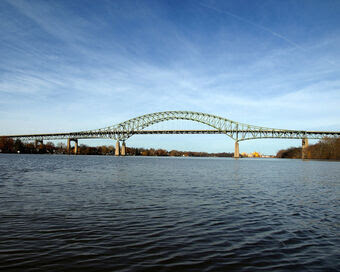
* Talen Energy Stadium. Built in 2010 for the expansion Philadelphia Union of Major League Soccer, and named PPL Park until last year when PPL was bought by Talen Energy, it seats 18,500 people, on the bank of the Delaware River in Chester, under the Commodore Barry Bridge (U.S. Route 222), linking it with Gloucester County, New Jersey.
The main supporters' section is called the River End, and is home to The Sons of Ben. The group named themselves after Benjamin Franklin, and they created an alternate logo for the team, showing a skull, with a Liberty Bell-style crack in it, wearing Franklin's hairstyle and bifocals, on a kite-shaped background. Of course, fans of the rival New York Red Bulls and D.C. United tend to call them The Daughters of Betsy -- after Ross. The U.S. national team played Colombia there on October 12, 2010, but lost.
1 Stadium Drive, in Chester. SEPTA Wilmington/Newark Line train to the Chester Transportation Center, then shuttle buses leaving every 20 minutes will take you to the stadium. If you're only going for a visit, not a game when there would be plenty of police protection, do not visit at night: Chester can be a dangerous city.
* Site of Frankford Stadium. Philadelphia's 1st pro football team was the Frankford Yellow Jackets, who played at Frankford Stadium in Northeast Philly from 1924 to 1930, winning the 1926 NFL Championship, before a fire on the eve of the 1931 season forced them into Baker Bowl and then into folding.
The stadium was on a plot bounded by Frankford Avenue, Devereaux Avenue, Hawthorne Street and Benner Street. An AutoZone (at 6137 Frankford) and rowhouses are on the site now. Market-Frankford Line to Frankford Transportation Center, then transfer to SEPTA Bus 66 Frankford & Harbison Avenues.
In addition to the Yellow Jackets, another ill-fated team played in Eastern Pennsylvania in the NFL's early days. The Pottsville Maroons played at the 5,000-seat Minersville Park, at the intersection of Sunbury Road and Prison Road, 106 miles northwest of Philly, from 1920 to 1928. They claimed the 1925 NFL Championship, but may have been "robbed" of the title.
* Site of Broadwood Hotel. From 1924 to 1991, this hotel stood at the intersection of Broad and Wood Streets, just north of Center City. From 1924 to 1946, its ballroom was the home of the Philadelphia SPHAs -- a basketball team run by the South Philadelphia Hebrew Association, even though it wasn't in South Philly. This team would evolve into the Warriors. A parking deck for Hahnemann University Hospital is on the site now. Broad Street Line to Race-Vine.
* Site of Cherry Hill Arena. Before the Devils, the 1st hockey team with major league pretensions to call New Jersey home was actually in South Jersey. In the 1973-74 World Hockey Association season, the former New York Raiders set up shop at the Cherry Hill Arena in Bergen County, and renamed themselves the Jersey Knights.
The building went up in 1959 as the Ice House, and was later renamed the Delaware Valley Gardens before assuming its most familiar name, but no one was confusing it with Madison Square Garden (old or new), the Boston Garden or Maple Leaf Gardens in Toronto. Sports Illustrated called it "perhaps the worst facility" used by any WHA team, noting that it lacked showers in the dressing room for visiting teams, who had to dress at a Holiday Inn 2 miles away, and that the ice surface was not even level, giving the home team a distinct advantage, as, 2 periods out of every 3, the visitors would have to skate uphill to the opponent's goal.
The Eastern Hockey League placed 2 teams there: The Jersey Larks in 1960-61, and the Jersey Devils (the 1st pro hockey team with the name) from 1964 until 1973, when the arrival of the Knights forced their move. The Philadelphia Warriors played an occasional "home game" there.
The Knights left for San Diego after the 1973-74 season. In 1978, the Arena was renamed The Centrum, and the Northeastern Hockey League placed the Jersey Aces there, but they only lasted a few games. The Arena was demolished in 1981.
The site is now a parking lot for a shopping center that includes a Burger King and a Retro Fitness. 1447 Brace Road, at Haddonfield-Berlin Road. Not easy to reach by public transit: PATCO train to Haddonfield, then almost a half-hour walk.
* Temple University. Straddling the border between Center City and the mostly-black North Philadelphia ghetto, Temple has given thousands of poor urban kids a chance to make something of themselves, including comedian Bill Cosby, who ran track for the school, including in the Penn Relays at Franklin Field.
Temple now plays basketball at the Liacouras Center, at 1776 N. Broad Street, across from its former arena, McGonigle Hall, at 1800. Broad Street Line to Cecil B. Moore station.
The Owls have played football at the South Philly complex since 1978, first at The Vet and now at the Linc. From 1928 to 1977, they played at Temple Stadium, a 20,000-seat facility on the city's northern edge. On September 25, 1968, the U.S. soccer team played Israel to a draw there. It was demolished in 1996, and, like Shibe Park/Connie Mack Stadium, the site is now home to a church. 2800 Pickering Avenue at Vernon Road. Broad Street Line to Olney Transportation Center, then transfer to the Number 18 bus toward Cedarbook Mall.
* LaSalle University. All of Philly's Big 5 basketball universities are private; unlike Penn and Temple, La Salle, St. Joe's and 'Nova are Catholic. LaSalle is in the northernmost reaches of the city, its bookstore at 1900 W. Olney Avenue, and the Explorers' new Tom Gola Arena, named for their late 1950s superstar and 1960s coach, and 2100 W. Olney. Broad Street Line to Olney Transportation Center.
* St. Joseph's University. St. Joe's straddles the western edge of the city, on a hill bisected by City Line Avenue. They are known for their Hawk mascot flapping his wings throughout the game, never stopping, thus leading to the chant, "The Hawk will never die!" This, of course, leads their Big 5 opponents to chant, "The Hawk must die!" and, if victorious, "The Hawk is dead!"
Their fieldhouse, now named the Michael J. Hagan Arena, is at 2450 N. 54th Street, and features a plaque commemorating a 1967 speech delivered there by Martin Luther King. Number 44 bus from Center City.
* Villanova University. The Wildcats just won their 2nd National Championship, defeating North Carolina in a thriller in Houston, 31 years after their even more amazing upset of Georgetown in Lexington, Kentucky.
Famously (well, famous within the Philadelphia area, anyway), they played a Big 5 game against St. Joe's at the Palestra a few years back, having beaten each of the other Big 5 schools, and, pulling away, their fans chanted, "We own Philly!" The St. Joe's fans, no fools, reminded them of their location, in the town of Villanova, 18 miles northwest of Center City: "You ain't Philly!"
Jake Nevin Field House, their home at the time of their 1985 National Championship, and The Pavilion, which that success allowed them to build, are next to each other, along with their bookstore, at 800 E. Lancaster Avenue. They also have a 12,500-seat stadium for their Division I-AA football team. SEPTA Lansdale/Doylestown Line to Villanova Station.
Of the Big 5, only Temple plays Division I-A football: Temple, 'Nova and LaSalle play I-AA, and while St. Joseph's Prep has one of the better programs in Philly-area high school football, their collegiate namesake doesn't play football at all.
* Spike's Trophies. When the Philadelphia Athletics Historical Society closed its facility in the northern suburb of Hatboro, they moved their operations, and the plaques honoring A's greats that used to be on the concourse wall at the Vet, to this store near Northeast Philadelphia Airport. 2701 Grant Avenue at Ashton Road. Market-Frankford Line to Frankford Transportation Center, then transfer to Number 50 Bus.
* Laurel Hill Cemetery. This is the final resting place of former Phillies manager Harry Wright, who founded the 1st professional team, the Cincinnati Red Stockings, in 1869; and of longtime broadcaster Harry Kalas. 215 Belmont Avenue in Bala Cynwyd, not far from the St. Joe's campus. Use the Number 44 bus to get to both.
* Gladwyne Methodist Church. Kalas' longtime broadcast partner, the Hall of Fame center fielder Richie "Whitey" Ashburn, is laid to rest here. 316 Righters Mill Road in Gladwyne. The Number 44 bus can also be used for this.
* Holy Sepulchre Cemetery. This is the final resting place of Connie Mack. 3301 W. Cheltenham Avenue. Broad Street Line to Olney Transportation Center, then Number 22 bus.
Philadelphia is home to Independence National Historic Park, including Independence Hall and the Liberty Bell. The Visitor's Center is at 6th & Market Streets: At this complex, there will be people there to advise you on what to do. 5th Street on the Market Street Line.
The President's House -- that's as formal a name as it had -- was where George Washington (1790-97) and John Adams (1797-1800) lived while Philadelphia was the national capital before Washington, D.C.. It was demolished in 1832. When digging to build the new Liberty Bell Center, the house's foundation was found, and somebody must've asked, "Why didn't anybody think of this before?" So, an exhibit has been set up, at 530 Market Street at 6th. The new Liberty Bell Center is between it and Independence Hall (Chestnut Street between 5th and 6th). Be advised that since 9/11 -- and since the movie
National Treasure -- they're understandably a bit finicky about security there.
The oldest surviving Presidential residence (chosen specifically for the President, not counting homes like Mount Vernon or Monticello) is the Germantown White House, which still stands at 5442 Germantown Avenue. George Washington and John Adams used it to escape the heat and, more importantly, the yellow fever epidemics of what's now Center City Philadelphia, making it less "the first Summer White House" and more "the first Camp David." SEPTA Chestnut Hill West Line to Germantown, then 3 blocks down Armat Street and a left on Germantown Avenue. Definitely not safe at night.
Speaking of George Washington, Valley Forge National Historical Park is just an hour's bus ride from Suburban Station. On JFK Blvd. at 17th Street, board the SEPTA 125 bus. Valley Forge Casino Resort and the King of Prussia Mall are a short drive (or a moderate walk) away. The fare is $4.75 each way ($9.50 total).
Only one President has ever come from Pennsylvania, and he might be the worst one of all: James Buchanan, whose Administration began with the Panic of 1857 and ended with the secession of several Southern States. (Whether Buchanan was gay has been debated since even before he became President, but the evidence is flimsy.) His home, Wheatland, still stands at 1120 Marietta Avenue in Lancaster, and he's buried about a mile away in Greenwood Cemetery. But Lancaster, the heart of "Pennsylvania Dutch Country," is 80 miles west of Philly. It's a cheap trip by Amtrak standards, but unless you've always wanted to visit the area, or you're a big history buff, I'd suggest forgetting about it if you're pressed for time.
The Musical Fund Hall hosted the 1st Republican National Convention in 1856, nominating John C. Fremont for President. (He lost to Buchanan.) It was one of many historical meetings at this building, which has stood since 1824. 808 Locust Street, Center City. The Academy of Music hosted their 1872 Convention, renominating President Ulysses S. Grant. It opened in 1857, and hosted the Philadelphia Orchestra from 1900 to 2001, when the Kimmel Center opened across Locust Street. 240 S. Broad Street, Center City.
And the Walnut Street Theatre, which opened in 1809 and is the oldest continuously operating theater in America, hosted the 1st Presidential Debate of the 1976 campaign, between Gerald Ford and Jimmy Carter. 825 Walnut Street, Center City.
Philadelphia's answer to the Museum of Natural History is the University of Pennsylvania Museum, at 33rd & South Streets, across from Franklin Field. (Same trolley stop.) Their answer to the Hayden Planetarium -- and a better one -- is the Franklin Institute, which is also the national memorial to Big Ben, the man who, more than any man made any city in the Western Hemisphere, made Philadelphia. 20th Street & Benjamin Franklin Parkway. Number 76 bus. 76, get it? The bus is nicknamed "The Ben FrankLine."
At the other end of the Parkway, at 25th and Spring Garden Streets, is Philly's answer to the Metropolitan, the Philadelphia Museum of Art. The Rocky Balboa statue is here, and it doesn't cost anything except sweat to run up the steps.
The chocolate city of Hershey, Pennsylvania is 95 miles west of Center City, and only 15 miles east of the State Capitol in Harrisburg. The smell of chocolate wafts over the city, and is the source of the nickname "The Sweetest Place On Earth." Amtrak goes from 30th Street station to Harrisburg and nearby Middletown (the home of the infamous Three Mile Island nuclear power plant, which is still in operation and hasn't had an incident since the one in 1979), but if you want to go to any prominent place in Hersey, you'll have to rely on local bus service.
There are 4 prominent places in Hershey. There's the Hershey's chocolate factory. There's Hersheypark amusement park. There's Hersheypark Stadium is a 15,641-seat high school football stadium, opened in 1939. On May 9, 1990, the U.S. soccer team beat Poland there. Most notably, Hersheypark Arena, formerly Hershey Sports Arena, which now seats 7,286 people. The Warriors and 76ers played a few home games here, including the March 2, 1962 contest between the Warriors and the Knicks, when Wilt Chamberlain scored 100 points.
The minor-league Hershey Bears used it from its opening in 1936 until 2002, when the 10,500-seat Giant Center opened next-door. It still hosts college hockey and concerts. Appropriately, the address of the Arena is 100 W. Hershey Park Drive.
No college football rivalry has been played more than Lafayette College and Lehigh University, separated by 17 miles of U.S. Route 22 in Northeastern Pennsylvania. Lafayette is in Easton, 69 miles north of Center City; Lehigh is in Bethlehem, 56 miles north. On occasion, they've played each other twice and, during World War II, even 3 times a season. Now, they limit themselves to 1. In 2014, on the occasion of their 150th meeting, they played each other at the new Yankee Stadium, with Lafayette winning. Lehigh won last year, but Lafayette leads the series, 78-68-5.
Lehigh's Goodman Stadium hosted a U.S. soccer game on October 23, 1993, a draw vs. Ukraine -- although I doubt too many people in the Delaware Valley were paying attention, as that was the day of Game 6 of the World Series, which the Phillies lost to the Toronto Blue Jays on the Joe Carter home run.
Believe it or not, it's easier to reach both Easton and Bethlehem without a car from New York than it is from Philadelphia: Transbridge Lines runs buses from Port Authority into the Lehigh Valley, and Susquehanna Trailways runs them from Philly's Greyhound Terminal at 1001 N. Filbert Street, across from the Market East Station.
Not surprisingly for a city of its size, Philadelphia has had a few TV shows set there, but not many actually filmed there.
Boy Meets World was filmed entirely at the Walt Disney Studios in Burbank. (Its sequel series,
Girl Meets World, featuring Cory & Topanga Matthews and their kids, is set in New York.) Neither does
It's Always Sunny In Philadelphia film in Philly -- and it is
not always sunny there. Nor did
Thirtysomething film there. Nor did
Body of Proof. And, being a cartoon,
Fat Albert and the Cosby Kids didn't have to "film" anywhere.
The 1960s flashback series
American Dreams did some filming under the Market Street Elevated Line, but most of it was filmed in L.A. The films
Philadelphia,
The Philadelphia Story and
The Philadelphia Experiment had a few Philly locations put in, but all filming was done in Southern California. For chronological reasons, the film version of the musical 1776 couldn't be filmed on the streets of Philadelphia, or even inside Independence Hall -- although
National Treasure used the Hall, and the Franklin Institute, and the Reading Terminal Market.
Probably the best-known film set in the city is
Trading Places -- except a lot of it was filmed in and around New York! The New York Chamber of Commerce Building (65 Liberty Street) and the Seventh Regiment Armory (643 Park Avenue) stood in for the Heritage Club. Mill Neck Manor for the Deaf on Long Island stood in for the Duke Brothers' estate. And, of course, the climactic scene was set at the New York Mercantile Exchange, at 4 World Trade Center, which was at destroyed in the 9/11 attacks. Locations in the film that were absolutely in Philly were: 30th Street Station; Duke & Duke, at Fidelity Bank at 135 S. Broad Street, 2 blocks south of City Hall; and Lewis Winthorpe's residence, with exterior shots at 2014 Delancey Place at 20th Street, near Rittenhouse Square, which is where Eddie Murphy pretended to be a blind, legless Vietnam veteran. (This is a private residence: Walk down there if you like, but leave the residents alone.)
*
So, to sum up, I would definitely recommend to any Devils fan to follow their team to nearby Philadelphia. But be warned: These are Flyer fans. Stay safe, and good luck. (To the team, too.)