
February 15, 1726, 300 years ago: Abraham Clark is born in Elizabethtown, in the Province of New Jersey. In 1855, Elizabethtown was incorporated as the City of Elizabeth, the seat of the newly-created Union County.
Like George Washington, Clark was taught to be a surveyor. Like John Adams and Thomas Jefferson, he became a lawyer. He became known as "the poor man's councilor," as he offered to defend poor men who could not afford a lawyer. He married Sarah Hatfield, and they had 10 children. Alas, as New Jersey was the last State in the North to abolish slavery, Clark was a slaveholder. (There was partial abolition in 1804, but full abolition only came with the ratification of the 13th Amendment to the Constitution in 1865.)
Clark was elected as Clerk of the Provincial Assembly, and then as High Sheriff of Essex County. In 1776, with New Jersey's delegates to the Continental Congress at Philadelphia divided on the issue of independence, new delegates were elected: Clark, John Hart, John Witherspoon, Francis Hopkinson and Richard Stockton.
On July 2, 1776, they all voted in favor of independence. On July 4, 1776, the day the Declaration of Independence was officially approved, Clark wrote a letter to Colonel Elias Dayton, saying, "It is gone so far, that we must now be a free independent State, or a conquered country... We can die here but once."
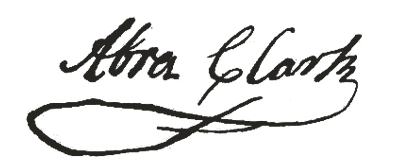
Clark's signature on the Declaration
(Dayton, 1737-1807, was a fellow Elizabeth native, a merchant, who rose to the rank of Brigadier General. His son, Jonathan, became the youngest signer of the Constitution of the United States.)
Clark remained in the Continental Congress through 1778, when he was elected as Essex County's Member of the New Jersey Legislative Council. He had 2 sons fighting in the war, and they were captured by the British, and incarcerated on the prison ship HMS Jersey, docked at Wallabout Bay, which later became the Brooklyn Navy Yard.
He served in Congress again from 1780 to 1783, and from 1786 to 1788. At the Annapolis Convention of 1786, Clark was one of New Jersey's 3 representatives, and formally motioned for the Constitutional Convention, although he was not a delegate to it.
He ran for the U.S. Senate for the 1st Congress in 1788, but lost. He ran for the U.S. House of Representatives for the 2nd Congress in 1790, and won. He was still serving when he died on September 15, 1794, in Rahway, New Jersey, at the age of 68.
He is buried at Rahway Cemetery. The adjoining Township of Clark is named for him, and so is Abraham Clark High School in the neighboring Borough of Roselle, where he lived. His original house burned down, but in 1941, a replica was built on the site, at 101 West 9th Avenue.


No comments:
Post a Comment