Showing posts with label 1776. Show all posts

Sunday, September 20, 2026

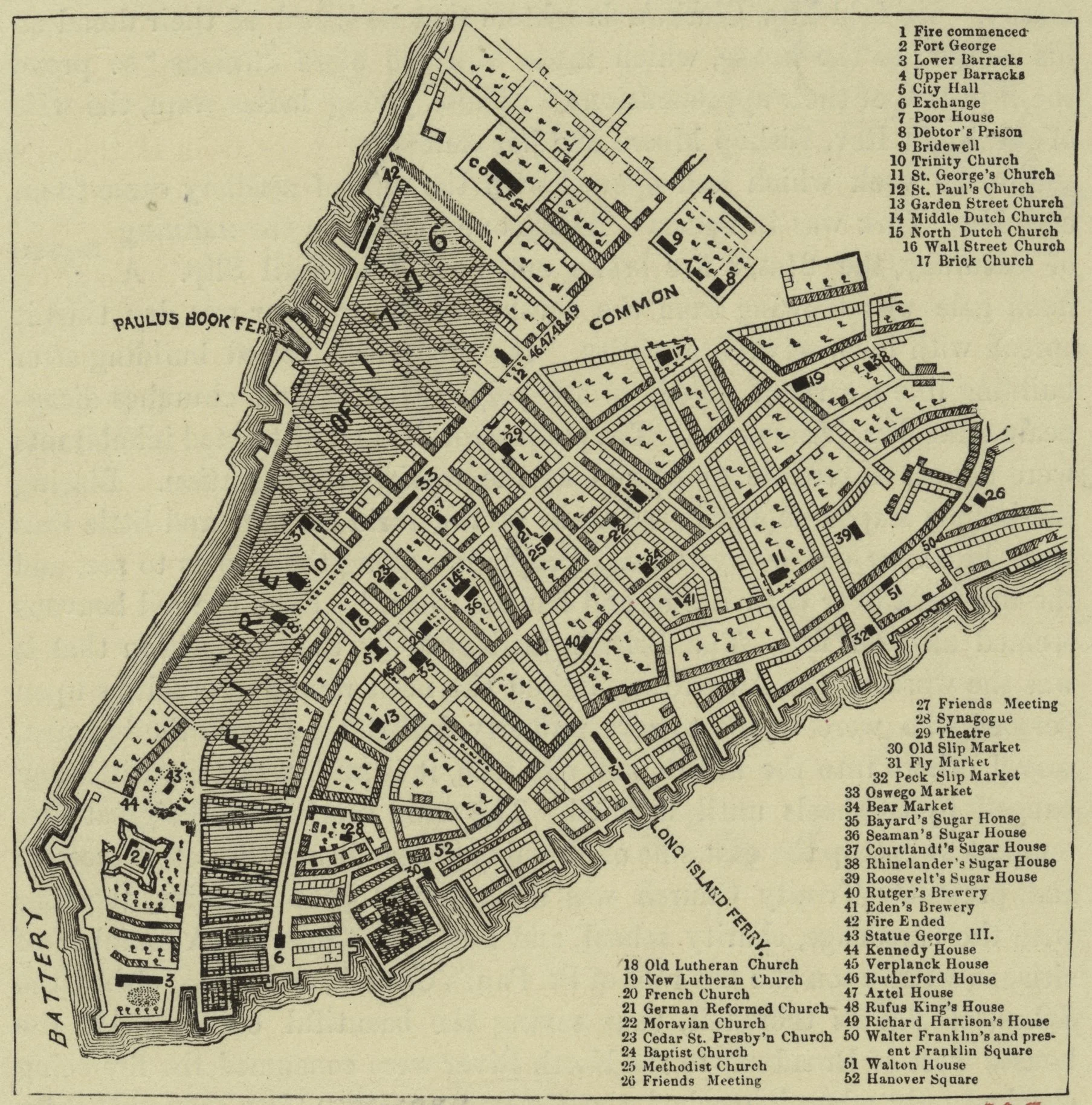
September 20, 1776: The Great Fire of New York


Have you ever wondered why Boston, Philadelphia, Baltimore, and even older New Jersey cities like Newark, Elizabeth, Perth Amboy and Trenton have building that predate American independence in 1776, but there aren't too many of them in New York? And why even the ones that are in the City aren't in Manhattan? (Fraunces Tavern, built in 1719, is one of the exceptions.)

This is why:

September 20, 1776, 250 years ago: The Great Fire of New York was set. It didn't "start," it "was set."

It was a bad Summer for the brand-new United States of America. The British Army was attacking the Continental Army, forerunner of the United States Army, commanded by General George Washington. On August 27, Washington's troops were defeated in Brooklyn in what became known as the Battle of Long Island. A dense fog enabled them to escape across the East River to Manhattan, in a maneuver that, in his book 1776, historian David McCullough called "America's Dunkirk."
On September 11, a date that was fraught with history, especially in America, well before 2001, a peace conference was held on Staten Island, including the British naval commander, Admiral Richard Howe, brother of their army commander, General William Howe; and American representatives including Benjamin Franklin and John Adams. It failed. A civilian exodus from the City began.

On September 15, British troops landed at Kips Bay, north of what was then the limits of New York City, roughly at what is now East 25th Street. On September 16, the Battle of Harlem Heights was fought, roughly where Riverside Church is now, at 120th Street at Riverside Drive. The Continentals pushed the British back.

On September 20, the British decided to smoke out whatever resistance remained. A fire was set at the Fighting Cocks Tavern, near Whitehall Slip, at the southern tip of Manhattan Island, roughly where Whitehall Ferry Terminal is now. The fire destroyed from 10 to 25 percent of the buildings in the City, while some unaffected parts of the City were plundered. It burned until the next morning.

On September 22, the British executed an American spy, Nathan Hale, a 21-year-old native of Coventry, Connecticut. Captain John Montresor, a British officer who was present at the hanging, reported that Hale's last words were, "I only regret that I have but one life to lose for my country."
On October 28, Washington lost the Battle of White Plains. On November 16, defeat in the Battle of Fort Washington, a location named for him, meant that he had to get his troops across the Hudson River, and evacuate New York, roughly at the point where the bridge named for him now stands. They made their way across New Jersey, and across the Delaware River into Pennsylvania. As Thomas Paine, who was with them, wrote in his pamphlet The American Crisis, "These are the times that try men's souls."

Washington needed a miracle. On December 25, 1776, he made his own Christmas miracle.

It wasn't until November 25, 1783, after the Treaty of Paris recognizing American independence was signed and copies reached American shores, that the British Army ended their occupation of New York City. On December 4, Washington resigned his commission, and said goodbye to his troops at the oldest remaining building in Manhattan, Fraunces Tavern, which survived the fire, and has survived others over the years.
New York City was rebuilt. It is always being rebuilt. Old buildings -- but not pre-Revolution old -- are always being replaced by new ones. Americans claim to have respect for their heritage, but we tend not to have much respect for our physical history.

I am all for America in general, and New York in particular, looking forward. But you can't know where you're going unless you know where you've been.

Saturday, July 4, 2026

July 4, 1976: America's Bicentennial

President Gerald R. Ford at Independence Hall,
Philadelphia, July 4, 1976.
The statue is of George Washington.

July 4, 1776, 250 years ago: Approved in a vote 2 days earlier, the Declaration of Independence of the United States of America, written by Thomas Jefferson, is ratified by the Continental Congress at what would become known as Independence Hall in Philadelphia: 

Resolved, that these United Colonies are, and of right ought to be, free and independent States, that they are absolved from all allegiance to the British Crown, and that all political connection between them and the State of Great Britain is, and ought to be, totally dissolved.

But it would take a war with Britain to make independence official, with the Treaty of Paris signed on September 3, 1783.

Big deals were made about the major anniversaries of independence: The 50th in 1826, the 100th in 1876, and even the 150th in 1926. In 2026, there is a big deal being made about the 250th Anniversary.

But the biggest deal was made about the 200th Anniversary. And, after years of turmoil in the 1960s and early 1970s, America needed a break, and a patriotic shot in the arm. And so, the years 1974, 1975 and 1976 were loaded with such events, leading up to Bicentennial Day itself.

*

July 4, 1976, 50 years ago: Bicentennial Day. President Gerald R. Ford gave a speech in front of Independence Hall, then headed up to New York to take part in Operation Sail. It was a nautical parade of tall-masted sailing ships, first done in New York in connection with the 1964 World's Fair.

As is their tradition, the Boston Pops gave an annual concert on the Esplanade along the Charles River, conducted by their aging legend Arthur Fielder, closing with Pytor Tchiakovsky's 1812 Overture, which has nothing to do with America, but whose cannon simulations go well with the show's accompanying fireworks. The National Mall in Washington, D.C. was also home to a fireworks-laden concert. And a salute-to-America show was held at the Los Angeles Memorial Coliseum, hosted by... Canadian singer Paul Anka.

CBS, which had been airing a series of vignettes titled The Bicentennial Minute since 1974, hosted In Celebration of Us, 16 hours of coverage, hosted by their news anchor, Walter Cronkite. ABC did similar programming, with anchor Harry Reasoner. So did NBC, with The Glorious Fourth, with their news anchors, John Chancellor and David Brinkley, followed on the night by Bob Hope's Bicentennial Star-Spangled Spectacular.

*

July 4, 1976 was a Sunday. It was the off-season for the NFL, the NBA and the NHL. But a full slate of Major League Baseball games was played, including some of what had been a tradition, the holiday doubleheader.

The New York Yankees played just one game: They beat the Cleveland Indians, 4-3 at Cleveland Municipal Stadium. Despite giving up 2 home runs to Rico Carty, Dock Ellis was the winning pitcher. The Yankee runs scored on RBI singles by Willie Randolph and Jim Mason in the 2nd inning, and a sacrifice fly by Graig Nettles in the 6th. After giving up Carty's 2nd homer in the bottom of the 9th, Ellis was removed by manager Billy Martin, who brought Sparky Lyle in to slam the door.

The New York Mets split a doubleheader with the Chicago Cubs at Shea Stadium. The Metropolitans won the opener, 9-4. The Cubbies won the nightcap, 4-2.

Perhaps oddly, or perhaps wisely, depending on how you look at it, the Philadelphia Phillies were away from home on Bicentennial Day. They split a doubleheader with the Pittsburgh Pirates at Three Rivers Stadium in Pittsburgh. The Phils won the 1st game 10-5, and the Bucs won the 2nd game 7-1.

Also in commemoration of the Bicentennial, Philadelphia, the city of independence, was awarded the hosting for various major sporting events in 1976. The 1st was fictional: According to the film Rocky, on New Year's Day, The Spectrum hosted the Heavyweight Championship fight between Champion Apollo Creed and local challenger Rocky Balboa. On Thanksgiving Night, November 26, The Spectrum hosted the rematch shown in Rocky II, in which Rocky avenged his "defeat" from the 1st film.

In real life, The Spectrum also hosted the NBA & NHL All-Star Games, and the NCAA Final Four, with Indiana ending Rutgers' undefeated season in the Semifinal, and then completing their own by beating Michigan in the Final. Veterans Stadium hosted the MLB All-Star Game.

In the day's only extra-inning game, the Chicago White Sox beat the Texas Rangers, 7-6. Before the game, White Sox owner Bill Veeck played the wounded fife player alongside two drummers, re-creating the famous Spirit of '76 painting by Archibald Willard, as they walked around the field at Comiskey Park.

Jorge Orta singled home the winning run in the bottom of the 12th. This was the opener of a doubleheader. In the 2nd game, the Rangers won, 3-2.Right before the next season started, the Yankees, unhappy with the lack of production from shortstops Mason and Fred Stanley, traded for the player who scored the winning run in this game: Bucky Dent.

*

Out of curiosity, I looked it up to see where some of the major musical acts of the time played that day or night:

* Frank Sinatra: No show. He probably spent the day with his family at home in Palm Springs, California. 

* Elvis Presley: The Mabee Center, on the campus of Oral Roberts University in Tulsa, Oklahoma.

* The former Beatles: None had any shows. Paul McCartney had wrapped up his Wings Over America tour on June 23. This included May 24 and 26 at Madison Square Garden. Paul did, however, have the Number 1 song in America at the time: "Silly Love Songs." And what's wrong with that? 

* Bob Dylan: No show. He had closed his Rolling Thunder Revue in May.

* The Beach Boys: The Oakland-Alameda County Coliseum.

* The Rolling Stones: No show. They had just concluded a tour of Europe on June 23.

* The Who: No show. They were in between legs of a world tour, and would soon arrive in America.

* Led Zeppelin: No show.

* The Grateful Dead: No show. They concluded a stand in Chicago on June 29, and would start one in their hometown of San Francisco on July 12.

* Stevie Wonder: No show. He was finishing up what might be his best album, Songs In the Key of Life.

* Elton John: Schaefer Stadium in the Boston suburb of Foxborough, Massachusetts, then the home of the New England Patriots. Built in 1971, it would be renamed Sullivan Stadium in 1983, and Foxboro Stadium in 1988, before being torn down in 2002, replaced by the new Gillette Stadium, built next-door.

* Paul Simon. No show. Sales-wise, it was a good year for him. But he only played 2 concerts the entire calendar year.

* Neil Diamond: The Aladdin Casino & Hotel in Las Vegas. He was already into the "Jewish Elvis" phase of his career, but it would be 1980 before he recorded a song heard every 4th of July since: "(They're Coming to) America."

* The Eagles: Tampa Stadium, where the NFL's Tampa Bay Buccaneers were about to begin their 1st season, going 0-14.

* Linda Ronstadt: No show. She had toured with The Eagles earlier in the year.

* John Denver: No show.

* Diana Ross: The Palace Theater in New York.

* The Temptations: No show.

* Billy Joel: No show. He could have used the rest, as he'd done stands at the Bottom Line in New York and for The Mike Douglas Show at the Academy of Music in Philadelphia in June, and would be opening for the aforementioned Beach Boys starting on July 12.

* Bruce Springsteen: Not surprisingly, he and the E Street Band played the place that made each other famous, the Stone Pony in Asbury Park, Monmouth County, New Jersey.

* Queen: No show. They had completed a world tour in April, including Madison Square Garden, February 6 to 8.

* Michael Jackson: No show. The last tour under the name The Jackson Five had been played in February, entirely in the Philippines.

And what about me? Where was I on Bicentennial Day? There was a carnival at the Middlesex County Fairgrounds in my hometown of East Brunswick, New Jersey, followed by a fireworks show. Here's a picture of me that day, age 6.
Note the red, white & blue shirt for the occasion. The object here was to find a penny in a haystack. I don't know how many pennies were in that haystack, but I didn't find one. I've been allergic to hay ever since.

July 4, 1776: The Declaration of Independence

Declaration of Independence, painted by John Trumbull in 1819.
The Committee of Five: Left to right, John Adams, Philip Livingston,
Roger Sherman, Thomas Jefferson and Benjamin Franklin.
John Hancock, President of the Continental Congress, receives it.

July 4, 1776, 250 years ago: The Continental Congress approves the declaration by the United States of America of its independence from the Kingdom of Great Britain. Ever since, the 4th of July has been celebrated by the U.S.A. as its Independence Day.

The sequence of independence often gets confused. Here goes:

* April 19, 1775: The Battles of Lexington and Concord are fought outside Boston. This is the beginning of the War of the American Revolution.

* January 10, 1776: Thomas Paine publishes his pamphlet Common Sense, arguing for independence from British rule in the Thirteen Colonies: New Hampshire, Massachusetts, Rhode Island, Connecticut, New York, New Jersey, Pennsylvania, Delaware, Maryland, Virginia, North Carolina, South Carolina and Georgia. No part of what eventually became Canada took part in this process.

* March 26: South Carolina adopts its own constitution, effectively breaking away from British royal authority.

* April 12: North Carolina produces the Halifax Resolves, making it the 1st of the 13 Colonies to officially authorize its delegates to the Continental Congress to vote for independence from the Kingdom of Great Britain. (The Kingdom was officially renamed "The United Kingdom of Great Britain and Ireland" in 1801, and "The United Kingdom of Great Britain and Northern Ireland" in 1922.)

* May 4: Rhode Island becomes the 1st Colony to specifically renounce its allegiance to King George III of Great Britain.

* June 7: Richard Henry Lee, a delegate from Virginia, proposes to the Continental Congress, meeting in Philadelphia at the Pennsylvania State House, which would later be renamed Independence Hall, "these united colonies are, and of right ought to be, free and independent states." This becomes known as the Lee Resolution.

The Lee family arrived in Virginia in 1639. Richard Henry would serve as President of the Confederation Congress from late 1784 to late 1785, and was 1 of Virginia's 1st 2 Senators. His brother Francis Lightfoot Lee, signed both the Declaration of Independence and the Articles of Confederation.

A first cousin, Henry Lee III, a.k.a. Light-Horse Harry, served in the Confederation Congress and the U.S. House of Representatives, and as Governor. He eulogized George Washington as "First in war, first in peace, and first in the hearts of his countrymen." His son was Robert E. Lee, who became the leading General of the Confederate States of America.

* June 11: The Continental Congress appoints a Committee of Five to draft a Declaration of Independence: Benjamin Franklin, John Adams, Roger Sherman, Robert Livingston and Thomas Jefferson.

Adams, from Quincy, Massachusetts, who had been the biggest advocate for independence, told Jefferson, from Charlottesville, Virginia, that he should write it: "Reason first, you are a Virginian, and a Virginian ought to appear at the head of this business. Reason second, I am obnoxious, suspected, and unpopular. You are very much otherwise. Reason third, you can write ten times better than I can."

* June 12: The Virginia Convention of Delegates adopts the Virginia Declaration of Rights, written by George Mason.

* June 15: The Delaware General Assembly votes to suspend government under the British Crown.

* June 28: Jefferson finishes writing the Declaration.

* July 2: The Continental Congress adopts the Lee Resolution. Adams wrote of the 2nd of July:

I am apt to believe that it will be celebrated, by succeeding Generations, as the great anniversary Festival. It ought to be commemorated, as the Day of Deliverance by solemn Acts of Devotion to God Almighty. It ought to be solemnized with Pomp and Parade, with shews, Games, Sports, Guns, Bells, Bonfires and Illuminations from one End of this Continent to the other from this Time forward forever more. 

* July 4: The Continental Congress approves the Declaration of Independence, as written by Jefferson. This turned out to be the day the country honored as its Independence Day, possibly due to the date being printed in the document's heading: "In Congress, July 4, 1776." It begins:

When in the Course of human events, it becomes necessary for one people to dissolve the political bands which have connected them with another, and to assume among the powers of the earth, the separate and equal station to which the Laws of Nature and of Nature's God entitle them, a decent respect to the opinions of mankind requires that they should declare the causes which impel them to the separation.
We hold these truths to be self-evident, that all men are created equal, that they are endowed by their Creator with certain unalienable Rights, that among these are Life, Liberty and the pursuit of Happiness.--That to secure these rights, Governments are instituted among Men, deriving their just powers from the consent of the governed, --That whenever any Form of Government becomes destructive of these ends, it is the Right of the People to alter or to abolish it, and to institute new Government, laying its foundation on such principles and organizing its powers in such form, as to them shall seem most likely to effect their Safety and Happiness. 

Key words: "From the consent of the governed." Britain's Parliament and its King did not have the consent of the people of British America. Jefferson continued:

Prudence, indeed, will dictate that Governments long established should not be changed for light and transient causes; and accordingly all experience hath shewn, that mankind are more disposed to suffer, while evils are sufferable, than to right themselves by abolishing the forms to which they are accustomed.

But when a long train of abuses and usurpations, pursuing invariably the same Object evinces a design to reduce them under absolute Despotism, it is their right, it is their duty, to throw off such Government, and to provide new Guards for their future security.

Such has been the patient sufferance of these Colonies; and such is now the necessity which constrains them to alter their former Systems of Government. The history of the present King of Great Britain is a history of repeated injuries and usurpations, all having in direct object the establishment of an absolute Tyranny over these States. To prove this, let Facts be submitted to a candid world.

Jefferson then listed several grievances, some of which would be addressed later on in the Constitution of the United States, or which he was in Paris, as U.S. Minister to France, and had nothing to do with writing, although one of his protégés, James Madison, did; and its Bill of Rights, of which he, in a letter to Madison after receiving his mailed copy of the Constitution, was one of the major recommendors.

It is shocking to see how many of Jefferson's grievances mirror those that we have, today, against Donald Trump. The actions of the British troops in America in 1775 and 1776 have been mirrored by those of ICE in 2025 and 2026. People being held without trial? Trump has done that, too, in his detention centers -- or, as we would have called them after World War II, his concentration camps.

Jefferson wrote that the colonial leaders had written to Parliament and to George III, asking for a peaceful compromise. They got war instead. So independence truly was a last resort. He concluded:

We, therefore, the Representatives of the united States of America, in General Congress, Assembled, appealing to the Supreme Judge of the world for the rectitude of our intentions, do, in the Name, and by Authority of the good People of these Colonies, solemnly publish and declare, That these United Colonies are, and of Right ought to be Free and Independent States; that they are Absolved from all Allegiance to the British Crown, and that all political connection between them and the State of Great Britain, is and ought to be totally dissolved; and that as Free and Independent States, they have full Power to levy War, conclude Peace, contract Alliances, establish Commerce, and to do all other Acts and Things which Independent States may of right do.

And for the support of this Declaration, with a firm reliance on the protection of divine Providence, we mutually pledge to each other our Lives, our Fortunes and our sacred Honor.

Only one man signed the Declaration that day: The President of the Continental Congress, John Hancock of Massachusetts. His large signature has led to a signature, or an autograph, being known as a "John Hancock" ever since. However, the great story that he signed it overside on purpose and said, "There! George III can read that without his spectacles, and double the price on my head!" is apocryphal, and developed long afterward.

* July 8: The Declaration is read in public for the first time, at Independence Hall. The State House Bell is rung in celebration. It becomes known as the Liberty Bell.

* July 9: The Declaration is read in public at Bowling Green in what is now considered Lower Manhattan, in New York City. The mob hearing it tore down the statue there, of George III on horseback. The statue's metal was melted down to make musket balls for the Continental Army.

* August 2: The Declaration is actually signed by most of the men who would end up signing it.

* August 15: British troops sail into New York Harbor. As difficult as it was to get all 13 Colonies to agree to independence, the real hard part now begins: Securing that independence through war.

*

This is what the world was like in 1776:

The men we now call "The Founding Fathers" liked to talk about freedom and liberty. My edition of Webster's New World Dictionary, published in 1982, defines "freedom" as, "1. The state or quality of being free; esp., a) exemption or liberation from the control of some other person or some arbitrary power; liberty; independence" followed by a b) through i)" and "2. A right or privilege."

It defines "liberty" as, "1. Freedom or release from slavery, imprisonment, captivity, or any other form of arbtrary control; 2. The sum of rights and exemptions possessed in common by the people of a community, state, etc." and so on.

There was very little of that in the world at the time, especially in America, where many of the Signers, mostly in Southern States, owned slaves.

The biggest cities in the country were Philadelphia, with about 40,000 residents; New York, about 25,000; Boston, 15,000; Charleston, South Carolina, 12,000; Baltimore, 10,000; and Newport, Rhode Island, 7,000. Georgetown was a town in Maryland, but there was no city of Washington, and no District of Columbia, both of which would absorb it. Fort Pitt existed, but Pittsburgh, as a city, did not. Nor did Buffalo, nor Cleveland, nor Atlanta.

Maine was still part of Massachusetts. West Virginia was still part of Virginia. Even with independence, Britain still controlled what are now the States of Ohio, Kentucky, Tennessee, Michigan, Indiana, Illinois, Wisconsin, parts of Minnesota and North Dakota, and the States of Oregon and Washington still belonged to Britain.

What are now the States of Louisiana, Arkansas, Missouri, Iowa, Oklahoma, Kansas, Nebraska and South Dakota; and most of Minnesota, North Dakota, Colorado, Wyoming and Montana belonged to France. What are now the States of Florida, Alabama, Mississippi, Texas, New Mexico, Arizona, Utah, Nevada and California belonged to Spain. Alaska belonged to Russia. And Hawaii was an independent kingdom.

Spain still controlled what is now Mexico, and of most Central America and South America. Portugal controlled Brazil, parts of India, and some Pacific islands. Britain controlled the rest of India, and most of Oceania. Britain, France and Portugal dominated Africa. The Ottoman Empire controlled most of the Middle East, including present-day Israel. And Prussia, Russia and Austria had already begun to partition Poland.

Sports, as we know it now, did not exist. Who had time to watch them? Who had time to play them? Who had the money to afford the equipment? Only the rich. There's a reason horse racing is called "the sport of kings." There was boxing, golf, tennis, and early forms of cricket, soccer and field hockey -- but no baseball, American-style football, basketball or ice hockey. And competitive Winter sports were completely limited to cold-weather countries.

People worked from Sunrise to Sunset, Monday through Friday. They worked half a day on Saturday -- which is why sports as we know them developed on Saturdays. Sunday was The Lord's Day. Doing things on Sunday was seen by the people in charge as wrong.

Voting rights for women, black people, and men who didn't own land? A 40-hour, 5-day work-week? Workers' protection? Protection for food and drugs? Banking insurance? Government sponsored health care? Letting women have abortions? Letting people of the same gender marry, or be seen as together? You would be told whatever was the 1776 American version of "Get outta heah, ya bum!"

Roi Louis XVI was on the throne of France. Czarina Ekaterina II, a.k.a. Catherine the Great, was on the throne of Russia. Kaiser Friedrich II a.k.a. Frederick the Great, was on the throne of Prussia. Edward Gibbon wrote The Decline and Fall of the Roman Empire. Adam Smith wrote On the Wealth of Nations. Johann Wolfgang von Goethe wrote Stella. Johann Sebastian Bach had been dead since 1750, but his sons Johann Christian Bach and Carl Philipp Emanuel Bach were still alive and composing. So were Wolfgang Amadeus Mozart, his not-really-a-rival Antonio Salieri, and Joseph Haydn.

James Madison was 25 years old. Alexander Hamilton was 21. James Monroe was 18. Andrew Jackson was 9. John Quincy Adams was about to turn 9. Arthur Wellesley, the 1st Duke of Wellington, was 7. Napoleon Bonaparte was about to turn 7. Ludwig van Beethoven was 5.

The tallest building in the world was Strasbourg Cathedral in France. Reaching a height of 466 feet, it held that title from 1439 until 1874. There were no computers, no television, no radio, no motion pictures, no telephones, no telegraphs, no airplanes, no automobiles, no railroads. The fastest method communication was a man on a horse. It took about 5 weeks for a copy of the Declaration of Independence to reach the British Parliament and King George III.

Medicine was rudimentary. Artificial organs were not yet possible. Transplantation of organs was not possible. The distribution of antibiotics was not possible: If you got any kind of infection, you could easily die. There were no vaccines of any kind.

In 1776, in events unconnected to the American Revolution, the Presidio of San Francisco was founded by the Spanish, the start of the City By the Bay. The Boshoi Ballet was founded in Moscow. Adam Weishaupt founded the Illuminati in Ingolstadt, Bavaria. Captain James Cook left Britain on what turned out to be his last voyage to the Pacific. The Domínguez–Escalante Expedition made the first exploration of what is now the American Southwest. A hurricane killed 6,000 people on the French Caribbean island of Guadeloupe.

Scottish philosopher David Hume, whose writings heavily influenced the Founding Fathers, died. So did King Yeongjo of Korea and King Hsinbyushin of Burma. Canadian explorer Simon Fraser was born.

That's what the world was like in 1776.

*

No, things did not get any easier after the Declaration of Independence was approved:

* August 27: General George Washington and his troops lose the Battle of Long Island, in what is now Brooklyn. They escaped across the East River to Manhattan.

* September 20: Washington and his troops have to evacuate the City. They make it to White Plains. The British burn New York to the ground. This is why there are very few pre-independence buildings in Manhattan.

* September 22: Nathan Hale is hanged by the British for espionage, at the Park of Artillery in Manhattan, roughly at present-day East 66th Street and 3rd Avenue. The Connecticut native and Yale College graduate was 21. British Captain John Montresor recalled that Hale's last words were, "I only regret, that I have but one life to lose for my country."

* October 11: A British fleet routs an American one off Valcour Island in Lake Champlain. The losing commander is General Benedict Arnold.

* October 28: Washington loses the Battle of White Plains.

* November 20: Washington and his troops evacuate New York, crossing the Hudson River into New Jersey. In 1931, the George Washington Bridge would open at that location.

* December 8: Having successfully retreated (for want of a better phrase) across New Jersey, Washington and his troops cross the Delaware River into Pennsylvania. The commander knows that most of his men's enlistments will run out on December 31, New Year's Eve, and that most of them will not want to go through any more of this. And it's getting cold.

* December 19: Thomas Paine publishes again. Embedded (as we would say today) with Washington's troops, his pamphlet The American Crisis is printed in nearby Philadelphia:

THESE are the times that try men’s souls. The summer soldier and the sunshine patriot will, in this crisis, shrink from the service of their country; but he that stands it now, deserves the love and thanks of man and woman. Tyranny, like hell, is not easily conquered; yet we have this consolation with us, that the harder the conflict, the more glorious the triumph. What we obtain too cheap, we esteem too lightly: it is dearness only that gives every thing its value. 

He wasn't kidding. Washington, America, the cause, all needed a win. Now.

* December 25, Christmas Day: Figuring that the Hessian troops, Germans hired by the British to fight for their side, occupying Trenton, New Jersey would be too hungover and stuffed from their holiday dinner to fight back, Washington begins getting his troops back across the icy Delaware, between 6:00 PM and 3:00 AM. Trenton is 9 miles to the south, along what is now New Jersey Route 29.

* December 26: At 8:00 AM, Washington's troops surprise the Hessians. The Battle of Trenton is exactly the victory that the man, the cause, and the country needed.

The hard part was far from over. But Washington and the Continental Army would hang on, winning by merely keeping the war going. On October 19, 1781, with French troops and ships aiding them, they beat the British at Yorktown, Virginia. With Ben Franklin negotiating, the Treaty of Paris was signed on September 3, 1783. It then had to get across the Atlantic Ocean, and be approved by our side. On January 14, 1784, meeting temporarily at what is now the Maryland State House in Annapolis, the Confederation Congress approved the Treaty.

But we don't celebrate the 3rd of September or the 14th of January as our Independence Day. We celebrate the 4th of July.

Of the 56 Signers:

* John Morton of Pennsylvania was the 1st to die, on April 1, 1777.

* Button Gwinnett of Georgia lost a duel, and died from his wound 3 days later, on May 19, 1777.

* Philip Livingston, of one of New York's most distinguished families, was already ill at the time of the Declaration, and died in 1778.

* Thomas Lynch Jr. of South Carolina boarded a ship heading for Sint Eustatius in the Caribbean in 1779. The ship never arrived, and likely sank. Joseph Hewes of North Carolina had died a few days earlier. John Hart of New Jersey, who had lost his farm to a British raid, died earlier in that year. So did George Ross of Pennsylvania.

* Richard Stockton of New Jersey was captured by the British, and released, but developed cancer, and died in 1781. His house in Princeton, named Morven, served as the Governor's Mansion from 1956 to 1981, and is now a museum. George Taylor of Pennsylvania also died in 1781.

* Caesar Rodney was elected President (Governor) of Delaware, and lived until 1784.

* William Whipple of New Hampshire served as a General in the Continental Army, and lived until 1785. So did Stephen Hopkins of Rhode Island.

* Thomas Stone was elected to the Maryland Senate, and died in office in 1787. Arthur Middleton of South Carolina also lived until 1787.

* John Penn of North Carolina lived until 1788.

* Thomas Nelson Jr. was elected Governor of Virginia, and lived until 1789.

* Dr. Lyman Hall was elected Governor of Virginia, and lived until 1790. So did William Hooper of North Carolina. And so did the most important American who never became President, Benjamin Franklin.

* Francis Hopkinson of New Jersey became a federal Judge. He designed the 13-star, 13-stripe American Flag. Not Betsy Ross. She did something more important than that: She sewed uniforms for the Continental Army. Hopkinson lived until 1791. So did Benjamin Harrison, was elected Governor of Virginia. His son, William Henry Harrison, was a General in the War of 1812, and was elected President in 1840. William Henry's grandson, Benjamin Harrison, was a General in the American Civil War, and was elected President in 1888.

* John Hancock became Governor of Massachusetts. Roger Sherman was elected to the U.S. Senate from Connecticut. Each died in office in 1793.

* The Rev. John Witherspoon was already President of the College of New Jersey, which became Princeton University, and held that office for the rest of his life. Another New Jerseyan, Abraham Clark, was elected to the U.S. House of Representatives, and died in office. Richard Henry Lee was elected U.S. Senator from Virginia. Dr. Josiah Bartlett was elected Governor of New Hampshire. All four of these men lived until 1794.

* Samuel Huntington was elected Governor of Connecticut, and died in office in 1796.

* Francis Lightfoot Lee and Carter Braxton, both of Virginia, lived until 1797. So did Oliver Wolcott, who died in office as Governor of Connecticut, having succeeded Huntington.

* James Wilson of Pennsylvania was appointed to the U.S. Supreme Court. George Read was appointed Chief Justice of Delaware. Each of them died in office in 1798. Also dying that year was Lewis Morris of New York, for whom the Morrisania section of The Bronx was named.

* William Paca was elected Governor of Maryland, and lived until 1799.

* Edward Rutledge was elected Governor of South Carolina, and died in office in 1800.

* Francis Lewis of New York lived until 1802.

* Samuel Adams, John's cousin, served as Governor of Massachusetts. He lived until 1803. So did Dr. Matthew Thornton of New Hampshire.

* George Walton was elected U.S. Senator from Georgia, and lived until 1804.

* Robert Morris of Pennsylvania became the great financier of the war, was elected U.S. Senator from Pennsylvania, and lived until 1806. So did James Smith of Pennsylvania and George Wythe of Virginia.

* Thomas Heyward Jr. lived until 1809.

* Samuel Chase of Maryland was appointed to the U.S. Supreme Court. He remains the only Justice ever impeached, although he was acquitted. He lived until 1811. So did the Rev. William Williams of Connecticut.

* Dr. Benjamin Rush, regarded as America's leading physician, was appointed Director of the U.S. Mint, and died in office in 1813. George Clymer, also of Pennsylvania, also died that year.

* Elbridge Gerry was elected Governor of Massachusetts, and served as James Madison's Vice President. He died in office in 1814. Robert Treat Paine was also from Massachusetts, and also lived until 1814.

* Thomas McKean of Delaware became Pennsylvania's Chief Justice, and then its Governor. He lived until 1817.

* William Ellery was appointed Chief Justice of Rhode Island, and lived until 1820.

* William Floyd was elected to the U.S. House of Representatives from New York, and lived until 1821.

* John Adams of Massachusetts, became the 1st Vice President, and was elected President in 1796, defeating Jefferson. He died on July 4, 1826, the 50th Anniversary of the approval of the Declaration, at the age of 90. His last words were, "Thomas Jefferson still lives. Independence forever."

* Thomas Jefferson became the Governor of Virginia, U.S. Minister to France, the 1st Secretary of State, the Vice President, and was elected President in 1800, defeating Adams. Their split was acrimonious, but their friendship was later restored by letter. After leaving office, Jefferson founded the University of Virginia, the 1st university in the world not officially affiliated with any religion.

What Adams didn't know was that Jefferson, too, had died on the 50th Anniversary of the Declaration of Independence he'd written, at 83. A few times, on the night of July 3, he regained consciousness long enough to ask, "Is this the 4th?" Told no, he would lose consciousness again. Finally, once more, he asked, "Is this the 4th?" Unable to bear his disappointment any further, they lied to him, and said yes. With a smile on his face, he lost consciousness for the last time. He breathed his last at 12:50 PM on the 4th; Adams, at 6:20 PM.

* And the last surviving Signer was Charles Carroll, who was elected U.S. Senator from Maryland. He died on November 14, 1832, 56 years after the Declaration of Independence.
Monday, June 29, 2026

June 29, 1776: The Presidio of San Francisco

The calendar year 1776 was a pivotal one on the Atlantic Coast of North America. Most Americans know that. What many may not be aware of is that it was also a pivotal year on the Pacific Coast.

June 29, 1776: El Presidio Real de San Francisco, or The Royal Fortress of Saint Francis, is established, marking the birth of what would become the City of San Francisco. It was named for St. Francis of Assisi, not St. Francis Xavier or any other St. Francis.

A "presidio," meaning a jail or a fortification, was a fortified base established by the Spanish Empire, mainly between the 16th and 18th Centuries in areas under their control or influence. The term is derived from the Latin word "praesidium," meaning protection or defense. This may seem strange to people who think of St. Francis of Assisi as a pacifist.

In the Mediterranean Sea and the Philippines, the presidios were outposts of the Christian defense against Islamic raids. In the Americas, the fortresses were built to protect against raids by pirates, rival colonial powers, and Native Americans. Later, having gained their independence from Spain, the Mexicans garrisoned the Spanish presidios on their northern frontier, and followed the same pattern in unsettled frontier regions such as the Presidio de Sonoma in California, and the Presidio de Calabasas in Arizona.

The Presidio of San Francisco was a simple fort made of adobe, brush, and wood. It was often damaged by earthquakes or heavy rains. In 1783, its company had only 33 men. Presidio soldiers' duties were to support Mission Dolores by controlling Indian workers in the Mission and farming, ranching, and hunting to supply themselves and their families. Support from Spanish authorities in Mexico was minimal.

In 1821, Mexico became independent of Spain. The Presidio received even less support from Mexico. Residents of Alta California, which included the Presidio, debated separating from Mexico. In 1835, the Presidio garrison, led by Mariano Vallejo, relocated to Sonoma, 40 miles to the north.

In 1846, the Mexican-American War began. American settlers and adventurers in Sonoma staged the Bear Flag Revolt against Mexican rule. The U.S. Army occupied the Presidio, which began a long era of directing operations to control and protect Native Americans as headquarters for scattered Army units on the West Coast.

From 1898 to 1906, The Presidio became the nation's center for assembling, training, and shipping out forces to the Spanish-American War in the Philippine Islands and the subsequent Philippine Insurrection. President Theodore Roosevelt visited in 1903. Troops from there were instrumental in providing security and fighting fires following the earthquake of 1906.

From 1914 to 1916, General John J. Pershing served as commanding officer, a prelude to his leadership in World War I. For that war, The Presidio produced the 30th Infantry Regiment, which the French nicknamed "The Rock of the Marne" for its service at the pivotal Second Battle of the Marne in 1918.

U.S. Route 101 was extended through the Presidio with the opening of the Golden Gate Bridge in 1937 and the MacArthur Tunnel in 1940. Due to the Pacific Theater of World War II, The Presidio again became a major U.S. Army facility.

Afterward, it was responsible for all U.S. Army forces in the Western U.S., including training, supplies, and deployment. This went on to include supporting roles in the Korean, Vietnam and Persian Gulf Wars, and hosting the signing of the ANZUS Treaty between the U.S. and the Pacific nations of Australia and New Zealand. In 1994, the Army closed The Presidio, and transferred control of it to the National Park Service.

In the future imagined by the Star Trek franchise, The Presidio became the headquarters for the United Federation of Planets' Starfleet Command, including Starfleet Academy.

Also on June 29, 1776: The Battle of Turtle Gut Inlet was fought, off the coast of what is now Wildwood Crest, New Jersey. It was an important, early naval victory for the Continental Navy and the man who went on to become known as the "Father of the American Navy," Captain John Barry.

It was the first privateer battle of the War of the American Revolution, and turned out to be the only battle of that war fought in Cape May County, the southernmost County of New Jersey.

Tuesday, March 17, 2026

March 17, 1776: The Siege of Boston

Henry Knox

March 17, 1776, 250 years ago: The Siege of Boston ends. No, this has nothing to do with the Yankees playing the Red Sox, or any other sporting event. It is the 1st great victory for the Continental Army in the War of the American Revolution.

The siege began on April 19, after the first battles of the war, at Lexington and Concord, Massachusetts, when Massachusetts militias blocked land access to Boston. The Continental Congress, meeting in Philadelphia, formed the Continental Army from the militias involved in the fighting, and appointed George Washington as commander in chief.

In June 1775, the British seized Bunker Hill and Breed's Hill, two Continental Army positions overlooking Boston. But their casualties proved heavy, and their gains were insufficient to break the Continental Army's encirclement.

After this, the Americans laid siege to Boston. No major battles were fought during this time, and the conflict was limited to occasional raids, minor skirmishes, and sniper fire. British efforts to supply their troops were significantly hindered by the smaller but more agile Continental Army and patriot forces operating on land and sea. The British suffered from a continual lack of food, fuel, and supplies.

In November 1775, General Washington sent General Henry Knox on a mission to bring the heavy artillery that had recently been captured at Fort Ticonderoga in Upstate New York. In a technically complex and demanding operation, Knox brought the cannons to Boston in January 1776, and this artillery fortified Dorchester Heights, which overlooked Boston Harbor.

This development threatened to cut off the British supply lifeline from the sea. The British commander, General Willie Howe, saw his position as indefensible, and he withdrew his forces from Boston to Halifax, Nova Scotia on March 17.

It has often been said that the American Revolution began in Boston on March 5, 1770, when British militia -- effectively, the first Boston Police -- fired on people throwing snowballs at them, killing 5 of them, the event that became known as the Boston Massacre. Six years later, the British bugged out of Boston. For what would eventually become known as the Hub City, the war was essentially over.

That would not be the case for points west and south: Connecticut, New York, New Jersey, Pennsylvania, Virginia, North Carolina, South Carolina and Georgia would all suffer terribly over the next 5 years.

When Washington became the 1st President of the United States, he appointed Knox to be the 1st Secretary of War, the post known since 1947 -- despite what Donald Trump and Pete Hegseth might now say -- as Secretary of Defense.

Monday, March 9, 2026

March 9, 1776: "The Wealth of Nations" Is Published

March 9, 1776, 250 years ago: An Inquiry into the Nature and Causes of the Wealth of Nations, by Scottish economist and philosopher Adam Smith, is published in London by Strahan and Cadell. Just 3 weeks earlier, they had published Volume I of The History of the Decline and Fall of the Roman Empire, by Edward Gibbon. The Wealth of Nations, as this book's title is usually shortened to, becomes the biggest-selling work of economics in history.

Adam Smith's date of birth is unknown, but he was recorded as having been baptized on June 5, 1723, in Kirkcaldy, Fife, Scotland, so it is generally accepted that he was born in Kirkcaldy a few days earlier, perhaps only one day.

His father, also named Adam Smith, was a Scottish Writer to the Signet (a senior solicitor), advocate and prosecutor (judge advocate), and also served as comptroller of the customs in Kirkcaldy. Smith's mother was born Margaret Douglas. Two months before Smith was born, his father died, leaving his mother a widow.

The father must have left the mother a good deal of money, because the son was able to attend the Burgh School of Kirkclady, described by a Smith biographer as "one of the best secondary schools of Scotland at that period." He entered the University of Glasgow at the age of 14, and graduated at 17. He moved on to Oxford University, and, based on his later writings, found it unsatisfying, learning more from the books in the Bodleian Library than from the professors.

In 1748, he began lecturing at the University of Edinburgh. Two years later, he met a literary and philosophical hero of his, David Hume. Smith would join Hume as a leading figure of what became known as the Scottish Enlightenment, and both are now featured in statues on the front of the Scottish National Portrait Gallery in Edinburgh.

In 1759, Smith published The Theory of Moral Sentiments, with writings that would shock people who only know him as "the father of capitalism":

The rich only select from the heap what is most precious and agreeable. They consume little more than the poor, and in spite of their natural selfishness and rapacity, though they mean only their own conveniency, though the sole end which they propose from the labours of all the thousands whom they employ, be the gratification of their own vain and insatiable desires, they divide with the poor the produce of all their improvements. They are led by an invisible hand to make nearly the same distribution of the necessaries of life, which would have been made, had the earth been divided into equal portions among all its inhabitants, and thus without intending it, without knowing it, advance the interest of the society, and afford means to the multiplication of the species.

The success of this book allowed him to assume a tutoring position that facilitated travel throughout Europe, where he encountered intellectual figures of his era. In response to the prevailing policy of safeguarding national markets and merchants through the reduction of imports and the augmentation of exports, a practice that came to be known as mercantilism, Smith laid the foundational principles of classical free-market economic theory.

In 1776, he published The Wealth of Nations. In it, he developed the concept of division of labor, and expounded upon how "rational self-interest" and competition can lead to economic prosperity.

He laid out a system of political economy with the famous metaphor of the "invisible hand" regulating the marketplace through individual self-interest. He provided a comprehensive analysis of different economic aspects: The accumulation of stock, price determination, and the flow of labor, capital and rent. The book contained Smith's critique of mercantilism, and of high taxes on luxury goods. For these reasons, he and his book upheld as exemplars by economic conservatives.

But the book also contained things to which liberals could point. He criticized the slave trade, with which Britain and its colonies, including the soon-to-be United States, were then heavily involved. He also denounced monopolies, advocating for free competition and open markets.

He made the point that transportation of goods makes economies possible, and points out that the strongest nations had the strongest economies, because they had the best transportation: Access to the sea, including through wide harbors and wide rivers.

It explained why it could be predicted, though he did not do so, that New York would surpass London as the leading city in the world over the next 150 years. What Smith also could not have predicted was the rise of railroads, which helped both Britain and America more than the rest of the world; and the development of air travel and transport.

In other words, Smith had unwittingly predicted the rise of vast fortunes through railroad companies, but also the development of the suburbs of major cities that the railroads would develop, allowing the creation of a vast middle class, especially in the English-speaking world -- including in European and Asian countries where English is, effectively, everyone's second language, regardless of what their first language is. And he unwittingly predicted how farm products could more easily get to the cities, making even agriculture a prosperous profession for a smart farmer.

In other words, Smith showed that increasing demand was the way to make an economy grow, not increasing supply. The supply-side economists of the late 20th Century totally misread him.

The book's 1st edition sold out in 6 months, causing William Strahan, publisher of both Smith and Gibbon, to write to a friend, "What you say of Mr. Gibbon's and Dr. Smith's book is exactly just. The former is the most popular work; but the sale of the latter, though not near so rapid, has been more than I could have expected from a work that requires much thought and reflection (qualities that do not abound among modern readers) to peruse to any purpose."

And to university professor and Enlightenment philosopher Adam Ferguson, Gibbon wrote, "What an excellent work is that with which our common friend Mr. Adam Smith has enriched the public! An extensive science in a single book, and the most profound ideas expressed in the most perspicuous language."

In 1778, Smith was appointed to a post as Commissioner of Customs in Scotland. From 1787 to 1789, he occupied the honorary position of Lord Rector of the University of Glasgow. He died on July 17, 1790, in Edinburgh, after what is described only as "a painful illness." He was 67 years old. He never married, and is not known to have had any children.