
Time with a collective "Man of the Year" for 1956.
Note the Communist seal cut out of the flag.
Cardinal József Mindszenty, the leader of the Catholic Church in Hungary, having previously been imprisoned by the Nazis, was arrested in 1949, and imprisoned and tortured for his anti-Communist activities. He was freed during the Revolution, and given asylum in the U.S. Embassy in Budapest. He became a hero of the movement, remained there until 1971, and died in 1975.

József Mindszenty
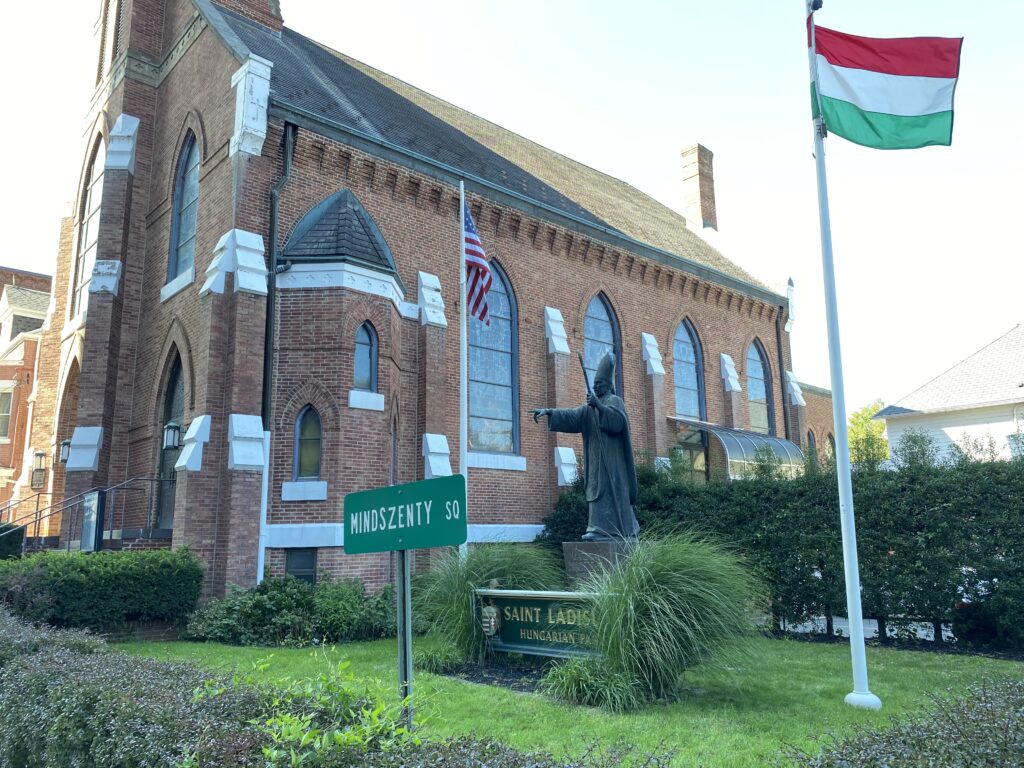
The city of New Brunswick, New Jersey once had a large Hungarian community, and their St. Ladislaus Roman Catholic Church has a memorial to the Revolution and a statue of Mindszenty out front.
Imre Nagy, Chairman of the Council of Ministers (effectively, the Prime Minister) from July 4, 1953 to April 18, 1955, wasn't so lucky. He was forced out of office by hardliner András Hegedüs, who was himself forced out by the Revolution on October 24, fleeing to the Soviet Union. Nagy was reappointed, dissolved the secret police (ÁVH), and withdrew Hungary from the Warsaw Pact on November 1.

Imre Nagy
When the Soviet tanks rolled in, he fled to the Yugoslavian Embassy, hoping that country's leader, Josip Broz Tito, a fellow anti-Moscow Communist, could protect him. He was lured out of the embassy under false promises on November 22, was arrested, and was deported to Romania. On June 16, 1958, Nagy was tried and executed for treason alongside his closest allies, and his body was buried in an unmarked grave. His remains would be repatriated to Hungary after the 1989 revolution. (Hegedüs returned to Hungary thereafter, but taught at a university rather than return to governing, and lived until 1999.)
Soccer team Budapest Honvéd FC was out of the country at the time of the Revolution, playing Athletic Bilbao, of the Basque Country in Spain, in the European Cup. Eliminated, the Honvéd players managed to get their families out of the country. Their stars, the bulk of the "Magnificent Magyars" team that won the 1952 Olympics, embarrassed England at Wembley Stadium in 1953, and reached the 1954 World Cup Final, went elsewhere, including some staying in Spain: Ferenc Puskás to Real Madrid, and Sándor Kocsis and Zoltán Czibor to FC Barcelona.
Since that year's Summer Olympics were given to Melbourne, Australia, in the Southern Hemisphere, they began on November 22, so the weather would be warm. Throughout the Olympics, Hungarian athletes were cheered by fans from the host nation and other countries. Many of them gathered in the boxing arena when László Papp won a Gold Medal.
A few days later, the crowd was with the highly successful Hungarian water polo team in its match against the Soviet Union, which became known as "the Blood In the Water Match." The game became rough and, when a Hungarian player, Ervin Zádor, was forced to leave the pool with blood streaming from a cut over his eye, a riot almost broke out. But police restored order, and the game was called early, with Hungary leading 4–0. The Hungarians went on to win the Gold Medal.
At the end of the calendar year, Time magazine named the Hungarian Freedom Fighters their Men of the Year. This was before they made the distinction "Person (or People) of the Year," although women had been recognized as such before.
At the same time as the Hungarian Revolution, the "Polish October" was taking place. President
Bolesław Bierut, a Stalinist dictator, had died on March 12. On June 28, a demonstration by workers in Poznań was crushed, leading to at least 57 and possibly more than 100 deaths. In October, a reform faction took over, led by Władysław Gomułka. However, Gomulka's administration ended up getting more and more repressive until his removal in 1970. As Hungary, Poland, and the rest of Eastern Europe found out, post-Stalin Communism was only a slight improvement over Stalinist Communism.


No comments:
Post a Comment