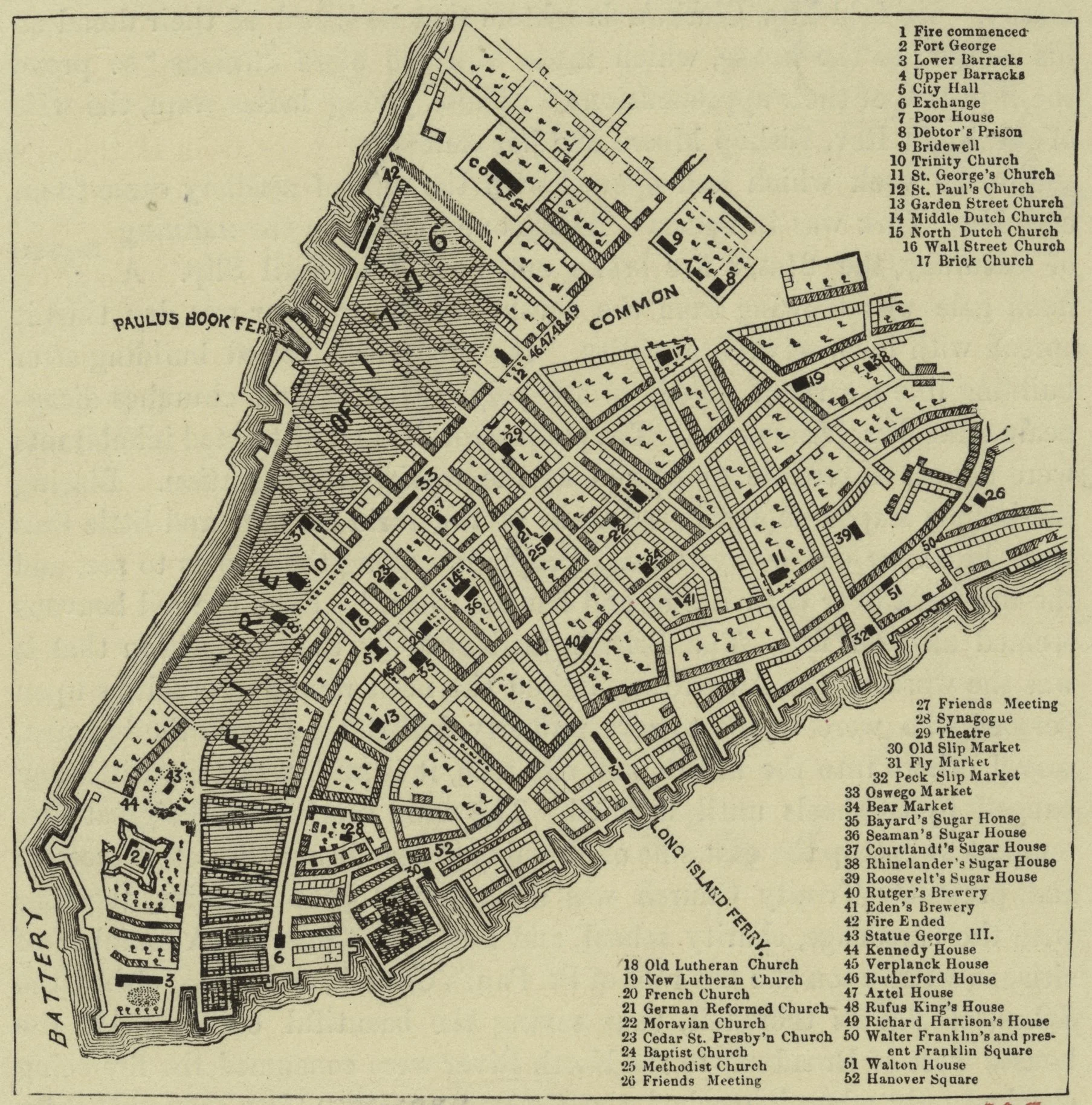
Have you ever wondered why Boston, Philadelphia, Baltimore, and even older New Jersey cities like Newark, Elizabeth, Perth Amboy and Trenton have building that predate American independence in 1776, but there aren't too many of them in New York? And why even the ones that are in the City aren't in Manhattan? (Fraunces Tavern, built in 1719, is one of the exceptions.)
This is why:
September 20, 1776, 250 years ago: The Great Fire of New York was set. It didn't "start," it "was set."
It was a bad Summer for the brand-new United States of America. The British Army was attacking the Continental Army, forerunner of the United States Army, commanded by General George Washington. On August 27, Washington's troops were defeated in Brooklyn in what became known as the Battle of Long Island. A dense fog enabled them to escape across the East River to Manhattan, in a maneuver that, in his book 1776, historian David McCullough called "America's Dunkirk."

On September 11, a date that was fraught with history, especially in America, well before 2001, a peace conference was held on Staten Island, including the British naval commander, Admiral Richard Howe, brother of their army commander, General William Howe; and American representatives including Benjamin Franklin and John Adams. It failed. A civilian exodus from the City began.
On September 15, British troops landed at Kips Bay, north of what was then the limits of New York City, roughly at what is now East 25th Street. On September 16, the Battle of Harlem Heights was fought, roughly where Riverside Church is now, at 120th Street at Riverside Drive. The Continentals pushed the British back.
On September 20, the British decided to smoke out whatever resistance remained. A fire was set at the Fighting Cocks Tavern, near Whitehall Slip, at the southern tip of Manhattan Island, roughly where Whitehall Ferry Terminal is now. The fire destroyed from 10 to 25 percent of the buildings in the City, while some unaffected parts of the City were plundered. It burned until the next morning.
On September 22, the British executed an American spy, Nathan Hale, a 21-year-old native of Coventry, Connecticut. Captain John Montresor, a British officer who was present at the hanging, reported that Hale's last words were, "I only regret that I have but one life to lose for my country."

On October 28, Washington lost the Battle of White Plains. On November 16, defeat in the Battle of Fort Washington, a location named for him, meant that he had to get his troops across the Hudson River, and evacuate New York, roughly at the point where the bridge named for him now stands. They made their way across New Jersey, and across the Delaware River into Pennsylvania. As Thomas Paine, who was with them, wrote in his pamphlet The American Crisis, "These are the times that try men's souls."
Washington needed a miracle. On December 25, 1776, he made his own Christmas miracle.
It wasn't until November 25, 1783, after the Treaty of Paris recognizing American independence was signed and copies reached American shores, that the British Army ended their occupation of New York City. On December 4, Washington resigned his commission, and said goodbye to his troops at the oldest remaining building in Manhattan, Fraunces Tavern, which survived the fire, and has survived others over the years.

New York City was rebuilt. It is always being rebuilt. Old buildings -- but not pre-Revolution old -- are always being replaced by new ones. Americans claim to have respect for their heritage, but we tend not to have much respect for our physical history.
I am all for America in general, and New York in particular, looking forward. But you can't know where you're going unless you know where you've been.


No comments:
Post a Comment