October 10, 1956, 70 years ago: Game 7 of the World Series is played at Ebbets Field in Brooklyn. A pair of Jersey boys start: Johnny Kucks (pronounced like "cooks") of Hoboken, Hudson County, for the New York Yankees; Don Newcombe of Elizabeth, Union County, for the Brooklyn Dodgers. The New York Post's headline reads:
Kucks vs. Newk and…
THERE’S
NO
TOMORROW
(Sorry, I looked for a photo of it online, and couldn't find it.)
The Post is right: Win or lose, this is it for one of the best seasons in New York baseball history, as the Yankees had Mickey Mantle's Triple Crown and Most Valuable Player; the Dodgers had a fantastic Pennant race, over the Cincinnati Reds, the St. Louis Cardinals, and the Milwaukee Braves, edging the Braves by 1 game, a season highlighted by no-hitters from Carl Erskine and former Giant nemesis Sal Maglie; and the World Series had Don Larsen's perfect game in Game 5 and a 1-0 10-inning Dodger win in Game 6.
This is Game 7. This is it.
The Yankees turn out to be "it": They shell Newk, with 2 homers from Yogi Berra and a grand slam from Bill "Moose" Skowron. Kucks hardly needs to pitch a shutout, but does, and the Yankees win, 9-0. The Dodgers had been World Champions of baseball for 372 days.

Johnny Kucks
The last out turns out to be the last play in the career of Jackie Robinson: He strikes out swinging, but Yogi drops the ball, a flash of the Mickey Owen and Tommy Henrich play 15 years earlier. His weight up and his speed down, but his instincts as keen as ever, Robinson sees what's happening, and runs to 1st base. But, as I said, his great speed is gone, and Yogi quickly picks up the ball, and throws him out. Jackie retires 2 months later.
What no one knows at the time -- not Robinson, not even Dodger owner Walter O'Malley -- is the extent of the finality of this game. It is not just the end of a terrific baseball season. It is the last Subway Series game for 44 years -- 33 years if you count the 1989 "BART Series."
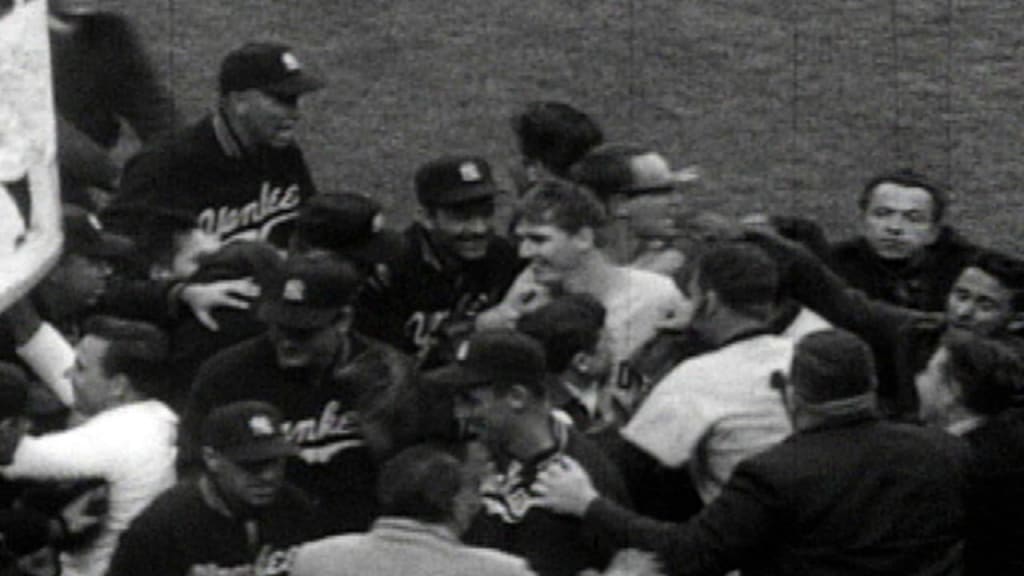
The Yankees' on-field celebration
Remember: It's only a Subway Series if it's a World Series. Nobody ever went to a regular-season game between the Brooklyn Dodgers and the New York Giants and called it a "Subway Series." And if they did, they'd be told, by fans of either team, "Go home, you're drunk." (The thought of being on drugs wouldn't have occurred to most baseball fans at the time.)
It is the last home game in a World Series for a National League team from New York for 13 years. And it is the last postseason game that Ebbets Field, or Brooklyn, will ever host. The next season, the Giants will announce they are moving to San Francisco, and the Dodgers will announce they are moving to Los Angeles.
"There's no tomorrow," indeed.
Bobby Richardson is the last surviving member of the 1956 World Champion New York Yankees.