Showing posts with label john madden. Show all posts

Friday, December 31, 2021

Those We Lost In 2021

Sam Jones, 1933-2021

In addition to such non-sports legends as Cloris Leachman, Christopher Plummer, Michael Collins, Charlie Watts, Jean-Paul Belmondo, Stephen Sondheim and Desmond Tutu...

And Betty White...

Paul Westphal, November 30, 1950 - January 2, 2021. Basketball Hall-of-Famer played for the Boston Celtics' 1974 NBA Champions. For the Phoenix Suns, led them to the NBA Finals as a player in 1976 and as head coach in 1993.

Colin Bell, February 26, 1946 - January 5, 2021. Midfielder starred for the great Manchester City soccer team of the late 1960s.

Tommy Lasorda, September 22, 1927 - January 7, 2021. Managed the Los Angeles Dodgers to 4 National League Pennants, including the 1981 and 1988 World Series.

Don Sutton, April 2, 1945 - January 19, 2021. Pitcher was a member of both the 300 Wins Club and the 3,000 Strikeouts Club.

Hank Aaron, February 5, 1934 - January 22, 2021. Baseball's legitimate all-time home run leader.

George Armstrong, July 6, 1930 - January 24, 2021. Hockey Hall-of-Famer was Captain of the Toronto Maple Leafs' Stanley Cup winners of 1962, 1963, 1964 and 1967.

John Chaney, January 21, 1932 - January 29, 2021. Longtime basketball coach at Temple University.

Tony Trabert, August 16, 1930 - February 3, 2021. American tennis legend, won the U.S. Open in 1953, the French Open in 1954, and fell the Australian Open short of winning the Grand Slam in 1955.

Leon Spinks, July 11, 1953 - February 5, 2021. U.S. boxing Gold Medalist at the 1976 Olympics, was briefly Heavyweight Champion of the World in 1978.

Yury Vlasov, December 5, 1935 - February 13, 2021. Soviet weightlifting Gold Medalist at the 1960 Olympics.

Leopoldo Luque, May 3, 1949 - February 15, 2021. Star striker at Buenos Aires soccer team River Plate, and a member of the Argentina team that won the 1978 World Cup on home soil.

Ian St. John, June 7, 1938 - March 1, 2021. Scottish soccer forward, starred for Liverpool FC in the 1960s.

Marvelous Marvin Hagler, May 23, 1954 - March 13, 2021. Middleweight Champion of the World from 1980 to 1987.

Peter Lorimer, December 14, 1946 - March 20, 2021. Scottish midfielder remains the all-time scoring leading at Leeds United.

Elgin Baylor, September 16, 1934 - March 22, 2021. Basketball Hall-of-Famer for the Los Angeles Lakers, named to the NBA's 50th Anniversary 50 Greatest Players.

Bobby Brown, October 25, 1924 - March 25, 2021. 3rd baseman was the last surviving member of the New York Yankees' World Series winners of 1947, 1949, 1950 and 1951. Served as President of the American League from 1984 to 1994.

Bobby "Slick" Leonard, July 17, 1932 - April 13, 2021. Played for Indiana University's basketball National Champions of 1953, and coached the Indiana Pacers' ABA Champions of 1970, 1972 and 1973.

Tamara Press, May 10, 1937 - April 26, 2021. Soviet athlete won the Gold Medal in the women's shot put at the 1960 Olympics, and both the shot put and the discus throw in 1964. Suspiciously retired before the next Olympics, when steroid testing began.

Del Crandall, March 5, 1930 - May 5, 2021. Catcher for the 1957 World Champion Milwaukee Braves, he was the last surviving player from the Boston Braves.

Rildo da Costa Menezes, January 23, 1942 - May 16, 2021. Defender known by his first name, starred at Brazilian soccer teams Botafogo and Santos. At Santos, was a teammate of Pelé. Played with him again on the 1977 North American Soccer League Champion New York Cosmos. Stayed in America as a coach.

Lee Evans, February 25, 1947 - May 19, 2021. American sprinter won 2 Gold Medals at the 1968 Olympics, including the 400 meters, setting a world record that lasted for 20 years.

Tarcisio Burgnich, April 25, 1939 - May 26, 2021. Defender was a member of the "Grande Inter" team of the 1960s, and the Italy soccer team that won Euro 68.

Mike Marshall, January 15, 1943 - May 31, 2021. Pitcher set each league's record for appearances in a season, and became the 1st relief pitcher to win either league's Cy Young Award, in 1974 with the Los Angeles Dodgers.

Giampiero Boniperti, July 4, 1928 - June 18, 2021. Forward helped soccer team Juventus win 5 Italian league titles, and was once considered the team's greatest player ever.

Paul Mariner, May 22, 1953 - July 9, 2021. Forward helped Ipswich Town win the 1978 FA Cup and the 1981 UEFA Cup. Later played in America, in the dark years between the NASL and MLS, and managed MLS' Toronto FC.

J.R. Richard, March 7, 1950 - August 4, 2021. Houston Astro was one of the best and most intimidating pitchers in baseball until his career was ended by a stroke in 1980.

Gerd Müller, November 3, 1945 - August 15, 2021. Forward led West Germany to the 1974 World Cup, and Bayern Munich to the 1974, 1975 and 1976 European Cups.

Rod Gilbert, July 1, 1941 - August 19, 2021. Right wing remains the all-time leading scorer for the New York Rangers, and a member of the Team Canada that beat the Soviet Union in the 1972 Summit Series.

Jacques Rogge, May 2, 1942 - August 29, 2021. Sailed for Belgium in 3 Olympics, and served as President of the International Olympic Committee from 2001 to 2013.

Francesco Morini, August 12, 1944 - August 31, 2021. Defender starred for the Juventus teams of the 1970s.

Ivan Patzaichin, November 26, 1949 – September 5, 2021. Won Gold Medals in canoeing for Romania at the 1968, 1972, 1980 and 1984 Olympics.

Sam Cunningham, August 15, 1950 - September 7, 2021. USC All-American running back credited with shocking the University of Alabama into finally racially integrating their football team. Became the all-time leading rusher for the New England Patriots.

Yuriy Sedykh, June 11, 1955 - September 14, 2021. Won the Gold Medal for the Soviet Union in the hammer throw in the 1976 and 1980 Olympics, and has held the world record in the event since 1986.

Jimmy Greaves, February 20, 1940 - September 19, 2021. Forward starred for North London soccer team Tottenham Hotspur, becoming the all-time leading scorer in England's top division under any name. Member of the England team that won the 1966 World Cup. Teamed with the aforementioned Ian St. John for the popular soccer TV show Saint and Greavsie.

Roger Hunt, July 20, 1938 - September 27, 2021. Forward starred for Liverpool FC in the 1960s, winning 1964 and 1966 League titles and the 1965 FA Cup. Teammate of Greaves on England's 1966 World Cup winners.

Eddie Robinson, December 15, 1920 - October 4, 2021. 1st baseman was the last surviving player from the 1948 World Champion Cleveland Indians.

Walter Smith, February 24, 1948 - October 26, 2021. Managed Glasgow soccer team Rangers FC to 7 straight Scottish League titles from 1991 to 1997, then 3 more in a row from 2009 to 2011.

Jerry Remy, November 8, 1952 - October 30, 2021. 2nd baseman for the Boston Red Sox became a beloved broadcaster for them.

Ron Flowers, July 28, 1934 - November 12, 2021. Midfielder starred for the Wolverhampton Wanderers team that dominated English soccer in the 1950s, and was the last surviving player from their 1960 FA Cup winners. Was another member of England's 1966 World Cup winners.

Sam Huff, October 4, 1934 - November 13, 2021. Linebacker for the New York Giants' 1956 NFL Champions was the 1st football player known primarily for his defense.

Bertie Auld, March 23, 1938 - November 14, 2021. Midfielder helped Glasgow soccer team Celtic FC win 5 Scottish League titles and the 1967 European Cup.

Ray Kennedy, July 28, 1951 - November 30, 2021. Midfielder was the leading scorer on North London soccer team Arsenal as they won the Football League and FA Cup "Double" in 1971. Later starred on the Liverpool team that dominated England in the 1970s.

Horst Eckel, February 8, 1932 - December 3, 2021. Winger starred for German soccer team FC Kaiserslautern, and was the last surviving member of the West Germany team that won the 1954 World Cup.

John Madden, April 10, 1936 - December 28, 2021. From coaching the Oakland Raiders to a Super Bowl win, to broadcasting NFL games on all 4 networks that do so, to writing books to creating the most popular sports video game in American history, he achieved something that may well be impossible: He made himself admired by fans of every NFL team.

Sam Jones, June 24, 1933 - December 30, 2021. Guard was a 5-time All-Star, and won 10 NBA Championships with the Boston Celtics, 2nd only to teammate Bill Russell. Named to NBA's 25th, 50th and 75th Anniversary Teams, Number 24 retired.

Wednesday, December 29, 2021

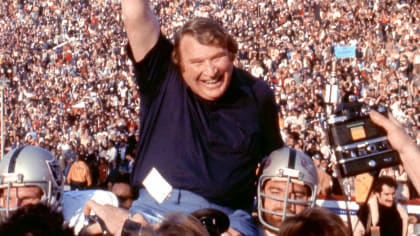
John Madden, 1936-2021

John Madden was a big man who looms large in the history of the National Football League.

John Earl Madden was born on April 10, 1936, in Austin, Minnesota, near the Iowa State Line. This is Big Ten Country, but when he was young, his father moved the family to Daly City, just south of San Francisco, and so John always considered himself a West Coast guy.

He went to Thomas Jefferson High School in Daly City, and then to California Polytechnic State University in San Luis Obispo. He was a catcher on their baseball team, and a tackle, both offensive and defensive, on their football team. At both Jefferson and Poly, he was a teammate of his neighborhood friend, John Robinson, who went on to coach at both the University of Southern California and the Los Angeles Rams.

He was drafted by the Philadelphia Eagles in 1959. But, having already injured one knee in high school, he injured the other knee in training camp, and that was the end of his playing career. He would not get to be on the Eagles team that won the 1960 NFL Championship.
That team was quarterbacked by Norm Van Brocklin, the Hall-of-Famer who went on to become the 1st head coach of the Minnesota Vikings, and the 2nd of the Atlanta Falcons. John remembered walking into the locker room on crutches, and seeing Van Brocklin looking at football film. Van Brocklin said, "Hey, Red, come watch with me."

They studied film together, and, John said, that's when he became a coach. Oddly, Van Brocklin wasn't a very good coach, although he never really had the horses.

In 1960, John got a job as an assistant coach at Allan Hancock College in Santa Maria, California, outside Santa Barbara. He became head coach in 1962. In 1963, he was hired as an assistant at San Diego State University, under Don Coryell, who would later coach the San Diego Chargers and engage in some memorable AFC Western Division battles with Madden.

In 1967, Oakland Raiders owner Al Davis hired him to be linebackers coach. They won the AFL Championship, losing to the Green Bay Packers of Vince Lombardi in Super Bowl II. A year later, John Rauch resigned, and Madden was named his successor as head coach. At 32, he was the youngest non-playing coach in pro football history. (Several early coaches ran their teams while still playing for them.)

Davis, who was also the Raiders' general manager, built a team in his image. Nasty. Sometimes weird. Someone once compared them to "the Island of Misfit Toys" in the 1964 Christmas special Rudolph the Red-Nosed Reindeer. But with Davis running the organization, and Madden running the team, they built a record that made them one of professional football's iconic franchises. They inspired NFL Films head Steve Sabol to write a poem, which he showed to Davis, who loved it, saying, "This is what the Oakland Raiders are all about." It concludes:

The Autumn Wind is a Raider
pillaging just for fun.
He'll knock you 'round
and upside-down
and laugh when he's conquered and won.

John Madden seems, from current perspective, to be too nice a guy to coach the Raiders. That's misleading: He was the perfect guy to coach that team -- and, maybe, only that team. Most coaches in those days acted like domineering fathers. He was more like the cool older brother, who would teach you things that Dad wouldn't teach you. The players related to him: White and black, urban and rural, the straight-laced and the party animal, the merely mischievous and the truly dirty.

He gave his players one rule, and only one: "Be on time." He liked to say, "Wearing a tie on the team flight never won a game." That gave them a freedom that most coaches wouldn't give. He coached them for 10 seasons, never finishing lower than 2nd in the AFC West. He won the Division in 1969 (the last season of the old AFL West), 1970, 1972, 1973, 1974, 1975 and 1976. He reached the AFL or AFC Championship Game in 1969, 1970, 1973, 1974, 1975, 1976 and 1977.

In 10 seasons, he went 103-32-7. Not only did he become the 1st coach ever to win 100 games in as few as 10 seasons, but his .763 winning percentage is the highest in NFL history, slightly higher than Lombardi's .738. He was the Light Side of the Raider Force, Al Davis was the Dark Side, and, together, they built something that wasn't always good, but it was always must-see TV, long after John left for the broadcast booth.

But the Raiders had difficulty winning big games. In 1968, his last year as an assistant, they beat the New York Jets in a regular-season game remembered as "The Heidi Bowl," but lost the AFL Championship Game to the Jets. In 1969, they lost the AFL Championship Game to the Kansas City Chiefs. In 1970, the 1st post-merger season, they lost the AFC Championship Game to the Baltimore Colts.

They missed the Playoffs in 1971. In 1972, they thought they had the Pittsburgh Steelers beaten in a Divisional Playoff, before a play known as "The Immaculate Reception." Various Raiders insisted that the play was illegal for various reasons: The pass hit Frenchy Fuqua, not Jack Tatum, therefore all Steeler players were ineligible receivers; Franco Harris caught the ball when it was on the ground, therefore it was an incomplete pass; and Phil Villapiano was illegally blocked by John McMakin, therefore the ball should have been placed at the spot of the foul, and then 5 yards marked off, negating the touchdown.

It's been nearly half a century. Every piece of footage of the play that has ever been found has proven that the ball hit Tatum, and never hit Fuqua. Every piece of footage found shows McMakin's block was legal. And no piece of footage found has yet shown the ball hitting the ground as Harris caught it. Still, Madden said he would never get over the play: "No matter how many times I watch the films of the Immaculate Reception play, I never know for sure what happened."

The Raiders lost the 1973 AFC Championship Game to the Miami Dolphins. In 1974, they dethroned the 3-time defending AFC Champion Dolphins in a wild game at the Oakland Coliseum that became known as "The Sea of Hands," but lost to the Steelers again in the AFC Championship Game. They lost to the Steelers again in the 1975 AFC Championship Game.

Finally, in 1976, after a 13-1 regular season, and a controversial Playoff win over the New England Patriots, they beat the Steelers, and advanced to Super Bowl XI. Once that stumbling block was removed, the last remaining game must have seemed like a piece of cake, because, on January 9, 1977, they dominated the Minnesota Vikings, 32-14. John Madden was carried off the field at the Rose Bowl by his players.

John's best friend while growing up in Daly City was John Robinson. Exactly 8 days earlier, Robinson led USC to victory in the Rose Bowl game on that very same field. Robinson had spent the 1974 season as the Raiders' running backs coach.

Madden got the Raiders back to the AFC Championship Game in 1977, but lost to the Denver Broncos. After missing the Playoffs with a 9-7 season in 1978, he resigned, citing an ulcer, and what would now be called "occupational burnout."

Tom Flores -- who succeeds John as the earliest living head coach to win a Super Bowl -- took control, and led them to wins in Super Bowls XV and XVIII. Super Bowl XV was played in New Orleans, and Flores followed the Madden model: Leave the players alone, and let them enjoy themselves.

Dick Vermeil, another Northern California guy, who got the Philadelphia Eagles there, was concerned that his players would misbehave in that most misbehaving of American cities, and kept them on a short leash. The considerably looser Raiders won big, and, 2 years later, Vermeil, himself a relatively young coach at the time, quit, calling himself "burned out." Oddly, like Madden, he went into broadcasting. Unlike Madden, he went back into coaching -- and won a Super Bowl with the St. Louis Rams.

*

Between realizing that his playing career could not continue, and deciding to become a coach, John Madden married Virginia Fields in 1959. In Pleasanton, California, in the East Bay near Oakland, they raised 2 sons, both of whom played Ivy League football: Joseph at Brown University, and Michael at Harvard.

Within a year of his marriage, the Cal Poly team plane crashed. John Robinson, then still a player at Cal Poly, was on that plane, and remarked that he was the dividing line: Everybody behind him lived, and everybody in front of him died. Madden lost friends as a result of that crash, and was afraid of flying thereafter. He endured it until 1979, when, in his 1st year as a game analyst for CBS Sports, he had a panic attack while flying back from covering a game in Tampa. He said he never flew again. Ironically, Virginia became a licensed pilot. But John never flew with her.

So from the 1980 season onward, he took Amtrak to the cities where he would cover the games. CBS, knowing they had a valuable commodity, accommodated this. One of the commercials he did for Lite Beer from Miller (as Miller Lite was then known) reflected this.

In 1981, after 2 years as a backup analyst, CBS paired John up with their Number 1 NFL play-by-play man, former New York Giants tackle Pat Summerall. They remained CBS' top team through the 1993 season, when CBS lost their share of the NFL's TV contract, and Fox gained it. The honchos at Fox Sports were no dummies: Their first hires were Pat and John, and they remained together through the 2001 season. Fox paid John more than any team paid any player. It was worth it: He may have been the greatest ambassador the NFL has ever known.
Years before former basketball coach Mike Fratello became known as "The Czar of the Telestrator," John Madden pioneered its use in TV broadcasts. He tended to draw a defensive player's path to a ballcarrier, and then, on impact, yell, "Boom!"

At the end of the 1984 season, he announced what he called "The All-Madden Team." For Fox's broadcast of Super Bowl XXXI in 1997, he announced an All-Time All-Madden Super Bowl Team, honoring the game's 1st 30 years. For their broadcast of Super Bowl XXXIII in 1999, he announced an All-Madden All-Millennium Team, honoring the greatest players of the last 1,000 years. (The NFL was only in its 79th season.) In his 1994 book All Madden, he explained:

What does it mean to be "All-Madden"? It's a whole range of things. For defensive linemen and linebackers, it's about Jack Youngblood playing with a busted leg, Lawrence Taylor wreaking havoc on the offense, and Reggie White making the other guy wish he put a little more in the collection plate at church. It's about a guy who's got a dirty uniform, mud on his face and grass in the ear hole of his helmet.

Because of his fear of flying, Madden never broadcast the Pro Bowl from Hawaii. Nor did he do any overseas games, such as the preseason exhibitions the NFL sometimes did in London. But he broadcast 12 Super Bowls.

And he loved doing Thanksgiving Day games from Detroit or Dallas. He brought a "turducken": A chicken stuffed inside a duck stuffed inside a turkey, and he would would present a turkey leg to the game's most valuable player. One year, he realized the real MVP was the Dallas Cowboys' offensive line, and he couldn't give 5 men 2 turkey legs. So, the next year, he brought what he called a "nuclear turkey," a bird with 8 drumsticks.
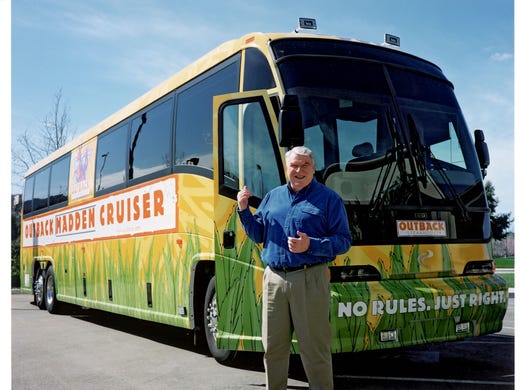
His love of food even led to a change in his mode of transportation: In 1987, Greyhound offered him the use of a customized bus, basically a hotel room on wheels. It became known as the Madden Cruiser, and he claimed it was the best way to see the country, especially since he could now do something that he couldn't do on the train: Take little side trips to anywhere, in search of just the right hot dog, just the right steak, just the right tacos, and so on. (Despite being a Minnesota-born Irishman, far from the tropics in both ways, he loved Mexican food.)

In 1998, he published John Madden's Ultimate Tailgating, discussing his favorite recipes, his favorite places to eat, and how food shapes the football-watching experience. It was the last of 6 books he wrote. He also did commercials for Miller Lite (when they had a baseball game, he was on the "Less Filling" team, in spite of his weight), Outback Steakhouse (which eventually sponsored the Madden Cruiser), Ace Hardware (leading their competitor True Value to hire Summerall), and "Tough Actin'" Tinactin, a fungicide used to treat athlete's foot.

His last broadcast for Fox was Super Bowl XXXVI, which may also have been the last time the New England Patriots were a lovable underdog. He moved to ABC, and paired up with Al Michaels for Monday Night Football. In 2006, Michaels and Madden moved to NBC for Sunday Night Football. John thus became the 1st person to call sporting events for each of American TV's "Big Four" networks (Michaels fell short because he's never worked for CBS), and became the 1st man to call a Super Bowl on 4 different networks. His last broadcast was Super Bowl XLIII on February 1, 2009, ending a 31-season career.

But there are millions of football fans who didn't watch his broadcasts, and may not even have known he was a coach. Because from 1988 onward, he sponsored EA Sports' Madden NFL football video game. He saw the game as a way for people who didn't know football to learn how the sport really works.

But this gave rise to the Madden Curse: A player who appeared on the box's cover before the new season would either have a bad year or be injured. The first real player to appear on the cover was Garrison Hearst in 1998. It didn't affect him: He set a San Francisco 49ers team record for rushing yards in a season.

The most notable example was Shaun Alexander, on the cover of Madden 07, released before the 2006 season. The season before, the running back had won the NFL's Most Valuable Player award, and helped the Seattle Seahawks reach their 1st Super Bowl, although they lost it. But after being on the cover, he suffered the first of a series of injuries that left him 547 rushing yards short of 10,000 for his career, and may be keeping him out of the Pro Football Hall of Fame. He doesn't blame the Curse, saying, "Do you want to be hurt and on the cover, or just hurt?"

John Madden was honored with 16 Emmy Awards, and election to the Bay Area Sports Hall of Fame and the California Hall of Fame -- the latter honoring people who have come from California and achieved fame in all walks of life. He is the only man honored by the Pro Football Hall of Fame with induction as a coach and as a recipient of their Pete Rozelle Award for media work.

Four days ago, on Christmas Day, the Fox Network aired All Madden, a documentary about him. Yesterday, December 28, 2021, John Madden died at his home in Pleasanton. He was 85 years old. After all his noise -- some of it cantankerous, much of it joyful -- his death appears to have been peaceful.

* Mike Tomlin, head coach of the Pittsburgh Steelers, winner of Super Bowl XLIII, John's last broadcast: John Madden was a true football man. RIP, Coach.

* Jerry Jones, owner of the Dallas Cowboys, perhaps forgetting about the existence of George Halas, but not too many others: I am not aware of anyone who has made a more meaningful impact on the National Football League.

* Vin Scully, who broadcast a few football games with him: I was saddened to hear about the passing of John Madden, at age 85. One the all-time greats, he showed me the ropes during our brief football partnership. He was always kind and delightful. He can now join his former partner, Pat Summerall, in calling Super Bowls in heaven.

* Lisa Olson, former NFL writer for the New York Daily News: Devastated. RIP to a legend, to a man who always returned a phone call, who was always gracious, who never hesitated to offer warm greetings or advice, our friend John MaddenBroken heart

* LeBron James, not a football guy: Rest in Paradise To the Goat John Madden!!!! Your legacy will continue to live on Infinity!!!!!

* Dan Rather, not a football guy despite coming from the football-mad State of Texas: Few approached life with the joy of legendary football coach & broadcaster John Madden. A colleague at CBS, he was a gentleman with a boisterous sense of humor. On the sidelines & in the booth, this voluble mountain of energy was a trailblazer. A golden era ends with his passing.

* Curt Menefee, anchor of Fox NFL Sunday: Just heard that the All Madden documentary will re-air in about an hour at 9p ET/6p PT on FS1. I love the fact that John Madden not only got to see it in full, but received all of the tributes from each participant and watched it with his family on Christmas Day. A living eulogy.

For the record, he appears not to have been related to the John Madden who played 13 seasons as a center in the NHL, including winning 2 Stanley Cups with the New Jersey Devils and another with the Chicago Blackhawks.

But Coach John Madden felt like family to all of us. He might be the one person in football who was beloved by fans of all 32 NFL teams. And he earned it, in many ways.

Wednesday, August 14, 2019

Top 10 Great Things About the AFL (& 3 Bad Things)

August 14, 1959, 60 years ago: The founding meeting of what was soon named the American Football League is held in Chicago. That city would not have a team in this league, the 4th to assume the name. (Previous AFLs operated in 1926, 1936-37 and 1940-41.)

The 8 founding teams that would begin play in September 1960 were, in alphabetical order:

* The Boston Patriots. With their move to suburban Foxborough, Massachusetts in 1971, they were renamed the New England Patriots.
* The Buffalo Bills. A team with that name had played in the All-America Football Conference from 1946 to 1949.
* The Dallas Texans. They were moved and renamed the Kansas City Chiefs in 1963. The team was owned by the League's founder, Lamar Hunt. Today, the AFC Championship trophy is named for him.
* The Denver Broncos.
* The Houston Oilers. They were moved to Memphis and renamed the Tennessee Oilers in 1997, moved to Nashville in 1998, and renamed the Tennessee Titans in 1999.
* The Los Angeles Chargers. They were moved to San Diego in 1961, and back to the Los Angeles market in 2016.
* The New York Titans. They were renamed the New York Jets in 1963.
* The Oakland Raiders. They were moved to Los Angeles in 1982, moved back to Oakland in 1995, and are now preparing to move to Las Vegas for the 2020 season.

In 1966, the AFL would add the Miami Dolphins. In 1968, it would add the Cincinnati Bengals. From 1966 to 1970, having made peace in their wild war with the established National Football League, the process of merging the 2 leagues into the modern NFL was undertaken.

The 1960s AFL was the most successful "rebel league" in U.S. sports history. You could argue that the NHL was, but it was an all-Canadian league at the start. In baseball, the National League wasn't really a "rebel league." The American League did get to make peace with the National League in 1902.
AFL Founder Lamar Hunt

But people didn't really think of "Major League Baseball" as a single entity at that time. It can be argued that MLB didn't become such an entity until the establishment of the Office of the Commissioner of Baseball in 1920, or even until 2000, when the AL and the NL were rendered team groupings only, with a single baseball and a single set of umpires for both Leagues.

Compare the number of teams that were absorbed into the established league:

* 1926 AFL: None.
* 1936-37 AFL: 1, the Cleveland (later Los Angeles) Rams.
* 1940-41 AFL: None.
* 1946-49 AAFC: 3, the Cleveland Browns, the San Francisco 49ers, and the original Baltimore Colts, who soon failed.
* 1960-69 AFL: 10, all of them.
* 1961-62 American Basketball League: None. It had 8 teams, including in 6 cities that didn't then have NBA teams. Cleveland, the San Francisco Bay Area and Washington would get NBA teams; Kansas City had one, but lost it.
* 1967-76 American Basketball Association: 4, the New York (now Brooklyn) Nets, the Denver Nuggets, the Indiana Pacers and the San Antonio Spurs. It had 12 franchises in all. Of these cities in which those teams played, the following now have NBA teams, in addition to the preceding: Charlotte, Dallas, Houston, Memphis, Miami, Minneapolis, New Orleans, Salt Lake City and Washington. Kansas City and San Diego got teams, but lost them.
* 1972-79 World Hockey Association: 4, the Edmonton Oilers, the original Winnipeg Jets (now the Arizona Coyotes), the Quebec Nordiques (now the Colorado Avalanche) and the Hartford Whalers (now the Carolina Hurricanes). Besides the preceding, the NHL would also put teams in Calgary, Cleveland (failed), the Miami area, New Jersey, Ottawa and Phoenix.
* 1974-75 World Football League: None. It had teams in 8 cities that did not then have NFL teams. Only 2 of those cities now have them: Charlotte and Jacksonville.
* 1983-85 United States Football League: None. It had teams in 10 cities that did not then have NFL teams. 3 of those cities would get NFL teams long-term: Baltimore, Jacksonville and Phoenix; 2 others would get them temporarily: Memphis and Oakland.
* 2001 XFL: None.
* 2019 Alliance of American Football: None.

*

Top 3 Bad Things About the AFL

3. The Patriots. Let's not forget that the bad things about the Patriots did not begin with Bill Belichick cheating. Patriot fans still whine about "The Ben Dreith Game," in the 1976 AFC Division Playoff against the Raiders. Dreith, considered one of the NFL's top referees -- he had been a referee for the AFL's entire existence -- was accused of making crucial calls against the Pats, or failing to make them against the Raiders. It got to the point where he wasn't allowed to officiate a game involving the Patriots again until the strike year of 1987.

There was team vice president Chuck Sullivan, son of owner Billy Sullivan, getting into a shoving match with some Raider players after beating them in the 1985-86 Playoffs, claiming, "We're just getting back for Jack Tatum, and all the crap that their football team has put on our football team over the years."

In 1988, a bankrupt Billy Sullivan sold the team to Remington razor company chairman Victor Kiam. In 1990, there was an incident in the locker room between Patriot players and sportswriter Lisa Olson, then of the Boston Herald. Kiam stood by his players (understandable, if wrong) with a rather vulgar statement about Olson (inexcusable). The controversy led him to sell the team to James Orthwein in 1992.

Orthwein wasn't much better. He tried to blackmail the City of Boston and the Commonwealth of Massachusetts into building him a new stadium to replace Foxboro Stadium, which was basically a 60,000-seat high school stadium in the suburbs halfway between the downtowns of Boston and Providence. If he didn't get it, he'd move the team. He played Boston and Baltimore off each other. A cousin of St. Louis Cardinals owner Augie Busch and a major stockholder in Anheuser-Busch, he played Boston and St. Louis off each other.

But it didn't matter whether the City or the State would have caved in, because the Sullivans lost the stadium and the land around it to a paper magnate, who wouldn't let the Pats out of their lease. In 1994, Orthwein sold the team to him. His name was Robert Kraft, and he still owns the team today.

He would also play Boston off Baltimore and St. Louis. But both of those cities got teams in the next couple of years. Finally, he cut a deal with Governor John Rowland of Connecticut to build what's now Pratt & Whitney Stadium in East Hartford. If the deal had gone through, he could have kept the "New England Patriots" name. But he was double-dealing, and Massachusetts gave him what he wanted to build a new stadium next-door to the old one, leaving Rowland and the Hartford area high and dry. (Rowland would later go to prison. Twice.)

All this, before Kraft hired Bill Belichick and drafted Tom Brady, and the cheating began. The Patriots were already a sickening franchise. Which segues into...

2. Al Davis. First, his record: 1950-51, offensive line coach at Adelphi University on Long Island; 1953, head coach of the football team at the Army's Fort Belvoir in the Virginia suburbs of Washington; 1954, scout for the Baltimore Colts 1955-56, offensive line coach at The Citadel in South Carolina; 1957-59, offensive line coach at USC; 1960-62, receivers coach for the Chargers; 1963-65, head coach of the Raiders; 1966, briefly Commissioner of the AFL; 1966-2011, general manager of the Raiders; 1966-71, part owner; 1972-2011, principal owner -- or, as he always called himself, the "managing general partner."

He was innovative, and he built an iconic team, with legendary characters like coach John Madden, Ben Davidson, Ken "the Snake" Stabler, Ted Hendricks (known as both "the Mad Stork" and "Kick 'em in the Head Ted"), Lester Hayes, John Matuszak, Lyle Alzado, and so on. However, not all the reasons that the team became iconic were good.

They were mean, to the point of the incident to which Chuck Sullivan referred: Raiders safety Jack Tatum hitting Patriots receiver Darryl Stingley into paralysis in 1978 -- in a preseason exhibition game. They were hopped up on all kinds of drugs, from cocaine to amphetamines to steroids. And team management, with Davis taking the lead, ignored their complaints of injuries, to the point where some of them were hopelessly crippled as they got old -- if they lived long enough to get old.

And then there were the fans, in their costumes, some playing off the Raiders' "pirate" image. Darth Vader masks have been common since Star Wars came out in 1977. But some fans dress like biker gang members -- slightly appropriate, as Oakland is the birthplace of the most famous motorcycle gang of them all, the Hell's Angels. (The titular gang in the TV show Sons of Anarchy operated out of the fictional town of Charming, said to be in California's Central Valley, which includes Sacramento and Fresno, which could be considered Raider territory.)

A visit to a Raider home game can be truly scary, in ways that Americans usually don't see unless they go to certain stadiums in European or South American soccer. Al Davis never denounced such things. By remaining silent on the matter, he gave this behavior his tacit approval. He wanted people, especially opposing teams, to be scared of the Raiders.

And, of course, Davis moved the team from Oakland to Los Angeles in 1982, and back in 1995, and was threatening to move again when he died in 2011. His son Mark Davis is now in the process of moving them to Las Vegas. It's bad enough that the Raiders pissed their loyal hometown of Oakland off once, but now, they're doing it again. I guess the crabapple didn't fall far from the tree.
"Just win, baby." He didn't care how.

1. The Spectacle of the Super Bowl. It's just too much. Whereas certain competitions used to call their finale, officially or otherwise, "the World Series of (our game)," such as golf and poker, now, a big event is called "the Super Bowl of (it)," to the point where the Daytona 500, usually held a weekend or two after the Super Bowl, has led NASCAR fans to say their season starts with "our Super Bowl."

People speculate about not just the participants, but the National Anthem singer and the halftime show performer, of the Super Bowl -- before the exhibition season even starts. And winning the Super Bowl has become so important that the aforementioned John Madden has said, "The biggest difference in sports is between the team that wins the Super Bowl and the team that loses it. The team that loses it feels worse than the teams that didn't even make it." He was an assistant coach when the Raiders lost Super Bowl II, and the head coach when they won Super Bowl XI, taking 9 years to get back to the big game and win it. So he knew.

And if it hadn't been for the AFL, the NFL's championship game would have remained simply that: "The National Football League Championship Game." It might now be hyped beyond what Frank Gifford or Johnny Unitas or Paul Hornung experienced when they played in it, but it wouldn't be THE SUPER BOWL, America's secular high holy day.

*

However, it is worth it to mention:

Top 10 Great Things About the AFL

Honorable Mention. Tailgating at Arrowhead. Okay, technically, I can't include this one in the Top 10, since Arrowhead Stadium didn't open until 1972, after the merger. But it's been said that, if you go to a Kansas City Chiefs home game, you can smell the parking lot before you can see the stadium. And that's a good thing. All that barbecue.

Honorable Mention. The Two-Point Conversion. The AFL used it, the NFL didn't. College football had adopted it in 1958. The World Football League, which played in the 1974 and '75 seasons, used it. The Canadian Football League adopted it in 1975. The United States Football League used it in the 1983, 1984 and 1985 seasons. Finally, the NFL adopted it in 1994.

10. The Myth of Broadway Joe. Joe Namath's career completion percentage was 50.1. His passer rating was 65.5. He threw a lot more interceptions (220) than touchdown passes (173). Only once, in 1972, did he lead his league (either the AFL, 1965 to 1969, or the NFL, 1970 to 1977) in touchdown passes.

In 13 seasons, only twice did he make the Playoffs, appearing in only 3 Playoff games, winning 2. In other words, Joe Namath may have been one of the most exciting figures in sports in the LBJ and Nixon years, but he wasn't that great of a quarterback. There was more sizzle than steak. The myth far exceeds the man.

But there is good reason for that myth. The 2 postseason games he won were the 1968 AFL Championship Game and Super Bowl III. The fact that he did it in New York made it bigger. And while he wasn't huge, stat-wise, he was doing what he did on not 1 but 2 bad knees. His courage allowed him to fight on when it might have been better to ask out of the game. Instead, he won games the Jets probably should have lost.

Broadway Joe Namath was an icon of cool, and, if only once, an icon of victory. His 1 Super Bowl appearance, a win, carries more weight than Tom Brady's 9 appearances and 6 wins -- even if you foolishly believe Brady did all that fair and square.
9. Buffalo Wings. Baseball gave American cuisine hot dogs and Cracker Jack. Football gave it Buffalo-style chicken wings. It all started in 1964, at the Anchor Bar, at 1047 Main Street at North Avenue, not far from the since-demolished War Memorial Stadium, where the Bills were on their way to the 1st of back-to-back AFL Championships.

Its proximity to "the Old Rockpile" made it a good stopover after Bills games. It was there during the 1964 season that the son of the couple who owned it brought some hungry friends over on a Friday night (not a game night), but all his mother had left in the kitchen was chicken wings, a part of the chicken not traditionally eaten up to that point. So she boiled them, made up a spicy sauce, and glazed the wings with the sauce. The boys couldn't get enough of them. Buffalo sauce and Buffalo wings were born. The bar is still in the family.
It all started here.

8. The Redemption of Old War Horses. The AFL gave guys who got pushed out of the NFL a 2nd chance. George Blanda had been dumped as quarterback of the Chicago Bears, but the Oilers took him, and he led them to the 1st 2 League titles, in 1960 and 1961. He then went on to the Raiders, helping them reach Super Bowl II, and showed remarkable longevity, starting at quarterback in the NFL at 43, and both playing that position and kicking field goals at 48.
George Blanda, the oldest "old war horse" in NFL history

Similarly, Tobin Rote, who had filled in for an injured Bobby Layne and led the Detroit Lions to the 1957 NFL Championship, was let go, but took over for an injured John Hadl and led the Chargers to the 1963 AFL Championship.

Johnny Unitas, Jack Kemp and Len Dawson were all cut by the Pittsburgh Steelers. Unitas quarterbacked the Baltimore Colts to NFL glory. Kemp led the Bills to the 1964 and 1965 AFL Championships. And Dawson did it for the Texans/Chiefs in 1962, 1966 and 1969, including losing Super Bowl I and winning Super Bowl IV. Okay, none really fit the pattern -- Unitas did it in the NFL, Dawson was just 27 in 1962, and Kemp was 29 in 1964 -- but the AFL did give Dawson and Kemp the second chances they deserved.

Let's not forget Paul Brown: The man who moved football offense into the modern era as head coach of the Cleveland Browns had been fired in 1962. In hindsight, it was a good idea, as the Browns won the NFL Championship just 2 years later. But Brown became owner, general manager, and head coach of an AFL expansion team, the Cincinnati Bengals, in 1968. By 1970, the 1st season after the merger, he had not only won the AFC Central Division, but beaten out the Browns to do it.

He eventually lived long enough to see the Bengals win 2 AFC titles, but lost Super Bowls XVI and XXIII. Both times, it was to the San Francisco 49ers, coach by one of his former assistants, Bill Walsh. The 2nd time, the Bengals' coach was their 1st quarterback, who got his chance through Brown: Sam Wyche.
Paul Brown and Sam Wyche

7. Horses. Several college football teams have horses and riders as part of their pageantry, most notably USC with Traveler. The AFL frequently tried to appeal to the college football fan by doing things associated with the college game, like mascots (live and otherwise) and bands.

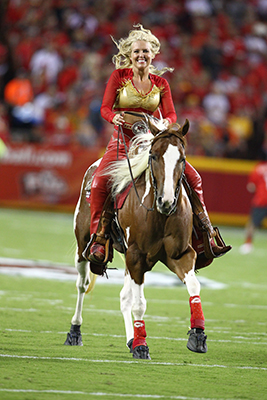
The Chiefs had a mascot, a horse named Warpaint, who was ridden around the field before every game and after every Chief touchdown, by Bob Johnson, who wore full Indian regalia, including a headdress. The current version, Warpaint III, is ridden by a Chiefs cheerleader, not wearing Native American regalia. Warpaint is also the name of the team's weekly game program.
Susie Derouchey aboard Warpaint III

Not to be outdone, the Broncos, as you might expect, also have a live horse mascot, Thunder, ridden onto the field before every game by Ann Judge-Wegener, leading the team on behind them, including their man in a horse costume, Miles (for the Mile High City).
6. The Rivalries. The ones the Jets had with the Dolphins and Patriots came later, but the one they had with the Raiders, hoo, boy.

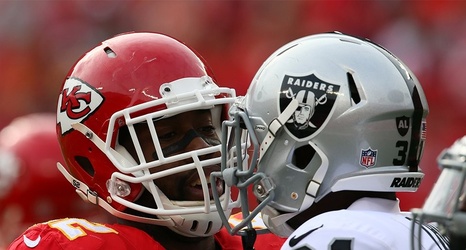
The ones the Raiders had with the Jets, Dolphins, Patriots and Chargers would come later, but the one they had with the Chiefs became intense in the late 1960s, and remains so today. The Chiefs (as the Dallas Texans) founded the AFL, but the Raiders came to define it.
"You hate me and I hate you!"
"So at least we understand each other."

5. Making Minor-League Cities Major. Buffalo. Houston. San Diego. Oakland. Denver. A little later, Miami. Before the AFL, none of these cities had a major league team in any sport. By 1971, each had had an NBA team. By 1993, all but Buffalo had an MLB team. By 1974, all had had either an NHL or a WHA team.

(UPDATE: Buffalo still hasn't had a permanent major league baseball team -- upper- or lower-case -- since 1915, and if you don't count the Federal League, not since 1885. But the COVID epidemic forced the Toronto Blue Jays out of Canada, and they had to play "home games" in Buffalo in 2020 and 2021, until the restrictions were lifted.)

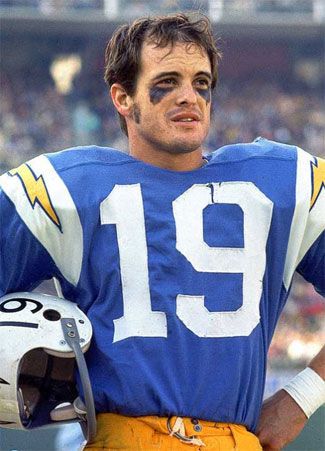
4. The Charger Uniforms. It's not just the lightning bolts on the helmets. From 1960 to 1973, they wore jerseys that had been called "collegiate blue" (probably a reference to UCLA, with whom they shared the Los Angeles Coliseum in 1960), "electric blue" (which matched the "charger" theme) and "powder blue" (which is what it usually gets called today).
Lance Alworth, the AFL's greatest receiver,
wearing the original version

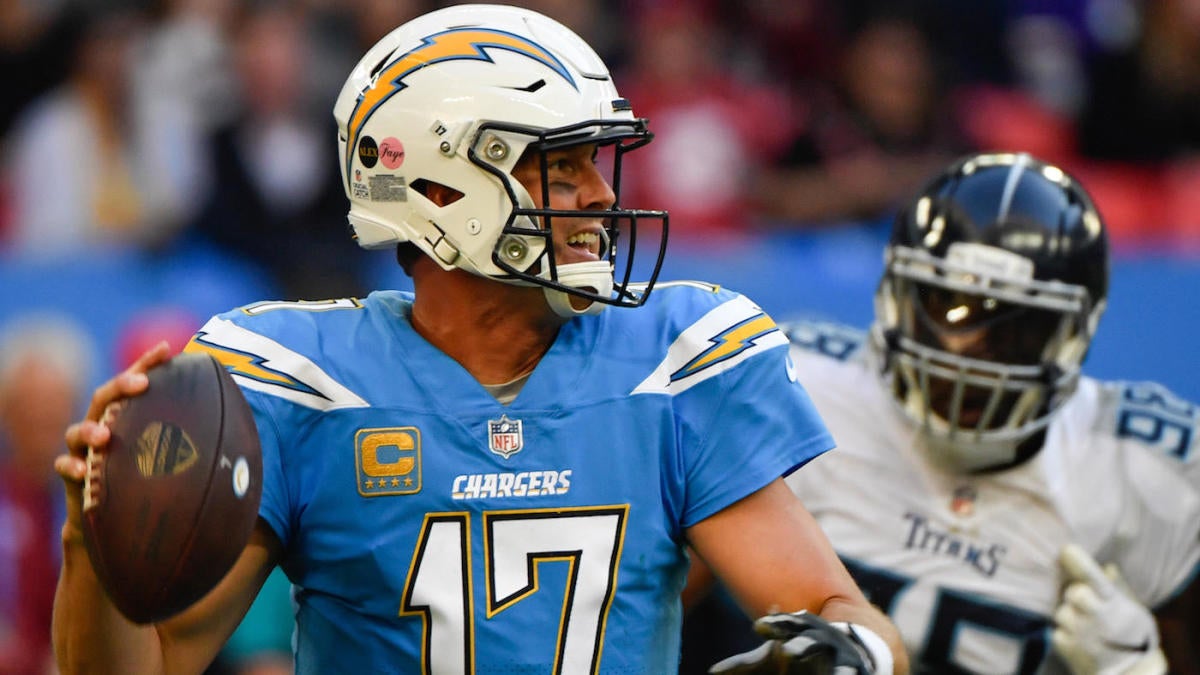
In 1974, they switched to dark blue jerseys and helmets. In 1978, they became one of a few teams that preferred to wear white jerseys at home, and it did look better. (In my opinion, this is also true for the Washington Redskins and the Dallas Cowboys.) They went back to dark blue at home in 1984, occasionally wore powder blue as "throwback uniforms" for a few years, and have announced that, in 2019, their 60th season, they will be wearing powder blue as their regular home color. They have also gone back to the white helmets.
Philip Rivers wearing the current version

3. John Madden. Before he became the video game guy, before he was the great commercial pitchman, before he was the best TV analyst the sport has ever known, he was a great coach. Coaching the Raiders from 1969 to 1978 (and the 2 seasons before that as linebackers coach), he went 112-39-7, including the Playoffs.

In 10 seasons, he never won fewer than 8 games (and they played 14 games a season until 1978, his last, when it became 16), won 7 AFL or AFC Western Division titles, reached 7 AFL or AFC Championship Games, and won Super Bowl XI in the 1976-77 season.

He kept his team loose by understanding them. He had one rule: Be on time. Other than that, he didn't care what you were like off the field. The players were grateful, and respected him. Even if they didn't always understand him: Once, during a tough game, he told them, "Don't worry about the horse being blind: Just load the wagon!"
The Coach and his Outback Steakhouse-sponsored
customized Madden Cruiser bus

Madden is still alive, at age 83, and does a talk show on San Francisco radio station KCBS. In one of the great ironies of American public life, while he hasn't gotten on an airplane since a panic attack on a flight in 1979, his wife Virginia -- they are approaching their 60th Anniversary as well -- is a licensed pilot.

(UPDATE: John Madden died on December 28, 2021, at 85. He might have been the only human being who was beloved by fans of all 32 teams.)

2. The Passing Game. The big argument against the NFL in the 1960s was that it was "too boring," "too conservative." How could anyone say that about a league that had Johnny Unitas, Bart Starr, Sonny Jurgensen and the young but already scrambling Fran Tarkenton?

Easy: Because, for all its T-formation passing opportunities, the NFL was still a run-first league, following the advice of Ohio State coach Woody Hayes: "There are three things that can happen when you throw the football, and two of them are bad," meaning an incompletion or an interception.

The AFL needed fans. And it needed TV viewers. How to get them? Put the ball in the air, and let the chips fall where they may. When Joe Namath said, before Super Bowl III, that there were 4 or 5 quarterbacks in the AFL better than Earl Morrall of the Colts, he wasn't just blowing smoke: The Jets had Namath, the Chiefs had Dawson, the Bills had Kemp, the Chargers had Hadl, and the Raiders had Blanda and Daryle "the Mad Bomber" Lamonica.

By the end of the 1970s, the passing-defense rules had been changed. In the 1980s, the NFL became like the 1960s AFL.

1. The Community of the Super Bowl. Did I say it was "America's secular high holy day"? Yes, I did. It brings people together, to cheer on a great team, or maybe to boo an undeserving one.
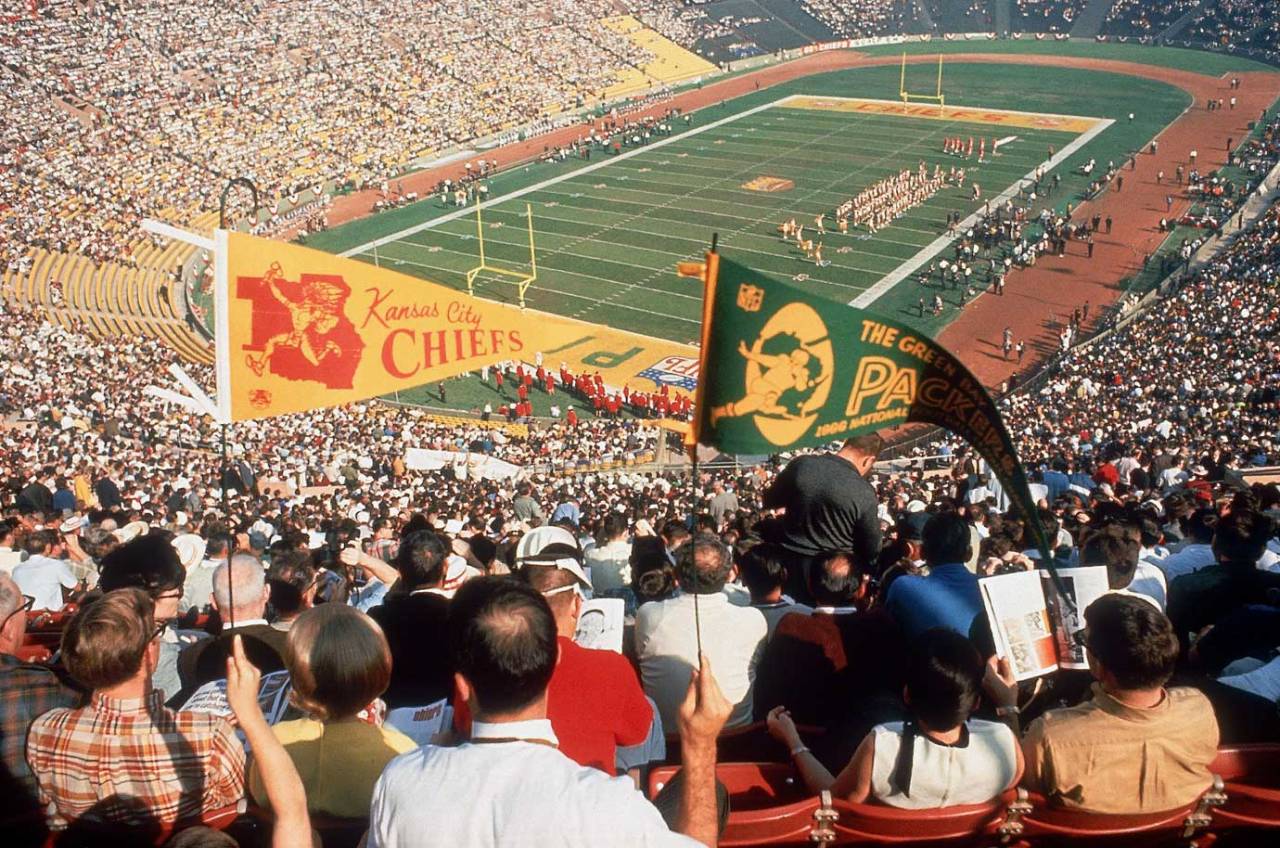
Fans with Chiefs and Packers pennants in the end zone
of the Los Angeles Memorial Coliseum,
Super Bowl I, January 15, 1967

And it all began because the AFL wanted to prove it was as good as the NFL. Well, by September 1970, there was only the NFL -- but it was better than it was before, because of the AFL.