Showing posts with label oakland raiders. Show all posts

Sunday, January 4, 2026

January 4, 1976: George Blanda: The NFL's Oldest Player

January 4, 1976, 50 years ago: The Pittsburgh Steelers beat the Oakland Raiders, 16-10 at Three Rivers Stadium in Pittsburgh, in the AFC Championship Game. The Raiders' George Blanda attempted an extra point, and made it; and attempted 2 field goals, making 1.

Two weeks earlier, in the Raiders' last regular-season game, a win over the Kansas City Chiefs at the Oakland Coliseum, Blanda threw 3 passes in relief of starting quarterback Ken Stabler, completing 1, for 11 yards.

The fact that Blanda was playing at all, never mind completed a pass, was extraordinary. He was 48 years old.

George Frederick Blanda was born on September 17, 1927 in Youngwood, Pennsylvania, outside Pittsburgh. He played at the University of Kentucky, the 1st renowned quarterback to play for future Alabama icon Bear Bryant, and was drafted by the Chicago Bears in 1949. In 1950, he succeeded Hall-of-Famer Sid Luckman as the Bears' starting quarterback, and remained in that spot through the 1958 season.

He was not particularly notable in the position. In 1953, he led the NFL in both attempts and completions. In 1954, he led in passing yards per game. In 1955, he led in field goal percentage. In 1956, he got the Bears to the NFL Western Division title, but they got clobbered by the New York Giants in the NFL Championship Game. He retired after the 1958 season, and he seemed destined to be a footnote in the history of professional football.

But the founding of the American Football League in 1960 changed a lot of things. He was coaxed out of retirement to become the quarterback for the Houston Oilers, and he led them to the AFL Championship in 1960 and 1961, and got them back into the AFL Championship Game in 1962. He was named AFL Player of the Year in 1961, a season that included his longest field goal: 55 yards.

In 1967, at the age of 40, he was traded to the Oakland Raiders, where he became the backup to Daryle Lamonica. The Raiders won the AFL Championship that season. He played for the Raiders until 1975, and only started 1 game for them, but he stayed on the roster because he was still one of the most accurate placekickers in the game. In 9 seasons with the Raiders, he attempted 250 extra points, and missed only 3; and he made 62.7 percent of his field goal attempts. Even in his last season, he made 13 out of 21.

Between the NFL and the AFL, he passed for 26,920 yards, which doesn't sound like much now, but was a big total for the time. He threw considerably more interceptions than touchdowns (277 to 238), but that wasn't surprising for a quarterback who debuted in the 1940s. He kicked 335 field goals, for 1,005 points; and kicked 943 extra points. He also ran 9 touchdowns in from the quarterback position, for 54 points. This gave him 2,002 points for his career, making him the NFL's 1st 2,000-point man.

In 2026, 50 years after his last game, he still ranks 7th all-time. The current all-time leader is Adam Vinatieri, with 2,673 points. However, Blanda's 238 touchdown passes means he had a hand in 3,430 points -- and that's before you factor in how many field goals his teams scored as a result of the drives he led. For the sake of perspective: Tom Brady has passed for 649 touchdowns, which accounts for 3,894 points.

Blanda still ranks 5th all-time with 340 games played. (Morten Andersen leads with 382.) His 335 field goals has long since been surpassed. (Vinatieri leads with 599.) But his 26 seasons, his playing at age 48, and his 943 extra points made are still all-time records. A few players, mostly backup quarterbacks and placekickers (and Blanda was both), have played at 46, but Blanda remains the only one to play at 47, or 48. He and John Carney, who kicked for several teams from 1987 to 2010, are the only men to have played in the NFL in 4 different decades.

On January 20, 1976, 16 days after Blanda's last game, the ABC sitcom Happy Days, which took advantage of the 1950s nostalgia wave, aired an episode with Richie Cunningham (played by Ron Howard) and Ralph Malph (Donny Most) watching a game on television. It was December 9, 1956, and the Chicago Bears were playing the Chicago Cardinals at Wrigley Field.

Ed Brown, playing quarterback for the Bears, threw an interception. Richie said he wanted the other quarterback put in. Ralph said, "He's washed up. He's old. He's 30. He's got no future." Richie said, "George Blanda has 2 or 3 good years left." The Bears won the game, 10-3.

Blanda was elected to the Pro Football Hall of Fame in 1981, his 1st year of eligibility. He was retroactively named to the AFL All-Time Team. He died on September 27, 2010, a few days after his 83rd birthday.

*

January 4, 1976 was a Sunday. Also that day, the NFC Championship Game was played, and the Dallas Cowboys beat the Los Angeles Rams, 37-7 at the Los Angeles Memorial Coliseum. The Steelers went on to beat the Cowboys in Super Bowl X. 

Friday, December 23, 2022

December 23, 1972: The Immaculate Reception

Note: When I wrote this, months in advance, I had no idea that Franco Harris would die just 2 days before the anniversary. By all accounts, he seemed to be in good health for his age.

December 23, 1972, 50 years ago: The Pittsburgh Steelers play their 1st Playoff game, in their 40th season. And for most of the game, it wasn't looking good.

They began play in 1933, with Art Rooney having founded them. But Art's love of football far exceeded his knowledge of it. In 1947, they finished in a 1st place tie in the NFL Eastern Division with the Philadelphia Eagles, and lost a playoff. To this day, the NFL does not recognize this as an official Playoff game.

Finally, after a 1-13 season in 1969, Art's sons, Dan and Art Jr., told dear old Dad to let them run the team from now on. And in just 3 seasons, they had built the team into AFC Central Division Champions.

Al Davis ran the Oakland Raiders, and had built them into AFL Champions in 1967. But they lost Super Bowl II, then lost the 1968 AFC Championship Game to the New York Jets. By 1972, they were dominating the AFC Western Division, but hadn't won a Super Bowl yet.

And so, on Saturday afternoon, December 23, 1972, Davis' Silver and Black marched into Three Rivers Stadium in Pittsburgh to face the Rooneys' Black and Gold. For a game with such an epic ending, it was not good theater most of the way. The 1st half ended scoreless. Roy Gerela kicked a field goal early in the 2nd half, but it remained 3-0 at the end of the 3rd quarter. Gerela kicked another field goal early in the 4th quarter, but the Steelers couldn't put the ball in the end zone, so it remained 6-0 as the clock wound down.

Daryle Lamonica, known as the Mad Bomber, struggled in the 1st half, and coach John Madden replaced him with Ken Stabler, the Alabama lefthander known as the Snake. With 1:17 to go, Stabler ran for 30 yards to get into the end zone. George Blanda, the Raiders' ageless backup quarterback and regular kicker, nailed the extra point, and the Raiders had a 7-6 lead.

The Steelers did not yet have a reputation as the kind of team that could win this kind of game. And Pittsburgh fans, who had seen the Pirates win the World Series the year before, were not used to glory from their football team. The 50,327 fans inside Three Rivers figured the game was lost.

Among them was Art Rooney. "The Chief" his suite and got into an elevator, to go down to the locker room to congratulate the Raiders and console his team. So he never saw the play that changed the course of his team's history.

Quarterback Terry Bradshaw, who had been the top pick in the 1970 NFL Draft, had a difficult relationship, not just with head coach Chuck Noll, but with the Pittsburgh fans. He hadn't yet lived up to their hopes. Now, he had gotten the Steelers to their own 40 yard line. But it was 4th and 10, and there were only 22 seconds left, and the Steelers had no time-outs left.

Noll's intended play was "66 Circle Option," intended for Barry Pearson, a rookie who had been on the Steelers' bench all season long without being sent into a game. Now, he was -- his 1st professional play.

But just as no battle plan survives the first shot, Noll's play didn't last. Raiders Tony Cline and Horace Jones bore down on Bradshaw, and "the Blonde Bomber" from Louisiana had to scramble. He just got a throw off before getting clobbered by Cline and knocked to Three Rivers' artificial turf.

The ball got to the Raiders' 33-yard line, and it looked like Steeler running back John "Frenchy" Fuqua was going to catch it. But Raider safety Jack Tatum did what he so often did to potential receivers: He leveled him.

Big mistake: As with so many dirty soccer players, Tatum should have gone for the ball, not the opposing player. He could have intercepted it. Instead, the ball bounced off him, and went backwards to the Raider 43. And it almost hit the ground.

And for 49 years, the Raiders and their fans have insisted that the ball hit Fuqua first, which, under the rules of the time, would have made every Pittsburgh player an ineligible receiver. And they have insisted that the ball did hit the ground.

It didn't. Franco Harris, the Steelers' half-black, half-Italian rookie running back out of Penn State, saved it, and took off down the left sideline, and scored. It was 3:29 PM -- don't bet any Steeler fan old enough to remember.

Steeler radio announcer Jack Fleming said, with only slight exaggeration, "From out of nowhere came Franco Harris, riding a white stallion, heading up Franco's Italian Army, galloping into the sunset!"

Like Rooney, Bradshaw didn't see the play. He remembered being down on the ground, and hearing a tremendous roar going up: "I knew that this was a good sound. This was the sound of something good happening."

Fans came pouring onto the field, and had to be cleared, because there was still an extra point to kick, which Gerela did, and 5 seconds to play. The Raiders could do nothing with the ensuing kickoff, and the Steelers had won, 13-7.

Those '72 Raiders still insist they were robbed. It would take until the 1976 season for them to win a Super Bowl. But the Steelers didn't win immediately, either: This was the season in which the Miami Dolphins went undefeated. Eight days later, they came into Three Rivers -- at the time, home-field advantage for Conference Championships was on a rotating basis, not decided by record -- and beat the Steelers, on their way to winning Super Bowl VII.

But the Steelers would win Super Bowls IX, X, XIII and XIV. Harris was named the Most Valuable Player for IX, receiver Lynn Swann for X, and Bradshaw for XIII and XIV. The Raiders would win Super Bowls XI, XV and XVIII.

The catch became known as "The Immaculate Reception." What Art Rooney, a devout Irish Catholic, thought about that, only he knew. Others, noting that it was 2 days to Christmas, called it a Christmas Miracle.

But, along with Alan Ameche's overtime plunge to win the 1958 NFL Championship Game for the Baltimore Colts, Bart Starr's quarterback sneak to win the 1967 Championship Game (the Ice Bowl), and Dwight Clark's "The Catch" from Joe Montana to win the 1981 NFC Championship Game, it ranks as perhaps the greatest play in NFL history.

Another NFL Playoff game was played that day, with the Dallas Cowboys beating the San Francisco 49ers in another classic, 30-28 at Candlestick Park in San Francisco.

The next day, Christmas Eve, the Washington Redskins beat the Green Bay Packers, 16-3 at Robert F. Kennedy Stadium in Washington. And the Miami Dolphins beat the Cleveland Browns, 20-14 at the Orange Bowl in Miami.

The following week, New Year's Eve, saw the Conference Championships: Dolphins 21, Steelers 17 at Three Rivers; and Redskins 26, Cowboys 3 at RFK Stadium. On January 14, 1973, at the Los Angeles Memorial Coliseum, the Dolphins completed their undefeated season, beating the Redskins, 14-7 in Super Bowl VII.

Wednesday, December 29, 2021

John Madden, 1936-2021

John Madden was a big man who looms large in the history of the National Football League.

John Earl Madden was born on April 10, 1936, in Austin, Minnesota, near the Iowa State Line. This is Big Ten Country, but when he was young, his father moved the family to Daly City, just south of San Francisco, and so John always considered himself a West Coast guy.

He went to Thomas Jefferson High School in Daly City, and then to California Polytechnic State University in San Luis Obispo. He was a catcher on their baseball team, and a tackle, both offensive and defensive, on their football team. At both Jefferson and Poly, he was a teammate of his neighborhood friend, John Robinson, who went on to coach at both the University of Southern California and the Los Angeles Rams.

He was drafted by the Philadelphia Eagles in 1959. But, having already injured one knee in high school, he injured the other knee in training camp, and that was the end of his playing career. He would not get to be on the Eagles team that won the 1960 NFL Championship.
That team was quarterbacked by Norm Van Brocklin, the Hall-of-Famer who went on to become the 1st head coach of the Minnesota Vikings, and the 2nd of the Atlanta Falcons. John remembered walking into the locker room on crutches, and seeing Van Brocklin looking at football film. Van Brocklin said, "Hey, Red, come watch with me."

They studied film together, and, John said, that's when he became a coach. Oddly, Van Brocklin wasn't a very good coach, although he never really had the horses.

In 1960, John got a job as an assistant coach at Allan Hancock College in Santa Maria, California, outside Santa Barbara. He became head coach in 1962. In 1963, he was hired as an assistant at San Diego State University, under Don Coryell, who would later coach the San Diego Chargers and engage in some memorable AFC Western Division battles with Madden.

In 1967, Oakland Raiders owner Al Davis hired him to be linebackers coach. They won the AFL Championship, losing to the Green Bay Packers of Vince Lombardi in Super Bowl II. A year later, John Rauch resigned, and Madden was named his successor as head coach. At 32, he was the youngest non-playing coach in pro football history. (Several early coaches ran their teams while still playing for them.)

Davis, who was also the Raiders' general manager, built a team in his image. Nasty. Sometimes weird. Someone once compared them to "the Island of Misfit Toys" in the 1964 Christmas special Rudolph the Red-Nosed Reindeer. But with Davis running the organization, and Madden running the team, they built a record that made them one of professional football's iconic franchises. They inspired NFL Films head Steve Sabol to write a poem, which he showed to Davis, who loved it, saying, "This is what the Oakland Raiders are all about." It concludes:

The Autumn Wind is a Raider
pillaging just for fun.
He'll knock you 'round
and upside-down
and laugh when he's conquered and won.

John Madden seems, from current perspective, to be too nice a guy to coach the Raiders. That's misleading: He was the perfect guy to coach that team -- and, maybe, only that team. Most coaches in those days acted like domineering fathers. He was more like the cool older brother, who would teach you things that Dad wouldn't teach you. The players related to him: White and black, urban and rural, the straight-laced and the party animal, the merely mischievous and the truly dirty.

He gave his players one rule, and only one: "Be on time." He liked to say, "Wearing a tie on the team flight never won a game." That gave them a freedom that most coaches wouldn't give. He coached them for 10 seasons, never finishing lower than 2nd in the AFC West. He won the Division in 1969 (the last season of the old AFL West), 1970, 1972, 1973, 1974, 1975 and 1976. He reached the AFL or AFC Championship Game in 1969, 1970, 1973, 1974, 1975, 1976 and 1977.

In 10 seasons, he went 103-32-7. Not only did he become the 1st coach ever to win 100 games in as few as 10 seasons, but his .763 winning percentage is the highest in NFL history, slightly higher than Lombardi's .738. He was the Light Side of the Raider Force, Al Davis was the Dark Side, and, together, they built something that wasn't always good, but it was always must-see TV, long after John left for the broadcast booth.

But the Raiders had difficulty winning big games. In 1968, his last year as an assistant, they beat the New York Jets in a regular-season game remembered as "The Heidi Bowl," but lost the AFL Championship Game to the Jets. In 1969, they lost the AFL Championship Game to the Kansas City Chiefs. In 1970, the 1st post-merger season, they lost the AFC Championship Game to the Baltimore Colts.

They missed the Playoffs in 1971. In 1972, they thought they had the Pittsburgh Steelers beaten in a Divisional Playoff, before a play known as "The Immaculate Reception." Various Raiders insisted that the play was illegal for various reasons: The pass hit Frenchy Fuqua, not Jack Tatum, therefore all Steeler players were ineligible receivers; Franco Harris caught the ball when it was on the ground, therefore it was an incomplete pass; and Phil Villapiano was illegally blocked by John McMakin, therefore the ball should have been placed at the spot of the foul, and then 5 yards marked off, negating the touchdown.

It's been nearly half a century. Every piece of footage of the play that has ever been found has proven that the ball hit Tatum, and never hit Fuqua. Every piece of footage found shows McMakin's block was legal. And no piece of footage found has yet shown the ball hitting the ground as Harris caught it. Still, Madden said he would never get over the play: "No matter how many times I watch the films of the Immaculate Reception play, I never know for sure what happened."

The Raiders lost the 1973 AFC Championship Game to the Miami Dolphins. In 1974, they dethroned the 3-time defending AFC Champion Dolphins in a wild game at the Oakland Coliseum that became known as "The Sea of Hands," but lost to the Steelers again in the AFC Championship Game. They lost to the Steelers again in the 1975 AFC Championship Game.

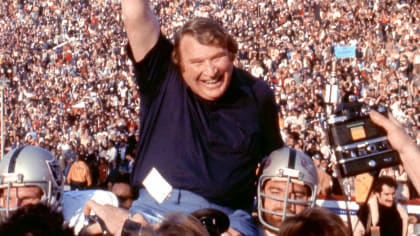
Finally, in 1976, after a 13-1 regular season, and a controversial Playoff win over the New England Patriots, they beat the Steelers, and advanced to Super Bowl XI. Once that stumbling block was removed, the last remaining game must have seemed like a piece of cake, because, on January 9, 1977, they dominated the Minnesota Vikings, 32-14. John Madden was carried off the field at the Rose Bowl by his players.

John's best friend while growing up in Daly City was John Robinson. Exactly 8 days earlier, Robinson led USC to victory in the Rose Bowl game on that very same field. Robinson had spent the 1974 season as the Raiders' running backs coach.

Madden got the Raiders back to the AFC Championship Game in 1977, but lost to the Denver Broncos. After missing the Playoffs with a 9-7 season in 1978, he resigned, citing an ulcer, and what would now be called "occupational burnout."

Tom Flores -- who succeeds John as the earliest living head coach to win a Super Bowl -- took control, and led them to wins in Super Bowls XV and XVIII. Super Bowl XV was played in New Orleans, and Flores followed the Madden model: Leave the players alone, and let them enjoy themselves.

Dick Vermeil, another Northern California guy, who got the Philadelphia Eagles there, was concerned that his players would misbehave in that most misbehaving of American cities, and kept them on a short leash. The considerably looser Raiders won big, and, 2 years later, Vermeil, himself a relatively young coach at the time, quit, calling himself "burned out." Oddly, like Madden, he went into broadcasting. Unlike Madden, he went back into coaching -- and won a Super Bowl with the St. Louis Rams.

*

Between realizing that his playing career could not continue, and deciding to become a coach, John Madden married Virginia Fields in 1959. In Pleasanton, California, in the East Bay near Oakland, they raised 2 sons, both of whom played Ivy League football: Joseph at Brown University, and Michael at Harvard.

Within a year of his marriage, the Cal Poly team plane crashed. John Robinson, then still a player at Cal Poly, was on that plane, and remarked that he was the dividing line: Everybody behind him lived, and everybody in front of him died. Madden lost friends as a result of that crash, and was afraid of flying thereafter. He endured it until 1979, when, in his 1st year as a game analyst for CBS Sports, he had a panic attack while flying back from covering a game in Tampa. He said he never flew again. Ironically, Virginia became a licensed pilot. But John never flew with her.

So from the 1980 season onward, he took Amtrak to the cities where he would cover the games. CBS, knowing they had a valuable commodity, accommodated this. One of the commercials he did for Lite Beer from Miller (as Miller Lite was then known) reflected this.

In 1981, after 2 years as a backup analyst, CBS paired John up with their Number 1 NFL play-by-play man, former New York Giants tackle Pat Summerall. They remained CBS' top team through the 1993 season, when CBS lost their share of the NFL's TV contract, and Fox gained it. The honchos at Fox Sports were no dummies: Their first hires were Pat and John, and they remained together through the 2001 season. Fox paid John more than any team paid any player. It was worth it: He may have been the greatest ambassador the NFL has ever known.
Years before former basketball coach Mike Fratello became known as "The Czar of the Telestrator," John Madden pioneered its use in TV broadcasts. He tended to draw a defensive player's path to a ballcarrier, and then, on impact, yell, "Boom!"

At the end of the 1984 season, he announced what he called "The All-Madden Team." For Fox's broadcast of Super Bowl XXXI in 1997, he announced an All-Time All-Madden Super Bowl Team, honoring the game's 1st 30 years. For their broadcast of Super Bowl XXXIII in 1999, he announced an All-Madden All-Millennium Team, honoring the greatest players of the last 1,000 years. (The NFL was only in its 79th season.) In his 1994 book All Madden, he explained:

What does it mean to be "All-Madden"? It's a whole range of things. For defensive linemen and linebackers, it's about Jack Youngblood playing with a busted leg, Lawrence Taylor wreaking havoc on the offense, and Reggie White making the other guy wish he put a little more in the collection plate at church. It's about a guy who's got a dirty uniform, mud on his face and grass in the ear hole of his helmet.

Because of his fear of flying, Madden never broadcast the Pro Bowl from Hawaii. Nor did he do any overseas games, such as the preseason exhibitions the NFL sometimes did in London. But he broadcast 12 Super Bowls.

And he loved doing Thanksgiving Day games from Detroit or Dallas. He brought a "turducken": A chicken stuffed inside a duck stuffed inside a turkey, and he would would present a turkey leg to the game's most valuable player. One year, he realized the real MVP was the Dallas Cowboys' offensive line, and he couldn't give 5 men 2 turkey legs. So, the next year, he brought what he called a "nuclear turkey," a bird with 8 drumsticks.
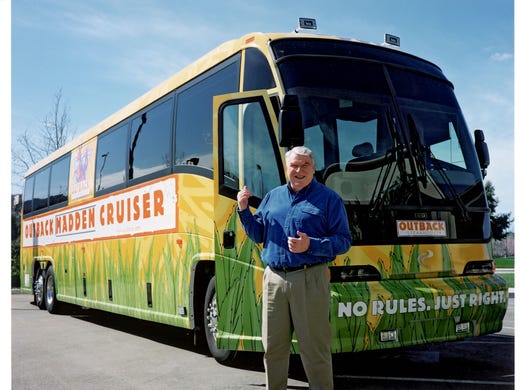
His love of food even led to a change in his mode of transportation: In 1987, Greyhound offered him the use of a customized bus, basically a hotel room on wheels. It became known as the Madden Cruiser, and he claimed it was the best way to see the country, especially since he could now do something that he couldn't do on the train: Take little side trips to anywhere, in search of just the right hot dog, just the right steak, just the right tacos, and so on. (Despite being a Minnesota-born Irishman, far from the tropics in both ways, he loved Mexican food.)

In 1998, he published John Madden's Ultimate Tailgating, discussing his favorite recipes, his favorite places to eat, and how food shapes the football-watching experience. It was the last of 6 books he wrote. He also did commercials for Miller Lite (when they had a baseball game, he was on the "Less Filling" team, in spite of his weight), Outback Steakhouse (which eventually sponsored the Madden Cruiser), Ace Hardware (leading their competitor True Value to hire Summerall), and "Tough Actin'" Tinactin, a fungicide used to treat athlete's foot.

His last broadcast for Fox was Super Bowl XXXVI, which may also have been the last time the New England Patriots were a lovable underdog. He moved to ABC, and paired up with Al Michaels for Monday Night Football. In 2006, Michaels and Madden moved to NBC for Sunday Night Football. John thus became the 1st person to call sporting events for each of American TV's "Big Four" networks (Michaels fell short because he's never worked for CBS), and became the 1st man to call a Super Bowl on 4 different networks. His last broadcast was Super Bowl XLIII on February 1, 2009, ending a 31-season career.

But there are millions of football fans who didn't watch his broadcasts, and may not even have known he was a coach. Because from 1988 onward, he sponsored EA Sports' Madden NFL football video game. He saw the game as a way for people who didn't know football to learn how the sport really works.

But this gave rise to the Madden Curse: A player who appeared on the box's cover before the new season would either have a bad year or be injured. The first real player to appear on the cover was Garrison Hearst in 1998. It didn't affect him: He set a San Francisco 49ers team record for rushing yards in a season.

The most notable example was Shaun Alexander, on the cover of Madden 07, released before the 2006 season. The season before, the running back had won the NFL's Most Valuable Player award, and helped the Seattle Seahawks reach their 1st Super Bowl, although they lost it. But after being on the cover, he suffered the first of a series of injuries that left him 547 rushing yards short of 10,000 for his career, and may be keeping him out of the Pro Football Hall of Fame. He doesn't blame the Curse, saying, "Do you want to be hurt and on the cover, or just hurt?"

John Madden was honored with 16 Emmy Awards, and election to the Bay Area Sports Hall of Fame and the California Hall of Fame -- the latter honoring people who have come from California and achieved fame in all walks of life. He is the only man honored by the Pro Football Hall of Fame with induction as a coach and as a recipient of their Pete Rozelle Award for media work.

Four days ago, on Christmas Day, the Fox Network aired All Madden, a documentary about him. Yesterday, December 28, 2021, John Madden died at his home in Pleasanton. He was 85 years old. After all his noise -- some of it cantankerous, much of it joyful -- his death appears to have been peaceful.

* Mike Tomlin, head coach of the Pittsburgh Steelers, winner of Super Bowl XLIII, John's last broadcast: John Madden was a true football man. RIP, Coach.

* Jerry Jones, owner of the Dallas Cowboys, perhaps forgetting about the existence of George Halas, but not too many others: I am not aware of anyone who has made a more meaningful impact on the National Football League.

* Vin Scully, who broadcast a few football games with him: I was saddened to hear about the passing of John Madden, at age 85. One the all-time greats, he showed me the ropes during our brief football partnership. He was always kind and delightful. He can now join his former partner, Pat Summerall, in calling Super Bowls in heaven.

* Lisa Olson, former NFL writer for the New York Daily News: Devastated. RIP to a legend, to a man who always returned a phone call, who was always gracious, who never hesitated to offer warm greetings or advice, our friend John MaddenBroken heart

* LeBron James, not a football guy: Rest in Paradise To the Goat John Madden!!!! Your legacy will continue to live on Infinity!!!!!

* Dan Rather, not a football guy despite coming from the football-mad State of Texas: Few approached life with the joy of legendary football coach & broadcaster John Madden. A colleague at CBS, he was a gentleman with a boisterous sense of humor. On the sidelines & in the booth, this voluble mountain of energy was a trailblazer. A golden era ends with his passing.

* Curt Menefee, anchor of Fox NFL Sunday: Just heard that the All Madden documentary will re-air in about an hour at 9p ET/6p PT on FS1. I love the fact that John Madden not only got to see it in full, but received all of the tributes from each participant and watched it with his family on Christmas Day. A living eulogy.

For the record, he appears not to have been related to the John Madden who played 13 seasons as a center in the NHL, including winning 2 Stanley Cups with the New Jersey Devils and another with the Chicago Blackhawks.

But Coach John Madden felt like family to all of us. He might be the one person in football who was beloved by fans of all 32 NFL teams. And he earned it, in many ways.

Wednesday, August 14, 2019

Top 10 Great Things About the AFL (& 3 Bad Things)

August 14, 1959, 60 years ago: The founding meeting of what was soon named the American Football League is held in Chicago. That city would not have a team in this league, the 4th to assume the name. (Previous AFLs operated in 1926, 1936-37 and 1940-41.)

The 8 founding teams that would begin play in September 1960 were, in alphabetical order:

* The Boston Patriots. With their move to suburban Foxborough, Massachusetts in 1971, they were renamed the New England Patriots.
* The Buffalo Bills. A team with that name had played in the All-America Football Conference from 1946 to 1949.
* The Dallas Texans. They were moved and renamed the Kansas City Chiefs in 1963. The team was owned by the League's founder, Lamar Hunt. Today, the AFC Championship trophy is named for him.
* The Denver Broncos.
* The Houston Oilers. They were moved to Memphis and renamed the Tennessee Oilers in 1997, moved to Nashville in 1998, and renamed the Tennessee Titans in 1999.
* The Los Angeles Chargers. They were moved to San Diego in 1961, and back to the Los Angeles market in 2016.
* The New York Titans. They were renamed the New York Jets in 1963.
* The Oakland Raiders. They were moved to Los Angeles in 1982, moved back to Oakland in 1995, and are now preparing to move to Las Vegas for the 2020 season.

In 1966, the AFL would add the Miami Dolphins. In 1968, it would add the Cincinnati Bengals. From 1966 to 1970, having made peace in their wild war with the established National Football League, the process of merging the 2 leagues into the modern NFL was undertaken.

The 1960s AFL was the most successful "rebel league" in U.S. sports history. You could argue that the NHL was, but it was an all-Canadian league at the start. In baseball, the National League wasn't really a "rebel league." The American League did get to make peace with the National League in 1902.
AFL Founder Lamar Hunt

But people didn't really think of "Major League Baseball" as a single entity at that time. It can be argued that MLB didn't become such an entity until the establishment of the Office of the Commissioner of Baseball in 1920, or even until 2000, when the AL and the NL were rendered team groupings only, with a single baseball and a single set of umpires for both Leagues.

Compare the number of teams that were absorbed into the established league:

* 1926 AFL: None.
* 1936-37 AFL: 1, the Cleveland (later Los Angeles) Rams.
* 1940-41 AFL: None.
* 1946-49 AAFC: 3, the Cleveland Browns, the San Francisco 49ers, and the original Baltimore Colts, who soon failed.
* 1960-69 AFL: 10, all of them.
* 1961-62 American Basketball League: None. It had 8 teams, including in 6 cities that didn't then have NBA teams. Cleveland, the San Francisco Bay Area and Washington would get NBA teams; Kansas City had one, but lost it.
* 1967-76 American Basketball Association: 4, the New York (now Brooklyn) Nets, the Denver Nuggets, the Indiana Pacers and the San Antonio Spurs. It had 12 franchises in all. Of these cities in which those teams played, the following now have NBA teams, in addition to the preceding: Charlotte, Dallas, Houston, Memphis, Miami, Minneapolis, New Orleans, Salt Lake City and Washington. Kansas City and San Diego got teams, but lost them.
* 1972-79 World Hockey Association: 4, the Edmonton Oilers, the original Winnipeg Jets (now the Arizona Coyotes), the Quebec Nordiques (now the Colorado Avalanche) and the Hartford Whalers (now the Carolina Hurricanes). Besides the preceding, the NHL would also put teams in Calgary, Cleveland (failed), the Miami area, New Jersey, Ottawa and Phoenix.
* 1974-75 World Football League: None. It had teams in 8 cities that did not then have NFL teams. Only 2 of those cities now have them: Charlotte and Jacksonville.
* 1983-85 United States Football League: None. It had teams in 10 cities that did not then have NFL teams. 3 of those cities would get NFL teams long-term: Baltimore, Jacksonville and Phoenix; 2 others would get them temporarily: Memphis and Oakland.
* 2001 XFL: None.
* 2019 Alliance of American Football: None.

*

Top 3 Bad Things About the AFL

3. The Patriots. Let's not forget that the bad things about the Patriots did not begin with Bill Belichick cheating. Patriot fans still whine about "The Ben Dreith Game," in the 1976 AFC Division Playoff against the Raiders. Dreith, considered one of the NFL's top referees -- he had been a referee for the AFL's entire existence -- was accused of making crucial calls against the Pats, or failing to make them against the Raiders. It got to the point where he wasn't allowed to officiate a game involving the Patriots again until the strike year of 1987.

There was team vice president Chuck Sullivan, son of owner Billy Sullivan, getting into a shoving match with some Raider players after beating them in the 1985-86 Playoffs, claiming, "We're just getting back for Jack Tatum, and all the crap that their football team has put on our football team over the years."

In 1988, a bankrupt Billy Sullivan sold the team to Remington razor company chairman Victor Kiam. In 1990, there was an incident in the locker room between Patriot players and sportswriter Lisa Olson, then of the Boston Herald. Kiam stood by his players (understandable, if wrong) with a rather vulgar statement about Olson (inexcusable). The controversy led him to sell the team to James Orthwein in 1992.

Orthwein wasn't much better. He tried to blackmail the City of Boston and the Commonwealth of Massachusetts into building him a new stadium to replace Foxboro Stadium, which was basically a 60,000-seat high school stadium in the suburbs halfway between the downtowns of Boston and Providence. If he didn't get it, he'd move the team. He played Boston and Baltimore off each other. A cousin of St. Louis Cardinals owner Augie Busch and a major stockholder in Anheuser-Busch, he played Boston and St. Louis off each other.

But it didn't matter whether the City or the State would have caved in, because the Sullivans lost the stadium and the land around it to a paper magnate, who wouldn't let the Pats out of their lease. In 1994, Orthwein sold the team to him. His name was Robert Kraft, and he still owns the team today.

He would also play Boston off Baltimore and St. Louis. But both of those cities got teams in the next couple of years. Finally, he cut a deal with Governor John Rowland of Connecticut to build what's now Pratt & Whitney Stadium in East Hartford. If the deal had gone through, he could have kept the "New England Patriots" name. But he was double-dealing, and Massachusetts gave him what he wanted to build a new stadium next-door to the old one, leaving Rowland and the Hartford area high and dry. (Rowland would later go to prison. Twice.)

All this, before Kraft hired Bill Belichick and drafted Tom Brady, and the cheating began. The Patriots were already a sickening franchise. Which segues into...

2. Al Davis. First, his record: 1950-51, offensive line coach at Adelphi University on Long Island; 1953, head coach of the football team at the Army's Fort Belvoir in the Virginia suburbs of Washington; 1954, scout for the Baltimore Colts 1955-56, offensive line coach at The Citadel in South Carolina; 1957-59, offensive line coach at USC; 1960-62, receivers coach for the Chargers; 1963-65, head coach of the Raiders; 1966, briefly Commissioner of the AFL; 1966-2011, general manager of the Raiders; 1966-71, part owner; 1972-2011, principal owner -- or, as he always called himself, the "managing general partner."

He was innovative, and he built an iconic team, with legendary characters like coach John Madden, Ben Davidson, Ken "the Snake" Stabler, Ted Hendricks (known as both "the Mad Stork" and "Kick 'em in the Head Ted"), Lester Hayes, John Matuszak, Lyle Alzado, and so on. However, not all the reasons that the team became iconic were good.

They were mean, to the point of the incident to which Chuck Sullivan referred: Raiders safety Jack Tatum hitting Patriots receiver Darryl Stingley into paralysis in 1978 -- in a preseason exhibition game. They were hopped up on all kinds of drugs, from cocaine to amphetamines to steroids. And team management, with Davis taking the lead, ignored their complaints of injuries, to the point where some of them were hopelessly crippled as they got old -- if they lived long enough to get old.

And then there were the fans, in their costumes, some playing off the Raiders' "pirate" image. Darth Vader masks have been common since Star Wars came out in 1977. But some fans dress like biker gang members -- slightly appropriate, as Oakland is the birthplace of the most famous motorcycle gang of them all, the Hell's Angels. (The titular gang in the TV show Sons of Anarchy operated out of the fictional town of Charming, said to be in California's Central Valley, which includes Sacramento and Fresno, which could be considered Raider territory.)

A visit to a Raider home game can be truly scary, in ways that Americans usually don't see unless they go to certain stadiums in European or South American soccer. Al Davis never denounced such things. By remaining silent on the matter, he gave this behavior his tacit approval. He wanted people, especially opposing teams, to be scared of the Raiders.

And, of course, Davis moved the team from Oakland to Los Angeles in 1982, and back in 1995, and was threatening to move again when he died in 2011. His son Mark Davis is now in the process of moving them to Las Vegas. It's bad enough that the Raiders pissed their loyal hometown of Oakland off once, but now, they're doing it again. I guess the crabapple didn't fall far from the tree.
"Just win, baby." He didn't care how.

1. The Spectacle of the Super Bowl. It's just too much. Whereas certain competitions used to call their finale, officially or otherwise, "the World Series of (our game)," such as golf and poker, now, a big event is called "the Super Bowl of (it)," to the point where the Daytona 500, usually held a weekend or two after the Super Bowl, has led NASCAR fans to say their season starts with "our Super Bowl."

People speculate about not just the participants, but the National Anthem singer and the halftime show performer, of the Super Bowl -- before the exhibition season even starts. And winning the Super Bowl has become so important that the aforementioned John Madden has said, "The biggest difference in sports is between the team that wins the Super Bowl and the team that loses it. The team that loses it feels worse than the teams that didn't even make it." He was an assistant coach when the Raiders lost Super Bowl II, and the head coach when they won Super Bowl XI, taking 9 years to get back to the big game and win it. So he knew.

And if it hadn't been for the AFL, the NFL's championship game would have remained simply that: "The National Football League Championship Game." It might now be hyped beyond what Frank Gifford or Johnny Unitas or Paul Hornung experienced when they played in it, but it wouldn't be THE SUPER BOWL, America's secular high holy day.

*

However, it is worth it to mention:

Top 10 Great Things About the AFL

Honorable Mention. Tailgating at Arrowhead. Okay, technically, I can't include this one in the Top 10, since Arrowhead Stadium didn't open until 1972, after the merger. But it's been said that, if you go to a Kansas City Chiefs home game, you can smell the parking lot before you can see the stadium. And that's a good thing. All that barbecue.

Honorable Mention. The Two-Point Conversion. The AFL used it, the NFL didn't. College football had adopted it in 1958. The World Football League, which played in the 1974 and '75 seasons, used it. The Canadian Football League adopted it in 1975. The United States Football League used it in the 1983, 1984 and 1985 seasons. Finally, the NFL adopted it in 1994.

10. The Myth of Broadway Joe. Joe Namath's career completion percentage was 50.1. His passer rating was 65.5. He threw a lot more interceptions (220) than touchdown passes (173). Only once, in 1972, did he lead his league (either the AFL, 1965 to 1969, or the NFL, 1970 to 1977) in touchdown passes.

In 13 seasons, only twice did he make the Playoffs, appearing in only 3 Playoff games, winning 2. In other words, Joe Namath may have been one of the most exciting figures in sports in the LBJ and Nixon years, but he wasn't that great of a quarterback. There was more sizzle than steak. The myth far exceeds the man.

But there is good reason for that myth. The 2 postseason games he won were the 1968 AFL Championship Game and Super Bowl III. The fact that he did it in New York made it bigger. And while he wasn't huge, stat-wise, he was doing what he did on not 1 but 2 bad knees. His courage allowed him to fight on when it might have been better to ask out of the game. Instead, he won games the Jets probably should have lost.

Broadway Joe Namath was an icon of cool, and, if only once, an icon of victory. His 1 Super Bowl appearance, a win, carries more weight than Tom Brady's 9 appearances and 6 wins -- even if you foolishly believe Brady did all that fair and square.
9. Buffalo Wings. Baseball gave American cuisine hot dogs and Cracker Jack. Football gave it Buffalo-style chicken wings. It all started in 1964, at the Anchor Bar, at 1047 Main Street at North Avenue, not far from the since-demolished War Memorial Stadium, where the Bills were on their way to the 1st of back-to-back AFL Championships.

Its proximity to "the Old Rockpile" made it a good stopover after Bills games. It was there during the 1964 season that the son of the couple who owned it brought some hungry friends over on a Friday night (not a game night), but all his mother had left in the kitchen was chicken wings, a part of the chicken not traditionally eaten up to that point. So she boiled them, made up a spicy sauce, and glazed the wings with the sauce. The boys couldn't get enough of them. Buffalo sauce and Buffalo wings were born. The bar is still in the family.
It all started here.

8. The Redemption of Old War Horses. The AFL gave guys who got pushed out of the NFL a 2nd chance. George Blanda had been dumped as quarterback of the Chicago Bears, but the Oilers took him, and he led them to the 1st 2 League titles, in 1960 and 1961. He then went on to the Raiders, helping them reach Super Bowl II, and showed remarkable longevity, starting at quarterback in the NFL at 43, and both playing that position and kicking field goals at 48.
George Blanda, the oldest "old war horse" in NFL history

Similarly, Tobin Rote, who had filled in for an injured Bobby Layne and led the Detroit Lions to the 1957 NFL Championship, was let go, but took over for an injured John Hadl and led the Chargers to the 1963 AFL Championship.

Johnny Unitas, Jack Kemp and Len Dawson were all cut by the Pittsburgh Steelers. Unitas quarterbacked the Baltimore Colts to NFL glory. Kemp led the Bills to the 1964 and 1965 AFL Championships. And Dawson did it for the Texans/Chiefs in 1962, 1966 and 1969, including losing Super Bowl I and winning Super Bowl IV. Okay, none really fit the pattern -- Unitas did it in the NFL, Dawson was just 27 in 1962, and Kemp was 29 in 1964 -- but the AFL did give Dawson and Kemp the second chances they deserved.

Let's not forget Paul Brown: The man who moved football offense into the modern era as head coach of the Cleveland Browns had been fired in 1962. In hindsight, it was a good idea, as the Browns won the NFL Championship just 2 years later. But Brown became owner, general manager, and head coach of an AFL expansion team, the Cincinnati Bengals, in 1968. By 1970, the 1st season after the merger, he had not only won the AFC Central Division, but beaten out the Browns to do it.

He eventually lived long enough to see the Bengals win 2 AFC titles, but lost Super Bowls XVI and XXIII. Both times, it was to the San Francisco 49ers, coach by one of his former assistants, Bill Walsh. The 2nd time, the Bengals' coach was their 1st quarterback, who got his chance through Brown: Sam Wyche.
Paul Brown and Sam Wyche

7. Horses. Several college football teams have horses and riders as part of their pageantry, most notably USC with Traveler. The AFL frequently tried to appeal to the college football fan by doing things associated with the college game, like mascots (live and otherwise) and bands.

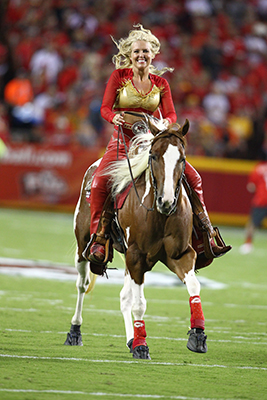
The Chiefs had a mascot, a horse named Warpaint, who was ridden around the field before every game and after every Chief touchdown, by Bob Johnson, who wore full Indian regalia, including a headdress. The current version, Warpaint III, is ridden by a Chiefs cheerleader, not wearing Native American regalia. Warpaint is also the name of the team's weekly game program.
Susie Derouchey aboard Warpaint III

Not to be outdone, the Broncos, as you might expect, also have a live horse mascot, Thunder, ridden onto the field before every game by Ann Judge-Wegener, leading the team on behind them, including their man in a horse costume, Miles (for the Mile High City).
6. The Rivalries. The ones the Jets had with the Dolphins and Patriots came later, but the one they had with the Raiders, hoo, boy.

The ones the Raiders had with the Jets, Dolphins, Patriots and Chargers would come later, but the one they had with the Chiefs became intense in the late 1960s, and remains so today. The Chiefs (as the Dallas Texans) founded the AFL, but the Raiders came to define it.
"You hate me and I hate you!"
"So at least we understand each other."

5. Making Minor-League Cities Major. Buffalo. Houston. San Diego. Oakland. Denver. A little later, Miami. Before the AFL, none of these cities had a major league team in any sport. By 1971, each had had an NBA team. By 1993, all but Buffalo had an MLB team. By 1974, all had had either an NHL or a WHA team.

(UPDATE: Buffalo still hasn't had a permanent major league baseball team -- upper- or lower-case -- since 1915, and if you don't count the Federal League, not since 1885. But the COVID epidemic forced the Toronto Blue Jays out of Canada, and they had to play "home games" in Buffalo in 2020 and 2021, until the restrictions were lifted.)

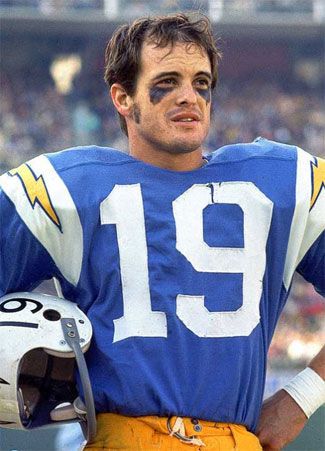
4. The Charger Uniforms. It's not just the lightning bolts on the helmets. From 1960 to 1973, they wore jerseys that had been called "collegiate blue" (probably a reference to UCLA, with whom they shared the Los Angeles Coliseum in 1960), "electric blue" (which matched the "charger" theme) and "powder blue" (which is what it usually gets called today).
Lance Alworth, the AFL's greatest receiver,
wearing the original version

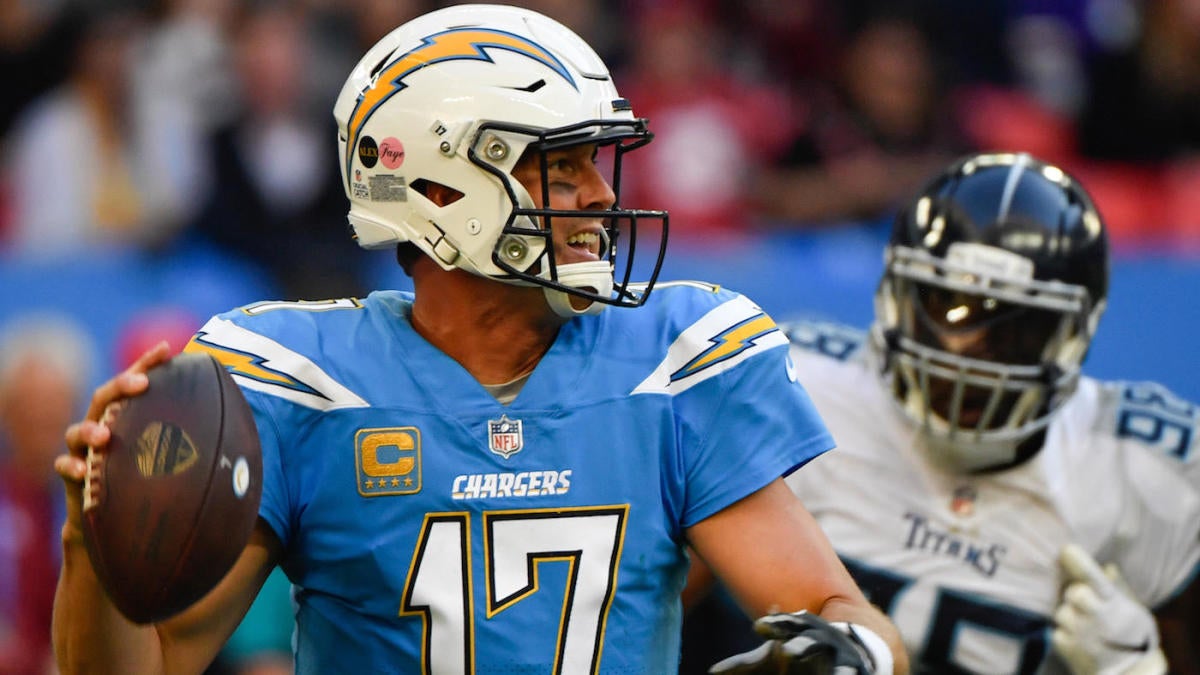
In 1974, they switched to dark blue jerseys and helmets. In 1978, they became one of a few teams that preferred to wear white jerseys at home, and it did look better. (In my opinion, this is also true for the Washington Redskins and the Dallas Cowboys.) They went back to dark blue at home in 1984, occasionally wore powder blue as "throwback uniforms" for a few years, and have announced that, in 2019, their 60th season, they will be wearing powder blue as their regular home color. They have also gone back to the white helmets.
Philip Rivers wearing the current version

3. John Madden. Before he became the video game guy, before he was the great commercial pitchman, before he was the best TV analyst the sport has ever known, he was a great coach. Coaching the Raiders from 1969 to 1978 (and the 2 seasons before that as linebackers coach), he went 112-39-7, including the Playoffs.

In 10 seasons, he never won fewer than 8 games (and they played 14 games a season until 1978, his last, when it became 16), won 7 AFL or AFC Western Division titles, reached 7 AFL or AFC Championship Games, and won Super Bowl XI in the 1976-77 season.

He kept his team loose by understanding them. He had one rule: Be on time. Other than that, he didn't care what you were like off the field. The players were grateful, and respected him. Even if they didn't always understand him: Once, during a tough game, he told them, "Don't worry about the horse being blind: Just load the wagon!"
The Coach and his Outback Steakhouse-sponsored
customized Madden Cruiser bus

Madden is still alive, at age 83, and does a talk show on San Francisco radio station KCBS. In one of the great ironies of American public life, while he hasn't gotten on an airplane since a panic attack on a flight in 1979, his wife Virginia -- they are approaching their 60th Anniversary as well -- is a licensed pilot.

(UPDATE: John Madden died on December 28, 2021, at 85. He might have been the only human being who was beloved by fans of all 32 teams.)

2. The Passing Game. The big argument against the NFL in the 1960s was that it was "too boring," "too conservative." How could anyone say that about a league that had Johnny Unitas, Bart Starr, Sonny Jurgensen and the young but already scrambling Fran Tarkenton?

Easy: Because, for all its T-formation passing opportunities, the NFL was still a run-first league, following the advice of Ohio State coach Woody Hayes: "There are three things that can happen when you throw the football, and two of them are bad," meaning an incompletion or an interception.

The AFL needed fans. And it needed TV viewers. How to get them? Put the ball in the air, and let the chips fall where they may. When Joe Namath said, before Super Bowl III, that there were 4 or 5 quarterbacks in the AFL better than Earl Morrall of the Colts, he wasn't just blowing smoke: The Jets had Namath, the Chiefs had Dawson, the Bills had Kemp, the Chargers had Hadl, and the Raiders had Blanda and Daryle "the Mad Bomber" Lamonica.

By the end of the 1970s, the passing-defense rules had been changed. In the 1980s, the NFL became like the 1960s AFL.

1. The Community of the Super Bowl. Did I say it was "America's secular high holy day"? Yes, I did. It brings people together, to cheer on a great team, or maybe to boo an undeserving one.
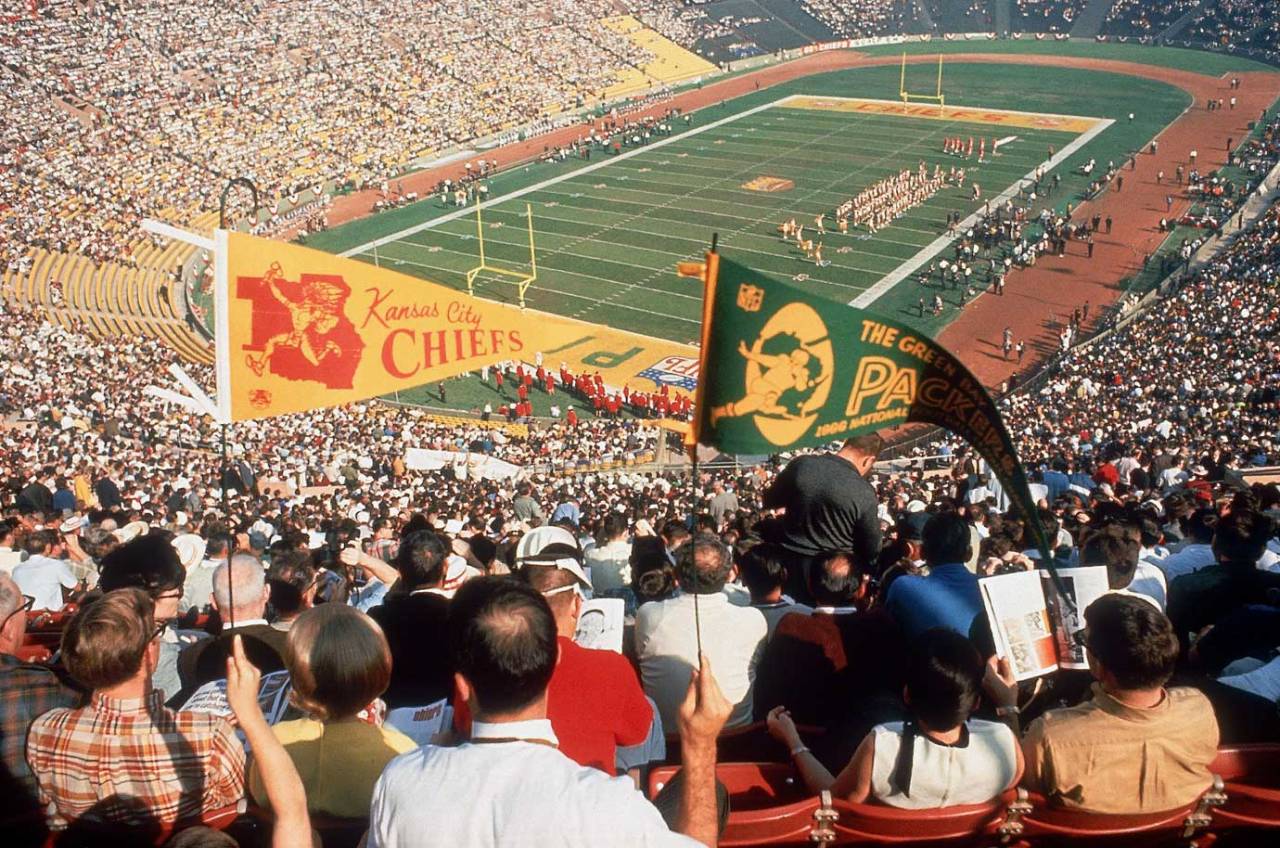
Fans with Chiefs and Packers pennants in the end zone
of the Los Angeles Memorial Coliseum,
Super Bowl I, January 15, 1967

And it all began because the AFL wanted to prove it was as good as the NFL. Well, by September 1970, there was only the NFL -- but it was better than it was before, because of the AFL.

Saturday, November 17, 2018

Top 5 Reasons You Can't Blame NBC for Switching from Football to "Heidi"

November 17, 1968, 50 years ago: A professional football game was played, and it had a stunning ending. People who saw this ending live in the Oakland-Alameda County Coliseum: An official paid attendance of 53,318. People who saw it on television: Zero.

"What do you mean, Uncle Mike?" you may ask. "Wasn't the game on television?" Yes, it was -- but not in its entirety. And it wasn't zero: Viewers in the Pacific Time Zone saw it live.

The New York Jets were playing the Oakland Raiders. The Raiders had won the American Football League Championship the season before, but lost Super Bowl II to the Green Bay Packers. They were 8-2 coming into this game. The Jets were 7-3. Each team had beaten the other in the previous year's regular season: The Jets' win was the only defeat for the Raiders prior to the Super Bowl, and the Raiders' win stopped the Jets from winning the Eastern Division.

Each team had a notable quarterback: The Raiders had Daryle Lamonica, known as the Mad Bomber; while the Jets had Joe Namath, coming off a season in which he became the 1st pro quarterback to pass for 4,000 yards in a season. The Raiders, especially defensive end Ben Davidson (later an actor) always targeted him for dirty hits: Davidson had broken Namath's jaw in the Raiders' win the season before.
Broadway Joe Namath

With the Playoffs for both the AFL and the NFL expanded for this season, this was seen as a possible Playoff preview -- correctly, as it turned out.

And while the owners of the original 8 AFL teams, a.k.a. "The Foolish Club," were friends and partners, the teams themselves, and the fans thereof, hated each other's guts. As Jets director of public relations Frank Ramos said, "When the Jets played the Raiders, it wasn't a rivalry, it was a war."

The game was scheduled for a 1:00 PM kickoff, Pacific Time -- meaning 2:00 Mountain Time, 3:00 Central Time, and 4:00 Pacific Time. In those days, before TV started insisting on more timeouts to run more commercials, games rarely took a full 3 hours. So it was reasonable to presume that the game would end before 7:00 PM Eastern Time.

It was the 2nd half of an AFL doubleheader on NBC. And the 1st half was a sign of trouble: The San Diego Chargers beat the Buffalo Bills 21-6, but it ran long. The result was not in doubt, but NBC still broke away from it at 4:00 on the dot, and began televising from Oakland.

*

The rough play began at the beginning, when the Jets were penalized for a personal foul on the opening kickoff. But they got close enough for Jim Turner to kick a field goal, then did it again: Jets 6, Raiders 0. Lamonica had back and knee injuries, but, late in the 1st quarter, threw a 22-yard touchdown pass to Warren Wells. The extra point was good, and it was Raiders 7, Jets 6.

Early in the 2nd quarter, Lamonica threw a 48-yard touchdown pass to Billy Cannon, the 1959 Heisman Trophy winner. Raiders 14, Jets 6. But Namath, himself always troubled by knee injuries, drove the Jets as the half wound down. With 5 seconds left, he took a quarterback sneak in from the 1-yard line. Since his backup, Babe Parilli, a veteran quarterback (he'd gotten the New England Patriots, then known as the Boston Patriots, into the 1963 AFL Championship Game), was the kick holder, coach Weeb Ewbank called for a fake kick. Parilli tried for the 2-point conversion (the AFL had it from the start, but the NFL didn't begin using it until 1994), and failed. Halftime score: Raiders 14, Jets 12.

Early in the 3rd quarter, Jet safety Jim Hudson intercepted a Lamonica pass. Namath drove the Jets, and Bill Mathis ran the ball in from the 4. Jets 19, Raiders 14. Unfazed by any of this, Lamonica drove 80 yards, threw a 3-yard touchdown pass to Charlie Smith, and rubbed it in the Jets' faces by successfully throwing a 2-point conversion pass to Hewritt Dixon.

The ball had gotten to the 3 in part because of the previous play: Hudson was called for a blatant facemask violation, a 15-yard penalty, then argued with referee Bob Finley, who threw him out of the game. Hearing the boos from the Raider fans as he walked off the field, he gave them the middle finger. End of the 3rd quarter: Raiders 22, Jets 19.

Early in the 4th quarter, the Raiders were driving again, but Smith fumbled at the Jet 3, and Gerry Philbin recovered. Namath threw 2 passes to Don Maynard: 47 yards, and 50 yards for a touchdown. Jets 26, Raiders 22. Broadway Joe got the Jets close again, and Turner kicked another field goal. Jets 29, Raiders 22. Lamonica drove the Raiders 88 yards, and threw a 22-yard touchdown pass to Fred Biletnikoff.

With under 4 minutes to play -- the AFL had no provision for overtime in regular-season games, the score was tied at 29. Namath drove the Jets again, and Turner was able to kick a 26-yard field goal. With 1:05 left, it was Jets 32, Raiders 29.

Time was running out. Smith took Turner's kickoff from the end zone to the Raider 22. Lamonica threw to Smith for an apparent touchdown, but it was called back due to a penalty. Lamonica kept trying, and got the Raiders closer. For the 2nd time in the game, the Jets were hit with a dumb facemask penalty, getting the Raiders into Jet territory. It was at this point that NBC made their big decision, which I'll get to in a moment.

On the next play, Lamonica threw to Smith again. He caught the ball, and ran 43 yards for a touchdown. George Blanda -- like Parilli, an aging quarterback given new life by the AFL in the early 1960s, in his case with the Houston Oilers -- kicked the extra point. Raiders 36, Jets 32.
The Mad Bomber, Daryle Lamonica

There were 42 seconds left. But Earl Christy fumbled the kickoff. Preston Ridlehuber recovered for the Raiders, and took it into the end one. Raiders 43, Jets 32. That was the final score.

If that had been the extent of the proceedings, and if they had concluded before 7:00 Eastern, the game might be worthy of mention on major anniversaries, like today's 50th, but that's about it. But that wasn't the extent of what happened, and it didn't conclude before 7. And this game still gets talked about, frequently.

*

As for the broadcast: NBC assigned its lead pro football broadcast team: Curt Gowdy, who had done everything in sports, and for whom the Basketball Hall of Fame's award for broadcasters is named; and Al DeRogatis, a member of the College Football Hall of Fame as a defensive tackle with Duke University, and a 2-time Pro Bowler with the New York Giants, who'd gotten started broadcasting their games.

NBC planned to follow the broadcast of this game -- at least, in the 3 easternmost time zones -- with a film version of Johanna Spyri's 1881 novel Heidi. It tells the tale of an orphaned girl in Spyri's native Switzerland, and the lives she touches. It had already been filmed 6 times, most notably in 1937 with Shirley Temple in the title role. There have been additional versions since 1968.

The version NBC was showing was new, made for TV, and aired in place of, but well within the style of, their usual Sunday night fare: The anthology series then known as Walt Disney's Wonderful World of Color. (A bit of a boast, given that only about half the homes in America had color TV sets at that point.) The show has been on the air continuously since 1954, and, for most of its history, including currently on the Disney Channel, it's been known as The Wonderful World of Disney.

In the 1968 TV-movie, Heidi was played by Jennifer Edwards, the 11-year-old daughter of film producer and director Blake Edwards, and stepdaughter of Blake's wife, Julie Andrews, star of Mary Poppins (so she also knew a thing or two about children's fare) and The Sound of Music (so she also knew a thing or two about feel-good movies set in the Alps). Jennifer has since left acting for screenwriting. The film also starred Maximilian Schell, Michael Redgrave and Jean Simmons.
As if there wasn't enough going wrong, 
this DVD cover didn't even get Jean Simmons' name right.

NBC had been hyping the movie like crazy, the way they would if it were a holiday broadcast -- say, if it had aired 5 nights later on Thanksgiving, or on Christmas Eve. They took out big print ads for it, including a full-page ad in The New York Times, which, then as now, was a prohibitively expensive move. They had to air it precisely at 7:00, so that it would end at 9:00, and kids who had to go to school the next day could then get a good night's sleep (at least, in theory).

Something I learned just as I was doing the research for this post, the day before (November 16): It wasn't just a judgment call. NBC had an actual contract with a single sponsor, Timex watches. The contract stated that Heidi had to start at exactly 7:00 Eastern Standard Time, and could not be delayed, or joined in progress, for any reason. The fact that the sponsor was a timekeeper became retroactively ironic.

It's also worth nothing that this was 1968. The VCR was a few years away from being invented. There was no DVR service. If you missed a show, you had to wait until it was repeated -- if it was repeated. (As far as I know, this version of Heidi was never shown on network TV again, although it is probably available on cable movie channels.)

And there were only 6 VHF channels in New York: CBS on 2, NBC on 4, ABC on 7, and the "independent" stations on 5, 9 and 11. (Channel 13 was there, but PBS was still in its infancy, and most people weren't thinking about it yet.) So, with few choices, when one got highlighted, you became convinced that this was something special, and you should watch it. It was around this time that the kind of TV production previously known as a "spectacular" began to be called a "special."

So with all the promotion of this "family entertainment," there was a considerable buzz about Heidi. In the history of American TV to this point, pretty much the only broadcasts that had ever gotten this much hype were the final episode of The Fugitive on ABC the year before, the 1955 NBC broadcast of the Broadway musical version of Peter Pan with Mary Martin in the lead role, and the appearances on CBS' The Ed Sullivan Show by Elvis Presley in 1957 and The Beatles in 1964. Even the 1960 Kennedy-Nixon debates and space launches didn't get hyped this much.

(The Beatles' 1st appearance on Ed Sullivan, February 9, 1964, was the most-watched TV show ever to that point. The last episode of The Fugitive, August 29, 1967, broke that record. It held the record until November 21, 1980, when Dallas revealed who shot J.R. Ewing. That record stood until February 28, 1983, the last episode of M*A*S*H, which still holds the record for most-watched episode of a regular series. A few Super Bowls have been watched by more Americans.)

*

Dick Cline was NBC's supervisor for sports telecasts. Except for the 1958 NFL Championship Game, which went to overtime, NBC had never broadcast a pro football game that had taken over 3 hours to complete. (The 1962 AFL Championship Game had gone to a 2nd overtime, but that was on ABC.) So he had no reason to believe this one would, either.

Don Ellis was the telecast's on-site producer. Scotty Connal was the executive producer. Julian Goodman was the president of NBC, and he told Connal that, no matter what, Heidi must start at 7:00 Eastern. Connal told this to Cline and Ellis, and overruled their objections.

But, between them, Namath and Lamonica threw 31 incomplete passes, each one stopping the game clock. Both teams used all their allotted timeouts -- each team got 3 in each half, for a total of 12. And there had already been 63 points scored with 4 minutes left on the clock. That's a lot of stoppages of the game clock.

The 4th quarter did not begin until 6:20. At 6:45, Connal, watching at his house in Old Greenwich, Connecticut, called Cline at NBC headquarters at the RCA Building, at 30 Rockefeller Plaza in Midtown Manhattan. They agreed that the game would not end before 7:00. They also agreed that NBC should run the game broadcast until its conclusion, but that wasn't Connal's call, or Cline's call.

They reached Goodman at his home in Manhattan. The 1968 version of a conference call was set up with NBC Television president Don Durgin, whose call it really was. Durgin was convinced: He told them to delay the movie.

Something else began to happen at 6:45. We hear the legends about the football fans angry that the game was cut off. But most of the calls coming to the NBC switchboard at "30 Rock" were from parents wondering if the movie would start on time. The switchboard blew a fuse. (Kids, you might want to ask your parents was a fuse is. And a switchboard.) Goodman couldn't get word to Cline to let the broadcast of the game continue. And so, not knowing that he had the O.K. to extend the game, Cline gave the order: Cut the game and switch to the movie.

And so, with 1:01 on the clock, viewers saw Smith pick Turner's kickoff up in the end zone, and get to the Raider 22-yard line. As he did so, the Burbank control room played the tune NBC used as its closing theme for AFL broadcasts. At exactly 7:00, the broadcast of Heidi began.

The people involved in the game -- players, coaches, officials, and fans -- didn't know this. Thinking that the Jets had won, Lucy Ewbank picked up the phone, called the visitors' locker room at the Oakland Coliseum, and congratulated her husband Weeb on the victory. He had to tell her what had happened in Oakland, and she had to tell him what had happened in New York.

Despite being NBC employees, Gowdy and DeRogatis didn't know about it, either. No one told them, so they kept calling the game as if the whole country was still seeing it. Unlike the network, the announcers "played to the whistle." Which came at 7:07 PM. All the fuss that followed, over 7 minutes.

To make matters worse, viewers had missed not one but two Raider touchdowns in the last minute of play, pushing the margin of victory above the 7 1/2-point spread, messing up a lot of bets. At 7:08, NBC put a crawl across the screen: "SPORTS BULLETIN: RAIDERS DEFEAT JETS 43-32." This happened just as Heidi's paralyzed cousin Clara started to walk again.

In his nationally syndicated newspaper column, humorist Art Buchwald wrote, "Men who wouldn't get out of their chairs in an earthquake rushed to the phone to scream obscenities." Associated Press sportswriter Jack Clary wrote, "The football fans were indignant when they saw what they had missed. The Heidi audience was peeved at having an ambulatory football score intrude on one of the story's more touching moments. Short of pre-empting Heidi for a skin flick, NBC could not have managed to alienate more viewers that evening." They were damned if they did, and damned if they didn't, and caught hell from both sides.

At 8:30 that night, Goodman apologized in a press conference. The next night, on The Huntley-Brinkley Report, NBC showed the remaining 7 minutes.

*

The aftermath: The Jets and Raiders each won their Divisions. It was the Eastern Division winner's turn to host the AFL Championship Game, and on December 29, 1968, a frigid crowd sold out Shea Stadium to watch the Jets win, and advance to Super Bowl III, where they pulled the biggest upset in pro football history by beating the Baltimore Colts.

On December 8, NBC aired, as part of the Disney anthology, a live-action version of Pinocchio, starring Peter Noone, the lead singer of Herman's Hermits. Newspaper ads said that the preceding football game would be shown in its entirety. It came in under 3 hours, and there was no problem.

On December 15, NBC aired a game between the Raiders and the Chargers. It ran over, and, with no contractual issue, it was shown to its completion. At 7:08 PM, The New Adventures of Huckleberry Finn, also part of the Disney anthology, began, and was shown to completion.

When the final details of the AFL-NFL merger were set, the contract included showing any game that ran over its allotted 3 hours to its conclusion. This -- professional football -- did more to break the hold of sponsors over network TV than anything else: Sponsors could still object to what a network was broadcasting, but their word was no longer law; and any sponsor demanding control over time slots faced the simple answer of, "Sorry, but we have a contract."

In 1974, the NFL, sick of having so many tie games, introduced regular-season overtime. Suddenly, games running over began to happen more often. This would increase following the 1978 liberalizing of passing rules, including the elimination of bump-and-run coverage.

On November 23, 1975, NBC broadcast a game between the Raiders and the Washington Redskins, at Robert F. Kennedy Stadium in Washington. Strange things seem to follow the Raiders around. Some helpful to them (Ghost to the Post, the Holy Roller), some not (the Immaculate Reception, the Tuck Rule Game).

NBC had once again heavily promoted their Sunday night movie: The 1971 version of Willy Wonka and the Chocolate Factory. But the game went to overtime, and the final gun went off at 7:42 PM -- the latest any regular-season game had yet gone. The Raiders won, 26-23.

No problem, right? NBC just went right to the movie -- joining it in progress! 42 minutes in! (31 minutes, not counting commercials.) Again, the switchboard was flooded, though, this time, it was only angry parents, not angry football fans.

Many has been the time that CBS has had an NFL broadcast, or even a golf tournament, run long, delaying the news broadcast 60 Minutes -- which, in another irony, has a stopwatch as its logo.

Interviewed for the 20th Anniversary of the Heidi Bowl in 1988, Dick Cline said, "I wonder if this Heidi things will ever die." It hasn't. In 1997, it was voted one of the 10 most memorable games in pro football history. In 2005, TV Guide listed it 6th on its list of the 100 Most Unexpected TV Moments. Interviewed at the time, the film's star, Jennifer Edwards, said, "My gravestone is gonna say, 'She was a great moment in sports.'"
A recent photo of Jennifer Edwards

Today, CBS starts its late games at 4:05 PM Eastern, and Fox starts its games at 4:25. They're now expected to run past 7:00, and Fox even has its studio show run all the way until 8:00.

*

Should NBC be blamed for the call they made? Or, rather, for failing to make the other call?

Top 5 Reasons You Can't Blame NBC for Switching From Football to Heidi

First, a couple of reasons that didn't make the cut: The Best of the Rest.

The Perception of the AFL. In spite of the in-process merger with the NFL, it was still a minor league in the eyes of many people, including NBC executives. It was the New York Jets against the Oakland Raiders. If it had been the NFL teams in those markets, the New York Giants playing the San Francisco 49ers, they might have stuck with the game.

No less than Curt Gowdy said that the reaction to the switch away from the game proved that the AFL was now seen as being on an equal footing with the NFL -- and this was 2 months before Super Bowl III, which Gowdy and DeRogatis also broadcast for NBC, along with another ex-Giant, Kyle Rote.

(For the record: The Giants did play the 49ers in the 1968 season, on October 20, and the 49ers won, 26-10 at Yankee Stadium. On November 17, the day of the Heidi Bowl, the Giants and the 49ers both played their arch-rivals at home: The G-Men beat the Eagles 7-6 at Yankee Stadium, and the Niners tied the Los Angeles Rams 20-20 at Kezar Stadium.)

The West Coast. When games are played on the Pacific Coast, they are started at around 1:00 PM local time -- which is 4:00 PM in New York, where the NFL offices and the network offices were (and remain). If the Jets -- or any AFL team other than the Raiders or the San Diego Chargers -- had been the home team, even the Denver Broncos in Mountain Time, the game would have ended well before 7:00 Eastern Time, and the issue never would have come up.

Now, the Top 5:

5. Weeb Ewbank and John Rauch. The opposing coaches called all those clock-stopping pass plays, and used up all their timeouts. The pass-happy nature of the AFL helped it to win over fans who thought it a more exciting version of the conservative NFL, and to survive its tumultous early years, the early 1960s. This time, it worked against their TV viewers.

Before Super Bowl III, when Joe Namath made his guarantee, he also said, "There are four or five quarterbacks in the AFL that are better than Morrall." (Meaning Earl Morrall, starting at quarterback of the opposing Colts, in the wake of the injury to Johnny Unitas.) He included himself and Daryle Lamonica of the Raiders -- and, also, Len Dawson of the Kansas City Chiefs and Jack Kemp of the Buffalo Bills.

All those passes, all that scoring, and all those timeouts insured that the game would still be going at 7:00 Eastern.

4. The Timex Contract. If NBC had cut away, Timex could have sued them. From that point onward, it would have been in the hands of the legal system. A judge could have thrown the suit out. The verdict could have depended on who had the superior lawyers, NBC or Timex. A jury of football fans... well, who knows which side they'd have taken, as they might still have been mad at NBC.

It's also possible that the jury could have upheld the contract, and ruled Timex the winner... and awarded damages of $1.00, as the delay only damaged the Timex executives' egos, not their brand's image. The bad publicity they might have gotten from going to court over 7 lousy little minutes might have hurt them more than a 7-minute delay in the start of a movie's broadcast.

3. The Callers. If all those parents worried about whether Heidi would start on time at 7:00 had simply let NBC make their own decision, the Rockefeller Center switchboard wouldn't have been blown, the message could have gone out to keep going with the game, and the movie would have ended at 9:07, and we wouldn't be talking about this these last 50 years.

Instead, we'd be talking about the 50th Anniversary of one of the Top 10 Games In AFL History with no more significance than that.

2. No Precedent. This had never happened to any of the Big Three networks before. With a playoff game, there was the possibility of overtime, and the network had to compensate for that.

One example: In 1960, it was the Eastern Division Champion's turn to host the NFL Championship Game. That turned out to be the Philadelphia Eagles, who then played at Franklin Field, which had no lights, and, still hosting home games for the University of Pennsylvania as it has since 1922, still doesn't have lights.

Since the game was scheduled for the day after Christmas (a Monday: At the time, the NFL wouldn't play on Christmas Day if it fell on a Sunday), and sunset would be at 4:42 PM, and the 1st overtime title game was just 2 years earlier and fresh in everyone's memory, the NFL moved the game, and the NBC broadcast thereof, back from the intended start time of 1:00 PM to 12:00 noon.

The Eagles beat the Green Bay Packers 17-13, no overtime was necessary. The film of the game shows long shadows on the field, but plenty of daylight remaining.

But the 1968 Jets at Raiders game was a regular-season game. If regulation ended in a tie, then a tie it would stay. There was no regular-season overtime until the 1974 season. No network -- not NBC with the AFL, not NBC with the NFL before 1964, not CBS since with the NFL, and not ABC in the early days of the AFL -- had any procedure telling them what the right thing to do in this situation was, because they'd never faced this situation before.

That 1962 AFL Championship Game that went to a "6th quarter" before the Dallas Texans (who became the Kansas City Chiefs the next season) beat the Houston Oilers? ABC started it at 3:00 Eastern, 2:00 Central and local. There was 77 minutes and 54 seconds of game time; real time, 7:07 Eastern. But ABC hadn't promised anyone a family movie at 7 on the dot, so there was no problem.

That record was broken in an AFC Divisional Playoff on Christmas Day 1971, again with the Chiefs, against the Miami Dolphins: Also into a 6th quarter, 82 minutes and 40 seconds. The Dolphins won, 27-24, and the time of day was 7:10 PM Central (8:10 Eastern). Monday Night Football had started the season before, but this was the latest ending yet for a Sunday afternoon game.

Maybe NBC should have made the decision, and an announcement about it, sooner: The network could have told Curt Gowdy in the break between the 3rd and 4th quarters that they would stay with the game beyond 7:00, and he could have said, "Ladies and gentlemen, and children waiting for the start of the broadcast of Heidi: We will show that film in its entirety, after the conclusion of this game. It may have to wait for a few minutes after 7:00 PM New York time. Please be patient with us." Maybe that would have been sufficient, for everybody but the Timex executives.

But, you know what? That would've been wrong. No, NBC did the right thing by switching to the movie. The reason was the best possible reason:

1. The Children. NBC had promised children that Heidi would air at 7:00 Eastern Time. They had to keep their word. Think about it: Football fans have proven that they'll watch any kind of football at any time. NBC going to Heidi may have pissed a lot of them off, but nobody boycotted NBC after this. Nobody picketed at Rockefeller Center and demanded that anybody be fired as a result. Nobody refused to watch NBC football broadcasts ever again. Because football fans are addicts, and televised football is their fix.

In contrast, if NBC had stuck with the game until its 7:07 conclusion, and then begun Heidi, the movie would have ended after 9:00, and some parents would have turned off the TV before it ended, and told their kids it was time to go to bed.

Yes, some parents were petty enough to send their kids to bed with 7 minutes left in a movie. Trust me on this one. When I was a boy, my mother was mean. "How mean was she?" I'll tell ya how mean she was: I didn't see Reggie Jackson's 3rd home run in Game 6 of the 1977 World Series, because it happened after 10:00 on a Tuesday night, and she presumed that, at 7-3, the Yankees already had the game won. She was right about that. She didn't understand the cultural significance of Reggie's 3rd homer, and couldn't have predicted it anyway. She made me go to bed. I didn't see it until the next night's 6:00 edition of WABC-Channel 7's Eyewitness News.

The Heidi Bowl happened a little over a year before I was born. If I had been born 10 years earlier, and was 8 going on 9... well, actually, being a sports nut, I probably would have preferred to see the end of the game. But if I had wanted to see Heidi in its entirety, I would have been out of luck. Mom would have sent me to bed at 9:00 sharp. There was school the next day.

Football fans forgave NBC, especially after they showed Super Bowl III, which the Jets won, 2 months later. Had a million children been sent to bed before the end of Heidi, some of them would have hated NBC for a long time to come. As Namath himself would have said, "I guarantee it." Some would now be writing letters to AARP The Magazine about how they got gypped half a century ago.

VERDICT: Not Guilty.