Showing posts with label usfl. Show all posts

Sunday, July 13, 2025

July 13, 1985: Live Aid

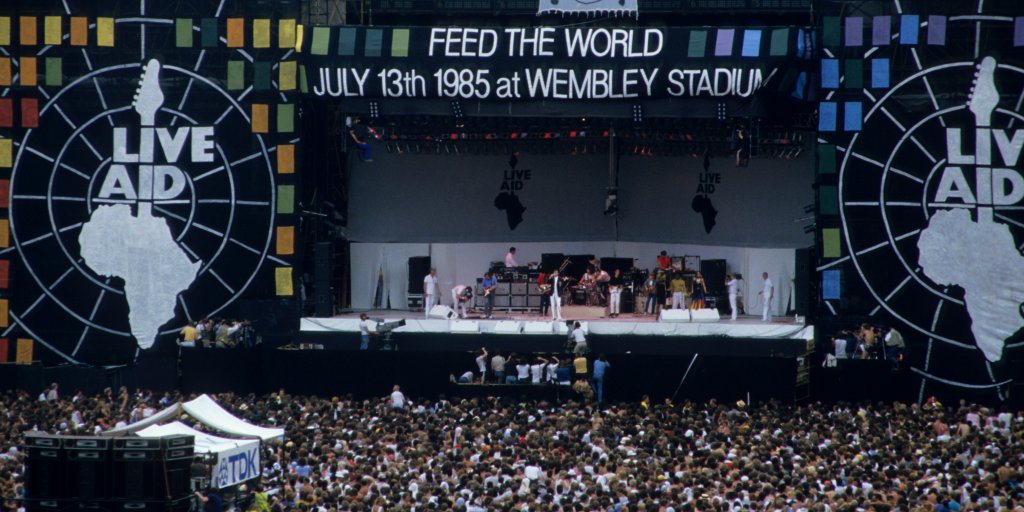
July 13, 1985, 40 years ago: The Live Aid concerts are held: One at the old Wembley Stadium in West London, the other at John F. Kennedy Stadium in South Philadelphia. 

The show was organized by Bob Geldof, leader of The Boomtown Rats; and James "Midge" Ure, lead singer of Ultravox. Geldof, Irish, and Ure, Scottish, had written "Do They Know It's Christmas?" for African famine relief, in time for the 1984 Christmas season, and got pretty much everybody who was currently anybody in music in the British Isles to sing on it.

With its success, an American version was inevitable. Producer Quincy Jones called Michael Jackson, at the time the biggest show business figure in the world. Jackson and Lionel Richie wrote "We Are the World," and Jones gathered several American musical luminaries to record it in Los Angeles. It was also a runaway success.

With both songs having raised a lot of money, a benefit concert was inevitable. It ended up being 2 shows, one in each country. It was a combination of current stars and established legends -- an "All-Star Game" and an "Old-Timers Day" in one. Or, in more recent parlance, an Avengers of rock and roll.

And it wasn't that easy. Geldof called Elton John, and said you gotta do it, because David Bowie and Queen had already agreed -- when they hadn't. While Elton was thinking it over, Geldof called Bowie, and told him that Elton and Queen had already agreed. Eventually, Geldof got everybody he wanted.

*

At 12:00 Noon London time, 7:00 AM U.S. East Coast time, the British leg began at the original Wembley, England's national stadium since its opening in 1923. Holding 100,000 in its normal configuration, the huge stage limited it to 72,000 seats, all sold. Tickets were £5, plus a £20 donation to charity. With Britain's rate of inflation, that's about £97. With today's exchange rate, that's about $131.
The Coldstream Guards gave a royal salute, and played the National Anthem, "God Save the Queen." Queen Elizabeth II was not in attendance -- she was already 58 years old, and tolerated rock and roll more than actually enjoying it -- but her son and heir, Prince Charles, and his wife, Princess Diana, were there.

The Anthem done, the 1st band to play was Status Quo. They were followed by The Style Council, Geldof's Boomtown Rants, Adam Ant, Ure's Ultravox, Spandau Ballet, Elvis Costello (singing only one song, The Beatles' "All You Need Is Love"), Nik Kershaw, Sade (who may have the sexiest voice in all of humanity), Sting from The Police and Phil Collins from Genesis together, Howard Jones, Bryan Ferry, Paul Young, U2, Dire Straits, Queen, David Bowie, The Who reunited for the 1st time since their 1982 "farewell tour," and Elton John.

Queen came on at 6:41 PM, and have been widely regarded as the highlight of the Wembley part of the show. They played "Bohemian Rhapsody," "Radio Ga Ga" (the song that inspired Stefani Germanotta, born the next year, to rename herself Lady Gaga), "Hammer to Fall," "Crazy Little Thing Called Love," "We Will Rock You," and "We Are the Champions."
Freddie Mercury and Brian May of Queen

At 9:48, Queen's lead singer Freddie Mercury and lead guitarist Brian May came back out, and played, "Is This the World We Created?" At 9:51, former Beatle Paul McCartney came out, and, with Bowie, Geldof, Alison Moyet and Who guitarist Pete Townshend backing him, sang "Let It Be." At 9:57, the show closed with everybody coming back out, and, over 5 months before the next December 25, sang, "Do They Know It's Christmas?"
Left to right: Bob Geldof, Bono, Paul McCartney and Freddie Mercury


*

Built in 1926, as Sesquicentennial Stadium, for a world's fair celebrating the 150th Anniversary of American independence, and known from that fair until 1964 as Municipal Stadium, John F. Kennedy Stadium was a 105,000-seat horseshoe in South Philadelphia, with The Spectrum and then Veterans Stadium built adjacent. Best known as the site of the annual Army-Navy football game, it was, by this point, rarely used, since it was aging and not well-cared-for.

So, why there? The producer for the American leg was Bill Graham, already legendary for the concerts he promoted in San Francisco, and operator of the concert halls Fillmore West there and Fillmore East in New York. He got well-known TV producer Tony Verna to handle the U.S. broadcast. Verna was a Philadelphia native, and Verna was on good terms with Mayor Wilson Goode, who offered the use of JFK Stadium.

Why not New York? The biggest stadium in the Tri-State Area was Giants Stadium, and, this being before the building of the Meadowlands Spur of New Jersey Transit's rail operations, getting there by any means other than car was a miserable experience. (Given the inevitable traffic backups, getting there by car wasn't much better.) And since both Yankee Stadium and Shea Stadium were owned by New York City, they would have needed Mayor Ed Koch's permission to do the show at either one, and Koch wasn't interested.

Tickets were $35, or about $104 in today's money -- hardly an unreasonable price, given how many stars took the stage at JFK Stadium. The crowd was listed as 89,484. They started earlier, their time, than London did: 8:51 AM.
The 1st act was Bernard Watson. Who? His real name was David Weinstein, he was 18 years old, he was from Miami Beach, he had just graduated from high school, and he had no professional musical experience. He slept outside the stadium for a week, hoping to get a ticket, and ran into Graham, and talked him into letting him open. He sang Bob Dylan's "All I Really Want to Do," and a song he wrote, "Interview." (About the only information I have on him is that he's still alive.)

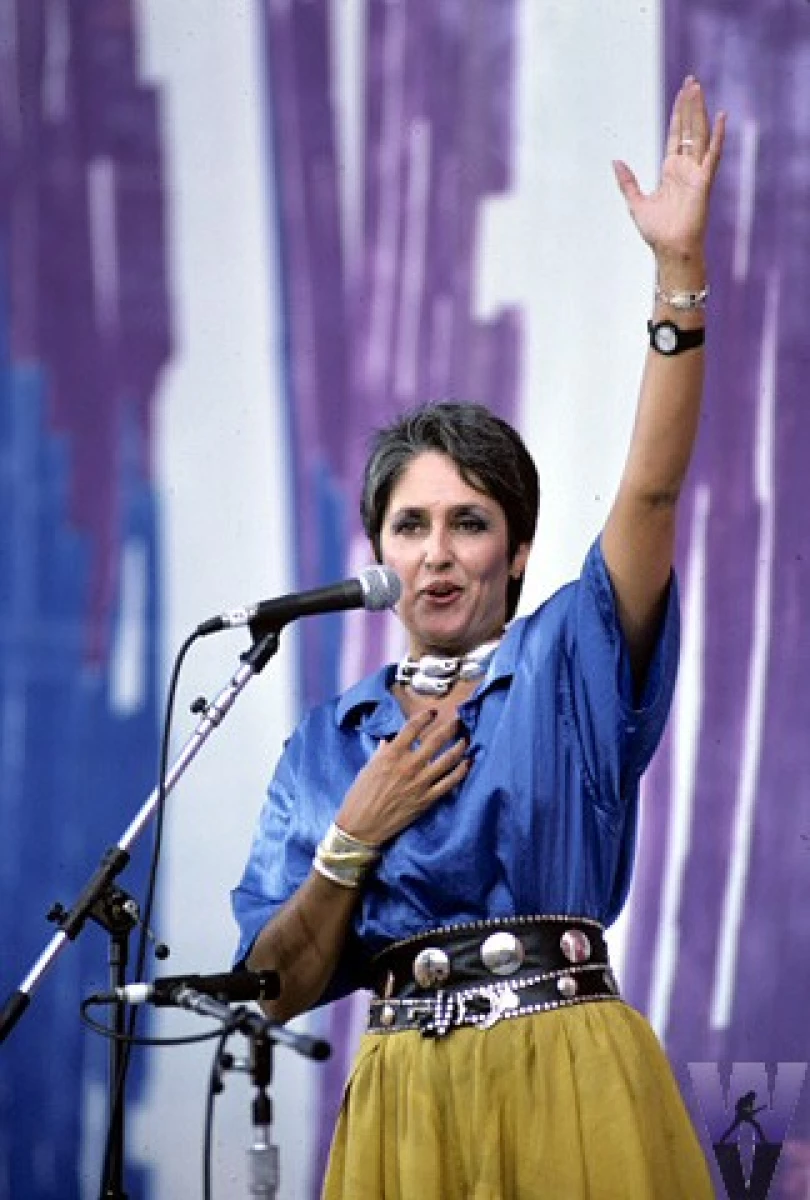
At 9:01 AM, Joan Baez, a veteran of the Greenwich Village folk scene, the Newport Folk Festival, and Woodstock took the stage. She told a generation too young to have gone to those shows, "This is your Woodstock, and it's long overdue." She sang "Amazing Grace" and "We Are the World."
She was followed by Philly natives The Hooters, then Motown legends the Four Tops. Trinidadian soul singer Billy Ocean was next, and then, a different style from any of those, the British inventors of heavy metal, Black Sabbath, with Ozzy Osbourne singing lead with them for the 1st time since 1979.

If that wasn't enough of a mix of styles, Sabbath were followed by the biggest group in rap at the time, Run-D.M.C. And they were followed by... Rick Springfield. And then REO Speedwagon. David Crosby, Stephen Stills and Graham Nash were the 2nd act from Woodstock, after Baez, to perform. And their soft-rock was followed by another British metal icon, Judas Priest. Then Bryan Adams. Then the Beach Boys, complete with Brian Wilson.

George Thorogood and the Destroyers came up from Delaware, with bluesmasters Bo Diddley and Albert Collins sitting in. Simple Minds came over from Scotland. The Pretenders were next. At the time, their leader, Chrissie Hynde, was married to Simple Minds' leader, Jim Kerr. Then, Woodstock veterans Santana. Motown songwriting couple Nick Ashford & Valerie Simpson, by now singing their own songs, performed with Philly native Teddy Pendergrass, by then in a wheelchair following a car crash.

Madonna was next, with Thompson Twins and Nile Rodgers backing her. Then, Tom Petty and the Heartbreakers, Kenny Loggins, The Cars. Neil Young, who has often performed with Crosby, Stills and Nash, performed without them. Next up was The Power Station: Lead singer Robert Palmer; Duran Duran guitarist Andy Taylor and bassist John Taylor; and Chic drummer Tony Thompson. Then, Eric Clapton.

One man played at Wembley, got over to Heathrow Airport, flew across the Atlantic Ocean on the Concorde, got from JFK Airport in New York by helicopter to JFK Stadium in Philadelphia, and played there, too: Phil Collins. He had played from 3:18 to 3:48 in London, and from 8:00 to 8:35 in Philadelphia -- with the 5-hour time difference, it was about a 10-hour gap.

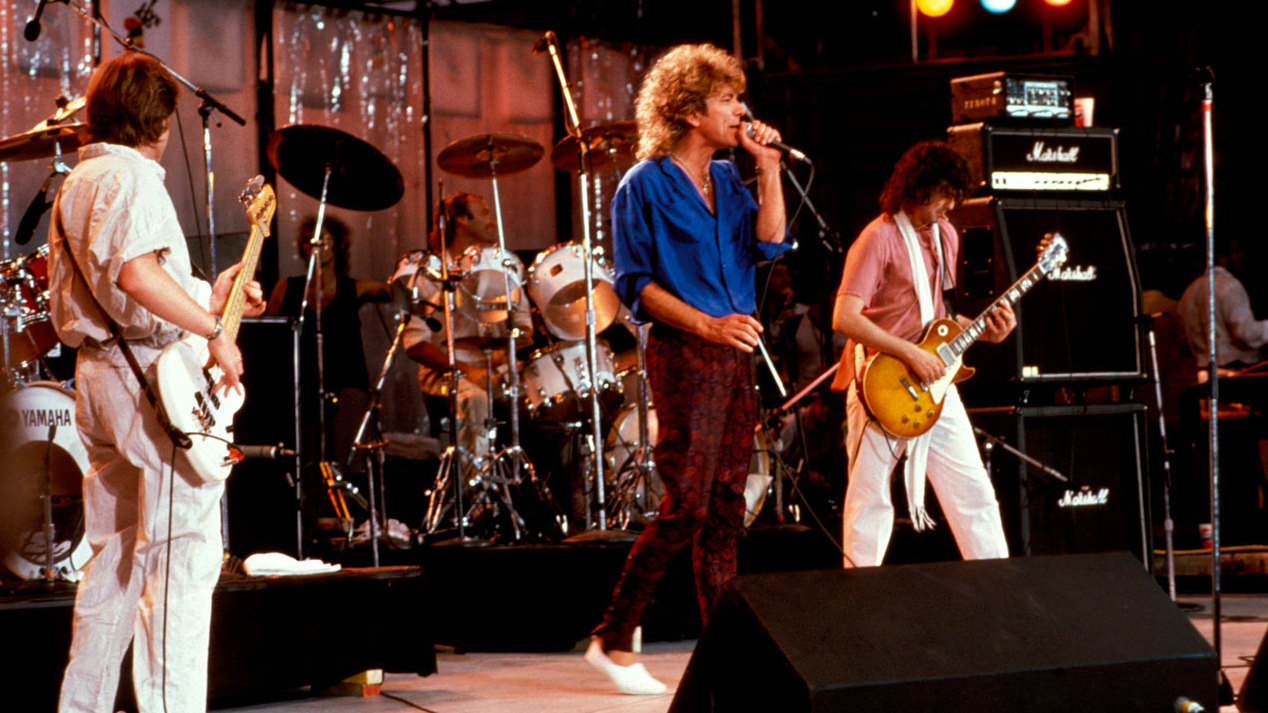
And that may not have been the most notable thing he did that day. He played drums for Led Zeppelin. Singer Robert Plant, guitarist Jimmy Page and bassist John Paul Jones hadn't played together since drummer John Bonham died in 1980. But, with Collins sitting in, they played "Rock and Roll," "Whole Lotta Love" and "Stairway to Heaven."
Then, as night began to fall over the Delaware Valley, Crosby, Stills, Nash & Young did sing together. So did Duran Duran. Then things got serious: On came Philly native Patti LaBelle. Then Philly natives Daryl Hall & John Oates, with former Temptations singers Eddie Kendricks and David Ruffin.
Tina & Mick

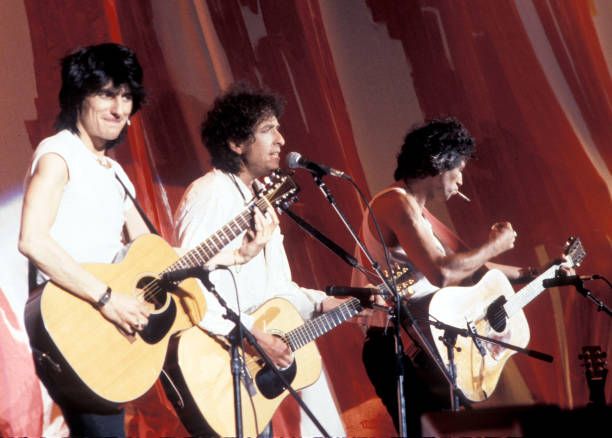
At 10:15, Mick Jagger of the Rolling Stones and Tina Turner took the stage, and sang 5 songs together. At 10:39, backed by Stones guitarists Keith Richards and Ron Wood, Bob Dylan, who did not play at Woodstock, came on, and sang "Ballad of Hollis Brown," "When the Ship Comes In," and "Blowin' in the Wind." The finale, at 10:55, was everybody coming onstage to sing "We Are the World."
Between the 2 shows, it was estimated that 1.9 billion people watched at least part of the broadcast, about 40 percent of the world's population at the time. Money raised? According to Geldof, about £150 million, or about $107 million given what was then the exchange rate, or about $319 million in 2025 money.

This was the greatest thing ever to happen at Wembley, or any other sports stadium. England's victory in the 1966 World Cup Final is a distant 2nd.

The old Wembley was not well-cared-for, and a replacement became necessary. It was closed in 2000, demolished, and the new Wembley Stadium opened on the site in 2007.

Mick and the Stones had planned to return to JFK Stadium for their Steel Wheels tour in 1989, but it was ruled unsafe for occupancy, so they headed 2 blocks north to The Vet. The last show at JFK Stadium was The Grateful Dead in 1991. The following year, it was demolished. In 1996, the new arena for the NBA's Philadelphia 76ers and the NHL's Philadelphia Flyers opened on the site. As one bank has bought out another, arena naming rights and all, it has gone through several names. On September 1, 2025, it will officially be renamed the Xfinity Mobile Arena.

In 1986, Spin magazine published an exposé on Live Aid's actions in Ethiopia. They claimed that Geldof deliberately ignored warnings from Doctors Without Borders, who had complained directly to Geldof even before Live Aid, about the role of the Ethiopian government under Derg leader Mengistu Haile Mariam in causing the famine; and that, by working with Mengistu directly, much of the relief funds intended for victims were in fact siphoned off to purchase arms from the Soviet Union, thereby making the situation even worse.

Geldof reportedly responded by saying, "I'll shake hands with the Devil on my left and on my right to get to the people we are meant to help."
 

Sunday, March 23, 2025

March 23, 1985: Bernard King's Injury

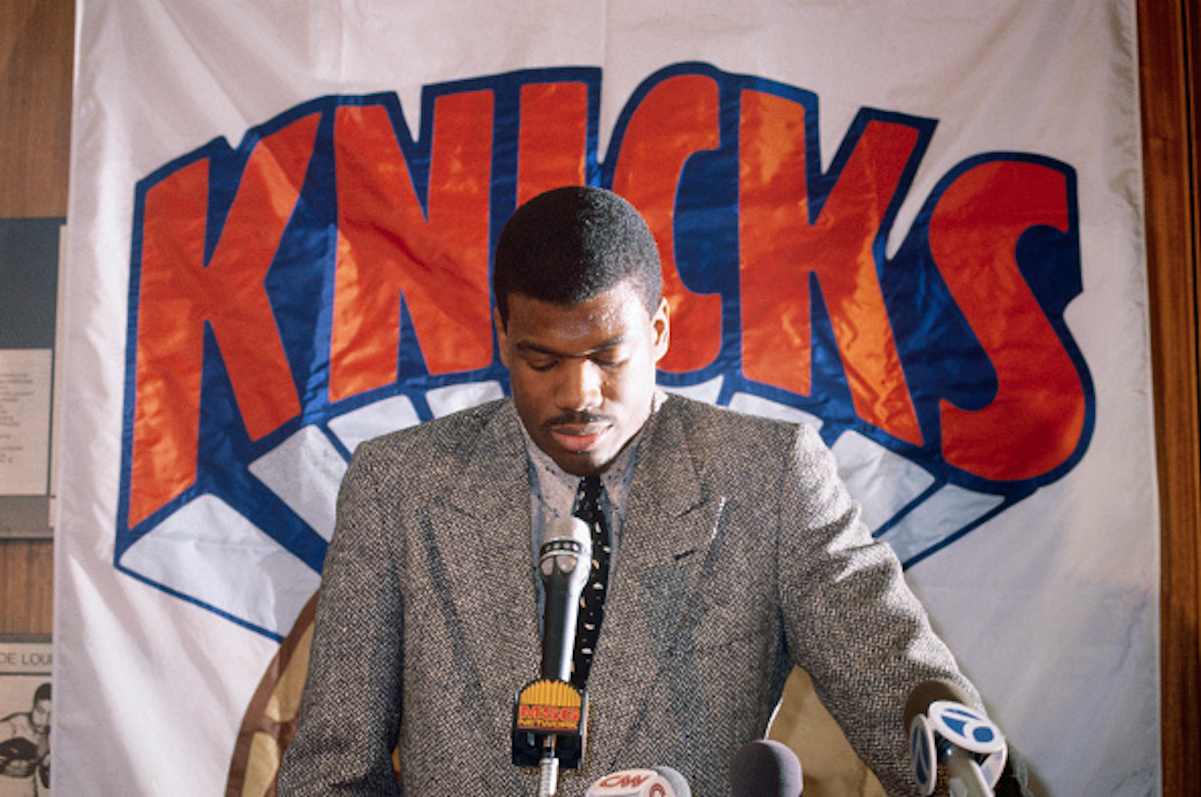
March 23, 1985, 40 years ago: The man who may have been the best player in the NBA at the time sees that status came to a most painful end.

Bernard King and his brother Albert King came out of Fort Hamilton High School in Brooklyn to become basketball stars. Bernard had starred at the University of Tennessee, Albert at the University of Maryland. Each began his NBA career with the New Jersey Nets, but Bernard was 3 years older: By the time Albert arrived with the Nets, Bernard had been traded to the Utah Jazz.

In 1982, Bernard was traded to the New York Knicks. In the 1983-84 season, he caught fire. He scored 50 points away to the San Antonio Spurs. The next day, he scored 50 again, away to the Dallas Mavericks. He averaged 34.8 points per game in the Playoffs, helping the Knicks reach the Eastern Conference Semifinals.

On Christmas Day, December 25, 1984, the Knicks lost to the Nets, 120-114 at Madison Square Garden, but Bernard scored 60 points. At the time, he was only the 10th player in NBA history to do so. His brother Albert was still with the Nets, but was injured, and did not play. Micheal Ray Richardson, whom the Knicks traded to get Bernard, scored 36; Mike Gminski scored 27; and Kelvin Ransey scored 24.

'Nard kept going in that 1984-85 season. He was leading the league with 32.9 points per game, at a time when it had Kareem Abdul-Jabbar, Magic Johnson, Larry Bird, George Gervin, Isiah Thomas, and a rookie named Michael Jordan. But the Knicks themselves were struggling, especially with injuries. 

They were 24-46 when they went into the Kemper Arena in Kansas City, just on the Missouri side of the State Line with Kansas, to play the Kansas City Kings, who were not much better at the time, going 27-43. Only 4,554 fans bothered to show up for a game that started with little meaning, but ended with a tremendous amount of meaning for the Knicks, and Bernard in particular, going forward.

The Knicks were trailing with 1:34 left in the game, and Bernard already had 37 points. Reggie Theus of Kansas City attempted a dunk. Bernard jumped to try to block it. But as he jumped, he yelled, "Oh!" As he came down, he yelled, "Oh, damn!" He crumpled to the floor, and started slapping it, in an immense amount of pain.

Knick broadcaster Marv Albert said, "Look out! King hurt himself as he gave the foul!" The crowd was small enough, and shocked into a level of sound so low, that not only the sound of Bernard shouting, "Oh, damn!" but the sound of his hand slapping the court was picked up by the MSG Network microphones. Hubie Brown, then the head coach of the Knicks, actually heard the injury, saying in an interview years later, "You could hear the crack. It was like a gun sound."

Ernie Grunfeld, who had been his teammate at Tennessee (where the media called them "The Bernie and Ernie Show"), and now was again with the Knicks, said, "It was devastating. My heart stopped, and I think everybody else's heart on the bench stopped, also."

The Kings won the game, 113-105, but hardly anybody cared. The most exciting player in the NBA was diagnosed with a broken tibia, a torn anterior cruciate ligament (ACL), and torn knee cartilage. No player, in any of North America's "Big Four sports," had ever come back from an injury like that before. As far as anyone could tell at the time, Bernard King, only 28 years old, was done.

The game was the 1st of 12 straight that the Knicks lost to close out the season. It put them into a much better position to win the NBA's 1st-ever Draft Lottery. They did -- and there are still people who believe this was fixed, to give the New York team the advantage and the NBA better TV ratings -- and selected Georgetown University center Patrick Ewing. Ewing kept the Knicks relevant as they climbed back up into the NBA's elite, and took them to 2 NBA Finals, but lost them both.

The Kings were not so fortunate. At the end of the season, they left Kansas City, and moved to Sacramento. The Kemper Arena was renamed the Hy-Vee Arena, and, though it still stands in 2025, was replaced by the Sprint Center in 2007. That building has been renamed the T-Mobile Center. The NBA has never returned to Kansas City.

But Bernard King returned to the NBA. He missed the entire 1985-86 season, and, through a lot of hard work by himself and the medical professionals around him, finally returned on April 10, 1987, a Knick loss away to the Milwaukee Bucks. He played just 6 games that season, and was released by the Knicks.

He was signed by the Washington Bullets, and played 69 of a possible 82 games in the 1987-88 season. He played all but 1 game in 1987-88, all but 1 game in 1988-89, and all 82 with the 1989-90 Bullets. He missed 1991-92 due to injury, then played out the string with the Nets in 1992-93, and retired.

He was elected to the Basketball Hall of Fame in 2013, and it's not clear that he would have made it had he retired right after his injury. He is now 68 years old, a studio analyst for the Knicks and for NBA TV, and remains beloved in Knoxville, Washington, and especially New York.

Monday, May 1, 2023

May 1, 1923: The Los Angeles Memorial Coliseum Opens

May 1, 1923, 100 years ago: The Los Angeles Memorial Coliseum opens, adjacent to the campus of the University of Southern California. It completed a stretch of two weeks in which three of the greatest stadiums ever built on planet Earth opened: The original Yankee Stadium in New York on April 18, and the original Wembley Stadium in London on April 28. Of the three, the Coliseum is the only one that still stands, 100 years later.

Unless you count the nearby HOLLYWOOD sign and the Golden Gate Bridge in San Francisco as "buildings," the Coliseum is the most famous building in the State of California.

At its opening, seating capacity was 75,144. It was expanded to 101,574 for the 1932 Olympic Games. A renovation, necessary after the 1994 Northridge Earthquake, dropped capacity to 93,103. Another recent renovation, including wider seats, and bigger media facilities requiring the removal of some seats, has made the current capacity 77,500, making it the 2nd-biggest stadium in California, behind the Rose Bowl in nearby Pasadena.

It hosted a football game for the 1st time on October 6, 1923. The University of Southern California hosted Pomona College, and won, 23-7. The USC Trojans have used the Coliseum as their home field ever since.

Their nearby rivals, the University of California at Los Angeles, played home games there from 1933 to 1981. The UCLA Bruins now play home games at the Rose Bowl, which, due to the Trojans' success, has often seemed like a secondary home field to them, not just every other year when they play UCLA in their home-and-home series, but also on January 1, when the Rose Bowl game is usually played.

The Coliseum has also been the leading professional football venue in Southern California. In the NFL, the Los Angeles Rams played there from 1946 to 1979, and again from 2016 to 2019; the Los Angeles Raiders from 1982 to 1994; Super Bowl I in 1967 and Super Bowl VII in 1973; and the postseason Pro Bowl from 1951 to 1972, and again in 1979.

Other pro football teams using the Coliseum: The Los Angeles Dons of the All-America Football Conference from 1946 to 1949, the Los Angeles Chargers of the American Football League in 1960, the Los Angeles Express of the United States Football League from 1983 to 1985, and the Los Angeles Xtreme of the XFL in 2001.

It has hosted the U.S. national soccer team 20 times, starting in 1965; and Mexico's team 61 times. In 1967, the only season of play for the United Soccer Association, it hosted the Los Angeles Wolves, who won that league's title. It also hosted the city's entry in another league starting that season, the Los Angeles Toros of the National Professional Soccer League. After that year, the two leagues merged to form the North American Soccer League, whose Los Angeles Aztecs used the Coliseum as their home field in the 1977 and 1981 seasons.

The Los Angeles Dodgers used the Coliseum as their 1st home field after leaving Brooklyn, while waiting for Dodger Stadium to be built, from 1958 to 1961. Their home games in the 1959 World Series against the Chicago White Sox attracted over 92,000 fans, the highest-attended competitive games in Major League Baseball history. An all-time record crowd for baseball, 115,300, attended a preseason game between the Dodgers and the Boston Red Sox on March 29, 1958, honoring the Dodgers' 50h Anniversary in Los Angeles.

And, of course, the Coliseum was the main venue for the 1932 and 1984 Summer Olympic Games, and will be again in 2028.

In 2018, naming rights to the playing surface were sold. It is now United Airlines Field. The Coliseum name remains for the stadium as a whole.

Monday, March 6, 2023

March 6, 1983: The USFL Begins Play

March 6, 1983, 40 years ago: The United States Football League plays its first games.

You don't remember the USFL? Even if you're over 40, that's not surprising. Its detractors called it the USeless Football League and the Undeniably Sorry Football League.

It could have succeeded. Indeed, the timing seemed to be right: The NFL was coming off a season in which there had been a strike, canceling almost half the season. Fans should have been willing to take something new: A professional football league playing in the Spring, when there was no pro football to watch.

But the timing wasn't right, at least according to the calendar. The 1st season started on March 6, when the NBA and NHL seasons were coming down the home stretch. The Championship Game was held on July 17, just as baseball's 2nd half was getting underway.

Had the league started in early May, by which point all but a few teams would have been eliminated from the NBA Playoffs and the Stanley Cup Playoffs, and the Championship Game on August 28, the last Sunday before the NFL season started, then, for most of the season, they would have only had baseball to contend with, as the North American Soccer League was already fading into irrelevance.

Here were the original 12 teams, in alphabetical order, and what else they had to compete with nearby at the time:

* Arizona Wranglers. No NFL, MLB or NHL at the time, just the NBA's Phoenix Suns. Played at Sun Devil Stadium, which was (and is) owned by Arizona State University, so even if there had been an NFL team playing there at the time, it couldn't have kept the Wranglers out. This was a good market for the USFL.

* Birmingham Stallions. Nothing: No MLB, no NBA, no NHL, and while the State of Alabama considers college and high school football to be a religion, there is no NFL team there. (This is also the case for several other Southern States, and for basketball in Kentucky. It is also why the Pacers have never been more popular than IU and Purdue in Indiana, and why no pro basketball team has succeeded in North Carolina.) Played at Legion Field. This was a good market for the USFL.

* Boston Breakers. Everything: The Celtics and Bruins, both perennial postseason teams at that point, and the Red Sox in April. Played at Nickerson Field, the 21,000-seat stadium of Boston University, where the Patriots played in their first few AFL seasons. The Patriots wouldn't let them play at what was then named Sullivan Stadium (formerly Schaefer Stadium, later Foxboro Stadium), and Boston College wouldn't let them use their Alumni Stadium, which was also larger than Nickerson. This franchise should never have been placed in Boston, even though the Patriots were a joke franchise at the time.

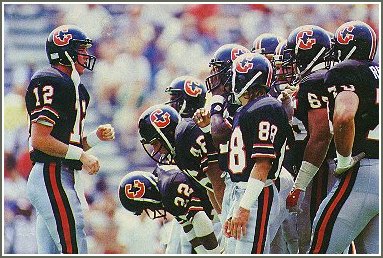
* Chicago Blitz. Everything: The Bulls and Blackhawks, both perennial postseason teams at the point, and the Cubs and White Sox in April. Played at Soldier Field, which was (and is) city-owned, so the Bears couldn't keep them out. Too many distractions for the fan dollar, but Chicago was the 3rd-biggest market and a football-mad one, so they had to have a Chicago team.

* Denver Gold. There was then no MLB or NHL team, but the NBA's Nuggets were a perennial postseason team. Played at Mile High Stadium, which was city-owned, so the Broncos couldn't keep them out. Still, the Broncos were a good team at the time, and the "Broncomania" that began with their 1st good season in 1973, and was seriously hyped up during their run to the Super Bowl in the 1977 season, had hardly abated. So this was a bad market for the USFL.

* Los Angeles Express. Everything: The Lakers and Kings, both perennial postseason teams at that point, and the Dodgers and the team then known as the California Angels in April. Played at the Los Angeles Coliseum, which was (and is) city-owned, so the Raiders, then using it as their home field, couldn't keep them out. Plus the Rams were still in the area, playing at Anaheim Stadium. But L.A. was the 2nd-biggest market, so they had to have an L.A. team.

* Michigan Panthers. Everything: The Pistons and Red Wings weren't very good at this point, but had solid fan bases that would not abandon them; and the Tigers in April. Played at the Silverdome, which was owned by its municipality, the Detroit suburb of Pontiac, so the Lions couldn't keep them out. The Lions were a good team at this point, and playing football in nice weather got canceled out by the dome, so as much as the State of Michigan loves its football, putting a franchise there was a bad idea.

* New Jersey Generals. Everything: The Knicks, Rangers and Islanders, all perennial postseason teams at that point, plus the Nets, who were (unusual for them) in the middle of back-to-back Playoff seasons; the Devils, finishing their terrible 1st season; and the Yankees and Mets in April. Played at Giants Stadium in the Meadowlands, which was State-owned, so the Giants couldn't keep them out. But New York was the biggest market, so they had to have a "New York" team, yet they took advantage of the ill feelings of New Jerseyans (including myself) who were mad at the Giants for moving to the State but not changing their names. More on this in a moment.

* Oakland Invaders. No NHL team then. The NBA's Golden State Warriors were pretty weak: New York sportscaster Spencer Christian called them "the Golden Stink Warriors." Neither the San Francisco Giants nor the Oakland A's were any good at the time. The 49ers across San Francisco Bay had just had a letdown season after winning the Super Bowl the season before, and no one foresaw the Niners becoming the NFL's dominant team over the next decade. And the Raiders had split down the Coast a year earlier, leaving the Oakland Coliseum, then as now owned by Alameda County (so the Raiders couldn't have kept them out anyway), available for football all year long. And they would pick up all the Raider fans still angry about the team abandoning the East Bay. So the nation's 4th-largest market was a good one for the USFL experiment.

* Philadelphia Stars. Everything: The 76ers and Flyers, both perennial postseason teams at that point, and the Phillies in April. Played at Veterans Stadium, which was city-owned, so the Eagles couldn't keep them out. But Philly was in a rare period where all its teams had recently been good, so while the Eagles had collapsed the preceding fall, the timing was still bad for a Spring football team based in Philadelphia. But Philly was a market both big and football-mad, and so the team was put there.

* Tampa Bay Bandits. Nothing: No MLB, no NBA, no NHL, and the NFL wasn't starting again until September. Played at Tampa Stadium, "the Big Sombrero," which was city-owned, so the Buccaneers couldn't keep them out. And the Bucs stunk then, so this was a good market for the USFL.

* Washington Federals. No MLB team at that point, but the NBA's Bullets (now Wizards) and the NHL's Capitals; neither was then good, but both were there. Played at Robert F. Kennedy Stadium, which was owned by the federal government, so the Redskins couldn't keep them out. But while putting a team in the Nation's Capital seemed like a must, putting a team in the same town as the Redskins -- who were not only a wildly popular institution in the town but had just won the Super Bowl a few weeks before -- was financial suicide.

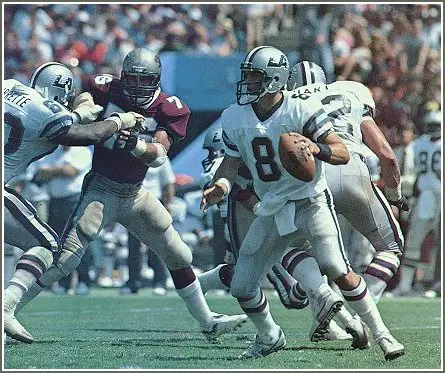
A league needs big names. At first, the biggest names were the coaches. New Jersey was coached by Chuck Fairbanks, who had led the University of Oklahoma to 3 Big Eight titles and the Patriots to their first AFC East title. Jim Stanley had led Oklahoma State to a Big Eight title, and was appointed to coach the Michigan franchise. Chicago was coached by George Allen, who had led the Redskins to the 1972 NFC title.

Oakland was coached by John Ralston, who had won 2 conference titles each at Utah State and Stanford, and had guided the Broncos to NFL respectability. Ralston's successor with the Broncos was Red Miller, who led them to the 1977 AFC Championship, and was hired to run the Denver franchise. Philadelphia was coached by Jim Mora Sr., who was not yet a big name, but he had coached at Stanford, UCLA, and the universities of Colorado and Washington, and had been an NFL assistant; he coached Philadelphia.

Tampa Bay was coached by Steve Spurrier, not yet "the ol' ball coach" who led his alma mater, the University of Florida, to SEC dominance and a National Championship, but was already a Heisman Trophy-winning quarterback, a respected college assistant, and the biggest living name in Florida collegiate football -- unless you want to count actor Burt Reynolds, a Florida State alum, and a part-owner of the team. The team was named after his character in Smokey and the Bandit, although their logo was a Wild West desperado on a charging horse. The Bandits were Spurrier's 1st head coaching job.

Burt is dead now, and he was never a particularly good actor. It's hard to explain to kids today just how big he was in the late Seventies and early Eighties. Like another guy who played college football in Florida, Dwayne "The Rock" Johnson -- but with a Southern drawl, a classic mustache, and a series of toupees that changed with the styles of natural hair.
"For the good old American life: For the money,
for the glory, and for the fun. Mostly for the money."

Los Angeles was coached by Hugh Campbell, who was not yet a big name in the U.S., but had coached the Edmonton Eskimos to the last 5 Grey Cups, the "Super Bowl" of the Canadian Football League (and had also played on a Grey Cup winner with the Saskatchewan Roughriders in 1966). His predecessor with the Esks (now the Edmonton Elks) was Ray Jauch, also not yet a big name in the U.S., but he had coached the Esks to the 1975 Grey Cup (and had also played on a Grey Cup winner with the Winnipeg Blue Bombers in 1959); he coached the Washington franchise.

Boston was coached by Dick Coury, who had previous insurgent-league experience, coaching the Portland Storm of the 1974-75 World Football League. Birmingham was coached by Rollie Dotsch, a respected assistant under Dan Devine at the University of Missouri and Notre Dame, and in the NFL under Fairbanks in New England and Chuck Noll in Pittsburgh. Arizona was coached by Doug Shivley, who'd been an assistant in New Orleans and Atlanta and at several colleges.

*

I was 13 years old when the USFL began, and I was very excited about the New Jersey Generals. At the time, I hated the Jets, because most of their fans were Met fans, and I hated the Mets. This was due to geography (both then played at Shea Stadium in Queens and also tapped into the Long Island fan base) and timing (both arrived in the early 1960s, just in time to take on Baby Boomers not steeped in Yankee & Giant traditions, and both won their leagues' championships in calendar year 1969). Until the Mets and Giants both won their leagues' 1986 championships (in that season if not that calendar year), it would never have occurred to 95 percent of Met fans to root for the Giants.

And I hated the Giants because of their refusal to acknowledge that they played in my home State by changing their name. The Generals admitted that they were based in the New York City market, but playing in New Jersey. They had Herschel Walker, one of the best running backs the college game had ever seen, a smart, personable young man. (It would be a long time before we knew about his personal demons, which, thankfully, haven't ruined him.) And I loved their helmet logo, a five-star general's ring of stars with leaf clusters.

As Theodore Roosevelt said about his 1912 Progressive Party, "Unhampered by tradition, uncorrupted by power, undismayed by the magnitude of the task, the new party offers itself as the instrument of the people, to sweep away old abuses." To me, and to many other fans, especially after the Strike of '82, the NFL represented established interest, corporate power, regimentation. True, I wasn't yet mature enough to think in those terms, but I could certainly feel it, watching games of what was already being called the No Fun League.

The USFL represented a clean slate. A chance to have a team without the connections to the Giants, then 27 years without a title and pretty frustrating since then, even if you did like them; or to the Jets, who had just come within 1 game of the Super Bowl, but were symbolized by Mark Gastineau, whose long hair, "porn 'stache," and obnoxious behavior made him the favorite player, and the Jets the favorite team, of "ginkers," what we called metalheads in East Brunswick in the Egregious Eighties.

The Generals had no past, and while this meant that we couldn't glory in their 1932, 1947, 1956, 1961 or 1977 titles (as we could with the Yankees), it also meant there was no dark age (as the Giants and Knicks were still in and the Yankees had been in from 1965 to 1975). There was no glory, but no shame, either.

And this was coming on the back of the Nets, who were in New Jersey and (all too briefly) winning; and the Devils, who were wrapping up their 1st season, playing horribly, but the novelty hadn't worn off yet, so we new Devils fans didn't care. The Generals, playing in a league where all the teams were expansion teams, would have a chance to win right from the start.

I was excited. I was buzzing. I was jazzed.

I was monumentally disappointed.

*

Is it possible for a league to be made by one game? People who study the history of the NFL seem to think so: It was when Red Grange took his "Galloping Ghost" fame from the University of Illinois into the Polo Grounds in 1925 and sold it out, and, although his Chicago Bears beat the Giants that day, the gate receipts from a 70,000-seat sellout saved the Giant franchise, thus making football in the New York market viable, thus making professional football in America viable. (This probably also killed off the best chance professional soccer had to make it in America for half a century.)

Is it possible for a league to be ruined by one game? From my perspective, it was. The Generals had signed the league's biggest coup, the sitting Heisman Trophy winner, Herschel Walker, lured out of his senior season at the University of Georgia and being a sure top pick in the 1984 NFL Draft by money and lots of it. But the Generals had no defense, and their 1st game, televised live on ABC, with the great college football voice Keith Jackson doing play-by-play, ended with the Los Angeles Express beating the Generals, 20-15, in front of just 32,008 fans, meaning the Coliseum had over 60,000 empty seats.
Other 1st-week games in the USFL: In the 1st game to be played, Tampa Bay beat Boston 21-17; Michigan beat Birmingham 9-7, Philadelphia beat Denver 13-6, Chicago beat Washington 28-7, and Oakland beat Arizona 24-0.

The Generals lost their 2nd game, too, losing 25-0 to the Stars at the Vet. They lost their 3rd game, their 1st home game at the Meadowlands (or, I was I was calling it then, "Generals Stadium"), 32-9 to the Bandits. They lost their 4th game, 31-21 to Boston at the Meadowlands.

As Stars coach Mora would later say when he was coaching the Indianapolis Colts, "Playoffs? Don't talk about Playoffs! You kidding me? Playoffs? I just hope we can win a game!"

Finally, the Generals went on a bit of a hot streak: They beat Arizona in Tempe, 35-21; then lost a home game to Michigan, 21-6, then got their 1st home win, 23-22 over a pathetic Washington squad; then lost in overtime in Chicago, 17-14; then beat Denver at Mile High, 34-29. Winning 3 out of 5 is good.

Then they lost their next 3, killing their momentum. They closed the season doing what a New York-area team should not do: They lost to a New England team, losing 34-10 in Boston. In the USFL's 18-game regular season, they finished 6-12, and didn't make the Playoffs.

Philadelphia won the Atlantic Division, Michigan the Central, Oakland (with a mere 9-9 record) the Pacific, and Chicago (tied for the Central lead but lost the tiebreaker) got the only Wild Card berth for the Playoffs. Philly beat Chicago at the Vet, Michigan beat Oakland in Pontiac, and in the USFL Championship Game, played on July 17, 1983, on neutral ground at Mile High in Denver, the Michigan Panthers, starring former University of Michigan receiver Anthony "The Darter" Carter, beat the Philadelphia Stars, 24-22.
Carter and the Panthers

*

The standard of play wasn't great, but it wasn't abject misery, as claimed by the media, which was in the pocket of the NFL. Don't forget: While ABC did the USFL's games, it also did Monday Night Football, and thus had a vested interest in the NFL's dominance. Even so, it was the 3rd-largest network, and both CBS and NBC had it in their interest for the USFL to fail.

If a sportswriter wanted to be interviewed for his football knowledge on a major network, he had to treat the USFL like a minor league. And not like in soccer, where England's 2nd division (now oddly named "The Championship") is a standard not that far below the 1st division ("The Premier League"), which would have been close to the USFL's actual performance level: The USFL was treated by the national media as if it was, truly, minor-league. And, as baseball pitcher turned sportscaster turned author Jim Bouton taught us, "The minor leagues are all very minor." (Though Bouton made an exception for Triple-A baseball's Hawaii Islanders.)

In management terms, the USFL was a colossal mess. The Denver Gold were a prime example: Red Miller feuded with management, so they fired him in midseason, and brought in his former Bronco quarterback, Craig Morton, who had just retired as a player, and had never coached before.

The L.A. Express were losing money left and right, and made a huge mistake the next season, signing Steve Young, the Brigham Young University quarterback who had nearly won the Heisman Trophy the year before, to an enormous contract, comparable in its excess to that of Alex Rodriguez, in its deferred payments to that of Bobby Bonilla, and in its results to that of Kevin Brown, who, lest we forget, was once considered good enough of a pitcher to get MLB's 1st contract worth a total over $100 million.
Steve Young, wondering if the money
he was promised was worth it

The USFL was also failing spectacularly at the box office. Leading the league in percent of stadium capacity filled were the Boston Breakers, with 61 percent -- but that meant they were getting 12,817 at Nickerson, which seated 21,000 at the time. Denver, which hadn't played to an unsold seat at a Bronco game since 1976 (and still hasn't, except for the Scab Year of 1987), had the highest average attendance, but even their 41,736 was only 56 percent. Tampa Bay had 39,896, but that was just 55 percent.

New Jersey (35,004), Oakland (31,211) and Arizona (25,776) also topped 25,000, but Birmingham's 22,046 was shockingly low for the football-mad State of Alabama, and L.A.'s 19,002 and Chicago's 18,133 were unacceptable for big markets. Even the teams that made it to the title game weren't packing 'em in: Michigan averaged 22,250, Philadelphia 18,650. These would have been unacceptable attendances even by the standards of 1983 baseball. Washington bottomed out at 13,850, in contrast to the Redskins, who hadn't played to an unsold seat since World War II.

Birmingham coach Dotsch, perhaps, said it best:

Every good coach has a game plan. In this case, the USFL got away from the game plan. There's no question we did, or I'll say the USFL did. I don't think we (meaning the Stallions) did, or Tampa Bay did. Hindsight is much better than foresight, I know, but things were done that hurt us. We didn't go crazy. We lost the fewest dollars of any USFL team. We were always the poorest team in the playoffs, but we held our own, and I'm proud of that. We did a good job with what we had. We won a lot more than we lost, and that's the biggest thing.
*

Clearly, the smart thing for the USFL to do would have been to look at which markets were doing well, and which markets didn't have as much competition in other sports, and move the failing teams (even if they were playing well) to lesser-tapped markets for the Spring of 1984.

Clearly, the USFL did not do the smart thing.

They moved the Breakers from Boston to New Orleans, where the only major league team in place was the Saints, who stunk at the time, and didn't own the Superdome. (The State of Louisiana did, and still does.) That wasn't a bad move, and attendance did jump to 30,557.
John Walton, who quarterbacked in the Continental Football League,
the WFL, the NFL (Philadelphia) and the USFL (the Breakers).

But the league made a huge mistake in expanding from 12 to 18 teams. A tremendous sub-mistake was making one of the added teams the Pittsburgh Maulers, who signed Heisman winner Mike Rozier of Nebraska. Ed DeBartolo, owner of the NHL's Penguins, and father of 49ers owner Eddie DeBartolo, seemed like the right guy to own a Pittsburgh team in the USFL... if putting a USFL team in Pittsburgh had been the right thing to do.

It wasn't. It wasn't just that the Pittsburgh area had lost so many jobs, and with it so many people, who went elsewhere to look for work. It was that the Steelers owned that market. In Western Pennsylvania, here's how sports popularity went at the time: 1. Steelers; 2. Penn State; 3. Pirates; 4. University of Pittsburgh football; 5. Uh, do we still have a hockey team?

Giving the Maulers purple uniforms didn't help. And what's a "mauler," anyway? The helmet logo was a guy in a hard hat swinging a sledgehammer, suggesting a factory or mill worker. Right, remind the people of Western Pennsylvania of the jobs they'd been losing like crazy for the last 20 years.
Rozier, looking for a pass from Glenn Carano, while Jim Lohmann blocks.
You've never heard of Carano or Lohmann? That's not surprising.

The Maulers' 1st game saw them lose to Birmingham, whose quarterback was Cliff Stoudt, reviled as Terry Bradshaw's inadequate backup with the Steelers, and the locals at Three Rivers Stadium threw snowballs at him. Rozier, a native of Camden, New Jersey, did not have the same impact in the USFL as Walker, and his pro career was a disappointment (although not an outright bust, as he later did all right for the Houston Oilers). The Maulers finished tied with Washington for the league's worst record, 3-15.

Seeing the Southeast as underserved -- Texas and Florida had NFL teams, but the rest of the old Confederacy then had only Atlanta and New Orleans in the NFL -- and seeing how Birmingham was working out, the USFL expanded to include the Memphis Showboats and the Jacksonville Bulls, playing at the Liberty Bowl and the Gator Bowl, respectively.

Memphis was respectable mainly for one reason: Defensive end Reggie White, who played in the State at the University of Tennessee. They were coached by Franklin "Pepper" Rodgers, who'd done well at the stadium for Memphis State (now the University of Memphis). But Lindy Infante, already a respected NFL assistant, couldn't get much out of the Bulls.
Reggie White

The USFL also expanded into the Southwest. Putting a team in Dallas to compete with the Cowboys would have been lunacy, but the Oilers were awful at the time, so they put in the Houston Gamblers, coached by Jack Pardee, a former linebacker who'd been an All-American at Texas A&M and All-Pro with the Rams and Redskins, and had coached the Bears and Redskins to Playoff berths. The Gamblers signed University of Miami quarterback Jim Kelly, and won the Central Division.
Jim Kelly, apparently trying to invent an alternative to the huddle

Putting a team in San Antonio seemed to make sense, as the city had only the NBA's Spurs. But longtime Texas A&I (not A&M) coach Gil Steinke couldn't get the Gunslingers into gear. Putting a team in Oklahoma, where they could peel off Sooner fans, and fans who were a long way from Dallas and Kansas City, seemed to make sense, and hiring former Steeler defensive coordinator Woody Widenhofer as head coach and former Buccaneers quarterback Doug Williams were good moves. And the Oklahoma Outlaws had cool uniforms, black jerseys with a nasty-looking desperado on their helmets. But they went nowhere.
Doug Williams had Jimmie Giles in Tampa before this,
and Gary Clark and Ricky Sanders in Washington after this.
In Tulsa, he had... the other Mel Gray.

And in the oddest transaction in pro football history, the owners of the Chicago Blitz and the Arizona Wranglers traded their entire franchises. Including rosters, coaching staffs, and front office personnel. Where Chicago had been good and Arizona terrible in '83, the reverse was true in '84.

L.A. got Steve Young, and former San Diego Charger quarterback John Hadl as coach, and they won the Pacific Division. Philadelphia had the best record in the league at 16-2, edging New Jersey for the Atlantic Division title.

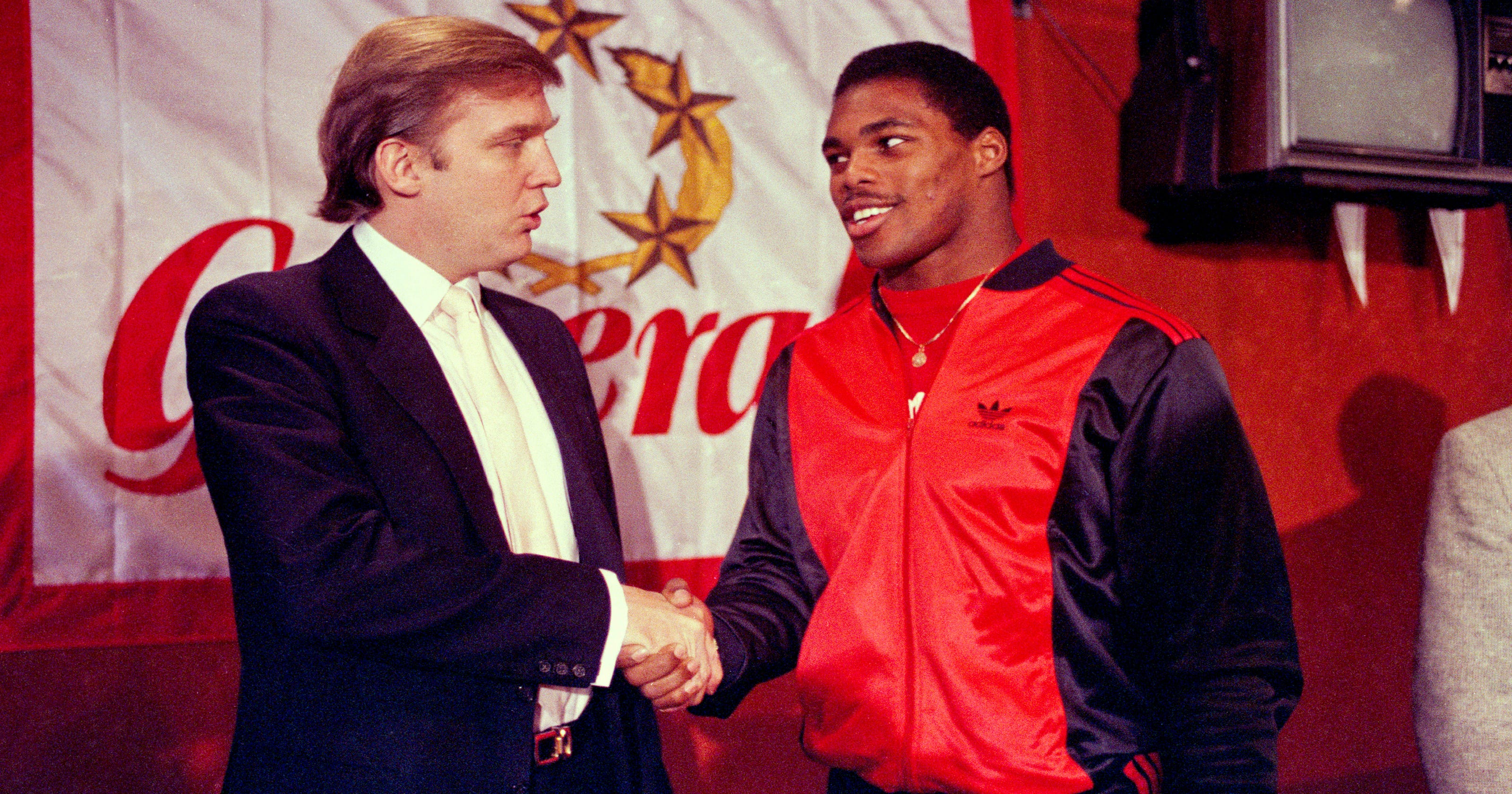
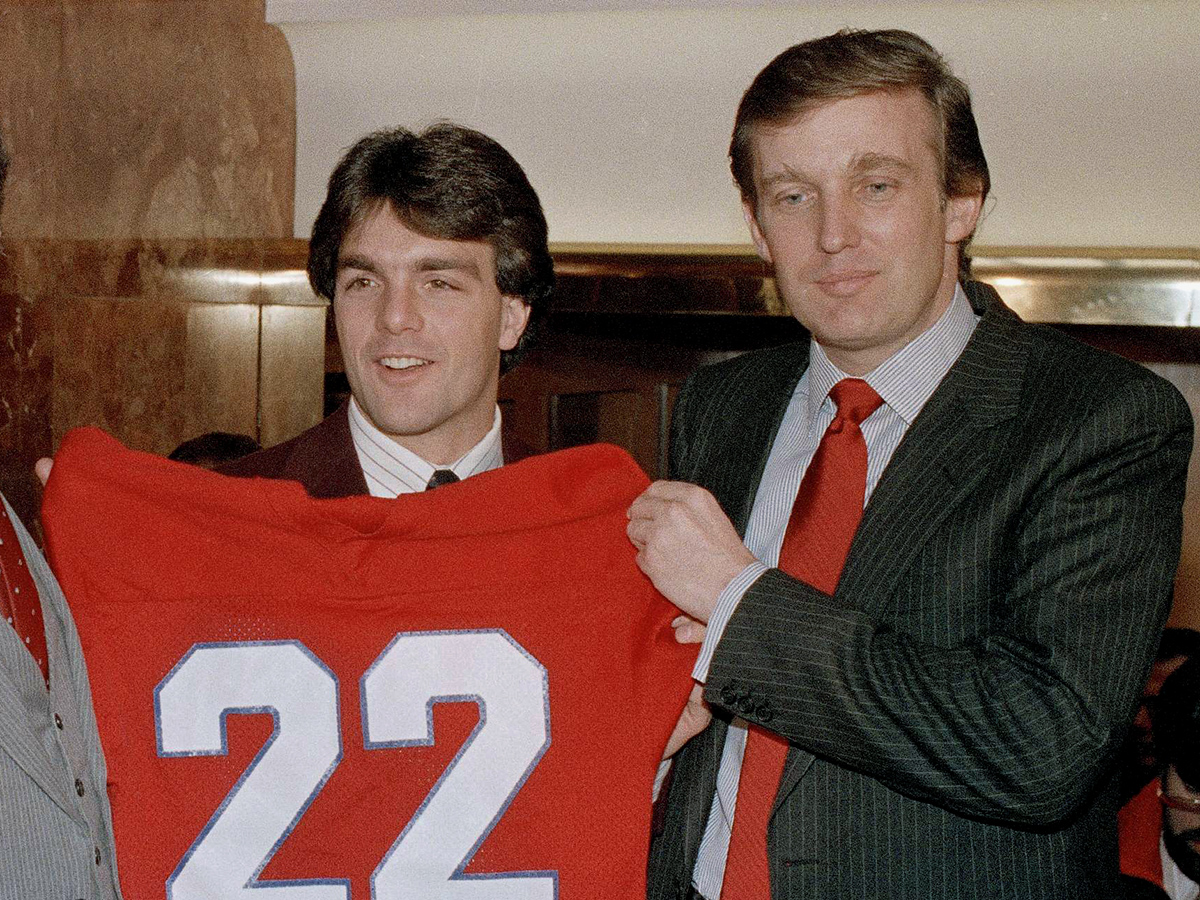
The Generals had been sold to Donald Trump, who brought in Walt Michaels, who'd coached the Jets to the AFC Championship Game in the '82 season, and former Cleveland Browns quarterback Brian Sipe, thus giving the Herschel-centric offense more diversity.
One of these men would later be treated for mental illness,
and the results are inconclusive. The other hasn't been treated
for mental illness, but became President.

(Supposedly, Trump originally wanted to lure Don Shula away from the Miami Dolphins, but balked when Shula wanted a free condo in the newly-opened Trump Tower. Somehow, I suspect, the older Trump would have accepted this, as the means to an end.)

The Generals lost to the Stars in the 1st round of the Playoffs, as former Penn State quarterback Chuck Fusina, running back Kelvin Bryant, and linebacker Sam Mills flattened Jersey's team. In the longest game in the history of professional football, one which went to a 3rd overtime (Sports Illustrated's article on it was titled "It Was a Game and a Half"), Young led Los Angeles to dethrone defending champion Michigan, 27-21. Birmingham beat Tampa Bay, 36-17, and Arizona beat Houston, 17-16.
Kelvin Bryant. Like the Phillies, the Stars had uniforms
that really clashed with the horrid artificial turf at The Vet.
Unlike the Phillies and especially the Eagles, the uniforms
went great with the stadium's seat-color scheme.

In the Conference Championships, Arizona beat L.A., 35-23; and Philly beat Birmingham, 20-10. The title game was played at Tampa Stadium, and Philly beat Arizona, 23-3.
This is what a USFL Championship ring looks like.

*

Did the USFL learn from its '83 and '84 mistakes? Partly. The league was contracted to 14 teams. Chicago and Pittsburgh were out. Michigan and Oakland were merged, keeping the Oakland Invaders name. Oklahoma and Arizona were merged, becoming the Arizona Outlaws, with the colors somewhat merged and Oklahoma's logo kept.

There were moves. To take advantage of the fact that the Baltimore Colts had been moved to Indianapolis, the USFL should have moved the Washington Federals to Baltimore. Instead, they moved their most successful team, the Philadelphia Stars, down Interstate 95.

But a legal wrangle prevented them from moving to Memorial Stadium for 1985, so they went to Byrd Stadium at the University of Maryland, inside the Capital Beltway in College Park. So while they had the name "Baltimore Stars," they were a lot closer to Washington. This cut their per-game attendance in half, from 28,668 in '84 to a dismal 14,275 in '85.

The Federals were moved, to Central Florida, an untapped market, to become the Orlando Renegades. Their coach was Lee Corso, a big name in the State, as he'd been Florida State's coach. Did this work out? As Corso would say in his later ESPN punditry career, "Not so fast, my friend!" The 'Gades finished 5-13, with an average attendance of 24,136. Each figure was better than they achieved in Washington, but still awful.

And the Breakers were moved again, to Oregon, where they became the Portland Breakers. True, Portland only had the NBA's Trail Blazers, but anybody who was an NFL fan in Oregon was either a Seattle Seahawks fan, or rooted for a faraway team like the Raiders, Steelers or Cowboys. And the L.A. Express crashed and burned: Their owners were bankrupt, and even with Young, they were just 3-15, with an average attendance of 8,415.

In the quarterfinals, Birmingham beat Houston 22-20, Memphis beat Denver 48-7, Oakland beat Tampa Bay 30-27, and Baltimore beat New Jersey 20-17 -- another Heisman winner, quarterback Doug Flutie, then considered "too short for the NFL," getting the Generals into the Playoffs, but no further.
One is a very small man. The other is a Heisman Trophy winner.
Alas, Flutie was a Republican, and continues to support Trump.
Trump was the first "Flutie Flake."

In the semifinals, Baltimore beat Birmingham 28-14, and Oakland beat Memphis 28-19. In the Championship Game, Baltimore (formerly Philadelphia) beat Oakland (sort of getting revenge on Michigan for the first title game), 28-24, at Giants Stadium.

The date was July 14, 1985. The USFL never played another game. Although this occurrence was suspected by many at the time, and knowing it would have surprised very few people, no one knew it for sure.

*

Later that year, the USFL announced that their challenge to the NFL was going to be full, starting in 1986: They were going to a Fall schedule, going head-to-head with the big boys. And they had sued the NFL on antitrust grounds. The USFL sought damages of $567 million, which, under antitrust law, would have been tripled to $1.7 billion if the jury found in their favor.

The USFL gave the NFL a chance to settle, proposing 2 remedies: Either force the NFL to negotiate new television contracts with only 2 networks, or force the NFL to split into two competing 14-team leagues, each limited to a contract with one major network.

Each NFL franchise was named as a co-defendant, with the exception of the Raiders, whose owner Al Davis was a major witness for the USFL, and had been excluded from the lawsuit in exchange for his testimony.

ABC announcer Howard Cosell was also a key witness for the USFL -- and this, more than his personality, his drinking, or his referring to Alvin Garrett of the Redskins, a black receiver, as "that little monkey" during a recent game, probably doomed him to being fired from Monday Night Football.

The lawyer for the USFL, Harvey Myerson, had what he felt were 3 "smoking guns":
1. A memo from March 1973 to NFL broadcasting director Robert Cochran, from attorney Jay Moyer, stating that an "open network" might be open to the "invitation to formation of a new league."
2. A memo from August 1983 from Jack Donlan, NFL management council executive director, to his staff. The memo laid out plans for NFL teams to "increase salary offers to USFL to existing players or run the risk of losing them."
3. A memo from a Harvard University professor named Michael Porter, which included a plan to "Conquer" the United States Football League.
The case went to trial in the Spring of 1986, and lasted 42 days. On July 29, 1986, the jury handed down its verdict: They declared the NFL a "duly adjudicated illegal monopoly," and found that the NFL had "willfully acquired and maintained monopoly status through predatory tactics." In other words, guilty as charged.
However, the jury rejected the USFL's other claims. They found that the USFL had changed its strategy to a more risky goal of a merger with the NFL. Furthermore, the switch to an Autumn schedule caused the loss of several major markets. It has been established that Trump, as owner of the Generals, specifically wanted to force a merger, knowing that the majority of teams would be eliminated.
Most importantly, the jury found that the NFL did not attempt to force the USFL off television. In essence, the jury felt that, while the USFL was harmed by the NFL's de facto monopolization of pro football in the United States, most of its problems were due to its own mismanagement(In each of these cases, the emphasis is mine, not the jury's.)

The jury awarded the USFL only one dollar in nominal damages, which was tripled under antitrust law to three dollars. It later emerged that the jury incorrectly assumed that the judge could increase the award.

Almost immediately upon announcement of the verdict, the USFL accepted that it was a Pyhrric victory, and announced it was suspending operations for the 1986 season, with the intent of returning in 1987. Players signed to contracts were free to sign with NFL (or other professional) teams immediately.

The USFL was now some $160 million in debt. With nearly all of its players under contract to the NFL and the Canadian Football League, Commissioner Harry Usher announced the league would stay shuttered in 1987 as well. In 1990, now basically a shell of a corporation (if not a "shell corporation," a term with which Trump is well familiar), the USFL finally received a check for $3.76 in damages, the additional 76 cents representing interest earned while the ultimately failed appeal had continued. (Factoring inflation in, that's about $8.41 in 2022 money.)

*
So what is the USFL's legacy? Actually, when you look at it, it could hardly be seen to have been a waste of time:
* Four players from the league made the Pro Football Hall of Fame: Steve Young went on to quarterback the 49ers to a title, Jim Kelly led the Buffalo Bills into 4 Super Bowls, Reggie White became a terror on defense for the Eagles and helped the Green Bay Packers win a Super Bowl, and Los Angeles Express offensive tackle Gary Zimmerman protected John Elway for 2 Bronco titles.

* The Redskins used some players who'd gotten their profiles raised in the USFL to win the title in the 1987 season. Oklahoma/Arizona's Doug Williams became the 1st black quarterback to play in, and the 1st to win, a Super Bowl, throwing passes to Jacksonville's Gary Clark and Houston's Ricky Sanders, and handing off to Philadelphia/Baltimore's Kelvin Bryant.

* Herschel Walker is not in Canton, but he should be: It's the Pro Football Hall of Fame, not the National Football League Hall of Fame. He gained 8,225 rushing yards and 4,859 receiving yards in the NFL, scoring 82 touchdowns. Put that together with his USFL stats, and that's 13,787 rushing yards, 6,843 receiving yards, and 143 touchdowns. Those are easily Hall-worthy numbers.

His NFL career is best remembered for the Cowboys trading him to the Minnesota Vikings for 5 players and 6 draft picks, which became a huge part of the Cowboys' quasi-dynasty of the 1990s. Herschel never won a ring, but he made the Playoffs with the Vikings, the Eagles and a return to the Cowboys, where he closed his career after the 1997 season. He also returned to the Meadowlands in 1995, with the Giants, but they didn't make the Playoffs that year. (The less said about his 2022 run for U.S. Senator from Georgia, the better.)

* Steve Spurrier moved on to Duke University, and revived their football program, giving them one of their few good periods, before going home to Gainesville and leading the University of Florida to glory.

* Doug Flutie was signed by the Chicago Bears after the USFL folded, but coach Mike Ditka didn't give him much of a shot. So he went to the CFL, and won Grey Cups with the Vancouver-based BC Lions, the Calgary Stampeders and the Toronto Argonauts.

Finally, the Bills gave him a shot, and, as Kelly's successor, he led them to the Playoffs. He would also do so with the San Diego Chargers, and closed his career in with his "hometown" Patriots (he grew up in Natick, on the opposite site of Boston from Foxborough, but was actually born outside Baltimore), backing up Tom Brady, and pulling off a trick that would have been in character for the USFL: On New Year's Day 2006, faking an extra point attempt as the holder, he dropped back and scored on a dropkick, something that hadn't been done, or even tried, in the NFL since 1941. That left...

* Sean Landeta as the last former USFL player still active. He'd been the Stars' punter, and won 2 Super Bowls with the Giants. He then bounced around, but reached the Playoffs with the Buccaneers, Packers, Eagles and Rams, before wrapping it up with the Giants in 2006, 21 years after the last USFL game.

* Houston's Jack Pardee and Darrel "Mouse" Davis (who took the Denver Gold reins in '85) both took the Gamblers' "run-and-shoot offense" elsewhere, Pardee racking up big scores as head man at the University of Houston, and Davis becoming the offensive coordinator of the Detroit Lions, helping them to what remains their last decent period.

* The USFL, like the 1960s AFL and the 1970s WFL, used the 2-point conversion. The NFL finally adopted it in 1994.
* Many high school football teams named the Panthers adopted the Michigan Panthers' helmet design for their own, and some still use it, decades after the Panthers folded.

* Perhaps the most lasting legacy of the USFL is its stock footage. Rather than pay the NFL the enormous licensing fees for use of their games, many TV shows and advertising agencies (for their commercials) have used USFL game footage to simulate people watching football games.

As Billy Joel, who released his album An Innocent Man shortly after the USFL's 1st season, would say, "There are not many who remember. They say a handful still survive." And many of those who do remember would like to forget.

Not me. On the 20th Anniversary, I wrote this piece for the song-parody website Amiright.com.

Long live The Three Dollar League!

Monday, January 16, 2023

Last Active Players for Defunct Teams and Leagues

Joe Cirella, an original New Jersey Devil
and the last Colorado Rockie active in the NHL

Major League Baseball:
Boston Braves, 1871-1952: Eddie Matthews, 1968
St. Louis Browns, 1902-1953: Don Larsen, 1967
Philadelphia Athletics, 1901-1954: Vic Power, 1965
Brooklyn Dodgers, 1883-1957: Bob Aspromonte, 1970
New York Giants, 1883-1957: Willie Mays, 1973
"Old" Washington Senators, 1901-1960: Jim Kaat, 1983
Milwaukee Braves, 1953-1965: Phil Niekro, 1987
Kansas City Athletics, 1955-1967: Reggie Jackson, 1987
Seattle Pilots, 1969: Fred Stanley, 1982
"New" Washington Senators, 1961-1971: Toby Harrah, 1986
Montreal Expos, 1969-2004: Bartolo Colón, 2018

National Football League:
Cleveland Rams, 1936-1945: Bob Waterfield, 1952
Chicago Cardinals, 1920-1959: Ken Gray, 1970 
"Old" Los Angeles Chargers, 1960: Ernie Wright, 1972
Dallas Texans, 1960-1962: Len Dawson, 1975
"Old" Oakland Raiders, 1960-1981: Howie Long, 1993
Baltimore Colts, 1953-1983: Rohn Stark, 1987
St. Louis Cardinals, 1960-1987: Mark Royals, 2003
"Old" Los Angeles Rams, 1946-1994: Sean Landeta, 2006
Los Angeles Raiders, 1982-1994: Tim Brown, 2004
"Old" Cleveland Browns, 1946-1995: Matt Stover, 2009
Houston Oilers, 1960-1996: Jon Runyan, 2009
St. Louis Rams, 1995-2015: 2 current, Aaron Donald & Rob Havenstein
San Diego Chargers, 1961-2016: 2 current, Keenan Allen & Joey Bosa 

American Football League (1926): Ray Flaherty, 1935
American Football League (1936-1937): Haven't been able to find rosters
American Football League (1940-1941): John Kimbrough, 1948
All-America Football Conference (1946-1949): Ben Agajanian, 1964
American Football League (1960-1969): Charlie Joiner, 1986
World Football League (1974-1975): Danny White, 1988
United States Football League (1983-1985): Sean Landeta, 2006
XFL (2001): Rod Smart, 2005

National Basketball Association:
Indianapolis Olympians, 1931-1953: Joe Graboski, 1962
Rochester Royals, 1937-1957: Jack Twyman, 1966
Fort Wayne Pistons, 1941-1957: Gene Shue, 1964
Minneapolis Lakers, 1947-1960: Elgin Baylor, 1971
Chicago Zephyrs, 1961-1963: Don Nelson, 1976
St. Louis Hawks, 1955-1968: Paul Silas, 1980 
San Diego Rockets, 1967-1971: Elvin Hayes, 1984 
Cincinnati Royals, 1957-1972: Nate "Tiny" Archibald, 1984
Baltimore Bullets, 1963-1973: Elvin Hayes, 1984
New York Nets, 1968-1977: Julius "Dr. J" Erving, 1987
Buffalo Braves, 1970-1978: Mike Glenn, 1986
New Orleans Jazz, 1974-1979: Rich Kelley, 1986
San Diego Clippers, 1978-1984: Terry Cummings, 2000
Kansas City Kings, 1972-1985: Otis Thorpe, 2001
Washington Bullets, 1973-1997: Juwan Howard, 2013
Vancouver Grizzlies, 1995-2001: Mike Bibby, 2012
"Old" Charlotte Hornets, 1988-2002: Baron Davis and Jamaal Magloire, 2012
Seattle SuperSonics, 1967-2008: 2 current, Kevin Durant, Jeff Green 
New Jersey Nets, 1977-2012: Brooklyn Lopez, active 
New Orleans Hornets, 2002-2012: 2 current, Marco Belinelli, Eric Gordon
Charlotte Bobcats, 2004-2013: 2 current, Kemba Walker, Bismack Biyombo

American Basketball Association, 1967-1976: Moses Malone, 1995

National Hockey League:
Pittsburgh Pirates, 1925-1930: Cliff Barton, 1940
Philadelphia Quakers, 1930-1931: Syd Howe, 1946
"Old" Ottawa Senators, 1902-1934: Flash Hollett, 1946
St. Louis Eagles, 1934-1935: Bill Cowley, 1947
Montreal Maroons, 1924-1938: Herb Cain, 1946
New York Americans, 1925-1942: Pat Egan, 1951
California Golden Seals, 1967-1976: Dennis Maruk, 1989
Kansas City Scouts, 1974-1976: Wilf Paiement, 1988
Cleveland Barons, 1976-1978: Dennis Maruk, 1989
Atlanta Flames, 1972-1980: Kent Nilsson, 1995
Colorado Rockies, 1976-1982: Joe Cirella, 1995
Minnesota North Stars, 1967-1993: Mike Modano, 2011
Quebec Nordiques, 1972-1995: Adam Foote, 2011
"Old" Winnipeg Jets, 1972-1996: Shane Doan, 2017
Hartford Whalers, 1972-1997: Jean-Sébastien Giguère, 2014
Atlanta Thrashers, 1999-2011: current, Zach Bogosian, Andrew Ladd, Evander Kane, Blake Wheeler

World Hockey Association, 1972-1979: Mark Messier, 2004

Friday, March 6, 2020

Top 5 Reasons You Can't Blame Donald Trump for Killing the USFL

Donald Trump and Herschel Walker

March 6, 1983: The United States Football League begins play.

July 29, 1986: The USFL won its antitrust lawsuit against the National Football League -- but the jury awarded damages of just $1.00. With antitrust awarded trebled, and appeals leading to inflation, the check the NFL eventually wrote came to $3.76. That's right: Three dollars and seventy-six cents.

Why did the USFL sue? Because they needed the money to go head-to-head with the NFL by playing in the Fall, instead of in Spring and Summer. Whose idea was that? The owner of the team in the New York market, the New Jersey Generals.

His name was Donald Trump.

There's a saying: "Everything Trump touches dies." But is he really the person primarily responsible for the USFL folding?

Top 5 Reasons You Can't Blame Donald Trump for Killing the USFL

5. The Commissioners. Chet Simmons was named the USFL's 1st Commissioner. He was a very successful TV sports executive. But he expanded the league too fast: They had 12 teams in 1983, but it jumped to 18 in 1984. That was too many: Instead of more good players and more good teams, there were more bad players, more bad teams, and more bad ownership situations.

He resigned in 1985, shortly before the 3rd season began. He was replaced by Harry Usher -- who, by a weird coincidence, shared his birthday with the USFL: March 6, 1939. He was happy to plunge the league into the antitrust suit, which was a huge mistake. After the verdict, he canceled the 1986 season, and that was all she wrote.

To put it another way: Pete Rozelle, then the Commissioner of the NFL, is often regarded as the greatest Commissioner any sports league has ever had, and putting Simmons and Usher up against Rozelle was like putting a couple of middleweights up against Muhammad Ali. Simmons and Usher may have meant well, but, if you'll pardon the pun, they were way out of Rozelle's league.

4. The Markets. The USFL had to have teams in the 3 biggest markets: New York, Los Angeles and Chicago. The teams in those markets didn't do well, and that was bad enough. But the USFL made big mistakes in putting teams head-to-head with established NFL teams.

Yes, they were smart to put teams in markets that didn't have NFL teams at the time: Birmingham, Jacksonville, Memphis, Orlando and Phoenix. In particular, putting teams in Baltimore and Oakland, which had both just lost teams, was a good idea. And the teams in Detroit and Tampa Bay seemed to do better on the field than the NFL teams in those markets.

But putting teams in Boston, Denver, Detroit, Houston, New Orleans, Philadelphia, Pittsburgh and Washington was a mistake. And some of the markets that didn't have NFL teams simply weren't able to support a team: Portland, San Antonio and Tulsa. Portland and San Antonio might have a big enough metro area to support an NFL team now, but they didn't then. Oklahoma City might now have one, but Tulsa likely never will.

3. The Other Owners. Some overstated their ability to pay expenses. Some underestimated the difficulties in running a professional football franchise. Some abandoned their teams when they realized that they would have to compete with NFL teams directly in Autumn 1986.

There were 18 separate teams in the USFL. Only 6 -- the Birmingham Stallions, the Denver Gold, the Los Angeles Express, the New Jersey Generals, the Oakland Invaders and the Tampa Bay Bandits -- played all 3 seasons without moving.

And, of those, the Gold were merged into the Jacksonville Bulls in anticipation of the Autumn move (as were the Houston Gamblers, into the Generals); the Bandits were in a hopeless situation, since their owner, John Bassett, previously having been easily the most competent owner in the league, was dying of a brain tumor and was not properly functional, putting the team in financial meltdown; and the Express were even worse financially, forcing the league to take over ownership.

It wasn't a total failure, though: The Jacksonville Jaguars showed that pro football could succeed in their city; the Arizona Wranglers showed that it could succeed in the Phoenix area; the Memphis Showboats showed that it could succeed in Tennessee, although the Houston Oilers would play only 1 season in Memphis before moving to Nashville to become the Tennessee Titans; and the Oakland Invaders showed that the problem in Oakland wasn't the market on the East side of San Francisco Bay, it was Al Davis' greed. (Or, given that the Raiders have now abandoned Oakland for a 2nd time, I should say, the Davis family's greed.)

2. The NFL. They are unbeatable. There have been 9 challengers to them: The 1926 American Football League, the 1936-37 AFL, the 1940-41 AFL, the 1946-49 All-American Football Conference, the 1960-69 AFL, the 1974-75 World Football League, the 1983-85 USFL, the 2001 XFL, and the 2019 Alliance of American Football. (I'm not counting the new XFL, because their result is yet to be determined.)

* The 1960-69 AFL succeeded, mainly because they were run by Al Davis, who was not only mean, like Trump; but smart, unlike Trump.

* The AAFC succeeded to the point where 3 of its teams were absorbed into the NFL: The Cleveland Browns, the San Francisco 49ers and the Baltimore Colts.

* The 1936-37 AFL got 1 team absorbed into the NFL, the franchise now known as the Los Angeles Rams.

* The others failed completely. The WFL failed so hard, they suspended operations in the middle of their 2nd season; the AAF, late in the regular season of their 1st.

To put it another way: The NFL has now played a full 100 seasons; all of its challengers combined, 26 -- 16 if you take out the '60s AFL.

The NFL learned its lesson from its dealings with the '60s AFL: Take control of the narrative. Let people know that they are the real football league, and that all others are pale imitations. This, as much as anything else, is the reason the USFL didn't have a good chance.

But one reason stands out above all others:

1. Conditioning. And I don't mean the players staying in good condition. I mean the way sports fans are conditioned.

Most people just aren't interested in watching football in the Spring and the Summer. Even with the Super Bowl extending the NFL season into the 1st week of February, they are trained to think of February to June as basketball and hockey season; and April to October as baseball season.

Colleges have training camps, and their annual intrasquad (Solid Color vs. White/Gray/Gold) game, in the Spring. But they don't have games that count in the Spring. High schools? Some States have Spring football, but most don't. For most Americans, Spring football was just... weird.

And as for the Summer, who wants to sit in 90-degree heat for 3 hours, without the natural breaks of innings giving you a good chance to cool off, get food, or use the bathroom?

The World League of American Football (sponsored by the NFL, so not a direct challenger) played in the Spring in 1991 and 1992. The AAF played last Spring. The original XFL played in the Spring and Summer in 2001, and all failed. The new XFL has started again, and attendance and TV ratings are pitiful.

If the funding, and the competent ownership of the teams, had been in place from the start in 1982-83, and the USFL had consolidated to the point where, with the possible exception of the Generals and the Express (got to have the New York and Los Angeles markets), no team was playing in the same market as an NFL team, they could have survived a while longer, possibly long enough to get their 4 best teams (commercially, not necessarily competitively) absorbed into the NFL in a mini-merger.

Under those conditions, Trump, for one of the few times in his life, would have been right.

VERDICT: Not Guilty. As much as I would like to blame Trump for the USFL folding -- after all, I loved that the Generals, unlike the Giants and the Jets, actually called themselves "New Jersey" instead of "New York" -- it just doesn't work.

Think of this analogy: The USFL was a hospital patient, dying of many things. Trump was an incompetent doctor, but even if he had been competent, the patient's chances of survival were not good.

Or to use a legal analogy: If it were a civil case, where a preponderance of the evidence was needed, maybe we could find against Trump; but, in a criminal case, where guilt has to be proven beyond a reasonable doubt, he can't be convicted -- of this charge.