Showing posts with label aafc. Show all posts

Tuesday, September 29, 2026

September 29, 1946: The Rams Debut & Desegregate the NFL

Kenny Washington

September 29, 1946, 80 years ago: The Rams, who played in Cleveland from 1936 to 1945, play their 1st home game in Los Angeles, making them the city's 1st real major league sports team. (Previous pro football teams had "Los Angeles" as their name, but their leagues could hardly be called "major.") The defending NFL Champions lose to the Philadelphia Eagles, 25-14.

This game is even more significant than the city's debut on the major league stage, because it is the NFL debut for halfback Kenny Washington and end Woody Strode, both of whom had played for UCLA at the Rams' new home, the Los Angeles Memorial Coliseum. They became the 1st black players in the NFL in 13 years, ending the color bar.
Woody Strode

Marion Motley and Bill Willis of the Cleveland Browns were doing the same in the All-America Football Conference that Autumn, so pro football had "four Jackie Robinsons," a few months before baseball had one. (Robinson had also played football at UCLA, and ran in the same backfield as Washington in 1939 and '40. In between UCLA and the Rams, Washington had played for the Hollywood Bears of the Pacific Coast Professional Football League.)

Washington played 3 seasons in the NFL before knee injuries forced him to retire at age 30. He worked for the Los Angeles Police Department, and when the Dodgers moved to Los Angeles in 1958, he became a scout for them. His son Kenny Jr. played in their farm system.

But Kenny Sr. battled ill health, and died in 1971, only 52 years old. He was elected to the College Football Hall of Fame, UCLA retired his Number 13, and the Los Angeles Memorial Coliseum Commission inducted him into the stadium's Court of Honor.

Strode only played the one season with the Rams, then went to Canada, helping the Calgary Stampeders win their 1st Grey Cup in 1948. He became a professional wrestler and an actor, notable for his role as the Ethiopian gladiator Draba in the 1960 film Spartacus. He seemed to specialize in Westerns, and his last role, filmed just prior to his death in 1994, showed him as an old man watching Sharon Stone walk into town in The Quick and the Dead.

Motley was born in Leesburg, Georgia, but grew up outside Cleveland in Canton, Ohio -- birthplace of the NFL, and eventually the site of the Pro Football Hall of Fame. Willis was from Columbus, the State capital and the seat of The Ohio State University. They both helped the Browns dominate the AAFC winning its title all 4 years, before coming into the NFL and winning their title in 1950, beating the Rams in a classic NFL Championship Game. (By that point, both Washington and Strode were out of football.)

Motley, who had played at the University of Nevada, where his Number 41 was retired, remained with the Browns until 1953, and last played with the Pittsburgh Steelers in 1955. With the Browns, he wore 76 and then 36. He was frustrated by his attempts to gain a coaching job, and worked in various capacities.
Marion Motley

Willis had his Number 99 retired by Ohio State, whom he'd helped win the 1942 National Championship. He was elected to the College Football Hall of Fame. He also remained with the Browns through 1953, usually wearing Number 30. He worked with the City of Cleveland Department of Recreation.
Bill Willis

He and Motley were both elected to the Pro Football Hall of Fame. Paul Zimmerman, the Sports Illustrated pro football expert known as Dr. Z, called Motley the greatest player he'd ever seen. Motley died in 1999. Willis, the last survivor of the 4, lived until 2007.

Canadian professional football also integrated in 1946 -- but might have done so earlier. It has been suggested that Robert "Stonewall" Jackson, a player for the Regina Roughriders (now the Saskatchewan Roughriders) in 1930, was black. But he may have been passing as white.

The first player to be signed by a Canadian football team that knew he was black was Herb Trawick, with the 1946 Montreal Alouettes. He was a two-way lineman from Pittsburgh, who attended what's now named Kentucky State University, an HBCU in the State capital of Frankfort.
Herb Trawick

He played 12 seasons with the Als, made 7 CFL All-Star teams, helped them win the Grey Cup in 1949, had his Number 56 retired and was elected to the Canadian Football Hall of Fame. He lived until 1985.

Sunday, September 6, 2026

September 6, 1946: The 1st Southern Team In the "Major Leagues"

September 6, 1946, 80 years ago: The All-America Football Conference, an early "rebel league," debuts. The Cleveland Browns, replacing the Rams, who won the NFL Championship and then moved to Los Angeles because of poor attendance, play their 1st game, at home, at Cleveland Municipal Stadium, and win, 44-0.

Under head coach Paul Brown, in the 4 years that the AAFC played, the Browns went 47-4-3, and won all 4 league championships. They then were admitted into the NFL, and won the Championship in 1950, 1954 and 1955; losing the Championship Game in 1951, 1952 and 1953. Counting their 4 AAFC seasons and their 1st 6 NFL seasons, they went 58-13-1 and reached 10 league title games, winning 7.

But this post isn't about the Browns, or the AAFC. It's about the team the Browns beat in their 1st game: The Miami Seahawks.

Miami... Seahawks? I mean the Miami Dolphins, or the Seattle Seahawks, right? Nope: The Dolphins didn't debut until 1966, in the AFL; and the Seattle team didn't debut until 1976. In fact, there was a minor-league hockey team called the Seattle Sea Hawks from 1936 to 1941.

No, the Miami Seahawks actually existed. And, if you consider the AAFC a "major league," then the Seahawks were the 1st major league team in the American South, the 1st major league team from a State that had seceded from the Union for the American Civil War.

Harvey Hester, a former quarterback at the University of Florida, and briefly the head coach at Wofford College in South Carolina, led a group of fellow Miami businessmen to put together an ownership team.

Their head coach was Jack Meagher, who had played at Notre Dame while Knute Rockne was an assistant coach there. He coached Rice University to an 8-4 season in 1930, Auburn to win the 1938 Orange Bowl, and the Iowa Pre-Flight Team to a 10-1 record under wartime conditions in 1944. His Auburn teams were nicknamed Meagher's Marauders.

The Iowa Pre-Flight Team, established (as were some of the other military-base teams that played college teams during World War II) near a major college campus, in this case the University of Iowa, was, due to the "flight" theme, named for a bird: The Seahawks. Meagher took their name with him, and Hester approved it for the Miami team, which made more sense in Miami than it did in Iowa City. He hadn't yet coached a pro game, but, certainly, he was qualified.

But while they got better after their opening disaster, they were never good. They lost 21-14 away to the San Francisco 4ers, and 30-14 away to the Los Angeles Dons, before playing their 1st home game, losing to the 49ers again, 34-7 at Burdine Stadium, which would be renamed the Orange Bowl in 1959.

On October 11, they got their 1st win, 17-14 over the Buffalo Bisons at Civic Stadium in Buffalo, later renamed War Memorial Stadium. But that would be the highlight of their season. They lost 28-7 to the Chicago Rockets at Soldier Field, 30-7 to the football version of the Brooklyn Dodgers at Ebbets Field, 24-21 to the football version of the New York Yankees at Yankee Stadium, and 20-7 at home to the Rockets.

(Note: When I say, "the football version of... " I only mean that those teams had the same names as their baseball equivalents, and it was convenient for them to play in the same stadiums. It wasn't the baseball teams moonlighting as football teams, a practice that did include Connie Mack's Philadelphia Athletics in a league that lasted just one year, 1902.)

The way the Seahawks' schedule worked out, 7 of their 1st 8 games were on the road, and their last 6 games were at home. On November 18, they beat the Bisons again. They lost 34-21 to the Dons, 34-0 to the Browns, and 31-0 to the Yankees. They closed on December 13, at home, beating the Dodgers, 31-20. 
The Seahawks wore orange and green,
like the University of Miami, and presaging the Dolphins.

They finished 3-11. With the Dodgers and the Bisons, the 2 teams they beat, both finishing 3-10-1, the Seahawks had the worst record in the league. They folded after the season.

Why? Several reasons. This was before the widespread use of air conditioning made life in Florida tolerable. As a result, Miami was, by far, the smallest market in the AAFC, and only Green Bay was smaller in the NFL. The stadium that would become the Orange Bowl only seated 35,000, so even if the Seahawks sold games out, it still might not have been enough to make a profit. It was soon expanded, but that didn't do the Seahawks any good.

The Browns had brought in black players Marion Motley and Bill Willis. The AAFC made it known that black players would be accepted. Despite Florida being a Southern State, there were no incidents when they played in Miami. But the Southern fans wanted no part of that, and the Seahawks simply didn't draw well. Knowing this, Hester knew he couldn't bring black players onto the team, no matter how good they were. So he was stuck with a an all-white team that went 3-11.

Even more telling, Hester needed the other members of his group to buy the team. He was the only owner, in the NFL and the AAFC combined, who was not a millionaire. Paul Brown, who was the Browns' head coach and GM, was not their owner, but stood in for the owners in league meetings until Art Modell bought the team in 1962. He noticed that Hester didn't seem to fit in, operationally or emotionally, with the other team owners, and wouldn't even play poker with them.

Meagher never coached again, and died in 1968. An Auburn fan group took the name "Meagher's Marauders," and annually award a scholarship and dedicate an award to an Auburn football legend. I can find no details of what happened to Hester after the Seahawks folded, only that he lost his life savings with the team, fell deeply into debt, and was not involved in professional sports again.

There wouldn't be another major league (or even "major league") team in a former Confederate State until 1952, when the NFL debuted the Dallas Texans. They failed after 1 season, too. In 1960, the NFL debuted the Dallas Cowboys, and the AFL debuted, with the Dallas Texans, who became the Kansas City Chiefs in 1963, and the Houston Oilers, who became the Tennessee Oilers in 1997 and the Tennessee Titans in 1999. In 1962, Major League Baseball debuted the Houston Colt .45s, who became the Houston Astros in 1965.

And the Miami Dolphins finally brought major league sports back to Florida in 1966. This would be followed by the NFL's Tampa Bay Buccaneers in 1976, the NBA's Miami Heat in 1988 and Orlando Magic in 1989, the NHL's Tampa Bay Lightning in 1992, MLB's Miami Marlins and the NHL's Miami-area Florida Panthers in 1993, the NFL's Jacksonville Jaguars in 1995, and MLB's Tampa Bay Rays in 1998. (The Rays were known as the Tampa Bay Devil Rays until 2007. The Marlins were known as the Florida Marlins until 2011.)

Other Southern cities getting major league teams have included Charlotte and Raleigh in North Carolina, Atlanta in Georgia, Nashville and Memphis in Tennessee, New Orleans in Louisiana, Oklahoma City, and, in addition to Dallas and Houston in Texas, San Antonio.

If you counted the ABA as "major league," not only did Memphis have a team, but the Norfolk area had the Virginia Squires, Louisville had the Kentucky Colonels, and Miami had the Floridians. If you counted the WHA, then there were the Houston Aeros, and the Toronto Toros moved to Alabama, anglicized their name, and became the Birmingham Bulls. A Miami Screaming Eagles was planned for the WHA's start in 1972, but their ownership group fell apart, and the franchise was awarded to Philadelphia instead.

One more sports note for September 6, 1946: The New York Yankees lost to the Philadelphia Athletics, 4-3 at Shibe Park In Philadelphia. Bob Savage outpitched Clarence Marshall, whose nickname was "Cuddles." How is a team supposed to beat a Savage with Cuddles? Joe DiMaggio went 3-for-4. Sam Chapman hit a home run for the A's.

Tuesday, September 16, 2025

September 16, 1950: The Cleveland Browns Announce Their Presence

Marion Motley carrying the ball -- painted white,
to be more visible in a night game. This did not catch on.

September 16, 1950, 75 years ago: The National Football League features a season-opening game between their defending Champions and those of a newly-defunct rival league.

The game was played at the 105,000-seat Municipal Stadium in South Philadelphia. Usually playing their home games at Shibe Park in North Philadelphia, the Philadelphia Eagles had played home games at Municipal Stadium from 1936 to 1939, and select games thereafter.
Municipal Stadium, by this point named John F. Kennedy Stadium.
Just to the north was The Spectrum; to the north of that, Veterans Stadium.

This game was, as soccer fans would call it, a "Charity Shield" or "Super Cup" game: The 2-time defending NFL Champion Eagles vs. the Cleveland Browns, 4-time titlists in the All-America Football Conference. The Browns were 47-4-3 over the AAFC's 4-season history; the Eagles, 22-3-1 over the last 2 years, thanks to a 5-2 alignment that was the 1st defensive unit to have a memorable nickname: Before San Diego, Detroit and Los Angeles had lines that became known as the Fearsome Foursome, Philly had the Suicide Seven.

Some people then called it "The Game of the Century," and some now think of as an unofficial "first Super Bowl." Such a name is ironic, since it took the Eagles until 2018 to win an NFL Championship in the Super Bowl era, and, through the 2024 season, the Browns haven't even been to a Super Bowl yet.

Playing on a Saturday night -- making it, sort of, not just "the 1st Super Bowl" but "the 1st Monday Night Football game" -- in front of 71,237 fans, still the largest crowd ever to watch a professional football game in Pennsylvania (and nearly double the capacity of Shibe Park, which really limited the Eagles' attendance), the Browns put on a show.

Paul Brown, having mastered his craft at every level below the NFL -- at Massillon High School outside Cleveland, at Ohio State University where he won the 1942 National Championship, and with the Browns in the AAFC -- was the greatest offensive mind the game of football had yet seen. With Otto Graham as his quarterback, passing to Dante Lavelli, Mac Speedie and Dub Jones, and with the acceptance of black players like fullback Marion Motley and guard Bill Willis, he had won those 4 AAFC titles.
Paul Brown

(The Browns were named for Paul Brown. The story that Brown, or the original owner, Arthur B. McBride, wanted to name the team the Cleveland Brown Bombers in honor of Joe Louis, then the Heavyweight Champion of the World, is a myth. McBride had run a fan contest to determine the name, and the winner was "Cleveland Panthers," who played from 1919 to 1933, including in the 1st American Football League in 1926, but Paul Brown called them a failed team that he wanted no part of. So, over Brown's objection, McBride named them the Browns.)

And that Saturday night in South Philly, Brown let his team put on a show. The Eagles took an early lead on a field goal by Cliff Patton. But Graham threw freely, and the Browns scored the next 4 touchdowns: A 59-yard pass from Graham to Jones, a 26-yard pass from Graham to Lavelli, a 13-yard pass from Graham to Speedie (that was his real name: He was born Mac Curtis Speedie), and a 1-yard run by Graham.

It was 7-3 Browns at the end of the 1st quarter, 14-3 Browns at the half, 21-3 Browns after 3 quarters, and 28-3 Browns before Bill Mackrides threw a touchdown pass to Pete Pihos to get the Eagles into double figures. Late in the game, Rex Bumgardner ran for a touchdown, making the final score Browns 35, Eagles 10. To borrow a line from Bull Durham, a movie from another sport, the Browns had announced their presence with authority.

The Eagles actually had more 1st downs, 24-23; more rushing yards, 148-141; and fewer penalties, 3 for 45 yards to the Browns' 12 for 98 yards. And there were plenty of turnovers on both sides: 5 for Philadelphia, 4 for Cleveland.

But Graham completed 21 of 38 passes for 346 yards, a display that NFL fans, even with Sid Luckman of the Chicago Bears and Sammy Baugh of the Washington Redskins still active, simply weren't used to. It forced the Eagles into the air: Between them, Mackrides and Tommy Thompson attempted 32 passes, but only completed 11.
Until 1951, the Browns wore white helmets,
and Otto Graham wore Number 60. After that,
he switched to 14, and the Browns have worn
orange helmets ever since.

The performance stunned football fans all over the nation. Eagle coach Earle "Greasy" Neale was contemptuous of the aerial assault, calling the Browns "a basketball team." When the teams met again on December 3 at Cleveland Municipal Stadium, Brown told Graham not to throw a single pass, just to make a point, and he didn't. And the Browns didn't score a single offensive touchdown. They didn't need to: Warren Lahr intercepted a Thompson pass, and returned it 30 yards for a touchdown, while Lou Groza added 2 field goals, and the Browns won, 13-7. Brown had a great defense, too.

The Eagles never recovered, going 6-6, and didn't reach the NFL Championship Game again for 10 years. The Browns won the NFL title that year, and appeared in 7 title games in 8 years, winning 3: 1950, 1954 and 1955. Brown and 8 of his 1950 Browns would be elected to the Pro Football Hall of Fame: Graham, Motley, Groza, Lavelli, Speedie, Willis, end Len Ford and center Frank Gatski.

Paul Brown would be fired by new team owner Art Modell after the 1962 season. Cleveland fans treated this as the 1st time Modell aggrieved them, and it would be far from the last, or the worst. In 1968, Brown founded a team in the American Football League, the Cincinnati Bengals. He tried to remake the team in the old Browns' image, using the same colors and the same offense. They even had the same initials, although there had been a previous team with the Cincinnati Bengals name, which played in the 2nd (1936-37) and 3rd (1940-41) leagues with the AFL name.

Don McCafferty (1970 NFL Champion Colts) coached under him at Ohio State. Among his coaches with the Browns were Weeb Ewbank (1958 and '59 NFL Champion Baltimore Colts, 1968 World Champion New York Jets), Blanton Collier (his replacement as Brown coach, 1964 NFL Champions), Lou Saban (1964 and '65 AFL Champion Buffalo Bills) and Don Shula (1968 NFL Champion Colts, 1972 and '73 NFL Champion Miami Dolphins). Among his coaches with the Bengals were Bill Walsh and Sam Wyche (who, among their other achievements, opposed each other in Super Bowl XXIII in 1989).

Take it to the next level, and his "3rd generation" coaches include Red Miller (1977 AFC Champion Denver Broncos), Howard Schenllenberger (1983 NCAA Champion Miami), Dick MacPherson (undefeated season with Syracuse in 1987), George Seifert (1990 and '94 NFL Champion San Francisco 49ers), Paul Holmgren (1996 NFL Champion Green Bay Packers, 2005 AFC Champion Seattle Seahawks), Marty Schottenheimer (4 AFC Championship Games, although he lost them all), Tony Dungy (2006 NFL Champion Indianapolis Colts), Doug Pederson (2017 NFL Champion Philadelphia Eagles) and Andy Reid (2019, '22 and '23 NFL Champion Kansas City Chiefs).

Through Schottenheimer, his "coaching tree" also includes Bill Cowher (2005 NFL Champion Pittsburgh Steelers), Lovie Smith (2006 NFC Champion Chicago Bears), Mike Tomlin and Ken Whisehunt (who, among their other achievements, opposed each other in Super Bowl XLIII in 2009), Mike McCarthy (2010 NFL Champion Packers), Gary Kubiak (2015 NFL Champion Broncos) and Bruce Arians (2020 NFL Champion Tampa Bay Buccaneers). So Brown's NFL legacy spans that much: 1950 to 2023, including 24 of the 1st 59 Super Bowls, and 27 of the last 75 NFL Championships.

The Browns won the 1964 NFL Championship under Collier, reached the NFL Championship Game in 1968 and '69, and reached the AFC Championship Game in 1986, '87 and '89. After the 1995 season, Modell moved them, and they became the Baltimore Ravens. Cleveland was granted a replacement team, and the new Browns began in 1999. They have mostly struggled since. As have the Bengals, although they have won AFC Championships in 1981, 1988 and 2021.

Paul Brown died in 1991. When the Bengals moved into a new stadium for the 2000 season, it was named Paul Brown Stadium. It held that name until Paul's son, Mike Brown, often ridiculed as one of the NFL's cheapest owners (hence, their struggles), finally took his father's name off the stadium and sold the naming rights: In 2022, it became Paycor Stadium.

Speaking of stadiums: The Eagles moved to the University of Pennsylvania's Franklin Field in 1958, then returned to the South Philadelphia sports complex in Veterans Stadium in 1971, replacing that with Lincoln Financial Field in 2003. They won the NFL Championship in 1960, the NFC Championship in 1980 and 2004, and finally won a Super Bowl in the 2017 season.

In 1964, Philadelphia Municipal Stadium was renamed John F. Kennedy Stadium. On August 16, 1966, the Beatles played there. On July 13, 1985, it hosted the American end of Live Aid. But that show exposed to the world that it already falling apart. The Rolling Stones, who had packed the place on their 1981 Tattoo You tour, chose the considerably smaller Vet for Steel Wheels in 1989. It was demolished in 1992, and the new arena opened on the site in 1996.

Sunday, November 3, 2024

Dub Jones, 1924-2024

We can now close the books on an interesting chapter in the history of professional football: The All-America Football Conference of 1946 to 1949, the league that produced 3 teams that joined the NFL. Namely, the Cleveland Browns, the San Francisco 49ers, and the Baltimore/Indianapolis Colts.

William Augustus Jones was born on December 29, 1924 in Arcadia, Louisiana, and grew up in nearby Ruston. He was a star two-way back at Louisiana State University, then transferred to the school then known as LSU's arch-rivals: Tulane University. It was World War II, and Tulane had a U.S. Navy training program.

After serving in The War, he turned pro, and he turned out to be the last surviving player who:

* Played for the 1st Southern team in major league sports, the 1946 Miami Seahawks of the All-America Football Conference.

* Played for a football team called the Brooklyn Dodgers, in the AAFC during the 1947 season.

* Played on the Cleveland Browns' AAFC Champions of 1948 and 1949. They had also won the title in that league in 1946 and 1947.

* Played in the AAFC at all.

* Played in the 1950 season-opening "merger" game between the AAFC Champion Browns and the 1948 and 1949 NFL Champion Philadelphia Eagles, which the Browns won, 35-10 in a stunning upset.

* Played on the Browns' NFL Champions of 1950 and 1954. 

* And he may also have been the last living player who regularly played both offense and defense. He was good enough to make the Pro Bowl in the 1951 and 1952 seasons.

Like many of the Browns in that era, he switched uniform numbers midway through his career, in his case from 86 to 40.

He was an assistant coach under Blanton Collier on the Browns' 1964 NFL Championship team. In other words, they've never won an NFL title without him being involved in some way. He died in Ruston yesterday, November 2, 2024, as the NFL's oldest living former player, just 57 days short of his 100th birthday.

With his death, there are now 2 surviving players from the 1955 NFL Champion Cleveland Browns: Bob Smith and Sam Palumbo.

And the oldest living former NFL player is George Sims, who just turned 97. He is from Seymour, in north Texas, a two-way back from Baylor University, who played for the Los Angeles Rams in 1949 and 1950.

Dub's son, Bert Jones, also starred at LSU, and was an All-Pro quarterback for the Baltimore Colts, making them the 1st father and son to both play in the Pro Bowl. 

Wednesday, October 2, 2024

October 2, 1949: Both Leagues' Pennants Decided On the Final Day

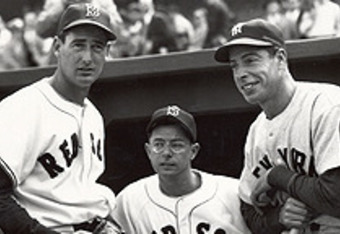
Left to right: Ted Williams, Dom DiMaggio, Joe DiMaggio.

October 2, 1949, 75 years ago: Yankee Stadium, Bronx, New York. Regular-season finale. Winner takes the American League Pennant.

On the last day of the 1948 regular season, the Boston Red Sox beat the New York Yankees at Fenway Park in Boston, clinching at least a tie for the AL Pennant, and knocking the Yanks out of a chance for it. Ted Williams went 2-for-4 with 2 RBI doubles. Sox center fielder Dom DiMaggio went 3-for-4, including a solo home run. His brother, Yankee center fielder Joe DiMaggio, went went 4-for-5 with 2 doubles and 3 RBIs -- meaning that, between them, the DiMaggios go 7-for-9 with 3 extra-base hits and 4 RBIs. And brother Vince, who also reached the majors, wasn't even in this game! Although he was there, as were their parents.

The next day, also at Fenway, the Sox lost a playoff for the Pennant to the Cleveland Indians, 8-3, as Tribe shortstop-and-manager Lou Boudreau hit 2 home runs. They went on to beat the Boston Braves in the World Series.

In the off-season, the Yankees Bucky Harris, who had managed them to the 1947 World Series, and hired Casey Stengel, who had just won the Pacific Coast League Pennant with the Oakland Oaks, but had failed as manager of the Brooklyn Dodgers and the Boston Braves. The Sox were managed by Joe McCarthy, who had managed the Yankees from 1931 to 1946, winning 8 Pennants and 7 World Series.

Joe DiMaggio, the best player in baseball since he arrived in the major leagues in 1936, missed the 1st 2 months of the season with a heel spur. In late June, the pain vanished. In a 3-game series at Fenway on June 28, 29 and 30, he went 5-for-9, with 4 home runs and 9 RBIs. The Yankees swept, winning 5-4, 9-7 and 6-3. During the 3rd game, a fan flew a plane over Fenway, trailing a banner reading "THE GREAT DIMAGGIO." The joke was that it had to be for Joe, since Dom was only a very good DiMaggio.

The Yankees jumped out to a 12-game lead, but blew it, mainly due to injuries that kept several players out of the lineup for long stretches. They trailed the Sox by 1 game with 2 to play -- and these 2 were against the Sox at The Stadium.

For the 1st time, the Pennant would come down to the Yankees and the Red Sox. Yes, there was 1904, but that was between the New York Highlanders and the Boston Americans. Not only had the teams not yet adopted their familiar names, but the rivalry tailed off, sparked again by the Red Sox' sale of Babe Ruth and practically their entire starting rotation to the Yankees in the early 1920s.

On October 1, the Yanks held Joe DiMaggio Day, since his brother Dom played for the Sox, and thus the whole family could attend. Joe had been ill with pneumonia, but had kept playing, and says, "I'd like to thank the Good Lord for making me a Yankee." (I guess he didn't have an agent back in 1934.) In the game that followed, the Sox, acting like more recent Red Sox teams, blew a 4-0 lead, Johnny Lindell hit an 8th-inning homer, and the race was tied. Yankees 5, Red Sox 4.

In fact, in the 1901 to 1968 era of 2 single-division leagues, 1949 was the only season in which both leagues' races were unresolved as the final day of the regular season dawned. On the last day of the season, the Brooklyn Dodgers needed a win or a St. Louis Cardinals loss to win the National League Pennant. If they'd gotten neither, there would have been a Playoff.

They needed 10 innings, but they got their win, 9-7 over the Philadelphia Phillies at Shibe Park (later renamed Connie Mack Stadium) in Philadelphia. Pee Wee Reese led off the inning with a single. Eddie Miksis sacrificed him to 2nd base. Duke Snider singled him home. Jackie Robinson was intentionally walked to set up the inning-ending double play. But Luis Olmo, one of the earliest Puerto Rican players in the major leagues -- and considered "white" enough to make it before Robinson desegregated the game -- singled Snider home. Jack Banta held the Phils off in the bottom of the 10th, and got the win in relief of Don Newcombe.
1949 Dodger photos. Top row, left to right: Ralph Branca,
Jackie Robinson, Gil Hodges, Roy Campanella.
Bottom row, left to right: Pee Wee Reese,
Duke Snider, a 2nd photo of Hodges, Don Newcombe.

October 2, 1949, Yankee Stadium. This was for the Pennant. A crowd of 68,055 was on hand. Phil Rizzuto led off the bottom of the 1st inning with a triple to left field. Tommy Henrich grounded to 2nd, and "The Scooter" scored. It was 1-0 Yankees.

The Yanks still led 1-0 with 1 out in the top of the 8th, when McCarthy sent Tom Wright up to pinch-hit for his starting pitcher, Ellis Kinder. Big mistake. Wright drew a walk, but Dom DiMaggio grounded into a double play.

Henrich led off the bottom of the 8th with a home run off Mel Parnell, ordinarily the Boston ace. McCarthy removed him, and brought in Tex Hughson, the ace of the Sox' 1946 American League Pennant winners. Yogi Berra, who came into his own this season as both a hitter and a catcher, singled to left. Joe DiMaggio grounded into a double play. But Lindell singled to center, with Hank Bauer pinch-running for him. Billy Johnson singled to left. Hughson, unintentionally, walked Cliff Mapes to load the bases. Jerry Coleman sent a drive down the right field line, clearing the bases, although he was out trying to stretch it from a double to a triple. It was 5-0 Yankees.

Yankee starter Vic Raschi had allowed only 2 hits over the 1st 8 innings, and got the 1st out in the 9th. Then he faltered: He walked Williams, threw a wild pitch, and allowed a single to Vern Stephens. Bobby Doerr lifted a drive to center field. Joe DiMaggio, still sick, dropped an easy fly ball, scoring both runners. Normally so good out there, Joe walked off the field, taking himself out of the game for the good of the team. Stengel moved Bauer from left field to right, moved Mapes from right to center, and put Gene Woodling in left.

Raschi got Al Zarilla to fly to center, where the newly-installed Mapes caught it. But Billy Goodman singled to center, scoring Doerr. It was now 5-3, the tying runs were on, and the run that could win the Pennant was at the plate, in the person of Sox catcher George "Birdie" Tebbetts.

Berra went out to talk to Raschi. "The Springfield Rifle" angrily said, "Gimme the goddamned ball, and get the hell out of here!" Yogi did as he was told, and Raschi got the final out, as Tebbetts popped up to 1st base, where Henrich, normally a right fielder, caught it. Final score: Yankees 5, Red Sox 3. The Yankees had won their 16th American League Pennant.

The Yanks beat the Dodgers in the World Series. In the last 2 seasons, the Sox had won 192 games, and didn't even win a Pennant.

"I won one," a jubilant Stengel said in the locker room. Later, in his weird way of talking that became known as "Stengelese," he said, "I couldn't a-done it without my players."

The following season, the Yankees won it again; while the Dodgers and Phillies again needed 10 innings to settle the race, this time against each other, with no scoreboard-watching. Dick Sisler hit a home run to win it.

Monday, May 1, 2023

May 1, 1923: The Los Angeles Memorial Coliseum Opens

May 1, 1923, 100 years ago: The Los Angeles Memorial Coliseum opens, adjacent to the campus of the University of Southern California. It completed a stretch of two weeks in which three of the greatest stadiums ever built on planet Earth opened: The original Yankee Stadium in New York on April 18, and the original Wembley Stadium in London on April 28. Of the three, the Coliseum is the only one that still stands, 100 years later.

Unless you count the nearby HOLLYWOOD sign and the Golden Gate Bridge in San Francisco as "buildings," the Coliseum is the most famous building in the State of California.

At its opening, seating capacity was 75,144. It was expanded to 101,574 for the 1932 Olympic Games. A renovation, necessary after the 1994 Northridge Earthquake, dropped capacity to 93,103. Another recent renovation, including wider seats, and bigger media facilities requiring the removal of some seats, has made the current capacity 77,500, making it the 2nd-biggest stadium in California, behind the Rose Bowl in nearby Pasadena.

It hosted a football game for the 1st time on October 6, 1923. The University of Southern California hosted Pomona College, and won, 23-7. The USC Trojans have used the Coliseum as their home field ever since.

Their nearby rivals, the University of California at Los Angeles, played home games there from 1933 to 1981. The UCLA Bruins now play home games at the Rose Bowl, which, due to the Trojans' success, has often seemed like a secondary home field to them, not just every other year when they play UCLA in their home-and-home series, but also on January 1, when the Rose Bowl game is usually played.

The Coliseum has also been the leading professional football venue in Southern California. In the NFL, the Los Angeles Rams played there from 1946 to 1979, and again from 2016 to 2019; the Los Angeles Raiders from 1982 to 1994; Super Bowl I in 1967 and Super Bowl VII in 1973; and the postseason Pro Bowl from 1951 to 1972, and again in 1979.

Other pro football teams using the Coliseum: The Los Angeles Dons of the All-America Football Conference from 1946 to 1949, the Los Angeles Chargers of the American Football League in 1960, the Los Angeles Express of the United States Football League from 1983 to 1985, and the Los Angeles Xtreme of the XFL in 2001.

It has hosted the U.S. national soccer team 20 times, starting in 1965; and Mexico's team 61 times. In 1967, the only season of play for the United Soccer Association, it hosted the Los Angeles Wolves, who won that league's title. It also hosted the city's entry in another league starting that season, the Los Angeles Toros of the National Professional Soccer League. After that year, the two leagues merged to form the North American Soccer League, whose Los Angeles Aztecs used the Coliseum as their home field in the 1977 and 1981 seasons.

The Los Angeles Dodgers used the Coliseum as their 1st home field after leaving Brooklyn, while waiting for Dodger Stadium to be built, from 1958 to 1961. Their home games in the 1959 World Series against the Chicago White Sox attracted over 92,000 fans, the highest-attended competitive games in Major League Baseball history. An all-time record crowd for baseball, 115,300, attended a preseason game between the Dodgers and the Boston Red Sox on March 29, 1958, honoring the Dodgers' 50h Anniversary in Los Angeles.

And, of course, the Coliseum was the main venue for the 1932 and 1984 Summer Olympic Games, and will be again in 2028.

In 2018, naming rights to the playing surface were sold. It is now United Airlines Field. The Coliseum name remains for the stadium as a whole.

Monday, January 16, 2023

Last Active Players for Defunct Teams and Leagues

Joe Cirella, an original New Jersey Devil
and the last Colorado Rockie active in the NHL

Major League Baseball:
Boston Braves, 1871-1952: Eddie Matthews, 1968
St. Louis Browns, 1902-1953: Don Larsen, 1967
Philadelphia Athletics, 1901-1954: Vic Power, 1965
Brooklyn Dodgers, 1883-1957: Bob Aspromonte, 1970
New York Giants, 1883-1957: Willie Mays, 1973
"Old" Washington Senators, 1901-1960: Jim Kaat, 1983
Milwaukee Braves, 1953-1965: Phil Niekro, 1987
Kansas City Athletics, 1955-1967: Reggie Jackson, 1987
Seattle Pilots, 1969: Fred Stanley, 1982
"New" Washington Senators, 1961-1971: Toby Harrah, 1986
Montreal Expos, 1969-2004: Bartolo Colón, 2018

National Football League:
Cleveland Rams, 1936-1945: Bob Waterfield, 1952
Chicago Cardinals, 1920-1959: Ken Gray, 1970 
"Old" Los Angeles Chargers, 1960: Ernie Wright, 1972
Dallas Texans, 1960-1962: Len Dawson, 1975
"Old" Oakland Raiders, 1960-1981: Howie Long, 1993
Baltimore Colts, 1953-1983: Rohn Stark, 1987
St. Louis Cardinals, 1960-1987: Mark Royals, 2003
"Old" Los Angeles Rams, 1946-1994: Sean Landeta, 2006
Los Angeles Raiders, 1982-1994: Tim Brown, 2004
"Old" Cleveland Browns, 1946-1995: Matt Stover, 2009
Houston Oilers, 1960-1996: Jon Runyan, 2009
St. Louis Rams, 1995-2015: 2 current, Aaron Donald & Rob Havenstein
San Diego Chargers, 1961-2016: 2 current, Keenan Allen & Joey Bosa 

American Football League (1926): Ray Flaherty, 1935
American Football League (1936-1937): Haven't been able to find rosters
American Football League (1940-1941): John Kimbrough, 1948
All-America Football Conference (1946-1949): Ben Agajanian, 1964
American Football League (1960-1969): Charlie Joiner, 1986
World Football League (1974-1975): Danny White, 1988
United States Football League (1983-1985): Sean Landeta, 2006
XFL (2001): Rod Smart, 2005

National Basketball Association:
Indianapolis Olympians, 1931-1953: Joe Graboski, 1962
Rochester Royals, 1937-1957: Jack Twyman, 1966
Fort Wayne Pistons, 1941-1957: Gene Shue, 1964
Minneapolis Lakers, 1947-1960: Elgin Baylor, 1971
Chicago Zephyrs, 1961-1963: Don Nelson, 1976
St. Louis Hawks, 1955-1968: Paul Silas, 1980 
San Diego Rockets, 1967-1971: Elvin Hayes, 1984 
Cincinnati Royals, 1957-1972: Nate "Tiny" Archibald, 1984
Baltimore Bullets, 1963-1973: Elvin Hayes, 1984
New York Nets, 1968-1977: Julius "Dr. J" Erving, 1987
Buffalo Braves, 1970-1978: Mike Glenn, 1986
New Orleans Jazz, 1974-1979: Rich Kelley, 1986
San Diego Clippers, 1978-1984: Terry Cummings, 2000
Kansas City Kings, 1972-1985: Otis Thorpe, 2001
Washington Bullets, 1973-1997: Juwan Howard, 2013
Vancouver Grizzlies, 1995-2001: Mike Bibby, 2012
"Old" Charlotte Hornets, 1988-2002: Baron Davis and Jamaal Magloire, 2012
Seattle SuperSonics, 1967-2008: 2 current, Kevin Durant, Jeff Green 
New Jersey Nets, 1977-2012: Brooklyn Lopez, active 
New Orleans Hornets, 2002-2012: 2 current, Marco Belinelli, Eric Gordon
Charlotte Bobcats, 2004-2013: 2 current, Kemba Walker, Bismack Biyombo

American Basketball Association, 1967-1976: Moses Malone, 1995

National Hockey League:
Pittsburgh Pirates, 1925-1930: Cliff Barton, 1940
Philadelphia Quakers, 1930-1931: Syd Howe, 1946
"Old" Ottawa Senators, 1902-1934: Flash Hollett, 1946
St. Louis Eagles, 1934-1935: Bill Cowley, 1947
Montreal Maroons, 1924-1938: Herb Cain, 1946
New York Americans, 1925-1942: Pat Egan, 1951
California Golden Seals, 1967-1976: Dennis Maruk, 1989
Kansas City Scouts, 1974-1976: Wilf Paiement, 1988
Cleveland Barons, 1976-1978: Dennis Maruk, 1989
Atlanta Flames, 1972-1980: Kent Nilsson, 1995
Colorado Rockies, 1976-1982: Joe Cirella, 1995
Minnesota North Stars, 1967-1993: Mike Modano, 2011
Quebec Nordiques, 1972-1995: Adam Foote, 2011
"Old" Winnipeg Jets, 1972-1996: Shane Doan, 2017
Hartford Whalers, 1972-1997: Jean-Sébastien Giguère, 2014
Atlanta Thrashers, 1999-2011: current, Zach Bogosian, Andrew Ladd, Evander Kane, Blake Wheeler

World Hockey Association, 1972-1979: Mark Messier, 2004

Thursday, February 15, 2018

Ben Agajanian, 1919-2018

The history of football is speckled with challengers to the NFL, and those challengers with unusual stories. Ben Agajanian was a part of both.

Benjamin James Agajanian was born on August 28, 1919 in Santa Ana, Orange County, California, and grew up in the San Pedro section of Los Angeles. His parents, Armenian immigrants, left the Ottoman Empire due to the genocide. Ben had an older brother, Joshua, known as J.C. Agajanian, who became a prominent auto racing promoter.

Ben became a placekicker on the football teams at San Pedro High School, Compton Junior College and the University of New Mexico. However, he was not selected in the 1941 NFL Draft. Nor did any team in the American Football League express interest in him. This was the 3rd league with the AFL name, following those of 1926 and 1936-37. This league was founded in 1940, but did not survive America's entry into World War II.

Pro teams may have been scared off of signing Agajanian because of an accident at an off-campus job in 1939. He was working at a cola bottling plant, sitting on a barrel of syrup that was on a moving freight elevator. His right foot, his kicking foot, was smashed into a ledge, and 4 toes, all but the little toe, were crushed.

They had to be amputated. He asked the doctor who would perform the surgery to make the nubs all the same length, because he thought it would make kicking easier. But this did not stop him from enlisting and being accepted into the U.S. Army Air Force, the forerunner of the U.S. Air Force.

He came out of The War, but his football reputation was not much enhanced. He played 1 game with the Philadelphia Eagles in 1945, then 5 with the Pittsburgh Steelers, attempting 4 field goals and making them all, albeit none from longer than 31 yards.

He was out of football in the 1946 season, and started a sporting goods store. But that year, a new league, the All-America Football Conference, was founded. The AAFC became for him, and many others, a professional lifeline. There was a team in his hometown, the Los Angeles Dons (named for the Spanish colonial lords of California and Mexico, and also the name of the teams of the University of San Francisco), and they signed him up. In 1947, he led the AAFC in field goals made, field goals attempted, and field goal percentage.

He was the 1st kicker to ask that his holder turn the football's laces outward. With his European background, he treated the ball as a soccer player would a soccer ball, taking just 2 steps to take a corner kick. This is why kickers who curved their paths into the ball became known as "soccer-style" kickers, which changed the position as much as Dick Fosbury's "Fosbury flop" changed the high jump. But Agajanian remained a straight-on kicker.

When he played, his left shoe was a size 11, his right shoe a size 7 1/2 with a square front. Some players -- as they would a generation later, when club-footed Tom Dempsey wore a "half-shoe" that allowed him to kick, including the 1st 63-yarder in pro football -- said that his disability was helping him, and was, therefore, cheating. He said, "Well, you can do it, too. If it helps you, why not?" No one did.

After 2 seasons with the Dons, the NFL finally took notice, and the New York Giants signed him for 1949. He made 8 field goals in 13 attempts, his 61.5 percent conversion rate leading the NFL. Feeling he had made his point (extra and otherwise), he retired from football, and went back to his sporting goods business.

But in 1953, following the retirement of quarterback-kicker Bob Waterfield, his hometown Los Angeles Rams needed a kicker, with Norm Van Brocklin still around to play quarterback. Ben was in town, so they signed him. The Giants took him back in 1954, and, splitting the kicking duties with Pat Summerall, he helped the Giants win the 1956 NFL Championship. He retired again after the 1957 season, 38 years old, and one of the few players making more money at his off-season job than he was in the NFL.

But another American Football League was founded in 1960, and they had a team in Los Angeles, the Chargers. They signed Ben, even though he was 41. He was 1 of only 2 players to play in the AAFC, the NFL, and the AFL. The other was linebacker Hardy Brown: AAFC, 1948 Brooklyn Dodgers and 1949 Chicago Hornets; NFL, 1950 Baltimore Colts, 1950 Washington Redskins, 1951-55 San Francisco 49ers, 1956 Chicago Cardinals; AFL, 1960 Denver Broncos.

Ben helped the Chargers reach the 1960 AFL Championship Game, where they lost to the Houston Oilers. In 1961, he was traded to the Dallas Texans, but was cut. He was then snapped up by the Green Bay Packers, and, playing in their games against his hometown Rams, kicked a field goal and made 8 extra points. Running back Paul Hornung did most of their kicking at the time, but Ben handled kickoffs for the Packers in the 1961 NFL Championship Game, a 37-0 demolition of the Giants on New Year's Eve at City Stadium (later renamed Lambeau Field).

He kept retiring, but, as Michael Corleone (Al Pacino) would say in The Godfather Part III, "Just when I thought I was out, they pull me back in." The AFL called him back twice more, with the Oakland Raiders in 1962 and the now-San Diego Chargers in 1964. Finally quitting for good, his last game was the 1964 AFL Championship Game, which the Chargers lost to the Buffalo Bills.

Even then, it wasn't his last job in football. The Dallas Cowboys hired him as their kicking coach, and he stayed with them for 20 years. He helped develop kickers Danny Villanueva (from New Mexico but of Mexican descent, and later a co-founder of the Spanish-language network Univision), Mike Clark (from the Dallas area), Toni Fritsch (from Austria), Efren Herrera (from Mexico) and Rafael Septien (also from Mexico). By an odd turn of events, Agajanian outlived Villanueva, Clark and Fritsch. (Herrera and Septien are still alive.)

He founded the Long Beach Athletic Club in 1972, and it became a magnet for the West Coast's leading handball players. He also became a world-class gin rummy player. He was married for 49 years to Arleen, and had sons Larry and Lewis, and daughters Lynne and Lori. He lived to see 10 grandchildren and 11 great-grandchildren. His wife and his son Larry predeceased him.
Yesterday, it was announced that Ben Agajanian had died last Thursday, February 8, 2018, in Cathedral City, California, at age 98, making him the oldest living former NFL player. 98 was also the number on the race car his brother J.C. professionally drove.

With his death, there are now just 4 surviving members of the 1956 NFL Champion New York Giants, 61 years later: Sam Huff, Rosey Grier, Harland Svare and Henry Moore. And there are 15 surviving members of the 1961 NFL Champion Green Bay Packers, 55 years later: Bart Starr, Paul Hornung, Jim Taylor, Willie Wood, Herb Adderley, Forrest Gregg, Willie Davis, Jerry Kramer, Boyd Dowler, Gary Knafelc, John Roach, Tom Moore, Dale Hackbart, Nelson Toburen and Lee Folkens.

UPDATE: He was cremated, so there is no gravesite. As of the 100th Anniversary of his birth, Starr, Taylor and Gregg have died, leaving 4 living '56 Giants and 12 living '61 Packers.