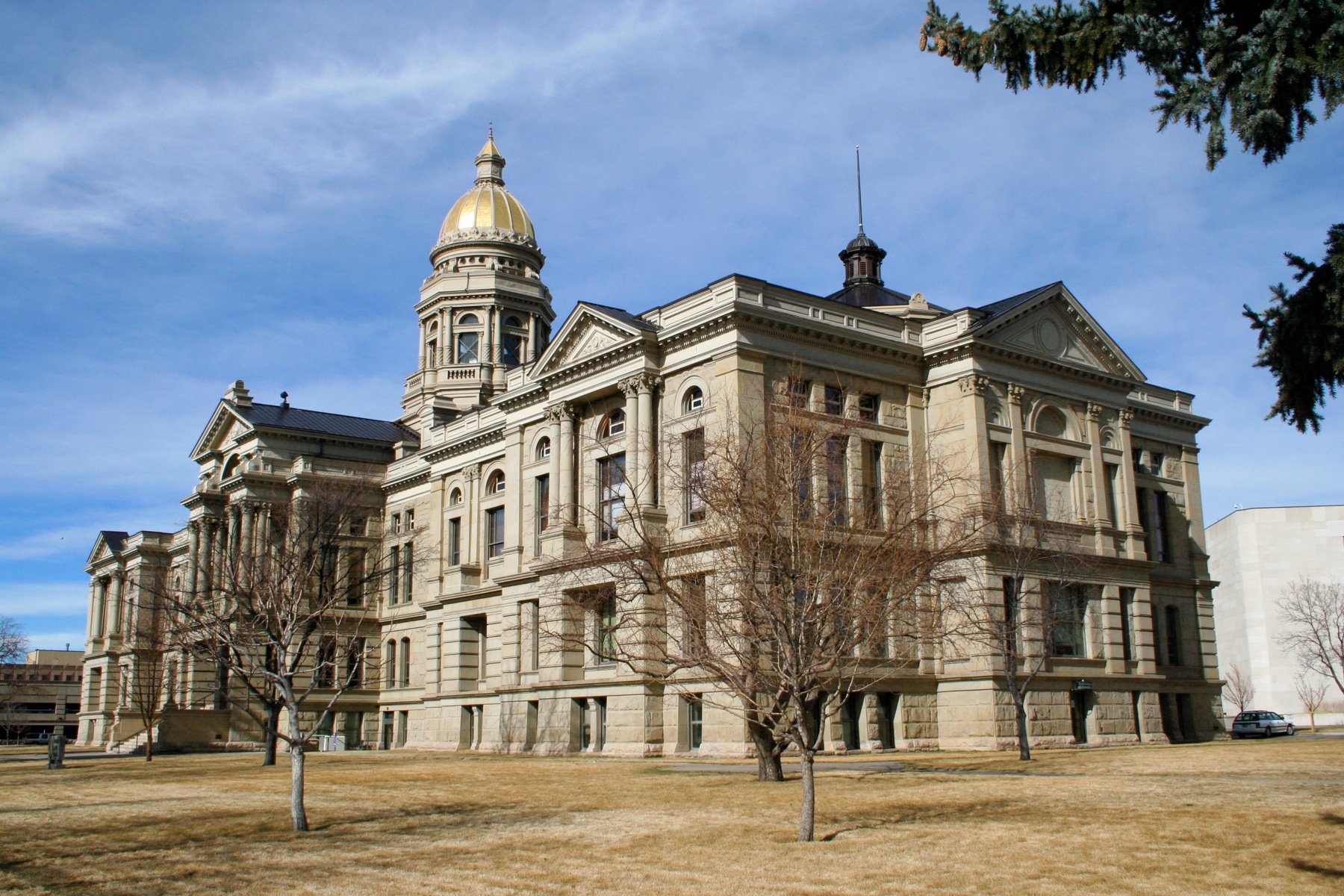
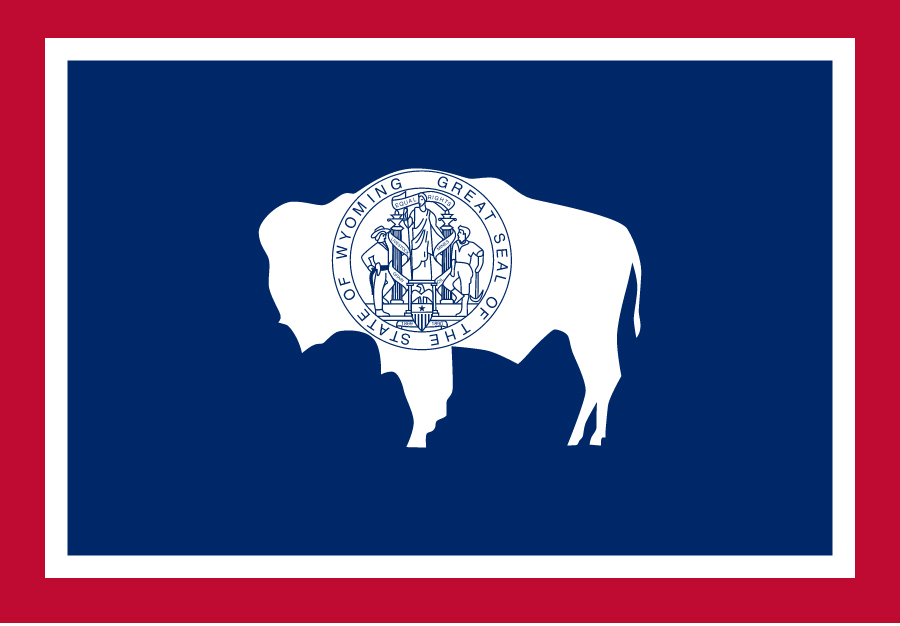
The State House in Cheyenne
ZIP Codes in Wyoming begin with the digits 82, and the Area Code is 307. The sales tax is 4 percent. The largest newspapers in the State are the
Wyoming Tribune-Eagle, covering both Cheyenne and Laramie; and the
Casper Star-Tribune; and the
Jackson Hole Daily, covering the noted vacation spot.
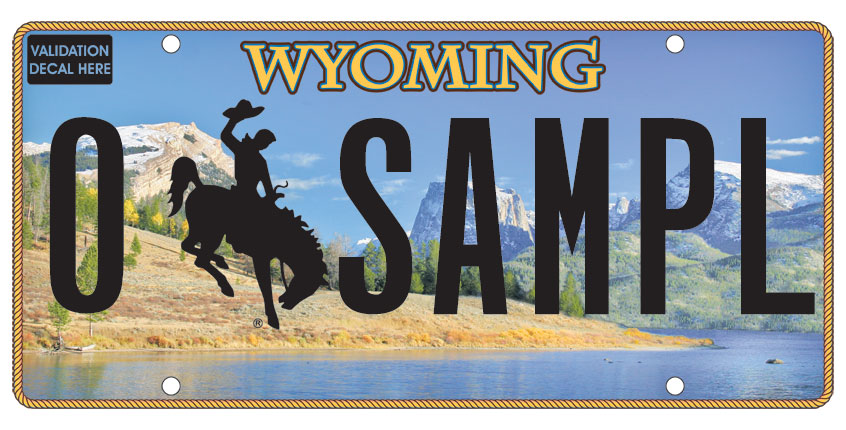
The "Bucking Horse and Rider" that appears on their license plates, their State Quarter, and the UW football helmets dates to World War I, and was trademarked as a State Symbol in 1936. The rider is believed to be Clayton Danks (1879-1970), a 3-time winner of the Cheyenne Frontier Days rodeo early in the 20th Century.
Street addresses in Laramie increase north and south from Grand Avenue (the aforementioned I-80 Business), and east and west from 1st Street. There appears to be no public transportation in Laramie, aside from the university bus service. Laramie does not have a beltway.
As with several other States with a "University of (State Name)," the University of Wyoming was founded when its State was still a Territory: Founded in 1886, and Statehood came in 1890. Notable alumni include former Vice President Dick Cheney; former U.S. Senators Clifford Hansen, John J. Hickey and Alan Simpson; and former U.S. Secretary of the Interior and all-around nut case James Watt. All were Republicans except for Hickey. Matthew Shepard, whose 1998 murder was a touchstone for the gay rights movement, was a student there at the time of his death.
Notable alumni include:
* Politics: Dick Cheney, Vice President under George W. Bush, also Secretary of Defense under George H.W. Bush, House Minority Whip, White House Chief of Staff under Gerald Ford and Deputy Assistant Chief of Staff under Richard Nixon; James Watt, Secretary of the Interior under Ronald Reagan; Governors Clifford Hansen, Dave Freudenthal and Matt Mead (Hansen's grandson); Senators Hansen, Millard Simpson and his son Alan Simpson, and John Hickey.
* Business: Dr. Jerry Buss, chemist, real estate mogul, and owner of the NBA's Los Angeles Lakers from 1979 until his death in 2013.
* Entertainment: Sportscaster Curt Gowdy.
* Science: W. Edwards Deming, inventor of the Total Quality Management philosophy.
Going In. The 29,181-seat War Memorial Stadium is about a mile and a half east of downtown, at 20th Street & Grand Avenue. If you drive in, there's metered parking nearby, costing $1.50.
The stadium opened in 1950, after World War II. Because of this, unlike most stadiums named Memorial, or War Memorial, it is a memorial to both World Wars, not just the 1st. The field runs north-to-south, and has been artificial since 2005. The playing surface is named Jonah Field, in honor of the family that donated to getting the artificial surface.
At 7,215 feet above sea level, it is the highest stadium in the NCAA's Football Bowl Subdivision (FBS, formerly Division I-A). There are few end zone seats, enabling them to preserve the trees at each end. In addition to UW football, it hosts the State's high school football championships.
Food. There is no mention of concessions on the stadium website. This suggests that there's little out of the ordinary: Hot dogs, burgers, maybe pizza, pretzels, candy, soda, but, since it's a college stadium, probably not beer, except in the luxury boxes. You're probably better off eating before and after the game. A parking lot to the east is called Tailgate Alley, but it's for season-ticket holders only.
Team History Displays. The University of Wyoming has been playing football since 1893, and successes have been few and far between. Bowden Wyatt arrived as head coach in 1947, and by 1949 he had the program turned around, with a 9-1 record. In 1950, the 1st season in the current stadium, he got them to 10-0, including winning the Gator Bowl.
They've also won the 1956, 1959 and 1966 Sun Bowls; the 2004 Las Vegas Bowl, and the 2009 New Mexico Bowl. Their only major bowl appearance has been a loss to Louisiana State in the 1968 Sugar Bowl. They appeared in last year's Poinsettia Bowl, but lost to Brigham Young University.
They were members of the Colorado Football Association (despite not being in Colorado) from 1905 to 1908, the Rocky Mountain Athletic Conference from 1909 to 1937, the Mountain States Conference from 1938 to 1961, and the Western Atheltic Conference (WAC) from 1962 to 1998. They've been members of the Mountain West Conference since 1999. But their only league title was in the WAC in 1967.
A common feature of Wyoming football has been coaches that do well there, then get hired to go elsewhere: Bowden Wyatt, 1947-52, went on to Arkansas and, with a bit of glory, Tennessee; Phil Dickens, 1953-56, moved on to Indiana; Bob Devaney, 1957-61, started the legend of Nebraska football; Fritz Shurmur, 1971-74, became one of the NFL's top defensive coordinators; Fred Akers, 1975-76, succeeded Darrell Royal at Texas; Pat Dye, 1980, revived the program at Auburn; Dennis Erickson, 1986, revived Washington State, won 2 National Championships at Miami, and also did well at Oregon State and Arizona State, although he flopped in the NFL; and Joe Tiller, 1991-96, did well at Purdue.
The Cowboys have no retired numbers. Their most notable players have been Jerry Hill, a running back on their 1958 Sun Bowl winners, who played for the Baltimore Colts when they lost Super Bowl III and won Super Bowl V; Mike Dirks, defensive tackle on their 1967 WAC Champions, who then played 4 seasons with the Philadelphia Eagles, and the most notable thing about him was that he was a rookie on the '68 Eagles team that heard its fans boo a man dressed as Santa Claus during a halftime show at Franklin Field; Jim Kiick, also a member of the 1967 WAC Champions, who became a star running back, helping the Miami Dolphins win Super Bowls VII and VIII, including the undefeated 1972 season; and Jay Novacek, a tight end who won 3 Super Bowls with a different set of Cowboys, the ones in Dallas/Irving/Arlington in the 1990s.
Other sports figures who graduated from UW included former major league 2nd baseman and Mets manager Art Howe, former Giants cornerback Derrick Martin, Indianapolis Colts head coach Chuck Pagano, former Los Angeles Lakers owner Jerry Buss, and basketball players Kenny Sailors (star of their 1943 National Champions, former Knick, alleged inventor of the jump shot) and Theo Ratliff.
Probably the University's best-known sports figure is Curt Gowdy, who turned to broadcasting after playing basketball there in 1942 -- a year before they won the National Championship.
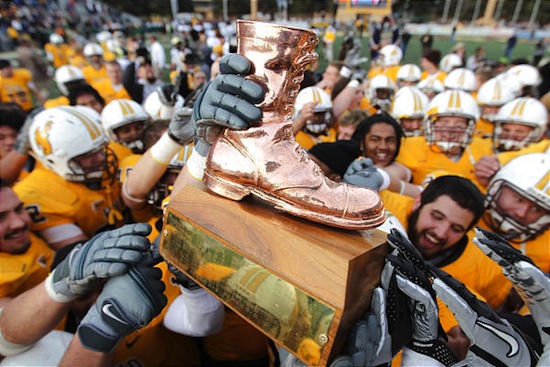
This game, between Wyoming and Colorado State, which is located 67 miles to the southeast, is known as the Border War, and has been played every year since 1946, and nearly every year since 1899. They play for a trophy known as the Bronze Boot, first awarded in 1968.
Colorado State dominated the rivalry for a long time, going 35-5-5 from 1899 to 1948. But, thanks to Coach Wyatt, Wyoming took over, dominating the Rams 19-4 from 1950 to 1973. Since then, it's been much more even. Since the Boot was established in 1968, Wyoming's lead is only 25-24, having won last year after dropping the previous 3. Overall, Colorado State leads 58-45-5. (UPDATE: Through the 2019 season, Colorado State leads 58-48-5, and Wyoming leads 287-24 for the Bronze Boot.)
Wyoming also has rivalries with Utah State, known as Bridger's Battle, with a .50 caliber rifle as the trophy; and Hawaii, with the Paniolo Trophy, "Paniolo" being the Hawaiian word for "Cowboy."
Stuff. The stadium isn't big enough to have a large team store. The university store is at 1000 East University Avenue, about 6 blocks west of the Stadium. Ryan Thorburn, a UW graduate and a sportswriter for the Boulder Camera in Colorado, wrote the definitive book on the school's program: Black 14: The Rise, Fall and Rebirth of Wyoming Football. There are no team videos available.
During the Game. Wyoming is one of those Western States with a libertarian streak: Essentially, the motto is, "If you respect my rights and otherwise leave me alone, I'll extend the same courtesy to you." Be courteous, and you will get the same in return.
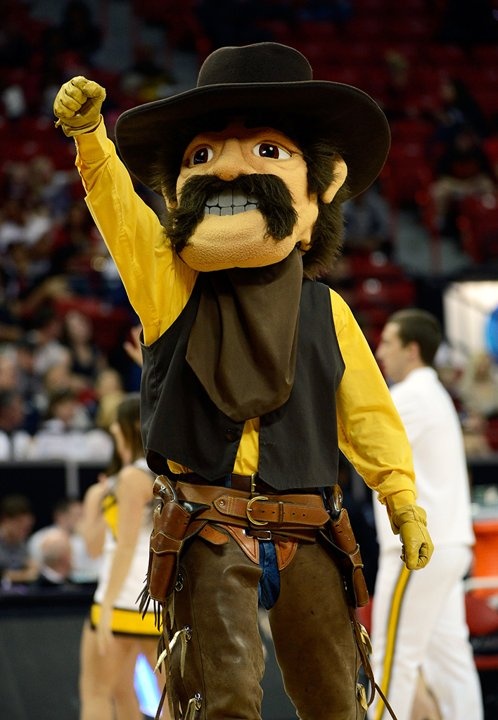
Pistol Pete
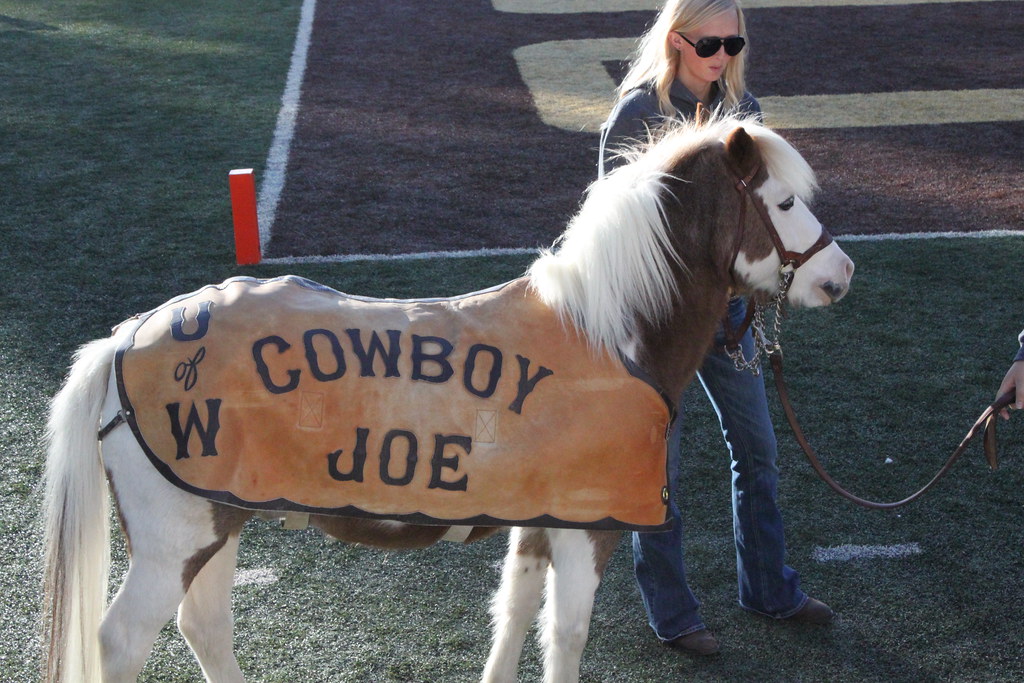
There are 2 mascots: A guy in a suit, named Pistol Pete (he looks nothing like baseball legend Pete Reiser or basketball icon Pete Maravich, both of whom had the nickname); and Cowboy Joe, a live pony mascot.
The Fight Song is "Ragtime Cowboy Joe." Thankfully, not "Cotton Eye Joe." Oddly, "Ragtime Cowboy Joe" was written in 1912 in Brooklyn, by lyricist Grant Clarke and composers Lewis F. Muir and Maurice Abrahams, who also wrote "Second Hand Rose." Despite its Western heritage, the University of Wyoming may be the only major football-playing college with a fight song written by "Tin Pan Alley."
After the Game. As long as you didn't antagonize the home fans, your safety will not be an issue. What will be an issue is deciding where to eat after the game, because there's an embarrassment of riches.
Grand Avenue, south of the stadium, has O'Dwyer's Public House, Subway, Taco Bell, Taco John's, Arby's, McAlister's Deli, Chili's, Sonic, Almanza's, Perkins, D.P. Dough, Burger King, Applebee's, Starbucks and No. 1 Buffet.
Dowtown has several places with a sports and/or Western theme: Born in a Barn, 100 E. Ivinson Street; the Cowboy Saloon & Dance Hall, 108 S. 2nd Street; Coal Creek Coffee, 110 Grand Avenue; Buckhorn Bar, 114 E. Ivinson Street; Library Sports Grille & Brewery, 201 E. Custer Street; Altitude Chophouse & Brewery, 320 S. 2nd Street; The Alibi Pub, 404 S. 4th Street.
About a mile and a half west of downtown is the place to go if you're in Laramie during the European soccer season, which we are now in: Snowy Range Sports Bar, at 223 S. Adams Street.
Sidelights. If you're not watching Wyoming Cowboys sports, and you're not working on a ranch, there isn't a whole lot to do in Wyoming. Indeed, there are no professional sports teams there, not even "independent league" baseball teams.
The Arena-Auditorium is to the northwest of the Stadium. It opened in 1982, and seats 15,028. It is round, domed, and a silhouette of 1943 National Champion Kenny Sailors graces the main gate.
Easily, the closest major league city to Laramie, or anywhere else in Wyoming, is Denver. 130 miles to the southeast. So if you live in Wyoming, your major league teams are the Colorado Rockies, the Denver Broncos, the Denver Nuggets, the Colorado Avalanche and the Colorado Rapids.
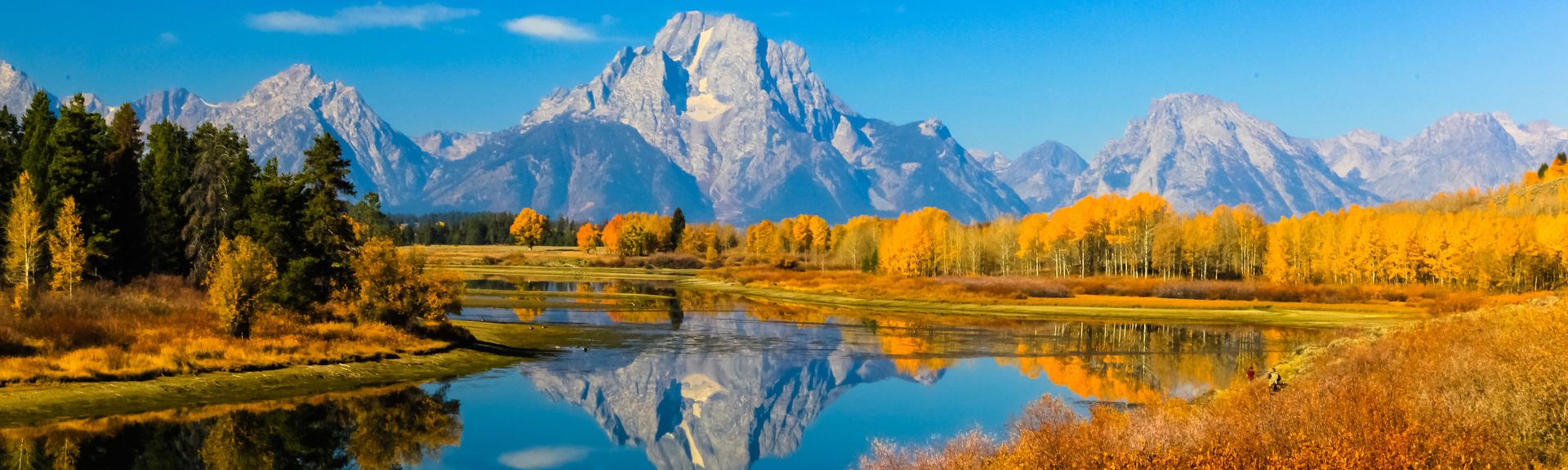
Neither Elvis Presley nor the Beatles ever performed in Wyoming. The tallest building in the State isn't very tall: It's the 148-foot Wyoming Financial Center in Cheyenne. The State has 2 of the better-known National Parks: Yellowstone, in the northwestern corner, 380 miles northwest of Laramie; and Grand Teton, 350 miles in the same direction, nearly next-door to Yellowstone. And Devil's Tower, made familiar by its inclusion in Close Encounters of the Third Kind, is 300 miles to the northeast.
Essentially, those parks are Wyoming's "museums." As for actual museums, the Cheyenne Frontier Days Old West Museum is at is at 4610 Carey Avenue in Cheyenne, 50 miles southeast of Laramie. The Buffalo Bill Center of the West is in the city named for Buffalo Bill, Cody, at 720 Sheridan Avenue, 357 miles northwest, reasonable close to Yellowstone. And don't be fooled by the name of Fort Laramie: It's 118 miles to the northeast.
The State has never produced a President. It has produced a Vice President: Dick Cheney, who served from 2001 to 2009 "under" George W. Bush, and was believed to be the true brains of that horrible Administration. Previously, he served as White House Chief of Staff to Gerald Ford, House Minority Whip, and Secretary of Defense to George H.W. Bush. But between serving as one Bush's SecDef and the other's Veep, he got involved in the energy business, and was a changed man. His portrayal by Richard Dreyfuss in Oliver Stone's film W. was truly scary.
Nearly every TV show set in Wyoming has been a Western: Cheyenne, Laramie, My Friend Flicka, The Virginian (based on the 1902 novel by Owen Wister, and set in the real town of Medicine Bow) and The Young Riders.
This is also true of films set there, including 4 different versions of The Virginian: 1914, 1923, 1929 (the 1st sound version, starring a young Gary Cooper) and 1946 (with Joel McCrea). This also includes Shane, Cat Ballou, Butch Cassidy and the Sundance Kid, the disastrous Heaven's Gate, and Quentin Tarantino's recent revisionist Western The Hateful Eight.
Aside from traditional Westerns, the best-known films to take place in Wyoming are Close Encounters of the Third Kind, with the spaceship landing at Devil's Tower (there's Richard Dreyfuss again); and Brokeback Mountain, which, while taking place from 1963 to 1983 and featuring a gay love affair, is, sort of, in the Western tradition.
*
Wyoming is a long way to go just to see a sporting event and "cross the State off your list." But it's beautiful, and, for some people, that's reason enough to visit. And Wyoming vs. Colorado State is a good rivalry game.