Showing posts with label mickey cochrane. Show all posts

Tuesday, December 12, 2023

December 12, 1933: A Dark Day In Sports

A colorized photo of Ace Bailey, included in a composite photo
of a Maple Leafs' Centennial Team, 2016

December 12, 1933, 90 years ago: A dark day in sports history. First, Connie Mack breaks up his team. Then, one of the best players in hockey almost dies on the ice.

The 1st time that Mack had broken up the Philadelphia Athletics, in 1914-15, it was because he couldn't keep up with the salaries being offered by the Federal League teams. This time, it was personal.

In 1925, the A's went 88-64, and were only 8 1/2 games behind the 1st-place Washington Senators. But the rise of the "Murderers' Row" Yankees delayed Philadelphia's return to greatness. In 1929, they began a run of 3 seasons in which they won 313 games, and game within a Game 7 loss in 1931 of winning 3 straight World Series.

But Mack lost all of his non-baseball holdings in the stock market Crash of 1929. He couldn't fund the A's with any other income. So, after the 1932 season, despite a strong 94-60 record (but 13 games behind the Pennant-winning Yankees), he began to sell of his 2nd generation of stars.

On September 28, 1932, he sent left fielder Al Simmons, 3rd baseman Jimmy Dykes, and center fielder Mule Haas are all sold to the Chicago White Sox, for $100,000. Simmons would be elected to the Baseball Hall of Fame, and Dykes and Haas would have been perennial All-Stars had the All-Star Game been founded before 1933.

But the big day was December 12, 1933, when Mack made 3 separate moves:

* Pitchers Lefty Grove and Rube Walberg, and 2nd baseman Max Bishop, are traded to the Boston Red Sox for Bob Kline and Rabbit Warstler and $125,000. Along with Carl Hubbell, Grove was 1 of the 2 best lefthanded pitchers in the game, and would go to the Hall of Fame. Walberg was the 3rd starter on the A's, behind Grove and George Earnshaw, but would have been the ace on many teams.

Key to this deal was the fact that Tom Yawkey had recently turned 30 and come into his inheritance, and had bought the Red Sox, and could afford to spend whatever he wanted to build a championship team. He did try, but the Yankees' dynasty that was restarted in 1936 thwarted his early efforts.

* Catcher Mickey Cochrane was traded to the Detroit Tigers for Johnny Pasek and $100,000. The Tigers subsequently named Cochrane player-manager, and won the next 2 American League Pennants.

* Finally, before the ink was dry on the previous 2 trades, Mack traded Pasek and Earnshaw to the White Sox for Charlie Berry and $100,000. So, in 1 day, Mack sold off his 3 best pitchers.
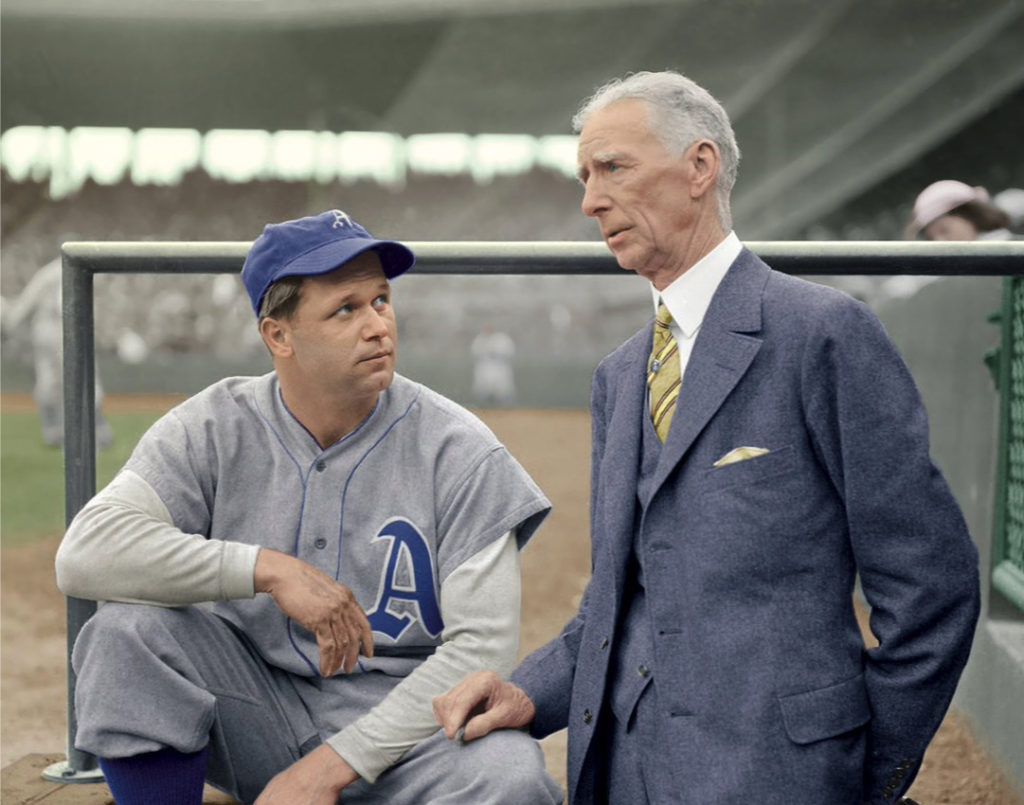
Jimmie Foxx (left) and Connie Mack

The A's went from 94-60 in 1932 to 79-72 in 1933, to 68-82 in 1934, to 58-91 in 1935. On December 10, 1935: 1st baseman Jimmie Foxx and pitcher Johnny Marcum were traded to the Red Sox for Gordon Rhodes, George Savino and $150,000. Foxx was the best righthanded slugger in the game, and would go to the Hall of Fame. Marcum was the Mackmen's best pitcher following the '33 fire sale, and Mack dumped him, anyway.

The A's never recovered, and the Mack family ended up selling the A's in 1954, to a buyer who moved them to Kansas City. They failed there as well, and Charlie Finley bought them in 1960, moving them to Oakland in 1968. After 5 straight AL Western Division titles, 1971-75, including 3 straight World Series wins, 1972-74, he broke them up, and the team crashed. New owner Walter Haas rebuilt them in the early 1980s, but the pitching collapsed, preventing a new dynasty. The A's rebuilt again, and won 3 straight Pennants, 1988-90, but after another Division title in 1992, were broken up again.

The pattern held: By 2000, the "Moneyball" regime built a team that reached the Playoffs 5 times in 7 years, but won no Pennants. They sold off, rebuilt, and made 3 straight Playoffs, 2012-14. They couldn't afford to keep it going, sold off, rebuilt, and made 3 straight Playoffs, 2018-20. They couldn't afford to keep it going, and sold off. In 2022, the A's lost 102 games, their most since the Finley fire sale bottomed out at 108 in 1979.

Now, it appears that the A's are moving to Las Vegas, probably for the 2025 season. If they do move, how long will it be before they win again? And, if so, how long before they have a 9th fire sale?

One thing is for sure: The A's are not moving back to Philadelphia, where the Phillies, having won the 2022 NL Pennant, are overwhelmingly popular. The city can certainly support one winning team, but not two teams. But, wherever they go, or if they stay, at some point, the A's will go back to their Philadelphia roots, and break it all down and start all over again.

*

Also on December 12, 1933, perhaps the ugliest game in National Hockey League history was played. But it led to one of the game's greatest moments.

The Boston Bruins were hosting the Toronto Maple Leafs at the Boston Garden. The Bruins still had most of the players who had led them to the 1929 Stanley Cup, including 2 of the greatest defensemen the game has ever known, Eddie Shore and Aubrey "Dit" Clapper. The Leafs, winners of the Cup in 1932, had another, Francis "King" Clancy.

This game, which the Leafs would win 4-1, was in the 2nd period. The Leafs had taken 2 quick penalties, and sent Clancy, defenseman George "Red" Horner, and right wing Irvine Wallace "Ace" Bailey out to defend the 5-on-3 Bruin power play.

Shore, who helped the Bruins win the Stanley Cup in 1929, rushed up the ice. Clancy, charitably listed at 5-foot-7 and 155 pounds, and a winner of the Cup with the Ottawa Senators in 1922, '23 and '27, and with the Leafs in '32, followed him, and checked him into the boards.

Shore got up, and, in his daze, he figured the closest Leaf player to him must have been the one who did it. He guessed wrong: The closest Leaf player to him was Bailey. Shore hit him from the side, and he landed head-first on the ice.
Horner skated over, knowing full well that it wasn't Bailey who had checked Shore, and yelled, "What did you do that for, Eddie?" Shore, not realizing the enormity of what he had done, gave Horner a big grin. What happened next is in dispute: The first source I saw on the story said that Horner hit Shore over the head with the blade of his stick. Another source said that Horner punched Shore, knocking him out in an instant.

Whatever the truth was, Shore was also out cold. The Boston crowd booed the hell out of Horner, who was already known as one of the dirtiest players in the game. But so was Shore, who, with his attitude, his receding hairline, and the fact that he was admired but not especially liked, was practically the Ty Cobb of hockey.

But it quickly became apparent that Bailey was hurt worse. Both men regained consciousness, and were carried off the ice together. Shore apologized. Bailey seemed to forgive him, saying, "It's all part of the game," and then passed out again.

Bailey was taken to Boston City Hospital. He was diagnosed with a fractured skull and an extradural clot on the brain. His father, listening to the game on the radio in Toronto, packed a gun, and immediately boarded a train for Boston, intending to kill Shore.

Leafs owner Conn Smythe found out about this, and talked to his general manager, Frank Selke. Selke had a friend working with the Boston Police, who met Bailey's father at the hotel, and talked him out of the murder plot.

Nevertheless, the BPD said they would charge Shore with manslaughter if Bailey died. Within 24 hours, he underwent 2 spinal taps to relieve intracranial pressure. There was at least one news report that Bailey had died. But, through several procedures, he came out of his coma after 10 days. He hung on, through Christmas and New Year's. In mid-January 1934, he was released from the hospital.

NHL President Frank Calder suspended Horner for 6 games, and Shore indefinitely. Once he was confident that Bailey was going to live, Calder set Shore's suspension at 16 games, or 1/3rd of the season at the time (48 games). Bailey never played again.

Walter Gilhooly, sports editor of the Ottawa Journal, recommended that a benefit game be played, to offset Bailey's loss of income. Calder agreed. The Leafs would host the game, and put their team out against a team made up of players from the rest of the League, 2 from each of the other 8 teams then in it.

The game was played at Maple Leaf Gardens on February 14, 1934. Here were the lineups:

* From the Toronto Maple Leafs, coached by Dick Irvin, once a great player, and the father of eventual Hall of Fame broadcaster Dick Irvin Jr.: Number 1, goaltender George Hainsworth, formerly a star with the Montreal Canadiens; 2, defenseman Red Horner; 3, defenseman Alex Levinsky; 4, defenseman Clarence "Hap" Day; 5, center Andy Blair; 7, defenseman King Clancy; 8, left wing Harold "Baldy" Cotton; 9, right wing Charlie "the Bomber" Conacher; 10, center Joe Primeau; 11, left wing Harvey "Busher" Jackson; 12, left wing Hector "Hec" Kilrea; 14, center Bill Thoms; 15, right wing Ken Doraty; 16, right wing Charlie Sands; 17, left wing Frank "Buzz" Boll.

NHL All-Stars, coached by Lester Patrick of the New York Rangers, also once a great player:

* From the Chicago Black Hawks: 1, goaltender Charlie Gardiner; and 7, defenseman Lionel Conacher, brother of Charlie.

* From the Boston Bruins: 2, defenseman Eddie Shore; and 9, center Nelson "Nels" Stewart, better known as a Montreal Maroon.

* From the Ottawa Senators: 3, right wing Frank Finnigan; and 17, defenseman Al Shields.

* From the Montreal Canadiens: 4, left wing Aurele Joliat; and 16, center Howie Morenz. Morenz, known as "the Babe Ruth of Hockey" -- like Ruth, he had several nicknames -- normally wore 7, but Lionel Conacher was considered the greatest all-around athlete in Canada, and had priority.

* From the Detroit Red Wings: 5, left wing Herbie Lewis; and 14, right wing Larry Aurie.

* From the New York Rangers: 6, defenseman Ivan "Ching" Johnson; and 15, right wing Bill Cook. Somebody decided that the Irish-Canadian Johnson looked Chinese, and nicknamed him Ching. He had seniority over Aurie, who also wore 6; but Lewis had seniority over Cook, who wore 5 with the Rangers.

* From the Montreal Maroons: 10, center Reginald "Hooley" Smith; and 18, right wing Jimmy Ward.

* From the New York Americans: 11, center Norman Himes; and 12, defenseman Norman "Red" Dutton.

Before the game, the other teams' players posed at center ice in their regular sweaters. Then they were given white jerseys with "NHL" on them. And the Leafs had special jerseys, too, with "ACE" on them.
The selection of Shore was controversial. When he skated up to receive his Number 2 jersey, the crowd of 14,074 was silent. Then he skated over to the Leafs bench, where Bailey was sitting in a suit, long coat and fedora. Shore offered his hand, and Bailey shook it. The crowd roared, and the players tapped their sticks on the ice, in what was already a long-established hockey salute.
The ceremony concluded with Smythe giving Bailey his Number 6 jersey, and announced that it would be retired.

Bailey dropped a puck for a ceremonial faceoff, and the game began. Charlie Conacher already had an injured knee, and left the game early. Other than that, there wasn't much hitting, and no penalties were called. Cotton and Jackson scored to put the Leafs up 2-0, before Stewart scored to make it 2-1 Leafs at the end of the 1st period.

Jackson scored again early in the 2nd period. Morenz and Finnigan scored to tie it up. But it was all Leafs the rest of the way: Day scored halfway through the 2nd, and Kilrea, Doraty and Blair scored in the 3rd. The Leafs won, beating the entire rest of the NHL, 7-3.

The game raised $20,909 for Bailey's family, about $426,000 in 2022 money. Bailey applied to the NHL to be a referee, but was turned down. Smythe hired him to work in the team's front office. He worked there, in one capacity or another, until a later owner, Harold Ballard, already perhaps the most hated man in the history of Canadian sports, fired him in 1986. Bailey lived until 1992.

A later player, Garnet Bailey, no relation, played in the NHL from 1969 to 1978, and was known as Ace Bailey. He was working as a scout for the Los Angeles Kings when he died in the destruction of United Airlines Flight 175 at the South Tower of the World Trade Center on September 11, 2001.

Shore continued to play with the Bruins through their 1939 Stanley Cup win. In 1940, he bought the minor-league Springfield Indians of Massachusetts, and remained their owner until his death in 1986. Both he and Bailey were elected to the Hockey Hall of Fame.

Bailey wanted the benefit game to become an annual event, for injured players. That didn't happen. But additional benefit games were held for the families of Morenz, who died of heart trouble in 1937, and the Canadiens' Albert "Babe" Siebert, who drowned in 1939. Both of those games were played at the Montreal Forum: The former was a combined Montreal team, Canadiens and Maroons, against the rest of the NHL. The Maroons folded in 1938, so it was just the Canadiens against the rest of the NHL in Siebert's benefit. Both times, the NHL All-Stars won. In 1947, the NHL finally established an annual All-Star Game.

Tuesday, February 6, 2018

Top 10 Athletes From Massachusetts

February 6, 1788: Massachusetts becomes the 6th State to ratify the Constitution of the United States.

Top 10 Athletes From Massachusetts

Honorable Mention to Baseball Hall-of-Famers: William "Candy" Cummings of Ware, outside Springfield; Tim Keefe, John Clarkson and Joe Kelley, all of Cambridge, north of Boston; Tommy McCarthy of Boston; Wilbert Robinson of Bolton, outside Worcester, although he's probably in the Hall more for what he did as a manager; Jack Chesbro of North Adams, outside Pittsfield; Rabbit Maranville of Springfield; and Charles "Gabby" Hartnett of Millville, outside Worcester. (Jeff Bagwell was born in Boston, but grew up in Connecticut, and is in my Top 10 for that State.)

Honorable Mention to Connie Mack of East Brookfield, outside Worcester. Cornelius Alexander McGillicuddy never legally changed his name, but thought "Mack" would look better in a box score. An ordinary major league catcher from 1884 to 1896, he began managing in 1894 and didn't stop until 1950. In between, he won 9 Pennants and 5 World Series with the Philadelphia Athletics: In 1910, 1911, 1913, 1929 and 1930.

But because he was also the main owner, he couldn't be removed as manager, despite it becoming clear after World War II that he was senile. Finally, after the 1950 season, his 50th year as manager of the Philadelphia Athletics, his sons Earle, Roy and Connie Jr., who agreed on little else, found a way to maneuver him out.

No manager ever managed more games, or won more -- or lost more. Along with his 1905, 1911 and 1913 World Series opponent, John McGraw, he was 1 of the 1st 2 managers elected to the Baseball Hall of Fame, and the only one ever elected while still managing. (The eligibility rules have since changed.)

After he was removed, and the Philadelphia Phillies bought Shibe Park from the family, the Phils renamed it Connie Mack Stadium. After his death, they erected a statue outside, moving it to Veterans Stadium and now to Citizens Bank Park. He and Robin Roberts were the 1st inductees the Phillies placed into the Philadelphia Baseball Wall of Fame.

Honorable Mention to Harry Agganis of Lynn, north of Boston. "The Golden Greek" starred in baseball and football at Boston University. In 1955, he was in his 2nd season with the Red Sox, and he had impressed even Ted Williams, when he got sick. He developed pneumonia, and died from a pulmonary embolism at age 24. BU's sports arena is named for him.

Honorable Mention to Tony Conigliaro of Revere, north of Boston. When he was 19, he hit a home run in the Red Sox' home opener. When he was 22, he was the youngest player ever to reach 100 career home runs. He had a local background, good looks, a great personality, and a swing tailor-made for Fenway Park. The future seemed limitless.

On August 18, 1967, baseball history was changed when Tony C was hit in the face with a pitch. The Sox were in a tight Pennant race, and he missed the rest of the season, although they win it anyway. He missed all of 1968, came back strong in 1969 and 1970, but his vision problems returned, and was done at 26 - except for a brief comeback at 30, failing to stick with the Sox' next Pennant team in 1975.

It gets worse. In 1982, his budding broadcast career ended with a heart attack, and oxygen deprivation caused brain damage. He was essentially comatose until his death in 1990. The Sox have inducted him into their team Hall of Fame, but if a New Englander had written Field of Dreams, it might have been about C.

Honorable Mention to Mark Fidrych of Northborough, outside Worcester. Another candidate for the screenplay. His sensational 1st season with the Detroit Tigers - sensational both both the quality of his pitching and his quirky personality - made him the 1976 American League Rookie of the Year.

But he got hurt in Spring Training the next year, and was never the same pitcher. Like Tony C, he was a superstar at 22 and done at 26. He went back to his Northborough farm, made a living, and supplemented that with appearances at memorabilia shows, accepting that he was still popular among baseball fans. But he fell victim to a fatal accident on his farm in 2009. At least he had more time to enjoy it all than Conigliaro did.

Honorable Mention to Fran Healy of Holyoke, outside Springfield, for helping the Yankees win the 1977 World Series. He became a broadcaster for both New York teams.

Honorable Mention to Jeff Reardon of Dalton, outside Pittsfield. A 4-time All-Star, he began his career with the 1979 Mets, and ended it with the 1994 Yankees. In between, he saved more games than any player before him, surpassing Rollie Fingers' record of 341 in 1992 -- but, before he retired with 367, was himself surpassed by Lee Smith. He reached the postseason with the 1981 Montreal Expos, the 1987 Minnesota Twins (winning the World Series), the 1990 Boston Red Sox, and the 1992 Atlanta Braves.

Honorable Mention to Angelo Bertelli of Springfield and Joe Bellino of Winchester, north of Boston. Bertelli quarterbacked Notre Dame to the 1943 National Championship, winning the Heisman Trophy, before a brief career in the All-America Football Conference. Bellino went to the Naval Academy, and the running back won the Heisman in 1960. After fulfilling his military commitment, he played for his hometown Patriots.

Honorable Mention to Mark Bavaro of Danvers, north of Boston. A Notre Dame grad like Bertelli, the tight end won Super Bowls XXI and XXV with the Giants, making 2 Pro Bowls. He has been elected to the Giants' Ring of Honor, but not yet to the Pro Football Hall of Fame.

Honorable Mention to Ray Flynn of South Boston. He played basketball at Providence College, and, exhibiting the parochialism of that most stubborn of neighborhoods in the City of Boston, got mad at the public address announcer, and told him that, from now on, he was to be introduced as, "from South Boston."

He was named an All-American, and the Most Valuable Player of the 1963 NIT. He was drafted by the Syracuse Nationals, just before their move to become the Philadelphia 76ers, was traded to his hometown Celtics, and was the last player cut from the defending World Champions.

He went into politics, elected to the City Council in 1977, and Mayor in 1983, 1987 and 1991. While Mayor, he ran in both the Boston and the New York City Marathon in 1984, and appeared on a 1989 episode of the Boston-based sitcom Cheers. He resigned as Mayor in 1993, to accept the post of U.S. Ambassador to the Vatican.

Honorable Mention to Massachusetts natives on the U.S. Hockey Team that won the Gold Medal at the 1980 Winter Olympics in Lake Placid, New York: Captain Mike Eruzione of Winthrop, north of Boston; goaltender Jim Craig of Easton, and Dave Silk of Scuituate, both south of Boston; and Jack O'Callahan of the Somerville section of Boston. The entire team was named Sports Illustrated's 1980 Sportsmen of the Year.

Honorable Mention to Massachusetts natives on the New Jersey Devils' Stanley Cup winners: Bobby Carpenter of Beverly, north of Boston (1995, he had been the 1st high school hockey player on the cover of SI); Bill Guerin of Worcester (1995, the 1st player of Hispanic descent in the NHL, he was also a member of the 2009 Cup-winning Pittsburgh Penguins); and Jay Pandolfo of Winchester, north of Boston (2000 and 2003).

Current Devils goalie Cory Schneider is from a certain town north of Boston, which has been part of an insult used by Bruin fans from the beginning of the franchise in 1924: "We got a town around here named after you: Marblehead!"

Honorable Mention to Massachusetts natives on the U.S. Hockey Team that won the 1996 World Cup of Hockey: Guerin; Keith Tkachuk of Medford, north of Boston; Tony Amonte of Hingham, south of Boston; Scott Young of the Worcester suburb of Clinton; Shawn McEachern of Waltham, north of Boston; and Jim Carey of the Dorchester section of Boston.

Honorable Mention to Rod Langway of Randolph, south of Boston. He won the Stanley Cup as a rookie with the 1979 Montreal Canadiens. With the Washington Capitals, he made 6 All-Star Games, and won the 1983 and 1984 Norris Trophies as the best defenseman of the year. The Caps retired his Number 5, and he was elected to the Hockey Hall of Fame, the only native of the Boston Bruins' home State yet so honored.

Tkachuk is not yet in the Hall of Fame, but is in the U.S. Hockey Hall of Fame. This is also true for Tom Barrasso of Stow, west of Boston. Jeremy Roenick of Marshfield, south of Boston, is not yet in either, despite 9 All-Star Games and 513 goals. So Honorable Mentions to them as well.

Honorable Mention to John Souza and Ed Souza of Fall River, closer to Providence, Rhode Island than to Boston. Despite not being closely related, they played together for Ponta Delgada Soccer Club of Fall River, founded by Portuguese immigrants and named for the capital of the Azores, islands off the coast of Portugal. Both forwards, they were members of the U.S. team that shocked England at the 1950 World Cup.

Honorable Mention to Debbie Belkin of Needham, west of Boston. She was a member of the U.S. team that won the 1st Women's World Cup in 1991. Under her married name of Debbie Radamacher, she became the 1st coach of the women's team at the University of Michigan.

Honorable Mention to Tracy Ducar of North Andover, north of Boston. She was the backup goalkeeper to Briana Scurry on the U.S. team that won the 1999 Women's World Cup, and was collectively named Sportswomen of the Year by Sports Illustrated.

Honorable Mention to Chris McCarron of the Dorchester section of Boston. He never rode a horse until he was 16. At 19, in 1974, he raced professionally for the 1st time, and won 547 races, a new record. He also led all U.S. jockeys in wins in 1975 and 1980.

He won the 1986 Belmont Stakes aboard Danzig Connection. He won the 1987 Kentucky Derby and Preakness Stakes, and the 1988 Breeders' Cup Classic (the 1st of 5 times he would win that race), aboard Alysheba. He won the 1992 Preakness Stakes aboard Pine Bluff. He won the 1994 Kentucky Derby aboard Go for Gin. He won the 1997 Belmont Stakes aboard Touch Gold.

He finished his career in 2002 with 7,141 wins, and $264 million in winnings, a record at the time. While still active, he was elected to the National Museum of Racing and Hall of Fame.

Honorable Mention to Tony DeMarco of the North End of Boston. He was Welterweight Champion of the World for 11 weeks in 1955. That was enough to get DeMarco, who just turned 86, a statue in the North End.

Honorable Mention to Paul Pender of Brookline, west of Boston. He fared a little better than DeMarco, ending Sugar Ray Robinson's 5th and last reign as Middleweight Champion of the World, holding it for nearly a year and a half in 1960 and 1961, and then holding it again for a year, in 1962 and 1963.

Honorable Mention to John Thomas of Cambridge, north of Boston. The 1st man to clear 7 feet in the high jump, he won the Bronze Medal at the 1960 Olympics in Rome and the Silver Medal at the 1964 Olympics in Tokyo. He had the misfortune to be a star in the event at the same time as the great Siberian Valeriy Brumel.

Honorable Mention to Johnny Kelley of Arlington, west of Boston. He ran his 1st Boston Marathon in 1928, at age 20, but didn't finish it. He won the race in 1935 and 1945. He competed in the Olympic marathon in 1936 in Berlin and 1948 in London, although he didn't come close to winning either one. (The Olympics of 1940 and 1944 were canceled due to World War II.) He ran his last Boston Marathon in 1992, at age 84, and finished it for the 58th time in his 61 attempts.

In 1957, John J. Kelley won the Boston Marathon. Not related, he became known as "Kelley the Younger," as his predecessor was nicknamed "Kelley the Elder." In 1993, a statue of Kelley the Elder -- 2 figures, showing him as the 27-year-old 1935 winner and the 84-year-old 1992 competitor -- was erected outside City Hall in Newton, which faces the course.

Honorable Mention to Alberto Salazar of Wayland, west of Boston. He won the New York City Marathon in 1980 and 1981, and won in both Boston and New York in 1982.

Honorable Mention to Tenley Albright of Newton, west of Boston. She won the Silver Medal in ladies' figure skating at the 1952 Winter Olympics in Oslo, Norway. She topped that with the Gold Medal in 1956 at Cortina d'Ampezzo, Italy. This made her the 1st American to win in, preceding, thus far, Carol Heiss in 1960, Peggy Fleming in 1968, Dorothy Hamill in 1976, Kristi Yamaguchi in 1992, Tara Lipinski in 1998 and Sarah Hughes in 2002.

Dishonorable Mention to Leo Durocher of West Springfield. A half-decent player who linked the 1928 Murderers' Row Yankees (he wasn't up yet in 1927) to the 1934 Gashouse Gang St. Louis Cardinals, he was an indecent human being.

He managed the Brooklyn Dodgers to the 1941 National League Pennant, and the New York Giants to the 1951 Pennant and the 1954 World Championship. But the disreputable parts of his character meant that, despite winning over 2,000 games as a manager, he wasn't elected to the Baseball Hall of Fame until after he died. No one wanted to hear his acceptance speech.

Now, the Top 10:

10. Harold "Pie" Traynor of Somerville, north of Boston. His nickname, inspired by his childhood love of the pastry, aside, as late as the 1969 Centennial of professional baseball, he was considered the greatest 3rd baseman who ever lived.

Fielding statistics weren't readily available in the 1920s and '30s, but contemporary observers believed that the Pittsburgh Pirate had surpassed Boston Red Sox star Jimmy Collins as the all-time best third sacker.

He wasn't a home run hitter. Forbes Field was considerably more conducive to doubles and triples, and, like later 3rd base stars Brooks Robinson, George Brett and Wade Boggs he took advantage of that, batting ,320 lifetime, with 2,416 hits, and 12 seasons of at least 100 RBIs.

He helped the Pirates win the 1925 World Series and the 1927 National League Pennant. He was the NL's starting 3rd baseman in the 1st 2 All-Star Games, in 1933 and 1934. He nearly managed the Pirates to the 1938 Pennant, and later served as a broadcaster, calling their 1960 World Series win along with Bob Prince.

He was the 1st 3rd baseman elected to the Baseball Hall of Fame by the writers (in charge of handling the recently retired, as Collins had been elected by the Veterans Committee). He lived long enough to see the Pirates win the 1971 World Series and retire his Number 20. In 1999, The Sporting News named him to their 100 Greatest Baseball Players.

9. Howie Long of Milford, outside Worcester. To look at Howard Matthew Moses Long today, with his short hair, glasses, suit, calm demeanor, and highly intelligence pronouncements on the game of football on Fox NFL Sunday, it's easy to guess that he is a cultured New England gentleman who went to a tweedy Northeastern school -- which he did, Villanova University, outside Philadelphia. What's not so easy to guess, even with his football knowledge, is that he played for the team that defines NFL badness, the Raiders.

He played in their last season in their 1st run in Oakland, 1981; and all but their last season in Los Angeles, 1982-93. He made 8 Pro Bowls, won Super Bowl XVIII with them in the 1983 season, and was named NFL Defensive Player of the Year in 1985. He was named to the Pro Football Hall of Fame and the NFL's 1980s All-Decade Team. The Raiders don't retire uniform numbers, so his 75 is still in circulation.

His son, Chris Long, a defensive end who just made it back-to-back Super Bowls with different teams, the New England Patriots last year and the Philadelphia Eagles this time, might make the Pro Football Hall of Fame as well. But he grew up in the Los Angeles area, and would qualify for California, not Massachusetts. Howie's songs Kyle and Howie Jr. also played in the NFL.

8. Patrick Ewing of Cambridge, north of Boston. He was actually born in Jamaica, on August 5, 1962, the day before Jamaica was granted independence by Britain. There he excelled at cricket and soccer, the British games from which baseball and American football, respectively, evolved. But when the family moved to Cambridge when he was 13, his growth led him to basketball.

At Georgetown University from 1981 to 1985, he was arguably the best player in college basketball all 4 seasons, reaching 3 NCAA Finals, but only winning 1, in 1984, and he was named the Tournament's Most Outstanding Player. He helped the U.S. team win the Gold Medal at the 1984 Olympics, and was a member of the 1992 "Dream Team" in Barcelona.

It is still suggested that the 1985 NBA Draft was fixed for the Knicks to get him. The question at that point was not if the Knicks would win an NBA title, but how many. Over 15 seasons, he became an 11-time All-Star, the 1986 Rookie of the Year, and the Knicks' all-time leading scorer.

But they could never break through, blocked first by the Detroit Pistons of Isiah Thomas, then the Chicago Bulls of Michael Jordan, then the Orlando Magic of Shaquille O'Neal, and finally the Miami Heat of Alonzo Mourning. They made the Finals twice: In 1994, while Jordan was away; and 1999, after Jordan's 2nd "retirement," and Ewing was hurt and missed the Finals.

It became a joke: Like Joe Namath and Mark Messier, Ewing predicted titles; unlike them, he couldn't deliver. He left the Knicks, still without a title since 1973 -- and still without one today. For all his achievements, he is the biggest failure in the history of New York Tri-State Area sports, ahead of Don Mattingly. Heck, even Alex Rodriguez won a title.

After a season in Seattle and another in Orlando, he retired, serving on the staffs of Washington, Houston, Orlando and Charlotte. He is now the head coach at Georgetown. The Knicks retired his Number 33, and he was named to the Basketball Hall of Fame and, while still active, the NBA's 50th Anniversary 50 Greatest Players.

7. Doug Flutie of Natick, west of Boston. Boston College had some good teams, especially in the 1930s and '40s, but the program had been in the dumps for a few years when, as a freshman in a 1981 game that the Eagles were losing badly, head coach Jack Bicknell told him, "Okay, Flutie, see what you can do." He didn't lead a comeback win, but brought them to 5-6. Repeating this story in their 1982 College Football Preview Issue, Sports Illustrated noted BC's tougher schedule, and wrote, "Good luck, Flutie."

In 1982, he led them to an 8-3-1 record, and into the Tangerine Bowl, which they lost. In 1983, they began moving some home games from Alumni Stadium, then seating only 32,000, to the Patriots' 61,000-seat Foxboro (then Sullivan) Stadium, beating Penn State, Alabama, and local rival Holy Cross there, finishing 9-3 and reaching the Liberty Bowl (but losing).

In 1984, they went 10-2, losing only away to West Virginia and Penn State, beating North Carolina and Syracuse in Foxboro, and winning that Day After Thanksgiving thriller in the rain at the Orange Bowl, beating Miami 47-45 on Flutie's desperation pass to his roommate, Gerard Phelan. If he hadn't already clinched the 1984 Heisman Trophy, that pass would have done it. Had there been a Big East Conference at the time, they would have won it back-to-back in 1983-84. He then led them to a Cotton Bowl win over the University of Houston, BC's 1st bowl win in 44 years.

But the NFL balked at him because of his height, 5-foot-9¾. The USFL's New Jersey Generals tried him out, and then he was signed by the Chicago Bears. His hometown Patriots also gave him a shot. But it was in Canada where he achieved professional success, winning the Grey Cup with the Vancouver-based British Columbia Lions in 1992 and the Toronto Argonauts in 1996 and 1997. He was named the CFL's Most Outstanding Player 6 times in 7 years from 1991 to 1997.

Finally, in 1998, when he was 36, the NFL could ignore him no longer, and he got the Buffalo Bills into the Playoffs. In 1999, he got the Bills into the Playoffs again, but coach Wade Phillips – who said he was acting on the orders of owner Ralph Wilson – benched him in favor of Rob Johnson for a Playoff game against the Tennessee Titans. The Titans won, on the play known as the "Music City Miracle." The Bills didn't make the Playoffs again for 18 years.

He went to the San Diego Chargers, and closed his career on January 1, 2006 with the Patriots. In his 1st attempted kick in NFL play, Flutie executed a dropkick for a field goal, the only one in NFL play since 1941.

He is now a motivational speaker. He is a member of the College Football Hall of Fame, and is the only non-Canadian in the Canadian Football Hall of Fame. A short stretch of road connecting the Natick Mall in his hometown of Natick and the Shoppers' World Mall in Framingham is named Flutie Pass. And it took Tom Brady's 12 to make Flutie's Number 22 the 2nd-most familiar uniform number in Boston football history.

6. Nick Buoniconti of Springfield, in Western Massachusetts. The site of the invention of basketball, and of its Hall of Fame, the greatest athlete it's produced has been a football player. An All-American linebacker at Notre Dame, he was a 6-time AFL All-Star for the team then known as the Boston Patriots, who named him to their team Hall of Fame. He played on their team that reached the 1963 AFL Championship Game, but was beaten badly by the San Diego Chargers.

He was traded to the Miami Dolphins, and won 3 AFC Championships, including Super Bowls VII and VIII in 1972-73 and 1973-74, as the leader of their "No-Name Defense." He was also elected to the Pro Bowls in those seasons, making 8 All-Star berths. The Dolphins named him to their Honor Roll, and he was elected to the Pro Football Hall of Fame. Sure, he has a tough name to spell and pronounce, but he's hardly a "No-Name."

5. Marvelous Marvin Hagler of Brockton, south of Boston. He actually grew up in the Central Ward of Newark, but after the 1967 riot, the family moved to the Boston area, where he learned to fight -- hence, he is included here, not with New Jersey's athletes.

At first, "Marvelous" was a nickname. He noticed that broadcasters didn't use it. So he had his name legally changed to "Marvelous Marvin." It wasn't just a boast: Aside from Tony Zale, whose reign included World War II and its manpower drain, nobody ever continuously held the Middleweight Championship of the World longer: 7 years, from 1980 to 1987.

He got his 1st shot at the title, against Vito Antuofermo in 1979, and it was a tough one that was ruled a draw. Antuofermo then lost the title to Alan Minter, who gave Hagler a shot. Despite being at the Wembley Arena in London, Hagler slaughtered him. He then welcomed Antuofermo into the Boston Garden, and beat him even worse.

The list of fighters he beat also includes Mustafa Hamsho (twice), Roberto Duran, a devastating 3-round demolition of Thomas Hearns, and a knockout of John "The Beast" Mugabi. The Ring
magazine named him Fighter of the Year in 1983 and 1985.

He was shocked by former Welterweight Champion Sugar Ray Leonard, a split decision that people still dispute. Tired of waiting for Leonard to give him a rematch, he retired in 1988, with a record of 62-3-2 -- and, unlike most boxers (Leonard sure didn't, "unretiring" more than Roger Clemens or Brett Favre), he stayed retired.

Since his retirement, he has moved to Italy, acted in films there, and served as a color commentator on European boxing broadcasts. Ironically, Antuofermo went the other way: He came from Italy, and became an actor in America.

4. Rebecca Lobo of Southwick, a little west of Springfield and a little north of Hartford, Connecticut. The center had a pretty good 1994-95 season at the University of Connecticut: 35-0, National Champions, National Player of the Year, and the Honda-Broderick Cup as the nation's outstanding female collegiate athlete. She then played on the greatest women's basketball team ever, the U.S. team that won the Gold Medal at the 1996 Olympics in Atlanta.

Her professional career wasn't as extraordinary, due to a recurring knee injury. With the founding of the WNBA in 1997, she was put on what was intended to be the league's marquee team, the New York Liberty. She did help them reach the Finals 3 times, but never won it.

A writer for Sports Illustrated, Steve Rushin, mocked the WNBA in a 2001 article. Shortly thereafter, they just happened to meet in a Manhattan bar. She challenged him to actually watch a game. He accepted. He was won over. He asked him to marry her. She accepted. The ceremony was held at the Basketball Hall of Fame, to which she was elected last year. They now have 4 children. She is a color commentator for ESPN.

But she was born in Hartford. Despite all the legends for the Boston Celtics, and the fact that the sport was invented in Springfield by Dr. James Naismith in 1891, the only person born in Massachusetts to make the Hall of Fame is Bill Laimbeer, a Detroit Pistons player that Celtic fans came to hate, and he grew up outside Los Angeles.

3. Tom Glavine of Billerica, to the north of Boston. 1995 World Series MVP. Had the Braves never moved to Milwaukee, and later to Atlanta, he would have pitched for his hometown team. He was also a high school hockey star, good enough to be drafted by the Los Angeles Kings, ahead of Brett Hull and Luc Robitaille in that 1984 NHL draft.

He chose baseball, and it was the right choice. A 10-time All-Star, he led the National League in wins 5 times. He won the NL Cy Young Award in 1991 and 1998. He helped the Braves reach the postseason 12 times, and the Mets once. He won Pennants with the Braves in 1991, 1992, 1995, 1996 and 1998. When they won their only World Series in Atlanta in 1995, he was named the Most Valuable Player.

Met fans will remember his horrendous season finale in 2007 more than how he contributed to their near-Pennant in 2006. Greg Prince, of the blog Faith and Fear In Flushing, named him "The Manchurian Brave" -- as if the Braves, rather than the Phillies (or the Yankees) were the Mets' true rivals. But he won 305 games, with 2,607 strikeouts. The Braves retired his Number 47, and he has been elected to the Baseball Hall of Fame.

2. Mickey Cochrane of Bridgewater, to the south of Boston. "My father named me Mickey after his favorite player," Mickey Mantle said. "His real name was Gordon. I'm sure glad he didn't name me Gordon Mantle."

"Cochrane" is a Gaelic name, and Gordon Stanley Cochrane was nicknamed "Mickey" because somebody thought he looked Irish, which he was, as his father had immigrated from Omagh in Northern Ireland. Some people called him the greatest catcher who ever lived, and when Mickey Mantle was born in 1931, and for a few years thereafter, it was a valid suggestion.

There was no All-Star Game until 1933 (although he was named to it in 1934 and 1935), and there were no Gold Gloves until 1957, so his defense was never quantified in his time. But from 1925 to 1933, he whipped the Philadelphia Athletics' pitching staff into shape, and they won 3 straight Pennants from 1929 to 1931, and the 1929 and 1930 World Series.

When Connie Mack needed money, among his fire sale items was Cochrane to the Detroit Tigers, and as both catcher and manager, he led them to the Pennant in 1934 and the World Series in 1935. Unfortunately, it was a Yankee pitcher, the unfortunately nicknamed Irving "Bump" Hadley (ironically, a native of nearby Lynn), who ended his career with a beanball in 1937. He left the manager's job a year later.

His lifetime batting average was .320. He was named American League Most Valuable Player in 1928 (ahead of Babe Ruth and Lou Gehrig of the World Champion Yankees) and 1934 (ahead of Gehrig again, despite Lou winning the Triple Crown). He was named to the Baseball Hall of Fame and to The Sporting News' 100 Greatest Baseball Players.

The Athletics, now in Oakland, have never retired his Number 2, and the Tigers are finally retiring the Number 3 he wore with them, but for Alan Trammell. Nevertheless, the Phillies honored him in their Philadelphia Baseball Wall of Fame (the A's honorees's plaques have been moved, but their names are inscribed on the base of Mack's statue), and the Tigers have placed his name with their other Hall-of-Famers on the outfield wall at Comerica Park.

1. Rocky Maricano of Brockton, to the south of Boston. "The Brockton Blockbuster" was the Heavyweight Champion of the World from 1952 to 1956, and retired undefeated, at 49-0. And 43 of those wins were by knockout. And unlike most boxers, he stayed retired. The Ring magazine named him Fighter of the Year in 1952, 1954 and 1955.
He won the title by knocking out Jersey Joe Walcott. He closed his career by knocking out Light Heavyweight Champion Archie Moore. In between he had 2 brutal fights with former Heavyweight Champion Ezzard Charles.

Sure, he almost lost a few fights, but almost beating The Rock was the worst thing you could have done, because it made him reach down deep and find something that allowed him to mess your face up. Muhammad Ali liked to say that his opponents were ugly, but few fighters made their opponents ugly as much as did Marciano.

Two men who learned to fight in Brockton, Massachusetts. Rocky Marciano and Marvin Hagler. The Rock and the Marvelous One. Both longtime champions, 30 years apart. Both retired and stayed that way.

Marciano was born when Jack Dempsey was Heavyweight Champion. He knocked Joe Louis out when Louis was at the end. He filmed a "computerized bout" with Ali in 1969, long after his retirement -- and right before he was killed in a plane crash, on the eve of his 46th birthday. And he never saw Larry Holmes, Mike Tyson, Evander Holyfield, Lennox Lewis, or the huge Eastern European fighters who've held pieces of the title recently. I'd love to have seen what he would have done with any of them.

Wednesday, April 2, 2014

New England's All-Time Baseball Team

If "Red Sox Nation" has borders -- and, as I've said before, we really need to deport some people back within those borders -- those borders contain the following States in their entirety: Massachusetts, Rhode Island, Vermont, New Hampshire and Maine.

Connecticut is usually included in the New England region. However, not all of Connecticut is in Red Sox territory. Connecticut has 8 Counties, and Fairfield and Litchfield are absolutely in the New York Tri-State Area. Middlesex, New London, Tolland and Windham are part of Red Sox Nation.

The wild card is New Haven County, with the city of New Haven, including Union Station (the terminus of the Metro-North Commuter Railroad's New Haven Line) and the campus of Yale University being kind of a "Romulan Neutral Zone" between Yankee/Met territory and Red Sox territory.

I've often joked that Connecticut is divided by what I call the Bristol Line, which goes from the northwest corner of the State, curving through Torrington, Bristol and Waterbury, before going down the Quinnipiac River into New Haven, New Haven Harbor and Long Island Sound.

Bristol is the home of ESPN's studios, 121 miles from Fenway Park and 100 miles from Yankee Stadium, yet their Red Sox bias seems so obvious to most Yankee Fans that we call it NESPN -- a combination of ESPN, Entertainment & Sports Programming Network (the "E" allows it to show events that are not real sports, such as golf, auto racing and "mixed martial arts"); and NESN, New England Sports Network.

Fortunately, having to decide who from New Haven County should be on the Red Sox territorial team, and who should be on the Yankees' or Mets' territorial team, proved unnecessary. While Yale has produced some great baseball players, there haven't been a whole lot of really good players from New Haven County. The best one that I could legitimately put in Red Sox Nation was Jack Barry, the shortstop, and least-heralded member, of the inaptly named "$100,000 Infield" of Connie Mack's 1910-14 Philadelphia Athletics dynasty. There is one New Haven County native in the Hall of Fame, and that's Roger Connor, but he played most of his career for the New York Giants, and thus was eligible for the Mets' territorial team, where I gave him an Honorable Mention.

3. New England's All-Time Baseball Team

I didn't find anyone from Maine, aside from a pair of 19th Century players who made the Honorable Mentions. Nor any players who grew up in Vermont, although I have three Honorable Mentions who were born there. For the record, there have been 651 Major League Baseball players who were born in Massachusetts, 193 in Connecticut, 77 in Maine, 75 in Rhode Island, 51 in New Hampshire and 37 in Vermont.

Strangely, this team, very solid at most positions, doesn't have an overwhelming pitching staff. It's got 3 starters in the Hall of Fame, and 1 more who maybe should be, but 2 of those starters pitched in baseball's Bronze Age, if not its Stone Age, so it's not clear that they would have been stars in the modern era.

In fact, of the 8 starting nonpitchers, only 1 played after 1937. So this really is an "all-time" team, but not really an "all times" team. Still, I wouldn't overlook the talent, even that part of it that played in the Administrations of Grover Cleveland, Benjamin Harrison and William McKinley.

1B Jeff Bagwell of Killingworth, Connecticut. (That's in their Middlesex County, definitely on "the Boston side of Connecticut.") The Red Sox could have had this local guy, who was actually born in the City of Boston. But, with Wade Boggs at 3rd base and Mo Vaughn at 1st, they thought he wasn't necessary. On August 30, 1990, while he was 22 years old andstill at Double-A New Britain, they traded him to the Houston Astros for reliever Larry Andersen.

Now, the Sox did need bullpen help, and they did win the American League Eastern Division that season, so it's not nearly as bad a trade as everyone thinks, 25 years on. Besides, if the Sox had kept Bags, would they have ever gotten David Ortiz?

Bags reached the Astros in 1991, the season after the trade, and was their regular 1st baseman for 15 years. His career OPS+ was 149, he collected 2,314 hits including 488 doubles and 449 home runs (easily the Astros' all-time leader). He won the National League's Rookie of the Year award in 1991 and its Most Valuable Player award in 1994, and nearly did so again in 1997 and 1999. Six times he batted .300, peaking at .368 in 1994. Eight times he had at least 100 RBIs, peaking at 135 in 1997. 

Without him, the Houston Colt .45's/Astros franchise has played 37 seasons and reached the postseason 3 times, with no postseason series wins to its credit; with him, 15 seasons, 6 trips to the postseason, and their first Pennant in 2005.

His Number 5 has been retired by the Astros, but he is not yet in the Hall of Fame, having gone through 4 elections without getting the necessary 75 percent of the vote. Baseball-Reference.com has him at 150 out of 100 on is Hall of Fame Monitor, and 59 out of 50 on its Hall of Fame Standards, both making him an easy choice.

On their 10 Most Similar Players to him, Frank Thomas and Willie Stargell are in; Albert Pujols probably will be; Fred McGriff should be; Carlos Delgado, Vladimir Guerrero and Todd Helton could be; Jason Giambi and Andres Galarraga won't get in; and David Ortiz might get in even though he's been exposed as a steroid cheat, simply because he's gotten away with it thus far. If the voters are not voting for Bagwell because they suspect him of steroid use, they need to know that he has never been seriously accused of it.

2B Napoleon "Nap" Lajoie of Woonsocket, Rhode Island. (Woonsocket was an Indian tribe in the era.) Also known as Larry, he starred for the Philadelphia Phillies in the late 1890s before jumping to the newly-formed American League in 1901. That year, he won the AL's 1st Triple Crown.

Depending on whose figures you believe, he either batted .422 for the highest average in AL history, or batted .426 for the highest average in either league since 1894. (See the outfielders.) Due to an injunction the Phillies got that prevented him from playing within the city limits of Philadelphia, he was traded to the Cleveland Blues, who made him player-manager and were renamed the Naps in his honor. (After he retired, they became the Indians -- see the right fielders below.)

In a particularly dead part of the Dead Ball Era, he had 4 100-RBI seasons. He had a lifetime batting average of .338 (5 batting titles, including, famously, a somewhat tainted one in a race with Ty Cobb in 1910), OPS+ 150, 3,242 hits, 657 doubles, 163 triples, 82 homers (good for the era), and 1,599 RBIs (great for the era).

He never managed a Pennant winner, but in 1908 got the Indians to within half a game of the Detroit Tigers. (No, I don't know why the Tigers didn't make up their 154th game.) He was one of the earliest inductees into the Hall of Fame. When The Sporting News announced its 100 Greatest Baseball Players in 1999, he came in at Number 29, even though he played his last game 83 years earlier.

Honorable Mention to Davey Lopes of East Providence, Rhode Island, a slick-fielding speedster who starred for the Dodgers before becoming one of the game's top coaches and briefly the manager of the Milwaukee Brewers.

Honorable Mention to Jerry Remy of Somerset, Massachusetts, who gave the Red Sox a few good years before becoming one of their broadcasters. As the fan-elected "President of Red Sox Nation," RemDawg has become Boston's answer to Phil Rizzuto in New York, Richie Ashburn in Philadelphia, Herb Score in Cleveland, Ron Santo in Chicago and Mike Shannon in St. Louis.

Honorable Mention to Frank Grant of Pittsfield, Massachusetts. Elected to the Hall of Fame in 2006 in an attempt to find overlooked black players who had been unable to play in the segregated pre-1947 major leagues, he may have been the first great black baseball player. Playing from 1886 to 1903 for teams in Buffalo, New York and Philadelphia, he may, due to length of time and segregation, have been the most-forgotten great player ever.

SS Walter "Rabbit" Maranville of Springfield, Massachusetts. In 1914, he helped his "hometown" Boston Braves go on a "Miracle" run and win the World Series. He remained one of the NL's best sortstops through the 1910s and '20s, leaving the Braves in 1921 and returning in 1929, staying long enough to play on their truly awful 1935 squad. He was never a great hitter, but he did get 2,605 hits, including 380 doubles and 117 triples, and his 291 steals were good for the era. He is in the Hall of Fame.

3B Harold "Pie" Traynor of Somerville, Massachusetts. For a long time, he was considered by many observers to be the best 3rd baseman of all time, mainly for his glove. There was no Gold Glove award in the 1920s and '30s, but his bat is quite capable of speaking for itself. He batted .320 lifetime, peaking with .366 in 1930, and had 2,416 hits and 7 100-RBI seasons, despite playing his home games at spacious Forbes Field.

He helped the Pittsburgh Pirates win the 1925 World Series and the 1927 Pennant. He was the NL's starting third baseman in the 1st 2 All-Star Games, 1933 and '34. He also managed the Pirates, and nearly got them a Pennant in 1938. (But see the catchers below.) Hall of Fame, Number 20 retired. When The Sporting News announced its 100 Greatest Baseball Players in 1999, he came in at Number 70.

Honorable Mention to Larry Gardner of Enosburg Falls, Vermont. He played on the Red Sox' World Champions of 1912, 1915 and 1916, before his former Boston teammate Tris Speaker, managing and playing center field for the Indians, traded for him, and together they won another World Series in 1920. A career .289 hitter, he had a 109 OPS+, 301 doubles, 165 stolen bases, and 2 100+ RBI seasons.

Is that really enough to get him on this list? Maybe not, but he singled home the winning run of the 1912 World Series. He later coached the baseball team at the University of Vermont, and is in both the Boston Red Sox and Vermont Sports Halls of Fame.

Honorable Mention to two New England guys who went on to star not for the Red Sox, but for the Yankees: Robert "Red" Rolfe of Penacook, New Hampshire, who starred on the Yanks' 1932-43 teams, and was named by Yankee broadcaster Mel Allen as the best 3rd basemen he ever saw; and Mike "Pags" Pagliarulo of Medford, Massachusetts, who kept them in the 1985-88 Pennant races with his great glove and lefty power.

LF Joe Kelley of Cambridge, Massachusetts. Starred with the Baltimore Orioles and Brooklyn Superbas (the Dodgers-to-be) of the 1890s (along with fellow Hall-of-Famer Wilbert Robinson of Bolton, Massachusetts, who nearly makes this team as a catcher or a manager), and then with the Cincinnati Reds of the 1900s.

He batted .317 lifetime, and had an OPS+ of 133 and 2,220 hits, despite having his last full season at age 34. He won Pennants in Baltimore in 1894, '95 and '96, and in Brooklyn in 1899 and 1900.

CF Hugh Duffy of Cranston, Rhode Island. That's him in the photo at the top of this post. He was a "hometown hero" who starred with the Boston Beaneaters (forerunners of the Braves) in the 1890s. In 1894, he was long believed to have batted .438, the highest batting average any player has ever had in a single major league season; a later check of the facts revealed it was in fact .440.

Lifetime, he hit .326, with a 122 OPS+, 2,293 hits and 8 100-RBI seasons, despite not having a full season after age 32. He helped the Beaneaters win Pennants in 1891, '92, '93, '97 and '98. Hall of Fame.

He later managed the Red Sox, White Sox and Phillies, and scouted for the Red Sox from 1924 until his death at age 87 in 1954, making him the last survivor of the 1890s Beaneaters. That's Duffy in the photo above.

Honorable Mention to George Gore of Hartland, Maine. Known as "Piano Legs," stolen base records from his era are incomplete, and we don't have totals for him from 1879 to 1885, but he's credited with 170 from 1886 to 1892, so his actual total may be roughly double that, well over 300.

He batted .301, had an OPS+ of 136, and in 1880 he led the NL with a .360 batting average. He won NL Pennants with the Chicago White Stockings (the franchise that became the Cubs, not the AL's White Sox) in 1880, '81, '82, '85 and '86, and with the New York Giants in 1888 and '89.

RF Tommy McCarthy of Boston, Massachusetts. He played with Duffy on the 1890s Beaneaters, and they were known as the Heavenly Twins. He batted "only" .292 lifetime (not that great in that era), and last played at age 32, so he may not belong in the Hall of Fame. So why is he in it? Well, 4 times he batted .300, he had a pair of 100-RBI seasons, and he stole 468 bases, great in any era.

Honorable Mention to Louis Sockalexis of Indian Island, Maine. A member of the Penobscot tribe, he may have been the 1st Native American to play in the major leagues (reports are sketchy on an earlier player named Jim Toy), at a time when the "Indian Wars" were still fresh in American memory. (The Wounded Knee Massacre happened less than 7 years before his big-league debut.)

He was a baseball star at the University of Notre Dame well before it became known as a football school. Debuting with the NL's Cleveland Spiders in 1897, he batted .338 with 3 homers, 42 RBIs and 16 stolen bases. So far, so good.

But on July 4 of that season, he jumped out of the window of a Cleveland brothel, and hurt his ankle when he fell. He was never the same player, and between his injury and his increasing drinking, he only lasted 2 more seasons. Drinking and tuberculosis led to heart trouble, and he died in 1913, only 42 years old.

The legend that the Cleveland Indians were named in his memory, and the one that they were named in memory of the Native Americans who once lived on the shore of Lake Erie, are bogus. After Lajoie left, they needed a new name for the 1915 season. The owners of the team asked sportswriters for their opinion. Since the Boston Braves were the defending World Champions, "Indians" was suggested, and the name stuck. It had nothing to do with Louis Sockalexis, "the original Cleveland Indian."

Honorable Mention to Tony Conigliaro of Revere, Massachusetts, whose day in the sun was longer than Sockalexis', but still all too brief. From April 16, 1964 to August 18, 1967, Tony C was the pride of the Boston metro area. He was just 22 years old, and already had 110 home runs for the Red Sox, including an AL-leading 32 in 1965. Then he was hit in the head with a pitch from California Angels pitcher Jack Hamilton, damaging his batting eye.

He missed the '67 run-in and World Series, and the entire '68 season. He came back strong in '69 and '70, but his eyesight began to fade, and despite a comeback attempt in '75, he was, as the U.S. version of Fever Pitch said, finished at 26. He auditioned to be a Sox broadcaster in 1982, but on the way back, he suffered a heart attack, and remained hospitalized until his death in 1990, only 45.

Of all the what-if stories in Sox history, his may well be the saddest. The team elected him to its Hall of Fame, but with good eyesight, and a righthanded swing tailor-made for the Green Monster, he could have made the big one in Cooperstown.

C Gordon "Mickey" Cochrane of Bridgewater, Massachusetts. What, not Carlton Fisk, born in Bellows Falls, Vermont and raised in Charlestown, New Hampshire? (Hall of Fame, Number 27 retired by the Red Sox and Number 72 retired by the White ones, who've also dedicated a statue of him at U.S. Cellular Field.)

Nor Rich Gedman of Worcester, Massachusetts and the '86 Red Sox? Not even Charles "Gabby" Hartnett of Woonsocket, Rhode Island, a Hall-of-Famer who backstopped the Cubs to 4 Pennants, including the great comeback and 20-game winning streak of 1935, and the comeback of 1938 when, as player-manager, he hit the "Homer in the Gloamin'" to put them in 1st place to stay?

No, as loaded as this position is for New England, none of those was ever considered the greatest catcher ever. Cochrane was, until surpassed by Bill Dickey (and then by Yogi Berra and possibly Johnny Bench). There were no Gold Gloves in those days, but he regarded as a great-fielding catcher. He batted .320 lifetime, with a 128 OPS+.

He led the Philadelphia Athletics to Pennants in 1929, '30 and '31, then was sold to the Detroit Tigers when Connie Mack needed a lot of cash, and led the Tigers to Pennants, as both manager and catcher, in '34 (MVP despite Lou Gehrig winning the Triple Crown) and '35. World Champion 1929, 1930 and 1935. Sadly, his career was ended in 1937 when Yankee pitcher Irving "Bump" Hadley (another Massachusetts guy, from Lynn) beaned him. Like Tony C, never really recovered, although he did live on until 1962.

Neither the A's (2) nor the Tigers (3) have ever retired his number, but the Hall-of-Famer has been honored by the Phillies with election to the Philadelphia Baseball Wall of Fame, and the Tigers with National Avenue, which ran behind the third-base stands at Tiger Stadium, being renamed Cochrane Avenue.

And in 1931, at the end of the A's dynasty, a young Oklahoma zinc miner named Elvin "Mutt" Mantle named his son after the great A's catcher. Fortunately, as the son said in his own Hall of Fame induction speech, he wasn't named Gordon Mantle. He was named Mickey Mantle. When The Sporting News announced its 100 Greatest Baseball Players in 1999, Mickey Cochrane came in at Number 65.

SP Tim Keefe of Cambridge, Massachusetts. It's hard to judge how good a pitcher was if he played his last game in 1893, the year the distance from the pitcher's mound to home plate was moved from 50 feet to 60 feet, 6 inches. He starred for the Giants, winning 42 games in 1886, and pitched them to NL Pennants in 1888 and '89. He finished 342-225, with an ERA of 2.63 (127 ERA+, meaning he was great compared to the other pitchers of his time), and a fine WHIP of 1.123.

But in that 1893 season, having gone 19-16 with a 2.36 ERA in 39 starts for the Phillies the year before, he dropped to 10-7 with a 4.40 ERA in just 22 starts. The new distance probably doomed him, but then, he was 36 and perhaps on the way down anyway. He is in the Hall of Fame.

SP John Clarkson of Cambridge, Massachusetts. He was 4 years younger than Keefe (although didn't live nearly as long, dying in 1909 at age 48), so they may have known each other well. Clarkson also benefited greatly from the 50-foot pitching distance. Nevertheless, he had a fine career record of 328-178, with a 2.81 ERA (134 ERA+), a WHIP of 1.209, and won NL Pennants with the Chicago White Stockings (Cubs) in 1885 and '86, and with the Boston Beaneaters (Braves) in 1891. 

With that shorter distance, he started 70 games in 1885, completed all of them, and won 53; in 1889, he started 73, completed all but one, and won 49. But in 1893, the 1st season of the sixty-and-six distance, he dropped from 17-10 to 16-17, and then to 8-10, and was done at age 32. Still, he is in the Hall of Fame.

SP Jack Chesbro of North Adams, Massachusetts. Happy Jack was a man. A man who won 49 games for the Pennant-winning Pittsburgh Pirates in 1901 and '02, then was part of the league-jumping that made the AL's solid footing possible. In 1903, as the first ace of the New York Highlanders (the team that became the Yankees), went 21-15.

Then, in 1904, he went 41-12, the most wins any pitcher has ever had under the 60-and-6 distance, although it should be noted that this was the Dead Ball Era, when there were not going to be any real home run threats, so pitchers didn't have to throw so many hard pitches and thus could pitch longer.

But he's best remembered not for any of those 41 wins, but for the 12th loss, as his 9th-inning wild pitch cost the Yankees the run that lost the opener of a final-day doubleheader to the Boston Puritans (Red Sox), clinching the Pennant not for Chesbro's employers but for his hometown team. 

He remained a terrific pitcher despite some not very good Highlander teams, but by 1909, age 35, he was burned out, pitching one last game… for the Red Sox. He finished 198-132, with a 2.68 ERA. He is in the Hall of Fame. And that's pronounced CHEESE-bro, not CHEZ-bro as I long believed.

SP Wild Bill Donovan of Lawrence, Massachusetts. He had cups of coffee with the Superbas (Dodgers) in their 1899 and 1900 Pennant seasons, then won 25 games with the 1901 Superbas (who didn't win the Pennant). He went an amazing 25-4 for the Tigers in 1907, and that doesn't include a performance in a September 30 game against the Athletics that was called due to darkness after 17 grueling innings, a game that, while the A's didn't lose it, pretty much exhausted them and ensured they wouldn't win the race.

The Tigers won 3 straight Pennants, 1907, '08 and '09, and over those seasons Donovan went 51-18 with an ERA of 2.17. He finished 185-139, 2.69 ERA, 1.245 WHIP. But he is not in the Hall of Fame, and, according to Baseball-Reference.com, of the 10 most statistically similar pitchers, only 1 is in: Chesbro. He later became a Yankee executive, but was killed in a train crash after the 1923 season.

SP Tom Glavine of Billerica, Massachusetts. He had a superb record of 305-203 in the majors, and is the only pitcher to win his 300th game in a Met uniform. Don't remind Met fans of that, though: Greg Prince of the blog Faith and Fear In Flushing calls him the Manchurian Brave. Glavine went 244-147 for Atlanta, and just 15-10 for Flushing, including the disastrous 2007 season finale, before returning to the Braves for 1 more season.

He had 5 20-win seasons for the Braves, and helped them reach the postseason season every year from 1991 to 2002 – except for 1994, of course. He pitched on 5 Pennant winners with the Braves (1991, '92, '95, '96 and '99) and nearly another with the Mets (2006). He was also an All-State hockey player at Billerica High School, but he chose his pro sport wisely. The Braves have retired his Number 47. He just got elected to the Hall of Fame, not that Met fans care.

Honorable Mention to Ray Fisher of Middlebury, Vermont. He pitched for the Highlanders/Yankees from 1910 to 1917, missed 1918 due to serving in World War I, then won the 1919 World Series with the Reds. His best season was 1915, going 18-11. From 1921 to 1958, he was the head coach at the University of Michigan. In 1982, shortly before his death at age 95, he was wheeled onto the field for Old-Timers' Day, and got a nice hand. It was the first time he had ever been inside Yankee Stadium.

Honorable Mention to Wilbur Wood of Belmont, Massachusetts. The knuckleballer went 164-156 for his career, and with an ERA+ of 114, I have to wonder what he could have done if he didn't spend most of his career with mediocre teams. He pitched most of his career with the White Sox, getting into Pennant races in 1967, '72 and '77, but most other years they were mediocre.

He won 106 games in just 5 seasons, 1971 to '75, including 24 each in '72 and '73. (In '73, he went 24-20; the only pitcher since to both win and lose 20 in the same season was, you guessed it, another knuckleballer, Phil Niekro.) He started at least 42 games in each of those 5 seasons, and we may never see another pitcher start 40 in a season unless they raise the mound back to its pre-1969 height of 15 inches.

Unfortunately, his string of workhorse seasons ended in 1976 when Ron LeFlore of the Detroit Tigers hit a comebacker that broke his kneecap. Wood retired after 2 more seasons. He was one of the few players ever who threw lefthanded but batted righthanded.

Honorable Mention to Chris Carpenter of Exeter, New Hampshire. After 6 seasons as basically a .500 pitcher with the Toronto Blue Jays, he was released, then picked up by the Cardinals. Good pickup: He went 21-5 in 2005 (winning the NL Cy Young Award) and 17-4 with a League-leading 2.24 ERA in 2009. A 3-time All-Star, he finished 144-94, and reached 5 postseasons with the Cards, including winning titles in 2006 and 2011.

RP Jeff Reardon of Dalton, Massachusetts. "The Terminator" didn't earn that nickname early in his career, because he didn't get the job done for the Mets. But then, how many save chances did the Mets give him from August 25, 1979 (his debut) until May 29, 1981, when they traded him? They sent him to the Montreal Expos, with Dan Norman (the 4th-best of the 4 guys they got for Tom Seaver), for former All-Star Ellis Valentine, and this was yet another BMT: Bonehead Met Trade: Valentine spent the rest of his career battling injuries, while Reardon retired as the major leagues’ all-time leader with 367 saves – 357 of them after leaving Flushing Meadow.

He had a career ERA+ of 122 and a WHIP of 1.199. He reached the postseason with the Expos in 1981, the Twins in 1987 (getting the final out of the World Series), the Red Sox in 1990 and the Braves in 1992. He just missed in 1994, as he closed his career with the Yankees, but the strike hit and that was it. He is eligible for the Hall of Fame, but I don't think he'll make it.

The all-time New England bullpen is pretty strong: Setting up Reardon can be Stu Miller of Northampton, Massachusetts; Steve "Bedrock" Bedrosian of Methuen, Massachusetts; Rob Dibble of Southington, Connecticut; and Brian Wilson of Londonderry, New Hampshire.

Bob Stanley was born in Portland, Maine, and went on to pitch for the Red Sox. Of course, he did give up the actual winning homer in the 1978 Playoff, to Reggie Jackson, and then throw those 2 fatal pitches toward Mookie Wilson in 1986. This is where Red Sox fans point out that "Steamer" is actually ineligible for this team, because, while he was born in New England, he actually went to high school in... Kearny, New Jersey. But do either the Yankees or the Mets want to claim him for their territorial teams? We may be crazy, but even Met fans aren't that stupid!

MGR Connie Mack of East Brookfield, Massachusetts. Born Cornelius Alexander McGillicuddy, he said he shortened his name so it would fit into a box score. It's hard to connect him to any city other than Philadelphia, even though, with his suits that never changed with the time and his thin, taciturn face and "Lace Curtain Irish" accent, he seemed like an old-time New England schoolmaster, or Parker Fennelly in those "Pepperidge Farm remembers" commercials.

A good catcher in the 1880s, he managed in the big leagues for 56 years, the last 50 with the Philadelphia Athletics from 1901 to 1950. Why so long? Because he was always at least a part-owner of the A's, and was sole owner from the early 1930s onward. Like George Steinbrenner, he built one dynasty (1910-14), messed it up, and then built another (1929-31). Unlike Steinbrenner, however, he messed up the second one, too, and both times over money: He had to dump salary because of the 1914-15 Federal League, and he lost all his savings in the 1929 stock market crash.

But his A's won 9 Pennants and 5 World Series: 1910, 1911, 1913, 1929 and 1930. He was elected to the Hall of Fame in 1937, its second class, while he was still an active owner and manager. After his increasing senility led to a family squabble that forced him out as manager and active owner, his sons were broke and forced to sell the team. But the Phillies remained in Shibe Park, renamed it Connie Mack Stadium, and erected a statue of him that now stands outside Citizens Bank Park.

I take Connie over Leo Durocher of West Springfield, Massachusetts. Although Leo was a winner, he was also a deeply evil man. Connie Mack may have been cheap, even when he didn't have to be, but he was a generous soul, and was beloved, known as the Grand Old Man of Baseball.

Monday, August 9, 2010

New England's All-Time Baseball Team

7-2! We beat The Scum 7-2! We beat The Scum 7-2! We beat The Scum 7-2!

A.J. Burnett had "tightness in his lower back." That might be a euphemism for "The Red Sox scared the shit out of him." Dustin Moseley stepped in and gave us a great start. Alex Rodriguez did play, and Derek Jeter picked up his 2,873rd and 2,874th career hits, passing Babe Ruth on the all-time list.

Somehow, I get the feeling that, if someone had told the Babe that, one day, 3,000 hits would be considered a big deal, he would have gotten the extra 127 hits he would have needed. In fact, it's amazing how many great hitters did not get 3,000 hits: The list includes the Babe, Lou Gehrig, Joe DiMaggio, Mickey Mantle, Ted Williams and Frank Robinson.

A-Rod now has 2,635 hits, and he looks like a good bet to get to 3,000, too. Of course, the all-time hits leader is Pete Rose with 4,256, and he is a reminder to be careful when using the word "bet" when talking about baseball.

Anyway, the Yankees have now taken 2 out of 3 from The Scum in this series, with a 4th to be played this afternoon at The Stadium II at 2:05. Phil Hughes starts against Jon Lester.

*

If "Red Sox Nation" has borders -- and, as I've said before, we really need to deport some people back within those borders -- those borders contain the following States in their entirety: Massachusetts, Rhode Island, Vermont, New Hampshire and Maine.

Connecticut is usually included in the New England region. However, not all of Connecticut is in Red Sox territory. Connecticut has 8 Counties, and Fairfield and Litchfield are absolutely in the New York Tri-State Area. Middlesex, New London, Tolland and Windham are part of Red Sox Nation. The wild card is New Haven County, with the city of New Haven, including Union Station (the terminus of the Metro-North Commuter Railroad's New Haven Line) and the campus of Yale University being kind of a "Romulan Neutral Zone" between Yankee/Met territory and Red Sox territory.

I've often joked that Connecticut is divided by what I call the Bristol Line, which goes from the northwest corner of the State, curving through Torrington, Bristol and Waterbury, before going down the Quinnipiac River into New Haven, New Haven Harbor and Long Island Sound.

Bristol is the home of ESPN's studios, 121 miles from Fenway Park and 100 miles from Yankee Stadium, yet their Red Sox bias seems so obvious to most Yankee Fans that we call it NESPN -- a combination of ESPN, Entertainment & Sports Programming Network (the "E" allows it to show events that are not real sports, such as golf, auto racing and "mixed martial arts"); and NESN, New England Sports Network.

Fortunately, having to decide who from New Haven County should be on the Red Sox territorial team, and who should be on the Yankees' or Mets' territorial team, proved unnecessary. While Yale has produced some great baseball players, there haven't been a whole lot of really good players from New Haven County. The best one that I could legitimately put in Red Sox Nation was Jack Barry, the shortstop, and least-heralded member, of the inaptly named "$100,000 Infield" of Connie Mack's 1910-14 Philadelphia Athletics dynasty. There is one New Haven County native in the Hall of Fame, but he played most of his career for a New York team and will thus be eligible for either the Yanks' or Mets' territorial teams, which I will get to last in this series, at the end of the season.

New England's All-Time Baseball Team

I didn't find anyone from Maine, with the slight exception of one of the guys I've mentioned for the bullpen. Nor any players who grew up in Vermont, although I did nominate one who was born there.

Strangely, this team, very solid at most positions, doesn't have an overwhelming pitching staff. It's got 3 starters in the Hall of Fame, and one more who maybe should be, but 2 of those starters pitched in baseball's Bronze Age, if not its Stone Age, so it's not clear that they would have been stars in the modern era.

In fact, of the 8 nonpitchers, only one played after 1937. So this really is an "all-time" team, but not really an "all times" team. Still, I wouldn't overlook the talent, even that part of it that played in the Administrations of Grover Cleveland, Benjamin Harrison and William McKinley.

1B Jeff Bagwell of Killingworth, Connecticut. (That's in their Middlesex County, definitely on "the Boston side of Connecticut.") The Red Sox could have had this local guy, who was actually born in Boston. But, with Wade Boggs at 3rd base and Mo Vaughn at 1st, they thought he wasn't necessary. On August 30, 1990, they traded him to the Houston Astros for reliever Larry Andersen.

Now, they did need bullpen help, and they did win the Division that season, so it's not nearly as bad a trade as everyone thinks, 20 years on. Besides, if the Sox had kept Bags, would they have ever gotten David Ortiz?

Bags reached the Astros in 1991, the season after the trade, and was their regular 1st baseman for 15 years. His career OPS+ was 149, he collected 2,314 hits including 488 doubles and 449 home runs (easily the Astros’ all-time leader). He won the National League's Rookie of the Year award in 1991 and its Most Valuable Player award in 1994, and nearly did so again in 1997 and 1999.

Six times he batted .300, peaking at .368 in 1994. Eight times he had at least 100 RBIs, peaking at 135 in 1997. Without him, the Houston Colt .45's/Astros franchise has played 27 seasons and reached the postseason 3 times, with no postseason series wins to its credit; with him, 15 seasons, 6 trips to the postseason, and their 1st Pennant in 2005.

He is now the Astro'’ hitting instructor, his Number 5 has been retired, and he becomes eligible for the Hall of Fame this coming January. He will probably get in, as the best of the rest of 1st-time-eligibles are Larry Walker and the steroid-tainted Rafael Palmeiro and Juan Gonzalez... and also the clean (as far as we know) Tino Martinez, John Olerud and Al Leiter.

2B Napoleon "Nap" Lajoie of Woonsocket, Rhode Island. (Woonsocket was an Indian tribe in the era.) Also known as Larry, he starred for the Philadelphia Phillies in the late 1890s before jumping to the newly-formed American League in 1901. That year, he won the AL's 1st Triple Crown. Depending on whose figures you believe, he either batted .422 for the highest average in AL history, or batted .426 for the highest average in either league since 1894. (See the outfielders.) Due to an injunction the Phillies got that prevented him from playing within the city limits of Philadelphia, he was traded to the Cleveland Blues, who made him player-manager and were renamed the Naps in his honor. (After he retired, they became the Indians.)

In a particularly dead part of the Dead Ball Era, he had 4 100-RBI seasons. Lifetime batting average .338 (5 batting titles, including, famously, a somewhat tainted one in a race with Ty Cobb in 1910), OPS+ 150, 3,242 hits, 657 doubles, 163 triples, 82 homers (good for the era), and 1,599 RBIs (great for the era). Never managed a Pennant winner, but in 1908 got the Indians to within half a game of the Detroit Tigers. (No, I don’t know why the Tigers didn’t make up their 154th game.) One of the earliest inductees into the Hall of Fame.

Honorable Mention to Davey Lopes of East Providence, Rhode Island, a slick-fielding speedster who starred for the Dodgers before becoming one of the game’s top coaches and briefly the manager of the Brewers.

Honorable Mention to Jerry Remy of Somerset, Massachusetts, who gave the Red Sox a few good years before becoming one of their broadcasters. As the fan-elected "President of Red Sox Nation," RemDawg has become Boston's answer to Phil Rizzuto in New York, Richie Ashburn in Philadelphia, Herb Score in Cleveland, Ron Santo in Chicago and Mike Shannon in St. Louis.

Honorable Mention to Frank Grant of Pittsfield, Massachusetts. Elected to the Hall of Fame in 2006 in an attempt to find overlooked black players who had been unable to play in the segregated pre-1947 major leagues, he may have been the 1st great black baseball player. Playing from 1886 to 1903 for teams in Buffalo, New York and Philadelphia, he may, due to length of time and segregation, have been the most-forgotten great player ever.

SS Walter "Rabbit" Maranville of Springfield, Massachusetts. In 1914, he helped his "hometown" Boston Braves go on a "Miracle" run and win the World Series. He remained one of the NL's best sortstops through the 1910s and ‘20s, leaving the Braves in 1921 and returning in 1929, staying long enough to play on their truly awful 1935 squad. Never a great hitter, but he did get 2,605 hits, including 380 doubles and 117 triples, and his 291 steals were good for the era. He is in the Hall of Fame.

3B Harold "Pie" Traynor of Somerville, Massachusetts. For a long time, was considered by many the best 3rd baseman of all time, mainly for his glove. There was no Gold Glove award in the 1920s and ‘30s, but his bat is quite capable of speaking for itself. He batted .320 lifetime, peaking with .366 in 1930, and had 2,416 hits and 7 100-RBI seasons, despite playing his home games at spacious Forbes Field.

He helped the Pittsburgh Pirates win the 1925 World Series and the 1927 Pennant. He was the NL's starting 3rd baseman in the 1st 2 All-Star Games, 1933 and '34. He also managed the Pirates, and nearly got them a Pennant in 1938. (But see the catchers below.) Hall of Fame, Number 20 retired.

Honorable Mention to two New England guys who went on to star not for the Red Sox, but for the Yankees: Robert "Red" Rolfe of Penacook, New Hampshire, who starred on the Yanks' 1932-43 teams, and was named by Yankee broadcaster Mel Allen as the best 3rd basemen he ever saw; and Mike "Pags" Pagliarulo of Medford, Massachusetts, who kept them in the 1985-88 Pennant races with his great glove and lefty power.

LF Joe Kelley of Cambridge, Massachusetts. Starred with the Baltimore Orioles and Brooklyn Superbas (the Dodgers-to-be) of the 1890s (along with fellow Hall-of-Famer Wilbert Robinson of Bolton, Massachusetts, who nearly makes this team as a catcher or a manager), and then with the Cincinnati Reds of the 1900s. Batted .317 lifetime, OPS+ of 133, 2,220 hits despite having his last full season at age 34. Won Pennants in Baltimore in 1894, '95 and '96, and in Brooklyn in 1899 and 1900.

CF Hugh Duffy of Cranston, Rhode Island. A "hometown hero" who starred with the Boston Beaneaters (forerunners of the Braves) in the 1890s. In 1894, he was long believed to have batted .438, the highest batting average ever; a later check of the facts revealed it was in fact .440. Lifetime he hit .326, with a 122 OPS+, 2,293 hits and 8 100-RBI seasons, despite not having a full season after age 32. He helped the Beaneaters win Pennants in 1891, '92, '93, '97 and '98. Hall of Fame.

RF Tommy McCarthy of Boston, Massachusetts. He also played with the 1890s Beaneaters, and he and Duffy were known as the Heavenly Twins. Batted "only" .292 lifetime (not that great in that era), and last played at age 32, so he may not belong in the Hall of Fame. So why is he in it? Well, 4 times, he batted .300, had a pair of 100-RBI seasons, and stole 468 bases, which is great in any era.

Honorable Mention to Tony Conigliaro of Revere, Massachusetts. From April 16, 1964 to August 18, 1967, Tony C was the pride of the Boston metro area. He was just 22 years old, and already had 110 home runs for the Red Sox, including an AL-leading 32 in 1965.

Then, on August 18, 1967, he was hit in the head with a pitch from California Angels pitcher Jack Hamilton, damaging his batting eye. He missed the '67 run-in and World Series, and the '68 season. He came back strong in '69 and '70, but his eyesight began to fade, and despite a later comeback attempt, he was, as the U.S. version of Fever Pitch said, finished at 26. There's a lot more to say about Tony C, but this is not the time or the post for it.

C Gordon "Mickey" Cochrane of Bridgewater, Massachusetts. What, not Carlton Fisk, born in Bellows Falls, Vermont and raised in Charlestown, New Hampshire? (Hall of Fame, Number 27 retired by the Red Sox and Number 72 retired by the White ones, who've also dedicated a statue of him at U.S. Cellular Field.)

Nor Rich Gedman of Worcester, Massachusetts and the '86 Red Sox? Not even Charles "Gabby" Hartnett of Woonsocket, Rhode Island, a Hall-of-Famer who backstopped the Cubs to 4 Pennants, including the great comeback and 20-game winning streak of 1935, and the comeback of 1938 when, as player-manager, he hit the "Homer in the Gloamin'" to put them in 1st place to stay?

No, as loaded as this position is for New England, none of those was ever considered the greatest catcher ever. Cochrane was, until surpassed by Bill Dickey (and then by Yogi Berra and possibly Johnny Bench). No Gold Gloves in those days, but regarded as a great-fielding catcher. Batted .320 lifetime, 128 OPS+.

He led the Philadelphia Athletics to Pennants in 1929, ’30 and '31, then was sold to the Detroit Tigers when Connie Mack needed a lot of cash, and led the Tigers to Pennants, as both manager and catcher, in '34 (MVP despite Lou Gehrig winning the Triple Crown) and '35. World Champion 1929, 1930 and 1935. Sadly, his career was ended in 1937 when Yankee pitcher Irving"Bump" Hadley (another Massachusetts guy, from Lynn) beaned him. Like Tony C, never really recovered, although he did live on until 1962.

Neither the A's (2) nor the Tigers (3) have ever retired his number, but the Hall-of-Famer has been honored by the Phillies with election to the Philadelphia Baseball Wall of Fame, and the Tigers with National Avenue, which ran behind the third-base stands at Tiger Stadium, being renamed Cochrane Avenue. And in 1931, at the end of the A's dynasty, a young Oklahoma zinc miner named Elvin "Mutt" Mantle named his son after the great A's catcher. Fortunately, as the son said in his own Hall of Fame induction speech, he wasn't named Gordon Mantle. He was named Mickey Mantle.

SP Tim Keefe of Cambridge, Massachusetts. It's hard to judge how good a pitcher was if he played his last game in 1893, the year the distance from the pitcher's mound to home plate was moved from 50 feet to 60 feet, 6 inches. He starred for the New York Giants, winning 42 games in 1886, and pitched them to NL Pennants in 1888 and ’89. He finished 342-225, with an ERA of 2.63 (127 ERA+, meaning he was great compared to the other pitchers of his time), and a fine WHIP of 1.123. 

But in that 1893 season, having gone 19-16 with a 2.36 ERA in 39 starts for the Phillies the year before, he dropped to 10-7 with a 4.40 ERA in just 22 starts. The new distance probably doomed him, but then, he was 36. He is in the Hall of Fame.

SP John Clarkson of Cambridge, Massachusetts. He was 4 years younger than Keefe (although didn't live nearly as long, dying in 1909 at age 48), so they may have known each other well. Clarkson also benefited greatly from the 50-foot pitching distance. Nevertheless, he had a fine career record of 328-178, with a 2.81 ERA (134 ERA+), a WHIP of 1.209, and won NL Pennants with the Chicago White Stockings (the franchise that became the Cubs, not the AL's White Sox) in 1885 and '86, and with the Boston Beaneaters (Braves) in 1891.

With that shorter distance, he started 70 games in 1885, completed all of them, and won 53; in 1889, he started 73, completed all but one, and won 49. But in 1893, the first season of the sixty-and-six distance, he dropped from 17-10 to 16-17, and then to 8-10, and was done at age 32. Still, he is in the Hall of Fame.

SP Jack Chesbro of North Adams, Massachusetts. Happy Jack was a man. A man who won 49 games for the Pennant-winning Pittsburgh Pirates in 1901 and '02, then was part of the league-jumping that made the AL's solid footing possible. In 1903, as the first ace of the New York Highlanders (the team that became the Yankees), went 21-15.

Then, in 1904, he went 41-12, the most wins any pitcher has ever had under the 60-and-6 distance, although it should be noted that this was the Dead Ball Era, when there were not going to be any real home run threats, so pitchers didn't have to throw so many hard pitches and thus could pitch longer.

But he's best remembered not for any of those 41 wins, but for the 12th loss, as his 9th-inning wild pitch cost the Yankees the run that lost the opener of a final-day doubleheader to the Boston Puritans (Red Sox), clinching the Pennant not for Chesbro's employers but for his hometown team. He remained a terrific pitcher despite some not very good Highlander teams, but by 1909, age 35, was burned out, pitching one last game… for the Red Sox. He finished 198-132, with a 2.68 ERA. He is in the Hall of Fame.

SP Wild Bill Donovan of Lawrence, Massachusetts. He had cups of coffee with the Brooklyn Superbas (Dodgers) in their 1899 and 1900 Pennant seasons, then won 25 games with the 1901 Superbas (who didn't win the Pennant). He went an amazing 25-4 for the Detroit Tigers in 1907, and that doesn’t include a performance in a September 30 game against the Philadelphia Athletics that was called due to darkness after 17 grueling innings, a game that, while the A's didn't lose it, pretty much exhausted them and ensured they wouldn't win the race.

The Tigers won 3 straight Pennants, 1907, '08 and '09, and over those seasons Donovan went 51-18 with an ERA of 2.17. He finished 185-139, 2.69 ERA, 1.245 WHIP. But he is not in the Hall of Fame, and, according to Baseball-Reference.com, of the 10 most statistically similar pitchers, only 1 is in: Chesbro.

SP Tom Glavine of Billerica, Massachusetts. He had a superb record of 305-203 in the majors, and is the only pitcher to win his 300th game in a Met uniform. Don’t remind Met fans of that, though: Greg Prince of the blog Faith and Fear In Flushing calls him the Manchurian Brave. Glavine went 244-147 for Atlanta, and just 15-10 for Flushing, including the disastrous 2007 season finale, before returning to the Braves for 1 more season.

He had 5 20-win seasons for the Braves, and helped them reach the postseason season every year from 1991 to 2002 – except for 1994, of course. He pitched on 5 Pennant winners with the Braves (1991, '92, '95, '96 and '99) and nearly another with the Mets (2006). He was also an All-State hockey player at Billerica High School, but he chose his pro sport wisely. The Braves have retired his Number 47. He will be eligible for the Hall of Fame in 2014, not that Met fans care.

Honorable Mention to Wilbur Wood of Belmont, Massachusetts. The great knuckleballer went 164-156 for his career, and with an ERA+ of 114, I have to wonder what he could have done if he didn’t spend most of his career with mediocre teams. He pitched most of his career with the White Sox, getting into Pennant races in 1967, '72 and '77, but most other years they were mediocre. Won 106 games in just 5 seasons, 1971 to '75, including 24 each in '72 and '73. (In '73, went 24-20; the only pitcher since to both win and lose 20 in the same season was, you guessed it, another knuckleballer, Phil Niekro.)

He started at least 42 games in each of those 5 seasons, and we may never see another pitcher start 40 in a season unless they raise the mound back to its pre-1969 height of 15 inches. Unfortunately, his string of workhorse seasons ended in 1976 when Ron LeFlore of the Detroit Tigers hit a comebacker that broke his kneecap. Wood retired after 2 more seasons. He was one of the few players ever who threw lefthanded but batted righthanded.

RP Jeff Reardon of Dalton, Massachusetts. "The Terminator" didn't earn that nickname early in his career, because he didn't get the job done for the Mets. But then, how many save chances did the Mets give him from August 25, 1979 (his debut) until May 29, 1981, when they traded him?

They sent him to the Montreal Expos, with Dan Norman (the 4th-best of the 4 guys they got for Tom Seaver), for former All-Star Ellis Valentine, and this was yet another BMT: Bonehead Met Trade: Valentine spent the rest of his career battling injuries, while Reardon retired as the major leagues' all-time leader with 367 saves – 357 of them after leaving Flushing Meadow.

He had a career ERA+ of 122 and a WHIP of 1.199. He reached the postseason with the Expos in 1981, the Twins in 1987 (getting the final out of the World Series), the Red Sox in 1990 and the Braves in 1992. He just missed in 1994, as he closed his career with the Yankees, but the strike hit and that was it. He is eligible for the Hall of Fame, but I don’t think he’ll make it.

The all-time New England bullpen is pretty strong: Setting up Reardon can be Stu Miller of Northampton, Massachusetts; Steve "Bedrock" Bedrosian of Methuen, Massachusetts; Rob Dibble of Southington, Connecticut; and Bob "Steamer" Stanley of Portland, Maine, who went on to pitch for the Red Sox. Of course, he did give up the actual winning homer in the 1978 Playoff, to Reggie Jackson, and then throw those 2 fatal pitches toward Mookie Wilson in 1986.

This is where Red Sox fans point out that, while Stanley was born in Maine, he actually went to high school in... Kearny, New Jersey. But do either the Yankees or the Mets want to claim him for their territorial teams? We may be crazy, but even the Mets aren't that stupid!

MGR Connie Mack of East Brookfield, Massachusetts. Born Cornelius Alexander McGillicuddy, he said he shortened his name so it would fit into a box score. It's hard to connect him to any city other than Philadelphia, even though, with his suits that never changed with the time and his thin, taciturn face and "Lace Curtain Irish" accent, he seemed like an old-time New England schoolmaster.

A good catcher in the 1880s, he managed in the big leagues for 56 years, the last 50 with the Philadelphia Athletics from 1901 to 1950. Why so long? Because he was always at least a part-owner of the A's, and was sole owner from the early 1930s onward. Like George Steinbrenner, he built one dynasty, 1910-14, messed it up, and then built another, 1929-31. Unlike Steinbrenner, however, he messed up the second one, too, and both times over money: He had to dump salary because of the 1914-15 Federal League, and he lost all his savings in the 1929 stock market crash.

But his A's won 9 Pennants and 5 World Series: 1910, 1911, 1913, 1929 and 1930. He was elected to the Hall of Fame in 1937, its second class, while he was still an active owner and manager. After his increasing senility led to a family squabble that forced him out as manager and active owner, his sons were broke and forced to sell the team. But the Phillies remained in Shibe Park, renamed it Connie Mack Stadium, and erected a statue of him that now stands outside Citizens Bank Park.

I take Connie over Leo Durocher of West Springfield, Massachusetts. Although Leo was a winner, he was also a deeply evil man. Connie Mack may have been cheap, even when he didn't have to be, but he was a generous soul, and was beloved, known as the Grand Old Man of Baseball.