Showing posts with label al simmons. Show all posts

Wednesday, July 10, 2024

July 10, 1934: The Crowning of King Carl Hubbell

July 10, 1934, 90 years ago: The 2nd baseball All-Star Game is held at the Polo Grounds, home of the New York Giants. Among the host players in the game for the National League are starting pitcher Carl Hubbell, starting 1st baseman Bill Terry, starting shortstop Travis Jackson, reserve outfielders Mel Ott and Jo-Jo Moore. Terry is also the NL team's manager, because he's the manager of the defending League (and, in this case, World) Champions.

But the American League's starting lineup is loaded:

2B Charlie Gehringer, Detroit Tigers, also their manager
CF Henry "Heinie" Manush, Washington Senators
RF Babe Ruth, New York Yankees
1B Lou Gehrig, Yankees
3B Jimmie Foxx, Philadelphia Athletics
LF Al Simmons, Athletics
SS Joe Cronin, Senators, also their manager and the AL team's
C Bill Dickey, Yankees
P Vernon "Lefty" Gomez, Yankees

Okay, Gomez wasn't a good hitter. Even by the standards of pitchers, he was lousy. Great pitcher, and a bit of a quipster, even as an old man, but a lousy hitter: "I never broke a bat until I was 73 years old, and that was by backing the car out of the garage." Still, all 9 are in the Baseball Hall of Fame.

Of course, the NL starting lineup wasn't exactly a bunch of Punch-and-Judy hitters:

2B Frankie Frisch, St. Louis Cardinals, also their manager
3B Harold "Pie" Traynor, Pittsburgh Pirates
LF Joe Medwick, Cardinals
CF Hazen "Kiki" Cuyler, Chicago Cubs
RF Wally Berger, Boston Braves
1B Bill Terry, New York Giants
SS Travis Jackson, Giants
C Charles "Gabby" Hartnett, Cubs
P Carl Hubbell, Giants

All of these are in the Hall of Fame, except Berger, and he was still a .300 lifetime hitter who peaked at 38 home runs in a season, despite playing in a pitcher's park for most of his career.

Gehringer started the game with a single to center, and advanced to 2nd base on an error by Cuyler. Manush followed by drawing a walk. And the Great Bambino was coming up, with the Polo Grounds' right-field pole only 257 feet away. It was not looking good for Hubbell.

Except Hubbell, a lefthander who was one of the earliest pitchers to throw an effective screwball, struck Ruth out on 3 pitches.

Gehringer and Manush executed a double steal, giving the lefthanded Gehrig a good chance at 2 RBIs, as if he didn't already have a good chance at 3 with that close pole. But Hubbell struck him out, too.

Next up was Foxx, Ruth's fellow Marylander, and the closest thing that righthanded hitting had to a Ruth: His 58 home runs in 1932 were then the most by any player other than Ruth. They even looked a lot alike. Gomez once said, "Even his hair has muscles." And, "He wasn't scouted, he was trapped." And the left-field pole wasn't a whole lot further out than the one in right: 279 feet. But Hubbell struck him out, stranding the runners.

Frisch led off for the NL with a home run off Gomez, giving Hubbell a 1-0 lead to work with. The next batter he faced was Simmons, a dangerous hitter who once batted .392, and would fall just 73 hits short of 3,000 for his career. Hubbell struck him out. Next up was Cronin, a lifetime .301 hitter on his way to his 5th straight season of at least 100 RBIs. Hubbell struck him out, too.

Hubbell had struck out 5 men who were already legends of the game. No one could believe it.

The next batter was Dickey, a dangerous hitter, and he singled. But next up was Gomez, and, as stated, he was no hitter. Hubbell had no problem striking him out.

Six strikeouts, all of them future Hall-of-Famers, including 5 in a row. Hubbell, a World Series winner with the Giants the season before, was known as "King Carl" from then on. In the 1936 and '37 seasons, he won 24 straight regular-season decisions, helping the Giants win the Pennant each time, and earning him a new nickname: "The Meal Ticket." Of course, that's in the regular season. In the 1936 World Series, a Gehrig homer helped to make him a losing pitcher, and the Yankees won both Series.

Hubbell finished his career in 1944, with a record of 253-154. The Giants made his Number 11 the 1st uniform number retired in the National League. He was elected to the Hall of Fame in 1947 (a player only needed to be retired for 1 full year at that time), and died in 1988. In 1999, he was ranked 45th on The Sporting News' list of the 100 Greatest Baseball Players.

Here's the thing, though: Hubbell wouldn't be the 1934 All-Star Game's winning pitcher. Not even after Medwick hit a 3-run homer in the bottom of the 3rd inning. The AL closed to within 3-2 in the top of the 4th.

And then, well, you know what walks can do, especially the leadoff variety. Lon Warneke of the Cubs was brought in to relieve Hubbell, and he started the top of the 5th by walking Ruth and Gehrig -- neither, intentionally.

Terry replaced Warneke with Van Lingle Mungo of the Brooklyn Dodgers, and he had nothing, allowing an RBI single to Foxx, an RBI single to Simmons, a popup by Cronin, a walk to Dickey, and a 2-RBI double to Earl Averill of the Cleveland Indians, who had pinch-hit for Gomez. He then intentionally walked Gehringer. The next batter was the new AL pitcher, Charles "Red" Ruffing of the Yankees. He was a good hitter for a pitcher, and singled home 2 more runs. It was 8-4 AL.

The NL closed to within 8-7 in the bottom of the 5th, including a steal of home plate by Traynor. But an RBI double by Cronin in the 6th gave the AL a 9-7 lead, and that's the way it ended. The winning pitcher was the Indians' Mel Harder.

July 10, 1934 was a Tuesday. Jerry Nelson, the puppeteer who operated The Count on the kids' TV series Sesame Street, was born on this day.

Tuesday, December 12, 2023

December 12, 1933: A Dark Day In Sports

A colorized photo of Ace Bailey, included in a composite photo
of a Maple Leafs' Centennial Team, 2016

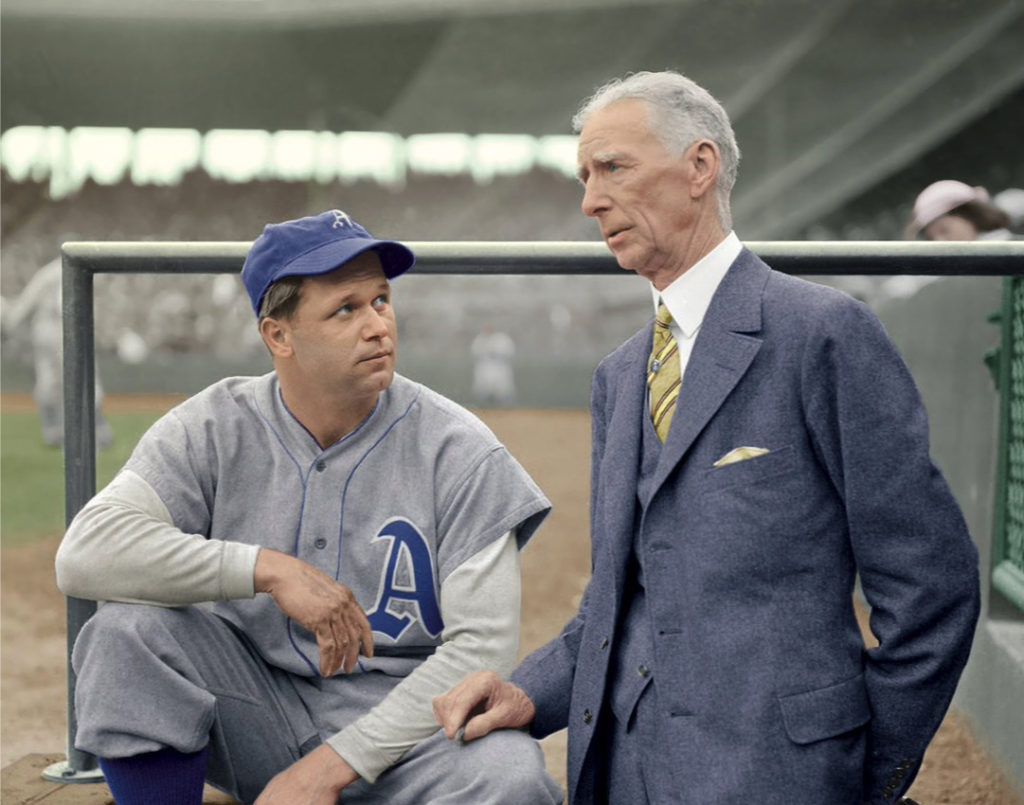
December 12, 1933, 90 years ago: A dark day in sports history. First, Connie Mack breaks up his team. Then, one of the best players in hockey almost dies on the ice.

The 1st time that Mack had broken up the Philadelphia Athletics, in 1914-15, it was because he couldn't keep up with the salaries being offered by the Federal League teams. This time, it was personal.

In 1925, the A's went 88-64, and were only 8 1/2 games behind the 1st-place Washington Senators. But the rise of the "Murderers' Row" Yankees delayed Philadelphia's return to greatness. In 1929, they began a run of 3 seasons in which they won 313 games, and game within a Game 7 loss in 1931 of winning 3 straight World Series.

But Mack lost all of his non-baseball holdings in the stock market Crash of 1929. He couldn't fund the A's with any other income. So, after the 1932 season, despite a strong 94-60 record (but 13 games behind the Pennant-winning Yankees), he began to sell of his 2nd generation of stars.

On September 28, 1932, he sent left fielder Al Simmons, 3rd baseman Jimmy Dykes, and center fielder Mule Haas are all sold to the Chicago White Sox, for $100,000. Simmons would be elected to the Baseball Hall of Fame, and Dykes and Haas would have been perennial All-Stars had the All-Star Game been founded before 1933.

But the big day was December 12, 1933, when Mack made 3 separate moves:

* Pitchers Lefty Grove and Rube Walberg, and 2nd baseman Max Bishop, are traded to the Boston Red Sox for Bob Kline and Rabbit Warstler and $125,000. Along with Carl Hubbell, Grove was 1 of the 2 best lefthanded pitchers in the game, and would go to the Hall of Fame. Walberg was the 3rd starter on the A's, behind Grove and George Earnshaw, but would have been the ace on many teams.

Key to this deal was the fact that Tom Yawkey had recently turned 30 and come into his inheritance, and had bought the Red Sox, and could afford to spend whatever he wanted to build a championship team. He did try, but the Yankees' dynasty that was restarted in 1936 thwarted his early efforts.

* Catcher Mickey Cochrane was traded to the Detroit Tigers for Johnny Pasek and $100,000. The Tigers subsequently named Cochrane player-manager, and won the next 2 American League Pennants.

* Finally, before the ink was dry on the previous 2 trades, Mack traded Pasek and Earnshaw to the White Sox for Charlie Berry and $100,000. So, in 1 day, Mack sold off his 3 best pitchers.
Jimmie Foxx (left) and Connie Mack

The A's went from 94-60 in 1932 to 79-72 in 1933, to 68-82 in 1934, to 58-91 in 1935. On December 10, 1935: 1st baseman Jimmie Foxx and pitcher Johnny Marcum were traded to the Red Sox for Gordon Rhodes, George Savino and $150,000. Foxx was the best righthanded slugger in the game, and would go to the Hall of Fame. Marcum was the Mackmen's best pitcher following the '33 fire sale, and Mack dumped him, anyway.

The A's never recovered, and the Mack family ended up selling the A's in 1954, to a buyer who moved them to Kansas City. They failed there as well, and Charlie Finley bought them in 1960, moving them to Oakland in 1968. After 5 straight AL Western Division titles, 1971-75, including 3 straight World Series wins, 1972-74, he broke them up, and the team crashed. New owner Walter Haas rebuilt them in the early 1980s, but the pitching collapsed, preventing a new dynasty. The A's rebuilt again, and won 3 straight Pennants, 1988-90, but after another Division title in 1992, were broken up again.

The pattern held: By 2000, the "Moneyball" regime built a team that reached the Playoffs 5 times in 7 years, but won no Pennants. They sold off, rebuilt, and made 3 straight Playoffs, 2012-14. They couldn't afford to keep it going, sold off, rebuilt, and made 3 straight Playoffs, 2018-20. They couldn't afford to keep it going, and sold off. In 2022, the A's lost 102 games, their most since the Finley fire sale bottomed out at 108 in 1979.

Now, it appears that the A's are moving to Las Vegas, probably for the 2025 season. If they do move, how long will it be before they win again? And, if so, how long before they have a 9th fire sale?

One thing is for sure: The A's are not moving back to Philadelphia, where the Phillies, having won the 2022 NL Pennant, are overwhelmingly popular. The city can certainly support one winning team, but not two teams. But, wherever they go, or if they stay, at some point, the A's will go back to their Philadelphia roots, and break it all down and start all over again.

*

Also on December 12, 1933, perhaps the ugliest game in National Hockey League history was played. But it led to one of the game's greatest moments.

The Boston Bruins were hosting the Toronto Maple Leafs at the Boston Garden. The Bruins still had most of the players who had led them to the 1929 Stanley Cup, including 2 of the greatest defensemen the game has ever known, Eddie Shore and Aubrey "Dit" Clapper. The Leafs, winners of the Cup in 1932, had another, Francis "King" Clancy.

This game, which the Leafs would win 4-1, was in the 2nd period. The Leafs had taken 2 quick penalties, and sent Clancy, defenseman George "Red" Horner, and right wing Irvine Wallace "Ace" Bailey out to defend the 5-on-3 Bruin power play.

Shore, who helped the Bruins win the Stanley Cup in 1929, rushed up the ice. Clancy, charitably listed at 5-foot-7 and 155 pounds, and a winner of the Cup with the Ottawa Senators in 1922, '23 and '27, and with the Leafs in '32, followed him, and checked him into the boards.

Shore got up, and, in his daze, he figured the closest Leaf player to him must have been the one who did it. He guessed wrong: The closest Leaf player to him was Bailey. Shore hit him from the side, and he landed head-first on the ice.
Horner skated over, knowing full well that it wasn't Bailey who had checked Shore, and yelled, "What did you do that for, Eddie?" Shore, not realizing the enormity of what he had done, gave Horner a big grin. What happened next is in dispute: The first source I saw on the story said that Horner hit Shore over the head with the blade of his stick. Another source said that Horner punched Shore, knocking him out in an instant.

Whatever the truth was, Shore was also out cold. The Boston crowd booed the hell out of Horner, who was already known as one of the dirtiest players in the game. But so was Shore, who, with his attitude, his receding hairline, and the fact that he was admired but not especially liked, was practically the Ty Cobb of hockey.

But it quickly became apparent that Bailey was hurt worse. Both men regained consciousness, and were carried off the ice together. Shore apologized. Bailey seemed to forgive him, saying, "It's all part of the game," and then passed out again.

Bailey was taken to Boston City Hospital. He was diagnosed with a fractured skull and an extradural clot on the brain. His father, listening to the game on the radio in Toronto, packed a gun, and immediately boarded a train for Boston, intending to kill Shore.

Leafs owner Conn Smythe found out about this, and talked to his general manager, Frank Selke. Selke had a friend working with the Boston Police, who met Bailey's father at the hotel, and talked him out of the murder plot.

Nevertheless, the BPD said they would charge Shore with manslaughter if Bailey died. Within 24 hours, he underwent 2 spinal taps to relieve intracranial pressure. There was at least one news report that Bailey had died. But, through several procedures, he came out of his coma after 10 days. He hung on, through Christmas and New Year's. In mid-January 1934, he was released from the hospital.

NHL President Frank Calder suspended Horner for 6 games, and Shore indefinitely. Once he was confident that Bailey was going to live, Calder set Shore's suspension at 16 games, or 1/3rd of the season at the time (48 games). Bailey never played again.

Walter Gilhooly, sports editor of the Ottawa Journal, recommended that a benefit game be played, to offset Bailey's loss of income. Calder agreed. The Leafs would host the game, and put their team out against a team made up of players from the rest of the League, 2 from each of the other 8 teams then in it.

The game was played at Maple Leaf Gardens on February 14, 1934. Here were the lineups:

* From the Toronto Maple Leafs, coached by Dick Irvin, once a great player, and the father of eventual Hall of Fame broadcaster Dick Irvin Jr.: Number 1, goaltender George Hainsworth, formerly a star with the Montreal Canadiens; 2, defenseman Red Horner; 3, defenseman Alex Levinsky; 4, defenseman Clarence "Hap" Day; 5, center Andy Blair; 7, defenseman King Clancy; 8, left wing Harold "Baldy" Cotton; 9, right wing Charlie "the Bomber" Conacher; 10, center Joe Primeau; 11, left wing Harvey "Busher" Jackson; 12, left wing Hector "Hec" Kilrea; 14, center Bill Thoms; 15, right wing Ken Doraty; 16, right wing Charlie Sands; 17, left wing Frank "Buzz" Boll.

NHL All-Stars, coached by Lester Patrick of the New York Rangers, also once a great player:

* From the Chicago Black Hawks: 1, goaltender Charlie Gardiner; and 7, defenseman Lionel Conacher, brother of Charlie.

* From the Boston Bruins: 2, defenseman Eddie Shore; and 9, center Nelson "Nels" Stewart, better known as a Montreal Maroon.

* From the Ottawa Senators: 3, right wing Frank Finnigan; and 17, defenseman Al Shields.

* From the Montreal Canadiens: 4, left wing Aurele Joliat; and 16, center Howie Morenz. Morenz, known as "the Babe Ruth of Hockey" -- like Ruth, he had several nicknames -- normally wore 7, but Lionel Conacher was considered the greatest all-around athlete in Canada, and had priority.

* From the Detroit Red Wings: 5, left wing Herbie Lewis; and 14, right wing Larry Aurie.

* From the New York Rangers: 6, defenseman Ivan "Ching" Johnson; and 15, right wing Bill Cook. Somebody decided that the Irish-Canadian Johnson looked Chinese, and nicknamed him Ching. He had seniority over Aurie, who also wore 6; but Lewis had seniority over Cook, who wore 5 with the Rangers.

* From the Montreal Maroons: 10, center Reginald "Hooley" Smith; and 18, right wing Jimmy Ward.

* From the New York Americans: 11, center Norman Himes; and 12, defenseman Norman "Red" Dutton.

Before the game, the other teams' players posed at center ice in their regular sweaters. Then they were given white jerseys with "NHL" on them. And the Leafs had special jerseys, too, with "ACE" on them.
The selection of Shore was controversial. When he skated up to receive his Number 2 jersey, the crowd of 14,074 was silent. Then he skated over to the Leafs bench, where Bailey was sitting in a suit, long coat and fedora. Shore offered his hand, and Bailey shook it. The crowd roared, and the players tapped their sticks on the ice, in what was already a long-established hockey salute.
The ceremony concluded with Smythe giving Bailey his Number 6 jersey, and announced that it would be retired.

Bailey dropped a puck for a ceremonial faceoff, and the game began. Charlie Conacher already had an injured knee, and left the game early. Other than that, there wasn't much hitting, and no penalties were called. Cotton and Jackson scored to put the Leafs up 2-0, before Stewart scored to make it 2-1 Leafs at the end of the 1st period.

Jackson scored again early in the 2nd period. Morenz and Finnigan scored to tie it up. But it was all Leafs the rest of the way: Day scored halfway through the 2nd, and Kilrea, Doraty and Blair scored in the 3rd. The Leafs won, beating the entire rest of the NHL, 7-3.

The game raised $20,909 for Bailey's family, about $426,000 in 2022 money. Bailey applied to the NHL to be a referee, but was turned down. Smythe hired him to work in the team's front office. He worked there, in one capacity or another, until a later owner, Harold Ballard, already perhaps the most hated man in the history of Canadian sports, fired him in 1986. Bailey lived until 1992.

A later player, Garnet Bailey, no relation, played in the NHL from 1969 to 1978, and was known as Ace Bailey. He was working as a scout for the Los Angeles Kings when he died in the destruction of United Airlines Flight 175 at the South Tower of the World Trade Center on September 11, 2001.

Shore continued to play with the Bruins through their 1939 Stanley Cup win. In 1940, he bought the minor-league Springfield Indians of Massachusetts, and remained their owner until his death in 1986. Both he and Bailey were elected to the Hockey Hall of Fame.

Bailey wanted the benefit game to become an annual event, for injured players. That didn't happen. But additional benefit games were held for the families of Morenz, who died of heart trouble in 1937, and the Canadiens' Albert "Babe" Siebert, who drowned in 1939. Both of those games were played at the Montreal Forum: The former was a combined Montreal team, Canadiens and Maroons, against the rest of the NHL. The Maroons folded in 1938, so it was just the Canadiens against the rest of the NHL in Siebert's benefit. Both times, the NHL All-Stars won. In 1947, the NHL finally established an annual All-Star Game.

Monday, May 29, 2017

Top 10 Athletes From Wisconsin

May 29, 1848: Wisconsin joins the Union as the 30th State.

Top 10 Athletes from Wisconsin

Honorable Mention to Harry "Bud" Grant of Superior. We know him as a great football coach, but he was a fantastic athlete, too: He is the only man ever to play regular-season games in both the NFL and the NBA -- and he actually achieved more as a player in basketball, winning a title with the 1950 Minneapolis Lakers. He lettered in those sports and in baseball at the University of Minnesota, a 3-sport star there a quarter of a century before Dave Winfield was.

He was a receiver with the Philadelphia Eagles, then moved to the Canadian Football League's Winnipeg Blue Bombers. He became their head coach, and led them to 4 Grey Cups, followed by 4 NFL/NFC Championships (but no Super Bowl wins) with the Minnesota Vikings. It is as a coach that he is in the Pro Football and Canadian Football Halls of Fame.

Honorable Mention to Mark Johnson and Bob Suter, both of Madison. As members of the 1980 U.S. Olympic Hockey Team that won the Gold Medal in Lake Placid, New York, Sports Illustrated
included them in their 1st entire team to be named their Sportsmen of the Year.

Both played at the University of Wisconsin for Johnson's father, Bob Johnson, who later coached the Pittsburgh Penguins to their 1st Stanley Cup in 1991. "Badger Bob" doesn't make this list, because he was from Minnesota, and his own playing career wouldn't have qualified him anyway. Mark, a center, now coaches the Wisconsin women's team. Unfortunately, Suter, a defenseman, was the 1st member of that 1980 team to die.

Honorable Mention to Gary Suter of Madison. Bob's younger brother, a defenseman, never won an Olympic medal, but he won 2 things Bob didn't: The Stanley Cup, with the 1989 Calgary Flames; and the World Cup of Hockey (formerly the Canada Cup), with the U.S. team in 1996.

Honorable Mention to Judi Brown of Milwaukee. She won a Silver Medal as a hurdler at the 1984 Olympics in Los Angeles. In 1987, for her work with abused children, Sports Illustrated named her 1 of 8 "Athletes Who Care" as their Sportspeople of the Year.

Honorable Mention to Paul Hamm of Waukesha. In 2004, the gymnast won a Gold Medal and 2 Silver Medals at the Olympics in Athens, Greece, and the James E. Sullivan Award, annually given by the Amateur Athletic Union to the nation's outstanding amateur athlete for that year.

Honorable Mention to Suzy Favor of Stevens Point. The 1500-meter runner from the University of Wisconsin won the Honda-Broderick Cup for America's best female college athlete for the 1989-90 schoolyear.

Honorable Mention to Kevin Dean of Madison, who helped the New Jersey Devils win the 1995 Stanley Cup.

Honorable Mention to Eric Hinske of Menasha, 1 of only 3 players since the 1920s -- Ramiro Mendoza and Johnny Damon are the others -- to have won the World Series while playing for the Boston Red Sox and the New York Yankees.

Now, the Top 10:

10. Helene Madison of Madison. After breaking the world record in every event open to female swimmers in 1930 and '31, she swam to 3 Gold Medals at the 1932 Olympics in Los Angeles. There, she met Johnny Weissmuller, fellow Gold Medal swimmer, and then the movies' Tarzan. He got her what then appeared to be a big break, and she swam in 2 movies.

But the International Olympic Committee declared that, as she was now swimming for money, she was a "professional," and declared her ineligible for the 1936 Olympics in Berlin. The IOC has frequently been unfair, and sometimes even hypocritical.

9. Alan Ameche of Kenosha. Although Ron Dayne also played at the University of Wisconsin, set a still-standing NCAA record for career rushing yards, and won the Heisman Trophy in 1999, he is from New Jersey. Ameche, a cousin of actors Don and Jim, is the only Wisconsin native to have won the Trophy, playing for UW in 1954. The Badgers retired his Number 35.

With the Baltimore Colts, he was a 4-time Pro Bowler, the 1955 NFL rushing yards leader and Rookie of the Year, and a member of the 1958 and 1959 NFL Champions. He scored the overtime touchdown that won the 1958 NFL Championship Game, frequently called "The Greatest Game Ever Played," a 23-17 Colt win over the Giants at Yankee Stadium. Until James White of the New England Patriots in Super Bowl LI this past February, it was the latest-scored touchdown in any NFL game.

An Achilles injury ended his career in 1960, leaving him short of statistics that would have gotten him into the Pro Football Hall of Fame. But he is a member of the College Football and Wisconsin Athletic Halls of Fame, and was named to the NFL's 1950s All-Decade Team. He also co-founded 2 fast food chains: Gino's with his Colt teammate Gino Marchetti (founded 1957, folded 1982, revived 2010), and Ameche's Drive-In (also a burger chain, peaking at 6 in the Baltimore area).

8. Jim Otto of Wausau. He was the Oakland Raiders' starting center from their 1960 inception through the 1974 season, including the 1967 AFL Championship. Between the AFL All-Star Team before the 1970 merger and the NFL's Pro Bowl after it, he was an all-star in the 1st 13 of his 15 seasons.

He was named to the AFL All-Time Team and the Pro Football Hall of Fame. The Raiders do not retire numbers, but, in a way, his is the only one they have retired: He wore 00, because it could be read as the pronunciation of his name: "Aught-oh." The NFL no longer permits that number to be worn.

But he's not the best football player from Wausau: That's the man at #7. And he's not the best University of Wisconsin center to have played in the NFL in the 1970s: That's the man at #6.

7. Elroy Hirsch of Wausau. "Crazy Legs" was the best receiver of the 1940s and the early 1950s (essentially, the Harry Truman Presidency), getting his Number 40 retired by the University of Wisconsin. He starred for the Chicago Rockets of the All-America Football Conference, which got him noticed by the Los Angeles Rams, for whom he played in 4 NFL Championship Games, winning in 1951.

He was a 3-time Pro Bowler, and when he retired in 1957, he was 2nd to Don Hutson on the NFL's list for most career receiving yards, 7,029. He was named to the NFL's 1950s All-Decade Team and the College and Pro Football Hall of Fame. He served as the Rams' general manager in the 1960s, and as UW's athletic director in the 1970s and '80s. He may be the most popular athlete in Badger history.

6. Mike Webster of Rhinelander. Often called the best center in NFL history, he snapped for Terry Bradshaw and blocked for the Pittsburgh Steelers offense for 4 Super Bowl wins in the 1970s, making 9 Pro Bowls.

He was elected to the Pro Football Hall of Fame, and to the NFL's 1970s and 1980s All-Decade Teams and to the Steelers' 75th Anniversary Team. While the Steelers usually don't retire numbers, his Number 52 has never been given back out.

5. Dan Jansen of the Milwaukee suburb of West Allis. He was probably the best speed skater in the world at the time of both the 1988 and 1992 Winter Olympics, but his struggles in those Games have become legend. By 1994, in Lillehamer, Norway, he had been surpassed by homeland hero Johan Olav Koss, but he finally got a Gold Medal, in the 1,000 meters. He was thus given the 1994 Sullivan Award.

Had the Winter Olympics stayed on the same schedule as the Summer Games, and he had to wait until 1996, he might not even have competed. But he finally got his just reward.

4. Eric Heiden of Madison. At the 1980 Winter Olympics in Lake Placid, New York, this speed skater not only won Gold Medals in all 5 of his races, but set world records in each. He wasn't even seriously challenged in any of them. He won the Sullivan Award in 1980. His sister Beth Heiden was also world-class in speed skating, and in cycling, too.

As great as this achievement was, I can't rank him any higher, since he was only a superstar for 2 weeks.

3. Adrian "Addie" Joss of Woodland. He has the lowest WHIP (walks plus hits, divided by innings pitched) in baseball history: 0.968. He has the 2nd-lowest ERA: 1.88. He pitched 2 no-hitters, 1 of them a perfect game in 1908.

He had a 160-97 career record, all for the Cleveland Naps (forerunners of the Indians), before his 32nd birthday. But just 2 days after that birthday, on April 14, 1911, he died of meningitis. There were no antibiotics in those days. Had he appeared in so much as 1 game in the dawning 1911 season, he would have appeared in a 10th major league season, and thus qualified for the Baseball Hall of Fame. In 1978, the Hall waived this requirement due to his special circumstances, and he was elected.

2. Al Simmons of Milwaukee. Changing his Polish name of Aloisius Harry Szymanski, the great left fielder for the Philadelphia Athletics batted .334 lifetime, collected 2,927 hits (he couldn't quite make it to 3,000, or else he'd be a lot better-remembered), helped the A's win 3 straight Pennants (1929-31) and back-to-back World Series (1929-30), and played in the 1st 3 All-Star Games (1933-35).

The A's, now in Oakland, do not retire numbers from their Philadelphia years, so his Number 7 remains available. But the Phillies honored him with election to the Philadelphia Baseball Wall of Fame. He died at 54 of heart trouble, but lived long enough to see his election to the Baseball Hall of Fame.

1. Ernie Nevers of Superior. He didn't get a movie made about him like Jim Thorpe and George Gipp. Unlike Red Grange and Bronko Nagurski, his teams no longer exist in their present form. But Ernie deserves to be celebrated as an early pro football star, just as those men rightly are.

In 1924, he led the Stanford football team to an undefeated regular season, before losing to Notre Dame and their Four Horsemen in the Rose Bowl. Had there been a Heisman Trophy in 1925, he would have won it. In 2008, ESPN named ranked him 25th on their list of the Top 25 College Football Players of All Time.

He was an All-Pro 5 times: In 1926 and '27 with the Duluth Eskimos, and in 1929, '30 and '31 with the Chicago Cardinals. What happened in 1928? He sat out the season, and returned to Stanford, serving as an assistant coach to his mentor, Pop Warner. Yes, the man for whom the legendary youth football program was named.
In 1929, he returned, and set an NFL record that has never been broken, scoring all of the Cardinals' points in a 40-6 Thanksgiving Day win over Grange's Chicago Bears: He ran for 6 touchdowns (that record has been tied, but never broken) and kicked 4 extra points. He was also, by the standards of the time, a good passer and a great defensive back.

Stanford retired his Number 1. The NFL Cardinals -- not named for Stanford's teams, as they were the Indians until 1972 -- now play in Arizona, and have not retired his Number 4. He was named to the NFL's 1920s All-Decade Team, and to the College and Pro Football Halls of Fame. He also pitched for the St. Louis Browns from 1926 to 1928.

Monday, March 17, 2014

Milwaukee's All-Time Baseball Team


Milwaukee's baseball history is a bit checkered. The Brewers of the Class AAA American Association won 8 Pennants: 1913, 1914, 1936, 1943, 1944, 1945, 1951, and 1952 -- the last 2 being in their last 2 seasons of existence. Then the Braves arrived from Boston, and they won National League Pennants in 1957 (winning the World Series over the Yankees) and 1958 (losing the Series to the Yankees).

After that, Milwaukee baseball teams have won just 1 Pennant in 55 years. The Braves got close again in 1959 and 1964, but moved to Atlanta after the 1965 season. The Brewers arrived in 1970, but have been to the postseason only 4 times: 1981, when they won the American League Eastern Division in the second half of a strike-forced split-season format and lost the AL Division Series to the Yankees, who had won the first half; 1982, when they won the Pennant but lost the Series to the St. Louis Cardinals; 2008, when, 10 years after switching to the NL, won the Wild Card, but lost the NLDS to the Philadelphia Phillies; and 2011, when they won the NL Central, and beat the Arizona Diamondbacks in the NLDS before losing to the Cardinals in the NLCS.

The Brewers have had some great talents over the years. True, Hank Aaron was at the end of the line, but they had Rollie Fingers at his best, and Robin Yount and Paul Molitor built Hall of Fame careers with them. Prince Fielder began his career with them, and might make the Hall of Fame. But they've never quite been able to put it all together.

Could this team do it?

26. Milwaukee’s All-Time Baseball Team

Players are eligible if they came from anywhere in Wisconsin, except for the westernmost part of the State that's closer to Minneapolis than it is to Milwaukee; and also from Michigan's Upper Peninsula, although I couldn't find any big-league players from there that were good enough.

Sports personalities, yes: Notre Dame football legend George Gipp, former San Francisco 49ers coach Steve Mariucci, Michigan State basketball coach Tom Izzo, and if you count professional wrestling, Lou Thesz; but baseball, no.

Still, this All-Badger State team has a solid infield and a very powerful outfield. And the first 3 starting pitchers are pretty strong. After that... uh...

1B Fred Luderus of Milwaukee. A star for the Phillies in the 1910s, he helped them win their 1st Pennant in 1915. A career OPS+ of 114, he hit 251 doubles despite only having full seasons in the majors between the ages of 25 and 33, although he remained a productive player in the high minors until he was 39.

2B Jim Gantner of Fond du Lac. A graduate of the University of Wisconsin at Oshkosh, he was the starting 2nd baseman for the only Brewer Pennant-winner in 1982, and in that World Series he batted .333 with a .943 OPS. He never batted .300, but batted at least .280 6 times, and hit 262 doubles. He played over 1,400 games at 2B and over 300 at 3B. He pitched an inning for the Brewers in a 1979 game, allowing 2 hits but no walks and no runs.

SS Tony Kubek of Bay View H.S. in Milwaukee. He received the Ford Frick Award, equivalent to election to the Hall of Fame as a broadcaster, for his work with NBC on the Saturday Game of the Week and on World Series broadcasts, most notably the 1975 Cincinnati-Boston epic.

But he was a pretty good player, too. He was the 1957 AL Rookie of the Year, and in both that season and 1958 he returned home to play the Braves in the World Series, losing in '57 but winning in '58. He made 3 All-Star teams, formed a superb double-play combination with Bobby Richardson, and hit 178 doubles and 30 triples despite a back injury ending his career when he was just 29.

Unfortunately, his playing career is probably best known for a ground ball that hit a pebble and hit him in the throat in Game 7 of the 1960 World Series, helping the Pittsburgh Pirates beat the Yankees. But he did help the Yankees win the Series in 1958, 1961 and 1962.

3B Lafayette "Lave" Cross of Milwaukee. This guy goes back a ways, all the way to 1887, the 1st term of President Grover Cleveland. A converted catcher, he starred for 3 Philadelphia teams: The Athletics of the American Association (a major league that ran from 1882 to 1891, not the minor league that would have the current Brewers' predecessors), the Phillies in the NL, and the Athletics in the AL (no connection to the AA Athletics except by name).

A career .292 hitter, he had 2,651 hits, 412 of them doubles in the really dead-ball era, and stole 303 bases. Twice had an OPS+ of 132, and 2 others times over 120. He helped the Brooklyn Dodgers win the NL Pennant in 1900 (technically, the last "World Championship" the franchise would win for 55 years) and the A's win AL Pennants in 1902 and 1905.

Honorable Mention to Ken Keltner of Boy's Technical H.S. in Milwaukee. A 7-time All-Star with the Cleveland Indians, he had an OPS+ of 112, 308 doubles, and 2 100-RBI seasons. But he's best known as a good fielder, who made 2 stirring stops to help the Indians halt Joe DiMaggio’s 56-game hitting streak on July 17, 1941.

He nearly helped the Indians win the Pennant in 1940, and had his best season for their World Champions of 1948, batting .297 with 31 homers and 119 RBI. But injuries made that his last full season, and 3 years later he was retired. He spent much of the rest of his life as a scout, and was inducted into the Indians' team Hall of Fame.

LF Al Simmons of Milwaukee. The State of Wisconsin is loaded at left field, with Davy Jones of Cambria (the 1907-09 Detroit dynasty), Morrie Arnovich of Superior (a 1940s All-Star), Andy Pafko of Boyceville (who won Pennants in the 1950s both with the Dodgers and with his home-State Braves), and even Harvey Kuenn played a lot of left field.

But I’m going with Aloys Harry Szymanski, known as Bucketfoot Al for the way he stepped toward 3rd base when he swung. He swung very well: .334 batting average, 132 OPS+, 2,927 hits – just 73 more and he would have been in the 3,000 Hit Club and would probably be much better-remembered today. Those were the most hits of any righthanded hitter in AL history until surpassed by Al Kaline. Of those 2,927, 539 were doubles and 307 were homers – that total ranked him 5th on the all-time list when he retired, behind Babe Ruth, A’s teammate Jimmie Foxx, Mel Ott and Lou Gehrig. He had 1,827 RBI.

He helped the Philadelphia Athletics return to glory, winning the World Series in 1929 and '30 and 107 games and the Pennant before losing the Series in '31. Here’s his averages for 1925 (age 23) through 1931 (29): .387, .341, .392, .351, .365, .381 and .390 (the last 2 winning the AL batting title). He had at least 100 RBI in each of his 1st 11 seasons, getting 157 to lead the AL in '29, 165 in '30 and 151 in '32. (Incredibly, in '30 he lost the RBI title to Gehrig with 174, and in '32 to Foxx with 169.)

After the 1932 season, needing cash after having lost all his money in the stock market and the A's successes not paying for themselves, Connie Mack sold Simmons to the Chicago White Sox. As a South Sider, beginning with the next season, he started in the 1st 3 All-Star Games. He began to decline and then bounced around a bit, before returning to the A's as a player-coach under Mack. He died of a heart attack shortly after turning 54, in 1956.

He was elected to the Baseball Hall of Fame and the Philadelphia Baseball Wall of Fame. (His plaque there, and those of the other A's honored, were moved from Veterans Stadium to a storefront run by the Philadelphia Athletics Historical Society in nearby Hatboro, and are now housed at Spike's Trophies in Northeast Philadelphia.) However, the A's, out of Philly since 1954, have not retired a number for him. (He wore several, but in '31 when the A's started wearing numbers, he wore 7.)

On August 19, 1996, to highlight an article about the 1929 A's, suggested that they were the greatest baseball team ever, Sports Illustrated put Simmons on the cover, rather than Mack or fellow Hall-of-Famers Foxx, Mickey Cochrane or Lefty Grove. Three years later, The Sporting News named him Number 43 on their list of the 100 Greatest Baseball Players.

CF Clarence "Ginger" Beaumont of Rochester. Another old-old-old-timer, this graduate of Wisconsin's Beloit College helped the Pittsburgh Pirates win the NL Pennant in 1901, '02 and '03. In 1902 he won the NL batting title, and in 1903 he led the League in games played, at-bats, hits, total bases and runs. His career batting average was .311, OPS+ 123. Unfortunately, the Pirates had already traded him by the time they won the 1909 World Series, but in his last season, 1910 (he was only 33), he helped the Cubs win a Pennant.

RF Harvey Kuenn of West Allis. He actually played more shortstop than any other position, but right field was his 2nd-most frequent position, and I needed someone here. He was AL Rookie of the Year in 1953, and made the All-Star team in each of his 1st 8 full seasons. He led the AL in hits in 1953, '54, '56 and '59, and in doubles in '55, '58 and '59.

He won the '59 batting title with a .353 average, but just before the next season, the Detroit Tigers traded him to the Indians for the previous season's home-run leader, Rocky Colavito. The trade worked out much better for the Tigers, as Cleveland fans, loving the Rock, booed Kuenn for no good reason: He didn't hit for much power, but he did bat .308 that season. The Indians traded him to the San Francisco Giants, and he helped them win the 1962 Pennant.

His lifetime batting average was .303, with 2,092 hits, 356 of them doubles, and an OPS+ of 108. He is also the manager of this team, having taken the Brewers – nicknamed "Harvey's Wallbangers" for their power hitting – to that 1982 Pennant, still the only Pennant won by a Milwaukee team since the Ike Age. His son Harvey Kuenn Jr. also played in the Brewers’ system.

C Damian Miller of West Salem. He had a relatively short career, but he did make the NL All-Star Team in 2002. I selected him because of his fielding – and because the next-best choice is Charlie Ganzel, who won 5 NL Pennants from 1887 to 1897, but was not substantially better, stat-wise. Miller helped the Diamondbacks reach 3 postseasons (including the 2001 World Championship) and the Chicago Cubs 1 (2003, nearly winning the Pennant).

SP Charles “Kid” Nichols of Madison. This is a tough choice, geographically speaking, because, while he's listed as having been born in Wisconsin's State Capital, he's mentioned on Wikipedia as having moved to Kansas City as a child, and Baseball-Reference.com lists him as having gone to Queen Elizabeth High School in Surrey, British Columbia, Canada. (Which Queen Elizabeth? He would have graduated in 1887, so not Elizabeth II, nor her mother the wife/widow of King George VI.) Anyway, I can't find a source that shows where he learned to play baseball. But the Kansas City team that you'll eventually see is absolutely loaded, pitching-wise, so I'm keeping Nichols with Milwaukee.

There's no doubting why he's in the Hall of Fame: 361 wins against just 208 losses from 1890 to 1906, including 7 times in 8 years winning at least 30 – both before and after the pitching distance moved from 50 feet in 1892 to 60 feet, 6 inches in 1893, so it didn't affect him. He was the youngest pitcher ever to crack the 300-win plateau, having notched his 300th before his 31st birthday. He won an additional 103 games in the high minors, for 464 – he could have ended up 2nd on the all-time wins list behind Cy Young, his only rival for the title of Pitcher of the Decade for the 1890s.

He had a career ERA of 2.96, an ERA+ of 140, and a WHIP of 1.224. He won Pennants with the Boston Beaneaters in 1891, '92, '93, '97 and '98, and was probably the best pitcher that the franchise eventually known as the Braves had until Warren Spahn, to say nothing of Greg Maddux.

SP Adrian "Addie" Joss of Beaver Dam. From 1902 to 1910, he was 160-97, ERA 1.89 (2nd-lowest ever), WHIP 0.968 (lowest ever). He pitched a perfect game in 1908. He won 51 games in 2 years for the Cleveland Indians in 1907 and '08. Absolutely sensational. After just 9 seasons, he was 31, and he should have been just getting started.

But just before the 1911 season, he died of spinal meningitis. Today's medicine could have saved him. It wasn't until 1978 that the Hall of Fame waived its 10-season requirement for him. After all, it wasn't his fault: If he'd been stricken just 1 week later, he would have pitched at least once in a 10th season and qualified.

SP Burleigh Grimes of Emerald. In 1920, the spitball and other doctorings of the baseball were banned, but 17 pitchers were allowed to continue using it for the rest of their careers. Grimes was the last to use the spitter legally, in 1934. He was also the last survivor of those 17, living until 1985.

He won 270 games and lost 212. He had 5 20-win seasons, and won Pennants with the Brooklyn Dodgers in 1920, the Cardinals in 1931, and the Cubs in 1932 -- making him one of the few players to win Pennants with both the Redbirds and their Chicago arch-rivals. He is in the Hall of Fame.

SP Dick Bosman of Kenosha. He was not up to the level of the 1st 3; in fact, he was just 82-85 for his career. But in 1969, pitching for the Washington Senators, he went 14-5 and led the AL with a 2.19 ERA. He went 16-12 in 1970, but the next season, the Senators' last before moving to become the Texas Rangers, his run support vanished and he was only 12-16.

On September 30, 1971, he started the last game the Senators ever played, against the Yankees at Robert F. Kennedy Stadium, and stood to be the winning pitcher as the Senators led 7-5 with 1 out left in the 9th, before the angry fans stormed the field and the game was forfeited to the Yankees. He also started the team’s first game as the Rangers. He had only 1 more winning season and was done at 32. He has since gone on to become one of baseball’s best pitching coaches.

SP Shane Rawley of Racine. Don't get me started: This one hurts. He was a journeyman for the Seattle Mariners, but in 1982 the Yankees traded for him, and he went 27-28 for the Pinstripes before being traded to the Phillies for Marty Bystrom and Keith Hughes on June 30, 1984. Stupid trade! Why would the Phillies give up a proven reliever like Bystrom, a key cog in their 1980 World Championship, for a .500 pitcher like Rawley?

Guess what: It was the Yankees, not the Phillies, who were stupid. Bystrom made just 15 appearances for the Yankees, was awful and injured, and never pitched after age 26. Rawley went 13-8 in '85, 11-7 in '86, and 17-11 in '87. Think the Yankees couldn't have used his arm in those seasons?

He fell apart in '88, and was done a year later at 33, finishing 111-118 – but at a time when he could have helped the Yankees a lot, he was stuck on a poor Phils team. That trade didn't work out for anybody, but George Steinbrenner and "my baseball people," as George called them, really screwed themselves.

RP Rinold "Ryne" Duren of Cazenovia. He was known for his "coke-bottle glasses" and his wild warm-up tosses. He was one of those guys who could throw hard, but you never knew where it was going to go. He was one of those players the Yankees of the 1950s always seemed to get from the Kansas City Athletics, in his case in 1958. That year, he led the AL with 20 saves and had a 2.02 ERA and a 1.097 WHIP. It was his only good year in a Yankee uniform, but it meant a World Championship.

It was injuries and alcohol that did him in, although, years later, he beat the booze. In 1982, I was watching the Yankees' Old-Timers Game on WPIX-Channel 11, and Joe Pepitone stepped in to bat against Duren. Mel Allen said, "Don't worry, Joe. He won't hit you... hard!" Legend has it that Ryne Sandberg was named after Ryne Duren.

Honorable Mention to Jerry Augustine of Kewaunee and the University of Wisconsin at La Crosse. A lefty complement to the righthanded Duren, Augustine played his entire career for his home-State Brewers. He won 25 games for the Brewers in 1977 and '78 as they became a respectable team, then was converted into a reliever. He didn't help much down the stretch in 1982, and did not appear in the World Series. But he did help a terrible team become a good one.

Finally, add to this team, Honorable Mention to Bob Uecker, of Technical H.S. in Milwaukee, the 1st Badger Stater to play for a Wisconsin MLB team, with the Braves in 1962 and '63, and was the backup catcher on the 1964 World Champion St. Louis Cardinals, and has been the voice of the Brewers almost since their inception. He also starred as family patriarch George Owens on the ABC sitcom Mr. Belvedere, and in a hilarious series of commercials for Miller Lite beer.

With his penchant for comedy, intentional and otherwise, he titled his autobiography Catcher In the Wry. Of course, if you ever saw him hit, you'd probably use his home-run call on him: "Get up! Get up! Get outta here!"

Tuesday, September 28, 2010

Milwaukee's All-Time Baseball Team

The Mets are playing out the string. So are the Milwaukee Brewers.

Neither of these facts is surprising: Since April 1970, when the Brewers made their debut, these 2 teams have made the postseason a grand total of 9 times in those 41 seasons.

The surprising part is that the Brewers are now, since 1998, in the National League. True, the Braves were in both the NL and Milwaukee from 1953 to 1965 (and had a bit of a rivalry with the Brooklyn Dodgers from 1953 to 1957 and the L.A. edition of the Bums thereafter), but it still doesn’t make sense to see the Brewers on the Mets’ schedule.

They've never faced each other in the postseason – although the Yankees and Brewers played each other in the strike-forced 1981 AL East Championship Series. The Yanks took the 1st 2 at Milwaukee County Stadium, then the Brew Crew took the next 2 at the old Yankee Stadium.

George Steinbrenner then went into the Yankee locker room and reamed them out, spewing profanities left and right. Bobby Murcer, trying to play both the veteran leader and the Christian gentleman, said, "Now is not the time, George, now is not the time." George said, "It is the time, goddamnit!" And did another 30 seconds of that before Rick Cerone stood up and said, "Fuck you, George!" and stormed out of the room. That shocked George and everyone else, and the next night, led by back-to-back 4th-inning homers by Reggie Jackson and Oscar Gamble, and another by, appropriately, Cerone, the Yanks won the deciding Game 5, 7-3.

The closest the Mets and Brewers have ever come to meeting in the postseason was in 2008, when a Playoff matchup was possible going into the final day, but the Mets completed yet another collapse for the NL East, and the Brewers edged the Mets for the NL Wild Card. It was also possible in 2007, when the Mets had their previous NL East collapse and the Brewers finished only 2 behind the Chicago Cubs for the NL Central.

In 1987, the Brewers were in the AL East race most of the way, before stalling at 91 wins and finishing 7 games behind the Detroit Tigers, while the Mets just missed in the NL East, 3 behind the St. Louis Cardinals. It was the Cardinals who beat the Brewers in their only World Series to date, a 7-game thriller in 1982.

Milwaukee's All-Time Baseball Team

This is limited to just 1 State, Wisconsin, and not even all of that: Westernmost Wisconsin, the Eau Claire area, is considerably closer to Minneapolis than to Milwaukee. (Eau Claire itself: 92 miles to Minneapolis, 246 miles to Milwaukee.) Theoretically, you could include the Upper Peninsula of Michigan, but no player from that region was good enough to make this team.

Which means that, despite the relatively small region, Milwaukee has a pretty decent all-time baseball team. A solid infield. A very powerful outfield. And the 1st 3 starters are pretty strong. After that, well, I said, "pretty decent," not "great."

1B Fred Luderus of Milwaukee. A star for the Phillies in the 1910s, he helped them win their 1st Pennant in 1915. A career OPS+ of 114, he hit 251 doubles despite only having full seasons in the majors between the ages of 25 and 33, although he remained a productive player in the high minors until he was 39.

2B Jim Gantner of Fond du Lac. A graduate of the University of Wisconsin at Oshkosh, he was the starter for the only Brewer Pennant-winner in 1982, and in that World Series he batted .333 with a .943 OPS. He never batted .300 but batted at least .280 6 times, and hit 262 doubles. He played over 1,400 games at 2B and over 300 at 3B. He pitched an inning for the Brewers in a 1979 game, allowing 2 hits but no walks and no runs.

SS Tony Kubek of Bay View High School in Milwaukee. He recently received the Ford Frick Award, equivalent to election to the Hall of Fame as a broadcaster, for his work with NBC on the Saturday Game of the Week and on World Series broadcasts, most notably the 1975 Cincinnati-Boston epic.

But he was a pretty good player, too. He was the 1957 AL Rookie of the Year, and in both that season and 1958 he returned home to play the Braves in the World Series, losing in '57 but winning in '58. He made 3 All-Star teams, formed a superb double-play combination with Bobby Richardson, and hit 178 doubles and 30 triples despite a back injury ending his career when he was just 29. 

He's probably best known for a ground ball that hit a pebble and hit him in the throat in Game 7 of the 1960 World Series, helping the Pittsburgh Pirates beat the Yankees. But he did help the Yankees win the Series in 1958, 1961 and 1962.

3B Lafayette "Lave" Cross of Milwaukee. This guy goes back a ways, all the way to 1887, the 1st term of President Grover Cleveland. A converted catcher, he starred for 3 Philadelphia teams: The Athletics of the American Association, the Phillies in the NL, and the Athletics in the AL (no connection to the AA team except by name).

A career .292 hitter, he had 2,651 hits, 412 of them doubles in the really dead-ball era, and stole 303 bases. Twice had an OPS+ of 132, and 2 others times over 120. He helped the Brooklyn Dodgers win the NL Pennant in 1900 (technically, the last "World Championship" the franchise would win for 55 years) and the A's win AL Pennants in 1902 and 1905.

Honorable Mention to Ken Keltner of Boy's Technical High School in Milwaukee. A 7-time All-Star with the Cleveland Indians, he had an OPS+ of 112, 308 doubles, and 2 100-RBI seasons. But he's best known as a good fielder, who made 2 stirring stops to help the Indians halt Joe DiMaggio’s 56-game hitting streak on July 17, 1941.

He nearly helped the Indians win the Pennant in 1940, and had his best season for their World Champions of 1948, batting .297 with 31 homers and 119 RBI. But injuries made that his last full season, and 3 years later he was retired. He spent much of the rest of his life as a scout, and was inducted into the Indians' team Hall of Fame.

LF Al Simmons of Milwaukee. The State of Wisconsin is loaded at left field, with Davy Jones of Cambria (the 1907-09 Detroit dynasty), Morrie Arnovich of Superior (a 1940s All-Star), Andy Pafko of Boyceville (won Pennants in the 1950s both with the Dodgers and with his home-State Braves), and even Harvey Kuenn played a lot of left field.

But I'm going with Aloys Harry Szymanski, known as Bucketfoot Al for the way he stepped toward 3rd base when he swung. He swung very well: .334 batting average, 132 OPS+, 2,927 hits – just 73 more, and had he been in the 3,000 Hit Club, he would be much better-remembered today.

Those were the most hits of any righthanded hitter in AL history until surpassed by Al Kaline. Of those 2,927, 539 were doubles and 307 were homers – that total ranked him 5th on the all-time list when he retired, behind Babe Ruth, his A's teammate Jimmie Foxx, Mel Ott and Lou Gehrig. He had 1,827 RBI.

He helped the Philadelphia Athletics return to glory, winning the World Series in 1929 and '30 and 107 games and the Pennant before losing the Series in '31. Here's his averages for 1925 (age 23) through 1931 (29): .387, .341, .392, .351, .365, .381 and .390 (the last 2 winning the AL batting title). He had at least 100 RBI in each of his 1st 11 seasons, getting 157 to lead the AL in '29, 165 in '30 and 151 in '32. (Incredibly, in '30 he lost the RBI title to Gehrig with 174, and in '32 to Foxx with 169.)

After the 1932 season, needing cash after having lost all his money in the stock market and the A's successes not paying for themselves, Connie Mack sold Simmons to the Chicago White Sox. As a South Sider, beginning with the next season, he started in the 1st 3 All-Star Games. He began to decline and then bounced around a bit, before returning to the A's as a player-coach under Mack.

He died of a heart attack shortly after turning 54, in 1956. He is in the Hall of Fame and on the Philadelphia Baseball Wall of Fame (his plaque having been moved from Veterans Stadium to the Philadelphia Athletics Historical Society house in nearby Hatboro). However, the A's, out of Philly since 1954, have not retired a number for him. (He wore several, but in '31 when the A's started wearing numbers, he wore 7.)

On August 19, 1996, to highlight an article about the 1929 A's, suggesting that they, not the 1927 Yankees, were the greatest baseball team ever, Sports Illustrated put Simmons on the cover, rather than Mack or fellow Hall-of-Famers Foxx, Mickey Cochrane or Lefty Grove. Three years later, The Sporting News named him Number 43 on their list of the 100 Greatest Baseball Players.

CF Clarence "Ginger" Beaumont of Rochester. Another old-old-old-timer, this graduate of Wisconsin's Beloit College helped the Pittsburgh Pirates win the NL Pennant in 1901, '02 and '03. In 1902, he won the NL batting title, and in 1903 he led the League in games, at-bats, hits, total bases and runs. His career batting average was .311, OPS+ 123. Unfortunately, the Pirates had already traded him by the time they won the 1909 World Series, but in his last season, 1910 (he was only 33), he helped the Cubs win a Pennant.

RF Harvey Kuenn of West Allis. He actually played more shortstop than any other position, but right field was his 2nd-most frequent position, and I needed someone here. He was AL Rookie of the Year in 1953, and made the All-Star team in his 1st 8 full seasons. He led the AL in hits in 1953, '54, '56 and '59, and in doubles in '55, '58 and '59.

He won the '59 batting title with a .353 average, but just before the next season, the Detroit Tigers traded him to the Indians for the previous season's home-run leader, Rocky Colavito. The trade worked out much better for the Tigers, as Cleveland fans, loving the Rock, booed Kuenn for no good reason. He didn't hit for much power, but he did bat .308 that season. The Indians traded him to the San Francisco Giants, and he helped them win the 1962 Pennant. His lifetime batting average was .303, with 2,092 hits, 356 of them doubles, and an OPS+ of 108.

He is also the manager of this team, having taken the Brewers – nicknamed "Harvey's Wallbangers" for their power hitting – to that 1982 Pennant, still the only Pennant won by a Milwaukee team since the Ike Age. His son Harvey Kuenn Jr. also played in the Brewers' system.

C Damian Miller of West Salem. He had a relatively short career, but he did make the NL All-Star Team in 2002. He is here for his fielding – and because the next-best choice is Charlie Ganzel, who won 5 NL Pennants from 1887 to 1897, but was not substantially better, stat-wise. Miller helped the Arizona Diamondbacks reach 3 postseasons (including the 2001 World Championship) and the Chicago Cubs 1 (2003, nearly winning the Pennant).

SP Charles "Kid" Nichols of Madison. This is a tough choice, geographically speaking, because he's listed as having gone to Queen Elizabeth High School in Surrey, British Columbia, Canada. (Which Queen Elizabeth? He would have graduated in 1887, so not Elizabeth II, nor her mother the wife/widow of King George VI.)

But there's no doubting why he's in the Hall of Fame: 361 wins against just 208 losses from 1890 to 1906, including 7 times in 8 years winning at least 30 – both before and after the pitching distance moved from 50 feet in 1892 to 60 feet, 6 inches in 1893, so that didn't affect him much. He won an additional 103 games in the high minors, for a total of 464 – he could have ended up 2nd on the all-time wins list behind Cy Young, his only rival for the title of Pitcher of the Decade for the 1890s. 

His career ERA was 2.96, ERA+ 140, WHIP 1.224. He won Pennants with the Boston Beaneaters in 1891, '92, '93, '97 and '98. He was probably the best pitcher the franchise now known as the Atlanta Braves had until Warren Spahn, to say nothing of Greg Maddux.

SP Adrian "Addie" Joss of Beaver Dam. From 1902 to 1910, he was 160-97, ERA 1.89 (2nd-lowest ever), WHIP 0.968 (lowest ever). He pitched a perfect game in 1908. He won 51 games in 2 years for the Cleveland Indians in 1907 and '08. He was absolutely sensational. After just 9 seasons, he was 31, and should have been just getting started.

But just before the 1911 season, he died of spinal meningitis. Today's medicine could have saved him. It wasn't until 1978 that the Hall of Fame waived its 10-season requirement for him. After all, it wasn't his fault" If he'd been stricken just 1 week, later he would have pitched at least once in the 10th season, and qualified.

SP Burleigh Grimes of Emerald. In 1920, the spitball and other doctorings of the baseball were banned, but 17 pitchers were allowed to continue using it for the rest of their careers. Grimes was the last to use the spitter legally, in 1934.

Before that, however, he was fantastic, winning 270 games and losing 212. He had 5 20-win seasons, and won Pennants with the Brooklyn Dodgers in 1920, the St. Louis Cardinals in 1931, and the Chicago Cubs in 1932. He is in the Hall of Fame.

SP Dick Bosman of Kenosha. He's not up to the level of the 1st 3; in fact, he was just 82-85 for his career. But in 1969, pitching for the Washington Senators, he went 14-5 and led the AL with a 2.19 ERA. He went 16-12 in 1970, but the next season, the Senators' last before moving to become the Texas Rangers, his run support vanished and he was only 12-16.

On September 30, 1971, he started the last game the Senators ever played, against the Yankees at Robert F. Kennedy Stadium, and stood to be the winning pitcher as the Senators led 7-5 with 1 out left in the 9th, before the angry fans stormed the field and the game was forfeited to the Yankees. He also started the team's 1st game as the Rangers. He had only 1 more winning season and was done at 32. He has since gone on to become one of baseball’s best pitching coaches.

SP Shane Rawley of Racine. He was a journeyman for the Seattle Mariners, but in 1982 the Yankees traded for him, and he went 27-28 for the Pinstripes before being traded to the Phillies for Marty Bystrom and Keith Hughes on June 30, 1984. Stupid trade! Why would you give up a proven reliever like Bystrom for a .500 pitcher like Rawley?

Guess what, it was the Yankees, not the Phillies, who were stupid. Bystrom made 15 appearances for the Yankees, was awful and injured, and never pitched after age 26. Rawley went 13-8 in '85, 11-7 in '86, and 17-11 in '87. Don't get me started: This one hurts. Do you think the Yankees couldn't have used his arm in those seasons? He fell apart in '88, and was done a year later at 33, finishing 111-118 – but at a time when he could have helped the Yankees a lot, he was stuck on a poor Phils team. That trade didn't work out for anybody.

RP Rinold "Ryne" Duren of Cazenovia. He was known for his "coke-bottle glasses" and his wild warm-up tosses. He was one of those guys who could throw hard, but you never knew where it was going to go.

One of those players the Yankees of the 1950s always seemed to get from the Kansas City Athletics right when they needed one, in 1958 he led the AL with 20 saves and had a 2.02 ERA and a 1.097 WHIP. It was his only good year in a Yankee uniform, but it meant a World Championship. It was injury and alcohol that did him in, and years later he beat the booze.

In 1982, I was watching the Yankees' Old-Timers Game on WPIX-Channel 11, and Joe Pepitone stepped in to bat against Duren. Mel Allen was broadcasting from a table behind home plate, piped into the public-address system, and said, "Don't worry, Joe. He won't hit you... hard!" Legend has it that Ryne Sandberg was named after Ryne Duren.

Honorable Mention to Jerry Augustine of Kewaunee and the University of Wisconsin at La Crosse. A lefty complement to the righthanded Duren, Augustine played his entire career for his home-State Brewers. He won 25 games for the Brewers in 1977 and '78 as they became a respectable team, then was converted into a reliever. He didn't help much down the stretch in 1982, and did not appear in the World Series. But he did help a terrible team become a good one.

Finally, add to this team, Honorable Mention to Bob Uecker, of Technical High School in Milwaukee, the 1st Badger Stater to play for a Wisconsin MLB team, with the Braves in 1962 and '63, and was the backup catcher on the 1964 World Champion St. Louis Cardinals, and has been the voice of the Brewers almost since their inception.

He also starred as family patriarch George Owens on the ABC sitcom Mr. Belvedere, and in a hilarious series of commercials for Miller Lite beer. With his penchant for comedy, intentional and otherwise, he titled his autobiography Catcher In the Wry. Of course, if you ever saw him try to hit, you'd probably use his home-run call on him: "Get up! Get up! Get outta here!"